Extension Connection
USPS-525-100
Sullivan County
YOUR LINK TO LOCAL, RESEARCH-BASED SOLUTIONS TO BETTER YOUR LIFE
VOLUME XCVII
NO. 10
OCTOBER 2026
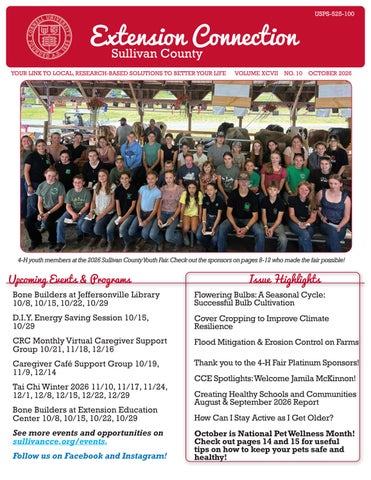
4-H youth members at the 2026 Sullivan CountyYouth Fair. Check out the sponsors on pages 8-12 who made the fair possible!
Upcoming U pcoming Events Events & Programs Programs
Issue Isssue sue Highlights Higghhligghhts
Bone Builders at Jeffersonville Library 10/8, 10/15, 10/22, 10/29
Flowering Bulbs: A Seasonal Cycle: Successful Bulb Cultivation
D.I.Y. Energy Saving Session 10/15, 10/29
Cover Cropping to Improve Climate Resilience
CRC Monthly Virtual Caregiver Support Group 10/21, 11/18, 12/16
Flood Mitigation & Erosion Control on Farms
Caregiver Café Support Group 10/19, 11/9, 12/14
Thank you to the 4-H Fair Platinum Sponsors!
Tai Chi Winter 2026 11/10, 11/17, 11/24, 12/1, 12/8, 12/15, 12/22, 12/29 Bone Builders at Extension Education Center 10/8, 10/15, 10/22, 10/29 See more events and opportunities on sullivancce.org/events. Follow us on Facebook and Instagram!
CCE Spotlights: Welcome Jamila McKinnon! Creating Healthy Schools and Communities August & September 2026 Report How Can I Stay Active as I Get Older? October is National Pet Wellness Month! Check out pages 14 and 15 for useful tips on how to keep your pets safe and healthy!
Welcome W elcome to to the the Issue! Issue! Page 3 Flowering Bulbs: A Seasonal Cycle: Successful Bulb Cultivation Page 4 Cover Cropping to Improve Climate Resilience Page 6 Flood Mitigation & Erosion Control on Farms Page 8 Thank you to the 4-H Fair Platinum Sponsors! Notify CCE Sullivan if you have a change of address: 845-292-6180 sullivan@cornell.edu
OFFICE HOURS Hours: Mon - Fri | 8:30 am to 4:30 pm Phone: 845-292-6180 E-mail: sullivan@cornell.edu Website: www.sullivancce.org Facebook.com/ccesullivanagfood Instagram.com/ccesullivan YouTube: bitly.com/ccesullivan
Table Table of of Contents Contents Page 13 CCE Spotlights Page 14 Fast Facts Page 16 Creating Healthy Schools and Communities August & September 2026 Report Page 20 Caregiver Resource Center Report Page 22 How Can I Stay Active as I Get Older?
Page 22 D.I.Y. Energy Savings Session Page 25 WISE Program Celebrates 2 Years in Sullivan County Page 26 The First PreVenture Session of the School Year Page 27 Thanks to our Sponsors!
EXTENSION CONNECTION Produced by: Cornell Cooperative Extension Sullivan County Edited by: Aaron Denman, Katie Gasior & Nicole Slevin Nikolados Cornell Cooperative Extension Sullivan County provides equal program and employment opportunities. NOTICE: Official endorsement of advertisers and their products is not intended by the acceptance of their sponsorships for the Extension Connection.
STAFF MEMBERS
Colleen Monaghan..............................................................................Executive Director Tracy Broyles...............................................................................SALT Program Manager Alan Carroll...................................................................Food Systems Program Manager Luciana Carvo...................................................STNY/Sullivan Fresh Market Coordinator Lynn Colavito..............................................Community Cupboard Program Coordinator Martin Colavito...........................................................Prevention Programs Issue Leader Dawn Parsons.......................President Wanda V. Cruz...............................................Healthy Communities Program Coordinator Alex Alorro...................Vice President Aaron Denman.........................................................Association Operations Coordinator Robert Kaplan.......................Secretary Jessica Doyle.............................................................................4-H Program Coordinator John Garigliano.....................Treasurer Katie Gasior........................................................................Horticulture Subject Educator Brian McPhillips...........Legislative Rep. Jenna Gangel...................................................................Shop Taste NY Market Manager Patricia Claiborne.............Cornell Rep. Isabel Lutz.......................................................................................................................Custodian Stacey Johnson Kim McDonnell............................................................................................TNY Market Manager John (JP) Lang Nancy McGraw.................................Team Leader/Educator, Caregiver Resource Center Erika Malmgreen Jamila McKinnon.....................................................................Beginner Farmer Educator Mark McLewin Melinda Meddaugh...................................................Ag & Food Systems Sr. Issue Leader Jennifer Mitchell Tess Isabel Molina Bayly.............................FORx Youth Prevention Program Coordinator Meaghan Mullally-Gorr Laura Quigley Barbara Moran................................................4-H Youth Development Program Manager Gary Silver Luis Ocasio........................................................................Prevention Program Coordinator Gary Silverman Patricia Ocasio...................................................................Prevention Program Coordinator Diana Weiner Shanice Owens..............................................Community Cupboard Program Coordinator Abyssinia Pla El...................................................................................Finance Coordinator Monica Ponce-Agredano ...............................................................Ag. Program Assistant Michelle Proscia...........................................................Ag. Production Program Manager Danielle Sykes.................................................4-H Animal Science Program Coordinator Heather Brown Robert Skotch..............................................................Sullivan Fresh Market Coordinator Roberta Chambers Nu El Nicole A. Slevin Nikolados.............................................Senior Administrator, Operations Courtney Hanback Tara VanHorn.........................................................................................Finance Manager Carmela Hugel Malinda Ware.................................................Statewide Strategic Engagement Specialist Cathi Paci John Wilcox..........................................................................................Facilities Manager Carol Roig Veronica Yangis.........................................................................Taste NY Operations Coordinator Stephen Stuart Hailee Crum, Billy Wells..........................................................................Ag Market Coordinators Eugene Thalmann
BOARD OF DIRECTORS
PROGRAM COMMITTEE
Deborah Worden
Page 2
Extension Connection
October 2026
FLOWERING BULBS: A SEASONAL CYCLE: SUCCESSFUL BULB CULTIVATION Written and submitted by Katie Gasior, Horticulture Subject Educator
a little deeper than three times their height, while keeping small bulbs closer to the surface.
Bulbs produce glorious flowers in a wide range of colors, shapes and sizes. Everyone is always happy to see early-season bulbs emerge through the snow.
Spacing is a personal preference and will depend on the look that you are trying to create. Remember that many bulbs, such as daffodils (Narcissus), multiply quickly and should not be planted too closely. Bulbs should never touch each other when planted--if one rots, it may cause others to deteriorate. Make sure there is no space underneath the bulb where water can settle, and rot the bulb.
In NY, some bulbs, such as daffodils (Narcissus), come back year after year, while others, such as tulips (Tulipa), tend to be shortlived and can be treated as annuals. The best way to increase their longevity is to provide optimum growing conditions.
Most spring-flowering Most bulbs thrive in freedraining, sunny locations in bulbs can be planted the garden. Others, such as in October, before the wood anemones (Anemone ground freezes. Bulbs should be firm and plump. nemorosa), dog-toothed If they cave in when you violets (Erythronium) and squeeze them, are full of snowdrops (Galanthus), mildew (a little is fine), are are woodland plants that need humus-rich soil (rich soft or rotting then throw them out. in organic matter), and shadier conditions. Growing Tips The rule of thumb for most bulbs is to plant them three • Plant bulbs in areas with good drainage. • Let the foliage die back on its own. times their height and Once the foliage starts to yellow it space them three times can be cleaned up. Bulbs need a their width. Be sure to plant six-week period for the foliage to bulbs right side up--that photosynthesize and put energy back is, the pointed end where into the bulb for the following year’s the leaves and flowers flowers. will emerge next spring. • When using bulbs for cut flowers, If you are not sure, lay the remove as little foliage as possible. bulb on its side and it will find its way to the surface. • The best time to fertilize bulbs is in the fall when you are planting, using a bulb Other general rules are to fertilizer or a balance fertilizer. Mix the plant bulbs deeper in the fertilizer into the soil before placing the North than in the South; bulb in the hole. plant deep in light sandy soils, shallow in heavy clay; and sink larger bulbs Extension Connection October 2026
Strategies for Protecting Bulbs from Squirrels, Chipmunks, Voles, Deer, and Humans • Plant pest-resistant bulbs such as “Tommy” crocus (Crocus tommasinianus), daffodils (Narcissus), hyacinths (Hyacinthus), fritillary (Fritillaria), grape-hyacinths (Muscari), snowdrops (Galanthus), and ornamental onions (Allium). • If planting just a few bulbs, build a mesh wire or cage to prevent them from being dug up or eaten by squirrels and voles. • Use 1/2-inch hardware cloth for the bottom and sides of the cage and larger chicken wire for the top. • Add a handful of sharp grit to the holes when planting tulips and other bulbs to prevent voles from tunneling up. • Plant bulbs that are susceptible to vole damage among patches of Narcissus. Voles hate daffodils and will stay away from the area. • Spray newly emerging shoots with deer repellent or hot pepper sauce or surround the area with blood meal.
If you are interested in learning more about fall bulb planting (including garlic bulbs!), register for the bulb planting workshop here at CCE Sullivan Wednesday October 28, 2026. Visit our events page for more information. Source: Research Guides: Bulbs: A Seasonal Cycle: Successful Bulb Cultivation. springshare2025. Accessed September 22, 2026. https://libguides.nybg.org/c. php?g=654974&p=4597805.
Page 3
by Northeast cover crop experts: Thomas Bjorkman, Deptartment of Horticulture, Cornell University; Michel Cavigelli, Research Soil Scientist, USDA-ARS Sustainable Agricultural Systems Laboratory; Dan Dostie, State Resource Conservationist for Pennsylvania, USDA-NRCS; Joshua Faulkner, Farming and Climate Change Program Coordinator, Center for Sustainable Agriculture, University of Vermont; Lynn G. Knight, Agricultural Economist, USDA-NRCS; Steven Mirsky, Research Ecologist, USDA-ARS Sustainable Agricultural Systems Laboratory, and Brandon Smith, Northeast Region Team Leader, USDA-NRCS Soil Health Division. Photo: A field of peas and oats. Image by Steve Pytlik, USDA-NRCS
COVER CROPPING TO IMPROVE CLIMATE RESILIENCE
Managing a continuous cover of plants to help improve soil health and prevent erosion.
Is your field covered from impacts? Heavy rains are becoming more frequent across the Northeastern United States and increasing soil erosion and nutrient runoff problems. Wetter weather in the spring and fall is reducing the number of days that fields can be worked. Consider planting cover crops to help adapt to these climate trends. Compared to leaving soil bare between cash cropping periods, continuously growing plants in a field provides many benefits. These benefits can bring greater crop production stability and profitability to a farm. Cover crops increase soil organic matter, and improve soil fertility by capturing excess nutrients after a crop is harvested. They also raise soil moisture holding capacity, help prevent soil erosion, limit nutrient runoff, reduce soil compaction, and can even help suppress some pests.
Rolled winter cereal cover crops provide weed suppression for organic no-till production systems. Image by Jeff Liebert, used with permission.
Uncover the Benefits Decomposing cover crops help feed soil life and contribute to stable soil organic matter, which improves nutrient cycling and soil structure. Cover crop organic matter can help join soil particles into stable aggregates. These aggregates and cover crop root channels help soils better absorb intense rain, resist erosion, and improve water holding capacity in drier conditions. Plant cover helps intercept and lessen the force of raindrops. This reduces soil erosion, compaction, and nutrient runoff from intense rainstorms. Cover crops reduce water pollution risks and remove CO2 from the atmosphere. They help the environment and reduce a farm’s carbon footprint. Cover crops provide economic benefits. They can increase crop yields, reduce machinery costs, out-compete weeds, break disease and insect cycles, host beneficial organisms, attract pollinators, scavenge nutrients, and supply forage. Cover crops take up excess water, which can help dry out wet fields before planting.
Careful Considerations Seed, fuel, and planting costs may not offset the economic benefits of cover crops in the short-term, but greater benefits are often experienced in the long term. Cover crops may immobilize nitrogen or deplete soil moisture, causing yield loss in the subsequent crop. Climate, management, and genetics affect the degree and duration of benefits from cover crops. Some cover crops may be difficult to terminate, go to seed, and become a weed if not properly managed.
Page 4
Extension Connection
October 2026
Application Methods and Tips
Additional Resources
The first step is to decide what you want to address with cover crops, then select covers that meet those needs. For example, a grass or brassica cover crop may provide excellent nutrient scavenging, while legumes provide new nitrogen. Yet both can help protect soil against erosion. If you are just starting out with this practice, the best approach is to start small. Plant some test strips, or use small fields, and see how it works out. From there, you can adjust the timing, species, and planting method until you find a combination that works on your soils with your management style and rotation selections. The timing of establishment can greatly influence a cover crop’s tolerance to the cold, wet conditions in the fall. Consider establishing them earlier to help covers overwinter better.
USDA NRCS COVER CROP ECONOMIC TOOLS + GUIDES
» https://go.usa.gov/xnMK8 » https://go.usa.gov/xnMK9 » https://go.usa.gov/xnMKX USDA ARS COVER CROP CHART
» https://go.usa.gov/xnMKA SUSTAINABLE AGRICULTURE RESEARCH AND EDUCATION (SARE)
» http://bit.ly/SARECoverCrops CORNELL UNIVERSITY
» http://covercrop.org Information is available from University Extension, USDA Service Centers, Conservation Districts, and crop consultants. Or schedule a time to host a knowledgeable advisor to visit your farm. They will be able to help you refine your current and future plans to develop climate adaptive cropping systems. It can be useful to attend regionally specific workshops and meetings to network with farmers and agricultural professionals to learn about the latest cover crop research. You may also want to speak with your Conservation District or Extension personnel to see if there are options for borrowing planting equipment to prevent large up-front investments.
Triticale, winter pea, and winter rapeseed interseeded into corn silage. Image by Kirsten Workman, used with permission.
EXTENSION
» http://bit.ly/eXtensionCoversOrganic » http://bit.ly/eXtensionWinterCovers OREGON TILTH: COVER CROP (340) IN ORGANIC SYSTEMS
» http://bit.ly/PACoverCropGuide PENNSYLVANIA STATE UNIVERSITY EXTENSION
» http://bit.ly/PSUForageFood » http://bit.ly/PSURollersGrain » http://bit.ly/PSUOrganicCropGuide » http://bit.ly/PSUAgronomyGuide UNIVERSITY OF VERMONT EXTENSION
» https://www.uvm.edu/extension/nwcrops
WWW.CLIMATEHUBS.OCE.USDA.GOV/NORTHEAST NEHUB@FS.FED.US
@USDACLIMATEHUBS
USDA IS AN EQUAL OPPORTUNITY PROVIDER, EMPLOYER, AND LENDER Photo: No-till planting soybean in rolled winter cereal cover crops. Image by Jeff Liebert, used with permission.
Extension Connection October 2026
Page 5
FLOOD MITIGATION & EROSION CONTROL ON FARMS Written and submitted by Michelle Proscia, Ag. Production Program Manager
Why Upstream Management Matters Flooding and erosion are two of the most expensive forms of farm damage, and both are strongly influenced by how water moves across the landscape. The most effective strategies are those that slow water, spread it out, and give it time to infiltrate. Research across USDA and NRCS programs shows that every $1 spent on upstream mitigation saves $6 - $10 in downstream repair costs, making prevention far more economical than recovery.
Photo credit: USDA Climate Hubs
rivers, slowing water and encouraging infiltration. Perennial Root Systems
Perennial crops and tree systems stabilize soil through deep, dense roots that increase soil shear strength, functioning Storm Water Ponds like biological rebar. These roots also create A properly engineered macropores that increase storm water embankment infiltration rates by 300 pond can reduce peak - 500%, reducing runoff runoff velocity by up to 90%, dramatically lowering volume during storms. erosion risk. These ponds Vegetation & Slope act as temporary storage Management during heavy rainfall, releasing water slowly Maintaining vegetation and protecting fields, on slopes is one of the roads, and downstream simplest and most effective neighbors. erosion control strategies. Increasing grass height Contour Based Planting from 2” to 6” can reduce by up to 50%. Slope Planting trees or perennial runoff safe equipment, such crops on contour interrupts as low center of gravity sheet flow and reduces mowers, allows farmers erosion by 50 - 70% to maintain vegetation compared to straight row planting. Contour systems without destabilizing soil. mimic the natural bends of Page 6
Extension Connection
October 2026
In the end, flood mitigation is not just about preventing damage, it’s about building long term resilience. Farms that invest in upstream water management experience fewer washouts, retain more soil, and maintain higher productivity over time. This material is based upon work supported by USDA/ NIFA under Award Number 2024-70027-42540 Sources: U.S. Department of Agriculture, Natural Resources Conservation Service. Soil Erosion: An Agricultural Threat. Washington, DC: USDA, 2024. Ohio State University Extension. “Soil Structure and Water Movement.” Agronomy Technical Bulletin, 2025. American Flood Coalition. “Flood Smart Agriculture: Upstream Practices for Downstream Protection.” Washington, DC: AFC, 2026.
DHI Report:
July 2026 㻴㼑㼞㼐㻯㼛㼐㼑
㻴㻱㻾㻰㻻㼃㻺㻱㻾
㻿㻭㻹㻼㻸㻱 㼀㼅㻼㻱
㻮㻾㻱㻱㻰
㻺㻻㻚 㻯㻻㼃㻿
㻹㻵㻸㻷
㻲㻭㼀
㻼㻾㻻㼀㻱㻵㻺
㻞㻝㻠㻣㻜㻜㻥㻢
㻮㻾㻭㻺㻰㻻㻺㻌㻼㻱㼀㻱㻾㻿㻌㻰㻭㻵㻾㼅
㻰㻴㻵㻙㻭㻼
㻴㻻
㻥㻝
㻝㻥㻤㻤㻥
㻤㻜㻟
㻢㻟㻟
㻞㻝㻠㻣㻜㻜㻞㻝
㻳㻸㻭㻿㻿㻱㻸㻘㻌㻾㻻㻮㻱㻾㼀
㻰㻴㻵㻙㻭㻼
㻴㻻
㻠㻡
㻝㻟㻡㻝㻡
㻡㻝㻜
㻠㻜㻢
DHI Report:
August 2026 SAMPLE TYPE
HerdCode
HERDOWNER
21470096
BRANDON PETERS DAIRY DHI-AP
21470021
GLASSEL, ROBERT
DHI-AP
NO. COWS
MILK
FAT
PROTEIN
HO
91
19662
795
624
HO
44
14341
534
428
BREED
Extension Connection October 2026
Page 7
Thank you to our 4-H Platinum Sponsors!
Page 8
Extension Connection
October 2026
Thank you to our 4-H Platinum Sponsors!
Extension Connection October 2026
Page 9
Thank you to our 4-H Platinum Sponsors!
Page 10
Extension Connection
October 2026
Thank you to our 4-H Platinum Sponsors!
Extension Connection October 2026
Page 11
Thank you to our 4-H Platinum Sponsors!
Page 12
Extension Connection
October 2026
CCE Sullivan Spotlights Staff Spotlight
WELCOME JAMILA MCKINNON, BEGINNER FARMER EDUCATOR Jamila McKinnon joins the team as a Beginner Farmer Educator. She grew up with a strong interest in nature and agriculture, which eventually led her to North Carolina A&T State University, where she earned a bachelor’s degree in Agriculture & Environmental Systems with a concentration in Sustainable Land & Food. Her background includes working as an Environmental Educator,
where she created hands-on learning experiences for K–8 students and helped them explore gardening, plants, pollinators, food, and the environment. She also gained research experience in mycology and agricultural systems, experiences that strengthened her interest in sustainable agriculture and the many ways people can connect with the land. Jamila is passionate about caring for the earth and helping others feel more connected to the natural world around them. She enjoys traveling, exploring new places, and being outdoors. In her free time, you can usually find her hiking, practicing yoga, cooking, and engaging in
arts. She is excited to be in Sullivan County and to learn from and contribute to the local agricultural community.
SULLIVAN FRESH MOBILE FARMERS’ MARKETS & MONTICELLO MARKET ONGOING UNTIL OCTOBER 28TH & 29TH Summer may have come to an end, but the Sullivan Fresh Markets have not! The following markets will continue to take place on a weekly basis until the stated date: Sullivan Fresh Mobile Farmers’ Markets Fallsburg Town Hall, 19 Railroad Plaza, South Fallsburg, NY 12:00 PM - 1:30 PM | Last day will be Wednesday, October 28th! Loch Sheldrake Parking Lot, Corner of Hasbrouck Road & Route 52, Loch Sheldrake, NY 3:00 PM - 4:30 PM | Last day will be Wednesday, October 28th! Sullivan Fresh Farmers’ Market at Monticello Located behind the Ted Stroebele Recreation Center 10 Jefferson Street, Monticello, NY 12701 10:00 AM - 1:00 PM | Last day will be Thursday, October 29th!
Extension Connection October 2026
Page 13
October Focus: Fast Facts, Cool Tools, & News to Use
al Pet n io t a N is r e b o t Oc ! Wellness Month ns you Take a look at some actiosafe and ts can take to keep your pe healthy!
Annual Exams: Pets should visit the veterinarian at least once a year. Annual exams are a great opporitunity to check on their overall health. You should also check in with your vet on vaccinations their pet may need. Weight management: According to the Association for Pet Obesity Prevention, veterinarians classified 53 percent of adult dogs and 55 percent of cats were classified as overweight or obese. Prevention is much easier to accomplish than treatment, so help pets get on the right diet and exercise regimen. Page 14
Extension E t Connection C t
Spay/Neu do the proter: Not only prevent in cedures medical p dividual such as m roblems and testic ammary and uterinular tumors spaying o e infections, also helps r neutering overpopu curb pet reduces thlation and unwantede number of are eutha pets who day. Spay nized every surgeries c and neuter performe an be safely 8-12 weekd as early as s of age. October 2026
Senior pets: As animals age, their dietary requirements and their ability to digest certain foods changes. When pets grow older, they lose some ability to concentrate urine so they need to produce more, and therefore need more water intake. You can help by feeding your pets better quality proteins and avoiding red meats like beef and beef by-products. Doing this will decrease the workload on the kidneys and help prevent diseases and health issues from developing.
Emergencies: You should have a plan before disaster strikes. Make your pet an emergency kit with food, water, bedding and toys for comfort. Keep your vet’s contact and vaccination records handy, and make note of shelter locations near you that you can bring your pet. Sources: “Client Education Tips for National Pet Wellness Month.” dvm360, October 8, 2012. https://www.dvm360.com/view/ client-education-tips-national-petwellness-month. “Prepare Your Pets for Disasters.” Ready. gov, March 20, 2026. https://www.ready. gov/pets. Amy.“It’s Been a Great Ride! On to the next Adventure ...” GoPetFriendly. com, February 13, 2025. https:// www.gopetfriendly.com/blog/ its-been-a-great-ride/.
Balanced diet: Commercial dog and cat foods make it easy to provide a nutritionally balanced and complete diet. Dog and cat foods contain all of the different nutrients pets need in the appropriate quantities. It’s very difficult to create a balanced and complete diet from people foods. Heat and Cold: During warmer seasons, ensure your pet has easy access to water and shade, especially when outdoors. During cold seasons, remember when you’re cold, your pets are cold! Bring them inside and wipe any ice and snow off their paws.
Dental care: Evaluate teeth and oral health annually. Also, brush your pets’ teeth regularly! Unchecked, dental disease can lead to kidney problems or nutritional issues if the pet cannot adequately chew and digest food.
Extension E t Connection C t October 2026
Page 15
CHSC’s to understand, CHSC’ ongoing i eƯorts Ư d d document and support the wellness-related work taking place across early childhood programs. The purpose of the survey was to gather information about current wellness policies, projects, and sustainability plans, as well as the supports childcare providers, group daycare homes and childcare centers have received from the Creating Healthier Schools and Communities (CHSC) grant.
Bright Eyes Daycare, Rock Hill CHSC program leader Nancy McGraw made a visit to Bright Eyes Daycare in July to present the staƯ with a large check and copies of the CHSC 10-Year Celebration magazine showcasing the work of this daycare and the many others involved in the Creating Healthy Schools and Communities initiative. The giant $1,000 check represents the dollar amount of purchases made on behalf of Bright Eyes Daycare for playground toys. The award was based on a sustainability survey conducted earlier this year with participating childcare providers in collaboration with the Sullivan County Childcare Council and CCE’s CHSC staƯ.
Above, holding a CHSC Award check: left, Bright Eyes Daycare Center staƯ member Caitlin Peterkin and right, the Director, Rachel Fromholz.
The ECE Sustainability Plan Survey was distributed in April 2026 as part of Page 16
Extension Connection
October 2026
SC Healthy C Below, C CHSC Communities Program Coordinator Wanda Vionet Cruz (right) presents Land of the Little People in Wurtsboro with a CHSC Sustainability award in the form of a giant check representing approximatley $1,000 worth of toys and items purchased on their behalf February through May 2026.
Pictured above, CHSC-funded toys at Bright Eyes Daycare in Rock Hill. The expansion of new toys helps develop large muscles and promote motor development in young children. Pictured below are some of the toys purchased by Valley Daycare in Mongaup Valley with CHCS funds with their sustainability award in May 2026. Children in the daycare have ample opportunities to play outdoors and use toys that help develop their large muscles and motor skills.
Above, Valley Daycare owner Nicole Newick accepts her daycare’s check representing a sustainability award received in the amount of $1,000 for wellness policy work improvements in nutrition and physical activity practices. Extension Connection October 2026
Page 17
PPRESENTS: RESENTS:
D.I.Y. ENERGY SAVINGS SESSION ON Thursday, October 15, 2026, 6:00 PM – 7:00 PM M Liberty Library 189 North Main St, Liberty, NY 12754 Register now to reserve a FREE energy kit ($45 value!) and learn how to take simple, D.I.Y. “do-it-yourself” actions to reduce energy waste and save money on your utility bills. Also covered in the session: heat pumps, insulation, incentives for home energy upgrades, EmPower+, and HEAP. The do-ityourself energy kit includes 2 LED light bulbs, weatherstripping, door sweep, power strip, window insulation, foam tape for windows/doors, and foam outlet & switch gaskets.
Register Now! Scan the QR code, visit https://libertypubliclibrary.li http ps:///liberty ypubliclibrary y.li bcal.com/event/17302840, bcal.com/ /event//17302840,, or call (845) 292-6180.
Page 18
Extension Connection
October 2026
Family F Friendly!
Bulb Planting Garden Workshop 64 Ferndale-Loomis Rd., Liberty, NY October 28th 5:00pm-6:00pm
As the growing season comes to an end, let’s get a head start on next season by planning for spring 2027! Learn which flowering bulbs are pest resistant, when to plant, and when each will bloom. We’ll be focusing on garlic and flowering bulbs that bloom throughout the year from March to September. Plan to get your hands dirty for this interactive experience and hear about the elements of garden design.
We will go through the process of:
Scan to register!
cleanup bed prep mulching planting bulbs
sullivancce.org/BulbPlanting
Katie Gasior at 845-292-6180 ext. 123 Questions? Contact or email kmg287@cornell.edu Cornell Cooperative Extension is an equal opportunity educator, provider, and employer.
Extension Connection October 2026
Page 19
Tai Chi for Arthritis & Fall Prevention The Tai Chi Summer Refresher series ran for 6 MEDIA OUTREACH weeks and was completed on August 4th with 14 seniors. A Fall series is scheduled Aug. 25 ¾ CRC Promotional ads – from Sullivan through Oct. 13Democrat and will include County Healthintroductory tab: July, refresher andCitizens more advanced Tai Chi movements Senior Day edition in August. (Stage 2) for those previous experience. ¾ Monthly CRCwith support groups & events We have many seniorson who have media provided feedback are posted social and the that they are benefitting tremendously and are CCE Events page repeat attendees. They are lookingarticles forward to ¾ CCE Extension Connection continuing to practice a regular basisHoot as well ¾ SC Office foron the Aging as to learn the more advanced movements. Newsletter articles & flyers Bone Builders ¾ Community calendar postings for workshops & for support groups with Registration is open Fall Series Bone Builders, Gold be & WJFF, and itBold will again underand wayRiver in twoReporter locations: at the Western Sullivan Public Library, Jeffersonville MEETINGS/REPORTS/OTHER community room starting Sept. 10th with Joy ¾ Monthly reports on CRC activities to Mendelsohn, and at CCE Sullivan starting Sept. the OFA Director 17th with Linda Siegel. Both are trained CCE ¾ Sullivan/Orange PAC Resource Committee, volunteers with the Caregiver Center. Alzheimer’s Association Registration JeffersonvilleCommittee: location is ¾ Sullivanfor thePlanning through the library website at: Alzheimer’s Association https://bit.ly/4pGNvK8 ¾ OFA Monthly staff meetings Bone Builders registration for the CCE Sullivan ¾ Monthly NYSOFA Caregiver Program location is on our events page: Coordinator calls https://sullivancce.org/events by calling 845¾ CCE Staff Strategic or Engagement 292-6180 ext. 122 & orStaff emailing Committee Meetings sullivancrc@cornell.edu TRAININGS ATTENDED
¾ Recorded Caregiver Drop-in Calls, Wellness Initiative for Senior Education NYSOFA (WISE) A 7six-week series was completed ¾ July Tai ChiWISE for Arthritis Stage 2 with the Town of Highland seniors on July 27 th. Instructor Recertification The next weekly series is being planned for Fall. Classes are a collaboration between SALT and the Caregiver Resource Center. To sign up for a future class, email: sullivancrc@cornell.edu
Page 20
Extension Connection
Shown below during the last class, some of the 14 participants who attended the Summer Refresher Tai Chi series, held weekly for six weeks June 30th through August 4th. A Fall series is underway through October 13th, and a Winter series has been scheduled.
____________________________________________
MONTHLY CAREGIVER SUPPORT GROUPS: Caregiver Café: The 2nd Monday each month starting in July. Location: CCE Sullivan’s board room. Dates: July 13, Aug. 10, Sept. 14, Oct TBD, Nov. 9 and Dec. 14, from 10-11am. Virtual support group: Is now the 2nd Wednesday each month: Sept. 16, Oct. 14 from 1-2pm. Call the Alzheimer’s Association at 1-800272-3900 to sign up. Parkinson’s Support Group: this group has transitioned to virtual meetings as of September, please call 845-292-6180 ext. 122 or email sullivancrc@cornell.edu for information.
October 2026
Extension Connection October 2026
Page 21
Page 22
Extension Connection
October 2026
Extension Connection October 2026
Page 23
Page 24
Extension Connection
October 2026
Wellness Initiative for Senior Education (WISE) Program Celebrates 2 Years in Sullivan County MEDIA OUTREACH In the Fall of 2024 two CCE staff members ¾ CRC Promotional ads – Sullivan attended training as WISE co-facilitators by the County Democrat Health tab: July, New Jersey Prevention Network (NJPN), Martin Senior Citizens Day edition in August. Colavito, Prevention Issues Leader and Nancy ¾ Monthly CRC supportCoordinator. groups & events McGraw, Team Leader/CRC By posted on social media and Januaryare 2025, WISE workshops began to be the Events page offered CCE for the first time to area residents age 60 ¾ CCE Extension Connection articles and older. To date, 44 seniors have benefited SCprogram Officewhich for is the Aging Hoot from¾this a cross-program collaboration between the Caregiver Newsletter articles & flyers Resource Center and SALT (Sullivan Allies ¾ Community calendar Leading postings for Together) through Cornell Cooperative workshops & support groups with Extension Sullivan County. Bold Gold & WJFF, and River Reporter Older adults are an often overlooked population MEETINGS/REPORTS/OTHER when it comes to receiving prevention and ¾ Monthly reports on CRC activities to behavioral health programming. Covering a OFAfrom Director range ofthe topics stress management and ¾ Sullivan/Orange Committee, strategies for healthy livingPAC to medication Alzheimer’s Association management and prescription drug use, WISE ¾ Sullivan Planningto help Committee: uses an interactive approach seniors Alzheimer’s Association celebrate aging, make positive lifestyle choices, Monthly staff meetings and ¾ feelOFA more confident and in control of their ¾(Source: Monthly NYSOFA Caregiver Program lives. https://www.njpn.org/wise). Coordinator calls Nationally recognized, the WISE program has ¾ CCE Staff Strategic Engagement shown the following improvements in the health Committee & Staff Meetings and wellness of older adults:
TRAININGS ATTENDE
Increased Knowledge Seniors gain crucial knowledge about aging, medication metabolism, and early signs of depression.
Behavioral Changes Over 84% of older adult participants report making positive lifestyle changes within six weeks of program start. (Data and pictures from: https://www.njpn.org/wise) In 2025, three 6-week workshops were held at two different locations, reaching 27 seniors in Sullivan County. Classes and lunch were provided at the CCE building and at Golden Park Apartments in Liberty. So far in 2026, 17 seniors have been reached with two 6-week programs. The most recent class was completed this summer at the Town of Highland Senior Center in Eldred. ____________________________________________
WISE Reach: 30 classes, 44 participants Improved Wellbeing Older adults report a greater sense of social guidance and social integration.
2025 2026
# 6-wk workshops 3 2
# classes 18 12
# Seniors participating 27 17
The next 6-week program will be offered at Liberty Commons this Fall. To sign up or express interest in hosting a future workshop series, email: sullivancrc@cornell.edu or call (845) 292-6180 ext. 122. The WISE program is supported in part by grant funding from New York State, Department of Health and Human Services (HHS), and Substance Abuse and Mental Health Services Administration (SAMHSA).
Extension Connection October 2026
Page 25
THE FIRST PREVENTURE SESSION OF THE SCHOOL YEAR Written and submitted by Patricia Ocasio, Prevention Program Coordinator, & Aaron Denman, Association Operations Coordinator
On Tuesday, y September p 29th, the CCE Prevention staff conducted the first session of PreVenture at the Liberty Middle School for the 2026-2027 school year. Created for y youth ages g 12-18, PreVenture is a prevention p program p g for youth y aged g 12-18 that uses p personality-focused y interventions to promote p mental health and reduce the risk of substance use. PreVenture workshops p are designed g to help p students learn useful coping p g skills, set long g term goals, g and channel their personality p y traits towards achieving them, so that they can thrive in all areas of their lives. “Adolescence is a time of rapid p change g and in the era of Fentanyl y and AI fueled digital g media,” says y Dr. Patricia Conrod, PreVenture Program g Director. option right “The most effective prevention p p g now is to equip q p young y g people p p with personally relevant skills to help them manage their mental health.” For this session, the traits discussed with the students were Impulsivity, p y Thinking Sensation seeking, g Negative g g and Anxious Sensations. Within the 45 minute session, youth y were provided p the opportunity pp y to work both individually y in p program-oriented g workbooks and as groups g p to discuss real life scenarios centered around the session’s main four traits. turnout about 20 participants.” “We had a good g p p says y Patricia Ocasio. “They y are all excited and engaged g themselves in the lesson, some even invite other friends to participate.” For more information on the PreVenture Program g and the CCE staff who bring it to the local communities, you can visit our website at sullivancce. org/prevention g p . org/prevention.
Page 26
Extension Connection
October 2026
Extension Connection October 2026
Page 27
STAFF WI N A SH LIV L Y U
CC ES
A OU
Happy H ppy py
Autumn! A uuttuum mn! Go Got G ot an an autumn au utu um mn n inquiry? in nq q ry? qui Contact Co C onttac ct our ourr office office e at at (845) (8 84 45)) 292-6180 292--6180 orr 2 sullivan@cornell.edu su ulliiva an@c co orn nell.e ed du d