Extension Connection
USPS-525-100
Sullivan County
YOUR LINK TO LOCAL, RESEARCH-BASED SOLUTIONS TO BETTER YOUR LIFE
VOLUME XCVII
NO. 11 NOVEMBER 2026
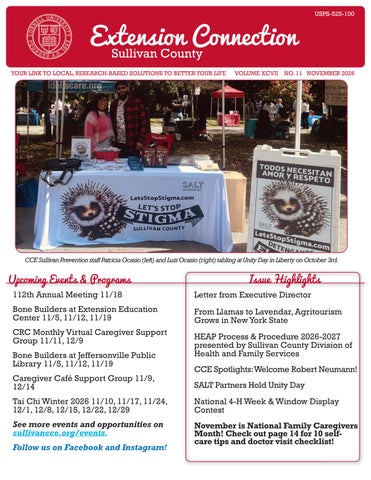
CCE Sullivan Prevention staff Patricia Ocasio (left) and Luis Ocasio (right) tabling at Unity Day in Liberty on October 3rd.
Upcoming U pcoming Events Events & Programs Programs
Issue Isssue sue Highlights Higghhligghhts
112th Annual Meeting 11/18
Letter from Executive Director
Bone Builders at Extension Education Center 11/5, 11/12, 11/19
From Llamas to Lavendar, Agritourism Grows in New York State
CRC Monthly Virtual Caregiver Support Group 11/11, 12/9 Bone Builders at Jeffersonville Public Library 11/5, 11/12, 11/19 Caregiver Café Support Group 11/9, 12/14
HEAP Process & Procedure 2026-2027 presented by Sullivan County Division of Health and Family Services CCE Spotlights: Welcome Robert Neumann! SALT Partners Hold Unity Day
Tai Chi Winter 2026 11/10, 11/17, 11/24, 12/1, 12/8, 12/15, 12/22, 12/29
National 4-H Week & Window Display Contest
See more events and opportunities on sullivancce.org/events.
November is National Family Caregivers Month! Check out page 14 for 10 selfcare tips and doctor visit checklist!
Follow us on Facebook and Instagram!
Welcome W elcome to to the the Issue! Issue! Page 3 Letter from Executive Director Page 5 From Llamas to Lavendar, Agritourism Grows in New York State Page 8 HEAP Process & Procedure 2026-2027 presented by Sullivan County Division of Health and Family Services Page 13 CCE Spotlights Notify CCE Sullivan if you have a change of address: 845-292-6180 sullivan@cornell.edu
OFFICE HOURS Hours: Mon - Fri | 8:30 am to 4:30 pm Phone: 845-292-6180 E-mail: sullivan@cornell.edu Website: www.sullivancce.org Facebook.com/ccesullivanagfood Instagram.com/ccesullivan YouTube: bitly.com/ccesullivan
Table Table of of Contents Contents Page 14 Fast Facts Page 16 Fall Garden Clean-Up Page 18 National 4-H Week & Window Display Contest Page 20 November 2026 Caregiver Resource Center Report Page 22 Early Childhood
Education (ECE) Coalition Forming Page 24 The Safe Systems Approach Page 26 SALT Partners Hold Unity Day Page 27 Thanks to our Sponsors! Page 28 112th Annual Meeting
EXTENSION CONNECTION Produced by: Cornell Cooperative Extension Sullivan County Edited by: Aaron Denman, Katie Gasior & Nicole Slevin Nikolados Cornell Cooperative Extension Sullivan County provides equal program and employment opportunities. NOTICE: Official endorsement of advertisers and their products is not intended by the acceptance of their sponsorships for the Extension Connection.
STAFF MEMBERS
Colleen Monaghan..............................................................................Executive Director Tracy Broyles.........................................................................FORx Program Coordinator Alan Carroll...................................................................Food Systems Program Manager Luciana Carvo...................................................STNY/Sullivan Fresh Market Coordinator Lynn Colavito..............................................Community Cupboard Program Coordinator Martin Colavito.............................................................Prevention Program Issue Leader Dawn Parsons.......................President Wanda V. Cruz...............................................Healthy Communities Program Coordinator Alex Alorro...................Vice President Aaron Denman.........................................................Association Operations Coordinator Robert Kaplan.......................Secretary Jessica Doyle.............................................................................4-H Program Coordinator John Garigliano.....................Treasurer Katie Gasior........................................................................Horticulture Subject Educator Brian McPhillips...........Legislative Rep. Jenna Gangel...................................................................Shop Taste NY Market Manager Patricia Claiborne.............Cornell Rep. Isabel Lutz.......................................................................................................................Custodian Stacey Johnson Kim McDonnell.....................................................................................Taste NY Market Manager John (JP) Lang Nancy McGraw.................................Team Leader/Educator, Caregiver Resource Center Erika Malmgreen Jamila McKinnon.....................................................................Beginner Farmer Educator Mark McLewin Melinda Meddaugh.......................................................Ag & Food Systems Issue Leader Jennifer Mitchell Tess Isabel Molina Bayly.............................FORx Youth Prevention Program Coordinator Meaghan Mullally-Gorr Laura Quigley Barbara Moran................................................4-H Youth Development Program Manager Gary Silver Robert Neumann...............................................................................................Bookkeeper Gary Silverman Luis Ocasio..............................................................................CYPEP Program Coordinator Diana Weiner Patricia Ocasio...................................................................Prevention Program Coordinator Shanice Owens..............................................Community Cupboard Program Coordinator Abyssinia Pla El....................................................................................Finance Coordinator Monica Ponce-Agredano .................................Ag. & Food Systems Program Coordinator Michelle Proscia...........................................................Ag. Production Program Manager Heather Brown Danielle Sykes.................................................4-H Animal Science Program Coordinator Roberta Chambers Nu El Nicole A. Slevin Nikolados......................................Chief Operating Officer/HR Manager Courtney Hanback Tara VanHorn.........................................................................................Finance Manager Carmela Hugel Malinda Ware.................................................Statewide Strategic Engagement Specialist Cathi Paci John Wilcox..........................................................................................Facilities Manager Carol Roig Veronica Yangis.........................................................................Taste NY Operations Coordinator Stephen Stuart Kyaraliz Babilonia Cruz, Hailee Crum, Billy Wells..................................Ag Market Coordinators Eugene Thalmann
BOARD OF DIRECTORS
PROGRAM COMMITTEE
Deborah Worden
Page 2
Extension Connection
November 2026
Dear friends of Extension, This is my first letter to you in the Extension Connection magazine since April 2025, which was my 114th letter to the community. It seems like so long ago, and a lot has happened in that time. Last year in January CCE Sullivan saw just over 30% of its operating revenues frozen with no notice and little information on if or when those congressionally appropriated, contractually obligated funds might be released. The association responded by streamlining operations, prioritizing grant and fundraising efforts closer to home, adding some fees for service, eliminating vacant positions, and the painful decision to conduct one layoff. In February I lost my aunt and my mom within 24 hours of each other, leaving me the only local family with my gramma, who turns 92 in in December. At the same time, my health was deteriorating after having COVID for the fourth time and the flu immediately following. And the merry go round of doctor and specialist visits began. There was an upswing in May when my family hosted an amazing celebration of life for my mom on a perfect day at the park, and then I took my son to see one of the last Dead & Company show before Bob Wier’s passing at the Sphere in Las Vegas. Honestly, I got more joy watching my son experience the show and venue than the show itself. But man, what an amazing way to wrap up my 30 years with all the live iterations of The Dead! As soon as I returned Fair season was starting, which is basically like having two full-time jobs for 3 months! It was a great year and sooo much fun! Except for sitting in the parking lot Sunday and having to blast the A/C on my foot for an hour before being able to put it on the gas pedal due to the burning pain! Over the next two months that pain spread all the way up my body right to the top of my head. I went to 15 specialists and tried a dozen medications. By the end of the November, after sitting at my desk computer on day for a period of 9 hours in a row with nothing happening. Like, I couldn’t read to comprehend, couldn’t think, couldn’t communicate thoughts if I had them, could add simple numbers, just complete cognitive failure. I called our fearless Board President Dawn Parsons and asked her to meet me in the parking lot. When we met, I told her I had to “tap out”, immediately, and that I wasn’t sure for how long. I left New York for the winter and spent the next three and half months sleeping, eating clean, moving my body, connecting with the people I love, listening to music, settling in silence, snuggling Frank (my dog), trialing all sorts of treatments, modalities, medicines, and hormones one at a time to find a combination of things that I could maintain and function with on a daily basis, and soaking in sun, gazing at stars, and breathing fresh air in the desert, by the sea, on mountains, inland, and on islands. I tried to come back to work at the end of February but ended up down and out for a week after just one day. I had to learn how to pace my energy expenditures before settling back in at the end of March. Extension Connection November 2026
Page 3
There’s really no definitive diagnosis for this sort of thing yet. The closest the immunologist suggests is “post viral syndrome” given the onset of things being after the COVID/flu combo. I haven’t met a medical professional yet, in person or online, that understands for sure how this works, why some people are affected and not others, why symptoms manifest differently for different people, or if or when it will go away. So, why am I sharing this story in my 115th Extension Connection magazine letter to the community? As harvest season comes to an end, it’s been our tradition as a nation to use this month to share our gratitude to, for, and with each other, our family, friends, neighbors, farmers, parents, volunteers, kids, elders, public servants, faith leaders, mentors, caregivers, pets, and whomever or whatever our higher power is. At the beginning of this year, I didn’t know if I’d return to CCE Sullivan after my time away. I still have bad days, where my body feels like it’s burning from the inside, or the space behind my eyes feels like mashed potatoes. I have had to accept a marked change in how I function and show up at work, home, and in the world. But I did make it back and I am incredibly grateful to the brilliant, competent, and resilient leadership of CCE Sullivan staff, Board Directors, and our constituents and program participants who held space and a place for me to return to, and who continue to make service to Sullivan County through Extension interesting, fun, and meaningful. I’m wishing you all the warmest wishes this Thanksgiving season <3 Yours Truly,
Colleen Monaghan Executive Director CCE Sullivan County cm638@cornell.edu
Page 4
Extension Connection
November 2026
FROM LLAMAS TO LAVENDAR, AGRITOURISM GROWS IN NEW YORK STATE Written by Caitlin Hayes, Cornell Chronicle Submitted by Aaron Denman, Association Operations Coordinator
For Andrea ParentTibbetts, owner of Clover Brooke Farm in Hyde Park, New York, the llamas and alpacas are the lure: the doe-eyes and fluff and the fact that they approach you face to face. “I can grab peoples’ attention that way,” ParentTibbetts said. “And then I can tell them a little bit about the animal, why they’re really purposeful, useful, so that people can understand what we do.”top of heated haystacks! Fire can burn cavities beneath the surface that will not support your weight. Over the past 10 years, the Parent-Tibbetts’ fiber farm has grown from a few sheep and llamas on a “feral” plot of land to a full-fledged agritourism business, hosting 5,000 visitors a year and known for its alpaca and llama hikes and natural fibers. Crucial help has come from Cornell Cooperative Extension (CCE), which began boosting its support for New York state agritourism in 2020 to keep pace with growth in
With the support of Cornell Cooperative Extension, Andrea Parent-Tibbetts and her family transformed a defunct farm in Hyde Park, New York into an agritourism business: Clover Brooke Farm, known for its llama and alpaca hikes and natural fibers.
the industry. Agritourism activity in the state has more than tripled since 2007, with nearly 1,000 farms generating $55.5 million in revenue as of 2022, according to the U.S. Department of Agriculture’s (USDA) Census of Agriculture. CCE support has helped Parent-Tibbetts prioritize and stay aligned with her mission as her business has grown. “There are so many aspects of your business, and you can go down a rabbit hole really easily. You need to stay at a macro level and at the same time juggle all the micro aspects,” she said. “I’ll be honest, it’s really Extension Connection November 2026
the support that’s come from Cornell Cooperative Extension, through many different programs, that has gotten me to where I am.” In a flurry of activity to support agritourism in the last three years, CCE has hosted and recorded more than 40 webinars, with accompanying fact sheets, on topics ranging from taxes and liability to writing grants and designing experiences. A working group of more than 80 CCE educators across county offices has organized farm tours and events to connect farmers with each other and with local resources, including an inaugural agritourism conference in 2025 in Page 5
Saratoga Springs, New York. Lindsey Pashow, CCE agricultural business development marketing specialist and agritourism statewide specialist, said last year’s conference hadn’t even ended yet when people started asking about this year’s event, which will be held Nov. 4-5 at Cornell AgriTech in Geneva, New York. “For farmers, agritourism is a way to diversify their operation, to bring in additional revenue,” Pashow said. “It also connects them with the community.” Agritourism educates, too, even when that’s not an explicit goal, Pashow said: “The farmers are
developing an experience, they’re bringing people to the farm, and those visitors are seeing something that’s not produced in a factory, something living and growing.” That education is crucial for sustaining farms, Parent-Tibbetts said. She’s especially concerned about agriculture in Dutchess County where farmland has become prime real estate for development. Statewide, the upward agritourism trend contrasts the trajectory for farms generally; New York state lost 14% of its farms and 9% of farmland between 2017 and 2022, according to the USDA. “The best thing we can do is welcome people onto our farms, educate them,
In addition to hikes, Clover Brooke Farm offers llama and alpaca yoga, soap and loofah making, crafts, farm tours and more.
let them see our passion and why we do it,” ParentTibbetts said. “Otherwise, they’ll say, ‘Why is this important in my life?’” Building, empowering new lives Parent-Tibbett’s relationship with CCE – and llamas and alpacas – started long before her business venture. When her family moved to the Hudson Valley in the 1990s, her kids got involved with 4-H through CCE Dutchess County, and ParentTibbetts, who was then the director of finance for a private school, found a new passion. “I really loved the basis of 4-H, with kids learning and doing and the families being involved as a community,” she said. Parent-Tibbetts went on to serve in multiple volunteer leadership positions for CCE (including leader of the Llama and Alpaca Club and president of the 4-H advisory committee). In 2018, she participated in a CCE training for women farmers – based on a national curriculum and nonprofit called Annie’s Project – which gave her confidence as she expanded her farm. “It really empowered me and made me feel like I could do anything I set my mind to. I know that sounds
Page 6
Extension Connection
November 2026
cliché, but I was a woman coming from a completely different career, in my 50s. It was intimidating,” she said. Similarly, Steven Marion, a first-time farmer who bought a defunct farm in Broome County a year ago, said CCE helped him establish Farm in Broome. His agritourism business offers unique farm stays that allow visitors to disconnect from technology. “CCE has been integral in getting things started, because I didn’t live in the area, and I had never farmed in my life,” said Marion, who started the farm to honor a dream he and his late husband shared. “They really helped me navigate where agritourism stands in the local environment and where I can fit in. Now so many people in the community are encouraged that something is being built here again, to see the life coming back into it.” “Connector of people” Agritourism is meeting a demand from the public as well, said Melaine Rottkamp, executive director of Destination Dutchess, a nonprofit that promotes tourism in the county. Rottkamp recounted a farm tour where a 70-year-old man,
a visitor from New York Inviting people onto the City, lay on the ground and farm is not always easy, rolled down a grassy hill though. for the joy of it. “There are a lot of trials “People want to connect and tribulations,” Pashow with the land, they want to said, “from working with connect with their food, your municipality to the they want a way to relax liability of having people and have fun, and since on your farm, and the fact COVID-19, they’re more that people are going to focused on wellness,” she be on your property and in said. “We have properties your space, maybe doing that are finding ways to things you don’t want them provide those kinds of to do.” experiences, which then The network of business help the farmers do the owners created by CCE work they want to do.” helps. “We need that Rottkamp said in addition network to survive,” to traditional hayrides Marion said. “You need to and pick-your-own be able to call on someone fruits, farmers have been to help you do something adding u-pick sunflower or answer a question, and lavender fields and and that community of even “luxury” farm stays. understanding – it’s so Marion said his farm offers important.” people a way to reconnect CCE has become an with themselves and to essential part of the heal. ecosystem surrounding “A lot of us have lost our agritourism, Rottkamp connection to experience, said, describing extension to where our food comes as “an incredible from or the sounds the connector of people.” trees make or how to skip “And we really need them a rock,” he said. “I want to use farming and this space to do that because we can’t do it all on our own,” as a place where people she said. “CCE is looking can reconnect and learn something new, where they out for the whole industry and guiding these new can just exhale. It’s been people coming in, to show healing for me as far as the process of trauma and them the opportunities and great careers to be loss, and I hear from a lot of people who are inspired had, to continue to build by it and want to be a part programming that stays up with the trends and shows of it.” people: You’re not going it alone.” Extension Connection November 2026
Page 7
Page 8
Extension Connection
November 2026
Extension Connection November 2026
Page 9
Page 10
Extension Connection
November 2026
Extension Connection November 2026
Page 11
Beginner Far Farmer
Mentors Mentorship COhort The Beginner Farmer Mentorship program is for folks who are ready to take the next step toward turning their farm dreams into a reality! Benefit from in-person learning with: farmer mentors CCE staff f and fellow mentees! Receive a $10 $10,000 000 stipend ts distributed in six payments across 12 months
Apply Now For details and to apply, Fo scan below:
GET MATCHED WITH A FARMER MENTOR TODAY! Questions? Contact Jamila McKinnon at (845)292-6180 ext. 101 beginnerfarmer@cornell.edu
This project is supported by USDA, National Institute of Food and Agriculture award #2022-06508. Cornell Cooperative Extension is an equal opportunity educator, provider, and employer.
Page 12
Extension Connection
November 2026
CCE Sullivan Spotlights Staff Spotlight
WELCOME ROBERT NEUMANN, BOOKKEEPER Robert Neumann joins the team as CCE’s new Bookkeeper! Living most of his life in Sullivan County, he is happy to support a local institution with his knowledge in finance and accounting. He is excited for the opportunity to give back to the community that has treated him so well.
Robert enjoys hiking, reading and is a loyal fan of the Mets, Jets and Devils. He is a lover of plants and gardening and likes useless trivia knowledge with Jeopardy aspirations. He also enjoys making memories with his two kids, Emmalyn and Garrison.
DHI Report:
September 2026 SAMPLE TYPE
HerdCode
HERDOWNER
21470096
BRANDON PETERS DAIRY DHI-AP
21470021
GLASSEL, ROBERT
DHI-AP
NO. COWS
MILK
FAT
PROTEIN
HO
90
19623
788
616
HO
44
14341
534
428
BREED
Extension Connection November 2026
Page 13
November Focus: Fast Facts, Cool Tools, & News to Use
10 T Tips ip ps fo for or F Family amily Caregivers Careg give ers s tto oB Balance alan nce C Caregiving are egiviing and and Self-Care Self-Care
You Y ou pour y your our heart e into into o caring ffor or someone m you yo ou love—but love—but —but who's who's caring carin for for you? ou? Being a often family amily caregiver car of o ten feels eels like like putting everyone ev ne else's needs first while whi your your own take takke a backseat. it's backsea ackseatt. Taking Taking care car c e of yourself yourselff isn't isn't selfish; e it's essential. essential t .
e actions you pets safe ep yourensuri ke ke to eable n tamanageable caregiving more you care car egivingca mor manag m able while ensuring you stay sta s y healthy, health a y, energized, energiz gized, ed, and resilient res resilien t for o healthy! somyou athelp lookwill keala tips These h tten en practical prTa actical you weave w wea ave self-care self-care intto your daily d routine, routine u , making a d into an the e long haul ha . haul.
ACCESS ONLINE www.caregiveraction.org/10-tips-family-caregivers/
Annual Exams: Pets support care of your own 1 Seek 2 Takehealth 3 should visit from otherthe so that you caregivers.at least once can be strong enough veterinarian Accept offers of help and You are not to take care of your specific things a year. Annual exams Spay/suggest alone! loved one. N e u you. tcan er:doNtoothelp are a great opporitunity do thepeople o n procedure ly prevent in to check on their overall s d i v iduforalsigns of health. You should also 5 Caregiving is hardmedica6l p Watch 4 depression. roblem work so take respite s s getting check in with their vet breaks u c D on’t delay Don’t h as mam often. Learn how to rhelp and testic maprofessional oncommunicate vaccinations their pet y when u l a r effectively and uterin tum may need.with doctors. you oneed rs it. e i n fections, spaying o r neutering a l s o h e lp9s curb p open to new Weight management: According 7 Betechnologies 8 et o v that e r p o p to the Association for Pet Obesity u l a tion and can make the r e d u c e Organize medical job easier. s Prevention, veterinarians tMake he nsure umlegal bareerinoorder. u information so it’s up towa n f n documents classified 53 percent of adult t e d p date and easy to find. e t s w a h re euthan o dogs and 55 percent of cats i z e d every day. Spay were classified as overweight or a nd neuter s u Acknowledge r g e obese. Prevention is much easier r i e s 10 can be sa yourself for rising yourself p e fely r f to accomplish than treatment, so o meet one of the to meet Scan the threm Cd ode Scan QReCode to a s e arly as 8ccess mo oget st demanding most -12 w ac th his access this help pets on the right diet and einfo eksonline responsibilities o f age. exercise regimen. there is. Page 14
Extension E t Connection C t
November 2026
DDoctor Do occtto oc tor or Visit V Checklist for Caregivers
Senior pets: As animals age, Balanced diet: Commercial dog their dietary requirements and and cat foods make it easy to their ability to digest certain foods changes. When pets grow provide a nutrition balanced Managing medical appointments is a crucial part of caregiving, ensuring that you andally your care recipient older, they lose some ability to are on the same page regarding health management. Thisand Caregiver Doctor Visit Checklist helps complete diet. Dog and cat concentrate urine making so they need streamline this process, doctor’s visits more productive and less stressful. This checklist allows to better prepare appointments, manage follow-ups, and coordinate effectively. foods contain to caregivers produce more, andfortherefore all ofcarethe different need more water intake. You nutrients pets need in the canDhelp by feeding your pets NAME OF DOCTOR: ATE OF DR. APPT: appropriate quantities. It’s very better quality proteins and avoiding red meats like beef difficult to create a balanced B E beef F O R E Tby-products. HE VISIT and Doing and complete diet from people this will decrease workload Update Medication the List | Ensure you have the most current list of all medications, including over-thedrugs and supplements. medical evaluations and prescriptions. foods. on the counter kidneys and help This is critical for accurate preventNote diseases health Symptoms | and Document any current symptoms your care recipient is experiencing. Use a symptom reporting guide to help detail these issues. issues from developing.
Heat and Cold: During warmer seasons, ensure have Emergencies: You should your pet has easy D U R I Nbefore G T H E disaster V I S I T strikes. a plan access to water and kit cy Bring a Medication List | Have the updated medication list handy for the doctor. pet an emergen Make your shade, espesically when and bedding water, with food, Report Symptoms | Communicate all symptoms observed. Avoid self-diagnosing; focus on cold sharing rs. During outdoo Keep your vet’s information. comfort. toys forfactual seasons, remember when on records Instructions | Take detailed notes on the doctor’s recommendations and instructions. vaccinati andDoctor’s contactRecord you’re cold, your pets are helps ensure that no important details are overlooked. make note of shelter and handy,This themorinside Bringtreatments cold! Discuss Recommenations | Engage in a discussion about the recommended next steps you that you can nearunderstanding. locations and verify and any wipe ice and bring your pet. Verify Follow-up | Confirm any follow-up appointments or tests thatoff must be scheduled. paws. their snow Confirm Appointment | Call the doctor’s office to confirm the appointment time and any specific requirements or preparations needed.
ASources: FTER THE VISIT
Dental care: Evaluate teeth and oral health annually. Also, brush your pets’ teeth regularly! Unchecked, dental disease can lead to kidney problems or nutritional issues if the pet cannot adequately chew and digest food.
“Client Education Tips for National Pet Review Notes | Review October your notes8, from the visit to ensure you understand the doctor’s instructions. Wellness Month.” dvm360, 2012. https://www.dvm360.com/view/ Update Calendar | Add any follow-up appointments or tests to your calendar to keep track of future client-education-tips-national-pethealthcare needs. wellness-month. Discuss Recipient | Ready. Discuss the visit’s outcomes and any changes to the care recipient’s “Prepare Yourwith PetsCare for Disasters.” care plan with them. gov, March 20, 2026. https://www.ready. gov/pets. Track Results | Follow up on any test results or additional information requested during the visit. Amy.“It’s Been a Great Ride! On to the next Adventure ...” GoPetFriendly. com, A D D I TFebruary I O N A L N O13, T E S2025. https:// www.gopetfriendly.com/blog/ its-been-a-great-ride/.
caregiveraction.org
Extension E t Connection C t November 2026
Page 15
FALL GARDEN CLEAN-UP Written by Aaron Steil, Consumer Horticulture Extension Specialist from Iowa State University Submitted by Katie Gasior, Horticulture Subject Educator
Photo credit Katie Gasior, Katie teaching bulb planting class. Page 16
Now that autumn is upon us, I’d like to share some best practices in preparing your garden and landscape for the end of the season. It is not necessary to clearcut the perennial garden after the first freeze of the season. Leaving the leaves, stems, dried flowers, and seed heads of many perennials provides more interest through the winter months. Leaving the plant materials also provides an extra layer of protection for the crown and root system of the perennial. Plus, the dead stems and leaves collect fallen leaves, adding even more protection. Leaving the plant material in place and removing it in early spring instead of fall also helps provide food and protection to native pollinators, beneficial insects, and wildlife, such as birds. While it is largely beneficial to leave the foliage in place through winter, removing plant material in the fall after it has naturally died back should be done for any perennials with disease or insect pest issues during the summer. Additionally, those Extension Connection
November 2026
perennials that tend to be weedy or spread aggressively by seed benefit from late-season deadheading and cleanup to prevent them from being too weedy. As for the vegetable garden, good fall clean-up is necessary, removing all leaves, stems, fruit, and other plant parts after the first frost. Most edible plants grown in home vegetable gardens have serious disease and/ or pest issues that can overwinter on plant debris, increasing its impact on crops in subsequent years. Removal and destruction of the diseased plant debris reduces the severity of many diseases in the next growing season. Removal of the plant debris also eliminates overwintering sites for some insects and helps reduce insect populations. Another way to prevent plant diseases next year is to take good notes now of where in the garden each type of plant grew this year. Disease problems often increase when the same crop or crop in the same family is planted in the
same area in successive years. For crop rotation to be effective, gardeners should not plant vegetables belonging to the same plant family in the same location for a minimum of three years. Selecting vegetable varieties that are resistant to specific diseases can also be helpful.
Gardeners can also manage leaves on the lawn by mowing. Chopping the leaves up with a mulching mower can help return organic matter to the soil, benefiting the lawn, and for most people, it is easier than raking and removing. The leaves must be chopped into pieces small enough to fall down between the blades of grass. When finished, very little leaf
debris should be visible. Mowing is best done when the layer of leaves is thin and dry, so mow often throughout the fall. If the leaf layer is thick, mow over an area more than once. Sources:
Steil,A., 2022. Fall Garden Clean-up. [online] Hortnews. extension.iastate.edu.Available at: <https://hortnews. extension.iastate.edu/fall-garden-clean> [Accessed 13 October 2022].
Photo credit Katie Gasior, bulb planting workshop at Extension Education Center garden. Extension Connection November 2026
Page 17
NATIONAL 4-H WEEK & WINDOW DISPLAY CONTEST Written and submitted by Jessica Doyle, 4-H Program Coordinator
During National 4-H Week, Sullivan County 4-H members proudly showcased their 4-H spirit throughout the community by participating in our annual Window Display Contest. Clubs designed and decorated creative displays highlighting the many opportunities 4-H provides young people, while promoting the 4-H pledge, project work, leadership, and community service. This year’s “Beyond Ready” themed displays brightened storefronts across the county and helped raise awareness of the positive impact 4-H has on youth, families, and communities. We are grateful to the local businesses that generously donated window space and to our members, volunteers, and leaders for their hard work and creativity. National 4-H Week is a time to celebrate all that 4-H has to offer, and these displays were a wonderful way to share the 4-H story with the public. Congratulations to all who participated!
Page 18
Extension Connection
November 2026
C C E S U L L I VA N S TA F F W I S H YO U A
PPY A H
Thanksgiving
Extension Connection November 2026
Page 19
Senior Resource Day and Annual Public Hearing The Caregiver Resource Center coordinator joined the Sullivan County OƯice for the Aging at SUNY Sullivan’s Seelig Theatre for its Annual Public Hearing and Senior Resource Day on Friday, October 9th from 10am-2pm. The event was well attended and seniors learned about the many resources available to them, including from dozens of community organizations. Shown below are some of the many organizations who participated, and Lise-Anne Deoul, Director of the Sullivan County OƯice for the Aging, who spoke to the audience at the annual public hearing about available services and accomplishments in 2026.
Above: Caregiver Resource Center coordinator Nancy McGraw shares information about the program’s services and supports.
Fall Tai Chi Series Ʊnishes Oct. 13
Above: Participants attending the Ʊnal class of the Fall Tai Chi series which ran from Aug. 25 – Oct. 13.
CAREGIVER SUPPORT GROUPS Caregiver Café: Held the 2nd Monday each month from 10-11am in CCE Sullivan’s Board Room. Upcoming dates: Nov. 9, Dec. 14 Virtual support group: NEW TIME: Now the 2nd Wed. each month) Nov. 11, Dec. 9 from 1-2pm. Call the Alzheimer’s Association to register: 1-800272-3900 for the Sullivan/Dutchess Virtual caregiver support group. INFORMATION & ASSISTANCE: to learn about available services and programs for individuals age 60 and older, please call the Caregiver Resource Center at 845-292-6180 ext. 122. Page 20
Extension Connection
November 2026
demand training training, expert guidance guidance, support groups, community forums, and resources tailored to their unique caregiving needs. These tools help caregivers develop new skills, reduce stress, and connect with others facing similar challenges.
National Family Caregivers Month November is National Family Caregivers Month. The Caregiver Resource Center (CRC) at CCE Sullivan recognizes and thanks the thousands of family caregivers in Sullivan County while raising awareness of the vital role they play in supporting loved ones and helping them maintain independence, health, and wellbeing. The CRC provides caregivers with information, support, education, referrals, and connections to respite as well as community services that can help ease the demands of caregiving and improve quality of life for both caregivers and those they care for. Whether caring for an aging parent, spouse, relative, or friend, caregivers can access free guidance, support groups, educational workshops, resource referrals, and assistance navigating complex health and long-term care systems through the Caregiver Resource Center.
The Trualta website available to caregivers is www.trualta.com. You can also call the Caregiver Resource Center and the coordinator will help you get signed up with a free online account. The service is conƱdential and free. If you prefer to attend a caregiver support group in person, the Caregiver Café meets monthly on the second Monday each month from 10am-11am at Cornell Cooperative Extension Building at 64 Ferndale-Loomis Rd., Liberty, NY. You can call for more information or to register: (845) 292-6180 ext. 122 or email: sullivancrc@cornell.edu. Support is available to help you care for your loved one while also caring for yourself – help is just a phone call away.
Caregivers can also join Trualta, a free online caregiver education and support platform that provides access to onExtension Connection November 2026
Page 21
EARLY CHILDHOOD EDUCATION (ECE) COALITION FORMING Written by Nancy McGraw, Team Leader & Caregiver Resource Center Educator
A strong early childcare system is built on collaboration. Through the Creating Healthy Schools and Communities (CHSC) grant (2026–2031), Cornell Cooperative Extension Sullivan County (CCE Sullivan) and the Sullivan County Child Care Council are bringing together community partners, organizations, and early care and education (ECE) providers to form a coalition that will support efforts to improve the quality and sustainability of childcare policies and best practices that promote physical activity and nutrition throughout Sullivan County. We invite childcare providers, community organizations, schools, businesses, and other stakeholders to join this new Early Care and Education (ECE) Coalition. Most meetings will be held virtually via Zoom. Together, we will explore the strengths and needs of Sullivan County’s childcare system, identify existing programs and resources, share ideas, best Page 22
practices, and gather community input to help shape future efforts. This coalition will provide a welcoming space for collaboration, learning, and problem-solving as we work to improve the sustainability of early childhood policies and practices around physical activity and nutrition to strengthen families. By working together, we can strengthen support for children, families, and providers and help ensure that every child has access to quality early learning opportunities. We Extension Connection
November 2026
welcome all interested partners to join us in this important work. For more information or to become involved, please contact Donna Willi, executive director of Sullivan County Child Care Council at (845) 292-7166 or dwilli@ scchildcare.com, or Nancy McGraw, CCE Sullivan at (845) 292-6180 ext. 122 or nam247@ cornell.edu. We look forward to working together to support children, families, and the early childhood workforce in our community.
FREE WEBINAR RECORDING: WHY WON’T THEY EAT? RESPONSIVE FEEDING ACROSS THE SPECTRUM OF CHILDREN’S EATING Written by Nancy McGraw, Team Leader & Caregiver Resource Center Educator
Access Recording: g (https://asphn.org/why-wont-they-eat-responsive( p p g y y p feeding-across-the-spectrum/) feeding-across-the-spectrum/ g p ) This recorded webinar from the Association of State Public Health Nutritionists (ASPHN) ( ) explores p p g the evidence base behind responsive feeding. feeding Topics p discussed include the following: g what responsive p g means, how it differs from traditional nutrition education approaches, pp and why y it matters especially p y for children who are neurodivergent, sensory-sensitive, or at the more challenging end of avoidant eating. health nutritionists, Women, Infants, and Children (WIC) Designed g for public p ( professionals, and early p y care and education nutrition leads, this session revisits foundational responsive p feeding g principles p p and extends them into clients and community are most often asking the territory y your y y partners p g about: children whose eating g behavior doesn’t respond p to typical yp guidance. g Participants will leave with updated framing, practical language shifts, and a stronger foundation for supporting the programs and families they work with. Source:
CDC’s Division of Nutrition, Physical Activity, and Obesity,WEEKLY PROGRAM DIGEST, September 25, 2026
WEBINAR RECORDINGS: NATURAL START ALLIANCE: PROFESSIONAL TRAINING WEBINARS DEVELOPMENT Written by Nancy McGraw, Team Leader & Caregiver Resource Center Educator
Access Library: (https://naturalstart.org/resources/professional-training/ p g p g webinars) The Natural Start Alliance offers hour-long g webinars on topics p of key y interest to early y childhood professionals p that aim to support pp the programs. p g Check out the library link above for a variety of recorded webinars, or view some examples below: The Power of Outdoor Learning: g Impacts p on Early y Childhood Development p & Educator Well-Being: g https://naturalstart.org/what-we-do/events/powerp g p outdoor-learning-impacts-early-childhood-development-educator-wellg p y p being g Flourishing in Winter: Guidance for Cold-Weather Play: https://naturalstart. p org/what-we-do/events/flourishing-winter-guidance-cold-weather-play g g g p y Source:
CDC’s Division of Nutrition, Physical Activity, and Obesity,WEEKLY PROGRAM DIGEST, September 25, 2026
Extension Connection November 2026
Page 23
D
R /SE TH A E
INJURY IS UNAC IOUS CE
PTA
BL E
M
CR UC I
MA
Safe Vehicles
KE
AKES MIST
REDUND ANC Y IS
S AN
THE SAFE SYSTEM APPROACH
Zero is our goal. A Safe System is how we will get there. SAF
Post-Crash Care
Safe Speeds
AR
Safe Roads
VE
S
AC RO
TI
EV
SP
UL
YI
NE
ET
Imagine a world where nobody has to die from vehicle crashes. The Safe System approach aims to eliminate fatal & serious injuries for all road users. It does so through a holistic view of the road system that first anticipates human mistakes and second keeps impact energy on the human body at tolerable levels. Safety is an ethical imperative of the designers and owners of the transportation system. Here’s what you need to know to bring the Safe System approach to your community.
B LE
APPROACH
Safe Road Users
RA
SAFE SYSTEM
HU
AL
THE
H RES
PONS
I B I LI T Y I S S H A R
UM
AN
ED
SAFE SYSTEM PRINCIPLES
Death/Serious Injury is Unacceptable
Humans Make Mistakes
Humans Are Vulnerable
While no crashes are desirable, the Safe System approach prioritizes crashes that result in death and serious injuries, since no one should experience either when using the transportation system.
People will inevitably make mistakes that can lead to crashes, but the transportation system can be designed and operated to accommodate human mistakes and injury tolerances and avoid death and serious injuries.
People have limits for tolerating crash forces before death and serious injury occurs; therefore, it is critical to design and operate a transportation system that is human-centric and accommodates human vulnerabilities.
Responsibility is Shared
Safety is Proactive
Redundancy is Crucial
All stakeholders (transportation system users and managers, vehicle manufacturers, etc.) must ensure that crashes don’t lead to fatal or serious injuries.
Proactive tools should be used to identify and mitigate latent risks in the transportation system, rather than waiting for crashes to occur and reacting afterwards.
Reducing risks requires that all parts of the transportation system are strengthened, so that if one part fails, the other parts still protect people.
FHWA-SA-20-015
Page 24
Extension Connection
November 2026
SAFE SYSTEM ELEMENTS Making a commitment to zero deaths means addressing every aspect of crash risks through the five elements of a Safe System, shown below. These layers of protection and shared responsibility promote a holistic approach to safety across the entire transportation system. The key focus of the Safe System approach is to reduce death and serious injuries through design that accommodates human mistakes and injury tolerances.
Safe Road Users
Safe Vehicles
Safe Speeds
Safe Roads
Post-Crash Care
The Safe System approach addresses the safety of all road users, including those who walk, bike, drive, ride transit, and travel by other modes.
Vehicles are designed and regulated to minimize the occurrence and severity of collisions using safety measures that incorporate the latest technology.
Humans are unlikely to survive high-speed crashes. Reducing speeds can accommodate human injury tolerances in three ways: reducing impact forces, providing additional time for drivers to stop, and improving visibility.
Designing to accommodate human mistakes and injury tolerances can greatly reduce the severity of crashes that do occur. Examples include physically separating people traveling at different speeds, providing dedicated times for different users to move through a space, and alerting users to hazards and other road users.
When a person is injured in a collision, they rely on emergency first responders to quickly locate them, stabilize their injury, and transport them to medical facilities. Post-crash care also includes forensic analysis at the crash site, traffic incident management, and other activities.
THE SAFE SYSTEM APPROACH VS. TRADITIONAL ROAD SAFETY PRACTICES
Traditional
Safe System
Prevent crashes
Whereas traditional road safety strives to modify human behavior and prevent all crashes, the Safe Design for human mistakes/limitations System approach also refocuses transportation system design and Reduce system kinetic energy operation on anticipating human mistakes and lessening impact Share responsibility forces to reduce crash severity Proactively identify and address risks and save lives. Prevent deaths and serious injuries
Improve human behavior Control speeding Individuals are responsible React based on crash history
W HERE ARE
YO U SAFE SYSTEM ON THE
JOURNEY ?
Implementing the Safe System approach is our shared responsibility, and we all have a role. It requires shifting how we think about transportation safety and how we prioritize our transportation investments. Consider applying a Safe System lens to upcoming projects and plans in your community: put safety at the forefront and design to accommodate human mistakes and injury tolerances. Visit safety.fhwa.dot.gov/zerodeaths to learn more.
Extension Connection November 2026
Page 25
SALT PARTNERS HOLD UNITY DAY Written and submitted by Patricia Ocasio, Prevention Program Coordinator, & Aaron Denman, Association Operations Coordinator
On Saturday, October 3rd, the CCE Prevention staff hosted Unity Day in Liberty, NY for local families. Prevention Program Issue Leader, Martin Colavito, describes the Unity Event as “a celebration regarding our neighbors who for a variety of reasons do not have the opportunity to participate in the traditional community events. It also celebrates the boots on the ground human servants who compassionately serve!” Local families attended the event to meet representatives from local non-profits, learn about local resources available to improve their quality of life, create arts and crafts projects to take home, enjoy food served by local volunteers, and participate in fun activities like karaoke. “The unity event had a good family, community, and agencies collaboration.” says Patricia Ocasio. “It was a great sunny day full of educational information, games, arts, crafts, and delicious food.” For more information on Unity day and the CCE staff who brought it to the local community, you can visit our website at sullivancce.org/prevention sullivancce.org/prevention. gp .
Page 26
Extension Connection
November 2026
Extension Connection November 2026
Page 27