Extension Connection
USPS-525-100
Sullivan County
YOUR LINK TO LOCAL, RESEARCH-BASED SOLUTIONS TO BETTER YOUR LIFE
VOLUME XC NO. 3
MARCH 2019
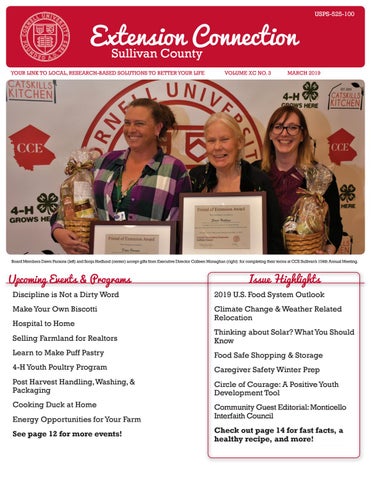
Board Members Dawn Parsons (left) and Sonja Hedlund (center) accept gifts from Executive Director Colleen Monaghan (right) for completing their terms at CCE Sullivan’s 104th Annual Meeting.
Upcoming U pcoming Events Events & Programs Programs
Issue Isssue sue Highlights Higghhligghhts
Discipline is Not a Dirty Word
2019 U.S. Food System Outlook
Make Your Own Biscotti
Climate Change & Weather Related Relocation
Hospital to Home Selling Farmland for Realtors
Thinking about Solar? What You Should Know
Learn to Make Puff Pastry
Food Safe Shopping & Storage
4-H Youth Poultry Program
Caregiver Safety Winter Prep
Post Harvest Handling, Washing, & Packaging
Circle of Courage: A Positive Youth Development Tool
Cooking Duck at Home
Community Guest Editorial: Monticello Interfaith Council
Energy Opportunities for Your Farm See page 12 for more events!
Check out page 14 for fast facts, a healthy recipe, and more!
Welcome W elcome to to the the Issue! I s s ue !
Table Table of of Contents Contents
Page 3 Message from the Executive Director
Storage Dos and Don’ts
Page 20 CCESC Spotlights
Page 12 Upcoming Programs
Page 22 Opportunities for You
Page 4 2019 U.S. Food System Outlook
Page 13 Business Planning Class
Page 23 FarmHearts
Page 6 DHI Report: January
Page 14 Fast Facts, Cool Tools, & News to Use!
Page 24 Sponsorships
Page 7 Climate Change & Weather Related Relocation
Page 16 In Case You Missed It
Page 26 Caregiving Safety Winter Preparations
Page 17 SWCD Annual Tree & Shrub Program
Page 27 Circle of Courage: A Positive Youth Development Tool
Page 19 Community Guest Editorial of the Month
Page 28 AARP Tax-Aide Program Going on at CCE until April!
Page 9 Thinking about Solar? What You Should Know Page 11 Food Safe Shopping and
The Extension Connection (USPS-525-100) is published monthly for $25.00 enrollment by Cornell Cooperative Extension Sullivan County, located at 64 Ferndale-Loomis Road, Suite 1, Liberty, NY 12754-2903. Entered at Liberty, New York, as a periodical class matter. Acceptance for mailing at special rate of postage provided for in section 412, Act of February 24, 1925. POSTMASTER: Send address changes to Extension Connection, 64 Ferndale-Loomis Road, Suite 1, Liberty, NY 12754-2903.
OFFICE HOURS
EXTENSION CONNECTION
8:30 am to 4:30 pm Monday-Friday Phone: 845-292-6180 E-mail: sullivan@cornell.edu Website: www.sullivancce.org
Edited by: Nicole Slevin & Colleen Monaghan Designed by: Centermost Marketing, LLC
Twitter.com/ccesullivan Facebook.com/ccesullivan Instagram.com/ccesullivan YouTube: bitly.com/ccesullivan
NOTICE: Official endorsement of advertisers and their products is not intended by the acceptance of their advertisements for the Extension Connection.
Produced by: Cornell Cooperative Extension Sullivan County Cornell Cooperative Extension Sullivan County is an employer and educator recognized for valuing AA/EEO, Protected Veterans, and Individuals with Disabilities and provides equal program and employment opportunities.
STAFF MEMBERS
Colleen Monaghan............................................................................Executive Director SueAnn Boyd.......................................................Healthy Schools Program Coordinator Wanda V. Cruz.............................................Healthy Communities Program Coordinator Jessica Glassel.....................................................................................Finance Assistant Robert Kaplan..............................President Beth Johnston-Groth..................................................................Administrative Assistant Amy Erlwein........................Vice President Marylin Jones..........................................................................4-H Program Coordinator Dawn Parsons...............................Treasurer Bridget Kackos...................................................................................Program Assistant John Kiefer...................................Secretary Bonnie Lewis..........................................................................Dependent Care Educator Nadia Rajsz........................Legislative Rep. Erica Lynch.........................................................Catskills Kitchen Program Coordinator Todd Brown Tharicia McZorn...........................................................Parenting & Family Life Educator Jenny Chamberlain Melinda Meddaugh......................................................Ag & Food Systems Team Leader Marcie Ehrman Barbara Moran...............................................4-H Animal Science Program Coordinator Denise Frangipane Sonja Hedlund Bee Moser................................................................................Eat Smart NY Nutritionist John “JP” Lang Vanessa Pahucki....Hudson Valley Catskills Welcome Center | Taste NY Market Manager Klu Padu Michelle Proscia.............................................................................Agriculture Educator Luisa Parker Nicole Slevin...............................................................Administrator & Diversity Officer Robert Wong Kaitlyn Conklin...........................................................................................4-H Educator Tara VanHorn.......................................................................................Finance Manager Malinda Ware..............................................................................Senior Program Leader Sean Welsh............................................................................Energy Resource Educator John Wilcox.........................................................................................Facilities Manager Mary Winter................................................................Temporary Horticulture Assistant
BOARD OF DIRECTORS
Page 2
Extension Connection
March 2019
Hello, friends! For some reason it seems like forever since I’ve written a monthly note. The winter really starts to drag on for me this time of year and I dream about the beach, which just isn’t in the cards right now. BUT, taking a look back at the 2018 program year in last month’s CCE Sullivan Annual Report to the Community gave me a boost as we look to 2019. Special recognition and thanks needs to go to CCE Administrator and Diversity Officer Nicole Slevin and Lindsay Wilcox of Centermost Marketing for publishing another brilliant representation of the work our 30 employees do with and for Sullivan County farmers, families, and kids. Now, the Catskills Kitchen Food Business Incubator is really heating up.With more than a dozen small food businesses and food trucks utilizing the space to grow Sullivan County businesses and create jobs, the initial vision of an entrepreneurial and teaching kitchen – to drive food-based economic development opportunities – is starting to come to fruition. In addition to serving as a shared-use commercial kitchen, a series of business development workshops, potentially leading budding food businesses to funding, is on the docket. We also have some local celebrities committed to offering a new spin on food and cooking classes offered at Extension.We’ll explore duck, gourmet pastries, pasta, and more.We hope you’ll join us! This is also the season for local and regional 4-H Youth Development program activities that give Sullivan County kids a chance to practice and hone their skills in public speaking, equine knowledge, international explorations, tech coding, science projects (this year’s project is centered around drones), and thinking towards what projects they’ll submit for this summer’s Sullivan County Youth Fair, for a chance to be seen at the Great New York State Fair in Syracuse.We have an additional 75 4-H’ers in the Monticello and Fallsburg afterschool programs, and start-up in-school clubs reaching another 20 or so students at Sullivan BOCES. These new programs are bringing 4-H directly to kids where they’re at, providing connections to community they didn’t have before. To complement that, CCE Sullivan is now offering Parenting Education workshops, also in the Monticello Central School District, beginning this month. The six session pilot series, Discipline is Not a Dirty Word, will help us design and deliver workshops that will help parents from all walks of life in supporting their youngsters at succeeding in the school and community setting. And not last, but I’m running out of space; is the capital improvement project to do a complete overhaul of the front lobby entrance, upper level classroom spaces and kitchen, and a few necessary tweaks to improve the user experience in the lower level Catskills Kitchen.With funding from the United States Department of Agriculture (USDA), and design help from The Center for Discovery and New Hope Community, plans are underway to make every space at the Extension Education Center fully ADA compliant, to ensure access for all our friends and neighbors in Sullivan and surrounding counties.We’ll also be upgrading the technology in the spaces to ensure educational experiences appropriate to the 21st century learner. It’s a tight project timeline, with a goal of finishing by the end of July, so if you visit, please excuse our appearance during renovations! We have the best intentions and hope you will enjoy the space. There’s certainly more to report, but I’m sure the font is already too small. If you love to receive the Extension Connection, and haven’t already, don’t forget to get in touch with Beth at the front desk to renew your subscription. Until next month, hug your family and friends to keep the chill away.
Myy veryy best,
ll Monaghan, h Colleen Executive Director cm638@cornell.edu
Don’t miss an is sue!
Enroll or rene w your subsc ription today! Receive month ly magazines and discounts on select clas ses. Fill out the en rollment card s on page 22 or call to enro ll by phone 84 5-292-6180.
Extension Connection
March 2019
Page 3
2019 U.S. FOOD SYSTEM OUTLOOK Submitted by Michelle Proscia, Agriculture Educator The U.S. Food Marketing System
home. In 2017, consumers spent almost $870 billion on food-away-from-home and only $750 billion on food-at-home.
The food marketing system in the United States is responsible for getting food from our farms into the hands of our consumer. It transports and stores, packages, processes, handles, distributes, markets, and retails our food. The marketing system moves food produced from farms through a variety of marketing channels to the end consumer. Changes in the world around us exert forces and pressures on this system. The size, complexity, and reactive nature of the system allow it to flex but not break with these pressures. When it flexes, the marketing channels in the system respond like water channels in a delta. Some channels thrive and grow larger while bending through different courses, others might diminish and dry up, and others arise in areas in which they never before occurred. The largest volume of food by far travels through the grocery retail channel. A general rule of thumb is that about 75% of the volume of food moves through food-at-home markets, such as supermarkets. Roughly 25% of food moves through foodaway-from-home markets, such as restaurants, accommodations, schools, etc.
U.S. Food Prices The 2018 gross domestic product (GDP) forecast is looking better than 2017, and the positive effects from this are stronger personal income. Real disposable personal income has been looking up since 2017. The forecast for real disposable personal income in 2018 also looks positive and on pace with the consumer price index. The consumer price index (CPI) for food in 2018 of 1.3% is higher than in 2017, but is not keeping pace with the overall CPI for all goods which averaged 2.4% for 2018.
Over half of consumers’ food expenditures are spent on food-awayfrom-home, while 46% is spent on food-at-home. This is because cost of food purchased in the form of meals served through restaurants and other food service establishments includes more than just the food, it includes the restaurant labor, real estate, etc. It is more expensive than purchasing the components for meals prepared at Page 4
Extension Connection
March 2019
While prices for food-away-fromhome, purchased primarily through restaurants, are forecast to increase between 2 to 3 percent, 2018 food-athome prices, purchased primarily
from supermarkets, are stagnant after 2 years of food deflation. (Table 2). In general, however, the prices forecast for various food at home categories in 2019 are slightly positive on top of some price swings between 2017 and 2018. The most notable exception is a projected decrease for prices for fats and oils in 2019. Some stronger increases are forecast for dairy products (3.0%4.0%), fresh fruits (2.0%-3.0%), fresh vegetables (2.5%-3.5%), and cereal and bakery products (2.0%-3.0%).
U.S. agricultural trade stabilizes domestic supplies, prices, and demand. Ag exports have been larger than imports since 1960 and have been able to help ease the trade deficit for non-ag merchandise. Exports for 2019 are forecast at $141.5 billion, imports at $127.0 for a trade balance of $14.5 billion. The largest declines in exports in 2018 have been in soybeans and cotton while increases in 2018 have been in corn and wheat. The decline in soybeans in 2018 can be attributed to the decrease in exports to China, the decline in cotton, a softening of the world market for cotton. (Continued on page 6.)
Producer Prices Producer price indexes (PPI) fluctuate more widely than CPIs, reflecting price swings due to growing conditions, harvests and input supply costs as well as demand.
the decreases seen in 2018. Large crops for apples and strawberries, two of the largest domestic commodities in terms of value, were seen in 2018. The apple crop will affect the marketing year in 2019.
Meat and egg prices, including farm level and wholesale level beef prices, wholesale pork prices and egg prices are all expected to decrease in 2019. Increases in production in these commodities drive most of the decreases in price forecasts for 2019. Dairy farmers looking for relief from low prices may see them in 2019. Farm level milk prices are predicted to increase 3.0%-4.0%, while wholesale milk prices will remain stable. The PPI forecasts for fruits and vegetables, for fresh markets and processing, is not encouraging. PPIs for fruits and vegetables in 2018 are lower than for 2017 and are expected to be lower yet in 2019, decreasing from -4.0%- -3.0% for fruits and decreasing -3.5%- -2.5% for vegetables in 2019 over and above
Extension Connection
March 2019
Page 5
For 2019, exports of horticultural products will continue to grow. At the same time, imports of almost all major product categories are expected to drop slightly in 2019, with the exception of oilseed and dairy products imports which are expected to remain stable.
Source: Park, Kristen. 2019 Food System Outlook. December 2018. Https://dyson. cornell.edu/outreach/documents/smartmarketing-2018-12.pdf, Dyson School of Applied Economics and Management, Cornell University, Ithaca, NY.
Let’s Get Social!
• Facebook.com/ccesullivan • Twitter.com/ccesullivan
• Instagram.com/ccesullivan • YouTube > bitly.com/ccesullivan
DHI Report: JANUARY
Page 6
Extension Connection
March 2019
(Continued on page 8.)
Extension Connection
March 2019
Page 7
Page 8
Extension Connection
March 2019
THINKING ABOUT SOLAR? WHAT YOU SHOULD KNOW Submitted by Sean Welsh, Community Energy Advisor You’ve heard about solar and how it can save you money on your energy bills. Maybe your neighbors have recently installed solar panels on their roof or you received a flyer in the mail from a solar company. Perhaps you’ve seen some larger arrays installed in your community. There are a lot of companies, products, and services out there to help you go solar. It can sometimes be confusing to know where to start. If you are curious about solar, here are a few helpful tips to get you in the know! There is more than one way to access solar energy. Installing roof or ground-mounted photovoltaic (PV) panels on your property is a popular option and is considered “behind the meter”, meaning the electricity you produce directly supplies your home without going onto the public grid. There are also ways you can go solar without having to install PV panels, which is great for renters. First, community distributed generation (CDG) facilities sell electricity onto the grid. Customers sign up to receive a share of the generated electricity, which shows up as credits on your utility bill. Right now, eligible households in New York can also receive FREE solar subscriptions paid for by NYS. You heard that right: there is no cost to participate and to start receiving solar energy credits. The program is flexible, meaning households can cancel any time without fees or penalties and can go with you if you move. If you have concerns about the high upfront cost to purchasing solar panels, you can also lease panels that are installed behind the meter. With
this model, the solar leasing company installs and owns the system, and homeowners pay a solar company scheduled payments over time. Most solar leases are between 15 and 20 years. If you would like to own the solar electric system outright, there are financing options that can help with the purchasing costs. There are several loans for purchasing solar electric systems, ranging from $1,500 to $25,000 with terms of 5, 10, or 15 years. There are also state (25%) and federal (30%) tax credits for solar electric systems. Solar contractors can help determine which works best for your home. Before signing and entering into any solar contract, make sure to thoroughly read through each contract or have a lawyer take a look for you. While going solar is a great option for many households, there are a few things you should consider before getting started. First, make sure your home is as energy efficient as possible, especially if you are thinking about purchasing or leasing solar panels. By taking steps to make your home more energy efficient, you can reduce your electricity use. The less energy your home is using, the smaller the number of solar panels you will need, which will lower the
Extension Connection
March 2019
cost. One step towards increasing the energy efficiency of your home is to get a home energy assessment. This assessment will help you cut down on the energy you waste in your home, and make your home safer and more comfortable. There are programs available to New York State households for free or reduced cost energy assessments, as well as grants and loans to cover the cost of energy efficiency retrofits and upgrades, like new insulation. Now is a great time to take advantage of energy efficiency and solar programs available throughout New York State. To find out more about energy and solar programs and financing options available to you, contact your Cornell Cooperative Extension Community Energy Advisors at 845-292-6180 or visit LINK: www.midhudsonenergychoices. org. Source: “Solar Energy in New York.” SEQR - NYS Dept. of Environmental Conservation. Accessed February 13, 2019. http://www. dec.ny.gov/energy/43231.html. Written by Camille Marcotte, Community Educator and Collin Adkins, Cornell Cooperative Extension Dutchess County Community Energy Advisory
Page 9
Page 10
Extension Connection
March 2019
Extension Connection
March 2019
Page 11
__
Page 12
Extension Connection
March 2019
Extension Connection
March 2019
Page 13
March Focus: Fast Facts, Cool Tools, & News to Use!
March is N Nutrition Mational onth! Did you know that kids need 60 minutess of o physical activity vity ty each e day? neeed 2 ½ hours nee Adultss need off moderate mode mo mod oderate activity y per week, eek, but 5 or more eek, hours rss per pe week can p provide health de additional ad benefits. tss. ts. eeel better, eel be p You’ll feel sleep str tronger, g better, bee stronger, and might even n reach rrea each (and ( maintain) a healthy h althy he heal weight. iees fo ies for kids Physical activities sho should as well as adultss should re re! be fun. Move more!
F r o m 20 0 0 n u m b e r o f - 20 13 , t h e r e l a t e d d e A l z h e i m e r ’s 71% while aths increa sed o t h e r m a j od e a t h s f r o m including h r dis eases, s t r o ke , a n e a r t d i s e a s e , dH A l z h e i m e r I V, d e c r e a s e d . m o r e A m e ’s d i s e a s e k i l l s d i a b e t e s, ar i c a n s t h a n breast can nd more than c a n c e r c o mc e r a n d p r o s t a t e bined.
FOLLOW
Our New 4-H Instagram Page! @ccesullivan4h
Page 14
Use an advanced power strip so all of your computer accessories are tturned off by one sswitch. Even in sleep mode, your m computer may cost com co c you year! y ou o u $105 5ay ear!!
Cereal is the seco advertiser on televnd-largest behind automobileision today, s.
Extension Connection
March 2019
March Focus: Fast Facts, Cool Tools, & News to Use! 8QLWHG 6WDWHV 'HSDUWPHQW RI $JULFXOWXUH
Healthy Eating on a Budget
Source: https://whatscooking.fns.usda.gov/sites/default/¿les/featuredlinks/HealthyEatingonaBudgetCookbook.pdf
Extension Connection
March 2019
Page 15
CAREGIVER SUPPORT
Note to readers:
You may notice lots of related activities are grouped together. We think it’s important to show the community not only the breadth and scope of the programs CCE Sullivan offers, but also how we work with partners to offer the Extension Education Center as a resource for local youth, family, business, and individual serving organizations. Your tax dollars pay for this space and we encourage you
Jan 17, 30, Feb 27 The Caregiver Resource Center offered inperson and telephone support group offerings. Support groups in 2019 will only be held at the Extension Education Center and by phone. Please call Bonnie if you need additional information regarding the new schedule.
to become familiar with, and access the services available to you. Enjoy!
WELLNESS PAINTING CLASS Jan 23, Feb 20
CATSKILLS KITCHEN HEATS UP Dec 31, Jan 1, 7, 15, 16, 17, 26, 27, 30, Feb 13, 25 Seven (7) potential new users toured the Catskills Kitchen, 1 completed their start-up NYS Ag & Markets Inspection, 3 produced, and the Fire Ansel System was inspected to ensure a safe space for commercial food production.
FURRY FRIDAY FOR THE DOGS Jan 4, Feb 1 The first Friday of every month is “Furry Friday”. Well behaved, socialized pups bring their owners (the staff) to work as part of our Worksite Wellness program. Stop in for a snuggle!
TAI CHI RETURNS Jan 10, 11, 17, 24, 31 2016 Extension Professional of the Year Bonnie Lewis offered her evidence-based Tai Chi for Fall Prevention Program to a packed audience. This popular program will return again in 2019.
DIVERSITY EQUITY INCLUSION Jan 10, Feb 14 The staff committee held their monthly meeting to draft follow-up survey questions, review new New York State laws, and organize an educational series on cultural competence for area businesses and organizations.
4-H CLUBS ABOUND
AGRI-TOURISM SERIES
Jan 5, 19, Feb 6, 10, 15, 16, 18, 22, 24, Mar 1
Jan 11, 18, 25, Feb 1, 8, 15
The Extension Education Center hosts 4-H clubs and programs throughout the month, including the Intergenerational Textile Group, Working Together Rabbit program, Diehl Me In club, Block & Bridle club, Adventures in Nature club, 4-H Explorers club, and more. This space is YOURS!
In partnership with CCE Delaware County, the Ag team offered a 6 session, web-based series focusing on Agri-Tourism. Content included Intro to Risk Management; Financial Risk; Production/Weather Risk; Legal Risk; Marketing Risk; Human Resources Risk; and an AgriTourism Panel. The team is working to reduce the offering into fewer sessions and provide an in-person interactive setting to discuss concepts.
PARTNERS IN DOING GOOD
Page 16
SPACE FOR LEARNING Jan 25, 26, 27, Feb 8, 9, Mar 2 Youth development programs, including International Night; Pasta Making for Kids in the Catskills Kitchen with Martin Colavito; Poultry Palooza; 2019 Shooting Sports; Dog Achievement Series; Snowmobile Safety Certification; and Public Presentations brought more than 200 young people to the Education Center for hands-on, experiential learning in a safe, supportive environment. What a great way to use our community space!
AARP TAX-AIDE SERVICE Feb 4, 5, 11, 12, 19, 20, 25, 26 Once again, our friends from AARP are offering free tax return assistance to Sullivan County residents. Call 845-292-6180 for an appointment.
FARMERS MARKET NUTRITION
Jan 9, 14, 27, 29, 31, Feb 7, 17, 19, 27 Since January, CCE Sullivan has hosted 8 of our partners at the Education Center. We are excited to partner with these organizations to build coalitions and networks that support Sullivan County residents. Partners include: WJFF, Firearm Safety, Older Adults Transition Services (OATS), FarmHearts Review Committee, Ag & Farmland Protection Board, Sullivan County Horse Council, Dialogue to Change, and the Sullivan County Farmers’ Market Managers.
BocaGirl Sullivan180 Wellness Circle held their monthly meeting. The group did an “Open Doors” paint-and-sip as an activity to brush the stress away. The wellness circles are facilitated by SueAnn Boyd monthly at 6:00 pm, and are open to the public at no cost.
4-H HORSE BOWL & HIPPOLOGY
Feb 13
Jan 12, Feb 16, 23
Ag Educator Michelle Proscia offered the annual Farmers’ Market Nutrition Program (FMNP) webinar, required for farmers’ market vendors to receive FMNP coupons as payments. The program, run through the Sullivan County Office for the Aging, with support from Public Health Services and CCE, helps connect Sullivan County seniors with fresh, local foods at any of the markets in Sullivan County.
The Sullivan County 4-H Horse Program hosted 2 volunteer led practice sessions to prepare the team for participation in the Regional 4-H Horse Bowl & Hippology competition held at the Extension Education Center. Participants from the entire region received 4-H Horse Program shirts and prizes!
Extension Connection
March 2019
6XOOLYDQ &RXQW\ 6RLO :DWHU &RQVHUYDWLRQ 'LVWULFW )HUQGDOH /RRPLV 5RDG /LEHUW\ 1< 2ႈ FH )D[
$118$/ 75(( 6+58% 352*5$0
2UGHU IRUP RQ SDJH 6XOOLYDQVZFG RUJ
$OO WUHHV VROG DUH LQWHQGHG IRU FRQVHUYDWLRQ SXUSRVHV DQG QRW IRU UHVDOH SXUSRVHV
Extension Connection
March 2019
Page 17
Completed order forms go to the Soil & Water Conservation District ofĂĽce.
Page 18
Extension Connection
March 2019
MONTICELLO INTERFAITH COUNCIL Written by Margaret Langston
religion? Sometimes.
In 2013, having moved from New York City only a few years earlier, I despaired in finding a new spiritual community. I had visited a few Buddhist communities, the closest being over forty minutes away from my house. I needed a group which was more accessible. I needed like-minded friends and so, did what anyone would: I Googled “Monticello” and “NY” and “Buddhist.” The results were dubious. I did the next thing anyone would do, and Googled “Monticello” and “Interfaith.” Expecting nothing, I was amazed to find The Monticello Interfaith Council on Facebook. I called the available number and was told to come to a youth committee meeting the next week.
Here are the various definitions for the word “faith”:
I arrived in the basement of St. John’s Episcopal Church with trepidation, not knowing what to expect. Having moved from the devout Christian faith of my teens to the uneasy agnosticism of my twenties, then wandering through varieties of New Age teachings in my thirties only to fall into a deep pit of cynicism by 40, I was surprised and happy to find myself taking the Buddhist refuge vows at the ripe young age of 46. I struggled with the idea of joining a group where the big G-word was sure to come up on a regular basis. I hesitantly posed the question to the friendliest of the group, Lillian Armstead, the wife of the pastor of Bethlehem Temple Church: “Is it a problem that I’m a non-theist?” Lillian gave me a confused stare. “Non-what?” She laughed loudly and told me to sit down. From that moment, I never looked back. The Monticello Interfaith Council, a small group of friends with the best of intentions, became my haven, my home base.
• Complete trust or confidence in someone or something. • Strong belief in God or the doctrines of a religion, based on spiritual apprehension rather than proof. • A system of religious belief. • A firmly held opinion or theory.
Founded in 2010 by charter organizations including St. John’s Episcopal Church of Monticello; the United Methodist Church of Monticello; the Church of Jesus Christ of the Latter Day Saints of Monticello; the First Baptist Church of Monticello; Bethlehem Temple Church of Monticello; and Temple Sholom of Monticello. This ambitious project was supported from the very beginning by Sullivan Renaissance and encouraged by former Sullivan Renaissance Director Glenn Pontier. Our mission statement says, “The purpose of the Interfaith Council is to bring together representatives of faith communities, community organizations, and interested individuals for dialogue, information sharing, celebration, and social transformation.” Over the past five years, the core of the Council has struggled to figure out what that means. We’ve had many conversations about what our purpose should be, on what we should be focusing. When I arrived, new members were encouraged to share something about their “faith”. I struggled with this. I imagine that faith, like many abstract concepts, is one that each person claims personally. Faith is a word that can be colored by belief. In what do we put our faith? Is faith synonymous with
Extension Connection
March 2019
So, why have an Interfaith Council? What faith does my small group of good friends and I hold, regardless of belief, regardless of creed? What keeps us together despite other differences? We all have faith in the possibility of human potential. We all have faith that, despite the horrible things people sometimes say or do, each one born into this world works from the motivation of wanting to be happy, of wanting to be safe. We all have faith that the smallest affirmative act, a moment of positive emotion, an act of love, can change lives. We all have faith in a love which seems to stand outside of and envelop our self-centeredness, our confusion, and our fear. When we come together, that love appears bigger than each one of us, more significant than all of us. After trying many formats over the past few years, the Monticello Interfaith Council has scaled things back a bit. We are taking time out to cultivate ourselves and to nurture our relationships. We let people know we’re here, but we keep meetings small and intimate. Still, you are welcome to join us. Write me at monticellointerfaith@ gmail.com.
Page 19
CCE Sullivan Spotlights
Farm Spotlight MOUNTAIN SIDE FARM Mountain Side Farm, located in Bloomingburg, was founded in 1861 by Eli Hultslander, and is currently owned by William Hultslander and his family five generations later. The Hultslander family owns 160 acres and leases another 200 acres of land. The 360 total acre farm produces about 2,500 square bales of horse quality hay that is sold, and over 250 round bales of hay for their own cattle. Mountain Side Farm also produces maple syrup and approximately six to seven Grass Fed Finished Beef each year without the use of antibiotics and hormones. They are sold as individual cuts, wholes, halves, and quarters. The Hultslander family loves to farm and feel the satisfaction of growing and selling products that people enjoy. Through farming, they have the opportunity to meet new people and showcase their healthy and pure products, sold on the farm. Due to a grant from Natural Resources Conservation Service and Soil & Water Conservation District, Mountain Side Farm is building an addition on their barn to provide more space for cattle. They are also building a manure storage building on their property.
Page 20
Staff Spotlight MICHELLE PROSCIA
Partner Spotlight
Michelle (Lipari) Proscia, CCE agriculture educator, has had many accomplishments in the last year!
LEE KARASIK Thank you to our new friend, Lee Karasik, Generalist at the Office of Career and Professional Development at the Center for Discovery, for his heart warming, smile inspiring presentation on Understanding Disability in a Judgement-Free Zone at our January staff meeting. The CCE Sullivan and Sullivan Renaissance staff had the unique opportunity to learn from this talented individual and garner important lessons for our work in the community. It’s our mission to include EVERYONE living, working, and visiting in the Sullivan Catskills into our educational offerings, and Lee has given us a few tools and tips to help us do so. Thanks to Lee for his enthusiastic and motivational delivery of this important message! Stay tuned for details on a Diversity, Equity, & Inclusion themed speaker series for you or your organization offered by CCE.
Extension Connection
March 2019
She was chosen as one of the Sullivan County Democrat’s 2018 Business and Professional Women of the Year this past fall. Michelle has become a certified Produce Safety Alliance (Cornell University, Food and Drug Administration, US Department of Agriculture) trainer for produce safety. After 150 hours of intensive training and a final exam, Michelle has successfully obtained a NYS Department of Environmental Conservation Pesticide Certification license. She is a facililtator for the Cornell University Small Farms state-wide poultry series. CCE is proud to have Michelle as part of its team, and we congratulate her on all her success!
CCE Sullivan Spotlights
4-H Spotlight REBECCA C. Long time 4-H member of Sullivan County 4-H Puppy Pals club and Working Together Rabbit 4-H program, Rebecca C. was recently awarded the Supervised Agricultural Experience grant, a national FFA opportunity. She was awarded this grant to help offset the cost of her rabbitry efforts. Rebecca competes with her rabbits on a national level, in breed showing, and in education contests. She has won many breed awards and national education contest titles. Rebecca also included in the grant that she would like to earmark some of the funding to purchase additional rabbit hopping equipment and educational supplies. She plans on using these items to help teach local 4-H members how to compete in hopping competitions and will use the educational supplies to help other 4-H rabbit participants learn more about rabbits. Rebecca hopes that other youth will be empowered and motivated to compete at state and national competitions. She is continually giving back to her local community and the 4-H program, serving as an inspiring role model for Sullivan County’s young people.
Nominate a Star ar Know someone who wh deserves the shine shin ine of the spotlight? Email Nicole Slevin: Slevin: nas96@cornell.edu nas96@corn nell.edu
Did you know? Youth 5-18 living in Sullivan County can apply to enroll in 4-H for FREE! 4-H positive youth development programs are open to everyone. Adults can apply to start a club anywhere in Sullivan County.
Learn more: Call 845-292-6180 or email sullivan@cornell.edu.
Extension Connection
March 2019
Page 21
Page 22
Extension Connection
March 2019
Extension Connection
March 2019
Page 23
Page 24
Extension Connection
March 2019
Extension Connection
March 2019
Page 25
CAREGIVING SAFETY WINTER PREPARATIONS Submitted by Bonnie Lewis, RN Dependent Care Educator
• Nightlights in many places
As the temperature drops and the weatherman forecasts nasty weather, my husband and I do the usual preparations for winter weather. Shovels, winter tires, ice scrappers, stocked pantry ~ you know the drill! But as I checked in with Mom, I knew we’re probably not as prepared, as caregivers, for winter. Although Mom has completed home improvements to stay safe and independent during mother nature’s tantrums (and she has two strong grandsons that help out) she has other house issues that still need addressing. From The Complete Caregiver Support Guide, here is a checklist to review to ensure your care receiver’s home is safe.
• Doorbell can be heard or triggers bright flashing light
OUTSIDE THE HOME ENTRANCES • Outdoor lights by entrances and garage • Secure rails
• Smoke and carbon monoxide detectors working
• Extension cords in perfect shape and not trip hazards • No hot-to-touch outlets or switches
• Sand or salt ready and shovels handy • Debris, clutter cleared from doors, steps • Uneven or cracked steps or sidewalk repaired
• Raised bed if too low
• Bed easy to get in and out of • Bed rail if needed
• No clutter/obstacles
• Nightlight
• Floor level changes marked with reflective tape • Carpeting in good shape (no wrinkles, ravels)
LIVING ROOM • Television remote in secured spot by chair • Phone within reach of chair as well
TELEPHONES • A phone is within reach at all times • Emergency numbers posted by all phones • Speed dial set to 911 on all cell and landlines
• Chair height adjusted for care receiver • Cords safe and away from canes or walkers • Lights-easy to reach, or have automatic on/off or remote controls
• Volume control adjusted for user • Large number dial pad for low vision (if needed)
STAIRS • Handrails on both sides • Light switches at top and bottom
BATHROOM
• Steps even and in good shape
• Nightlight
• Step edges are visible
• Non-slip strips on tub/shower floor
• No rugs at top or bottom
• No throw rugs
• No objects, clutter on stairs
• Grab bars around tub, shower and toilet
• Non-skid contrasting tape on single step
• Shower and elevated toilet seats
• Non-skid contrasting tape on noncarpeted stairs
• Clear, ready for shovels or plows
• Hand-held showerhead
KITCHEN • Appliances in working order
WINDOWS AND DOORS
• Stove controls marked (especially for low vision)
• Easy to open and close, lock easily
• Fire extinguisher by the stove
• Doorways wide enough to maneuver
• Sharps stored safely
• ELECTRIC
• Regularly used items within easy reach
• Bright lighting to eliminate shadows
• Reachable dishes, silverware and
Page 26
• Doorway clear
• No throw rugs
• Frequent bathroom commodities within easy reach
INSIDE THE HOME
BEDROOM
FLOORS
DRIVEWAY • Broken pavement repaired or smoothed, reducing fall hazard
• No spoiled/outdated foods in pantry and refrigerator
• Clear, lit path to bathroom with no clutter
• Lock box ready with extra key • Ramp or stair climber maintained (if needed)
glasses
Extension Connection
March 2019
• Top of steps gated or blocked
Source: The Complete Caregiver Support Guide By Ester R.A. Leutenberg & Carroll Morris with Kathy Khalsa, OTR/L © 2012 Whole Person Associates
CIRCLE OF COURAGE: A POSITIVE YOUTH DEVELOPMENT TOOL Submitted by Kaitlyn Conklin, 4-H Educator The Circle of Courage is an excellent tool to keep in mind when working with youth, whether it is in a program setting or a more casual learning environment. Using the examples from Iowa State University Extension, the Circle of Courage is comprised of four areas: Belonging, Mastery, Independence, and Generosity. These are the characteristics for youth to become successful after basic needs are met (food, water, shelter, safety). If the circle stays intact, youth have the courage they need to care for others and make good decisions for themselves. If an event happens that causes the circle to break, the youth may become discouraged, which may affect how they treat others and how they make decisions. Understanding the Circle of Courage Belonging: The youth feels connected, important, valued, and part of the group. It feels good to know that others want the youth to participate and value their opinion. Mastery: Being good at something, having skills, and letting the youth know they are capable and can be successful in an area. When working with youth, a mentor may need to help them see the skills they already have and encourage them to gain more through practice and experience. This encouragement can help youth gain confidence in trying new activities and become wellrounded individuals. Independence: Allowing youth to start doing more things on their own with less adult influence. It also means the youth can make more decisions for themselves.Youth learn that the decisions they make have consequences, whether those are good or bad, and these consequences can affect those around them.
Generosity:Youth give back through community service or providing leadership, mentoring, or lending a helping hand. In this area, youth feel their life has meaning and a sense of purpose. This is an area where youth can see that they can have a positive impact on others. So what happens if these needs are not meant? How does each area effect another? If a youth’s need for belonging has been met, they will feel more confident about trying new things to learn skills. However, if a youth’s need for belonging has not been met or has been met in a negative way, this can lead to the youth becoming nervous or anxious about trying something new. They may fear failure or being made fun of if the new skill they are trying to learn does not come easy to them. This can limit the youth’s experiences due to the fear of not belonging. Another scenario is if a youth’s need for belonging and mastery have been met in a positive way, they will most often make good decisions for themselves. This will effect the youth’s independence. If they have had success in these other areas, they will start to
Extension Connection
March 2019
feel more confident in their decision making and therefore start making more decisions on their own. However, if the needs for belonging and mastery haven’t been met or have been met in a negative way, they can have more difficulty making choices that are right for them. They may even start looking to others to make choices for them. Poor choices lead to negative consequences, which can set the stage for more poor choices. Keeping the Circle of Courage in mind when working with youth can help adults have a more positive impact on a youth’s experience. Insuring these basic needs of belonging, mastery, independence and generosity are being met and that youth get the opportunity to practice these areas will provide the youth with the tools they need to become a well-rounded, capable, caring, and confident individual.
Source: Grover, Vanette. The Circle of Courage and Meeting the Needs of Youth. Iowa State University Extension
Page 27
Get your* taxes prepared for free! AARP approved and qualified volunteers are at Cornell Cooperative Extension Sullivan County on Mondays and Tuesdays until April by appointment only. Call 845-292-6180 to make your appointment. SE HABLA ESPAĂ‘OL. *No age limit or AARP membership required.