Volume LXXXXVI, No. 4
Liberty, NY -:- April, 2015
(USPS) 525 - 100
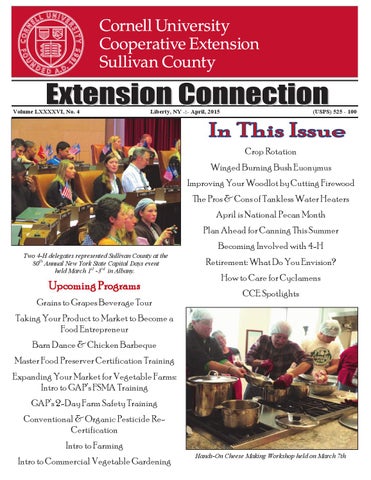
Crop Rotation Winged Burning Bush Euonymus Improving Your Woodlot by Cutting Firewood The Pros & Cons of Tankless Water Heaters April is National Pecan Month Plan Ahead for Canning This Summer Becoming Involved with 4-H Two 4-H delegates represented Sullivan County at the 80th Annual New York State Capital Days event held March 1st -3rd in Albany.
Upcoming Programs Grains to Grapes Beverage Tour
Retirement: What Do You Envision? How to Care for Cyclamens CCE Spotlights
Taking Your Product to Market to Become a Food Entrepreneur Barn Dance & Chicken Barbeque Master Food Preserver Certification Training Expanding Your Market for Vegetable Farms: Intro to GAP’s FSMA Training GAP’s 2-Day Farm Safety Training Conventional & Organic Pesticide ReCertification Intro to Farming Intro to Commercial Vegetable Gardening
Hands-On Cheese Making Workshop held on March 7th
Retirement: What Do You Envision?
13
Upcoming Programs & Events
14
Save the Date—Grains to Grapes Beverage Tour
15
Free Gardening Seminars
16
Upcoming Ag Events
17
How to Care for Cyclamens
18
CCESC Spotlights
20
9
In Case You Missed It
23
April is National Pecan Month
10
Fast Facts
24
Plan Ahead for Home Canning This Summer
11
News to Use
25
Becoming Involved with 4-H
12
Membership Exchange
26
Message from the Executive Director
3
Crop Rotation
4
Eastern Region NY Beef Producers Assoc. Annual Mtg
5
Winged Burning Bush Euonymus
6
Improving Your Woodlot by Cutting Firewood
7
CCESC Hosts the Only Extension Community Groups in
8
The Pros & Cons of Tankless Water Heaters
Necessary Business The Extension Connection (USPS-525-100) is published monthly for $25.00 enrollment by Cornell Cooperative Extension of Sullivan County, located at 64 Ferndale-Loomis Road, Suite 1, Liberty, NY 12754-2903. Entered at Liberty, New York, as a periodical class matter. Acceptance for mailing at special rate of postage provided for in section 412, Act of February 24, 1925. POSTMASTER: Send address changes to Extension Connection, 64 Ferndale-Loomis Road, Suite 1, Liberty, NY 12754-2903.
The Extension Connection Edited by: Nicole Slevin Layout & Design by: Tracey Argent Produced at Cornell Cooperative Extension Sullivan County 2015 Board of Directors Donna Willi..……..…...…..………….………..………..President Earl Myers…………..…….………………….........Vice President Pamela Rourke……………………………...…………...Secretary Glenn Pontier…………………………...…….…………Treasurer Dawn Boyes Christopher Gozza Sonja Hedlund Steve Mogel Edward Moran Louisa Parker Mike Sakell Janet Threshman Pete Tweed
Cooperative Extension in New York State provides Equal Program and Employment Opportunities. New York State College of Agriculture and Life Sciences, New York State College of Human Ecology, and New York State College of Veterinary Medicine at Cornell University, Cooperative Extension Associations, County Governing Bodies, and the United States Department of Agriculture, cooperating.
NOTICE: Official endorsement of advertisers and their products is not intended by the acceptance of their advertisements for the Extension Connection.
Page 2
REGULAR OFFICE HOURS 8:30 am to 4:30 pm ~ Monday-Friday Phone (845) 292-6180 Fax: (845) 292-4946 Website: www.sullivancce.org Email: sullivan@cornell.edu Twitter @ccesullivan Facebook \ccesullivan
Staff Colleen Monaghan...……………..…………...Executive Director Tracey Argent…………………Sr. Administrator & HR Manager SueAnn Boyd………………..…...Sr. Administrative Assistant & Master Food Preserver Susan Dollard………………...Community Horticulture Educator Marylin Jones...…………………….….4-H Community Educator Bonnie Lewis……….…….....................Dependent Care Educator Michelle Lipari………………....Ag & 4-H Community Educator Erica Lynch ……….…………………….……..Kitchen Assistant Melinda Meddaugh……..Ag & Natural Resources Issue Leader, SC Planning Liaison Nicole Slevin…………………………Public Affairs Coordinator Tara VanHorn...…………………………….…..Finance Manager Sean Welsh……………….…Youth & Family Team Coordinator John Wilcox…………………….....Building & Grounds Manager
Extension Connection
April, 2015
Colleen Monaghan, Executive Director cm638@cornell.edu Hello all and happy spring! It’s been an exciting month with a flurry of activity beginning at CCE as we start the big melt. We’ve spent lots of time holed up in the office writing grants and planning to help us grow our staffing and program capacity. We won’t hear about most of the applications until late in the year so we’ll need your ongoing support in 2015. Construction on our capital projects is creeping along, a new 4-H club formed after Nicole hosted a fun Robotics workshop about science, technology, engineering, and math, and we’re receiving more inquiries from folks wondering what Extension has to offer after the freeze we’ve all endured. We have already offered three dairy and livestock related workshops this year including an Agri-business Tax Workshop, Succession and Estate Planning, and an update on the new Farm Safety and OSHA Regulations. I had the good fortune to meet the Nearing brothers and several of our commercial farmers over at Cochecton Mills’ Open House along with CCE Board Vice President Earl Meyers. I have to say, even though it was cold and sleeting, I’m so thankful for the warm reception and advice they shared as I keep learning the ropes at CCE. By the end of 2015, we’ll have hosted at least four more opportunities for livestock farmers to hear the latest from Cornell University and the field, and I’m confident they will prove useful to some of our very diverse farming community. In this month’s issue of Extension Connection you’ll see that spring has sprung and our doors, nature and teaching trail, and gardens are open to visitors. Educational opportunities for new and experienced growers and home gardeners are in the works. We’re most excited to save the date April, 2015
for some special events and hope you’ll put them on your calendar too! Mother’s Day weekend, on Saturday, May 9th, CCE will be hosting the first ever Sullivan County Grains to Grapes Beverage Tour (see page 15). Supporting local businesses on a comfortable bus tour tasting some of the county’s favorite wines, beers, and spirits is a sure way to spend an unpredictable spring day. We’ll grab lunch on the loop and end with coffee and dessert. The next big day has grown to be a signature event for CCEs across the state. The Annual Chicken Barbeque and Barn Dance with homemade, slow grilled, savory chicken and all the fixins, music and dancing, and a live auction. We’ll reveal all the details early next month but if I were you, I’d plan to bring a driver if you’re feeling ready to party!
ing curious and flexible as we navigate some pretty significant changes in how we do business, raise the standards and expectations for how we plan and deliver programs, and enhance our customer service efforts. I’m so very lucky to have landed in a position where I am surrounded by dedicated, smart, and thoughtful people and am grateful for the opportunity to serve the Sullivan County community alongside them. The 2016 budget process is underway, both at the organizational and county level. If you, too see the value that Extension staff bring to the community by coordinating and delivering educational and civic opportunities for youth, families, agriculture, and community and economic vitality, please consider contributing to Extension. Your support is important and the CCE team and I look forward to continuing to serve you. Until next month, be well.
As we kick off a new season, and my sixth month on the job, I’d like to give a special shout out to the 12 men and women who work with me at Extension. In the last three years the staff survived flat or reduced agency funding, a furlough, more than six layoffs, and gave back five paid holidays. And still, they’ve done an incredible job keeping No one was home when Earl and I stopped for a farm visit at things movHalloran’s Farm, but we did get to see these little ones. ing and stayExtension Connection
Page 3
Submitted by Michelle Lipari, Ag & 4-H Community Educator Crop rotation is one of the most effective tools for managing pests and maintaining soil health, but there aren't many specific recommendations for how to go about it. Each farm needs to develop a plan that fits its unique combination of crops, soils, equipment and environmental conditions. A common approach on vegetable farms is to rotate crops by families. Another approach is to alternate vegetable crops with field or forage crops, such as small grains or alfalfa. Some growers try to rotate fields so they are in cash crops one year and cover crops the next year. On farms with limited land available for rotation, sweet corn is a good rotation crop since it hosts very few insects or diseases that affect other vegetables. At a minimum: 1) the same crop should never follow itself in the same field (or bed, in the case of small farms) and 2) a winter cover crop should be planted after annual vegetables every year if possible. Too many growers rotate crops using a seat-of-the-pants technique, relying on memory and making decisions at the time of planting. To get the most benefit from crop rotation it’s better to plan ahead using written records of where crops were grown in the past. It also helps to have a written plan for how crops will be arranged in the future, even if it’s subject to change. Start by making a map of the farm and any available fields including those that are rented. Label the fields or subfields with names and acreage. Make photocopies of the map and at the end of each season fill one in for each field and date it, noting what was grown where, and any serious pest or soil problems. Prior to the growing season, fill in a new map with your best guess as to where crops will go in the field.
Page 4
As you plan, remember that rotation helps prevent some pests but not others. For insects that over-winter near the crop they infest, such as Colorado potato beetle, European corn borer, or flea beetle, it helps to plant host crops as far away as possible the next year. Having a barrier such as a road or river between last year's crop and this year's crop can enhance the rotation effect. Rotation will not help prevent insect damage from pests that migrate into the area on storm fronts, such as potato leafhopper or corn earworm.
critical to sustaining production over the long-term. Even if growing cash crops in a field every year it is possible to build a rotation plan to maintain soil health by alternating the two main types of winter cover crops. Lateplanted vegetables can be followed by winter-hardy cover crops that are used to build organic matter and add nitrogen to the soil; early-planted vegetables can be followed by winter-killed cover crops that add some organic matter and protect the soil over winter but make it easier to prepare an earlyseason seedbed. If possible, one should also include spring-planted and summer-planted cover crops when there is a space in the rotation.
For diseases that are soil-borne or over -winter in crop residues, rotating out of susceptible crops is a key to preventing infection, as in the case of Phytophthora blight, early blight, and Year-long fallowing with cover crops many other diseases. However, host or forage crops gives fields a 'rest' crops must be rotated far enough away from the intensive tillage and field to avoid infection through blowing or traffic that vegetable production often washing soil. The movement of soil on requires. However, long-term cover equipment from field to field can also crops are best suited to fields that are introduce diseases and weeds into a already low in weed pressure; the lack field. A few minutes spent cleaning of tillage can promote extensive weed equipment before moving from one seed production or proliferation of field to another can help avoid spreadperennial weeds. In fields with high ing pest problems. For some diseases, weed pressure, shorter periods of covsuch as club root of crucifers, susceper crops are best to maintain soil tible weeds, in this case the mustard health without losing ground to weed family, must be controlled if rotation management. is to be effective. As with insects, roIdeas for rotations that include cover tation cannot prevent airborne diseases crops and vegetables in the Northeast: that move in from other areas, such as downy mildew or late blight, nor can it pre- Alternating winter cover crops and vegetable crops vent seed-borne diseasYear 1 Plow winter rye plus hairy vetch es. Rotating crops is good for soil health. It leads to changes in tillage intensity and crop nutrient removal but more important is the use of cover crops in the rotation. This practice is
Late-planted (warm season) vegetables Oats in fall Year 2
Extension Connection
Disk oats
View from Stone Ridge Farm with pond Early-planted (cool season) vegetables Winter rye plus hairy vetch in the fall (Continued on page 5)
April, 2015
One year in cash crops/one year in cover crops
Eastern Region New York Beef Producers’ Association Annual Meeting
Year 1 Plow winter rye plus hairy vetch
Monday, April 6, 2015 from 6:30 – 8:30 pm
(Continued from previous page)
Cornell Cooperative Extension Orange County 18 Seward Ave Suite 300, Middletown, NY 10940-1919
Transplanted vegetables Winter rye in fall
6:30 PM
Dinner, Courtesy Boehringer Ingelheim
7:00 PM
Hannah McCabe, Boehringer Ingelheim Prevention Works, Know Your Vaccines: Types of Vaccines, Diseases You Should Vaccinate for on Your Farm, Developing a Vaccine Protocol
7:30 PM
Eastern Region Annual Meeting Election of Directors, Financial Report, Ideas for Upcoming Educational Events
8:00 PM
Tom Gallagher, CAAHP Livestock Educator Setting up Feeder Calf Pools Beef Farm Business Summary Program Adirondack Graziers Strategic Marketing Plan
8:30 PM
Adjourn
Year 2 Plow rye in late spring Sudangrass or two crops buckwheat Year 3 Plow oats plus hairy vetch Direct seeded vegetables Oats in fall Year 4 Disk oats Field peas plus triticale in spring Sudangrass or two crops buckwheat in summer Rye and hairy vetch in fall
Please pre-register by email to Sara LaFountain, spl67@cornell.edu . For more information:
Any questions? Call Tom Gallagher, CCE CAAHP, 518-765-3518 or Andy King, Eastern Region Director, 518-852-1587.
http://www.sare.org/Learning-Center/Books/CropRotation-on-Organic-Farms
Beef Farm Account Book will be for sale at the meeting for $10. This meeting is sponsored by the The Eastern Reigion New York Beef Producers Association, Boehringer Ingleheim and Cornell Cooperative Extension.
DHI Herdcode 70096 70120
Herdowner
February Type
Breed
#
Milk
Fat
Protein
Brandon Peters Dairy J&E Weissmann Farms Thony’s Dairy
DHI-AP DHIR-AP
H H
96.6 35.0
22570 20370
790 739
689 625
DHI-AP
H
56.4
19168
756
589
DHIR-AP
M
24.0
17894
653
554
70093
Weissmann MShorthorns Hughson, Wilfred
DHI-AP
H
131.5
16437
672
526
70375
Ashluck Farm
DHI-AP
X
29.9
16575
559
512
70021
Glassel, Robert
DHI-AP
H
45.4
14115
491
425
70146 70374
April, 2015
Extension Connection
Page 5
Submitted by Susan Dollard, Horticulture, Community Educator
Common Names: winged burning bush, winged euonymus, burning bush, burning bush euonymus, wahoo, winged spindletree Native Origin: Asia to central China; introduced into U.S. around 1860 as an ornamental shrub. Description: A deciduous bushy shrub in the bittersweet family (Celastraceae) that grows to 15 to 20 feet tall and equally as wide. It is multi-stemmed with a broad closed crown. The green to brown stems have two to four prominent corky wings. The elliptic leaves are simple, opposite or sub-opposite, 1 to 3 inches long and 1/2 to 1 1/4 inches wide and have fine toothed margins. The leaves turn a bright red in the fall before dropping. Small green inconspicuous flowers have 4-petals and occur from May to early June. Small smooth red-orange fruits appear as stemmed pairs in leaf axils and turn purple in fall. Habitat: It can be found in open woods, forests, pastures, prairies, and roadsides. It is very adaptable to a variety of soils, including being pH adaptable, performing best in well drained soils and poorest in waterlogged soils. It grows well in full shade and full sun but shows stress in soils subject to drought. Distribution: This species is reported from states shaded on Plants Database map. It is reported invasive in CT, DE, IN, KY, MA, MD, Page 6
MO, NH, NJ, OH, PA, RI, TN, VA, WI, and WV. Ecological Impacts: It has been widely planted as an ornamental shrub for its spectacular red autumn foliage and along roadsides for its tolerance to salt. It may spread by seed from where it is used as an ornamental shrub. It colonizes by root suckers and spreads by animaldispersed seeds. It shades out native herbs and crowds out native shrubs. The shrub may become a troublesome plant because of the ease with which seeds are spread, the readiness of germination, the adaptability to various soils, and tolerance of full shade.
References: www.forestimages.org, http://plants.usda.gov, www.nps.gov/ plants/alien, Czarapata, Elizabeth J. Invasive Plants of the Upper Midwest, An Illustrated Guide to their Identification and Control, 2005 p. 90- 91, www.vnps.org/invasive/invfseual.htm, www.invasive.org Resource: www.nrcs.usda.gov
Control and Management: Manual- Hand-pull seedlings up to 2 feet tall; cut or dig out larger plants; root systems can be removed with a spading fork or pull with a weed wrench; ground out stump and paint with glyphosate immediately after cutting. Chemical- It can be effectively controlled using any of several readily available general use herbicides such as glyphosate, imazapyr, or triclopyr. Cut stumps can be sprayed or painted with glyphosate. Follow label and state requirements.
Extension Connection
April, 2015
Submitted by Melinda Meddaugh, Ag & Natural Recourse Issue Leader THINNING HARDWOOD STANDS Trees need room to grow at their maximum rates. If too close together, they compete for water, nutrients, and sunlight, and grow more slowly. A young stand of trees starts with 4000 to 6000 stems per acre. At maturity, when they measure about 20 inches in diameter, less than 100 trees per acre will survive. Most of the young trees die before they are large enough to harvest for sawlogs. This is a natural selection process and it is slow, requiring 150 to 200 years or more to complete. Thinning hardwood stands when they are young hastens the process by permitting the more desirable trees to grow rapidly throughout their lives. Removing competing trees by frequent thinnings enables the stand to produce larger, higher quality trees. This promotes a greater volume of wood per acre in a reduced period of time-much less than 100 years. Before thinning your hardwood stand, know the value of the trees you are thinning. As a rule sugar maple, ash, white and yellow birch, are more valuable than red maple, beech, or aspen (poplar); oaks are more valuable than the hickories. Check with your forester for advice on this point and for hints on tree identification. You should begin thinning as early as possible to gain the benefits of repeated thinnings. The best time to start thinning a hardwood stand is when the trees average between 4 to 10 inches is diameter at breast height (41% feet above ground). Trees of this size class, commonly referred to a~ poles, respond rapidly to thinning. At that point it life, intense competition from surrounding tree starts to slow their growth.
April, 2015
This does not mean that stands of larger size trees, averaging 10 to 12 inches, should not be thinned. Such hardwood stands are, however, approaching commercial sawtimber size. In most cases, the thinnings can be sold as sawlogs. Before doing anything in these stands of larger trees, you should get technical assistance from the local service forester or a consultant forester. These professionals will help you select the trees to be cut and those that should be left for future growth. SELECTING CROP TREES The best way to thin a young polestand is the "crop tree selection method". This is a simple method for thinning stands to the greatest advantage of the best trees in the stand. Cut competing trees for firewood. The trees selected as crop trees should be of valuable species. They will probably be the most valuable individuals in the stand. They should be straight and tall with relatively small branches, and should show signs of self-pruning: the lower 10 to 16 feet of the tree should have few or no branches. A quality tree, free of defects. Look up into the crown. The crown of a crop tree needs three to four feet of open space on at least two sides. Those trees touching the crown of your crop tree are the competitors. They may be removed for fuelwood. In most cases, removing one or two side competitors will provide the crop tree with the space it needs, but don't hesitate to remove more if necessary. The field procedure for selecting crop trees is this: start 10 to 20 feet into the stand or from the property line. Select a crop tree and identify it, either by tying a ribbon around it at breast height, or by using a spot of paint. Then, pace about 20 -feet (eight steps) on a line Extension Connection
parallel to the edge of the stand or property line. Mark the closest crop tree within a 57 foot radius. If there are no trees that meet the crop tree specifications within this circle, pick the best of the lot and mark it. If there are no trees, pace out another 5 feet (two steps) and try again. If there aren't any trees within 7 feet of the second spot skip it and start over again at the next spot 20 feet away. Follow this procedure until you reach the far edge of your stand or the distance you have previously decided to go into the stand. When you reach the end of the first line, pace off 20 feet at a right angle to the first line. Pick a crop tree, mark it, and then go back along a line parallel to the first line. Use the paint spots or ribbons on the crop trees of the first line to guide you as you proceed on the second line. Ideally, you should pick a crop tree every 20 feet and release its crown. As nature doesn't space trees evenly, it is impossible to adhere rigidly to this distance, but by using it as a guide you will end up with a sufficient number of released trees (about 100 per acre). As you walk through your stand, don't hesitate to pick a good crop tree even though it's growing within 15 feet of the last one. If it is impossible to locate an ideal crop tree within 25 feet, pick the best one you have.
Page 7
Submitted by Colleen Monaghan, Executive Director For more than fifty years, Cornell Cooperative Extensions across New York State hosted what were previously known as Homemaker Groups. Groups of women would get together once a month at an Extension office or other place that was easy to get to. For an hour or two, they would teach eachother new recipes and what we now call “life hacks”, tips and tricks for making day-to-day chores and responsibilities faster, easier, and more effective. Through these learning sessions, a great camaraderie grew and friendships that started decades ago still hold many of these women together. As time progressed and the needs of the home, family, and community changed, so did the activities of the groups. Today, Sullivan County Extension is the only CCE association that still hosts these groups, now called Community Groups. As more and more families have a single head of household, or both parents or caregivers working, the educational priorities of the members changed, and youth, and families in the county had different needs. Our Community Groups are still active because they saw that though their purpose had changed a bit, they are needed more than ever. Every group still meets at least monthly, usually in the evenings, and offers a variety of educational programs selected by the membership throughout the year. Community service is a key part of the Community Groups’ activities and manageable projects are completed to meet the needs of Sullivan County’s youth and families. The last we checked in, the Calico Geese have quilted and donated more than 2,060 quilts to babies, the frail and elderly, veterans, and the sick since 1992! The Page 8
Liberty Belles collect new and gently used clothing for babies and toddlers and bake dessert for free community dinners that rotate between different churches in the community. The Bethelites raise funds for youth scholarships and teach and make crafts for gifts and sales. The Fremont Bluebirds plan all kinds of community service activities and focus on the fun part of giving back to the community. All of that doesn’t even include all the friendship, support, growth, and service the other groups, the Youngsville Firecrackers, The Ruralettes, and the HBs have done in support of local food pantries, new moms, struggling neighbors and others! Community Groups are always open to new members. If you are interested in being connected with an existing group, give the Extension office a call at 292-6180 for meeting schedules, locations, and group contact information. If you have at least five likeminded folks and you’d like to start your own Community Group, you can do that too! Association with Community Groups provides friendship, support, stimulation, and growth for people who wish to improve their knowledge, skills, family, and community, and gives a brief space in time to do something for YOU. Think about it.
Calico Geese Quilt Guild Donation In December 2014, The Calico Geese Quilters Guild of Sullivan County made a $250.00 donation to the THR People to People Fund. The donation was a portion of the proceeds, from raffle tickets sold during the 2014 calendar year. The beautiful queen size quilt was designed by volunteers from the quilting guild. Raffles are sold at various venues throughout the county. The guild members were pleased to present the quilt to the winner, who is a resident of Sullivan County. To ensure that every member of the guild could be represented in the quilt, members contributed fabric from their stash to be included in the quilt’s design. The scrappy quilt design was a perfect match for this idea. After fabrics were collected, a full day workshop was opened to all members, with instructions on precise cutting, sewing and squaring of the blocks. The blocks were then sewn together to create the quilt. The Raffle Quilt Committee, each year, chooses a charity for donation. Anyone interested about learning more about the Calico Geese Quilt Guild or purchasing tickets for the 2015 raffle quilt may call for nore information @ 845 292 9814. Guild meetings are held the 2nd Monday of each month at the Cornell Cooperative Extension in Liberty.
Children's Arts and Craft Workshop - The Art of Quilting On Saturday, March 21, 2015 from 1:30 to 3:00 pm members of the Calico Geese Quilt Guild of Sullivan County hosted a free learning workshop in conjunction with the Friends of the Liberty Library, for children, boys and (Continued on page 19)
Extension Connection
April, 2015
Submitted by Sean Welsh, Youth and Family Team Coordinator Tankless, also called instantaneous or on-demand water heaters produce hot water only when a hot water faucet in the home is turned on. When hot water is called for, cold water flows into the tankless heater and travels through a series of coiled pipes. At the same time this is occurring, large gas burners turn on and apply a burst of heat to this coiled pipe. The result is that the cold water entering the coil, exits the coil as hot water. Tankless water heaters, while common in Europe for decades, are relatively new to the United States. And while tankless water heaters are gaining popularity, storage tank style water heaters remain the most commonly used water heaters in the U.S. Tanks sizes typically range from 20 to 80 gallons. When a hot water faucet is turned on, hot water is drawn from the top of the tank and cold water flows into the bottom to replace the amount used. This method provides a large reservoir of hot water always ready to be used. However, because energy is required to keep this reservoir of water hot, tank type hot water systems consume energy even when you are not actually using hot water. The energy efficiency advantage of a tankless heater, compared to a storage style water heater, comes primarily from the absence of a large tank of water that requires frequent inputs of heat to keep the water in the tank hot. The energy losses of storage style water heaters are reflected in their low energy ratings, typically 59%. When you compare this to the 80% efficiency rating of a typical tankless water heater, you begin to understand the potential energy savings a tankless could provide.
April, 2015
However, there are other factors that should be considered before switching to a tankless style heater. One factor to be aware of is that there are other options for heating water that are more efficient than tankles heaters. Homes that use a high efficiency boiler for space heating can have an indirect tank and coil for heating domestic hot water installed. These systems have efficiency ratings above 90%. But this method only works for homes heated with a boiler. Using a solar water heating system can significantly reduce hot water heating costs. The U.S. Department of Energy estimates that a solar hot water heating system can decrease the water heating bill for a typical household by 50% to 80%. The biggest drawback of a solar water heating system is the high initial cost to purchase the system components and have them installed. Condensing storage water heaters are relative newcomers to the residential water heating market. These water heaters have efficiency ratings well above 90%. They do have a large storage tank to hold a reservoir of hot water, but the similarities with typical storage tank water heaters end there. They have a sealed combustion system and have a primary and secondary heat exchanger. These two heat exchangers pull so much heat from the combustion gasses that the water vapor contained Extension Connection
in those gasses condenses. This phase change releases even more energy which is also transferred as heat to the water in the storage tank. In addition to the high efficiency of these water heaters an additional advantage is that the flue gasses are cool enough to be vented directly to the outside via plastic pipe. This means combustion gas spillage and other issues related to an orphaned conventional water heater do not apply to condensing storage water heaters. Venting/Safety Gas fired tankless water heaters are direct vented with a special fan that actively pushes combustion gasses out of the home, making them much safer than naturally vented storage tank style gas water heaters. Durability/Life Expectancy Life of a storage tank style heater is about 7 to 10 years. Life of an ondemand water heater is about 10 to 20 years. Some condensing type water heaters have long lasting stainless steel storage tanks. Flow-Rates Marketers like to claim that tankless water heaters will provide an endless flow of hot water. But this is true only if the demand for hot water is not greater that the heaters flow rate. For example, a 185,000 BTU gas ondemand unit can heat water at an incoming temperature of 75째 to an output temperature of 120째 and maintain a flow rate of about 6.5 gallons per minute. A dishwasher consumes about 1.5 gallons of hot water per minute and a showerhead about 2.5 gpm. So a demand water heater of this size, increasing incoming water by a temperature of 45째 could easily maintain a flow of hot (Continued on page 19)
Page 9
Submitted by SueAnn Boyd, Master Food Preserver Did you know that four-fifths of the fats found in pecans are the unsaturated fats – the “good-for-you” fats and the type health professionals recommend? Research has shown that pecans can help lower cholesterol and it was found that pecans contain plant sterols – widely touted for their cholesterol lowering ability. Pecans contain over 19 vitamins and minerals including vitamin A, vitamin E, folic acid, calcium, magnesium, copper, phosphorus, potassium, zinc and several B vitamins. Pecans are cholesterol-free, sodium-free and provide 10 percent of the daily value for fiber. Fortunately, there are countless ways to incorporate pecans into just about any meal or snack. From tossing pecans over a favorite salad to sprinkling pecans on pizza (and every possibility inbetween), pecans add unmistakable zest and flavor – and not to mention a powerful nutrition punch – to a variety of recipes. Here are some simple ways to include the sweet, savory taste and nutritional benefits of pecans in your favorite dishes:
Enliven a favorite salad with a handful of pecans.
Include pecans in your favorite bread or muffin recipe for extra crunch and flavor.
Sprinkle pecans on oatmeal or your favorite breakfast cereal.
Top appetizer-size pizzas with shredded mozzarella, fresh oregano, and chopped pecans before baking.
Sprinkle pecans over a wild rice casserole.
Mix toasted pecan halves with popcorn on your next movie night.
Garnish potato soup with minced pecans and caramelized onions.
Page 10
olive oil and spread on salmon fillets before grilling.
Tips for Buying and Storing Pecans
Encrust pork tenderloin in chopped pecans and bread crumbs before roasting.
Cover a cheese ball with pecans to improve appearance and flavor.
Brush chicken breast tenders with olive oil and roll in a mixture of bread crumbs, pecans and grated Parmesan cheese before baking.
Combine ground pecans with parsley and green onions thicken with
To keep pecans fresh and flavorful, follow these buying and storage guidelines: When buying pecans, look for plump pecans that are uniform in color and size. Shelled pecans can be kept in the refrigerator for about nine months and for up to two years in the freezer. Pecans can be thawed and refrozen repeatedly during the two-year freezing period without loss of flavor or texture.
Pecan Banana Bread Servings: 12 1¾ c. whole wheat flour 1 T. baking powder ½ c. no sugar added applesauce ½ c. pecans (coarsely chopped) 2 eggs (slightly beaten)
½ c. maple syrup ¼ t. baking soda 2 ripe bananas (mashed) 1 T. grated lemon peel
Preheat oven to 350 degrees. In a bowl, mix first four ingredients with fork. Use knife to cut in butter until mixture has crumbly appearance. With fork, stir bananas, pecans, lemon peel and eggs into flour mixture until flour is just moistened. Spoon the batter into lightly greased 9x5” loaf pan. Bake at 350 degrees for 40-50 minutes or until inserted knife comes out clean. Cool at least 10 minutes before slicing and serving. Recipe from Pecans .com Nutritional facts: Calories: 170 calories from fat: 45 cholesterol: 35 mg total carbohydrates: 29 g total fat: 5 g, trans fat: 0g sodium: 180 mg dietary fiber: 3g Sugars: 13g protein: 4g
(Continued on page 11)
Extension Connection
April, 2015
(Continued from previous page) Airtight containers, such as jars
with lids, are best for storing pecans in the refrigerator. Sealed plastic bags are best for
storing pecans in the freezer. In-shell pecans can be stored in a
cool, dry place for six to 12 months. After removal from cold storage, pecans will stay good for an additional two months. Pecans not stored properly will become rancid quickly. Rancidity is caused by air, moisture, warm temperatures and light, so pack tightly and exclude as much air as possible when storing, Pecans not only taste good, they're also good for you because recent research and health professional recommendations have shown that pecans can and should be part of a heart-healthy diet. There’s no reason to wait for the holidays, to enjoy the great taste of pecans they can be enjoyed year-round. I have added a delicious recipe for pecan banana bread for you to enjoy.
Nutrition Facts—Pecans 1 cup serving—99 grams Calories - 684 Total Fat - 71g Saturated Fat - 6g Polyunsaturated Fat - 21g Monounsaturated Fat - 40g Cholesterol - 0 Potassium - 406 mg Total Carbohydrates - 14g Dietary Fiber - 10g Sugar 3.9g Protein - 9g Resources: National pecan sellers Association University of Arkansas cooperative extension
April, 2015
Submitted by SueAnn Boyd, Master Food Preserver If you are just now thinking about joining the trend in our communities to can food this summer, start by checking your equipment and supplies. Proper equipment in good condition is required for safe, high quality home canned food. A pressure canner is essential for canning low -acid vegetables, meats, fish, and poultry. Two basic types are available. One has a dial gauge to indicate the pressure inside the canner; the other has a metal weighted gauge. Dial gauges must be tested for accuracy before each canning season. For information on testing a dial gauge, call our office to have it checked. Be sure to check the rubber gasket if your canner has one; it should be flexible and soft, not brittle, sticky or cracked. Also make sure any small pipes or vent ports with openings are clean and open all the way through. A boiling water canner is needed for canning other foods such as fruits, pickles, jellies, and jams. The canner should be deep enough to allow at least one to two inches of water to boil over the tops of the jars. Both types of canners should have a rack in the bottom to keep jars off the bottom of the canner.
Mason-type jars specifically designed for home canning are best. Jars that use two-piece self-sealing metal lids are the recommended container in USDA guidelines. A "must" every canning season is new flat lids. Used lids should be thrown away. The screw bands are re-usable if they are not bent, dented or rusted. Publications and information are available at your county Extension office or on the website for the National Center for Home Food Preservation. The most recently revised edition of the USDA Complete Guide to Home Canning is dated 2009; all recommendations in this book are current. Be sure to look at the instructions for what you want to can well before you are ready to prepare the food. You may need time to purchase some ingredients and small equipment that are necessary to prepare food exactly as the directions indicate. There are a few products in the USDA Complete Guide to Home Canning, for example, that use a starch only available through mail order for most locations. Planning ahead can save you time, money, and frustration with home canning. Make it a happy, successful canning season by getting prepared before your harvest is ready.
Inventory your jars and decide if you need to buy new jars this year. Inspect those you have for nicks, cracks or chips, especially around the top sealing edge. Nicks can prevent lids from sealing. Very old jars can weaken with age and repeated use; they break under pressure and heat. Consider investing in new jars if you need to, and watch for specials at the stores. New jars are a better investment over time than buying used jars at yard sales or flea markets.
Become a Certified Master Food Preserver!
Extension Connection
Resource: National Center for Home Preservation; sullivancce.org
May 19th -21st 8:30 am - 4:30 pm $375.00 See page 14 for more information,
Page 11
Submitted by Marylin Jones, 4-H Community Educator Cornell Cooperative Extension 4-H youth programs connect kids to the resources of Cornell University and the land-grant system, strengthening the next generation of inventors, entrepreneurs and problemsolvers. Activities and events inspire and shape youth, give them opportunities to master skills, enrich their knowledge, and work with others who can positively influence them. To become involved in 4-H, contact your local Cornell Cooperative Extension office. An Extension educator working with the 4-H Youth Development Program will be able to guide you and your child to 4-H opportunities in your area. There are 4H clubs, afterschool activities, school enrichment projects, camps, and events in every county for youth, ages 5 to 19.
Why 4-H? People often ask what impact 4-H Youth Development has on its participants. We know from our experiences that 4-H changes lives, helping youth to become confident, mature adults ready to succeed in today’s challenging world. Studies show that youth participating in 4-H do better in school, are more motivated to help others, feel safe to try new things, and develop lasting friendships. Each year roughly half a million youth from urban, suburban, and rural communities across New York participate in 4-H experiences. 4-H programs are offered in a number of research-tested outreach strategies: through school enrichment and afterschool programs, in camp settings and in community clubs. Additionally, fairs and festivals offer youth an opportunity to demonstrate their skills and earn recognition for their best work. Page 12
The fundamental 4-H ideal of practical, learn-by-doing experiences encourages youth to experiment, innovate, and think independently. Youth learn leadership, citizenship, and life skills through more than 1,000 projects with topics as varied as rocketry, GPS mapping, DNA analysis, public speaking, photography, nutrition, and community service. And finally, as the youth program of Cornell Cooperative Extension, 4H’s connection to Cornell University and other land-grant institutions sets us apart from other youth serving organizations. Access to Cornell’s resources gives young people an opportunity to make connections for college and beyond.
Above: CCESC Robotics Class
Interested in learning more about the research and practice of 4-H Youth Development? Call Sean or Marylin at 845-292-6180 or email Sullivan@cornell.edu.
Above: CCESC Vet Science Program
Above: CCESC Felting Program
Extension Connection
Above: Youth Fair, Dairy Show
April, 2015
Free One-Hour Web Seminars for Caregivers! Submitted by Bonnie Lewis, RN, Dependent Care Educator Will the town or village you now live in It has a checklist of key factors to conmeet your needs in 20 or so years? If sider, including: you couldn’t drive, how well would you Accessible, affordable housing make out? How far away is the grocery Safe, walkable neighborhoods store or pharmacy? Do you have a core group of family or friends that you could Transportation options count on to get from here to there? Safe driving conditions Then again, if you need to move, have Emergency preparedness you made a list of what’s important to Support services addressing agyou and what you can overlook? If you ing residents’ needs for health care, are a pet owner, is vet care nearby? shopping, healthy food and sociabilWhat are you interested in? The arts, ity. music, volunteer opportunities, historical sites, or learning/self-improvement opThe report’s first key finding: Commuportunities? Do you intend on remaining nity characteristics that promote aging active in an organization (Masons, Rotain place have the potential to lead to ry, Lions) – where is there a club, have positive outcomes for the entire populayou visited it, and do you like it? Golf tion. This includes improving the health or tennis anyone (or other sport that and well-being of older adults, and benekeeps you active, like yoga, pilates, fiting other residents, businesses, organietc.)? Of course this list hasn’t menzations, and local governments by, for tioned where you need to go for primary example, fostering the economic and medical care most of the time, then the environmental health of the community. distance to other specialists or experts. Have you noticed something about the list above? Most of it is the ‘fun’ stuff of life (well, except when I mentioned the medical care part). All of that makes your day-to-day living enjoyable and what makes the thoughts of retirement so enticing. BUT when you retire, and the years progress, there are other critical things to also consider. Livable Community Indicators for Aging in Place — (http:// longevity3.stanford.edu/wp-content/ uploads/2013/03/mmi-livablecommunities-study.pdf) from the Stanford Center on Longevity, the University of Michigan and the MetLife Mature Market Institute can help you assess how well your community would meet your retirement needs.
April, 2015
So if you feel your hometown doesn’t rate well on these criteria, perhaps you need to consider what you love and what can be changed. Every community is unique, and therefore local governments should think about how to adapt these indicators to best meet the needs of their residents. There are many resources to help you find the ‘perfect’ retirement place- but I know so many older county residents that consider our county the BEST retirement place. ALL generations need to consider what promotes aging in place – safely and as happy and healthy as possible!
Extension Connection
Caregivers American Society on Aging (ASA) continues to present web seminars sharing pertinent caregiving issues. These webinars feature a variety of topics to help caregivers. Each class can be conveniently watched from home – or you can join the Caregiver Resource Center to view many of them at CCE. Caregivers and the public have free access to this online learning opportunity. Upcoming topics include Solving Communication Issues within Families, Living at Home with Arthritis and Senior Nutrition and Mealtime. You can view the list of classes at ~ http:// www.asaging.org/series/103/familycaregiver-support-web-seminarseries.
Would You Like to Get Free Healthy Aging Tips? You can sign up for weekly tips to help you maintain your health as you get older. On the What's New On NIHSeniorHealth you can register to receive exercises to improve your balance, suggestions for healthy snacks, ways to fall proof your home, and more. Sign up now for free healthy aging tips! (http:// nihseniorhealth.gov/10thann.html)
Page 13
Taking Your Product to Market-Become a Food Entrepreneur This 90 minute workshop includes Q&A session following presentation. This workshop will answer many questions for food preservers, home bakers, food processors, cooks, and chefs who are considering taking a favorite recipe into the market place. Instructor: Paula Barber, Retired Food Safety Inspector New York Department of Ag & Markets
Tuesday, April 14, 2015 6:00 - 7:30 pm $10 per couple $5 Enrollees* Extension Education Center Pre-registration is required. Call 845-292-6180 or email srb46@cornell.edu to register. *Anyone can enroll in CCESC for $25 per family. Enrollees must identify membership status at time of payment to receive discount.
Become a Certified Master Food Preserver 3 Day Program - May 19th - 21st 8:30 to 4:30 pm $375.00 Extension Education Center This course includes the scientific basis of food preservation, hands-on experience in boiling water and pressure canning, gelled products and pickling, demonstrations in freezing and drying, and discussions on other methods of preservation. This program will be taught by CCE Home Food Preservation Experts Katherine Humphrey and Judy Price, and includes pre-and post-tests. Evening study is required. Program participants will earn a certificate of completion, the first important step to becoming a CCE Master Food Preserver.
Call 845-292-6180 or email srb46@cornell.edu Space is limited so paid pre-registration is required no later than May 11th. Cost of program includes a 340 page handbook, lunch and food samples to bring home. No refunds. Page 14
Extension Connection
April, 2015
April, 2015
Extension Connection
Page 15
GO FROM A BROWN THUMB TO A GREEN THUMB IN 3 EASY CLASSES!
Wednesday
April 1, 2015 6 PM to 8 PM GARDENING TRAINING 101
Soil, Water & Sun!
Wednesday
Wednesday
May 6, 2015
June 3, 2015
6 PM to 8 PM
6 PM to 8 PM
GARDENING TRAINING 102
GARDENING TRAINING 103
Weeds, Shoots & Flowers!
Designing, Digging & Delegating!
All classes will be held at the Gerald J. Skoda Extension Education Center teaching garden located at 64 Ferndale-Loomis Road in Liberty. Sullivan Renaissance and Cornell Cooperative Extension Sullivan County are proud to announce a series of three FREE hands-on instructional trainings to teach the public about gardening. Learn how to care for a garden from the ground up, start to finish! CCE Sullivan County Master Gardener Volunteers will teach horticulture basics and explain how you can use your skills at a community gardening project near you. Whether you are already involved in a community project or would like to volunteer - these classes are for you! Attendees who complete all three classes will receive a certificate and a special gift from Sullivan Renaissance.
Pre-registration is required!
Register online at SullivanRenaissance.org or call (845)295-2445
Page 16
Extension Connection
April, 2015
Upcoming Agriculture Programs Farm Safety Series 4/14 Expanding Your Market for Vegetable Farms: Intro to GAP & FSMA Training Time: 5:00—8:30 pm Cost: $15 per person/ $10 per CCESC enrollee* John-Erik Kocho-Schellenberg, GAPs Educator from CCE-Orange will present an introductory class on what Good Agricultural Practices (GAP)’ certifications and Food Safety Modernization Act (FSMA) training is and how it applies to producers. Producers interested in education on-farm produce safety, food safety plans, and third party verifications should attend. John Bruise of Ginsberg’s Foods, a broadline foodservice distribution company and Hudson Valley Logistics & Distribution, LLC, operator for the proposed food hub, and Dawn Boyes, Food Service Director for Sullivan BOCES, will be on hand to discuss the purchasing requirements and product demand.
4/30 - 5/1 GAP’s 2-Day Food Safety Training Times: 8:30 am—4:00 pm Cost: $50 per farm/ $24 each additional attendee Farmers who are interested in produce safety or who are being required by buyers to develop food safety plans and provide third party verification of their food safety practices are invited. Learn what is needed to have a USDA GAP/GHP audit, and about the two types (harmonized and basic). Begin writing a farm food safety plan that complies with a USDA GAP/GHP audit.
5/6 Conventional & Organic Pesticide Re-Certification Time: 9:30 am—3:45 pm Cost: $35 per person/ $30 per CCESC enrollee* (lunch and credits included) This full day workshop will offer pesticide re-certification credits in NY and PA. Partial funding provided by NYS Agriculture and Markets.
Beginning Farmer Series 4/23 Intro to Farming Time: 5:30—8:00 pm Cost: $15 per person/ $10 per CCESC enrollee* This workshop will focus on the rules and regulations of farming. Topics to be discussed include how to get started such as zoning and lease options, business considerations such as agricultural assessments and writing a business plan, and marketing considerations such as direct marketing rules and regulations.
5/21 Intro to Commercial Vegetable Gardening Time: 5:30—8:00 pm Cost: $15 per person/ $10 per CCESC enrollee* Do you want to start your own vegetable farm? Topics to be discussed include insect, disease, and weed management, soil fertility, and organic certification requirements.
6/25 Intro to Poultry Time: 5:30—8:00 pm Cost: $15 per person/ $10 per CCESC enrollee* Michelle Lipari, CCESC Agriculture & 4-H Community Educator, will present on various topics including breed selection, egg hatching, raising chicks and adult birds, feed and nutrition, equipment, healthcare, and the regulations on selling eggs and meat.
Call 845-292-6180 or email srb46@cornell.edu All workshops to take place at the Cornell Cooperative Extension Sullivan County Gerald J. Skoda Extension Education Center on 64 Ferndale-Loomis Road in Liberty, NY 12754. Space is limited- Paid pre-registration is required. No refunds. Enrollees must identify membership status at time of payment to receive discount. April, 2015
Extension Connection
Page 17
Submitted by Susan M. Dollard, Horticulture, Community Educator You may be one of many who received a beautiful cyclamen as a gift at Valentine’s Day and now you are wondering how to care for it. Many folks throw them out when they start losing blooms and leaves. However, you may need to understand that this plant goes through a dormant stage, but will bloom again. The cyclamen, cyclamen persicum, is a Mediterranean plant. In nature it goes dormant during the summer months, comes into growth as cooler, damper weather starts, flowers in autumn, winter, or spring, and goes dormant again as the summer becomes warm. cyclamens grow from tubers that are round and rather flat. The tubers are the storage organs that keep the plants alive during their summer dormancy. If you are choosing a cyclamen be sure to select one with only a few flowers open. The flower stems should stand straight up, and there should be lots of buds tucked underneath the foliage that will develop and bloom later. Getting the Most Out of Your Blooming Plant After you get a cyclamen, it's important to keep it cool and to water it correctly, making sure not to under- or overwater. To prevent disease problems, it is also a good idea to maintain good air movement around the plant. From late autumn to early spring, provide your plant with as much light as possible. Sunburn is usually not an issue this time of year, although you Page 18
may want to avoid placing your cyclamen directly in front of a south-facing window. Aim for temperatures between 40° and 50°F at night and day temperatures less than 68°F. A cyclamen won't be too happy in a house heated much above 70°F, with the dry atmosphere that goes with it. If you are unable to provide cool enough conditions, the plant will survive for a time, but eventually it will develop yellow foliage and its blooming time may be cut short. It will probably tolerate a less than ideal location for a day or two as long as you return it to a better place shortly afterwards. The plant will tolerate indoor conditions even better if you move it to a cool spot at night. Make sure to provide as much light as possible in its daytime location. I have mine placed in a cool, but sunny window in my kitchen. Watering incorrectly can cause many problems, especially when too much water has been applied. Always wait until the soil surface feels dry before you water, but don't wait until the plant becomes limp. Do not water the center of the plant or the tuber may rot. A cyclamen prefers to receive a good soaking, then dry out partially before receiving a good soaking again. Allow the plant to drain over a sink or empty the water collection tray beneath the container after a few minutes. This will help prevent the roots from remaining too wet, which can lead to rotting. Fertilize your cyclamen with a watersoluble fertilizer recommended for use on indoor plants, mixed half strength. Apply it every 3 or 4 weeks, starting about a month after you receive the plant. Overfeeding is more likely to produce foliage than flowers. Extension Connection
Dead flowers or leaves should be removed by giving their stems a sharp tug. If a sharp tug doesn't remove them, wait another day and try again. You don't want to risk yanking out a chunk of the tuber along with other healthy leaves. After Blooming - Cyclamen Care When the plant stops blooming, its leaves will begin to turn yellow and it will enter a dormant state. This is when most people discard the plant. However, you may be able to force it to bloom again. Stop watering when the leaves turn yellow and wither. Keep the pot in a cool place, if possible, and allow the soil to become dry. It may be placed outdoors during the summer in a location where rainfall won't reach it, out of direct sunlight. Once all the leaves have dried, a process that could take up to two months, the tuber may be repotted into a container that is 1 inch larger in diameter than the old pot. This is usually necessary only every 2 years. Use a packaged, peaty soil mixture. The top half of the tuber should protrude above the soil line to assure adequate drainage and avoid tuber rot. Do not water it, as this could trigger new growth prematurely.
(Continued on page 19)
April, 2015
(Continued from previous page) In fall when new leaves start to grow, water the soil thoroughly. If you have trouble getting the potting soil to take up water, add a couple drops of hand dish-washing detergent to the water. This will not harm the plant, but will act as a wetting agent. If new growth hasn't occurred by late October you can go ahead and water it. As long as the tubers are still plump and hard, they should be okay. Wait for shoots to appear and the soil to become dry--then water thoroughly again. Re-Blooming
(Continued from page 8)
earlier section under "Getting the Most Out of Your Blooming Plant," and follow the recommended procedures. The amount of time it will take is uncertain, but if all goes well the plant should eventually bloom again. However, it may not be as spectacular as it was the first time. In other words, the flowers may be smaller, and lighter colored. There may be fewer of them, and their stems may not stand straight up. Still, it is fun to get them to bloom again, and worth the effort if you succeed.
girls, ages 9 and up and their families to make a quilted project to take home. The workshop was well attended and fun was had by all.
Quilt Show A Quilt Show presented by the Calico Geese Quilt Guild of Sullivan County took place from February 26th through April 8th, Come view the quilts designed and created by our guild members, see our 2015 Raffle Quilt, and vote for your favorite in our 1st Viewer's Choice Contest. The winner will be announced at the April Quilt Guild meeting. In addition, results will also be posted in the Liberty Library on North Main Street.
When the new leaves emerge from the tuber, move the plant to a bright location, as described in the
(Continued from page 9) water for the dishwasher and a shower indefinitely. And there would be enough capacity to also supply hot water to a low-flow faucet for hand washing. But what if the incoming water temperature is 45°, typical of wintertime water temperatures in our region? Then the heater must increase the water temperature by 75° to get to the output temperature of 120°. In that case the 185,000 BTU demand water heater could maintain a flow rate of just 4 gallons of hot water per minute. Now the shower and dishwasher consume the entire flow rate of the on-demand heater. And if the person showering wanted an extra hot shower, a shower water temperature above 104°, the heater would not be able to supply the amount of hot water being demanded. If a homeowner wants a higher flow rate than this, then an on-demand heater with a larger burner size would need to be installed.
April, 2015
Other Issues to Consider: If considering switching from a typical storage type heater to a tankless (ondemand heater) be aware that a larger diameter gas line will likely be required. In addition, demand style water heaters require a 115 volt electric line. So in addition to the cost of the new heater and installation costs, there will also likely be costs related to installing a larger gas line from the meter. In addition the services of an electrician may be required to run a wire to the new heater (typical storage tank water heaters do not require electricity). Switching from a typical storage tank water heater to a tankless water heater can reduce your costs for heating hot water. And because these units are direct vented and use a fan to blow exhaust gasses out of the house, they are likely to be safer than standard storage tank heaters. But you must do your homework to make certain this type of heater will meet your needs. The most Extension Connection
important item to consider is the flow rate of the unit. Homes on well systems will likely see entering water temperatures at 55° year round. And all homes across New York will likely experience entering water temperatures at or below 55° during colder months of the year. So be certain the unit will provide you with an adequate amount of hot water even when the entering water temperature is 55° or colder. And be certain that any price quotes you receive from contractors include all costs of installation, including larger gas lines and any wiring work required. Written by Professor Joseph Laquatra and Extension Associate Mark Pierce, Cornell University, College of Human Ecology Design and Environmental Analysis.
Page 19
Business Spotlight - Frost Valley YMCA Frost Valley YMCA has generously donated the use of their buildings, grounds and staff for the past four years for the Annual Caregivers Retreat. This retreat provides local Caregivers the opportunity to take one day off from their busy schedules to enjoyed a few hours of relaxation. The day includes a picnic lunch, hiking, a tour the castle, a visit to the horse barn, and a campfire sing-along. The Alzheimer’s Association offers facilitated activities such as Tai Chi, hoop dancing, oil painting or stamp art. Instrumentalists on the harp, flute and guitar play while participants are enjoying the comradery and support of others with similar situations or responsibilities. Frost Valley also generously donates the service of Respite Care. Without this service many of the caretakers would be unable to attend the retreat because there is no one to look after the care receivers in their absence. The care receivers spend the day with RN’s, LPN’s and EMT’s employed in the camp’s health facility who serve them lunch and arrange for activities (crafts, nature, music) so the caregivers can truly relax.
Volunteer Spotlight - Karen Mariner Karen has been a volunteer for CCESC with the Master Food Preservers for 25 years. She is also a volunteer with the 4-H program and has been a member of the Liberty Bells homemaker group since 1999. Karen is a Sullivan County resident who enjoys volunteering, crafting and couponing. Karen has taught many of the Master Food Preserver food preservation workshops including pie fillings, pickling and jams and jellies. She was the leader of the Tri-Valley Tazmanian Devils 4-H Club for several years, has been chairperson of the past two Annual 4-H Winter Workshops committees, and has served as lead instructor for a number of 4-H Saturday Craft Workshops over the years. For her service as a longtime volunteer, CCESC thanks Karen for all she has done for us.
Page 20
4-H Member Spotlight - Becky C. Becky C. has been a member of the CCE Sullivan County 4-H Program for 8 years, pursuing a wide array of projects from raising beef to sewing. As part of the 4-H Puppy Pals club she has been particularly involved in healthy living initiatives. Becky has done tremendous work in community service as the club annually pursues volunteer and fundraising activities for national as well as local projects. Becky’s interest in Rabbit projects has become especially focused the past couple of years. Guided by her involvement with the Working Together rabbit club, she models the 4 -H way of “learning by doing.” Accomplishments in this project area include first place finishes in Intermediate Showmanship and Rabbit Skillathon, Best of Breed and Best of Show rabbits at the Sullivan County Youth Fair, as well as a first place finish in the Intermediate Rabbit Decathlon at State Fair. Becky went on to participate in the Grand Finals NYS show and was crowned as a NYS 2014/2015 Rabbit Princess. With fellow Working Together members she participated in the 2014 ARBA Convention in Fort Worth, TX, placing highly in rabbit hopping events and Rabbit Royalty (1st place District 7 Duchess). She continues to regularly show her rabbits throughout the region which adds to her points tally in several competitive classes. In the NY State End of Year Points Class for Dutch Becky accomplished a first place. Our best wishes go to Becky in achieving her next goal of competing at Dutch Nationals in Ohio this month. Extension Connection
April, 2015
Staff Spotlight - Bonnie Lewis Bonnie, a registered nurse, has worked for CCESC for over 15 years as a Dependent Care Educator. Bonnie works in partnership with youth, family and senior serving community organizations with an emphasis on human development, social wellbeing, and quality of life. Bonnie facilitates support groups in three locations around Sullivan County and arranges programs that assist caregivers in everyday life. Bonnie also offers one on one consultations providing resources to those that need some direction on where to turn next. Bonnie and her husband, have three sons and reside in Grahamsville.
Farm Spotlight - Catskill Mountain Sugar House March means maple season. We all wait anxiously for the rise of temperatures to above freezing during the day to release some wonderful Sullivan County maple sap. One of the state’s largest producers if not the biggest, is Catskill Mountain Sugar House in Grahamsville, NY. The Ag staff at CCE was lucky enough to take a tour of the 800 acre and 60,000 tap operation. We were impressed by the sheer volume of vacuum tubing weaving through the woods to the 10 pump houses surrounding the operation. Even though the season was late to start this year, the evaporator and the reverse osmosis machines are running now. This year they will be producing more of their Bourbon Barrel maple syrup along with the regular maple syrup, both are made organically.
April, 2015
Extension Connection
Page 21
Pay with cash, check, or credit in the office or through our NEW website sullivancce.org
Contributor Amount Level General Enrollment
$25
You will receive these materials to help you share with others how they can also support CCE Extension Connection subscription, Reduced Fees for Classes
General Plus Above + Car Magnet
Cooperative
$50
Capital
$100
Above + Annual Report Mention
Garnet
$250
Above + Pin
Blue Ribbon
$500
Above + Name on Donor Plaque
Millennial
$1,000
Gold
$2,500
Diamond
$5,000
Platinum
$10,000
Excelsior
$10,001+
Above + Quarterly Business card in Extension Connection Above + Quarter Page Ad in Extension Connection Above + Short Sleeve CCE Polo Shirt Above + Waived Program Fees for all Classes Above + Waived Building Use Fees (restrictions apply)
As of January 1, 2015. Applies to the calendar year.
Consider a long term giving plan by including Cornell Cooperative Extension Sullivan County in your retirement, will, living trust, or life insurance plans. Page 22
Extension Connection
April, 2015
Shooting Sports Training February 20, 21st and 22nd
CCESC 4-H Shooting Sports program sent four instructors to the 4-H certified volunteer training in Ballston Spa NY. Volunteers are trained in different firearm disciplines to broaden the volunteer base and capacity for local youth programming in 4-H Shooting Sports in Sullivan County.
……………………………….
Robotics February 26th In celebration of National Engineers Week and National Introduce a Girl to Engineering Day, over 35 children and their families engaged in this Robotics workshop to work with a prototype design for an interactive "robot", using LEGO Mindstorms NXT Robotics kits. Participants learned about the importance of engineering. Working in groups, children and parents built a robot "arm" designed to solve the problem of knocking down a deteriorating structure to make room for a neighborhood park. Groups collaborated and evaluated their work, comparing to other group solutions and made adjustments to the original as needed. The robotics kit is available on loan from Cornell University for use by 4-H clubs and local organizations for future educational possibilities
van County placed 4th in Horsebowl team competition and 8th and 10th place in the individual competition.
……………………………….
4-H Public Presentations March 7th and 18th
4-H Youth attended public presentations at CCESC on March 7th and 18th focused on improving youth public speaking abilities. Sullivan County saw 19 4-H Youth move on to District Public Presentations to be held at Ulster County Community College on April 18th, while 4 youth qualified for District Horse Communications on March 21st. These opportunities for youth are made possible with the assistance of 21 CCESC 4-H adult volunteers, and 5 teen leader volunteers.
……………………………….
Cheese Making On March 7th, 21 participants attended a workshop on cheese making. Master Food Preservers, Cheyenne Zigmund and Liliana Lima led this hands on workshop where participants learned how to make Paneer and Mozzarella cheese. Participants were sent home with samples as well enjoying the cheese in class. This workshop was held in the EaT Kitchen which debuted January 2015.
……………………………….
……………………………….
Horsebowl Hippology
Dairy Bowl
th
February 28
March 23rd
Six Sullivan County 4-H youth who participated in numerous practices for this horse knowledge competition were able to show their stuff at this southeast district horsebowl/ hippology event. Youth compete in quiz bowl and equine knowledge competitions to determine advancement to the state level event held at Cornell University. Sullivan County 4 -H Horse Program had a 5th place Team Hippology finish with a 9th place individual performance. Sulli-
Orange, Ulster, and Sullivan County teams came together with a total of eight members on the senior team and four on the junior team to participate. Sullivan County did very well this year with a second place team ribbon. In addition, we had the 1st place individual ribbon to one of our own youth out of the whole region. All who attended were in great spirits and are ready to head to Cornell University for the State Dairy Bowl competition on April 25th.
April, 2015
Extension Connection
Shooting Sports Safety Night March 26th On March 26, Cornell Cooperative Extension Sullivan County 4-H Shooting Sports instructors discussed safety within a range setting and general firearm safety. 4-H Shooting Sports trained instructors discussed range etiquette, MATT, shooting stance, and nomenclature of equipment used in the 4-H Shooting Sports disciplines
……………………………….
Agriculture for Local Classroom Libraries Cornell Cooperative Extension has a wonderful reading program for local elementary schools. The program is called the New York Agriculture in the Classroom Program, “Ag Lit” for short. This is the tenth year that this program was held during National Agriculture Week March 16 - 20 2015. Over 1,200 community members around the state volunteered to read Weaving The Rainbow by George Ella Lyon to first through third grade classrooms. This book is about an artist who raises sheep and uses her wool to weave a colorful picture of the pasture where her lambs were born. Last year, 1,700 books were read to over 50,000 students across New York State. This program is one of the best ways to celebrate the beauty and bounty of New York agriculture. In Sullivan County the Master Gardeners coordinated this program distributing 50 books, with 30 volunteers reading to approximately 3,500 students in our county.
Page 23
CCESC
National Arbor Day is April 24th
Program Areas
Ag & Food Systems
Environment &Natural Resources
Community & Economic Viability
Inclusion leveraging diverse talents & valuing all individuals
Nutrition & Healthy Families Youth & Family Development
The first Master Gardener program was started in Washington State in 1972. Forty-six states and Canada now have Master Gardener programs.
Cornell University was founded on April 27, 1865
A hummingbird flaps its wings up to 70 times per second its heart rate can reach 1,260 beats per minute.
NATIONAL AUDUBON DAY April 26th is designated as National Audubon Day. This day is set aside to honor the birth of John James Audubon (April 26, 1785 – January 27, 1851).
Milk is New York's leading commodity
Sullivan County is named after John Sullivan (1740–1795), an American Revolutionary War general.
2004-2008 Increase in Medication related ER visits for adults over 50: 121%
Page 24
Number of tomato varieties 10,000
Going from 1 soda a day to 1 per week would cut: 65 cups of sugar 43,630 calories 12.5 pounds
Extension Connection
13.2 billion pounds in 2012 worth $2.56 billion. New York is the nation’s 4th leading producer.
The New York State tree is the Sugar Maple (Acer saccharum).
April, 2015
Spring Maple Syrup Tasting at Western Sullivan Public Library April 9th 6:30 - 8:00 pm Western Sullivan Public Library is offering a “Spring Maple Syrup Tasting” event on Thursday, April 9th from 6:30 -8:00 pm at the Jeffersonville Branch of the Western Sullivan Public Library in Jeffersonville. This event is sponsored by Diehl’s Maple Syrup in Callicoon. Learn all about the process in which maple syrup is made from a local farm family. Registration is required for this event – be sure to register early, online at www.wsplonline.org or call (845) 482-4350. …………………….
Upcoming Beekeepers Annual Seminar Saturday, May 2nd 9:00 am - 4:00 pm Extension Education Ctr. The Sullivan County Beekeepers Association will hold their Annual Beekeepers Seminar/Workshop on Saturday May 2nd, for beekeepers with any level of skill, experience, or ability. The workshop will cover basic biology, equipment, how to work the bees, management, bee diseases, honey production, queen bees, pesticides, swarms, mites, and moving bees. Registration begins at 9:00 am. The program starts at 9:30 am and ends at 4;00 pm. Cost is $30.00 per person. To register or for more information contact Jim Kile at 845-647-6759, or Bob Davis 845-4824057 or e-mail bdavis1@hotmail.com.
Gardening for Butterflies & Bees
April, 2015
May 30th The dwindling number of pollinators – especially bees and butterflies – has many gardeners adding pollinatorfriendly plants, including whole "pollinator gardens." Roadside weed spraying, the indiscriminate use of (herbicides) and the development of what used to be meadow areas have wiped out many of the plants that pollinators need to survive. Home gardeners are compensating by reducing spraying and adding butterflyand bee-attracting choices to their yards. We will have a great selection of plants to attract butterflies and bees at the Master Gardeners’ Annual Plant Sale on May 30th, 2015 at CCESC. …………………….
Capital Access Agricultural Loan Program The Capital Access Agricultural Loan Program offers small to medium sized loans to nurture environmentally friendly farms and food businesses throughout the Catskill region. Integral to the program design, and the loan recipient’s success, is the free pre- and post- loan support, including business planning and business technical assistance. The ideal candidate has at least three years’ experience with farming or food production, a proven business model, utilizes sustainable practices, and is ready to take their business to the next level. Catskill Mountainkeeper’s team looks forward to working with area farmers and program partners to grow agricultural businesses in the region. To learn more about the loan program or to submit an application, please visit: Extension Connection
www.catskillmountainkeeper.org and follow the Catskill Food Initiative Link under Programs or call Catskill Mountainkeeper at 845-439-1230. …………………….
Nut Growers Meeting
April 18th
8:30 am - 3:00 pm
Sullivan County Master Gardener Volunteers will host the spring meeting of the New York Nut Growers Association on Saturday, April 18, 2015, from 8:30 am to 3:00 pm at the Cornell Cooperative Extension Sullivan County office, 64 Ferndale Loomis Road, Liberty, NY 12754. Lecture topics will include growing nut and fruit trees in our hardiness zone; forest management to encourage high value nut trees and timber; farm management; and direct marketing of vegetables, herbs, and nuts. Guest speakers include Lee Reich, lecturer and author of numerous books on gardening and landscaping, Keith Stewart, organic farmer from Westtown, author and lecturer, Randy Kelly and Ryan Trapani, both foresters in the Catskills and Peter Haarmann, owner of a nut tree farm in Aquebogue, N.Y. Nut trees will be distributed with a demonstration on how to plant bare root stock. The afternoon session will be held at Forestburgh, NY (about a half hour’s drive from Liberty). Learn about the forest owner’s plans to create an ecologically-healthy, familylivelihood forest portfolio. To register you can send a check or money order for $18.00, made payable to “NYNGA”, to Jim Darling, NYNGA Treasurer, 1300 Spring Street Ext., Groton, NY 13073. Price includes a light breakfast, lunch, nut trees, and handouts. Questions -- contact Jerry Henkin, NYNGA Vice President, (914) 282 – 1371. See their web site (www.nynga.org) for more information about local accommodations, driving directions, and registration information.
Page 25
Charles Keating Cell: 570-430-1045 Fax: 570-689-2688
Member Exchange ANIMALS & SUPPLIES FOR SALE Oak Ridge Farm – Horses Boarded, Horse
Back Riding Lessons, hay for sale. 845-4824686 Lashside Farm. Full board or turnout. 845-292 -3765 Retired Horse Boarding on 45 acre farm. Your horse will be well taken care of on our peaceful farm. 845-482-4779 Lambs, Baby Goats and Hay 845-434-7764 Registered Polled Hereford Bulls for Sale. Bred cows. Call Stone Ridge Farm 845-4394359 Trout for sale. 6"-8" Brook Trout. Delivered or picked up. Call Beaverkill Trout Hatchery for details. 845-439-4947 Bring us your retiring horse or those in need of rest. We will provide personalized care on our 50 acre farm at reasonable cost. Heaven’s Gait Farm 1-516-721-9173. For Sale: Miniature Donkey Jacks. 845-4824061 Goats for sale. 845-252-7434
AUTOS & OTHER VEHICLES 1938-1939 International Stake Bed Truck Model #D-30-232 Cubic Inch Engine Rating 1.5 ton chassis #D3072207 T.G.W. 13.200. Very Good Shape- Asking $1200 – 985-7052 Go Kart. 5 hp. Briggs & Stratton. Good condition. 6 yr. old. $100 (845) 557-6090 1987 H-D Sportster, 9500 miles, excellent condition. Lots of extras $ 2200 obo. 2005 Artic cat sno-pro F7 Excellent Condition, $ 4100 miles. $3000.00
Page 26
EQUIPMENT FOR SALE John Deere 3010, Diesel, WFE, Dual Hyd. Outlets, Rops. Asking $6,000. 845-551-1649
John Deere Snow Blower 44” fits the 500
series John Deere Tractor. Brand new, used once. Call for details 845-583-7818 2013 Kobelco Excavator NEW 20 hours $85,000 marilynk@mac.com 2005 Navigator 23,000 miles $15,000 marilynk@mac.com 5ft bush hog for sale. 845-428-5005
MISCELLANEOUS FOR SALE Yarn for sale. Alpaca 2 ply& core yarn 516-
FIREWOOD Brad Curry. Firewood - Landscaping - Logging - Scrap Iron (845) 807-8676
Firewood delivered, Logging & Excavation 845 -807-3236
Men’s size 8 chest high fishing waders with
941-7207
2013 Kawasaki Motorcycle 650 KLR Dual Purpose on/off street legal bike, mint condition, under 300 miles, loaded with options $6000.004 person peddle boat Large, Mint heavy duty $500.00 2003 Arctic Cat pantera, 2 up(seater) 2000 miles, mint condition snowmobile $2000. Artic cat 370cc snowmobile 1000 miles- $1100. Mint condition 2 slots machines, mint working condition. Lights and sound with tokens- 120.00 each. Antique Mantle clocks (Mint) Many other items. Pete (845-557-8678) petetraina4u@yahoo.com 1983 Glassport 19' 7'' inboard/outboard, 350 Chevy and 20' dual axle trailer. Needs work. Make offer. 203 740 0167 Hot water radiators 25.5" x 15.5" to 47" [10 total] and 19" x 36.5" and 39" BO 203-7400167
felt soles. Worn once paid $200 asking $85. 914-237-2329. SNOWBLOWER- Agway gas dual stage 6 speed #523 23 inch wide $280 or best offer 845 791-4501 WOODSTOVE- Dutchwest cast iron Convection Heater Model 2462 by Vermont Castings. 2 speed fan, extra-large for up to 25 inch logs, accessories included. $765 or best offer 845 791-4501 5 foot 3 pt. hitch Woods Finish Moore RM59. Asking $500. 434-6850 2 pairs of snow shoes-Little Bear Trappe of Aspen $45. 973-890-1747 Leave message. 2008 Meyer 7 ½ ‘MDII EZ Mount Snow Plow. Mint condition, well maintained and garage kept. All you need is vehicle specific mount and harness. Over $4000.00 new. Have mount for 2004-2014 Nissan Titan. Light use on small driveway. Just bought ATV with plow and no longer need truck with plow. Plow comes equipped with Plow Flowmaster Air dam for those long road trips. Helps keep truck running cool. $2000. Call or text 845-590 -0140 or 845-583-6244
(Continued on page 27)
Extension Connection
April, 2015
Member Exchange HAY FOR SALE HAY – Square Bales - Local Delivery available
WANTED Looking for a piglet to raise for four months for
845-887-4582
Hay 1st, 2nd, 3rd square, round and wrapped. Protein – 19.1 – 22.6 composted. Topsoil, sand, gravel and cattle. 845-985-7866 Hay square bales 845-807-2532 Round Hay Bales for sale – 583-6024 Hay-2nd and 3rd cutting grass; forage analysis, 19-23% protein; $6.50
FARMERS’ MARKET CORNER
Muthig Farm - Maple Syrup, Maple Cream, Maple Jelly, Maple Sugar. 845 -292-7838
Justus Asthalter Maple Syrup Inc. – New &
used maple equipment & supplies for all size maple producers. Syrup, Cream, Candies, we ship anywhere. Sugar Hill Containers and Leader glass in stock. Call us at 845-292-8569 or email family@justusmaple.com/ www.justusmaple.com CATSKILL MOUNTAIN HONEY Pollen, propolis, Royal Jelly, bee supplies & equipment. Hives supers frames from our shop. Save $$ Jim Kile 845-647-6759 Farm fresh real food prepared and delivered weekly. Naturalcontents.com 888-551-8625 Wahldairyfarm.com Home grown Pork, Beef and Eggs. Guinea Fowl – 845-887-5737 Asian Specialty Vegetables. Charlie Koh. Seon Organic Farm 631-599-0072 Nutritious and Delicious Home Made Soups and Breads delivered to your door. Woodridgesoupemporium.com Organic Garlic for sale; reasonable prices. Call John 845-292-1195 "Dogs Luv'em" all natural Murray's chicken dog treats. 845-283-1128 All Natural Organic Sunbird Cookies. 5-6 oz.-no eggs, no dairy, handmade with Love. Gluten Free and Vegan. Kim-845-901-4706 Story’s Neversink Plant Co.-Rare succulents and interesting plants. By app’t. Only. John W. Story, Proprietor 845-985-5071 Korwan's Nursery Rhododendrons, perennials, trees, shrubs, and woodcarving. Landscaping 845-482-3345 Beaverkill Trout Hatchery- top quality trout, brook, brown & rainbow for sale. Trout preserve open Apr.1- Labor Day- 845-439-4947 email: troutlady61@yahoo.com THEODORA ORGANIC FARM Email: Theodoraorganicfarm@gmail.com- 646-710-0505 “No Farms, No Food” On farm vegetable and fruit stand open Saturday 10-2. River Brook Farm, Cochecton, NY 845-932-7952 Fertrell organic fertilizers, soil amendments and complete soil testing with recommendations available. Baron Organics, Products & Support, Jeffersonville, NY 12748. 845-482-3209
April, 2015
slaughter. 845-733-4031 or emiller384@hotmail.com Wanted: Speedex Tractors Parts & Accessories 845-557-8030 Wanted: Llama for pet. Please call 845-4823509 Looking for stories and/or photos about Camp 4 -H pines. Contact Neversink Historian, Carol Smythe Po Box 307 Grahamsville, NY 12740 Wanted: Side Delivery Hay Rake in Working Condition. Call Mike 482-3628
FOR BETTER BUSINESS
Licensed Security Guards & Any size property
patrol. Alarm & camera installation with central station. Since 1980” When you are away your neighbors will pay” Reasonable rates. 845-5578678. petetraina4u@yahoo.com Muthig & Sons - Landscaping - Logging Decks - Roofs - Firewood (845) 807-1711 Clown for all occasions, info @ www.misssunshinetheclown.com for all your party entertainment. 845-807-6222 Klein's Tax Service. 25+ Years Experience. (845) 292-9225 T-shirts and machine embroidery for your business, club, organization. Hats, aprons, tote bags. Local business. Mountain Bear Crafts, Livingston Manor, NY. 845-439-8050. See photos: www.mountainbearcrafts.com Wurtsboro Veterinary Clinic- 163 Sullivan St. Box 190, Wurtsboro, NY 12790 845-888-4884 Dr. Linda Tintle, Dr. Dean Tinter, Dr. Nancy Odell, Dr. Joe D’Abbraccio Norbert’s Clock Repair. Antique specialist. Fair Price. For estimate/pickup 845-887-5831 Group Travel around the world with Barbara’s Bunch. Call, 914-799-3362 or email: barbarahahl@yahoo.com Old interesting barn finds? Call for free appraisal 482-4901 Hartley Consulting, INC. Strategic Development for Non Profits. www.hartleyconsulting.com Duke Pottery. www.dukepottery.com Pottery Studio, Art Gallery, Gift Shop. Open Year Round, Fri, Sat, Sun 11:00-5:00 or by chance. 855 Co. Rd. 93, Roscoe, NY Clemente S Frances, Attorney at Law 845-8876344 or 570-729-8607. PO Box 866 32 Lower Main St. Callicoon, NY 12723 Lawrence L. Oestrich L.L.S New York State Licensed Land Surveyor, Po Box 354 Kauneonga Lake, NY 12749 – 845-791-4541 O&L Digital Photo- Weddings, Sweet 16, Birthdays, Baptisms and special events. Album packages & DVD video. 845-932-5020 or 917693-9891 www.dbase.com or olima@msn.com
HELP WANTED Garden Assistant Needed for residential vegetable garden. Salary Negotiable, knowledge of gardening, preferred Horticulture student. 845888-5047 Full time Healthy Food and Bakery Prep. Experience preferred. Send resumé to info@javaloveroasters.com Rabbits for all Reasons and Chicks to Hens of Many Breeds. Member of A.R.B.A. for 37 years. 845-888-0274 Part time farm help available. 845-434-8832
FURNITURE & HANDMADE ITEMS Visit Charlie Barbuti Furniture Mall for all your furniture and mattress needs. 292-4826 www.barbutifurniture@verizon.net
FOR A BETTER YOU Jin Shin Jyutsu, Near Grahamsville. Energetic, Harmonizing 647-6572
Dr. Jorge R. Delgado. Board certified Chiropractic Neurologist. 23 yrs. experience. Caring, quality chiropractic care in a warm, comfortable atmosphere. Rt. 52 West, Liberty, NY (845) 292 -3455 Yoga classes near Neversink Dam. Gentle stretches for seniors and beginners. Schedule Mon, Wed, Sat a.m. Thurs. p.m. I free introductory class. Yoga improves flexibility & health. Reiki sessions by appt. Relieve stress & pain. Call Joy 845-292-7870 Catskill Aesthetics & Laser Center, Loree Ann Stanton, RN-HT, CDN - Botox, Fillers, Laser for Hair, Veins and Brown Spots, Peels 794-3030
REAL ESTATE – AGENCIES, PROPERTIES, & RENTALS
1200 sq. ft. apt for rent. 2nd story 3 bdrm- 2 full
Extension Connection
baths. Tri-Valley school district. Washer/ Dryer hook- up. Open concept floor plan. Pets allowed with security. Grounds are cared for. $900.00 a month. 1st month security. (845-9857052) Apt. for Rent- 1 spacious bdrm, laundry alcove, excel. Heat/ hot water in private custom built home, wooded acres. Location: Harris off old 17.Rent: 650.00 Avail. March. —914-237-2329 EAGLE VALLEY REALTY Farms, Homes, Country Properties, Listings Needed. Gerald Euker, Broker Call: (845) 252-3085 Catskill Brokers, Inc. Real Estate Services. Cynthia L. Johnson, Broker. Woodbourne, NY 845-434-7860- email: catskillbrokers@hvc.rr.com For all your real estate needs come for a visit and stay for a lifetime. “Trout Town USA” Roscoe, NY. Sullivan County, Delaware County – Lilly@elliot-pomeroy.com Barbanti Realty- 40 years in business- 845-292 -2800 Rieber Realty, Monticello, NY 845-794-0211. www.RieberRealty.com
Page 27
Earl Kinney
Excavating & Trucking Ready To Meet Your Needs Free Estimates - 40 Years Experience DRAINAGE SEPTIC SYSTEMS FOUNDATIONS DRIVEWAYS ROADS PONDS LAND CLEARING GRADING STONE SAND GRAVEL REDSHALE
No Job Too Big or Too Small
887-5540
OFFICE - 46 ROCK AVE., HORTONVILLE EVENINGS - 887-5647
Trucking & Hauling
Bulldozing
J. HUGHSON EXCAVATING, INC. - CONSTRUCTION -
Foundations — Sand — Gravel—Fill—Topsoil Septic Systems Installed
845-482-9826
PO Box 557 Jeffersonville, NY 12748