
Extension Connection
Sullivan County
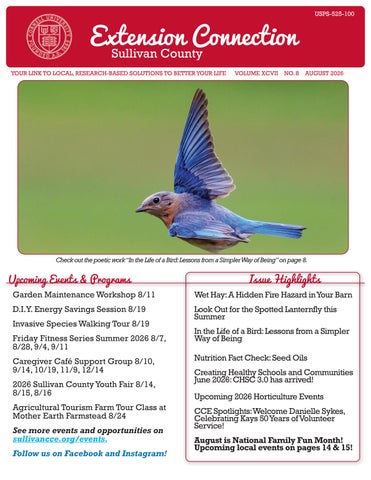
Check out the poetic work “In the Life of a Bird: Lessons from a Simpler Way of Being” on page 8.

Upcoming Events & Programs Issue Highlights Issue Highlights ssue Upcoming Events & Programs
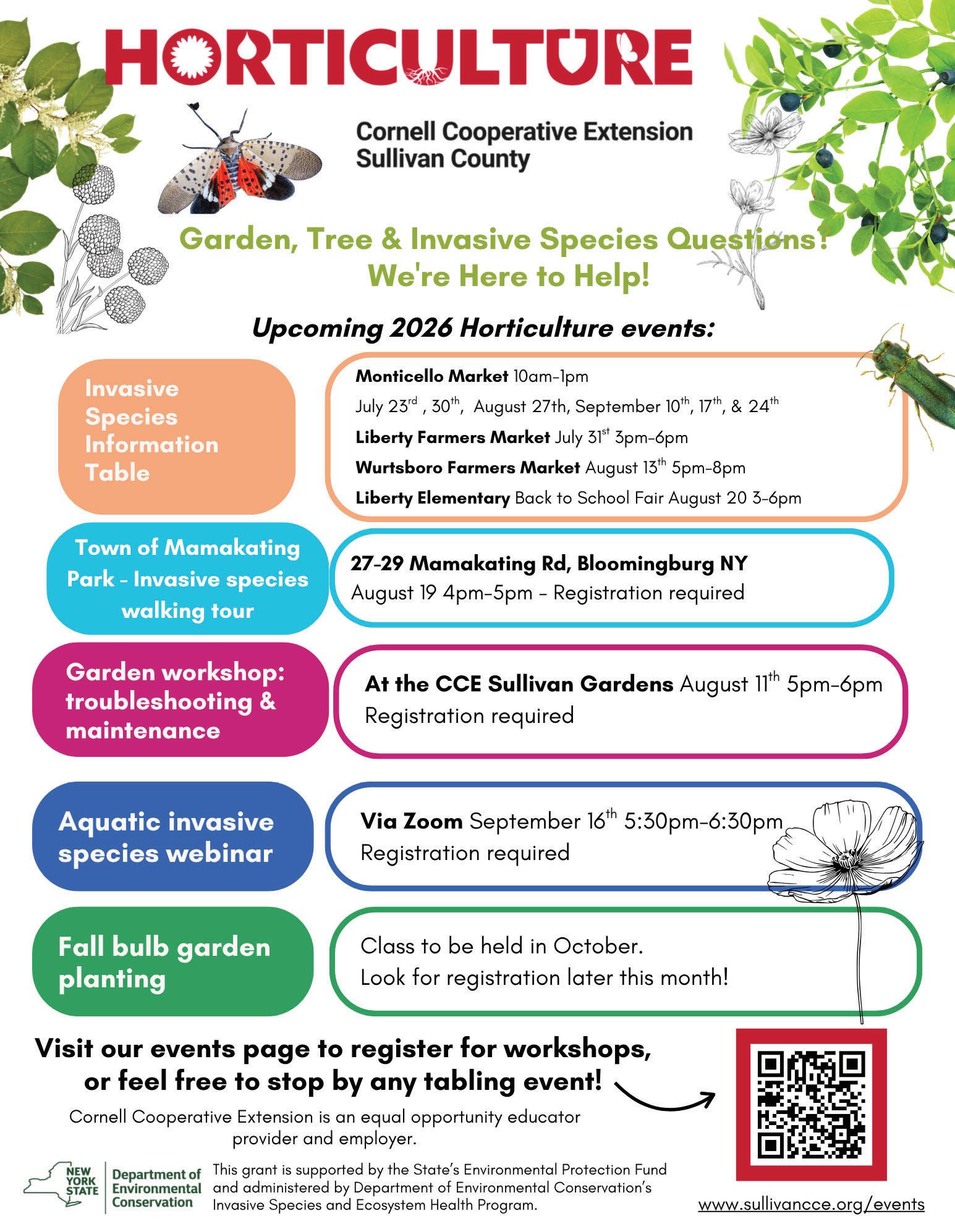
Garden Maintenance Workshop 8/11
D.I.Y. Energy Savings Session 8/19
Invasive Species Walking Tour 8/19
Friday Fitness Series Summer 2026 8/7, 8/28, 9/4, 9/11
Caregiver Café Support Group 8/10, 9/14, 10/19, 11/9, 12/14
2026 Sullivan County Youth Fair 8/14, 8/15, 8/16
Agricultural Tourism Farm Tour Class at Mother Earth Farmstead 8/24
See more events and opportunities on sullivancce.org/events.
Follow us on Facebook and Instagram!



Wet Hay: A Hidden Fire Hazard in Your Barn
Look Out for the Spotted Lanternfly this Summer
In the Life of a Bird: Lessons from a Simpler Way of Being
Nutrition Fact Check: Seed Oils
Creating Healthy Schools and Communities
June 2026: CHSC 3.0 has arrived!
Upcoming 2026 Horticulture Events

CCE Spotlights: Welcome Danielle Sykes, Celebrating Kays 50 Years of Volunteer Service!
August is National Family Fun Month! Upcoming local events on pages 14 & 15!


Welcome to the Issue!
Page 3 2026 Sullivan County Youth Fair
Page 4
Wet Hay: A Hidden Fire Hazard in Your Barn
Page 6 Look Out for the Spotted Lanternfly this Summer
Page 8 In the Life of a Bird: Lessons from a Simpler Way of Being
Page 12 CCE Spotlights!

Page 13 June DHI Report
Page 14 Fast Facts
Page 16 Nutrition Face Check: Seed Oils
Page 18 Creating Healthy Schools and Communities in Sullivan County
Page 20 Creating Healthy Schools and Communities
June 2026: CHSC 3.0 has arrived!

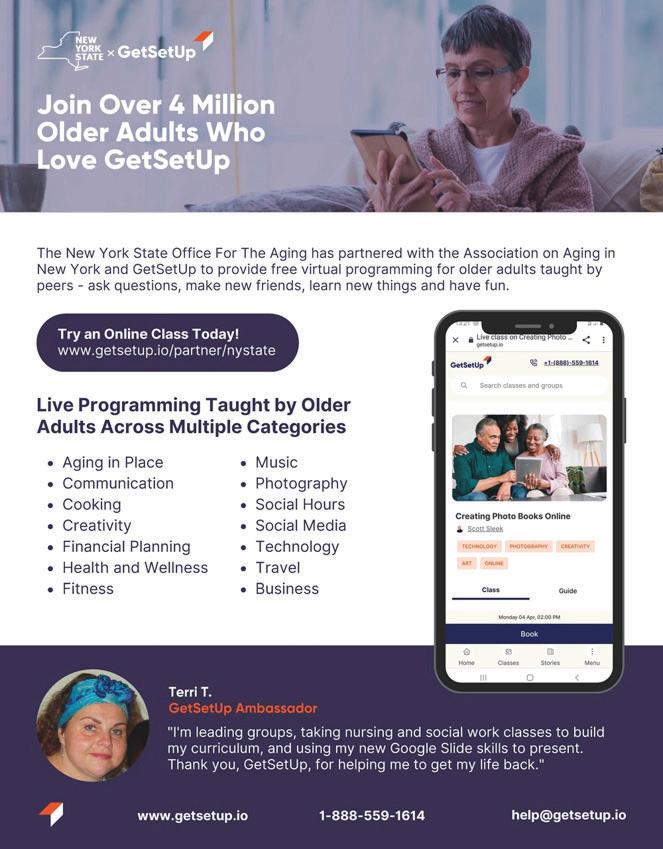
Page 21 The GetSetUp Program
Page 22 Upcoming Horticulture Events
Page 23 Thanks to our Sponsors!
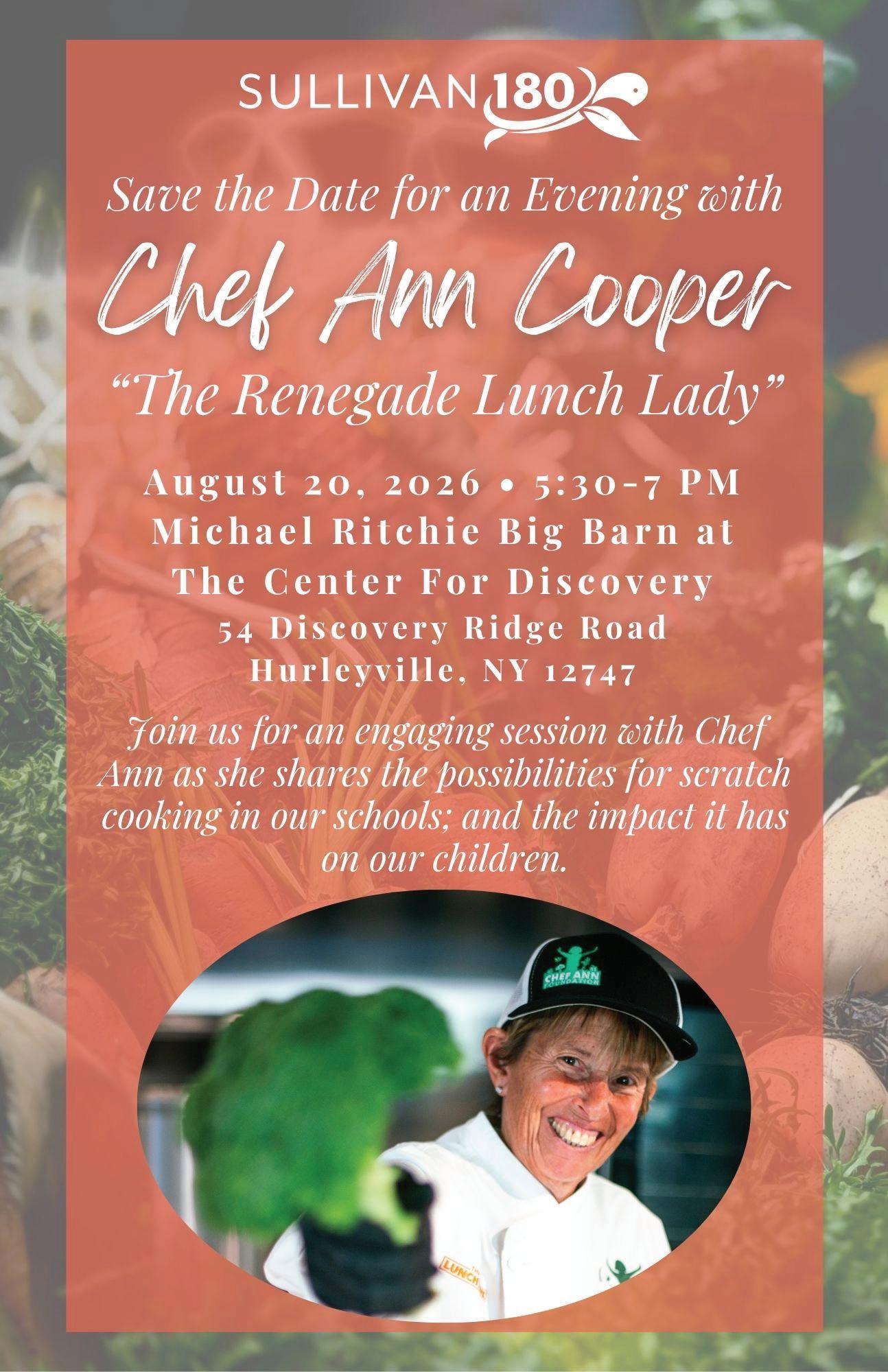
Page 24 An Evening with Chef Ann Cooper “The Renegade Lunch Lady”

NotifyCCESullivan if you have
Notify CCE Sullivan if you have a change of address: 845-292-6180
sullivan@cornell.edu
OFFICE HOURS
Hours: Mon - Fri | 8:30 am to 4:30 pm
Phone: 845-292-6180
E-mail: sullivan@cornell.edu
Website: www.sullivancce.org
Facebook.com/ccesullivanagfood
Instagram.com/ccesullivan
YouTube: bitly.com/ccesullivan
BOARD OF DIRECTORS
Dawn Parsons.......................President
Alex Alorro...................Vice President
Robert Kaplan.......................Secretary
John Garigliano.....................Treasurer
Brian McPhillips...........Legislative Rep.
Patricia Claiborne.............Cornell Rep.
Stacey Johnson
John (JP) Lang
Erika Malmgreen
Mark McLewin
Jennifer Mitchell
Meaghan Mullally-Gorr
Laura Quigley
Gary Silver
Gary Silverman
Diana Weiner
PROGRAM COMMITTEE
Heather Brown
Roberta Chambers
Nu El
Courtney Hanback
Carmela Hugel
Cathi Paci
Carol Roig
Stephen Stuart
Eugene Thalmann
Deborah Worden
EXTENSION CONNECTION
Produced by: Cornell Cooperative Extension Sullivan County
Edited by: Aaron Denman, Katie Gasior & Nicole Slevin Nikolados Cornell Cooperative Extension Sullivan County provides equal program and employment opportunities.
NOTICE: Official endorsement of advertisers and their products is not intended by the acceptance of their sponsorships for the Extension Connection.
STAFF MEMBERS
Colleen Monaghan..............................................................................Executive Director
Tracy Broyles...............................................................................SALT Program Manager
Alan Carroll...................................................................Food Systems Program Manager
Luciana Carvo...................................................STNY/Sullivan Fresh Market Coordinator
Lynn Colavito..............................................Community Cupboard Program Coordinator
Martin Colavito...........................................................Prevention Programs Issue Leader
Wanda V. Cruz...............................................Healthy Communities Program Coordinator
Aaron Denman.........................................................Association Operations Coordinator
Jessica Doyle.............................................................................4-H Program Coordinator
Katie Gasior........................................................................Horticulture Subject Educator
Jenna Gangel...................................................................Shop Taste NY Market Manager
Joy Leon.................................................................Nutrition & Physical Activity Educator
Isabel Lutz.......................................................................................................................Custodian
Kim McDonnell............................................................................................TNY Market Manager
Nancy McGraw.................................Team Leader/Educator, Caregiver Resource Center
Melinda Meddaugh.......................................................Ag & Food Systems Issue Leader
Tess Isabel Molina Bayly.............................FORx Youth Prevention Program Coordinator
Barbara Moran................................................4-H Youth Development Program Manager
Luis Ocasio........................................................................Prevention Program Coordinator
Patricia Ocasio...................................................................Prevention Program Coordinator
Shanice Owens..............................................Community Cupboard Program Coordinator
Abyssinia Pla El...................................................................................Finance Coordinator
Monica Ponce-Agredano ...............................................................Ag. Program Assistant
Michelle Proscia...........................................................Ag. Production Program Manager
Danielle Sykes.................................................4-H Animal Science Program Coordinator
Robert Skotch..............................................................Sullivan Fresh Market Coordinator
Nicole A. Slevin Nikolados.............................................Senior Administrator, Operations
Tara VanHorn.........................................................................................Finance Manager
Malinda Ware.................................................Statewide Strategic Engagement Specialist
John Wilcox..........................................................................................Facilities Manager
Veronica Yangis.........................................................................Taste NY Operations Coordinator
Hailee Crum, Julieth Melendez, Billy Wells.............................................Ag Market Coordinators


CominginAugust!

CHECKOUTGOODS PRODUCEDBY4-HYOUTH! S Y Coming in August!

SULLIVANCOUNTY YOUTHFAIR
AUGUST14TH-16TH
AUGUST 14TH - 16TH
GRAHAMSVILLE FAIRGROUNDS FOR MORE INFORMATION, VISIT
S U L L I V A N C O U N T Y 4 - H
U L L I V A N C O U N T Y O U T H F A I R L I V E S T U C T I O N
GRAHAMSVILLEFAIRGROUNDS FORMOREINFORMATION,VISIT SULLIVANCCE.ORG/EVENTS!
SULLIVANCOUNTY4-H LIVESTOCK&AG.PRODUCTAUCTION
SUNDAY,AUGUST16TH
SUNDAY, AUGUST 16TH
GRAHAMSVILLE FAIRGROUNDS, UPPER RING PREVIEW STARTS AT 12:00, AUCTION BIDDING AT 1:00
GRAHAMSVILLEFAIRGROUNDS, UPPERRING
PREVIEWSTARTSAT12:00, AUCTIONBIDDINGAT1:00
4-HARTISANMARKET
4 - H A R T I S A N M A R K E T
HAPPENINGALLWEEKENDLONGIN THE4-HYOUTHBARN!
HAPPENING ALL WEEKEND LONG IN THE 4-H YOUTH BARN! CHECK OUT GOODS PRODUCED BY 4-H YOUTH!


WET HAY: A HIDDEN FIRE HAZARD IN YOUR BARN
Written and submitted by Michelle Proscia, Ag. Production Program Manager
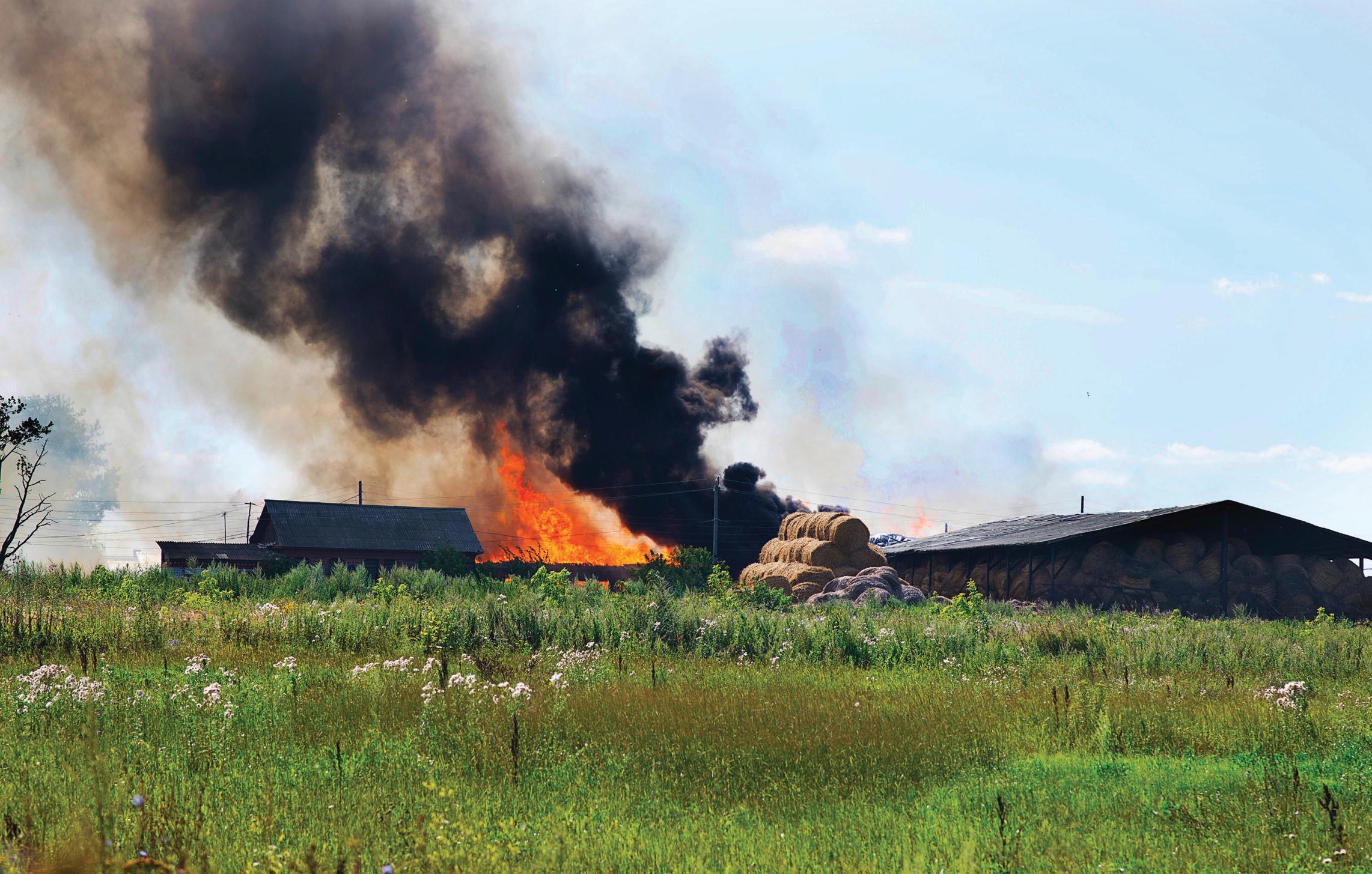
Every summer, barns across the region are lost to fires that start not with a spark, but with hay that was baled just a little too wet. Spontaneous combustion in stored hay is one of the leading causes of barn fires, and it is almost entirely preventable.
How Wet Hay Catches Fire
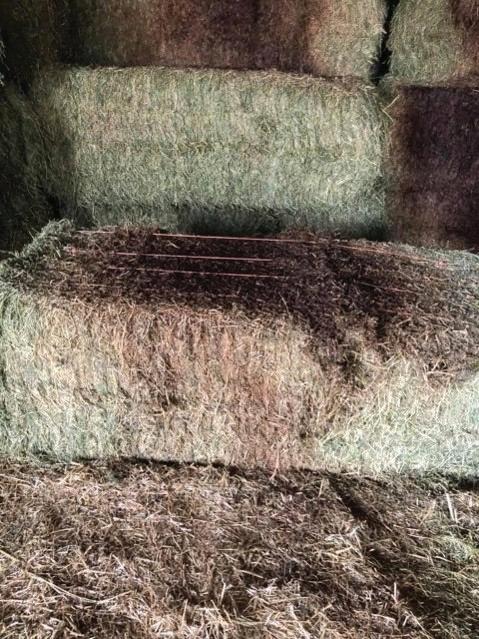
Hay baled at moisture levels above 20 percent creates ideal conditions for microbial growth. As bacteria and fungi feed on the plant material, they generate heat. In a tightly packed bale or stack, that heat cannot escape. Once internal temperatures climb past 130°F, heattolerant microbes and chemical reactions take over, and temperatures can continue rising on their own. At around 175°F and above, the hay can ignite, often two to six weeks after baling, when many producers assume the danger has passed.
in stored hay:
• A slight caramel or musty odor, or a smell like burning tobacco
• Visible steam or condensation on the barn roof or walls
Know the Warning Signs
Watch for these red flags
• Hay that feels hot to the touch or has settled unevenly
• Mold growth, which
signals the heating process is underway
Monitor Temperatures
For the first six weeks after storage, check hay temperature regularly using a probe thermometer on a long rod driven into the center of the stack.
Use this guide:
• Below 130°F: Normal. Continue routine checks.
• 130–140°F: Recheck daily; heating is occurring.
• 150°F: Move hay to allow air circulation and check every few hours.
• 175°F or higher: Call the fire department before moving any hay. Shifting hot bales introduces oxygen and can trigger open flames.
Never walk directly on top of heated haystacks! Fire can burn cavities beneath the surface that will not support your weight.
Prevention Starts in the Field
The best protection is baling at the right moisture: below 20 percent for small square bales and below 18 percent for large round or square bales, which shed heat more slowly. If weather forces you to bale wetter hay, consider a preservative, store suspect bales separately
from the barn, and stack loosely to allow airflow.
A few minutes with a hay probe could save your barn, your winter feed supply, and possi bly your livestock. When in doubt, check it out and keep monitoring until temperatures hold steady.
*Contact the Ag team for hay probe recommendations or moisture testing assistance.*
This material is based upon work supported by USDA/NIFA under Award Number 2024-7002742540.
LOOK OUT FOR THE SPOTTED LANTERNFLY THIS SUMMER
Written and submitted by Katie Gasior, Horticulture Subject Educator
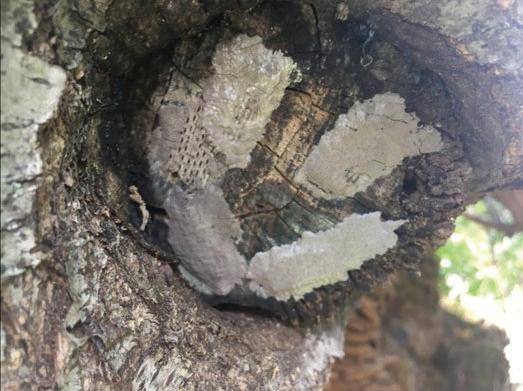
Summer is officially in full swing! Birds are chirping, bees are buzzing- and the notorious spotted lanternfly (SLF) is about to hit it’s third instar! This is still a nymph stage, but almost a full adult (see instar stages in photo). SLF has been in Sullivan County for a few years now, but based on the enormous population we saw in Orange County last season, we might be seeing a rise in their numbers here.
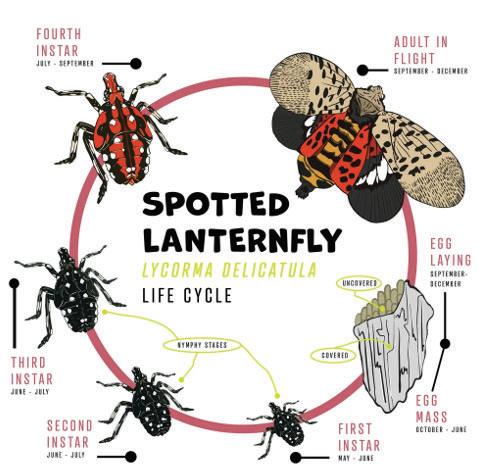
If you are not familiar with them, the spotted lanternfly (Lycorma delicatula) is an invasive insect that continues to spread through New York State, so residents should be aware and have the ability to identify the pest. This invasive leafhopper does not sting or harm humans – but it does harm trees, ornamental landscapes, and
agricultural crops. SLF is a sapsucker – they use piercing mouthparts to feed and cause damage to stems and bark leaving the plants vulnerable to disease, and cause loss of overall vigor. They feed on grapevines, hops, maple, black walnut, willow, birch, and fruit trees – among many others. One important indication of SLF to watch for are
the insect’s egg masses. Females are able to lay eggs pretty much anywhere, including trees, wood, patio furniture, trailers, stone, and any type of vehicle. Egg masses are laid from late summer through the fall and resemble gray putty (pictured in photo). As they dry out, the putty can become crackled giving it a dried mud appearance and individual egg sites become more visible. Egg masses are easier to
look for when the trees are bare during colder weather.
A large infestation of SLF produces sticky honeydew from the insect -- covering leaves and outdoor surfaces. This attracts stinging insects like wasps and bees. Honeydew encourages the growth of black sooty mold as well, which is unsightly and diminishes the plant’s ability to photosynthesize.
Residents can help slow the spread by inspecting their trees and outdoor patio furniture for SLF egg masses, and reporting adults through iMapinvasives.org. If you find an egg mass scrape it into a container of rubbing alcohol or hand sanitizer to destroy the eggs.
This grant is supported by the State’s Environmental Protection fund and administered by Department of Environmental Conservation’s Invasive Species and Ecosystem Health Program.
Visit Crisp.org and https://dec.ny.gov/ nature/invasive-species for more information -and keep a look out!
In the Life of a Bird: Lessons from a Simpler Way of Being
Submitted by Malinda Ware, Statewide Strategic Engagement Specialist
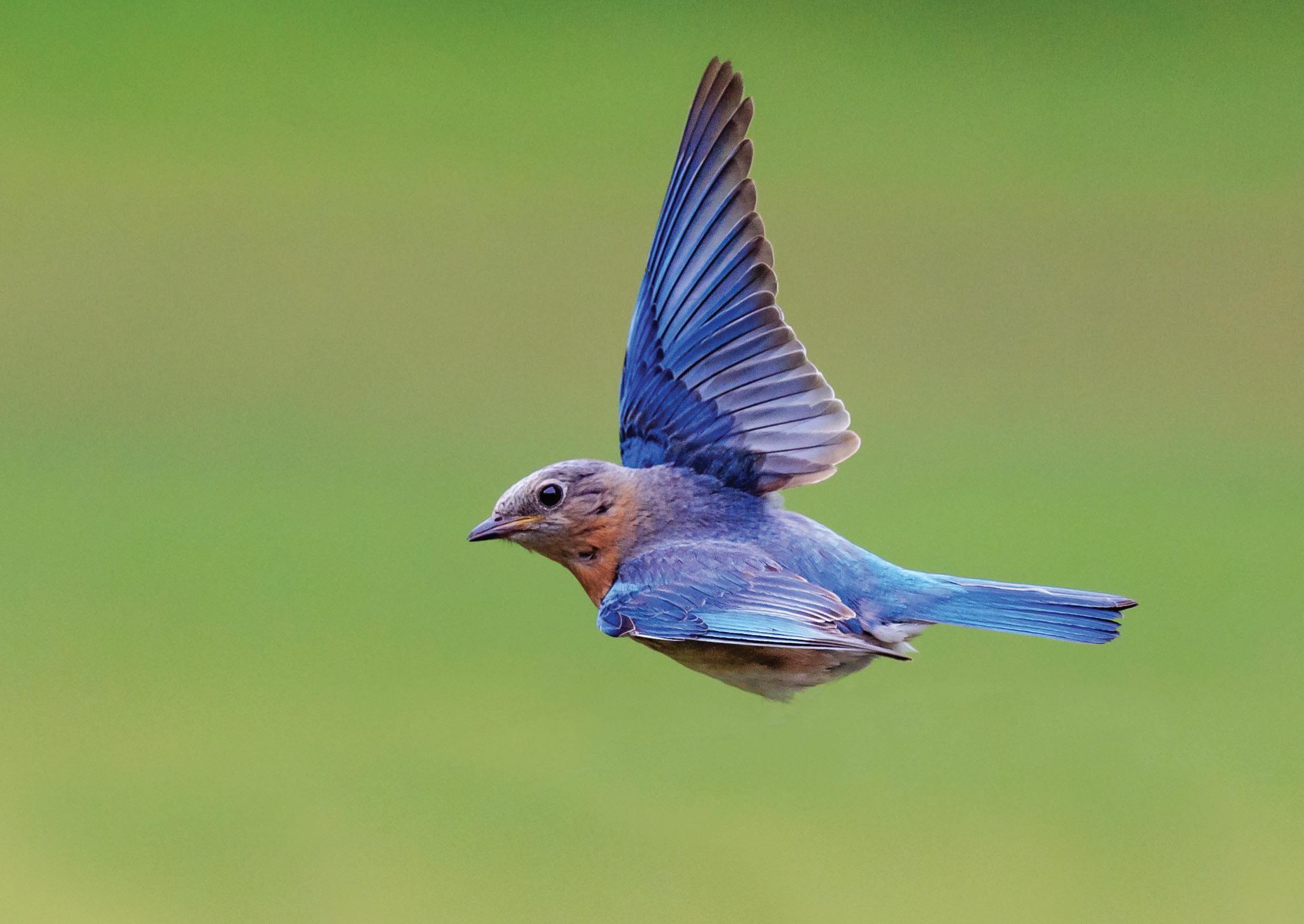
This morning, I watched a bird.
Not through a screen. Not through a photograph. Not through someone else's video.
I simply watched.
It hopped along a branch, paused, tilted its head as if listening to a conversation only it could hear, and then took ight. There was no rush. No schedule to manage. No list of things to accomplish. No worry about yesterday or anxiety about tomorrow.
It was simply being a bird.
And I wondered...
What if we could learn something from them?
In the life of a bird, there is a beautiful simplicity.
A bird wakes with the sunrise.
It searches for nourishment.
It sings because it has a song.
It builds because it knows how.
It rests when it is tired.
It ies when it is time to go.
It does not spend its day comparing itself to another bird. It does not wonder if its feathers are the right color, if its nest is large enough, or if another bird is ying higher.
It simply lives the life it was given.
Yet humans, with all our intelligence and innovation, often make life much more complicated.
We rush from one appointment to another.
We ll every quiet moment with noise.
We worry about things that haven't happened and replay things we cannot change.
We measure our worth by what we own, what we accomplish, and how others see us.
We chase more, even when we already have enough.
Somewhere along the way, many of us have forgotten the beauty of simplicity.
A bird does not need a calendar reminder to appreciate the morning.
It does not need permission to sing.
It does not wait for the perfect moment to spread its wings.
It just does what it was created to do.
Perhaps that is the lesson.
Not that we should live like birds, but that we should remember parts of ourselves that have become buried beneath the weight of modern life.
When was the last time we sat quietly and listened?
When was the last time we noticed the changing colors of the sky?
When was the last time we enjoyed a moment without needing to capture it, share it, or prove it mattered?
Birds remind us that life does not always have to be complicated to be meaningful.
A small nest can be a home.
A morning song can be a celebration.
A gentle breeze can be a reason to y.
Maybe happiness is not always found by adding more.
Maybe sometimes it is found by returning to less.
Less rushing.
Less comparing.
Less worrying.
Less distraction.
More noticing.
More gratitude.
More connection.
More being present.
The bird does not know what tomorrow holds, yet it wakes and sings anyway.
It does not carry yesterday's storms into today's sky.
It does not apologize for taking up space.
It does not question whether it deserves to y.
It simply opens its wings.
And maybe we can learn something from that.
Maybe we can remember that we, too, were created to experience wonder.
To breathe deeply.
To appreciate small moments.
To nd joy in ordinary things.
To be present for the life happening right in front of us.
So the next time you see a bird sitting on a branch or soaring across the sky, pause for a moment. Watch. Listen. Re ect.
A bird's life may appear simple.
But perhaps that simplicity holds a wisdom we desperately need.
Because in a world that constantly tells us to do more, have more, and become more...
Maybe the greatest gift is remembering how to simply be.
CCE Sullivan Spotlights
Staff Spotlight
WELCOME
DANIELLE SYKES, 4-H ANIMAL SCIENCE PROGRAM COORDINATOR
Danielle Sykes joins Cornell Cooperative Extension Sullivan County as the 4-H Youth Development Animal Science Program Coordinator. 4-H has played a huge role in her life. She started out as a Cloverbud and aged out of the program. Not long after she became a leader of the 4-H Moo-Juicers. She also took on the role as the Youth Fair Dairy Superintendent. She
Volunteer Spotlight
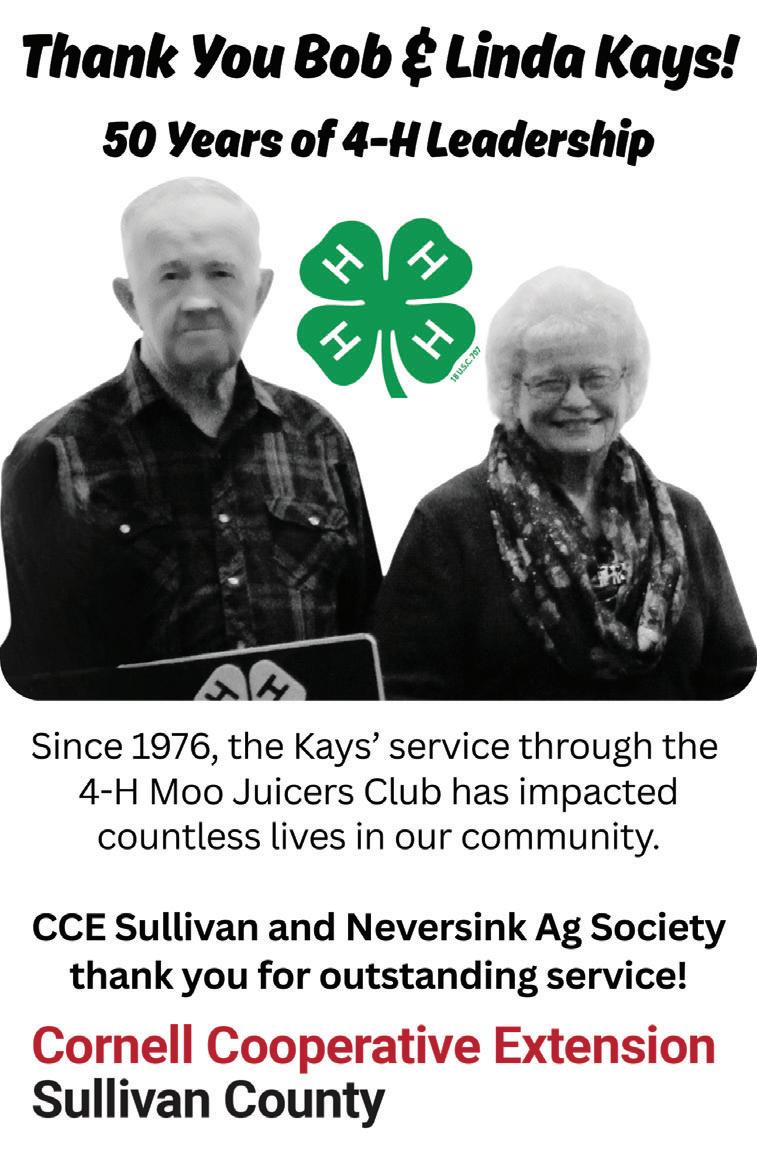
CELEBRATING KAYS 50 YEARS OF VOLUNTEER SERVICE
Bob and Linda Kays met at the Sussex County Fair in New Jersey, where Bob showed Ayrshire dairy cows. They married in 1963 and rented a small dairy farm in New Jersey. In 1968 they bought the family farm in Callicoon, where they still live now, having raised five children and starting a trucking business, too.
In 1976 Bob and Linda started the only dairy based 4-H club in Sullivan
has also enjoyed helping her younger siblings and cousins get ready for the fair and eventually helped other youth in her club excel in the dairy program. The fair has always been a highlight of her year. After a decade of volunteering in 4-H, she is excited to take on the role as the Animal Science Program Coordinator.
Aside from 4-H, she works on her family’s dairy farm where she milks cows, feeds calves, breeds cows, keeps up to date records and practices other herd management skills daily. When she’s not on the farm, she likes to spend time with her family or relaxing at home with her fiancé and dog.
County, the 4-H MooJuicers. Over 50 years, the Kays have mentored hundreds of Sullivan County kids and even have children of former club members in the 4-H MooJuicers now!
Linda also served as the 4-H Dairy Superintendent at the Sullivan County Youth Fair for many years, ensuring a full, clean barn, complete with educational displays and flowers to showcase Sullivan County agriculture and the next generation of farmers. We are so grateful for their dedication and service to 4-H and families across the County.














August Focus: Fast Facts, Cool Tools, & News to Use






















August is National Family Fun Month! Check out the fun stuff happening this month!













































All events listed are located in Sullivan County!















Saturday, August 1st, 11:00 am
The Forestburgh Playhouse

































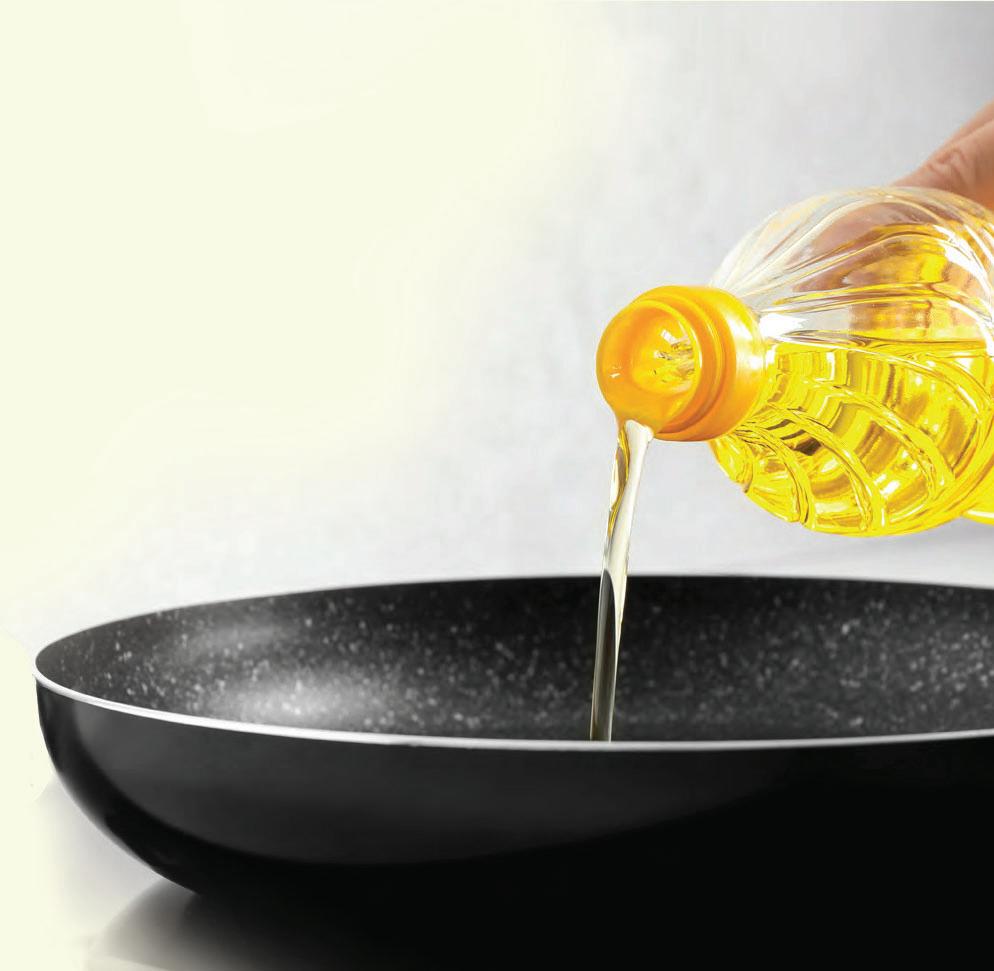
Seed Oils
What are seed oils?
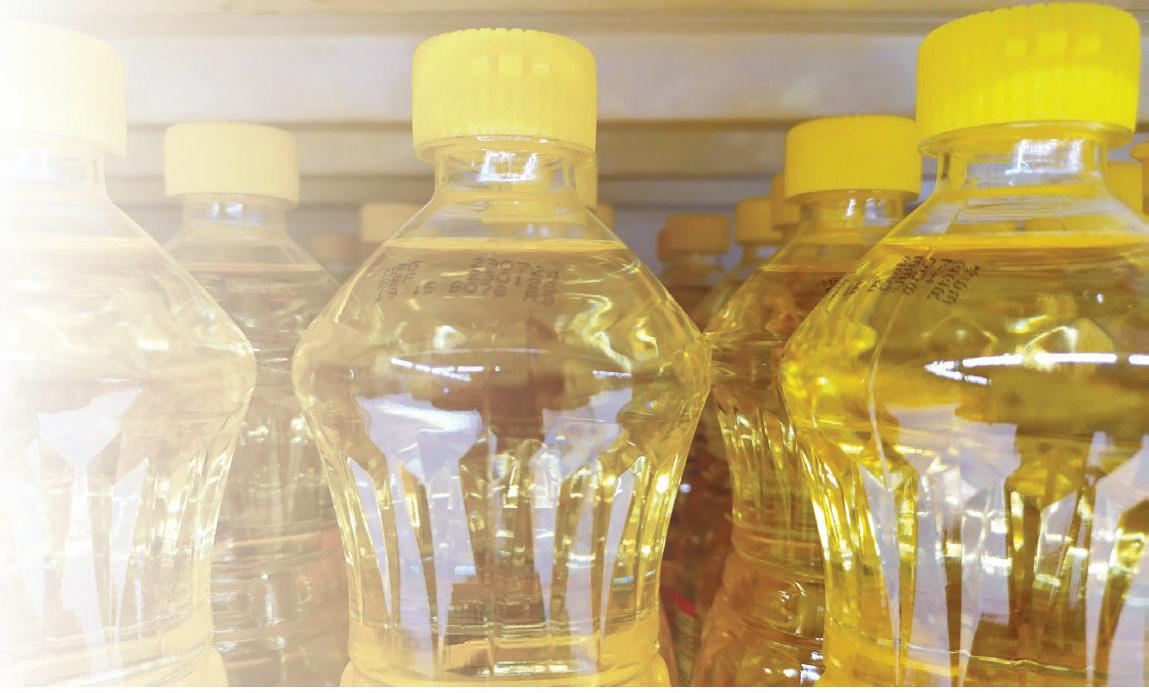
The most well-known seed oils are canola, soybean, sa f ower, corn, cottonseed, grapeseed, rice bran and peanut oils. Seed oils provide saturated, monounsaturated (MUFAs) and polyunsaturated fats (PUFAs). PUFAs are often present in the highest amounts and are the hot topic of today’s conversations on seed oils.
Research supports
Current research supports using seed oils as part of a balanced diet, particularly as alternatives to saturated fats. While some concerns remain about inflammation or oxidative effects, most studies don’t find these effects when seed oils are consumed in typical dietary amounts. Credentialed health professionals continue to recommend seed oils over animal fats due to their potential to lower cardiovascular risk. As with any fat, seed oils are best used in moderation alongside a diet that emphasizes whole, minimally processed foods.
Seed oils and your health
Omega fatty acids
Omega fatty acids are often categorized as omega-3s are “good” and omega-6s are “bad,” but there is no evidence to support this statement.
•Omega-3 fatty acids (found in foods such as fatty fish, walnuts, chia and flax-seeds) can help support brain and heart health.
•Omega-6 fats are beneficial for lowering the risk of heart disease.
Inflammation
•Linoleic acid, the main omega-6 in seed oils, can convert to arachidonic acid, a precursor to inflammation. However, only a small amount is converted and higher omega-6 intake is linked to better heart health.
•While omega-3s have strong anti-inflammatory effects, there’s no clear evidence that omega-6s are pro-inflammatory.
Toxicity
•Many seed oils are processed at high temperatures, which can create harmful toxic products; these are mostly removed during refining. Cold pressed or expeller pressed oils avoid chemicals but have lower smoke points for cooking, shorter shelf lives and are more expensive.
Lower mortality risk
A study found that:
• High intake of plant-based oils was associated with a 16% lower risk of total mortality; high butter intake had a 15% higher risk
• Canola, soybean and olive oils were especially associated with lower mortality
• Replacing butter with plant oils reduced total and cancer mortality by 17%.
• Higher plant oil intake lowered cancer mortality risks by 11% and cardiovascular risks by 6%
Cholesterol and blood sugar
• Studies have found that vegetable/seed oils high in MUFAs and PUFAs – such as canola, rice bran and olive oil—may help reduce total and LDL cholesterol, improve blood sugar control and support weight management.
• Multiple reviews show that higher intake of linoleic acid (higher PUFA) and replacing SFA with LA/PUFAs can improve heart health and lower type 2 diabetes risk.
• A 2025 review indicated that seed oils like canola, flaxseed and sesame improve lipid profiles, blood sugar control and may reduce oxidative stress.
Healthy ways to use seed oils
• Substitute for some of the solid fat in baked goods, such as whole-grain muffins
• Season a cast iron skillet
• Oil grill grates to keep food from sticking
• Roast vegetables in the oven to get a toasted flavor
• Stir-fry meat and vegetables
• Pop popcorn on the stove
• Make salad dressings—the fat in oils increases the absorption of fat-soluble vitamins A, E and K that are in leafy greens
• More recipes featuring healthy fats are available on eatright.org For more evidence-based information on nutrition topics that are in the news, visit: eatrightPRO.org/NutritionFactCheck

Note from the Academy of Nutrition and Dietetics: The information in this document is from the Academy’s scientific summary of seed oils, which reflects findings from evidence-based research and is a high-level overview of seed oils; this summary is not a comprehensive deep-dive on the topic. This information is up to date as of June 2025.
Creating Healthy Schools and Communities in Sullivan
County
Written
and submitted by
Wanda V. Cruz, Healthy Communities Coordinator
Cornell Cooperative Extension Sullivan County is fortunate to be awarded a ve-year grant (for the third time), funded by the New York State Department of Health (NYSDOH) Creating Healthy Schools and Communities (CHSC).
Every ve years, also known as (aka) CHSC 1.0, 2.0, and now 3.o, the CHSC grant has come with changes that make the coming ve year’s initiatives a little di erent from those in the past. Although they have included new program initiatives, one consistent focus has been on schools and communities. Some changes will occur with partners, locations, and sta but the work will continue to focus on improving health and strengthening schools and communities at a systems level.
COMMUNITIES - The FIRST ve-years (CHSC 1.o) focus included government, community-based organizations, schools, hospitals, faith-based organizations, grocery stores, gas stations, convenience stores, supermarkets, pantries, cafeterias, cafés, vending machines, businesses with more than 10 employees, and other partners. Policies and infrastructure implementations were related to Complete Streets, Worksite Wellness, Physical Activity Access, and Nutrition.
Comprehensive Plans and other policies were adopted to implement projects related to nutrition, physical activity, and complete streets. What began as a blank canvas evolved into a vibrant picture of progress, with projects emerging and making their mark across Sullivan County.
COMMUNITIES - The second ve-year round of funding (CHSC 2.0) introduced unexpected changes and several new initiatives. We viewed this phase as an opportunity to build upon and enhance projects launched during CHSC 1.0 while also creating new ones.
Rather than Complete Streets, the new initiative had been changed to Active Friendly Routes for Everyday Destinations. That included projects related to Safe Routes to Schools, Safe Routes to Parks, Vision Zero, and Active Friendly Routes for Everyday Destinations.
New and improved municipal workplans were created, while worksite wellness and physical activity initiatives were changed to “Food Service Guidelines” and included all areas of nutrition.
COMMUNITIES
- A third ve-year (CHSC 3.0)
2026-2031 CHCS grant was again awarded to CCE Sullivan County. This iteration comes with even more changes that will assist communities to expand the policy and systems work for physical activity and nutrition environments they have completed while also allowing for some new projects.
New initiatives, new adventures. CHSC 3.0 is expected to reduce health disparities with chronic conditions related to hypertension, heart disease, type 2 diabetes, and obesity.
The NYSDOH Division of Chronic Disease Prevention’s mission is to provide New Yorkers with opportunities for healthier lives. Integrating policies, systems, and environmental improvements that support health in all communities where New Yorkers live their day-to-day active living, eating, playing, working, and learning. It’s at its best when incorporating racial justice and equity practices throughout the program, its practices, and policies.
CHSC 3.0 will have a variety of programs that will include:
Fruit and Vegetables program expansion
Physical Activity and Nutrition Best Practices in Early Care (ECE) and Education
Community Design for Physical ActivityConnecting Active Friendly Routes to Everyday Destinations
Schools Strategies: Physical Activity and Nutrition
Educating our communities and partners while also providing them with access to our national partners has always been a part of what we do and is imperative for accomplishing all CHSC requirements successfully.
Building on the Past Ten Years
During CHSC 1.o we sponsored a training and workshop where Mark Fenton and Emiko Atherton, former Director for Smart Growth America and president of the National Complete Streets Coalition participated with our local partners and held events as speakers.
During CHSC 2.0 we again tapped into our national partners to assist two local partners with speakers such as Ian Thomas - Director of America Walks and Jessica G. Rich former Safe Streets 4A Program Manager for the Federal Highway Administration O ce of Safety.
A zoom conference was held on “Funding for Safe Routes” with local, state, and federal representation. Speakers included: Ian ThomasState & Local Director for American Walks, David P. Orr PE, PHD - Cornell University Director for Local Roads Program and NYS LTAP and Hillary Isebrands PE, PHD - Federal Highway Administration Resource Center O ce of Innovation Implementation Sr.
Safety Engineer Team Leader and Safety and Design Technical Service
Team, along with local county and not-for-pro t leaders, including County planning, public health, and Sullivan 180.
We expect CHSC 3.0 will build upon the past ten years of progress, with a focus on strengthening food systems policies and physical activity. We will provide updates in the coming months as we launch CHSC 3.0!
This work was supported by Creating Healthy Schools and Communities (CHSC), a five-year New York State Department of Health funded initiative, helping to build stronger, healthier communities.