Extension Connection
USPS-525-100
Sullivan County
YOUR LINK TO LOCAL, RESEARCH-BASED SOLUTIONS TO BETTER YOUR LIFE
VOLUME XC NO. 8
AUGUST 2019
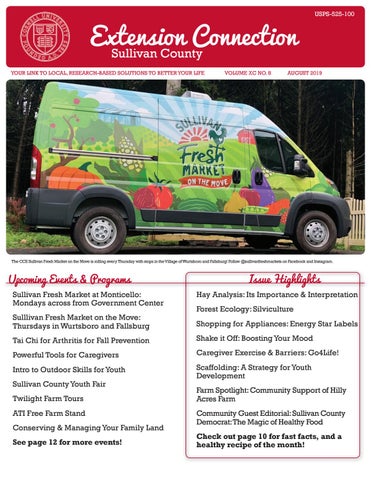
The CCE Sullivan Fresh Market on the Move is rolling every Thursday with stops in the Village of Wurtsboro and Fallsburg! Follow @sullivanfreshmarkets on Facebook and Instagram.
Upcoming U pcoming Events Events & Programs Programs Sullivan Fresh Market at Monticello: Mondays across from Government Center Sulllivan Fresh Market on the Move: Thursdays in Wurtsboro and Fallsburg
Issue Isssue sue Highlights Higghhligghhts Hay Analysis: Its Importance & Interpretation Forest Ecology: Silviculture Shopping for Appliances: Energy Star Labels
Tai Chi for Arthritis for Fall Prevention
Shake it Off: Boosting Your Mood
Powerful Tools for Caregivers
Caregiver Exercise & Barriers: Go4Life!
Intro to Outdoor Skills for Youth
Scaffolding: A Strategy for Youth Development
Sullivan County Youth Fair Twilight Farm Tours ATI Free Farm Stand Conserving & Managing Your Family Land See page 12 for more events!
Farm Spotlight: Community Support of Hilly Acres Farm Community Guest Editorial: Sullivan County Democrat: The Magic of Healthy Food Check out page 10 for fast facts, and a healthy recipe of the month!
Welcome W elcome to to the the Issue! Issue!
Table Table of of Contents Contents
Page 3 Message from the Executive Director
Page 10 Fast Facts, Cool Tools, and News to Use!
Page 18 Caregiver Exercise & Barriers: Go4Life!
Page 4 Hay Analysis: Its Importance & Interpretation
Page 11 Eat Smart NY Featured Healthy Recipe
Page 19 Scaffolding: A Strategy for Youth Development
Page 6 Forest Ecology: Silviculture
Page 12 Upcoming Programs
Page 8 Shopping for Appliances: How to Read Energy Star Labels
Page 13 Community Guest Editorial of the Month
Page 20 Sullivan County Youth Fair Schedule Aug 15-18
Page 8 DHI Report
Page 14 CCESC Spotlights
Page 9 Shake It Off: Boosting Your Mood
Page 16 Sponsorships
The Extension Connection (USPS-525-100) is published monthly for $25.00 enrollment by Cornell Cooperative Extension Sullivan County, located at 64 Ferndale-Loomis Road, Suite 1, Liberty, NY 12754-2903. Entered at Liberty, New York, as a periodical class matter. Acceptance for mailing at special rate of postage provided for in section 412, Act of February 24, 1925. POSTMASTER: Send address changes to Extension Connection, 64 Ferndale-Loomis Road, Suite 1, Liberty, NY 12754-2903.
OFFICE HOURS
EXTENSION CONNECTION
8:30 am to 4:30 pm Monday-Friday Phone: 845-292-6180 E-mail: sullivan@cornell.edu Website: www.sullivancce.org
Edited by: Nicole Slevin & Colleen Monaghan Designed by: Centermost Marketing, LLC
Twitter.com/ccesullivan Facebook.com/ccesullivan Instagram.com/ccesullivan YouTube: bitly.com/ccesullivan
NOTICE: Official endorsement of advertisers and their products is not intended by the acceptance of their advertisements for the Extension Connection.
Produced by: Cornell Cooperative Extension Sullivan County Cornell Cooperative Extension Sullivan County is an employer and educator recognized for valuing AA/EEO, Protected Veterans, and Individuals with Disabilities and provides equal program and employment opportunities.
STAFF MEMBERS
Colleen Monaghan............................................................................Executive Director SueAnn Boyd.......................................................Healthy Schools Program Coordinator Kaitlyn Conklin...........................................................................................4-H Educator Wanda V. Cruz.............................................Healthy Communities Program Coordinator Robert Kaplan..............................President Jessica Glassel.....................................................................................Finance Assistant Amy Erlwein......Vice President & Secretary Marylin Jones..........................................................................4-H Program Coordinator John Kiefer...................................Treasurer Bridget Kackos...................................................................................Program Assistant Nadia Rajsz........................Legislative Rep. Bonnie Lewis..........................................................................Dependent Care Educator Todd Brown Erica Lynch.........................................................Catskills Kitchen Program Coordinator Brian Brustman Melinda Meddaugh......................................................Ag & Food Systems Issue Leader Jenny Chamberlain Brenda Miller...........................................Community Horticulture Program Coordinator Marcie Ehrman Barbara Moran...............................................4-H Animal Science Program Coordinator Denise Frangipane John “JP� Lang Bee Moser................................................................................Eat Smart NY Nutritionist Klu Padu Vanessa Pahucki...Hudson Valley Catskills Welcome Center | Taste NY Market Manager Luisa Parker Michelle Proscia.............................................................................Agriculture Educator Dara Smith Nicole Slevin...............................................................Administrator & Diversity Officer George Stang Ashley Tully...............................................................................Administrative Assistant Robert Wong Tara VanHorn.......................................................................................Finance Manager Sean Welsh............................................................................Energy Resource Educator John Wilcox.........................................................................................Facilities Manager
BOARD OF DIRECTORS
Page 2
Extension Connection
August 2019
Greetings, friends! With summer passing right on by, we’re finally drying out and feeling the heat. Please, be sure to wear sunblock and drink LOTS of water to stay safe and healthy! As usual, the CCE Sullivan team is out and about, this year more than ever with the Sullivan Fresh Monticello and Market on the Move Farmers’ Markets, our weekly residency at ENGN in Callicoon, and an array of Taste NY activities including last month’s Catskill Challenge at Bethel Woods Center for the Arts. Leading up to these activities, the CCE Sullivan team worked together to submit about $2,200,000 worth of new grant applications. No, that’s NOT a typo! With any luck, some of these program funds will come through and help to free up general fund dollars for our HVAC system.We’re always accepting capital campaign donations to support the remaining estimated $500,000 worth of modernizations and upgrades to our 32 year old systems. The 4-H Youth Development team is working with tens of volunteers and more than 100 young people on the annual Sullivan County Youth Fair at the 140th Grahamsville Little World’s Fair, hosted by the Neversink Agricultural Society at the Grahamsville Fairgrounds. The third weekend in August is a milestone year for Sullivan County.We’re expecting thousands of visitors to celebrate the 50th anniversary of the Woodstock music festival. Along with that celebration, dozens of special events and activities are happening across the county, giving us an opportunity to show off one of our most important assets,YOUTH! Please come by to see the wonderful work they’ve done this year with their large and small animals, and still project exhibits that range from plants, to photography, to woodworking, arts and crafts, baking, technology, and more. Encourage your friends and neighbors to do the same! Next month, we’ll be announcing our Annual Meeting and Friends of Extension celebration plans, tentatively taking place late October.We’re looking forward to doing something a little different as a thank you for your years of financial, volunteer, and moral support as both the community, and our local Extension, has grown and changed. Until then, stay cool and hydrated. See you at the County Fair!
My veryy best,
Colleen Monaghan, Executive Director cm638@cornell.edu
Extension Connection
August 2019
Page 3
HAY ANALYSIS: ITS IMPORTANCE & INTERPRETATION Submitted by Michelle Proscia, Agriculture Educator
Visual Analysis of Hay for Horses In visual analysis, there are several factors that should be considered.
Having your hay analyzed is a great idea. It is the only way to determine its actual nutrient content. Knowing nutrient content is important to know this so that you can be sure your horse (or other livestock) is consuming an adequate diet. The better the quality of the hay you feed, the less grain you will need to feed, and you may not have to feed any. So, good-quality hay can mean a significant savings. Two kinds of analyses, visual and chemical, can be performed. If you have already purchased hay, then you probably have performed a visual analysis. For a chemical analysis, hay is sampled, and then the nutrient content of the hay is determined by a laboratory.
These include:
Page 4
• Maturity of hay - The more mature, or older, hay is, the more fiber it contains, and the stemmier or unpalatable it will become. • Leafiness of the hay - The more leaves a hay has, the more nutrients it is likely to contain, since nutrients are concentrated in the leaves (where photosynthesis occurs). • Color of the hay - generally the greener, the better (but see the chart below). • Odor and condition of the hay - look for hay that is not musty, dusty, or moldy; throw out any hay that is. • Presence of foreign materials in the hay - can be injurious (poisonous plants, wire) or non-injurious (weeds), but either decreases the overall quality of the hay.
Extension Connection
August 2019
Chemical Analysis of Hay for Horses In order to have your hay analyzed chemically, you will need to obtain a hay sample. Use a core sampler and try to sample from at least 20 to 25 different bales. Be sure to penetrate into the center of the bale with the core sampler. See your county Extension office for information on how to use the core sampler (or to borrow one) if you do not have experience in hay sampling. Mix the samples together and then put them in a tight, clean, plastic bag or in the bag that the forage testing lab provides. Mail the sample to the forage testing lab for analysis as soon as possible. Interpreting your hay analysis results may not be the easiest part of this process. If you cannot determine what the results mean, you may want to consult an Extension specialist in forage crops or agronomy at your county Extension office, an animal
scientist, or a county Extension employee. Some of the main things to focus on when you see the analysis reports are: • Dry Matter (DM) - This tells you how much of the sample is left after water is removed. It is the moisture or dry matter content of the sample. Hay will generally be about 89 percent dry matter or greater. • Digestible Energy (DE) - This is a measure of the digestible energy in the hay. For a light working horse, DE should be 20.5 Mcal/day. Hay may have .76 to .94 Mcal/lb or higher of DE. • Total Digestible Nutrients (TDN) This is a measure of the total digestible nutrients in the hay or its energy value (may be used in place of DE or offered in addition to DE), which may range from 40 to 55 percent. • Crude Protein (CP) - This is a measure of the protein concentration of the hay and can range from 6 to 8 percent in native grass hays to about 15 percent or higher in high quality legume hays. • Neutral Detergent Fiber (NDF) - This is a measure of the plant’s cell wall content, shown as a percent. The higher this is, the less the horse will eat of the hay. • Acid Detergent Fiber (ADF) - This is
a measure of the fiber concentration of the hay, shown as a percent. As ADF increases, digestibility and nutrient availability decrease. • Non-Structural Carbohydrates (NSC) - This is a measure of the non-structural carbohydrates in the feed.
If your horse has Cushing’s disease or is prone to colic or laminitis, you want to select hay with a lower NSC value. Timothy and alfalfa hay may have a 15 percent or 20 percent NSC value, respectively. If you want this analysis done, you should check to see if the lab offers it, as it is not a common analysis at this time. • Starch and Sugar - This is a measure of sugars and starches in the feed. You should feed no more than 15 percent of total daily calories from starch and sugar to horses with EPSM (equine polysaccharide storage myopathy) and PSSM (polysaccharide storage myopathy) EPSM is a muscle disease found in over 100 draft breeds that may cause severe weakness and muscle wasting in horses of all ages, poor performance, abnormal hind limb gaits, and shivers (in which the muscles keep twitching). PSSM is a muscle disease found in horses with Quarter Horse in their breeding such as American
Extension Connection
August 2019
Quarter Horses, Paints, and Appaloosas with signs including reluctance to move, muscle stiffness, sweating, shifting lameness, and tremors in the flank area.
Here is what analysis of a good hay should look like: Hay type DM DE CP NDF ADF Mid-bloom alfalfa 91% 0.94 Mcal/lb 17% 42.9% 33.4% Midbloom smooth brome 87.6% 0.85 Mcal/lb 12.6% 50.5% 32.2% Midbloom timothy 88.9% 0.80 Mcal/lb 8.6% 56.6% 32.3% Now you know some basics about analyzing hay. Be sure to consult your county Extension agents or state specialists for help if you are not sure how to apply these results. By analyzing your hay, you will be able to feed your horse more effectively and efficiently.
Source: NHay Analysis: Its Importance and Interpretation. Middletown, NY. Accessed July 30, 2019. https://s3.amazonaws.com/ assets.cce.cornell.edu/attachments/3794/ Hay_Analysis.pdf?1414588647.
Page 5
FOREST ECOLOGY: SILVICULTURE Submitted by Melinda Meddaugh, Ag & Food Systems Issue Leader Silviculture is perhaps the most important aspect of forestry. Silviculture is defined as the art and science of growing and tending forest crops. Crops? You might ask. Certainly! Trees and forests are a form of agriculture just like a farmer’s corn field, with a few differences like the time required to reach maturity and the obvious height and appearance differences. The science aspect of silviculture draws upon the requirements that trees have for growth and their response to changes in their environment. Components of many sciences are drawn together to help the silviculturist better understand this scientific approach to tree growth. The art aspect of silviculture involves thinking of creative ways to manipulate the forest mosaic to reach desired goals. Communication between the landowner and the forester will inform the forester of the landowner’s goals and will inform the landowner of limitations and expectations associated with various forms of management. An understanding of goals, and limitations will set the general parameters for the silvicultural treatment. A silvicultural treatment is made up of three steps. These steps are regeneration (establishment of the next crop), tending (improvement cuttings and other practices performed on the growing crop) and harvesting (removal of the mature crop). Two predominant forest conditions that influence which treatment to use are even-aged and uneven-aged forest stands. As the names suggest, an even-aged stand is comprised of a community of trees all having comparable ages and the uneven-aged stand is made up of trees of varying ages. Foresters should bring with them knowledge of silviculture through Page 6
education and, most likely, experience. Using forest measurements taken in the field, the forester can determine which silvicultural treatment should be applied to reach the desired outcome. The silvicultural treatments prescribed by the forester are actions that often times alter the forest stand to encourage an accelerated realization of desired goals. Silviculture is an ever-evolving and continually tuned management tool that will hopefully guide sound forestry into the future. Let’s take a look at some common silvicultural treatments: • The selection method of treatment most often used on an uneven-aged stand concentrates on removing mature trees while simultaneously tending the immature trees. This treatment focuses on maintaining a specific spacing and density of remaining trees in the stand and will result in healthy harvests at short time intervals. • The shelterwood method is used in an even-aged stand. The mature trees are removed in two or more successive cuttings. Remaining trees are left to provide a seed source and protection for the next generation of trees. Once the new generation of trees has taken hold and no longer needs protection, the remaining overstory is removed. • The seedtree method is very similar to the shelterwood method and is also used in even-aged stands. The seedtree method removes all but a few, widely spaced residual trees in the stand. This method is often times used with tree species that have large amounts of easily dispersed seed. As with the shelterwood method, the remaining mature trees are removed once an adequate amount of regeneration is reached. • The dreaded clearcut has received a bit of a bad reputation. However, it is an acceptable form of silvicultural management. The visual impacts of a clearcut are most likely the reason for its negative perception. The clearcut is defined by the complete cutting of an area in one operation. Removal of all trees in a stand will open a stand up to many regeneration possibilities.
Extension Connection
August 2019
Planting is one option of regenerating an area after a clearcut and will allow the manager more control over the next generation of trees; however, it is also quite cost and labor intensive. Seed that is lying dormant in the soil is another possibility for the type of regeneration that will take over. (Some seeds can remain dormant and viable in the soil for up to 50 years before the correct growing conditions occur.) Seeding from surrounding trees is another source of regeneration for clearcuts. Clearcuts can vary in size and shape, can be very obvious or quite conspicuous, and after a few years will most likely be a thick jungle of vegetation and regeneration that is sought after by many forms of wildlife.
Other considerations associated with silviculture practices include the potential threat that invasive plants pose by opening up the forest canopy. Forest Regeneration The forest seems to just want to exist. By mowing your lawn you are essentially keeping away a forest. Seeds from trees are widely dispersed by wind, water, wildlife, and by a number of other means. Some trees are also born out of roots of existing trees. There are general trends that help determine what, where, when, and why various types of trees will grow in a Northern hardwood forest. One major trend that helps determine what trees will occupy a site is shade tolerance. Some trees are shade intolerant and generally will not grow unless they have plenty of sunlight. These trees are usually the first types that occupy a site when a lot of sunlight is available, such as a recent clearcut, an area after a forest fire, or a neglected farm field. Some northeastern tree species that are in this “pioneer” category include aspen, white birch, fire cherry, and pine. Once these trees are established and start growing, the shade created by them will allow more shade tolerant species like yellow birch, maple, beech, hemlock, spruce, oak, and
hickory to begin growing. Taking shade tolerance into account can help the forester manage a forest for the desired outcome. While it seems like trees are sprouting up everywhere, it can be difficult trying to make some specific types of trees grow. There are many factors which limit the success of natural regeneration on a site. Some factors that affect success of regeneration are: soil type, aspect, temperature, moisture, and wildlife. One regeneration problem encountered in New York is deer. Deer seem to love munching on commercially desirable tree species. Small, delicious hardwood regeneration is usually right at the perfect height for hungry deer to browse. Some types of trees such as oaks are also difficult to naturally regenerate, not because of deer browse, but because we haven’t quite figured out how to set up the right conditions to help oak naturally regenerate. Overall, it is usually possible through proper management to utilize natural regeneration to help perpetuate a healthy forest. Doing nothing… Not doing anything is always an option when dealing with forest management. Even with no management, a forest will continue to grow into something on its own. If no management will create the type of forest that best meets the landowner’s goals, wonderful! Many types ty ypes of management require a waiting period. peri pe r od. Time will allow trees to grow ri and an d compete comp co omp m ete and may be the best thing to do do in n some som ome instances. Understanding the th he goals goal go a s of management will allow the fforest fo rest re st owner st own wner er and their forester to plan er accordingly acco ac co ord rdin in ngl g y to t best reach the desired outcome. outc ou tcom tc ome. om e. e. Harmful Harm Ha rmfu rm fu ul Practices P ac Pr a ti tice ces ce While Whil Wh hil ile forests forestts can n be be very resilient resili l ent in some aspects, they are also quite delicate. Improper use of harvesting
equipment in a forest can cause serious damage for years to come. Likewise, improper forest management practices can have extremely long lasting effects on the forest. The improper use of equipment can cause damage to the forest through erosion, soil compaction, and wounds to remaining trees. Skid trail layout and time of year play an important role in forest management. After taking conditions into account, a forester will lay out an efficient system of skid trails to be used when accessing the property during an operation. This may be done with the aid of a timber harvester (AKA logger) who will be performing the work. Working together, the logger can sometimes help the forester realize the limits of various types of equipment. Sometimes, however, certain types of harvesting equipment may be restricted from use on the property and more specialized low-impact equipment may be required. By using the same skid trail system from operation to operation, disturbances will be confined to a smaller area. Soil compaction is a problem encountered in many forests. Fine soils have a greater tendency to compact. These soils are also better suited for growing. Tree roots spread out to fine hair like tips and are generally found in the upper six inches of soil. These roots are called the feeder roots. Feeder roots can make up to 80 percent of the tree’s root system and supply the tree with its life sustaining nutrients and water. Compaction of the soil around these roots can essentially cut off the tree’s supply of nutrients. Limiting the use of equipment to specific areas can reduce the overall overal alll impacts of soil compaction.
and damage to tree roots. Increased sap flow during this season will also allow bark to be knocked off remaining trees much easier. Missing patches of bark are open wounds for a tree and will most likely cause problems for the tree in the future. Winter “freeze up” is probably the best time in which to harvest. Frozen soil will often show very little evidence the forest has been accessed at all. “Bumper” trees are a management tool used by foresters when laying out skid trails, usually of low-value and are intentionally left in strategic places along skid trails. Bumper trees are used to help pivot and aid in navigation of skidded logs along skid trails. This practice reduces damage to residual trees in the stand. Bumper trees may be left after a harvest, however, they may be removed if they could lose their harvest value or are too damaged to be retained for future use as bumper trees. Poor harvest decisions can also be a harmful practice. Removal of just high-value timber or “high-grading” during a harvest can produce poor, long lasting effects in a forest. Highgrading removes all merchantable timber, including the seed source for future regenerations. Successive high-grading operations will deplete a forest of all merchantable timber, leaving only undesirable timber species. Recovery from this improper practice can require a long period of time. Source: “Forestry Letter Five” Cornell Cooperative Extension Columbia & Greene Counties Agroforestry Resource Center and The Watershed Forestry Program of the Watershed Agricultural Council. www. cccecolumbiagreene.org. cc ecolumbiag gre r ene.org.
Seasons and d weather weat we athe at h r play p ay an pl an important im impo mpo port rtan rt antt an role ro ole in in skid sk kid d trail tra ail il use. use se. e. The The springtime Th sp prriing ngtiime e or “mud “m mud d season” season” can be be one of the worst times to harvest timber. Wet soils at this time of year can cause rutting, erosion
Extension E t i Connection C ti
August 2019
Page 7
SHOPPING FOR APPLIANCES: HOW TO READ ENERGY STAR LABELS Written by Sean Welsh, Community Energy Advisor and Camille Marcotte, Cornell Cooperative Extension Dutchess County Resource Educator
save you both money and energy in the long run.
Now that the summer has arrived, many major stores and retailers are having big sales on appliances. Maybe you have gift cards to spend or you waited until the holidays were over to buy a new appliance to take advantage of the sales – but you want something that’s an upgrade to your old appliance.
Many appliances also include a yellow “energy guide” tag on them. This guide shows you an estimate of how much energy the appliance will use in electricity, as well as the average yearly cost to run the appliance. This is also where you will find the ENERGY STAR logo, which tells you the appliance uses less energy than appliances without the ENERGY STAR logo.
One way to upgrade is to buy an appliance that’s more energy efficient. You can do that by looking for the ENERGY STAR label while you’re out shopping. The ENERGY STAR label is on appliances that are certified to be above federal standards for energy efficiency. While they may be more expensive to purchase upfront, by using less energy they will ultimately
Appliances that come with the ENERGY STAR label include refrigerators, freezers, computers, televisions, and dryers.
New appliances can be expensive to purchase, but many utilities offer rebates and incentives for purchasing ENERGY STAR and other more efficient appliances. Check your local utility’s website for more information.
So, next time you’re out shopping, look for appliances with the ENERGY STAR label. If you have any questions about choosing energy efficient appliances or anything else related to energy resources or programs available, Cornell Cooperative Extension Community Energy Advisors can help you out! Contact us at: 845-292-6180 ext. 127 or visit www. midhudsonenergychoices.org.
DHI Report: JUNE SAMPLE NO. BREED COWS TYPE
Herdcode HERDOWNER
Page 8
MILK FAT PROTEIN
21470096 BRANDON PETERS DAIRY DHI-AP
H
98.0 21926
791
682
21470146 THONY'S DAIRY
DHI-AP
H
57.5 19203
720
592
21470021 GLASSEL, ROBERT
DHI-AP
H
47.5 15040
560
457
Extension Connection
August 2019
SHAKE IT OFF: BOOSTING YOUR MOOD Submitted by SueAnn Boyd, Healthy Schools Coordinator Have you ever had a bad mood you just couldn’t shake? Everyone feels grouchy or irritable some days. But a bad mood or major mood swings that go on too long may signal a bigger problem. The good news is that certain healthy habits can help you boost your mood. We all have different “temperaments”, or combinations of personality. “There are some people who temperamentally are always in a ‘good’ mood and there are people who are temperamentally always in a ‘bad’ mood” which are biologically based,” says Dr. Maria Kovacs, an NIH-funded psychologist at the University of Pittsburgh. People who have a more negative temperament tend to have a higher risk for mood and anxiety disorders. Changing Moods It’s not only temperament that affects how you feel each day. Daily habits that affect your ability to manage stress—like diet, exercise, sleep, or how much alcohol you drink— play an important role, too. Other biological factors can affect your mood too, like hormones. Women may experience shifts in hormones during their menstrual cycles, pregnancy, and menopause that cause mood changes. Men can have decreases in testosterone as they age, which has been linked to depression. Certain medical conditions, such as a vitamin deficiency, can make you feel “down” or lack energy. Mental health conditions like depression and
“Moods that fluctuate occasionally are a normal thing. It’s when it’s combined with other symptoms—like significant distress and/or impairment of function or relationships—that it
hiding their feelings. Her research has shown that people often use the same strategies that their parents or older siblings use. For those with mood problems, talking with a mental health professional can help to identify negative patterns and choose healthier coping skills. “If you come from a family that has a history of depression, it’s incredibly important to try to create an environment for yourself that can maximize the likelihood that you’re not going to get into a depression,” Kovacs says. That means avoiding things that can trigger depression or anxiety, like not getting enough sleep or exercise.
becomes an issue” Zarate explains. People may not know when their mood has become a problem.
Charting your moods can help you figure out what’s affecting how you feel. There are even apps that help. Dr. David C. Mohr, who studies technology-based mental health interventions at Northwestern University, has found that people want to do more than just track their moods using apps. They want to see how their activities and moods are related, to help them take action to feel better. “That sounds like a simple task, but it’s difficult to do in a way—and provide information back in a way— that’s understandable and reliable,” Mohr explains. “That’s one of the directions we’re working on right now.”
bipolar disorder can also cause you to feel very sad and have low energy. Other mental health conditions can cause mood issues as well—including anxiety disorders, obsessive compulsive disorder, and personality disorders.
Dr. Kovacs, her team, and others have shown that what you do when feeling down can boost your mood or spiral you into feeling worse. One strategy is ‘attention refocusing’ where the person stops paying attention to whatever is making them miserable or unhappy and they start putting their attention elsewhere. This may mean having a conversation with a friend or going for a walk or to see a movie. Kovacs has found that people with depression or other mental health conditions tend to turn to coping strategies that worsen their mood rather than lift it. For example, thinking about what’s bothering them over and over again, or avoiding or
Extension Connection
August 2019
If your mood is making it hard to cope with daily life, talk with your health care provider. If you’re having suicidal thoughts, call your doctor immediately or the National Suicide Prevention Lifeline at 1-800-273-TALK. Source: NIH News in Health, nihnewsinhealth@od.nih.gov
Page 9
August Focus: Fast Facts, Cool Tools, & News to Use!
August is Nati Breastfeeding onal Month
The average private forest landowner parcel in the Catskill/ Hudson Valley rregion is about 1 5 acres and 15 ssh hrriin h nking. shrinking.
DYK ? Adults only need ed d to to exercise forr 30 minutes mi a day? y?? You Y can c even break eak eak k that time into 10 minute u e chunks. Summer ut ute is the best b st time to get be into the habit habit of being ha hab active. Once nce ce you’re y used to it you wouldn’t u dn’t want uld uldn to miss that amazing mazing ma mazi feeling you havee when w whe hen you move your body! dy! dy! Green and white are the 4-H colors. The white background of the æag symbolizes purity. The green 4-H emblem is nature’s most common color in the great outdoors, and green is the color of springtime, life, and youth. Page 10
A sunflow e looks like r one lar
ge flower, but e a composed o ch head is of tiny flo f hundreds florets, wh wers called become theich ripen to the case fo seeds . This is in the sun r all plants inclu ding flower family, golden rod, daisies, yarrow, and bachelasters, coreopsis, or ’ss but ton s. Boas and pythons a re reptiles that give b the only irth to live young.
Extension Connection
August 2019
August Focus: Fast Facts, Cool Tools, & News to Use!
Healthy Recipe of the Month
Extension Connection
August 2019
Page 11
UPCOMING PROGRAMS Mondays
CCE In the Field at Soul Food Café — 170 North Main, Liberty
Wednesdays CCE In the Field at ENGN — 12 Lower Main St. Callicoon July 9 — August 29 July 9 — August 29 July 16 — August 20 8/1/19 8/8/19
3:30 — 5:45 pm Shifts Vary
Tai Chi for Arthritis for Fall Prevention — Neversink (Tues & Thurs) 9 — 10 am Tai Chi for Arthritis for Fall Prevention — Harris (Tues & Thurs)
4 — 5 pm
Powerful Tools for Caregivers — Catskill Regional Medical Center
6 —8 pm
Intro to Outdoor Skills for Youth — Livingston Manor Library
1 — 2 pm
August 16 Sullivan County Youth Fair — Grahamsville Fairgrounds
9 am — 6 pm
8/22/19 9/10/19
5:30 — 7:30pm
Twilight Farm Tours — Good Find Farm & Wild Russet Farm
August 28 FREE Farm Stand at ATI — 309 Broadway, Monticello
10 am — 1 pm
Sept. 4 — Horse Lovers Introduction to Horses (Weds) Sept. 18
4 pm
Sept 18
FREE Farm Stand at ATI—309 Broadway, Monticello
10 am—1 pm
Sept. 19
Eơective Communication Strategies — 309 Broadway, Monticello
2 pm
Sept. 23, 30 Living with Alzheimer's for Middle Stage Caregivers — 309 Oct. 7 Broadway Monticello Sept. 23 — Living with Alzheimer's for __ Middle Stage Caregivers — ATI October 7
1:30 — 3:30 pm
Sept. 24
Legal & Financial Planning for Alzheimer's Disease
5:30 — 8 pm
Sept. 27 Oct. 25 Nov. 22
Pocket Pets Program
6:30 — 8 pm
Oct 12
Conserving & Managing Your Family Land
9 am—12 pm
Join us! Registration is required in advance.
1:30 — 3:30 pm
Events at the Extension Education Center on 64 Ferndale-Loomis Rd., Liberty NY unless otherwise listed.
Call 845-292-6180
E-mail sullivan@cornell.edu Page 12
Extension Connection
Visit sullivancce.org
August 2019
THE MAGIC OF HEALTHY FOOD Submitted by Isabel Braverman, Sullivan County Democrat
Anthony Espinal operates out of the Cornell Cooperative Extension Sullivan County Catskills Kitchen
Magic Maple Foods, based in the Catskills Kitchen Food Business Incubator Program at Cornell Cooperative Extension in Liberty, offers healthy snack fruit and nut clusters using locally-sourced maple syrup. LIBERTY - When Anthony Espinal started a sustainability consulting company in 2016 he quickly realized that “people don’t want to pay you to tell them what to do.” So he quickly changed course, and with a lifelong passion for sustainability and food, he started Magic Maple Foods. His company creates healthy snacks with the main product being fruit and nut clusters, which are vegan and gluten free and contain only whole, natural ingredients, including maple syrup. Espinal got a permit to work out of his home but after about a year his operation grew in capacity and he now operates out of the Catskills Kitchen Food Business Incubator Program at Cornell Cooperative Extension in Liberty. “Once we started getting a little bit of interest from the local farm stands and businesses that we started working with, and they began to not only accept a first order, but also started reordering, I reached max capacity out of my single oven,” Espinal said. Their products are currently available at Morgan Outdoors in Livingston Manor and Canal Towne Emporium in Wurtsboro. The fruit and nut clusters come in a variety of flavors, such as blueberry and walnut or strawberry and pecan, and Espinal says they are constantly trying out new recipes. The maple syrup is sourced from Tree Juice
in Arkville, NY. They also add seasonal recipes, such as pumpkin in the fall. “We’re looking at the quality of the ingredient but still keep the price reasonable for a small, growing business,” Espinal said. Growing up in Vermont instilled a love for maple syrup in Espinal. The natural product is a healthier sweetener option than high fructose corn syrup, which can be found in most packaged snacks. Not only was the healthfulness of the product important to Espinal, but also the environmental impact. “We’re trying to be responsible consumers in the world. And so we have a focus on ensuring our product packaging is eco-friendly,” Espinal said.
Espinal said. “Our product falls into a couple different categories, and we’re celebrating it.” Espinal lives in Bloomingburg with his wife and they enjoy spending time and connecting with the community. While it’s just him and his nephew running the company, they often get a helping hand from the rest of their family. As they grow they hope to add job positions, from production to marketing. Espinal points out that the healthy snack market is a $25 billion industry, and in the next three to five years will grow to $32 to $35 billion. “It’s just really interesting what you can do when you look at the wholesomeness of what the Catskills and Hudson Valley gives us in creating these quality products for the consumer market,” Espinal said.
As the business starts to grow, Espinal and his partner, his nephew-in-law, hope to get their product and the brand out in the community. Their products were recently handed out at the Catskill Challenge event, and a long-distance vegan runner only ate their fruit and nut clusters as he ran 100 miles in 24 hours. “With the growth of this business we get to meet some interesting people,”
Extension Connection
August 2019
Page 13
CCE Sullivan Spotlights
Farm Spotlight
Partner Spotlight
COMMUNITY SUPPORT OF HILLY ACRES FARM
LISE-ANNE DEOUL
Earlier this month, Hilly Acres Farm, owned and operated by Andy and Tanya Hahn, was struck with tragedy when a fire broke out destroying part of their livelihood. Hilly Acres Farm specializes in beef, pork, poultry, and lamb as well as agri-tourism events. While many know this farm for its high quality products, others recognize Andy and Tanya for their hard working nature and kindness. When news spread that Hilly Acres Farm had suffered such a catastrophic loss, the local community came together in an amazing way. With the help of many, an event was held to raise money to help get the farm back up and running. Bob Eckert of Northern Farmhouse Pasta; Shannon, Donna, and Phil Vallone of the Roscoe Beer Company; Brian Facquet of Prohibition Distillery; and Justin Sutherland of Somewhere In Time Farm were generous enough to donate their time, money, and love to help create a night the Hahn family will never forget. The community also came together to start a GoFundMe for the farm. If you are interested in donating, visit GoFundMe.com and search Hilly Acres Farm.
Page 14
Lise-Anne was appointed as Sullivan County Office for the Aging director in February 2019 after spending 18 years at the Rockland County Office for the Aging as a case manager for the EISEP (Expanded In-Home Services for the Elderly Program). For the last 5 months, she has proficiently stepped into her new role, getting acquainted with our county’s aging services and senior population, and setting new program priorities. After earning her B.A. in Psychology from SUNY Plattsburgh, Lise-Anne worked for non-profits as a Group Home Supervisor and a Psychiatric Rehabilitation Specialist. In these roles a passion was discovered for assisting the vulnerable and helping people attain and maintain their highest level of independence. A primary goal in all interactions is providing the most accurate information with great emphasis on providing superior customer service using warmth and patience. Outside of work, Lise-Anne enjoys spending time with her family, friends and pets. Her husband Stephen is a registered nurse and daughters Bella and Nicky are both currently college students.
Extension Connection
August 2019
Program Spotlight HEALTHY MEETINGS Summer is in the air and CCESC held its monthly staff meeting at the Town of Thompson Park Pavilion to include a walk through the Healthy Heart Trail. The Wellness Committee meeting met first thing in the morning, followed by a picnic potluck breakfast and staff meeting business. Halfway through the agenda, Eat Smart NY Nutritionist and CCE Sullivan worksite wellness chair, Bee Moser, led a break for physical activity. The meeting continued with a thoughtful poem sharing activity to highlight diversity, equity, and inclusion. The meeting ended when Katelyn Conklin received the Golden Apple, a monthly tradition for staff “caught doing good”. Staff walked the trails together and returned for a healthy lunch at the park pavilion before returning to the CCE office. It was a beautiful day to remember! If you would like to visit the Thompson Town Park for a hike or to use the playground and facilities, visit 179 Town Park Road in Monticello, NY.
CCE Sullivan Spotlights
4-H Spotlight SULLIVAN COUNTY YOUTH FAIR The Sullivan County Youth Fair is a collaboration between the Grahamsville Little World’s Fair and the Cornell Cooperative Extension Sullivan County’s 4-H Youth Development program. The Grahamsville Fair is hosted by the Neversink Agricultural Society, Inc.
Did you know? Youth 5-18 living in Sullivan County can apply to enroll in 4-H for FREE! 4-H positive youth development programs are open to everyone. Adults can apply to start a club anywhere in Sullivan County.
Learn more: Call 845-292-6180 or email sullivan@cornell.edu.
The Grahamsville Little World’s Fair is the longest running independent fair in New York, occurring the third weekend in August each year. 2019 marks the 140th annual fair which will feature 4-H and open agricultural and livestock exhibits and shows, as well as daily entertainment including live music and demonstrations, rides, food, games, vendors, 4-H Bessie Bingo, and the 4-H live pie and livestock auctions. Stop by the 4-H Youth Building for homemade popcorn sale, free hands-on crafts, information tables, still exhibits, and more! Admission to the fairgrouonds includes free parking, access to exhibits and contests, and free entertainment. Join the fun this August 16,17, & 18 Visit sullivancce.org/events for info.
Nominate a Star Know someone who deserves the shine of the spotlight? Email Nicole Slevin: nas96@cornell.edu
Extension Connection
August 2019
Page 15
Download your free copy! The NEW Creating Healthy Schools and Communities project highlight “brag book” is available for download on our website at
www.SullivanCCE.org!
Page 16
Extension Connection
August 2019
Extension Connection
August 2019
Page 17
Cut this out to keep! Read more on page 18.
CAREGIVER EXERCISE & BARRIERS: GO4LIFE! Submitted by Bonnie Lewis, RN, Dependent Care Educator Caregivers often find it a challenge to exercise as their responsibilities increase and their free time (and stamina) diminishes, but taking care of themselves is critical (who will care for the care receiver if the caregiver falls ill?). The National Institute on Aging (NIA) at National Institutes of Health (NIH) has a website that has many practical, motivational and creative ideas to incorporate exercises into our daily routines for all age groups. Young or old, caregiver or care receiver: make time for regular exercise for overall physical and mental well-being while preventing chronic diseases. For caregivers, the NIA makes these suggestions: opt to include short exercise breaks throughout the day (three 10-minute “mini-workouts” instead of 30 minutes all at once), make an appointment with specific time and day to exercise, find a friend to exercise with (and get the added benefit of emotional support) and, if possible, find ways to be active with the person you’re caring for. Both of you can benefit from physical activity! Go4Life (https://go4life.nia.nih.gov/ overcoming-barriers-to-exercise-nomore-excuses) provides these additional suggestions for exercises, encouraging readers into positive thinking and admonishes “no more excuses”! Finding Time to Exercise Try exercising first thing in the morning. Combine physical activity with a task that’s already part of your day, such as walking the dog or doing household chores. If you don’t have 30 minutes to be active, look for three 10-minute periods. As you progress, add more 10-minute sessions until you hit your goal! Sticking with Your Exercise Plan Make exercise interesting and enjoyable. Page 18
Do things you enjoy, but pick up the pace and try new activities to keep your interest alive. Being creative about your physical activity plans and regularly trying new forms of exercise prevent boredom. If you can stick with it for at least 6 months, it’s a good sign that you’re on your way to making physical activity a regular habit. Exercising without Spending Money Being active doesn’t have to cost a thing! All you need for brisk walking is a pair of comfortable, non-skid shoes. For strength training, you can save money by making your own weights using soup cans or water bottles. Check with your local parks and recreation department or senior center about free or low-cost exercise programs in your area. Increasing Your Energy Regular, moderate physical activity can help reduce fatigue and even help you manage stress. Exercise can also reduce feelings of depression, while improving your mood and overall emotional wellbeing. Once you become active, you’re likely to have more energy than before. As you do more, you also may notice that you can do things more easily, faster, and for longer than before. Go4Life provides two useful tools to start an exercise plan. The first tool is online (a new interactive Activity Planner from the U.S. Dept. of Health and Human Services) to help individuals get the recommended amount of endurance and strength activity during a given week. The Move Your Way (https:// health.gov/MoveYourWay/ActivityPlanner/?from=badge) campaign lets you build a weekly physical activity plan and then print it out.You can choose from a variety of fun and exciting endurance (aerobic) and strength exercises, personalize your activities by location and purpose, and indicate how much of each exercise you will do. Once you
Extension Connection
August 2019
create your plan, don’t forget to add in balance and flexibility exercises. The second tool is a short and longterm goal-setting worksheet (https:// go4life.nia.nih.gov/wp-content/ uploads/2018/06/Goal_Setting_ Worksheet-fillable.pdf).Your success depends on setting goals that really matter to you.Write down your goals, put them where you can see them, and renew them regularly. Go4Life recommends writing down at least two of your own personal short-term goals. What will you do over the next week or two that will help you make physical activity a regular part of your life? For long-term goals, focus on where you want to be in 6 months, a year, or 2 years from now. Remember, setting goals will help you make physical activity part of your everyday life, monitor your progress, and celebrate your success.
See page 17 for a cut-out resource for personal use! Sources: Go4Life Caregivers and Exercise – Take Time for Yourself; https://go4life.nia.nih. gov/caregivers-and-exercise-take-timefor-yourself/ Go4Life Overcoming Barriers to Exercise: No More Excuses; https://go4life.nia.nih. gov/overcoming-barriers-to-exercise-nomore-excuses/?fbclid=IwAR09y516R4ka8 m7uHoGRx9upftToXMWocKBj4qLkgGeNzj 3G3Xw16FW17TU Go4Life Goal Setting Worksheet; https://go4life.nia.nih.gov/ goal-setting-worksheet/
SCAFFOLDING: A STRATEGY FOR YOUTH DEVELOPMENT Submitted by Marylin Jones, 4-H Program Coordinator
A scaffolding teaching strategy can be broken down into four main components:
“Scaffolding” is a teaching strategy that engages young people collaboratively in tasks that they would not be able to complete on their own. It evolved out of a learning theory originally proposed by Russian psychologist Lev Vygotsky in the 1930s. The optimal place or time for learning occurs when a student can build on skills or knowledge he or she already has, in order to continue advancing to a new level. Unable to do it alone, the student would work with the support and guidance of a more knowledgeable person such as a teacher, which Vygotsky identified as “the proximal zone of development,” and others call the optimal learning zone.
1) Break down tasks and acquisition of skills into small units. Many independent living and social interaction skills are quite complex, requiring a combination of behavioral, decision-making, and cognitive skill sets. Breaking the process down into smaller units makes teaching and the student’s development of these skills more manageable and less overwhelming.
How do you help young people experience their optimal learning zones? The first step of the strategy is to engage them from the beginning, working with them to assess what they already know, what their strengths are, and identifying their goals to move forward. Successful scaffolding builds on existing skills to expand the skill set. Thus, assessment is a critical component in motivating a student to engage and learn. The scaffolding teaching strategy requires that goals be set within reach of a student’s ability and the plan to reach those goals be broken down into smaller, manageable steps. Guidance and support of a mentor, working sideby-side and monitoring progress, is key to a successful scaffolding strategy. Guidance can take many forms such as explaining steps, modeling, providing feedback and encouragement as well as encouraging a young person to teach another youth. Similar to scaffolding equipment in construction, scaffolding in teaching provides support where needed, and withdraws it when goals are accomplished and support is no longer required. As the student achieves mastery in content, process and skills, interventions by an instructor can fade away.
2) Assess the youth’s learning zone. Include youth in identifying his/her development needs. Gauge how high to set the goal. Determine the level of support needed. Identify ways to keep youth motivated to learn. 3) Provide youth with guidance and support by employing combinations of the following methods: • Modeling – showing how one should feel, think or act in a given situation either by verbalizing each step of the task sequence; giving a physical demonstration of the task while verbalizing the thought process or problem-solving, or simply demonstrating the task. • Offering explanation on what is being learned, why it is being learned, and how to apply this learning. If needed, employ memory aids such as using rhyme, a jingle, or a visual reference.
skills attained can encourage further engagement, whereby setting a goal too high can achieve an opposite, negative effect, making a young person withdraw. Youth who withdraw from a negative outcome tend to give up, creating an experience of failure. A learning experience benefits from scaffolding through individualized attention and instruction as well as opportunities for peer-teaching and learning. By providing a welcoming and caring learning environment, students engage in meaningful discussions, are motivated to become better students (learning how to learn), and increase the likelihood of meeting objectives. A scaffold experience is one that also can be “recycled” for other learning, extending continuity of support in facing new, challenging experiences and solidifying a student’s ability to be a lifelong, independent learner. Sources:
• Inviting youth contributions to the learning process in soliciting ideas or suggestions, to engage active learning and provide a sense of ownership for the learning experience. (Example: Introduce a new step, then invite student to suggest the next step.)
Dotterweich, Jutta, comp. PositiveYouth Development 101. 2015.A Curriculum forYouth Work Professionals, Cornell University, Ithaca, New York.
• Verify and clarify a young person’s understanding: Respond by offering affirmative or corrective feedback.
Krishnamurthi, Murali. Instructional Scaffolding to Improve Learning. 2012. Instructional guide for university faculty and teaching assistants, Northern Illinois University, DeKalb, IL.
Dotterweich, Jutta, comp. Scaffolding Overview. 2015. Handout, PositiveYouth Development 101 Manual, Cornell University, Ithaca, NewYork.
4) Ensure a successful outcome in making the learning experience a positive one to keep youth motivated in learning. Success is linked to feasible, reachable goals. Practicing the
Extension Connection
August 2019
Page 19
Please notify CCE Sullivan if you have a change of address:
845-292-6180 sullivan@cornell.edu