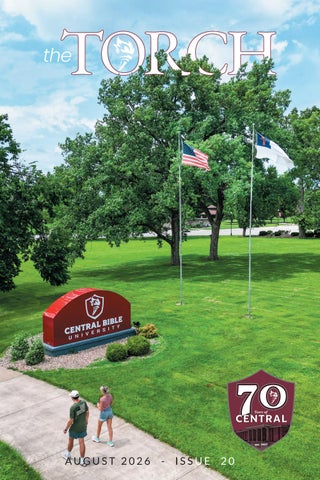
AUGUST 2026
-
ISSUE
20
MINISTRY EDUCATION’S LEGACY
Having completed my 30th year of working at Central Christian College of the Bible this summer, I still remember the hot July day in 1996 when Sandy and I moved to Moberly to join the faculty. Since then, I have seen first hand the hard work required to make Central successful. Former and fellow employees who invested their lives into CCCB set an example for me to do the same thing for others. It has been a joy to be part of that legacy. Closely observing the stories of Cincinnati Christian University and St. Louis Christian College reveals the same lesson. Any institution pursuing eternal impact through its students and supporters will require spiritual leaders, devoted supporters, and incredible effort from many people in order to create a lasting legacy through students who attend. This issue of the TORCH is the first issued since becoming Central Bible University. It also describes the legacy of three different schools, each created by dedicated work of those who trusted the Lord to use their efforts. Central’s story continues their legacy for a new season of serving students and the church. Thank you for being part of it as well. David Fincher, Ph.D President@CentralBible.edu
Table of Contents: 3 4 6 7 8 14 20 26 27 28 29
2
New Academic Agreements Russell School of Ministry Updates Night classes at Extended Locations Youth in the Booth and the Ministry & podcast The Legacy of Cincinnati Christian University The Legacy of St. Louis Christian College The Legacy of Central Christian College of the Bible The SEAL Scholarship Program Spring 2027 SOLID & Shine Conference Dates Memorial & Honorary Gifts Introducing the Central Bible Fund
www.CentralBible.edu
NEW ACADEMIC AGREEMENTS
Following months of work by VP of Academics Dr. Arthur Rawlings, an agreement was signed in February 2026 with Columbia College to create a comprehensive academic transfer plan. This innovative dual degree partnership expands academic opportunities while equipping Central students to combine their Christian commitment with their career choice. Participating students will experience Central’s immersive, Biblecentered education while gaining access to career-focused coursework aligned with today’s workforce needs. Through the collaboration, students will complete their General Education and Biblical Studies courses for a Bachelor of Arts in Christian Studies at Central while earning a professional studies degree at Columbia College. The agreement utilizes online enrollment at Columbia College while the student lives in Moberly, although in-person attendance at one of their campuses is also available. Dr. David Russell, President of Columbia College said, “We are proud to partner with Central to create meaningful pathways for students who are called to serve. This agreement reflects our shared commitment to academic excellence, student success, and preparing graduates to make an impact in their communities and professions.” In addition, Central has new transfer agreements for students outside of Moberly. These include Northern Kentucky University in the Greater Cincinnati Area and Southeastern University for students in Florida. These support Central’s vision of innovative ministry education in multiple locations for the Christian Church. THE TORCH
3
You take your calling seriously, and so do we. That’s why exciting developments are happening in Russell School of Ministry. Russell School of Ministry continues to offer new and innovative opportunities for graduate education. The Master of Arts in Ministry Leadership degree provides students with a solid foundation for leadership, personal growth and formation, as well as options for targeted learning in a specific concentration. Along with a concentration in Preaching, students can choose from two new concentrations. • Organizational Health. This concentration focuses on developing strong churches and organizations through leadership development, cultural engagement, and strategic planning.
4
www.CentralBible.edu
• Co-vocational Ministry. Students who already have earned graduate credit in another field (e.g. business, education, healthcare, etc.) can learn to integrate that knowledge into a ministry setting. This concentration uses those courses for part of the degree while providing additional training in spiritual leadership skills. To prepare graduate students for a successful educational journey, these leaders work alongside of the faculty. Contact either one of them with your questions or to learn how to pursue your calling.
Dr. Roger Clark
Dean of Graduate Education Roger.Clark@CentralBible.edu Dr. Clark brings a wealth of ministry experience to the role, having served in worship, executive, and discipleship roles in Indiana and Missouri. In addition, Dr. Clark is a seasoned college administrator, having previously served in several roles at St. Louis Christian College, including Academic Dean. He works at Central’s St. Louis location.
Drew Bromm
Director of Graduate Student Experience Drew.Bromm@CentralBible.edu Drew’s role walks alongside master’s students from initial interest to graduation while building relationships with RSM alumni. He brings ministry and college experience to the RSM, having served in preaching ministry and also at Mid-Atlantic Christian University. Drew works at the Moberly campus while also traveling to churches, conferences, and events. Attend the Russell School of Ministry Forum: Leading Through Tragedy (with Dr. LeRoy Lawson), held at the St. Louis site on Wednesday, October 7. THE TORCH
5
End Biblical Illiteracy... In 2020, Central opened an extension site in the Greater Cincinnati area to continue the legacy of ministry education. In August 2025, the next phase of this mission was launched by offering of accredited undergraduate Bible courses at the CCL Center in Florence, KY. The classes, offered on Tuesday evenings via in-person or Zoom instruction, are ideal for ministry staff, church leaders, or people who wish to be better equipped to lead a Bible study. The flexibility of the format increases exposure to those seeking biblical instruction. Students grow in their faith and strengthen their knowledge of God’s Word. One of the Cincinnati students spoke about the impact of his experiences in the classroom and online, “I can’t count the number of times I’ve continued to use what has been taught to me. It shows up in my sermons. It shows up in discipling others. It shows up in regular conversations that one would have on an ordinary day.” After attending classes in Cincinnati and graduating, B.J. Patton is now the Senior Minister at Shelby Christian Church in Versailles, Indiana. The success of this program in Cincinnati has inspired Central to offer these classes in other extension sites. Students can now take classes in person at our St. Louis campus or at a site in Columbus, Indiana. (Those in other areas can also enroll using Zoom from home or their church.) Find out more and register online at CentralBible.edu/locations.
Take Bible Courses for University Credit in Cincinnati, St. Louis, and Columbus. 6
www.CentralBible.edu
youth
BOOTH IN THE
High school students: RUN THE SHOW LIGHTING
AUDIO
LIVESTREAM
SLIDES
Empower the next genreation to take ownership of their role in the church with training from The Center for Church Leadership. Students who complete the training and serve for at least one year at their local church qualify for a $500 scholarship to a Christian college of their choice and $1,000 if they choose Central Bible University! Cast the vision and teach the next-generation to lead.
SCAN TO
Get Started
Anyone who has served in a ministry knows it’s never just ministry. It’s ministry and frustrations and disappointments and detours… with no guarantees that it will wrap up in a neat, tidy bow. Those are the stories we share on the “Ministry &” podcast. It is a space to hear the often untold ministry stories of lament, endurance, and hope. It reminds us that we’re not alone and gives us hope for the road ahead. Listen on YouTube, Spotify, or other streaming platforms. Scan the code to find out more. And to share your story, reach out to MinistryAnd@ccleadership.org. THE TORCH
7
CINCINNATI CHRISTIAN UNIVERSITY: A Legacy of Faithful Service (1924-2020)
McGarvey. And Foster’s students, in turn, carried that legacy forward. This intentional passing of theological DNA from generation to generation created a distinctive educational culture—one that valued biblical fidelity, scholarly rigor, and practical ministry preparation. Two Schools Become One
ORIGIN STORY Rooted in the Restoration Movement: The Heritage That Shaped Us While Cincinnati Christian University officially began in 1924, its heritage reaches back much further into the heart of the Restoration Movement. The theological and philosophical foundations were shaped by leaders such as Barton W. Stone and Thomas and Alexander Campbell in the early 1800s. Their commitment to biblical authority, Christian unity, and New Testament Christianity would define the institution for nearly a century. Students of R.C. Foster, one of the school’s founders, were often reminded of their direct connection to this heritage. They stood only two generations removed from Alexander Campbell himself. J.W. McGarvey, the renowned scholar of the late 1800s, studied under Campbell. R.C. Foster studied under
8
The institution was born from the merger of two fledgling Bible colleges, each struggling to gain a foothold during the challenging economic climate of the early 1920s. McGarvey Bible College opened in Louisville, Kentucky, on October 2, 1923, with Henry Lutz as president and Ralph Records and R.C. Foster as professors. Seven students enrolled that first semester, bringing hope and determination to a modest beginning. At the same time, Cincinnati Bible Institute opened in Cincinnati under the leadership of John Tyndall, with faculty including Edwin Errett, E.W. Thornton, and R.E. Emore. More than 100 students enrolled from across the nation, signaling strong interest in Bible-centered education in the Cincinnati region. It soon became clear that neither college would thrive if supporting churches were required to divide their limited financial resources between the two institutions. Recognizing the greater good, leaders from both schools came together in a spirit of cooperation and kingdom-mindedness.
www.CentralBible.edu
In September 1924, the two schools merged under the auspices of The Clarke Fund (now known as The Christian Restoration Association) to form Cincinnati Bible Seminary. This merger represented not a defeat for either institution, but a strategic unification that allowed both visions to flourish together. In 1928, Cincinnati Bible Seminary incorporated as a separate institution, independent from the CRA, establishing its own identity while maintaining its commitment to the Restoration Movement principles. Why Cincinnati in 1924? Cincinnati was strategically positioned in the heartland of the Restoration Movement, with strong churches, committed ministry leaders, and a region hungry for trained biblical servants. The city’s central location made it accessible to students throughout the Midwest and beyond. The timing—just after World War I and during a period of cultural transition in America—underscored the urgent need for biblical education that could equip faithful men and women in God’s Word so they could serve churches with excellence, teach with authority, and lead with wisdom.
CAMPUS DEVELOPMENT The Early Years: Chateau Avenue (19241940)
The Move to Glenway Ave. (1939-1940) In 1939, the Seminary purchased the Glenway Avenue property from the Grandview Hospital Company—a transformative acquisition that provided 27 acres and five buildings. The centerpiece was the former Peter Neff mansion, later affectionately nicknamed “Old Main.” This historic building became the heart of campus life, housing classrooms, faculty offices, the library, and the bookstore. The Coach House was converted into a student fellowship center, providing space for informal gatherings, meals, and the kind of spontaneous theological conversations that often shape ministry vocations as much as formal coursework. In 1940, classes officially began on the new Glenway campus. One year later, in 1941, the college purchased the Price Avenue Presbyterian Church building to serve as a permanent chapel, giving the school a dedicated worship space that would host countless chapel services, guest speakers, missions conferences, and evangelistic gatherings over the decades.
Cincinnati Bible Seminary began humbly on Chateau Avenue in the Price Hill neighborhood of Cincinnati. The campus consisted of two brick buildings, with nearby homes repurposed as dormitories. Chapel services were held at Westminster Presbyterian Church, symbolizing the cooperative spirit that marked the institution from its earliest days. It would also become known as a “Light on the Hill.” THE TORCH
9
Building for Growth: 1953-1984 As enrollment grew, so did the campus infrastructure. Each new building represented not just expansion, but the sacrificial generosity of churches, alumni, and friends who believed in the mission. • 1953 — A women’s dormitory was constructed (later named Phyllis Rine Residence), providing housing, dining space, and the campus’s largest meeting area. • 1960 — Alumni Hall was dedicated, serving as both residence hall and classroom space, reflecting the growing needs of an expanding student body. • 1968 — The Edwin G. Crouch Memorial Building opened, housing the George Mark Elliott Library, the Graduate School, and Foster Hall lecture auditorium. This building signaled the institution’s commitment to advanced theological education and scholarly resources.
• 2004 - Worship and Ministry Center was dedicated, becoming the primary chapel and ministry training center. This stateof-the-art facility reflected the institution’s vision for the 21st century—a space designed not just for worship, but for hands-on training in preaching, worship leading, and ministry leadership. Through each decade, the campus expanded to meet growing enrollment while maintaining its presence as a “Light on the hill” overlooking Cincinnati.
PRESIDENTS & LEADERS Generations of Faithful Service The history of Cincinnati Christian University is inseparable from the presidents and leaders who guided the institution through seasons of growth, challenge, and transformation. Each leader brought unique gifts, faced distinct challenges, and contributed to the school’s enduring legacy. Ralph L. Records (1928-1948)
• 1973-1974 — Additional properties were acquired, and Restoration Hall was constructed to house male students, addressing ongoing dormitory needs. • 1983 — Presidents Hall added critical infrastructure: classrooms, faculty offices, a cafeteria, bookstore, and gymnasium. For the first time, students had access to on campus athletic and recreational facilities. • 1984 — West Meadows apartments were purchased for graduate and married student housing, acknowledging the growing number of older students pursuing advanced degrees.
10
Ralph Records served as the school’s first long-term president, providing two decades of steady leadership during the institution’s formative years. Under his guidance, Cincinnati Bible Seminary established its identity, built its reputation, and weathered the challenges of the Great Depression and World War II.
www.CentralBible.edu
Woodrow Perry (1948-1970) Woodrow Perry became the school’s second president, serving for more than two decades. His tenure represented continuity and stability during the postwar years when American higher education was expanding and cultural changes were beginning to reshape the nation. Harvey C. Bream (1970-1986) Harvey C. Bream’s presidency spanned a period of significant growth and, eventually, acute financial crisis. Under his leadership, the institution expanded its programs and facilities. However, his tenure ended amid the financial emergency of 1986, when the college came within 48 hours of closing. Bream resigned, and the institution entered a season of financial restructuring. He later served as Chancellor, continuing to contribute his wisdom and experience.
restoring momentum. Though his service was relatively brief, it provided a bridge to the next era of leadership. Dr. David Grubbs (1993-2002) Dr. David Grubbs brought to the presidency a unique perspective shaped by his missionary service at Mashoko Christian Hospital Medical Ministry in Zimbabwe. His global vision and commitment to missions education enriched campus life and reinforced the institution’s commitment to training leaders for international ministry. Dr. David Faust (2002-2014)
Ronald G. Geary (Interim, 1986-1988) Ron Geary was brought in as interim president during one of the most critical moments in the school’s history. His steady leadership helped stabilize operations following the 1986 crisis, and his efforts contributed to the remarkable summer fundraising campaign that raised approximately $3 million and saved the institution from closure. D. Barry McCarty (1989-1993) Barry McCarty’s presidency represented a new chapter following the financial crisis. His tenure focused on rebuilding confidence, strengthening administrative systems, and THE TORCH
Dr. David Faust’s presidency brought renewed energy, optimism, and momentum. Known nationally for his preaching and church ministry, Faust connected the institution more deeply to the broader Christian Church/Church of Christ fellowship. His tenure saw renewed enrollment growth, facility improvements, and increased visibility. During this period, conversations about potential mergers with Kentucky Christian University and Johnson University were explored, though neither came to fruition.
11
Ken Tracy (2014-2015) Ken Tracy’s brief presidency represented a transitional period as the institution continued to navigate financial and enrollment challenges common to small Bible colleges in the 21st century. Dr. David Ray (Interim, 2015-2017) Dr. David Ray served as interim president, providing stability and continuity during a season of institutional discernment about the future. Ronald E. Heineman (2018-20) Ron Heineman’s presidency came during the final chapter of the institution’s independent operation. His leadership coincided with the Higher Learning Commission’s “ShowCause” status and the ultimate decision to withdraw from accreditation, leading to the closure of independent operations and the transition of key assets to Central Christian College of the Bible.
KEY SUCCESSES World-Class Faculty Despite Humble Facilities One of Cincinnati Christian University’s most remarkable achievements was its ability to attract exceptional students despite aging buildings, limited facilities, and modest resources. The reason was clear: CCU offered world-class professors who were deeply faithful to God’s Word and passionately committed to teaching it effectively. Students in those years walked a mile to chapel, parked in gravel lots, and lived in dormitories that had been constructed decades earlier for other purposes. There was no on-campus gymnasium for many years. The library was cramped, and the technology was often outdated.
12
What mattered most was the quality of biblical instruction and the spirit of Christian love and camaraderie that defined campus life. Students absorbed not just information but a way of thinking: a theological framework and a pastoral heart that prepared them for a lifetime of faithful ministry. Sister institutions looked for CCU alumni to fill faculty positions. Churches across the country confidently called CCU graduates as preachers. The institution’s influence was also evident in more than 100 international mission fields served by former students. Global Missions Impact For many years, Cincinnati Bible Seminary hosted the Conference on Evangelism, a gathering that drew hundreds of church leaders from across the nation. During opening sessions, flags representing nations where alumni served were carried onto the stage and later displayed along the gymnasium walls—a powerful visual reminder of the school’s global reach. Alumni served in Asia, Africa, Latin America, Europe, and across North America. Many families produced multiple generations of CCU graduates, creating ministry dynasties that extended the school’s influence across decades. Accreditation Accomplishments Cincinnati Christian University maintained high academic standards and pursued multiple levels of accreditation: • 1966 — The undergraduate division was accredited by the American Association of Bible Colleges (AABC), later known as the Association for Biblical Higher Education (ABHE). • 1976 — The graduate division became an associate member of the Association of Theological Schools (ATS), later achieving full membership.
www.CentralBible.edu
• 1990s — The institution received accreditation from The Higher Learning Commission (HLC), a regional accreditor that strengthened academic credibility and expanded opportunities for students. The university also participated in the Greater Cincinnati Consortium of Colleges and Universities, providing students with cross-registration opportunities and access to shared resources throughout the region. Cincinnati Christian University was a member of the Association of Schools of Jerusalem University College and received state approval to offer the Master of Arts in Counseling, along with CACREP recognition that elevated the program to national prominence and trained counselors who served in churches, Christian counseling centers, and community mental health agencies. CALL Program: Expanding Access In 2003, the Christian Adult Leadership Learning (CALL) program was launched to serve nontraditional students. The program enabled working adults to complete degrees through accelerated courses meeting one night a week for five weeks. This innovative approach expanded access to Christian higher education for hundreds of students who otherwise could not have pursued ministry training. Athletic Excellence
The university eventually fielded 17 varsity teams across men’s, women’s, and coed sports, providing student-athletes with opportunities to compete at a high level while pursuing their academic and ministry goals.
Music and Worship From its beginning, music was central to campus life. Faculty members such as Don Whitman, E. Wayne Berry, Roy Koerner, Byron and Katie Cartwright, Gary Gregory, Ken Read, and Brenda Lang led vibrant programs that enriched the spiritual and cultural life of the campus. This included choirs, camp teams, ensembles, the Come Alive Singers, and later Christmas Dinner Theaters. These programs not only provided students with musical training but also created connections between the college and local churches, fostering goodwill and support throughout the region.
Athletically, the Golden Eagles competed for decades in the National Christian College Athletic Association (NCCAA). The men’s basketball program won three consecutive national championships in the 1980s, bringing pride to the campus and visibility to the institution. Later, the school joined the National Association of Intercollegiate Athletics (NAIA) and competed in the River States Conference. THE TORCH
13
ST. LOUIS CHRISTIAN COLLEGE A Legacy of Faithful Service (1956-2022)
ORIGIN STORY A Center of Evangelism: The Concern That Brought Us Together In June 1956, three St. Louis ministers— Luther Perrine, Hubert Burris, and Vernon Newland—met to address a pressing concern: the evangelistic need in their region. In the words of Mr. Newland, “The purpose of establishing a new Bible college in this area is primarily evangelistic and not entirely for scholastic attainments or prestige, but to fill the need of providing new workers for our general area.” Their bold proposal: found a Bible college as a “center of evangelism” for the St. Louis region—training leaders who would reverse decline, plant churches, and reach the growing urban population with the Gospel. Luther (“Luke”) E. Perrine, minister at a St. Louis area church, became founding president (1956-1966). In the first year, faculty responsibilities were distributed among eleven ministers—men already serving churches who believed deeply enough in the vision to teach classes while maintaining their congregational ministries. Nineteen students enrolled, bringing hope and determination to this modest beginning.
The Mission: Excellence in Urban and Rural Ministry From its inception, SLCC provided Biblecentered higher education to equip men and women to lead with the Word of God and to minister with excellence in urban centers and rural communities around the world. The dual focus reflected St. Louis’s unique geography—a major metropolitan area surrounded by small towns and farming communities. St. Louis presented both opportunities and challenges for ministry training. The urban context required preparing leaders for diverse populations, complex social issues, and the fast-paced environment of city ministry. The surrounding rural areas needed pastors who understood small-town life, agricultural communities, and the distinctive challenges of ministry in less populated regions. SLCC embraced both contexts, training students who could minister effectively whether called to serve an inner-city congregation, a suburban megachurch, or a small country church. This versatility became one of SLCC’s defining strengths: graduates who could adapt to diverse ministry settings while maintaining biblical faithfulness. Why Florissant in 1956? The timing and location of SLCC’s founding were both strategic and providential. The mid-1950s represented
14
www.CentralBible.edu
a period of post-war church growth and suburban expansion. St. Louis was experiencing dramatic population shifts, with families moving from the city to suburbs like Florissant. New churches were being planted, and existing congregations were growing rapidly. The need for trained ministry leaders was urgent.
The college initially met at Ferguson Christian Church (August 1956-November 1958) while searching for a permanent campus. In November 1958, during Thanksgiving time, SLCC moved to its permanent campus in Florissant, Missouri—a former tulip farm estate with an elegant 1863 White House and 11.5 acres of property. The campus location proved ideal: one mile west of the intersection of West Florissant Avenue and Interstate 270, and one-half mile east of the intersection of Washington/Elizabeth and Interstate 270, placing it just twenty minutes from downtown St. Louis. The Florissant location provided several strategic advantages. The suburban setting offered a safe, attractive campus environment while remaining accessible to the urban core. The property provided room for expansion as enrollment grew. And the Florissant community welcomed the college, recognizing the educational and cultural contribution it would make to the region.
of more than 4,800 students over sixty-six years. Graduates would serve across the nation and around the world. The college founded as a “center of evangelism” for the St. Louis region would extend its influence to dozens of nations and hundreds of churches.
CAMPUS DEVELOPMENT St. Louis Christian College’s campus history began long before the college existed. In 1863, during the Civil War era, an elegant White House was built on a tulip farm in Florissant, Missouri. This gracious structure would stand for a century before becoming the centerpiece of SLCC’s campus—a tangible link between the college’s twentiethcentury mission and the region’s nineteenthcentury heritage.
When SLCC acquired the property in 1958, the White House became an iconic symbol of the college. Students photographed it for yearbooks, families posed in front of it during graduation weekends, and prospective students immediately recognized the campus from its distinctive appearance. The White House represented permanence, elegance, and the rooting of SLCC’s mission in a specific place with deep history.
Yet from this humble beginning, SLCC would grow into an institution that would confer 1,705 degrees and shape the lives THE TORCH
15
was built (in later years converted to the Choir Room, supporting SLCC’s vibrant music ministry). • 1966 — Bethany Hall (men’s dormitory, later converted to women’s)
The first major construction project under SLCC’s ownership was the Keystone Building, developed in stages as enrollment and resources allowed: • 1959 — The South Wing was completed, providing desperately needed classroom and office space. • 1964 — The North Wing was added, completing the Keystone Building and creating the academic heart of campus. • 1967 — The full Keystone Building became operational, housing classrooms, faculty offices, administrative offices, and becoming the primary location where the college’s educational mission unfolded daily. • 1970 —The chapel and gymnasium addition transformed campus life, providing dedicated spaces for worship, athletics, and community gatherings.
Between these major additions, smaller but essential facilities were added:
• 1967 — Berea Hall (men’s dormitory) • 1971 — Bethel Hall (married student apartments) • 1979 — Bethesda Hall (second women’s dormitory.) • 1993 —President’s Hall was SLCC’s most ambitious building project, consolidating the library, cafeteria, student center, and bookstore into a single modern facility—the true campus hub. The campus that emerged was beautiful, functional, and deeply loved by generations of students who called it home. Walking across campus between classes, gathering in the cafeteria for meals, studying late in the library, worshiping together in chapel, and competing in the gymnasium—these daily experiences created the formative community that defined the SLCC experience. When the merger with Central Christian College of the Bible was completed in 2022, the Florissant campus was leased by The Solomon Foundation to Gateway Legacy Christian Academy, ensuring SLCC’s facilities continue serving young people.
• 1961 — A duplex was constructed (in later years housing music rooms, a guest apartment, and the Security Office, illustrating SLCC’s practice of adapting facilities to changing needs). • 1965 — A Maintenance and Print Shop
16
www.CentralBible.edu
PRESIDENTS & LEADERS Luke E. Perrine (1956-1966) Luke Perrine led SLCC through its critical first decade, establishing identity, building the campus, hiring faculty, and developing curriculum. Perrine’s wife, Gladys, served alongside him, providing hospitality and support that made faculty and students feel welcomed and valued. Together, Luke and Gladys Perrine embodied the sacrificial servant leadership that would characterize SLCC for decades. He hired Eugene Hetzel as the first fulltime professor (1957), signaling SLCC’s commitment to academic excellence. Glenn H. Bourne (1966-1978) Glenn Bourne became SLCC’s second president in June 1966, serving twelve years during a period of significant development and growth. His presidency coincided with the tenure of Academic Dean Russell Boatman (1962-1978). Their leadership became known as the BourneBoatman administration—a golden era for SLCC. In 1977, SLCC became accredited by the American Association of Bible Colleges, a milestone that validated the quality of the college’s academic programs and opened doors for students seeking graduate education or professional ministry positions requiring accredited degrees.
THE TORCH
Leadership Transition Period (1978-1979) Following Bourne’s departure in June 1978, SLCC experienced a brief but difficult transition period searching for its next president. This crisis tested the college’s resilience and revealed the depth of commitment among its supporters. In April 1978, Bob Stacy was named president-elect but stepped down before assuming office. William Maynard (Business Manager) became Acting President in October 1978, providing interim leadership. In March 1979, Bob Lyttle was named president-elect but also stepped down shortly afterward. Thomas W. McGee (1979-1995) Thomas McGee became SLCC’s third president in August 1979, ending the leadership crisis and beginning the longest presidential tenure in the college’s history. McGee served for sixteen years, providing the visionary leadership that would shape SLCC through its most formative decades. During McGee’s presidency, over 300 students graduated—a testament to enrollment growth and institutional stability. He led SLCC through the challenges of the 1980s (including the agricultural crisis that affected supporting churches), maintained ABHE accreditation, and positioned the college for the facility improvements of the early 1990s. Dr. Kenneth L. Beck (1995-2004) Ken Beck completed and dedicated President’s Hall (1997), transforming campus life. He oversaw the growth of the A.I.M. (Adults in Ministry) program in 1993, extending SLCC’s reach to working adults through weekend/evening
17
intensive courses. This innovative program allowed ministers and church workers to complete degrees through intensive weekend and evening courses, multiplying SLCC’s impact beyond traditional college-age students. Transition Team (2004-2006) From 2004 to 2006, St. Louis Christian College was led by a five-man Presidential Transition Team—an innovative leadership structure that demonstrated SLCC’s flexibility and the commitment of church and institutional leaders. The team included two senior ministers from major St. Louis area churches: Ben Merold of Harvester Christian Church and Paul Newland of Gateway Christian Church. These seasoned church leaders brought pastoral wisdom and connections to large, thriving congregations. Three operational staff members rounded out the team: Dr. Jamie Lankford (finance officer), Dr. Kendall Brune (development officer), and Professor Keith McCaslin (academic officer). This collaborative leadership model distributed responsibilities while maintaining continuity. The team successfully sustained operations, preserved SLCC’s mission, and positioned the college for its next president. Dr. Guthrie Veech (2006-2016) In June 2006, Dr. Guthrie Veech became SLCC’s fifth president in the college’s 50-year history. He brought a valuable balance of academic expertise from the college classroom and ministry experience from diverse local congregations—exactly the combination needed to lead a Bible college training both scholars and practitioners. Veech’s decade-long presidency provided
18
stability and continuity during a period of significant change in American higher education. Enrollment remained relatively strong during his tenure, with SLCC reaching its peak enrollment of 337 students in Fall 2010—the fifth consecutive year enrollment climbed over 300. Transition Team (2016-2017) For the duration of the 2016-17 school year, SLCC was again led by a Presidential Transition Team that provided leadership during another critical juncture. From July-December 2016, the team included: Dr. Don Sanders (Director of the Merold Institute for Ministry at Harvester Christian Church), Pam Ralls (Director of Institutional Excellence), Dr. Mike Pabarcus (Professor and Interim Academic Dean), and Dr. Ken Johnson (SLCC trustee and retired professor at Lindenwood University). From January-May 2017, the team members shifted to: Dr. Ken Johnson, Dr. Ladd Haverly (Executive Pastor at Gateway Christian Church), Harold Merritt (Professor and Chair of Biblical Education Division), and Dr. Scott Womble (Professor and Adults in Ministry Coordinator). This transition team model—drawing on church leaders, trustees, and internal staff— demonstrated SLCC’s collaborative spirit and the deep commitment of St. Louis area churches to the college’s mission. Terry Stine (2017-2022) In June 2017, Terry Stine became SLCC’s sixth and final president as an independent institution. Stine came to SLCC from Boise Bible College, where he had served as Professor of Missions (beginning 2005) and President (20072017). His extensive experience leading a sister Bible college made him well-suited for
www.CentralBible.edu
the challenges SLCC faced in its final years. Stine’s presidency was marked by significant challenges: declining enrollment (particularly after 2020), the Ferguson demonstrations and regional instability (2014 onward), and the COVID-19 pandemic (2020), which disrupted operations, reduced enrollment, and eliminated housing and auxiliary revenue. Despite these difficulties, Stine maintained SLCC’s mission focus and worked with Central Christian College of the Bible toward the eventual merger.
KEY SUCCESSES Academic Recognition St. Louis Christian College achieved accreditation status in 1977 with The American Association of Bible Colleges (AABC), later known as The Association for Biblical Higher Education (ABHE), and maintained good standing throughout its sixty-six year history. This achievement validated SLCC’s academic quality and provided assurance to students, supporting churches, and partner institutions. Licensed by Missouri to award Associate and Bachelor’s degrees, SLCC’s curriculum was rich in humanities—biblical studies, theology, literature, history, communication, and liberal arts. Courses were offered to traditional day, evening, and online students. Record Enrollment and Regional Impact SLCC’s peak enrollment came in Fall 2010, when 337 students enrolled—the fifth consecutive year that enrollment climbed over 300. This sustained growth reflected not just effective recruitment, but SLCC’s reputation for quality biblical education, genuine Christian community, and effective ministry preparation.
THE TORCH
The growth was particularly remarkable given SLCC’s urban/suburban location and the financial challenges many Bible colleges faced during this period. While some sister schools were declining, SLCC was growing—a testament to effective leadership, faithful faculty, and the compelling mission of training leaders for urban and rural ministry contexts. Men’s Day Tradition (1975-2021) The first Men’s Day (March 15, 1975) drew over 550 men and $2,730.40 in offerings. This annual event continued for nearly five decades, strengthening relationships with churches and extending SLCC’s influence. The final Men’s Day (March 2021) brought together Presidents Stine and Fincher as merger discussions progressed. Adults in Ministry (A.I.M.) Program (1993-2022) The A.I.M. program revolutionized SLCC’s reach to working adults. This innovative program allowed ministers, church workers, and marketplace Christians to complete degrees through intensive courses offered on weekends and evenings, all without leaving their positions. This program expanded SLCC’s impact dramatically, serving students who would never have attended traditional residential programs. A.I.M. graduates strengthened churches throughout the region, and the program model influenced other Bible colleges seeking to serve non-traditional student populations.
19
CENTRAL CHRISTIAN COLLEGE OF THE BIBLE
A Legacy of Faithful Service (est. 1957)
ORIGIN STORY Answering a Regional Call: The Crisis That Motivated Us to Action In December 1956, Chillicothe Bible College closed its doors, leaving churches throughout northern Missouri without a local institution for training ministry leaders. Churches struggled to find qualified preachers, youth ministers, and Christian educators. Young people with ministry callings had nowhere nearby to pursue biblical education. In February 1957, a steering committee of five men met in Moberly to address this crisis. Led by John Hall of Vandalia as President, with O.S. Lincoln of Novelty as first board chairman, they made a bold decision: start a new Bible college there. Their purpose was crystal clear: “to recruit and train leadership for the church at large according to the New Testament teaching.” Missouri issued a Certificate of Incorporation on March 11, 1957, to Central Christian College of the Bible “for a term of perpetual years.” Seventy years later, the institution continues that founding purpose. Why Moberly in 1957? The steering committee chose Moberly for strategic reasons: excellent transportation via highway and rail, accessibility to students throughout Missouri, city facilities to
20
leverage, White Oak Camp nearby for ministry training, Union Avenue Christian Church as a supportive partner, and Moberly Junior College, which showed the community valued higher education. There was also a Cincinnati connection. Reuben Bullard—teaching at Cincinnati Bible Seminary—contributed his expertise to John Hall, one of his students. Several of the first faculty were Cincinnati graduates. From its earliest days, Central’s story intertwined with its sister school in Ohio. The founders purchased a three-story academy building from the Sisters of Loretto for $17,500, with $2,500 down and $5,000 per year, financed by the Chance Foundation. This former Catholic school on North Ault Street would become Central’s first home. A Modest But Determined Beginning The first faculty included three professors who would stay in Moberly for the remainder of their lives, giving decades of service: Frank Watson, Lloyd M. Pelfrey, and Gareth L. Reese. Their commitment set the tone for a culture marked by longevity, faithfulness, and deep personal investment in students. The first convocation service was held September 3, 1957, at Moberly’s Municipal Auditorium. Fewer than 20 full-time students enrolled, though more than 100 evening students took advantage of night classes. It was a modest beginning, but one marked by great faith and determination.
www.CentralBible.edu
leadership, the college acquired forty-one acres on Urbandale Drive in southeastern Moberly. Groundbreaking was held in 1966, and in 1968, classes officially began on the new campus with the opening of the Cafetorium (combined cafeteria, library, and assembly area). Spurling Hall was constructed as the first women’s dormitory with offices and classrooms. Beginning with few students and limited resources, dedicated leaders worked to build enrollment, facilities, and an alumni network. Graduates soon served across the nation and around the world. What started as an answer to northern Missouri’s needs grew into an institution that would shape churches and missions worldwide.
Building for Growth: 1971-2010
CAMPUS DEVELOPMENT
• 1980 — Memorial Hall included offices, classrooms, and gymnasium (renamed Pelfrey Hall in 1998). For the first time, students had access to on-campus athletic and recreational facilities, fostering school spirit and community life.
From Ault Street to Urbandale The Early Years: North Ault Street (1957-1968)
Each new building represented sacrificial generosity from churches, alumni, and friends: • 1971 — Lang Hall dedicated as men’s dormitory (modernized in 2022)
• 2000 — Reese Resource Center opened (expanded in 2003 and modernized in 2026) to relocate the library and bookstore.
The first campus was located at 415 North Ault Street. The Memorial Building housed classrooms, offices, and library. Cowgill Dormitory was purchased with estate gift funds. Male students lived upstairs while Professor Campbell’s family lived downstairs. The Harris House and other residences provided additional housing as enrollment grew. The Move to Urbandale Drive (1966-1968) In 1966, under President Jack Spratt’s THE TORCH
• 2004 — Mabee Foundation Hall constructed (modernized in 2025) • 2006 — Pelfrey Hall West Wing addition doubled capacity to accommodate growth • 2010 — Walton Student Center completed (updated in 2025) providing modern student gathering spaces, a coffee shop, and recreational areas. • 2021 — Central completed a sale and leaseback agreement with The Solomon Foundation, providing financial stability,
21
facilitating the merger with St. Louis Christian College, and investing over $2 million of capital into the modernization of the Moberly campus.
expansion, positioning the school for future growth. Ensign’s seven-year presidency brought stability and financial health during a critical period.
Through six decades, the Urbandale campus evolved from forty-one acres of farmland into a comprehensive college campus that has served thousands of students. Each building tells a story of sacrifice, vision, and commitment to the founding mission.
Walter “Jack” Spratt (1966-1972)
PRESIDENTS & LEADERS John W. Hall (1957-1959) John W. Hall served as Central’s first president, leading the institution from vision to reality. A minister at First Christian Church in Vandalia, Missouri, Hall was charged with the immense task of setting the college in order—hiring faculty, establishing curriculum, recruiting students, and building community support. He selected the first faculty, laying a foundation of excellence and faithfulness that would define the school for decades. Grayson H. Ensign (1959-1966) Grayson Ensign succeeded Hall and made critical improvements in the administrative and bookkeeping procedures, moving the college toward a more professional collegiate model. His business acumen proved invaluable during the institution’s formative years. Under his leadership, Central eliminated its first mortgage—a significant financial milestone for a young college. He also purchased additional property to provide room for
22
Jack Spratt’s presidency marked a transformational era for Central. He led the acquisition of the Urbandale property that would become Central’s permanent home. Under his leadership, several buildings were developed as part of the relocation from cramped facilities on Ault Street to spacious acreage on Urbandale Drive. His bold step of faith would shape Central’s identity for generations, giving Central room to grow. Lloyd M. Pelfrey (1972-1998, Interim 2005-2006) Pelfrey’s 26-year presidency represents the longest tenure in Central’s history. Coming to Moberly in 1957 as founding faculty, he served as Professor and Academic Dean before becoming president. During his presidency, Central worked to eliminate construction debts, completed Memorial Hall (1980, later renamed Pelfrey Hall), and achieved ABHE accreditation in 1982 (with reaffirmations in 1987 and 1992). After retiring in 1998, he returned to the classroom and later served as interim president (2005-2006). Receiving an honorary doctorate in 2022, Dr. Lloyd Pelfrey taught for a total of 65 years. Pelfrey’s presidency embodied Central’s founding vision: faithful, long-term service driven by deep love for God’s Word and students preparing for ministry.
www.CentralBible.edu
Dr. Russell James (2000-2005) Dr. Russell James served as Central’s fifth president during a period of dramatic growth, creating the Full-Tuition Scholarship model. Through careful planning and successful fundraising, Dr. James made it possible for students to attend Central debt-free, removing the financial barrier that prevented many from pursuing ministry training. This bold move contributed to a period of rapid enrollment growth. ABHE accreditation was reaffirmed in 2003, validating the quality of Central’s academic programs. Existing facilities were renovated and expanded to accommodate the growing student body. During his presidency, Mabee Foundation Hall was constructed in 2004. Under Dr. James, the Full-Tuition Scholarship transformed Central from a regional Bible college into a nationally recognized institution attracting students from coast to coast. His presidency ended with over 520 students enrolled in Fall 2005—the highest in Central’s history.
Dr. Oakes led the construction of the Walton Student Center in 2010, oversaw the development of online education programs. ABHE accreditation was reaffirmed once again in 2013 during his tenure. His presidency was committed to biblical truth while increasing the quality of the student experience. Dr. David Fincher (2014-Present) Dr. David Fincher was named Central’s seventh president in 2014 and continues to lead the institution into its next season as Central Bible University. A 1993 graduate of Central, he is the first alumnus to serve as president. Before becoming president, he served five years as Professor of New Testament and Communication and twelve years as VP of Academics, giving him deep institutional knowledge and broad relationships throughout the Central community. Dr. Fincher’s presidency has focused on connecting with alumni, refining the institution’s vision, and implementing strategic initiatives to ensure Central’s mission continues for generations.
Dr. Ron Oakes (2006-2013)
Under his leadership, Central has navigated significant changes, including:
Dr. Ron Oakes became Central’s sixth president in 2006, having started as a professor in 2004. (Before coming to Central, he served over 20 years as a professor and Academic Dean at St. Louis Christian College.) His presidency was marked by ambitious initiatives to elevate the institution’s academic standing and expand its reach. Under his leadership, Central pursued regional accreditation, achieving candidate status with the Higher Learning Commission in 2013.
• 2019-20 — Integrating Cincinnati Christian University ministries, including the Russell School of Ministry, the Center for Church Leadership, and the Elliott Library
THE TORCH
• 2021 — Partnering with The Solomon Foundation through a sale-leaseback program • 2022 —Merging with St. Louis Christian College to expand Central’s footprint and mission reach • 2020-25 — Modernizing all three residence halls through designated fundraising
23
• 2026 — Transitioning from Central Christian College of the Bible to Central Bible University in preparation for the institution’s 70th year. His leadership has emphasized remaining true to the Word while adjusting to the changing times of churches and society, staying relevant to churches as they evolve in staffing, facilities, and programming.
KEY SUCCESSES Full-Tuition Scholarship: A Revolutionary Model Central implemented the Full-Tuition Scholarship in 2001 so students from across the country and around the world could attend without the financial barriers that kept many from ministry training. Churches benefited by receiving ministry leaders who could accept positions based on calling without the burden of educational debt.
Shine, respectively) gathered believers from the northern Missouri region for worship, teaching, and fellowship. Youth events such as Crazy Days, Come-C-Central, and In Focus challenged teenagers to consider deeper service for Christ and the church. Music Programs Under the leadership of John Leinbaugh and Dr. Tarry Koutz, Central developed vibrant music programs that enriched both campus life and the broader church community. The Living Christmas Tree presentation by the Central Chorale became an annual tradition. Groups such as the Great Day Singers traveled to perform at supporting churches. Chorale tours extended Central’s reach through concerts at churches across the region. The Jubilation summer music camp brought high school students to practice for a week on campus followed by a week of touring to perform at churches. These musical programs wove together ministry training, outreach, relationship building, and worship.
Regional Influence Central’s influence included many activities and events for regional churches and Christians to attend. The Missouri Christian Lectureship, restored from its 1880s origins, brought scholars and church leaders to Moberly annually. For decades, Men’s and Women’s Days (later known as SOLID and
24
Student Athletics Almost from the beginning, the school recognized the value of athletics for student development and campus community. Sports teams competed against other small colleges and Bible schools, with Gareth Reese coaching the earliest basketball teams. Teams played at St. Pius and the old junior high facilities before Central had its own gymnasium for basketball and volleyball. Later renamed the Ferneau Center, it became a symbol of Central’s growth and a gathering place for generations of students. Later
www.CentralBible.edu
sports added included soccer, cross-country, and shooting sports.
Conservative Doctrine Throughout decades of cultural change and theological drift, Central held fast to conservative biblical doctrine. This commitment attracted students and supporting churches who valued Central’s unwavering stance on biblical authority, inspiration of Scripture, and New Testament Christianity. This theological faithfulness became one of Central’s greatest successes Lifelong Impact Central’s greatest success will always be the thousands of lives transformed through biblical education. Alumni became preachers, missionaries, youth ministers, worship leaders, faculty at sister colleges, directors of camps and children’s homes, and campus ministry leaders. Later collaborations with sister institutions in Cincinnati and St. Louis have created a network of graduates who share common values, theological convictions, and ministry training.
The Legacy of Three Schools Continues The steering committee of five men who met in Moberly in February 1957 dreamed of training leaders for the church. They couldn’t have imagined their startup Bible college would become Central Bible University, serving students in multiple locations. If they were here today, they would recognize the same heart: commitment to the Bible, sacrificial service to students, and kingdom ministry. Through nearly seventy years, Central alumni have shaped thousands of lives, strengthened hundreds of churches, and sent missionaries to dozens of nations. For Cincinnati alumni, their biblical DNA was successfully passed from Campbell to McGarvey to Foster to Pelfrey, Reese, Cottrell, Koffarnus, and beyond. Countless students working in churches today learned from those professors and many more. Their commitment to biblical authority, Christian unity, and practical ministry remains as vital now as it was in 1924. For St. Louis alumni, their rich heritage continues to make an eternal difference. Merging two institutions with complementary strengths, shared values, and common mission has made it possible to extend kingdom influence further than either could do alone. The closures of CCU and SLCC as independent institutions were painful, but their legacies endure. Those graduates have been welcomed into the family of those who graduated from CCCB as well. As Central Bible University continues the work of these three institutions, it represents more than just 70 years of education in Moberly. Over 230 years of cumulative effort have been invested across multiple generations. The story started in 1924 and expanded in 1956 & 1957. All of these efforts made it possible for their graduates to be FAITHFUL on PURPOSE.
THE TORCH
25
The SEAL Scholarship Program is a mission‑driven framework for students to discover and develop their God‑given purpose while reducing financial barriers to their education.
“He has also put His seal on us. . . .” (2 Corinthians 1:22) Service illustrates the posture of humility in a student’s life. It is the heartbeat of a faithful follower of Christ who puts others first. Purpose begins when a student learns to ask, “Where can I help?” and “Who can I bless?” Experiences develop perseverance by working through hard things with others. It shapes a student’s view of their purpose. Perseverance is built by keeping real-life commitments, even when they are difficult. Academics define a person’s passion by combining intellectual ability and lifelong teachability. Studying God’s Word and the world He created grows an understanding of truth and wisdom for a faithful life of purpose. Leadership is the position received when a person demonstrates integrity and vision. More than just a title or office, it includes the opportunity to pursue faithful purpose through courage and giftedness.
See How Central Rewards Your Unique Qualifications With a Customized Scholarship. 26
www.CentralBible.edu
27
MEMORIAL & HONORARY GIFTS Gifts for ministry education were received between February 2025 and July 2026 to recognize the following. (Attendees of Central, St. Louis, and Cincinnati are noted.)
Darrin Adwell My Daughter, Angi Dr. Gary Bailey Shirley J. Barker Bev Barrett Leonard & Ruby Berry Jim Bilbro Roy Bingaman Sally Bolen Martha Bordenaro Borys and Bruce Boyuk David Britt Joan Brown Vera Bruner John Burgess Gerald Byars Clarence & Etta Cain Norval & Dondena Campbell Barbara J. Carnes Gerald & Aldena Corbin Edsil & Ruth Dale Jim Daniels Marcia Dowell Kelly & Genevieve Dye Paul Foglesong Elaine Forrester Tom Friskney Mary Ann Gadberry Loyal Gallaher Sharon Gann Dixie Garrison Fred & Jan Green
Steve Greiner
Don Qualls
William Coe & Cora Harris Coelleta Harris-Jorgensen Linda Henderson Victor & June Hunter
Rodney & Lelah Randall Gareth & Kathleen Reese Frank & Margie Richardson Jack Richardson Forest “Glee” Ross
Loretta Jarrell Angela Jenkins James Johnson Jr.
Dallas Savage Dwight Savage Carol Schofield David & Jewell Shelton Gloria Spellman Goldie Spurling Curt Stephens Carl Stevens Tom Stevens Clifford & Deborah Stock Sharon Stowers Dr. Billy Strother Stephanie Sumption
Victor & Blanche Kakac Sylvia Ann (Lincoln) Klor Jack Knechtly Larry J. Knechtly Jimmie Knifley Mary Kropf Dr. Elroy M Leach Jim Lincoln Bruce McClintock Lowell E. McCoy Albert McGee Chris McKinney Andy McNeely Orval M. Morgan
Cynthia Thomas Reggie Thomas Ronald E. Thomas James Townes Kenneth Tuggle
Bernice Nauman Pauline Newbrough
Denny Varner
Robert Owings Bill Paten Dr. Phil Perrey Pete & Linda Peterson Shelby & Dom Plumb-Austin Tom Pullen
William Walton Donna Westhoff Virginia Wilhelm O.E. Wilkerson Patricia Kay Young
The righteous one will be remembered forever. (Psalm 112:6) Use the enclosed envelope or visit CentralBible.edu/give to make your gift. 28
www.CentralBible.edu
THE
CENTRAL
BIBLE FUND The mid-twentieth century was a challenging time for Christian churches in north-central Missouri, because there weren’t enough preachers available. To meet this need, a small group of leaders gathered in 1957 to create Central Christian College of the Bible for this purpose: “to recruit and train leadership for the church at large according to the New Testament’s teaching.” In the decades since, Central has remained faithful to that original purpose while adapting to changing times and technologies. This resulted in expansion to work with like-minded congregations and organizations. Since 2020, Central has continued the legacy of Cincinnati Christian University and Saint Louis Christian College by offering educational opportunities in those regions. To better communicate this mission and vision, CCCB became Central Bible University in 2026, reaching beyond Moberly, Missouri, to provide innovative ministry education in multiple locations for the Christian church. Ministry education requires more than time spent in a classroom. It includes hands-on experience, on-going development, and leadership opportunities that are built on a biblical foundation. The Central Bible Fund involves about 300 churches and over 900 individuals who support ministry education. Ministry education only happens when churches and individuals recognize the value of training Christian leaders. You can also be part of Central’s story by joining together with others who support the Central Bible Fund. Faithful donors like you provide over half of the annual budget through their gifts, making it possible for Central to remain FAITHFUL on PURPOSE.
THE TORCH
29
“God uses Scripture to prepare His people to do every good work.” (2 Timothy 3:17) RESIDENTIAL EDUCATION
Students learn in an attractive, safe, and positive environment of Christian community while growing in spiritual maturity. Your support funds the SEAL Scholarship Program to recruit students, invests in their development, and covers the ongoing operational costs of the home campus facilities in Moberly, Missouri.
EXTENDED EDUCATION
Students discover that serious study of Scripture helps them use their gifts in a local congregation through church partnerships. Your support helps cover the costs of online education resources, remote instructors, development of future congregational partners, and the ongoing operations of the Cincinnati and St. Louis extension sites.
GRADUATE EDUCATION
Students expand their capacity to begin or deepen a ministry career as a professional or volunteer leader. Your support provides for the administration and instruction of the Russell School of Ministry and graduate student scholarships for adults to complete a Master of Arts degree through online and hybrid classes in only two years.
LEADERSHIP EDUCATION
Church leaders receive coaching, collaboration, and resources to help their congregations be healthy. Your support strengthens leaders to implement biblical truths and ministry principles through the ongoing activities of The Center for Church Leadership, which includes the collections of the Elliott Library & Museum.
REFER SOMEONE TO BE A STUDENT. Equip future ministry leaders to be FAITHFUL on PURPOSE by referring them to CBU at CentralBible.edu/alumni-friends/refer-student. 30
www.CentralBible.edu
Your Faithful Impact With Central Pray for Central Bible University Graduates Sign up at CentralBible.edu/pray to receive a monthly email with a Bible devotion by the President and a story of a recent Central Bible University graduate who is living a faithful life of kingdom ministry. You can pray for that person and other students.
Support the Central Bible Fund as a church Include Central Bible University in your church’s missions budget, take a special offering for ministry education each year, or make a special one-time gift.
Make a personal gift to the Central Bible Fund If ministry education is important to you, giving to the Central Bible Fund supports many valuable activities and outcomes. One-time, annual, or monthly gifts all make a difference. Two special giving programs also help Central in distinct ways: • Saints Boosters - Lift up the student-athletes playing for the CBU Saints. • Shield Fund - Defend CBU from the unexpected expenses of repairs and projects.
Partnership Levels
Annual Giving Amount
Sustaining Partners
Up to $1,000
Equipping Partners
$1,000 - $10,000
Advancing Partners
$10,000 - $25,000
Legacy Partners
$25,000 and above
How You Can Give to the Central Bible Fund: • Make a secure online gift by visiting CentralBible.edu/give.
• Mail a check made payable to Central Bible University at this address: CBU, 911 E. Urbandale Dr., Moberly, MO 65270. • Reduce your taxes and increase your impact with a living trust, stock gift, IRA transfer, or charitable gift annuity. To learn more, select “Planned Giving” at CentralBible.edu/give or send an email to give@CentralBible.edu. THE TORCH
31
70
est. 1957
CENTRAL
Scan for more info or visit CentralBible.edu/RALLY.
Join with the Central family to rally behind the Saints! QR CODE
Come in time for a cookout on the lawn and visit the newly remodeled Library in the Reese Resource Center. Bid on historical CCCB items, particpate in the Saints Boosters silent auction, and attend Saints Athletics games: soccer, volleyball, and men’s and women’s basketball.
Return to where it all began and celebrate Central’s 70th year and the new name of Central Bible University.
Saturday, Oct 24, 2026
SAINTS RALLY DAY
Central Bible University 911 East Urbandale Drive Moberly, Missouri 65270 www.CentralBible.edu 660-263-3900
Central Bible University does not unlawfully discriminate on the basis of race, color, sex, age, disability, national or ethnic origin in employment, admissions, financial aid, or participation in its programs.