

Table of Contents
Katherine
Ashley



The Structuring of Legal Editor’s Note
Legal work rarely arrives neatly packaged. It appears in fragments—an email chain forwarded without context, a contract that surfaces late in the business process, a question that begins as routine and slowly reveals larger implications. Lawyers interpret, sort and translate these fragments into matters, agreements, investigations and advice.
For a long time, that translation relied largely on professional instinct and institutional memory. Experienced lawyers knew where to look, who should handle what and how a decision would move through the organization. Systems existed to support the work, but they rarely determined its structure.
Read straight through, the contributions in this guide suggest that this balance is changing.
Legal departments increasingly operate within systems that shape how work enters the function, how it moves across teams and how decisions are recorded, evaluated and revisited. The technologies themselves vary widely, but the underlying shift is structural. Legal work is becoming something that must be designed as deliberately as it is practiced.
That evolution appears from many angles in the perspectives gathered here.
At the American Arbitration Association, Diana Didia approaches artificial intelligence through the lens of institutional legitimacy. Her work focuses on embedding governance directly into system architecture—ensuring that human judgment remains visible, explainable and accountable even as analytical tools expand the scale and speed of dispute resolution.
Krystal Putman-Garcia and Oliver Silva of Casepoint examine the structural demands of modern litigation
environments. Their argument centers on the integrity of data itself: when investigative and discovery workflows are spread across fragmented systems, risk multiplies. Unification, in their view, is not a branding exercise but a prerequisite for defensibility.
Several contributors return to the earliest stage of legal work. Evan Wong of Checkbox explores the discipline of intake—the point where informal business requests become structured legal matters. Katherine King of IntuityAI by Dazychain pushes that observation further, arguing that matter management failures rarely originate in reporting systems but at the front door, when requests first enter the function.
Bradford Jones of CobbleStone Software looks downstream at the contract lifecycle itself. Agreements, he suggests, are still managed primarily as documents even though their obligations shape operational behavior across procurement, finance and compliance. The signature on a contract may conclude negotiation, but it marks the beginning of the system responsible for carrying those commitments forward.
Questions of governance appear most clearly in the work of Diligent, which brings the discussion into the boardroom. As enterprise risk becomes more interconnected and continuous, oversight increasingly depends on the ability of directors to see how risk moves through operational systems rather than episodic reports.
In the context of litigation and investigations, Chuck Kellner of Everlaw reminds us that discovery is rarely a secondary concern. It often determines the cost, timing and leverage of disputes, shaping how cases evolve long before trial or settlement.
Other contributors turn their attention inward, examining the systems legal departments rely upon every day.

Andy White of Filejet challenges the assumption that legal technology should merely record work, arguing instead for systems capable of executing compliance and governance tasks under supervision. Lacy DeBruyn of Mitratech addresses the practical work required to translate AI governance from policy language into operational reality inside legal workflows.
Jeff Solomon of Onit describes the quiet structural transformation of the legal department itself. Over time, a series of tactical solutions—billing platforms, intake systems, contract management tools—has formed the backbone of a new operational model. What once appeared as isolated improvements is increasingly recognized as infrastructure.
Looking further ahead, Michael LaBrie of OpenText explores how emerging agentic AI systems may reshape investigative analysis, allowing software to pursue complex analytical paths across large datasets. Aaron Bromagem of Tonkean emphasizes that automation alone cannot resolve the ambiguities that surround legal work; systems must clearly define ownership, escalation and accountability before automation can operate safely at scale.
Dean Sonderegger of Wolters Kluwer carries the discussion into the realm of decision intelligence. Rather than simply reporting past activity, advanced analytics now allow legal leaders to anticipate outcomes and shape strategy across portfolios of matters and outside counsel relationships.
Finally, Keith Vallely of Moonlight 365 Technologies offers a perspective grounded in operational design rather than software expansion. Working primarily within Microsoft 365 environments, his work focuses on restoring coherence to systems organizations already own—emphasizing governance, clarity of ownership and architectural discipline over the continual addition of new platforms.
Taken together, these perspectives do not point to a single technological breakthrough. They describe something quieter and more consequential: a growing recognition that the systems surrounding legal work now shape the work itself.
For decades, corporate legal departments managed complexity through experience, relationships and professional judgment developed over time. Those qualities remain indispensable. Yet they now operate within environments where systems increasingly record, guide and sometimes anticipate the decisions lawyers make.
Across these pages, the contributors approach that reality from different vantage points—governance, litigation, contracts, infrastructure, automation and decision intelligence. Each describes a different layer of the same transition.
What is taking shape is not simply a more technological legal function.
It is a more structured one.
The systems that once supported legal work are gradually becoming part of the work itself.
And in that shift lies one of the most significant changes now unfolding inside the modern legal department.
Five Tactical Steps to Take Before Rolling Out an AI Policy in Legal
Lacy DeBruyn, Mitratech

Lacy DeBruyn is Chief Customer Officer at Mitratech, where she leads global customer strategy across legal, risk and compliance solutions. She works closely with legal operations and enterprise teams to align technology adoption with operational governance, performance management and defensibility. Her focus is on helping legal departments translate policy into scalable execution.
Faster AI adoption looks strong on paper. In practice, Legal Ops teams are often asked to enforce policy before the reality of how legal work actually happens has caught up.
AI is already embedded across legal workflows, from intake and contract review to legal spend analysis and outside counsel management. But when ownership is unclear, processes vary by tool and data flows aren’t well understood, even a well-written AI policy struggles to hold up in day-to-day operations.
For Legal Ops leaders, the question isn’t whether to use AI. It’s how to operationalize governance in a way that supports innovation while remaining defensible. Before rolling out or enforcing an AI policy, these five steps help turn principles into practice.
Step 1.
Map Where AI Is Already Influencing Legal Decisions
AI often enters legal workflows incrementally, embedded in tools teams already use, which makes its influence easy to underestimate. Intake routing, contract review, document analysis and knowledge management are common starting points. But legal spend management and outside counsel workflows are where AI impact often scales fastest. Invoice review, rate benchmarking, timekeeper analysis, matter classification and anomaly detection increasingly rely on AI-driven models that influence financial decisions and vendor performance.
Why this matters
You can’t govern what you haven’t defined. AI policy enforcement depends on knowing where AI influences judgment, data or outcomes.
What to do
Create a practical inventory of AI-enabled capabilities across legal systems, starting with high-volume workflows like spend and vendor management. For each use case, document:
Lacy DeBruyn
• The decision or recommendation AI supports
• Data inputs and outputs
• Whether human review is required and where it occurs
• The business or legal risk if the output is wrong
This becomes the foundation for governance decisions that follow.
Step 2.
Assign Clear Legal Ops Ownership for AI Governance
Most organizations already have enterprise AI principles covering ethics, data handling and accountability. The gap usually isn’t policy, it’s execution inside Legal.
Without defined ownership, AI governance becomes fragmented. Reviews happen tool by tool, approvals live in email threads and enforcement varies by team. Legal Ops is often accountable for outcomes without clear visibility into how AI decisions are made or monitored.

Why this matters
Responsible AI fails when no one owns ongoing enforcement once the tool is live.
What to do
Define Legal Ops responsibility for:
• Reviewing and approving AI use cases within Legal
• Enforcing enterprise AI standards across legal systems
• Defining escalation paths for exceptions or failures
• Monitoring AI usage over time
Governance must be operational, repeatable and defensible.
Step 3.
Standardize Intake for AI Use Cases and Vendors
Every AI-enabled capability should start with the same structured intake, whether it’s a new contract review feature, invoice analytics model or outside counsel platform using generative AI.
A standardized intake replaces ad hoc approvals with consistent evaluation. It captures why AI is being used, what data it touches, how automation works and where humans intervene.
Why this matters
Centralized intake creates accountability and eliminates undocumented AI decisions inside legal processes.
What to do
Route all AI-related requests through a single intake workflow that captures:
• Use case purpose and scope
• Data sensitivity and access
• Vendor disclosures and model transparency
• Automation thresholds and human-in-the-loop requirements
• Escalation and exception handling
The goal is to allow Legal Ops to move fast without sacrificing oversight.
Step 4.
Embed Governance Controls Directly into Legal Workflows
AI governance doesn’t scale when it lives in policy documents, spreadsheets or side checklists. It scales when controls are built into the systems legal teams already use.
Approvals, documentation, audit trails and review checkpoints should happen inline inside matter management, e-billing, contract workflows and outside counsel processes.
Why this matters
Governance that lives outside systems is easy to bypass and nearly impossible to audit.
What to do
Work with system owners to embed:
• Required approvals before AI-driven actions occur
• Clear review points where humans can override or validate outputs
• Automatic documentation of decisions and changes
• Audit trails tied to matters, invoices or contracts
The best way to ensure compliance with AI policy is to build governance into the workflow.
Step 5.
Build for Change, Not One-Time Approval
AI capabilities, regulations and risk profiles will continue to evolve. Governance models that rely on one-time approvals break quickly, especially in high-volume areas like spend management and vendor oversight. Effective Legal Ops teams treat AI governance as an operating discipline.
Why this matters
AI is an amplifier. A strong governance model ensures that AI amplifies strengths rather than weaknesses.
What to do
Design workflows that support:
“AI will either amplify your strengths or scale your weaknesses fast. That’s why Legal Ops has to get the operational foundation right before policy or tools come into play.”
— Liz Lugones, VP, Professional Services, Mitratech
• Ongoing monitoring and usage visibility
• Versioning as models or use cases change
• Regular review of controls and outcomes
• Training and reinforcement as adoption expands
The goal is auditability and defensibility over time.
By taking these five steps before rolling out an AI policy, Legal Ops teams can move beyond principles on paper and create governance that works in practice, supporting innovation while maintaining oversight, accountability and trust.


TRUSTED BY LEGAL. TRANSFORMED BY AI.

You’re balancing speed, risk, and accountability. Mitratech’s award-winning, AI-powered Enterprise Legal Management platform helps you simplify how work gets done, automate what slows you down, and gain the visibility you need to lead with confidence.

ONE PLATFORM ELEVATING PEOPLE, INNOVATION & IMPACT.

AI & Expert
Invoice Review
Legal Solutions you can trust:

Document Assembly & Automation
Legal Intake, Request & Workflow Automation
Legal Hold Technology
Outside Counsel Selection and Panel Management
Matter Management & eBilling
Spend Review & Analytics
The Silent Shift to Structural Legal Operations
Jeff Solomon, Onit

Jeff Solomon
Jeff Solomon, VP of GTM Strategy & Alliances at Onit, focuses on positioning Onit’s solutions with customers to optimize outcomes and drive measurable value. Previously a Managing Director at Swiftwater & Company, Wolters Kluwer ELM Solutions and Elevate, he has more than 20 years of experience advising large law departments on operational performance and technology strategy.
The Changing Role of Legal Departments
Legal departments have fundamentally changed. They are no longer just advisory bodies attached to the corporation, sitting quietly on the periphery until a crisis emerges. They are complex business units managing significant budgets, massive data sets and global risk portfolios. The scale of this responsibility has outpaced the traditional methods of managing legal work, yet many organizations are living with this new reality without fully acknowledging it.
Ten years ago, a general counsel could manage operations through presence and personality. You knew your team, you knew the key stakeholders and you could resolve prioritization conflicts with a quick conversation in the hallway. This reliance on informal networks and institutional memory worked well enough when teams were smaller and the regulatory environment was less volatile.
That era is over. The volume of work has grown, but volume is not the primary driver of this shift. The driver is complexity. Regulatory landscapes are denser. Data privacy requirements are stricter. Now, as automation and generative AI reshape how work moves across the business, legal is expected to respond with the same speed and operational clarity. You cannot manage a modern legal function by walking around the office or relying on email threads.
The Limits of Informal Coordination
When informal coordination fails, it creates friction. Requests get lost. Approvals stall. Outside counsel spend drifts away from budget forecasts. And legal teams spend time managing work instead of doing it.
To address these pressures, leaders have introduced specific solutions over the last decade, including e-billing to control costs, contract management tools to expedite routine agreements and a hire for legal operations to bring order to the chaos. These were tactical decisions made to solve isolated problems.
But those fixes accumulated. Over time, they did more than patch holes. They began to form a new layer of infrastructure.
That infrastructure now defines how the department functions. It determines how work enters the legal team, it governs how matters are assigned and tracked and it shapes the data leaders use to make decisions. Legal operations is no longer a support function sitting off to the side. It has become structural.
The choice is no longer whether to have legal operations. The choice is whether that structure is intentional or accidental.
From Tactical Response to Structural Change
The move from a support function to a structural component was gradual and driven by necessity, not grand design.
It started with a narrow focus on cost. The first wave of legal operations centered on outside counsel spend. Departments implemented e-billing and matter management systems to get control over invoices, budgets and reporting. These were financial controls applied to a legal context.
Once cost visibility improved, the next constraint emerged: work allocation. The business needed a clear entry point for legal requests and legal teams needed a way to triage them. This drove the adoption of intake processes. What began as a simple ticketing workflow evolved into a system that captured data about request types, business units, turnaround times and workload distribution.
These systems did more than organize work. They began replacing the informal coordination that once held the department together. Priority was no longer determined by who called the general counsel last or who shouted the loudest. It was increasingly shaped by the rules embedded in intake, routing and workflow design.
As more work moved through structured systems, legal teams gained visibility across matters, contracts and spend. Leadership could see bottlenecks and patterns that were previously hidden. And once those patterns became measurable, they became manageable. The focus shifted from resolving individual legal issues in isolation to managing the overall flow of legal work.
Unintended Consequences and Emerging Structure
The consequences were unintended but significant. The piecemeal adoption of tools for billing, intake and contract workflows created a de facto operating model for the department.
Each system was chosen to solve a specific problem. But together they formed a structure that governs how legal services are requested, assigned, tracked and measured. In many departments, this amounted to an accidental redesign of the legal function, executed one tool at a time.
The result is a paradox familiar to many legal leaders: the department feels more operational than ever, yet less connected and coherent than it should be.
Predictability, Visibility and Leadership Behavior
When legal operations functions as infrastructure, its primary output is predictability.

This does not mean every contract is signed in exactly five days. It means the process for handling that contract is consistent and measurable. Predictability is not perfection. It is reliability.
Business partners know how to submit a request and what to expect next. Lawyers know where work is coming from and how it has been prioritized. Leaders know where to find data on cycle times, workloads and spend. This clarity allows the department to function at a scale that would otherwise be unmanageable.
Visibility is a direct consequence of structure and it changes leadership behavior.
Without operational data, leaders are forced to manage by anecdote and intuition. They react to the loudest complaint or the most recent crisis. With reliable data, they can manage the department as a system. They can see that a surge in requests from sales is causing delays in procurement. They can identify that a specific category of regulatory work is consuming a disproportionate share of
budget. They can spot where a process is slowing down and whether the root cause is staffing, prioritization or workflow design.
This clarity also reduces friction. When the rules of engagement are clear, lawyers and business partners spend less time negotiating how work gets done and more time on the substance of the work itself. An automated nondisclosure agreement workflow, for instance, can eliminate dozens of low-value email exchanges for every transaction.
New tools, including AI-first and AI-native systems, can amplify what a well-run legal department is capable of, but only when the underlying structure is coherent.
This is not about chasing an abstract ideal of efficiency. It is about reducing the operational drag that consumes lawyers’ time and attention.
The Risks of Remaining Tactical
The opposite occurs when legal operations remains tactical
and disconnected. In a large department, this leads to fragmentation at scale.
One practice group tracks matters in spreadsheets. Another uses a dedicated tool. A third uses email and shared folders. Each team develops its own way of handling work, creating islands of process that do not connect. This fragmentation makes it difficult to understand the department’s true workload, risk exposure or resource allocation.
To bridge these gaps, teams create manual workarounds. A paralegal might spend 10 hours a week pulling data from multiple systems to build a single report for the General Counsel. These workarounds are initially seen as temporary. In practice, they become permanent. They are brittle, dependent on specific individuals and prone to error.
This ad hoc approach also creates hidden risk. Without a consistent intake and triage process, there is no reliable way to ensure the most critical work is addressed first. A high-risk compliance issue can sit in an inbox while a lawyer works on a lower-value agreement that arrived earlier simply because it was easier to process.
Over time, the cumulative effect is a department that becomes perpetually reactive. Not because the people are failing, but because the structure is.
Navigating Trade-offs in Legal Department Structure
These realities force legal leaders to navigate fundamental trade-offs. There are no permanent solutions, only persistent tensions that require ongoing judgment.
One of the most common tensions is between standardization and professional judgment.
A standardized contract review process increases speed and consistency, but an overly rigid system can prevent a lawyer from applying experience to a novel situation. The goal is to build a framework that handles the routine 80 percent systematically, freeing senior lawyers to focus on the complex 20 percent that requires expertise and context.
Another tension is between centralization and autonomy. A centralized operations team can deliver consistency and economies of scale, but it can also become a bottleneck or feel disconnected from the work of practice groups. A decentralized model may be more responsive, but it often leads to fragmentation and inconsistency. Many departments land somewhere in the middle: a central team sets standards for technology, data and reporting, while operational specialists are embedded within practice groups to support execution.
A related tension exists between governance and speed. The business wants answers immediately, while legal must ensure appropriate review and risk mitigation. A welldesigned operating structure can reduce this friction by automating low-risk workflows and applying clear triage criteria for high-risk matters. This provides speed where it is safe to do so, while preserving the integrity of legal review.
Finally, there is the tension between consistency and responsiveness. Consistency creates predictability. But the business environment is not always predictable. A major acquisition, a sudden investigation or a new regulation demands flexibility. An operating model that is too rigid will break under this pressure. The structure needs to be durable enough to support routine work, yet adaptable enough to absorb change.
These tensions cannot be solved once and for all. They must be actively managed over time. The choices a
leader makes in navigating them define the character and performance of the legal department.
The Leadership Imperative
This is fundamentally a leadership issue because legal operations cannot resolve these tensions alone.
Operations professionals can design workflows and implement systems. But they cannot define the department’s risk tolerance. They cannot set policy. They cannot decide which trade-offs matter most. Those decisions belong to the General Counsel and legal leadership.
When leadership avoids making these choices, the avoidance shows up operationally. The department accumulates disconnected tools because no one makes a clear decision about the core platform. Teams operate with conflicting processes because there is no shared understanding of priorities. The result is a structure shaped less by intent than by inertia.
Leadership ownership is not about managing an operations team’s project plan. It is about setting guiding principles for how the department runs. It means deciding where to prioritize standardization versus flexibility. Where to centralize control versus empower autonomy. What “good” looks like operationally and how to hold the department accountable to it.
This requires a mindset shift for many legal leaders, from being the department’s chief lawyer to being the executive responsible for a complex business unit.
Durability and Clarity in Legal Operations
A durable legal operations function, built on clear leadership
decisions, makes the department understandable from the inside and credible to the outside.
In day-to-day operations, it means a practice group leader can see workload and capacity without relying on hallway conversations. It means the General Counsel can explain to the CFO how budget is allocated across categories of work. It means leaders can answer basic operational questions with data rather than guesswork.
A durable structure also helps the department absorb change without descending into chaos. When a new regulation is passed, there is a process for assessing impact and assigning responsibility. When the company acquires a new business, there is a playbook for integrating legal work. The operational infrastructure becomes a stable platform that supports agility, rather than an obstacle to it.
This structural integrity matters even in the absence of a major transformation initiative. A stable, well-run department is simply more effective. It delivers more consistent work product, provides a better experience for business partners and creates a more sustainable environment for the lawyers doing the work.
The Consequence of Structure
The operational infrastructure of a modern legal department is no longer an optional accessory. It is a core component of the function itself, shaping outcomes every day.
It determines which risks get attention, how quickly the business can move and how legal resources are deployed. Across many organizations, this shift is already underway. The only remaining choice is whether the department’s structure will be shaped by deliberate leadership decisions or by a series of accidental, tactical compromises.

Designing AI for Trust in Dispute Resolution
A measured approach to embedding governance, human validation and continuous monitoring into the system itself at the American Arbitration Association Diana Didia, The American Arbitration Association

Diana Didia serves as Executive Vice President and Chief Information & Innovation Officer at the American Arbitration Association. She leads enterprise technology, cybersecurity, data strategy and AI development across the organization’s dispute resolution platform. With more than 30 years in technology leadership, she focuses on operational discipline, governance architecture and scaling human judgment responsibly.
AI governance has largely been treated as a secondary concern— addressed after systems are deployed, framed as policy rather than design and delegated away from core decision-making. That model is breaking down as AI systems begin to influence judgment, outcomes and institutional legitimacy.
At the American Arbitration Association (AAA), those pressures are not theoretical. Neutrality, procedural integrity and trust are foundational to the organization’s role in dispute resolution, shaping how AI is designed, governed and validated in practice.
We spoke with Diana Didia, Executive Vice President and Chief Information & Innovation Officer, about what it means to treat AI governance as architecture rather than oversight—and why that shift increasingly belongs at the executive and board level.
Why Governance Followed Deployment—and Why That No Longer Works
The lag between AI deployment and governance is not surprising. Generative AI capabilities are still evolving and organizations have been forced to build systems and invent governance in parallel. There is no universal governance template; frameworks must reflect institutional mission, risk tolerance and use case specificity.
Early experimentation—pilots, narrow deployments and beta tools—was necessary to surface real risks, from hallucinations to privacy exposure. In lower-risk environments, retrofitting governance was manageable.
That logic collapses as stakes rise. Once AI systems move beyond productivity and begin to influence outcomes, governance can no longer be layered on. For high-risk applications, Didia argues, governance must move upstream—embedded directly into system architecture and design.
Diana Didia

Designing AI for Trust, Not Just Scale
The American Arbitration Association’s operating context fundamentally reshapes the AI design problem. In justiceadjacent environments, trust is not inferred from efficiency. It is earned through explainability, transparency and continuous assurance of rigor.
With the AAA’s AI Arbitrator, governance is inseparable from system design. Models are constrained to defined corpora. Prompts are carefully engineered. Techniques such as retrieval-augmented generation are used to ensure legal reasoning meets a high bar of consistency and accuracy. Performance is continuously monitored rather than assumed.
Equally important is how the system communicates its work. AI cannot function as a black box where legitimacy
matters. Users are shown how their submissions were interpreted—what claims were identified, which issues surfaced and how the dispute was framed. These deliberate “read-outs” are not cosmetic features; they are trust mechanisms that allow parties to validate that the system understood them correctly.
Human oversight is not symbolic. Human arbitrators validate AI outputs, serving as a core governance control. Interfaces are designed so reviewers can assess outcomes holistically without missing critical details. In this model, governance is as much about experience design as it is about technical constraint.
From Principles to Infrastructure
Like many organizations, the AAA began with AI principles—ethical use, transparency, confidentiality.
Those principles evolved into policies, cross-functional governance committees and risk assessments, following a familiar cybersecurity-inspired trajectory.
The harder work lies in operationalization.
Governance becomes meaningful only when principles translate into procedures, processes and technical controls: where humans remain in the loop, how performance is scored, what thresholds trigger review and how remediation occurs. Model evolution exposes the gap. As underlying models are upgraded, operationalized systems must be revalidated—yet many organizations lack repeatable processes or even visibility into which models their tools are running on.
At the AAA, governance infrastructure includes continuous performance scoring, monitoring for degradation and routing issues to accountable teams. This is governance as system design, not policy documentation.
That operational layer is also where new roles are emerging. Monitoring, validation, lifecycle management and performance testing of AI systems are becoming core functions—not side responsibilities.
Scaling Judgment Without Replacing It
One of the most consequential design questions concerns human judgment. Didia draws a clear distinction between AI as a productivity aid and AI as an analytical actor.
In many legal tools—document summarization, Q&A—the arbitrator retains full judgment. AI assists without steering outcomes. The AI Arbitrator goes further, performing substantive legal analysis and proposing outcomes that human arbitrators must validate.
That influence is intentional and carefully governed. Human decision-makers are fallible; they experience fatigue, bias and time pressure. AI brings stamina, consistency and scale—reading every line, checking internal coherence and surfacing patterns that might otherwise be missed.
The objective is not replacement, but augmentation. By curating analysis in ways that invite interrogation and override, the system scales human judgment rather than displacing it. When governed properly, this combination can produce outcomes that are not only more efficient, but potentially fairer and more defensible.
When AI Governance Becomes Board Oversight
As AI systems move from experimentation into adjudicative and operational reliance, governance can no longer sit solely with technology, legal or innovation teams. The design choices embedded in AI systems—how judgment is structured, how performance is monitored, how errors are surfaced and corrected—carry institutional consequences that boards are ultimately accountable for.
In environments where trust underpins legitimacy, those consequences extend beyond operational risk into defensibility, reputation and authority. The AAA’s approach illustrates that AI governance is not merely a compliance function; it is a form of organizational oversight that boards will increasingly need to understand, interrogate and resource.
The question for leadership is no longer whether AI is being used responsibly. It is whether executives and boards have visibility into how judgment is being shaped, scaled and constrained inside the systems their institutions now rely on.

Contracts Become Infrastructure at Enterprise Scale
Bradford Jones, CobbleStone Software

Bradford Jones
Bradford Jones is a senior leader at CobbleStone Software, recognized for his clear-eyed perspective on how contracts function inside complex organizations once they move beyond legal review and into operational reality. He works closely with legal, procurement and compliance teams across contract-intensive industries, advising on how scale, volume and institutional handoffs reshape risk and decisionmaking.
For many in-house legal teams, growth exposes a quiet problem. Contract volume increases, more functions touch the agreement lifecycle and responsibility spreads beyond legal into procurement and the business. What begins as a manageable review process becomes harder to sustain—not because legal judgment declines, but because consistency does.
In this interview, Bradford Jones of CobbleStone Software discusses how legal teams encounter scale in practice: why reviewcentric models break down, where intent erodes after signature and how governance shifts once contracts must be managed as an ongoing operational system rather than a one-time legal event. This interview has been edited for length and style.
CCBJ: As contract volumes grow, legal teams tend to organize in one of two ways: around review or around operations. From what you’ve seen, what distinguishes those models—and why does the difference become consequential only at scale?
Bradford Jones: When organizations are small, a review-centric model works because legal can realistically touch every contract. As volume increases, the challenge isn’t legal judgment—it’s how that judgment is applied consistently across hundreds or thousands of agreements.
A review-centric model assumes risk is largely controlled at signature. An operations-centric model assumes risk must be controlled across the full lifecycle—through standardized language, workflow discipline and post-signature execution. At scale, the failure mode isn’t bad lawyering; it’s inconsistency. Similar deals start producing different outcomes, obligations are missed and exceptions quietly become the norm.
What scales isn’t more review—it’s embedding legal standards into templates, clause logic, approval paths and lifecycle controls. Human review doesn’t disappear, but it moves upstream. That shift is what allows legal teams to maintain consistency without becoming the bottleneck.

Contracts can reflect careful legal intent at signing—days, weeks or months of negotiation. But that intent often erodes once the agreement moves into execution. Where does that slippage occur and what assumptions allow it to persist?
Intent erodes at handoffs—legal to procurement, procurement to the business and then into the systems that govern execution. Each handoff introduces interpretation, delay and simplification. Unless each group is actively working from the same source of truth—which is rare—you get a “whisper down the alley” effect.
There’s also a long-standing assumption that the business will naturally follow the contract. Historically organizations lacked the infrastructure to make that true. Obligations like renewals, SLAs, audit rights or data-handling requirements are agreed to carefully, then dispersed across teams with no systematic enforcement.
The issue isn’t people—it’s systems. When obligations,
deviations and nonstandard terms aren’t visible or monitored, legal intent degrades by default. Modern contract systems exist to close that gap: centralizing obligations, automating reminders and surfacing deviations early—before they turn into operational or compliance failures.
At enterprise scale, oversight shifts from individual agreements to aggregate behavior—patterns, exceptions and drift. How should legal rethink governance when traditional review is no longer the primary control?
At scale, governance becomes a portfolio problem. You’re no longer managing contracts one at a time—you’re managing behavior across an entire agreement population. Traditional review can’t serve as the primary control because it’s episodic. What replaces it is system-level governance: standardized templates, clause playbooks tied to policy, automated approval logic and continuous monitoring of deviations and exception rates. The goal isn’t perfection at the document level—it’s visibility at the portfolio level.
Legal’s role becomes architectural. Instead of inspecting every agreement, legal defines the guardrails that shape how contracts are created, approved and executed across the business. That’s what allows risk to be identified as a trend, not as a surprise.
Business clients now expect legal input at operational speed, not on a separate timeline. What structural or cultural changes are required to meet that expectation without turning legal into either a bottleneck or a rubber stamp?
Structurally, legal has to move its expertise into the system itself—through playbooks, fallback logic, riskbased approval thresholds and workflow rules. Routine agreements should resolve themselves inside those guardrails, while higher-risk matters escalate by design.
Culturally, legal has to abandon the idea that speed and control are opposites. They’re not. Control comes from consistency, not from delay. When legal judgment is embedded upstream and reinforced through intelligent routing and escalation, agreements can move faster and become more defensible.

The payoff is focus. Legal teams spend less time on lowrisk repetition and more time on complex, high-impact work—without sacrificing quality or credibility.
As contracts increasingly function as operational infrastructure rather than static records, how does the role of legal evolve in organizations that take that shift seriously?
Legal moves from document production to system stewardship. Instead of drafting agreements in isolation, legal defines the frameworks— templates, workflows, data structures and controls—that allow contracts to operate as part of the enterprise.
Structurally, legal has to move its expertise into the system itself—through playbooks, fallback logic,
risk-based approval thresholds and workflow rules.
When contracts are treated as infrastructure, they inform procurement, finance, compliance and operations in real time. Legal becomes responsible for the integrity of that system: ensuring obligations are visible, deviations are understood and patterns are learned from.
Organizations that make this shift stop viewing legal as a downstream checkpoint. Legal becomes a strategic function that shapes how the business operates—by designing the rules of engagement, not just reviewing them after the fact.
Conquer contracts with Agentic AI, collaborative editing, and more!
Seamless internal & external negotiation tools
Chatbot agent for the entire contract process
Centralized workflows that keep legal in control
Stop by booth
619 to learn more! Unlock Your Demo Today

Boardroom Resilience
Is No Longer a Soft
Concept.
It’s a Governance Imperative.
Diligent, Summarized
by Kristin Calve
Directors now rate enterprise risk at 6.8 out of 10. Yet only 23 percent oversee crisis management processes. In a structurally volatile environment, resilience is no longer posture — it is governance design.
Geopolitical instability. Climate volatility. Cyber breaches. Regulatory expansion.
This is not a cycle. It is the operating condition.
Directors now rate the level of risk facing their organizations at 6.8 out of 10, according to research from the Diligent Institute and Corporate Board Member. That number reflects normalization, not alarm. Risk is no longer episodic. It is persistent, interconnected and fast-moving.
Yet recognition has not fully translated into structure.
Only 23 percent of boards currently oversee their organization’s crisis management processes, according to an Economist Impact survey cited in Diligent’s governance research.
That gap is not philosophical. It is architectural.
In a permanently volatile environment, resilience is not a crisis playbook pulled off the shelf. It is the product of governance design — defined by oversight discipline, integrated information flow and decision velocity under stress.
Risk Is Embedded — So Governance Must Be
The Diligent findings underscore a central reality: while management executes day-to-day controls, “the governance buck stops with the board.”
Resilience, therefore, is not operational theater. It is board responsibility.
Importantly, resilience is not framed solely as defensive risk management. Research cited in the report makes the financial stakes explicit: nearly one-third of longrun relative total shareholder return depends on how companies perform during periods of turbulence.
Crisis does not merely test organizations. It differentiates them.
Boards that treat volatility as episodic tend to focus on containment and response. Boards that recognize volatility as structural embed preparedness into authority structures, reporting mechanisms, technology infrastructure and culture.
That distinction shows up in performance.
The Framework Question
Resilience depends on whether governance is joined up — or fragmented.
McKinsey research cited in the report notes that 48 percent of companies have no formal corporate governance procedures in place. Without clearly defined decision rights, escalation pathways, controls and metrics, resilience remains rhetorical.
The white paper outlines practical steps boards must take:
• Define purpose and scope of governance frameworks
• Identify stakeholders and assign roles clearly
• Establish decision-making protocols that function at speed
• Put controls, KPIs and remediation workflows in place
• Communicate, train and continuously review frameworks
Resilient boards also avoid silos. Fragmented dashboards across compliance, cybersecurity, audit, legal and operations create blind spots. Directors require a holistic, enterprise-wide view of risk — not compartmentalized updates.
Information integrity becomes resilience infrastructure.
Boards that lack connected governance systems operate with latency. In volatile conditions, latency is exposure.
Oversight Beyond the Corporate Perimeter
Resilience no longer stops at the organization’s boundaries.
Regulatory regimes including the UK’s PS16/24 framework, the EU’s NIS2 Directive and the Digital Operational Resilience Act (DORA) elevate expectations around cybersecurity and operational resilience — including within supply chains.
The EU AI Act extends responsibility further. It assigns oversight obligations not only to developers, but to deployers — organizations using AI systems — for classification, regulatory compliance and ongoing monitoring.
Boards are therefore accountable for third-party and AI risk in ways that did not exist even a few years ago.
The report warns against “tick-box” compliance. Effective governance requires operationalization of controls,
ongoing monitoring and cross-functional oversight. Standardized questionnaires alone will not capture risk quantum. Monitoring must be continuous. Independent assessments must inform board reporting.
Resilience now demands harmonized, evidence-based assurance across jurisdictions.
Culture Under Pressure
Structure alone will not hold.
The Diligent research emphasizes psychological safety in the boardroom. Directors must feel empowered to challenge assumptions, surface weak signals and raise dissent without fear of reprisal.
Nearly one-third of long-run relative shareholder return is determined by performance during turbulence. Crisis does not just test companies. It differentiates them.
Boards characterized by informed confidence, agility and humility are better positioned to anticipate emerging risk. They recognize that many emerging risks are detected too late and insufficiently integrated into traditional risk frameworks.
Candor without structure produces noise. Structure without candor produces blind spots.
Resilience requires both.
Questions Every Board Should Be Asking Now
Drawn directly from Diligent’s governance findings:
• How are we anticipating and preparing for the next major disruption?
• Do we have a realtime, holistic view of enterprise-wide risk?
• Are resilience plans proactive rather than reactive?
• When did we last stresstest critical operations and business services?
• How resilient are our supply chains and thirdparty dependencies?
• Are we making effective use of modern governance technology?
If directors cannot answer these clearly, resilience remains aspirational.
Technology as Infrastructure
Governance technology is positioned not as an objective, but as an enabler.
Board management software improves meeting discipline and information flow. Entity management platforms provide a “single source of truth” across subsidiaries. Enterprise risk management systems deliver real-time reporting across risk domains.
When connected across governance, risk, compliance, audit and ESG functions, these tools reduce fragmentation and accelerate decision-making.
In volatile environments, information latency becomes strategic risk. Connected governance reduces that latency.
Resilience is not messaging. It is not branding. It is not a committee line item.
It is governance architecture.
Boards that design for resilience — through defined authority, integrated oversight, disciplined culture and continuous review — convert volatility into advantage.
Boards that do not will find that disruption exposes governance weaknesses first.
That is the imperative.
To understand where your governance architecture stands — and how Diligent can help strengthen it — visit Diligent.com to learn more or request a demo.
Inside the Boardroom: The State of AI Adoption
Download the resource to see how your board stacks up on AI adoption, understand the real-world tools and use cases directors rely on, and spot the governance gaps you need to close now.
What’s inside:
How often directors are using GenAI today, how fast adoption is growing, and where AI ranks versus priorities like M&A and supply chain.
The top board use cases for AI, from meeting prep and intelligence summarization to benchmarking and emerging risk-focused applications.
Which AI tools directors are actually using — and the key governance and legal risks of relying on consumer GenAI platforms.

Scan the QR code to download or visit diligent.com for more information and to request a demo.
Unification as Strategy in High-Stakes Legal Environments
Krystal Putman-Garcia and Oliver Silva, Casepoint

Krystal Putman-Garcia
Krystal Putman-Garcia serves as Chief Marketing Officer at Casepoint, where she leads global marketing strategy, brand positioning and growth initiatives for the company’s AI-driven e-discovery and data discovery platform. With deep experience translating complex legal technology into strategic value for law firms, corporations and government agencies, she focuses on market education, customer engagement and scaling enterprise adoption in a rapidly evolving regulatory environment.
Casepoint operates in a corner of legal technology where failure is not measured in inconvenience, but in exposure. The company has long been known as a highly secure, AI-driven SaaS e-discovery provider serving large enterprises, their outside counsel and government agencies. Over the past year, however, it has consolidated its product architecture, engineering capacity and customer model, while deepening its capabilities around a more structural claim: Legal departments handling high-stakes matters need unified data infrastructure built on consistently strong components across the workflow - not a growing stack of disconnected tools or a single powerful system surrounded by weaker fragmented parts.
The shift follows its acquisition by Thoma Bravo and the consolidation of Casepoint, Opexus and mLINOS — bringing together e-discovery, FOIA and investigations expertise under a single architecture. Today the company is poised to offer the security and scale needed to handle high stakes and complex workflows for highly regulated industries and companies.
“We’re describing this as an evolution, not a revolution,” said Krystal Putman-Garcia, Chief Marketing Officer of Casepoint. “We brought three respected organizations together, aligned our people, processes and systems and then asked whether the market story reflected what was already operationally true. This is an evolution — not a fresh coat of paint.”
That distinction matters in a market saturated with platform claims. Legal technology vendors frequently expand by layering modules onto legacy cores or integrating adjacent acquisitions. The result can appear comprehensive while leaving governance, permissions and audit trails fragmented at the data layer.
Casepoint is attempting to draw a harder line.
“We didn’t stitch together point solutions,” said Oliver Silva, Vice President of Product at Casepoint. “We built around a single
data foundation, consistent governance controls and end-toend workflows. That’s what makes it infrastructure rather than a collection of features.”
Architecturally, that means request management, legal hold, discovery, investigations and reporting operate inside one highly configurable governed environment rather than across loosely connected systems. For organizations managing litigation, regulatory response, FOIA and cross-border compliance simultaneously, the difference is not cosmetic.
“Disconnected systems don’t just slow teams down,” Silva said. “They introduce risk. Leaders lose visibility. Teams duplicate work. Defensibility becomes harder to maintain.”
Security posture reinforces the company’s positioning. Casepoint maintains IL5 and IL6 authorizations for handling controlled unclassified and secret data, FedRAMP High compliance and CMMC Level 2 certification — credentials typically associated with federal and defense-adjacent environments. Those certifications function less as marketing signals than as design constraints.
“Our customers operate where the stakes are very high,” PutmanGarcia said. “Security isn’t something we layer on. It shapes how we build.”
Artificial intelligence, while central to the company’s roadmap, is framed through the same lens. Rather than positioning AI as a differentiating headline feature, Silva describes it as embedded within governed architecture.
“AI only becomes valuable when it operates inside a controlled, auditable system,” he said. “If it compromises chain of custody or introduces uncertainty into defensibility, it undermines the very environments we serve.”
The broader argument is structural. Enterprise legal departments

Oliver Silva is Vice President of Product at Casepoint, overseeing product strategy, roadmap execution and innovation across the company’s cloud-native discovery platform. He works at the intersection of legal operations, data governance and AI-enabled workflow design, driving product development that prioritizes defensibility, security and enterprise-scale performance for complex litigation, investigations and compliance matters.
Oliver Silva

are facing exponential data growth alongside relatively flat staffing. Litigation, investigations and compliance events increasingly intersect. In fragmented environments, each new matter requires reconstruction of context under deadline pressure.
“When data is already governed, searchable and contextualized inside one environment, responding to a matter becomes execution — not reconstruction,” Silva said.
For Putman-Garcia, the brand evolution signals maturity rather than expansion alone.
“We wanted to ensure that the product, the delivery model and the scale were aligned before telling a broader story,” she said. “Only then does a platform narrative carry credibility.”
Whether the market ultimately rewards that positioning will depend less on language and more on sustained architectural coherence. In a legal technology sector still prone to feature velocity and platform inflation, Casepoint is making a narrower bet: that unification, security and defensibility — built into the foundation — will prove more durable than novelty in high-stakes environments.
Transformation, Built for Legal.
Built for todayʼs corporate legal teams, Casepoint delivers transformation where it matters most by simplifying complex legal work through a modern, AI-powered platform secured with military-grade protection.

Seamlessly collect, preserve, and discover legal, regulatory, and compliance data in one unified platform from any source while bringing speed, clarity, and control to every matter.
Agentic AI and the Next Era of In-House
Michael LaBrie, OpenText


Mike LaBrie is the Director of Cloud Solution Implementation at OpenText, where he leads a Professional Services team specializing in single-tenant cloud deployments of OpenText eDiscovery. With 18 years of experience in the field, Mike bridges the gap between complex legal requirements and technical execution.
Autonomous systems are moving into enterprise legal platforms. Michael LaBrie, Director of Cloud Solution Implementation at OpenText, who leads AI integration across enterprise legal systems, discusses the implications for control, defensibility and in-house legal operations.
OpenText has been deploying AI in legal technology for more than two decades. How should in-house counsel understand that evolution — and why does it matter now?
OpenText has been applying AI to legal technology for more than two decades — long before the current wave of interest in the subject. Concept search came first in 2002, followed by predictive coding and Technology Assisted Review (TAR) in 2009, which helped legal teams prioritize documents for review using machine learning rather than relying solely on keywords and manual effort. By 2014, OpenText added purpose-built chat parsers for messaging data and visualization tools to help legal teams identify patterns and anomalies across large document sets. By 2019, OpenText had incorporated proprietary text analytics to automatically surface entities, concepts and sentiment, giving attorneys faster and deeper insight into their data.
When large language models became publicly available in late 2022, we moved quickly to integrate the technology and in 2024 launched OpenText eDiscovery Aviator with generative AI capabilities including document summarization, key document summaries, rapid data exploration and AI-assisted review.
Agentic AI is the next logical step in that progression. Where earlier tools helped reviewers find relevant material or understand it faster, agents can reason through complex tasks, make decisions and act autonomously across investigative workflows that would previously have required significant attorney time.
If you step back from the technical jargon, what is the real inflection
Michael LaBrie

point between early AI tools and today’s generative and agentic systems?
Think of it as three generations. The first is rules-based AI: deterministic systems that follow instructions precisely, like Boolean keyword searches. If the document contains a specific word, it is flagged. Reliable, but limited.
The second generation is machine learning, which learns patterns rather than following rules. It can recognize that different phrases relate to the same concept, surface likely relevant documents and identify people, places or emotional tone within a document corpus. The document summaries produced at this stage are essentially sophisticated highlights, though not synthesized analysis.
Generative AI is the third generation. Rather than recognizing patterns, it creates content. A generative AI
summary is not a collection of extracted phrases. It is a contextualized narrative, like the difference between a list of keywords and a well-written headnote. Agentic AI builds on this foundation and is where the technology is heading now.
The term “agentic AI” is everywhere. From a legal operations standpoint, what does it actually mean — and how is it materially different from prompting a generative tool like ChatGPT?
Generative AI answers a specific question when prompted. Agentic AI pursues a defined goal autonomously, making a sequence of decisions and taking a series of actions to get there, without requiring a human prompt at each step.
Practically, an AI agent can call on multiple tools, query data sources, assess interim results and adjust course, all
within a single workflow. For legal operations, this means the difference between asking an LLM to summarize one document and deploying an agent that can investigate an entire dataset, surface key themes, flag anomalies and report findings without step-by-step human direction.
For general counsel managing budgets and outside counsel relationships, where does agentic AI create measurable leverage?
Agentic AI delivers the same core benefits as generative AI: speed, cost reduction and the ability to perform tasks that previously required human review. But it extends those gains into workflows that have historically been difficult to systematize.
Consider a complex commercial litigation matter where counsel needs to reconstruct a timeline of executive communications across thousands of emails, chat logs and board minutes. Traditionally, that falls to a junior associate or contract reviewer working through documents manually, flagging items for a senior attorney to assess in context. An agentic AI can handle that investigative layer—pulling relevant documents, identifying patterns, cross-referencing dates and custodians and surfacing a draft chronology— before a senior attorney ever touches the file.
The result isn’t just faster document review. It’s that experienced attorneys spend less time gathering and organizing information and more time doing what they’re actually trained to do: analyzing what the facts mean and advising clients on what to do next.
In litigation and investigations, where does autonomous AI add strategic value — and where should legal teams draw clear boundaries?
Agentic AI performs best where tasks require multi-step reasoning, where the tools needed are not fully predictable in advance and where the context is complex. This describes the investigative and analytical work that sits at the heart of most e-discovery and internal investigation matters.
Take a corporate internal investigation triggered by a whistleblower complaint. Outside counsel comes in with a set of names, a date range and a general allegation. From there, the investigative path isn’t linear—it depends on what turns up. An agent can autonomously work through that process: searching across custodians, following threads as new names or dates surface, flagging anomalies and building out a factual record. What might take a team of associates several weeks to compile can be done in a fraction of the time, with the agent adapting its approach based on what it finds rather than executing a fixed script.
Conversely, it is not the right tool for simple or highly deterministic tasks, for situations where predictability is paramount or where strict performance constraints apply. In those cases, conventional software with well-defined logic remains preferable. Understanding that distinction is important before deploying agents in any production environment.
What governance risks should in-house leaders be focused on before deploying AI agents in active matters?
The risks associated with LLMs carry forward to agentic systems, including hallucination, where the model produces plausible but incorrect output. We address this by configuring our models to prioritize accuracy over creativity and by designing features so that attorneys can readily verify what the agent produced and why.
Agentic AI introduces an additional concern: an agent
pursuing a complex goal can, if not properly constrained, take unexpected paths to reach it. We manage this through transparency: the system shows what the agent is doing in real time and we build in confirmation checkpoints before the agent takes any action that is consequential in terms of time, cost or data impact. Oversight is built into the architecture, not treated as an afterthought.
You’re bringing agentic AI into investigations first. What makes that workflow the right proving ground?
Our first agentic AI feature allows an agent to investigate an unknown dataset autonomously, using integrated analytical tools. The agent can surface themes, identify patterns and develop an understanding of the corpus, work that would otherwise require significant attorney time early in a matter.
We deliberately started applying this to an investigations workflow because the risk profile is low and the value is high. Unlike document-by-document review workflows, the token consumption does not scale linearly with the size of the dataset, which keeps costs manageable. As technology matures and we build confidence in its performance, we will expand to higher-stakes workflows.
Multi-agent systems suggest something closer to an AI legal team than a single tool. How should legal departments think about that architecture?
Rather than relying on a single agent to handle everything, we deploy multiple specialized agents that work in parallel. Each agent is configured for a specific type of task, which improves quality and reduces the risk that any one agent will be overwhelmed by the breadth of what it is being asked to do.
Think of it as the difference between assigning one lawyer to handle an entire matter and assembling a team where each member focuses on their area of expertise. Speed and accuracy both improve.
From a legal operations perspective, what infrastructure or data preparation is actually required — and what is not?
Very little upfront setup is required. An agent needs instructions specifying the goal it is trying to achieve. The tools available to each agent — meaning the specific actions it can perform — are pre-configured within the OpenText eDiscovery platform and tailored to its purpose. An investigator agent, for example, might only be able to search and filter documents, while a document-analysis agent reads document content and metadata. Multiple agents can also run simultaneously, allowing the system to process large document sets in parallel.
There is no need to train a model on your data. eDiscovery Aviator uses a best-in-class large language model hosted in a secure cloud environment. Client data is never used to train the underlying model. The agents improve over time not because they learn from your matters, but because we integrate newer, more capable model versions as they become available. The model powering the system today is already remarkably capable — and it is worth noting that this may well be the least capable version we will ever use. Improvements happen at the platform level with minimal disruption to existing workflows.
With model providers like Anthropic signaling direct interest in legal workflows, how should enterprise buyers distinguish between infrastructure platforms and AI assistants?
We see it as market validation rather than a competitive threat. Products like Anthropic Claude Cowork raise

awareness that AI can perform legal tasks faster and at lower cost, which is a conversation we welcome. However, the scope of those tools and of enterprise e-discovery software are fundamentally different.
Enterprise e-discovery is not primarily about answering legal questions. It is about ingesting and processing data at scale, integrating with enterprise systems, maintaining a defensible and repeatable chain of custody and handling the operational complexity of large matters. That infrastructure takes years to build and is not replicated by a legal AI assistant, regardless of how capable the underlying model is.
What is your timeline for production release — and how should legal teams evaluate claims of “agentic AI” in the interim?
We have been demonstrating a working prototype since October 2025 and expect to release a production version in mid-2026. Based on what we see in the market, we believe we are ahead of the major competitors, most of whom are describing agentic AI capabilities that are either conceptual or are, on closer examination, conventional LLM features operating under a different label.
The distinction matters for legal teams evaluating vendors. Genuine agentic AI (systems that autonomously pursue goals through multi-step reasoning and tool use) represent a different capability from a prompted generative AI feature. We encourage clients to ask vendors to demonstrate, not just describe what their systems can actually do.

Legal’s Most Overlooked Investment Is Its Front Door
Evan Wong, Checkbox

Evan Wong
Evan Wong is the CoFounder and CEO of Checkbox, the AI-powered Legal Front Door for inhouse teams. He founded the company on the belief that nontechnical professionals should be able to automate complex work, later focusing on legal as a critical enterprise function. Checkbox supports global organizations including SAP, Hitachi and Elastic. Wong is a Forbes 30 Under 30 honoree and LegalTech CEO of the Year.
As in-house teams deploy AI, CLM and workflow automation, many still rely on lawyers to manually translate unstructured business demand into structured work. A disciplined Legal Front Door turns intake from invisible friction into governed infrastructure.
Over the past decade, in-house legal teams have invested heavily in technology. Contract lifecycle management platforms (CLMs) were deployed, workflow tools configured, AI pilots launched, dashboards built. The promise was visibility, efficiency and control — a modern legal function capable of keeping pace with the business.
And yet, in many departments, the day still begins the same way.
Requests arrive through scattered emails. Slack and Teams messages light up with “quick questions.” A sales leader forwards a contract without context. A procurement manager copies three lawyers into a thread and hopes someone responds. Somewhere in the noise, a high-risk issue waits quietly in a crowded inbox.
The systems may be modern. The entry point is not.
Legal leaders speak confidently about transformation and scale. Boards ask for clearer reporting on risk exposure and workload distribution. Executives expect faster turnaround without increasing headcount. Meanwhile, lawyers spend their mornings deciphering what is being asked, chasing missing information, deciding who should handle what and manually moving work into systems that were never designed to capture it at the outset.
The paradox is hard to ignore. Legal has never had more technology at its disposal, yet much of its time is spent acting as a human bridge between unstructured business demand and structured internal processes. Work does not arrive categorized. It rarely arrives complete. Someone inside legal must interpret, prioritize and translate it before it can be tracked or measured.
That gap sits at the very beginning of the lifecycle — between how
the business raises requests and how legal manages them. Most departments have invested in tools that activate after a matter is created, after approvals are triggered and after data fields are populated. Far fewer have examined what happens before any of that begins — when a vague message turns into legal work and a lawyer becomes the system.
As demand grows and scrutiny sharpens, relying on lawyers to clean up intake by hand becomes fragile. In an environment that requires speed, precision and defensibility, intake and triage can no longer remain invisible.
Rethinking the Legal Front Door begins by acknowledging this structural gap. Before workflows deliver efficiency, before AI automates intelligently and before dashboards tell a credible story to the board, there must be a disciplined way for work to enter the function. Without that foundation, every downstream investment compensates for chaos at the start — and legal remains reactive rather than strategic.
The Intake Problem
Ask most legal teams where their bottlenecks lie and intake rarely tops the list. Attention typically turns to contract volume, regulatory change or outside counsel spend. Yet intake is where friction begins.
Work does not arrive as neatly categorized matters. It comes in fragments — a forwarded email chain with missing context, a Slack message requesting a “quick look,” an urgent contract copied to multiple lawyers with no clear owner. Before anything can be tracked or automated, someone must interpret it.
That someone is usually a lawyer.
They determine issue type, assess urgency, chase missing details and decide ownership. Only then does the matter enter a formal system. The time spent clarifying and coordinating often goes unrecorded, even as it consumes hours each week.
The result is inconsistent triage, incomplete reporting and mounting frustration. High-risk issues can sit beside routine queries without structured prioritization. Leadership sees metrics on completed matters, not the invisible effort required to convert unstructured messages into actionable work.
Because this gap sits between the business and legal operations — and belongs fully to neither — it persists and widens as demand increases.
Why Existing Tools Fall Short
When intake friction becomes apparent, the instinct is to add another tool:
• A shared inbox to centralize requests
• A static intranet form to capture standard details
• A repurposed IT ticketing system
• A project management board to improve visibility
Each offers partial relief. None resolves the structural gap.
A shared inbox consolidates messages but does not improve their quality. Lawyers still read threads, interpret intent and redirect work manually. Static forms may standardize fields, but because they sit outside the channels employees naturally use, they are bypassed when urgency rises.
IT-style ticketing systems assume predictable issue types and linear resolution paths. Legal work often involves
privilege, layered approvals and shifting risk assessments that resist rigid categorization. The system either becomes overly complex or too simplistic — and lawyers compensate for the mismatch.
Even sophisticated platforms such as CLM and workflow automation tools begin only after a matter is properly initiated. They depend on clean, structured intake. If information entering those systems is incomplete or inconsistent, automation cannot fix what was never captured correctly.
Across organizations, the pattern is consistent: most tools manage work once it exists inside the system. Few govern how it enters. Without addressing that first mile, every downstream investment rests on unstable ground.
What Is a Legal Front Door?
If the problem lies between how work is raised and how it is managed, the solution must sit in that gap.
A Legal Front Door is a dedicated intake layer positioned between the business and legal operations. It governs how legal demand enters the function. It is not a shared inbox or a static form. It operates before downstream systems activate, shaping requests at the moment they are made so they arrive complete, categorized and ready for action.
Instead of requiring lawyers to interpret unstructured messages, a Legal Front Door guides users through dynamic intake that adjusts based on context — prompting for relevant information depending on issue type, risk level, value or jurisdiction. A simple contract query follows one path; a high-risk compliance concern escalates automatically.
Critically, it embeds within channels people already use — email, Microsoft Teams, Slack or internal portals — minimizing behavioral change. What changes is the structure behind the scenes. Requests are categorized consistently, data is captured in structured fields and routing logic directs work appropriately without manual sorting.
The distinction matters. Many transformation efforts focus on what happens after a matter is created. The Legal Front Door addresses what happens before — ensuring that downstream systems operate on stable, reliable inputs.
Why It Matters in 2026
In prior years, intake chaos was treated as an operational nuisance. In 2026, it sits closer to the center of governance risk.
Boards demand clearer visibility into enterprise exposure across AI, data privacy, ESG and cross-border regulation. Executive teams expect legal to move faster and provide sharper commercial guidance without expanding headcount. Budgets remain tight. Scrutiny is rising.
When intake is informal, leadership sees only a partial picture of demand. Reports reflect what was logged, not the advice delivered informally over chat or email. Trends in recurring risk areas remain hidden because data was never captured consistently.
The same limitation constrains automation. AI and workflow systems depend on structured inputs. If requests arrive as free-text messages with missing context, even advanced tools cannot reliably triage or escalate them. Automation becomes reactive rather than strategic.
Governance and defensibility are also implicated.
In a climate of frequent investigations and audits, demonstrating consistent triage criteria and documented escalation paths matters. Without a formal entry layer, processes rely on individual discretion rather than institutional design.
The pressure on corporate legal is not merely to handle more work. It is to handle work with precision, traceability and accountability from inception.
What Changes in Practice
When a Legal Front Door is implemented, the business experience appears familiar. Requests still flow through established channels. But behind the scenes, the structure shifts.
Requests are guided through defined pathways. Deadlines, risk indicators, contract values, jurisdictions and business units are captured at entry. Work arrives categorized and ready to move. High-priority matters surface quickly because triage is embedded in the intake layer.
Operationally, cycle times stabilize. Workload distribution becomes clearer. Lawyers spend less time clarifying and redirecting, more time analyzing and advising.
Strategically, structured intake generates reliable data on demand patterns across the enterprise. Legal can identify recurring risk themes, quantify friction points and allocate resources deliberately. Conversations with the board shift from anecdotal descriptions of being “busy” to evidencebased discussions about exposure and performance.
Perception changes as well. When engagement is predictable and organized, legal is experienced as a responsive partner embedded in enterprise operations — not a bottleneck reacting to scattered requests.
The Infrastructure Question
Legal transformation often begins with visible pressure points: a contract backlog triggers CLM adoption; outside counsel spend prompts e-billing analytics; efficiency goals spark workflow automation and AI pilots.
But if the entry point remains unstructured, downstream systems compensate.
Workflows stall when required details are missing. Reporting becomes reactive because data was inconsistently captured. Automation yields partial gains because inputs are unpredictable. Shadow spreadsheets and manual controls proliferate, increasing complexity in an effort to stabilize what was unstable from the beginning.
Rethinking the Legal Front Door reframes modernization as an infrastructure decision. Before legal can scale advice, deploy AI confidently or present board-ready insight, it must control how demand enters the function.
Some technology providers are beginning to address this front-end architecture directly. Platforms such as Checkbox, for example, embed structured intake into everyday business channels, connecting demand to downstream legal systems in a disciplined way.
In an environment defined by regulatory scrutiny, constrained resources and heightened expectations, operating without a governed entry point is no longer a minor inefficiency. It is a structural vulnerability.
For legal leaders planning the next phase of their technology roadmap, the more consequential question may not be which new tool to add, but whether the foundation beneath the stack is strong enough to support it.
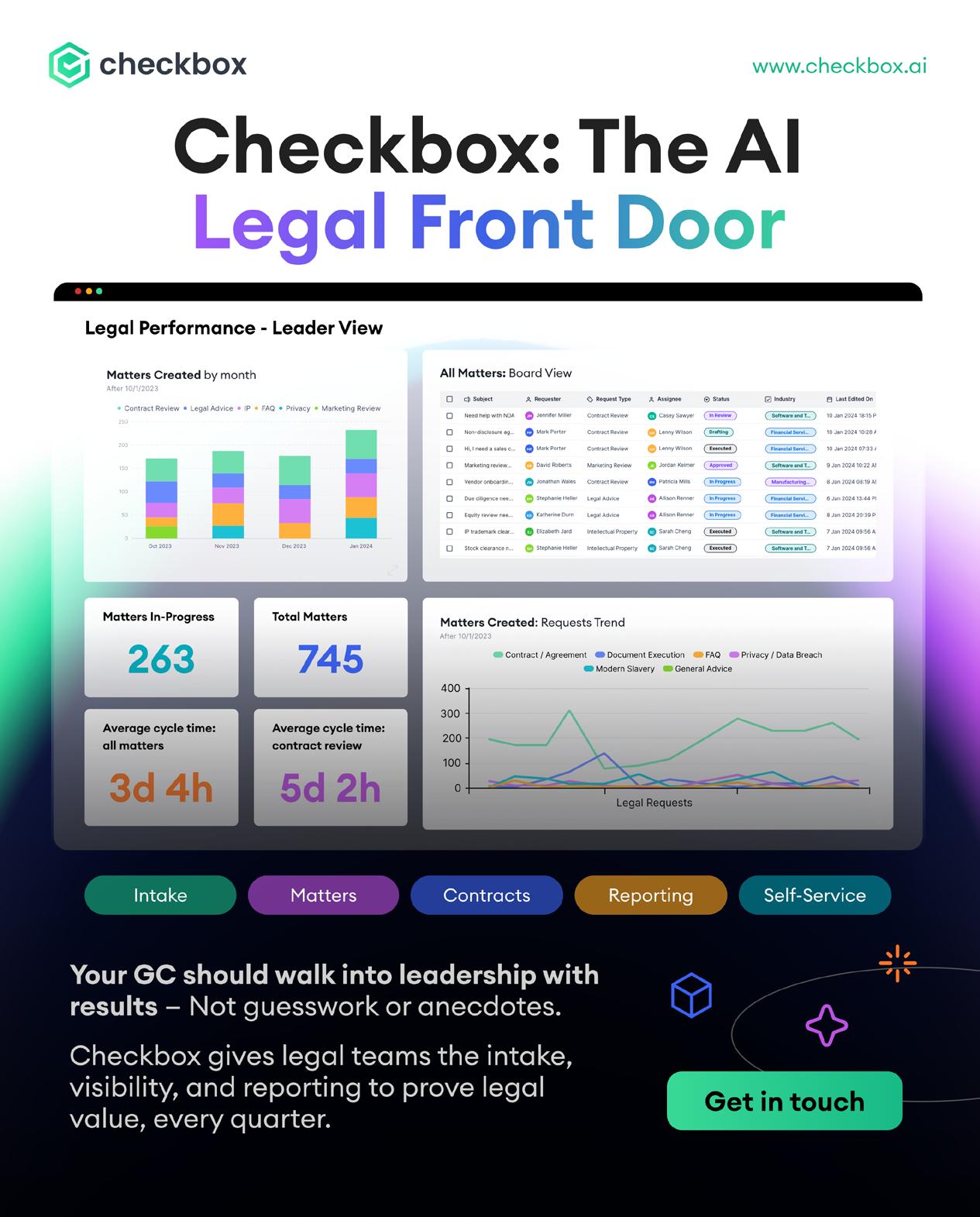
Cyber Risk Isn’t an IT Problem. It’s a Judgment Problem.
Chris Pogue, CyberCX

Chris Pogue
Chris Pogue serves as the Director of Digital Forensics & Incident Response (DFIR) for CyberCX in the Americas and a member of its global leadership team. He advises organizations and outside counsel during cyber incidents involving regulated data, disclosure exposure and governance scrutiny. He also serves as an Adjunct Professor of Practice at Oklahoma State University and the University of Oklahoma, teaching cyber incident response and business strategy.
When executives talk about cyber incidents, they tend to reach for the most comforting explanation first: this is an IT problem, it happened fast, it’s contained, we’ll patch and move on.
Chris Pogue has spent a career watching what follows.
A veteran digital forensics and incident response leader and an adjunct professor teaching cyber incident response, Pogue has worked thousands of breaches from inside the room where early decisions are made—under pressure, with partial information and with consequences that extend well beyond systems recovery. His conclusion is unsentimental: the most consequential failures during cyber incidents are rarely technical. They are failures of judgment. And they almost always begin early.
Executives, he observes, rarely underestimate the importance of an incident. What they underestimate is its shape.
In the opening hours, leaders default to what feels familiar. They assume the organization is an unlikely target, that its data has limited value, that the incident is discrete rather than prolonged. Early technical assessments—necessarily incomplete—can reinforce that framing by offering clean narratives at precisely the moment when uncertainty is highest.
It is a classic availability bias: leaders overweight what they have personally seen and discount risks that have not yet become concrete in their own experience.
Those narratives rarely survive contact with the evidence.
Threat actors do not distinguish between large and small organizations or between companies that believe their data matters and those that do not. If data has value, it will be taken. If an organization can pay, it will be pressured. And the timeline executive often imagine—an attack that begins and ends quickly— almost never holds. Typical dwell time stretches across months, which means discovery is not the start of the incident. It is the
moment leadership finally becomes aware of how long it has already been unfolding.
This is where judgment begins to slip.
In the first hours of a response organizations want certainty. Pogue’s experience is that this desire, while understandable, often becomes a source of risk. Responders rely on pattern recognition to orient investigations quickly; familiarity with threat actors and techniques helps narrow the field. But experience does not eliminate ambiguity. Some incidents resolve rapidly. Others take days simply to understand.
Problems arise when early hypotheses harden into conclusions—especially when those conclusions align with what leadership hopes is true. Narrative begins to drive decisions, rather than evidence.
The discipline, Pogue argues, is restraint. Assessments should be made once there is enough information to support them with confidence—not perfect certainty, but something materially stronger than assumption. Moving faster than the evidence allows does not reduce risk; it compounds it.
The most consequential missteps tend to appear at the transition point, when a technical incident becomes a legal and governance event. Questions about data type, regulatory regime and record volume quickly take on weight. Tension often arises when legal conclusions race ahead of technical certainty.
In practice, the absence of definitive proof—no visible moment of exfiltration—is sometimes treated as proof of absence. That framing ignores the totality of what responders see: confirmed threat-actor access, presence in sensitive data environments, ransom communications
and claims that align with the organization’s data profile. Governance risk emerges when legal comfort overrides technical judgment.
Cyber incidents, Pogue emphasizes, do not end when systems come back online. They persist—through scrutiny. Early decisions are revisited months later by regulators, insurers, opposing experts and courts. With hindsight, those decisions are evaluated against a reasonableness standard—not intent, urgency or good faith. Who was informed, what was said, when law enforcement was engaged, whether systems were shut down—each choice ages in public.
In a cyber incident, speed without discipline compounds risk.
This is why prior relationships matter. When responders and legal counsel have worked together before, decisions move faster and hold up better. Shared experience reduces friction at precisely the moment when judgment matters most.
What leaders most often underestimate, Pogue says, is not the technical complexity of an incident, but its human weight. For responders, this may be familiar territory. For executives, it is often the first encounter with operational failure, regulatory exposure and personal accountability all at once. Responders who lack the ability to navigate that reality add risk rather than remove it.
The most expensive cyber failures are not failures of tooling or technology. They are failures of judgment— shaped by comfort narratives, premature certainty and decisions made faster than the evidence allows.

Taking Control of E-Discovery Before It Controls the Case
Chuck Kellner, Everlaw

Chuck Kellner is a Strategic Discovery Advisor at Everlaw and a veteran of the e-discovery industry with more than 25 years of experience spanning Am Law firms, Big Eight consulting environments and boutique discovery providers. He advises leading law firms and corporate legal departments on governing complex, highstakes discovery, controlling cost exposure and building defensible processes at scale. He has published on e-discovery standards and held leadership roles within prominent industry working groups.
Corporate counsel operate in a constant state of dispute—against competitors, business partners, regulators, employees and others. Regardless of forum or stakes, each matter ultimately returns to two questions from business leadership: How long will it take and how much will it cost?
E-discovery—the process of identifying, collecting, preserving, reviewing and producing electronically stored information (ESI) for use in litigation or investigations—often determines the answer to both. It frequently represents the single largest driver of litigation spend and can decisively shape the pace and posture of a dispute. When weaponized or poorly governed, it escalates cost, entrenches positions and prolongs resolution. When executed with discipline and foresight, it can surface decisive facts, narrow issues and materially influence outcome.
Chuck Kellner, Strategic Discovery Advisor with Everlaw and an expert on the catalytic effects of e-discovery, explains why corporate counsel must understand the dynamics of weaponization—and how adversarial tactics can be diffused or strategically applied to shape cost, timing and leverage.
How does e-discovery have an “outsized impact” on dispute resolution?
E-discovery makes up the majority of litigation spend and is often the most consequential phase of a dispute. Properly executed, e-discovery can uncover “smoking gun” evidence and other decisive facts. Poorly executed, e-discovery carries risks including judicial sanctions, adverse inferences and court orders to redo expensive work. When weaponized, e-discovery can fuel rancor that causes disputes to drag on for years, driving up legal bills and delaying trial or settlement.
Chuck Kellner

Corporate counsel typically engages outside counsel to resolve significant disputes. Shouldn’t they already be experts at handling e-discovery?
There’s a wide range of proficiency in e-discovery; some AmLaw firms have large teams of legal, technology and data professionals dedicated to it. These groups typically support the firm’s practice areas and work directly with lawyers, advising on document production and delivering ESI recommendations on a case-by-case basis.
At the other end of the spectrum are firms that lack preparation and experience in e-discovery, the two biggest determinants in de-weaponizing the process. Experienced counsel worry when the other side is inexperienced—when opposing counsel does not know how to calculate data metrics, identify custodians or define data sources. They bemoan when opposing counsel is unprepared. During meet-and-confer, lawyers may know a great deal about the
merits of a case but little about e-discovery and are not prepared to discuss ESI protocols or scope.
A corporate law department executive using experienced outside counsel might nevertheless be detached from discovery operations and the strategic elements of discovery. Though this executive is responsible to the C-suite and Board for policy, reporting, budget and clearing disputes, they may not be fully aware of how e-discovery can catalyze resolution in individual cases.
How can weaponized e-discovery affect every dispute?
The e-discovery process can catalyze—either accelerate or delay—dispute resolution because information sharing is a critical step in the chronology of every legal matter.
Weaponization is often the default; once parties are in litigation, it can feel advantageous for one side or another
to adopt an antagonistic posture. Active weaponization can take the form of withholding basic information about available data or demanding more discovery than necessary, either to drive up cost or to set an upper boundary for negotiating scope. It can include raising serial objections to extend production timelines and prolong the overall life of the case.
Inadvertent weaponization arises when counsel is inexperienced or unprepared and unwittingly forfeits goodwill. Their pleadings can place them on the wrong side of the judge or opposing party. Weaponization can begin even earlier—at the outset of the case—when parties argue about the content and scope of discovery in ways that are neither productive nor defensible.
These lawyers may then need to play catch-up, often by bringing in an e-discovery expert to right the ship after the case is underway. An expert reviewing discovery pleadings, correspondence, motion practice and judicial orders can often infer which strategy is prevailing. It may become clear that one side is experienced but employing delay tactics or that another lacks discovery competence and stumbles from one motion to compel to another. In some instances, a party may attempt to leverage sanctions for tactical advantage.
Since weaponized e-discovery seems to be the default, what are the incentives not to use it? Why give up a dominant or aggressive position if it can be established at the outset?
Don’t get me wrong—an adversarial approach can be a useful litigation tool if applied strategically. For example, if a company in a crowded market files suit against top competitors for patent violations, the plaintiff can deliver mountains of documents or define parameters so broad that competitors must effectively empty their systems.
This strategy is sometimes invoked in “bet-the-company” disputes where delaying judgment may be advantageous. In such matters, discovery can become the “main event,” and weaponization may be deliberately considered.
In most cases, however, weaponization is counterproductive because it moves both parties further from resolution. It can have a multiplier effect on the two essential business concerns: duration and cost. Sharing evidence allows parties to assess common ground and move toward settlement— which remains the most common outcome in disputes.
What exactly constitutes de-weaponization? What are the benefits?
Discovery experience and preparation are the most effective ways to de-escalate tension during meetand-confer. Tension typically manifests as friction and fear; parties react to perceived provocation, setting an adversarial tone for disputes that may not warrant it.
An ESI protocol is a key tool for de-weaponization. Experienced e-discovery professionals understand that it provides a framework for predictability and incremental trust. An ESI protocol enhances clarity around scope and compliance; data sources and custodians; timing; and protections such as security, confidentiality, privilege and clawback. It also standardizes definitions for documents, searchable text, dates, deduplication, threading and the handling of system files, short messaging, hyperlinked attachments and structured data.
Preparation for meet-and-confer applies to both corporate counsel and outside firms. It is imperative that external counsel have an experienced and knowledgeable e-discovery professional—or access to a specialist as needed. Corporate clients and their firms should align
internally on an ESI protocol before engaging opposing counsel. When both parties negotiate and agree on such a framework early, it builds trust and reduces uncertainty—to catalytic effect.
What steps can corporate counsel take to de-weaponize e-discovery and prepare for the disputes in which it inevitably occurs?
Corporate counsel should ensure that outside firms maintain top-of-mind awareness of how weaponization affects dispute duration and cost. Lawyers should continuously train and mentor on developing caseappropriate e-discovery strategies and negotiating ESI parameters effectively.

Continuing Legal Education (CLE) on e-discovery practices and ESI obligations is widely available through professional organizations, universities and solution providers. These courses address Federal Rules of Civil Procedure (FRCP) requirements, ethical duties of technological competence, proportionality standards and avoidance of sanctions for spoliation or non-compliance.
The Sedona Conference, a nonpartisan nonprofit research and educational institute dedicated to advancing the law through reasoned dialogue, offers e-discovery negotiation training and working groups that support collaborative practice outside adversarial settings.
In-house and external legal teams may also deploy advanced e-discovery software that enables rapid analysis, parsing and querying of evidentiary documents to evaluate cases early and develop narrative strategies. Artificial intelligence (AI)-powered e-discovery tools enhance the ability to process and derive insight from the millions of electronic documents that may be produced under compressed deadlines. These platforms are equally valuable for analyzing a party’s own documents before production.
You’ve mentioned that judges’ patience can wear thin when parties argue back and forth, wielding obvious weaponization tactics. Do you have any cautionary tales to share?
Absolutely. Early in my career at an AmLaw 50 firm, a betthe-company dispute involving multiple parties dragged on for nearly three years. The judge ultimately required both sides to appear in court with their discovery counsel and experts. I was part of a group the judge sequestered in a courthouse conference room until agreement was reached on scope and an ESI protocol. With no adjournment and no meals, it took only hours before a protocol was finalized for her signature.
From Task Manager to Infrastructure
Andy White, Filejet

Andy White
Andy White is the founder and CEO of Filejet, a legal infrastructure company focused on entity governance, compliance automation and corporate record integrity. He has led the company’s evolution from traditional corporate services to a cloud-based legal infrastructure platform. With a background shaped by hands-on experience in entity compliance and regulatory filings, he focuses on turning manual governance processes into intelligent, supervised automation.
We sat down with Andy White, founder and CEO of Filejet, to discuss why legal teams must stop treating their systems as task managers and start expecting them to function as operational infrastructure. White outlines a shift from passive recordkeeping to supervised automation—where software completes filings, monitors compliance and surfaces risk in real time. For him, the real barrier isn’t technology. It’s expectation. Mr. White’s remarks have been edited for length and style.
You’ve helped move the legal industry from toolkits toward intelligence platforms. What ultimately fails in organizations that continue to treat legal systems as task managers rather than decision infrastructure?
Having low expectations is the real failure. Too many teams still treat their systems as digital filing cabinets or reminder tools. In entity management especially, software has historically been used to organize data and track deadlines, with only limited workflow support. That mindset is outdated. Today’s systems can use the data they hold to perform the work itself—with full visibility. Seeing what’s coming due, watching the system execute the task and being alerted only if there’s an issue is entirely achievable. The shift required is cultural: recognizing that expecting this level of performance is reasonable.
Intelligence platforms don’t just support work—they shape judgment. How prepared is the legal profession to be accountable for decisions informed by systems rather than individual instinct?
There is a healthy level of skepticism in legal around reliability and accuracy and that’s appropriate. At the same time, these tools are improving at an exponential pace. Staying informed about that progress is often the real challenge. Not all platforms are equal. Systems must earn trust through performance, transparency and consistency. Accountability doesn’t disappear—it evolves. Professionals still own the judgment, but they do so with betterinformed inputs.

As legal insight becomes centralized and surfaced in real time, how does authority shift inside firms and legal departments— and who tends to resist that shift most?
Any meaningful process change invites resistance. Often, the people who push back are the ones who care most about outcomes. They may have spent years building workable processes from limited tools. What looks like resistance is usually protectiveness. In practice, those individuals often become the strongest champions once they see measurable improvement. Their role is to challenge. Our role is to demonstrate value. When that alignment happens, progress accelerates.
When systems can recognize patterns faster than experience can be accumulated, what happens to traditional notions of expertise, seniority and trust in legal practice?
Technology remains a tool. The professionals who use it most effectively create the most value. That has always
been true across industries. As systems accelerate pattern recognition and execution, expertise doesn’t disappear—it shifts. Value moves toward judgment, oversight and the strategic application of capability. Adaptation becomes part of professional maturity.
If the last era of legal technology was defined by efficiency, what defines the next—and what does that evolution require of legal leaders personally?
The next era is defined by automation—specifically, intelligent automation. Systems can now review and summarize documents, conduct research, complete filings, renew licenses, process service of process, integrate with other platforms and surface issues automatically, all under human supervision. The outcomes include fewer errors, regained time and greater confidence. For leaders, this requires raising expectations and being willing to treat systems as infrastructure rather than support tools.
Filejet replaces fragmented vendors and manual tracking with intelligent automation for entity filings and compliance — delivering real-time visibility across your entire entity portfolio.
The Intelligent Platform for Entity Management
Built for law firms managing client entities and in-house legal teams overseeing corporate structures, Filejet centralizes and automates the entire entity lifecycle.
Formations • Foreign Qualifications • Amendments • Annual Reports • Ongoing Compliance
Need
All executed through one intelligent platform across every U.S. jurisdiction.
No spreadsheets.
No vendor coordination.
Ad
No manual tracking.
Just automation, control, and real-time visibility.
With Filejet, legal teams gain:
Automated entity filings and compliance monitoring
Real-time entity status dashboards
Client-facing dashboards for law firms
Centralized oversight across jurisdictions
60–75% faster transaction processing
30–50% less compliance tracking effort
Stop coordinating vendors. Stop tracking deadlines. Start running entity compliance as infrastructure.
Intelligent Automation for Entity Compliance
Visit Filejet at Booth 449 • Legalweek NYC filejet.com
Orchestration, Not Automation, Is the Real Test of AI-Ready Legal Operations
Aaron Bromagem, Tonkean

Aaron Bromagem
Aaron Bromagem serves as General Manager of LegalWorks with Tonkean, where he focuses on building scalable, governance-driven infrastructure inside highgrowth enterprises. He specializes in translating contracts, obligations and decision logic into operational systems that can withstand AI-driven speed. His work centers on orchestration, accountability and crossfunctional alignment in complex, multi-system environments.
As artificial intelligence accelerates legal work, the margin for informal process disappears. Aaron Bromagem explains why orchestration—not more automation—has become the defining discipline for legal teams operating at scale.
For years, legal operations teams have equated progress with speed. Faster contract review. Faster routing. Faster answers. Artificial intelligence has only intensified that instinct. But as AI begins to move work automatically across systems, something uncomfortable is becoming clear: speed does not compensate for structural weakness. It exposes it.
In a recent conversation with Aaron Bromagem, a senior legal operations executive with Tonkean, the distinction that mattered most was not between old tools and new ones, but between two fundamentally different ways of thinking about legal work: automation and orchestration.
Automation, Bromagem explained, assumes the work is already understood. The steps are known, ownership is clear and efficiency comes from acceleration. Orchestration begins where those assumptions fail. It addresses the parts of legal work that have always been implicit rather than designed—decision rights, conditional logic, accountability, escalation and proof. That difference could be glossed over when humans quietly absorbed ambiguity. It cannot be ignored once machines take over the movement of work.
“Automation assumes you’ve already figured everything out,” Bromagem said. “Orchestration is different. It’s tackling the questions that were always kind of fuzzy.”
Those fuzzy areas have long been managed informally. When a handoff broke, someone noticed. When a decision wasn’t clearly owned, experience filled the gap. AI removes that buffer—not because it is more intelligent, but because it is faster. As Bromagem put it, “It’s not about how much smarter it is than us—it’s how much
faster it makes things.” Speed turns small ambiguities into systemic risk.
That is why Bromagem views many legal operations failures not as workflow breakdowns, but as governance failures. “Most failures in legal ops aren’t because they forgot a step,” he said. “They’re because decision rights are unclear.” Automation simply accelerates whatever logic already exists. If ownership, escalation and success criteria were never explicit, they do not disappear when AI is introduced. They scale.
The warning signs of that fragility are often visible well before a crisis. Bromagem described organizations that still rely on spreadsheets and institutional memory to manage critical obligations. “You could always tell when a company’s six months away from a disaster,” he noted, “because their process is basically, ‘Sarah will remember.’” That approach holds until growth, turnover or an acquisition forces the organization to confront how much of its operation lived only in people’s heads. Orchestration replaces memory with design.
Nowhere is this distinction more consequential than in how legal teams treat contracts. Most organizations still view contracts as static documents—signed, filed and revisited only when something goes wrong. Bromagem rejects that framing outright. “It doesn’t really matter where your contracts are,” he said. “It matters what’s in them.” Pricing terms, SLAs, renewal dates, audit rights, notice periods—these are not archival details. They are operational commitments.
That is why he flips the traditional contract lifecycle on its head. In many systems, signature marks the end of legal’s involvement. From Bromagem’s perspective, that logic is backwards. “The signature is the starting gun—not the end point.” Execution is the moment obligations come
alive and exposure begins. Without orchestration—clear ownership, triggers, timelines and auditability—those obligations remain theoretical until something breaks.
The same misunderstanding is playing out in today’s rush toward AI governance. Organizations are scrambling to write policies after tools are already in use, assuming governance can be layered on later. Bromagem was blunt about the limits of that approach. “People think if you have a policy document, you’ve solved the problem.” Policies articulate intent, but they do not enforce behavior. “That’s not a policy—that’s a system.” Orchestration is what turns governance into something demonstrable—rules that constrain action, escalation paths that involve humans and audit trails that show what happened and why.
The early value of orchestration is not always framed as traditional ROI, but it is no less real. Missed SLA credits. Unclaimed contractual rights. Obligations that exist on paper but are never enforced because no one owns them operationally. Automation speeds tasks. Orchestration ensures those tasks reach the right person, under the right conditions, with accountability attached.
The deeper implication Bromagem returned to is one legal teams can no longer postpone. Informal process was survivable when humans served as the backstop. AI removes that safety net. Orchestration forces organizations to decide—explicitly—how work should flow, who owns decisions and what success looks like before speed magnifies every weakness.
In that sense orchestration is not a buzzword or a feature set. It is the dividing line between legal teams that can operate safely at scale and those that will discover, very quickly, that automation without orchestration is simply faster failure.
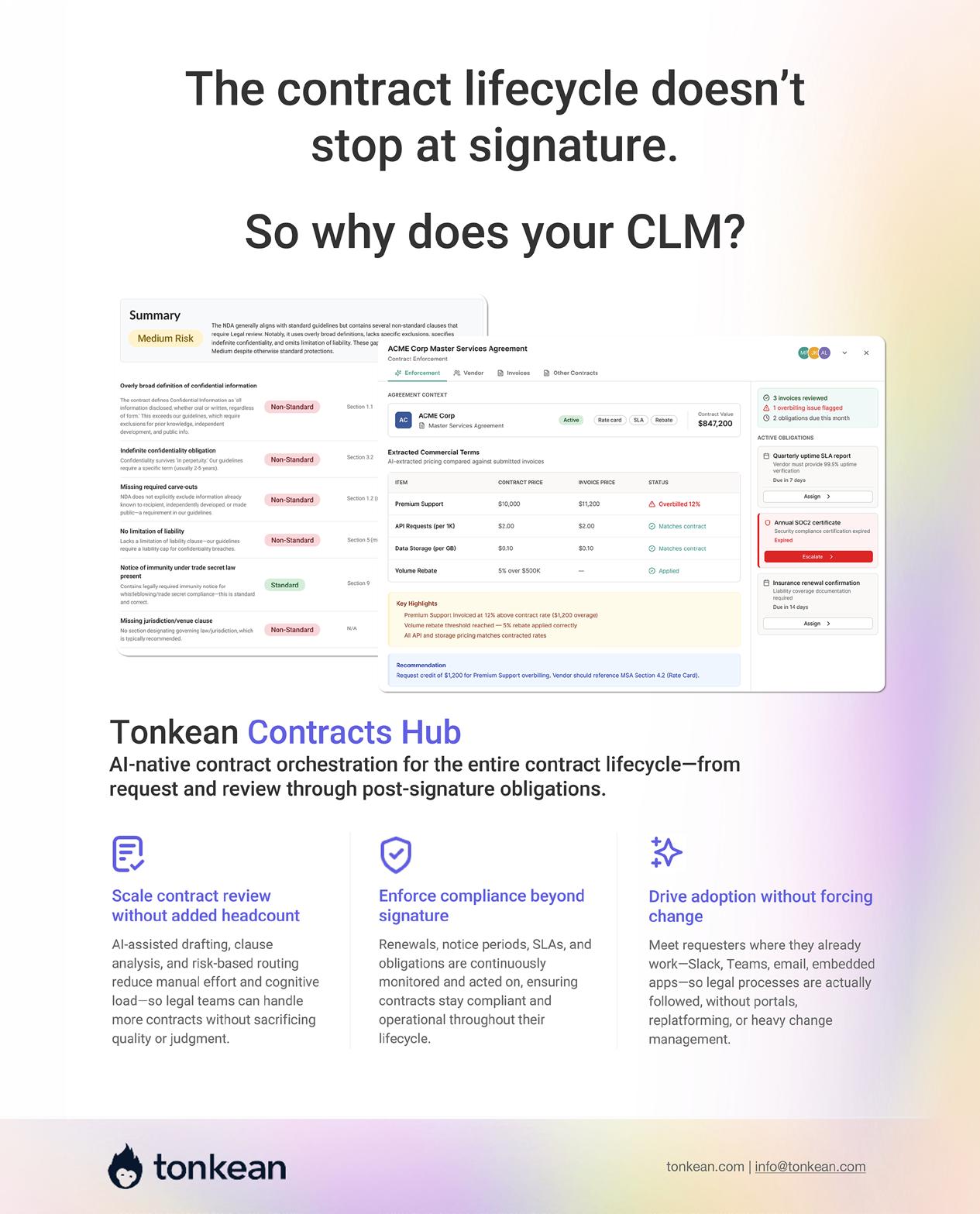
Decision Intelligence and the Structural Shift in In-House Judgment
Dean Sonderegger, Wolters Kluwer

Dean Sonderegger
Dean Sonderegger is Senior Vice President and General Manager of the ELM Solutions business at Wolters Kluwer, where he leads strategy, growth and innovation in legal spend and matter management technology. A veteran executive with more than 25 years in legal and tax software, he previously led multiple global business units across the company’s Legal & Regulatory and Tax & Accounting divisions.
Advanced analytics reports what happened. Decision intelligence embeds operational expertise into what should happen next — translating data into repeatable, defensible action. When cost and cycle time become anticipatory, outside counsel strategy changes. When risk patterns surface earlier, accountability intensifies. When AI synthesizes complexity, leaders still own the strategy.
In this Q&A, Dean Sonderegger, Senior Vice President and General Manager of the ELM Solutions business at Wolters Kluwer, examines how decision intelligence is reshaping legal judgment — moving departments from descriptive reporting to modeled outcomes, enterprise risk discipline and performance-driven counsel strategy.
CCBJ: What distinguishes “decision intelligence” from advanced analytics — and how does that change how a GC exercises judgment?
Dean Sonderegger: Advanced analytics provides legal teams with insight on what’s happening; whereas decision intelligence helps them to decide what actions to take, consistently and at scale. Decision intelligence embeds operational expertise into recommended actions that are explainable and repeatable— ultimately leading to better and more consistent outcomes. For a GC, leveraging decision intelligence enables the organization to set risk tolerance, priorities and decision guardrails once, instead of reinventing the decision every time new data shows up.
For example, analytics might flag that an employment matter is likely to exceed budget, while decision intelligence recommends a specific intervention like initiating a scope reset, moving to a capped fee or shifting staffing, based on what has actually worked in similar matters before. The result is judgment that still stays human but now scales across the department and is far easier to explain to finance and the business because the “why” is built in, not assumed. Decision intelligence is earlier, more deliberate and more defensible.
How should legal leaders rethink outside counsel strategy when cost and cycle time become anticipatory?
When legal teams use decision intelligence and predictive insights to anticipate cost and cycle time, outside counsel strategy fundamentally shifts. There’s less time spent negotiating rates in the moment and more focus on reliability, execution and outcomes at scale—who can deliver predictable outcomes for a given type of work. Instead of relying on relationships or ad hoc judgment, decision insight allows legal leaders to intentionally steer work toward firms and fee structures, including AFAs, that have proven performance under similar conditions. Outside counsel strategy moves from reactive and personal to operational, explainable and aligned with how the business expects decisions to be made. This is how decision intelligence moves from an abstract concept to something that actually changes day to day behavior and decision making.
What patterns signal exposure early — and how do you separate durable insight from noise?
Early exposure rarely shows up as a single outlier, rather it shows up as repeat behavior, such as consistent variance, cycle time compression or expansion or deviations from peer matters with similar profiles. This of course assumes that legal teams are consistently capturing the right data in the first place. The challenge is signal integrity—having a reliable and clean data set - durable insight comes from patterns that persist over time, across comparable work and within clear business context, which is how teams distinguish structural risk or opportunity from noise. Decision intelligence then allows legal teams to proactively focus attention on the things that matter, instead of reacting to every anomaly.
Where is the boundary between synthesis and strategy as generative AI becomes embedded in platforms like TyMetrix 360°?
AI is extremely good at synthesis— organizing complexity, identifying patterns and clarifying trade-offs. Strategy remains human.
As cost and cycle time become anticipatory, outside counsel strategy shifts from reactive rate negotiation to performance-driven allocation aligned with enterprise expectations.
The boundary is clear: AI informs decisions; leaders own them. Where AI becomes meaningful at the executive level is when it shortens the distance between information and judgment—when it allows leaders to assess options faster, ask better questions and act with greater confidence.
That’s influence, not autonomy and it’s the right balance.
How should legal departments think about accountability and defensibility when AI-informed insight shapes decisions?
Accountability doesn’t diminish with predictive systems, it actually increases.
AI-informed insight should be treated the same way finance treats forecasts: probabilistic, transparent and governed. Defensibility comes from understanding how insights are

generated, documenting how they inform decisions and maintaining clear human ownership of outcomes.
When AI is used to support judgment rather than substitute for it organizations are better informed and better positioned.
Are you seeing a widening performance gap between data-mature departments and those still operating descriptively?
Yes and the gap is widening quickly, but not just because of analytics capability.
Data mature departments tend to have deliberate legal ops structures, sufficient resources and leadership alignment that allow data to be captured, interpreted and acted on over time, while less mature departments are constrained by bandwidth, tooling or a GC mindset shaped by traditional law firm decision making. Growth in maturity doesn’t happen overnight; it requires intentional
investment in people, process and technology, along with top down reinforcement that foresight matters more than post hoc explanation. When that shift happens, legal teams move from describing what went wrong to anticipating risk and leading strategically alongside the business.
Looking ahead, is the ambition to predict cost — or to model outcomes and enterprise risk with greater rigor?
Predicting cost is table stakes, but the real ambition is broader. It’s to model performance, outcomes and enterprise risk with the same discipline the business applies to capital allocation, including how work is intentionally balanced across in-house teams, outside counsel and ALSPs. As decision intelligence matures, technology enables legal leaders to move beyond managing spend to actively shaping firm relationships, delivery models and fee structures based on reliability and results, not habit. That’s where legal data stops being administrative overhead and starts driving smarter, more strategic decisions about how legal work gets done.

SharePoint Isn’t a Legal DMS— Until You Make It One
Keith Vallely, Moonlight 365 Technologies, Inc.

Keith Vallely
Keith Vallely is a graduate of the University of Chicago, completing his studies in the late 1980s. With over twentyfive years of experience in the document management industry, Keith has built his expertise in sales, marketing and consulting. Over the course of his career, he has broadened his skill set to include design, architecture and solution-based consulting, especially within the Microsoft 365 ecosystem. His primary focus has centered on SharePoint and the Power Platform.
Subscription Overload is Everywhere. At home, we juggle Hulu, Paramount+, Disney+, Netflix, Peacock, Max, Amazon Prime—the list never ends—because each one has that one show we can’t miss. So, we add another subscription… and another. Businesses and law firms are falling into the same trap—only with software.
The rise of SaaS changed everything. In the early 2000s, software came as a one-time purchase—with a few updates sprinkled in until it eventually became outdated. Then SaaS arrived and flipped the model. Instead of a heavy upfront cost, we were offered smaller, predictable monthly payments and the promise of always-updated software without the hassle of installing new versions. For users, it felt like freedom. For software companies, it was a goldmine—steady, recurring revenue that allowed them to focus on rolling out new features and supporting existing customers rather than constantly chasing new ones. In many ways, SaaS applied the car-leasing model to software: lower monthly payments, continuous upgrades and most importantly a cycle you never truly exit.
SaaS, 20 years later, looks very different. By 2026, many software providers have been swept up by private-equity firms or taken public and the pressure to sustain recurring revenue has intensified. The result? Fewer updates, thinner support and steadily rising subscription fees. And the increases aren’t slowing down. Gartner’s “CIO’s Guide to Effectively Negotiating GenAI with Enterprise Software Vendors” warns that the near-universal addition of AI agents across SaaS platforms will push costs up to 40 percent higher by the end of 2027—with price hikes accelerating, not stabilizing. In other words, the subscription model that once promised predictability is now driving an escalating cost curve that every business will feel.
Why SaaS costs are spiking. The surge in subscription pricing isn’t just a money grab—it’s driven by the hidden economics of AI. Modern AI models demand massive computing power and only a handful of companies control that infrastructure. SaaS vendors now must rent that power to run the AI agents they’re baking into every

product. And like any tenant, they pass the premiums straight to you. Nearly every solution your business subscribes to will absorb these rising costs, funneling more of your budget to the major cloud providers behind the scenes—often the same companies you already buy from, with Microsoft being the most obvious example. The bottom line? As AI becomes embedded into every SaaS product, higher costs are unavoidable. You won’t be able to “opt out,” because AI features are no longer optional—they’re becoming the new baseline for modern software.
Single-point solutions have created a new kind of bloat. As SaaS vendors work to justify never-ending subscription fees—separate from the constant updates required by Windows or Mac—they’ve responded by stuffing their products with more features, more modules and more complexity. Over time, the original reason you purchased the software gets buried under layers of functionality you never asked for. You might adopt a single-point solution to solve one specific business task… and find yourself staring at a cockpit of controls no one understands. Most users end up saying some version of, “I have no idea what any
of this is. I just click here to do the one thing I need.” In effect, Many organizations pay for a Boeing 747 worth of capability, yet only use it to drive to the grocery store.
The long-term cost of the SaaS model is becoming impossible to ignore. Yes, AI agents can increase efficiency and reduce the need for certain staff roles—but that’s only half the story. The other half is far less glamorous: the “affordable” subscription you once justified is now consuming a larger share of your IT budget every year.
And with every workflow automated and every action logged, SaaS platforms generate mountains of new data (your data)—data that must be stored, secured, integrated and ultimately accounted for in the ever-increasing costs of storage and security.
To keep pace with rising subscription costs, firms and businesses often face the same pressure point: reducing staff or absorbing the cost. This cycle is already becoming unsustainable. Software companies, in order to justify the ever-increasing costs of their SaaS or single-point solutions, must now do more than the original intended task. With AI agents, the expectation has grown into the notion that the software will soon do what humans currently do.
These SaaS costs can never be paid off and thus are systems you can never truly own. You’re leasing the car forever. And meanwhile, your company’s departments find themselves trapped on a treadmill of rising expenses and increasingly complex, rarely used features—a rat wheel no organization can afford to stay on.
Does any of this sound familiar?
The old way is becoming the new way again. For decades,
American businesses and law firms have purchased software to streamline processes and improve efficiency. Yet today, many organizations find themselves repeating the same pattern: buying a new subscription for a specific department or practice area—even when they already subscribe to multiple tools that do nearly the same thing. Why?
Because they don’t want their operations dictated by software. They want the software to conform to their business or legal process – typically a process they believe has already been refined and optimized over time. And that’s a fair point. However, it can also lead to subscription sprawl unless a solution can meet these three critical criteria:
• It must fit the existing business process perfectly.
• It must cost less—and perform better—than adding more staff.
• It must be simple, intuitive and easy to use.
Secure.
Private. Costefficient. That is the Microsoft 365 model. And you’re already paying for it.
There is a platform that meets those criteria and most organizations already subscribe to it: Microsoft 365. Companies and firms that build solutions on Microsoft’s platform gain immediate advantages—a lower IT operational cost, a single, unified layer of security and centralized content storage. Even more importantly, because Microsoft 365 already houses your email, documents, files, images, PDFs and videos, it positions your organization to execute longterm AI strategies using your own data—not someone else’s third-party learning model.
Microsoft 365’s “Waffle.” After signing in to Office.com, you’ll find a small grid of nine dots in the upper-left corner—the Microsoft 365 “Waffle.” Most people have clicked it at least once, often without realizing just how much power lives behind that simple icon.
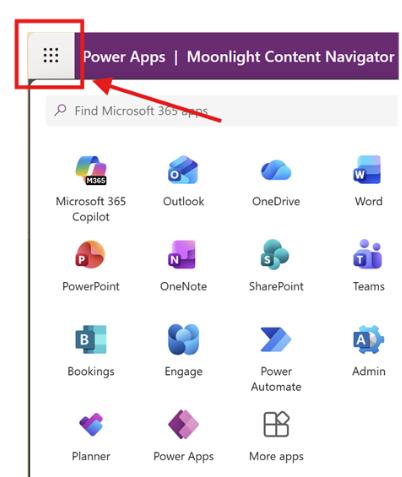
Open it and you’re greeted with a suite of applications that come bundled with your subscription—many of which are underused or never considered at all. Familiar names like OneNote, SharePoint, Teams and OneDrive sit alongside powerful yet often overlooked tools such as Planner, Power Apps, Power Automate and Bookings. What most organizations don’t realize is that Microsoft’s strategy
mirrors that of a utility company. Just like electricity, water, or gas, Microsoft aims to be a permanent, essential part of your operational infrastructure.
Every Microsoft 365 subscriber receives storage, email management, content management, task and calendar tools and—most importantly—the ability to integrate all of them. Taken together, these capabilities, combined with your own private data and the AI layer provided by Copilot, form a potent, cost-effective foundation for your business or firm. The tools are already there. The value is already paid for. The opportunity is simply waiting to be unlocked.
Moonlight 365 Technologies.
With more than 50 years of combined experience in business and legal process management across a wide range of technologies, Moonlight 365 Technologies, Inc. delivers what Microsoft experts call the “final mile.” After years of working closely with Microsoft professionals, one reality has become clear: when Microsoft looks at industry verticals—finance, insurance, legal and others—they see markets that are too narrow for them to build bespoke solutions for. Their mission is broader. Microsoft aims to be the foundational technology infrastructure for every organization, large or small, public or private—not a pointsolution vendor. That’s why Microsoft relies on experts within each vertical to build tailored solutions on top of the Microsoft 365 platform. Moonlight 365 is one of those experts. We design and deliver customized solutions for businesses, finance organizations, legal departments and law firms—solutions built using SharePoint, Power Automate, Power Apps, Microsoft Forms, Planner, Power BI, Exchange and more. Moonlight 365 doesn’t just implement Microsoft tools, we orchestrate them into cohesive, intuitive, business-specific systems that solve real operational challenges and drive measurable efficiency.
Moonlight 365 Solutions.
Developing Microsoft-based solutions is an art—and it starts with listening. Moonlight 365 professionals take the time to understand the real needs of your business, department or law firm, then assemble the right mix of Microsoft technologies to meet those requirements with precision. Consider one example. An accounting department at a major firm was overwhelmed by internal requests. What they needed resembled a matter-intake system—but tailored for accounting. Moonlight 365 delivered a streamlined, web-based request form that allowed the firm’s professionals to submit exactly what they needed. Each submission automatically generated a “ticket,” notified accounting by email and fed into a centralized dashboard built with Power Automate and Power Apps. From that dashboard, accounting staff could view priorities, assignments, deadlines and task details, closing items with a click - once completed. Every task was logged, stored and fully auditable, with reporting available for management. And throughout the entire process, requesters received automatic status updates without anyone lifting a finger. This is just one example of how Moonlight 365 leverages the Microsoft 365 platform to solve real operational challenges—combining deep process expertise with Microsoft’s ecosystem to deliver intuitive, reliable, perfectly-fitted solutions.
Moonlight 365 Products.
Now let’s start cooking with gasoline. Moonlight 365 has built a suite of powerful, turnkey solutions—including contract management, document management and knowledge management (aka Content Management)— using the full strength of Microsoft SharePoint. And for organizations already storing content on SharePoint, we’ve developed a range of tools that dramatically enhance the Microsoft experience: Software that gives users the power to file email and documents directly
to SharePoint with ease, metadata correction engines for when your documents have the wrong metadata, SharePoint security repair tools, business intelligence dashboards, Teams-integrated search, full-content business insight reporting, Word templates that can add SharePoint document ids and much more. Many Moonlight 365 customers come to us with specific business requirements, assuming they need a custombuilt solution—only to discover we’ve already engineered a product that meets or exceeds those needs. And in most cases, there is no subscription fee, because you own the solution upon delivery. In short, Moonlight 365 Technologies, Inc. is the Microsoft 365 expert your business, department, or law firm has been searching for. We help you fully leverage the platform you already own—so you can reduce reliance on overpriced point solutions and finally start lowering your IT spending.
The Microsoft Conclusion.
The SaaS spiral isn’t slowing down—but your spending doesn’t have to follow it. The tools, the platform and the power to take back control of your technology costs are already sitting inside your Microsoft 365 subscription. The only missing piece is a partner who knows how to unlock it. Moonlight 365 Technologies turns Microsoft’s ecosystem into a streamlined, tailored, cost-cutting engine for your business or law firm—no bloated subscriptions, no runaway expenses, no flying a 747 to pick up groceries.
If your goal is to reduce software spend, simplify your technology stack and get more value from Microsoft 365, the next step is to rethink how the platform is structured and governed. With the right approach, the tools many organizations already own can begin to function as a coherent legal document environment rather than a collection of disconnected systems. To learn more about how this model works in practice, visit moonlight365.com.

Already pay for Microsoft 365?
Moonlight 365 Technologies, Inc. builds custom Microsoft solutions you need without another monthly subscription.

Document Management
SharePoint-based document, contract, & knowledge management with doc IDs

Moonlight Navigator
Your web-based dashboard to access all your SharePoint and Microsoft 365 files and data

Moonlight Filer
Save emails, at tachments, and documents from Outlook, Word, Excel and PowerPoint directly to

Moonlight 365 solutions solve problems without soft ware subscriptions. Including: Mat ter Intake, Business Process Automation, Admin Utilities, and other solutions.
Matter Management Is a Structural Problem
Katherine King, IntuityAI by Dazychain

Dr. Katherine King, CEO of Dazychain, leads the development of IntuityAI, a matter management platform built for lean in-house legal teams operating under growing complexity and persistent resource constraints. The company sits at the intersection of legal operations, workflow discipline and applied AI, examining how smaller departments evolve from improvised systems to durable infrastructure.
Despite years of investment in legal technology and legal operations training, matter management continues to break down in lean legal departments. From what you see, what is the most persistent failure mode—and why hasn’t it been solved yet?
If I had to pick one persistent failure mode in lean legal teams, it’s this: Matter management fails at intake. It fails in the first five minutes.
Despite years of investment in legal tech and legal ops training, most departments still don’t have a clean, structured, enforced way to capture what the matter actually is, why it exists, what risk it carries and what outcome is expected.
Instead, work arrives via email, Teams, Slack, hallway conversations, forwarded threads and “quick questions.” By the time someone tries to formalize it in a matter management system, the context is already diluted or worse, lost.
Lean legal teams don’t have a technology problem. They have a behavioral and structural problem. People route around systems.
If logging a matter feels slower than just replying to an email, they won’t log it. If categorization requires legal nuance that business users don’t have, they guess. If lawyers are under pressure, they prioritize solving the problem over documenting it.
Over time, the matter management system becomes a partial truth. And partial truth is worse than no truth, because it creates the illusion of control. Because most matter management tools were designed to track work, not to shape it. In lean departments, none of that is true.
The reality is:
• Legal triage is happening in someone’s inbox
• Prioritization is happening in someone’s head
Katherine King
• Risk assessment is implicit
• Knowledge walks out the door when someone resigns
Technology that sits downstream of chaos can’t fix chaos. This is where the combination of IntuityAI by Dazychain becomes interesting.
IntuityAI isn’t just a matter tracker, it’s built for corporate legal teams who are juggling matter management, contract management and triage simultaneously. It forces structure at the front door. Intake becomes deliberate. Categories aren’t an afterthought. Workflows reflect how legal actually works.
But structure alone isn’t enough. IntuityAI changes the game because it can:
• Interpret messy intake requests in plain language
• Classify risk and matter type automatically
• Suggest next steps and workflows
• Identify gaps in information before the lawyer even sees it
That means intake stops being a manual compliance exercise and becomes intelligent triage. Now the system isn’t just recording work, it’s helping shape it.
Matter management hasn’t been solved because we tried to solve it as a reporting problem. It’s not. It’s a front-door design problem. Until intake is structured, frictionless and intelligently supported, lean legal teams will continue to:
• Under-report matters
• Misclassify risk
• Lose knowledge
• Burn time on reactive firefighting
The solution isn’t “more training.” It’s better architecture. When you combine structured intake with intelligent triage and pattern recognition, matter management stops being a compliance burden and becomes what it was supposed to be:
A strategic operating system for legal. And in a lean department, that’s not a nice-to-have. It’s survival.
In smaller legal teams, pressure tends to surface quickly— through volume spikes, regulatory demands or executive scrutiny. Where do systems start to degrade first under that pressure and why is matter management often the point of failure?
In smaller legal teams under pressure, whether from sudden spikes in volume, tightening regulatory demands or heightened scrutiny from executives, the first cracks don’t usually appear in litigation strategy or contract negotiation skills. They show up in the systems that are supposed to keep work visible, orderly and measurable. And matter management, including the discipline and technology for intake, tracking organizing and reporting on every piece of legal work is often where things fail first.
Matter management fails first under pressure not because legal teams lack skill, but because traditional systems never gave them a single, embracing framework for all of their work. Tools like IntuityAI by Dazychain are changing that by turning matter management from a fragile repository into a resilient, AI-augmented operating system for legal work.
Matter management is the operational backbone of an in-house team. It governs intake, triage, allocation, deadlines, documents, spend and reporting. When that backbone relies on email threads, shared drives

and spreadsheets, visibility disappears under pressure. Work is duplicated or overlooked. Deadlines are tracked inconsistently. External spend becomes harder to monitor. Leaders ask for data that cannot be produced with confidence. The problem is not legal capability. It is structural fragility.
Smaller teams feel this more acutely because they have no excess capacity to absorb disorder. When demand rises, there is no margin for inefficiency. Without a central system of record, prioritization becomes reactive and risk becomes harder to see.
Modern platforms such as Dazychain, powered by IntuityAI, are designed to prevent this breakdown. They centralize every matter in a single, structured workspace, automate intake and task routing and provide real-time dashboards on workload, deadlines and spend. AI-driven summaries and insights reduce manual handling and improve consistency. The result is not simply administrative efficiency. It is operational control.
Under pressure, systems degrade where visibility and coordination are weakest. In many small legal teams, that weakness sits in matter management. Strengthening it transforms legal from a reactive function into a controlled, data-driven partner to the business.
AI is frequently positioned as a way to improve efficiency and visibility. In practice, where does AI genuinely help matter management—and where does it risk accelerating fragmentation rather than fixing it?
Where AI Genuinely Helps Matter Management
Intelligent Intake and Classification
AI can automate the way matters enter the system. Instead of manual entry, IntuityAI can read requests from intake forms and classify them accurately, attaching key metadata like matter type, priority, stakeholders and deadlines. This reduces manual errors and ensures matters are captured in the central system from the outset. Without this, teams risk lost work or inconsistent tagging that undermines visibility.

Summarizing and Organizing Information
A major drain on legal teams is reading through long threads, attachments and notes to understand the current state of a matter. IntuityAI can produce concise summaries and extract key dates, obligations, clauses, risks and commitments. When these summaries are stored in Dazychain’s matter workspace, everyone sees a consistent snapshot of the work, improving clarity and reducing time wasted.
Intelligent Task Routing and Recommendations
AI suggests the logical owner based on patterns from past matters. This triage and assignment accelerates progress and reduces hand-offs that slip through cracks. In Dazychain, this means matter tasks are automatically proposed and assigned, not left to ad-hoc emails or tribal knowledge.
Enhanced Reporting and Trend Visibility
IntuityAI can analyze large volumes of matter data to highlight bottlenecks and identify types of work
that consume disproportionate resources. Integrated dashboards powered by IntuityAI help leaders see trends and risks they would otherwise miss. This turns data into actionable insight.
These capabilities make matter management faster, more consistent and more transparent, helping legal teams stay organized under pressure.
Where AI Risks Accelerating Fragmentation
AI is no magic cure. If not architected in service of a single system of record, it can make fragmentation worse.
AI Tools That Operate Outside the Central Workflow
If AI is used in separate tools that aren’t integrated into the core matter management platform, you end up with “AI silos,” insights and summaries scattered across inboxes, documents or apps. That increases fragmentation rather than reducing it.
Uncontrolled AI Prompting and Output Storage
When individual users generate AI outputs and save them to local drives, personal notebooks or disconnected apps, there is no authoritative version of truth. Matter history becomes fragmented across systems. Asking IntuityAI to generate and store outputs inside the matter’s workspace avoids this by keeping everything where the team expects to find it. AI output should be shared, stored and reusable to keep costs down and reduce consumption.
Automation Without Governance
AI that takes actions without guardrails can create inconsistent records. Great care needs to be taken to ensure your AI is only looking at authorized materials. In contrast, Dazychain’s integrative design ensures that AI suggestions respect configured workflows and allowed data, reinforcing coherence rather than subverting it.
Many teams attempt to layer AI onto workflows that were already informal or inconsistent. What sequencing mistakes do you see most often and what foundations need to be in place before AI can be effective rather than destabilizing?
Many legal teams make the same sequencing mistake: they introduce AI before they have stabilized the underlying workflows. Instead of fixing fragmented intake, inconsistent matter structures or unclear ownership, they attempt to automate them. The result is faster chaos!
The most common mistakes include:
Automating undefined processes
If intake is informal, metadata inconsistent and matter stages unclear, AI replicates that inconsistency at scale. Poor tagging, unclear priorities and incomplete records become systemic rather than occasional.
Adding AI outside the system of record
When AI tools operate in email, chat or standalone applications rather than inside the matter management platform, outputs become disconnected from the authoritative file. This increases fragmentation and weakens governance.
Skipping taxonomy and reporting design
AI depends on structured data. Without agreed matter types, risk categories, status stages and reporting fields, AI can’t produce reliable insights. It may generate summaries, but not meaningful business intelligence.
Before AI can be effective, three foundations must be in place:
A single, structured system of record
Platforms like IntuityAI provide a centralized matter workspace where intake, documents, tasks, spend and reporting are consistently captured. Without this backbone, AI has nothing stable to enhance.
Defined workflows and governance controls
Clear intake channels, standardized metadata and agreed lifecycle stages ensure that AI operates within guardrails. IntuityAI works best when it reinforces these structured workflows rather than improvising around them.
Leadership clarity on business outcomes
AI should be deployed to achieve specific goals: faster turnaround, reduced external spend, improved visibility/ reporting or better risk tracking. In IntuityAI, AI-driven summaries, intelligent intake and analytics directly support these outcomes because they are embedded within the operational framework.
The lesson is straightforward: AI should not be the
starting point. Structure comes first. Once workflows are standardized and centralized in a platform like Dazychain, IntuityAI can accelerate efficiency, enhance visibility and strengthen control. Without that foundation, AI risks amplifying disorder rather than resolving it.
There is often a long delay between when a legal team has outgrown spreadsheets or email-based tracking and when leadership acknowledges it. What signals indicate that a department has crossed that threshold—even if no one has formally named it yet?
There is usually a quiet tipping point before anyone says, “Our systems are no longer fit for purpose.” The signs are operational, not dramatic. But they are unmistakable.
Executive scrutiny increases
Often the trigger is external. The board asks for risk trends. Finance wants forecasting. Compliance requests audit trails. If producing defensible data requires manual reconciliation, the gap between operational reality and governance expectation has already widened too far.
AI is most powerful when it enhances a structured, central source of truth. The moment a legal team feels constant friction in answering basic operational questions, struggles to prioritize consistently or depends on individual memory to track matters, it has crossed the threshold. It may not have named it yet, but the system is already signaling that informal tools are no longer sustainable.
Work becomes hard to see in aggregate
It’s a threshold moment when teams can’t answer questions such as: How many matters are open? Where are the bottlenecks? What is our external spend exposure? When data lives across inboxes and
spreadsheets, visibility depends on manual collation. The lag between question and answer is the signal. And it’s agonizing for the team to try to piece that data together. We’ve seen examples of teams trolling through the general ledger to ascertain their spend, with days or even weeks spent collating monthly or annual reports.
With IntuityAI embedded in a structured matter platform, those insights are generated from live matter data rather than reconstructed retrospectively. When reporting becomes an exercise in chasing people rather than reading dashboards, the department has already outgrown informal tracking.
Prioritization is driven by noise, not risk
Squeaky wheel gets the oil, right? When the loudest stakeholder gets attention first, rather than the highestrisk or highest-value matter, the system is under strain. Email-based tracking doesn’t provide structured risk scoring or consistent categorization. AI cannot meaningfully prioritize what is not structured.
IntuityAI relies on defined matter data to surface trends, flag delays and highlight risk patterns. If those patterns can’t be surfaced because the data is inconsistent or scattered, that is a clear indicator the team has crossed the threshold.
Institutional knowledge lives in people, not systems
When team members are the only source of truth for the status of a matter, the department is vulnerable. Holidays, turnover or role changes suddenly create operational blind spots. AI cannot assist where information is tribal. Hidden knowledge becomes the currency of power. Once matter information is centralized, IntuityAI can summarize history, extract key obligations and provide continuity. If continuity depends on memory rather

than system intelligence, the department has outgrown spreadsheets.
Looking ahead, how should lean legal teams redefine success in matter management? What assumptions about visibility, control or “good enough” processes do you think need to be unlearned as AI becomes more embedded in daily legal work?
Looking ahead, lean legal teams need to redefine success in matter management from “keeping up” to operating with measurable control and foresight.
For years, many teams accepted a version of success that simply meant matters were eventually resolved, inboxes were managed and nothing catastrophic slipped through. That standard may have been survivable in low-volume environments. It is no longer sufficient in an AI-enabled operating model. Volumes are increasing, sometimes exponentially.
First, visibility must be real-time, not retrospective. In the past, visibility often meant pulling together a monthly spreadsheet or manually assembling a board update. That’s not true visibility. As AI becomes embedded, success means leadership can see live matter volumes, turnaround times, risk distribution and workload trends at any moment. If insight depends on manual collation, the process is not “good enough” anymore.
Second, control must be systemic, not personal. Lean teams have historically relied on highly capable individuals who “just know” what is happening across their matters. That model does not scale and it doesn’t withstand scrutiny. IntuityAI, when embedded within structured matter management, captures and analyzes matter data continuously, generating summaries,
With tools like IntuityAI, the benchmark shifts in three important ways.
surfacing risks and identifying bottlenecks. Success is no longer dependent on institutional memory. It is embedded in the system.
Third, efficiency must mean intelligent leverage, not just speed. AI should not simply help lawyers move faster through emails or documents. Its real value lies in pattern recognition, surfacing insights that humans would miss. Lean teams should unlearn the assumption that “handling more matters with the same headcount” is the only measure of progress. Success is the ability to allocate resources based on data, predict pressure points and proactively manage risk.
Finally, “good enough” processes must give way to structured discipline. AI amplifies whatever foundation it is given. Informal intake, inconsistent categorization and ad hoc tracking will produce amplified inconsistency. But structured, centralized matter data allows IntuityAI to generate reliable insights and strategic reporting.

The assumption that loosely organized processes are acceptable for small teams needs to be unlearned.
In an AI-enabled legal function, success in matter management is defined by clarity, predictability and defensibility. Lean teams should measure themselves not by whether work gets done, but by whether they can see it, explain it, forecast it and improve it in real time. That is the new standard.
At its core, this conversation is not really about software. It’s about sustainability.
Too many capable lawyers quietly absorb growing volumes of work, expanding regulatory demands and rising executive expectations, convincing themselves that strain is simply part of the profession. Spreadsheets multiply. Inbox flags accumulate. Evenings disappear. The system creaks and the individual compensates.
But lawyers should not have to function as shock absorbers for broken processes.
If matter management depends on personal vigilance rather than structured visibility, the cost is paid in stress, fatigue and long-term health. No team should have to live in a constant state of low-grade panic just to maintain control. No general counsel should lie awake mentally reconciling risks that a properly structured system could surface in seconds.
AI, when embedded thoughtfully through platforms like IntuityAI, is not about replacing judgment. It is about relieving unnecessary cognitive load. It is about giving legal professionals back the clarity and control that allow them to practice at their best.
The future of lean legal teams should not be burnout disguised as resilience. It should be intelligent systems that carry their share of the weight, so lawyers can focus on judgment, strategy and leadership without sacrificing their wellbeing in the process
Intake with legal front door
Reporting & dashboards
Spend management
Collaboration portal for internal clients & law firms

automated triage

Integrates with Outlook, Office 365, Gmail, DocuSign AI summaries & AI Q&A
Cost-effective Legal AI.
Built for control and compliance.
IntuityAI helps in-house legal teams automate work, reduce spend, and stay firmly in control, all within Dazychain.
contracts & documents
Contract & document automation
Reduce effort and cost using AI-assisted workflows
Scan to explore IntuityAI Intelligent control over intake, matters, and contracts Built-in compliance, AI governance, and one-click reporting

Automation without risk, designed for corporate legal teams by
Legal AI Has a Prerequisite: Structure
Cory Flynn, Array

Cory Flynn
Cory Flynn is Chief Technology Officer at Array, where he oversees the company’s technology strategy across AI, data operations and litigation support services. With more than 20 years of experience in e-discovery and legal technology, Flynn has held leadership roles spanning operations, product development and business intelligence. His current focus is on embedding AI into the litigation lifecycle in ways that are operational, governed and defensible—bridging the gap between innovation and real-world legal practice.
At Array, AI is already being pushed beyond review and into the full litigation lifecycle. That’s not yet the market standard—but it’s where the market is heading.
The premise is straightforward, if uncomfortable: AI does not create order. It depends on it.
That runs against how much of legal tech is still approaching generative AI in 2026—introducing it first, then trying to retrofit structure around it. The results are increasingly familiar: strong demos, contained pilots and uneven performance when it matters most.
What’s taking hold instead is a quieter shift. Less about what AI can do, more about where—and when—it actually works.
At Array, where Cory Flynn stepped in as Chief Technology Officer in 2025, the focus has been on making AI operational under real litigation conditions—embedded into workflows, governed and defensible. Not as a layer on top, but as part of the system itself.
“If AI results can’t be clearly explained to a court or regulator and tied to a defensible process, it’s not ready.”
That distinction is starting to separate signal from noise.
E-discovery has long been a proving ground for applied AI. TAR, clustering and predictive workflows have been standard for years. What’s changed is not just the sophistication of the tools, but the expectation placed on them. AI is now expected to surface insight earlier—summarizing, connecting and shaping case strategy before review is complete.
That shift is real. But it only holds under the right conditions.
Modern matters are no longer driven by email and file shares alone. Short-form messaging, collaboration platforms and dynamic data

structures now sit at the center of discovery. They are fragmented, constantly evolving and often incompatible with traditional review tools. Legal teams are spending as much time making data usable as they are analyzing it.
In that environment, AI doesn’t fail because it lacks capability. It fails because it lacks structure.
This is where most efforts stall. Pilots succeed in controlled environments—clean data, narrow scope, limited stakes. Production introduces everything those pilots avoid: messy inputs, shifting parameters and the requirement that outputs be explainable and defensible.
“Production environments aren’t clean. You’re dealing with messy data, evolving scope and real defensibility requirements.”
The gap isn’t technical. It’s operational.
The teams beginning to close it are not starting with AI. They are starting with the system—defining workflows, normalizing data and embedding governance so outputs
can be validated, traced and defended. In that context, AI becomes reliable. Outside of it, it remains provisional.
That shift reframes value.
The early returns—faster review, lower cost—are real, but secondary. The more consequential change is upstream: understanding data sooner, identifying risk earlier and shaping strategy with greater clarity at the outset of a matter. Speed follows. Clarity leads.
It also sharpens the human role. As linear review declines, expertise does not. It concentrates. Workflow design, validation and defensibility become more critical, not less. AI outputs cannot stand on their own. They must be interrogated, contextualized and ultimately owned.
By 2026, the industry is no longer asking whether AI works. It’s asking where it works—and under what conditions.
The answer is becoming clearer.
Structure first. Then AI.

Modern Litigation Runs on Intelligence
A I - P O W E R E D I N N O V A T I O N F O R
E V E R Y P H A S E O F L I T I G A T I O N
F r o m e D i s c o v e r y a n d m a n a g e d r e v i e w t o
t e s t i m o n y a n a l y s i s a n d l i t i g a t i o n s u p p o r t , A r r a y c o m b i n e s p r o p r i e t a r y t e c h n o l o g y , A I -
d r i v e n w o r k f l o w s , a n d l i t i g a t i o n e x p e r t i s e t o
h e l p l e g a l t e a m s m o v e f a s t e r , w o r k s m a r t e r , a n d o p e r a t e w i t h c o n f i d e n c e
T h i s i s m o r e t h a n A I , i t ’ s i n t e l l i g e n c e f o r t h e f u t u r e o f l i t i g a t i o n
A R R A Y E N D - T O - E N D L E G A L
S E R V I C E S . B U I L T F O R L I T I G A T O R S .



AI in Legal Is Easy to Try—and Hard to Trust
Ashley Miller, Litera

Ashley Miller
Ashley Miller serves as Vice President of Sales, North America with Litera, where she advises law firms and corporate legal departments on technology adoption, workflow design and operational transformation. With more than 15 years in legal technology, she has held leadership roles at EY, Thomson Reuters and LexisNexis, focusing on legal operations, process optimization and the practical application of emerging technologies across the legal function.
Legal teams don’t resist AI—they resist unreliable output. When work can’t be trusted to hold, it slows down or gets redone. Trust, consistency and structure—not training—determine whether adoption takes hold.
We sat down with Ashley Miller, who leads Litera’s work with corporate legal departments and small law firms and has spent two decades across legal tech, consulting and implementation, to talk about why so many AI initiatives stall just as organizations expect them to scale. The conversation quickly moved past tools and training to something more fundamental: whether systems can be relied upon in real legal work.
“It’s a product problem and a process problem before it’s a people problem,” Miller said—an observation that helps explain a pattern playing out across the market. Legal teams are not slow to adopt because they lack interest or discipline. They slow down, or stop altogether, when the output they are asked to rely on does not consistently meet the standard their work demands.
You can see it in the behavior. “If lawyers start building workarounds almost immediately, that’s a red flag,” she noted. “If they’re rewriting outputs, double-checking everything, or avoiding the tool entirely— that’s a trust failure, not a training issue.” Inconsistency compounds it. When the same input produces different results, confidence doesn’t erode gradually—it drops off. And once that happens, usage becomes tentative at best. “If success depends on just a few individuals, it’s not scalable. It’s fragile.”
From the outside, this is often framed as an adoption problem. Inside, it feels different. It feels like work being done twice—work that has to be revalidated line by line before it can move forward. The question that ultimately governs behavior is a simple one: can this be used as-is, or does it need to be redone? Until the answer is consistently the former, adoption remains provisional. Legal is very good at measuring activity; it is less good at measuring whether the work actually holds.
That is where the conversation around “legal grade” AI begins to sharpen. The term is widely used, but the standard it implies is not abstract. “It has to be substantively correct, grounded in verifiable sources and aligned with the organization’s standards—not just well written,” Miller said. “And it needs to be consistent, riskaware and repeatable at scale.” The practical test is even more direct: “If a senior lawyer has to significantly rework it or start from scratch, it’s not legal grade.” Fluency is not the threshold. Reliability is. And what legal teams often describe as trust is, in practice, governance—standards embedded into how work is produced, not applied after the fact.
That distinction becomes more important as the conversation shifts from prompting to what comes next. The first phase of AI adoption understandably centered on prompts—how to ask better questions, how to guide systems toward better outputs. But that focus is already giving way to something broader. “The mindset needs to move from prompting to orchestration,” Miller said. What she is describing is less about interacting with a tool and more about structuring the work itself—breaking it into defined tasks, setting guardrails around risk and jurisdiction and shifting review from line edits to an assessment of completeness and exposure. “You’re not just generating text. You’re managing a workflow.”
Many organizations are still trying to optimize prompts inside systems that were never designed to produce consistent results across users and use cases. That’s where progress stalls. AI does not create structure; it depends on it.
The way most organizations approach adoption reinforces the problem. The sequence is familiar: select a tool, train the team and expect usage to follow. When it
doesn’t, the instinct is to return to training. Miller’s view is that the sequence itself needs to change. Selection should prioritize reliability over demonstration—“accuracy, consistency and governance—not just a great demo”— and testing should reflect actual legal workflows rather than idealized scenarios. Pilots should be narrow enough to prove reliability before scale, with success measured not only in time saved but in how much rework is still required. Only once that foundation is in place does it make sense to embed the capability into the systems where lawyers already work—Word, Outlook, DMS, CLM—and reduce the friction that comes with context switching. Training, in that model, is still essential, but it follows proof rather than substituting for it. “Adoption is the last step—not the first.”
If a senior lawyer has to significantly rework it or start from scratch, it’s not legal grade.
Where that order is respected, the work changes. Less time is spent verifying and revising, and more time moves to assessing risk, completeness and business impact. Where it isn’t, the pattern is familiar: outputs are checked, adjusted and often reworked before they can move forward.
The difference shows up in the work. When it holds, it moves. When it doesn’t, it cycles back.
Corporate
Trusted Legal
Practice Smarter