MFA WRITING HANDBOOK
CCA Graduate Writing Program
CCA Graduate Writing Program
This handbook includes a wide range of materials to help orient you to the MFA Writing Program at CCA. While many were created by members of the faculty, others have been culled from writers in the greater literary world so as to give you a multiplicity of perspectives.
We are fortunate to have carved out a beautiful space for ourselves right in the heart of a (still) uproariously literary and creative city—The City, as it’s long been known by those who love it. For this reason, the handbook also contains resources meant to help expand your life as writers: highlights from San Francisco’s literary scene, recommended Bay Area bookstores, lists of local presses and magazines, and more.
In the spirit of San Francisco, you’re free to skip around this guide, try something new, put it aside, and return whenever you’re in need of guidance or inspiration.
Happy reading—and writing!
Patricia Kain
The process of writing an essay usually begins with the close reading of a text. Of course, the writer’s personal experience may occasionally come into the essay, and all essays depend on the writer’s own observations and knowledge. But most essays, especially academic essays, begin with a close reading of some kind of text—a painting, a movie, an event—and usually with that of a written text.
When you close read, you observe facts and details about the text. You may focus on a particular passage, or on the text as a whole. Your aim may be to notice all striking features of the text, including rhetorical features, structural elements, cultural references; or, your aim may be to notice only selected features of the text—for instance, oppositions and correspondences, or particular historical references. Either way, making these observations constitutes the first step in the process of close reading.
The second step is interpreting your observations. What we’re basically talking about here is inductive reasoning: moving from the observation of particular facts and details to a conclusion, or interpretation, based on those observations. And, as with inductive reasoning, close reading requires careful gathering of data (your observations) and careful thinking about what these data add up to.
1. Read with a pencil in hand and annotate the text. “Annotating” means underlining or highlighting key words and phrases—anything that strikes you as surprising or significant, or that raises questions—as well as making notes in the margins. When we respond to a text in this way, we not only force ourselves to pay close attention, but we also begin to think with the author about the evidence—the first step in moving from reader to writer.
Here’s a sample passage by anthropologist and naturalist Loren Eiseley. It’s from his essay called “The Hidden Teacher.”
. . . I once received an unexpected lesson from a spider. It happened far away on a rainy morning in the West. I had come up a long gulch looking for fossils, and there, just at eye level, lurked a huge yellow-and-black orb spider, whose web was moored to the tall spears of buffalo grass at the edge of the arroyo. It was her universe, and her senses did not extend beyond the lines and spokes of the great wheel she inhabited. Her extended claws could feel every vibration throughout that delicate structure. She knew the tug of wind, the fall of a raindrop, the flutter of a trapped moth’s wing. Down one spoke of the web ran a stout ribbon of gossamer on which she could hurry out to investigate her prey. Curious, I took a pencil from my pocket and touched a strand of the web. Immediately there was a response. The web, plucked by its menacing occupant, began to vibrate until it was a blur. Anything that had brushed claw or wing against that amazing snare would be thoroughly entrapped. As the vibrations slowed, I could see the owner fingering her guidelines for signs of struggle. A pencil point was an intrusion into this universe for which no precedent existed. Spider was circumscribed by spider ideas; its universe was spider universe. All outside was irrational, extraneous, at best raw material for spider. As I proceeded on my way along the gully, like a vast impossible shadow, I realized that in the world of spider I did not exist.
2. Look for patterns in the things you’ve noticed about the text—repetitions, contradictions, similarities. What do we notice in the previous passage? First, Eiseley tells us that the orb spider taught him a lesson, thus inviting us to consider what that lesson might be. But we’ll let that larger question go for now and focus on particulars— we’re working inductively. In Eiseley’s next sentence, we find that this encounter “happened far away on a rainy
morning in the West.” This opening locates us in another time, another place, and has echoes of the traditional fairy tale opening: “Once upon a time . . .”. What does this mean? Why would Eiseley want to remind us of tales and myth? We don’t know yet, but it’s curious. We make a note of it.
Details of language convince us of our location “in the West”—gulch, arroyo, and buffalo grass. Beyond that, though, Eiseley calls the spider’s web “her universe” and “the great wheel she inhabited,” as in the great wheel of the heavens, the galaxies. By metaphor, then, the web becomes the universe, “spider universe.” And the spider, “she,” whose “senses did not extend beyond” her universe, knows “the flutter of a trapped moth’s wing” and hurries “to investigate her prey.” Eiseley says he could see her “fingering her guidelines for signs of struggle.” These details of language, and others, characterize the “owner” of the web as thinking, feeling, striving—a creature much like ourselves. But so what?
3. Ask questions about the patterns you’ve noticed—especially how and why.
To answer some of our own questions, we have to look back at the text and see what else is going on. For instance, when Eiseley touches the web with his pencil point—an event “for which no precedent existed”—the spider, naturally, can make no sense of the pencil phenomenon: “Spider was circumscribed by spider ideas.” Of course, spiders don’t have ideas, but we do. And if we start seeing this passage in human terms, seeing the spider’s situation in “her universe” as analogous to our situation in our universe (which we think of as the universe), then we may decide that Eiseley is suggesting that our universe (the universe) is also finite, that our ideas are circumscribed, and that beyond the limits of our universe there might be phenomena as fully beyond our ken as Eiseley himself—that “vast impossible shadow”—was beyond the understanding of the spider. But why vast and impossible, why a shadow? Does Eiseley mean God, extra-terrestrials? Or something else, something we cannot name or even imagine? Is this the lesson? Now we see that the sense of tale telling or myth at the start of the passage, plus this reference to something vast and unseen, weighs against a simple E.T. sort of interpretation. And though the spider can’t explain, or even apprehend, Eiseley’s pencil point, that pencil point is explainable—rational after all. So maybe not God. We need more evidence, so we go back to the text—the whole essay now, not just this one passage—and look for additional clues. And as we proceed in this way, paying close attention to the evidence, asking questions, formulating interpretations, we engage in a process that is central to essay writing and to the whole academic enterprise: in other words, we reason toward our own ideas.
Jasmin Darznik
The 7 Signatures of Narrative
As difficult as it is to offer a single definition of excellent fiction and narrative nonfiction, when reading one another’s work and producing your own, consider carefully Charles Johnson’s seven criteria in The Way of the Writer: (1) a story with logically plotted sequences, (2) three-dimensional characters—that is, real people with real problems; (3) sensuous description, or a complete world to which readers can imaginatively respond; (4) dialogue with the authenticity of real speech; (5) a strong narrative voice; (6) rhythm, musicality, and control of the cadences in fiction; (7) and, finally, originality in theme and execution.
The Method
Always read the piece twice. The first time read without making marks on the draft. Simply absorb the work as it is. Take a break—ten minutes or so works well. When you return, look over any questions the author has asked us to consider in advance on the separate page affixed to the document. You shouldn’t confine yourselves to just these questions, but I would like you to consider them when re-reading the piece and writing your critique letter. Now go back for a second reading, this time with pen in hand. (This, by the way, is my method when reading your work.)
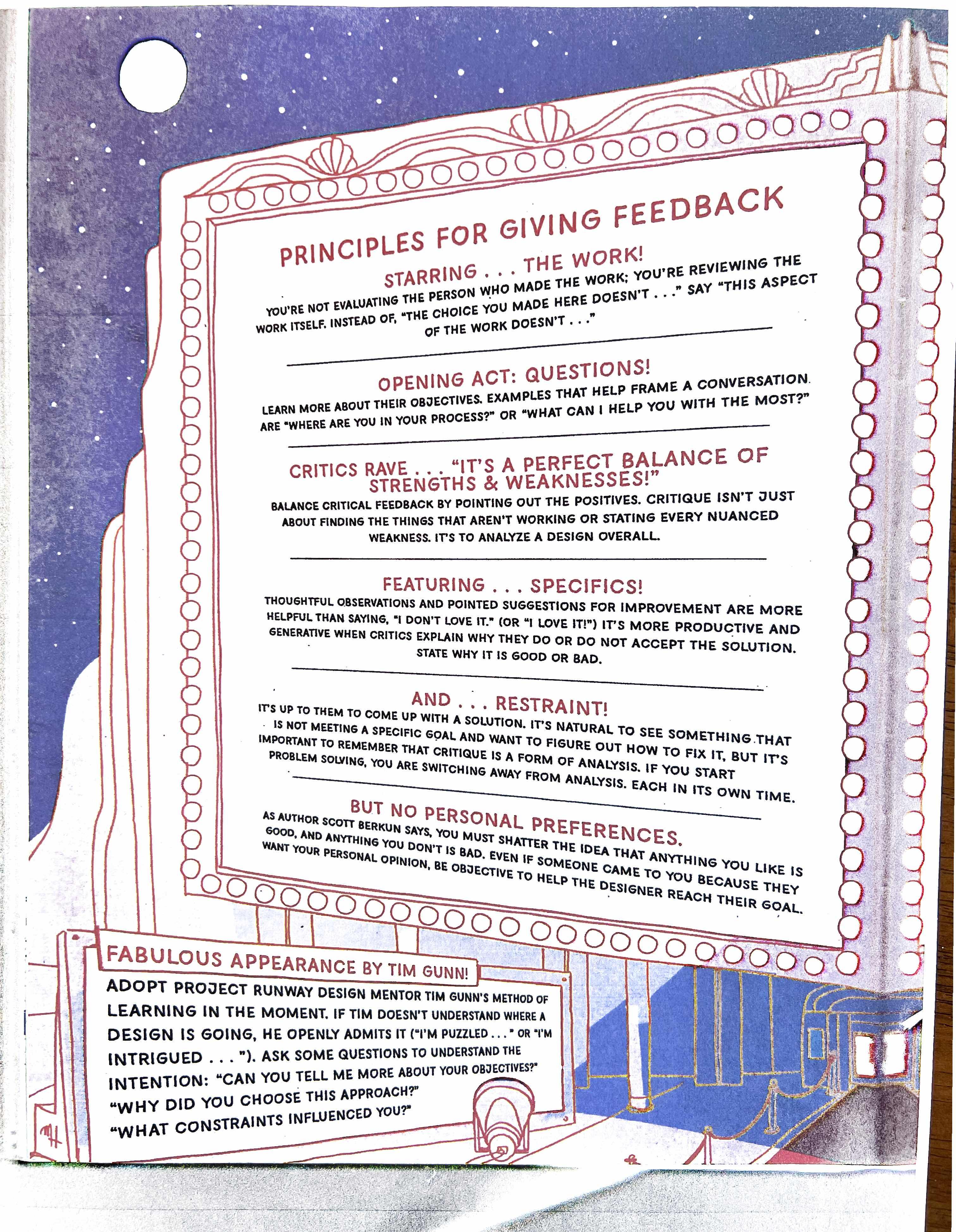
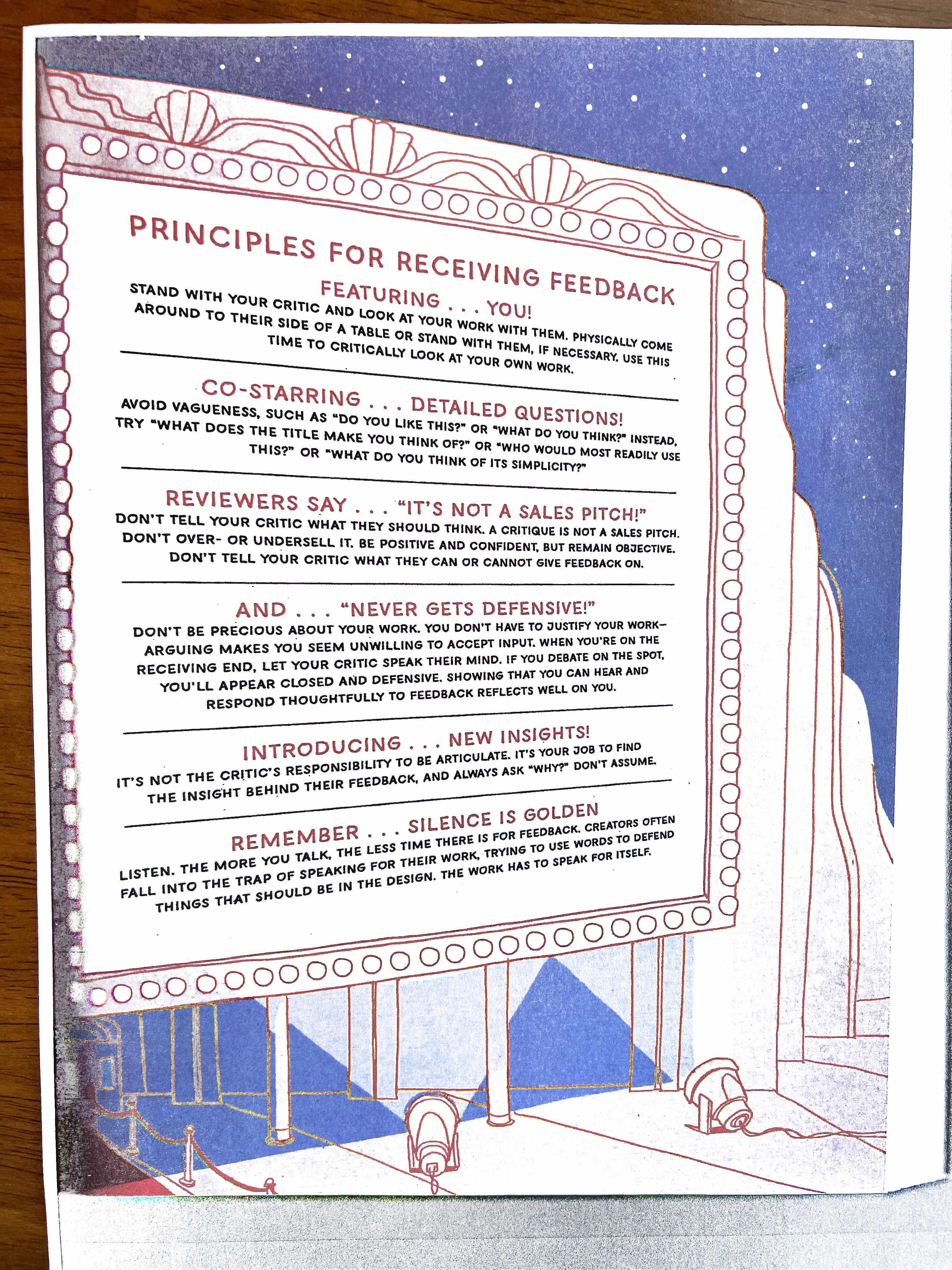
Here are some basic strategies for how to frame your critique letters. Not every strategy will be relevant to every piece submitted for workshop, but do try to incorporate a few each time you conduct a peer review:
Pointing. Which words, phrases, or features of the prose do you find most/least compelling? Is there an overuse of abstractions and imprecise language?
Summarizing. What do you hear the author saying? What’s the main meaning or message?
Reading for What’s Almost Said or Implied. What do you think the writer is going to say but doesn’t? What ideas seem to hover around the edges? What do you end up wanting to hear more about?
Finding the Generative Center. What do you sense as the generative center or the source of energy for the piece? Sometimes an image, phrase, detail, or digression seems to give special life or weight to the piece. The center might be something minor theme that is “trying” to be major. Could you distill in one word the theme that drives this piece of writing?
Voice, Point of View, Attitude Toward the Reader. How would you describe the voice you hear (e.g., tentative, concerned, self-centered)? Does the piece sufficiently orient the reader, answering basic questions of Who, What, Where, and When? And does such “backstory” emerge through a slow, steady, artful accretion of details or is it, rather, “dumped” onto the page?
Level of Abstraction or Concreteness. Are the writer’s generalizations appropriate to the subject? Are there places at which you feel you need more details or information?
Are the Basic Elements of Story Present? Does the author include: character, desire, conflict, and conclusion, those basic elements of storytelling?
Structure. How is this piece of writing organized? Does the opening compel you to read on? Are the transitions between sections both meaningful and clearly articulated? Does the piece unfold in summary or in a succession of as-yet unrelated thoughts? If this is a chapter or otherwise self-contained piece, does the ending “fit” the piece, either reflecting its “generative center” or complicating it in some way for the reader?
Language, Diction, Syntax. What kinds of words are used (technical, down-to-earth, colloquial)? What kinds of sentences and phrases? Are there sentences that confuse you because of their word order or the way they are punctuated? Does the author deploy too many passive verbs? Does the prose generally “flow” and display a stylistic elegance.
The following are observations I’ve gathered from every workshop I’ve ever been in, from many genres of writing to many genres of the visual and musical arts, over the last twenty-one years, plus a few wise lessons learned from other teachers and popular culture along the way. I’m going to leave out all qualifiers like “I think” or “In my opinion” or “Perhaps” and so on to save space.
For poets:
Sign your name to your poem. Sign your name to your critiques.
Date everything. Notate everything: time, class, teacher, section, college, whatever you think will help yourself or your fellow writer in the future place your comments.
Ask yourself what would you like back in comments from your fellow students. The golden rule does not apply here, but it is a helpful beginning. Know your own moods and obstacles as best you can, and remember that every other writer faces those moods and their unique but just as frustrating obstacles.
Being correct in diagnosing your moods or your obstacles is not important: being able to articulate them in some
manner to yourself is essential. To say, “I feel that I’ve been having trouble with beginnings . . . ” to yourself or friends and then to actually explore your writing and discover that no, it’s not the beginnings, it’s the endings that echo back to the beginnings and cause friction, is an observation gathered from taking a stand against oneself, taking the risk and naming the mystery. As one names the boogeyman, the monster in the closet and the monster that lives in your most ancient progenitor and your newborn child, one names what we can, and then we ask for help.
Write your manifesto. Then write its opposite. Name your strengths as weaknesses and your weaknesses as strengths and pitch opposite against clichéd opposite until your fingers, face, and social life turn purple.
Understanding one’s own writing leads to asking fellow writers what they might like in criticism before peppering them with the host of canned workshop responses (more on those momentarily). Given that humans and writers seem to vacillate between giddy and suicidal, please ask your fellow writer which critique she might like, the one that will push her over the brink into total giddiness or the one that will send her to Lowe’s for a variety of supplies. Or whatever balance can be found in between.
Your fellow writers are not just your friends, but if they’re not, then what the Hell is the matter with you? Look around your circle—these are the people who will save you, who will have the honesty to tell you when you’ve gone off the rails, who will walk you back from the edge of the bridge, and who will be starting their own literary journeys, becoming editors, producers, actors, musicians, and, of course, writers. Your professor is great, but look at the ratio of fellow writers to the professor, he or she doesn’t have the time to explore and know your work the way you can with your fellow students.
Form critique groups beyond class. Include as many people as you can beyond your genre, spend ridiculous amounts of time arguing minutiae of the written aesthetic. Shout about the “&” versus “and.”
Be merciless with your time—your time in a school devoted to writing, where you can find people who will debate white space in a poem with you. This time is exquisitely short, poignant and, for most of us, a once in a lifetime event.
Do not compete with your fellow students. They are your allies, as is every writer on the planet. There is more than enough room for all the good writing and all of the great writing. If you must compete, compete against your own heroes, the artists you admire, and the lives they live and led, the work they make and the work that they produced. Learn as much as you can about your idols and heroes. Lean what sacrifices they made, what lucky breaks they had, and as names come up in their lives, trace those names down and marvel at the network keeping even the most isolated of us afloat.
In popular culture the self-abusing alcoholic artist is a terrific stereotype. For us, the real life is that the best art routinely comes from the clear head and full stomach, and no matter how great the artists, once we’re dead, that’s it. No more art from us.
Stay alive and, if at all possible, healthy.
And if it is not possible to stay healthy, work just as hard on your sense of humor as your art and do not stop until you’re stopped by fate and can work no more on either.
~
Learn the language of mechanical poetry criticism: The line, the stanza. The line break. The beginning and the
end. Sections and section markers. Epigraph. Epigrams. Epitaphs. Nonce. Ekphrastic.
And learn what a complete sentence is, why sentences exist, and how and why punctuation is tangled with the sentence and with language in general.
There is no harm in deviating from an accepted term or grammatical structure, but know why the choice was made, have a reason, make every deviation an intentional act, because again, while it’s unlikely the reason will be correct, the very act of naming the impulse gives you, the writer, the one who wields the world through words, a word of appellation to apply, reject, or bury deep in the backyards of our childhood homes.
The first step of admitting there’s a problem is admitting there’s a problem.
The first step of owning a success is knowing a success.
As a critical technique, sometimes asking a poet why a certain word or phrase is in a poem will reveal that the poet has never really thought about it. Inspiration had struck, or the part being questioned was deemed unimportant compared to the through thought of the poem, and so placeholder language exists in a poem in workshop.
Usually, it’s enough to write such things down, not bring them up as discussion points, unless the point in question pertains to a much larger ongoing or very recent discussion.
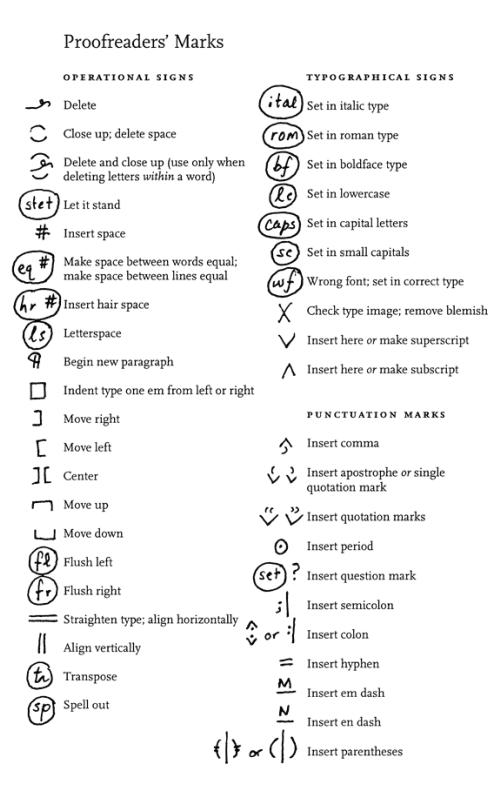
Save all mechanical aspects of the writing of poems, from the misspellings to the grammatical stumbles to the line breaks to the way the poem is spaced on the page for written comments. Assuredly the person you’re critiquing is as smart as you are, learn true editing marks, or make your own marks clear and legible, and the parts of the poem being edited clear and connected to their respective marks. Do not waste time with these marks: underlining with no comment, a drawn smiley face with no comment, a heart, a frowny face, an arrow, a stamp, a doodle, an elaborate illustration of the poem’s subject matter.
These beloved reading marks, for that’s what they are most often—the marks left by you, the reader, while reading, should ideally be translated into something useful for the poet being workshopped. Myself, I do not particularly mind being shown a grammatical mistake or spelling
mistake, but if that’s all I get back from a fellow writer, I’m deeply disappointed. If that’s all you’ve got for your fellow writer, save you both the time and you stop writing such errata and stop giving it to your classmates.
Trust them, they are smart people.
In addition to a solid, thought-provoking comment, a host of my spelling mistakes pointed out to me is fine. The difference for me is one of respect. I take the editorial marks as a help to speed myself along in revision, and I take the thoughtful comment as a gift, knowing that a classmate has pondered, however long or short, to come up with something more than this should be it’s, not its. In art school the saying was, Technique is easy, Idea is hard. I can learn to spell. I can use any number of tools to help me. For that matter, if it’s an average workshop, I have probably learned from at least four people that its should’ve had an apostrophe.
~ On the one hand, there is nothing wrong with writing I loved this line! next to a particularly powerful line.
BUT WHY? Why did you love that line? What was it in the poem that led to that scribble? Was it the single line? The rhythm? The fact that the line reminded you of a good memory? A bad memory? A good meal? What the poet needs to know is the why not the the fact of the love of the line. We’re always being told to show not tell but then we allow ourselves to tell during our comments to each other.
But who has the time? I mean, to really ponder a poem and articulate what one likes or doesn’t like about a poem will take so much time! Perhaps. But it’s like any other exercise, it gets easier. And besides, most poets would prefer one carefully articulated point about a single motion/ part/line/word in their poem than a host of vague Good Jobs and Loved It!
~ Particular sins:
If you happen to be in a workshop where each student has to read the poem aloud, take pity. Never criticize the reading of the poem or feel compelled to tell the reader, “You read through the line break in line three.” There’s a special place in Hell for that comment.
There’s a time for criticizing performance of poetry, and generally workshop is not that time. Of course, there are workshops on performance, and of course, there is nothing wrong with a teacher asking to have a poem read again. There is also nothing wrong with a student having a fellow student read aloud for her unless forbidden by the exercise at hand. Writing is hard enough. We write alone. If the lesson the teacher wants to teach is one of performance, then there should be a different time, and if the lesson the teacher wants to portray is that reading aloud is an effective way of self critique, that too can be taught without making a poet suffer.
The reason one doesn’t criticize a reading within a standard workshop is that there are too many variables at play, the nervousness of the reader, the rustling papers, the poor lighting, the poor attention span of the readers, the fact that each listener has her own concepts of how long the caesura of a line break should be, etcetera etcetera.
Workshop time is precious.
Weigh your comment inside your head carefully. Is it for sure a comment that would contribute to the spoken discussion or would the comment work just as well on paper? This holds true even if there’s no verbal discussion going, and it doesn’t look like any is going to start. There should never be a discussion about a poem “just because.” If the written comments are clear and careful enough, that leaves more time for other poems, and a workshop should also never be so formal and regimented that two weeks hence a poet could not bring back a previously discussed poem and say, “Now that I’ve had some time to think, notice how the issue in this poem echoes the issues we’re talking about tonight . . . ”
Questions to bring to the poem from sculpture:
How does the poem activate its space? What three dimensional space exists within the poem? How does the point of view move? How does the reader fit into that space? How did the writer? How does the poem exist in time? As an ongoing event or a piece of an ongoing event with a hinted beginning and a presumed life after the end? Imagine the characters/ideologies/concepts at the end of their day, and at the beginning. Are they the types to turn to face a dawn or to look at their long shadows?
Questions to bring to the poem from drawing:
How is balanced on the page? Where are its thirds compositionally? How does the eye of the reader move over and through the lines and stanzas? Does the white space impede or impel the eye? Take a black sharpie, and after photocopying the poem black out each line, then photocopy the new one. Photocopy several of each. Arrange them into patterns. Is the poem functioning as window or windowpane? Once identified, in what way does the poem reveal or occlude the subject matter? How few words (from drawing, lines) can be used to reveal the whole? How to portray only black and white and how to portray the full range of colors? How to write words that crumble like pastels and chalk?
Questions to bring to the poem from . . . making a coffee, riding in an elevator . . .
Occam’s razor doesn’t just apply to horses and zebras, auroras and aliens, but also to us as writers: we live, however strange our lives might be, our lives; is it necessary to bring some GREAT PERSON’s life into our poem? Some GREAT EVENT? Isn’t our life, if we can learn to see our life with total honesty, enough?
Among the many subjects that can elicit from me the most spectacular, feline of yawns—the doings of the British Royal Family, the ethics of foie gras, the benefits of hot yoga—over the years, none seems to have the zombie-like endurance in my peer group like debates about the relative merits or deficiencies of the creative writing workshop. Are they homogenizing or democratizing? Elitist or boorish? Cutting-edge or fusty? Poetry workshops seem to be especially subject to anxiety or suspicion, given the elasticity about what a poem “is.” That the general public already treats poetry with a robust mix of terror and derision—regarding anyone who claims the title “poet” to be little more than a New Age charlatan with unusually good Scrabble skills—does little to help. Compared with the more approachable prose genres—look at those novelists stretching all the way to the right margin like respectable, solid citizens!—all we poets seem to be doing in our workshops is killing time until we hit the next opium den.
But I think the pointlessness about debates over the workshop’s right to exist (which inevitably devolve to screeds against MFA programs, the Poetry Foundation, the NEA, semi-colons, etc.) springs from a fundamental misunderstanding about what the workshop is. Given that so many different cultural poetries claim their own thriving, traditional forms—ballad, haiku, blues, ghazal, villanelle—we need to remember that the workshop itself, rather than being a prescribed method or ideology, is a form as well, born of a stricture of time and content. And the persistence of a form does not immediately guarantee the quality or integrity of its content; the sonnet may be venerated, but that doesn’t mean a sonnet can’t be shitty. The best teachers are capable of taking this pedagogical form and using it as a venue to communicate what is sacred about poetry. Like poetic form, workshop, too, can be exciting when a teacher seeks to question, undermine, or experiment with received knowledge about how a creative writing workshop ought to be.
I love what Seamus Heaney says about the last lines of Elizabeth Bishop’s “At the Fishhouses”:
[they] do what poetry most essentially does: they fortify our inclination to credit promptings of our intuitive being. They help us to say in the first recesses of ourselves, in the shyest, pre-social part of our nature, ‘Yes, I know something like that too. Yes, that’s right; thank you for putting words to it and making it more or less official.’
Yet credence needs to be given for poetry, and poetry-teaching, that has an opposite effect; this is where the shitty workshop has its value. There is nothing quite like the shattering clarity after a remark from a peer or teacher when I’ve thought: “Wow, I may not know much, but what this person has said is completely the opposite of everything that I cherish and hold true about literature.” Granted, there is nothing more tedious than a person who’s entire sense of self is demarcated by her dislikes, but to have that moment of silent, private certainty, which may be entirely against the authority of the workshop in which one sits, can be an invaluable epiphany. And I have no doubt that I’ve summoned similar feelings in my own classes over the years. If I become a student’s anti-lodestar of all things poetry, so be it. They’re terribly wrong, of course, but I’m happy to be a fixed point in what is often otherwise a maelstrom of aesthetic uncertainty.
Don’t get me wrong. I always want my poems to be relatable. I want people to relate to them. I want relations all time. We all do. Nothing is worse than not relating, not having any relations. But, please, don’t tell me that you can’t relate to a poem.
Having taught poetry workshops at the university level for the past fifteen years, I am inclined to say (and of course have a vested interest in saying) that they work. When run well (and sometimes even when run poorly), they generally produce savvier writers, more experienced readers, and more compassionate collaborators. And having read enough snarky poems by unimaginative people about how bad their students are, how they trust the spellcheck and end up writing papers about the famous Irish poet “Yeast,” I am disinclined to poo-poo the very students who present me with a teaching job. (And let’s face it: it’s a good job.) I was in fact one of those students not terribly long ago, who bumbled into a poetry workshop and there fell in love with art. So, in a sense, I can relate.
But still: can we just stop relating to poems?
Here’s the rub: whether or not someone in a workshop relates to someone else’s poem is of very little consequence to me or to the poem. It’s the reader’s job to go in there and get some of that relation. A failure to relate, in my book, is a failure of the reader, not the poem. There may be all sorts of other problems with the poem, but relatability is never one of them.
Example: I am not a Danish prince with an existential (if quite eloquent) crisis. Hence, I cannot relate to Hamlet. Neither am I a whiny, self-important, late-medieval Tuscan on a journey through hell. Hence—mi dispiace, Dante—sorry, buddy, but can’t relate. I’m not even Catholic.
I know those examples represent a healthy dose of hyperbole—which I can very much relate to—but the point is still valid, seems to me. Just because you haven’t pushed a dead deer, one with a living fawn still warm inside, over the edge of Wilson River Road, doesn’t mean you can’t relate to William Stafford’s “Traveling through the Dark.” And even if you’re not a teenage girl who’s made out with a bunch of other teenage girls in some parents’ basement, doesn’t mean you’re incapable of relations with Marie Howe’s “Practicing.” And let’s be serious: who could relate to any Wallace Stevens or Emily Dickinson poem? Have you personally called the roller of big cigars to whip those concupiscent curds (nasty little curds)? I venture a no. Did you hear a fly buzz when you died. I think not.
Put another way, the idea of relating to a poem is absolutely the lowest common denominator of judgment. More so, it’s just a cover for what we really mean: I don’t understand the poem or I am uncomfortable with the poem or, perhaps most disturbingly, I just don’t care about the poem. All of those questions we can handle in a workshop. That’s in fact what the workshop is for. I say this simple thing at the start of every workshop I teach. You may think the workshop is about making your poems better. It’s not, at least not directly. We were not there with you when you wrote that poem, and many times the workshop criticism will seem scattered and counterproductive to you, the author. We hope some of our criticism helps you, but frankly it’s not our first priority. You’re only one person in this class of ten or fifteen or whatever. Our primary interest lies with the rest of the group, of which most days you represent a part. (Even in advanced workshops, we spend a great deal of time with each piece and take part in all sorts of other activities, so you will probably workshop—at most—three poems.)
A few times during the semester, you are going to volunteer to relinquish your part in our conversation by
becoming that about which we converse. You offer up the conversation piece (your poem), and the rest of us attempt to hold a meaningful discussion about it. You—sorry, buddy—are out of the picture that day. We will not relate to you, at least not directly. If we help you, great. If we don’t, oh well. Mostly, we do (and we mean to). We’re much more interested, however, in what it means to offer valuable criticism, to build a critical acumen, an interiorized editor who can be summoned at will when your own draft sits in front of you, and you want to make it better. One way to do that is to stop each time someone offers a bit of anemic criticism—I don’t think this part flows well or I love this part or I can’t relate to this part—and try to ratchet up the specificity. The workshop, in that sense, is really more about your critical skills than your creative ones.
But any artist worth her relations knows her critical and her creative skills are interrelated and mutually dependent. Can’t you relate?
Jasmin Darznik
Rewriting is the essence of writing well—where the game is won or lost. —
William Zinsser
1. Look at your first paragraph. Does it hook the reader, either by way of some electrifying idea or linguistic brilliance? Be honest with yourself: Why would someone want to read past the first paragraph? Past the first page? Do you set up stakes from the beginning or are you holding the tension in reserve? What can you do to create a heartbeat straight out of the gate?
2. Reverse outline your story/excerpt. Working paragraph by paragraph, assign a one or two sentence summary of each paragraph’s main point. Remember: a paragraph is a unit of thought. Have you fully explored the possibilities of each and every paragraph in your piece? Do your paragraphs open in an interesting way, does each sentence contribute to the meaning of the whole, and does the last sentence land us in a new or different place?
3. Check the organization of your reverse outline: Does your story follow a pattern that makes sense? Do the transitions move your readers smoothly from one scene or section to the next? Do you employ too many section breaks or not enough of them? Would your piece work better if you moved some things around?
4. Now consider your first page or two. Does it orient the reader? Do we know where the story takes place, who the main characters are, and get at least a glimmer of the trouble that awaits them?
5. Scrutinize all abstractions or generalities. Question whether such sections have been grounded in sensory detail. Remember: “No ideas but in things,” meaning you cannot express ideas effectively in fiction without showing them through concrete details.
6. Examine the balance within the story/excerpt: Are some parts out of proportion with others? Do you spend too much time on one part of the story and devote unequal discussion to another? Do you give lots of details or gorgeous language early on and then let your prose get thinner and less compelling by the end?
7. Check the balance of exposition (telling) and scene (showing). Are there sections that would work better if rendered in scene or vice versa?
8. Check your ending: Does the last paragraph of the story or section tie together smoothly and end on a stimulating note, or do the pages just die a slow, redundant, or abrupt death? Have you asked yourself “So What?” By which I mean, have you asked yourself how your ending reflects back or upends or in some way meaningfully interacts with the opening and other parts of the piece? Have you truly “earned” your ending—meaning, does it offer a fresh but still believable/credible experience for the reader or does it come seemingly out of nowhere?
Check for passive verbs. These are all forms of “to be,” including constructions that end with –ing (e.g. is seeing). Switch out as many passive verbs for active verbs, selecting the most effective (which often means active) verbs possible. Use the Synonym Finder (which can be downloaded for free online) or other solid thesaurus (most online sources fall very short).
Check for all constructions of “to have.” These, too, have a stultifying effect on your prose.
Do a global search for “that.” Kill all but the essential uses of the word.
Anything that sounds like a cliché must die.
Take one paragraph and count the words in each sentence. Looking at the paragraph of the whole, are you creating enough variety in your sentence lengths? This makes a big difference in energizing your prose. Also consider when you want to modulate the sentence length to create certain effects (short sentences slow the reader down, whereas long ones get her reading at a clip).
Is the imagery precise enough? Are you relying solely on visual detail, or are you enlisting other senses such as smell? Are you in control of your images’ effects, meaning do you know what emotional response you aim to induce in the reader and are you truly inducing it?
Look at any metaphors and similes. Make sure they are both unexpected and necessary.
Before submitting your story, read the entire draft aloud. You’ll be astonished how much this one exercise will reveal. Commit to reading everything you submit (even workshop drafts!) before sharing it with others.
Excerpted from CRAFT IN THE REAL WORLD
1. Craft is a set of expectations.
2. Expectations are not universal; they are standardized. It is like what we say about wine or espresso: we acquire “taste.” With each story we read, we draw on and contribute to our knowledge of what a story is or should be. This is true of cultural standards as fundamental as whether to read from left to right or right to left, just as it is true of more complicated context such as how to appreciate a sentence like “She was absolutely sure she hated him,” which relies on our expectation that stating a person’s certainty casts doubt on that certainty as well as our expectation that fictional hatred often turns into attraction or love.
Our appreciation then relies on but also reinforces our expectations.
What expectations, however, are we really talking about here?
In her book Immigrant Acts, theorist Lisa Lowe argues that the novel regulates cultural ideas of identity, nationhood, gender, sexuality, race, and history. Lowe suggests that Western psychological realism, especially the bildungsroman/coming-of-age novel, has tended toward stories about an individual reincorporated into society—an outsider finds his place in the world, though not without loss. Other writers and scholars share Lowe’s reading. Examples abound: In Jane Eyre, Jane marries Rochester. In Pride and Prejudice, Elizabeth Bennet marries Mr. Darcy. In The Age of Innocence, Newland Archer, after some hesitation, marries May Welland. (There is a lot of marriage.) In The Great Gatsby, Nick Carraway returns to the Midwest and Daisy Buchanan returns to her husband.
Some of these protagonists end up happy and some unhappy, but all end up incorporated into society. A common craft axiom states that by the end of a story, a protagonist must either change or fail to change. These
novels fulfill this expectation. In the end, it’s not only the characters who find themselves trapped by societal norms. It’s the novels.
3. But expectations are not a bad thing. In a viral craft talk on YouTube, author Kurt Vonnegut graphs several archetypal (Western) story structures, such as “Man in a Hole” (a protagonist gets in trouble and then gets out of it) and Cinderella (which Vonnegut jokes automatically earns an author a million dollars). The archetypes are recognizable to us the way that beats in a romantic comedy are recognizable to us—a meet-cute, mutual dislike, the realization of true feelings, consummation, a big fight, some growing up, and a reunion (often at the airport). The fulfillment of expectations is pleasurable. Part of the fun of Vonnegut’s talk is that he shows us how well we already know certain story types and how our familiarity with them doesn’t decrease, maybe only increases, our fondness for them. Any parent knows that a child’s favorite stories are the stories she has already heard. Children like to know what is coming. It reduces their anxiety, validates their predictions, and leaves them able to learn from other details. Research suggests that children learn more from a story they already know. What they do not learn is precisely: other stories.
Craft is also about omission. What rules and archetypes standardize are models that are easily generalizable to accepted cultural preferences. What doesn’t fit the model is othered. What is our responsibility to the other? In his book The Hero with a Thousand Faces, Joseph Campbell famously theorized a “monomyth” story shape common to all cultures. In reality, his theory is widely dismissed as reductionist—far more selective than universal and unjustly valuing similarity over difference. It has been especially criticized for the way its focus on the “hero’s journey” dismisses stories like the heroine’s journey or other stories in which people do not set off to conquer and return with booty (knowledge and/or spirituality and/or riches and/or love objects). It is important to recognize Campbell’s investment in masculinity as universal.
Craft is also about omission. What rules and archetypes standardize are models that are easily generalizable to accepted cultural preferences.
Craft is the history of which kind of stories have typically held power—and for whom—so it also is the history of which stories have typically been omitted. That we have certain expectations for what a story is or should include means we also have certain expectations for what a story isn’t or shouldn’t include. Any story relies on negative space, and a tradition relies on the negative space of history. The ability for a reader to fill in white space relies on that reader having seen what could be there. Some readers are asked to stay always, only, in the negative. To wield craft responsibly is to take responsibility for absence.
4. In “A Journey Into Speech,” Michelle Cliff writes about how she had to break from accepted craft in order to tell her story. Cliff grew up under colonial rule in Jamaica and was taught the “King’s English” in school. To write well was to write in one specific mode. She went to graduate school and even published her dissertation, but when she started to write directly about her experience, she found that it could not be represented by the kind of language and forms she had learned.
In order to include her own experience, Cliff says she had to reject a British “cold-blooded dependence on logical construction.” She mixed vernacular with the King’s English, mixed Caribbean stories and ways of storytelling with British. She wrote in fragments, to embody her fragmentation. She reclaimed the absences that formed the way she spoke and thought, that created the “split-consciousness” she lived with.
To own her writing—I am paraphrasing—was to own herself. This is craft.
5. Craft is both much more and much less than we’re taught it is.
6. In his book on post–World War II MFA programs, Eric Bennett documents how the Iowa Writers’ Workshop, the first place to formalize the education of creative writing, fundraised on claims that it would spread American values of freedom, of creative writing and art in general as “the last refuge of the individual.” The Workshop popularized an idea of craft as non-ideological, but its claims should make clear that individualism is itself an ideology. (It shouldn’t surprise us that apolitical writing has long been a political stance.) If we can admit by now
that history is about who has had the power to write history, we should be able to admit the same of craft. Craft is about who has the power to write stories, what stories are historicized and who historicizes them, who gets to write literature and who folklore, whose writing is important and to whom, in what context. This is the process of standardization. If craft is teachable, it is because standardization is teachable. These standards must be challenged and disempowered. Too often craft is taught only as what has already been taught before.
7. In the West, fiction is inseparable from the project of the individual. Craft as we know it from Aristotle to E. M. Forster to John Gardner rests on the premise that a work of creative writing represents an individual creator, who, as Ezra Pound famously put it, “makes it new.” Not on the premise that Thomas King describes in The Truth About Stories: A Native Narrative: that any engagement with speaking is an engagement with listening, that to tell a story is always to retell it, and that no story has behind it an individual. Each “chapter” of King’s book, in fact, begins and ends almost the same way and includes a quote from another Native writer.
Audre Lorde puts it this way: “There are no new ideas. There are only new ways of making them felt, of examining what our ideas really mean.” (My italics.)
It is clear in an oral tradition that individual creation is impossible—the authors of the Thousand and One Nights, the “Beowulf poet,” Homer, were all engaging with the expectations their stories had accrued over many tellings.
Craft is the cure or injury that can be done in our shared world when it isn’t acknowledged that there are different ways that world is felt.
Individualism does not free one from cultural expectations; it is a cultural expectation. Fiction does not “make it new;” it makes it felt. Craft does not separate the author from the real world.
When I was in graduate school, a famous white writer defended Joseph Conrad’s Heart of Darkness (whose craft was famously criticized by author Chinua Achebe for the racist use of Africans as objects and setting rather than as characters) by claiming that the book should be read for craft, not race. Around the same time, another famous white writer gave a public talk in a sombrero about the freedom to appropriate. Thomas King, on the contrary, respects the shared responsibility of storytelling and warns us that to tell a
story one way can “cure,” while to tell it another can injure. Craft is never neutral. Craft is the cure or injury that can be done in our shared world when it isn’t acknowledged that there are different ways that world is felt.
8. Since craft is always about expectations, two questions to ask are: Whose expectations? and Who is free to break them?
Audre Lorde again: “The master’s tools will never dismantle the master’s house.”
Lorde presents a difficult problem for people who understand that freedom is never general but always freedom for someone: how to free oneself from oppression while using the language of one’s oppressors? This is a problem Lorde perhaps never fully “solved.” Maybe it has no solution, but it can’t be dismissed. When we are first handed craft, we are handed the master’s tools. We are told we must learn the rules before we can dismantle them. We build the master’s house, and then we look to build houses of our own, but we are given no new tools. We must find them or we must work around the tools we have.
To wield craft is always to wield a tool that already exists. Author Trinh Minh-ha writes that even the expectation of “clarity” is an expectation of what is “correct” and/ or “official” language. Clear to whom? Take round and flat characters. In Toward the Decolonization of African Literature, authors Chinweizu, Onwuchekwa Jemie, and Ihechukwu Madubuike complain that African literature is unfairly criticized by Western critics as lacking round characters. E. M. Forster’s original definition of roundness is “capable of surprising in a convincing way.” Chinweizu et al. point out that this definition is clear evidence that roundness comes not from the author’s words but from the audience’s reading. One reader from one background might be convincingly surprised while another reader from another background might be unsurprised and/or unconvinced by the same character. Whom are we writing for?
9. Expectations belong to an audience. To use craft is to engage with an audience’s bias. Like freedom, craft is always craft for someone. Whose expectations does a writer prioritize? Craft says something about who deserves their story told. Who has agency and who does not. What is worthy of action and what description. Whose bodies are on display. Who changes and who stays the same. Who controls time. Whose world it is. Who holds meaning and who gives it. To wield craft is always to wield a tool that already exists.
Nobel Prize–winning author Toni Morrison suggests in Playing in the Dark that the craft of American fiction is to use Black people and images and culture as symbols, as tools. In other words, the craft of American fiction is the tool that names who the master is. To signify light as good, as we are taught to do from our first children’s stories, is to signify darkness as bad—and in this country lightness and darkness will always be tied to a racialized history of which people are people and which people are tools. To engage in craft is always to engage in a hierarchy of symbolization (and to not recognize a hierarchy is to hide it). Who can use that hierarchy, those tools? Not I, says Morrison. And so she sets off to find other craft.
10. In his book The Art of the Novel, Czech author Milan Kundera rejects psychological realism as the tradition of the European novel. He offers an alternate history that begins with Don Quixote and goes through Franz Kafka. He offers this history in order to make a claim about craft, because he knows that craft must come from somewhere. Contrary to psychological realism’s focus on individual agency, Kundera’s alternate craft says that the main cause of action in a novel is the world’s “naked” force.
Kundera wants to decenter internal causation (character-driven plot) and (re)center external causation (such as an earthquake or fascism or God). He insists that psychological realism is no “realer” than the bureaucratic world Kafka presents in which individuals have little or no agency and everything is a function of the system. (This is also a claim about how to read history.) Only our expectations of what realism is/should be make us classify one type of fiction (which by definition is not “real”) as realer than another. Any novel, for Kundera, is about a possible way of “being in the world,” and Kafka’s bureaucracy came true in the Czech Republic in a way that individual agency did not.
Another advocate of Kafka’s brand of “realism” is the author Julio Cortázar. Cortázar is usually considered a fabulist or magical realist. Yet in a series of lectures collected in Literature Class, he categorizes his own and other “fantastic” stories as simply more inclusive realities. He uses his story “The Island at Noon” as an example, in which a character dives into the ocean to save a drowning man, only to find that the man is himself. The story ends with a fisherman walking onto the beach we have just seen, alone “as always.” The swimmer and the drowner were never there. Cortázar says this story represents a real experience of time in which, like a
daydream, it becomes impossible to tell what is real and what is not. Time, fate, magic—these are forces beyond human agency that to Cortázar allow literature to “make reality more real.”
In Toward the Decolonization of African Literature, Chinweizu et al. encourage African writers to remember African traditions of storytelling. They identify four conventions from a tradition of incorporating the fantastic into everyday life: (1) spirit beings have a non-human trait that gives them away, such as floating; (2) if a human visits the spiritland, it involves a dangerous border-crossing; (3) spirits have agency and can possess humans; and (4) spirits are not subject to human concepts of time and space.
Craft tells us how to see the world.
11. The Iowa Writers’ Workshop established craft’s current focus on style and form, writes Eric Bennett, a focus which also conveniently served four related agendas: (1) it overthrew the domination of totalitarian manipulation (if Soviet) or commercial manipulation (if American) by being irreducibly individualistic; (2) it facilitated the creation of an ideologically informed canon [of dead white men] on ostensibly apolitical grounds; (3) it provided a modernist means to make literature feel transcendent for the ages [rather than tied to time and place]; and (4) it gave reading and writing a new semblance of difficulty, a pitch of rigor appropriate for the college or graduate school classroom.
In other words, it made literature easy to fundraise for, and easy to teach.
12. We have come to teach plot as a string of causation in which the protagonist’s desires move the action forward. The craft of fiction has come to adopt the terms of Freytag’s triangle, which were meant to apply to drama, and of Aristotle’s poetics, which were meant to apply to Greek tragedy. Exposition, inciting incident, rising action, climax, falling action, resolution, denouement. But to think of plot and story shape in this way is cultural and represents the dominance of a specific cultural tradition.
Craft tells us how to see the world.
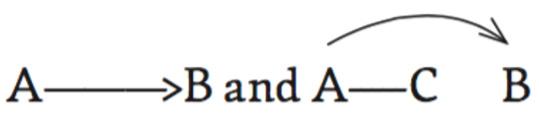
In contrast, Chinese, Korean, and Japanese stories have developed from a four-act, rather than a three- or fiveact structure: in Japanese it is called kishotenketsu (ki: introduction; sho: development; ten: twist; ketsu: reconciliation). Western fiction can often be boiled down to A wants B and C gets in the way of it. I draw this shape for my students
This kind of story shape is inherently conflict-based, perhaps also inherently male (as author Jane Alison puts it: “Something that swells and tautens until climax, then collapses? Bit masculo-sexual, no?”). In East Asian fiction, the twist (ten) is not confrontation but surprise, something that reconfigures what its audience thinks the story is “about.” For example, a man puts up a flyer of a missing dog, he hands out flyers to everyone on the street, a woman appears and asks whether her dog has been found, they look for the dog together. The change in this kind of story is in the audience’s understanding or attention rather than what happens. Like African storytellers, Asian storytellers are often criticized for what basically amounts to addressing a different audience’s different expectations—Asian fiction gets labeled “undramatic” or “plotless” by Western critics.
The Greek tragedians were likewise criticized by Aristotle. In his Poetics, Aristotle does not just put forward an early version of Western craft (one closely tied to his philosophical project of the individual) but also puts down many of his contemporaries, tragedians for whom action is driven by the interference of the gods (in the form of coincidence) rather than from a character’s internal struggle. It is from Aristotle that Westerners get the cultural distaste for deus ex machina, which was more like the fashion of his time. Aristotle’s dissent went forward as the norm.
13. Craft, like the self, is made by culture and reflects culture, and can develop to resist and reshape culture if it is sufficiently examined and enough work is done to unmake expectations and replace them with new ones. (As Aristotle did by writing the first craft book.)
We are constantly telling stories—about who we are, about every person we see, hear, hear about—and when we don’t know something, we fill in the gaps with parts of stories we’ve told or heard before. Stories are always only representations. To tell a story about a person based on her clothes, or the color of her skin, or the way she talks, or her body—is to subject her to a set of cultural expectations. In the same way, to tell a story based on a character-driven plot or a moment of epiphany or a three-
act structure leading to a character’s change is to subject story to cultural expectations. To wield craft morally is not to pretend that those expectations can be met innocently or artfully without ideology, but to engage with the problems ideology presents and creates.
In my research for this book, I found various authors (mostly foreign) asking how it is that we have forgotten that character is made up, that it isn’t real or universal. Kundera points out that we have bought unreflexively into conventions that say (a) that a writer should give the maximum information about a character’s looks and speech, (b) that backstory contains motivation, and (c) that writers somehow do not have control over their characters. Nobel Prize winner Orhan Pamuk, in The Naive and Sentimental Novelist, complains that creative writing programs make it seem as if characters are autonomous beings who have their own voices, when in fact character is a “historical construct . . . we choose to believe in.” To Pamuk, a character isn’t even formed by an individual personality but by the particular situation and context the author needs her for. When it’s all made up, he suggests, character is more nurture than nature. If fiction encourages a certain way that a character should be understood or read, then of course this way must influence and be influenced by the way we understand and read each other.
14. To really engage with craft is to engage with how we know each other. Craft is inseparable from identity. Craft does not exist outside of society, outside of culture, outside of power. In the world we live in, and write in, craft must reckon with the implications of our expectations for what stories should be—with, as Lorde says, what our ideas really mean.
15. Consider the example of the Chinese literary tradition, which we will get to later in the book. Western critics have generally called traditional Chinese fiction formless. Yet Chinese critic Zheng Zhenduo, who studies the Chinese novel’s historical trajectory, says one characteristic of Chinese fiction is that it is “water-tight,” by which he means that it is structurally sound. They are describing the same fiction but different expectations.
Craft does not exist outside of society, outside of culture, outside of power.
While Western narrative comes from romantic and epic tradition, Chinese narrative comes from a tradition of gossip and street talk. Chinese fiction has always challenged historical record and accepted versions of “reality.” Western storytelling developed from a tradition of oral performances meant to recount
heroic deeds for an audience of the ruling class. Like Thomas King, author Ming Dong Gu, in his book Chinese Theories of Fiction, describes writing as something more like “transmission” than like “creation.” More collective and less individual.
16. Chinese American author Gish Jen claims in Tiger Writing that her fiction combines Western and Eastern craft. She makes a case for an Asian American storytelling that mixes the “independent” and “interdependent” self: the individual speaker vs. the collective speaker, internal agency vs. external agency.
The difficulty for Jen in her fiction was not in finding it a Western audience but in representing her Chinese values. As Jen writes, “existing schema are powerful.” Growing up with American and European fiction, she struggled to represent her culture and self. The kind of agency a Western protagonist has was compelling to her—she describes it almost as a seduction—being so different from her family life. Tiger Writing actually begins with Jen analyzing her father’s memoir, which is mostly family history and only gets around to himself in the final third.
The suggestion is that family history, the ancestral home, their immigration to America, is exactly what defines her father, rather than any individual characteristic. Jen compares the memoir to a Chinese teapot, which unlike an American teapot is worth much more used than new, prized for how many teas have already been made in it, so that the flavor of a new tea mixes with the flavors before it.
17. “Know your audience” is craft. Language has meaning because it has meaning for someone. Meaning and audience do not exist without one another. A word spoken to no one, not even the self, has no meaning because it has no one to hear it. It has no purpose.
Chinweizu, Jemie, and Madubuike employ the metaphor of an artist’s sketch. Responding to Western critics who claim African fiction has too little description and weak characterization, they compare the relationship between craft and expectation to the relationship between a sketch and its evocation of a picture. “It perhaps needs to be stressed that the adequacy of a sketch depends upon its purpose, its context, and also upon what its beholders accept as normal or proper.” In other words, “the writer’s primary audience” may find the sketch enough to evoke the picture even if the European audience cannot. It shouldn’t be the writer’s concern to satisfy an audience who is not hers.
African fiction is written for Africans—what is easier to understand than that? Not that other people can’t read it, but, as Chinweizu et al. tell us, it might take “time and effort and a sloughing off of their racist superiority complexes and imperialist arrogance” to appreciate it. When the Thousand and One Nights is translated into English, translators often cut stories. The Nights is a story about storytelling, full of framed narratives, stories within stories within stories. Like Chinese fiction, it is often accused of the opposite sins of African fiction—of having too many digressions and extraneous parts. Part of the necessity of abridgment is that the Nights is extremely long, and part is that different versions of the Nights include different groups of stories—it might be impossible to include every story or to know what a complete version of the Nights would even look like, as every telling is a retelling—but stories that get cut out as extraneous are never actually pointless. Author Ulrich Marzolph argues convincingly that repetition of similar stories and themes and motifs is not a failure of craft but “a highly effective narrative technique for linking new and unknown tales to a web of tradition the audience shares.” Children learn the most from stories they already know.
Similar abridgments occur in translations of traditional Chinese fiction. Again, these are often cases of translators misrepresenting the audience. In Chinese fiction, repetitions and digressions like those in the Nights are called “Casual Touches” and are a sign of mastery. According to author Jianan Qian, it takes a very good writer to be able to add “seemingly unrelated details . . . here and there effortlessly to stretch and strengthen a story’s meanings.” What is considered “good writing” is a matter of who is reading it.
18. There are many crafts, and one way the teaching of craft fails is to teach craft as if it is one.
19. Author Jennifer Riddle Harding writes about what she calls “masked narrative” in African American fiction, in which Black authors wrote to two audiences at the same time: a white audience they needed in order to have a career and a Black audience who would be able to understand a second, “hidden” meaning through context clues that rely on cultural knowledge. As an example, Harding analyzes a story by Charles W. Chesnutt about a white-presenting woman who wants to know who her mother is, and a Black caretaker who allows the woman to think her mother was white—though a Black audience would realize that the caretaker is the actual mother. Language has meaning because it has meaning for
someone. Meaning and audience do not exist without one another.
Different expectations guide different readings. “The black story had to look like a white story,” writes the author Raymond Hedin, while also speaking to a Black audience via the same words.
In other words, the plot of external causation that Kundera would like to return to never disappeared; it was simply underground. In America, coincidence and fate have long been the domain of storytellers of color, for whom the “naked” force of the world is an everyday experience. In the tradition of African American fiction, for example, coincidence plots and reunion plots are normal. People of color often need coincidence in order to reunite with their kin.
20. Adoptee stories also frequently feature coincidence and reunion. Maybe that is why I am drawn to external causation, to alternative traditions, to non-Western story shapes. Like Jen, I grew up with fiction that wasn’t written for me. My desire to write was probably a desire to give myself the agency I didn’t have in life. To give my desires the power of plot.
Cortázar calls plot, that string of causation, an inherent danger to the realistic story. “Reality is multiple and infinite,” he writes, and to organize it by cause and effect is to reduce it to a “slice.” Plot is always a departure from reality, a symbol of reality. But the power of stories is that we can mistake the symbolic for the real.
21. In Maps of the Imagination, author Peter Turchi writes about invisible conventions such as organizing prose in paragraphs, capitalizing the first letter of a sentence, assuming that the fictional narrator is not the author. These conventions become visible when they are broken. To identify them (these are tools: whose tools are these?) is the first step toward making craft conscious. Craft that pretends it does not exist is the craft of conformity or, worse, complicity.
22. Here is a convention up for debate, one in the process of becoming visible: in an essay on the pathetic fallacy, author Charles Baxter argues that setting in literary realist fiction should less often reflect the protagonist’s inner state. Baxter has seen too much rain when the hero is sad, too many sad barns when the hero has lost a child (as in the famous John Gardner prompt). In reality, rain is not contingent on emotion and objects do not change their appearances to fit people’s moods. (The Gardner prompt,
to describe a barn from the perspective of a grieving father, is more about what a person in a certain mood would notice—but the point holds.) Baxter thinks realism should do more to resist story conventions and accurately represent reality.
Yet on screen, the pathetic fallacy seems widely accepted (especially if there is no voiceover to provide a character’s thoughts), and student fiction seems more and more influenced by film expectations than prose expectations.
Different expectations guide different readings.
For a few months, I read almost exclusively fiction by a trio of Japanese writers, Haruki Murakami, Yoko Ogawa, and Banana Yoshimoto. Each seems to offer a world that is very shaped by the interiority of the protagonist. In Murakami’s work, it’s a fair critique to complain that female characters seem to be who they are because the male protagonists want them to be so. In Yoshimoto’s work, characters often seem created solely for their effect on the protagonist: a psychic gives the protagonist a crucial warning, or a dying character shows the protagonist how to live. In Ogawa’s work, settings and even mathematical equations represent emotion. There are foils and mirrors and examples of how to act and how not to act and sexual fantasies and supernatural guides and exactly the right wrong partner. In truth, these worlds that seem half the protagonist’s imagination give great pleasure. There is a kind of structural pleasure that comes from seeing the pathetic fallacy played out on a grand scale. It’s not the pleasure of reality, but of what we sometimes feel reality to be, a way of being in the world.
23. Why, when the protagonist faces the world, does she need to win, lose, or draw? This is a Western idea of conflict. What if she understands herself as a part of that world, that world as a part of herself? What if she simply continues to live?
24. In Tiger Writing, Gish Jen cites a study in which whites and Asians are asked to identify how many separate events there are in a specific passage of text. Whites identify more events, because they see each individual action, such as “come back upstairs” and “take a shower,” which appear in the same sentence, as separate events— while Asians do not. Jen writes that the American novel tends to separate time into events and to see those events as progression, as development—a phenomenon she calls “episodic specificity.” At first, she believed herself to be culturally disadvantaged, as a writer, but then she found
Kundera and his idea of the novel as existential rather than a vehicle for plot.
In “Characteristics of Negro Expression,” author Zora Neale Hurston identifies characteristics of African American storytelling, such as adornment, double descriptions, angularity and asymmetry, and dialect. All are things often edited out of workshop stories in the name of craft. Hurston identifies them in order to legitimize them. Craft is in the habit of making and maintaining taboos.
25. The considerations here are not only aesthetic. To consider what forces have shaped what we think of as psychological realism is to consider what forces have shaped what we think of as reality, and to consider what forces have shaped what we think of as pleasurable, as entertaining, as enlightening, in life.
Craft is support for a certain worldview.
Realism insists on one representation of what is real. Not only through what is narrated on the page, but through the shape that narration takes.
Craft is support for a certain worldview.
If it is true that drafts become more and more conscious, more and more based on decisions and less and less on “intuition,” then revision is where we can take heart. Revision is the craft through which a writer is able to say and shape who they are and what kind of world they live in. Revision must also be the revision of craft. To be a writer is to wield and to be wielded by culture. There is no story separate from that. To better understand one’s culture and audience is to better understand how to write.
Grant Faulkner
& Writers
When I first came to San Francisco as a young English major during my spring break in 1987, I knew nothing of the Bay Area’s literary history. I didn’t know that the young bootstrapping Jack London had determinedly chiseled himself into a writer in nearby Oakland, or that Allen Ginsberg’s famous “Howl” reading had riled the literary world (and its censors) in San Francisco in the 1950s. I hadn’t yet read Dashiell Hammett’s noir novels, nor Eldridge Cleaver’s Soul on Ice (Ramparts Press, 1968), nor Armistead Maupin’s Tales of the City (Harper & Row, 1978). And I had no idea that Gertrude Stein had said, “There’s no there there,” about Oakland (if only she could see the “there there” now).
I didn’t know that so many writers had lived out their insurrectionary impulses and beliefs in San Francisco—that for many authors the Bay Area served as a place of refuge, escape, and even salvation from the rest of America.
I had only one thing on my list. A friend told me that if I did just one thing in San Francisco, I had to go to City Lights (261 Columbus Avenue), a bookstore and publishing house owned by the doyen of the Beats, Lawrence Ferlinghetti.
I’d never be quite the same again. When I walked through the doorway, I didn’t just see rows of bookshelves; I felt drawn in, seduced, by the exotic call of the ideas and stories that seemed as if they were part of the air itself. The wooden floors were creaky and uneven, each room a mysterious cavern, a haven. I picked up books published by presses I’d never heard of, books that felt alluring and dangerous, as if they’d prick me with new thoughts. I greedily bought as many as I could afford, and then went to Vesuvio Cafe, the bar across the alley from City Lights where the Beats themselves had thrashed through ideas over too many drinks, and I immersed myself in the lawless careening of their words, enthralled by an edgy, searching, incandescent expression I didn’t know was possible.
Thus began my love affair with the roguish spirit of the Bay Area and its literary tribes of misfits, dropouts, and seekers. If you haven’t been to San Francisco, ban the popular notion of it as a bastion of tie-dyed hippies with streets full of cute cable cars and postcard views of the Golden Gate Bridge. It’s much more than that. It’s a place spawned by the raucous boom-and-bust spirit of the Gold Rush, a place where people have always exuberantly and recklessly searched for different kinds of fortunes. It’s a city that disregards the need for stability, resting precariously on a restless fault line, inviting gate crashers who strive to push the limits of being and shake up all forms poetry and prosody.
“It’s an odd thing, but anyone who disappears is said to be seen in San Francisco,” said Oscar Wilde. It’s a city for those who feel “other,” who feel lost, and then find themselves in the Bay Area.
Literature Born in the Streets
Silicon Valley has moved into San Francisco in many ways—“invaded” or “encroached,” some might say, driving up rents and driving out bohemians—but the rollicking energy of former days is alive and well in literary festivals like Litquake, an annual orgy of readings and discussions that sends literary tremors throughout the city for nine days each October. Events take place in unlikely spaces—chapels, bars, and hair salons—and everything culminates in a bacchanalia called Lit Crawl, a pub crawl of readings that wends through the teeming streets of the Mission District on the final Saturday night.
What’s nice about Litquake is that while it includes a healthy lineup of big-name authors, it is fundamentally a celebration of local authors and the maverick spirit of the city. Founded in 1999 by San Francisco writers Jack Boulware and Jane Ganahl, Litquake is now the largest independent literary festival on the West Coast, and it’s grown to Austin, Seattle, New York City, Iowa City, Los Angeles, Portland, London, and Helsinki. Similarly, Oakland has spawned the Oakland Book Fes-
tival, a festival that captures the unique character of the quickly evolving East Bay, which has in some ways become the Bay Area’s version of Brooklyn, a haven for artists priced out of San Francisco. It’s not a festival designed around book tours, as many festivals can be, but serves as an exploration of ideas on topics related to Oakland’s past, present, and future, with the goal of encouraging debate. Each year’s festival, which takes place in Oakland’s City Hall in May, has a different theme. This year’s theme is “Equality and Inequality,” following “Labor” and “Cities.” The Bay Area offers so many literary events and festivals that I can’t list them all. Beast Crawl, a version of Lit Crawl for the East Bay, takes over Uptown Oakland for one night every July with more than one hundred and fifty writers who have roots in the East Bay. The San Francisco Writers Conference brings together best-selling authors, literary agents, editors, and publishers from major publishing houses every President’s Day weekend to help emerging writers launch their professional writing career. And then the Bay Area Book Festival, now in its third year, features notable authors from across the country for a two-day festival in early June in downtown Berkeley. Of note, each year the festival constructs Lacuna, an outdoor library that is assembled with fifty thousand books, all available to take for free, and always empty by the end.
You might say the Bay Area itself is an ongoing literary festival, though. Bookstores are crowded with authors on book tours, and there’s a farrago of ongoing series that break the boundaries of conventional readings and invoke a communal spirit that transcends them.
Quiet Lightning, a submission-based reading series, has produced more than a hundred shows over the last seven years—in locations as varied as night clubs, a greenhouse, a mansion, a sporting goods store, and a cave. The series is named Quiet Lightning because it aspires to create “that feeling of what was in the room when someone has stopped talking, but everyone has been listening and paying close attention,” says Evan Karp, founder of the series. Quiet Lightning readings are always bursting with people, yet exist in a hush of focused attention. One person reads, and then the next, with no banter or introductions in between, creating a focus on just the work itself and a feeling that the entire evening is an experience of a single continuous piece of art. Of special note, Quiet Lightning publishes a corresponding book of writings from each show.
Other reading series are less quiet, but pack their own definition of lightning. Porchlight, a monthly storytelling
series that takes place at the fabulous Verdi Club (2424 Mariposa Street), features six people telling ten-minute stories without using notes. Like Quiet Lightning, cofounders Beth Lisick and Arline Klatte don’t invite just famous storytellers, but strive to create a space for the voices of all sorts of characters of the city. Storytellers have included school bus drivers, mushroom hunters, politicians, socialites, sex workers, social workers, and even me. Then there’s the ribald, bawdy Shipwreck, which is billed as “San Francisco’s premier literary erotic fanfiction event,” and takes place on the first Thursday of every month in the Booksmith (1644 Haight Street), one of San Francisco’s best bookstores. Shipwreck thumbs its nose at the sanctimony of conventional literary events by “destroying” classic works. A few weeks before each event, six local authors are selected and assigned to write an erotic story from the point of view of a character from a classic novel. Their pieces are then read aloud to the audience while the authors watch from the stage, trying to show no signs of which piece is theirs before voting begins. In December, Victor Hugo’s Les Misérables was erotically plumbed, and this January, Laura Ingalls Wilder’s The Little House on the Prairie will be undressed.
Writers With Drinks is a monthly literary variety show with a raucous cross-genre approach held each month at the Make Out Room (3225 22nd Street) in the Mission, which hosts many literary events. Writers With Drinks features six readers from six different genres, but the show isn’t just about readings—it’s one part stand-up comedy, one part erotica, one part rant, and one part something else. I go just to hear the hilarious host, Charlie Jane Anders, spin fictitious biographies of the authors. And then there’s plenty of drinking, of course.
I sometimes sneak out of work for the Lunch Poems series that former U.S. poet laureate Robert Hass started at the University of California in Berkeley’s sumptuous Morrison Library (101 Doe Library). When I first heard that the Mechanics’ Institute Library (57 Post Street) was a private library, I imagined it as an elite bibliophile’s country club, but it’s anything but that. It hosts a diverse range of cultural events including author readings and conversations, the CinemaLit Film Series, and the oldest continuously operating chess club in the United States (its plump leather chairs are also perfect for afternoon naps, as I learned when I worked nearby). The San Francisco Poetry Center (1600 Holloway Avenue) was founded in 1954 with a small donation by W. H. Auden, and it now puts on thirty public readings, performances, and lectures each year on the San Francisco State University campus and at various
off-campus venues. If you can’t go to a reading, dive into its American Poetry Archives, a collection of five thousand hours of original audio and video recordings documenting its reading series.
Other engaging series include Why There Are Words, a monthly reading series put on by Peg Alford Pursell that fills the Studio 333 gallery in Sausalito every second Thursday. And then I’d be remiss if I didn’t mention the series I cohost with Jane Ciabatarri, Kirstin Chen, and Meg Pokrass, the Flash Fiction Collective series, which showcases writers in San Francisco’s bustling flash fiction scene at the funky Alley Cat Books (3036 24th Street). Many call San Francisco the hub of flash fiction because so many writers in the Bay Area have found a literary home in the shorter side of stories.
If you can tell who a person is by their shoes, then you can tell what kind of city you’re in by its bookstores. The big box bookstores were never welcome in the Bay Area, and even though the advent of online book sales and high rents plunged a dagger into some of my favorite indie bookstores, the Bay Area is still a flowering garden of bookstores with distinct personalities.
There’s the ragamuffin artiness of Dog Eared Books (900 Valencia Street) in the Mission, a bookstore that represents the “old Mission” to me, before the Internet swooped in with its shiny sheen in the late nineties. It’s the type of bookstore where you never know what you’re going to find. I’m as likely to leave with a new small press collection of poetry as I am the latest novel featured in the New York Times Book Review. Borderlands (866 Valencia Street), which is just down Valencia Street, specializes exclusively in science fiction, fantasy, and horror. Its adjoining café is my favorite place in the Mission to dally over a book or scribble in my journal, and you’ll often see a group of people writing assiduously in a Shut Up & Write meetup there.
Green Apple (506 Clement Street) looks upon the Richmond district like an avidly curious and beloved kooky professor. Its floors creak with each step, and if a whiff of dust rises when you take a book off its shelves, it seems like magical reading fairy dust. The Booksmith (1644 Haight Street) offers comfy browsing in the Haight, where I love to thumb my way through the breadth of its magazine rack, and the old San Francisco anarchist spirit is alive and well in the stacks of radical literature at Bound Together Bookstore (1369 Haight Street) right down the street.
I now live in Berkeley, though, so I spend many hours combing the shelves for biblio surprises as my kids roam the children’s section at one of the Pegasus (2349 Shattuck Avenue) stores in the East Bay. Moe’s Books (2476 Telegraph Avenue) has been a venerable indie institution since 1959 on Telegraph Avenue, just down the street from UC Berkeley. Moe’s possesses all of the labyrinthine jumble of the best used bookstores, yet the stacks feel carefully curated.
It’s impossible to name all of my favorites. There’s Mrs. Dalloway’s (2904 College Avenue), a bookstore that could be cast as the charming community bookstore in a movie, in Berkeley’s Elmwood neighborhood. Books Inc. (601 Van Ness) opened in the Gold Rush days, and now has eleven stores throughout the Bay Area and hosts an overflowing calendar of readings and a number of cool programs for kids. If I’m in Marin, I like swinging by the famous Book Passage (51 Tamal Vista Boulevard), which probably hosts the most author events and classes in the Bay Area. If I’m south of San Francisco, I make a point to dip into Kepler’s (1010 El Camino Real) in Menlo Park. I often go on mini writing retreats in Petaluma, and take breaks to peruse the books in Copperfield’s (140 Kentucky Street) and chat with its dedicated staff of book lovers.
And then my favorite place for sumptuous journals and whimsical, fantasy writing supplies—such as wax seals for my letters or ink for my quill pen—is Castle in the Air on Berkeley’s Fourth Street. Someday I hope to take a calligraphy class there.
In its early days San Francisco was the scene of fierce newspaper competition, and some of its earliest chroniclers were writers such as Ambrose Bierce, Bret Harte, and Mark Twain. Twain is attributed with coining the famous line, “The coldest winter I ever spent was a summer in San Francisco.” It is cold because of the city’s fog, which is so prominent it even has its own Twitter account, the humorous @KarlTheFog
The East Bay is home to much Jack London lore, including Heinold’s First and Last Chance (48 Webster Street), a favorite hangout of London’s, appropriately located in the Jack London Square shopping complex in Oakland. London studied there as a teenager and sketched out two of his most acclaimed novels, The Call of the Wild (Macmillan, 1903) and The Sea-Wolf (Macmillan, 1904). Next to Heinold’s is London’s Cabin, where London lived during the nineteenth century Klondike Gold Rush.
Dashiell Hammett came to San Francisco soon after London died and created the classic sleuthing detective, Sam Spade, the protagonist of The Maltese Falcon (Knopf, 1929), which Hammett dreamed up while working for the Pinkerton National Detective Agency. San Francisco looms large in much of Hammett’s work, where he paints the city as a paradise for drifters and grifters. Today, you can take a walking tour devoted to Hammett’s time in San Francisco, and visitors can stroll by the apartment building located at 891 Post where the fictional Spade—as well as Hammett himself—lived.
John Steinbeck grew up in nearby Salinas, which houses the National Steinbeck Center (1 Main Street) and is just seventeen miles from Monterey, where Cannery Row (Viking Press, 1945) is set. Eugene O’Neill, the first American playwright to win the Nobel Prize for Literature, ended the meanderings of his restless life when he chose to live on a 158-acre ranch called Tao House near Danville (now the Eugene O’Neill National Historic Site at 1000 Kuss Road), where he wrote The Iceman Cometh, Long Day’s Journey Into Night, and A Moon for the Misbegotten.
If you’re a Beat aficionado, traipse up to the Beat Museum, which is easy to make out in San Francisco’s North Beach with its huge black-and-white painting of Kerouac and Neal Cassady. Part store, part shrine, you can peruse hardto-find Beat titles by everyone from Kerouac to Hunter S. Thompson to Charles Bukowski.
The Beats existed alongside other hippie writers, such as Richard Brautigan, Ken Kesey, and a shifting group of merry pranksters. Brautigan handed out poetry on the streets when he first moved to San Francisco and later became involved in its sixties countercultural scene. He gave away a poem, “All Watched Over by Machines of Loving Grace,” to the Diggers, a group of radical anarchists that included Peter Coyote, a Bay Area author and actor, who distributed it throughout the city. The poem predicts a time when “mammals and computers live together in mutual programming harmony,” presciently illustrating the tech and mammal culture that flourishes in the city today.
Armistead Maupin’s celebrated series Tales of the City captured the eighties, and his stories were among the first popular books to deal with AIDS. Nan Boyd’s Wide-Open Town (University of California Press, 2003) charts the history of gay San Francisco, and is a good complement to Randy Shilts’s arresting history of AIDS, And the Band Played On (St. Martin’s Press, 1987). Michelle Tea’s Valencia (Perseus Books Group,
2000) is a lively chronicle of lesbian life in the early nineties of the Mission District.
Several Bay Area poets have served as U.S. poets laureate, including Robert Hass and Kay Ryan. To celebrate the region’s heritage of poets, Downtown Berkeley features a “poetry walk,” a series of “stepping stone” plaques engraved with lines of one hundred and twenty-eight poems by poets who lived, worked or influenced the area, including poems from Ohlone Indians, Mexican rancho era song/poets, poems from Japanese and Chinese internment camps, and contemporary wordsmiths. If you’re in Oakland, you can pause to ponder longtime Oakland writer Ishmael Reed’s famed poem, “Let Oakland Be a City of Civility,” which was written for Jerry Brown’s 1999 Oakland mayoral inauguration and is emblazoned on a mural on the side of General Liquors in Reed’s neighborhood.
Many other landmarks—such as Gertrude Stein’s residence, the location of the “Howl” reading, and Philip K. Dick’s apartment (Dick graduated from Berkeley High in the same class as Ursula K. Le Guin)—are included in the Literary City, an interactive literary map of the Bay Area created by San Francisco Chronicle book editor John McMurtrie.
San Francisco is a city of cafés, bars, and bookstores. In fact, USA Today once reported that San Francisco has the highest per capita consumption of both alcohol and books. I still make a point of taking occasional pilgrimages to City Lights, located in the North Beach neighborhood, which stretches away from the financial district with festoons of Italian cafés, pastry shops, and fine restaurants. Every time I go, I make sure to spend time reading and writing in the nearby Caffe Trieste (601 Vallejo Street)—the West Coast’s first European-style coffee house—where Francis Ford Coppola wrote much of The Godfather, and where writers such as Alan Watts, Gregory Corso, and Kenneth Rexroth gathered amidst the clutter of photographs that hang on the walls.
After buying my books at City Lights, I dip into Tosca (242 Columbus Avenue), a bar across the street, where writers like Salman Rushdie, Susan Sontag, and Hunter S. Thompson have sipped martinis to the sounds of legendary opera on the jukebox alongside celebrities like Sean Penn or Nicolas Cage. Other writerly watering holes include John’s Grill (63 Ellis Street), which Dashiell Hammett immortalized in The Maltese Falcon. It hasn’t changed since then: It’s still a place for a good thick steak and a martini. The Library Bar (562 Sutter Street) inside Hotel Rex hosts the Books and
Booze Happy Hour Book Swap, which meets to exchange books over drinks. In true speakeasy fashion, you’re required to knock at Bourbon and Branch’s (501 Jones Street) unmarked wooden door and provide the secret password (“books”). After reciting the correct code, you’re treated to the main library, lined from floor to ceiling with books from the Prohibition era. And then there’s the new Octopus Literary Salon (2101 Webster Street) in Oakland, which is plentiful with book launches, readings, and fine beer.
Every neighborhood in San Francisco is dotted with cafés, if not crowded with them. When I first moved to San Francisco in 1989, I would often spend an entire day traipsing from one café to the next along Valencia from 24th Street to 16th Street—a corridor that now houses fine restaurants and trendy shopping, but still holds the funky artsy textures of yore. Most of the cafés I adored are gone, but I still like meandering through my old hood and stopping to read and write at Ritual (1026 Valencia Street) or making my way among the bookstores and Mexican markets along 24th Street to end up at the famous Philz (3101 24th Street), my go-to coffee shop throughout the Bay Area.
If you’re in Potrero Hill, then you have to go to Farley’s Coffee (1315 18th Street) to indulge in coffee and a plentiful selection of magazines (its tagline “Community in a Cup” says it all). The Blue Danube Coffee House (306 Clement Street) is a great place to hole up with a book in the foggy Inner Richmond. And Café du Soleil (200 Fillmore Street) gives a European vibe to the otherwise gritty Lower Haight.
The Bay Area has spawned a number of renowned literary organizations that have put their mark on the world by taking a more experimental and playful approach to the written word. Just as Silicon Valley gave birth to Open Source, the Bay Area resists forming itself around literary fortresses and hierarchies, and gravitates more to a spirit of art for art’s sake (which often produces the best art, as it turns out).
National Novel Writing Month (NaNoWriMo), located in Berkeley, where I serve as executive director, grew from the idea that you don’t need to get an MFA or read how-to books to write a novel—you become a novelist by writing a novel. With that gate-crashing spirit—and an encouraging, whimsical community rooting you on— nearly 500,000 people sign up for our programs each year, including 80,000 kids and teens in our Young Writers Program. It is the biggest literary event in the world,
with chapters in approximately 700 locations around the world, and it has given rise to thousands of published novels, including award winners and best-sellers. In fact, more novels have been penned in National Novel Writing Month than in all of the MFA programs in the United States combined.
Likewise, 826 Valencia embraces a DIY whimsicality to make writing fun and demystify the process. Located in the heart of the Mission—at 826 Valencia Street—it was started by Dave Eggers in 1999 and has since grown to have chapters in seven cities across the nation. Its Pirate Supply Store is a true literary landmark, where you can buy a pirate’s hook or eye patch to fund free programming for the kids being tutored in the learning center in the back of the building.
Oakland has its own version of an 826 center, Chapter 510 & the Department of Make Believe—“a made-in-Oakland writing center (and magical bureaucracy)” as they put it. You can purchase official “Permits to Make Believe,” “Licenses to Dream,” and “Creative Manifestation Filing” in the store to support their tutoring and creative writing workshops.
There are newer organizations—and new ways to engage with writing—that continue to blossom across the Bay Area. Left Margin Lit, a literary arts center in Berkeley, opened its doors in 2016, and aspires to be what the Loft is to Minneapolis or Grub Street is to Boston: a literary hub and learning center. Likewise, the Writing Salon has offered creative writing classes in the Bay Area since 1999, and San Francisco’s famous Grotto, a shared workplace for writers, features classes taught by many of its esteemed fellows.
Lit Camp just might be my favorite writing retreat and conference in the world. It offers amazing faculty (think Pulitzer Prize and National Book Award winners) in the rustic luxury of Mayacamas Ranch in Napa Valley for four days each May. It is affordable, and its warm, inviting casualness inspires an ongoing community of writers to work together afterward. It is more than a writing retreat, though. It hosts the monthly Writing & Drinking Club, a monthly meetup for writers at the Scholar Match/ McSweeney’s offices in San Francisco, and puts on a reading series (with free beer) every other month.
I’ve been told that the Bay Area is second only to New York as a publishing center, but that comparison doesn’t do service to the area’s unique range of presses. While it has large publishers such as HarperOne and is the home
of titans of educational publishing such as Pearson and McGraw-Hill, the eclectic mix of literary publishers is what distinguishes the Bay Area.
Some say San Francisco is the center of fine printing and bookmaking in the United States. The premier letterpress publisher Arion Press offers weekly tours on Thursdays so that you can witness one of the last bookmaking facilities of its kind. Visitors can see how type is cast from hot metal in its foundry, watch pages being made up in the composition room and printed by letterpress, and learn how a book is bound by hand, from sewing to backing to casing in.
If you want to actually learn the art of making letterpress books hands-on, San Francisco Center for the Book offers four hundred workshops annually, spanning the range of bookbinding and letterpress printing techniques, from traditional methods to cutting-edge printing techniques and experimental book forms.
Manic D Press brings a different kind of artisanal energy to the fore, focusing on works shunned by traditional publishers, ranging from the late Justin Chin’s poetry collections to Beth Lisick’s early story collections to underground pop culture books and children’s books themed around punk rock. As a nostalgist for the upstart punk energy of the San Francisco of yore, Manic D is one of my favorite publishers.
Nomadic Press operates with a similar street sensibility, publishing underground and marginalized voices through an annual journal, seasonal chapbooks, translations, and special issues in print. Nomadic Press is far-ranging, as its name might imply, hosting regular reading events and performances. It’s a small press with a large presence.
Berkeley’s Counterpoint Press includes three imprints— Counterpoint, Shoemaker & Hoard, and Soft Skull Press— and publishes an array of edgy, fresh voices. Seal Press, which publishes “books that inform women’s lives,” is located nearby in the Berkeley office of Perseus Books Group, which also owns the major West Coast-based distribution companies Consortium and Publishers Group West, and is one of the nation’s largest publishers of independent imprints. Cleis Press, located just a few hops away, is the largest independent sexuality publishing company in the United States, focusing on LGBTQ, BDSM, romance, and erotic writing.
Chronicle Books, an indie publisher since San Francisco’s
Summer of Love in 1967, publishes some of the most colorfully inviting books on anyone’s bookshelf, with a list that runs from art, design, and pop culture, to children’s books, calendars, and fabulous Moleskine notebooks. Make a point to visit their vibrant, fun store at their offices on San Francisco’s Second Street.
McSweeney’s has been publishing an impressive range of books, journals, and multimedia material since Dave Eggers founded it in 1998. Outpost19 provides “original provocative reading,” as its tagline promises, and publishes the annual anthology, New Writing From the Golden State, featuring short fiction and nonfiction by emerging and established authors. Heyday Books, a nonprofit publisher in Oakland, publishes approximately twenty-five books per year dedicated to celebrating and probing the diverse range of California’s heritage. The aforementioned City Lights publishes everything from poetry collections to literary translations to books on social and political issues. Fiction Advocate, founded by Rumpus books editor Brian Hurley, is an emerging local press that hunts for strange and exciting books that might not get published otherwise.
The hub of all of this exquisite and challenging roguery is Small Press Distribution, a nonprofit in Berkeley that helps offer book distribution, information services, and public advocacy programs to hundreds of small publishers.
As you might guess, the Bay Area is an ever-expanding hub of eclectic writing (how many times can I use the word “eclectic” ...but there’s no better word for the Bay Area).
There are highly regarded lit-mag institutions like ZYZZYVA, which has published established authors and new voices with a particular San Francisco bent since 1985, and the Three Penny Review, founded by Wendy Lesser in 1980, but there are also plenty of new, emerging magazines. Stephen Elliott founded the Rumpus in 2008, with the idea of addressing what’s missing in literary and cultural matters on the Internet, and it’s gone from young upstart days to being viewed as its own type of institution (and sells one of my favorite writing mugs on the Internet emblazoned with advice from a famous Dear Sugar column by Cheryl Strayed—“Write Like a Motherfucker”).
Francis Ford Coppola isn’t just a filmmaker and a vintner, he also publishes Zoetrope: All-Story, a quarterly journal founded in 1997 that is distinguished by a different designer for each issue, including such names as Julian Schnabel, Laurie Anderson, and Wim Wenders. McSweeney’s publishes the highly re-
garded the Believer, edited by authors Vendela Vida and Heidi Julavits. It is highbrow, unpredictable, yet accessible and fun. Narrative Magazine has built a widespread digital presence through the fine writing it has published since 2003.
There are also several compelling journals published by the creative writing departments at Bay Area colleges and universities. Fourteen Hills is put out by graduate students in San Francisco State University’s creative writing department. Eleven Eleven is published through the MFA Writing program at California College of the Arts in San Francisco. 580 Split is the literary magazine published by Mills College in Oakland, and the University of San Francisco publishes Switchback.
I’d be remiss if I didn’t mention my own journal of little stories, 100 Word Story, which I publish with Lynn Mundell and Beret Olsen. And I’ve just become acquainted with Foglifter, a queer journal “that queers our perspectives” with writing that explores the sometimes abject and sometimes shameful—honest, revelatory writing, in other words. And I hope to submit to Zoetic Press’s cool new mag, NonBinary Review, in 2017, which takes a piece of classic literature and invites authors to submit short stories, creative nonfiction, poetry, and visual art that interact with the work and extend its meaning.
Bring Your
The best way to absorb the literary moods and history of the city is to walk through its patchwork of neighborhoods that are nestled in forty-three steep hills. Despite the incline of its hills, it’s a walkable city, and I’ve spent many a day walking from one neighborhood to the next, one bookstore to the next, one café to the next.
“San Francisco itself is art...every block is a short story, every hill a novel. Every home a poem, every dweller within immortal,” said longtime San Francisco writer William Saroyan.
Indeed, Jennifer Egan’s A Visit From the Goon Squad (Knopf, 2010), Michael Chabon’s Telegraph Avenue (HarperCollins, 2012), Frank Norris’s McTeague (Doubleday, 1899), Dave Eggers’s A Heartbreaking Work of Staggering Genius (Simon & Schuster, 2000), Amy Tan’s The Joy Luck Club (G.P. Putnam’s Sons, 1989), Thomas Pynchon’s The Crying of Lot 49 (J. B. Lippincott, 1965), J. T. LeRoy’s Harold’s End (Last Gasp of San Francisco, 2004), Ursula K. Le Guin’s Always Coming Home (Harper and Row, 1985), Czeslaw Milosz’s Visions From San Francisco Bay (Paris: Instytut Literacki, 1969), Maxine Hong Kingston’s The Woman Warrior (Knopf, 1976), Tom Wolfe’s The Electric Kool-Aid Acid Test (Farrar, Straus and Giroux, 1968), and Joan Didion’s Slouching Towards Bethlehem (Farrar, Straus and Giroux, 1968) illustrate the many stories that weave through the Bay Area.
It’s a “viewtiful city” with a “thousand viewpoints,” said Herb Caen, the city’s famous chronicler. Or, as Eggers put it, “There’s no logic to San Francisco generally.... It’s the work of fairies, elves, happy children with new crayons.” So be sure to bring your box of crayons when you come.
MARCUS BOOKS
Oakland, marcusbooks.com
THE BOOKSMITH
San Francisco, booksmith.com
GREEN APPLE BOOKS
San Francisco, greenapplebooks.com
CITY LIGHTS BOOKSELLERS & PUBLISHERS
San Francisco, citylights.com
MEDICINE FOR NIGHTMARES BOOKSTORE & GALLERY
San Francisco, medicinefornightmares.com
ISOTOPE: THE COMIC BOOK LOUNGE
San Francisco, isotopecomics.com
OMNIVORE BOOKS ON FOOD
San Francisco, omnivorebooks.myshopify.com
MOE’S BOOKS
Berkeley, moesbooks.com
THE COLLECTIVE OAKLAND
Oakland, thecollectiveoakland.com
BOOKS INC.
Palo Alto, booksinc.net
BOOK PASSAGE
Corte Madera & San Francisco, bookpassage.com
KEPLER’S BOOKS & MAGAZINES
Menlo Park, keplers.com
READERS’ BOOKS
Sonoma, readersbooks.com
POINT REYES BOOKS
Point Reyes Station, ptreyesbooks.com
BANDUNG BOOKS
Oakland, eastsideartsalliance.org/bandungbooks
CHRISTOPHER’S BOOKS
San Francisco, christophersbooks.com
FOREST BOOKS
San Francisco, forestbookssf.com
RECYCLE BOOKSTORE
Campbell, recyclebookstore.com
MORTI’S USED BOOK NOOK AND CAT ADOPTION
LOUNGE
Petaluma, petalumapetpals.org/mortibooksandcats
TREEHORN BOOKS
Santa Rosa, treehorn.com
ANTENA AIRE LANGUAGE JUSTICE COLLECTIVE
A collective that focuses on building multi-lingual spaces and supports experimental writing and publications
ASYMPTOTE
An online journal featuring contemporary literature in translation
CACONRAD’S (SOMA)TIC POETRY EXERCISES
Provocative prompts for writing somatic poetry
MOVING POEMS
Contemporary poetry videos
PENN SOUND
An extensive archive of poets reading and performing their work
POETRY FOUNDATION
POETRY FOUNDATION GLOSSARY
Definitions of poetic terms with links to examples
SMALL PRESS TRAFFIC
Bay Area literary arts organization with adventurous programming)
SFSU POETRY CENTER DIGITAL ARCHIVE
An extensive archive of videos of readings given at the poetry center over the last 50+ years
UBU WEB
An extensive archive of avant-garde performance, film, and literature from Modernism until now
WORDS WITHOUT BORDERS
International writing and global conversations between writers, readers, and translators
MAGAZINES & WEBSITES FOR WRITERS
- Poets & Writers (the gold-standard for craft essays, with the most comprehensive database of prizes, conferences, and publishing opportunities)
- The Writer’s Journal (AWP’s monthly magazine)
- Electric Literature (online)
- Literary Hub (online)
- ALTA (California-based monthly magazine with extensive books section)
- Htmlgiant A Literature Blog (covers movies, culture, literature etc.)
- New Pages News, information and guides to literary magazines, independent publishers, creative writing programs, independent bookstores, alternative periodicals, independent record labels, alternative newsweeklies and more.
- The Rumpus Essays, interviews, advice, music, comics etc.
ANTIRACIST WRITING WORKSHOP READING LIST
Compiled by Felicia Rose Chavez, author of The Anti-Racist Writing Workshop, this is robust reference, with diverse readings and resources in all genres. https://docs.google.com/document/d/1SAzfAQzyKomyaGfBhaKdZXa0L0_o6pjPQQoeBLMprFE/edit
GENERAL CRAFT BOOKS
- Refuse to Be Done, Matthew Bell
- The Antiracist Writing Workshop, Felicia Rose Chavez
- Craft in the Real World, Matthew Salesses
- Notes On My Dunce Cap, Jesse Ball
- On Writing Well, William Zinsser
NONFICTION/CRAFT
- To Show and To Tell, Philip Lopate
- The Art of Memoir, Mary Karr
- The Situation and the Story: The Art of Personal Narrative Vivian Gornick
- The Art of Fact, Kevin Kerrane and Ben Yagoda
- The Art of the Personal Essay, Philip Lopate
- Extraordinary Lives: The Art and Craft of American Biography
- Body Work, Melissa Febos
- How Fiction Works, James Wood
- Norton Anthology of American Literature, Volume II
- Burning Down the House, Charles Baxter
- Aspects of the Novel. E.M. Forster
- The Art of Fiction, John Gardner
- Narrative Design, Madison Smart Bell
- Writers at Work Series in the Paris Review
POETRY/CRAFT
- Postmodern American Poetry: A Norton Anthology (Paul Hoover, ed.) (2nd Edition, 2013
- The Poem Is You, Stephanie Burt
- African American Poetry: 250 Years of Struggle & Song, edited by Kevin Young
- Subject to Change: Trans Poetry & Conversation, edited by H Melt
- Unsettling America: An Anthology of Contemporary Multicultural Poetry, edited by Gillan
- American Prosody, Gay Wilson Allen
- Poetic Meter and Poetic Form, Paul Faussell
- The Poet’s Work: 29 Masters of 20th Century Poetry
- Claims for Poetry, Donald Hall
- How to Read a Poem, Edward Hirsch
- Nine Gates: Entering the Mind of Poetry, Jane Hirschfield
- Dictionary of Poetic Terms, Jack Myers
- On Lies, Secrets and Silence, Adrienne Rich
- Stealing the Language: The Emergence of Women’s Poetry, Alicia Ostriker
- Princeton Encyclopedia of Poetry and Poetics, edited byAlex & T.V.F. Brogan