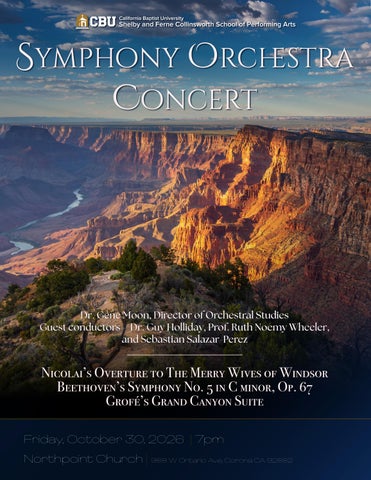
SymphonyOrchestra Concert
Dr . GeneMoon, Di r ect orofOr ches t r al St udi es Gues tconduct or s–Dr . GuyHol l i day, Pr of . Rut hNoemyWheel er , andSebas t i anSal az ar Per ez
Ni c ol a i ’ sOv e r t u r et oTheMe r r yWi v e sofWi n ds or Be e t hov e n ’ sS y mp hon yNo. 5i nCmi n or , Op . 6 7 Gr of é ’ sGr a n dCa n y onS u i t e Fri day, October30, 2026 | 7pm Northpoi ntChurch| 988 W Ontari oAve, CoronaCA 92882
Symphony Orchestra Concert Friday, Oct. 30, 2026 | 7:00 PM Northpoint Church 988 W Ontario Ave, Corona, CA 92882
Program Overture to the Merry Wives of Windsor
Otto Nicolai June 9, 1810, Königsberg May 11, 1849, Berlin, Germany
Dr. Guy Holliday, guest conductor Symphony No. 5 in C minor, Op. 67 I. Allegro con brio II. Andante con moto III. Scherzo. Allegro IV. Finale. Allegro
Ludwig van Beethoven December 17, 1770, Bonn, Germany March 26, 1827, Vienna, Austria
Brief Intermission Grand Canyon Suite I. Sunrise II. Painted Desert III. On the Trail IV. Sunset V. Cloudburst
Ferde Grofé March 27, 1892, New York, NY April 3, 1972, Santa Monica, CA
Conductors Dr. Gene Moon Professor Noemy Wheeler Sebastian Salazar-Perez
Symphony Orchestra personnel Dr. Gene Moon, Director of Orchestral Studies Professor Noemy Wheeler, Assistant Conductor Sebastian Salazar-Perez, Graduate Conductor Flutes Alexis Zamora, principal, Valley View HS Ella Young, Riverside Poly HS Piccolo Bernadine Pazcoguin, Roosevelt HS Oboes Stephanie Marquez* Joseph Hille* English Horn Joseph Hille* Clarinets Joshua Yuan, principal, Ramona HS (RUSD) Caden Turner, Vista Murrieta HS Bass Clarinet Rebekah Campbell, Canyon Springs HS Bassoons Maggie Moffat, principal, Sam Barlow HS (OR) Lianna Leysack, Beaumont HS Contrabassoon Brenya Burgess, Heritage HS (WA) Horns Weston Glover, principal, Sam Barlow HS (OR) Jc Eclar^ Marcela Perez^ Simon Morris+ Trumpets Canon Adkins, principal, New Orleans Ctr Creative Arts (LA) Noah Perkins, Vista Murrieta HS Esteban Mondragon, Redlands HS Trombones Abigail Ortiz-Carranza, principal, Riverside Poly HS Maggie Pang, El Dorado HS Bass Trombone Diana King, Upland HS Tuba Andrew Calvillo, CBU^# Timpani and Percussion Tyler Bothof, principal, Emmanuel Christian Academy Katie Domke, Woodcrest Christian School Ellie Dahlgren, Boulder Creek HS (AZ) Ronin Ewell, Capital Christian HS#
Piano/Celeste Emma Lindeman, University of Redlands# Keyboard (Harp) Kevin Bird, Desert Christian HS Violin I Rebecca Moon, co-concertmaster, Ruben S. Ayala HS Amy Willis, Homeschool Ariana Pigott, Scale Leadership Academy Norah Boling, Basha HS (AZ) Sebastian Salazar-Perez, Masters University# Joseline Duarte, Arlington HS Liam Membreno*, Compass Charter School Jeremy Ward^+ Violin II Kara Emmett, co-concertmaster, Homeschool Magdalena Herrmann, Heartland Charter School Jeanne Xia, Anhui Normal School (China) Shuyan Jia, Ruben S. Ayala HS Daniel Hidalgo, Henry J. Kaiser HS Destiny Alferez, Murrieta Mesa HS Angel Grounds, Woodcrest Christian School Violas Lydia Seyfried, co-principal, Wilma Carter HS Jadon Yang, co-principal, El Dorado HS Julianna Nguyen, Valley Christian HS Dutch Ponce, San Juan Hills HS Dylan Munoz, River Springs Charter School Keiton Rowles, Bothell HS (WA) Aidan Combes, Orange Lutheran HS Matthew Chan, Santa Fe Christian School Tobias Membreno*, Compass Charter School Cellos Vincent Strivings, co-principal, CalArts Duarte George Richardson, co-principal, Doral Academy Red Rock (NV) Josiah Yang, El Dorado HS Kayla Manansala, Summit HS Adam Graham, Canyon HS (Hart Unified) Double Bass Gavin Walsh, principal, Santiago HS (CNUSD) Sabrina Wronko, Jackson Hole HS (WY) Ernie Nunez+ #Graduate student *Guest musician ^CBU alum +CBU faculty
PROGRAM NOTES Overture to the Merry Wives of Windsor by Otto Nicolai Otto Nicolai is remembered today for two things: he founded the Philharmonic Concerts in Vienna in 1842, the origin of the Vienna Philharmonic, and he wrote Die lustigen Weiber von Windsor (The Merry Wives of Windsor), the comic opera from which this overture comes. Nicolai had made his name in Italy with a series of Italian operas before settling in Vienna, and the Shakespeare opera, composed mostly in 1845 and 1846, was his first major work in German. The libretto, by Salomon Hermann Mosenthal, follows Shakespeare’s plot: two married women, Frau Fluth and Frau Reich, discover that the vain and penniless Falstaff has sent them identical love letters, and set about humiliating him, first by tipping him into a ditch in a laundry basket and finally at a midnight masquerade in Windsor Forest, where he is tormented by guests disguised as spirits and elves. Around this runs the love story of Anna Reich and the young Fenton, who marry in secret while her parents each try to marry her off to someone else. The work proved hard to place. The Vienna Court Opera declined to give the first performance, a disappointment that was one of the main reasons Nicolai left the city in 1847. The opera was finally premiered in Berlin on 9 March 1849, with Nicolai conducting, but he died there only a short time later, in May, having just been appointed court music director. Its lasting popularity came after his death, above all in Germany and Austria, where it has remained in the repertoire. The overture became a concert favourite in its own right. Musically the opera follows the German Singspiel tradition, with musical numbers joined by spoken dialogue, and it combines two strands of German opera of the time: the romantic, supernatural colouring of Weber in the moonlit forest scenes, and the comic style of Albert Lortzing in the scenes with Falstaff and the jealous husbands. –
Jacopo Castellano
Symphony No. 5 in C minor, Op. 67 by Ludwig van Beethoven No piece of orchestral music is more famous than Beethoven’s Fifth Symphony, and few have been more influential. Its four opening notes, three short and one long (‘short-shortshort-LONG’), are perhaps the most recognisable musical idea ever written, and the symphony built from them became, almost immediately, the very emblem of what a symphony could be: not merely a sequence of pleasing movements but a single dramatic journey, a struggle that ends in triumph. Beethoven worked on the symphony over several years, completing it in 1808 amid the most fertile period of his life, even as his deafness deepened. It was unveiled at one of the most extraordinary concerts in history: a marathon, freezing four-hour event at Vienna’s Theater an der Wien on 22 December 1808, which also gave the premieres of the Sixth Symphony, the Fourth Piano Concerto and the Choral Fantasy, with Beethoven himself at the piano. The under-rehearsed performance was reportedly a shambles, but
the Fifth Symphony’s power soon became undeniable. The writer E. T. A. Hoffmann, reviewing it shortly afterwards, hailed it as opening ‘the realm of the colossal and immeasurable.’ The symphony’s overarching design, a tense, stormy C minor driving across four movements to a blazing C-major victory, became the model for the ‘struggle to triumph ’ narrative that would shape Romantic music for the rest of the century. The terse opening motto saturates the whole work, binding it into a single, irresistible argument. –
Jacopo Castellano
Grand Canyon Suite by Ferde Grofé Early in his career, Ferde Grofé made an indelible mark on American music, for it was he who orchestrated Gershwin’s Rhapsody in Blue. Grofé was Paul Whiteman’s staff arranger, and without his experience and craftsmanship, there is no small doubt that Gershwin’s masterpiece would have been ready in time, or even have achieved the succès fou that it did. He created so much of the “sound” that we associate with Gershwin’s composition, and in 1942 went on to create the arrangement for full symphonic orchestra that everybody knows today. But, of course, Grofé was an accomplished composer in his own right, and Grand Canyon Suite is the work by which he is remembered today. An indefatigable notable in the American popular music scene for decades, he was born in New York City to a distinguished classical music family, but received his early music education in Germany, and by 1920 was playing piano for Whiteman’s orchestra. He went on to arrange and compose myriad works, was on the radio, conducted in Carnegie Hall, worked on Broadway, was a film composer in Hollywood, and even taught at the Juilliard School. His interests lay everywhere, and his serious compositions reflect this, especially his penchant for composing orchestral suites that are heavily descriptive: Mississippi Suite, Kentucky Derby Suite, Aviation Suite, Death Valley Suite, World’s Fair Suite, and Rudy Vallee Suite, to name just a very few. And let’s not forget his Sonata for Flute and Bicycle Pump. But, still, Grand Canyon Suite is the survivor, and rightly so. It is a masterpiece of pictorialism and orchestration. Finished in 1931, the suite depicts various scenes as may occur in the canyon. The first movement, “Sunrise,” is a gentle, ever-growing depiction of the sun’s creeping rays, carried by constantly ascending scale passages. There are no real memorable tunes here, just atmospheric, swelling harmonies—quite a contrast to Richard Strauss’s bombastic sunrise from the beginning of Also sprach Zarathustra. “Painted Desert”, too, largely avoids singable melodies, rather, it evokes the static beauty of the quiet desert by constant, repetitive soft woodwind clusters and shimmering percussive effects that revolve slowly like a reflective prism. The introspective English horn finally ends it all, with a little help from a solo clarinet. Who hasn’t heard “On the Trail,” with its clip-clopping donkey hooves? Long ago, it became ubiquitous from its use by the Philip Morris radio and TV shows. And unmistakable is the opening “hee-
haw”—and many more throughout the movement–from our long-eared friends. It’s a placid, quintessential Western atmosphere, and with a real, memorable melody, to boot! Horns and chimes announce “retreat,” the end of day and the advent of “Sunset.” In an inversion of the ascending scales of “Sunrise,” gentle descending scales, accompanied by lush scoring in the best Hollywood tradition, gradually settle into dusk, with a final muted call in the brass. “Cloudburst” opens with a grandiose, romantic scene setter, but soon little furtive drops of rain begin to fall, distant thunder and lightning draw nearer, and a full-fledged Western gully-washer is in full roar. You don’t need a Walt Disney film to help your imagination in this totally masterful evocation. Then, of course, it all dies away almost as soon as it came, and Grofé tops the suite off with a “grand” peroration led by a recounting of the “On the Trail” theme, majestically intoned by the brass. –
William E. Runyan
BIOGRAPHIES Recognized on four continents, maestro Gene Moon has earned international acclaim as a conductor whose artistry bridges cultures and inspires audiences worldwide. His career has taken him to podiums in the United States, Asia, and South America, leading distinguished ensembles including the Orquesta Sinfónica Nacional in the Dominican Republic, the Saigon Philharmonic in Vietnam, the Orquesta Filarmónica de Medellín in Colombia, the Gangnam Symphony Orchestra in Korea, and orchestras across Macau, Hong Kong, China, Korea, and Vietnam. His global presence has solidified his reputation as a versatile maestro sought after for both symphonic and operatic performances. Dr. Moon serves as Director of Orchestral Studies for the Collinsworth School of Performing Arts at California Baptist University, where he leads the artistic and educational vision of the orchestral program. Under his direction, the CBU Symphony Orchestra presents performances spanning symphonic masterworks, opera, and musical theatre, providing students with professional-level experiences that integrate artistry, pedagogy, and outreach. Additionally, he serves as conductor of the Riverside City College Symphony Orchestra, the premier community college orchestra program in Southern California. A passionate advocate for music education, Dr. Moon is in constant demand as a guest conductor and clinician, having led All-State orchestras in Oklahoma, Louisiana, Arkansas, and beyond, as well as national events including the ASTA National Orchestra Festival. His summer posts have included Resident Conductor at the Sewanee Summer Music Festival and the Chloé Trevor Music Academy. Deeply committed to developing young musicians, he has established enduring pathways for youth orchestras throughout the United States. Previously, Dr. Moon held leadership roles as Director of Orchestral Activities at Stephen F. Austin State University, Artistic Director of the East Texas Youth Orchestras, and Music Director of the Longview Symphony Orchestra. His earlier teaching appointments include the University of Central Oklahoma, the University of Oklahoma, and the Mid-Del School District, along with his tenure as Music Director of the Oklahoma Youth Symphonies. As the newly appointed Music Director of Love in Music, Dr. Moon continues to champion music’s power to unite communities and cultivate artistic excellence. Through his work as conductor, educator, and mentor, he exemplifies a career that seamlessly unites performance, education, and international collaboration—continuing to inspire audiences and musicians across generations.
Professor Ruth Noemy Wheeler is an accomplished violinist, conductor, and music educator whose career reflects a steadfast commitment to musical excellence, artistic leadership, and education. She studied at the Professional Conservatory Manuel Carrá and the Superior Conservatory of Music in Málaga, Spain, and furthered her training through workshops at The Juilliard School and the New York Conducting Institute. She holds dual master’s degrees in Violin Performance and Conducting from California Baptist University (CBU), where she received the Outstanding Graduate Student Award in 2010. She has performed with more than 20 orchestras across Europe and the United States and served as Concertmaster of the Corona Symphony Orchestra for 15 years. As one of the orchestra’s founders, she continues to serve as Assistant Conductor, a position she has held for six years. Her collaborations include internationally acclaimed artists such as Maxim Vengerov, Natalie Cole, Michael W. Smith, Chris Botti, David Benoit, Michael Cavanaugh, Burt Bacharach, and Mannheim Steamroller. Since 2010, Professor Wheeler has made lasting contributions to CBU’s musical and educational programs. She established the CBU Symphony Orchestra, CBU String Quartet, and CBU Concerto Competition, helping expand opportunities for ensemble performance, artistic development, and student achievement. With more than 15 years in higher education, she has taught a broad range of music courses and conducted numerous performances, including the Southern California premiere of Dietrich & Maria. She currently serves as Assistant Conductor of the CBU Symphony Orchestra and Corona Symphony Orchestra, Conductor of the Riverside Arts Academy Overture Orchestra, a coach for RUSD, and an independent music contractor. She was appointed Music Director and Conductor of the Riverside Festival Orchestra, making her debut at Riverside’s Concert for Heroes 2026. Her honors include the 1998 Honor Award from the Superior Conservatory of Music in Málaga, First Place at the 2021 Los Angeles International Conducting Competition, and the 2025 Maestra Award from the Riverside Arts Academy. Beyond the podium and concert stage, Professor Wheeler is an Army wife and mother, roles that have strengthened her resilience, leadership, and dedication to serving others through music.
Dr. Guy Holliday received a Bachelor of Arts degree in Music Education from California State University, Fresno, and a Master of Music degree in Conducting from Azusa Pacific University under Dr. Gary Bonner. He holds a Doctor of Musical Arts degree with an emphasis in Conducting from Claremont Graduate University, where he studied with Jorge Mester, former conductor of the Pasadena Symphony, and Dr. Mitchell Fennell, former Director of Bands at California State University, Fullerton. Before coming to CBU in 2003, Dr. Holliday taught instrumental and choral music in two California public high schools for a total of 13 years, in which he directed an award-winning Marching Band, Concert Band, Jazz Band, and several choirs. Dr. Holliday is currently the Director of Athletic Bands and Associate Conductor of the University Choir and Orchestra at California Baptist University. He also teaches conducting and the band and orchestra literature course. He is the founding conductor of the CBU Wind Ensemble, Concert Band, Jazz Band, and Lancer Pep Band. Over the years he has also directed the University Choir and Orchestra, Women’s Choir, Choral Union, and Symphonic Band. Dr. Holliday served as the Director of Bands at CBU for 20 years. In addition to his teaching and conducting duties, Dr. Holliday served as the Associate Dean of Undergraduate Studies from 2015-2020. Now in his 37th year as a music educator, Dr. Holliday is frequently called upon as a festival adjudicator, band clinician, and guest conductor of junior high and high school honor bands. Dr. Holliday also serves as the Music Pastor at Calvary Chapel Old Towne in Orange, California, now in his 23rd year there. Guy’s wife, Kim, is a middle school social studies teacher. They have two adult children, Allison and Justin. Allison will soon complete the master’s program in Counseling Psychology at CBU, and Justin works as a barista, graphic designer, and has other creative endeavors. Guy, Kim, Allie, and Justin reside in Riverside, California.
Sebastián Salazar, a native of León, Guanajuato, Mexico, is a violinist and conductor currently pursuing a Master of Music degree under the guidance of Dr. Moon. He holds a Bachelor of Music in Violin Performance from The Master’s University. Before turning his primary focus to conducting, Sebastián trained extensively as a violinist, studying with Michael Ferril, Benjamin Mason, Eugene Watanabe, Bruce Dukov, and Steven Copes. His background as a string player continues to shape his work on the podium, informing his attention to phrasing, balance, and ensemble cohesion. As a performer, he has collaborated with artists such as Jubilant Sykes, Simone Porter, and Aubree Oliverson, and has participated in recording sessions at 20th Century Fox. A detail-oriented musician committed to genuine artistry, Sebastián approaches each score with careful study and stylistic sensitivity. He seeks clarity, expressive depth, and meaningful connection between performers and audience.