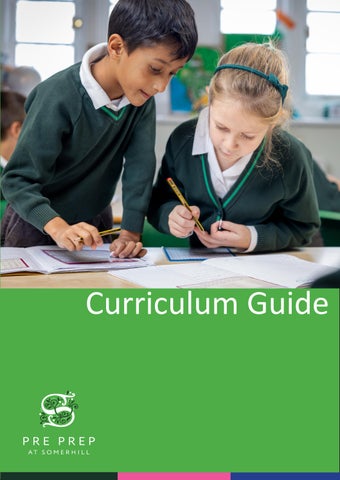
Curriculum Guide
1
Somerhill Pre-Prep 2020 2021
SOMERHILL PRE-PREP CURRICULUM GUIDE
2023 Welcome Welcome to the Reception, Year One and Year Two Curriculum Guide. These years represent a vital part of the children’s educational journey that bridges the gap between the end of Early Years and Key Stage 2. Reception is the final year of the Early Years Foundation Stage. Year One and Year Two sit in what is known as Key Stage One. As our pupils continue to grow and develop, our curriculum is designed to build upon their foundation knowledge, fostering creativity, independence, and a lifelong love of learning. At this crucial stage of a child's development, we recognise that children thrive when they are engaged in meaningful, hands-on learning experiences which ignite their imagination. Our Creative Curriculum is designed so children acquire knowledge and grasp new concepts, but also to allow them to develop confidence and independence in their own learning – through exploration, critical thinking, and problem-solving. One of our primary goals in the Pre-Prep as we head into Year Two is to ensure that our children are well-prepared for the transition to Year Three. We understand that this can be a significant step for young learners, so our curriculum is structured to help ease this transition. Primarily, we want to ensure that the pupils feel confident and capable as they progress on their educational journey. Each year expectations increase, as does their readiness! Throughout Reception, Year One and Year Two, there will be many opportunities to find out about your child’s curriculum with workshops, parent meetings and our weekly class news email. All of these will help inform your support of your child at home. We hope that this guide is a helping hand, together with the Maths and Phonics/Reading webinars which are embedded within it.
Amanda McKnight, Head of Pre-Prep
The Curriculum Our Creative Curriculum feeds curious minds and inspires critical thinking through a focus on project work. Creativity encompasses much of our time here in Pre-Prep. Children are taught to be bold and inquisitive learners through asking questions and taking risks along the way. The Creative Curriculum focuses on big ideas, interesting projects, and individual pupils' passions and needs and school days are packed with purposeful and creative learning opportunities. Children can enjoy working independently or collaborate on group tasks. Learning takes place in both our indoor and outdoor environments. By adopting an integrated approach to planning and learning, we can lock into children’s natural curiosity and spark a love of learning. Creativity is more than just a single subject in the Pre-Prep; it is the basis for learning core and key skills in a happy and engaging environment. Our Creative Curriculum includes: English, science, art and design, history, geography and design and technology objectives. We follow the National Curriculum subject objectives for each year group which are covered across the academic year. Rigorous teaching of discreet subject specific skills and knowledge is delivered alongside opportunities to apply those skills in a cross curricular context.
Click here to find out more about the Creative Curriculum in Pre-Prep
Learning and Development Writing We use a variety of interesting texts as our stimulus during English lessons and study fiction, non-fiction and poetry. We try to choose texts which are unfamiliar to the children and therefore spark their curiosity, creativity and imagination. Texts will generally be linked to our topic and an array of fun and engaging activities will be planned for the children to complete. This will typically involve role plays and acting as well as writing stories, detailed descriptions, poems, letters and designing posters and leaflets. Where possible, we plan writing activities that are meaningful and allow children to share their writing with a real audience – not just writing in a book that only their teachers read!
Handwriting In Nursery and Kindergarten, the focus is on developing both gross and fine motor skills. Children will begin their writing journey by practicing holding a pencil and drawing and tracing patterns. In Reception, the pencil grip begins to strengthen, and children learn how to form letters using the print style. In Year One, children learn how to form pre cursive, leading them to learn fully cursive writing by the end of Year Two. Reading There are many skills involved in the art of reading; it is not simply about decoding the letters. When your child can read every word placed in front of them, we place more of an emphasis on fluency, comprehension, and inference. We take the time to ensure your child understands all the punctuation, context, and definitions of new vocabulary. They need to be able to infer information from a text and refer to it for evidence; they should also be able to read with expression and talk in a detailed manner about what they have read giving valid opinions about what they have particularly enjoyed about the text. Children in Reception – Year Two are taught phonics and reading using the ‘Read Write Inc.’ scheme. Children are taught in small groups across their year group, depending on their stage of reading. • • • • •
Children read to an adult every week. Children read daily through guided reading sessions, RWI phonic sessions and other opportunities across the curriculum. We encourage you to share as many books and genre of text as possible at home. When hearing your child read at home, a “less is more” approach is best. It is best to read a few pages at an excellent standard than rushing to complete a whole book. We have been reminding the children that it is good practice to read a book more than once so that each time you can focus on a different reading skill. Click here to find out more about how both reading and writing are taught in Pre-Prep
Maths The Early Years Foundation Stage has two strands: Numbers and Shape, space, and measure. The Numbers strand encourages children to use number names and language spontaneously in play, to show curiosity about numbers and number problems and to realise that anything can be counted, not only objects. It focuses on having a broad understanding of, and ability to use, the numbers to 10. Mathematics is taught through practical experiences, learning through doing whilst gaining understanding and recognition of numbers and how we can use them. Starting with counting, we point to each item as we say a number so that the children learn that the last number we say is how many objects are in the set. We also introduce simple adding, taking away and sharing. Children in Year One up to Year Eight at Somerhill are taught using the Abacus maths framework. The principal focus of mathematics teaching in KS1 is to ensure that pupils develop confidence and mental fluency with whole numbers, counting and place value. This involves working with numerals, words and the four operations, including practical resources (for example, concrete objects and measuring tools). At this stage, pupils develop their ability to recognise, describe, draw, compare and sort different shapes and use the related vocabulary. Maths learning involves using a range of measures to describe and compare different quantities such as length, mass, capacity/volume, time and money. By the end of Year Two, pupils should know the number bonds to 20 and be precise in using and understanding place value. An emphasis on practice at this early stage will aid fluency. Pupils work towards reading and spelling mathematical vocabulary, at a level consistent with their increasing word reading and spelling knowledge at KS1.
Ideas for supporting your child at home include: • • • •
Setting up a shop; Playing board games which involve counting on and back; Weighing and measuring ingredients to help with cooking; and Reading different types of clocks. Click here to find out more about how maths is taught in Pre-Prep
Example weekly class timetables
Enrichment In support of our exciting learning opportunities here at Pre-Prep, we are fortunate enough to offer the children regular extra-curricular enrichment experiences. These include; • •
Offsite school trips; Guest authors;
• • • • • •
Seasonal workshops including dance; Guest speakers connected to our current topic of learning; STEM day; French day; Book week; and An extensive after school club and care provision.
Pre-Prep Pals Our Pre-Prep Pals are a set of animals (chosen by our Somerhill children) who depict our school values. The Pals translate these values into understandable language for our children in Pre-Prep and support the children’s behaviour and learning dispositions to create a positive and respectful school environment. They shape our community to help us all feel valued, respected, and motivated to maintain positive behaviour. Our Pre-Prep Pals, and their associated value, are: • • • • • •
Ree the Bee: Community Darri the Dog: Kindness Oli the Owl: Responsibility Cortez the Cat: Respect Hideo the Horse: Excellence Terri the Tortoise: Resilience
Parents as Partners In the Pre-Prep, we hugely value the support and engagement of our parent body. It is widely acknowledged that parents working in partnership with schools increases pupil achievement and success. Parents have an exciting role to play in continuing their children's learning development at home. As such, we have many lines of communication both formal and informal. Daily messages can be written in ‘Green contact books’ and you are always welcome to email your child’s form teacher or a connect for a quick chat/phone call at the end of the school day. A summary of how we formally connect with Parents each term in outlined below:
Term Michaelmas
Pre-School
Reception
Years 1&2
‘Meet the teacher’ event. ‘Meet the teacher’ event. ‘Meet the teacher’ event. Parent consultations evening.
Parent consultations evening.
Parent consultations evening.
Lent
Parent consultations evening.
End of term report. Parent consultations evening.
End of term report. Parent consultations evening.
Trinity
End of term report for Kindergartners. A 2-year progress report will be written for all nursery children during the school year.
End of term report (includes attainment against Early Learning Goals and comments on characteristics of effective learning).
End of year report.
Learning support Supporting children with additional needs through early intervention is crucial for their development and long-term success. Early intervention aims to identify and address any challenges or developmental delays as soon as possible to provide children with the support they need. By identifying when support is needed and collaborating with families and specialists, it can help children thrive and reach their full potential. We have two designated learning support teachers in Pre-Prep, who work with the class teachers and parents to support children who need additional support. If you have any concerns about your child, your child’s class teacher is the first point of contact.
Medical information We have a school nurse on site each day from 08:30 – 16:30. You can contact the school nurse via email at schoolnurse@somerhill.org or by telephone via reception on 01732 352124. The information that you provide in your child’s mandatory medical questionnaire will be recorded in their school held medical records. Please inform the school nurse as soon as possible if there are any changes to your child’s medical or dietary needs. If you do not inform the school nurse of any changes, we will assume that the information that we hold is accurate. The school holds stock medication. These are detailed on the mandatory medical questionnaire. You can consent for your child to be given stock medication for minor illnesses (such as fever or pain) on the questionnaire. You can also indicate that you do not want the school to administer any or some of the school stock medication via the
questionnaire. The school will always check for consent before administering stock medication to your child and will inform you of the time, dose, and reason for giving the medication via email or telephone. Should your child require a short course of prescription medication, such as antibiotics, the school nurse will ensure that this is administered in school. Medication can only be administered to your child if presented correctly and accompanied by a Medication Administration and Request Form (MARC), which can be printed off from the Parent Portal. Information about the correct presentation can be found on the Parent Portal. For the safety of your child, the school will not administer any medication if it is presented incorrectly or without a completed MARC Form. It is school policy not to administer homeopathic remedies. If your child has a fever (a temperature over 37.5), is feeling too unwell to continue their school day, has vomited, had a bout of diarrhea, or has hurt themselves badly, the school nurse will telephone you and ask you to come and collect them from school. Please ensure that you can do this within 60 minutes of us contacting you. If your child is sent home with a fever, they must not return to school until they have been fever-free (without the need for medication) for 24 hours. If your child is sent home with vomiting or diarrhea, they must not return to school until 48 hours have passed since their last episode of vomiting or diarrhea.
Food Creating delicious and healthy school meals is essential at Somerhill, to ensure that children receive the nutrition they need to learn and thrive. Well-balanced school meals provide a variety of nutrients, appeal to children's varied tastes, and promote healthy eating habits and manners. Education doesn’t end in the classrooms, trying new foods and reinforcing good table manners makes meals times another learning opportunity and a lovely social occasion where we can all have a lovely chit chat. We have a varied morning and afternoon snack which may be fruit or a sandwich, scone, cracker with milk or water. An example lunch menu for a school week as well as information regarding wrap-around care food provision can be found below:
Wrap-around care - Breakfast Club: Toast with jam, cereals with milk, milk, juice, and fresh fruit. Wrap-around care - Somers & Little Somers Teatime: A selection of yummy sandwiches, with a little sweet treat to end the day such as a flapjack or piece of fruit.
Staff list Nursery
Auxi Westhorpe – TA
Amber Passey – Room lead (maternity cover for Carla Streeton)
Year One
Jane Gillett – Key worker Emma Spender – Key worker Emily Dickinson – Key worker (maternity cover) Kindergarten KSH Sarah Hutchings – Teacher Natasha Fagg – Key worker Bethan Miles – Key worker KAD Amanda Dawes – Room lead Izzy Hopkins – Key worker Saplings Louise Munn Samantha Clarke Reception RKH Kate Herbert – Teacher Faye Dew – TA RMN Madeleine Nagel – Teacher Hayley Janeke – TA RSW Sarah Woodgate – Teacher & EYFS lead Kerryn Smith – TA RHM Lynn Harding – Teacher (job share) Becky McGrath – Teacher (job share)
1ML Matilda Lowe – Teacher Chloe Perkins – TA 1JC Jordyn Campbell – Teacher Julie Taylor – TA 1GL Grace Laverick – Teacher Claire Martin-Coward – TA 1RB Rachel Bond – Teacher Rebecca Loras Gandú – TA Year Two 2CB Camilla Bullen – Teacher Amanda Page – TA 2CM Claire Matthews – Teacher Leah White – TA 2SF Stephanie Ferrabee – Teacher Sarah Wakeford – TA 2HL Hazel Levy – Teacher Kathryn Mason – TA
01732 352 124 www.somerhill.org @SomerhillKent
2