A publication of Canadian Baptist Ministries
Fall 2015
Also in this issue
Food for Life:
4
A Hunger in Our Hearts
Feeding body, mind and soul
10
Mindful Meals
18
Welcome to Paradise
mosaic is published three times a year by Canadian Baptist Ministries. Copies are distributed free of charge. Bulk quantities available by request.
c o n ta c t 7185 Millcreek Drive Mississauga, ON l5n 5r4 Tel: 905.821.3533 mosaic@cbmin.org www.cbmin.org Managing Editor Jennifer Lau Editor Laurena Zondo Art Direction Gordon Brew
Connect with us.
www.cbmin.org @canadianbaptist facebook.com/cbmin.org
God comes to the poor in the shape of bread. I love these words I read at Mahatma Gandhi's homestead in South Africa because it reminds me of CBM’s deep commitment to ensuring our global partners are able to provide food aid where it is most needed and food security to those who lack it. Our membership in the Canadian Foodgrains Bank is vital to this strategy. Some estimates indicate that among the global poor, up to 80% of an average person's life is spent seeking their next mouthful of food. In many parts of the world, including among our own poor, food is a necessary preoccupation. More than one billion people – nearly a sixth of the world’s population – suffer from chronic hunger. It is a crisis with devastating and farreaching effects. This issue of mosaic focuses on food. We hope you will be appropriately nourished on the articles, stories and images you find herein. And so as you open these pages, all that remains, as my French friends would say, is to wish you, "bon appetit".
Terry Smith Director, International Partnerships
As partners in the Canadian Baptist family we exist to serve the local church in its grassroots mission. Together we impact our communities and beyond through the love of Christ.
P.S. As I write this, I am mindful and grateful for the investment of wisdom, vision and leadership Rev. Sam Chaise has provided CBM over the past five years. Sam recently stepped down from his position as Executive Director and he and his wife Cindie are seeking God's direction for their future. Sam greatly shaped who we are today as the mission movement of choice for Canadian Baptists. On behalf of the Board and staff of CBM, thank you Sam for your leadership!
3
Fall 2015
learn.. .............................. 4 A Hunger in Our Hearts
8 Restoring Hope 10 Mindful Meals
just think......................12 14 Food for Life 18 Welcome to Paradise 20 She Matters Update
the view........................ 22 Rod Olsen
23 Hopeful Gifts for Change
Photo credit: Johnny Lam Photography
touch............................. 24 Grassroots Heroes
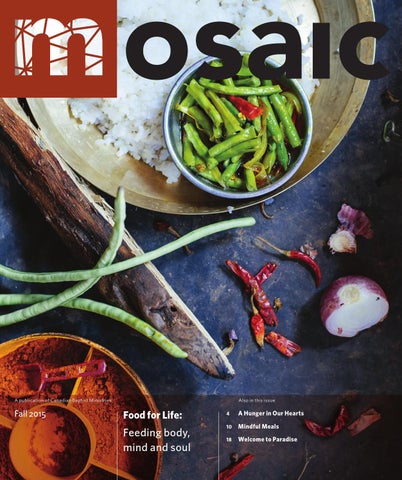
ON THE FRONT COVER of this issue of mosaic is the ingredients for Allodi Torkari (vegetable curry), a favorite dish of Sunamoni, who lives with her husband and three young children in a remote village in Odisha State, India. Sunamoni participated in a nutrition project offered by CBM and the Kui Baptist Association.
She also received health awareness training and is now a volunteer health worker in the village, encouraging other women to plant gardens for fresh fruits and vegetables and use mosquito nets to protect families against malaria.
mosaic is a community forum of local and global voices united by a shared mission. mosaic will serve as a catalyst to stimulate and encourage passionate discipleship among Canadian Baptists and their partners.
4
mosaic—fall 2015
A Hunger
learn
Photo credit: Johnny Lam Photography
in Our Hearts
mosaic—fall 2015
5
HOWEVE R THE CE LE BR ATION OF THIS ACHIEVEMENT NEEDS TO BE MUTED BY SOME KE Y CONSIDER ATIONS:
the measuring standard is twelve consecutive months of under-nourishment the majority of the 795 million malnourished people in the world live in rural areas of the Global South where food crops are produced by Gordon King, CBM Resource Specialist
OUR SUPERMARKETS ARE EVIDENCE that we rank among the privileged people of the world. An average grocery store in Canada sells over 43,000 items and presents us with a stunning array of choice. Yet there are distressing signs of poverty and undernutrition in our nation. Over 850,000 Canadians depend on food banks each month – more than one-third of them are children and youth. Recent studies have linked poverty and poor health in Canada with undernutrition. Low income and inadequate nutrition reduce life expectancy of people in some Canadian postal codes by up to 15 years. These factors also result in shorter life spans and an increased incidence of diabetes, dementia, strokes and heart attacks. In the rest of the world, the challenges of global hunger continue. The United Nations’ Millennium Development Goals (MDGs) conclude in 2015.
UN OFFICIALS CALL THE MDGS THE MOST SUCCESSFUL ANTI - POVERT Y MOVEMENT IN HISTORY, POINTING TO A REDUCTION IN HUNGER FROM 23% TO 13% OVER THE 25 YE AR PERIOD.
over 23% of the population of Sub-Saharan Africa is undernourished or hungry with 24 countries currently facing a food crisis food insecurity in the Middle East augments political instability climate change continues to adversely impact our ability to grow crops This period may be the calm before the storm. The challenge to address local and global hunger will increase as the world’s population grows to 9 billion by 2050. However, responding to physical and spiritual hunger is embedded in our DNA as Canadian Baptists.
6
mosaic—fall 2015
Connecting Mission & Hunger THE CONNECTION BET WEEN FAITH , witness and compassion for the hungry is embedded deeply in the scriptures. Isaiah speaks of shared meals with the poor (Isa 58: 6-7). Jesus fed the hungry and taught that a common table with the poor was more important than maintaining the social obligations of reciprocity (Lk 14: 12-14). St. Paul organized a famine relief collection among the congregations of the early Christian movement (2 Cor: 8-9). Over the decades, compassion for the hungry has become part of our own identity as Canadian Baptists. Here are just a few highlights of local and global initiatives:
❖ Agronomists and nutritionists were included in the
missionaries sent out by CBM and we remain committed to feeding the hungry through agriculture projects in areas of hunger. Bob and Anne Swann, CBM missionaries to Kenya, built and managed feeding stations in three massive UN refugee camps at the height of the Somali civil war in the 1990s. Similar circumstances in 2011 resulted in new food assistance programs under the direction of CBM Africa Team Leaders Aaron and Erica Kenny.
❖ In the early 1980s farming families of Brownfield Baptist
Church in Alberta participated in a prairie movement to contribute wheat to alleviate the Ethiopian famine. This grassroots Christian commitment resulted in the formation of the Canadian Foodgrains Bank. Today, grow projects across the country like the one in Brownfield continue to save lives from hunger. A new generation of young farmers from Moosomin Baptist Church in Saskatchewan began the Harvest of Hope project in 2012. Urban churches like Lorne Park Baptist Church in Mississauga, Ontario, Westview Baptist Church and First Baptist Church in Calgary, and Willowlake Baptist in Winnipeg have created partnerships with rural CBM/Foodgrains Bank grow projects.
Scott, from last year's Springforth short-term mission trip, learning about conservation farming alongside local Kenyan farmer Margaret on her demonstration farm in Maai Mahiu, Kenya.
❖ The Mustard Seed movement was born in Emmanuel
Baptist Church in Victoria, B.C. 35 years ago. It has grown to become the largest food bank on Vancouver Island with other programs that respond to urban poverty. New Mustard Seed organizations were initiated in Edmonton and Calgary with the support of Baptist churches. The Gleaners, launched with Canadian Baptist leadership and support in the South Okanagan of B.C., has become a national movement dedicated to using surplus production to feed the hungry. The Oasis Dufferin Community Centre has been caring for the personal, spiritual and food needs of new immigrants in the area around Dufferin Street Baptist Church in Toronto, Ontario for 20 years. RiverCross Church in Saint John, NB has become an incarnational centre of social compassion and transformation. The RiverCross Mission Centre is the home of the North End Food Bank in Saint John.
❖ In Atlantic Canada, participants in Springforth, the annual
gathering of Baptist youth, raised over $12,000 to support a food security project in Kenya. Midland Baptist Church in New Brunswick has run a Friday morning drive-through coffee program out of the church to benefit food projects for the past nine years. In Nova Scotia, agronomists associated with Baptist churches volunteer time to work with CBM food security teams in East Africa, bringing specialized skills in areas like soil analysis, conservation farming, horticulture and post-harvest storage.
mosaic—fall 2015
7
“THERE ARE TIMES WHEN WE NEED TO SPEAK ON BEHALF OF THOSE WHO LIVE WITH HUNGER.”
GOOD SOIL CAMPAIGN MARK DOERKSEN, THE CANADIAN BAPTISTS OF WESTERN CANADA’S HEARTLAND REGIONAL MINISTER, recently encouraged Canadian Baptist church leaders to raise their voices on behalf of those who are hungry. As Mark stated, There are times when we need to speak on behalf of those who live with hunger. The Canadian Foodgrains Bank’s Good Soil campaign gives Canadian Baptists an opportunity to speak collectively about our concern for those who live on the margins and struggle for food. This campaign encourages each congregation to make a public statement in support of farmers with small landholdings in the Global South. 84% of family farms in the world have less than two hectares of land. Supporting these farmers is an important and effective way to reduce world hunger and promote the Canadian government’s objective of improving maternal and child health. CBM, in partnership with the Canadian Baptists of Western Canada, is joining with the 14 other members of the Foodgrains Bank to ask the Government of Canada to restore development assistance for agriculture to 2010 levels, when as a nation we made global food security a national priority. The Good Soil campaign can be incorporated into a morning worship service, be part of a church lunch, or be the central theme in a special workshop. CBM provides letters which are addressed to your local Member of Parliament requesting assistance in restoring Canada’s agricultural aid programs. When a meal is shared, participants engage in the symbolic act of bending spoons to show that there is something wrong with a global distribution system that leaves so many food producers and rural communities deprived of adequate nutrition. The bent spoons will be collected and used to create art that represents the horror of hunger and our collective response. Join the Good Soil campaign. Go to unbendthetrend.ca for more details.
8
mosaic—fall 2015
Restoring Hope by Ruth Munyao, CBM Africa Food Security Specialist
AN ESTIMATED 80% OF AFRICA’S population are subsistence farmers whose livelihoods depend on producing food on a small plot of land. Yet out of the 1 in 9 hungry people in the world, many are farmers. That is because they face a number of challenges, particularly with climate change. Areas that previously received adequate rainfall now receive insufficient levels. In Kenya, droughts are frequent and crops fail one out of every three seasons. Other concerns include limited access to training and resources for poor farmers who are not able to keep pace with technological advances, and the deterioration of soil health. A rising population density has led to rapid depletion of soil nutrients, declining yields and environmental degradation. Traditional agricultural methods of clearing the land by cutting down all the trees is depleting the land. All of these challenges have led to a chronic dependency on food aid for many subsistence farmers. CBM and our partners are committed to improving the health of people and restoring the land through conservation agriculture projects that use alternative farming methods. The impact of these initiatives is already producing real results. One project among 1,200 farming families in a drought-prone region of Kenya has seen a great reduction in hunger. Before the project, maize and beans were the only crops. Prolonged droughts caused consecutive crop failures and extreme periods of hunger. Farmers were compelled to spend money to buy food – at high rates – at the expense of school fees and medicine. After the project, nearly 75% of interviewed participants were growing more than three different drought tolerant crops, and the number of hunger months has reduced from seven months (in 2010) to three and half months (in 2015).
9
Now my children can eat carrots, cabbage and eggs but I can also pay their school fees. This program is a real blessing for us. Masika Mulwahali from DR Congo tells us that, On a small plot where we used to get hardly two bags, I harvested five bags of cassava and after selling part of it, I bought six iron sheets for the roof of our house. We have learned also to grow vegetables. We never thought cabbage could grow in this place but with my first experience, I harvested 50 kg, which I sold to buy some chickens. Our diet is improved: now my children can eat carrots, cabbage and eggs but I can also pay their school fees. This program is a real blessing for us. Another farmer, Kabuyaya Akila, is encouraged by the tomatoes he now grows. Using the seeds I received from the project and with the two harvests of tomatoes, I managed to secure my own plot of land. Now I also plant cassava, using the proper spacing and mulching As a result of new techniques, production increased and I managed to buy a motorbike, which helps me to take my products to the market. From the sale of tomatoes and cassava, I get all the other basic things I need such as cooking oil, medicine and school fees for my children. Even when there is not enough rain, I use the watering can to water the plants and the spray to apply pesticides on my tomatoes I feel that my duty is to sensitize all my neighbors to apply the same technologies so that we may increase production in the village and have access to better markets.
Photo credit: Johnny Lam Photography
mosaic—fall 2015
mosaic—fall 2015
Photo Credit: Brooke McAllister
10
The following article is an excerpt from the book Planted: A Story of Creation, Calling, and Community, which is about the founding of A Rocha Canada, an international Christian organization which, inspired by God’s love, engages in scientific research, environmental education, community-based conservation projects and sustainable agriculture.
by Leah Kostamo, Co-Founder & Communications Director, A Rocha Canada
IN OUR MIND’S EYE, the A Rocha enterprise was meant to be about conservation and education, anchored in community. But landing at our first environmental center and looking out the farmhouse’s bay window onto the rich brown soil of the half-acre garden plot, we suddenly began dreaming of growing enough food to feed guests and interns. How romantic and sustainable the zero-mile diet! We fantasized of roasted beets sprinkled with goat cheese and fresh tomato and basil salads. The more we fantasized the more we realized that, like everything else, it’s all connected. The means is always the end, and if we wanted to take environmental stewardship seriously, then we’d have to be consistent in what we ate at the Center.
THE ORGANIC DEBATE Because we are now in the food game, people are constantly trying to get us to weigh in on the organic versus conventional food debate. Is organic really better? they want to know. Our first response is, Better, how? Nutritionally? Economically? Environmentally? It’s interesting, but nearly to a person, if it’s a member of the older (50 years and above) set asking, they want to know if it’s better nutritionally. The answer is complicated and hard to answer with clear scientific backing. It is true that conventionally grown produce is doused with pesticides and herbicides that have been shown, when consumed in high levels, to act as neurotoxins, endocrine disruptors, and carcinogens, but the amount of these toxins one actually ingests in a given pear or potato might still be harmless. Might. That one’s still up in the air.
mosaic—fall 2015
11
Photo credit: Timothy Friesen
Toxicity aside, what about nutritional value? Again, as Michael Pollan points out, it’s tough to say with empirical certainty since so many variables affect a vegetable’s nutritional quality (things like geography, freshness, genetics, soils, etc.). What is becoming more qualifiable is the higher levels of micronutrients and polyphenols present in organically grown plants. Polyphenols are chemical metabolites that help plants metabolize nutrients and are found especially in the skins of fruits. A study by researchers at the University of CaliforniaDavis which looked at vitamin and polyphenol levels in organic and conventionally grown foods has shed new light on the benefit of organically grown produce. The organic fruits and veggies consistently had higher levels of vitamin C and a wide range of polyphenols, which have antioxidant and antimicrobial properties. Why were levels higher? The researchers theorize that without the benefit of pesticides and herbicides the plants must defend themselves naturally (via polyphenols) against pests or succumb, making for stronger, healthier plants. That’s one theory. The other is that by drastically simplifying the soil with chemical fertilizers and no compost or rotational crops, plants no longer have the ingredients to produce these compounds. Other studies have shown similar patterns. So, yes, organically grown food is most likely more nutritional. But, frankly, I must add that this is not the primary reason we grow organic veggies at A Rocha. We are quite conscious of the fact that eating only organic can be quite self-serving, especially if the organic fruit or vegetable in question has traveled hundreds of miles to one’s plate. After all, doesn’t shelling out two dollars for an organic apple from New Zealand seem a bit outrageous when the rest of the world starves for a bit of vitamin C? Finally, there’s the environmental angle. No petrochemicals (in the forms of fertilizers, pesticides and herbicides) equals more environmental, right? Yes and no. Growing plants and animals using organic methods does mean less soil erosion, less nitrogen run-off and no toxic pesticides, herbicides, and growth hormones in the watershed all huge factors in sustaining healthy ecosystems. So, yes, organic is tremendously better for the health of the planet. But we now have the oxymoronical beast known as industrial organic which operates in the agri-business mode, only without all the petrochemicals. It’s a good news/bad news scenario. On the one hand these companies and their farms aren’t sterilizing soil or polluting streams, a benefit that cannot be overemphasized. But they still use around eight calories of fossil fuel energy to deliver one calorie of food energy to my table. While the soil might be happier, the air gets just as polluted, tons of carbon is released into the atmosphere, and the whole model rests on an ever-dwindling supply of cheap oil.
People are constantly trying to get us to weigh in on the organic versus conventional food debate. HOMEGROWN And so we arrive at the Eat Local craze. These folk religiously track food miles so as to avoid being tainted by a peach or pear that might have been grown outside their own 100 mile radius. Actually, I don’t know why I’m making fun of them in my best moments I want to join them! At the A Rocha Center, we do have our scruples and no-go areas things like feedlot beef, soda pop and processed snack food. And though we are situated in British Columbia, we do eat wheat from Saskatchewan and the occasional fruit from California in the winter. But where possible, we eat locally produced produce, which is especially easy in the summer and fall when our gardens are burgeoning. It’s our meagre stand of solidarity with our brothers and sisters in the two-thirds world for whom a locally grown, mostly vegetarian diet is the norm. Read Leah Kostamo’s book Planted to learn more about A Rocha Canada. arocha.ca
12
mosaic—fall 2015
just think
mosaic—fall 2015
13
* SOURCE: SAVE FOOD: Global Initiative on Food Loss and Waste Reduction Food and Agriculture Organization of the United Nations
Photo credit: Johnny Lam Photography
Every year, consumers in rich countries waste almost as much food (222 m tonnes) as the entire net food production of subSaharan Africa (230 m tonnes)*
14
mosaic—fall 2015
food for life
The gift of food in a hungry world provides so much more than just sustenance for our bodies. All around the world, CBM’s food projects are giving life to people in many other ways – feeding body, mind and soul. Now that’s what we call a satisfying meal.
IN DIA
Food = Nutrition
lue. In some pa rt s l foo d holds eq ua l va We kn ow th at no t al d staple s, but no ma y be ac ce ss to foo of th e world , th er e e of th e world’s tr iti on . In di a ha s on educ at ion ab out nu to a pr og ra m lnut rit ion . Th an ks ma ild ch of s te ra t ge s hi gh es an d ne gle ct ed vi lla fa mi lie s in re mo te supp or te d by CBM, ’s d to th eir in fa nt al supplem ent to ad re ce ive a nutr iti on nt ga rd en s for fre sh s an d tra in in g to pla foo d, as we ll as se ed alt hi er life. a go od sta rt for a he s It’ s. ble ta ge ve d fru it an
Photo credit: Johnny Lam Photography
mosaic—fall 2015
15
BOLI VI A
Food = Education
Foo d is vit al to the nou ris hm ent of gro win g min ds and bod ies. A hun gry chi ld can not foc us in sch ool and doe s not hav e eno ugh ene rgy to get thr oug h a day of lea rni ng. Pro vid ing hot nut riti ous me als to chi ldr en is one of the mo st imp ort ant asp ect s of the Pri son Kid s pro gra m in Bol ivia . Chi ldr en are als o sup por ted thr oug h tut ori ng, cou nse llin g and tra nsp ort ation to ens ure aca dem ic suc ces s. But it all sta rts wit h a hea lthy me al. It’s nou ris hm ent for the bod y and min d.
mosaic—fall 2015
KENYA
Food = Enterprise
The gift of an ani ma l for a str ugg ling far me r can ma ke a dra ma tic imp act on fam ily inc om e. Tha t’s why ani ma ls are an ess ent ial par t of the Gua rdi ans of Hop e pro gra m in Kenya, wh ich ass ists fam ilie s mo st imp act ed by HIV and AID S. Asi de from pro vid ing me at, ani ma ls pro duc e oth er sou rce s of pro tein like egg s and mil k, wh ich me ans bet ter ove ral l nut riti on for the fam ily and a boo st in inc om e. The add ed rev enu e pay s for oth er ess ent ials like sch ool fee s, hea lth car e and clot hin g. It’s a sm all bus ine ss tha t ben efit s the whole fam ily.
Photo credit: Johnny Lam Photography
16
mosaic—fall 2015
17
L EBA NON
Food = Ho pe
lo ok s conf lic t, hope es f le ei ng fr om ge fu re an ri su ou gh pplie s For Sy x fi lle d w it h en bo od fo y nc ge t li ke an em er ue V in e Bapt is for a m onth . Tr ily m fa a sp el n ai go e to su st ti ng th n is de m on st ra no ba Le e, hl Chur ch in Za ng be hi nd an d ve le ft ev er yt hi ha ho w es ge to re fu ve ry lit tle. For m mun it y w it h co w ne r ei th an d th e ar ri ve d into ov id ed by CBM pr x bo od fo is th m any fa m il ie s, an un ex pe ct ed nk re pr es ents Ba ns ai gr od ’s an ac t of Ca na di an Fo m e of cr is is . It ti a in ve lo ’s od th e ex pr es si on of G de sp er at ion of es hope in th e or st re at th n ro w. compa ss io a be tt er tom or le s dr ea m s for ab en d an t en pr es
18
mosaic—fall 2015 mosaic—fall 2015
to Paradise!
by Paul Carline, CBM Strategic Associate serving as Director of Intercultural Ministries with the Convention of Atlantic Baptist Churches
A story of a small church taking on the big challenge of sponsoring a refugee family THE SYRIA/IRAQ CRISIS IS HUGE. Canadian Baptist churches plan to resettle 100 refugee families (not so huge, but very significant for us and the families). In February I’d just emailed CBM, saying Atlantic Baptists would take responsibility for 50 of those families, when my phone rang. It was a leader from Paradise Baptist Church outside Bridgetown, Nova Scotia. (If the province is the only one of those locations you recognize, just picture rural.) We’ve never done anything like this before, he said, We’re a church of 30 people struggling to maintain a building, but we’re quite sure God wants us to sponsor Syrian refugees. That’s when I sort of wondered if we were on to something. Three weeks later, 24 people from nine churches crowded into a living room in Paradise to hear my presentation. One of those churches joined Paradise’s effort and several others have embarked on their own sponsorship journeys.
That’s when I strongly suspected we were on to something. Last month the refugee team met and selected a family – an Iraqi mother with five daughters. They only speak Arabic, and are Muslim. A house has already been rented for them in Bridgetown. The landlady was thrilled. She was one of five daughters. Five girls again! I can’t believe it! Enquiries about English language instruction led the team to the local school and to the resource teacher who had TESOL training. You won’t believe this, he said, But for two months I’ve been wondering how I could ever help Iraqi children caught in this conflict. Look at my computer. His desktop was a picture of Iraqi children. He’s insisting on helping the mother with language too. Last week, a team member was raking grass at the rented house. During a conversation with a neighbour, she shared that the church was sponsoring an Iraqi family. Do they speak
mosaic—fall 2015
19
HOW YOUR CHURCH CAN SPONSOR A REFUGEE:
Paul and members of Paradise Baptist Church share their excitement at the 2015 Oasis Assembly.
Arabic? he asked. Because I do. I’ve lived in Iran and call Kuwait home. A translator lives next door! That’s when I knew we were on to something – a God thing. Ephesians 1:4-5 says that God also met once and arbitrarily picked people to rescue, redeem and be in relationship with. He chose us in him before the creation of the world... In love, he predestined us to be adopted as his children. There’s something exhilarating about choosing and committing yourself to someone (or six) for better or for worse. Relationships fuel life. We’re so pumped!! the team told me right after selecting their family. But will the excitement last? I’ve learned a thing or two about sponsorship and adoption. What’s thrilling for the in-control group and parents is traumatic for the refugees and orphans. All the major changes they’ve recently experienced have been bad and this newest transplant promises to be just as uncomfortable and incompatible. Imagine that urban Iraqi family in the little town of Paradise – shock. I remember my adopted youngest son’s face when he first came home to us – terror. The only hope of success in either endeavour (and even then it’s not guaranteed) is if the sponsoring hosts or the adopting parents begin to absorb the trauma, carry the hurt and actually start hurting. When the Paradise team call me sometime after the big arrival, they are more likely to say, We’re in pain than We’re pumped. And that’s when I will be convinced that we are indeed on to a God thing and that there’s hope. Ephesians 1 goes on to say that in Christ we have redemption. Redemption has two parts: release – we are set free from bondage and given a new life – and ransom – someone has to pay a very high price for that new life. How high a price did God pay for us? In him we have redemption by his blood. And this was no reluctant afterthought or hidden fee. For when we were chosen, Jesus became the Lamb who was slain from the creation of the world (Rev 13:8). There are more of the 100 families to sponsor and this must be our motivation – thankfulness. We were refugees and orphans, harassed and homeless, and God, at great cost, committed himself to us and brought us into his family forever. With grateful, worry-free obedience we can get in on this God-thing and confidently wait to hear him say, Welcome to Paradise!
If your church feels led to sponsor a refugee, the Canadian Baptist regional denominational offices are all government-authorized Sponsorship Agreement Holders. Any member church wishing to sponsor a refugee family can do so through them. These are the two most likely ways churches can sponsor refugees. 1. Private Refugee Sponsorship (PRS) · to sponsor relatives of people already in Canada · can take 2-6 years before refugees arrive in Canada · sponsor is responsible for one year of financial support · sponsor is responsible to find sponsored refugees a place to live, provide clothing and other essentials, provide emotional support, etc. for one year 2. Blended Visa Office-Referred (BVOR) · to sponsor pre-selected refugees who are travel-ready, matching a profile that fits a sponsor’s interests · can take 1-4 months to bring refugees to Canada · sponsor shares costs 50-50 with federal government for one year of financial support · sponsor is responsible to find sponsored refugees a place to live, provide clothing and other essentials, provide emotional support, etc. for one year We invite and encourage churches to respond to this opportunity. If you sense the Lord prompting you or your congregation in this matter or if you have further questions, please contact: Rod Olson (rolson@cbwc.ca) in Western Canada (CBWC) Carol Gouveia (cgouveia@baptist.ca) in Ontario and Quebec (CBOQ) Paul Carline (paul.carline@baptist-atlantic.ca) in Atlantic Canada (CABC) Source: www.cbwc.ca/ministries/refugees-uprooted-peoples More information: www.cic.gc.ca/english/refugees/sponsor/index.asp
20
mosaic—fall 2015
This past April, the Collision youth group at Timberlea Baptist Church threw an incredible fundraiser in support of She Matters.
She Matters Update 120 Canadian Baptist churches across the country have joined CBM’s She Matters campaign to address the social injustice of gender bias in education where at least twothirds of uneducated children in the world today are girls. A similar percentage of illiterate adults are women. The campaign has raised over $180,000 to improve access to education for girls, exceeding our goal of $100,000 for the first year. Advocacy has also been an important part of She Matters. Your letters to Prime Minister Harper encouraging the Government of Canada to strengthen its support for the education of girls in the global community has made a difference! This past spring Canada announced a $120-million commitment to the Global Partnership for Education. Thank you on behalf of all the girls who will benefit because you raised your voice. One of the projects She Matters supported is the building of a hostel for young girls from remote villages in Odisha State, India. The hostel allows them to safely attend the nearest school,
which is located in a town far from home. This past July, the new hostel officially opened and 60 girls, ages 6-13 are now in school. Parents are very proud to see their daughters get an education. Because we have never been to school, we are illiterate so we want to give a good education to our children, says Israel. He agreed to send his daughter, seven-yearold Romita, to live at the hostel so that she can go to school. It is her first time away from the family, but she says that she is not scared. I have friends here girls from other villages. Fathers play a vital role in ensuring their daughters receive an education (see page 21). Men are also key in the empowerment of their wives. She Matters Too will focus on improving women’s lives, which is essential to breaking the cycle of poverty in families and communities. Participate in She Matters Too, coming to your church this fall. Help support access to microcredit loans, business training, literacy skills and health and nutrition training for women. Visitwww.cbmin.org/shematterstoo
mosaic—fall 2015
21
She Matters
because she’s my daughter
ARATI and her dad Prashanta
Photo credit: Johnny Lam Photography
I like to draw. When I grow up I want to be a teacher.
Share why she matters to you at... shematters.cbmin.org
JHUNU and her dad David
I like to study and play Kabaddi. When I grow up I want to be a nurse and help people.
ROMITA and her dad Israel
When I grow up I want to be a nun and serve others.
22
mosaic—fall 2015
the greater community responds. There is nothing like gardening to engage the neighborhood around your church. I can confidently say now that if you want to engage your community, build a garden and they will come.
You also operate a Leaf & Lyre Urban Farms, which seeks to create beauty and bring life to our city spaces through the cultivation of backyard gardens. This seems particularly important in our increasingly urbanized world. What do you see as the value of cultivating green spaces?
THE VIEW
Canada Rod Olsen serves with the Canadian Baptists of Western Canada (CBWC) in Calgary, where he oversees a diverse set of ministries, including refugee sponsorships and camps. When he is not at the CBWC, he is active in the community as an urban farmer, spiritual director and professional singer. He is passionate about cultivating life and is an advocate for simplicity and sustainability.
You are a farmer and a theologian – a fascinating combination! What do you see as the linkage between faith and farming? I think the primary one is the connection to Creation, to the way things were intended to be. When I farm, I am connected to the miracle that God saw in a lump of clay. I am beginning to recognize this miracle as well at many levels, not least of which is in the microbial life that is so abundant beneath our feet. Another connection came to me by surprise one day, after running into an Eritrean person who, when finding out I was a farmer, replied "Oh, you are close to God". In Canada, where farming is not always given a high profile, I chuckled at his words, yet find a lot of truth in them too.
Part of your job is to promote community gardening through local churches. What has the response been? I have had the opportunity to work with A Rocha Canada to put on a gardening workshop in Calgary. I find when churches come together to share extra land,
This is a difficult question to answer. If I was to boil it down, it would be that we are the soil. When Jesus says, "What you did for the least of these... you did for me..." it reminds me of the work I do with the soil. There is nothing smaller than the microbiology that we cannot see. We are merely dust that has the breath, the Ruah of God. We need to see a bit of the wild in our urban environment because it reminds us of who we really are. For me, growing food is part of a beauty which is part of the redemption of all things. It connects all of us; we all need to eat. When we produce and grow food in the city, people are able to see the process from beginning to end, which creates a stronger connection to the food they eat. People realize how food is part of a living system as opposed to simply a commodity.
Having grown up on a farm and now being an urban dweller, what lessons can we learn from one another? Down on the farm there is an instinctive understanding of place, of seasons, the life and death of things, the long obedience in one direction, consistency and dependability, of silence and solitude. These qualities are desperately needed in our cities but in some rural areas these are no longer seen as gifts. In the city we have the exchange of ideas, the need to open ourselves constantly in order to welcome the stranger. There is a quickness and responsiveness required in the city and there are people, lots of people, which results in the ability to create more space for difference and diversity – one of the greatest marks of creation. But my warnings to the city are to be wary of arrogance, of forgetting that we are dust, of hype and novelty for the sake of novelty, and to truly embrace the diversity of the city as opposed to sectioning off difference into quadrants of the city.
23
THIS CHRISTMAS...
HOPEFUL GIFTS FOR CHANGE CBM Gift Catalogue 2015
See your gifts in action, just like Taylor! You can participate in the renewal of life. In a world broken by extreme poverty, health pandemics such as HIV and AIDS, civil conflict and other global issues, you are there to respond with God’s love and compassion. Together with church partners around the world, CBM has the community presence, commitment and local expertise to transform the lives of people most impacted by the pressing issues of our time. Your purchase of gifts from the Hopeful Gifts for Change Gift Catalogue will give marginalized children and families what they need for fuller and healthier lives. The best way to honour your loved ones this Christmas is to give someone in our world the gift of life. Order your free copy today by emailing communications@cbmin.org or give online at cbmin.org
Through her involvement with the Convention of Atlantic Baptists’ youth event called Springforth, Taylor financially supported and then participated in a food security short-term mission trip with CBM. This past summer she returned to Kenya to volunteer alongside Kenyan youth leaders at Kamp Tumaini, a camp for kids impacted by HIV and AIDS. Support the ongoing work of CBM through this year’s Hopeful Gifts for Change Catalogue and make your giving a gift to a broken world.
touch
grassroots heroes
DE AR CBM,
onal ” was filled with wonderful inspirati Our mosaic magazine on “She Matters rd…and rt the stories and excerpts they hea messages and the children took to hea well. They wanted to make a difference as then their young minds began to roll. Change to raise money for Hopeful Gifts for The children decided they wanted Action. They called themselves Children in [CBM’s Christmas gift catalogue]. ent church family; made the announcem They planned a luncheon for their and food the ed , set the tables, serv themselves; arrange d the auditorium did the clean up.
KIDS CARE:
CHRISTMAS DREAM Just in time for Christmas! It’s fun and free! A new resource to help children share in the joy of giving. Includes a real story from India that connects with meaningful gi s that can be given through CBM’s Hopeful Gi s for Change Catalogue. Download your free copy today at cbmin.org or email communications@cbmin.org
FSC LOGO HERE
lly The children eagerly and enthusiastica We feel it was a wonderful success. ing serv and ood what discipleship worked and in doing so they underst They also raised $518 along with ng. others is all about. They had fun givi to go is $53 8. Please accept our che que their weekly offering so their total it can be use d to help other children towards Hopeful Gifts for Change so where the nee d is most great. Listening to Jesus, First Baptist Sunday School Brantford, Ontario
Canadian Baptist Ministries 7185 Millcreek Drive Mississauga, Ontario L5N 5R4