OFFICIAL MAGAZINE OF THE CBF | APRIL 2022
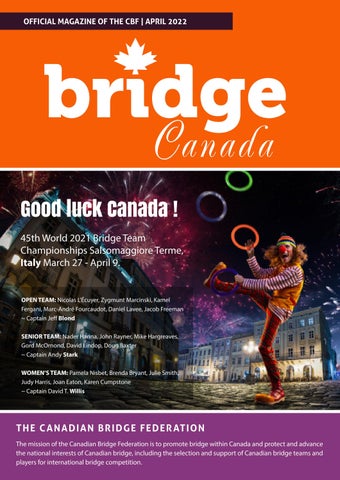
Good luck Canada ! 45th World 2021 Bridge Team Championships Salsomaggiore Terme, Italy March 27 - April 9.
OPEN TEAM: Nicolas L’Écuyer, Zygmunt Marcinski, Kamel Fergani, Marc-André Fourcaudot, Daniel Lavee, Jacob Freeman ~ Captain Jeff Blond SENIOR TEAM: Nader Hanna, John Rayner, Mike Hargreaves, Gord McOrnond, David Lindop, Doug Baxter ~ Captain Andy Stark WOMEN’S TEAM: Pamela Nisbet, Brenda Bryant, Julie Smith, Judy Harris, Joan Eaton, Karen Cumpstone ~ Captain David T. Willis
T H E C A N A D I A N B R I DG E F E D E R AT I O N The mission of the Canadian Bridge Federation is to promote bridge within Canada and protect and advance the national interests of Canadian bridge, including the selection and support of Canadian bridge teams and players for international bridge competition.
APRIL 2022 • VOL. 52 NO.2 IN THIS ISSUE 03.
15
Editors Message
03. Calendar of Events 05. President’s Message 06. 2020 IBPA Awards 09. The New Player Spot: Awaiting Developments by Andy Stark
16
09
12. Bridge Basics: Two Club Convention 15. Restricted Choices by Ed Zaluski 16. The Intermediate Spot: When to pre-empt by Neil Kimelman 18. The Expert Spot: What Went Wrong? by Paul Thurston 21. IBPA: The USBF Finals
10
15
MEMBERSHIP
Bridge Canada is available to members only.
23. The Great Canadian Bidding Contest 32. TGCBC June 2022 Problems
Stay CONNECTED EMAIL: ina@cbf.ca (Ina Demme) PHONE: 1 416 706 8550
If you know of anyone who wishes to become a member of the Canadian Bridge Federation please share with them these options: 1. Be sure to include CBF dues with your ACBL dues. 2. Visit cbf.ca and click Join The CBF. 3. Email info@cbf.ca for more information. NOTE: Starting Jan 2021, membership dues for players 25 years of age and under are $10 per year. When joining or renewing on the CBF website, use promo code JUNIOR to access the discount..
WEB: www.cbf.ca TWITCH: CanadaBridge YOUTUBE: Canadian Bridge Federation FB: Canadian.Bridge.Federation
MAGAZINE AD RATES Full page $ 250 | Half page $ 150 Quarter page $ 87.50 | Business Card $ 50 10% DISCOUNT if 3 issues paid in advance. PUBLISHED 6 TIMES A YEAR
2
Bridge Canada | www.cbf.ca
EDITOR’S MESSAGE What??? Part I Happy April fool’s Day! I hope you found some gentle humour: I mean we have to find something to make us smile. For me this happened recently, during my regular Thursday evening game. On the first hand I picked up NAK2 MAKQ1072 L- KAK92. As I was planning the approach for my bidding, my fairly straight-laced partner opened 2M!! I chatted, ‘Is it April’s Fools Day?’ No answer. I made the obvious 7M bid. Partner said when the bidding was over: ‘I hope you have good trump support?’ I modestly answered to the affirmative. Partner’s hand: NJ MJ96543 LK KQJ763.
What??? Part 2 A new feature will debut in the June issue of Bridge Canada, entitled What does this bid mean? As you may have guessed, unusual bidding sequences will be featured. Solving bidding problems not previously encountered is a practical way to learn some helpful principles in dealing with future, real-life examples of this ilk. Regardless of your level, having this tool in your toolkit is important for all players aspiring to improve their game. Let me know what you think, or if you have any other ideas for other Bridge Canada features.
Neil Kimelman Bridge Canada Managing Editor
Mollo ON PLAY XXI
Contract: 6M by South at IMPs. Lead: MQ, East discards L2. Plan the play. Show that the contract is assured on the assumption that West holds the club king. N M L K
6543 9862 AK AQ9
N M L K
AK8 AK7543 4 J65
Answer on page 08
CALENDAR OF EVENTS CNTC Open April 23/24 and Apr 30/May1 CNTC B Apr 30/May 1 CNTC C April 23/24 CWTC May 6/7 CMTC May 13/14 and May 20/21 CSTC May 28/29 COPC June 4/5 CIPC June 11/12
www.cbf.ca | Bridge Canada
3
CANADIAN BRIDGE FEDERATION
BOARD OF DIRECTORS
Q
Zone I & CBF President Kathie Macnab 5 Wren St. Halifax, NS B3M 2R1 902-443-4676 zone1@cbf.ca
Zone IV Freddie Myktyshyn zone4@cbf.ca
Zone II Vacant
Zone V Jerry Mamer 151 Nordstrom Road Saskatoon, SK S7K 6P9 306-668-3951 zone5@cbf.ca
Zone III Stephen Laufer 2065-85 Skymark Dr Toronto, ON M2H 3P2 416-729-8600 zone3@cbf.ca
Zone VI & CBF Vice-president Shelley Burns 1695 Orkney Place North Vancouver, BC V7H 2Z1 604-988-0990 zone6@cbf.ca
Q
SUPPORT TEAM
FRENCH EDITOR Francine Cimon wirek@videotron.ca
PRODUCTION EDITOR Jude Goodwin jude@cbf.ca
WEB ADMINISTRATION Louise Mascolo webmaster@cbf.ca
4
Bridge Canada | www.cbf.ca
CBF EXECUTIVE ASSISTANT Ina Demme 99 Ellis Avenue, Nobleton, Ontario L0G 1N0 ina@cbf.ca
Q
ACCOUNTING & FINANCE MANAGER Cathy Walsh accounting@cbf.ca
CBF CHARITABLE FOUNDATION Gim Ong 32 Sandusky Drive, Winnipeg, MB R3T 5W4 204-775-5114 charity@cbf.ca
Q
MANAGING EDITOR Neil Kimelman editor@cbf.ca
MESSAGE FROM THE PRESIDENT
KATHIE MACNAB I am proud to be the new president of the Canadian Bridge Federation. It appears that this pandemic has provided me with many new learning curves – and it is all exciting. The board of the CBF has gone through a lot of changes over the last two years. We suffered a tragic loss of our Zone 3 director, Susan Cooper. We have had more than one President serving over the last two years. And of course, we are trying to make our way through this pandemic. Trying to find ways to make the CBF visible over the last two years has been a challenge. There have been no specific games for the CBF. We have received our portion of online charity games but had not held many Face-2-Face games. We also have not been able to hold our Erin Berry nor Helen Shields Rookie/Master games. We attempted a CBF STaC but with so very few clubs able to play live, they were not a success. And no International Fund Canadian Regional. We have however, started our “Online Coast to Coast” pairs game. Held the THIRD SATURDAY of the month. We appreciate the ACBL for allowing the CBF to have a sanctioned club, hopefully we can use this more as time progresses. Come and play and meet your fellow Canadian players. We host two games one for 499ers beginning at 10:00 PDT/ 2:00 ADT and our OPEN event beginning at 10:15 on the west coast and 2:15 on the east coast. Our Canadian Championships which were originally scheduled for Saskatoon, Sask. have been moved to online play. At this time, I want to thank Jerry Mamer (Zone V) for all his time, energy, and expertise he gave to the CBF to arrange this event. Too many uncertainties caused the CBF Board of Directors to move the event to online. Planning this event has certainly presented us with many challenges.
Holding championship games online has also offered many challenges. Here are some changes. All the Canadian Championship Events – Canadian Open Teams, Canadian Women’s Teams, Canadian Senior’s Teams and the Canadian Mixed Teams, will be held online – using a new platform “RealBridge”. This platform is excellent for championship play as it offers audio/video as well as screens – just like Face-2-Face events. Our Canadian Championship Flights B & C along with our Canadian Open Pairs and Canadian IMP pairs will be held on BBO. We have directors for all the games and a schedule that runs April through June. This schedule is posted in Bridge Canada. Take a look, find your favourite partner, and come and play. I would also like to welcome to the CBF board our new directors, Freddie Mykytyshyn, Zone 4, and Mark LaCroix Zone 2. Our board is made up of many young and enthusiastic players. They have new ideas and are eager to have the face of the CBF out there. Currently we are working on CBF image and letting all Canadian players understand why they should be supporting Canadian Bridge. You can help us by encouraging all your Canadian bridge playing friends to join the CBF. We have a 3-month free campaign happening right now – but seriously it is only $20.00 per year. I want everyone to know that our board is open for your ideas, comments, and suggestions. Feel free to contact me anytime. Email: kmacnab@eastlink.ca www.cbf.ca | Bridge Canada
5
2020 IBPA Awards
Continued from February Issue
Yeh Bros. Best Bid Deal of the Year Winners: Michael Whibley/Matt Brown (New Zealand) Journalist: Brian Senior (England) & Geo Tislevoll (New Zealand) Event: 52nd Asia Pacific Bridge Championships, Singapore, June 11-20, 2019 New Zealand’s Michael Whibley and Matt Brown bid the following deal nicely, as originally reported by Geo Tislevoll; a nice way of combining their use of gadgets and common sense. Board 1. Dealer North. Neither Vul. N Q96 M 643 L 86 K AK643 N K3 M 872 L AQ542 K J109 N J10854 M J5 L 103 K Q875 West Whibley 3L1 4L3 4NT5 6L7
North Brown Pass Pass Pass Pass All Pass
N M L K
A72 AKQ109 KJ97 2
Winner: Christian Bakke (Denmark) Journalist: Geo Tislevoll (New Zealand) Event: 2019 Scandic Maritim Cup, Haugesund, Norway This deal is from a recent team event, the Scandic Maritim Cup in Haugesund, Norway. Dealer East. EW Vul.
East
South
1M 3NT2 4M4 5L6
Pass Pass Pass Pass
Bridge Canada | www.cbf.ca
Whibley and Brown found the excellent six-diamond spot, which does not depend on the hearts to come in and scored plus 920. Unfortunately, though, the hearts broke, so six hearts was a make, and their reward was to lose 2 IMPs!
Richard Freeman Junior Deal of the Year
1. Limit raise with three hearts 2. Shortage in clubs, slam try 3. Control 4. Willing to subside 5. Promising a spade control (as four spades would have been a key-card ask) 6. Control 7. Offer to play
6
Jan van den Hoek & Tom Reynolds The Alan Truscott Memorial Award Winners
N A1097652 M A92 L A6 KK N QJ43 M KJ764 L 3 K A86 N K M Q5 L 10842 K QJ10743 West Nesdal 1M
North Blake 4N
East Rekstad Pass All Pass
N8 M1083 LKQJ975 K952
South Ekren Pass
IBPA AWARDS … CONTINUED
East led the king of diamonds. The good news was that the trump king was still in dummy as an entry but, when Bakke won the first trick with the diamond ace and played the club king, West found the best defence by ducking. If West takes the king of clubs with the ace, declarer will be able to enter dummy to cash two club tricks. He will get two quick discards for red-suit losers before the fourth round of clubs puts pressure on West. If West ruffs in, he will lose one of his trump tricks. If he doesn’t, North’s last red-suit loser will disappear, so it would have been ten tricks either way. When West ducked the king of clubs, the loss of a club trick for the defence looked like a good exchange for three defensive red-suit winners. Together with two trump tricks, that would have set the contract two tricks. One for three is not bad, but it was not to be. Bakke saw that, to make the contract at that point, West must have no more diamonds and be the victim of an endplay. After the club king won the trick, Bakke played the spade five to the king. The club queen was covered by the ace and ruffed with the spade six. Without the carefully kept trump deuce an endplay might still work if West is not on the ball. After ruffing out the club ace, declarer plays the spade ace and another, and West gets two trump tricks with his queen-jack before he must lead away from his heart king (or play a club). The declarer gets an entry to dummy to enjoy the clubs for red-suit discards. However, West can make another sacrifice by unblocking big spades, giving up one of his two trump tricks. The defender wants to exit with the spade three to force declarer to play the rest from North with two heart losers and a diamond loser; one down. West’s giving up one of his trump tricks – one trick – gives the defenders three more tricks! But Bakke was prepared for such an unblock. The carefully kept trump deuce ensured that West had no move to beat the contract.
This was the position, if West had unblocked trumps: N 10972 M A92 L 6 KN Q3 M KJ764 L - K 8 N M Q5 L 108 K J1074
N M L K
1083 QJ97 9
North plays the trump ten; West wins and tries to exit with the three, but North follows with the two! As the play went, Bakke made 11 tricks by losing only two trump tricks. If, double-dummy, you saw at once that the spade two was the most important card on this deal, you are a very strong player. Bakke saw it at the table, only seeing the North and South cards. Don’t be surprised if you hear more of Christian Bakke in the coming years.
The Alan Truscott Memorial Award Jan van den Hoek & Tom Reynolds Jan van den Hoek Jan van den Hoek is a bridge aficionado and lawyer who had already built a name for himself in the Netherlands (and Europe) in bridge. The first Alt tournament was conceived as a replacement for the cancelled Vanderbilt Trophy at the Columbus NABCs in March 2020. With the help of Sjoert Brink, the event turned out to be very popular and many more tournaments followed, with Daily Bulletins edited by Christina Lund Madsen.
A lady who travels the world and hasn’t played any duplicate in the U.S and is carrying around all kinds of foreign currency, makes an illegal comment during the bidding and the director fines her 3 IMPs. She says: “O.K, but what’s the conversion rate?”
www.cbf.ca | Bridge Canada
7
IBPA AWARDS … CONTINUED
Tom Reynolds I describe myself as a “really good bridge player for someone who really doesn’t play the game.” I was life Master 10,718 in 1969 but took multiple years completely off and multiple years where I played very little. Yes, life got in the way but, playing a full regional, much less a full national, is not something I enjoy. I really only care about playing teams against the best, so you will see me at the USBF Trials, the Spingold or the Vanderbilt but not much at a matchpoint event.
ON PLAY XXI Problem on page 3.
Contract: 6M by South at IMPs. Lead: MQ, East discards L2. Plan the play. Show that the contract is assured on the assumption that West holds the club king.
Other Winners
The IBPA Personality of the Year: The Rimstedt Family – Sandra, Cecilia, Mikael & Ola, with a nod to parents Magnus & Ann (Sweden)
N M L K
The Master Point Press Book of the Year: Kim Frazer, Gaining the Mental Edge at Bridge
Next issue: 2021 IBPA Winners
greatbridgelinks.com Linking you to Bridge on the Net News • Interviews • Articles
Gifts & Bridge Supplies giftsforcardplayers.com ONLINE SINCE 1995
8
Mollo
Bridge Canada | www.cbf.ca
N M L K
6543 9862 AK AQ9
Q 10 7 2 Q J 10 Q 10 8 K 7 2 N M L K
N J 9 M L J 9 7 6 5 3 2 K 10 8 4 3
AK8 AK7543 4 J65
Declarer should win the MAK, unblocking in dummy and play top diamonds, discarding a spade. (If West ruffs a diamond, either a) if West started with four or more spades he will be squeezed in the black suits, b) if East started with four spades along with their nine diamonds, the club nine will take a trick, or c) declarer can establish the long spade for their 12th trick. Next, cash the NAK. If West ruffs they are endplayed. If West follows or discards, he is thrown with their trump trick. If West has no spades they are endplayed. If West can lead a spade, this will set up a trick in dummy unless (see diagram) West started with four or more spades. In this case, declarer finishes playing trumps, squeezing West positionally in the black suits.
by Andy Stark
Awaiting Developments I’ve discovered a few proverbial chinks in the armour of my bridge students. These gaps are specifically to do with responding to partner’s one-level opening bid. Let’s see where you draw the line between a 1NT response and bidding a new suit (nonjump) at the two-level. For example, let’s say partner has opened the bidding with 1N. Which of the following hands do you think are 1NT responses and which are 2K responses? 1.
N M L K
J3 J108 965 AQJ97
2.
N M L K
3 J108 Q965 AJ976
THE
NEW PLAYER
Spot
www.cbf.ca | Bridge Canada
9
AWAITING DEVELOPMENTS … CONTINUED
3.
4.
N M L K
J3 108 Q96 AJ9765
N M L K
3 108 965 KQ97643
Before I reveal how I think you should respond with each hand above, let me clarify that these students all play Standard American, not 2 over 1. If you happen to play 2/1 then you will be bidding 1NT with all of the hands because a bid of 2K is game-forcing, and none of these hands can force to game.
Opener Responder 1N 1NT 2M 3K Let’s review: Opener has shown a hand with 5 or more spades and 4 or more hearts with 12-18 points at the most. They were not good enough to jump to 3M so they won’t have a maximum strength hand of 19-21 points. Responder has shown a hand with 6-9 points, no fit for either major, and at least six clubs. The conversation might be transribed as follows: Opener: I have five or more spades and enough to open.
Oh, one more stall. Let’s review, shall we? A 1NT response shows 6-9 HCPs while a two-level response shows 10+ HCPs. Sometimes you can shade towards the more aggressive call with a 9-count but you will have something special about your hand, say perhaps a 6-card suit headed by the AKQ or AKJ10. Other than that, and here is my last clue—if you hold 5, 6, 7, 8 or 9 high card points, just respond with 1NT. That’s it. That’s the lesson. Therefore, all of the above hands are 1NT responses!
Responder: I have enough to respond but not enough to go to the 2-level. Also I can’t support your spades.
Believe it or not, but my students respond 2K with each and every one of the above hands, and that is a stretch each and every time.
Responder: Don’t worry, I have a lot of clubs.
Now, it could be because we have been conditioned to think that a 1NT bid must be balanced, so right away Hands 2 and 4 do not qualify for 1NT. Or maybe new players are worried they will never be able to show their 5-card or 6-card or 7-card suit unless they bid at their first turn to call. That’s fine, but partner will expect a better hand. Best is to start with 1NT, and then, as Goren used to write, “await developments.” Oftentimes you will get a chance to show your long suit and in the case of Hand 4 you will show your clubs for your rebid.
10
The auction will go like this:
Bridge Canada | www.cbf.ca
Opener: I have four or more hearts and a minimum or medium strength hand. Responder: I have clubs! Opener: But now we’re at the 3-level! I might not have any.
Opener: I hope you have Hand 4 in the example hands above. Responder: You just broke the fourth wall. Opener: That’s okay. Just don’t go down. I pass. And that is one sweet, disciplined auction. It’s tough for opener to pass here, but it’s the right thing to do. Responder heard everything opener was saying and still decided to show introduce their clubs at the 3-level. So definitely the auction above would fit Hand 4 above.
AWAITING DEVELOPMENTS … CONTINUED
Another way to look at this auction is to ask yourself this question: whose hand will be a better dummy for partner? Will your hand be a good dummy for partner in spades or hearts? Most assuredly it will not. But your partner’s hand, the hand with 13-18 points, should be a much better dummy for your hand. Let’s look at the full deal: N KJ1076 M KQ72 L KJ3 K J N A982 M J93 L Q1074 K A2 N 3 M 108 L 965 K KQ97643
N Q54 M A654 L A82 K 1085
If you could conjure up a sequence to play this hand in 2K you would, but you cannot. So we’ll just have to take our chances in 3K. Good defence should see it go down one, but if the defence slips up you will make nine tricks with clubs as trump. (For example, say they lead a low diamond; play low from dummy and you will either force the ace or you’ll win with the L9. Now you’re gin. You’ll lose one trick in each suit.) Observe how poorly a spade or heart or notrump contract plays out. For starters, partner will probably never win a trick with a card in your hand. Partner will constantly be playing out of their own hand. Bottom line: as Responder, don’t overstate your values. The 1NT call is a catchall for all the bids you cannot make. Start with it first whenever you have 6-9 points and … await developments.
On sale only
$50
905.727.2300 1.800.463.9815 vinceoddy.com www.cbf.ca | Bridge Canada
11
BRIDGE BASICS TWO CLUB CONVENTION We continue our look at Conventions that are used when your side opens 2K. Some of these agreements are widely used, some are not. But they are here for you and your partner to be aware of, and decide if they are for you.
3. When 4th hand intervenes. Let’s say that the bidding starts 2K-Pass-2L - .
WHEN THE OPPONENTS INTERVENE
• If RHO overcalls: » Double – Balanced hand, no stopper in bid suit. » New suit – one or two suiter. » 2NT – Balanced 22-24 with stopper. » Pass – Either wants to penalize, or shows a three suiter. Responder is forced to reopen with a double. The strong hand will either pass or bid the cheapest of their three suits.
It is important to have agreements when the distribution or vulnerability allows the opponents to disrupt your communication. Here is a fairly easy and comprehensive system: 1. After the opponents double. • Pass shows a weak hand, less than 3 HCPs. After a pass, opener can bid a new suit (one round force), 2NT (passable), redouble to play, or bid 3K asking partner to bid 3NT with a club stopper. • Redouble shows 4+ HCPs and is game forcing. 2. After the opponents overcall. • Double is positive (as redouble above). • Pass is weakest hand, as above in #1. • New suit shows 5+ cards, 2 of the top 3 honours.
12
This is the 22nd article in a New Player Bridge Canada series. Some of these concepts may be a review for you, but this series will also cover more advanced techniques and ideas.
Bridge Canada | www.cbf.ca
• If RHO doubles, then redouble is to play, and all other bids retain their normal meanings.
RAISING AGREEMENTS A two club leaves less room to investigate fits and controls, so It is important to have clear agreements in a couple of specific areas: Splinters – If you have a fit and shortness it is almost always right to splinter. Therefore a simple raise usually denies shortness. Game level raises – when a suit is raised at the game level it is natural and not necessarily a sign off. In fact it is best played forcing in most auctions.
BRIDGE BASICS … CONTINUED Example 1: 2K 2N 4M
2L 3M
This is a natural auction, and is forcing. Responder has shown a long heart suit and opener has set hearts as trumps. Responder should now show their lowest 1st or 2nd round control. SHOWING A FOUR CARD MAJOR Differentiating between a four and five card major can be difficult, especially when it is a 2nd suit. One helpful Convention is when your 2K opener includes a long diamond suit, with four card major. After a 2K-2L start: • 3M shows four hearts and longer diamonds. • 3N shows four spades and longer diamonds. Here is another useful treatment, in a common two club auction: Example 2: 2K 2L1 3K2 1. Artificial, any strength. 2. Natural Both opener and responder may have a four card major. A good treatment is that 3L by responder is artificial, implying at least one four card major. Now the strong hand can show a four card major at a convenient level.
Example 3: 2K 2L1 2N 3N2 3NT3 1. Waiting. 2. Natural raise, stronger than 4N. 3. Trump Asking Bid Responses are: 1st step: Minimum length*, no high honour. 2nd step: Minimum length, one high honour. 3rd step: Extra length no high honour. 4th step: Extra length and one high honour. 5th step: Two of the top three trumps. 6th step: All three top honours. *Unless otherwise agreed, the two clubber is assumed to have five cards in their first suit, and four in their second one. CAB – Control Asking Bid is used after trumps have been agreed, as a way for the strong hand to find out if a suit is controlled. Example 4: 2K 2L1 2N 3N 4K2 1. Waiting. 2. CAB in clubs.
Three common ones are TAB, SAB and CAB (No, not soft drinks or transportation).
Responses are: 1st step: no first round control. 2nd step: 2nd round control, king or singleton. 3rd step: 1st round control, ace or void. 4th step: Total control. AK or singleton ace. 2nd step: 2nd round control, king or singleton. 3rd step: 1st round control, ace or void. 4th step: Total control. AK or A.
TAB – Trump Asking Bid is a specialized request for a description of responder’s trump support. When a suit is bid and raised, the minimum notrump is TAB. It can also be used when the strong hand is agreeing trumps.
A repeat CAB in a suit asks for 3rd round control: 1st step: No. 2nd step: Yes, either the queen or a doubleton in the CAB suit.
ASKING BIDS
www.cbf.ca | Bridge Canada
13
BRIDGE BASICS … CONTINUED
SAB – Support asking bid is the least used of the three, asking responder to show their support for opener’s independent suit. A jump in a suit is SAB. After a negative response (responder holding at most xx in SAB suit) a new suit is also SAB. After a positive response, a new suit is CAB. Example 5: 2K 2L1 3N2 1. Waiting. 2. SAB in spades.
QUIZ INTERMEDIATE DECLARER PLAY ANSWER ON PAGE 22 Contract: 4 M IMPs. West leads: M3, East follows. N 654 M KQJ9 L A K J K K63
Responses are: 1st step: x or void. 2nd step: xx. 3rd step: xxx(x). 4th step: H or Hx 5th step: Hxx(x). 6th step: HH(x)
N M L K
A K 10 A8742 95 J52
Plan the play.
Example 6: Let’s say the two hands are NAKQ10xx MA LAKJ10xx K and Nx M10xxx LQ9 Kxxxxxx. The suggested bidding: 2K 2L1 3N2 3NT3 4L4 5K2 7L 1. Waiting 2. SAB in spades. 3. Void or singleton. 4. SAB in diamonds. 5. Singleton queen or Qx in diamonds. When you are right, you’re right? Next issue: 2L openers. Patrick Jourdain, a famous bridge player-teacher from Wales is called over to a table at one of his classes where a hand has just passed out, but 4th hand had 17 high card points. “So why did you pass?” asks Patrick. “Because you told us after three passes the bidding is over, so I had to pass.”
14
Bridge Canada | www.cbf.ca
Restricted Choices By Ed Zaluski
In a recent match point game, a contract of 6K was reached on the hands and auction shown below.
N M L K
AK A742 Q63 KJ94
N M L K
Q98 3 AJ1072 A1082
West North East South Pass 1L Pass 1M Pass 2K Pass 2N1 Pass 2NT2 Pass 4K3 Pass 4N4 Pass 6K All Pass 1. Fourth suit forcing. 2. Stopper in spades, and therefore likely a singleton heart. 3. Jump to 4K is Minorwood, asking for key cards with clubs trump. 4. Three steps shows two key cards but no trump queen. West leads a low heart and you win the Ace. If you decide to immediately pull trump, which opponent do you play to hold the KQ? Make a decision before reading on. If you decide to take the diamond finesse first by leading and passing the Queen, it wins. Thinking back to an early lesson on opening leads, you remember that a trump lead was suggested whenever the opponents had bid two suits but decide to play in a third suit as trumps (as in this case). The theory is that, when the opponents reject playing in a notrump
contract and they cannot support each other’s first-bid suit, then they usually have distributional hands that need to make tricks by ruffs. Leading trumps in this situation is often best. Does this help you decide? Well, it should. What is at work on this hand is another application of the “Theory of Restricted Choice.” This means that finessing West for the trump Queen is much better than finessing East because West, with small cards in clubs and following the advice stated above, could have but decided not to lead a trump. Of course, a trump lead would not be forthcoming if West was holding the Queen! Therefore, in my opinion, finessing West for the Queen has much better than a fifty percent chance to succeed. Should you have chosen to finesse the Queen of diamonds followed by a second finesse before pulling trump, West will win the King and give his or her partner a ruff to defeat your contract. Finessing West for the Queen of clubs wins, and 6K succeeds, losing only one trick to the King of diamonds. The hands were as shown below: N AK M A742 L Q63 K KJ94 N 1043 M KJ85 L K95 K Q53 N Q98 M 3 L AJ1072 K A1082
N M L K
J7652 Q1096 84 76
www.cbf.ca | Bridge Canada
15
BIDDING STRATEGIES 7 When to Pre-empt By Neil Kimelman
Question: When to Preempt? Answer: When it is right!! Sometimes it feels like that. You preempt and then fate intervenes. Sometimes your preempts hurt, and sometimes they garner a good score. Maybe the opponents have a bidding misunderstanding, get to a bad contract, but it makes when three finesses work! More likely, the opponents get to a normal contract, but the preempt helps them guess who is more likely to hold the queen of trump. On the flip side it is not unknown that, after our side has preempted, the opponents end up in 3L when 6M is cold!! Preempting is definitely a double edged sword. However when judgement is used, and partnership agreements are followed, the odds of being on more positive outcomes is greatly improved.
THE
REASONS TO PREEMPT
INTERMEDIATE
Spot
1. Preempts use up the opponents’ bidding room. After you open 2N, let’s say LHO has a marginal opening bid with five hearts. Should they overcall? Does LHO’s partner have a fit or a misfit? Do they have points? Are they going for 800 if they bid, or if they pass, missing a game or slam? 2. You find a profitable sacrifice. A big fit, even with few high card cards, can result in finding a profitable sacrifice at the five, six or even seven
16
Bridge Canada | www.cbf.ca
BIDDING STRATEGIES … CONTINUED level! Once you do, then it is the opponents’ turn to guess what to do! 3. Normal conventions do not come into play. The opponents may have great conventions to investigate whether to bid game or slam when they open at the one level. But if you preempt, they cannot used these agreements. 4. You describe your hand in one bid. Partner will know if you have a fit or misfit, who likely has game or slam, and whether to enter the auction. As the hand in the Editor’s Message, the preemptor’s partner knew exactly what to do over partner’s 2M opener! 5. You stay out of trouble. If partner has an opening bid, but shortness in your suit, after your preempt they know to stay out of the bidding. Whereas had you not bid, they may have overcalled and gotten into trouble. 6. Partner can penalize the opponents. This happens frequently, and is a very important consideration. In #1 point above, imagine that LHO does overcall 3M and partner holds Nx MKJ108 LKJ96 KAK73. Double!! 7. If defending, partner will have a much better idea as what to lead and how to defend. They will avoid leading from an honour, lead your suit when they wouldn’t normally, or even lead an ace from Axxxxx, trying to give you a ruff or two.
Example 1: You hold as South NK7 MK72 LAQ83 KAQJ4. Both vul, the bidding starts: West 3M Pass
North Pass 3NT 6L
East Pass Pass Pass
South 1L 4NT ?
You only invite with 4NT, as you know from the last articles in this series, that partner may have a little more of or a little less than an opening bid, as the preempt has caused problems. Do you pass? Without opposition bidding, sure. But here you need to consider that East may be void in hearts. You know partner has to have the MA as they would not have accepted your slam try without it. Bid 6NT. The full deal: N Q102 M A106 L K10975 K K3 N A63 M QJ98543 L 4 K 52 N KJ M K72 L AQ83 K AQJ4
N M L K
98754 J62 109876
RISKS OF PREEMPTING 1. You can get doubled for a bad score. This is definitely possible, but often the opponents don’t have enough information to do so. The other dynamic is that if you preempt at favourable vulnerability, the opponents, if faced with a choice of penalizing or bidding 3NT, will chose the latter, as +600 will usually be better than down 2 or 3, for +300 or +500. 2. The opponents can more accurately bid. Preempting gives the opponents a lot of information. They can profit from that in the bidding. They know your hand will have few high card points outside of your suit, and some suits will likely split poorly. Here is a hand that came up during an online game:
At the table, South passed. A heart lead meant -200 instead of +1370. 3. Play of the hand. This is probably the most important consideration. When you make a bid that closely defines your hand, your declaring opponent will greatly benefit from that information. This is also true when you open 1NT. The big difference is that when you preempt you will be defending the majority of the time. Next issue: Rules to guide your decision to preempt.
www.cbf.ca | Bridge Canada
17
What Went Wrong? by Paul Thurston A brief study of the layout of our first deal will show that South’s heart game is slated to go down one with the loss of one spade trick, two diamonds and the heart ace. As it happened, the defense managed to take only three of those tricks so declarer escaped with his game bonus. WHAT WENT WRONG? Dealer: North. Both vulnerable. N Q1075 M KJ65 L A74 K A6 N KJ9 N 843 M 7 M A84 L KQ102 L 986 K 108732 K Q954 N A62 M Q10932 L J53 K KJ
THE
EXPERT
Spot
18
Bridge Canada | www.cbf.ca
West Pass All Pass
North 1L 2M
East Pass Pass
South 1M 4M
Lead: 7M West’s choice for an opening lead wouldn’t get a majority vote from any panel on the topic but wasn’t totally unreasonable (my vote: the eight of clubs, second-best of a poor suit). East let the lead slide round to declarer who promptly played back another heart
WHAT WENT WRONG … CONTINUED to the Jack and ace. Wouldn’t it be nice if a bell went off at the precise juncture in the play where a defender needs to make the contract-deciding play? Not this time as East gave the matter very cursory thought before returning his third heart. That passive approach to the defense gave South time to work on spades and eventually set up a long card in the suit for a diamond discard from the closed hand and that was how four defensive winners got reduced to three. What was wrong with East’s thinking? Dummy showed up with weaker diamonds than might have been expected for the opening bid as well as longer and stronger spades that could easily be perceived as a possible source of tricks and/or discards for declarer. And what might South need to discard? Very likely diamonds if anything. Again from the look of dummy and East’s diamond holding, it shouldn’t have been overly difficult to conceive that West’s possible diamond holding sitting over declarer’s would need to be led to instead of away from and the heart ace was East’s one and only chance to take an active role in the defense. So What Went Wrong here was East’s persistent passive approach to the defense when he might have done something about helping his partner’s hand. And just for the record: West did the best he could (after that doubtful opening lead) to help out when he discarded a negative attitude club (“nothing good in this suit over here partner”) on the second round of hearts. Dynamic slams, wild distributions and vigorous exchanges of competitive bidding may get a lot of the headlines but the trench warfare of part scores will always make up a lot of score differences in tight matches.
HAND 2 The second deal for this instalment also features a misdefense that allowed declarer to escape with a plus rather than the minus he should have incurred: 5 IMPs to the team that defended more effectively.
Dealer: East. Both vulnerable. N 7 M K108 L 1083 K J98652 N Q642 N J3 M 742 M AQ953 L K75 L QJ92 K K73 K Q10 N AK10985 M J6 L A64 K A4 West North East 1M 2M Pass Pass All Pass
South 1N 2N
Lead:??? Again you can have the benefit of viewing the entire layout before proceeding and will no doubt have come to the conclusion that South should lose one spade, two hearts, two diamonds and one club for down one but the record from one table in an International match showed South had made his eight-trick partial. WHAT WENT WRONG? The defense started in orthodox fashion as West chose to lead the suit his side had bid and raised but the choice of cards was doubtful: the deuce of hearts. Thinking that partner’s lead (in conjunction with the bidding) showed possession of the heart Jack, East gently covered dummy’s play of the eight with his nine and a very surprised South won his eighth trick right away! Why the nine? East could see that the dummy posed no real threat but that there could be a benefit to West being able to make further heart leads through the dummy without the peril of possibly setting up a heart winner that would stall subsequent heart plays. And if West started with the heart Jack, what harm could the play of the nine possibly do? Just so! But no matter what card – high, low or middle – a partnership agrees www.cbf.ca | Bridge Canada
19
WHAT WENT WRONG … CONTINUED to lead from three small cards, there should be adjustments made when a suit has been bid by the non-leader. For most, those adjustments would focus on the leader’s holding and whether he has raised his partner’s suit or not. If the leader has not raised his partner’s suit, then count information will likely be most critical to third hand to make a low lead from three small cards the superior choice. And when the leader has raised (as in this auction), the count of the suit will already be known (at least within one card – three or four cards being shown by the raise) so that the leader’s possible possession of an honour in the suit being led will be of more use. From East’s perspective, that opening lead of the heart deuce didn’t just suggest West possessed the heart Jack, it incontrovertibly guaranteed it. With the lead of the heart seven, East would play the Queen and that would be that for South’s possibility of a plus score.
HAND 3 Time for yet another bout of system soap-boxing as we see how two expert pairs in an online match (mis)managed the following North-South hands mainly due to having a convention available that they would have been better off leaving on a shelf somewhere. N M L K
J2 Q742 Q5 Q9642
N M L K
AQ103 KJ108 A A1085
Table One Table Two North South North South 1K 1K 3K 4K 3K 3L Pass 3M 3N 4K 5K In both cases, North’s response was an “Inverted Raise” showing five-plus clubs and a weak hand, apparently without reference to holding or not holding a four-card major. Maybe a reader can help me out here but I always thought that any weak minor raise would deny four cards in a major as the priority in game bidding is often suggested as major, notrump and minor in that order. In the case at hand, both North-South pairs missed their 4-4 heart fit 20
Bridge Canada | www.cbf.ca
and what I believe went wrong is they both chose to play with the Inverted Minor toy when they probably shouldn’t have. In the first auction, whatever South thought his 4K rebid meant (presumably invitational?), North didn’t assess his collection of quacks as worthy of any more bidding – and he might have been right. The second South simply put the bidding bit in place after the preemptive raise and whatever 3M meant (third-round control?), didn’t stop bidding until game was reached. This time clubs played for one loser, the NK was onside and no heart ruff was arranged by the defense (it might have been!) so five clubs escaped unscathed. But WHAT WENT WRONG in both cases was relatively serious: the very playable heart game was missed and would have been bid quite effortlessly after the natural one heart response by North. That’s one of the serious drawbacks with the adoption of certain conventions that get misused and/or abused when a perfectly ordinary natural call would be more effective. My lack of affection for Inverted Minors goes back a long way into the previous century when, against my better judgment, I had agreed to play that conventional treatment with a favourite partner. And during the late deals of a CNTC final, I picked up N96 M1042 L AQ752 K Q106. Partner opened 1L – over to this hand for a response? 2L? No, that shows at least a limit raise and invites game. 3L? No, that’s a weak and preemptive raise. The long and short of it: no immediate diamond raise is appropriate when playing Inverted Minors even though the Responder’s hand does seem to be all about diamonds! What to bid? As I expect most I.M. Partnerships would do, I responded 1NT to show 6-10 hcp with no 4-card Major. Raised briskly to 3NT by partner who tabled a very nice dummy; NK5 MAQ6 LK10863 KAK8. The opening lead of the Queen of spades was very bad news and so was the defense taking the first six spade tricks for down two. The other table: not saddled with the Inverted Minor encumbrance, South responded 2L (natural and limited to about 6-9 HCP) and North rebid 3NT and took the first ten tricks after a heart lead. Of course, there might have been other deals to make up the eventual 4 IMP deficit but the 13 turned over here did seem like a self-inflicted wound- and convinced me once again that I wouldn’t want to start any explanation to teammates of “WHAT WENT WRONG” with: “... well, we play Inverted Minors … “!
THE IBPA FILES The International Bridge Press Association (IBPA) is a world-wide bridge organization of more than 300 members in all corners of the world. Its main objective is to assist bridge journalists in their bridge related professional activities. The IBPA publishes a monthly online Bulletin, which consists of interesting deals involving some of the best players of the world, competing in key international tournaments.
USBF OPEN TEAM TRIALS 3 John Carruthers, Kingsville, ON Suzi Subeck, Chicago, Ill.
Editor’s note: Over the next few issues we will feature hands from the 2021 USBF Team trials, the good and the bad. Day 5 - RR2B – Match 13. NICKELL vs. SPECTOR There were some wild goings-on in this match, the second round-robin match of the second Round Robin (Phase 2). Confused? Me too. Remember, there were 12 teams in Round Robin 2. Those teams played a double round robin, so this is the second time NICKELL and SOECTOR met in the second round robin. With that sorted… N 62 M A943 L QJ1032 K 65 N J3 M 10 L A9654 K A8432 N AK975 M 875 L K KJ1097 West Kranyak — Pass Pass Double Double
North Levin — 1NT 3L 3N Pass
East Wolpert — 2M Pass Pass Pass
N Q1084 M KQJ62 L K87 KQ
South Weinstein 1N 2NT1 Pass Pass Pass
Prudence is a word seldom used to describe top-level bridge today… 1.A wish to bid, with fewer values than a direct suit-bid would have shown. www.cbf.ca | Bridge Canada
21
IBPA FILES … CONTINUED One could argue that all four players made at least one bid that was indiscreet. Kranyak led the ten of hearts. Weinstein won and led a club, queen, king, ace. West continued with the eight of clubs so that Wolpert could ruff and cash his high hearts. On the fourth round of the suit, Weinstein ruffed with the ace of spades and led the king and another for two down, minus 500. That was much better than three diamonds doubled would have been.
QUIZ INTERMEDIATE DECLARER PLAY PROBLEM ON PAGE 14 Contract: 4 M IMPs. West leads: M3, East follows.
West Hampson — 2NT1 Pass Pass
North Bathurst — Pass Double
East Greco — 3L Pass
South Hurd 1N Pass Pass
N M L K
Q10 6 8 -
On the last heart, Greco threw his club loser; Bathurst ruffed and led the jack of diamonds, making just one more trump trick for one off, minus 100. That, however, was good enough for a 12-IMP gain when added to the 500 at the other table.
Bridge Canada | www.cbf.ca
N M L K
Q 7 3 2 10 5 3 10 3 2 Q 10 8
Hampson was luckier than Weinstein had been, not running into the misfit. Hurd led two high spades and shifted to a heart. Bathurst won with his ace and played a club. Greco won and ruffed a club, cashed one hearts for a club pitch and ruffed the jack of hearts. When he led a trump from the dummy, Bathurst split his honours, so Greco won with the king and led a the queen of hearts for another club pitch, then led the fifth heart in this position, having lost just three tricks and with North reduced to trumps:
22
654 KQJ9 A K J K63 N J98 M 6 L Q8764 KA 9 7 4
1.Minors
N M L J1032 K N - M - L A96 K 8 N 97 M L K J10
N M L K
N M L K
A K 10 A8742 95 J52
Plan the play. This is a simple one. The key is realizing that you can afford two club losers, and that you will always get one club trick if you can get the opponents to lead that suit. Pull trump, cash the top diamonds and ruff a diamond, and now cash two spades and concede a spade. West can win and lead a club, but you duck. If they lead the KQ cover with the king. Easy.
Dummy apologizing for getting the partnership too high says: “I was hoping you had a second suit.” Their partner says: “I didn’t even have a first suit”.
the APRIL 2022 TGCBC
Host: David Willis For Panelists, see page
Editor: Despite it being a tough set for most panelists, Nick L’Ecuyer scored 50, followed by David Grainger with 44. On the panelist side Ashot Harutyunyan scored back to back highs with 47 this month. Also congrats to David Johnson for his April score of 43. Ashot walks away with $100 with the top combined February/April totals. Sheldon Spier was 2nd and will get $50 in mad money! The June TGCBC problems can be found after this article. Join in the fun and enter your bids by May 10th. Willis: A few themes in this month’s problems: trouble with clubs, “what does double mean?” and is this a pinochle deck? Some of our panelists really liked this month’s problems: Good probs! Great for partnership discussion; Thanks for doing this - very enjoyable; Willis’s problems have given me a headache; while others did not: “No offence, but I am not keen on some of the hands”, “With this set, my questions far outnumber my answers”. Just goes to show you can’t please all the people even some of the time. Now onto the problems. 1. IMPs, N-S vul, East deals. South holds: NQJ96 M 5LAK975 KQ43 West
North 1NT 2K
East 1N 3N
South Pass ?
Action 5K 4N 4K 4L Pass 3NT Dbl
Votes 6 2 4 1 1 0 4
Score 10 9 8 7 6 2 1
A not atypical auction at unfavourable vulnerability. Already at the four level, possibly with the best high card hand, and having to figure out what to do. Most but not all avoided the trap of double or 3NT recognizing the possible side heart fit for the opponents or a diamond fit for our side that was likely to be a problem. Steve Mackay: 4K. If I bid 3NT, west may know to lead a heart. Nick L’Ecuyer: 5K. Probably a little crazy but West might bid 4M if I do something else and it looks like they have a pretty good heart fit – I am hoping partner has a stiff spade and somewhat of a decent overcall. I am not even sure we are beating 3N or 4M. Stephen Cooper: Double. Take the sure (?) plus. Lots of bidding. Must be based on shape. Tempted to try 3NT, but hearts are wide open, and they will have time to switch if it’s right. Don’t typically double when they have jumped to show strength…
What do you bid? Bob Kuz: Double. If/when my LHO bids 4M and partner does not dbl. I bid 5K hoping for -1. (Willis: Surviving the runout but not the passout)
www.cbf.ca | Bridge Canada
23
Neil Kimelman (with Hornby): Double. Seems clear. We might have a game or slam in clubs, as partner will likely have their bid, at these colours. I suspect West has very little. Having said that, if partner’s secondary length is in diamonds, they could make 3N.
While others are trying for slam:
We can give the floor to Ron Bishop who covers most of the possibilities for bidding:
A couple of the slammers mention 4L as a possibility.
Ron Bishop: 4K. We seem to be playing with a ‘pinochle’ deck. RHO should be truly inviting game (some 14+ count with AK10xxxx is as likely as anything else; as only maniacs jump on AK10xxx suits when the auction smells of a misfit). So our pts plus declarer’s plus some (5-7 min.) for the dummy and there is not much left for partner except for their suit. If we were to hit 3N (penalties); we would be ‘happy’ (??) if it went all pass…that is, of course, until it made. Or if LHO ‘pulls’ to their mystery 7-card heart suit which is passed back to our seat. What would we do then? Defend; defend doubled; or pull unilaterally? A good ‘guesstimate’ of what partner has is 1-3-3-6 on the order of x K10x xxx AJ109xx. A club part score is in our future! 3NT? If LHO can lead a spade and club is on, we will do fine…but if LHO can’t (or chooses not to) lead a spade and tries a heart instead (Ed: or leads a N and then a M switch occurs) what then? The majority choose to support clubs in some way. Some go low: Francine Cimon (With MacKay): 4K. A lot of bidding. I try to figure what East and North have… The suits should break very badly. Others go medium: Paul Thurston: 5K – a vulnerable game (if it makes) is better than 3N doubled -1 (if it even goes down). David Turner (with Smith, Todd, Lindop): 5K. Tough situation. Doesn’t sound like partner has many spades nor righty many clubs, so it all comes down to partner’s red suits, and I’ve no good way to find out what they are like. 24
Bridge Canada | www.cbf.ca
Keith Balcombe (with Miles): 4N. We are going to game baby! If partner has a spade void, we are going to slam baby!
Bill Treble (with support from Lindop, Miles): 4L. Since I haven’t overcalled or pre-empted diamonds at my previous turn, this should be a diamond control with club support. Finally, another conservative but possibly winning outlier: Andy Stark: Pass. I’ll double 4N if they get there but I’d rather defend 3N than 4M which a double might help them discover. After reading all of the comments 5K was awarded the highest score as most recognized the possibility of game and the need to block hearts out. 4N was similarly awarded a higher score than 4L which gives room for hearts to be bid and tells the opponents when to double. The full hand: N 7 M Q7 L J1086 K AKJ962 N 3 M AJ10842 L Q42 K 1087 N QJ96 M 5 L AK975 K Q43
N M L K
AK108542 K963 3 5
Double, penalty, was the choice at the table which was not a success with the not unexpected side heart fit coming into play which also made 3NT a big loss. 5K was slated to be down 1 due to the poor break in diamonds but would make on many layouts.
the
Doubling but anticipating the risk:
2. IMPs, Neither vul, West deals. South holds NK1093 M- LJ103 KAKQJ98. West North 1 2L Pass 1. Weak in a major. 2. Pass or correct.
East 3M2
South ?
Votes 6 11 1 0
David Lindop: Double. Partner is aware I’m likely doubling based on heart shortness and hopefully won’t choose to defend with a weak heart holding. Another doubler who has a sneaking admiration for another of our panelists’ choices:
What bid do you make? Action 4K Dbl 3N Pass
David Turner (with support from Treble): Double. Obviously I’m hoping for a 3NT bid from partner rather than a pass.
Score 10 6 4 2
First an apology from the host for not indicating which multi-defense would apply and the double of 3M could safely be assumed to be takeout. Most panelists assumed this and moved forward with the problem. The crux of this problem comes down to your approach or philosophy to doubling with voids and looking after your partner. We know that East typically has a hand that is at least 3-3 or better in the majors but not enough to try for game. It is either a competitive part score or our hand for game. Most settle for the takeout double that seems to be under their nose: Keith Balcombe (with Todd, Hornby, Stark, Treble, Cooper): Double. Heart double à emporter (takeout), n’est-ce pas (right?)? Ron Bishop: Double. Our problem is ‘attempting’ to find a spade fit (when our partner is 5-3 in S/H without the proper hand to overcall 2N) without overextending ourselves when he doesn’t. Overcalling 4K would offer some safety, but will it help us to find spades; or get us to 5K? But, since we are willing to ‘pull’ a takeout of 4L on to 5K, then we might as well double.
Danny Miles: Double. Another deal thrown in the Bingo Ball Machine with anyone’s guess what comes out. We could have them nailed, or we could defend their 9 card fit with a big fit of our own. Not willing to bypass 3NT or let them off the hook should partner hold strong hearts. Curious to see if there are any 3N bidders out there – no, I’m not related to Marshall Miles (I don’t think!) Julie Smith: 3N. Hoping to hear 3NT from partner. Finally lets here from those that bid what is in front of their noses: Francine Cimon: 4K. East shows the 2 majors, but we still can have a very good fit in spades, so I hesitate to double. I f I double, and partner pass I don’t have so much defence. My hand is really clubs. Paul Thurston (with Mackay, Kimelman): 4K – maybe this is the set of problems to bid clubs? Nick L’Ecuyer (with Kuz): 4K – and hopefully 4N later. I don’t like to double with relatively suspect defense and a hand that looks offensive. I could not bid it with my regular partner as this would show clubs and five spades. But here I believe I can bid 4K natural. At this vulnerability going plus (or small minus) in 4K and avoiding a significant minus (in 3M doubled) seems judicious. The scoring reflects this with 4K coming out ahead of double despite the majority preference. Pass, having been selected by none of our www.cbf.ca | Bridge Canada
25
panelists, was downgraded in the scoring. There was limited discussion of how likely it was that partner could bid 3NT over double or the downside that double often would frequently commit us to a minus in 4L or 3N (when partner bids that with only three of them). The full hand: N 87 M A987 L Q75 K 7653 N Q6 M QJ6542 L A984 K 4 N K1093 M L J103 K AKQJ96
Steve Mackay: I see Woolsey is getting a bit of a workout in these problems. As it should.
N M L K
AJ542 K103 K62 102
At the table double was chosen followed by pass by North which was not a success. The North hand could also have been given as a problem. Decide for yourself what you would have chosen with the North hand. 3. IMPs, Both Vul, West deals. South holds NA94 M- LQ7543 KQJ1064 West North East South 1 Pass 1NT 2L ? 1. One major. 2. Lebensohl applies, double is takeout. What call do you make? What is your plan?
26
Action 3L 3K Dbl Pass
Votes 1 2 8 7
Round 2: Cuebid 4NT 2NT 3 of a suit Dbl (T/O)
5 5 4 4 2
Bridge Canada | www.cbf.ca
Score 10 8 5 3
As one of our panelists highlights fulsome partnership discussion of what to do over Multi-Landy / Woolsey over our no trump should be a key item for partnership discussion given the prevalence of that convention in the game today.
(no score for Round 2) (no score for Round 2) (add Round 2 score) (Add Round 2 score)
Double is takeout as given in the problem is perhaps an unusual treatment; more accurate might have been to say takeout/values. Note that it should not be diamonds only as there are hands you may not be able to afford to pass as 2L is not forcing and partners double in balance is takeout. In this instance you can likely pass and not expect it to be passed out. Now if you pass what do your bids mean the second time around? What do you do if LHO can jump the bidding with support for both majors (a not unlikely scenario)? Is Lebensohl still on after pass or is 2NT for the minors? Also do you force to game or just invite? On the first round we have votes for Pass, Double, 3K and 3L and then divergence on follow-ups: Starting with the double and then cuebids: Danny Miles (with Turner): Double. Start by showing it’s our hand. I plan to cue-bid the opponents’ major (assuming hearts, of course) to hopefully get this hand type across. The other option is bidding diamonds now then clubs, but I don’t want to lose spades just yet. Ray Hornby (with Cooper): Double and cuebid. I’d like to be able to bid 3M as a splinter with both minors but I doubt that’s in our methods. Double seems most descriptive, followed by a heart cuebid. The trouble is going to come when partner doubles 4M and its decision time. Some are inferring that double shows diamonds rather than cards: Nick L’Ecuyer: Double (primarily diamonds) and probably a cue of some numbers of hearts. Say they bid 2M pass or correct. I will then bid 3M and pull 3NT to 4K (minors) although I might review this with the
the
Andy Stark: Pass and double (takeout) if it goes 2M If it comes back at 2N I’ll try 2NT. If 2NT was Lebensohl at my first turn, surely this delayed 2NT shows both minors. action at the table. This is a hand where they will tell me what to do. Partner might also have five spades and can get them in the picture. Others will double and force with a new suit: Ron Bishop: Double (showing diamonds). Being prepared to bid 3K later… Let’s (for now) be content to have a plan to get both our suits into the auction. If we don’t act now it may go 3M by LHO (preemptive; P/c), then we may find ourselves in a ‘box’ of our own construction, unable to show anything approximating what we actually have. Bob Kuz: Double and bid 3K. Even if Partner hits 2M. We will try to figure it out from there. I can’t sit a double with only one defensive trick. Neil Kimelman: Double and 3L. I think you have to start with a double, so partner will know you have values. The problem will come on the next rounds of bidding. If it then goes 2M, double, pass to me I will pull to 3L, and then guess what to do after partner’s continuation. By the way, I play that if you pass first, then double it is negative. Now for the passers: Julie Smith: Pass at my first turn. Then, if they are stopping in 2M, I will double for takeout. We may play a 4-3 Spade contract. If partner bypasses spades to bid a minor, I will raise to game. If partner bids 2NT, I will raise to 3NT. Paul Thurston: Pass and then use Lebensohl over their 2M. Steve Mackay: Pass and double (takeout). If I pass and then double when 2M (or even 3M) comes back to me, this is take-out and I will hope partner does not leave it in. So, pass.
Bob Todd: Pass and cuebid. Whether I start with a double or start with 3L I am no further ahead. Assuming they bid 2M, I can bid 4NT and at least we will get to partner’s best minor. And a few bid immediately: Keith Balcombe: 3K. At least 3K is forcing. I might have passed and then doubled the pending heart bid for takeout or perhaps pass then bid 2NT as both minors (or is it?). Bill Treble: 3K. I’ll invite game with the direct bid of my stronger minor and then bid again if the opponents compete in hearts and partner fails to double, likely 3N. David Lindop accurately sums up the key consideration – good partnership agreements are required particularly with so many now playing this convention. He throws in some interesting thoughts on spade length: David Lindop: Pass followed by double. The partnership needs to agree on the methods where there is no “anchor” suit to bid around. One agreement I have is 2M and 2N are natural, double followed by double is for penalty, and pass followed by double is for takeout. If West bids 2M followed by two passes, partner may expect me to have only three spades when I double since I might have bid spades right away with five and balanced with 2N with only four. I’ll likely bid game if partner bids a minor. The diversity of panel responses on this one to show how unlikely you are to be on the same page with any given partner in this relatively common auction. A good one for everyone to discuss with their favourites.
www.cbf.ca | Bridge Canada
27
The full hand: N Q63 M A9 L KJ10 K AK953 N K108 M K8753 L A86 K 82 N A94 M L Q7543 K QJ1064
opponents’ constructive auction. We have support for a whole range of actions including silence, bumping, inviting or bashing. Starting with the bashers:
N M L K
J752 QJ10642 92 7
At the table there was a bit of confusion over what double of 2L was (meant as diamonds, taken as agreed to as cards/values). The auction continued P-P-2M-3K-3M-3N (showing good clubs and no desire to double M but with a stopper). This was passed out and went down when there were not enough tricks with 5 of either minor cold. The scoring reflects the panel preference for forcing to game and getting your suits across without getting overly pre-empted or risking 2M doubled with no trump to lead to partner. 4. Imps, E-W vul, West deals. South holds N10873 M7432 LK KA975. West North East South 1 2 1NT 2M Dbl ? 1. Hearts and a minor, at least 5-4. 2. Negative
Votes 8 7 2 1
Score 10 8 7 5
And if we did not get enough of Multi-Landy on the last one back for more with this one, but this time for the overcallers. A key consideration here is what is your hand range for a favourable vulnerability 2M and has your side already done enough damage to your 28
Bridge Canada | www.cbf.ca
Francine Cimon (with Thurston, Cooper, and Kimelman): 4M. I have a good fit and some support for his minor. Partners can be very weak on that vulnerability, but if it is the case I think it will be a good sacrifice against 3NT or 4N. David Lindop: 4M. A bit of an overbid, but it is IMPs. Perhaps I should ask for partner’s minor. If it’s clubs, we might want to compete further over the opponents’ 4N. However, I’ll guess its diamonds and leave the opponents to guess what it is and guess what to do. My guess is we have enough to defend against 4N if that’s what they bid. Ron Bishop clearly plays with more disciplined partners at these colours than many of us: Ron Bishop: 4M… We have quite a good hand for partner. Reasonable defense as well considering we have four spades and an ace. Let’s bid game now and worry about future considerations later. The inviters:
What do you bid? Action 3M 4M 2NT Pass
Danny Miles (with Smith, Kuz: 4M. I toyed with going through 2NT in-case partner has clubs (then we must keep bidding and bidding) but instead I’ll take a reasonable shot at what I think we can make, without giving the opponents room or information.
Bob Todd (with Treble and support from Stark): 2NT – what’s your minor. 4Ms will force them to 4N and we will have no idea what to do. 2NT may give us the most information and of course may backfire. Hopefully West just doubles 2NT on a good day. The bumpers, with L’Ecuyer leading off: Nick L’Ecuyer: 3M – no need to bid 4M since who knows who is making what? They have not yet bid a game and it may not make. I will decide later what to do. I like to bid fast when I know what to do but here,
the
At the table 4M was bid and got doubled by East on the way out, going for an unlucky -300 after the lead of the N2. On a club lead… honestly, I have no idea. Again, I am hoping the table action will let me know what to do later. Furthermore, I don’t think jumping to 4M will block 4N so why bid it and give them a fielder’s choice (doulbe us or bid 4N) Keith Balcombe: 3M. This feels kind of like a trick question: “What do you bid with 6-10 points and four card support for your partner?” Admittedly, I might raise to game. Ray Hornby (with Mackay, and Stark): 3M, the trick total bid (I assume the double of 2M is negative) And the optimists: David Turner: Pass. And write down +470. I am not sure there is a right answer on this one and in fact all of the approaches might work on any given hand. In this instance with the potential defense I think L’Ecuyer best summarizes things. However, this is a scenario where, similar to poker, you may want to vary your strategy to keep your opponents guessing. A lot depends on the range of your partner’s 2M bids and as in the table hand the discipline of the opponents notrump bids. Pass was downgraded in the scoring as it allows the opener to reveal their hand. The full hand: N Q94 M AK985 L Q10965 K N AJ M Q10 L J72 K KQJ1043 N 10873 M 7432 L K K A975
N K652 M J6 L A843 K 862
5. Matchpoints, Neither vul, East Deals. South holds NA7 MA105 L10 KAQJ9843. West North East South 1K Pass 1N Pass 3K Pass 3L Pass ? What would you bid? Please comment if you would bid differently at imps. Action 3M 3NT 4K 3N
Votes 12 6 0 0
Score 10 8 6 2
Another good hand for partnership discussion. 3K can contain a wide variety of hands and there are a lot of things to sort out once partner bids 3L. 3L can be bid on a variety of hand types, many of which do not contain diamonds. You can be looking for secondary spade support, have natural diamonds, have a good hand for clubs or be worried about hearts for no trump. A key discussion point is what does partner’s 3M now show. Let’s see what the panel thinks: The 3M bidders: David Turner (with Smith): 3M. Is there any alternative? Stephen Cooper (with Stark, Treble): 3M. Stalling. Over 3N, I raise. If partner can’t bid 3NT over that, we probably don’t want to be there. Protects the diamond position. Neil Kimelman (with Balcombe, Todd): 3M. This is a very good hand for spades, notrump or clubs. If partner has a modest hand with a heart card, their 3NT will end the auction. I will raise 3N to 4N and bid 4N over 4L. Over 4K I will raise to game as I think a 7-1 club fit will www.cbf.ca | Bridge Canada
29
play better than a 5-2 spade fit. An important point is whether the 3K has denied four hearts. For me, the answer is yes, otherwise I would have rebid 2M on my 2nd turn. If partner is on the same wavelength they will know I have a good hand with the 3M call. Ron Bishop: 3M. Let’s show something in Hearts and deny solid clubs – since with a heart stopper accompanying solid clubs, we would bid 3NT. Nick L’Ecuyer: 3M: this is a good 3K bid. 3L is forcing and may or may not be natural. I think 3M sort of shows where I live and allows partner to insist on spades if need be. Surely 3NT is inadequate with a stiff diamond. We may need to get to 4N, 3NT or some numbers of clubs. I think 3M is the most flexible. Now the 3NT bidders with Steve Mackay giving a great problem summary: Steve Mackay: If I bid 3NT, we could be missing 6N or 6K. If I bid 3N, we could be missing 3NT. If I bid 3M, will partner play me for this hand? Trying to right-side 3NT, or will he think I am asking for a heart stopper? He may not think MJx is good enough. I guess, at matchpoints, I will bid 3NT. To me, the question about whether IMPs would be different is a good, but difficult question. If only we knew more about partner’s shape. Lots of possibilities. I think I will stick with 3NT but 3M could be much better. Danny Miles: Blech. 3NT. The M10 may be an important card. Normally I would show delayed spade support, especially with a ruffing value and aces, but the matchpoint payoff could be a lot. Francine Cimon: 3NT. Playing by passing 1L, on that sequence partner can have only 4N. I thought to bid 3M but I think it tends to deny a heart stopper. Paul Thurston (with Lindop and Hornby): Now that I’ve got that club bidding out of my system, it’s time for 3NT, at any form of scoring. Any other call at the three level could make life very uncomfortable for partner who’s probably exhausted from all my club bidding. And finishing with the 3M bidder with the right plan 30
Bridge Canada | www.cbf.ca
for the hand: Bob Kuz: 3M My favorite - asking AND showing a heart stopper. Over 3N, I bid 3NT asking partner to pass with Qx or Jx in hearts. If he doesn’t 5K or 4N should be a better spot. The scoring reflects the flexibility of 3M in getting to the best spot versus the finality of 3N which could easily be wrong. The panel responses show that partnership discussion is needed to understand what to do after the 3M bid and after a 3N follow up. Most people did not see a big difference at Matchpoints versus IMPs where I think 3M is more indicated. Although at imps 4K could also be attractive depending on the range of hands for 3L. The full hand: NKQ1083 M732 LK764 K5 N652 NJ94 M964 MKQJ8 LQJ832 LA95 KK7 K1062 NA7 MA105 L10 KAQJ9843 At the table confusion over the exact meaning of the auction occurred as things proceeded 3M – 3N and the wheels came off landing in a poor (4L – 5L 6K), although even 5K was poor. A good auction to discuss with your favourite partners given how space is at a premium and how much there is to sort out.
the
PANEL’S ANSWERS HAND 1 HAND 2 HAND 3 HAND 4 HAND 5 Bid Score Bid Score Bid Score Bid Score Bid Score
TOTAL
Keith Balcombe
4N
9
Dbl
6
3K
8
3M
10
3M
10
43
Ron Bishop
4K
8
Dbl
6
Dbl
9
4M
8
3M
10
41
Francine Cimon
4K
8
4K
10
Pass
8
4M
8
3NT
6
40
Stephen Cooper
Dbl
1
Dbl
6
Dbl
10
4M
8
3M
10
35
David Grainger
4K
8
Dbl
6
3L
10
3M
10
3M
10
44
Ray Hornby
Dbl
1
Dbl
6
Dbl
10
3M
10
3NT
6
33
Neil Kimelman
Dbl
1
4K
10
Dbl
9
4M
8
3M
10
38
Bob Kuz
Dbl
1
4K
10
Dbl
9
4M
8
3M
10
38
Nick L’Ecuyer
5K
10
4K
10
Dbl
10
3M
10
3M
10
50
David Lindop
5K
10
Dbl
6
Pass
5
4M
10
3NT
6
37
Steve Mackay
4K
8
4K
10
Pass
5
3M
10
3NT
6
39
Danny Miles
4N
9
Dbl
6
Dbl
10
4M
10
3NT
6
41
Julie Smith
5K
10
3N
4
Pass
5
4M
10
3M
10
39
Andy Stark
Pass
6
Dbl
6
Pass
5
3M
8
3M
10
35
Paul Thurston
5K
10
4K
10
Pass
7
4M
8
3NT
6
41
Bob Todd
5K
10
Dbl
6
Pass
8
2NT
7
3M
10
41
Bill Treble
4L
7
Dbl
6
3K
8
2NT
7
3M
10
38
David Turner
5K
10
Dbl
6
Dbl
10
Pass
5
3M
10
41
www.cbf.ca | Bridge Canada
31
the
JUNE PROBLEMS Host: Ray Hornby
Please return your responses no later than May 10.
1. IMPs, E-W vulnerable, as South you hold: N A10 M KQ1093 L J942 K Q4
4. IMPs, EW vulnerable, as South, you hold: N KQ1043 M KQ6 L K54 K 42
West Pass Pass
West
North East 1N Pass 3L1 Pass
South 2M ?
North East Pass 3K
South ?
What call do you make? 1. 3L promises shape and/or some extra strength. a) What call do you make? b) If you bid 4L, partner bids 4M. And now? 2. IMPs, both vulnerable, as South you hold: N A2 M KQ862 L K8 K KJ109 West
North East Pass 2N
South ?
What call do you make? 3. IMPs, N-S vulnerable. As South you hold: N Q876 M K1097 L K9 K AK7 West North East South 1K1 3L 4L2 5L ? 1. Your 1NT range is 12-14 2. Game forcing club raise What call do you make? 32
Bridge Canada | www.cbf.ca
5. IMPs, neither vulnerable. As South you hold: N Q1063 M 52 L AJ75 K A92 West North East Pass Pass 2NT Pass Dbl Pass1 Pass Pass 3L3 Pass Pass 4N Pass
South Pass 3K Rdbl2 3N4 ?
1. Denies a club stopper 2. Promises a club stopper 3. Promises 1 or both 4-card majors 4. Natural, protecting a potentially vulnerable King Do you take another call, If so, what?
www.cbf.ca | Bridge Canada
33