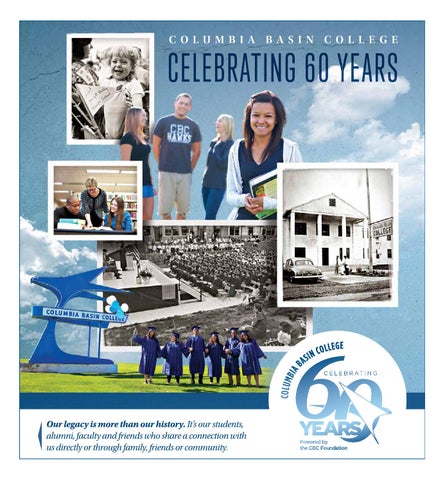
CBC Commemorative Sunday, November 1, 2015
2
60 Years of Educational Excellence Columbia Basin College has grown and changed considerably since 1955. Grafted from the Pasco School District, with just a handful of programs serving a few dozen students in temporary facilities at the Pasco Airport, the College blooms now include Pasco, Richland, and Virtual campuses that enroll over 11,000 students in 72 degree or certificate programs. Our focus on creating social mobility and workforce development has grown with our community. One great example is that we became accredited, in 2009, as a baccalaureate institution to serve more working professionals who need to upgrade their technical educations with bachelor of applied science degrees. We offer several bachelor degrees in business, health, and information technology areas. Another example is that we are a federally designated Hispanic-Serving Institution (HSI) better able to serve our minority populations as the Tri-Cities has become one of the fastest growing Hispanic communities in the nation in recent years. These are simply two among dozens of improvements the College has made to ensure that our students are able to transform their lives and families with accessible, affordable, and rigorous higher education. In fact, many of our students are the first in their families to attend college. Others are adults who are re-careering or coming to college for the first time. We have a large number of Running Start students who enroll in our dual-credit program if they are able to perform college-level work while simultaneously finishing high school. Many others enroll in our career and technical programs because they want the practical, work-oriented education that only community colleges offer. As a member of the Tri-Cities community, CBC is highly invested in the success and growth of the local economy. Columbia Basin College works closely with local industry and businesses to understand the specific employment needs of our area and provide high quality, workforce-ready employees. The renowned Economic Modeling Systems, Inc. (EMSI) analysts have calculated the annual value-add of CBC to local economic activity to be over a half-billion dollars annually. I am very excited about the next 60 years. CBC 2.0, which we began with our baccalaureate accreditation, will continue to unfold with new buildings, programs, and student residences. On behalf of our Trustees, faculty, staff, and administration, I want to say thank you to this community for the opportunity to serve. We love what we do at CBC!
Dr. Richard Cummins President Columbia Basin College
COLUMBIA BASIN COLLEGE
FAST FACTS
In 60 years, Columbia Basin College has grown to meet the higher education needs of the region. Beginning largely as a technical school known for its nursing, manufacturing, and welding programs, the majority of our students today continues at four-year universities or earn bachelor degrees here at CBC. Career and Technical programs do continue to play a large role, however, offering degrees in 34 areas that range from dental hygiene to information technology, from marketing to nuclear technology‌.all of the many areas for which a solid two- or three-year degree is sufficient for starting a career in the mid-Columbia. CBC also offers our own bachelor degrees. Currently, these are in Cyber Security, Project Management, and Applied Management, but planned future offerings include the Bachelor of Science in Nursing, Bachelor of Applied Science in Dental Hygiene, and Bachelor of Applied Science in Information Technology. Basic education for adults and community education in areas such as GED and English as a Second Language are also important aspects of our mission. Columbia Basin College – 60 years strong!
Demographics
Degrees Awarded 2014
Gender
Female 53%
1,699 TOTAL Male 47%
Degree & Certificate Programs available
Age
72
25 to 29 14% 30 to 39 14%
19 and younger 34%
TOTAL
Annualized Enrollment 2014
40 and older 10% 20 to 24 28%
Ethnicity
Bachelor of Applied Science - 65 Associate in Applied Science - 373 Associate in Arts & Sciences - 717 One-Year Certificates - 118 GED Certificates - 426
Native American 1% Not Disclosed 2%
Asian/Pacific Islander 3% African American 2% Other 2%
White 54%
Hispanic 36%
11,344 24.8 TOTAL
51.2% estimate, limited cohort
42.6%
Enrollment by course content Pre-College & Community Education 10% Career & Technical Programs 21% Basic Skills 14%
Academic Transfer Programs 55%
Average Class Size
Degree seeking students using financial aid
of students are first generation
CBC Commemorative Sunday, November 1, 2015
4
Coach Howard’s legacy lives on through memorial scholarship For the Howard kids, Columbia Basin College (CBC) isn’t just a school—it’s a second home. Their father, the late John Howard, was a professor and coach who guided Hawk players for nearly 40 years. Naturally, Howard’s children, Jonna, Joe, Jeanene and Judy, were immersed in the community college’s culture.
years. Howard also coached football, golf and tennis while teaching in the Physical Education department. He’s been so influential to student athletes, CBC declared a “Coach Howard Day” in March 1980.
“I would go up on the weekend with my dad and hang out there while he was doing work. We knew everything about the campus; every building and every instructor,” explained Judy Brown, the youngest of his four children. “I was born into CBC culture. I don’t remember anything different.”
“As a family, we established the fund in our dad’s name to continue the CBC opportunity for future students.”
Over the last several decades, the Howard family has watched the school evolve as buildings and programs were added to improve the quality of education students receive. The family also watched Coach Howard revitalize the wrestling program. CBC won 53 straight dual meets, a streak that lasted four
When he passed away in June of this year, the
– Jeanene Landby family pulled out vintage CBC memorabilia to display at his service. But the memorial brought back more than fond memories—it brought back some of the students whose lives Coach Howard had impacted over the years. “We had athletes back from his earliest coaching years attend, and every one of them came up to us and reintroduced themselves. It was like a big family reunion,” said Brown.
Coach Howard may have had four biological children, but the siblings have always joked that they’ve shared their dad with hundreds of students. Their father was a huge advocate for education, and Brown said her father realized there were a lot of athletes who didn’t have the financial means or support to reach college after high school. “He knew if he could get them into college with athletics, he could help them understand how important their education was. He would get them into the classes they needed to be in, help set them up with housing, and help get them recruited to other colleges after CBC,” she explained. One athlete who benefited from Coach Howard’s support in particular was CBC golferturned-pro, Mike Combs. “I just found a letter from Mike. I found it when we were going through the CBC memorabilia,” she said. “Mike was only being recruited by small colleges after CBC. He won the Northwest Athletic Conference individual championship and was the number one golfer in the state at the time. So my dad picked up the phone and started calling all these colleges and got him a scholarship to play at a major university. Mike then went on to play in the PGA.” The letter from Mike is symbolic of the impact Coach Howard had over the years. Brown said her father didn’t just believe that the players he recruited would get a quality education at CBC, he believed his own children would earn a great degree. All four siblings attended and graduated from CBC—three even played sports for the college. “For our parents, with four kids to put through college in about a 10-year span, the cost advantage of community college here at home was definitely an added value,” said Landby, the third oldest of the Howard children. “But they also knew CBC offered so much more.”
Coach Howard in a heated discussion with the referees during a wrestling match. His family remembers Howard as being a fierce competitor with a fiery temper, saying ‘He was small in size but had a huge presence!’
Howard’s children attended CBC and graduated in the class of 1981, 1984, 1987 and 1991. All three son-in-laws also attended CBC,
A su pplem en t of th e Tr i - C i ty H e ra l d
5
PHOTO BY BOB BRAWDY
The Howard family siblings stand behind their mother, Virginia, for a family portrait after receiving Columbia Basin College’s Outstanding Alumni award for 2015-16 during Wednesday’s faculty and staff gathering in the college’s theatre, an annual prelude to the start of classes on Sept. 21. From left, they are: Jeanene Landby, Joe Howard, Jonna Mayfield and Judy Brown.
and even Coach Howard’s wife, Virginia, took business courses at the college. “That’s a testament to the school,” Brown said. “Dad really believed in it, and I still find myself promoting CBC.” This past spring, CBC selected the Howard children as 2014-2015 alumni of the year. Brown was both honored and shocked. “We haven’t done anything extravagant in order to receive this honor, but they said, ‘You’re part of the community. Your father taught here, and you guys believe in the CBC program,’” said Brown. Joanna Mayfield, the oldest daughter, currently works for St. Joseph Medical Center as a physical therapy assistant. Joe Howard went into business management and information systems and is currently employed by EMC Corporation. Landby works in the Washington Wine Industry as a sales director for Mercer Estates; and Brown specialized in marketing management but recently returned to the work field in education. “I’m substitute teaching, and in classes, I find myself talking about college,” said Brown. “I
think looking back at my college education CBC was the smartest choice I ever made. The cost, the class size, the quality instructors and the wide range of classes—it’s a great place to try things out before going on to a huge, expensive college. Plus, CBC has kept me connected to the community.” For 49 of the school’s 60-year history, the Howard family has been around, and they plan to continue being involved with the creation of a scholarship. The Coach John Howard Memorial Scholarship will be given to student athletes who attend CBC and meet GPA criteria. The fund is already set up with about $2,500 available to students. “The scholarship will be awarded next year, and the application deadline will be February 21st,” said Debbie Risk, Director of Operations for the CBC Foundation. “Students will apply to the foundation using the foundation’s general scholarship application.” A volunteer committee of about 20 individuals will review the applications, with each one being read by about three different people. Applicants are scored and scholarships
Coach John Howard cheering on one of his student athletes.
are announced prior to the fall quarter. “In October, the donors get to meet the students benefiting from their support at a Scholarship Awards Ceremony. We hold it at the Pasco Red Lion and have about 700 people attend every year,” said Risk, adding donations to the Coach John Howard Memorial Scholarship fund may be mailed to CBC Foundation, 2600 N. 20th Ave., Pasco, WA 99301. Risk never had a chance to get to know Howard, but she’s met the children several times, and said she’s never seen a family so proud. “As a family, we established the fund in our dad’s name to continue the CBC opportunity for future students,” said Landby. “We know it will pay tribute to how he valued higher education and how much he loved this college.”
Donations to the Coach John Howard Memorial Scholarship fund may be mailed to: CBC Foundation, 2600 N. 20th Ave., Pasco, WA 99301
FAILURES = SUCCESS Juny
Soukhavong
and
Jorge
Mendoza are members of Columbia Basin College’s Student Marketing Group. creative
The
students
consultants
work with
as
real-
world clients to appreciate failure as a learning experience toward success.
LIVE
HEROISM IN AFGHANISTAN
YO U R S TO RY
Pfc. Garrett Clary, U.S. Army veteran and CBC student, fought a battle in
Afghanistan’s
Korengal
Valley
alongside Medal of Honor recipient Staff Sgt. Salvatore Giunta. Giunta is the first living recipient of a Medal of Honor since the Vietnam War. The appearance of U.S. Department of Defense (DoD) visual information does not imply or constitute DoD endorsement.
STUDENT SHOWCASE CBC students’ stories come to life at CBC. While each path is different, every student gains the skills and knowledge they need to be future leaders in their chosen fields. What’s your story?
CREDIT FOR WHAT YOU ALREADY KNOW Vicki Ross hasn’t taken a college class since 1990. But she recently enrolled in Columbia Basin College’s Competency-Based Education program and is using her work experience to advance more quickly toward an associate degree in business.
A su pplem en t of th e Tr i - C i ty H e ra l d
7
New competency-based online program aims to help working professionals complete their degree Any time Vicki Ross was in a debate about education versus experience, she always argued experience was more important. Her viewpoint changed two years ago when her boss wanted to promote her, but the position required a college degree. “I realized I was really limiting myself by not having a degree,” said Ross. “I started to explore different online programs, but many were expensive.”
Vicki Ross, is enrolled in CBC’s Competency-Based Education program.
She stumbled upon an article about earning an associate degree in business with Columbia Basin College’s (CBC) Competency-Based Education program.
The program offers a new way to earn a college degree, different than both on-campus classroom instruction and traditional online instruction. While it’s offered entirely online, the Competency-Based Education courses are designed to allow students to independently make their way through classes to acquire the knowledge they should know to complete their degree. The program launched as a state-level trial earlier this year. CBC is serving as the lead pilot institution, and the degree is also being offered at Everett, Tacoma, Centralia, Pierce, and Olympic colleges. The Competency-Based Education program is modeled after Western Governors University, which lent its expertise to help develop the curriculum. Students who already have the required knowledge in a topic area can choose to pass tests to demonstrate it, rather than being required to take classes on information they know. “It appealed to me because it was completely online, completely competency-based and self-
paced,” she said. “In talking to CBC about the program, it was clear that my success is personally important to them, and they have a refusal to allow you to fail attitude. Failure was my greatest fear because I hadn’t taken any college courses since 1990.”
She anticipates graduating from in June 2016.
Ross attended college from 1988 to 1990 but did not complete her degree before turning her attention to her family and raising two kids. Now her children are 22 and 20 and frequently watch what she is doing during her classes. Her daughter recently enrolled in college because of her mother’s example.
Competency-Based Education Benefits
The courses are just as challenging, and the level of support is the same as it is on campus. Ross frequently interacts with her instructors. She recently needed additional help with an accounting assignment, and her professor invited her to meet at his office to discuss her questions. “I assumed his office was at CBC, but I was surprised to learn that he owns a local accounting firm,” said Ross. “He also teaches on campus and through the online program and is able to share real-world experiences. He is a great teacher, very patient.” When asked what she hopes to gain from this experience besides a degree, she shared that a degree is something that can never be taken away. “One can lose their job, their home, their car, but no one can take away your education,” she said. “When I enrolled, I thought, if I can just get through a year that is my goal. Now I think, ‘What am I going to do after I graduate?’” she said excitedly. “I may pursue a bachelor’s degree in business or hospital administration.”
“Just the fact that I’m able to go back to college is an accomplishment,” she added. “I was so afraid to fail that I didn’t think about what I would gain if I did achieve my goal of earning a degree. Unless you try, you will never know.”
• Earn credit for what you know. Use knowledge you already have from work or life experience to pass assessments that prove competencies. • Earn your degree totally online. Learn outside the traditional classroom using a variety of online formats (videos, podcasts, eBooks, online conferencing). • Advance at your pace. Progress by passing assessments when you are ready. • This flexibility helps balance education with work and family. • Receive personalized support. Get help and guidance from highly-qualified instructors and a completion coach. For more information, visit: columbiabasin.edu/cbe By 2018, 63 percent of all job openings will require workers with at least some college education. – Projection of Jobs and Education Requirements Through 2018, Georgetown University, 2010
CBC Commemorative Sunday, November 1, 2015
8
Humble hero fought in Afghanistan battle alongside Medal of Honor recipient “The attack came from 20 meters away. They were firing rockets, shooting machine guns and AK-47s,” said retired Pfc. Garrett Clary. It was nighttime in the Korengal Valley, a part of eastern Afghanistan near the Pakistani border. Clary describes the Korengal as, “one of the most dangerous places you could be in Afghanistan.” The imprint of the October 25, 2007, battle is still fresh, eight years later. Clary was only 19. Clary and his fellow soldiers were near the end of a multiday combat mission. They had just finished security sweeps of a nearby village following a deadly attack on their sister platoon two days prior. The squad was hiking back to their outpost in single file formation, down a narrow and rocky ridge when they were ambushed from both the front and alongside. “We were on foot patrol all the time because the Korengal is a forested area on the side of a mountain, so there were no vehicles. We walked everywhere,” he explained. A member of the 173rd Airborne Combat Team, Clary described the attack as an “L-shaped ambush,” designed to kill or capture everyone. The squad was separated from its unit shortly before the attack, leaving only six soldiers to fight. Rocket-Propelled Grenades (RPGs) and muzzle flashes from enemy fire lit up the tree line. Hundreds of rounds per minute pounded the ridge the squad was navigating. As the firefight continued, the two lead soldiers, Sgt. Joshua Brennen and Spc. Franklin Eckrode, were cut off from the group and hit, both wounded. “We were trying to fight them off but also get back up to our lead guys. That is when our squad leader was struck. Sal [Staff Sgt. Salvatore Giunta] ran out and grabbed him and pulled him back,” recalled Clary. Giunta was struck twice while running through enemy fire to save squad leader Staff Sgt. Eric Gilado. But he continued to fight with his team as they returned fire and threw grenade after grenade, using the explosions as cover to inch closer to the two injured
soldiers still stranded at the front and exposed. The team finally reached one of the lead soldiers, Eckrode, and began treating his wounds. Giunta raced toward Brennan’s last known position. With enemy fire still blanketing his path, he saw two insurgents attempting to drag Brennen away. “Sal broke off and ran ahead to get to Josh, who had been shot several times. Sal killed one insurgent, and the other ran off,” said Clary. “He was able to get our friend back.” Clary sprinted past Giunta and Brennan and continued firing at the retreating enemy.
U.S. ARMY PHOTO
President Barack Obama presents the Medal of Honor to Staff Sgt. Salvatore Giunta in the East Room of the White House, November 16, 2010. Giunta is the first living recipient to receive the award since the Vietnam War. The appearance of U.S. Department of Defense (DoD) visual information does not imply or constitute DoD endorsement.
The squad converged to treat Brennen’s severe injuries. He was shot multiple times and took an RPG round to the chest. They kept him alive until the MEDEVAC was able to lift him off the mountain. Brennen died on the operating table. And in the first moments of the battle the team lost their medic, Spc. Hugo Mendoza. The attack that evening lasted about three minutes and every member of the squad was hit. “My gear was hit with RPG shrapnel. I was lucky.”
For heroic combat actions at Korengal, Giunta received a Medal of Honor. It’s the highest military honor, awarded for personal acts of extreme bravery above and beyond the call of duty. Giunta is the first living recipient to receive a Medal of Honor since the Vietnam War. Clary earned an Army Commendation Medal with Valor and later a Bronze Star Medal. When speaking about his military service, even years later he says his memories are bittersweet. “It was always my dream to join the military, but I’m not sure where it came from. I think it was something I was born to do,” he said thoughtfully. “I wanted to retire from the military but going through that kind of an experience makes you rethink a whole lot. But I would probably do it again because of the people
I met, but it hurts to lose a lot of friends.” Clary remains in touch with many of the soldiers he served with, including Giunta, but he is now a world away from Afghanistan. After retiring from the military in August 2013, he returned home to eastern Washington. He lives in Pasco and is a second-year CBC student working toward his bachelor’s degree in business administration. Clary is participating in the BRIDGES program, a coordinated bachelor’s degree program providing students a direct path from CBC to Washington State University Tri-Cities. He is still undecided on his future career path. “I think I want to go into marketing or public relations, something where I can interact with people,” he said. “I enjoy writing, and I have a niche for it at times, but I prefer face-to-face. I’m much more effective when I can talk directly to people. See their expressions, mannerisms and gestures.” Clary’s most memorable moment at CBC came in 2014 when he met his fiancé, Chelsea, through a mutual friend on campus. They are planning a springtime wedding, around the time Clary graduates from CBC in 2016.
A su pplem en t of th e Tr i - C i ty H e ra l d
9
Keep up-to-date on special events and CBC news! Submit your contact information below and be in the know. First Name____________________ Last Name__________________________ Email _____________________________________________________________
The quality of education I received at Columbia Basin College was second to none. The classes were inspiring, and the knowledge and enthusiasm of the faculty were magnetic. Frank Aguilar
Engineer Washington River Protection Solutions Engineering, 2012
I’m a face of CBC. What’s your connection?
SPONSORED BY
Connect with CBC and help us celebrate! columbiabasin.edu/connect
Affiliation (check one) * Community Member/Donor Current Student Alumni CBC Faculty/Staff For Alumni & Students - Years at CBC? _____________ Complete online at ColumbiaBasin.edu/Connect or mail or drop off card at any CBC location Mailing Address: Columbia Basin College Foundation 2600 N. 20th Avenue Pasco, WA 99301
10
CBC Commemorative Sunday, November 1, 2015
Students work with real-world clients to learn what textbooks can’t teach: failure “Failure is an option. And it’s okay if you fail because it’s a learning experience, not a failure. And those types of failures lead to student success,” said Gene Holand, Columbia Basin College (CBC) associate professor of business. Those are the rules of engagement for Holand’s student marketing group. Holand started the group in the early ‘90s with the goal of operating it as a business to give his students real-world experiences. “The thing is, I don’t work with textbook clients, I only work with real clients in the classroom,” he said. “Have you ever had a client say, ‘No, that’s not what I want’? My students need to hear that. Textbooks don’t teach you that, but I guarantee a real client will.”
“We get a lot of ideas rejected, and that’s going to happen in the real world. And to me, it’s a lot more gratifying than sitting in a classroom and listening to a lecture.” – Jorge Mendoza.
Throughout the years, the student marketers have worked with about 450 regional businesses. The program started with nothing and has grown to 14 computers, a large shop, welding equipment and other tools, supporting as many as 30 students.
Holand helps guide the students but lets them tackle the work on their own. “He gives us some input like maybe we should rethink the concept,” said Soukhavong. “Then he steps aside and lets us handle it like a real business. He’s kind of like our manager.” One of Soukhavong’s favorite projects is the Cable Bridge Run. She designed posters and T-shirts for the event. “It let me tap into my ability and let me think outside my own comfort zone,” she said. Soukhavong’s parents envisioned she would work in the medical field, but she decided to go into business instead. “I like the advertising, marketing aspect. I love to be creative and design different logos and advertisements.” When asked how her parents accepted the news, she laughs: “It was a really long talk to convince my dad to change his mind.” Her parents are proud of her accomplishments. Whenever her logo designs appear in publications, Soukhavong says her parents point them out to friends and say, “‘Hey, that’s my daughter’s work right there.’”
Client requests vary and have ranged from brand packages, websites, logo designs, business cards, T-shirt designs, posters, and even specialty trailers. The group comprises students from the business degree track who want to put into practice what they’ve learned in the classroom. “CBC has become exceptionally progressive. We’re doing our best to move at the speed of business. We can no longer move at the speed of education,” explained Holand. “If I were to propose creative marketing consultants in the classroom 20 years ago, people would have laughed at me. Our president is willing to take chances.” Student marketing group members Juny Soukhavong and Jorge Mendoza have been in the group for more than two years and are both in their last quarter at CBC. They have worked on several of the group’s client projects. Both students have encountered failure as a learning experience, as well as the exhilarating feeling of seeing their finished products used, and appear in publications. “We get a lot of ideas rejected, and that’s going to happen in the real world,” said Mendoza. “And to me, it’s a lot more gratifying than sitting in a classroom and listening to a lecture.” Mendoza recently completed a demonstration trailer project for an organization called Our Climate Matters. “The client wanted it eco-friendly, so we bought a trailer from Harbor Freight and cut it up and attached solar panels to charge her TV and electronics,” he said.
Kestrel’s Vintners’ wine bottle designs, Lady in Red and Pure Platinum (pictured), were designed by Columbia Basin College’s Student Marketing Group. The Cable Bridge Run poster was designed by Juny Soukhavong, a member of the Columbia Basin College Student Marketing Group.
A su pplem en t of th e Tr i - C i ty H e ra l d
Columbia Basin College Student Marketing Group member, Jorge Mendoza, recently completed this eco-friendly, demonstration trailer project for Our Climate Matters.
Both students have ideas of what they would like to do following graduation. Soukhavong plans to work at an advertising firm, and Mendoza would like to open a small bistro or welding shop. Many of the group’s former students are working in marketingrelated industries. “I’m a firm believer that if my students can’t “do,” I can’t really put them out in industry,” said Holand. “CBC students are getting an exceptional degree. Whether it’s an AA business degree, we want to think they’re ahead of students coming out of other schools. And industries are telling us we’re on track because they’re hiring our students.”
CBC Student Marketing Group Project Highlights • Kestrel’s Vintners’ Lady in Red and Pure Platinum wine bottle designs • Blue Flame Spirits distillery name and logo • The city of Mabton’s logo • Downtown Pasco brand redesign • Columbia Basin College’s logo • Rudy’s Pepper Blends logo
11
CBC Commemorative Sunday, November 1, 2015
12
WE ARE
CBC
A su pplem en t of th e Tr i - C i ty H e ra l d
13
BUILT TO LAST Economic indicators confirm Manufacturing Technology jobs are here to stay, and program Professor Alan Hardwood is helping CBC students build solid careers to take on the future.
SAFE AND SECURE
LEARN BESIDE THE BEST
Matt Boehnke had an office at the Pentagon and ran a 30-million dollar Cyber Security program. Now he’s teaching CBC students how to secure personal and business information.
F A C U LT Y F O C U S Our faculty bring real-world experience, thought leadership and innovative research into the classroom to advance every student’s future.
A HEALTHY CAREER CHOICE CBC is one of seven schools in the state to offer a Surgical Technology program. Assistant Professor Doug Hughes has toured dozens of programs, and shares why CBC’s is top notch.
A su pplem en t of th e Tr i - C i ty H e ra l d
15
Former Pentagon employee joins CBC Matt Boehnke never planned to work at the Pentagon. He envisioned a life devoted to law, wearing suits and ties, and defending clients in the courtroom.
were coming in, and we needed to look at how the cockpits were going to be setup, and how the information would be transmitted safely without overwhelming the pilots.”
you don’t have the protection in place,” he said. “I don’t want to scare people, but I want people to be aware, and that includes our students and faculty—our CBC family.”
The verdict changed when he landed an opportunity to join the U.S. Aviation Team.
He spent the next several years working with the military. But each promotion meant another duty—another move. Boehnke’s last assignment included an office with the Pentagon managing a 30-million dollar Cyber Security program. In 2011, he retired back in the Tri-Cities so his youngest son could finish high school.
Posters and newsletters to staff and students will highlight simple steps people can take to protect themselves. But students enrolled in Boehnke’s courses will dive deeper into cyber security. They’ll learn about the transfer of information and the critical balancing act of keeping that information secure without disrupting a business’s daily operations.
“While I was in college, I joined the Reserve Officers’ Training Corps (ROTC). I earned a spot in the U.S. Aviation helicopter school by being the number one ROTC cadet in the state of Washington,” said Boehnke. “It was quite a twist of fate if you will, but I pursued it. I went off to fly helicopters.” The surge of information technology (IT) in the late 1990s would alter Boehnke’s fate once again when he was offered the chance to be an instructor and student at the home of the U.S. Army Signal Center of Excellence, which eventually evolved into the U.S. Army Cyber Command. As technology progressed, Boehnke said the military wanted officers to learn how to integrate this new emerging technology into the current and future Army operations. His job was to incorporate IT into aviation operations. Boehnke represented the aviation branch during a time when cockpits were becoming more automated. The military was ahead of the curve when it introduced GPS and touchscreen technology. “So part of my job was to assist with what was going on,” he explained. “Advanced aircraft, such as UH-60 Blackhawks and AH-64 Apaches
“I tried to take a year off, but my wife wouldn’t allow me to sit on the couch that long,” he said, a smile in his voice. Boehnke stayed busy volunteering with various organizations, including the Kennewick Arts Commission and the American Legion Post 4. But in the end, he found himself drawn back into the matrix of cyber security. This fall he joined the faculty at Columbia Basin College (CBC) in the school’s Computer Science department. Course work includes teaching students the basic fundamentals to secure information from hackers. “I’m not here to teach students how to hack, but in order for people to understand what the bad guys are doing, they need to understand how to find weaknesses in an organization and how they can stop it,” he said. Whether a company is large or small, Boehnke said network infrastructure is vulnerable. In the last two years, companies such as Target and Lowe’s have had their information compromised, putting customers’ personal data at risk. “The students I have are a bit blown away by how easy it is for people to steal personal information,” said Boehnke, who teaches three classes this fall quarter. “Now with social media, it’s easy to find personal data such as when you’re leaving on vacation and what restaurant you’re eating at. People can rob your house because they know you’re gone.” October is Cyber Security Awareness Month, and Boehnke said it’s an opportune time to initiate conversation with his class—as well as students enrolled in other courses at CBC.
Matt Boehnke stands in front of the CH-47 Chinook helicopter he used to fly.
“Something as simple as the location services on your phone can put you at risk. Your location can be sent out every minute of every hour if
“The students I have are a bit blown away by how easy it is for people to steal personal information.” – Matthew Boehnke, Cyber Security Assistant Professor at CBC “Information needs to get out in order for purchases to be made, and too much security is going to drive a lot of businesses to fail,” he explained. Many of his students are interested in information technology (IT) careers; however, Boehnke said he also has a business owner enrolled who wants to keep their business, and their customers, safe. Boehnke hopes to offer business owners a risk analysis as part of his course curriculum in the near future. His goal is to have students evaluate the level of passwords a company uses, backup systems for data retrieval, as well as a host of other areas that hackers might look at when assessing a company’s overall security. “It’s a win-win for the student and a win-win for the business,” he explained. “The student will have to get the data and present it back to the employer.” With the ever-changing world of technology, Boehnke said students enrolled in IT classes have a bright future ahead of them as more and more companies realize the value of having the proper security measures in place. “You’re going to steal the car that’s easy to get to, the one that’s not locked up,” said Boehnke, in reference to cyber security. “You’re going to take the car with the windows down. So the goal is to teach our CBC students how to put obstacles in place to deter thieves from stealing information.”
CBC Commemorative Sunday, November 1, 2015
16
Manufacturing Technology program is built to last Alan Harwood has been dissecting tractors since before he could operate one. Raised on a wheat farm in eastern Washington, Harwood learned quickly that in order to keep the equipment going, he needed to know how to take apart and rebuild tractors, combines and everything in between.
recalibrate them—and gain respect for the tools.”
“My dad saved every piece of scrap metal to use later. Parts would break down constantly, and Dad always had us work with him to get it fixed. That gave me the tinkering ability,” said Harwood. “I worked on scooters as a kid—with a lot of help from my dad and later on we built motorcycles and tractors. My dad encouraged me to look into being a machinist.”
“I don’t believe a student needs to necessarily know how to design a part in a CAD program, but they need to know how to import a part into a computer program, and manipulate it on the machines,” he said.
Students become familiar with Computer Aided Drafting (CAD) models, as well as solid modeling programs where parts are sent digitally into a computer and can be manipulated before being turned into a physical part.
Harwood is confident students are being prepared for the workforce thanks to the industry advisory committee members who are comprised of local shop owners and employees from the Tri-Cities and Walla Walla. The group meets twice a year to review CBC’s curriculum and the program itself.
Manufacturing Technology Instructor, Alan Harwood, helps students learn the fundamentals of machinery so they can be successful in the workforce.
After earning an AAS degree as a machinist at Spokane Community College (SCC), Harwood worked in industry for six years. He started teaching at Walla Walla Community College while working closely with the instructor at Columbia Basin College (CBC). “I even took night classes from CBC professor, Al Anthis, or at least attended his night classes to learn more,” said Harwood. “Al helped me understand how to teach the basics of machining extremely well. John Gray, my instructor at SCC taught me the basics of machining, and together they instilled a positive agenda for me.” Al Anthis passed away in 2005, but Harwood is following in his footsteps. In 2014 he accepted a job as the Manufacturing Technology instructor for CBC and has been working with the administration, the advisory committee and others to continue the tradition of the program. “There’s a huge need for machiningmanufacturing technology jobs,” said Harwood. “The program should be overflowing. There should be a waiting list. The job openings may not be in the Tri-Cities—they may be in Moses Lake or Seattle or the shipyards in Bremerton—but you can find a job, especially if you’re qualified.” Despite the fear people have about manufacturing jobs being outsourced overseas,
Harwood said there are plenty of products being made in the U.S.A. Everything from big equipment, such as parts made for Caterpillar Tractor Company, to the plastic mold to make milk jugs and other plastic parts, not to mention aerospace and tools for the medical fields are made by machinists here in the United States. “People don’t really understand what manufacturing is,” he stated. “Everything in the world that’s been manmade has been touched by a machinist at one time.” Machine tool sales are used as an economic indicator, said Harwood. In the United States, it’s one of the top 10 indicators of economic growth. And Harwood said the number keeps going up. (http://www.mmsonline.com/articles/ can-you-believe-it) “Oh yeah. It’s growing right now,” he said confidently. In his program, students work on turning a virtual part into an actual part since machinists don’t necessarily draw and design equipment. And students begin learning the basics of manual machines right away. “Because if you don’t understand how things work and get put together, you don’t have enough respect for the part,” he said. “Students in my classes learn how to read precision measuring tools within the first couple of weeks, and then we disassemble them, clean them, and
“They sometimes have to teach me certain things, especially when they have skills I don’t have,” said Harwood about the advancements in the field and the benefit of meeting advisors. Industry instructors also get together annually to tour machine shops around the country. Harwood looks forward to those meetings, but finds himself thumbing through the phonebook and Internet even when he’s on vacation as he looks for shops to visit. “I can hardly go by a town without looking for machine shops to see what’s going on,” he chuckled. “When my wife and I were in Windsor, Vermont, I visited the American Precision Museum, and other shops.” His passion for machining/manufacturing technology has always stayed intact, and it certainly carries over in his love of teaching. But Harwood said he’s just a conduit, a vessel to teach students the way his father and his machining instructors taught him. “It’s not what I do that makes the program great. It’s what the school does,” he said. “It takes the industry advisory committee members and school’s support to get these students out to the workforce.”
A su pplem en t of th e Tr i - C i ty H e ra l d
17
Surgical Technology program fills critical role Patients undergoing surgery rarely meet all the people involved in their procedure. In most cases, their primary doctor and attending nurses are the last faces they see before the anesthesia pulls them under. But no matter what the surgery is, surgical technologists are a part of the team. “That’s one of the most interesting things about the Surgical Technology program here at Columbia Basin College (CBC). We have to teach students to be experts on every type of surgery that they might encounter in the surgical world,” said Doug Hughes, Assistant Professor of Surgery and Surgical Technology Program Director for the college. “Every surgery that happens in a hospital or outpatient center has to have a surgical technologist or the operation can’t happen. It’s a very critical role in the operating room.” CBC students are prepared to work as effective surgical team members by learning pre-operative, intra-operative and postoperative patient care. The 12-month program is accredited by the Commission on Accreditation of Allied Health Education Programs (CAAHEP). Coursework covers aseptic
technique, sterile procedures and surgical instrumentation. The first two quarters of the program are spent in the classroom, balancing bookwork and introducing students to mock surgeries. “We have a model lab in our building, and we have all the same equipment and supplies that students will see in the real world, and we simulate the situation like an operating room. The only difference is that our mannequin doesn’t bleed,” said Hughes. CBC’s lab is so realistic, Hughes said his students are surprised how calm they feel when they are placed in real-life operating rooms during the latter half of the program. The college has clinical agreements to provide students with 24 hours of surgical tech work per week during the third quarter, and 32 hours in their final quarter—and many times those turn into real jobs upon graduation. “Our job placement rate on the 2015 CAAHEP annual accreditation report was 100 percent,” Hughes said proudly. “With the retiring baby boomers getting older, and with the population growth and expansion in this area especially, there is a growing need for people to perform surgeries—and with that an increased need for surgical technologists.” In fact, according to the Bureau of Labor Statistics, employment in the field is projected to grow by 30 percent throughout the next decade. That’s three times faster than the average for all other occupations.
CBC students brought a mock lab to the Columbia Center Mall last year in order to raise awareness about the surgical technology program.
Students hoping to enter the program next year will have to write an essay and have some pre-requisites under their belt before applying. Hughes and his department select 18 to 20 of the top candidates and bring them in individually for interviews. Prospective students need to be able to deal with blood, body fluids
For program information, photos and more, visit: facebook.com/cbcsurgtech and anatomy. Hughes said the ideal candidates would also have to be able to work in a highly stressful environment. “Surgeons can be very stressed out,” he explained. “We help facilitate the surgery, and depending on the surgery being conducted, one wrong move can be catastrophic. So you need to separate the work you’re doing with the emotional aspect.” Most importantly, candidates need to be ready for an intensive field of study that’s condensed into four quarters. “Every year we take a total of 15 students. The class size fits the availability of the job market. The number has to match the clinical slots available in the hospitals so our students can get the hours of experience they need to graduate,” he said. “As the community grows, as hospitals expand, the job market will grow too and we’ll be able to take more students in the future.” CBC’s Surgical Technology program is one of approximately 450 in the county, and one of seven in the state. Hughes worked at a few other colleges before coming onboard with CBC in 2014. He’s also toured dozens of other schools thanks to his work with the national professional organization, the Association of Surgical Technologists. Without a doubt, he said the TriCities should count itself lucky. “Based on experiences I’ve had, CBC has the best lab I’ve ever seen,” Hughes said, adding he’s mutually in awe at the quality of staff at the college. “We all work really well together and there’s a real emphasis on each student’s success. At other colleges I worked at that was obviously a priority, but it was more of a business aspect. Everyone I’ve met here—from the receptionists to the tenured professors—we all have the same goal: help the students be successful.”
CBC Commemorative Sunday, November 1, 2015
18
A WORLD AWAY CBC graduate, Oumou Sidibe, arrived in America from West Africa speaking and understanding very little English. Her goal was to complete her college education before returning home to help her county where there is a vast shortage of mechanical engineers.
BONDS THAT LAST Eduardo Zaragoza had a job lined up before he graduated from CBC’s Welding Technology program. But
LEAD T H E WAY
that doesn’t mean he’s put school behind him. He hopes to return to his alma mater some day to inspire students the same way his instructors inspired him.
ALUMNI SPOTLIGHT CBC alumni can be found every corner of the world. They are developing successful careers built on their CBC experience.
OLD AND NEW TRADITIONS Ginger McCormick’s tribal heritage is rich with traditions. But Ginger recently added a few new ones. Selected as a NASA Community College Aerospace Scholar, she is also the first in her family to graduate from high school as well as college.
A su pplem en t of th e Tr i - C i ty H e ra l d
19
Family’s first college graduate selected for prestigious NASA internship Ginger McCormick’s life is rich with tradition. She grew up as a member of the Tlingit and Haida Tribes near Ketchikan, Alaska, on a small coastal island about the size of Pasco.
and research. I was the only chemist, the rest of the interns were engineers,” she said. “Our team had to build a 3D rover for our final project. The entire experience helped me develop my leadership and teamwork skills.”
“We had big ceremonies with dancing and traditional foods like deer and fish,” she said.
CBC has been a major part of McCormick’s life for the past 2 ½ years. She started in the lower math series and worked her way through pre-calculus – only accomplished by 15 percent of students. McCormick also participated in the Mathematics, Engineering, Science Achievement (MESA) program.
Those traditions continued when the tribes’ chief, Thomas Skultka, who is also McCormick’s uncle, selected her to wear the tribes’ regalia at her graduation ceremony earlier this year. Her journey to college was a long one. McCormick moved with her father to Hermiston, Oregon, about 10 years ago. She didn’t graduate from high school. Years later, she went back to school to earn her GED to set a good example for her children, as well as the tribe’s younger generation.
She said she feels like CBC is a second home, where she is welcome and supported, and she knows every professor is there to help.
She decided to continue her education and enrolled at Columbia Basin College (CBC) in 2013. But with the daily round-trip drive of nearly 80-miles, it wasn’t always easy.
“There were multiple times during my commute from eastern Oregon every day that I experience challenges,” said McCormick. “I’ve had flat tires, left hours earlier to drive through snow storms. And one time I had just sat down in class as they closed the campus for the day due to the snow. I considered sleeping in my car. But through it all, I never missed a day of school.”
“I feel completely ahead now. CBC helped me connect my education to what I wanted to major in.” – Ginger McCormick Her story isn’t all struggles. McCormick knew early in her college career that she wanted to earn her degree in criminal justice, but that changed when she took a chemistry class at CBC – the first time she’d ever experienced chemistry. She “fell in love.” “I always wanted a career where I could
“Any class I’ve ever taken at CBC, I got to know my professors. I would talk to any of them if I had a question. You don’t get that kind of personal attention at other schools,” said McCormick. “I’ve personally met the president of CBC, he knows my name and is proud of me. That isn’t what you experience at other colleges.”
CBC students and NASA Aerospace Scholars Ginger McCormick, center, and Leslie Ibarra, meet Governor Inslee during a Mathematics, Engineering, Science Achievement (MESA) reception in Olympia. (Photo courtesy of the Association of Washington Business)
help people, especially in smaller or rural communities. I’m now focused on a degree in biochemistry because it’s a foot-in-the-door to forensics, and that is what I plan to earn my master’s degree in,” she said proudly. During her second year at CBC, McCormick was selected as a NASA Community College Aerospace Scholar following a six-week, indepth application and testing process. She is one of only two CBC students chosen, and the only student selected from the state of Oregon. The initial phase of the program was an intense, five-week online learning experience designed to provide students with a foundation of NASA’s scientific and engineering exploration efforts on Mars. Top scoring scholars traveled to the Armstrong Flight Research Center in California for an all-expenses-paid, three-day workshop where they worked in teams to further their NASA experience. McCormick’s efforts earned her an invitation to the workshop in California. “The NASA internship was a lot of work
“I feel completely ahead now. CBC helped me connect my education to what I wanted to major in,” she added. McCormick graduated this fall with both an Associate of Arts degree and her high school diploma. She is the first person in her family to graduate from both high school and college. “I know everyone at home is very proud of me and how hard I worked to get here. And to be the one from my family chosen to wear my tribes’ regalia was a huge honor,” she gushed. “My aunt gathered the materials and handmade it all, and there is so much meaning to every piece.” McCormick is now attending Portland State University with the goal of earning her degree in biochemistry. “I know I can accomplish anything. There is nothing – no goal that anyone can’t accomplish as long as they are motivated and ready for life’s mishaps along the way,” she said.
CBC Commemorative Sunday, November 1, 2015
20
West Africa native overcame challenges to pursue her dreams, chosen as All-USA Academic All Star Oumou Sidibe always dreamed of becoming a surgeon, to follow in her mother’s footsteps. But her father, an engineer, didn’t know if she was serious enough about becoming a doctor, so told her he thought she should consider following her true passion—engineering. “He was being sarcastic, but he was right,” said Sidibe. “So I chose both, I will become an engineer but work to create better instruments that will be used in surgery.” Sidibe grew up in West Africa in Niamakoro, a small town in Bamako, Mali. She is the oldest child of 10 brothers and sisters. Both her parents were educated in Russia, and they also insisted she attend college abroad. After finishing high school, Sidibe’s parents sent her to the Tri-Cities where her aunt, Aissata Sidibe, is an associate professor of physics at Columbia Basin College (CBC). But she didn’t begin college until the following year because she wanted to work on her English-language skills. Sidibe attended Kamiakin High School for about nine months before enrolling at CBC. “Learning the language was a struggle,” she said. “I studied some English in high school, but I didn’t speak or understand English well when I arrived.” She started classes at CBC in 2013 and soon discovered the hands-on learning style was also a challenge. “In Africa, we don’t have a lot of lab experiences, just lectures,” she shared. “At CBC, there were labs for my chemistry and physics courses, which was a new experience.” Although she had to overcome several challenges at the beginning of her education, her aptitude was never one of them. In March, after nearly two years in college, she and one other student were selected by CBC President Rich Cummins, as a 2015 AllUSA Academic All Star for the school. The Phi Theta Kappa Honor Society organizes the competition at colleges nationwide. To be considered, students much achieve at least a 3.5 gradepoint average, demonstrate significant campus and community leadership and engagement, and be on track to earn an associate or bachelor’s degree. Sidibe didn’t initially realize she was chosen for the award.
Oumou Sidibe, back center, and her father, Mamadou, front, and friends gather following Sidibe’s graduation from Columbia Basin College this fall.
“I was sent an email, but I had to read it twice before I realized I was picked,” she said laughingly. “I was so honored. It is always nice to be recognized for things you’ve done, it’s encouraging. It makes me want to keep going.”
TRI-CITY HERALD
Oumou Sidibe, of Niamakoro, West Africa, left, and Royden Luckey were selected as 2015 All-USA Academic All Stars for Columbia Basin College.
Earlier this year, Sidibe was also selected as a NASA Community College Aerospace Scholar. She again was one of only two CBC students selected following an extended application and testing process. After five-weeks of online learning, Sidibe was identified as one of the nation’s top scoring scholars. She was invited to attend an all-expensespaid, three-day workshop at the Armstrong Flight Research Center in California, to continue her NASA experience. “Going to NASA was amazing. I learned a lot, and would have never considered aerospace or software engineering,” she said. “I almost changed my career path.” But Sidibe stayed focused on mechanical engineering and graduated from CBC this fall with a 3.85-grade point average. She earned her Associates of Arts degree and is now attending the University of Maryland College Park. She is double majoring in both mechanical engineering and mathematics. Sidibe plans on obtaining her bachelor’s, master’s, and doctoral degrees before ultimately returning to Africa to help her home country, where there is a shortage of mechanical engineers. “We don’t have many mechanical engineers in my country and we need them. Most are electrical engineers,” explained Sidibe. “We need to build our own industry rather than relying on mechanical engineers from other countries.” When asked about her aspirations once she returns to Africa, she shared that she may start an engineering company or work with her dad. But one thing is clear, Sidibe has a passion for giving back. “CBC is a really great school and a friendly campus,” she said. “Most students need help just like I did, and we can all help at different levels.”
Former welding student stays bonded to alma mater During his senior year, Eduardo Zaragoza needed an elective to fill time between the usual lineup of math and science. Little did he know welding would end up being his favorite class.
steel before progressing to more advanced metals to earn certifications. Zaragoza earned five certifications while working toward his Associate of Applied Science degree, progressing all the way to ‘exotic metals’.
“Something about it drew my attention,” said Zaragoza, explaining that it allowed him to enter a world that was both dangerous and artistic while meeting his elective requirements. “I like making things, I always have. You’re dealing with fire, and it’s an art.”
“There’s an unlimited number of certifications you can get,” he explained, “because if you change one variable it changes the entire welding process—such as which metals you weld together— and that creates a whole new certification.”
After high school, Zaragoza started working at K&D Machine in Grandview, Washington. For years he honed his craft, but there was that nagging sensation in the back of his mind—a voice telling him to go back to school. He’d heard great things Eduardo Zaragoza and members of the 2014about the Columbia Basin College (CBC) Welding 2015 Welding program participate in a fencing Technology program and remembered his former high project at the Benton Franklin Fairgrounds. school teacher had raved about it. “I actually looked at other colleges, and CBC’s just looked a lot better, from the online presentation of it and the reputation,” he said, “and I’m glad I made the choice to go to CBC.” But Zaragoza almost didn’t get in to the program. He emailed the associate professor of Welding Technology, Chris Mitchell, and got a response that he was number eight on the waiting list. Undeterred, Zaragoza emailed the professor a few weeks later and, low and behold, Mitchell responded that he might have a spot available in the 2014-2015 class. Zaragoza needed to come to the college for an in-person meeting where Mitchell asked him about his background and interest in welding. Zaragoza nailed the interview and felt a wave of relief when he learned he’d landed a spot. “The first week of coursework there was a lot of instruction in safety, then we started getting into the rhythm of work and building on the craft,” he said. “The instructors are there to teach you, but at the end of the day, you have to put in the work.” During the one-year program, students learn shield metal arc welding, flux cored arc welding and plasma arc cutting. The curriculum also covers heating and melting points of metals and which metals can be welded together. There are 10 lessons students must take before they can undergo their first welding test. Since Zaragoza had prior welding experience, he was able to take his first test within a quarter and a half of the program. “It was still very nerve wracking even though I’ve been welding for years,” said Zaragoza. “The instructors take you back to the fundamentals so you learn how to fix mistakes you might have learned along with way. They use the correct terminology and safety procedures, and they keep it very professional.” Students start with carbon steel welding and move on to stainless
Zaragoza is even certified to the American Society of Mechanical Engineers B31.3 code, which allowed him to do work specifically on nuclear applications, a code that sets him in an upper class of welding certification.
In fact, two months before graduating from the welding program, Mitchell pulled Zaragoza aside. Columbia Energy had called the associate professor about an opening at the company, and Mitchell recommended Zaragoza. “I went to Columbia Energy and took a welding test,” he said. “Every company has their own in-house welding test, and I passed. They offered me the job and I started working there part time, which bumped up to full time when I graduated from CBC last spring.” Zaragoza now welds pipes that carry radioactive material and said the role makes him feel both important and accomplished. “I love it. It’s pretty cool to be doing something so important,” he said. Zaragoza credits CBC for making him a better welder, noting that instructors like Mitchell always push students to strive for the best. “They always said, ‘You’re going to have inspectors question this or that,’ and everything the professors tell you is right on point. For example, Chris Mitchell would always question my work—any little thing—when I was in the program. He would nitpick the smallest details. At first it was annoying, because I knew I was doing a decent job, but then I realized he was only trying to make me a better welder. For me, I used that to grow, to become who I am today,” he said. “I would definitely recommend the CBC Welding program. All the instructors there know what they’re talking about. The school has the right people in place.” Eventually Zaragoza said he might even find himself back at CBC—but not necessarily as a student. He enjoyed the program so much he said he could see himself on the other side of the desk 10 or 20 years from now. “I would love to teach at CBC,” said Zaragoza. “When I’m done getting my welding battle scars—because you do get them occasionally from the heat you work with—I might give Chris a call. We still talk, and someday, down the road, maybe we’ll work together.”
For program information visit: columbiabasin.edu/welding
CBC Commemorative Sunday, November 1, 2015
22
“Many years ago we were the recipients of college scholarships which opened the way to careers which we truly love. Now we have the opportunity to financially assist students through the Columbia Basin College Foundation”
GERI & RON WALTERS
“Starting the Scholarship in John’s memory is one of
LEAVE A L E G ACY
the best things I have ever done. It has brought me such happiness”
DONOR HIGHLIGHTS Our generous donors are making a meaningful difference in the lives of CBC students through scholarships, program sponsorships
CAROLINE & JOHN R. EWALT
and endowments.
“CBC did so much for me; it made my life better. Now I want to help others fulfill their wishes”
LEUITA P. MATHIOWETZ
A su pplem en t of th e Tr i - C i ty H e ra l d
23
SCHOLARSHIP FACTS COLUMBIA BASIN COLLEGE
First Foundation Scholarships Awarded 1986-1987 Amount awarded $5,000 Number of scholarships 5
year 2014-2015
$1,019,777 515 440 648
amount awarded
number of scholarships number of students
total students applying
Total $ amount awarded since 1986
$6,035,220.69 Top 5 degree focus areas receiveing scholarships
As Columbia Basin College celebrates 60 years of serving students in our community, the CBC Foundation takes this opportunity to thank all of the donors and community partners who have given so generously to support student success at CBC. The core mission of the Foundation is to support student scholarships and programs. The students of Columbia Basin College are at the heart of everything we do. The Foundation Scholarship Program serves our qualifying students by providing a bridge for those students to cross the financial gap beyond traditional financial aid and tuition costs. From first generation students entering CBC from high school, to students returning after many years due to unanticipated life circumstances or those affected by industry downsizing, CBC offers an exceptional educational value to our community. Many private and corporate scholarship donors work through the Foundation representing a generous and compassionate giving community focused on the success of CBC and the students it serves. The investment made by these donors is not only financial, but also a deep philosophical belief in the faculty, staff and programs of CBC which empower student success. On behalf of the CBC Foundation board of directors, staff and all our donors, we are honored and privileged to serve our community and be associated with an exceptional institution such as CBC. We at the Foundation look forward to the future as we work with and continue to cultivate our donor base supporting the college and our students in achieving their higher education goals and dreams.
Nursing Accounting/ Business Humanities Dental Hygeine Agriculture/ Agri-Business
Scholarship Funding Sources
Best Wishes,
Annual Scholarship Donations 25% Scholarship Gala 18%
Your support changes lives
Endowment 57%
Eric P. Clements Chief Executive Officer/Executive Director Columbia Basin College Foundation “Go Hawks�
CBC Commemorative Sunday, November 1, 2015
24
Diane Hoch Stage provides students with sophisticated training, improves audience experience Diane Hoch has no interest in wearing stage makeup or memorizing lines. And while you won’t find her building sets, she shows her support for theatre by attending shows. “I’m just a patron of the arts,” Hoch said with a laugh. She’s attended shows from New York to Seattle, but this summer she saw a performance that topped them all—right in her hometown. “Columbia Basin College (CBC) built an outdoor stage and named it after me,” said Hoch, who learned she’d become the namesake after delivering her 2014 Outstanding Alumna speech. “My mouth opened; I didn’t know what to say.” Thanks to a $250,000 gift from Diane’s family, CBC’s Performing Arts program was catapulted into state-of-the-art status. The
outdoor stage included a truss system so sophisticated it requires a level of technical certification and expertise to set up. “Part of the conversation Dick Hoch and I had was, ‘Let’s take a look at what’s most important for our stage production, and let’s look at what we really need to take the program itself to the kind of level to really invigorate the educational component of our theatre program,’” said Bill McKay, the Dean of CBC’s Arts and Humanities division and the person who will oversee outdoor stage productions. Truss systems are primarily used to support stage lighting and sound equipment. Six chain motors can also lower or raise the show’s ceiling based on needs. If a performance calls for a more intimate setting, for example, the top might be lowered. Regardless of how high or low the truss system is, high winds can pose
a problem; therefore, the school installed an anemometer on top of the Performing Arts building in order to keep a constant measure of the wind speed. “If there’s continuous winds of 40 miles per hour, or 50 mile per hour gusts, it’s coming down,” said McKay, who’s iPhone will soon be set to alert him of wind speeds. “It’s a remarkable piece of equipment for one, and it’s a safety precaution to bring it down with high winds.” Altogether, it takes about two days to set up the truss system. From an educational standpoint, McKay said students will be taught how to set up and operate the truss system. Those skills will be vital to help prepare students for careers in production and performing arts. “We have a technical theatre program, and to have any of these students really prepared for roadwork, this truss system is critical,” said McKay. “This is about providing students with the training they need.” And while the system will attract prospective students, it also captures the interest of the young urban professionals who have a desire to attend higher-end events and activities they would normally not get to do in the Tri-Cities, said McKay. Outdoor dinner theatre is not new to CBC, but with the truss system enhancing the quality of the performance, it creates a new caliber of theatre and is a win-win for students and the community. In August 2015, CBC utilized the Diane Hoch Stage and truss system for the first time during a winemaker’s dinner event. Guests paid $150 per plate for the opening night performance and were treated to Suds: The Rocking 60’s Musical Soap Opera. “It was great! It had music I appreciate and know,” said Diane Hoch, who was one of 80 people who attended the first showing. “They’re as good as what I’ve seen in New York.”
Dick and Diane Hoch (Diane can be seen on the right in the chair with a white bow) were among the first 80 people to attend an outdoor theatre performance on the Diane Hoch Stage.
McKay said the school will keep their outdoor
A su pplem en t of th e Tr i - C i ty H e ra l d
The Diane Hoch Stage has a truss system so sophisticated it requires a level of technical certification and expertise to set up.
performances limited as not to over-saturate the market. There were three performances for Suds, and all three nights were sold out. The goal is to keep patrons excited about the niche market CBC has created. There are two shows slated for next year, and while the dates haven’t been nailed down, McKay expects they’ll take place between June and August. Dick Hoch hopes their gift to the Performing Arts program starts the momentum for future gifts to come in. CBC is also in need of backstage enlargement for sets, storage, costume production and dressing rooms for the indoor theatre program. The school would also benefit from a recital hall for formal music and an amphitheater, he explained. “CBC needs to become a more complete source of new performing artists for the community one step at a time,” said Dick Hoch.
25
The opportunities Columbia Basin College gave me made a significant impact in my life and provided a solid foundation for my career. Marie Thomas
Business Strategy & Risk Supervisor Energy Northwest Multidisciplinary Studies, 2002
I’m a face of CBC. What’s your connection?
His wife concurred, adding, “CBC is such a good school, not only for drama, for music as well. And now with this stage, the program can continue to grow.” Diane Hoch may not have participated in many performing arts classes, but she did attend CBC in a full-time academic program, which included business and accounting courses. Whenever she needed classes in certain areas, whether it was an accounting course or related to business management, she could count on CBC. “CBC is what got me started,” she said. “Whatever success I may have had is due in large part to my initial enrollment at CBC and the wonderful classes and teachers I had. The school has become a tremendous asset for the community. Imagine what’s in store for the next 60 years.”
SPONSORED BY
Connect with CBC and help us celebrate! columbiabasin.edu/connect
CBC Commemorative Sunday, November 1, 2015
26
Q&A with CBC Mascot Harvey the Hawk How did you get the CBC’s mascot job? Well, it’s a family tradition for me. My grandfather, Henry, was the first Columbia Basin College mascot. At a time was when color TV was fairly new, and the first McDonald’s opened. So a big deal. Unfortunately, grandpa’s first few years were rough. He gained a few too many pounds from eating in front of the TV while watching Gunsmoke. Eventually, he started working out with the basketball team. Legend has it that these daily routines helped the Hawks win back-to-back State Championships in 1963 and 1964. Anyway, my dad, Hank, took over as the official CBC hawk in 1975, when I was a wee eyas—that’s what a baby hawk is called. But lots of great moments in Hawk’s sports during my dad’s years, including the 1978 CBC football team national championship. Then it was my time, I took over as the official CBC mascot in 2000. So, you’ve been CBC’s mascot for a long time, what are some of your fondest memories? There have been a lot of Hall of Fame inductions during my tenure. My family isn’t taking credit, but it is an interesting coincidence. And I loved serving with the late-Coach Howard, just like my dad and grandpa. It was exciting to watch him with the players. And the CBC Golf program claimed 10 NWAACC Championships under his leadership. He was also part of the coaching staff that placed 16 players in the National Football League. Just incredible. What is your favorite thing to do as Harvey the Hawk? There are a lot of perks to being me. Not everyone can pull off fiercebut-friendly. I do it daily. Seriously, my favorite thing to do is hang out with our students on campus. They always have interesting ideas on how I can up my game even further. Sometimes I even pick up a few good stock tips. Other times I enjoy playing pranks on our players or giving our coaches a hard time. It just depends on my mood. And I’ve worked to liven things up under my watch and take advantage of technology. I’ve been thinking about setting up my own command center in the Cyber Security department, so I can simulcast a new program I’ve been thinking about. Two words, ‘stay tuned.’ What do you do to get the fans excited during games and events? I’m all about uniting people. Our teams are fueled by the support of our students and fans. I take pride in knowing I’m playing my part. Sometimes that’s jumping around or breaking out some dance moves. Other times it’s soaring through the sky or playing loud anthems. And frankly, at times it’s a little friendly smack talk to our rival teams’ mascots.
What do you do during your time off? There’s no getting out of this suit. Being CBC’s mascot is a full-time gig. I tried to migrate with my family a few years ago, but that didn’t fly. No pun intended. Do you ever hang out with other mascots? We’ll, I’m a night owl. Most of the other mascots in this region are early birds. We still hang out occasionally, but we try to keep our game faces on, whenever we’re in public. Many people don’t realize there’s a whole mascot underground. I guess I shouldn’t have shared that. You versus Rich Cummins. Who wins? Hmmm, that’s a tough one. In a sky match, I’d win every time. Hands, I mean, wings down. On land though, Rich is pretty spirited. Can I deploy a ‘swooping’ technique?
A su pplem en t of th e Tr i - C i ty H e ra l d
27
Attending CBC as a Running Start student gave me an early glimpse into the real world. That eye-opening experience gave me the skills I needed to be successful in my career. McKenzie Thompson
Financial Service Specialist HAPO Community Credit Union AA – Running Start Student, 2010
I’m a face of CBC. What’s your connection?
SPONSORED BY
Connect with CBC and help us celebrate! columbiabasin.edu/connect