this publication is intended for information purposes only and the information herein should not be applied to specific fact circumstances without the advice of counsel.
the British columbia Branch of the canadian Bar Association represents more than 6,700 B.c. members and is dedicated to improving and promoting access to justice, reviewing legislation, initiating law reform measures and advancing and improving the administration of justice.
Bartalk Publication sales Agreement #40741008
EVENTS
MARK YOUR CALENDAR!
CBABC PROfESSiONAL DEvELOPMENT iN TERRACE 2013 following last year’s success, this event is returning to terrace in march. earn six cPd hours in one day. date: Saturday, March 2, 2013 location: Best Western Terrace inn. to register: contact Professional development department at pd@bccba.org or telephone 1-888-687-3404 ext. 329.
MARK YOUR CALENDAR AgAiN!
CBABC PROfESSiONAL DEvELOPMENT iN COURTENAY 2013
Presented by the cBABc in partnership with the north island Bar Associations. date: friday, March 8, 2013. location: Crown isle Resort and Golf Community to register: contact Professional development department at pd@bccba.org or telephone 1-888-687-3404 ext. 329.
send your letters to the editor to:
Deborah Carfrae BarTalk editor the B.c. Branch of the canadian Bar Association fax: 604-669-9601 toll-free fax: 1-877-669-9601 email: bartalk@bccba.org
note: BarTalk undertakes every effort to publish letters to the editor, subject to space and editorial discretion. letters to the editor can also be found in BarTalk Online at www.cba.org/bc.
Photo: r. Dusdal
Photo: Boomer Jerritt
Inside This Issue
“By sea land and Air we Prosper,” says Vancouver’s coat of arms. we explore adventures on the sea and in the air, from arresting ships to suits for psychological injuries from air crashes to inflight language rights. new legislation allowing PPsA registrations for fishing licences, lawyer coaching, an interview with a legal activist from india and how lawyers volunteer at home and abroad round out this issue.
News and Events
2 cBABc Professional development in terrace 2013 cBABc Professional development in courtenay 2013 cBA national Aboriginal law conference
18 canadian legal conference 2013 – save the dates! envisioning equal Justice summit deanna ludowicz of grand forks receives legal Aid leader Award
19 two candidates running for cBA national second Vice-President fAQs on solicitor-client Privilege for in-house counsel count yourself in cBA intervenes in cn v. mcKercher llP and wallace
20 View from the north by clint sadlemyer, Qc call for nominations cleBc Update
21 legislative Update Branch & Bar calendar
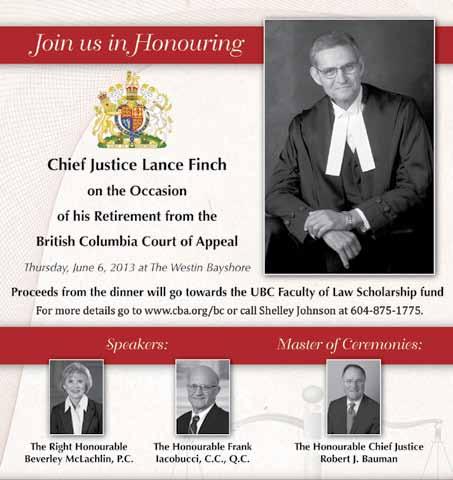
Join us in honouring chief Justice lance finch 22 cBABc wlf education day: April 26, 2013 international women’s day: march 8, 2013
Answer to trivia Question
Practice tip for the family lawyer in supreme court B.c law month April 2013
Also In This Issue
F ROM Th E P RES i DENT
K erry l simmons
Law Day an engaging forum to educate the public
one of the Canadian Bar Association’s best public engagement events is Law Day, and the celebrations that occur across the country throughout the month of April. Why am I talking in February about an event in April? All lawyers who wish the public had a better perception of lawyers and our justice system can get involved now to help change that perception by helping with Law Day celebrations in their communities.
On April 17, 1982, Queen Elizabeth II and Prime Minister Pierre Trudeau signed the Charter, thereby guaranteeing fundamental rights and freedoms for all Canadians. In 1983, the CBA introduced Law Day to celebrate the one-year anniversary of this milestone. Law Day has become our opportunity to introduce the public to the legal institutions that form the cornerstone
of Canadian democracy. It provides our profession an engaging forum to educate the public about the vital role lawyers and the judiciary play in guaranteeing an open, independent and unbiased judicial system.
Throughout B.C., we celebrate Law Day with the Barry Sullivan Law Cup public speaking contest, Dial-a-Lawyer, courthouse tours, mock trials, police dog demonstrations, fun runs, question and answer sessions with judges, and lectures on the law, to name a few of our activities. And if you think this event only highlights our justice system and courtroom work, think again. Some of the best entertainment and education have been brought by skits and events from our Alternative Dispute Resolution and our Wills & Estate Planning Sections.
My first experience with Law Week was in the Cowichan Valley’s Law Day Mock Trial where I assumed the role of the Wicked Witch in the trial of Hansel and Gretel. Those children were charged with mischief for allegedly eating the Wicked Witch’s
website www.bclawweek.org. Like us on Facebook www.facebook. com/bclawweek.
Moving to our bi-monthly update on the CBABC advocacy activities, I am pleased to report that we presented our response to the White Paper on Justice Reform – Part One.
gingerbread house. The courtroom was packed and a local Scout troop formed the jury. I recall the fun I had being part of a community event that showcased the Canadian judicial system rather than that portrayed in yet another US television show. More recently, I enjoyed being part of the Victoria organizing committee for Law Day. That team of sheriffs, court registry staff, Justice Education Society staff and local lawyers gave me a chance to see people with roles throughout the system work together.
Our CBABC Law Week activities are co-ordinated by our Law Week (Regional) Committee chaired by Jasroop Grewal and Law Week (Vancouver) co-chaired by Meghan Maddigan and Serena Chow. Local organizing committees work with the Law Week (Regional) Committee. To find out more about events, contact these chairs or at the Branch Office, Alexandra Presley at committees@bccba. org. Look at the 2013 Law Week
My thanks to Carmen Rogers, QC, Eric Gottardi and Art Grant who co-ordinated our Branch’s response.
In December, the province appointed nine judges to the Provincial Court. CBABC had repeatedly called for these appointments throughout 2012 and it was satisfying to see that they were finally made. That said, more appointments are required to replace judges who left the Bench in 2012 and earlier in order to bring the Provincial Court judicial complement to the required level. Furthermore, we desperately need increased funding for court services, Crown Counsel, Legal Aid and technology. We continue to advocate for these important and fundamental requirements. The province has another opportunity to show its commitment to justice in British Columbia when it presents the budget on February 19.
Kerry L. Simmons president@bccba.org
E x ECUT i VE D i RECTOR
New Year, New Initiatives
a resolution we intend to keep
if an organization made New Year’s resolutions, ours would be: “We resolve to find more meaningful ways to engage and reward lawyers who choose to belong.”
What does that look like? A good example is our initiative to reach out to those who are no longer in the full-time practice of law. The demographics of the legal profession are changing; as lawyers age, fewer are choosing full-time retirement as their next step, and when they are younger, they are more likely to consider career options beyond full-time practice in a law firm environment. We’ve paid attention to those shifts in who is doing what, and have introduced a large discount on membership for two new categories – Non-Practising lawyer and Part-Time practitioner. We know from talking with many of you that staying in touch with colleagues and keeping updated on what’s going
on in the law and justice system is important regardless of where and how you work. If you are a parttime or non-practising lawyer, the option to belong to the CBA for half the cost of the regular fee is our way of supporting your continued engagement with the profession and with the CBA.
Many of you choose to participate in our great professional development programs – through Sections, our PD offerings and the Branch Conference in a sunny location every November (November 15-17 this year – mark your calendar!). As of September 1 of this year, there will be two new options of packages to save you significant money on your participation: at minimum, each package will include a 20 per cent saving on Education Credits that can be used toward any CBABC Section or any CBA PD program across the country. On top of that, to encourage and reward more engagement with us, we’ll be giving an annual rebate on anything you spend with
us above whichever package you purchase. These new initiatives are about more than ensuring you keep more money in your pocket – although we consider that part of our job too! We know that your involvement and engagement in the CBA
We resolve to find more meaningful ways to engage and reward lawyers who choose to belong.
makes us a stronger, more relevant and meaningful professional association. We want you, your colleagues, new students – anyone and everyone who qualifies for membership – to get more out of membership and participation in the CBA.
Along the theme of “getting more” out of life, another new initiative of note is the CBABC Wellness Task Force. The Task Force is a
small group of dedicated B.C. lawyers from diverse practice areas, each at different stages in their careers. Their task is to consider how best to integrate into existing CBA programs and services the concept of supporting wellness in the legal profession. The reality is that every one of us experiences stress and times when we don’t take care of our physical, emotional and spiritual needs.
The big challenge for the legal profession is that there are some specific characteristics of the individuals who choose to become lawyers – and their work environments – that result in some real barriers to admitting a need for help or making personal wellness a priority.
The reality is that lawyers are no different from other humans –really! We all need a sense of connection to one another, a sense of security in being who we really are, and permission (mostly from ourselves) to make our personal wellness a priority. The Wellness Task Force will be making recommendations in March. If you have ideas you think they should consider, I look forward to hearing from you.
Caroline Nevin cnevin@bccba.org
id J. B ilins
Is There an iPad in Your Future?
One in three lawyers are already using one
r It’s all about the Apps Store and iTunes. They continue distribution of software media.
iPad (do do do do do)
iPad (do do do do)… r
– Lyrics, music and recorded by Parry Gripp.
gerry Purdy PHD, an expert on wireless technologies, has made a prediction. In the future, you will own three devices:
1. a smartphone (to make calls, check on email and messages and do light web browsing);
2. a tablet (to do more review of content, more serious web browsing and messaging); and
3. a desktop or notebook PC device (to create original content that is read on other devices). What is driving his prediction? For one, mobile device sales (smartphones, iPads) already exceed those of desktops/laptops. Secondly, mobile web traffic is about to exceed desk-based web use. We are a mobile, connected world and we want applications and devices that enable our lifestyle. Furthermore, iPads represent lawyers taking charge and gaining access to technology that does not involve having to deal with the law firm IT department and all their restrictive policies. The other factor is the ease of use of the iPad as compared to traditional PC-based technology. The iPad has exceeded everyone’s expectations on these criteria. Apps which traditionally run from free to $9.99 (and in some cases more) place incredible processing power in the hands of users. Games, book readers, word processing, presentation software, business
apps – there are literally hundreds of thousands from which to choose. News apps from the NYT, BBC, AP and others place you in the center of the “what’s happening now” world. TweetDeck and Facebook allow you to comment and connect with the Twitterverse about what is happening now.
Wi-Fi or cellular data plans connect your iPad to the world. Inexpensive online storage is available via Dropbox, iCloud and others. Courtesy of such online synchronization and storage services, you can have the latest version of your documents, photographs and more available wherever you have a web connection. You can embed and present graphics, videos and more in presentations using Keynote for court, mediations or meetings. Gray’s Anatomy app places medical-school quality illustrations at your fingertips for evidentiary purposes. Contacts, calendars and reminders
can all be synched and available to you whether you are on an iPad, iPhone or Mac. Photos and videos can be viewed on the iPad’s “retinal” display that has more pixels than you have receptors in your eye, producing a stunning visual experience. Social media content can be easily accessed, updated and created in different apps and shared with the world.
There are apps for organizing your information in myriad ways. Evernote, an online notebook app, is a world-class organizer of all types of information from text to web pages to images and videos – and unbelievably, it is free. Evernote is your traditional paper notebook –on steroids! Wunderlist is a task manager that synchs your ‘to-dos’ across your PC, Mac, iPad, iPhone and Android devices. You can use it to collaborate and co-ordinate tasks amongst team members as well as share shopping lists with your spouse.
the views expressed herein are strictly those of the author and may not be shared by the law society of British columbia. continued on page 7 >>>
David J. Bilinsky is the Practice Management Advisor for the Law Society of British Columbia. Email: daveb@lsbc.org Blog: www.thoughtfullaw.com
dave’s techtips
What are those essential apps that are out there for lawyers for the iPad?
here is a selection:
TRiALPAD: At $89.99 this is the most expensive app i have seen. however, it is the equal of trial presentation software for the Pc that costs hundreds of dollars more. this is one highgrade presentation app that has been designed with trial lawyers in mind (it is also a wonderful app for anyone doing highlevel presentations). it does PowerPoint-type presentations with such features as call-outs (expanding a paragraph of a document for emphasis). it has a whiteboard for brainstorming or note taking. it imports all sorts of formats, including Pdf, PowerPoint, word, tiffs and others. it can play videos or clips and do much more. Very highly rated.
TRANSCRiPT PAD ($49.99): from the same people as trialPad, this app is dedicated to reviewing discovery transcripts. After importing a transcript via
continued from page 6
Apps such as LogMeIn and GoToMyPC can connect you to your office desktop from wherever you may be. Kayak, a travel app, can help you book flights, hotels and more to those distant lands. Tired of typing? Dragon Dictate and other
email, you can use colors that are associated with “issues” in the case (causation, damages etc.) to annotate the transcript. from there, you can jump to the passages that you have marked or export them to a report organized by issue/color. once you have created an “issue code” you can use it in other cases (for consistency) if you wish. you can create a report in text, Pdf or table format by issue code (just containing the text that is relevant). you can import exhibits (Pdf format) but can’t (as of yet) annotate or highlight exhibits (coming in a later version). transcript Pad does not (as of yet) incorporate collaboration via the web (i am sure this is coming as well) and it doesn’t (as of yet) work with real-time feeds. however, this is a solid transcript search and annotation app.
PAGES ($9.99) has been designed by Apple to be the best word processing experience on the iPad. it can import word documents and others. you can insert images and drag them into the proper location. All the standard formatting features are incorporated. saving the document as a Pages, word or Pdf document is straightforward. you can also save to evernote, the icloud and dropbox. its companion app is numbers ($9.99) which is a spreadsheet application for the iPad.
DOCUMENTS TO GO
(basic $9.99, premium $16.99) is another word processing app that allows you to import word, PowerPoint and excel files. there is a good selection of formatting options, including bulleted lists, styles, undo and redo, find and replace, and word count.
PAPERPORT NOTES is a different note-taking app (free). here you can dictate your notes right into the app and organize them using its “note sets” ability. it integrates with dropbox and Box.net for file storage. it is an alternative to evernote.
NETfLix ($9 per month) grants you unlimited access to their movie database. while you don’t get current releases and their catalogue in canada is perhaps not quite as large as one might wish, the price is unbeatable. you can stream media to all your devices (your hdtV via AppletV, iPad via your netflix app, smartphones etc.). it also grants you access to hundreds of online radio stations and more. if you are a movie buff, this app is for you!
fACETiME: this app is pre-installed on the iPad. it allows you to make free video calls over wi-fi to anyone’s iPhone, iPad, iPod touch or mac.
apps can do voice recognition or voice recording. Feel like note taking the old-fashioned way? Penultimate is a stylus note taking app that also allows you to draw in colors, insert a photo and draw on it and organize your handwritten notes.
Ultimately it is all about the apps on the iTunes and Apps store. They open up a whole new world of software and media and place that in your hands on the iPad, allowing you to do whatever it is that you wish to do.
tony wilson
The Golden Age of T.V. Clowns How JP Patches got me hired (sort of)
there are some of you who might actually recognize the man whose photo is next to mine in this print edition of BarTalk. But I’ll bet you don’t know that his real name was Chris Wedes, and if he took the job he was offered by CBC Toronto in 1956, those of us who were kids in the 60s and 70s would never have known JP Patches, the resident T.V. Clown at KIRO in Seattle. He died in July at 84. No doubt, there will be those who might wonder why on Earth BarTalk would publish a column in a Canadian legal magazine about a Seattle T.V. Clown whose kids show went off the air in 1981. “He had nothing whatsoever to do with law,” I hear them rant.
So I’ll tell you. It’s because of the Douglas Symes and Brissenden Christmas skit of 1985. The video we articled students did that year (when “videotaping” the skit was cutting edge)
had running gags that were lifted straight out of JP Patches. As that skit more or less got me kept on as an Associate at DS&B, I feel compelled to write about old JP and to posthumously thank him for launching my career. Had that skit bombed, I wouldn’t have been kept on and would have been thrown out on the street begging for lattes, sushi and Pinot Noir.
Like Chaplin, Keaton, Tim Conway, Laurel and Hardy and other slapstick entertainers of yesteryear, JP Patches had the gift of timing, self-deprecation and pie-in-the-face humour that still works wonders in improv clubs today. But instead of doing stand up in L.A., the Ed Sullivan Show in New York or having a career in film, he ended up in Seattle doing children’s television.
Until the arrival of cable in 1965, my humble home in the poorer part of North Oak Bay was just too far away from Vancouver to receive Razzle Dazzle on our antenna, so my brothers and I grew up watching Seattle T.V. JP was on at 7 in
Once cable replaced T.V. antennas, Chris told me the show developed a huge following in B.C., and many members of the B.C. Bar probably grew up watching JP and Gertrude.
JP outlasted all the other local kids’ shows. His afternoon version was cancelled to make way
the morning, and again at 4:00 p.m. in glorious black and white. Cartoons were interspersed with JP’s improvised comedy, pies in the face, pratfalls, a cameraman who would nod “yes” or “no” with the motion of his camera, and regular visits from Ketchikan the Animal Man, Boris S. Wort (the Second Meanest Man In The World), JP’s “Girlfriend” Gertrude, Ggoorrsstt the Friendly Frpl, Miss Smith from Miss Smith’s motorcycle delivery service and others; all of them played by his sidekick, Bob Newman, (who was a KIRO floor director when he wasn’t “on screen”).
I tried to hire JP for a party a few years ago, and I spoke to him about the show. He said it was unrehearsed, improvised comedy in the “Golden Age” of local T.V. when a floor director like Bob could put a mop on his head, crack jokes in a falsetto voice and be a star. And for 13 years out of the show’s 23 years on the air, Chris and Bob did it twice a day, live.
for “The Big Money Movie” and the morning show lost out in 1981 to something like “Eyewitness News.” It seems the demographics had changed. The boomer kids had grown up and weren’t watching T.V. clowns anymore. Some were even having their own kids.
I last saw JP’s show while on a ski weekend in Kelowna in the late 70s. He was using the “ICU2TV” to wish Cindy a happy 32nd birthday and Billy a happy 40th. After he gave his birthday greeting to kids who weren’t kids anymore, he did a quick traffic report followed by the weather. Then Gertrude threw a pie in his face.
Now, why can’t we see that on T.V. anymore?
guest
l indA K. r o B ertson
Coaching: A Practice Development Advantage How lawyers can benefit from coaching
richard, a partner in a law firm, feels that every day he just puts out fires without any real control over the chaos of his busy practice. Sarah, a partner at a small firm, has just returned from maternity leave and is challenged by how to rebuild her practice and find the time and energy to spend with her new baby. Thomas, a young associate, wants to become a partner someday but wonders if he’s doing what is needed to make that happen.
Each of these lawyers wants to manage their work and career better. Richard knows what he should be doing to manage his time but can’t seem to stick to any routines. Sarah has no idea how she can practise law and be a parent at the same time. Thomas wonders if he is in the right practice area or with the right firm.
The answer to each of these challenges cannot easily be learned in a classroom or from a book. Just as athletes work with a personal coach to improve their game, lawyers and business people can work with a professional coach to improve their practice management and business development skills, make better career decisions, transition to another job or become stronger leaders.
Coaches provide confidential, unbiased support to their lawyer
clients to assist them in clarifying what they want to change, develop a plan to reach those goals and provide support and encouragement along the way. When the plan runs into a roadblock or the lawyer gets discouraged and wants to give up, a coach works with the lawyer to develop an alternate plan or to find the motivation to change.
It is often hard to change behaviour on our own. We need feedback. We need someone to ask about our fears around changing, and most importantly, someone to hold us accountable to make the change. Just as
Coaches help their clients come up with solutions that the client has generated. What might work for the coach or the coach’s other lawyer clients, might not work for everyone. Each person has to find his or her own solutions based on his or her own personal motivation and strengths.
Lawyers today need a whole range of skills that are not taught in law school. They need to be entrepreneurs and understand how to run a practice like a business.
engaging a personal trainer at the gym encourages us to show up every week on time and stick to the exercise plan, a professional coach keeps us on track to reach our goals.
Lawyers today need a whole range of skills that are not taught in law school. They need to be entrepreneurs and understand how to run a practice like a business. They need to develop the confidence to have difficult conversations with clients. They need to manage their time effectively in an increasingly fast-paced world. They need to develop resiliency so they have energy left over for their families and a personal life. They need to make tough career decisions around what kind of practice or legal environment will work best for them. Lawyers need to be leaders of practice groups, firms or legal departments and understand how to manage and to motivate their peers.
All of these new behaviours can be learned but it can be hard to make a change without support. A coach can guide and support the change one step at a time. Corporations have embraced coaching especially for their management and executive employees. Lawyers are increasingly using it as one more tool in their toolbox to create more successful practices.
Linda K. Robertson, BA, LL.B, LL.M, is a Lawyer Coach in Vancouver, B.C. www.lindakrobertson.com
sections
Keep Current A review of provincial Section meetings.
Animal Law
Meeting: October 31, 2012
Speaker: Paul van Westendorp
Topic: Regulatory Environment for Urban Animal Husbandry
Maritime Law
Meeting: October 18, 2012
Speaker: David S. Jarrett
Topic: Monthly Maritime Law Section Meeting
Alternate Dispute Resolution
vancouver
Meeting: November 20, 2012
Speaker: Renee Collins Goult, Roster
Program Manager, Mediate BC Society
Topic: The Notice to Mediate: A Litigation Tool for Counsel and an Appointment Enabler for Mediators
international Assistance
Meeting: November 22, 2012
Speakers: Alison Hopkins (pictured) and Heather Wojcik
Topic: CBA Young Lawyers international
Animal Law
uPaul van Westendorp, Provincial Apiculturist, B.C. Ministry of Agriculture, provided an overview of the various regulations and standards facing beekeepers. The legal issues surrounding beekeeping have changed as some municipalities have begun allowing urban residents to manage their own hives. Beekeeping has evolved into a complex management system of animal husbandry. Beekeepers, professional and hobbyist, must take into account a range of legislation from local bylaws to animal health and food safety standards. Mr. Westendorp explained the importance of bees, which are critical pollinators for many plant species, to agriculture in B.C. He also discussed the various municipal regulations affecting urban beekeepers to prevent the importation of diseases or mitigate their impact, and legislation and regulations control the movement of bees into and within Canada and around the province. To this end, regulations divide British Columbia into 14 Bee Districts.
Maritime Law
uDavid S. Jarrett spoke to the Section regarding a recent case at which he acted as co-counsel with Peter G. Bernard, QC. Peter and David successfully defended the ship Dubai Fortune and Fortune Maritime Ltd. against a claim of vicarious liability brought by a shipping company in response to damage done to another vessel. The tugboat that collided with the Plaintiff’s vessel was found to be the only liable party, and the claim of vicarious liability was dismissed.
A Federal Court case was discussed involving one of three derelict vessels at Britannia Beach. These vessels were owned by a Society that has ceased to exist and was struck from the register. The Society, by letter, delivered them to the province. The Society Act s.73 provides that assets of a society that is dissolved must be transferred or delivered to the Minister of Finance. On that basis, a claim was made against British Columbia as owner at the time, for pollution resulting from the vessel.
Alternate Dispute Resolution
Vancouver
uRenee Collins Goult, Roster Program Manager at Mediate BC Society, gave a presentation on the Notice to Mediate as a tool for litigation. The Notice to Mediate has its origin in B.C., and various Notice to Mediate regulations apply to different areas of law. A Notice to Mediate is used when seeking to resolve a dispute outside of the courts, but there is a lack of cooperation between the parties. Renee described the process of using the Notice to Mediate, beginning with the determination of its suitability to the situation. The Roster Office takes over when a Notice to Mediate is served. Once they have confirmed or clarified all of the information in the notice, they can provide a list of Mediators from the Mediate BC Roster and offer appointment times to both sides.
International Assistance
uThe International Assistance Section meeting on November
22, 2012 focused on the Canadian Bar Association’s Young Lawyers International Program for 20112012. Two past participants came to speak to the Section about the program, the work they completed, and their experiences practising law abroad. Alison Hopkins presented on her work at the Legal Resources Centre in Durban, South Africa and Heather Wojcik presented on her work at the Guyana Legal Aid Centre in Georgetown, Guyana. The group engaged in an active discussion on strategic litigation to advance human rights, the differences in their respective constitutions from Canada as well as their personal experiences in these foreign placements.
For enrolled CBA members, more detailed information and available minutes from the Section meetings are online at www.cba.org/bc in CBABC Forums and Sections under Professional Development.
senior lAwyers section news
The Senior Lawyers Section has been going from strength to strength. its dinner meeting format has proven quite successful. The highlight of last year’s list of speakers was Chief Constable James Chu. Lined up for this year are Roberta Rich, former family law lawyer and presently bestselling author and Tom Berger, politician/judge/lawyer. Meetings have been drawing between 18 and 25 attendees. Former judges and members of the profession regularly attend. Speaker’s topics continue to feature an eclectic mix of matters of interest.
s ection n ews
Natural Resources Law
At Provincial council last June, the natural resourcesforestry section was renamed the natural resources law section. natural resource industries continue to play a strong role in British columbia’s economy. in changing the name, natural resources law section members aimed to better reflect the current state of the natural resource sector in B.c., and the growing importance of the mining and energy industries within it. these industries are linked by legislation and, to a lesser degree, by the interests represented within sector. the section updated their mandate as well, to acknowledge that practitioners from all natural resource sectors in British columbia are welcome.
In resolution: This name and mandate change was discussed at the last meeting of the Natural resources – Forestry Section and was approved by those members in attendance. The Executive and the membership of the Section who discussed the name and mandate change are of the mind that “Forestry” is overly restrictive and narrow considering the natural resource industries in British Columbia also include such industries as mining and energy. Of late, activity in the forest sector has declined and both the mining and energy industries have seen growth, although such industries do not have Sections themselves within the CBA. There is a sizable number of practitioners in Vancouver that may be interested in having one Section to represent all natural resource sectors in British Columbia.
To allow encumbrances against licences Amendment of the Personal Property security act
Historically, the fishing industry in Canada has suffered from poor access to capital because at common law a licence is not considered to be property. As a result, lending institutions have been very reluctant to accept fishing licences as collateral for loans. In the fishing industry where the cost of fishing licences often exceeds the cost of fishing vessels and equipment, this was a significant problem until 2008 when the Supreme Court of Canada decided Saulnier v. Royal Bank of Canada, 2008 SCC 58. This case held that although a fishing licence was not property at common law, for the purpose of the expanded definitions in both the Bankruptcy and Insolvency Act and the Nova Scotia
B.C. passed Bill 5, which expanded the definition of “licence” in the PPSA so that the PPSA applies to other types of licences, including fishing licences. This amendment was brought into force by Order in Council on September 1, 2012.
While this legislation greatly improves the situation, it does have some limitations, including the following:
1. the legislation applies only to the parties to a loan agreement and their respective receivers and/or trustees in bankruptcy and does not bind the Federal Department of Fisheries and Oceans;
Personal Property Security Act, a fishing licence was considered property and could be encumbered. This decision was good news in Nova Scotia and most other provinces, but not such good news in British Columbia because, up until recently, the B.C. Personal Property Security Act (PPSA) had a restrictive definition of the term “licence” that limited the application of the PPSA to licences to harvest timber and Christmas trees. As a result of the Saulnier decision, a subcommittee of the Maritime Section of the B.C. Branch of the Canadian Bar Association consisting of the author, Brad Caldwell and Jack Buchan, took the initiative to write to the Ministry of Finance in June of 2009 proposing an amendment. On November 22, 2011, the Province of
2. there is a rebuttable presumption that legislation only has prospective effect, so loan agreements signed before September 1, 2012 that purport to encumber fishing licences would likely not be enforceable; and
3. the legislation provides that a licence may be disposed of “only in accordance with the ... terms and conditions of the licence,” so licences must be reviewed to ensure they do not contain any language limiting the rights of creditors.
It is also good news that as a consequence of the Saulnier decision the Department of Fisheries (DFO) has instituted a notice and acknowledgement system whereby persons loaning money to fish harvesters can register a notice with DFO.
It is likely that this amendment will also be welcomed by many other industries in B.C. where participants also purchase government issued licences.
Brad Caldwell, Maritime Law, Caldwell & Co. Law Corp.
e lyn Underhill
The Nuts and Bolts of Arrest
The secret weapon of the maritime lawyer
Arrest is the secret and distinguishing weapon of the maritime lawyer. The arrest or threat of the arrest of a ship, which usually prevents the vessel from earning income, will quite often induce the ship owner to quickly settle the claim being advanced by the party doing the threatening or the arresting. Even if the claim is one that cannot be settled quickly, the arrest will give the arresting party the advantage of having security to look to satisfy the ultimate judgment. Both the Federal Court and the Supreme Court rules provide for the arrest of a vessel (and cargo or freight).
Section 22 of the Federal Court Act sets out when the Federal Court and the Supreme Court (see Rule 21-1(2)) have maritime jurisdiction and consequently when an action can be brought “in rem.” An action in rem may be brought against a ship where there is a claim relating to that ship in respect of ownership, employment, earnings, a mortgage, damage or loss of life or personal injury caused by a collision or otherwise, cargo, the carriage of goods or passengers, salvage, towage, construction or repair of a ship, crew wages, marine insurance and dock charges.
Once the action has been commenced, an arrest warrant for the ship or property may be obtained
without court appearance on the filing of a short and simple affidavit. The rules also provide that the claiming party can arrest a ship in the same ownership as the ship to which the claim relates. The sheriff then serves the arrest warrant by attaching it to a conspicuous place on the ship. Once arrested, the vessel cannot be moved without a court order or consent of the parties. Possession remains with the party having possession of the vessel prior to the arrest.
judgment) as security and this is common where a reputable protection and indemnity club or an insurance company is posting the security. Failing agreement, the court will accept cash deposited with the court or a bail bond in the prescribed form.
If no security is posted, the vessel will remain under arrest until the trial has been heard and judgment rendered. In cases where the vessel or other property is a wasting asset, the court may, on application by the plaintiff, make an order for the sale of the property. Depending on the circumstances, that order for sale may be a private sale or a sale by public auction but more likely the latter.
The owner must post security for the plaintiff’s claim if the owner wishes to have the vessel released from arrest.
Arrest is an extraordinary remedy that has been available to plaintiffs in the admiralty court for hundreds of years.
The plaintiff is entitled to security for its reasonably best arguable case (that includes prejudgment interest and costs) up to the value of the vessel. If the parties cannot agree on the amount of the security, the court will decide on an application to set bail. The parties may agree to accept a letter of undertaking (a promise to pay the
Once the defendant ship owner submits to the jurisdiction of the court, the action proceeds not only in rem but in personam against the ship owner.
If the plaintiff’s action fails, damages for wrongful arrest may only be awarded where the arresting party acts with either bad faith or gross negligence.
Arrest is an extraordinary remedy that has been available to plaintiffs in the admiralty court for hundreds of years. A plaintiff can take comfort in knowing security has been posted and the bail stands in the place of the ship which may be lost or leave the jurisdiction.
Elyn Underhill, partner at giaschi & Margolis (a commercial, mediation and litigation practice dealing with maritime matters and transportation law).
mich A el dery
Parlez-vous français? Treaty precludes award of damages for language rights violation
One of the most interesting aspects of aviation law involves the determination of which legal regime applies to a particular case. Because aircraft fly across provincial and national borders, lawyers practising in the field of aviation may find themselves dealing with provincial law, federal law, foreign law or international treaties. There are times when all of these laws may apply and there are times when conflicts between these laws must be resolved.
In Thibodeau v. Air Canada, 2012 FCA 246, the Federal Court of Appeal considered an apparent conflict between the Montreal Convention and the Official Languages Act, R.S.C. 1985, c. 31 (4th Supp.) (the “OLA”). This case resulted from a complaint filed by Michel and Lynda Thibodeau with the Commissioner of Official Languages. The Thibodeaus complained that Air Canada did not offer them service in French during two round trips between Canada and the United States.
In general terms, the Montreal Convention is an international treaty that governs passengers’ claims against airlines for injury or death suffered during an international flight or when embarking or disembarking from an international flight. The Convention also governs claims for loss or damage to baggage and cargo, and
delays in air carriage. The Convention entered into force in Canada on November 4, 2003, and is incorporated into Canadian law by the Carriage by Air Act, R.S.C. 1985, c. C-26. It is intended to unify and codify the rules governing international carriage by air, to provide greater certainty and predictability and to ensure protection of consumers.
The OLA requires Air Canada to provide its services in French.
The OLA is meant to apply to federal institutions, but Air Canada’s former obligations as a Crown Corporation were continued after the company was privatized. Under the OLA, courts may award damages in “appropriate situations.”
except in cases where it provides for a remedy, and held that it constitutes a complete code in respect of the aspects that it expressly regulates. This includes air carriers’ liability for damages, regardless of its source. The conflict between the Convention and the OLA was resolved in the following manner.
The OLA states that courts may only award damages under the OLA “in appropriate situations.”
Accordingly, the Court ruled that it would not be appropriate to award damages under the OLA in situations where the Montreal Convention governs.
Among other remedies, the Federal Court awarded the Thibodeaus $6,000 each in damages.
On appeal, Air Canada argued that the Federal Court did not have jurisdiction to grant damages in respect of three of the violations, because these occurred on international flights, which were exclusively governed by the Montreal Convention.
The appellate court agreed, finding that the Convention precluded the awarding of damages for causes of action not specifically provided therein. It rejected the position that the Convention has no force
The exclusivity of the Convention as a remedy for claims in respect of international carriage was previously unsettled in Canada, with courts in different countries taking opposing views. Some have held that the Convention is the exclusive legal regime under which a claim may be made, and that if it is silent on an issue, a remedy is not available. Others have held that where a cause of action is not provided by the Convention, it may nonetheless be available under domestic law.
The Federal Court of Appeal’s decision may not be the last word on this issue, however, as the Thibodeaus have sought leave to appeal to the Supreme Court of Canada.
Michael Dery is a partner at Alexander holburn Beaudin + Lang LLP. his practice concentrates on aviation and transportation law. he provides counsel and advice to clients on a variety of litigation and regulatory matters particular to the aviation industry.
Aircraft Accidents Damages for psychological injury
The next time you take an international flight, check for a notice that the Montreal Convention governs your flight. This convention limits what you may recover in the event of an accident on board the aircraft. It also ensures that you will be able to recover up to a certain limit for injuries sustained during the flight.
The issue of what injuries would be compensated has persisted since the Warsaw Convention was implemented in 1929. The Warsaw Convention was replaced in 1999 by the Montreal Convention. Both conventions refer to “bodily injury.” This term was interpreted for decades as excluding psychological injury. For some people, the simple act of flying could be terrifying. Compensation for that fright was not allowed.
Domestic law around the world recognized and compensated persons injured in other kinds of accidents for both physical and psychological injury. The exclusion of compensation for a psychological injury in aircraft accidents began to appear unfair.
Commencing in the United States, a series of cases established that the term “bodily injury” could be extended to include psychological injury where the psychological injury flowed from the bodily injury. The interpretation does not go so far as to allow compensation for psychological injury that arises from the accident itself.
The psychological injury must arise from the bodily injury. This could be depression flowing from the constant pain of the injury or post-traumatic stress disorder.
The case of Jack v. Transworld Airlines (1994 USA) established the mainstream interpretation of the term “bodily injury.” In that case, the aircraft experienced an aborted takeoff, crash and fire. Fire destroyed the plane but all passengers survived. Plaintiffs with impact injuries were able to recover for their impact injuries and the emotional distress flowing only from the physical injuries.
ficulties, and fear of flying. The Appeal Court found no evidence of a causal connection between the Ehrlich’s bodily injuries and their mental suffering. The result was that the Erhlichs could not recover for psychological injury.
The time for psychological injury to occur can be quite short. When Mr. Ospina was blown out of the aircraft by an exploding bomb there was a period of conscious suffering of a range of five to ten seconds before death. The court found that Mr. Ospina suffered physical injury, which then caused him psychic harm.
The decision in Jack was referred to as the “mainstream view” in the
for some people, the simple act of flying could be terrifying. Compensation for that fright was not allowed.
case of Ehrlich v. American Airlines (2004 USA). In that case, the aircraft overshot the runway and was stopped suddenly by an arrester bed. The Ehrlichs complained of injuries to their knees, neck, back, shoulder and hips. They also complained of mental injuries, including nightmares, sleeping dif-
It was appropriate to award damages to compensate for that harm.
In re Inflight Explosion on Trans World Airlines, Inc. (1991 USA). In Canada, there has not been a decided case in which there was physical injury and psychological injury flowing from it. Attempts have been made to obtain compensation when the injury was only psychological and there was no physical injury. They have been dismissed. That was the case in Plourde v. Service aérien (2007 QCCA) and in Walton v. MyTravel (2006 SKQB).
In a recent British Columbia case, awaiting judicial decision, it was argued that there was both physical injury and psychological injury flowing from the physical injury. The decision in Wettlaufer v. Air Transat is awaited with interest.
David Varty practises civil litigation in Vancouver with Varty & Company. his practice includes air law. he is the plaintiff’s legal counsel on the Wefflaufer case. he produced Air Law in Canada: A British Columbia Perspective
dAV id VA rty
christine m U rr Ay
An interview with Prashant Bhushan Human rights and anti corruption activist
Prashant Bhushan has been advocating in the Supreme Court of India since 1983. His practice focuses on human rights, environmental and public interest law. He is a wellknown, respected, and often controversial figure beyond the borders of his native India.
Mr. Bhushan visited several Canadian cities in 2012 at the invitation of the World Sikh Organization. While in Vancouver, he spoke at a B.C. Branch of the Canadian Bar Association event “In Conversation with Prashant Bhushan: Accountability and its Impact on Human Rights.”
This brief interview provides a tip-of-the-iceberg look at Mr. Bhushan’s very accomplished career, and what the future may hold.
WHAT MOTivATED YOU TO GO iNTO THE LEGAL PROfESSiON?
Having witnessed some of the extremely important cases in India such as Mrs. Gandhi’s election case (1975) on which I also wrote and published a book, “The Case that Shook India” (Vikas Publishing House: 1977), the Habeas Corpus case (1976), and the Kesavananda Bharati aborted review, I realized that law could be an interesting profession where one’s work could also have an important impact on society.
I was fortunate to be able to observe these cases from a vantage point because my father (Shanti Bhushan) was the lawyer in the first two. After getting into the profession, I have mostly done public
interest cases, which have given me the opportunity to understand some of the most critical issues of Indian society such as civil liberties, human and social rights of the poor, environmental issues, issues concerning corruption and the accountability of public servants, again from a vantage point.
WHAT COURT CASES ARE YOU CURRENTLY WORKiNG ON?
I have been working recently on a number of cases involving corruption. For example, the 2 G Telecom scam cases, the Coalgate scam case, and the Scorpene Submarine Deal case.
They need to be made much more informal and simple so that people can access them without lawyers.
WHiCH SPECifiC iSSUE(S) DO YOU PLAN TO DEDiCATE THE MAJORiTY Of YOUR TiME TO iN THE fUTURE?
I will continue to spend a good part of my time on important public interest cases, while restricting further the few private cases that I handle. I will also be devoting some of my time to look after the Sambhavna Institute of Public Policy and Politics that I have helped to found in Palampur, Himachal Pradesh (www. sambaaavnaa.org) and the Cam-
I have also been working on the case for making India’s Intelligence Agencies accountable (CPIL v. Union of India), the case against the Koodankulam Nuclear Power Plant, cases regarding the rights of slum dwellers, rickshaw pullers and street vendors of Delhi, and the case against genetically modified foods in India.
HAvE YOU HAD AN OPPORTUNiTY TO OBSERvE CANADA’S JUSTiCE SYSTEM? if SO, WHAT ARE SOME Of YOUR REfLECTiONS?
I have not had the opportunity to witness the Canadian legal system very closely but modelled as it is on the British system, as is the Indian system, I have some understanding of it. I feel that these judicial systems are too procedurally complex and lawyer friendly and thus difficult for common people to access.
paign for Judicial Accountability of which I am the convenor (judicialreforms.org). I will need to devote an increasing amount of my time to the Aam Aadmi Party led by Arvind Kejriwal of which I am a founding member. This party was born out of the anti-corruption movement and is committed not just to legislation to put in place an independent anticorruption ombudsman but also to change the nature of our democracy to a more decentralised participatory democracy, apart from fundamentally and structurally reforming the major institutions of governance such as the police, the civil services and the judiciary.
L-R: Christine Murray, partner at Cassels Murray. Prashant Bhushan’s specialization covers Public interest Litigation.
What Lawyers Do in the Community Here and abroad
Search and Rescue Community Honours Don Blakely
The National Search and Rescue Program Award of Excellence for Exemplary Service was awarded to Don Blakely of Vernon Search and Rescue (SAR) in British Columbia. The Award of Excellence recognizes members of our community who have solved a problem or successfully leveraged an opportunity that has served to enhance search and rescue. Mr. Blakely was honoured for his 24-year commitment to volunteer ground SAR at the local, provincial and federal levels. Without Mr. Blakely’s energetic, determined, thoughtful and detailed approach, the SAR service throughout Canada and particularly in B.C. would not be what it is today. in B.C., the SAR volunteers respond to more than 1000 callouts per year, and to do so successfully involves a great deal of background work. Mr. Blakely has been involved in much of that work, as well as responding to SAR incidents. his input has been key to creating the response capability that exists today in British Columbia.
géraldine Underdown, Executive Director of the National Search and Rescue Secretariat (NSS), said “Mr. Blakely’s work has improved the SAR response, and thousands of volunteers and their families as well as subjects and their families have and will benefit from his hard and sustained work over the past 24 years.”
The NSS is an autonomous arm’s length organization of the federal government that reports directly to the Lead Minister for Search and Rescue, the Minister of National Defence. Created in 1986, the Secretariat manages and coordinates the National Search and Rescue Program (NSP) by working with various levels of government, police and emergency services and volunteer search and rescue organizations across Canada.
Michael Welsh in Haiti
in his 24 years in Rotary, Michael has participated in a number of international service projects, most recently in haiti in April 2012. The haiti project was focused on providing safe drinking water for residents of Milot, on the north coast near Cap-haitien. The Rotary team from B.C. and Washington State delivered and provided instruction on the use of household water filters to local families. Michael also worked with a community near Milot to build a prototype community water filter, as the local well was contaminated. The residents built the cinderblock shelter and Michael assembled and installed the filter. Michael and the other Rotarians each paid their own travel and accommodation costs and their clubs paid for the filter equipment. Rotarians also set up a micro-financing program for local women to build small businesses, as many families have no income. Michael says, “haiti is a country of great tragedy but also great hope. The people are uniformly generous, friendly and proud of their heritage as the only nation founded by slaves who successfully fought for freedom. The north is beautiful, with soaring mountains and tropical beaches, but infrastructure is non-existent and there are huge problems of water-borne diseases, mostly notably cholera. Clean water is vital for the sake of everyone, but particularly the children.” Responding to recent criticisms of Canadian aid to haiti, he comments, “My experience is that aid is often most effective in small scale projects where a NgO or other group works directly with a local community, learning what that community sees as its needs and pairing with it to effectively meet them. Especially in haiti, where so much is needed for even the most basic living standard, a lot of money can seemingly disappear with no visible effect. That is why large scale programs can seem not to accomplish much.” Michael plans to return to Milot soon to monitor the project and to look at ways it can be expanded.
news&events
Canadian Legal Conference 2013 – Save the Dates!
The 2013 Canadian Legal Conference takes place August 18-20 in Saskatoon. Be a part of the only national gathering of Canada’s legal community and attend to connect with your peers and participate in interactive, leading edge PD sessions. Watch for all the details in early spring.
c BA n Ation A l news
Deanna Ludowicz of Grand Forks Receives Legal Aid Leader Award
Envisioning Equal Justice Summit
for too long, we’ve been talking about an access to justice crisis without making tangible progress. But as the crisis has gotten worse, our knowledge base has grown, and strategies are emerging to build a practical vision of equal justice. if you’re looking to make a meaningful contribution and help resolve the crisis, you need to attend the cBA’s envisioning equal Justice summit, April 25-27 in Vancouver. At the summit, you’ll develop practical strategies, skills and tools for building a more just society and take home new ideas to use in your own work. you’ll also earn at least 12 cPd hours in the process.
\ To learn more and register, visit: http://j.mp/equaljusticesummit
deanna ludowicz of grand forks, B.c., is the cBA’s most recent winner of the legal Aid leader Award. having spent her legal career assisting clients in need, ludowicz has built a reputation as a champion for those without an advocate and for encouraging others to promote and defend the legal aid system. impressively, she has been involved with every level of legal aid in British columbia: as a staff lawyer at the Upper skeena counseling and legal Aid society in hazelton, as a sole practitioner in grand forks, and as a legal services society Area director and as a local agent. in 2009, she was appointed to the Board of legal services society by the law society of British columbia, serving as Vice-chair of the society (2010-11) and member of the executive committee.
\ for more about Deanna, and to learn how you can nominate a deserving colleague for the award, visit: www.cba.org/cBA/Advocacy/legalAid/
c BA n Ation A l news
c BA n Ation A l news
Saskatoon, Saskatchewan.
c
BA n Ation A l news
Two Candidates Running for CBA National Second Vice-President
Two candidates from Ontario are vying for the position of CBA Second VicePresident for 2013-2014: Janet Fuhrer of Ottawa and Paul Sweeny of Burlington. Once elected, the Second Vice-President will go on to become the First Vice-President in August 2014, and then President of the CBA in August 2015.
All members of CBA National Council are eligible to vote, as per CBA bylaws. Members will cast their ballots online using secure voting technology. An email containing voting information will be sent to Council members in mid-February. The election will begin on February 19 at 8:00 a.m. (ET) and will end March 21 at 8 a.m. (ET). The winner will be announced on March 21 following a tally of the votes.
\ To learn more about the candidates, visit: www.janetfuhrer.ca and www.paulsweeny.ca
c BA n Ation A l news
FAQs on Solicitor-Client Privilege for In-house Counsel
Building on the popular 2010 fAQs on Privilege and confidentiality for lawyers in private practice, the cBA ethics and Professional responsibility committee and the cccA have produced a new series of fAQs about solicitor-client privilege and confidentiality aimed to meet the needs of in-house counsel. the new fAQs cover the basic principles and offer practical
Count Yourself In
one of the ways the cBA can better serve its members is through an enhanced understanding of who they are. the national membership committee, in consultation with the equality committee, has implemented a self-identification module on the cBA website whereby members can update profiles to be statistically counted
guidance for difficult situations. sample questions include “what are the exceptions to the duty of confidentiality and solicitor-client privilege?” and “what do i do when there is a possibility of a crime or fraud occurring?”
\ for the answers to these questions and more, visit: www.cba.org/ CBA/activities/code/privilege.aspx
c
BA n Ation A l news CBA Intervenes in CN v. McKercher LLP and Wallace
as a member of a particular demographic group – such as race, sexual orientation, gender, or religion. Please consider identifying yourself, in confidence. this can be done at any time on the cBA website.
\ To self-identify and count yourself in, visit: http://j.mp/ CBAmembership
on January 24, the cBA intervened in the supreme court of canada appeal of CN v. Mckercher llP and Wallace on the issue of the scope of the duty to avoid conflicts of interest. the cBA argued that this duty does not categorically prohibit acting directly adverse to the immediate interests of a current client. the Mckercher appeal provided the first opportunity for the supreme court to squarely address the application of the “brightline rule” it articulated in r. v. Neil and Strother v. 3464920 Canada Inc. malcolm mercer, eric Block, and Brendan Brammall of mccarthy tétrault llP acted as pro bono counsel for the cBA.
Malcolm Mercer
L-R: Janet fuhrer of Ottawa and Paul Sweeny of Burlington.
news&events
View from the North
fROM NORTHEASTERN BRiTiSH COLUMBiA TO YOU
i recently made a career move that took me to the north Peace region and while i wait at the yVr airport bar for my flight back up i can only pause and reflect on some of the misconceptions i had prior to actually spending some time there.
Misconception number one the weather is warm. July 29 was warm down here in rome (Vancouver, as grant currie doesn’t call it). July 29 was warm along highway 1 north and beyond all the way to Prince george and beyond there to fort st. John. turns out the summer is warmer in the north. driving my 12 year old pickup, loaded with all kinds of things i was sure i’d need, i arrived in fort st. John expecting that i would be coming into a small city where everyone drove old pick-ups like mine.
Misconception number two the economy is booming in
the northeast. gas and oil, well mostly gas, has created a boom that has been heard for the last two decades or more. while my truck doesn’t stand out as a hazard, it is far outnumbered by newer, shinier, bigger pickups of all makes, which, as often as not, are towing or otherwise carrying boats, motorbikes, quads, ski-doos, sea-doos or other such toys of modern man.
Misconception number three the real estate market. i was sure i could pick up a small house in town for an amount that wouldn’t rival the prices closer to rome. while the market has not heated up as it has in the lower mainland, it does rival the island, which is not that far behind the areas in and around the lower mainland. the north – different, but not in a bad way and truly a new experience for me and one that i will share and hope will be of interest to you the reader. til next time, this is:
My View from the North Clint Sadlemyer, QC
AwA
rd
n omin Ations Call for Nominations
you are encouraged to honour a colleague and fellow cBABc member through their nomination for one of the following prestigious awards:
The Equality and Diversity Award. celebrates the accomplishments of a cBABc member who has succeeded in advancing equality in the legal profession or generally in B.c
The Harry Rankin, QC Pro Bono Award. the Award recognizes outstanding contributions by a member of the cBABc in the area of pro bono work.
The Work Life Balance Award. recognizes lawyers, law firms or organizations who demonstrate leadership in promoting work life balance within the practice of law. nominations for all awards must be submitted on or before 4:30 p.m. on April 26, 2013. for more information visit www.cba.org/bc under “call for nominations.”
NEW CLEBC PRECEDENT COLLECTiON
Need to find that needed form or precedent quickly and easily? Subscribe to the CLEBC Precedent Collection.
cleBc has launched a new online precedent collection!
Access hundreds of forms and precedents from
cleBc publications in a range of practice areas in one regularly updated online collection. cleBc manages the collection; you find the form or precedent that you need quickly and easily through keyword searching or by browsing a wide range of practice areas. each form and precedent is accompanied by a short description to provide guidance on its use. All the forms and precedents are easily downloadable. with each form or precedent in the collection you can:
review a short description on how to use it;
download it to your desktop in either word or wordPerfect; and
subscribe to an rss feed to follow updates on the form or precedent. for more information, and to browse the cleBc Precedent collection, visit the cleBc website at www.cle.bc.ca.
B.c . legisl Ati V e UP dAte ACTS
IN FoRCE
Current from October 24 to December 31, 2012
legislative Update is provided as part of the CBaBC legislative and law reform program. It is a service funded by CBa membership fees, and is, therefore, provided as a benefit of CBa membership. The full version of legislative Update is now only published online and available to CBa members exclusively at www.cba.org/bc.
Sections 30, 31 and 34 to 37 are in force December 23, 2012
\ for a full list of Acts in force go to: www.cba.org/bc
B r A nch & BA r calendar
FEBRUARY
6 CBaBC PD Webinar/In-Person: Negotiation in the Business of law
14 CBaBC PD Webinar/In-Person: Being External Counsel to Government and Corporate Counsel
20 CBaBC PD Webinar/In-Person: Plan, Prepare & Pack –Practical Tips on Your Next law Office Move
26 CBaBC PD/kelowna Bar association Joint Seminar: Planning for risk and Succession
MARCH
7 CBaBC PD Webinar/In-Person: recruitment and Succession
9 Provincial Council
news&events
c BAB c wlf news
CBABC WLF Education Day: April 26, 2013
on April 26, 2013, the women lawyers forum of the B.c Branch of the canadian Bar Association, will hold its annual education day in Vancouver. this year’s program is called “insider tips for how to survive, thrive and Build a Practice.” the format will include panel discussions and workshops. the cBABc wlf panelists will share strategies and insights applicable to women lawyers in private practice and in house, on various topics, including:
creating your business plan;
how to differentiate yourself;
the importance of building
International
a network and the “do’s and don’ts” of staying connected;
marketing yourself internally and externally;
attaining leadership positions; and
how to thrive while jugglingwork and all the rest.
Besides offering a unique education opportunity, the cBABc wlf ’s education day provides a number of opportunities to network and continue dialogue on the education topics with fellow lawyers during the continental breakfast, breaks and healthy choice lunch. save the date!
Women’s
on march 8, 2013, international women’s day will be celebrated across the globe to recognize and honour the courageous advocates of women’s rights and equality. in celebration of international women’s day and the achievements of women lawyers across B.c. and canada, the cBABc women lawyers forum will hold an international women’s day celebration event on
PRACTiCE
TiP fOR THE fAMiLY LAWYER iN SUPREME COURT: counsel of record
Practice tip: to become counsel of record, a lawyer must notify the court registry in writing and then serve it on the opposing parties in addition to any statement made to the court during a hearing. failure to do so could result in an order being made in your absence because either the court or the parties did not know how to notify you of a hearing.
The form to use: form f87 (Notice of Appointment or Change of lawyer) found at: http://www.ag.gov.bc.ca/courts/ forms/sup_family/f87.pdf
The rule to follow: rule 22-6(1) in the Supreme Court Civil rules Ministry of Justice, Court Services Branch
Day: March 8, 2013
march 8, 2013. the event will focus on bringing women lawyers together, from all across B.c., and in doing so, to celebrate the achievements of women in law. we hope this event will launch an annual celebration of international women’s day by the women lawyers forum, not only in B.c., but across canada. mark your calendar and watch for further details!
ANSWER TO TRiviA QUESTiON
What is the location of where Rebeka and Tero are walking on the cover of the October 2012 issue of BarTalk?
ANSWER: Along Pitt River in Pitt Meadows. Thank you to those who submitted your guess to the location.
law week 2013 events will be held in various communities throughout B.c. Kicking things off will be an open house in downtown Vancouver followed by the Barry sullivan speech contest, dial-a-law day and the fun run and course.
\ for more information on Law Week 2013 events throughout B.C., visit www.bclawweek.org.
grantsapproved
$58,000 entrance scholarships
$27,500 legal education and research Projects
$75,000
the Board of governors of the law foundation of B.c. met on november 24, 2012 and approved funding totalling $8,662,493 for 36 programs and projects:
Funding totalling $8,165,980 was approved for the following 25 continuing programs:
$3,599,750
LEGAL SERviCES SOCiETY operating grant
$2,737,750
BC COURTHOUSE
LiBRARY SOCiETY operating grant
$313,600
B.C. CiviL LiBERTiES ASSOCiATiON major Programs
$257,180
LAW SOCiETY Of B.C. the Professional legal training course
UNivERSiTY Of BRiTiSH COLUMBiA
$167,000 first nations legal clinic
$120,000 graduate fellowships
$65,000 Public interest work Placements
$58,000 Undergraduate scholarships
$27,500 legal education and research Projects
$27,000 entrance Awards
UNivERSiTY Of viCTORiA
$97,200 Public interest work Placements
$60,000 graduate scholarships
HAiDA GWAii LEGAL PROJECT SOCiETY legal education/ Advocacy Program
$75,000
NANAiMO CiTizEN ADvOCACY ASSOCiATiON legal Advocacy Program
$75,000
POWELL RivER COMMUNiTY SERviCES ASSOCiATiON Poverty law Advocacy Program
$71,500
LAW SOCiETY Of B.C. cAnlii Virtual law library
$70,000 B.C. fREEDOM Of iNfORMATiON AND PRivACY ASSOCiATiON law reform & Public legal education Program
$50,000
MULTiPLE SCLEROSiS SOCiETY, B.C. AND YUKON DiviSiON Volunteer legal Advocacy Program
$35,000
PRiNCE RUPERT UNEMPLOYED CENTRE SOCiETY Advocacy Program
$35,000
YELLOW PAGES GROUP Advertisment of Public legal services
$25,000 PRO BONO STUDENTS CANADA – UBC community Placement Program
$20,000
DEBATE AND SPEECH
ASSOCiATiON Of B.C. law foundation cup
$19,000
PRO BONO STUDENTS
CANADA – UviC student Placement Program
Funding totalling $71,013 was approved for the following five legal research grants:
UNivERSiTY Of viCTORiA
$20,000 coast salish civil Procedure
$12,000 Anti-corruption research
$19,973
PETER EDELMANN, LOBAT SADREHASHEMi
Access to counsel for refugees in B.c
$10,000
ANDREW PiLLiAR, ANNA LUND
Pro Bono by British columbia lawyers
$9,040
THOMPSON RivERS
UNivERSiTY
canada’s new refugee health care law regime
Funding totalling $425,500 was approved for the following six grants:
$175,000
fiRST UNiTED CHURCH MiSSiON Poverty law Advocacy Program
$100,000
UNivERSiTY Of BRiTiSH COLUMBiA law foundation Awards
THOMPSON RivERS UNivERSiTY
$58,000 entrance scholarships
$27,500 legal education and research Projects
$50,000
UNivERSiTY Of viCTORiA law foundation Awards
$15,000 fOUNDATiON fOR LEGAL RESEARCH legal research Projects
\ for full details of the programs and projects that received funding, please visit www.lawfoundationbc.org.
New Board Chair
At its november meeting, the law foundation Board of governors appointed ms. tamara hunter as its new chair as of January 1, 2013. ms. hunter is a litigation lawyer at davis and company in Vancouver, and practises in the areas of freedom of information and privacy law, administrative law, professional regulation and commercial litigation. she began her legal career as a law clerk to chief Justice lamer of the supreme court of canada and was called to the Bar in 1992. she has represented both private and public sector organizations before the office of the information and Privacy commissioner and in related litigation. she is a current and founding member, and past co-chair, of the B.c. Branch of the canadian Bar Association (cBABc) freedom of information & Privacy law section. she is also a member of the cBABc Administrative law section and the women lawyers forum.
professionaldevelopment
cBABc courses are designed to meet the needs of lawyers while still maintaining the opportunity to network and advance one’s career, practice and business. cBABc prides itself in bringing courses to lawyers that will provide the required professional responsibility and ethics, client care and relations, and practice management component for 2013 law society of British columbia reporting.
Upcoming Webinars
Being External Counsel to Government and Corporate Counsel
Date: february 14, 2013
Speakers: richard fyfe, Qc, B.c ministry of Justice and Attorney general and wendy A. King, general counsel, central 1 credit Union
Plan, Prepare & Pack –Practical Tips on Your Next Law Office Move
Date: february 20, 2013
Speakers: A. John lakes, lakes, whyte llP and tako J. van Popta, mcQuarrie hunter llP
Employment Tips for Law firms
Date: february 27, 2013
Speakers: carman J. overholt, Qc, overholt law corporation and gabrielle m scorer, roper greyell llP
Changing from HST to PST
Date: march 12, 2013
Speakers: terry Barnett, thorsteinssons llP and rosemary Anderson, thorsteinssons llP
Planning for Risk and Succession
Date: february 26, 2013
Speakers: michael litchfield, thinklab consulting and dirk sigalet, Qc, sigalet & co
Location: royal Anne hotel, Kelowna
Business Skills for Lawyers Series
the Business Skills for lawyers webinar series delivers practical content focused on topics addressing various aspects of the business of practising law.
Upcoming In-Person Seminar
IN PARTNERSHIP WITH THE KELOWNA BAR ASSOCIATION
Upcoming courses in this Series: March 7, 2013: recruitment and succession
April 11, 2013: Project management for legal Practice
\ Need to complete your required 12 hours of CPD? We can help. The recordings of past webinars are available for you. Contact Professional Development at pd@bccba.org or phone 604-687-3404 ext. 329 for full information.
memberservices
seasonal promotions and special offers to members are promoted weekly via CBABC News and Jobs. Visit the cBABc website for links to various activities and promotions on the Member Savings page from the drop down list under Membership
\ ACCOMMODATiONS – BOOK B.C. HOTELS ONLiNE: cBA members receive exclusive savings when booking hotel rooms through meetingmax.
\ CBABC PREfERRED SUPPLiER: As the exclusive preferred supplier of print services to the British columbia Branch of the canadian Bar Association (cBABc), still creek Press is pleased to offer cBABc members preferential rates on all printing services.
BarTalk Gets Results
Now in its 4th season, the Rural Education and Access to Lawyers initiative (REAL) continues to flourish providing rewarding experiences for second year law students to practise in rural and small communities. Launched in 2009, the REAL initiative is a coordinated set of programs intended to address the current and project shortage of lawyers practising in rural areas and small communities in British Columbia. Since its launch, the program has provided summer placements for 65 students in locations throughout British Columbia. These students have not only learned the benefits of small town practice and contributed their services to the communities in which they summered, but approximately 50 per cent of them have returned to these communities to complete their articles. in addition to the summer student program, the REAL initiative has also made a significant impact by changing the dialogue around small town practice and lawyer succession in these areas.
barmoves
Who’s Moving Where and When
Michael Stephens joins fraser milner casgrain (fmc) as an associate in the firm’s securities group. Prior to joining fmc, mike practised at mccarthy’s in both Vancouver and london, UK.
Patrick Dowler joins fraser milner casgrain (fmc) as an associate in the firm’s securities group. Patrick articled with fmc and was called to the Bar in August 2012.
Stephen Coyle joins fraser milner casgrain’s construction practice as counsel. Prior to joining fmc, stephen practised at shapiro hankinson & Knutson.
Jeff Morton has joined clark wilson llP in the technology and intellectual Property Practice groups. Prior to joining clark wilson, Jeff worked for several years as a lawyer and registered trade-mark agent for a leading national iP boutique.
Lori Mathison has been appointed managing partner of fraser milner casgrain’s (fmc) Vancouver office. lori joined fmc in 1997 as an articling student and has since assumed various managerial roles at the firm.
Graeme Nunn has joined hungerford tomyn lawrenson and nichols in Vancouver. graeme is a litigator with a practice focused in the areas of insurance defence, commercial and general civil litigation.
Simon Collins has left slater Vecchio llP and joined collette Parsons harris. simon continues to practise exclusively in the area of plaintiff personal injury law.
Scott Morishita has left slater Vecchio llP and joined collette Parsons harris. scott continues to practise exclusively in the area of plaintiff personal injury law.
William J. Harris has joined forces with collette Parsons to form collette Parsons harris. Bill continues to practise exclusively in the area of plaintiff personal injury law and will be based out of both the Port coquitlam office and the Vancouver office.
Alexander Coombes joins fraser milner casgrain as an associate in the firm’s tax group. Alex previously practised at lawson lundell.
sPAce is At A PremiUm And AVAilABle on A first-come first-serVed BAsis so send yoUr BAr moVe (mAx. 30 words) And Photo to cBA@BccBA.org now. for more BAr moVes go to BArTAlk ONlINE
Jessica Campbell joins Branch macmaster llP as an associate practising in the areas of class actions and insurance litigation.
November & December 2012
Regular Member
Agbayani Bulosan Bulosan Law Office Vancouver
Graeme H.f. Charlton Smart & Biggar Fetherstonhaugh/ Vancouver
Ashley Cochran Davis LLP Vancouver
Tom Hakemi and lisa ridgedale have merged practices to form hakemi & ridgedale llP, focusing on commercial litigation with an emphasis on securities and competition law. www.hakemiridgedale.com
Lisa Ridgedale and tom hakemi have merged practices to form hakemi & ridgedale llP, focusing on commercial litigation with an emphasis on securities and competition law. www.hakemiridgedale.com
Meera Thakrar has joined harris & company llP to lead the business immigration practice. she works with organizations and individuals on a broad range of applications for temporary and permanent entry to canada, as well as citizenship.
Patrice Newman has been named a partner by horne coupar. Patrice is a civil litigator focusing on estate litigation, personal injury, contract disputes and employment matters.
Catherine A.M. Jarawka
Catherine Jarawka Barrister & Solicitor West Kelowna
Bryan McLean Smart & Biggar Fetherstonhaugh/
Vancouver
Geoffrey N. Metropolit Farris, Vaughan, Wills & Murphy VancouverLLP
frederick Anthony Sheppard Heenan Blaikie LLP Vancouver
Jordan J. Watson Clark Wilson LLP
Vancouver
Articling Students
Elly Bahrami Borden Ladner Gervais LLP Vancouver
Nav Baidwan Farris, Vaughan, Wills & Murphy VancouverLLP
David Balfour Lawson Lundell LLP Vancouver
Meganne Cameron Taylor Nakai Litigation LLP Vancouver
Bo Carter Clark Wilson LLP West Vancouver
Mark Chandler
Lawson Lundell LLP Vancouver
Drew Davis Lawson Lundell LLP Vancouver
Rob Davis Borden Ladner Gervais LLP
Vancouver
Sophie Elliot Lawson Lundell LLP
Vancouver
Yun Li
Farris, Vaughan, Wills & Murphy VancouverLLP
Darcy Lindberg Davis LLP Whitehorse
Amber Lo Farris, Vaughan, Wills & Murphy VancouverLLP
Nathaniel Lyman Miller Thomson LLP
Vancouver
Kyle i. Miller Farris, Vaughan, Wills & Murphy VancouverLLP
Paul Moon Borden Ladner Gervais LLP Vancouver
Anna Pogosjan McCarthy Tétrault LLP Vancouver
Duncan J. Reid Farris, Vaughan, Wills & Murphy VancouverLLP