A powerful tool: Using computer animation in accident reconstruction
Computer Law Section june 28, 199 5
Mr Macinnis began by defining computer animation and went on to outline when it is effective and when it is not .
W H AT IS COMPUTER ANIMATION?
Computer animation is a sequence of individual s till images that convey motion when viewed in rapid sequence In computer animation, the" computer" is only a tool to improve the generation time and precision of the animation Individual images are drawn using a computer rather than by hand, then viewed in sequence at regular time intervals . The entire process is controlled through the computer, resulting in improvements in detail and marked reductions in cost. Mr. Macinnis was careful to point out that the basic theories behind computer animation are the same as those used by cartoonists and graphic designers, but there is an important difference when using it in the courtroom. The presentation must not be a stylized or dramatized depiction of the event, but must be based strictly on the laws of motion and show a sequence of events viewed in real time and true to size Discontinuities of motion will not be technically correct, and probably will not look realistic, even to a layviewer. These discontinuities provide wonderful opportunities for cross-examination of the animator and reconstruction expert. Computer animation is a presentation tool, not an analytical tool.
WHEN IS IT EFFECTIVE?
An animation will be most effective when the viewer is required to visualize a complex event or series of events that are occurring simultaneously and interacting . With the written word alone, it is often difficult to convey the complex interrelationship amongst all of the vehicles and people involved in a motor vehicle collision If one picture is worth a thousand words, then five or ten seconds of computer animation can effectively show the motion and interaction of moving objects, whereas the written description requires many pages of difficult reading in the
engine e r' s r e port. Any aspect of the im a ge, s uch as the objects , light s, colors and camera s, can be made to move or change with time. The ability to change time-space relationships among the still images is what gives animation the third dimension, something that is difficult to achieve with static images The relative position s of multiple vehicle s while accelerating or braking can be pre sented very effectively. The predicament of a car driver faced with a dartin g child is evident When sight obstructions are identified at an accident site, and the positions and s p eeds of vehicles are determined, then a driver' s opportunity to avoid a collision can be clearly shown As well, computer animation allows the accident to be seen from a number of vantage points, including those of the participants and witnesses
WHEN IS IT NOT APPROPRIATE?
When there is insufficient data to reconstruct an accident properly it is unlikely that an effective scientific animation can be prepared An animation based on sketchy data can do little more than demonstrate the fragility of the reconstruction and provide an entertaining cross-examination. An engineer's opinion, or an animation, is only as good as the quality of the data and analysis that supports it.
Timing is important. InMr.Maclnnnis' opinion the technical evidence tends to solidify as one approaches trial. If an animation is prepared too early much of the time and effort spent may be lost. The animation may turn out to be irrelevant to the facts before the court.
Furthermore animation can be costly . Mr. Macinnis estimated the cost of a typical animation in the range of $3,000.00 to $10,000 00.
Animation i s not appropriate for all reconstructions, but if the physical evidence is favorable for an animation and dynamic issues are complex enough to benefit from it, then computer animation can help lead to a prompt and efficient settlement, or to a very effective trial. •:•
The use of computers ...
Continu e d from page 3
optical drive. That disk contained the full text and images of all of her client's documents. She had all of the other side's documents on the disk as well. Most of the time, however, she did not need to see the actual documents, because her junior had made short summaries in the database of the main points of the key documents, and she had even left some editorial comments, as well as cross-references to the transcripts of the examinations for discovery that had been conducted earlier. But whenever she wanted to see the actual document, the senior partner merely had to click on the image icon, and the document appeared on the screen. Working away at her cottage, the senior partner assembled the evidence that she needed for her examination for discovery and the evidence that she would ultimately need at trial. She made notes, highlighted the documents, searched for other references to the same point, checked prior testimony of witnesses, and selected the documents that she would put to the witness. She clid this entirely on her notebook computer, while the eight boxes of documents sat safely in storage
In the office, the senior partner's secretary used the laser printer to make a copy of every document that the lawyer had tagged while at the cottage, so that she would have a paper copy of the document to put to the witness. The examinations for discovery and the trial proceeded efficiently. There were no binders of exhibits stacked along the courtroom walls The judge, the witness and counsel could see the documentary evidence on large screens in the courtroom. The trial took much less time than anticipated.
CREATING THE DATABASE
According to Mr. Conde' entering documents into a database is a systematic process that can be performed by anyone with even rudimentary ability with a keyboard. First, they have to be shown the few steps that they need to know to use the database program, and then they have to be instructed in the naming and descriptive conventions required to ensure consistency of the data that is to be entered. A secretary, a paralegal, or even a university student working on casual basis can input 200- 300 documents a day into a well planned database. Once the database has been completed, counsel will no longer have to spend more than a few seconds
looking for any document for which they know the author, or the recipient, or the date, or a description of the document. Counsel can then go clirectly to the box that contains the document he or she wants. However, searching for documents or listing them chronologically is only one of the most basic of uses for the database. The database can be used to tell you something about the documents themselves. There are two ways to do this: either by typing a short summary of the relevant documents into the database, or by scanning and creating a full-text version of the document by putting it through a scanner\ optical character reader (OCR)
FUTURE PREDICTIONS
In Mr. Conde's opinion, at the rate technology and software programs are developing it will soon be possible to generate the bulk of a document list automatically, without manual input by a data entry clerk. This automatic document listing will be made possible by systems that will be capable of searching for any word in a file, once the file's documents have been scanned, and adding the relevant words to the preset database fields Presumably, manual input will still be required for documents that do not conform to an OCR-readable format, such as handwritten notes. Furthermore, document lists with individually-listed documents may become unnecessary in the future. Once it becomes more economical to scan all of a party's documents and to process them through reliable OCR software, than to have a data entry clerk type in the data, there will be a compelling reason to merely bulk-list the documents and to provide the documents to opposmg counsel as electronically scanned images in the standard format. The image and full-text of the documents will then be available to counsel who will then be able to search the documents without need of a database. The creation of a database, or other framework of annotations and cross-references will become a lawyer's work product, and will not be used as a list for production to opposing counsel.
Mr . Conde' admits that there is no such thing as a completely paperless office and perhaps there will not be in our lifetimes. However, some businesses are organizing their data in a way that minimizes paper. This will greatly change the way we gather and store information as part of the discovery process. In Mr. Conde's opinion it is not a question of whether it will happen; it is a certainty. He noted, "The future arrives faster than it used to."
•!•
BY jOANNE POWER Manager Registrar Programs
If you have any in terestin g or unusual questions or comments about this co lumn , please wr ite directly to:
JOANNE POWER Manager, Registrar Programs
law Courts
850 Burdett Ave.
Victoria, B.C.
V6W 1B5
Rule 41(16)
QIf a consent order pursuant to Rule 41 (16) is presented to a Registrar for entry and the Registrar thinks it is improper to proceed
under this rule, what are the options open to the Registrar?
AWhen a consent order is presented the Registrar should first ascertain that the conditions stipulated in Rule 41(16) are met. If it is apparent on the face of the order that a personinvolvedis under a djsabjJityor that an affected party has not consented, the order should be refused by the Registrar and returned to the applicant If the conditions are met then the Regish·ar has the power only to: "41(16)(d) refer the applicant to a judge or master who may i) make the order, or ii) direct that the application be spoken to"
Rule 608 (19)
Q
Can a Petition for Divorce be served on a Sunday?
AYes. The Supreme Court Act in force as of July 1, 1990, omitted Section 64 which did not allow service on Sunday. This was done due to a number of similar prohibitions regarding Sunday service which had been struck down under the Charter.
Section 1 8(3)
DIVORCE ACT
Q
Pursuant to Section 18(3) of the Divorce Act how many certified copies of evidence do the reciprocating jurisdictions require?
AFurther to directions given in the April1994 Newsletter, please amend your instructions to allow for three (3) certified copies of the Provisional Order and three (3) certified copjes ofthe evjdenceto be sent to R.E .M.O. for transmission to the reciprocating jurisdiction.
Section 1 38(2)
ESTATE ADMINISTRATION ACT
QAre all original Wills and Codicils which are filed in estate applications still required to be sent to the Victoria Registry for safekeeping?
AYes. All registries, with the exception of Vancouver, New Westminster, Chilliwack, Kelowna, Vernon, Penticton, Kamloops, Prince George and Nanaimo, must still con-
tinue the process of sending original Wills and codicils to the Victoria Registry. The authority for this requirement is set out in section 138(2) of the Estate AcJminjstrahon Act. The practice was adjusted to exclude the above registries by a memorandum of Master Halbert in June 1986.
APPENDIX C
Sc h edu l e 1 Item 25
I NTERPRETA TION ACT
Sect ion 29
Q
Does the $4.00 search fee set out in Schedule 1 of the Rules of Court apply per search, or for the year being searched?
AThe fee applies to a search of a record, a "record" being defined in the Interpretation Aetas including " books, documents any other thing on which information is recorded or stored ... ". The fee assessed is $4.00 for each search regardless of the number of years or indices searched to obtain the particular file If the search is negative, that is, there is no file, a charge is still made for the process.
Rule 60(22)
QCan an agent, or a party, other than a party to the proceeding search a divorce or Family Relations Act file with the consent of the
solicitor of record?
ANo. Rule 60(22) states that only a party to the proceeding may authorize a person to search a divorce or Fanlily Relatjons Act file. A solicitor, in person, may search any file, after proof of membership in the Law Society. A solicitor may not, however, authorize others to search a matrimonial file.
Rule 32
Q
When a registrar is conducting a reference pursuant to an order of the court under Rule 32 can the registrar look to the reasons for
judgment with respect to the terms of the reference?
ANo The registrar's authority must be found in the order of the court, not in the reasons for judgment. The authority for this is a recent Court of Appeal decision Moore v Expansjon Holdings Ltd. and Shmgler(unreported) Victoria Registry No. V01789 I V01790 dated August 2, 1994. In those reasons Madam Justice Southin stated at page 13 :
" ... all that the Master had the right to do, acting as the District Registrar, was what the court said he was to do
...Whatis left, therefore, is the ordinary common form of order under Rule 50(5)(b). In my opinion, such an order does not extend to an issue suc h as this in which one party asserts that even ts have happened which deprive the other of the right to rely on the written terms of the instrument.
Since the common form does not so extend, then it provides no foundation for the master, acting as district registrar, to make any recommendations ... "
In that case the order as drafted and entered did not reflect the reasons for judgment. The reasons for judgment contained a provision that the parties were at liberty to call evidence before the registrar to show that there had been a ceiling set on a mortgage.
The Court of Appeal concluded a master, sitting as a registrar, could not go beyond the scope of the order. The court asked, but did not answer the question of whether a master, sitting as a registrar, had the authority to inquire into the question of a ceiling, had it been included in the order. Rule 49
QArevehicles under section 87 of the Motor Vehicle Act to be processed through the Supreme Court's criminal registry pursuant
to the rules for summary conviction appeals or through the Supreme Court civil registry pursuant to rule 49 of the Rules of Court?
AThis question was recently answered in a decision of Madam Justice Boyd LandrjauJt v Her Majest the Queen as Represented by the Superm tendent of Motor VehjcJes (unreported) Vancouver Registry CC940476, July 19, 1994.
At page 15 Boyd, J. said:
" .I understand that including the initial Notice of Appeal, the Notice of Hearing and affidavit material, the filling fees may be in order of $300$400. :. "
" .. an appeal brought under section 87 of the Motor Vehicle Actis a civil appeal and procedurally, must be governed by Rule 49 of the Rules of Court. Quite apart from the wording of s.87 itself, I am satisfied that the courts have historically perceived prohibitions from driving or even 24 hour roadside suspensions as "civil disabilities" rather than "punishments"
BANKRUPTCY & INSOLVENCY ACT
Sect ion 173
QCan a discharge from bankruptcy be both suspended and conditional?
ANo. The discharge must be either suspended for a defined period of time or conditional upon a defined set of circumstances occurring
The only time this may cause difficulty is when an individual has been previously bankrupt. Normally they would receive a suspended discharge. If, however, an order for payment is called for, either due toneglect on making payments in the course of the bankruptcy or due to some other factor in Section 173, the order would be for the discharge to be granted conditionally on payment of "x" dollars with the discharge at a specific date.
QIfthe parties have entered a consent dismissal order providing for costs to the plaintiff can the registrar assess the costs of the plain-
tiff and offset the costs with expenses claimed by the defendant such as a cancellation fee?
ANo. The order provides for costs to the plaintiff. The defendant has no entitlement to any costs or disbursements.
A look at public perceptions
Lawyers concerned about restoring the public's confidence in the justice system should attend a conference being held at the Banff Springs Hotel Oct. 11-14 by the Canadian Institute for the Administration of Justice. The conference will look at how "consumers" of the justice system perceive the administration of justice.
The Institute promises an open dialogue among the clientele of the courts, including lawyers, judge s and the media, in examining where and how the justice system is perceived to have failed. For more information or to register, contact the Institute at the University of Montreal's Faculty of Law, phone (514) 3436157, fax (514) 343-6296.
OWEN NAMED DEPUTY AG
Stephen Owen, Q.C., head of the Commiss i on on Resources and Env i ronment (CORE) since January 1992, is B.C.'s new Deputy Attorney Genera l. Premier Mike Harcourt announced the appointment, effective Aug. 1. Owen was the province's ombudsman from 1986 to 1992 after serving four years as executive director of the Legal Services Society oi B.C.
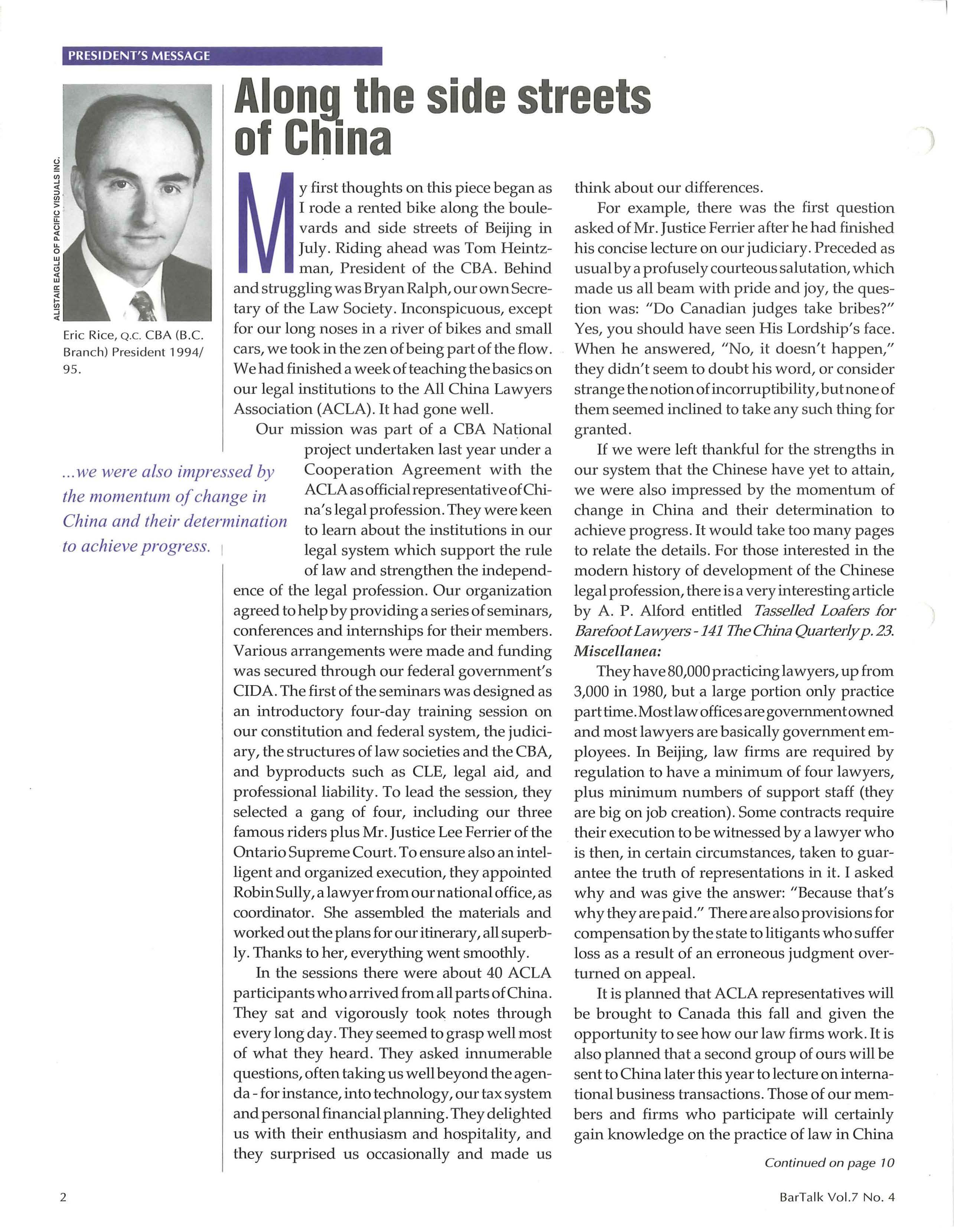
chin a
Continued from page 2
and the chance to establish links with these ACLA members who are the leaders in their profession all over China. There is no underestimating these opportunities, given the tremendous growth of the Chinese economy and continuing policy of opening to the West.
Learning a few things new and perhaps regaining certain insight as to aspects of our own system, we also experienced what one embassy official told me was typical. With each passing day the streams of humanity that we saw seemed less and less Asian, and more and more diverse and interesting. The more we saw and the more we had to struggle with sign language and guidebook expressions in Chinese, the more fascinated we became with how much there was to learn. Amongst ourselves we lamented that an 11-hour flight was necessary to stir such multicultural consciousness. We resolved to make up for lost time by seeing as much as we could on this visit. I am sorry, but my editors say that there is too little space here for me to say more. They have gently suggested that I offer a slide show sometime later at my home for those who are interested.
A few final reminiscences :
• Beijing is a beautiful, peaceful city of tree lined streets and parks and extraordinary royal palaces.
• The Great Wall is truly a great wonder, and you will never guess who we met there.
Former U.S . Secretary of Defence Robert McNamara, whom I thanked on behalf of the B.C. Branch for writing his book and apology on Vietnam.
• The food and the rituals of dining were too exotic for words. My favourite was the fresh blood and gallbladder dribbled into our cups from the water snake killed and skinned at our table .
• The early mornings of old people performing their tai chi, groups dancing in the parks before work, couples taking their only child to school.
Lastly, and again, I extol the superb work of Robin Sully in administering to all aspects of preparation, from briefing our interpreters to keeping us from getting lo st in large crowds. Our ACLA colleagues were hardly ever fazed by Tom Heintzman's repeated English malapropos and puns, and Bryan Ralph was never left to fall too far behind on his bicycle. •:•
UBC law school celebrates 50th
When Nova Scotian George Curtis arrived at Point Grey to become UBC' s first dean of law in August 1945, he thought he had a year to build a law school. As it turned out, he had less than a month. The Second World Warwasendingand veterans began flooding to the campus.
"No sooner had I sat down than they were banging on my door," recalls Curtis, 1995 recipient of The Ramon John Hnatyshyn Award for Law. "I tried to tell them to head East because we had nothing, but they said they'd prefer to stick it out and take a chance here."
Today, 50 years later, th e Faculty of Law boasts more than 7,000 graduates and the George F. Curtis Building is home to the second la rgest common law school in Canada.
Many of those graduates will renew old friendships while helping th e law schoo l celebrate its 50th anniversary this Oct.12-14. Among events planned: a symposium on the environment and the law, a specia l convocation to confer honorary degrees, open house presentations, a gala dinner-dance with "music through the decades" and other entertainmen t, and the launch of an illustrated history of legal education in B.C.
The three-day celebration will include a number of class reunions. Names and telephone numbers of class representatives, and tickets to the gala dinner, can be obtained from Elaine Borthwick at UBC, phone (604) 822-6303, fax (604) 822-8108. To register for the sympos ium, contact Continuing Legal Education at (604) 8932162, (toll free 1-800-663-0437), fax (604) 6699260.
Interpreters available
A new group of interpreters is available for legal work in eight language combinations as a result of a training program at Vancouver Community College. Twenty-two students graduated from the college's accredited Certificate Program in Court Interpreting in June and are avialable for work in interview situations, in court, and other areas where interpretation is required. Languages include Cantonese, Farsi (Persian), Korean, Mandarin, Punjabi, Spanish, Vietnamese, and American sign language . For information, contact Silvana Carr (323-5585).
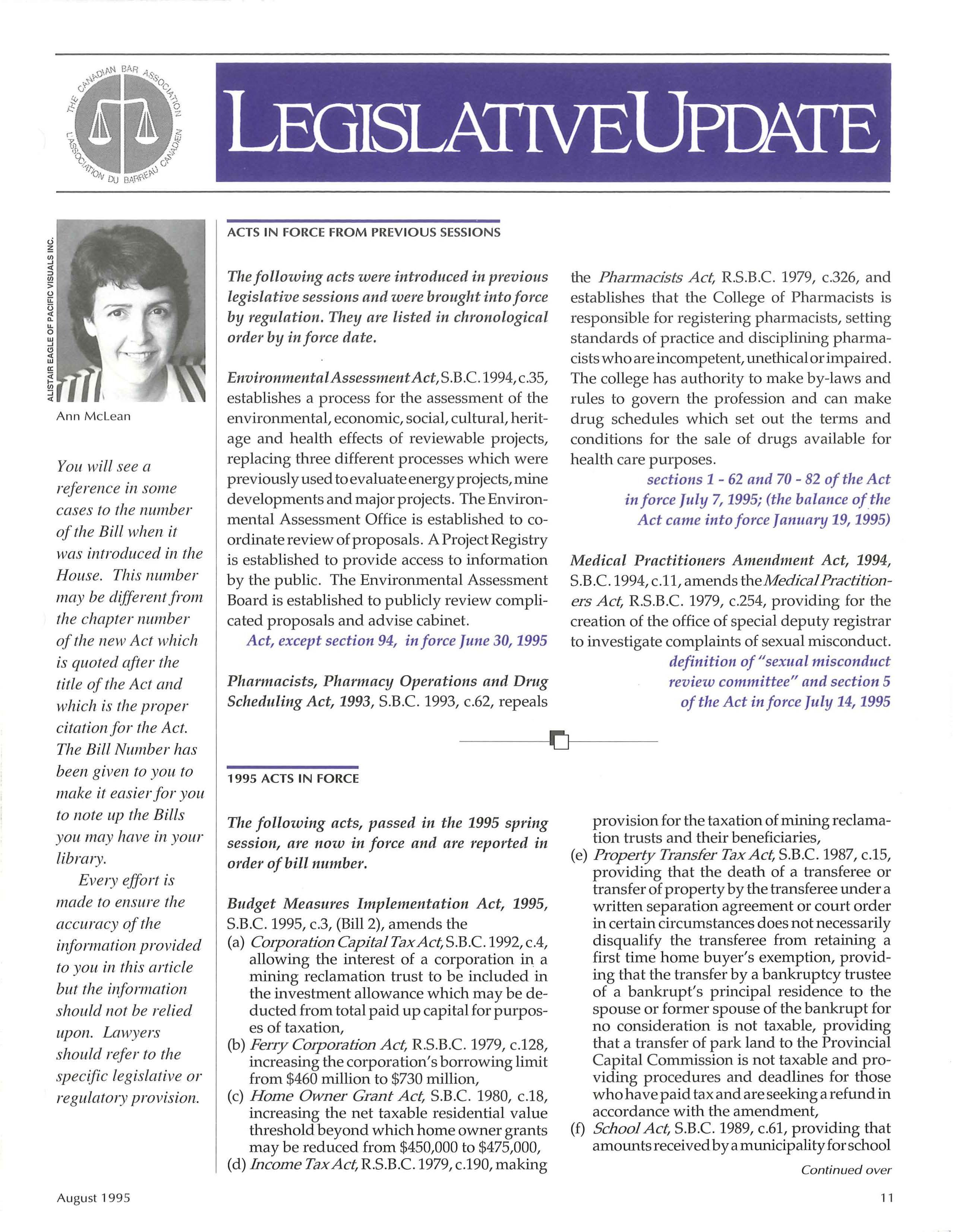
Ann Mclean
You will see a reference in some cases to the number of the Bill when it was introduced in the House. This number may be different from the chapter number of the new Act which is quoted after the title of the Act and which is the proper citation for the Act. The Bill Number has been given to you to make it easier for you to note up the Bills you ma y have in your library.
Every effort is made to ensure the accuracy of the information provided to you in this article but the information should not be relied upon. Lawyers should refer to the specific legislative or regulatory provision
ACTS IN FORCE FROM PREVIOUS SESSIONS
The following acts were introduced in previous legislative sessions and were brought into force by regulation. They are listed in chronological order by in force date.
EnvironmentalAssessmentAct,S.B.C.1994,c.35, establishes a process for the assessment of the environmental, economic, social, cultural, heritage and health effects of reviewable projects, replacing three different processes which were previously used to evaluate energy projects, mine developments and major projects. The Environmental Assessment Office is established to coordinate review of proposals. A Project Registry is established to provide access to information by the public. The Environmental Assessment Board is established to publicly review complicated proposals and advise cabinet. Act, except section 94, in force June 30, 1995
Pharmacists, Pharmacy Operations and Drug Scheduling Act, 1993, S B.C. 1993, c.62, repeals
1995 ACTS IN FORCE
The following acts, passed in the 1995 spring session, are now in force and are reported in order of bill number.
Budget Measures Implementation Act, 1995, S.B.C. 1995, c.3, (Bill2), amends the (a) Corporation Capital Tax Act, S.B.C.1992, c.4, allowing the interest of a corporation in a mining reclamation trust to be included in the investment allowance which may be deducted from total paid up capital for purposes of taxation,
(b) Ferry Corporation Act, R.S.B.C. 1979, c.l28, increasing the corporation's borrowing limit from $460 million to $730 million,
(c) Home Owner Grant Act, S.B.C. 1980, c.l8, increasing the net taxable residential value threshold beyond which home owner grants may be reduced from $450,000 to $475,000,
(d) Income Tax Act, R.S.B.C.1979, c.l90, making
the Pharmacists Act, R.S .B .C. 1979, c.326, and establishes that the College of Pharmacists is responsible for registering pharmacists, setting standards of practice and disciplining pharmacists who are incompetent, unethical or impaired The college has authority to make by-laws and rules to govern the profession and can make drug schedules which set out the terms and conditions for the sale of drugs available for health care purposes.
sections 1 - 62 and 70 - 82 of the Act in force July 7, 1995; (the balance of the Act came into force JanuanJ 19, 1995)
Medical Practitioners Amendment Act, 1994, S.B.C.1994, c.ll, amends the Medical Practitioners Act, R.S B.C. 1979, c.254, providing for the creation of the office of special deputy registrar to investigate complaints of sexual misconduct. definition of "sexual misconduct review committee" and section 5 of the Act in force July 14, 1995
provision for the taxation of mining reclamation trusts and their beneficiaries,
(e) Property Transfer Tax Act, S.B.C. 1987, c.15, providing that the death of a transferee or transfer of property by the transferee under a written separation agreement or court order in certain circumstances does not necessarily disqualify the transferee from retaining a first time home buyer's exemption, providing that the transfer by a bankruptcy trustee of a bankrupt's principal residence to the spouse or former spouse of the bankrupt for no consideration is not taxable, providing that a transfer of park land to the Provincial Capital Commission is not taxable and providing procedures and deadlines for those who have paid tax and are seeking a refund in accordance with the amendment,
(f) School Act, S.B C. 1989, c.61, providing that amounts received by a municipality for school
ATTENTION EXPATRIATE QUEBECERS
Fonner Quebec residents now li ving in B.C. and other parts of Canada may be eligib l e to vote by mai l in the com in g referendum on the sovereignty issue.
Vancouver l awyer Cather in e Sas can provide more information , including a brochure o n the subject and a voter registration form. Ca ll her at (604) 689-5444 or fax (604) 689-5666.
purposes as grants in lieu of taxes are payable to the Minister of Finance and Corporate Relations, and (g) Soda] Service Tax Act, R.S B.C. 1979, c.388, clarifying the circumstances in which software is sufficiently customized to be nontaxable and making amendments to provisions relating to refund s of tax on return s of motor vehicles, refunds for farmers andrefunds of tax paid for exploratory mining equipment.
sections 1 and 4 - 7 of the Act in force June 29, 1995 retroactive to the dates indicated in s.17; section 3 of the Act in force January 1, 1995; sections 8 - 10 and 12 - 16 of the Act in force March 29, 1995; sections 2, 11 and 17 of the Act in force June 8, 1995
Grains and Oilseeds Revenue Protection Plan
Tntst Fund Act, S B C. 1995, c.7, (Bill 3), establishes the Grains and Oilseeds Revenue Protection Plan Trust Fund and makes a consequential amendment to the Spedal Accounts Appropriation and Control Act, winding up the Farm Income Assurance Fund special account . in force effective at the end of March 31, 1995
Gra z ing Enhancement Special Account Act, S .B.C. 1995, c .8, (Bill4), establishes the Grazing Enhancement Special Account for the maintenance and enhancement of range resources. in force effective April1, 1995 and repealed, except s.6, March 31, 2000
Securities Amendment Act, 1995, S B C. 1995, c.l5, (Bill 5), amends the Securities Act, S.B.C. 1985, c.83, making the British Columbia Securities Commission a corporation, changing the basis upon which the Commission is financed and making consequential amendments to the Finandal Information Actand thePublic Service Labour Relations Act. in force effective at the end of March 31, 1995
Columbia Basin Trust Act, S B C.1995, c.49, (Bill 7), establishes the Columbia Basin Trust to manage the portion of funds available from the Columbia River Treaty which is to be allocated to the Columbia River region and makes a consequential amendment to the Water Act.
in force July 6, 1995
Water Protection Act, S .B .C. 1995, c.34, (Bill9), confirms ownership of surface and ground water by the Crown, prohibits the removal of water from the Province, except for removal which has
been previously licensed and other minor exceptions, prohibits the large scale transfer of water between major watersheds in the Province, provides for the registration of licensed regi s trant s who have been removing surface water from the Province and the di s position of the land, mine or undertaking to which the licence is appurtenant, provides for the registration of unlicensed registrants who have been removing groundwater from the Province and the disposition of the land, mine or undertaking to which the registration is appurtenant, provides powers to stop and search vehicles, vessels and aircraft to allow for enforcement of the Act and makes consequential amendments to the Water Act in force June 21, 1995
Mountain Resort Associations A ct, S.B.C. 1995, c 13, (Bill10), provides for the establishment of mountain resort areas and mountain resort associations and makes consequential amendments to the Munidpal Act to provide for special local governance for mountain resort communities. in force July 14, 1995
Growth Strategies Statutes Amendment Act, 1995, S.B.C. 1995, c.9, (Billll), amends the (a) Municipal Act, R.S.B.C. 1979, c.290, adding Part 28.1 - Regional Growth Strategies, authori z ing regional districts to undertake long term planning by developing, adopting and implementing regional growth strategies which will guide decisions on growth, change and development within the regional district, providing for the appointment by the minister of facilitators to monitor and assist local governments in reaching agreement on the regional growth strategy through nonbinding or binding resolution processes, and providing for the co-ordination of official community plans with the applicable regional growth strategies,
(b) Islands Trust Act, S.B.C. 1989, c .68, allowing regional district boards to comment on the trust policy statement of the Islands Trust, but preventing regional district boards from adopting regional growth strategies in the trust area and allowing for service co-ordination agreements between the trust council and regional district boards,
(c) Vancouver Charter, S.B.C.1953, c.55, making the Regional Growth Strategies Part of the Municipal Act apply to the City of Vancouver, and
(d) Agricultural Land Commission Act, R.S B.C. 1979, c. 9, providing that regional growth strategies may not conflict with the Act and regulations and orders under it.
in force June 8, 1995
Real Estate Amendment Act, 1995, S B.C. 1995, c.l4, (Bill15) amends theRealEstateAct, R.S.B .C. 1979, c.356, providing for
(a) regulation of real estate salespeople, including increased disclosure by agents of the services which they are going to provide and the details of any other relationships which they have relating to the transaction, requiring that agents maintain a trust account within the Province, and allowing agents to disburse funds in accordance with a written separate agreement, and (b) regulation of the sale of undivided or shared interests in land, including providing disclosure requirements, providing for the deposit of funds in trust, requiring the use of licensees for sales of shared interests in land situated outside of the Province, and requiring that a developer obtain necessary planning approvals, and makes consequential amendments to the Regulations Act.
Act, except section 1(a), in force June 8, 1995
ClassProceedingsAct,S .B.C.1995,c.21, (Bill16), establishes the procedures whereby a single court proceeding may be brought to resolve factual or legal issues that are shared by 2 or more persons. Either a plaintiff or defendant can apply to the court to certify a proceeding as a class proceeding and appoint a representative plaintiff . A subclass may be certified where a smaller group has separate interests requiring representation. A member of the class may opt out of the proceeding and non-residents of British Columbia may opt in, forming a separate subclass. After certification, notice must be given by the representative plaintiff to the class members, unless the court dispenses with notice. Determination of common issues and individual issues and distribution of awards is provided for . The approval of the court is required for settlement, discontinuance or abandonment. There are no costs payable in the action or in an appeal, except in exceptional circumstances. An agreement for fees and disbursements between a solicitor and a representative plaintiff must be approved by the court and if a fee agreement is not so approved, provision is made for the determination of the fees and disbursements owing. Interest on fees and disbursements is provided for and amounts owing for fees and disbursements are a first charge on the settlement or monetary award. A consequential amendment is made to the Crown Proceeding Act in force August 1, 1995, unless brought into force on an earlier date by regulation August 1995
Miscellaneous Statutes Amendment Act, 1995, S.B C. 1995, c.ll, (Bill17), amends the (a) Coal Act, R.S.B.C. 1979, c.51, transferring to the minister, cabinet's power to designate a coal land reserve by regulation,
(b) Expropriation Act, S.B.C 1987, c.23, clarifying that payment is deemed to be made by an expropriating authority at the time payment is tendered and the one year limitation period for making application to the board to determine compensation begins at the date that payment is tendered,
(c) Family Relations Act, R.S.B.C. 1979, c.121, providing that a written agreement between spouses may contain a provision that on marriage breakdown there will be no division of unadjusted pensionable earnings under the Canada Pension Plan and providing protection to pension plans and plan administrators which rely on a notice, waiver or other document given under Part 3 1 of the Act,
(d) msuranceAct,R.S.B.C.1979,c.200, providing for payment of insurance monies payable to a minor either to the Public Trustee, to a minor who has reached age 18 or to a trustee for the minor and requiring that where money is paid to the trustee, the insurer must provide a notice to the Public Trustee,
(e) fury Act, R.S.B.C. 1979, c.210, providing that the allowances and fees payable to jurors may be set by regulation,
(f) Mineral Tax Act, S B.C.1989, c. 55, providing that the fiscal year end of a mine occurs when the operator of the mine becomes bankrupt or when an interest in the mine is acquired or disposed of, and dealing with entitlement to the investment allowance when an interest in a mine is acquired or disposed of,
(g) PacificNationalExhibitionmcorporationAct, S.B.C. 1973, c.66, making housekeeping amendments, providing for the appointment of 15 directors to the board for a term of two years each, eliminating the requirement that the City of Vancouver consent to the exhibition granting security, changing the year end to December 31 and providing that on dissolution or winding up of the exhibition, any surplus be paid to the province,
(h) Power of Attorney Act, R.S.B.C. 1979, c.334, repealing s.7(3), which dealt with the termination of a power of attorney on the making of an order under the Patients' Property Act, (i) Property Transfer Tax Act, S.B.C. 1987, c.15, clarifying that in order to qualify as a first time home buyer under the Act, a person must have resided in the Province throughout the 12 month period immediately preceding the date of making the application for exemption,
(j) Social Workers Act, R.S.B.C.1979, c.389, giving the board legal capacity for some purposes, and
(k) SupremeCourtAct,S B.C.1989,c.40, permitting the Chief Justice to elect under thefudgesAct(Canada)to assume the role of judge of the court, and makes consequential amendments to the AttomeyCeneralStatutesAmendmentAct, 1989, theMiscellaneousStatutesAmendmentAct(No. 3/ 1994, and the Public Guardian and Trustee Act.
sections 6 - 8 of the Act in force July 1, 1995; sections 2 - 5, 18 - 21, 28 - 36, 38 and 40 of the Act in force June 8, 1995; sections 14 and 15 of the Act in force July 4, 1995; section 39 of the Act in force July 14, 1995; sections 1, 9- 13, 23 and 37 of the Act in force August 1, 1995
Home Owner Grant Amendment Act, 1995, S.B.C. 1995, c.lO, (Bill 19), amends the Home Owner Grant Act, S.B.C. 1980, c.18, providing for home owner grants in relation to residential accommodation provided by housing cooperatives and housing societies. in force effective January 1, 1995
GuaranteedAvailable Income For Need Amendment Act, 1995,S.B .C.1995, c.25, (Bill20),amends the Guaranteed Available Income for Need Act, R.S.B .C. 1979, c .158, allowing the minister to make agreements, including data matching agreements, with other provincial agencies, providing that information obtained under the Act may be disclosed as evidence in child protection proceedings and makes a consequential amendment to the Miscellaneous Statutes Amendment Act(No. 2/1990.
sections 2 - 5, 9(a), 11 and 12 of the Act in force June 21, 1995
Tobacco SalesAmendmentAct, 1995, S B C.1995, c.16, (Bill 21), amends the Tobacco Sales Act, R.S.B C. 1979, c.403, providing for the designation of enforcement officers and an administrator, inspection of business premises, the production of evidence of an offence and determination whether suspensions under the Act should occur when a dealer has received 2 or more convictions under the Act at the same business location and makes consequential amendments to the Tobacco Product Amendment Act, 1992.
sections 1 - 7 of the Act in force September 1, 1995
Education Statutes Amendment Act, 1995, S .B.C. 1995, c.22, (Bill23), amends the
(a) Independent School Act, S.B.C. 1989, c.51, requiring an authority that has provided a report on discipline or resignation under s.6.1 of the Act to provide on request all available documentation relating to the matter to the College of Teachers and the individual, (b) School Act, S B.C. 1989, c.61, replacing the term "regional correspondence school" with the term" distance education school", requiring a board that has provided a report on discipline or resignation under s.l6 of the Act to provide on request all available documentation relating to the matter to the College of Teachers and the individual, amending the way in which provincial education funding is allocated, and authorizing regulations respecting the accreditation of schools, and
(c) Teaching Profession Act, S B.C. 1987, c.l9, allowing the College of Teachers to terminate the memberships and cancel the certificates of qualification of certain members whose fees are in arrears.
sections 2 (a) and (c) - (/), 6- 13 and 16 of the Act in force Februartj 15, 1995; balance in force June 21, 1995
Miscellaneous Statutes Amendment Act (No.2), 1995, c.l2, (Bill 24) amends the
(a) Court ofAppeal Act, S .B.C. 1982, c.7, clarifying that the Court will not review an order granting leave to appeal and establishing a procedure for dismissing an inactive appeal without holding a hearing,
(b) Evidence Act, R.S B.C. 1979, c.116, providing confidentiality of information provided to committees evaluating medical staff or programs for the purpose of improving health care,
(c) Family Relations Act, R.S .B.C. 1979, c.l21, providing that information received by a family court counsellor or family search officer is confidential despite the Freedom ofInformation and Protection ofPrivacy Act, other than information supplied to the commissioner pursuant to s.44(2) and (3) of the Act,
(d) FinancialDisclosureAct,R.S.B.C.1979,c.l30, requiring disclosure by municipal officials, public employees and municipal employees annually, rather than semi-annually and dar- . ifying the form of disclosure for business owners, business employees and officers of organizations,
(e) Labour Relations Code, S.B.C. 1992, c.82, excluding s 103 from the list of sections that apply to mediation-arbitration under s.l05 of the Act,
(f) Liquor Distribution Act, R.S.B.C. 1979, c .238, providing that certain information concerning the acquisition or sale of liquor is information supplied in confidence for the purposes of s.21(1)(b) of the Freedom of Information and Protection of Privacy Act,
(g) Motor Dealer Act, R.S.B C. 1979, c 287, pro-
viding that the Minister of Finance is the trustee of the fund and must pay money at the direction of the board and that any earnings of the fund become part of the fund,
(h) Motor Fuel Tax Act, S.B.C.1985, c.76, clarifying that the tax payable for the purposes of the BC Transportation Financing Authority is payable by the person who uses gasoline or motive fuel in an area prescribed under the Build BCActand allowing the minister to enter into the International Fuel Tax Agreement with one or more governments of other jurisdictions, which provides for the interjurisdictional administration of the collection, remittance and enforcement of motor fuel tax,
(i) Municipalities Enabling and Validating Act (No 2), S.B.C. 1990, c.61, retroactively permitting minimum parcel sizes established by local governments to prevail over the minimum parcel size established by the Community Planning Area Number 24 (Gulflslands) Regulation,
(j) Special Accounts Appropriation and Control Act, S.B.C.1988, c.26, adding to the list of sections of the Criminal Code pursuant to which money may be forfeited and paid into the Forfeited Crime Proceeds Fund, (k) Statute Revision Act, S.B.C. 1992, c.54, making a housekeeping amendment, and (1) Wildlife Act, S B.C. 1982, c.57, as to s.62, providing that s.62(1) applies where a person applies to renew a licence or certificate and postponing the renewal of a certificate or licence where it expires before a determination is made by the regional manager. sections 16 and 18 of the Act in force May 17, 1995; section 26 of the Act in force August 19, 1993; section 12 of the Act in force June 1, 1995; sections 3 - 6, 10, 11, 25, 27, 32 of the Act in force June 8, 1995; sections 1 and 2 of the Act in force July 14, 1995
Pharmacists, Pharmacy Operations and Drug Scheduling Amendment Act, 1995, S.B C. 1995, c 31, (Bill27), amends the Pharmacists, Pharmacy Operations and Drug Scheduling Act, S.B.C. 1993, c.62, providing for the establishment of PharmaNet, a Provincial computerized pharmacy network and database in which the patient record information of all persons to whom prescriptions are dispensed must be recorded and the establishment by the College of Pharmacists of a committee to access the portion of the PharmaNet database that contains patient record information and general drug information. The Freedom of Information and Protection of Privacy Actapplies to the College with respect only to information and records relating to PharmaNet, until that Act applies to the entire oper-
ation of the College. Relevant patient information must be disclosed to other pharmacists, medical practitioners, insurers or government agencies which reimburse drug costs or the college, for the purposes set out in the Act. in force July 7, 1995
Election Act, S.B.C. 1995, c.51, (Bill 28), repeals the Election Act, R S.B.C. 1979, c 103, and sets out the requirements for the administration of provincial elections, including appointment of election officials, the establishment of the Election Advisory Committee, calling an election, registration of voters, nomination of candidates, voting and counting the votes, registration of political parties and constituency associations and election financing and communications. Consequential amendments are made to the Constitution Act;. Financial Administration Act;. Freedom ofInformation and Protection ofPrivacy Act;. Income Tax Act;. Legislative Assembly Allowances and Pension Act;. Legislative AssemblyManagementCommitteeAct;.Public Service Labour Relations Act;. Recall and Initiative Act;. Referendum Act and Vital Statistics Act sections 1, 11, 40, 284, 285, 286 and 289 of the Act in force July 14, 1995; sections 14- 16, 283, 287 and 288 of the Act in force August 3, 1995; section 297 of the Act in force when s.54 of the Employment Standards Act, S.B.C.1995, c.38 comes into force; balance in force September 1, 1995
Health Statutes Amendment Act, 1995, S.B.C. 1995, c.26, (Bill30), amends the (a) Community Care Facility Act, R.S.B.C.1979, c.57, providing that the director will sit alone or as a member of the panels of the variance committees established under s.5 1 and an exemption granted under s.5.1(3) may be made by the unanimous consent of the panel members in attendance, (b) HealthProfessionsAct,S .B.C.1990, c.50, permitting the board of a college to establish a maximum fine for purposes of professional disciplinary proceedings and to fine a registrant up to the maximum established and allowing the executor or adminish·ator of an estate of a deceased shareholder in a health profession corporation to hold shares for the purpose of winding up the estate or a trustee in bankruptcy to hold shares for the purpose of bankruptcy proceedings, (c) Medical and Health Care Services Act, S.B.C. 1992, c.76, deleting references to the repealed Physiotherapists Act and allowing the Com-
mission to establish payment schedules under s.2 for supply management and optimum distribution of medical care throughout the province, and
(d) Medica1PractitionersAct,R.S.B.C.1979,c.254, expanding the provisions relating to the composition, practice and procedure of the sexual misconduct review committee and inquiry committees and making confidentiality provisions subject to the Ombudsman Act, and makes consequential or housekeeping amendments to the Evidence Act, Insurance (Motor Vehicle) Act and Medical Practitioners Amendment Act, 1994.
sections 1, 4(b), 5- 14 and 16 of the Act in force July 14, 1995
Municipal Affairs Statutes Amendment Act, 1995, S.B.C. 1995, c.29, (Bill31), amends the
(a) Greater Vancouver Sewerage and Drainage District Act, S.B.C. 1956, c.59, allowing the District to establish levies payable by the generators of solid waste within the District,
(b) Municipal Act, R.S B.C. 1979, c.290, providing that Parts 2 and 3 of the Act apply to the extent of any inconsistency or conflict with the Freedom of Information and Protection ofPrivacy Act and restricting the inspection of ballots,
(c) Municipalities Enabling and Validating Act (No 2), S.B.C. 1990, c .61, adding various enabling and validating provisions respecting local government s, and
(d) Vancouver Charter, S.B.C. 1953, c.55, providing that Par ts 1 and 11 of the Vancouver Charter apply to the extent of any inconsistency or conflict with the Freedom of Information and Protection of Privacy Act, restricting the inspection of ballots, and allowing the City of Vancouver to provide as compensation for a heritage designation extra density which may be transferred to another site approved by the Development Permit Board .
in force June 21, 1995
Finance and Corporate Relations Statutes Amendment Act, 1995, S B.C.1995, c.39, (Bill33), amends the
(a) Motor Fuel Tax Act, S.B.C. 1985, c .76, confirming that a purchaser of coloured fuel who uses the fuel for an unauthorized purpose must pay the extra tax and providing that collectors, deputy collectors and retail dealers may be required to provide security for the tax that will be payable on the fuel by a purchaser,
(b) Social Service Tax Act, R.S B.C. 1979, c.388, inter alia providing for the payment of a 7% tax on the provision of telecommunication service, and
(c) Tobacco TaxAct,R.S .B.C.1979,c.404,clarifying that the Act applies to raw leaf toba cco , prohibiting the sale of tobacco at any loc a tion where a dealer's permit or authorization has been cancelled, clarifying and adding provisions dealing with security, and making provision for the enforcement of the Act.
sections 1, 3, 17(a), 24 and 29(a) of the Act in force April1, 1989; sections 8 and 10(b) of the Act in force August 1, 1995; balance in force June 30, 1995
Fire and Police Services Collective Bargaining Act, S.B.C.1995, c.40, (Bill35), provides access to binding arbitration to fire fighters' and police officers' unions and their employers for the purpose of resolving collective bargaining disputes . in force June 30, 1995
Consumer Protection Amendment Act, 1995, S.B.C. 1995, c.4, (Bill36), amends the Consumer Protection Act, R.S.B.C. 1979, c.65, inter alia (a) narrowing the definitions of" direct sale" and "direct seller", and (b) providing a right of cancellation for buyers of time share contracts which are not covered by the provisions regarding time share plans in the Real Estate Act, within 7 days after receiving a copy of the contract.
sections 1 - 3, and 5 of the Act in force June 8, 1995
Criminal Injury Compensation Amendment Act, 1995, S B.C.1995, c.36, (Bill38) amends the Criminal Injury Compensation Act, R.S.B.C. 1979, c.83, extending compensation for pain, suffering, mental or emotional trauma, humiliation or inconvenience to cases where victims are injured in the course of employment, extending compensation to immediate family of deceased victims of crime, rather than just to dependants and removing the requirement that the Attorney General be given notice of each application under the Act. in force July 14, 1995; many effective date provisions are specified
HealthAuthoritiesAmendmentAct, 1995, S.B.C. 1995, c.41, (Bill40), amends the Health Authorities Act, S.B.C.1993, c.47,interaliaresh·ucturing the membership of regional health boards and community health councils to allow for representation by aboriginal peoples and health care service providers and to allow for remuneration of members and providing for the consolidation of designated corporations with regional health boards or community health councils and the
transfer of facilities from the government to the boards or councils.
in force July 14, 1995
Child, Family and Communittj Service AmendmentAct, 1995,S.B.C.1995,c.l9, (Bill41), amends the Child., Family and Commzmity Servke Act, S .B.C. 1994, c.27, clarifying that the safety and well-being of children are the paramount considerations in the interpretation and administration of the Act, amending the reporting requirements to make explicit the duty to report physical harm, sexual abuse or exploitation inflicted on a child by any person, allowing the director to obtain a supervision order to take effect when the child is returned to the parent on the expiry of a temporary custody order, allowing the court to extend the maximum time limits for custody orders where it is in the child's best interests, providing that a party to a proceeding must disclose on request the orders the party intends to request, the reasons for requesting those orders and the intended evidence and requiring the director to establish an internal review process.
in force June 21, 1995
Forest Amendment Act, 1995, S.B .C. 1995, c.24, (Bill 42), amends the Forest Act, R.S.B.C. 1979, c.140, extending the deadline for completing the allowable annual cut review, authorizing consensual boundary changes for woodlot licences, requiring the holder of an old temporary tenure, timber licence or licence to cut to pay stumpage instead of royalty and excepting some timber from stumpage, giving the Minister discretion to dispose of timber and amend licences in the Strathcona Timber Supply Area and makes consequential or housekeeping amendments to the Forest Practices Code of British ColumNa. sections 2 - 4, 6 - 14 and 19 of the Act in force effective April1, 1995; sections 15 - 18 of the Act in force effective June 15, 1995; sections 1, 5 and 20 of the Act in force June 21, 1995
School Sites Acquisition Statutes Amendment Act, 1995, S.B.C. 1995, c.32, (Bill43), amends the (a) Munidpal Act, R.S .B.C. 1979, c.290, requiring that owners of land seeking to subdivide it, where the school board has shown a need for school land and has entered into an agreement with the local government respecting this requirement, either de die ate land or provide payment in lieu, or a combination of both, with some limitations on the subdivi-
sions which may be affected, and (b) School Act, S .B.C. 1989, c.61, providing that money paid for school sites in accordance with the Mzmidpal Act be kept in trust and spent only to acquire school lands.
sections 1 - 4 of the Act in force effective May 31, 1995
Vancouver Stock Exchange Amendment Act, 1995, S.B .C. 1995, c.l7, (Bill 45), amends the Vancouver Stock Exchange Act, S B C. 1907, c.62, providing that 1/3 of the governors of the Exchange are to be public governors appointed by cabinet for a one year term and that one of the public governors is to be appointed as chair of the board and requiring that the corporation report annually to the minister. in force June 8, 1995
Cooperative Association Amendment Act, 1995, S.B C. 1995, c.S, (Bill46), amends the Cooperative Assodation Act, R.S.B.C. 1979, c.66, prohibiting cooperative associations from distributing the assets of the association to the members upon dissolution of the association, except those that were dissolved or had commenced winding up before June 5, 1995.
section 1 of the Act in force effective June 30, 1988; balance in force June 8, 1995
Child, Youth and Family Advocacy Amendment Act, 1995, S.B C. 1995, c.20, (Bill47), amends the Child., Youth and Family Advocacy Act, S.B.C. 1994, c.28, prohibiting retribution against people who complain, give evidence or otherwise assist in an investigation, allowing the advocate to make special reports to the Legislative Assembly and the public, providing that the advocate is to be paid a salary equal to the salary paid to the chief judge of the Provincial Court and making provision for the superannuation benefits payable to the advocate .
section 3 of the Act in force effective May 15, 199S; balance in force June 21, 1995
Royal Roads University Act, S .B .C. 1995, c.44, (Bill49), establishes the Royal Roads University to offer certificate, diploma, undergraduate and graduate programs in applied and professional fields, makes consequential amendments to the College and Institute Act, Freedom of Information and Protection ofPrivacy Act, and University Act. Act, except sections 21 and 23 in force July 14, 1995
Continued over
REMINDER
Remember to complete and return the Electronic Access to B.C. Court of Appeal and Supreme Court Judgments Questionnaire which the Ministry of Attorney General is implementing in consultation with the Superior Courts judiciary. The due date is September 29, 1995. If you hav e questions , please call Sandra Sajko at (604) 356-9475 in Victoria
Motor Vehicle Amendment Act (No. 2), 1995, S.B.C. 1995, c.43, (Bill 50), amends the Motor Vehicle Act, R.S.B.C. 1979, c.288, giving municipalities the power to make bylaws requiring the wearing of bicycle safety helmets on paths or ways within the municipality which are not highways or located on private property and creating an offence for persons operating or riding as a passenger on a cycle on a highway without a bicycle safety helmet and creating an offence for parents or guardians authorizing or knowingly permitting a person under age 16 to operate or ride as a passenger on a cycle on a highway without a bicycle safety helmet.
sections 11 and 22 of the Act in force September 3, 1996
Park Amendment Act, 1995, S.B.C. 1995, c.54, (Bill 53), amends the Park Act, R.S.B.C. 1979, c 309, increasing the minimum amount of land protected under the Act to 7,300,00 hectares currently and 10,000,000 hectares by January 1, 2000, designating 106 previously created protected areas, and creating an offence provision, with a maximum fine of up to $1,000,000 and makes consequential amendments to the Carmanah Pacific Park Act and the Freedom of Information and Protection of Privacy Act. in force July 13, 1995; section 95 of ScheduleD (Tatshenshini- Alsek Wilderness Park) in force February 21, 1996; section 104(b) of Schedule D (part of West Arm Park) in force December 31, 1995
Miscellaneous Statutes Amendment Act (No.3), 1995, S .B .C. 1995, c.53, (Bill 55), amends the (a) Court ofAppeal Act, S.B.C.1982, c.7, clarifying that the definition of "rules" includes rules governing practice or procedure in the Court of Appeal made under the Court Rules Act, (b) Freedom of Information and Protection of Privacy Act, S.B.C.1992,c .61,making the Act applicable to regional health boards andcommunity health councils,
(c) Highway Act, R.S.B.C. 1979, c.l67, allowing the minister to lease parts of highways to the BC Transportation Financing Authority without giving public notice and without the need for special circumstances,
(d) Hydro and Power Authority Privatization Act, S.B.C. 1988, c.39, removing the restriction that a special company must not alter its memorandum or articles without first obtaining cabinet approval and increasing from 4% to 10% the total number of the issued and outstanding voting shares in a special com-
pany that may be held by any person or group of associated persons as members or beneficial owners,
(e) Legislative Assembly Allowances and Pension Act, R.S.B.C.1979, c.228, terminating the current pension plan for MLA's at the next general election and delegating to theca binet the power to make amendments to the Act so that the pension plan complies with federal requirements under the Income Tax Act,
(f) Mines Act, S.B.C. 1989, c.56, providing for confidentiality of information held pursuant to the health, safety and reclamation code,
(g) Municipal Act, R.S.B.C.1979, c.290, allowing development cost charges to be used to improve applicable park land, and allowing interest on reserve funds to be used to make trails on park land,
(h) Pacific Racing Association Act, S.B.C. 1993, c.60, allowing the association to convert itself from a corporation of directors to a society,
(i) Securities Act, S.B.C.1985, c.83, providing for the confidentiality of certain evidence and information arising out of an investigation under s. 127, 128 or 129 of the Act,
(j) Statistics Act, R.S.B.C. 1979, c.392, providing for the confidentiality of individually identifiable information,
(k) Vancouver Charter, S B.C. 1953, c.55, allowing development cost charges to be used to improve applicable park land, and
(1) Wildlife Act, S.B.C. 1982, c.57, providing for increased penalties for offences relating to grizzly bears and authorizing regulations prescribing offences to which higher penalties will apply,
and provides in respect of Radiant Ceiling Heating Panels, thatthe limitation periods and notice requirements for bringing action against the City of Vancouver or other municipality in s.754 and 755 of the Municipal Act and s.294(1) and (2) of the VancouverCharterdonotapplyinrespectof certain radiant ceiling heating panels installed before November 18, 1994 and ordered disconnected by the Chief Electrical Inspector. A new limitation period is established and an action must be commenced before July 1,1996.
section 12 of the Act in force June 29, 1995; sections 14, 15, 19-21, 26, 30 - 34, 36, 37, 43, and 52 - 54 of the Act in force July 13, 1995
Workers Compensation Amendment Act, 1995, S.B.C. 1995, c.55, (Bill 56), amends the Workers Compensation Act, R.S.B.C. 1979, c.437, providing for the appointment by cabinet of public administrators to carry on the functions of the governors. in force July 13, 1995
ACTS NOT YET IN FORCE TO NOTE
The following acts passed in the 1995 spring session have received royal assent, but have not yet been brought into force by regulation.
Human Rights Amendment Act, 1995, S.B.C. 1995, c.42, (Bil132), amends the Human Rights Act, S.B.C. 1984, c.22, changing the name of the Act to the Human Rights Code, setting out the purposes of the Act, replacing the Human Rights Council with three bodies, the British Columbia Human Rights Tribunal, responsible for adjudication, the British Columbia Human Rights Commission, responsible for investigation, mediation, education and research and the Human Rights Advisory Council, responsible for encouraging community involvement and ensuring that public concerns are brought to the commission and the minister and makes provision for the operation of these bodies. will be brought into force by regulation
Victims of Crime Act, S.B.C. 1995, c.47, (Bill37), provides for information and support services for victims of crime and their families will be brought into force by regulation
Adoption Act, S.B .C. 1995, c.48, (Bill 51), provides a new regulatory scheme for adoptions. will be brought into force by regulation
REGULATIONS TO NOTE
Water Act, B.C. Reg. 204/88, the Water Regulation is amended by the addition of Part 7 "Changes in and About a Stream", setting out the requirements for obtaining authority and setting standards for work conducted in and around streams.
B.C. Reg. 241 /95 effective June 2, 1995
Social Service Tax Act, B.C. Reg. 84/58, the Social Service Tax Regulations are amended to allow for tax due by a vendor or lessor to be remitted by electronic means
B.C. Reg. 256/95 effective June 9, 1995
Residential Tenancy Act, B.C. Reg. 26/81, the Residential Tenancy Regulation is amended, increasing th e rate ceiling in the definition of "hotel tenant" in s.l of the Act to $20 per day.
B.C. Reg. 265/ 95 effective June 15, 1995 August 1995
Environmental Assessment Act, B.C. Reg 277 j 95, the Transition Regulation is made, specifying projects and categories of projects which are "grandparented" from application of the Act and B.C.Reg. 278/95, the Environmental Assessment Prescribed Time Limits Regulation is made, which sets time limits for steps in the review process.
effective Jun e 30, 1995
Waste Management Act, B C. Reg 269/95, the Contaminated Sites Fees Regulation is made, providing for the fees payable in respect of certain activities or requests for action set out. effective July 1, 1995
Court Rules Act, B.C. Reg. 221/90, the Supreme Court Rules are amended (a) adding subrule 39(26.1), providing that a court may transfer a proceeding from the Supreme Court to Provincial Court under of the 5_upreme Court Act despite the fllmg of a notice requiring a jury trial under subrule 39(26),
B.C . Reg. 273 / 95 effective June 29, 1995 (b) correcting a reference in sub rule 42(12), and (c) addingForm59A-"NoticeofAppeal", which allows for the standard set of directions to be attached
B.C. Regs 274 / 95 and 275 / 95 effective July 1, 1995
Jury Act, B.C. Reg 282/95, the Jury Regulation is made, providing for payment of fees and reimbursement of expenses of juror s. effective July 4, 1995
REPORTS AVAILABLE
The legislation and Law Reform Committee ha s received a copy of the fo ll ow in g reports from the B.C. government. In formation may be obtained from the source not e d or from Ann Mclean, B.C. Branch Legislation and Law Reform Officer in Victor i a (598-2860).
REPORT
Draft Report for Consultation on The legal Consequences of a Temporary land Title Office Shutdown
Proposals for the Harmonization of Cost of Credit Disclosure laws in Canada
SOURCE law Reform Commission of British Columbia (660-2366)
Federal/Provincial Cost of Credit Disclosure Working Group (819-953 -2797 )
Bar Talk is published by the British Columbia Branch of the Can adi a n Bar Association, 10th Floor
845 Cambie Street Vancouver, B.C. V6B 5T3
TEL: (604) 687 -3404 FAX: (604) 669-9601
• Bar Talk Editor: LARRY HNETKA, Communi cations Director 687 -3404
• Legislation & La w Reform Officer: ANN MCLEAN (Victoria) 598- 2860
• SectionTa/kEditor: SHELLEY BENTLEY, LL.B. CIBC TRUST CORP. 665-1784
• PradiceTa/kEditor: DAVID BILINSKY, Lakes, Straith & Bilinsky 984-3646
• ALISTAIR EAGLE of Pacific Visua ls Inc. (688 -8867) is the CBA (B.C. Branch) official photographer.
© Copyright the British Columbia Branch of the Canadian Bar Association- 1995.
This publication is intended for information purposes only and the information contained herein should not be applied to specific fact circumstances without the advice of counsel.
The B.C. Branch of the Canadian Bar Association represents over 7,600 lawyers within British Columbia.
The B.C. Branch is dedicated to improve and promote access to justice, to review legislation, initiate law reform measure s and advance and improve the administration of justice.
On behalf of the profession, the B C. Branch works to improve and promote know ledge, skills, ethica l standards and well-being of members of the legal profession and promotes the interests of its members