Applying for a Child Arrangements Order: What Separating Parents Should Know Before Going to Court
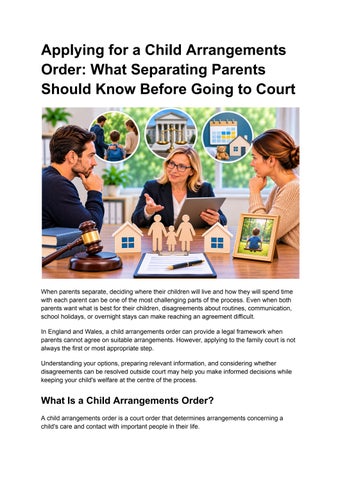
When parents separate, deciding where their children will live and how they will spend time with each parent can be one of the most challenging parts of the process. Even when both parents want what is best for their children, disagreements about routines, communication, school holidays, or overnight stays can make reaching an agreement difficult. In England and Wales, a child arrangements order can provide a legal framework when parents cannot agree on suitable arrangements. However, applying to the family court is not always the first or most appropriate step. Understanding your options, preparing relevant information, and considering whether disagreements can be resolved outside court may help you make informed decisions while keeping your child's welfare at the centre of the process.
What Is a Child Arrangements Order? A child arrangements order is a court order that determines arrangements concerning a child's care and contact with important people in their life.
It can specify: ● Where a child will live, including whether they will live with one parent or spend time living with both. ● When a child will spend time with each parent. ● Whether contact should take place in person, by telephone, or through video calls. ● How arrangements should work during school holidays and special occasions. ● Other practical details necessary to make the arrangements workable. These orders are made under the Children Act 1989 and are intended to support arrangements that promote the child's welfare. A child arrangements order does not automatically require children to spend equal amounts of time with both parents. The court considers the individual circumstances of the child and what arrangements are most appropriate.
Do You Need a Court Order After Separation? Not every separating family needs a child arrangements order. If parents can agree on where their children will live, how contact will work, and how important decisions will be managed, they can often put arrangements in place without asking the court to intervene. For example, parents might agree that their child will live primarily with one parent, spend alternate weekends with the other, and share school holidays according to an agreed schedule. A written parenting plan can help record these arrangements and reduce misunderstandings. However, a parenting plan is not automatically legally enforceable in the same way as a court order. A court application may become necessary when disagreements remain unresolved, particularly where there are ongoing disputes about contact, concerns about a child's welfare, or significant differences over living arrangements. The appropriate approach will depend on the family's circumstances, including whether discussions between parents are safe and practical.
What Should Parents Consider Before Applying to Court? Before starting court proceedings, it is useful to identify the specific issues preventing an agreement.
Understand the Main Areas of Disagreement Parents sometimes disagree about several matters at once, making it difficult to identify what needs to be resolved. Common issues include: ● ● ● ● ● ●
Where the child should live during the school week. How often overnight contact should take place. Arrangements for birthdays, Christmas, and school holidays. Transport responsibilities and handover locations. Communication between the child and each parent. Changes to existing arrangements when work schedules or family circumstances change.
Separating these issues can help parents distinguish between matters that are already agreed and those requiring further discussion.
Consider Your Child's Existing Routine Children often benefit from predictable arrangements that take account of their education, relationships, and everyday needs. Before proposing a new schedule, consider school attendance, travel distances, childcare responsibilities, extracurricular activities, and the child's relationship with each parent. A schedule that appears balanced on paper may not be practical if it involves lengthy journeys or frequent disruption. The aim should be to develop arrangements that are realistic and sustainable rather than focusing solely on how time is divided between adults.
Keep Communication Child-Focused Separation can involve strong emotions, particularly where trust has broken down. When communication is safe, concentrating on specific parenting arrangements rather than past relationship difficulties may make discussions more productive. Written communication can sometimes help parents clarify proposals and avoid misunderstandings. However, direct negotiation is not appropriate in every situation. Where domestic abuse, intimidation, coercive control, or safeguarding concerns are present, specialist advice and appropriate protective measures may be necessary.
Can Family Mediation Help Before a Court Application?
Family mediation offers separating parents an opportunity to explore disagreements with the assistance of an independent, impartial mediator. Unlike a judge, a mediator does not impose decisions or determine which parent is right. Instead, mediation provides a structured environment in which parents can discuss practical arrangements, consider different options, and work towards mutually acceptable proposals. Discussions may cover where children will live, how contact will be organised, communication expectations, and arrangements for holidays or special occasions. Mediation is voluntary, and an agreement cannot be forced on either parent. It is also important to recognise that mediation is not suitable for every family, particularly where safety concerns or significant power imbalances make meaningful participation difficult.
Understanding the MIAM Requirement Before making many types of private family law applications, including applications for child arrangements orders, applicants are generally expected to attend a Mediation Information and Assessment Meeting (MIAM), unless a valid exemption applies. A MIAM is an individual meeting with an authorised family mediator. It provides an opportunity to understand mediation, discuss the nature of the dispute, and consider whether mediation or another form of non-court dispute resolution could be appropriate. Parents who are considering court proceedings can arrange a MIAM assessment with an accredited family mediator to explore the available options, discuss suitability and safety concerns, and understand the relevant court-form requirements if an application becomes necessary. Attending a MIAM does not mean that parents must proceed with mediation. The assessment helps establish whether mediation is suitable and whether another approach may be needed. Certain circumstances, including qualifying domestic abuse evidence, child protection concerns, or particular urgent situations, may justify an exemption from the usual MIAM attendance requirement. The applicable exemption rules should be checked carefully rather than assuming that disagreement or unwillingness to mediate automatically removes the requirement.
How Do You Apply for a Child Arrangements Order? When parents cannot reach an agreement and court proceedings are necessary, the application process generally involves several stages.
Step 1: Check Whether You Can Apply
Parents with parental responsibility can generally apply for a child arrangements order without first obtaining the court's permission. Other people, including certain relatives or individuals with an established relationship with the child, may also be eligible to apply. However, some applicants must obtain permission from the court before proceeding. Eligibility depends on the applicant's legal relationship with the child and the relevant statutory provisions.
Step 2: Complete Form C100 Form C100 is generally used to apply for a child arrangements order, prohibited steps order, or specific issue order. The application asks for information about the children involved, the people with parental responsibility, the arrangements being requested, and the reasons for seeking the order. Applicants should explain their proposals clearly and focus on how the requested arrangements would meet the child's needs. If there are allegations of domestic abuse, harm, or other relevant safeguarding concerns, Form C1A may also be required. It is important to provide accurate information and avoid making unsupported allegations.
Step 3: Address the MIAM Requirement The application normally requires confirmation that the MIAM requirement has been met or that an applicable exemption is being claimed. Where the applicant has attended a MIAM and mediation is not proceeding, an authorised mediator may complete the relevant section of the court application. Where an exemption is claimed, the applicant must identify the relevant grounds and provide supporting information or evidence where required.
Step 4: Submit the Application Applications can generally be made through the appropriate government online service or by submitting the required paperwork. A court application fee will usually apply, although eligible applicants may qualify for help with fees. The current fee and application requirements should be checked before submission. Official guidance is available through the GOV.UK child arrangements application service.
Step 5: Prepare for the Court Process After an application is issued, the court will consider the next procedural steps. In many cases, the first hearing is a First Hearing Dispute Resolution Appointment (FHDRA). Before or around this stage, safeguarding checks may be carried out, and the Children and Family Court Advisory and Support Service (Cafcass) may become involved. The court may explore whether agreement is possible, identify safeguarding concerns, and decide whether further evidence or hearings are required. Not every application follows exactly the same route.
What Is the Difference Between a Child Arrangements Order and Other Children Act Orders? Parents sometimes encounter several types of court orders when trying to resolve disagreements about their children's upbringing. Although related, these orders serve different purposes. Court order
Main purpose
Child arrangements Determines where a child lives and when they spend time or have order contact with another person.
Prohibited steps order
Restricts a specified action concerning a child without the court's permission.
Specific issue order Resolves a particular question about a child's upbringing. For example, a dispute about a child's weekly living arrangements may require a child arrangements order. A disagreement about a particular school or another specific parental decision may instead involve a specific issue order. The correct application depends on the nature of the dispute and the circumstances.
How Can Parents Prepare for a Child Arrangements Hearing?
Preparation can help parents explain their proposals clearly and provide information relevant to the child's welfare.
Organise Relevant Documents Depending on the issues involved, useful documents may include school schedules, existing parenting arrangements, relevant correspondence, and information about practical childcare responsibilities. Parents should concentrate on documents that directly relate to the matters the court needs to determine. Large amounts of unrelated correspondence may make the important issues harder to identify.
Develop a Practical Parenting Proposal A proposed parenting schedule should explain how arrangements would work in everyday life. Consider school-day routines, weekend contact, holiday arrangements, transport responsibilities, and communication between households. It can also be helpful to identify how parents would manage unexpected changes, such as illness or work commitments.
Be Clear About the Outcome You Are Seeking Parents should be able to explain what order they are requesting and why they believe it would benefit their child. Proposals should be realistic, specific, and responsive to the child's circumstances. Where possible, distinguish between arrangements that are essential for the child's welfare and matters where some flexibility may be appropriate.
Consider Legal Advice Although parents can represent themselves in family court proceedings, legal advice may be particularly valuable where there are complex disputes, safeguarding concerns, allegations of abuse, or questions about parental responsibility. A solicitor can explain relevant legal considerations and help assess the available options.
Can Parents Reach an Agreement After Court Proceedings Begin?
Starting a court application does not necessarily mean that every issue must be decided by a judge following a contested final hearing. Parents may still reach an agreement during proceedings, provided discussions are appropriate and safe. Depending on the circumstances, the court may encourage suitable forms of non-court dispute resolution or allow time for parents to explore proposals. Where an agreement is reached, the court can consider whether an order reflecting the agreed arrangements is appropriate. Any proposed order remains subject to the court's assessment of the child's welfare. Parents should also understand that a mediated agreement does not automatically become a legally binding court order.
What Happens If a Parent Does Not Follow a Child Arrangements Order? Once a child arrangements order is in force, the people subject to it are expected to comply with its terms. However, disagreements can arise when circumstances change or when one parent believes the arrangements are no longer workable. Where an order is not followed, the available response depends on the circumstances. The court may consider enforcement proceedings, whether there was a reasonable excuse for non-compliance, and whether the existing arrangements continue to serve the child's welfare. Possible outcomes vary and may include enforcement measures or changes to the existing order. Parents should avoid assuming that every missed contact session automatically results in a penalty. Where there is an immediate safeguarding concern, appropriate legal or emergency assistance may be necessary.
How Can Parents Reduce the Risk of Future Disagreements? Whether arrangements are agreed privately, through mediation, or following court proceedings, clarity can help reduce future conflict.
Parents may find it useful to establish expectations around communication, notice of schedule changes, school events, and holiday planning. A practical arrangement should also recognise that children's needs change as they grow older. For example, a schedule that works well for a preschool child may need reconsideration when the child begins secondary school or develops new activities and commitments. Where both parents can communicate safely and constructively, reviewing arrangements periodically may help identify difficulties before they become more serious. If direct discussions are not appropriate, professional support or a more structured communication process may be needed. The aim is not to eliminate every possible disagreement but to establish arrangements that remain focused on the child's needs.
When Might Court Proceedings Be Necessary? Although resolving disagreements outside court can be beneficial, there are situations where judicial intervention may be necessary. These may include serious safeguarding concerns, persistent disputes that cannot be resolved through appropriate alternatives, or situations where a legally enforceable decision is required. Court proceedings may also be necessary where one parent seeks an order preventing a particular action or resolving an important issue about the child's upbringing. The decision to apply should reflect the seriousness of the dispute, the child's circumstances, and the available alternatives. Parents should not feel obliged to pursue informal negotiations or mediation where doing so would place them or their children at risk.
Final Thoughts Applying for a child arrangements order is an important decision that can affect a child's everyday life and relationships. For separating parents in England and Wales, understanding the court process is only one part of preparing for that decision. It is equally important to consider the child's needs, identify the issues requiring resolution, and assess whether a safe and practical agreement can be reached without contested proceedings. Family mediation and other appropriate forms of dispute resolution may provide opportunities to address disagreements before they escalate. Where court intervention is
necessary, careful preparation and a clear focus on the child's welfare can help parents present their circumstances effectively. Ultimately, the most constructive approach is one that prioritises the child's safety, stability, and long-term wellbeing rather than treating parenting arrangements as a dispute to be won.