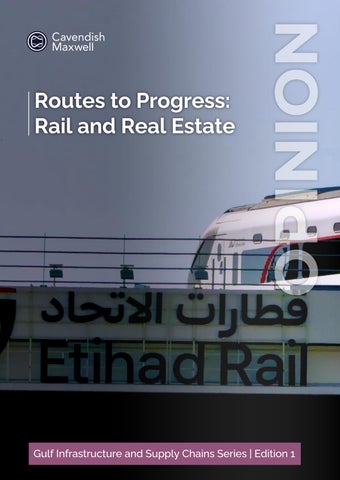
Routes to Progress: Rail and Real Estate
Gulf1 Infrastructure and Supply Chains Series | Edition 1
Recent rail developments in the Gulf Bookings are already open for Etihad Rail’s first passenger operations. With a maximum speed of 200 km/h, the new passenger trains will cut travel times significantly across the UAE: ▪ ▪ ▪
Dubai to Abu Dhabi: 57 minutes Dubai to Fujairah: 69 minutes Abu Dhabi to Fujairah: 105 minutes
Even these journey times are expected to fall eventually. Ten of the planned 13 trains have already been delivered to serve the 869 km network across the Emirates, each with a capacity of up to 400 passengers.1 The rail network already carries freight, connecting the UAE’s major ports, including Khalifa Port and Jebel Ali, to key industrial zones, with links to Saudi Arabia.
Source: Etihad Rail (2026)2
2
Routes to Progress: Rail and Real Estate
Saudi Arabia has also been developing its own rail network at speed. The Haramain High-Speed Railway, comprising 453 km of track connecting Madinah, Makkah and the world’s largest airport railway station at King Abdulaziz International Airport,3 carried 2 million passengers in Q1 2026 alone, while the Saudi rail network as a whole transported more than 4 million tonnes of minerals,4 alongside significant passenger volumes. The Kingdom’s rail corridors are expected to support wider regional connectivity by: ▪ ▪ ▪ ▪
Connecting major Gulf ports with inland logistics hubs such as Riyadh and Dammam Linking key industrial zones with seaports and urban centres Supporting the Saudi Landbridge project, which aims to connect the east and west coasts5 Creating the potential for future regional links to Muscat and Doha
Source: Global Construction Review (2026)6
Enthusiasm for all of these new services is understandably very high.7 8 But what are the likely economic results of the new rail networks in the Gulf likely to be, and what will be the implications for real estate? Fortunately, there are plenty of previous global examples on which to draw in order to answer these questions.
3
Routes to Progress: Rail and Real Estate
Rail networks and economic development At the macro level, economists have long emphasised the role that rail networks play in economic growth. Typically, for every dollar spent on a rail network, studies from economies as disparate as Malaysia and Belgium suggest that between $2.5 and $3 of economic activity is eventually created.9 10 China has been the key exemplar here: one study estimated that, in the long run, every 1% increase in high-speed railway construction will increases economic development by 0.058%.11 It is easy to see why this is the case. High-speed rail creates “time and space compression”, bringing people, businesses and markets closer together. This can generate several economic benefits: ▪ ▪ ▪ ▪ ▪ ▪ ▪
Lower travel costs Improved labour mobility Greater job accessibility Higher employment density12 The emergence of new enterprises Stronger links between cities, ports and industrial zones Increased tourism activity over time
The inevitable increase in land prices leads to the replacement of industries with lower rental affordability by those with higher rental affordability, a phenomenon that has been characterised as ‘industrial gentrification’.13 Malaysia is one such example, with the prospect of further benefits from the high-speed rail connection with Singapore currently under development.14 India is now following with its Dedicated Freight Corridors, which aim to lower traditionally higher logistics costs, estimated at 8-14% of GDP, compared with the global average of around 8%, largely because the Indian freight transport sector is dominated by road, which carries about 65% of the total volume, compared to rail at 26%.15 But rail networks also act to balance economic growth within economies. In France for example, the TGV network has enabled the diversification of Lille into a developed economic hub.16 We know that tourism, too, is known to benefit from high-speed rail,17 with the effect becoming stronger over time.18 Madinat Zayed and Mezaira’a for example will connect urban and inland desert areas.19 Rail networks also potentially strengthen economic resilience by providing alternative routes for internationally traded goods.20 Travel time between China and the EU has been reduced from around 36 days by sea to the current average of 14 days by rail.21 The possibility of replicating such a transformation in the Gulf is tantalising. Finally, rail brings sustainability benefits. Etihad Rail has been projected to: ▪ ▪ ▪
Reduce CO2 emissions by 21% Cut road transport costs by 8% Remove up to 300 trucks from the road through a single train journey22
Implications for real estate Rail networks themselves absorb construction resources. Construction workers need to be housed, and new roads are often required to deliver materials. The dozens of national and international companies that sponsored the Saudi Rail Conference in 2025 are evidence of the extent of this initial impact.23 4
Routes to Progress: Rail and Real Estate
For real estate, however, the economic multiplier effects of construction are secondary to the main event: the valuation uplift and elevation of suburbs, towns and new districts along rail routes. Integrated rail networks can influence real estate values in several ways: ▪ ▪ ▪ ▪ ▪ ▪
Making commuting easier Improving access to employment centres Supporting new commercial and residential development Increasing the relative attractiveness of secondary locations Encouraging regeneration around station areas Creating new mixed-use and transit-oriented districts
The economic balancing induced by integrated rail networks is also reflected in real estate values as commuting and social interaction generally become easier and, in some cases, practicable where it was not before. In China, the introduction of high-speed rail directly enhanced equity between cities by improving job accessibility.24 Fujairah and Sharjah can therefore expect to rise in relative value by comparison to Dubai and Abu Dhabi as a whole. The extent and pace of this process have also been researched. The technical question of through trains versus direct Dubai-Abu Dhabi trains will be important in the UAE case, as a combined frequency on the mixed-use trunk route will probably peak at around six trains per hour, whilst both these two city centres and University City Sharjah are now themselves on rail spurs within the network. At the local level, the potential benefits of Transit-Oriented Development (TOD), are clear. Numerous examples of station-area projects can be found in San Francisco, Toronto and Washington, D.C. In several cities, land near transit stations has realised rent premiums and therefore valuation uplifts.25 In Italy, for example, every extra kilometre from a station reduces price by about 4%.26 Similarly, in Hungary similarly, five fewer minutes of travel time to the nearest station providing fast access to the city centre raised real estate prices by nearly 1%.27 Chinese data suggests, more modestly, that for every additional kilometre from the rail transit station, house prices increase by 0.246%.28 Some of this benefit to locations in Abu Dhabi such as Al Dhannah and Madinat Zayed, and Jumeirah Golf Estates in Dubai will already have happened, but we know from comparable studies that a significant proportion defers until train frequency, last-mile questions such as car parking and congestion in the vicinity of train stations, interchanges with metro and bus networks, and eventual passenger numbers are fully understood and priced in.29 It is also important to recognise that TOD has succeeded in conjunction with favourable redevelopment zoning, attractive sites, walkability, higher housing density and a comparatively strong local market for development.30 So using Lille again as an example, the impact of the TGV on real estate values would not have occurred without the regeneration of derelict industrial sites in central locations, cultural regeneration, a housing policy focused on densifying inner-city areas and an economic development strategy supporting specific clusters with potential.31 In Japan new development has positive effects on land price changes around stations and negative effects in places far from stations.32 In Europe, train stations close to the existing urban fabric and well connected by complementary regional and local public transport are on average associated with more land-use change, while peripheral stations outside metropolitan regions attract little development.33 Supporting evidence from China suggests that the effect is more pronounced in cities with well-developed digital infrastructure and cities with high government expenditure.34
Conclusions The evidence that rail networks promote macroeconomic growth is conclusive. There is little doubt that the already best-in-class economic performance of Gulf jurisdictions will be further improved through the new rail networks. This is especially the case in comparison with those jurisdictions that have not seized the opportunity to utilise hydrocarbon revenues as wisely. It is also reasonable to conclude that current disparities between real estate prices in secondary locations throughout the Gulf will diminish substantially once the rail network, especially high-speed rail, connects them to capital cities. What is much less certain, however, is whether because of both climate and cultural differences, TODs in the Gulf will deliver benefits in a comparable way to those that have occurred historically in USA, China and European jurisdictions. It may also be that the relative absence of these supposed advantages is not necessarily negative, as recent research points towards TOD value uplifts being a zero-sum game. The main advantages of Gulf rail networks may well emerge as economic benefits at the national and regional level. Real estate benefits may therefore be more widely dispersed than in those jurisdictions that have seen more traditional TOD at the local level.
5
Routes to Progress: Rail and Real Estate
Dubai has seen this dynamic play out before, from Expo 2020 to the Al Maktoum International Airport expansion. Jumeirah Golf Estates now has a similar opportunity, supported by Etihad Rail, future Metro connectivity and surrounding undeveloped land. If realised as a transit-oriented mixed-use district, this could drive a meaningful uplift in long-term property values.
Siraj Ahmed Director, Head of Strategy and Consulting
Authors Julian Roche
Ali Siddiqui
Chief Economist Cavendish Maxwell julian.roche@cavendishmaxwell.com
Research Manager ali.siddiqui@cavendishmaxwell.com +971 50 877 0190
Key Contacts Zacky Sajjad
Siraj Ahmed
Director, Business Development and Client Relations zacky.sajjad@cavendishmaxwell.com +971 50 644 5089
Director, Head of Strategy and Consulting siraj.ahmed@cavendishmaxwell.com +971 50 382 4409
Dubai +971 4 453 9525 dubai@cavendishmaxwell.com 2204 Marina Plaza, Dubai Marina, P.O. Box 118624, Dubai, UAE Dubai
Abu Dhabi
Sharjah
Ajman
Ras Al Khaimah
Muscat
Kuwait City
Riyadh
cavendishmaxwell.com
Disclaimer: The information and analysis contained in this publication are derived from sources generally considered reliable and based on assumptions deemed reasonable and current at the time of undertaking market research. However, no representation or warranty, express or implied is made regarding their accuracy or completeness. We reserve the right to vary our methodology and to amend or discontinue the indices at any time for regulatory or other reasons. The information and its analysis in this publication do not constitute legal, financial, or any other form of advice. Furthermore, it does not constitute a formal valuation, feasibility study or analysis of any property interest and should not be construed as such. Such analysis, including forward-looking statements are opinions and estimates only, and are based on a wide range of variables which may not be capable of being determined with accuracy. Variation in any of these indicators can have a material impact on the analysis and we draw your attention to this. Cavendish Maxwell accepts no liability whatsoever for any loss or damage whether direct or indirect arising from reliance on this information.
For the complete list of references, please refer to our website