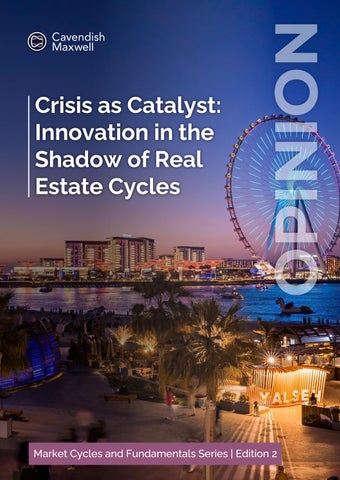
Crisis as Catalyst: Innovation in the Shadow of Real Estate Cycles
Market Cycles and Fundamentals Series | Edition 2 1
Evidence for a hypothesis The idea that creativity flourishes in a crisis has some solid empirical support. The steam turbine, transformer, radio, and helicopters were all patented during Depressions and were turned into successful products during subsequent recovery periods. Various explanations of this phenomenon have been advanced, the most well-known of which has been Joseph Schumpeter’s theory of ‘creative destruction’, where downturns sweep away previous barriers to innovation.1 Some successful companies were also founded during economic downturns. The ‘lost decade’ of the 1990s in Japan saw the creation of companies such as Fanuc and Softbank. The Global Financial Crisis (GFC) saw the founding or scaling of now household names: Airbnb, Slack, WhatsApp, Square, Uber, and Instagram. Can we expect the next generation of business giants to be formed when the global economy is next under serious strain? Historically, that’s correct. Periods of crisis tend to expose weaknesses in existing systems, which create openings for new products, services, and delivery models. Those who recognise these shifts early are often the ones who define the recovery phase. This pattern is not limited to tech start-ups: the beginning of every major 18-year real estate or economic cycle has typically aligned with the adoption of a new technology, indicating that innovation, rather than caution, is usually what drives the next expansion.
2
Crisis as Catalyst: Innovation in the Shadow of Real Estate Cycles
A change in global perspective: real estate vs macro cycles Since the time of the GFC that saw these companies founded and first grow in value, the importance of real estate as an asset class has increased significantly.2 There have even been plausible claims made that developed economies such as the UK, USA and China have transitioned from being manufacturing and service-based to significant reliance on real estate as an economic driver itself.3 4 If this is true for these economies, so much more so for Dubai and the Gulf as a whole, as demonstrated by statistics on real estate lending and stock market valuations as a percentage of the respective totals.5 The question that therefore arises is what the correlation between the comparative success of innovation and specifically real estate cycles is likely to be. Answering this question is complicated by several factors. First, while real estate and economic cycles have moved together for over two centuries, their interaction has shifted from loose correlation to direct financial interdependence, to a degree that was not evident even a generation ago,6 not least because of the growing percentage of listed stocks that depend on the real estate market for their cashflows.7 True, they were strongly correlated in the past: it was certainly the case that the UK and Japanese real estate markets tumbled after stock market valuations fell dramatically and investment dried up, whilst in the opposite direction, the GFC was triggered by US real estate securitisation defaults. But in the past, there were exceptions, for example, after the Saudi stock market collapse of 2006 or the Australian real estate downturn in 2017-18. These exceptions are now likely to become even rarer than in the past. What remains is that traditional Hoyt real estate cycles, which are typically around 15 years, are currently extending to almost two decades from peak to peak, longer than typical venture capital investment cycles of up to seven years.8 It has however, also been suggested that this structural transformation in the economy will be associated with technological change, as were its predecessors, the industrial revolution and the switch to a service economy. The increasingly successful use of big data for real estate valuation is one example; the rise of rideshare and timeshare apps is another; smart cities a third. A measure of caution might, however, be appropriate here: many of these innovations rely on national markets, even global dominance, and there are therefore few opportunities for unicorns. Real Estate is often more reluctant as an industry to adopt innovative technology.9 Promoting Software as a Service (SaaS) into real estate is after all a difficult proposition: the capitalised monthly cost of a software product on building valuation can be considerable.10 Nevertheless, investment in PropTech continues to grow: globally venture capital invested in PropTech rose from $11.38bn in 2023 to $15.1bn in 2024.11 Real estate has its own innovation now in the form of PropTech. A subsidiary question is now therefore whether investment in PropTech is statistically likely to be more successful in a macro and/or real estate downturn. What indications are there already?
3
Crisis as Catalyst: Innovation in the Shadow of Real Estate Cycles
Is PropTech countercyclical? The suggestion has certainly been made by some US investors that indeed it is, or at least that its profitability is unlikely to correlate strongly with real estate cycles.12 On the other hand, evidence from Australia suggests that it is precisely issues such as lack of affordability that are driving financial innovation, for example, from companies such as Homely.13 The truth is that PropTech as a whole is still a relatively recent phenomenon, which constrains empirical evidence. And money in is very different from achieved Internal Rate of Returns (IRRs). As of now, there are few clean PropTech exits at all, let alone sufficient to compare annual cohorts. The pandemic also distorted exit timeframes for early PropTechs. Indications should start to be available in about five years, and by a decade hence, reliable cohort data will enable a proper answer. For now, the closest available proxy is therefore simple survival, but even here, data are scarce and provide little to suggest or deny countercyclicality. A 2023 study of 1,052 PropTechs globally suggested that the number of full-time employees over the firm’s lifetime, its number of financing rounds and its number of investors over lifetime were the principal driving factors behind survival – certainly not what Venture Capitalists (VCs) would describe as its ‘annual cohort’.14 A study from Scandinavia found that larger companies are statistically significantly more likely to survive but that the number of founders and investor rounds were negatively correlated with the survival time of these companies.15 This is partly accounted for, no doubt, by the fact that local PropTech markets often see startups plateau at the Seed-to-Series A stage due to limited local venture capital, including in the Gulf, so that PropTech companies that might eventually have been successful simply run out of funding road on the way. 4
Crisis as Catalyst: Innovation in the Shadow of Real Estate Cycles
It is however also important to recognise that PropTech itself is far from monolithic.16 Some firms are deeply exposed to asset prices, while others are service-layer disruptors that thrive on volatility. The key is probably whether their value proposition is transactional (volume and price dependent) or operational (efficiency, data, retention). It is still too early to make categorical pronouncements, but clearly apps that squeeze better performance from existing real estate and optimise headcount are likely to perform better in a highly competitive downturn than those that, for example, enable more wide-ranging market research or aid more efficient construction.17 Examples may include valuation and risk analytics that focus on stress-testing and forecasting, such as Plunk and TruEstimate, tenant-related apps such as HqO, SmartONE and Homebase that improve service through better feedback and faster response times, automate maintenance, or reduce costs, platforms that can amalgamate and streamline property management tasks, and even alternative financing models such as Coposit, Ejari, Prypco and Rize may be able to step in when bank liquidity falters. This is not, of course, to imply that these specific firms will emerge as winners when the market turns, but it is to suggest that these sub-sectors of the PropTech landscape have a good chance of lower valuation falls than the physical real estate market and even of achieving a measure of countercyclical results. Whether apps focused on energy efficiency and sustainability more widely can be included in this list depends on the extent to which those issues retain their importance for real estate during a downturn. In the past, green valuation premia declined as markets cooled, but there is no certainty that this will be repeated in future.18
Conclusions: Fortune favours the brave and wise Past evidence suggests that VC instincts are honed during recessions. Where money is committed, it does stand a better chance of success than during a boom. PropTech is quite likely to follow the same trend. Survivor bias will therefore make it difficult to determine whether better PropTech companies emerge during a recession. At the sectoral level, whether PropTech will be valued countercyclically to the real estate market will depend at least in part on the type of PropTech that dominates investment. Those firms that are deeply exposed to asset prices will not be, but those that disrupt markets and thrive on volatility stand a much better chance of being so in a Schumpeterian world19 where “small is beautiful” and resistance to innovation in real estate continues to crumble.
5
Crisis as Catalyst: Innovation in the Shadow of Real Estate Cycles
Authors Julian Roche
Ali Siddiqui
Chief Economist Cavendish Maxwell julian.roche@cavendishmaxwell.com
Research Manager ali.siddiqui@cavendishmaxwell.com +971 50 877 0190
Guest Author Akhil Patel
Director, Property Sharemarket Economics
Key Contacts Kevin Duffield
Ronan Arthur
Siraj Ahmed
Zacky Sajjad
Director, Head of Built Asset Consulting kevin.duffield@cavendishmaxwell.com +971 56 344 2177 / +966 59 496 3815
Director, Head of Residential Valuation ronan.arthur@cavendishmaxwell.com +971 50 296 1411
Director, Business Development and Client Relations zacky.sajjad@cavendishmaxwell.com +971 50 644 5089
Director, Head of Strategy and Consulting siraj.ahmed@cavendishmaxwell.com +971 50 382 4409
Dubai +971 4 453 9525 dubai@cavendishmaxwell.com 2205 Marina Plaza, Dubai Marina, P.O. Box 118624, Dubai, UAE Dubai
Abu Dhabi
Sharjah
Ajman
Ras Al Khaimah
Muscat
Kuwait City
Riyadh
cavendishmaxwell.com
Disclaimer: The information and analysis contained in this publication are derived from sources generally considered reliable and based on assumptions deemed reasonable and current at the time of undertaking market research. However, no representation or warranty, express or implied is made regarding their accuracy or completeness. We reserve the right to vary our methodology and to amend or discontinue the indices at any time for regulatory or other reasons. The information and its analysis in this publication do not constitute legal, financial, or any other form of advice. Furthermore, it does not constitute a formal valuation, feasibility study or analysis of any property interest and should not be construed as such. Such analysis, including forward-looking statements are opinions and estimates only, and are based on a wide range of variables which may not be capable of being determined with accuracy. Variation in any of these indicators can have a material impact on the analysis and we draw your attention to this. Cavendish Maxwell accepts no liability whatsoever for any loss or damage whether direct or indirect arising from reliance on this information.
For the complete list of references, please refer to our website