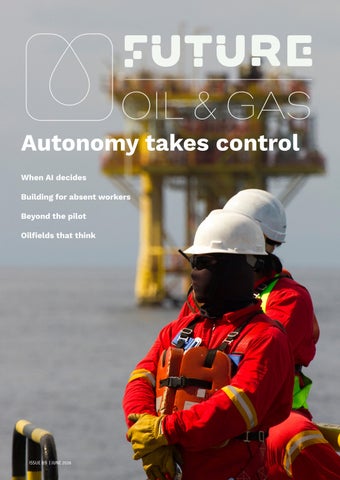
Autonomy takes control
When AI decides
Building for absent workers
Beyond the pilot
Oilfields that think
Trust doesn’t come from AI models.
It comes from what feeds them.
AI’s already in your operations. But here’s the problem: Most of it’s running on content you don’t trust.
• Outdated engineering files
• Fragmented asset records
• Unverified reports
AI doesn’t fix bad information. It amplifies it. In offshore environments, that’s exposure. Because when AI gets it wrong:
• Operations slow down
• Risks increase
• Decisions lose accountability
Trusted AI starts with trusted content.

CEO Adam Soroka
Editor Mark Venables
The oil and gas industry has never been short of technology. For decades it has pioneered engineering solutions capable of operating in some of the world’s most challenging environments, extracting hydrocarbons from ever more complex reservoirs and processing them through increasingly sophisticated facilities. Yet the conversation taking place across the industry today feels different. The focus is no longer solely on physical infrastructure. Increasingly, attention is turning towards the intelligence that sits behind it.
Artificial intelligence has rapidly moved beyond the hype cycle that often accompanies emerging technologies. Operators are no longer asking whether AI has potential. They are asking how it can be deployed safely, scaled effectively and integrated into operational environments where reliability, safety and accountability remain non-negotiable. That shift is reflected throughout this edition.

Autonomy takes control
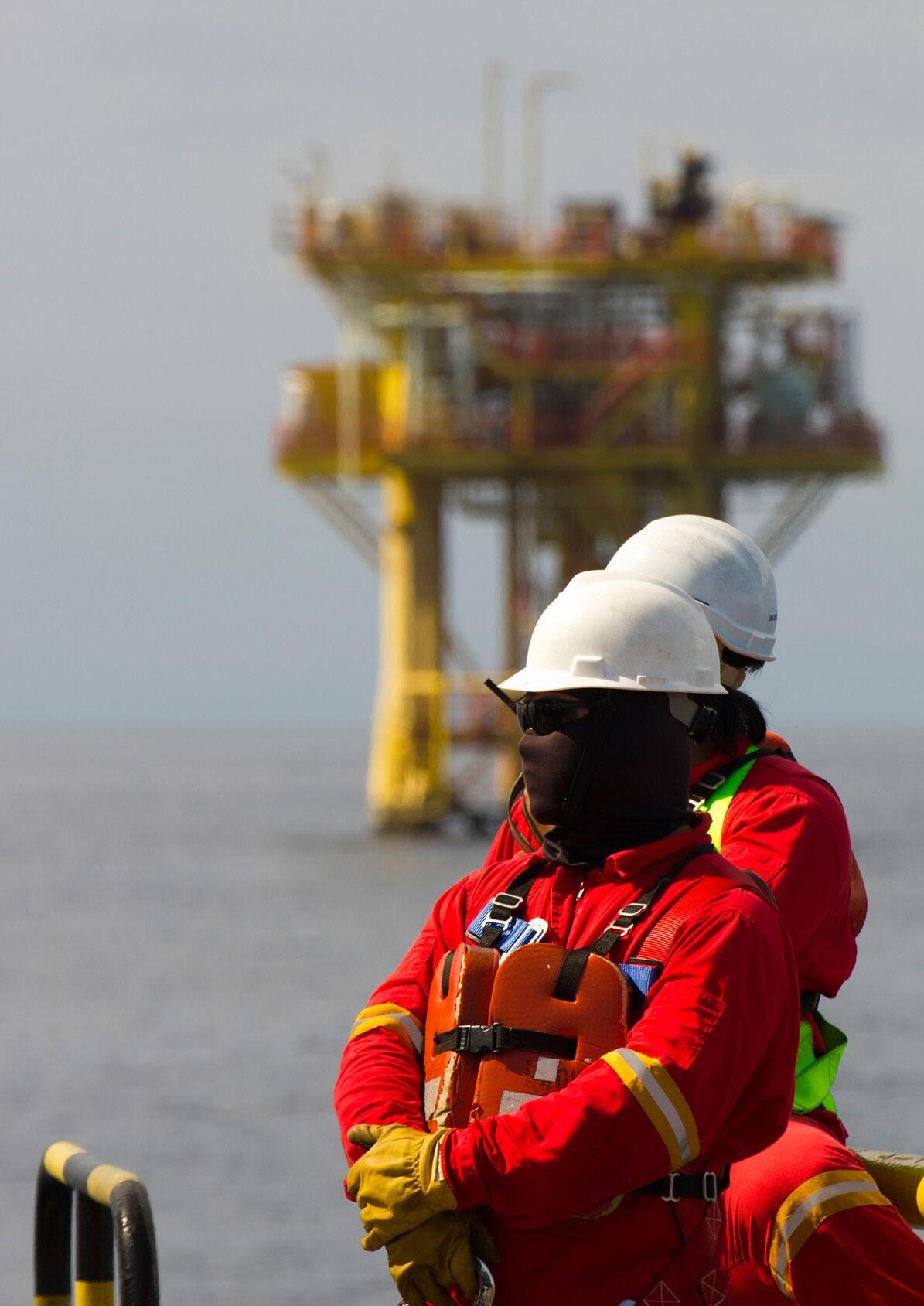
Several themes emerge repeatedly. One is the growing recognition that data alone is not enough. The industry has spent years collecting vast quantities of operational information, yet value only emerges when that information can be transformed into timely, trustworthy decisions.
Whether the discussion centres on autonomous operations, asset integrity, digital twins or AI-enabled facility design, the common challenge is creating the context that allows intelligence to become actionable.
Another recurring theme is the changing relationship between people and technology. Despite increasingly capable AI systems, there is little evidence that the future belongs to autonomous decision-making in isolation. Instead, the most compelling developments are those that combine engineering expertise with machine intelligence. Across the sector, organisations are exploring how AI can strengthen human judgement, preserve institutional knowledge and help less experienced personnel access decades of accumulated operational understanding.
The importance of trust also runs throughout these discussions. As AI moves closer to operational workflows, questions surrounding governance, explainability and accountability become increasingly important. The issue is no longer whether a model can generate recommendations. It is whether operators understand how those recommendations have been produced and whether they can confidently act

upon them in environments where the consequences of poor decisions can be significant.
Perhaps most importantly, the industry appears to be moving beyond experimentation. Pilot projects and proofof-concept programmes have demonstrated what is possible. The next challenge is creating the foundations necessary for long-term adoption at scale. That means investing in data architectures, cybersecurity, interoperability and workforce development as seriously as organisations invest in the AI technologies themselves.
The future oil and gas facility will undoubtedly be more connected, more intelligent and more automated than those operating today. The organisations that succeed, however, will not necessarily be those deploying the most advanced technology. They will be those that build environments where people, processes and intelligence evolve together. The articles in this edition explore that journey and the opportunities and challenges that lie ahead.
Mark Venables Editor
(0)203 675 9530
Future Digital Twin & AI
Cavendish
Enablon
Building a safer, more responsible and sustainable world using the power of innovative technology.
Award-winning software for optimizing environmental performance, improving worker safety, streamlining reporting and achieving regulatory compliance
Recognized as a global market leader by third party analysts including Verdantix and Gartner
25+ years of experience of delivering innovative software that adapts to evolving regulations
Part of Wolters Kluwer, a global leader in professional information, software and services with operations in over 40 countries
Trusted by the world’s largest companies
90% of the largest oil & gas companies
70% of the top 10 pharmaceutical companies
70% of the world’s top 10 technology giants
70% of the world’s largest aerospace & defence companies 65% of the world’s largest food & beverage companies
40% of the top 10 chemical producers
06
18 Autonomy arrives in the control room The pilot phase is over
As artificial intelligence moves from experimentation into operational decision making, the oil and gas sector faces a more difficult challenge than deploying new technology. The industry must learn how to trust systems that increasingly influence asset integrity, production performance and operational risk while ensuring that human expertise remains firmly in the loop.
10 When the model starts making decisions
The oil and gas industry spent years building digital twins to understand physical assets more effectively. The arrival of artificial intelligence is changing that relationship. The twin is no longer simply reflecting operational reality, it is increasingly becoming part of the decision-making process itself.
14 Designing facilities for a workforce that has not arrived yet
The oil and gas industry has spent decades designing facilities around equipment, process flows and operational constraints. Artificial intelligence is forcing a different conversation. Increasingly, operators are asking how facilities should be designed when decision support, automation and human expertise are expected to work together from the outset rather than being added later.
Artificial intelligence is no longer struggling to prove that it can work in the oil and gas sector. The more pressing challenge is proving that it can work consistently, securely and profitably at scale. As organisations move beyond experimentation, attention is shifting from technology itself towards governance, operating models and the practical realities of creating lasting business value22 Infosy.
22 The Intelligent Oilfield: How AI Is Changing the Way Energy Operates
The oil and gas industry has never lacked data, but turning information into timely operational decisions remains one of its greatest challenges. Avinash Darisa, Senior Client Partner, Infosys, and Ian Gaylard, Partner, Energy Practice, Infosys, explore how artificial intelligence is reshaping everything from well planning and production optimisation to knowledge management and workforce productivity.
26 Turning early signals into trusted action
The challenge facing many upstream operators is no longer detecting operational anomalies but understanding their likely consequences before production value is lost. Alessandro Speranza, Global Technology Portfolio Manager, KBC, and Michelle Wicmandy, Marketing Campaigns Manager, KBC, examine how production twins are combining engineering models, real-time data and physics-grounded AI to help organisations act earlier, reduce uncertainty and improve production assurance.
30 AI where the work actually happens
Artificial intelligence is beginning to deliver its greatest value not in exploration and reservoir modelling, but in the maintenance, reliability, permitting, scheduling, and asset management processes that determine day-to-day operational performance. In this article, the experts at Prometheus Group examine how purpose-built AI is being embedded directly into operational workflows, helping oil and gas operators reduce downtime, improve safety, and extract greater value from existing assets.
34 AI is only as valuable as the data it can access
Artificial intelligence, digital twins, and advanced analytics all depend on one critical ingredient: trusted operational data that can move securely between systems and environments. In this article, Jacqui Connelly of 4Secure explores why the success of digital transformation initiatives in oil and gas is determined less by the sophistication of the technology and more by the strength of the data foundations that support it.
38 From Snapshots to Intelligence: Cenosco’s Roadmap for AI-Driven Asset Integrity
Rahul Kejriwal, CEO of Cenosco, outlines how digital twins, integrity graphs and AI copilots could transform asset integrity management from a process built around periodic snapshots into one driven by continuous awareness. Rather than replacing engineering judgement, he believes the next generation of integrity platforms will strengthen it, helping organisations preserve expertise, improve decision-making and move closer to Goal Zero.
42 Powering trusted AI for offshore oil & gas:
Artificial intelligence may be reshaping offshore oil and gas, but its effectiveness ultimately depends on the quality, accessibility and governance of the information that underpins it. Phil Schwarz, Sr. Industry Strategist, Energy & Resources at OpenText, explores why secure information management is emerging as the essential foundation for trusted AI, autonomous operations and the future digital enterprise
46 Human-in-the-loop and beyond: Decision governance for AI-enabled operations
The debate surrounding AI in heavy industry has largely focused on keeping humans in the loop. Pedro Alcântara Nunes Neto, Chief Revenue Officer at Falkor, argues that the more important question is how organisations design the governance, data foundations and operational safeguards that will eventually allow humans to move from approving every decision to supervising systems that can be trusted to act within clearly defined boundaries.
48 Responsible AI in industrial software: putting data governance before hype
Artificial intelligence is rapidly becoming embedded within industrial software, but trust remains the foundation on which successful digital transformation depends. Lisa De Vellis, Global Content Lead at MODS, argues that responsible AI adoption begins with robust data governance, client control, and a commitment to applying technology only where it delivers measurable operational value.
50 Final Word
The industry is asking the wrong question about AI

AI FOR ENERGY EVOLUTION
Reimagining the future of energy through AI-powered intelligence and innovation.
Autonomy arrives in the control room
As artificial intelligence moves from experimentation into operational decision making, the oil and gas sector faces a more difficult challenge than deploying new technology. The industry must learn how to trust systems that increasingly influence asset integrity, production performance and operational risk while ensuring that human expertise remains firmly in the loop.
For decades, the oil and gas industry has pursued a simple ambition. If more data could be gathered from assets, better decisions would follow. Every generation of digital transformation has promised greater visibility, stronger predictive capabilities and improved operational performance. Sensors became cheaper, connectivity improved and cloud platforms created the ability to analyse vast quantities of information that would once have remained isolated inside individual facilities.
Yet many operators now find themselves confronting an uncomfortable reality. The industry has become exceptionally good at collecting data but far less effective at turning it into actionable intelligence. In many organisations, engineers still spend significant portions of their working day searching for information, validating reports or attempting to reconcile conflicting versions of operational truth. As artificial intelligence moves deeper into critical operational environments, these longstanding challenges become impossible to ignore.

The discussion has therefore shifted. The focus is no longer on whether AI can deliver value. Instead, attention is turning towards how organisations can create the conditions necessary for AI to operate safely, reliably and at scale across complex industrial environments.
That challenge sits at the heart of the next phase of digital transformation. Success increasingly depends on creating connected operational ecosystems where data, expertise and decisionmaking can flow across assets, functions and business units without compromising trust, safety or governance.
Building operational context
One of the most significant barriers to industrial AI adoption is not the sophistication of algorithms but the quality and accessibility of operational data. Most oil and gas operators possess enormous volumes of information spread across engineering systems, maintenance platforms, historians, production databases, inspection records and countless spreadsheets developed over years of operational activity. Much of that information remains trapped within organisational silos, making it difficult for AI systems to develop the contextual understanding required to support operational decisions.
The emergence of cross-asset data hubs seeks to address this challenge. Rather than viewing individual facilities as separate operational entities, organisations are increasingly creating unified environments capable of aggregating and contextualising information from multiple assets across entire portfolios.
This shift represents far more than a technology upgrade. It fundamentally changes how knowledge is captured, shared and applied. An engineer investigating compressor performance on one offshore platform may now have access to historical maintenance records, production trends and failure patterns from dozens of comparable assets operating elsewhere in the organisation. AI systems can identify patterns that would remain invisible when analysing facilities in isolation, creating opportunities to improve reliability, reduce downtime and optimise maintenance strategies.
Asset integrity programmes stand to benefit
particularly from this approach. Traditional inspection and maintenance regimes often rely upon periodic assessments and historical experience. AI-enabled systems operating within connected data environments can continuously assess changing operational conditions, identify emerging anomalies and prioritise interventions based on real-time risk profiles. The result is not simply faster decision-making. It is the creation of a richer operational context in which both humans and machines can make more informed judgements.
The trust challenge
While enthusiasm surrounding industrial AI continues to grow, concerns regarding trust remain entirely justified. Generative AI systems have demonstrated remarkable capabilities, but they have also exposed an important limitation. These models can produce highly convincing outputs that are nevertheless incorrect. In consumer applications, hallucinations may be inconvenient. Within safety-critical industrial environments, they can have far more serious consequences.
This distinction explains why many oil and gas organisations are approaching AI deployment with a level of caution that differs significantly from other sectors. The issue is rarely the technology itself. The challenge lies in ensuring that AI-generated recommendations remain grounded in verified operational reality.
Training data quality therefore becomes a critical consideration. Models trained using incomplete, outdated or poorly contextualised information can produce outputs that appear credible while introducing subtle forms of risk into operational decision-making. Biases embedded within historical data can be amplified. Rare operational events may be overlooked. Important contextual factors can be lost as information moves through increasingly automated workflows.
Addressing these risks requires more than technical safeguards. It demands governance structures capable of maintaining transparency throughout the AI lifecycle. Many organisations are beginning to implement layered approaches in which AI-generated recommendations remain visible and explainable to human operators. Rather than replacing engineering judgement, AI systems act as decision-support tools that surface relevant information, identify patterns and highlight potential actions while leaving accountability with appropriately qualified personnel.
This approach recognises an important reality. Trust is not created by removing humans from the process. Trust emerges when technology enables people to make better decisions while preserving visibility into how recommendations have been generated. For highly regulated industries such as oil and gas, explainability may ultimately prove more important than raw predictive accuracy.
AI becomes infrastructure
Perhaps the most profound shift occurring across the industry is the changing perception of AI itself. Many organisations initially approached AI as a software capability that could be deployed within existing operational structures. Experience is demonstrating that this view may be too narrow.
As AI becomes embedded within maintenance planning, production optimisation, integrity management and operational workflows, it increasingly resembles critical infrastructure rather than a standalone application.
This distinction matters because infrastructure carries different expectations. It must be resilient, secure, governed and continuously maintained. Its failure can have operational consequences extending far beyond the technology environment itself.
The emergence of agentic AI further reinforces this reality. Unlike earlier generations of analytical tools, agentic systems can perform tasks, coordinate activities and interact with multiple operational systems with varying degrees of autonomy. Their value lies not simply in generating insights but in influencing workflows and actions.
Such capabilities create significant opportunities. Routine engineering tasks can be accelerated. Reporting processes can be streamlined. Maintenance planning can become more dynamic. Operational teams can gain access to expertise and analysis that previously required
substantial manual effort. At the same time, these developments raise important questions regarding accountability, governance and control.
Industrial organisations therefore face a balancing act. They must create sufficient flexibility for AI systems to deliver meaningful operational value while ensuring appropriate safeguards remain in place.
This is why discussions around responsible AI are moving beyond compliance checklists and regulatory frameworks. Operators are increasingly focused on practical governance mechanisms that determine how AI systems are monitored, validated and managed throughout their operational lives. The objective is not merely regulatory compliance. It is operational confidence.
Beyond the cloud
Much of the early discussion surrounding industrial AI centred on cloud computing. While cloud platforms remain essential, the next phase of deployment increasingly extends beyond traditional IT boundaries. Operational environments generate vast quantities of data that require rapid interpretation and response. In many situations, sending information to a distant cloud environment before taking action is neither practical nor desirable.
This reality is driving growing interest in edge intelligence. By processing data closer to the source, operators can reduce latency, improve resilience and maintain critical capabilities

even when connectivity is constrained. Offshore facilities, remote production sites and geographically dispersed operations are particularly well suited to this approach.
The future is therefore unlikely to be defined by a choice between edge and cloud architectures. Instead, successful organisations are developing hybrid models that combine the strengths of both environments. Cloud platforms provide the scale required for advanced analytics, model training and enterprise-wide visibility. Edge systems deliver real-time responsiveness and operational continuity. Together they create an architecture capable of supporting increasingly autonomous operations.
Importantly, this evolution also changes workforce expectations.
As AI becomes embedded within operational workflows, digital literacy can no longer be confined to specialist technology teams. Engineers, operators, maintenance personnel and business leaders all require a greater understanding of how AI systems function, where their limitations lie and how their outputs should be interpreted. The most successful organisations are recognising that workforce enablement is not a separate initiative running alongside technology deployment. It is an integral component of the transformation itself.
Autonomous operations will not emerge simply because more sophisticated algorithms become available. They will emerge when organisations successfully combine trustworthy data, robust governance, operational expertise and human judgement within a common framework.
The oil and gas industry has spent decades building the physical infrastructure required to operate safely and efficiently in some of the world’s most demanding environments. The next challenge is constructing an equally robust digital foundation.
The organisations that succeed will not necessarily be those deploying the most advanced AI models. They will be those that create environments where people trust the technology, understand its limitations and can confidently integrate its capabilities into everyday operational decisions. In an industry where reliability remains paramount, that may prove to be the most important competitive advantage of all.
> Software < Solutions > Intelligent < Industrial

Connected software solutions that put the intelligence behind how assets are managed
When the model starts making decisions
The oil and gas industry spent years building digital twins to understand physical assets more effectively. The arrival of artificial intelligence is changing that relationship. The twin is no longer simply reflecting operational reality, it is increasingly becoming part of the decision-making process itself.

For many years, digital twins occupied an awkward position within the oil and gas industry’s digital transformation agenda. Operators understood their potential and technology suppliers promoted them relentlessly, yet the practical outcomes often struggled to match the ambition. Three-dimensional models of offshore platforms, production facilities and subsea infrastructure certainly looked impressive, but many organisations found themselves asking a difficult question once the demonstrations were over. Beyond visualisation, what exactly was the twin contributing to day-to-day operations?
That question is becoming easier to answer. The combination of artificial intelligence and digital twin technology is changing both the purpose and value of these virtual environments. Rather than functioning as passive representations of physical assets, digital twins are increasingly becoming operational platforms capable of supporting planning, maintenance, integrity management and production decision-making. In some organisations they are evolving into environments where potential actions can be assessed before they are carried out in the field, creating a bridge between physical operations and digital analysis that did not previously exist.
The shift arrives at an important moment for the industry. Asset portfolios are ageing, experienced personnel continue to retire, operational complexity is increasing and expectations around efficiency continue to rise. Against that backdrop, operators are looking for ways to extract greater value from the vast quantities of information generated across their facilities. Artificial intelligence offers one route forward, but only if it can be applied within a framework that understands the operational context in which decisions are being made. That is where digital twins are beginning to demonstrate their greatest value.
Context becomes the differentiator
The oil and gas sector does not suffer from a shortage of information. Modern facilities generate enormous volumes of operational data through instrumentation systems, process historians, maintenance records, inspection reports and engineering databases. The challenge is that most of this information was never designed to work together. Data sits inside different systems, managed by different departments and often
governed according to different priorities.
This fragmentation creates a significant challenge for artificial intelligence. Models can identify patterns within datasets, but understanding what those patterns mean requires context. A pressure fluctuation in isolation may simply be a data point. When viewed alongside maintenance history, equipment performance records, process conditions and operational changes elsewhere in the facility, it may become evidence of a developing reliability issue. The distinction is critical because industrial decisionmaking rarely depends upon individual pieces of information. It depends upon understanding how numerous factors interact over time.
Digital twins provide a mechanism for bringing these relationships together. They create a common operational framework capable of linking information from engineering, operations, maintenance and production systems. This allows artificial intelligence to analyse data within a much richer context than would otherwise be possible. The result is not simply better analysis. It is analysis that reflects the realities of how industrial assets behave.
This is particularly important in offshore environments where small operational decisions can have consequences that extend far beyond the equipment being examined. A maintenance intervention on one system may affect production elsewhere. A change in operating conditions may influence asset integrity risks across multiple parts of the facility. Digital twins allow those dependencies to become visible in ways that traditional reporting environments often struggle to achieve.
Beyond the visual model
One of the enduring misconceptions surrounding digital twins is that their primary value lies in visualisation. While graphical interfaces undoubtedly help users understand complex systems, the real transformation is taking place beneath the surface. Increasingly, the twin itself is becoming an operational environment through which decisions are explored, tested and validated before they are implemented in the real world.
This evolution is perhaps most visible within asset integrity management. Traditionally, operators have relied upon a combination of inspections, engineering judgement, maintenance records
and risk-based assessments to determine where interventions should be prioritised. These approaches remain essential, but they are often constrained by the amount of information that engineers can realistically process and interpret.
Artificial intelligence changes that equation. When applied within a digital twin environment, it becomes possible to analyse relationships across large volumes of historical and real-time information simultaneously. Inspection records can be examined alongside process conditions. Maintenance histories can be compared against operational performance. Emerging anomalies can be evaluated against patterns observed elsewhere within an organisation’s asset portfolio. Instead of examining isolated events, engineers gain visibility into how multiple variables combine to influence risk.
The same principle is beginning to influence production operations. Digital twins increasingly allow operators to understand the wider implications of decisions before they are executed. Potential changes can be assessed against operational objectives, asset constraints and historical performance data. Rather than relying solely on retrospective analysis, organisations are beginning to create environments that support more informed forward-looking decision-making.
What makes this significant is that the value does not come from replacing engineering expertise. It comes from expanding the amount of information that expertise can effectively utilise.
Trust cannot be automated
As organisations become more ambitious in their use of artificial intelligence, a different challenge is emerging. The issue is no longer whether AI can generate insights. The issue is determining how much confidence operators should place in the outputs it produces.
This concern is particularly relevant within highly regulated industries where safety, environmental performance and operational integrity remain paramount. The recent enthusiasm surrounding generative AI has demonstrated how convincingly systems can present information. It has also demonstrated that confidence and accuracy are not always the same thing.
For this reason, many oil and gas companies
are focusing significant attention on data governance, contextualisation and validation processes. The quality of an AI recommendation ultimately depends upon the quality of the information used to generate it. If data is incomplete, inconsistent or poorly contextualised, the resulting outputs may appear credible while introducing subtle forms of risk into operational decision-making.
Digital twins can help address this challenge by providing a framework through which information is organised and validated. However, they do not eliminate the need for human oversight. Experienced engineers remain essential because they possess operational knowledge that cannot always be captured within digital models. Understanding why a recommendation has been generated often matters as much as the recommendation itself.
This is one reason why many operators continue to position AI as a decisionsupport capability rather than an autonomous decision-maker. The objective is not to remove human judgement from critical processes. The objective is to ensure that judgement is supported by a more complete understanding of operational reality.
Building the foundation first
Many of the industry’s most successful digital transformation programmes have reached a similar conclusion. The greatest obstacle to scaling artificial intelligence is rarely the technology itself. More often, the challenge lies in creating the data foundations necessary to support meaningful adoption.
This is driving growing interest in federated data environments. Rather than attempting to move every dataset into a single central repository, operators
are increasingly focusing on connecting information where it already resides. The aim is to create common access frameworks and governance structures that allow information to be shared without requiring wholesale replacement of existing systems.
Digital twins fit naturally within this approach because they provide a contextual layer capable of linking information from across the enterprise. Artificial intelligence can then operate on top of that foundation, drawing upon a broader and more trustworthy view of operational reality. The organisations making the greatest progress are often those that spent time solving data accessibility and contextualisation challenges before pursuing advanced AI deployments.
The conversation taking place across the industry is therefore changing. A few years ago, attention focused on whether digital twins justified the investment required to build them. Today, the discussion increasingly centres on whether organisations can realise the full value of artificial intelligence without them.
That distinction matters because it reflects a broader shift in thinking. Digital twins are no longer being viewed solely as technology projects. They are becoming operational assets in their own right, providing the contextual framework through which artificial intelligence can interact with the physical world. As AI becomes more deeply embedded within exploration, production and asset management activities, the organisations that thrive are likely to be those that recognise a simple truth. The quality of decisions depends not only on the intelligence of the model but also on the depth of understanding surrounding the environment in which it operates.

AI-POWERED EAM SOFTWARE
Empowering oil & gas teams for 2 5+ years.
Maintenance & Logistics
Plan, schedule, and mobilise work from the control room to the rig, refinery, and pipeline.
Environmental Health & Safety
Standardise permitting, manage operational risk, and stay audit-ready across every site.
Capital Project Management
Get real-time visibility into turnarounds, projects, risks, and capital allocation.
Master Data Management
Clean, enriched, and trusted asset data—integrated with your ERP/CMMS system.
75%

44% decrease in scheduling process time—via one system
decrease in days sales outstanding—from 9 to 5 days

Designing facilities for a workforce that has not arrived yet
The oil and gas industry has spent decades designing facilities around equipment, process flows and operational constraints. Artificial intelligence is forcing a different conversation. Increasingly, operators are asking how facilities should be designed when decision support, automation and human expertise are expected to work together from the outset rather than being added later.
Many of the facilities operating across the North Sea today were designed in a very different technological era. Control systems were largely deterministic, automation followed clearly defined rules and operational expertise resided primarily within experienced engineers and operators who understood how assets behaved under a wide range of conditions. Digital technologies have been added progressively over time, but the underlying philosophy has remained largely unchanged. The facility was designed first. The digital layer came later.
Artificial intelligence is beginning to reverse that relationship. As operators consider new developments, life extension programmes and major upgrades to existing assets, digital capability is increasingly becoming part of the design process itself. Decisions regarding instrumentation, connectivity, data architecture and operational workflows are being made much earlier because organisations recognise that future performance will depend as much on the quality of information flowing through a facility as the physical equipment installed within it.
This shift represents more than another phase of digital transformation. It reflects a growing recognition that future competitiveness will be determined by how effectively organisations combine human expertise, operational technology and increasingly intelligent systems. The facilities being designed today will need to support workforces, operating models and decision-making processes that continue to evolve throughout their operational lives.
That creates both opportunity and uncertainty. While artificial
intelligence offers the prospect of improved reliability, enhanced safety and more efficient operations, it also forces organisations to reconsider long-held assumptions regarding skills, accountability and operational control.
Moving beyond programmed responses
Industrial automation has delivered enormous benefits to the oil and gas sector. Modern facilities are capable of monitoring and controlling thousands of process variables simultaneously, maintaining safe operating conditions while reducing the burden on operational personnel. Yet conventional automation remains fundamentally constrained by one characteristic. It responds to situations that have already been anticipated.
The challenge is that operational environments rarely behave exactly as expected.
Equipment ages, operating conditions change and interactions emerge that were never considered during the original design phase. Experienced engineers often recognise these nuances because they have spent years observing how assets behave under real-world conditions. Artificial intelligence introduces the possibility of augmenting that capability by identifying patterns and relationships that might otherwise remain hidden within large volumes of operational data.
This is where the discussion begins to move beyond traditional automation. Rather than simply executing predefined instructions, AI systems have the potential to identify emerging issues, recommend interventions and support decision-making under changing conditions. In maintenance environments, this may involve recognising subtle indicators of equipment degradation before conventional alarm thresholds are reached. In production operations, it may involve evaluating operating conditions and identifying opportunities to improve efficiency without compromising reliability.
Importantly, this does not mean facilities are moving towards fully autonomous operation. Despite some of the more ambitious claims surrounding artificial intelligence, most operators recognise that industrial environments remain too complex and too consequential for complete automation. The greater value lies in creating systems that enhance human decision-making rather than attempting to replace it. That distinction is likely to define the next phase of industrial AI adoption.
One workforce many perspectives
Technology adoption has always been as much a cultural challenge as a technical one. Artificial intelligence simply brings that reality into sharper focus. Across the oil and gas sector, organisations are managing a workforce that
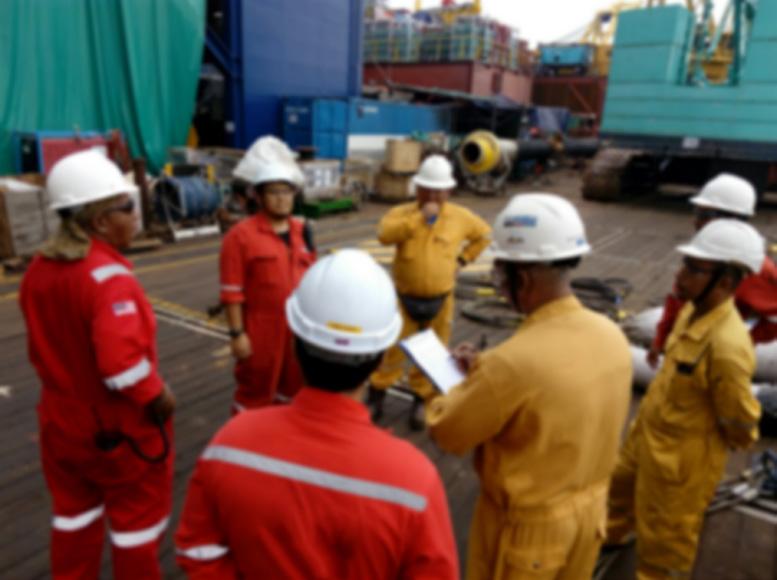
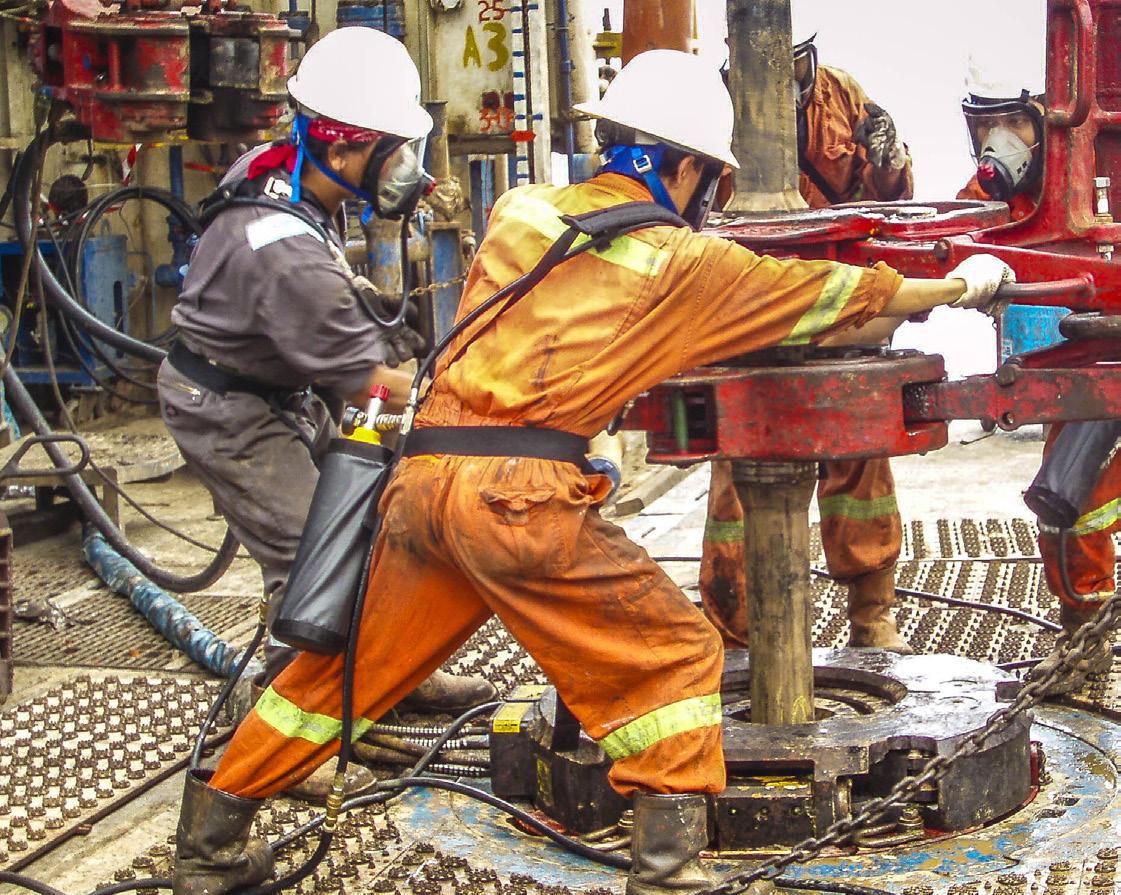
spans multiple generations of experience. Some employees began their careers before widespread digitalisation transformed industrial operations. Others have entered the industry expecting access to digital tools and data-driven decision support as a normal part of working life. Both groups bring valuable perspectives, but they often approach technology from different starting points.
This dynamic becomes particularly important when organisations begin deploying AI-enabled systems. Experienced personnel frequently possess deep operational knowledge that cannot be found within databases or engineering drawings. Their
understanding has been developed through years of observing assets under varying conditions, responding to unexpected events and learning from situations that rarely appear in training manuals. Newer generations of workers may be more comfortable interacting with advanced software environments, but they often lack the practical experience that allows them to interpret complex operational signals.
Successful organisations are recognising that artificial intelligence creates an opportunity to bring these strengths together. AI-enabled learning platforms, digital assistants and
contextual decision-support tools can help make expertise more accessible across the organisation. Knowledge that previously remained concentrated within small groups of specialists can be captured, structured and shared more effectively. At the same time, experienced personnel remain critical because they provide the judgement required to assess whether recommendations align with operational reality.
The objective is not to favour one generation over another. It is to create an environment where experience and technology reinforce each other. This matters because one of the industry’s
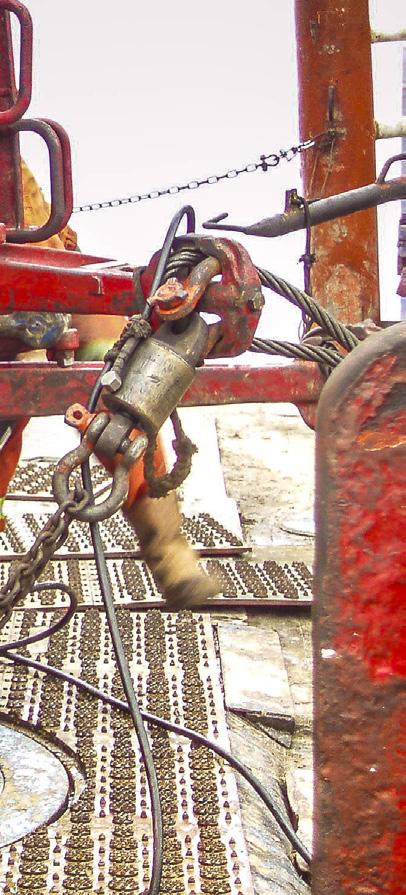
most pressing challenges is the gradual loss of institutional knowledge through retirement and workforce turnover. Artificial intelligence cannot replace decades of operational experience. It can, however, help organisations preserve and distribute that knowledge more effectively than traditional approaches have allowed.
Value of connected ecosystems
A recurring lesson emerging from digital transformation programmes is that isolated technology deployments rarely deliver lasting value. Organisations can implement sophisticated analytics platforms, digital twins or AI applications,
but the benefits often remain limited if these technologies operate independently of wider operational processes.
This is particularly true in oil and gas environments where decisions rarely occur within a single discipline. Reliability teams depend upon information from maintenance systems. Production personnel require visibility into asset condition. Engineering teams rely upon accurate operational data to support modifications and life extension programmes. The effectiveness of any individual technology increasingly depends upon its ability to operate within a broader ecosystem.
Artificial intelligence is accelerating this trend because its value is closely linked to the quality and accessibility of information available to it. The most effective deployments are emerging in organisations that have prioritised interoperability and data accessibility rather than pursuing isolated digital initiatives.
Digital twins often play an important role within these environments because they provide a framework through which information from multiple systems can be understood collectively. However, the underlying principle extends beyond any individual technology. What matters is the ability to create operational environments where information flows efficiently across organisational boundaries.
This is where many operators are beginning to see transformational value. Improvements in reliability, safety and operational efficiency rarely result from a single application. They emerge when multiple technologies, datasets and workflows begin working together in ways that support better decisions throughout the organisation. The discussion is therefore moving away from technology selection and towards ecosystem design.
Security in an intelligent environment
The integration of artificial intelligence into operational environments inevitably creates new security considerations. Traditional cybersecurity approaches focused primarily on protecting networks, devices and applications. The introduction of AI introduces additional concerns that many organisations are only beginning to address.
One of the most significant is the integrity of the models themselves.
An AI system is only as reliable as the information it receives and the assumptions upon which it was trained. If data can be manipulated, corrupted or poisoned, the resulting recommendations may become unreliable without immediately appearing suspicious. Similarly, attempts to influence or manipulate model behaviour could create operational risks that differ from conventional cyber threats.
These concerns are driving growing interest in combining zero-trust security principles with AI governance frameworks. The objective is not simply to prevent unauthorised access. It is to establish confidence that data, models and outputs remain trustworthy throughout their operational lifecycle.
For oil and gas operators, this challenge extends beyond technology teams. Decisions generated through AI-enabled systems may influence maintenance priorities, operational strategies and business processes. Confidence in those systems therefore becomes a business issue rather than a purely technical concern.
The facilities of the future will almost certainly contain more intelligence than those operating today. They will generate more information, support more sophisticated decision-making processes and rely upon increasingly interconnected technologies. Yet their success will not depend solely upon the sophistication of the tools deployed within them.
It will depend upon whether organisations can create environments where people trust the information available to them, understand the role that artificial intelligence plays within operational processes and remain confident in their ability to make informed decisions. The industry has spent decades learning how to design facilities capable of operating safely in challenging physical environments. The next challenge is ensuring those facilities are equally prepared for the complexities of an increasingly intelligent operational world.
The pilot phase is over
Artificial intelligence is no longer struggling to prove that it can work in the oil and gas sector. The more pressing challenge is proving that it can work consistently, securely and profitably at scale. As organisations move beyond experimentation, attention is shifting from technology itself towards governance, operating models and the practical realities of creating lasting business value.
The oil and gas industry has never been short of pilot projects. For decades, new technologies have been trialled on individual assets, within specific business units or as part of limited operational programmes intended to demonstrate potential value before wider deployment. Artificial intelligence has followed a similar path. Across the sector, operators have tested predictive maintenance applications, production optimisation tools, intelligent document management systems and a growing range of generative AI capabilities.
Many of these initiatives have delivered encouraging results. Some have generated measurable operational improvements. Others have demonstrated significant productivity gains or highlighted opportunities to improve decision-making processes. Yet a growing number of organisations are reaching a common conclusion. Success within a pilot environment does not necessarily translate into success across an enterprise.
This distinction is becoming increasingly important as executive teams look beyond technology demonstrations and begin asking more fundamental questions about return on investment, organisational readiness and long-term competitiveness. The conversation is changing because the barriers preventing wider adoption are often unrelated to the performance of individual AI models. In many cases, they
are rooted in data architecture, governance, workforce capability and the ability to integrate new technologies into operational processes that have evolved over many years.
As a result, the industry is entering a different phase of adoption. The challenge is no longer proving that artificial intelligence can create value. The challenge is creating the conditions necessary for that value to be replicated across multiple assets, business functions and operating environments.
Scaling requires a different mindset
One reason many organisations struggle to move beyond successful pilots is that pilot projects are often designed to remove complexity. Teams focus on clearly defined use cases, carefully selected datasets and highly engaged stakeholders. The environment is deliberately controlled because the objective is to prove that a concept can work. Operational reality is considerably less accommodating.
Production facilities operate with legacy systems, competing priorities and varying levels of digital maturity. Data quality differs between assets. Workflows have developed over time to address local requirements. What appears straightforward within a controlled pilot environment can become significantly more complicated when applied across an entire organisation.
This is why scaling artificial intelligence increasingly resembles an organisational challenge rather than a technical one. Operators that are making meaningful progress tend to invest heavily in data foundations, governance structures and change management activities before pursuing large-scale deployment. They recognise that successful implementation depends upon creating consistency across the organisation rather than simply introducing new tools.
There is also growing recognition that AI programmes require clear ownership. Many early initiatives emerged from innovation teams, digital transformation groups or technology functions operating separately from core business activities. While this approach helped accelerate experimentation, it often created a disconnect between technology development and operational execution.
As organisations move towards production-scale deployments, responsibility is shifting closer to the business. Reliability teams, operations leaders, maintenance managers and asset owners increasingly play a central role in determining how artificial intelligence is deployed and measured. The focus moves away from technical performance and towards operational outcomes. That shift may prove more important than any individual technology breakthrough.
Building resilience into digital ecosystems
As artificial intelligence becomes more deeply embedded within operational environments, the resilience of
the underlying ecosystem becomes increasingly important. Many discussions surrounding AI focus on algorithms, models and applications. In practice, the quality of outcomes often depends far more heavily on the infrastructure supporting them. Data must be accessible, trustworthy and available when required. Systems must interact effectively across organisational boundaries. Cybersecurity measures must evolve alongside increasing connectivity.
This challenge is particularly relevant within the oil and gas sector because many operators manage complex environments that have been developed over decades. Production systems, engineering applications, maintenance platforms and business systems frequently originate from different vendors and were never designed to operate as part of a unified digital architecture.
Artificial intelligence places new demands on these environments because it relies upon information flowing across organisational and technical boundaries. Models cannot generate meaningful insights if critical information remains inaccessible or fragmented. Similarly, AI-enabled workflows become difficult to scale when every asset requires bespoke integration efforts.
The most successful organisations are therefore focusing on digital ecosystems rather than individual applications. Their objective is to create environments where information can move securely and efficiently between systems, allowing new capabilities to be introduced without extensive redevelopment.
Cybersecurity forms an increasingly important component of this strategy. As AI systems become more influential within operational processes, protecting the integrity of data and decision-making environments becomes essential. The discussion extends beyond traditional network security towards ensuring that information remains trustworthy throughout its lifecycle and that AI-
generated recommendations cannot be manipulated through compromised data sources. The resilience of the ecosystem ultimately becomes inseparable from the reliability of the outcomes it produces.
Collaboration becomes a competitive advantage
For much of the digital era, organisations often viewed technology development as a source of competitive differentiation. Proprietary platforms, bespoke applications and internally developed solutions were frequently seen as strategic assets capable of creating long-term advantage.
Artificial intelligence is encouraging a different perspective. The scale of investment required to develop data platforms, governance frameworks and advanced AI capabilities means that relatively few organisations can realistically build every component themselves. Even among the largest operators, there is growing recognition that collaboration frequently delivers faster and more sustainable outcomes than isolated development efforts.
This trend is becoming visible across the industry. Operators are increasingly working with technology providers, cloud companies, software vendors and specialist partners to create common foundations upon which multiple use cases can be built. Rather than attempting to develop every capability independently, organisations are focusing on where their unique expertise genuinely creates value.
The distinction is important because competitive advantage rarely comes from owning a technology platform. It comes from applying technology more effectively than competitors within operational environments. Collaboration also helps address another challenge facing many organisations. Artificial intelligence requires expertise spanning data science, engineering, cybersecurity, governance and operational disciplines. Few organisations possess deep capabilities across all these areas simultaneously. Partnerships allow companies to access specialised knowledge while maintaining focus on their core business objectives. As the industry continues to mature, success is likely to depend less on who owns the technology and more on who can create the most effective combination of capabilities around it.
Trust becomes an operational metric Few concepts appear more frequently in discussions surrounding artificial intelligence than trust. Yet trust often remains poorly defined. Within operational environments, trust is not an abstract principle. It is a measurable characteristic that influences whether technology is adopted, relied upon and ultimately scaled. Engineers trust systems when recommendations consistently align with operational reality. Managers trust systems when outcomes remain predictable and transparent. Organisations trust systems when governance mechanisms ensure accountability remains clear.
This becomes increasingly important as AI moves beyond analytical support and begins influencing operational workflows more directly. The emergence of agentic systems is accelerating this discussion because these technologies are capable of initiating actions, coordinating processes and interacting with multiple systems with varying degrees of autonomy. Their potential benefits are significant, particularly in areas such as reporting, workflow management and operational support. At the same time, they introduce important questions regarding accountability and oversight.
Trust therefore becomes something that must be designed into systems rather than assumed. Organisations need visibility into how decisions are generated, what information influenced recommendations and where human intervention remains necessary. Governance frameworks become operational tools rather than compliance exercises. This is particularly important within regulated industries where decisions can affect safety, environmental performance and asset integrity. Confidence in technology cannot be based solely on technical performance. It must also reflect an understanding of how that performance is achieved and maintained.
From experimentation to impact
The most revealing shift taking place across the oil and gas sector is not technological. It is organisational. A few years ago, discussions surrounding artificial intelligence often focused on possibility. The emphasis was on what the technology might achieve, how quickly it was advancing and which use cases appeared most promising. Those conversations have not disappeared, but they increasingly sit alongside

2026 EVENTS PROGRAMME

The Intelligent Oilfield: How AI Is Changing the Way Energy Operates
The oil and gas industry has never lacked data, but turning information into timely operational decisions remains one of its greatest challenges. Avinash Darisa, Senior Client Partner, Infosys, and Ian Gaylard, Partner, Energy Practice, Infosys, explore how artificial intelligence is reshaping everything from well planning and production optimisation to knowledge management and workforce productivity.

Oil and gas companies have always operated under multiple constraints, but the nature of that pressure is now changing rapidly. A 2025 survey of more than 700 energy executives identified a dual challenge for the sector: meeting rising energy demand while continuing to decarbonise1. As emissions targets tighten, expectations to deliver reliable, lower-carbon energy continue to rise. Markets have become more volatile, and the industry faces a growing shortage of experienced professionals with many retiring faster than they can be replaced. These forces are converging on operations teams in ways that make the old playbook, built around steady-state planning and slow feedback loops, more difficult to sustain.
It is also evident that a new generation of tools and agents powered by artificial intelligence (AI) is changing how energy companies respond. From real-time monitoring to automated knowledge retrieval, AI is giving operators and engineers ways to understand what is happening across their assets much faster. It is also helping them make better decisions under tight timelines.
Where Traditional Approaches Fall Short
The oil and gas industry has a long-standing record of remarkable engineering achievement. The ability to drill complex wells, manage offshore platforms, and operate refineries at the edge of thermodynamic limits reflects decades of accumulated expertise.
Yet much of the decision making behind these operations still depends on fragmented systems, disconnected data, and significant manual work. For instance, a single well planning cycle may require an engineer to review hundreds of pages of historical reports, completion records, offset well comparisons, and operational lessons learned. This information is often spread across different databases and document management systems, in formats that may not be compatible. The expertise needed to interpret all of it certainly exists, but it is locked in the minds of experienced professionals or buried in documents that can take hours to decipher. When decisions need to be made quickly, this gap between available and accessible knowledge becomes difficult to bridge.

Similar issues arise in production optimisation, maintenance scheduling, and risk assessment. In many cases, the data is available but getting it into the hands of the right person at the right moment remains a challenge. The systems that served the industry well for decades were built for a world that moved more slowly and were not meant to handle the current scale and complexity of data.
Turning Data into Decisions
Across the industry, companies are now applying AI, machine learning (ML), computer vision (CV), and generative AI (GenAI) to complex operational problems that were time-consuming to address.
On the asset side, predictive maintenance models are learning to spot early signs of equipment degradation before failures occur, thereby reducing unplanned downtime and improving reliability. Machine vision systems can detect flare events and fugitive emissions in real time, supporting both safety and environmental performance. On the operations side, AI models are helping teams optimise production across multiple wells, fine-tune drilling parameters, and assess risk with greater precision. The common thread is that these applications transform large volumes of disparate
data into actionable insights for the relevant teams.
AI assistants are also helping teams find information and compare alternatives faster, reducing the time spent on repetitive manual analysis. For an engineer preparing a well plan or reviewing incident history, the ability to ask a question in plain language and get a sourced, summarised answer in seconds is immensely useful. In 2019, Equinor’s then chief information officer (CIO) had estimated that professionals in oil and gas spend around 80% of their time searching through unstructured information to support decisions, about three times the average across other industries2. The challenge still holds today, making the use of AI in information retrieval and decision support invaluable.
The greatest value lies in bringing these capabilities together across the energy value chain rather than deploying them as isolated point solutions. Several organisations are pursuing such integrated approaches. In fact, frameworks like Infosys’ AI for Energy Evolution reflect this thinking. This solution connects AI-driven asset intelligence, operational analytics, and workforce co-pilot tools into a unified approach that spans
exploration through production and beyond.
From Intelligent Tools to Intelligent Agents
One of the more significant developments in recent years is the emergence of AI agents. These are systems that go beyond answering questions to performing multi-step tasks, reasoning through complex information, and supporting engineers through entire workflows. The oil and gas sector, with its vast repositories of operational data and its constant need for context-rich decision making, is a natural fit for such advanced technology.
Well planning offers a good illustration of where agents can make an immediate impact. It remains one of the most information-intensive activities in the industry. Engineers planning a new well need to understand what happened on nearby wells, the problems that surfaced, what worked and what did not, and how conditions may differ this time. Traditionally, this would require extensive reviews of reports, logs, diagrams, completion summaries, and lessons learned before a plan could even begin to take shape.
Purpose-built AI agents are transforming this workflow. For example, an AI agent designed for
well operations can ingest thousands of pages of documentation and identify relevant learnings from past activities. It can compare offset wells, highlight operational risks, and generate preoperational summaries in a fraction of the time it would take a human team.
The industry is already beginning to see the practical value of these capabilities. The Infosys AI Agent for Well Operations is one such tool. Built on Microsoft Azure and OpenAI’s GPT-4o infrastructure, it integrates with subsurface data environments aligned to the Open Subsurface Data Universe (OSDU) standard. During testing, the agent has demonstrated 92% accuracy in surfacing past-event lessons, giving engineers a reliable starting point when decisions need to be made under pressure.
There are similar results being observed across the industry. In an EY oil and gas engagement, an AI system successfully processed 750 documents in three weeks3. Previously, teams were able to process only four or five documents a month. The system also rewrote and tagged engineering requirements, significantly reducing manual effort.
However, it is important to note that AI agents cannot replace engineering judgement. Engineers are still responsible for the decisions they make. AI agents simply help them get to the information and context faster.
Building the Foundation
A dependable AI system relies on good data. Yet in many oil and gas organisations, information is spread across systems and records may be incomplete. Critical operational knowledge often remains buried in reports and historical documentation.
This is why organisations investing in their data foundations and AI models are seeing the most encouraging results from the AI revolution. Building that foundation requires several elements to come together: cloud infrastructure, cybersecurity, governance, and data architecture aligned with standards such as OSDU.
Recommendations based on incomplete or poorly structured information can introduce operational risk instead of reducing it. Getting the data right is therefore a vital prerequisite.



Avinash Darisa, Senior Client Partner, Infosys
Ian Gaylard, Partner - Energy Practice, Infosys
Turning early signals into trusted action
The challenge facing many upstream operators is no longer detecting operational anomalies but understanding their likely consequences before production value is lost. Alessandro Speranza, Global Technology Portfolio Manager, KBC, and Michelle Wicmandy, Marketing Campaigns Manager, KBC, examine how production twins are combining engineering models, real-time data and physics-grounded AI to help organisations act earlier, reduce uncertainty and improve production assurance.
What if the most expensive production loss this year began days before anyone recognized it?
In many upstream operations, the warning signs often appear long before production is affected. A pressure deviation. A developing bottleneck. The early stages of hydrate formation. Today, upstream operators generate more operational data than at any point in the industry’s history. Sensors, connected assets, and digital monitoring systems generate a continuous stream of information across the production network.
Yet, many organizations continue to operate reactively. Why? Because identifying a signal is often easier than determining its operational impact. Knowing why it changed and what should happen next remains far more difficult.
Several factors contribute to this challenge:
1. Operational data is frequently distributed across multiple systems, applications, and functional teams. While engineers and operators work across multiple systems, production and asset teams often rely on different data sources, which create delays in identifying emerging risks and coordinating responses.
2. Assets continue to grow more complex while experienced personnel retire, and organizations struggle to replace them. As workforce transitions continue across the energy sector, organizations face growing pressure to preserve knowledge and support less experienced teams with better decisionmaking tools.
3. Visibility shows that something changed. Action requires understanding why it changed and what to do next.
“The industry does not need another screen full of data,” said Dr. Alessandro Speranza, Global Technology Portfolio Manager for KBC. “It needs trusted guidance that helps teams act earlier and with greater confidence.”
KBC Acuity™ digital twins[WM1.1][AS1.2][WM1.3][AS1.4] help operators move beyond reactive monitoring with more cognitive capabilities. They combine physics-based AI, engineering models, and operational intelligence to support earlier, more confident decision-making.
Visibility creates awareness while guidance builds confidence
Over the last decade, digital twins have emerged as a cornerstone of upstream digital transformation. By integrating engineering models with contextualized operational data, digital twins provide a more complete view of upstream performance. But what happens after an engineer sees the problem?
Engineers rarely make decisions based on a single measurement.
Many frontline teams spend their days monitoring dashboards, investigating alarms, and piecing together information from multiple systems after a problem has started.
Production decisions influence reliability and economics across the asset. Understanding how a developing constraint may affect the broader system often requires significant investigation and engineering effort. Effective decisions require a common understanding of operating conditions across engineering, production, and operations teams.
The next phase of digital transformation helps teams determine which signals matter and what actions need attention.
Confidence comes from context
This shift is driving a new generation of digital twins that combine engineering knowledge, real-time operating data, and artificial intelligence to support decision-making. According to Speranza, “AI can identify patterns, but physics determines what is possible. Trusted operational guidance requires both.”
Production systems operate within guardrails. Physical constraints, equipment limitations, and operating procedures all require engineering context.
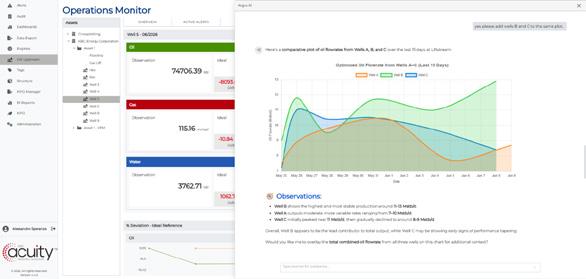
Thus, many organizations adopt physics-grounded AI approaches that combine firstprinciples engineering models with machine learning models, agentic AI and generative AI to improve reliability, explainability, and trust. KBC Acuity[WM2.1][WM3.1] Industrial Cloud Suite applies this approach by connecting contextualized operating data with validated engineering models, helping teams investigate deviations and maintain confidence in operational decisions. Figure 1 shows how automated alerts flag deviations from expected performance, and an AI agent providing insights on the operations, helping engineers identify emerging issues earlier and prioritize investigation efforts.
As AI moves closer to operational decision support, model assurance grows increasingly important. A production or process digital twin creates value when it reflects how an asset behaves today, not how it behaved six months ago.
As assets evolve, model drift can gradually reduce confidence in recommendations and decision support. Continuous validation, governance, and model-assurance workflows help ensure recommendations remain accurate and aligned with changing operating conditions. Human expertise anchors operational decision-making. The goal is to strengthen engineering judgment with better context and more reliable guidance. It is to reduce the
PRODUCTION TWINS
Figure 1 Operating dashboard and AI agent’s insights monitoring a gas-lifted producing asset
time engineers spend chasing alarms and gathering information so they can focus on evaluating options, managing risk, and making decisions.
Production twins extend visibility by helping teams identify emerging issues, understand likely causes, and focus attention where it can have the greatest operational impact.
Trust is earned before production is lost
How much production value is lost between the first warning sign and the decision to act?
Like a pipeline beginning to constrict, production losses often develop gradually before becoming visible at the surface. They rarely begin with a shutdown. More often, they start as small restrictions somewhere in the system. A subtle pressure change, a gradual increase in backpressure, or the early stages of hydrate formation can appear hours, days, or even weeks before throughput begins to decline.
Flow assurance risks provide a clear example. Small changes in fluid composition, temperature, pressure, or flow behavior can create conditions for hydrate formation, wax deposition, and other developing constraints long before production declines become visible.
Left unresolved, these constraints can reduce throughput, increase interventions, accelerate production deferrals, and ultimately erode production value.
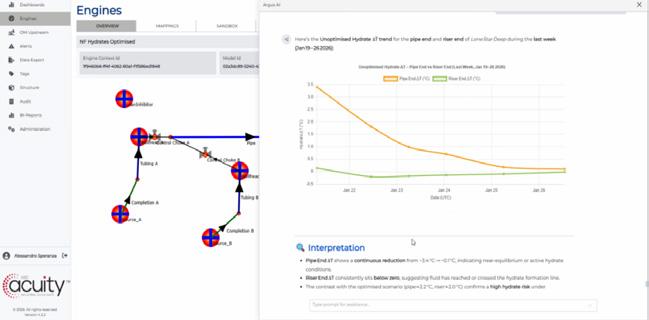
Similar constraints surface throughout the production network. A gas-lift issue on one well, a developing bottleneck in a gathering system, or a change in facility operating conditions can create impacts that extend far beyond a single asset. Understanding these interactions requires operational context that helps teams identify emerging constraints, evaluate consequences, and prioritize action before throughput is affected. Figure 2 illustrates how an AI agent, supported by physics-based modeling, can analyze and extrapolate the current trends. Then, compare these with thermodynamic predictions to identify emerging hydrate risks.
Determining the cause of a developing constraint often requires understanding interactions across the production network. Is the issue driven by gas lift performance, flow assurance conditions, facility limitations, equipment performance, or changing operating conditions elsewhere in the system?
Earlier intervention often delivers substantial value. In one upstream application, a production twin helped identify opportunities for approximately 2% production enhancement and more than US$6
million in estimated annual value. This is the objective of production assurance: identifying emerging constraints and protecting value before throughput is affected.
This shift from detection to informed action enables organizations to protect throughput and improve reliability of operational resources across the asset lifecycle.
Turning early signals into trusted action
KBC Acuity digital twins[WM4.1][SA4.2] support this next stage of digital transformation by combining engineering models, real-time operating data, physics-based AI, and model assurance. Together, these advanced capabilities help upstream teams investigate risks, evaluate alternatives, and prioritize action before value is lost.
The objective is not simply greater visibility. It is trusted guidance that helps operators act earlier, with greater speed and certainty, and within real operating constraints.
For operators, these capabilities deliver practical benefits:
Earlier detection of emerging production and reliability risks
• Greater confidence in digital twins through model assurance and calibration workflows Physics-grounded recommendations that respect real operating constraints
Simulation-backed scenario analysis before changing the real asset
Better alignment between process models, reactor models, LP vectors, and planning assumptions
More time for scarce experts to diagnose root causes, evaluate opportunities, and improve performance.
As upstream operations become increasingly connected and intelligent, competitive advantage will depend on identifying constraints earlier and acting before production value is lost. These same capabilities can also help upstream organizations improve energy efficiency and reduce emissions while Bringing Decarbonization to Life® through better operational decisions.
Speranza concludes, “The future of digital twins is not simply detecting problems. It is turning early signals into trusted action.”
Figure 1 Operating dashboard and AI agent’s insights monitoring a gas-lifted producing asset

Calum MacLean Projects Director

John Walden CTO
AI where the work actually happens
Artificial intelligence is beginning to deliver its greatest value not in exploration and reservoir modelling, but in the maintenance, reliability, permitting, scheduling, and asset management processes that determine day-to-day operational performance. In this article, the experts at Prometheus Group examine how purpose-built AI is being embedded directly into operational workflows, helping oil and gas operators reduce downtime, improve safety, and extract greater value from existing assets.
The AI conversation in oil and gas fixates on the subsurface — seismic, reservoirs, exploration. Important work, but it overlooks where operators actually lose and recover time, money, and safety margin: the operational core of maintenance, turnarounds, permitting, asset data, and the day-to-day health of equipment. Offshore operators average around 27 days of unplanned downtime a year, costing roughly $38 million. That is where AI can have the clearest, most immediate return.
How that AI is built matters. Prometheus Group draws a line between horizontal AI, which only suggests, and vertical AI, which interprets, decides, and executes inside the workflow itself. A general model can summarise a document; it cannot sequence a turnaround or read a pump’s health from its sensor history. Prometheus Group builds intelligence into those workflows directly, trained on decades of real maintenance data — purpose-built for asset-intensive operations, and proven in oil and gas
In Their Own Words
Organisations see immediate improvements in their operations with
Prometheus-AI:
“It’sclearthisAIisbeingbuilttherightway—withrealcustomersinmind.”
— Enterprise Systems Manager, Multi-Billion-Dollar Refining Operation
“Theabilitytojusttypeinwhatyou’rewantingittodoisahugeplusforourusers.”
— Analyst, High-Volume Corrugated Packaging Facility
“ThisAIdoesn’tjustfollowtheprocess.Ithelpsteachit.”
— Plant Maintenance IT Business Consultant, Leading Global Packaging Manufacturer
Where the intelligence lives
GWOS-AI — planning and scheduling. Trained on more than twenty years of maintenance data, GWOS-AI turns a noisy backlog into an executable schedule. Planners reassign resources in natural language and run AI-powered mass changes, while the system places preventive and corrective work and optimises by crew or location. Step-by-step guidance enforces a standardised approach and cuts onboarding time for the new and rotating crews common to shift-based oil and gas operations.
DSO — upstream scheduling and optimisation. In upstream operations, idle time is the most expensive kind: nonproductive time can swallow more than 30% of a well’s cost, and rig operating cost accounts for the bulk of the rest. DSO pulls well delivery — permitting, drilling, completion, facilities, and field operations — into a single optimised schedule, using an AI optimisation engine built for upstream complexity to assign rigs, crews, and equipment to activities under real-world constraints. Planners build and compare multiple developmentplan scenarios in minutes and run “What if?” analysis against cost, production, and KPIs, so a change or disruption can be absorbed without losing the plan — helping operators hit production targets and maximise return on assets.
STO-AI — turnarounds, shutdowns, and outages . The turnaround is the largest controllable event of a facility’s year and the one most exposed to overrun: industry benchmarks show more than two-thirds miss plan by at least 10% on cost or schedule, and a large refinery turnaround can exceed $100 million — usually because scope creeps in after the freeze date.
STO-AI accelerates work-package creation from standardised templates, historical norms, and ERP data, while models trained on decades of operational history produce more accurate schedules, surface risks earlier, and optimise plans before execution. During the event, real-time
dashboards and automated shift-change logs keep handovers clean and progress, delays, and resource readiness in full view.
ePAS-AI — permitting and safety. In the North Sea especially, the permit to work is the backbone of safety culture — with reason: at refineries, under 10% of time is spent in transient operations like startup and shutdown, yet more than half of process safety incidents occur then. ePAS-AI guides permit creation — prompting for job description, location, and scope, recommending values from similar historical permits, and pushing back on vague or incomplete entries. Its HIRA module auto-populates hazards and controls by work category, from welding and grinding to electrical, then compares against similar permits to surface missing hazards and quality gaps. Naturallanguage queries replace filter-building — how many hot-work permits are active, average cycle time by type, what is awaiting approval — with instant answers. And by tracking isolations and lockouts across permits, it flags conflicts between jobs sharing equipment and mismatched isolation conditions before work begins.
MDaaS-AI — the data foundation . None of it works on bad data — Gartner puts the cost of poor data quality at an average of $12.9 million a year, with companies losing an estimated 15–25% of revenue to it. MDaaS-AI uses AI to standardise, cleanse, and enrich material masters — assigning noun and modifier, parsing manufacturer and part numbers, and analysing and building out bills of materials against ERP structures. For operators carrying vast MRO inventories across complex rotating equipment, that means accurate spares, lower supply-chain cost, and a master record the platform can trust.
RapidAPM — asset performance . Further along the curve, RapidAPM monitors every sensor on every asset, using AI and neural networks to detect reliability and efficiency issues before they become failures — failures that can cost up to $149 million per site. Crucially, it prioritises alerts, cutting through the flood of notifications operators field every day, so teams act on the signals that matter rather than drowning in noise. McKinsey research suggests predictive maintenance can reduce downtime by 30–50% and extend equipment life by 20–40%, while built-in Value-at-Risk and ROI calculators put a number on each avoided failure.
On the connected Prometheus-AI Platform, intelligence compounds: clean data sharpens scheduling, one asset record feeds permits and work orders, and Prometheus Group is adding new AI across the platform at pace.
The operational dividend
The pressures defining oil and gas — ageing assets, tighter margins, demanding safety, an energy transition asking more of the assets already in the ground — are operational at root. That is where purpose-built intelligence earns its place: not the AI that looks deepest into the earth, but the kind that works alongside the people keeping the operation running.
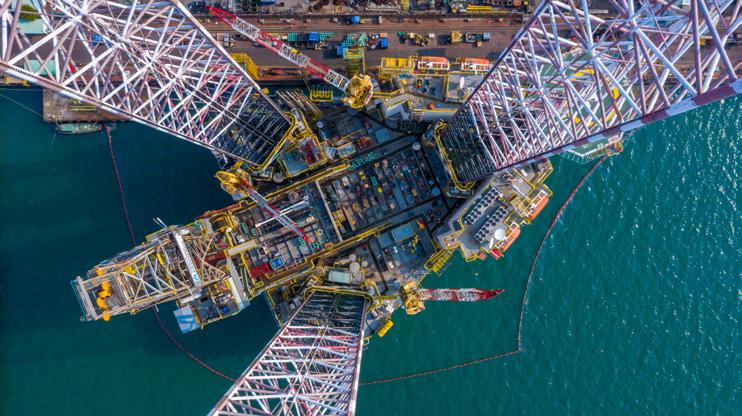


AI is only as valuable as the data it can access
Artificial intelligence, digital twins, and advanced analytics all depend on one critical ingredient: trusted operational data that can move securely between systems and environments. In this article, Jacqui Connelly of 4Secure explores why the success of digital transformation initiatives in oil and gas is determined less by the sophistication of the technology and more by the strength of the data foundations that support it.
No Data, No Party. It’s a simple concept. No music? No party. No guests? No party.
No refreshments? Definitely no party. Imagine that Digital Transformation is a party. You want all of the cool kids there. AI. Digital twins. Advanced analytics.
But they won’t come if you don’t have what they’re looking for.
Data from across the operation. Pipeline sensors. Process control systems. Offshore platforms. Remote assets.
Without it, the party never really gets started. You can have the latest AI platform. The most sophisticated digital twin. The best analytics tools money can buy.
But if the operational data isn’t available, accessible and trusted, none of them can deliver the value they’re promising.
Just like a party, digital transformation depends on what you put into it.
For Oil and Gas operators, operational data belongs on that list too. Without it, many of the technologies shaping the future of the industry simply don’t work.
Artificial Intelligence, digital twins and advanced analytics have shifted from innovation projects to operational priorities across the Oil and Gas sector. The potential upsides are well documented:
improved production efficiency, optimised maintenance strategies, enhanced asset performance and faster, more informed decisionmaking.
The common theme behind all of them is data. Data. Data. And more data.
From offshore platforms and pipelines to processing facilities and remote assets, organisations are increasingly looking to operational data as the foundation of the modern digital oilfield.
If the upsides are known, why isn’t this easier? Despite the industry’s focus on AI and digital transformation, many organisations continue to face a more fundamental challenge.
How do you get the right operational data to the right place, at the right time, without increasing risk?
Because before an AI model can generate insight, before a digital twin can simulate performance and before enterprise analytics can support decisionmaking, data must first move from operational environments into systems where it can be used. And for many Oil and Gas operators, that remains easier said than done.
For decades, operational technology environments have been deliberately separated from business networks. These environments control and monitor critical processes where reliability, safety and availability are vital. As a result, many
organisations have implemented highly segmented architectures designed to minimise exposure to cyber threats and protect critical operations. These approaches have served the industry well. However, the operational requirements of today’s digital transformation initiatives are creating new demands on those same environments.
Production data is required by enterprise analytics platforms. Engineering teams need visibility across geographically dispersed assets. Digital twins depend on accurate operational information. Remote operations centres require access to realtime data. AI initiatives need trusted data sources to generate meaningful outcomes.
The value of these initiatives is widely recognised. What is often underestimated is the challenge of enabling the secure movement of data that makes them possible.
Across the industry, there is growing recognition that AI success is not determined solely by the sophistication of the technology being deployed. The challenge is not simply having data. It is having trusted data.
Because when operational information is incomplete, delayed or inaccessible, the value of every downstream analytics, AI and digital twin initiative is diminished.
An organisation may have a sophisticated analytics platform, a digital twin programme or a roadmap for scaling AI across multiple assets. However, if

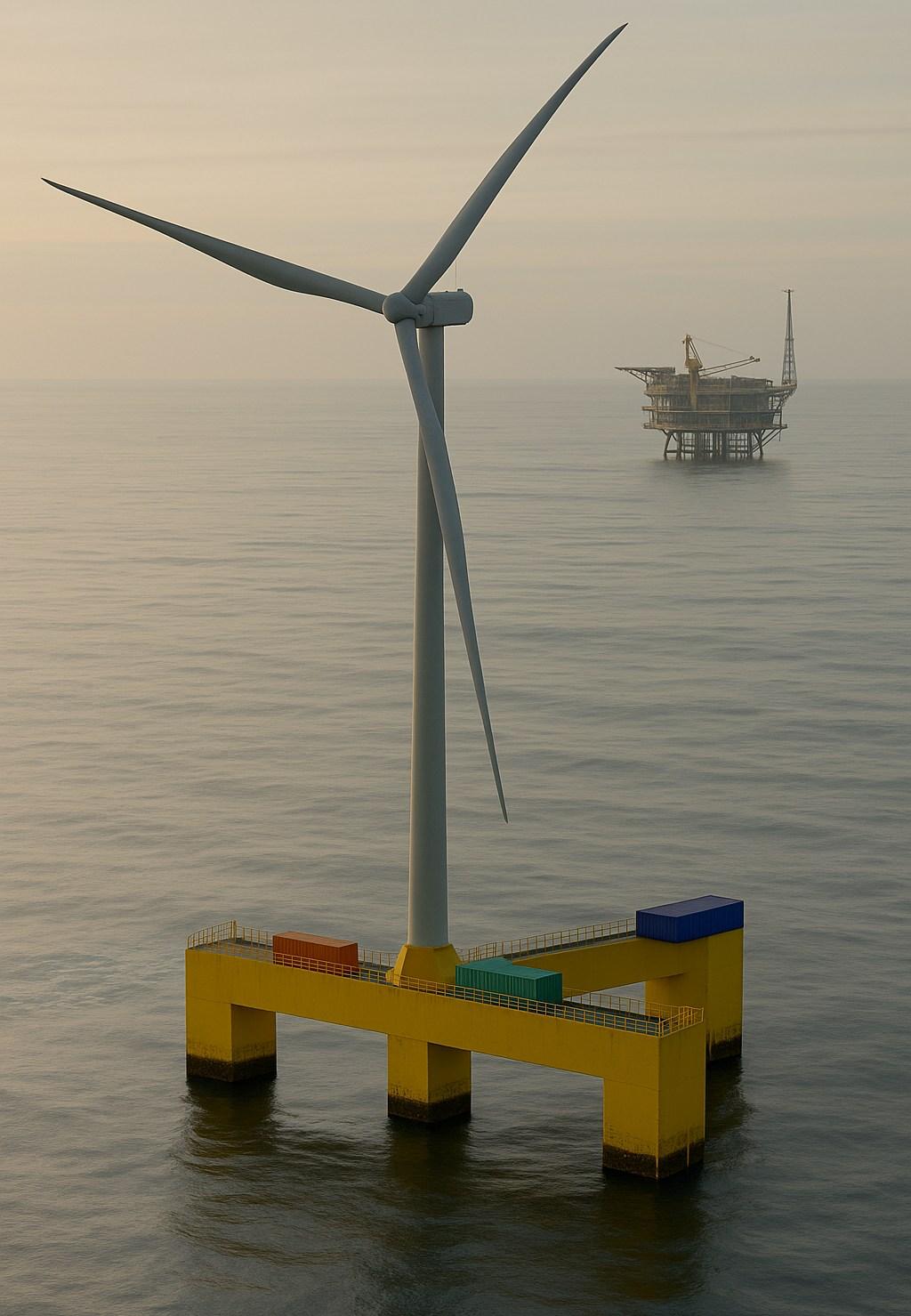
Floating Power Plant’s unique wind energy system incorporating long duration energy storage offers economical solutions to increasing field life and new opportunities at CoP, while our Power as a Service model removes the need to own and operate additional assets. Get in touch to hear more
critical operational information remains trapped within isolated environments, the value of those investments becomes significantly harder to realise.
This is creating a renewed focus on trusted operational data.
AI has become the industry’s latest focus, but AI cannot create value from data it cannot access. The challenge is no longer simply collecting information. It is making trusted operational data available where it can be used to improve decisions, optimise performance and support innovation.
This presents a challenge.
The straightforward solution would be to connect everything together.
Yet most operators understand that increasing connectivity can also increase exposure. Every new connection, remote access pathway and integration introduces additional complexity and expands the potential attack surface. For organisations responsible for safety-critical operations, unrestricted connectivity is rarely an acceptable option.
At the same time, maintaining complete isolation is becoming increasingly difficult to justify.
The industry no longer operates in a world where operational data is only required within the control environment. Modern operating models depend upon information flowing between assets, operations centres, enterprise systems, analytics platforms and cloud-based services.
The challenge therefore is not whether data should move.
It is how that movement can occur without compromising the integrity of critical systems. This is where many organisations are rethinking traditional approaches to connectivity. Rather than viewing security and operational visibility as competing priorities, operators are increasingly adopting architectures designed specifically to govern how information moves between environments.
The objective is not unrestricted access.
The objective is controlled data exchange. By implementing policy-enforced controls, protocol-aware inspection and tightly governed communication pathways, organisations can enable operational information to move where it is needed while maintaining appropriate separation between environments with different levels of trust.
This allows production data to support enterprise
reporting. It enables operational information to feed analytics platforms and digital twins. It supports visibility across remote assets and central operations centres. It creates the trusted data flows required to support AI initiatives and future digital transformation programmes.
Most importantly, it enables these outcomes without forcing organisations to compromise the security and resilience of their operational environments.
As organisations look to scale AI, digital twins and advanced analytics beyond pilot programmes, the ability to move operational information securely and reliably becomes increasingly important. The challenge facing many organisations today is not a lack of ideas, technology or ambition. It is the ability to operationalise those initiatives at scale.
Digital twins require trusted data. AI requires trusted data. Enterprise analytics require trusted data. Autonomous operations require trusted data. Without reliable and secure mechanisms for exchanging information between environments, even the most promising initiatives can struggle to progress beyond proof-of-concept.
The organisations that succeed in the next phase of digital transformation will not necessarily be those with the most advanced AI models.
They will be those with the strongest data
foundations.
They will be the organisations capable of making operational information available where it creates value while maintaining the security, resilience and reliability that critical operations demand.
For years, the Oil and Gas industry has focused on protecting operational environments from external threats.
That responsibility remains as important as ever. But as digital transformation accelerates, another requirement is emerging alongside it.
The ability to move trusted operational data safely between environments.
Because in the age of AI, digital twins and datadriven operations, the organisations that create the most value will not necessarily be those with the most data.
They will be those that can make trusted operational data available where it is needed, without compromising the environments from which it originates.
Because in modern Oil and Gas operations, the principle is surprisingly simple. No Data. No Party.
At 4Secure, we help operators make critical operational data available where it creates value, without compromising the environments from which it originates.
Find out more at 4-secure.com.



























From Snapshots to Intelligence: Cenosco’s Roadmap for AI-Driven Asset Integrity
Rahul Kejriwal, CEO of Cenosco, outlines how digital twins, integrity graphs and AI copilots could transform asset integrity management from a process built around periodic snapshots into one driven by continuous awareness. Rather than replacing engineering judgement, he believes the next generation of integrity platforms will strengthen it, helping organisations preserve expertise, improve decision-making and move closer to Goal Zero.

Integrity teams are under pressure from every direction. Assets are aging. Experienced engineers are retiring faster than they can be replaced. And the data needed to make confident decisions is scattered across systems that were never designed to talk to each other. The question is no longer whether the industry needs to change how it manages asset integrity. It is whether organizations are building the right foundations to make that change stick.
Cenosco’s IMS (Integrity Management System) manages some of the most complex infrastructure on Earth. From offshore facilities and pipelines to storage tanks, LNG plants, chemical plants, and refineries, our assets are living, breathing, and degrading every second.
Yet when it comes to safeguarding asset integrity, organizations still operate within frameworks shaped by regulatory requirements, operational constraints, and the practical realities of data availability. We use Risk-Based (RBI) software to plan inspections on fixed intervals, following established RBI models, not because the industry is slow to modernize, but because these cycles are essential for compliance, governance, and auditability. We conduct visual rounds to meet mandated observation frequencies. We compile reports to satisfy assurance processes that have kept facilities safe for decades.
These traditional methods remain vital, they are the foundation of modern integrity management. They embody engineering discipline, codified standards, and the lessons of past incidents. But they were built for a world where continuous data streams did not yet exist. As a result, they operate on periodic snapshots, while degradation evolves continuously between inspection cycles. What is changing now is not the importance of RBI or visual inspection, but the environment around them. Sensors, robotics, and machine learning now make it possible to augment these trusted processes with evidence that updates itself. The opportunity is not to replace regulated, cyclical practices, but to enrich them through an asset integrity management platform that integrates inspection planning software and live sensor data.
At Cenosco, we believe the next leap forward comes from embedding real-time asset intelligence inside the structure of existing integrity programs. That means enabling RBIsoftware to refresh dynamically with live data, allowing degradation assessments to evolve as new evidence appears, and creating a continuous feedback loop that strengthens auditability rather than challenging it. Continuous intelligence becomes a complement to periodic cycles, filling the gaps, reducing uncertainty, and elevating engineers’ ability to make decisions with confidence.
From a C-level executive perspective, the urgency is clear. Integrity teams are highly skilled but chronically stretched, not because they produce “meaningless reports,” but because the current
processes create unavoidable inefficiencies: repeated manual data compilation, reactive rather than predictive interventions, and limited ability to prioritize across hundreds of assets. This inefficiency translates into real cost: reduced production and elevated risk exposure to a major black swan event. The upside of real-time intelligence, enhanced by predictive corrosion modeling, is not abstract. It shows up directly in key metrics: reduced unplanned outages, extended asset life, optimized inspection budgets, and materially lower operational risk.
From Periodic Oversight to Continuous Awareness: Real-Time Intelligence
Asset integrity management today happens in cycles. Visual inspections occur quarterly or after shutdowns. But degradation doesn’t wait for our schedules. It evolves continuously.
The next generation of Asset Integrity Management will be driven by a living network of IIoT sensors and autonomous inspection robots, drones, crawlers, and quadrupeds, streaming live data on temperature, vibration, wall thickness, corrosion potential, and emissions.
These digital observations become new inputs to existing RBI frameworks. Instead of manually refreshing models, advanced RBI software continuously updates likelihood-of-failure estimates using real-time evidence.
AI agents, trained on historical and physics-based models, interpret these data streams, distinguishing normal behavior from early signs of degradation. Combined with integrity digital twins grounded in real engineering physics, this creates a dynamic understanding of asset health.
Imagine an RBI dashboard that offers insightful and actionable suggestions as new sensor data arrives. A corrosion loop that receives risk ranking suggestions in real time. A pipeline that identifies its own hotspots before they become leaks. Meanwhile, inspection planning software seamlessly integrates this intelligence, enabling dynamic and prioritized inspection workflows. This is real-time integrity intelligence, where physical inspection is super-charged with continuous digital awareness, yet the trusted methodologies of RBI and visual inspection remain essential reference points.
Operators already running connected inspection workflows within IMS are seeing earlier anomaly detection, faster risk reassessment, and a measurable reduction in reactive interventions.
The Brain: The Integrity Graph
As real-time data begins to pour in from sensors, robots, and inspection systems, the challenge is no longer collecting information. It is understanding it. In today’s plants, data is abundant but fragmented. Corrosion logs live in spreadsheets. RBI models sit in isolated databases. Sensor readings stream into control systems that rarely talk to the asset integrity management tools.
The industry’s response to this fragmentation is converging around a clear need: a living, interconnected representation of every asset, its condition, and its evolving risks. One that does not just store data but understands relationships. One that knows how a pump’s vibration profile relates to bearing wear, how a temperature excursion affects corrosion rate, and how a small leak could accelerate nearby degradation. At Cenosco, we call this the Integrity Graph, and it is our answer to that industry need.
This graph will become the foundation for real-time reasoning. As IIoT sensors report temperature or thickness changes, as drones capture images of insulation damage, or as engineers log new inspection findings, each data point will update the graph’s understanding of the asset’s state. The models inside it, physics-based and data-driven, will continuously make suggestions to engineers on likelihood-offailure estimates, risk rankings, and help identify non-obvious patterns across units and plants. In time, the Integrity Graph will evolve into
the collective memory of the organization, a living model of how assets behave, degrade, and respond to intervention. It is the bridge between observation and insight, between data and action. And it is what makes the next step possible: AI copilots that think in context, make recommendations in real time, and help engineers see not just what is happening.
The Copilot Architecture: Domain Expertise at Scale
As asset integrity moves into the age of realtime data, the engineer’s role is being redefined, not replaced. The future of Asset Integrity Management is not about removing human judgment. It is about extending it with intelligence that is always on, always current, and always grounded in the physics of how assets actually degrade.
At the heart of this transformation is what we call the Copilot Architecture, a new class of AI collaborators purpose-built for engineering reasoning. These copilots are not generic
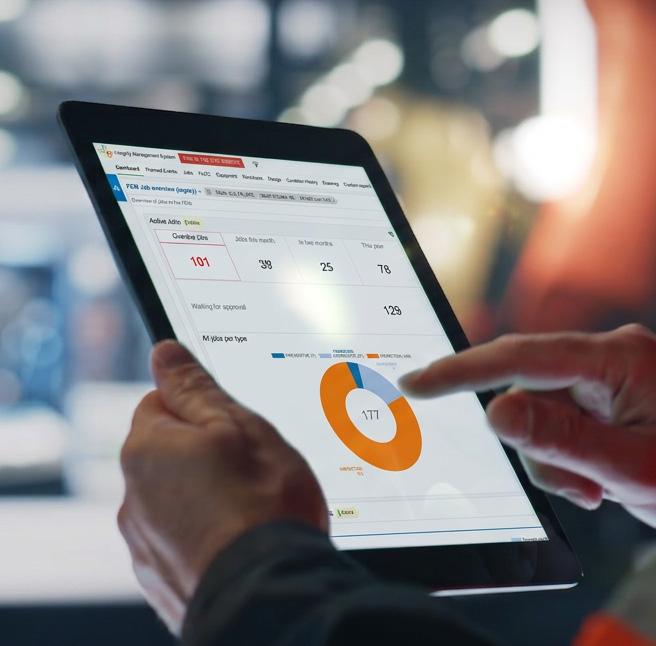
assistants or large language models. They are domain-specialized systems trained on decades of inspection data, degradation models, and standards like API 571, API 580, and ISO 14224.
The first such copilot that Cenosco is working on is the Degradation Mechanism Copilot, a digital expert that will not just monitor known damage mechanisms but actively help diagnose which ones are at play. Through advanced predictive corrosion modeling, it continually updates its understanding of damage progression, improving the accuracy of its recommendations.
In the future, when an engineer selects a piece of equipment, such as a heat exchanger shell, the copilot will draw on a combination of factors, including the material of construction, process temperature, pressure, chemical environment, inspection findings, and live sensor readings. From this, it will infer and rank the most probable degradation mechanisms, whether it is hightemperature sulfidation, chloride-induced stress corrosion cracking, erosion-corrosion, or simple thinning. It will cross-reference these possibilities with known operating histories and environmental conditions, explaining why certain mechanisms are more or less likely.
But it will not stop at identification. The copilot will continuously make suggestions as new data flows in, from ultrasonic thickness readings, visual inspection images, or surface temperature sensors. If a drone detects hot spots, or an IIoT probe reports rising moisture beneath insulation, the copilot will recalibrate its hypothesis and update its recommendation of corrosion under insulation (CUI) or external corrosion accordingly. It will then recommend next steps: which inspection methods would most efficiently confirm the active mechanism, what monitoring adjustments to make, and how to update the RBI model’s likelihood-of-failure. All of this happens transparently, every inference traceable, every assumption explainable, every recommendation grounded in engineering logic and empirical evidence.
Over time, the Degradation Mechanism Copilot will become an institutional expert that learns continuously. It absorbs feedback from human engineers, correlates plant experiences across sites, and builds a richer understanding of how degradation actually evolves in the real world. What emerges is a shared, ever-
learning intelligence, one that fuses human judgment, physical models, and datadriven reasoning into a single, trusted partner for every integrity engineer.
The Human in the Loop: Uncompromising Accountability
As integrity decisions become increasingly augmented by AI, another question emerges for senior leadership: who carries responsibility when an AI-supported recommendation influences or fails to influence an outcome?
This is like the debates around accountability in autonomous vehicles. In our domain, the answer must remain unequivocal: engineering judgment, regulatory compliance, and operator governance stay firmly in control. AI can surface insights, detect anomalies earlier, and propose optimized interventions, but it does not replace the responsible engineer of record. For organizations to trust this evolution, every AI-driven suggestion must be explainable, traceable, and auditable, ensuring that the chain of accountability remains intact, and that regulators can see not only what decision was made, but why. Cenosco’s architecture is designed with this accountability built in from the start, not added as an afterthought.
The Destination: Goal Zero as an Operating Model
The future of Asset Integrity Management is not about replacing engineers or discarding proven methods. RBI, corrosion models, and visual inspections remain essential. They provide the foundation upon which real-time intelligence is built. What is changing is how these inputs are collected, interpreted, and acted upon. This transformation is powered by integrity digital twins that create dynamic, physics-based models of assets updated with continuous data from sensors and autonomous inspections. Coupled with AI copilots, such as the Degradation Mechanism Copilot, these tools enable organizations to make integrity decisions faster, more consistently, and with greater confidence.
Over time, these systems capture institutional knowledge and help prioritize interventions based on evidence rather than assumptions. This will help less experienced engineers and managers be more confident and reduce the stress of

overburdened engineers and managers struggling to make time to deal with what really matters. This approach moves organizations closer to Goal Zero, a state where risks are visible before they become incidents, maintenance is informed rather than reactive, and assets are managed proactively based on real-world behavior. Achieving Goal Zero doesn’t mean eliminating all risk. It means making uncertainty manageable, predictable, and transparent.
Cenosco’s AI roadmap is designed to make this transition practical and achievable. Not as a theoretical ideal, but as a grounded, implementable evolution of asset integrity management that the industry is already moving toward. The organizations that invest in the right data foundations today are the ones that will have the operational confidence to act on AI intelligence tomorrow.

Rahul Kejriwal, CEO, Cenosco
Powering trusted AI for offshore oil & gas
Artificial intelligence may be reshaping offshore oil and gas, but its effectiveness ultimately depends on the quality, accessibility and governance of the information that underpins it. Phil Schwarz, Sr. Industry Strategist, Energy & Resources at OpenText, explores why secure information management is emerging as the essential foundation for trusted AI, autonomous operations and the future digital enterprise.
Across offshore oil and gas operations, AI is rapidly moving from experimentation to expectation. Leaders are under pressure to deliver safer operations, faster project execution, improved asset reliability, and lower emissions—at scale. Yet behind every AI initiative lies a less visible, but far more strategic dependency: content.
Engineering drawings, well files, inspection reports, shift logs, procedures, regulatory submissions, images, video, failure reports, and decades of operational knowledge represent the institutional memory of the enterprise. This information is fragmented across systems, formats, contractors, and lifecycle stages. Without secure, governed, and contextualised access to this content, AI cannot be trusted—particularly in regulated, safety critical offshore environments.
As the industry enters the era of intelligent, agentic AI—where systems reason, plan, and act across complex workflows—the need for a unified, AI ready content foundation becomes paramount. Trusted AI is not only trained on data; it is shaped by human intent, operational context, and governed knowledge.
This editorial explores how secure information management underpins six core themes shaping the future of offshore oil and gas—and why getting content right is now a strategic imperative.
Moving from AI POCs to production—getting AI ready
Many oil and gas organisations have proven that AI can work. The challenge now is making it work
reliably, repeatedly, and at scale. Production grade AI—especially agentic AI—demands more than algorithms. It requires enterprise memory.
Agentic AI systems depend on context: historical decisions, approved procedures, engineering intent, asset states, and regulatory constraints. This information lives primarily in human generated, unstructured content—documents, drawings, correspondence, and expert judgment. When this content is fragmented or poorly governed, AI remains stuck at the proof of concept stage.
Becoming AI ready means solving the fragmented memory problem. Content must be unified across its lifecycle, enriched with metadata, classified automatically, de identified where necessary, and secured with fine grained access controls. Only then can it safely power retrieval augmented
generation, domain specific copilots, and decision support agents.
Equally important is governance—ensuring cybersecurity, auditability, and interoperability across regulated environments. When curated correctly, unstructured content becomes the intent layer for AI, embedding business rules and professional judgment into human–AI collaboration. This is how offshore operators move beyond experimentation to AI that delivers measurable, bottom line value.
Autonomous operations depend on trusted content
Autonomous offshore operations rely on more than real time telemetry—they depend on trusted context. AI models making or recommending decisions must understand not only what is happening, but what should be happening.
Engineering drawings must reflect the physical asset—not outdated versions scattered across contractors. Inspection images must be traceable to specific equipment, locations, and timeframes. Dial gauge readings, maintenance photos, and security footage must be captured, indexed, and linked to asset histories. Without this trusted content backbone, autonomy introduces risk rather than resilience.
Secure information management enables AI driven asset integrity by ensuring content accuracy, version control, and traceability. Image analytics can identify leaks, corrosion, or unauthorised human presence around offshore assets—but only when images are governed and contextualised. Over time, this content becomes a learning system, supporting trend analysis, predictive maintenance, and safer autonomous decision making.
AI must be treated as critical infrastructure. Managing hallucination risk, data quality, and explainability is impossible without secure, auditable content foundations. Trusted content is what allows autonomous operations to remain accountable, compliant, and human centred.
Change management and preserving institutional knowledge
AI transformation is as much about people as technology. Offshore oil and gas faces a dual challenge: accelerating digital adoption while safeguarding decades of experiential knowledge as workforces evolve.
Change resistance often stems from mistrust—of systems that appear opaque or disconnected from established practices. Secure content management bridges this gap by making human expertise
visible, accessible, and respected within AI enabled workflows. Procedures, lessons learned, approvals, and engineering decisions provide continuity between generations of workers.
Engineering change management is particularly critical offshore, where design modifications, redlines, approvals, and compliance documentation must be tightly controlled. Equally important are non engineering change processes—quality management, safety investigations, audits, and contractor collaboration—where consistency and traceability matter.
By managing content centrally, applying governance automatically, and embedding AI assistance responsibly, organisations enable learning from human–AI failures rather than hiding them. This strengthens trust, accelerates adoption, and ensures that digital transformation enhances—not erodes— institutional memory. Change succeeds when people see AI as an extension of their expertise, not a replacement for it.
Digital twins & AI—context is everything
Digital twins promise unprecedented insight into offshore assets—but without trusted information, they risk becoming sophisticated visualisations disconnected from reality.
The value of AI enabled digital twins lies in contextualisation. Design data, operational documentation, inspection records, maintenance histories, and regulatory artifacts must be federated securely across systems and partners. Secure content foundations allow digital twins to reflect not just the asset’s structure, but its operational truth.
AI can accelerate reporting, work order package compilation, and surface insights—yet it must do so transparently. Decision makers need confidence that recommendations are based on current, unbiased, and governed information. This is especially critical offshore, where decisions impact safety, uptime, and environmental risk.
Secure information management ensures that digital twins are built on authoritative sources, with lineage, versioning, and access controls intact. When content, data, and twins are aligned, AI supports sound decision making rather than amplifying uncertainty. This is how digital twins move from pilots to operational systems of record.
EPC contractors & the energy transition
EPC contractors play a pivotal role in decarbonising offshore oil and gas— delivering complex projects under pressure from cost, compliance, and sustainability goals. Success depends on information agility.
Electrification, CCUS, emissions reporting, and AI driven forecasting all rely on the ability to access and analyse trusted project and operational content across the value chain. Engineering documentation, supplier records, environmental studies, and geopolitical risk assessments must be securely shared—without losing control.
Secure information management enables EPCs to collaborate globally while maintaining compliance and intellectual property protection. AI can then be applied to forecast risks, optimise schedules, and assess emissions impacts across projects and regions.
In an environment shaped by supply chain volatility and energy transition demands, content is not administrative overhead—it is a strategic asset. Those who manage it intelligently will deliver projects faster, operate more sustainably, and adapt more confidently to geopolitical and regulatory change.
EPC contractors & technology integration
As EPCs adopt AI enabled facility design and self learning operational environments, integration becomes the central challenge. Rule based automation gives way to systems that learn from human collaboration, operational feedback, and historical context.
Secure content management supports multi disciplinary collaboration across generations—connecting engineers, operators, contractors, and AI systems around a shared source of truth. Design iterations, approvals, simulations, and operational insights must be accessible without compromising security.
AI driven decision support raises new questions about trust and zero trust architectures. Content governance—classification, access management, auditability—is essential to ensure that recommendations are defensible and secure.
When content is unified and governed, digital twins and AI systems can improve reliability, safety, and efficiency simultaneously. Technology integration succeeds not by replacing established workflows, but by embedding intelligence directly into them—securely and transparently.
Conclusion: trusted ai starts with trusted content
The future of offshore oil and gas will be shaped by AI—but only if that AI is trusted. Trust does not come from models alone; it comes from secure, governed, and contextualised information.
Across operations, projects, autonomy, and the energy transition, content is the connective tissue between human expertise and machine intelligence. It carries intent, judgment, and accountability—qualities that no algorithm can infer on its own.
Organisations that invest in intelligent content management lay the groundwork for agentic AI, resilient digital twins, autonomous operations, and sustainable EPC delivery. They move faster not by cutting corners, but by strengthening their information foundation.
As the industry looks beyond pilots toward production scale AI, the question is no longer whether AI will transform offshore oil and gas—but whether our information foundations are ready to support it. Those who secure, unify, and activate content today will power the trusted AI that defines tomorrow’s operating model.


visco.no
Human-in-the-loop and beyond: Decision governance for AI-enabled operations
The debate surrounding AI in heavy industry has largely focused on keeping humans in the loop. Pedro Alcântara Nunes Neto, Chief Revenue Officer at Falkor, argues that the more important question is how organisations design the governance, data foundations and operational safeguards that will eventually allow humans to move from approving every decision to supervising systems that can be trusted to act within clearly defined boundaries.
How do we keep humans in the loop?
In safety-critical environments like oil and gas, power generation, and chemical processing, the instinct to keep a person between the AI and the consequence is reasonable. In the long term, it is also unsustainable at scale.
On a complex industrial asset generating thousands of data signals per hour, human approval for every high-frequency decision diminishes the value of AI before it ever arrives.
The question we should be asking: Which decisions are statistically safer with a human, and which are safer with an agent?
This is a reframe, and it is a directional one. For now, and for a considerable period to come, human-in-the-loop will remain the right model for most industrial operations. The foundations are not yet in place to operate otherwise. But the organizations that will lead are already asking what it will take to build beyond it.
Growth versus guardrails
PwC’s 2025 Global AI Jobs Barometer found that industries
most exposed to AI had nearly quadrupled in productivity growth. The industries least exposed, including mining and energy, saw productivity growth decline over the same period. The gap is widening, fast.
For industrial operators, this creates a specific tension. The pressure to adopt AI is real and growing. But in environments where a wrong decision can take a facility offline, injure a worker, or breach a safety threshold, speed of adoption is not the same as quality of adoption.
Capturing the productivity advantage requires a governance framework that lets AI operate at the speed and scale it is capable of, without removing the human accountability that safetycritical operations demand.
Why human-in-the-loop fails at scale
Human-in-the-loop was designed for a world where AI made occasional, high-risk recommendations, like a radiologist reviewing a scan flagged by AI. In this context, human approval adds value by bringing in contextual judgment that the model cannot replicate.
Industrial operations are different. We know that the volume of decisions is continuous and not occasional. Anomaly detection, maintenance prioritization, production optimization, feedstock simulation. These are pattern-recognition tasks where statistical consistency outperforms human judgment, especially under fatigue, pressure, or information overload.
Human approval remains the right safeguard across most decision types in industrial operations today. But the direction is clear: requiring human approval of every high frequency decision that
agents are statistically better equipped to handle is a model with a ceiling.
It also means the knowledge transfer problem never gets solved. Most operational knowledge in heavy industry still lives in people’s heads, in the gap between documented procedures and the way a job is actually done. AI cannot reason across information that does not exist.
A decision distribution framework for the future
This governance model would allocate decisions to the decider that is statistically stronger for that decision type, whether human or agent, while humans remain in an oversight role across both.
This is not the operating reality today, where human-in-the-loop remains the appropriate and responsible model while prerequisites are still being built. But it is the destination, forcing deliberate design work to make this transition trustworthy.
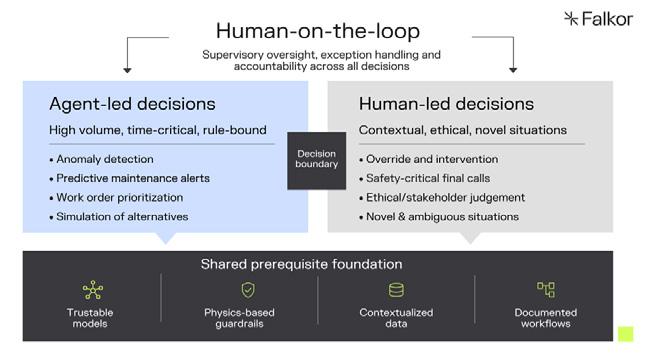
Think of it as two distinct but connected tracks, divided by a decision boundary:
The first track is agent led: high volume, time critical, rule bound decisions where statistical consistency outperforms human judgment. Agents do not fatigue, and they do not get distracted at hour eleven of a shift.
In practice this means anomaly detection across hundreds of data streams, predictive maintenance signals prioritized by failure probability, and work order scheduling ranked by operational risk before a human commits.
The second track is human led: contextual, ethical, and novel decisions where experience and accountability are the asset. Examples: safety-critical final calls including shutdown, isolation, and personnel decisions. Situations with no prior pattern, where a trained engineer’s instinct is the only available model.
Bridging these two tracks is the governance layer: the human-on-the-loop. Not approving every decision, but supervising the system and intervening by exception while remaining accountable for outcomes on both sides of the boundary.
The organizations that arrive at human-on-the-loop responsibly will be the ones that started building the foundation before they needed it.
The prerequisite for reliable decision distribution
McKinsey’s ‘The State of AI in 2025’ reports that in any given business function, no more than 10 percent of enterprises say their organizations are scaling AI agents. The technology is rarely the reason. The failure mode is often the same: AI deployed on top of fragmented data, undocumented processes, and workflows that were never connected in the first place. You cannot put intelligence on top of chaos.
The prerequisite for decision distribution is an industrial intelligence platform that aggregates all data into one coherent picture, contextualizes data against how work is actually performed, and embeds AI into the workflows people are already running.
Digital twins are not just visualization tools. They are active repositories for operational knowledge, capturing how assets are actually operated, maintained, and constrained over time. But knowledge alone is not enough in physical operations: AI recommendations also need to remain within the asset’s safe operating limits.
In a safety-critical environment, a model that is 90% accurate is unusable if the remaining 10% carries unacceptable consequence. Physics-based simulation and deterministic guardrails are not optional additions to industrial AI. They are the architecture that keeps agents operating within the envelope, and that makes the human-on-the-loop model viable rather than theoretical.
The new division of labor
The organizations that will capture this advantage are the ones that can successfully redesign the division of labor between human and machine, with governance at the center, and move humans up to the layer where their judgment is genuinely irreplaceable.
Human-on-the-loop will make the people operating within it more capable, not less. But the transition will not happen by accident. It requires conscious determination now of which decisions belong where, what foundation agents need in order to be trusted, and what oversight looks like when a human’s role shifts from approval to supervision.
The technology is moving. Will our operating models move with it?
“A model that is 90% accurate is 100%wrong.”
Responsible AI in industrial software: putting data governance before hype
Artificial intelligence is rapidly becoming embedded within industrial software, but trust remains the foundation on which successful digital transformation depends. Lisa De Vellis, Global Content Lead at MODS, argues that responsible AI adoption begins with robust data governance, client control, and a commitment to applying technology only where it delivers measurable operational value.
Successful software-as-a-service (SaaS) depends on trust. Beyond delivering functionality, software providers are responsible for protecting the data, intellectual property, and proprietary operational information entrusted to their digital systems. As AI capabilities become increasingly embedded within software products across industries, many organizations are now asking how they can benefit from innovation while maintaining security, governance, and control. It’s a reasonable, nay, essential question. Modern software increasingly depends on large volumes of data to deliver value. This opens a Pandora’s box of confusion revolving around how AI systems access, process, and use that information.
At MODS, data security and governance are foundational software development principles. Our approach to AI is deliberate and measured, enduring that
any AI-enabled capability is implemented responsibly and with appropriate safeguards. MODS intelligent industrial software solutions are not dependent on AI to function, allowing us to introduce AI features selectively where they deliver genuine value while maintaining robust governance standards.
MODS’ philosophy is simple: technology should solve real business problems, not be adopted simply because it is fashionable. We discuss AI-related concerns with our clients and recognize that organizations need confidence in how new technologies are implemented, governed, and controlled. It our role, as guardians of software products, to alleviate these concerns and mitigate risk on behalf of our owner-operator and EPC clients.
Responsible innovation sometimes means deciding not to apply AI when the risks outweigh the benefits. In industrial environments, where software supports the maintenance and operation of critical assets, reliability, traceability, and governance are essential. For this reason, MODS have intentionally limited AI’s role in the MODS Connect ecosystem to assistance rather than automation. This is an important distinction. AI can help users navigate MODS Connect software and implement it more effectively, but it does not make decisions, manipulate operational data, or act autonomously.
MODS operate according to a set of clear values, including

acting with integrity. Trust is earned through transparency, accountability, and clear governance. These principles guide every development decision at MODS, including product design, software deployment, and client support. This includes shaping how we evaluate emerging technologies such as AI.
This philosophy does not mean avoiding AI altogether. On the contrary, MODS believe that AI can enhance the user experience and benefit organizations when applied thoughtfully, transparently, and within clearly defined boundaries. That is the belief that has informed our approach to AI within MODS Connect.
To that end and with the clear vision of supporting users without introducing unnecessary operational risk, one of the ways in which we’ve incorporated AI is via an optional Support Agent within MODS Connect. [JL1.1][JL1.2]
AI in MODS Connect: client control comes first
The MODS Connect Support Agent is entirely optional in the MODS Connect ecosystem and can be enabled or disabled according to client requirements. When disabled, it is fully inactive. This reflects a core principle of responsible AI implementation – clients remain in control of whether and how AI is used within their software environment. AI functionality should never be imposed as a prerequisite for harnessing the value of the MODS Connect platform, so it’s important that our clients have that choice.
The Support Agent is not used to operate the software, power models, or automate decision-making. Instead, it is designed to help users learn the user interface more quickly by providing contextual guidance and “how-to” support. The objective is to improve user adoption, accelerate onboarding, and enhance productivity without affecting operational workflows.
In practice, the AI-powered Support Agent functions as an on-demand user guide. It helps users find information and perform functions faster while preserving established workflows, procedures, and human oversight. It does not modify records, make decisions, or perform any autonomous action. By limiting AI to this support role in MODS Connect, MODS deliver practical benefits of available technology while minimizing operational and governance risks.
Looking ahead, it’s important to recognize that AI capabilities will continue to evolve, and so too will the opportunities for it to enhance industrial software. It’s a delicate balance: harnessing the latest and greatest developments in a way that provides value over fanfare, while proceeding cautiously so as to not compromise security and ethics. Incorporating the most AI possible to keep ahead of trends is, simply, irresponsible.
The challenge for software providers is not to adopt the most AI possible, but to apply AI where it creates measurable value while maintaining security, governance, and trust. Responsible adoption requires balancing innovation with caution and ensuring that new capabilities are introduced only when benefits clearly outweigh any risks.
MODS have opted for this pragmatic approach, choosing function over form and prioritizing meaningful outcomes over technology for its own sake. Any future AI functionality introduced into our products will be assessed against the same principles that guide us today: security, transparency, client control, reliability, and measurable business value. As governance frameworks mature and client needs evolve, MODS will continue to evaluate AI opportunities carefully, responsibly, and with our clients’ trust at the forefront of every decision.
The industry is asking the wrong question about AI
By Mark Venables
For the past two years I have sat through countless presentations, product launches, conference sessions and executive briefings focused on artificial intelligence in the oil and gas industry. Almost without exception, they begin with the same question: what can AI do? It is an understandable place to start. The technology is evolving at remarkable speed, new capabilities appear almost weekly, and vendors are eager to demonstrate increasingly sophisticated applications. Operators are understandably keen to understand where value might be created.
Yet I am becoming increasingly convinced that this is no longer the most important question. The oil and gas sector has already established that AI can be useful. We know it can analyse large datasets, support maintenance activities, accelerate engineering workflows, improve reporting and surface operational insights that might otherwise remain hidden. The debate about whether AI works has largely been settled. The more important question is whether the industry is changing itself quickly enough to take advantage of what AI makes possible.
This may sound like a subtle distinction, but I believe it sits at the heart of the challenge facing the sector today. Throughout its history, oil and gas has excelled at solving engineering problems. When faced with technical barriers, the industry has consistently found ways to overcome them. It has drilled deeper wells, operated in harsher environments and developed technologies capable of unlocking resources once considered inaccessible. The current challenge feels different because it is not fundamentally an engineering problem.
The greatest obstacle to AI adoption is not model performance, computing power or software capability. It is organisational inertia. Many companies continue to treat artificial intelligence as a technology programme when it should increasingly be viewed as a business transformation programme. That difference matters because technology programmes can be delegated to IT departments or innovation teams. Business transformation programmes require leadership engagement, cultural change and difficult decisions about how organisations operate. The industry often talks about digital transformation, but many transformation efforts remain focused on introducing new tools while leaving existing processes largely intact. The result is predictable. New technologies are layered onto old ways of working, creating additional complexity rather than removing it. What AI exposes, perhaps more than any previous technology, is the inefficiency hidden within many organisations. Engineers spend time searching for information rather than applying
expertise. Critical knowledge remains trapped within documents, spreadsheets and individual experience. Decisions move slowly because information moves slowly. Artificial intelligence does not create these problems. It simply makes them impossible to ignore. This is why I find discussions about autonomous operations particularly interesting. Much of the public conversation focuses on the prospect of machines making decisions. In reality, most operators are nowhere near that stage, nor should they be. The more immediate opportunity lies in helping people make better decisions by providing them with better information at the moment they need it. That may sound less dramatic than autonomous systems and intelligent agents, but it has the potential to create far greater value because it addresses a problem that has existed for decades rather than one that may emerge years from now.
There is another aspect of this discussion that deserves more attention. For years, the oil and gas sector has worried about the retirement of experienced personnel and the loss of institutional knowledge. This concern is entirely justified. Across many organisations, decades of operational experience is leaving the workforce, often faster than they can be replaced. What strikes me is that AI may represent the first genuinely credible opportunity to address this challenge at scale. Not because technology can replace expertise, it cannot, but because it may finally provide a mechanism for making expertise more accessible. The industry has always possessed extraordinary knowledge. The problem has been finding it, sharing it and applying it consistently across large organisations. Artificial intelligence changes that equation by making it easier to surface relevant information, connect historical experience with current challenges and distribute knowledge more effectively across the workforce.
The organisations that benefit most from AI over the next decade may not be those with the largest technology budgets or the most sophisticated algorithms. They may simply be those that become better at capturing, organising and distributing knowledge. That may sound less exciting than discussions about agentic systems or autonomous operations, but it addresses a challenge that sits at the core of operational performance. Every organisation knows more than it can currently use. The question is whether that knowledge can be made available to the people who need it when decisions are being made.
There is also a risk that deserves acknowledgement. The current enthusiasm surrounding AI occasionally creates the impression that technology itself is becoming the destination. It is not. Oil and gas companies are not in the business of deploying artificial intelligence. They are in the business of producing energy safely, reliably and profitably. AI only matters if it helps achieve those objectives. That may sound obvious, yet it is a point worth repeating because industries have a habit of becoming distracted by technology rather than outcomes.
The companies that emerge as leaders during this next phase of transformation are unlikely to be those talking most loudly about AI. They will be the organisations quietly building better data foundations, simplifying workflows, improving collaboration and creating environments where people can make faster, more informed decisions. In my view, the winners may not be the companies with the smartest machines at all. They may simply be the companies that finally learn how to use their collective intelligence more effectively
One platform.
52 leaks prevented. $95M protected.
IMS by Cenosco is the intelligent platform for asset integrity, reliability, and functional safety. When data is trusted and systems are connected, teams make better decisions earlier. IMS brings together inspection, maintenance, risk, and functional safety in one intelligent platform, supporting AIpowered insights , digital twins , robotics , and connected field operations. One source of truth for the decisions that protect assets, uptime, and margins.
Real-World Impact
52 leaks prevented. $95M in revenue saved at a Middle East refinery.
50% less turnaround scope. 16% faster return to production at a Nordic refinery.
$2.35M annual maintenance cost reduction at a Caribbean supermajor.
$1.4M/day offshore downtime prevented. 1 major event avoided in the North Sea.


Scan the QR code to explore Success Stories