Seeing beneath the seabed
Machines making unwanted decisions
When measurement is not enough
Data slowing production down
Machines that explain themselves
When chemistry assumptions fail
ProcessModel V™ (PMV™)
Built on Physics. Engineered with AI.
Our Physics-based AI platform to design, validate and optimize intelligent operations.






CEO Adam Soroka
Editor Mark Venables
There is a growing tendency in this industry to talk about digital twins and AI as though they are technologies waiting to be deployed. The reality, as the work in this issue makes clear, is far less comfortable. These systems are already here, already influencing decisions, and increasingly operating at a speed and scale that exposes the limits of how oil and gas has traditionally been run.
What becomes immediately apparent across the articles in this issue is that the constraint has shifted. It is no longer the absence of data, nor even the ability to process it. The constraint now sits in the gap between interpretation and action, in how quickly insight can be trusted, contextualised, and applied in environments where delay carries real operational and commercial consequence. In that sense, the conversation around AI is no longer technical. It is structural.
There is a thread that runs through this publication which is difficult to ignore. As systems become more capable of modelling behaviour, predicting outcomes, and recommending actions, the balance of control begins to change. Decision-making is no longer a discrete activity carried out by individuals or teams. It is becoming embedded within the operational flow itself, compressing the distance between detection and response to the point where the two are almost indistinguishable.
That shift brings opportunity, but it also brings exposure. Several of the articles here challenge an assumption that has quietly underpinned much of the digital transformation narrative, that better data and more sophisticated models automatically lead to better decisions. In practice, the opposite can occur. When systems are not grounded in the physical realities they are modelling, whether that is subsurface uncertainty, fluid behaviour, or complex process interactions, they can amplify error rather than reduce it.

What emerges instead is a more demanding view of what digital twins and AI need to become. They are not overlays, and they are not optional enhancements. They are becoming the mechanisms through which operations are understood, managed, and increasingly executed. That places a far greater emphasis on the foundations beneath them, on data architecture, on physics, on chemistry, and on the ability to explain not just what is happening, but why.
There is also a human dimension that cannot be ignored. As systems take on a greater share of the analytical and decision-making burden, the role of the operator changes. Expertise is no longer defined purely by the ability to interpret raw data, but by the ability to validate, challenge, and guide systems that are themselves making judgements. Trust, in that context, becomes as important as capability.
The industry has always operated at the intersection of uncertainty and consequence. What is changing is how that uncertainty is managed. The question is no longer whether digital twins and AI will shape operations. It is whether organisations are prepared for what happens when those systems begin to act, not as tools, but as participants in the decision-making process.
Mark Venables Editor
Future Digital Twin & AI
Cavendish Group
beneath the seabed

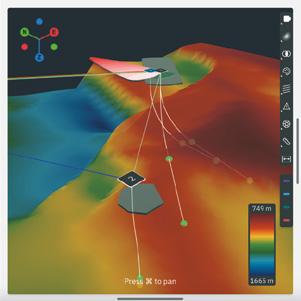
Imaging the invisible beneath the seabed
Decisions worth hundreds of millions are being made on data that can never be observed directly. Advances in compute, physics-based modelling, and AI are reshaping how the subsurface is understood, narrowing uncertainty while exposing just how much still remains unknown.
When machines start making decisions operators did not ask for
Oil and gas operations are no longer constrained by a lack of data but by the inability to act on it in time. As AI systems move from analysis into real-time decisionmaking, the industry is being forced to confront a more fundamental shift, control is no longer entirely human.
16
When measurement fails, physics steps in
The industry has spent decades chasing more data, yet some of the most critical variables in oil production remain stubbornly difficult to measure in real time. Physicsinformed AI is beginning to expose a different path, where understanding the system matters more than simply collecting more information.
When data becomes the bottleneck, production follows
Oil and gas has never lacked data. What it has lacked is the ability to use it at the speed operations demand. The shift now underway is not about generating more information, but about removing the friction that stops it influencing decisions.
24 When machines start explaining themselves
The industry has spent years building systems that can detect anomalies in real time, yet the moment that matters most still depends on human interpretation. The real shift is not faster alerts, but whether machines can explain what they are seeing well enough to influence decisions under pressure.
28 When chemistry is treated as solved, operations inherit the error
Digital transformation in oil and gas is accelerating, but much of it rests on an assumption that no longer holds under scrutiny. The physical systems being modelled are not static, and when their chemistry is simplified or ignored, the consequences do not remain contained, they propagate.
32 When AI has to prove its worth in the field
In upstream oil and gas, AI does not struggle because of a lack of data. It struggles because the data that matters is fragmented, inconsistent, and often inaccessible at the point of decision-making. For SLB’s Patricia Cejas Manceron, scaling AI is less about algorithms and more about operational reality.
38 AI Is Repeating the Mistakes That Stalled Digital Twins
The question worth asking isn’t what AI can do – but how it should be applied to deliver the operational results that matter. AI has moved rapidly from the margins of industrial technology into everyday life, and that shift is now being felt across energy and materials organizations.
40 What does Ansys, part of Synopsys bring to the world of Digital Twining?
As digital twins move beyond visualisation into operational decision-making, the convergence of physics-based simulation and AI is reshaping how assets are designed, validated, and operated across their full lifecycle. From virtual sensors to systemlevel optimisation, the technology is emerging as a critical enabler for managing increasingly complex, data-intensive environments driven by AI and energy demand.
42 Trust Where Decisions Matter Most
Artificial intelligence and digital twin technologies are rapidly moving from advisory tools to systems that influence operational and safety critical decisions across the energy sector.
46 The energy industry is buying AI but not scaling it. Here is why.
At CERAWeek just a short while ago, AI was everywhere. On stage, in the hallways, in every conversation about what comes next for energy operations. The ambition is real. The investment is real.
48 Final Word: When faster decisions become a hidden risk
As AI moves into operational control, the real challenge is no longer capability but consequence. Mark Venables argues that oil and gas must confront what happens when decisions are made at a speed that outpaces understanding.


Imaging the invisible beneath the seabed
Decisions worth hundreds of millions are being made on data that can never be observed directly. Advances in compute, physicsbased modelling, and AI are reshaping how the subsurface is understood, narrowing uncertainty while exposing just how much still remains unknown.
There is a persistent misconception that the greatest uncertainty in oil and gas lies in markets, regulation, or geopolitics. The most consequential unknown still sits kilometres beneath the seabed, hidden in layers that cannot be observed directly and that refuse to reveal themselves without considerable effort, cost, and interpretation. Every major investment decision begins there, with an incomplete picture of the subsurface that must be made sufficiently reliable to justify commitments measured in hundreds of millions.
Herlinde Mannaerts-Drew, SVP oil and gas technology at BP, frames the challenge in practical terms. The objective is not simply to find hydrocarbons, but to reduce the uncertainty attached to doing so in environments where drilling decisions carry enormous financial and operational consequence. When rigs operating in deepwater can cost hundreds of thousands of dollars a day, the tolerance for ambiguity becomes extremely limited, and the value of every improvement in subsurface understanding becomes immediately commercial.
The paradox is straightforward. The subsurface must be understood with increasing precision, yet it can only be observed indirectly. Seismic imaging remains the primary mechanism for doing so, but the scale and complexity of the data involved have transformed it into a computational challenge as much as a geophysical one. What was once constrained by instrumentation is now constrained by the ability to process and interpret vast volumes of data quickly enough to influence decisions.
Richard Corfield, VP imaging technology at BP, describes seismic data as the output of a large-scale physical experiment. Sound waves are projected into the subsurface, reflecting and refracting through geological structures before returning to the surface, where they are captured across dense arrays of receivers. The resulting dataset, built from hundreds of millions of source and receiver pairings, must then be reconstructed into a coherent image of the Earth.
“The physics of the problem is well understood long before the compute power is actually available to cope with accurately running the models on such large data sets,” Corfield explains. “A lot of the art is in developing algorithms with simplified approximations of the physics and down sampled data sets, just to make the problem tractable.”
This gap between physical understanding and computational capability has defined decades of progress. Each advance has come not from new physics, but from the ability to apply it more completely. The breakthrough that reshaped seismic imaging was full waveform inversion, a technique that iteratively refines a model of the subsurface by comparing simulated wave behaviour with recorded data, then adjusting the model repeatedly until the difference narrows.
“The difference was absolutely astonishing,” Corfield says. “A huge amount of geological detail that was previously invisible suddenly became visible.” Structures that had been interpreted as noise resolved into coherent geological features, transforming how reservoirs could be understood and developed.
Resolution and consequence
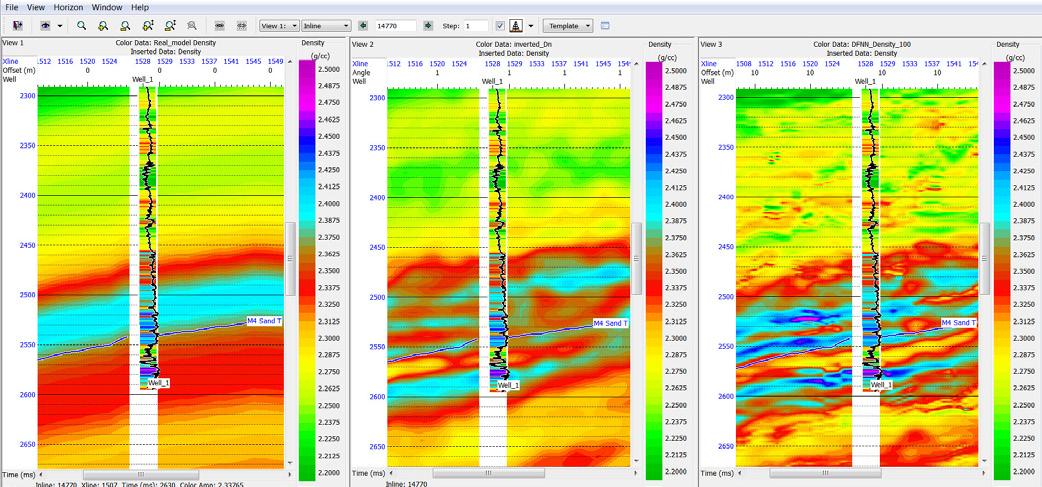
The evolution of imaging at the Mad Dog field illustrates how these advances accumulate. Early images offered limited clarity, particularly in complex regions where noise obscured key features. Improvements in acquisition and modelling gradually revealed
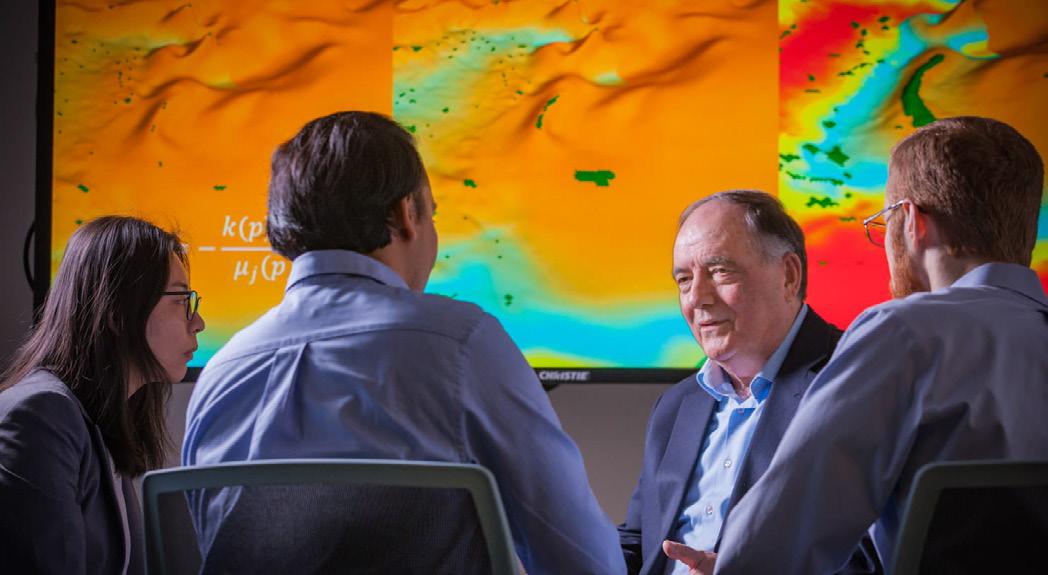
more structure, but the application of full waveform inversion delivered a step change in resolution, sharply defining geological detail and enabling more confident well placement.
“Every one of those compartments is a potential drilling target,” Corfield notes. “Each one could involve the investment of hundreds of millions of dollars, so getting a good image is commercially critical.”
The commercial value lies in what higher resolution makes discussable. A blurred image can confirm the broad shape of a reservoir, but it cannot always resolve the internal barriers, fault offsets, or smaller compartments that determine how the field will actually behave once production begins. At that point, seismic imaging is no longer a question of technical elegance. It becomes part of capital discipline, because the quality of the image affects where wells are placed, how many are drilled, and how confidently production can be forecast.
Time-lapse seismic adds another dimension, allowing operators to observe how reservoirs change over time. By comparing surveys taken years apart, it becomes possible to track fluid movement and pressure changes within the reservoir. This gives operators a dynamic view of production, rather than a static interpretation of geology at a single moment.
“We can see where water has displaced oil and where pressure has dropped due to production,” Corfield explains. “That knowledge is hugely valuable, both for managing existing wells and identifying remaining hydrocarbons.”
Even small improvements in resolution can materially change interpretation. Geological structures that appear simple at lower resolution can resolve into multiple layers and fault systems, each influencing how a reservoir behaves. The clearer the image, the more informed the decision, particularly in mature fields where remaining opportunities may sit in smaller, more complex pockets that earlier technologies could not describe with enough confidence.
Compute as constraint
If resolution is the objective, compute is the constraint. Mannaerts-Drew is clear that high performance
computing is not just infrastructure, but an integrated capability linking scientists, engineers, and operations. The centre is not simply a collection of machines, but a mechanism for shortening the distance between scientific possibility and operational use.
“When I think about high performance computing, I do not think about a building,” she says. “I think about a community working together to solve material problems.” Demand for compute is effectively unbounded. Each increase in capacity is quickly absorbed by more ambitious modelling, higher resolution datasets, and more complex simulations. Rather than chasing scale for its own sake, BP has aligned compute growth with the development of its most impactful algorithms, particularly full waveform inversion and reverse time migration.
That discipline matters because compute does not automatically create insight. It must be directed at the workflows that influence decisions, whether that means improving the physics in a seismic model, shortening the cycle time of reservoir simulation, or enabling teams to explore uncertainty rather than settling for a single answer. In that sense, the question is not how large a computing centre can become, but how quickly it can convert scientific ambition into
At Wood, we are designing the future by decoding digital to transform industry.
Our Digital Asset and DataOps solution applies decades of operating experience and digital expertise to deliver the building blocks of digital transformation.
As your Main Digital Contractor, we drive digitalisation across capital projects by setting the lifecycle strategy and building the digital asset. We then embed technology in operations to advance ways of working, enable operational excellence and deliver lasting value.
See what’s possible: woodplc.com/digital


usable products for the business.
The transition from CPUs to GPUs has been central to this strategy. “GPUs are the only cost and power efficient systems available that can provide the growth we need today,” Mannaerts-Drew says. The gains are substantial, enabling not just faster processing but entirely new ways of working.
“Rather than solving for one solution, we are now looking at many solutions that all fit the data,” she explains. “Understanding that uncertainty can be the difference between an economic field and one that is not.” This move towards probabilistic modelling represents a shift in mindset. The goal is no longer to produce a single definitive answer, but to explore a range of possibilities and understand their implications. For well design, field appraisal, and development planning, that is a critical change, because the value of a decision often depends not only on the most likely interpretation, but on the consequences if that interpretation is wrong.
Rethinking the workflow
The impact of increased computational capability extends beyond imaging into the broader workflow of field development. Traditional processes often involve sequential handovers between subsurface specialists and drilling teams, with decisions refined through repeated exchanges. Each discipline brings essential constraints, but the process can become slow when geological targets, drilling risks, pressure regimes, and existing infrastructure are reconciled manually.
Mannaerts-Drew describes this as a slow and iterative process that can take weeks to converge. By reframing it as a large-scale optimisation problem, it becomes possible to generate multiple viable well trajectories simultaneously. The point is not simply to automate a familiar task, but to expose the design space more fully than conventional workflows allow.
“What we can now do is generate a whole range of well trajectories, not just for one well but across a field,” she says. “It is not just about speed, it is about enabling better decisions.”
This shift allows engineers to explore a broader design space, improving outcomes by considering options that would previously have been impractical to evaluate. It also changes the character of expert work. Instead of spending weeks constructing a narrow set of possible answers, teams can interrogate a wider field of options and apply judgement earlier, when decisions are still flexible enough to change the outcome.
AI is beginning to play a role in this transformation, particularly in interpreting seismic data across multiple vintages. Subtle differences between datasets can reveal important changes in the subsurface but identifying them manually is time-consuming. The value of an AI assistant in this context is not that it replaces interpretation, but that it helps direct attention towards variations that may otherwise be missed.
“We are building tools that can provide those insights within seconds,” Mannaerts-Drew says. “It allows our experts to focus on understanding the implications rather than searching for the differences.”
Towards autonomy and scale
Acquiring higher resolution data requires greater density of measurements, but this comes with increased cost and operational complexity. More receivers, closer spacing, and denser sampling can sharpen the image, but they can also extend field operations and expose more personnel to offshore hazards. That creates a familiar oil and gas tension, where the data that would improve decisions is also the data that becomes harder and more expensive to acquire.
Mannaerts-Drew sees autonomy as a key part of addressing this challenge. By introducing semiautonomous systems into seismic operations, BP has already reduced personnel requirements and costs. The long-term objective is to change the logistical footprint of seismic acquisition, making dense data more
affordable and reducing the need for people to operate in hazardous marine environments.
“We have reduced the number of people on board by around 60 percent and brought costs down by 30 percent,” she says. The longer-term vision involves fully autonomous operations, fundamentally changing how seismic data is acquired. This is not simply about efficiency, but about enabling new operating models that reduce risk and expand capability. If autonomy can lower the operational burden of dense acquisition, the industry can push resolution further without treating every improvement as a proportional increase in cost and complexity.
The horizon of possibility
The convergence of high-performance computing, physics-based modelling, and AI will continue to shape subsurface imaging. Emerging technologies such as quantum computing are being explored, although Mannaerts-Drew remains measured in her expectations. BP is assessing quantum and quantum-inspired approaches in a deliberately cautious way, looking at where they might one day help simulate complex physical systems or reduce cycle times in seismic modelling.
“It feels like a galaxy far, far away, but we want to be ready when it arrives,” she says.
For now, GPUs remain the primary driver of progress, enabling more detailed models and faster iteration. Each improvement brings the industry closer to a clearer understanding of the subsurface, even if complete certainty remains out of reach. The point is not to claim that computation can remove geological uncertainty, but to use it to understand uncertainty more precisely and act with greater confidence.
“The subsurface has a remarkable ability to keep surprising us,” Mannaerts-Drew reflects.
“Our scientists and engineers will always be the voice of the hydrocarbon molecule, and it is their judgement and insight that will guide the business.”
The balance is unlikely to change. Technology will continue to reduce uncertainty, but it will not eliminate it. The future lies in combining computational power with human expertise, ensuring that decisions are not just faster, but better informed.












































When machines start making decisions operators did not
ask for
Oil and gas operations are no longer constrained by a lack of data but by the inability to act on it in time. As AI systems move from analysis into real-time decision-making, the industry is being forced to confront a more fundamental shift, control is no longer entirely human.

There is a moment in every control room when the data stops being useful. It is not because there is too little of it, but because there is too much, arriving too quickly, and demanding a response that no human system is structured to provide. In oil and gas operations, that moment is no longer occasional. It is constant, and it is beginning to reshape how decisions are made.
The industry has spent decades building instrumentation, layering automation, and refining workflows to improve reliability and output. Yet most assets still operate below their theoretical potential, not because the physics cannot be understood, but because the system cannot be interpreted fast enough. The gap between what is measured and what is acted upon has become an operational constraint.
A single asset can now generate continuous streams of multivariate data at a scale that would have been inconceivable even a decade ago. The Avathon white paper - Optimizing Oil & Gas - Operating Performance with AI - notes that one pump alone can produce hundreds of gigabytes of data per day, multiplied across dozens of interconnected systems on a typical platform. Visibility is no longer the problem. Comprehension is.
What follows from this is not simply a case for better analytics. It is a structural problem in how operations are run. When the volume, velocity, and interdependency of data exceed human capacity, optimisation becomes reactive by default. Decisions are made after performance has already drifted, often only once failure has made the issue visible.
The point where optimisation breaks
The industry has long accepted inefficiency as an operational reality, but the scale of it is rarely confronted directly. Offshore platforms typically operate well below full capacity, not because of resource constraints, but because maintaining stable, optimised conditions across interconnected systems is inherently complex. Small deviations accumulate, and over time those incremental losses become structural.
According to the white paper unplanned downtime remains the most visible and costly manifestation of this. A single day of lost production can erase millions in revenue, turning what appears to be a technical fault into an immediate commercial issue. The problem is not that failures occur, but that they are often predictable, just not acted upon early enough.
Predictive maintenance has attempted to address this, but its effectiveness has been limited when applied in isolation. Equipment does not fail independently. It fails as part of a system, influenced by process variables, environmental conditions, and decisions made elsewhere. Identifying patterns in a single asset is not sufficient when the underlying issue is systemic.
The challenge is no longer about predicting failure in one component, but about understanding how the entire system behaves in real time. That requires a shift from monitoring to interpretation.
From data to behaviour
What is emerging is a model that treats operations as a dynamic system with a definable normal state. Rather than relying on fixed thresholds, these systems learn what normal behaviour looks like across the operation and identify deviations as they occur.
This changes the definition of a problem. Instead of waiting for a parameter to cross a limit, the system detects when behaviour begins to drift, even if all individual readings remain within acceptable ranges. Intervention moves earlier in the timeline, often far enough to prevent disruption entirely.
Avathon describe this as modelling normal behaviour and monitoring for anomalies, enabling systems to flag issues well before failure becomes inevitable. The impact is not limited to reduced downtime. It alters
how maintenance and operations are planned, shifting from reactive scheduling to predictive intervention.
There is also a change in how decisions are generated. Machine learning models can isolate the variables driving performance and suggest adjustments. In drilling operations, systems can evaluate multiple control parameters simultaneously and recommend changes to optimise output. With continued feedback, those recommendations move closer to autonomous execution. This is the point where the discussion moves beyond analytics and into control.
The expanding boundary of autonomy
Autonomy in oil and gas is often framed in terms of individual applications, predictive maintenance, logistics optimisation, or safety monitoring. In practice, its impact is cumulative. Each deployment extends the boundary of what can be managed without direct human intervention, and as these systems begin to interact, the nature of operations changes.
In midstream environments, complexity lies in the relationships between assets. Pipelines, storage, and transport networks form a tightly coupled system where disruptions propagate quickly. AI-driven models that map these interdependencies and optimise routing decisions in real time do more than improve efficiency, they stabilise the system itself.
The same applies downstream, where refining operations depend on the precise coordination of feedstocks, processes, and equipment. A failure in a single component can cascade through the system, forcing shutdowns that extend far beyond the original fault. By integrating process data with operational constraints, AI systems can identify conditions likely to lead to disruption and intervene before they materialise.
Autonomy is not being introduced as a standalone capability. It is emerging as a layer across the value chain, connecting upstream production, midstream logistics, and downstream processing into a continuous, responsive system.
Faster decisions, different roles
The most immediate effect of this shift is speed. Decisions that once required analysis and validation can now be generated within the operational cycle of the system itself. The time between detection and response compresses to the point where monitoring and control begin to merge.
The white paper suggests that systems trained on historical performance data can move from data to action in a matter of days rather than months. The significance lies in the expectation this creates. Operations are no longer bounded by periodic analysis but operate within a continuous feedback loop.
Trust remains a critical factor. The reluctance to rely on AI in critical environments has often been tied to the perception of opaque decision-making. Systems that explain why anomalies occur, rather than simply flagging them, address this directly. They allow operators to engage with recommendations rather than react to alerts.
The role of the operator evolves accordingly. Instead of interpreting raw data, operators evaluate system outputs, validate behaviour, and manage exceptions. This requires a different balance of skills, combining domain expertise with an understanding of how digital models interpret the system.
The system begins to decide
The final stage of this transition is not marked by a single breakthrough, but by accumulation. As systems become more capable of interpreting data, identifying patterns, and recommending actions, the threshold
for autonomous decision-making lowers. Decision support gradually becomes decision execution.
This does not remove human oversight, but it changes its focus. Operators define boundaries, validate outcomes, and intervene, when necessary, rather than managing each decision directly. The system operates within those constraints, adjusting in real time to maintain performance.
The white paper frames this as embedding decision-making directly into operations, linking asset health, supply chain signals, and workforce considerations into a unified system. Planning and execution begin to converge, and decisions become part of the operational flow rather than a separate activity.
What emerges is not a fully autonomous operation, but one where the balance of control has shifted. Systems take on a greater share of the operational burden because they can process and act on information at a scale aligned with the complexity of modern assets.
The question for the industry is not whether this shift will happen. It is already underway. The question is whether organisations are prepared to operate in environments where decisions are no longer entirely human, and whether they are ready to manage the consequences when systems begin to act before anyone asks them to.


When measurement fails, physics steps in
The industry has spent decades chasing more data, yet some of the most critical variables in oil production remain stubbornly difficult to measure in real time. Physics-informed AI is beginning to expose a different path, where understanding the system matters more than simply collecting more information.
There is a persistent contradiction at the heart of modern oil production. Wells are instrumented, monitored, and analysed extensively, yet one of the most commercially significant variables, flow rate, often remains inferred, delayed, or uncertain. The more complex the well environment becomes; the less reliable direct measurement can be. In heavy oil reservoirs or depleted fields, where artificial lift dominates, that gap is not a marginal inconvenience but a structural limitation on how effectively operators can manage production.
The NVIDIA and Softserve report - Leverage Physics-Driven AI for Energy Innovation - frames this problem in a way that moves beyond the usual narrative of insufficient data. It suggests that the challenge is not simply about measurement capability, but about the nature of the system itself. Multiphase flow, pressure variability, and changing operating conditions create an environment where direct observation is inherently difficult, regardless of how much instrumentation is deployed.
This is where physics-informed machine learning begins to alter the direction of travel. Instead of relying on historical data alone, models are constrained by the physical laws governing the system. That shift changes the role of data. It becomes a reference point rather than the foundation, allowing models to function effectively even when information is incomplete or inconsistent.
Where data stops being enough
Artificial lift systems, particularly electrical submersible pumps, sit at the centre of this challenge. They are

used precisely because natural reservoir pressure is no longer sufficient to sustain flow, introducing a layer of operational complexity that is difficult to monitor directly. Pressure, temperature, and vibration can be tracked, but flow rate remains elusive.
The report highlights the scale of this issue, noting that ESP-lifted wells account for a significant share of global production. Despite this, continuous and reliable flow measurement is rare. Physical multiphase flow meters are costly, prone to failure, and often provide only intermittent readings. In viscous or unstable conditions, their accuracy can degrade further.
This creates a gap between what operators need to know and what they can observe. Flow rate underpins production optimisation, informs control decisions, and plays a key role in diagnosing
equipment health. Without reliable real-time visibility, operators are forced into conservative strategies, running systems within wider safety margins and reacting later than they would prefer. The instinctive response has been to gather more data, yet there is a point at which additional sensors do not resolve the underlying problem.
Embedding physical reality into models
Physics-informed neural networks offer a different approach. Rather than treating the system as a pattern to be learned, they embed the governing equations directly into the modelling process. This ensures that any output remains consistent with known physical behaviour, regardless of data limitations. The report positions PINNs as particularly valuable where data is scarce or expensive to obtain, which aligns closely with upstream realities.
By incorporating physical laws, these models reduce dependence on large datasets and improve their ability to operate outside previously observed conditions. This matters because upstream environments are rarely stable. Reservoir characteristics evolve, equipment performance changes over time, and operating conditions shift. Models that rely solely on historical data can struggle in such environments, whereas a model grounded in physics retains its relevance.
There is also a practical advantage that becomes apparent at scale. Because the model is constrained by physical relationships, it does not need to be rebuilt every time conditions drift. This reduces the operational burden associated with maintaining AI systems and makes deployment across multiple assets more realistic. In effect, the model travels with the physics of the system rather than the specifics of the dataset.
From estimation to control
The most direct application described in the report is the development of a virtual flow meter based on a hybrid PINN approach. Instead of measuring flow directly, the model infers it from pressure data, control parameters, and the physical relationships governing the system.
At its core, the method treats flow as an unknown variable within a system of equations describing the well. Pressure measurements and control inputs provide boundary conditions, allowing the model to estimate flow by minimising the difference between predicted and observed behaviour. The problem is solved over short time intervals between measurements, enabling continuous estimation.
The result is a virtual metering capability that operates in real time without the need for physical
flow meters. Crucially, the report indicates that the approach can be applied across different wells without retraining, operating over a wide range of parameters. That level of generalisation is essential if such systems are to move beyond isolated use cases.
This is not simply a technical improvement. It addresses a longstanding operational limitation. Flow data becomes available continuously rather than intermittently, allowing operators to respond to changes as they occur rather than after the fact. Real-time flow estimates enable more responsive control strategies, with pump settings adjusted dynamically and deviations from expected behaviour identified earlier.
The report highlights the role of such monitoring in preventing equipment failure and extending the lifespan of ESP systems. This has direct financial implications. Unplanned downtime and equipment replacement are among the most significant costs in upstream operations, and reducing these events improves both reliability and profitability.
Building towards system-level models
The virtual flow meter is also positioned as a building block for broader system models. By providing reliable estimates of a critical variable, it contributes to a more complete representation of the production environment. The report suggests that such models can underpin digital twins of upstream operations, extending the value beyond a single application.
What distinguishes this approach is that it is built on physical principles rather than purely statistical relationships. This makes the resulting models more interpretable and, in many cases, more trustworthy. In environments where decisions carry significant financial and safety consequences, that distinction matters.
There is a broader shift implied in how the industry views data itself. The prevailing assumption has been that more data leads to better outcomes. Physicsinformed approaches challenge that assumption by demonstrating that the quality and relevance of data are more important than sheer volume. In a PINN framework, data is used to anchor the model to reality rather than to define it.
This reduces the need for extensive data collection and processing, which can be a barrier to deployment. It also shifts the focus back towards domain expertise, as the effectiveness of the model depends on how well the underlying physics is represented. The model becomes a synthesis of engineering knowledge and computational capability rather than a purely statistical construct.
There is also a practical implication for trust. Operators are more likely to rely on systems that reflect known behaviour and can be interrogated in terms they understand. The report’s comparison with more computationally intensive approaches, such as full fluid dynamics simulations, highlights the balance being struck between accuracy and practicality.
What emerges is not a replacement for existing approaches, but an extension of them. Physics-informed AI fills a gap where traditional data-driven methods struggle, providing a way to model complex systems with greater fidelity and less dependence on extensive datasets. For oil and gas operators, the significance lies in the shift from reactive to informed operation.
When critical variables can be estimated reliably in real time, decisions become more precise, interventions more timely, and systems more resilient. That is not a marginal improvement. It is a change in how production is understood and managed, grounded not in the volume of data available, but in how effectively the system itself is understood.

When data becomes the bottleneck, production follows
Oil and gas has never lacked data. What it has lacked is the ability to use it at the speed operations demand. The shift now underway is not about generating more information, but about removing the friction that stops it influencing decisions.
There is a persistent assumption in oil and gas that scale is a strength. Larger data sets, more sensors, deeper reservoirs of historical insight. In practice, scale has often been the thing that breaks systems first. When billions of records move through architectures never designed to cope with that volume, the result is not better decisions, but delay, fragmentation and, ultimately, operational blind spots.
The uncomfortable reality is that much of the industry has spent years investing in data capture while neglecting the mechanics of data use. Information has been collected, stored and replicated across systems, but rarely unified in a way that allows it to shape frontline decisions in real time. That gap is where inefficiency lives, and it is far more consequential than any individual technology choice.
What is now changing is not simply the introduction of artificial intelligence, but the re-engineering of the environments in which data sits. The shift is structural. It is about moving from architectures that constrain analysis to platforms that allow it to operate at the same scale as the physical systems they are meant to optimise.
Devon Energy’s experience is a clear illustration of how that tension plays out in practice. The company’s exploration strategy depends on integrating geophysical, geochemical, seismic and operational data, each with its own
format, cadence and complexity. The ambition was straightforward enough, find oil and gas more efficiently while maintaining safety and cost discipline. The execution, however, was constrained by an environment that could not keep pace with the data it was generating.
The architecture problem
There is a tendency to describe these issues as legacy challenges, as though they are a natural consequence of ageing systems. That framing misses the point. The problem is not age, it is architecture. Systems built to move data between applications were never designed to support continuous, large-scale analytics across multiple domains.
At Devon Energy, the strain was visible in the day-to-day experience of data teams. With billions of records to ingest and process, the existing environment could not scale effectively. Efforts to manage Apache Spark clusters internally introduced additional layers of complexity, diverting resources into maintenance rather than analysis. Even where machine learning models were developed, the absence of a unified environment meant they could not be deployed consistently or reproduced reliably.
Paul Bruffett, data and analytics architect at Devon Energy, captured the frustration in practical terms. “With billions of records to ingest on a regular basis, our previous systems buckled under the
scale. This made it impossible for our data teams to extract actionable insights from our massive data sets.”
That breakdown has wider implications than delayed analytics. When data cannot be accessed or trusted at the point of decision, operators fall back on experience and approximation. In an industry where margins are shaped by small shifts in efficiency, that is a significant constraint.
The move to a unified, cloud-based platform was not simply about performance improvement. It was about removing the friction that prevented collaboration and slowed the iteration of models. The ability to deploy compute resources on demand, scale them dynamically and shut them down when not required addressed both cost and agility in a way that static infrastructure could not.
Bruffett describes the change in operational terms rather than technical ones. “In the past, each of our data scientists would be allocated a GPU machine, which gets expensive to scale. With Databricks, we can now easily deploy clusters on-demand that auto-terminate, which helps manage our costs better.”
From data access to decision speed
Speed is often treated as a performance metric, something to be improved for its own sake. In oil and gas, it is better understood as a constraint on decision-making. When insight arrives too late, it ceases to be useful, regardless of its accuracy.
What Devon Energy achieved was not simply faster analytics, but a shift in how data feeds into operational workflows. By building an end-to-end pipeline that connects data ingestion, processing and analysis, the company created a system where insights can be generated and acted upon within the same operational cycle.
Bruffett reflects this in how he describes the organisation’s identity. “Our COO has said frequently that we are a technology company that digs for oil. What that means to me is that innovation, data analysis and technical excellence are really core to our business.”
That statement is less about branding than it appears. It signals a recognition that competitive
advantage no longer sits purely in the physical assets, but in the ability to interpret and act on data faster and more effectively than peers.
The same dynamic is visible at a different scale within Shell. Here, the challenge is not a single set of data pipelines, but an enterprise-wide effort to bring together data, analytics and machine learning across a global operation.
Dan Jeavons, VP Computational Science and Digital Innovation at Shell, frames the shift in terms that reflect both urgency and inevitability. “We, as an industry, are going through a massive transition. Digital technology is absolutely core to making our existing business more effective and efficient. As the industry continues to expand into new areas of energy that are more sustainable and reduce environmental impact, data and digital technology are now table stakes.”
Scaling insight across the enterprise Shell’s response has been to treat data infrastructure as a foundational layer rather than a supporting function. The creation of the Shell.ai platform reflects an understanding that analytics, machine learning and data engineering cannot operate effectively in isolation.
The complexity lies not only in the volume of data, but in its distribution across the organisation. Different teams require access to the same underlying information, but in forms that align with their specific use cases.
Jeavons highlights the importance of simplicity in enabling that access. “Our ambition has been to enable our data teams to rapidly query our massive datasets in the simplest possible way. The ability to execute rapid queries on petabyte scale datasets using standard BI tools is a game changer for us.”
By lowering the barrier to entry, Shell has expanded the number of people able to engage with data directly. Analysts and engineers closer to the operational context can test ideas and feed results back into decision-making without relying on centralised teams.
This is particularly evident in areas such as supply chain and inventory management, where the ability to run large-scale simulations has direct financial impact. Models that previously took days to execute now run in hours, allowing the company to optimise stock levels across thousands of parts and facilities.
A different kind of constraint
What emerges from both Devon Energy and Shell is a pattern that challenges some of the assumptions around AI in oil and gas. The limiting factor is not the sophistication of the models, but the environment in which they operate. Without a platform that can ingest, process and expose data at scale, even the most advanced algorithms struggle to deliver value.
This shifts the conversation away from individual use cases towards the underlying infrastructure. Investment decisions are less about selecting the right application and more about building the conditions in which multiple applications can operate effectively.
For an industry often characterised by its physical infrastructure, this represents a subtle shift. The constraints that matter most are increasingly digital. They determine how quickly information can move, how effectively it can be interpreted and how confidently it can be acted upon.
The implications are visible in operational detail. The time it takes to process a well, the accuracy of an inventory forecast, the responsiveness of a supply chain. Each improvement compounds, creating an advantage that is difficult to replicate without similar investments in underlying architecture.


When machines start explaining themselves
The industry has spent years building systems that can detect anomalies in real time, yet the moment that matters most still depends on human interpretation. The real shift is not faster alerts, but whether machines can explain what they are seeing well enough to influence decisions under pressure.
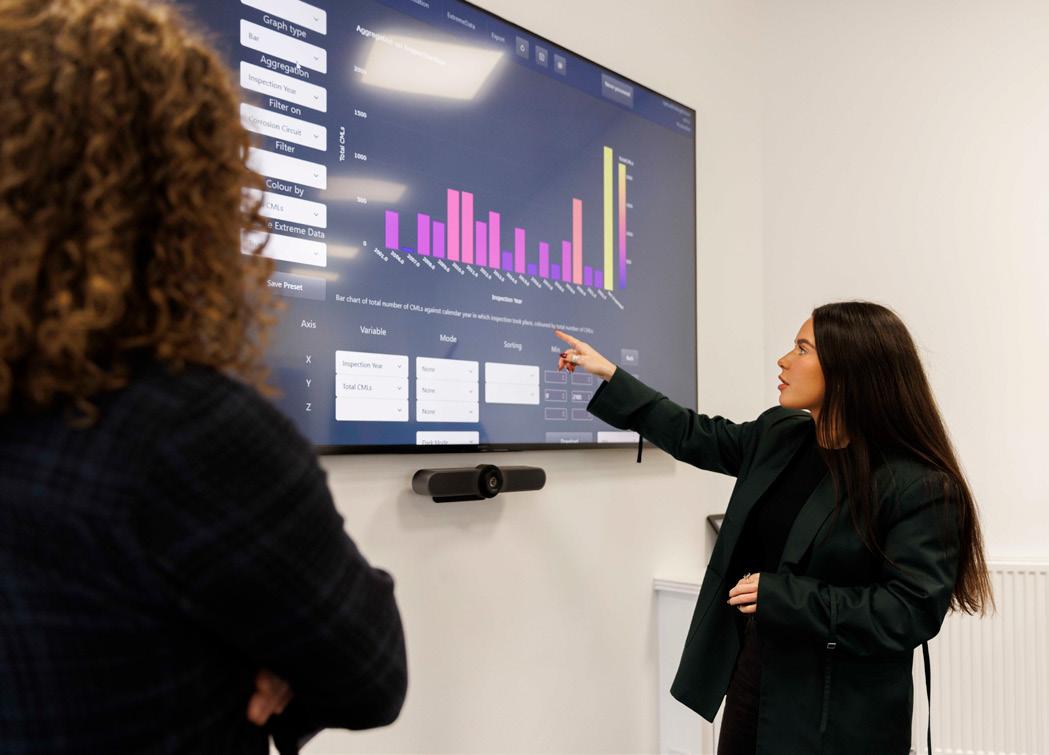
There is a quiet contradiction at the centre of upstream operations. Control rooms are saturated with data, yet when something deviates from plan, the burden of interpretation still falls on the individual staring at the screen. Engineers are not short of signals, they are short of clarity, and that gap becomes most visible when time is constrained and consequences are immediate.
Real-time operations centres were supposed to resolve this tension. They have certainly changed the speed at which data moves, and the volume that can be processed, but they have not fundamentally altered how decisions are made. The alert still arrives stripped of context, forcing teams to reconstruct meaning from fragments, often under conditions where hesitation carries cost.
Peter Kowalchuk, Engagement Director at C3 AI, has spent much of his career working inside that gap. His focus is not on generating more insight, but on changing how that insight is delivered, and whether it can carry enough context to support action in the moment it is needed.
In the oil and gas industries, realtime monitoring is central to safe and efficient operations, Kowalchuk explains. From drilling and well management in real-time operations centres to command environments overseeing hydraulic fracturing and production teams tracking well performance, every stage of the process generates massive, fast-moving streams of sensor data. The challenge lies in turning that continuous flow into clear, reliable insight that can actually drive decision making, particularly when the correct course of action depends on context, history, and expert judgement.
The limits of detection
The industry has become highly proficient at identifying when something is wrong. That capability is now largely assumed, embedded into time series models and monitoring platforms that can flag deviations across a wide range of parameters. The problem is that detection alone rarely answers the question that matters most, which is what to do next.
In most real-time monitoring environments, engineers track metrics such as torque, pressure, flow rate, rate of penetration, proppant concentration, or production output to identify anomalies or emerging trends. These systems can raise alerts with increasing precision, but an alert that simply signals deviation does little to resolve uncertainty. It introduces urgency without necessarily reducing ambiguity.
Kowalchuk points out that a drilling dysfunction alert such as vibration or stick-slip might originate from entirely different causes, including changes in weight on bit or issues with the mud motor. A pressure drop during fracturing could reflect proppant bridging, sensor failure, or a deliberate operational change. In production environments, declining output might indicate a mechanical issue, a control system fault, or a shift in
reservoir behaviour.
That delay is not simply an inconvenience. It introduces a layer of variability into decision making that cannot easily be standardised or scaled. Two experienced engineers may interpret the same signal differently depending on their background and the time they have to assess it. In environments where minutes can have material consequences, that variability becomes a structural limitation.
Embedding context into the signal
Kowalchuk describes the next phase of development as a shift away from alerting toward explanation. At C3 AI, this has taken the form of new architectures designed to embed context directly into the decision loop, rather than leaving it to be reconstructed after the fact.
He explains that retrieval-augmented explainability, or RAE, is designed to move beyond simply flagging anomalies to explaining why they have occurred. The approach retrieves historically similar time periods, enriched with expert annotations and operational context, allowing engineers to understand the underlying patterns behind what they are seeing in real time
In practical terms, this changes how an anomaly is presented. Instead of an isolated alert, the system can
surface comparable historical scenarios, including the conclusions reached by experts at the time. If abnormal vibration patterns are detected on a drill string, the system can retrieve previous instances where similar patterns were observed and identify how those events were interpreted.
The significance lies not only in retrieval, but in the confidence with which those comparisons are made. The system assigns probabilities to different interpretations, weighting them according to similarity and historical frequency. Engineers are presented with a structured view of possible explanations and the likelihood associated with each.
Kowalchuk notes that once the relevant time periods are retrieved and ranked, the system generates natural language explanations that make the insights interpretable. These explanations describe how the current scenario compares to known patterns and offer recommendations grounded in domain knowledge.
Learning as operations evolve
The introduction of explainability raises a second challenge, which is how systems keep pace with changing operational conditions. Oil and gas environments are not static, and the relevance of historical data depends on how effectively it can be updated with new knowledge.
This is where Kowalchuk introduces the concept
of the expert companion. If RAE provides the mechanism for retrieving and interpreting past events, the expert companion ensures that new experience is continuously incorporated into the system.
He explains that when experts encounter new anomalies, they can annotate those occurrences with their interpretation and the actions taken. The expert companion captures and structures that information, linking it to the associated time series patterns and operational context. These insights are then added to the retrieval base, allowing the system to learn from each event and decision.
The effect is cumulative. Each intervention becomes part of the system’s memory, expanding the range of scenarios it can recognise in the future. Over time, the monitoring environment evolves into a dynamic knowledge base shaped by both data and human expertise.
From data to decision
The broader implication is that the industry’s relationship with data is beginning to change. For years, the focus has been on collection and integration, building platforms capable of handling large volumes of information. That work is still necessary, but it is no longer sufficient.
What matters now is whether that data can
be translated into decisions at the point of use. The value of information is realised not in its accumulation, but in its application, particularly in environments where timing and accuracy are critical.
Kowalchuk frames this as a shift from monitoring to decision support. The upstream industry faces a clear challenge in delivering actionable and explainable insights during critical operational moments but also holds an advantage in the scale of data available.
He suggests that the next step is to integrate systems such as RAE and the expert companion directly into frontline workflows. This would allow operators to move beyond basic data collection toward real-time, intelligent decision support, where insight is accessible in a form that can be acted upon.
As experienced field personnel become scarcer, the ability to codify and scale expertise becomes increasingly important. Systems that can capture and redistribute knowledge have the potential to mitigate that shift, ensuring that critical insights are not lost.
The consequence is subtle but significant. When machines begin to explain themselves, they change not only how decisions are made, but how expertise is defined and applied in the field.

When chemistry is treated as solved, operations inherit the error
Digital transformation in oil and gas is accelerating, but much of it rests on an assumption that no longer holds under scrutiny. The physical systems being modelled are not static, and when their chemistry is simplified or ignored, the consequences do not remain contained, they propagate.
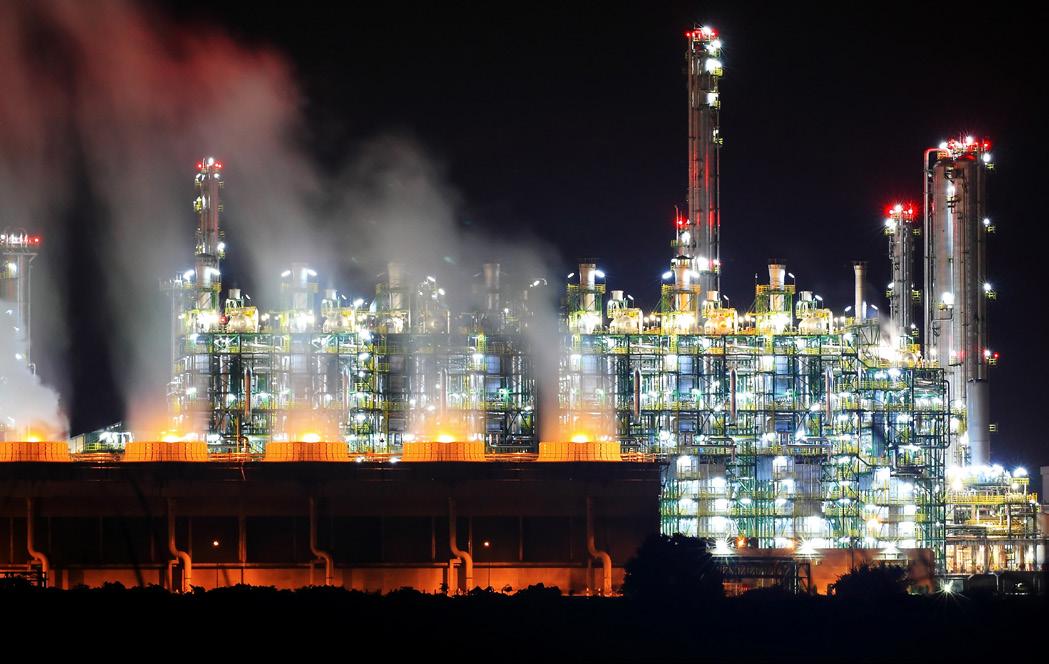
There is a quiet assumption embedded in many digital twin programmes that becomes difficult to see once it has been accepted. Chemistry is treated as a given, something already understood, already solved, ready to be consumed by platforms that promise visibility, orchestration, and increasingly, autonomy. The problem is not that operators have stopped caring about chemistry, it is that the systems being built around them behave as though it has already been accounted for, and that assumption is now starting to show up in operational risk.
Andy Rafal, CEO at OLI Systems, describes a widening gap between the sophistication of digital architectures and the physical accuracy of what they are modelling. “You can have a perfectly architected twin, but if the underlying chemistry model is materially off, the architecture doesn’t tell you that. The system will still look coherent. The risk is that the error is hidden, not that it is visible.” That distinction becomes more important as systems move beyond decision support and begin to act on behalf of operators in real time.
When models were interpreted by experienced engineers, errors could be contained through judgement and context, and the consequences were often limited to discrete decisions. Rafal argues that this containment breaks down once AI is introduced at scale across an asset. “Historically, the risk was bounded,” he says. “You had people in the loop who could catch what a model might miss. Now that same gap doesn’t stay static. It compounds across every recommendation, every decision, every unit that system touches.” AI inherits the data, not the judgment. The errors were always there; what is gone is the human layer that used
to catch them, and without that friction they propagate.
Andre Anderko, Chief Science Officer at OLI Systems, frames the issue from the perspective of the underlying physics. “Corrosion, mineral scaling and related phenomena are governed by electrolyte thermodynamics, which means you are dealing with interactions between multiple species under changing conditions,” he says. “The behaviour is highly non-linear. A small change in composition or temperature can lead to a completely different outcome. This non-linearity is precisely what makes simplified or empirical models fragile when conditions move beyond what has previously been observed.”
The limits of observation
Monitoring has improved significantly across oil and gas operations, with more sensors generating more data across increasingly complex systems. The expectation has been that this visibility would reduce uncertainty, yet in practice it has shifted the problem rather than resolving it. Operators now have a clearer picture of what has happened, but that does not necessarily translate into an understanding of what will happen next.
“Monitoring tells you what is happening and what has happened,” Rafal explains. “It does not tell you what is about to happen unless you have a model that understands the chemistry driving the system. Without that predictive layer, operations remain reactive, even when supported by advanced analytics.”
Anderko highlights the underlying limitation of relying on observation alone. “If you rely only on sensors, you see the final outcome,” he adds. “You do not see the interactions that led to that outcome. Those interactions are what you need to understand if you want to prevent the problem rather than respond to it. The complexity of chemical systems means that causality is not easily inferred from historical data, particularly when conditions change.”
This is where the distinction between empirical and first-principles models becomes critical. “Empirical models are essentially curve fits to observed behaviour,” Anderko explains. “They can be very effective within the range of data they were built on, and machine learning extends that capability. But once you move outside that range, the predictions become unreliable. In contrast, first-principles models are based on thermodynamics

and electrochemistry, allowing them to predict behaviour under conditions that have not yet been encountered.”
When small errors become large consequences
The operational impact of inaccurate chemistry modelling is rarely linear, and small deviations in prediction can translate into disproportionate consequences. Rafal points to the economic and safety implications of these shifts, noting that what appears to be a marginal difference in modelling accuracy can quickly escalate in the field. “The difference between getting it right and getting it close might look like a few percentage points in a model, but in operations that can mean millions of dollars or a safety incident,” he says.
Anderko offers examples where this sensitivity becomes evident in practice. In refinery overhead systems, operators often add neutralising amines to mitigate corrosion, but that intervention can introduce secondary effects that are difficult to predict without a detailed understanding of the chemistry. “When you add neutralising amines, you can form amine hydrochlorides, which create a different corrosion problem,” he explains. “The system becomes a balance between competing risks, and the behaviour depends on interactions that are not straightforward.”
Scaling presents a similar challenge in production systems, where mineral deposition can restrict flow or even block pipelines entirely. “If scaling occurs and closes the pipeline, production stops, and the operator may need to rework the entire well,” Anderko continues. “The conditions that trigger or prevent scaling can depend on subtle changes in brine composition and temperature, making accurate modelling essential for maintaining flow assurance.”
The increasing focus on carbon capture and storage introduces further complexity, particularly in the transport and injection of CO₂. “Impurities associated with CO₂ can form small amounts of corrosive acids,” Anderko notes. “These effects were not fully understood until relatively recently, but they can be predicted from first principles. Without that predictive capability, operators may not
anticipate risks that are not immediately visible in the data.”
AI without physics
The growing use of AI in industrial operations has amplified both the potential and the risks associated with modelling approaches. Rafal is clear that the issue is not AI itself, but the assumptions that underpin it. “AI without physics is fast but brittle. Physics without AI is rigorous but slow. The combination — validated data and models governing the AI — is what industrial operations actually need,” he notes. “AI can produce answers very quickly and with a high degree of confidence, but that confidence is not tied to physical reality when you move outside the training data.”
The failure mode is particularly problematic because it is not always obvious when the system is operating outside its domain. “AI does not fail quietly,” Rafal continues. “It fails with confidence, and it will tell you everything is fine even when it is encountering conditions it has not seen before. In complex industrial environments, that kind of failure can have significant consequences.”
At the same time, physics-based models on their own have traditionally been slower and more difficult to scale across large systems. The direction of travel is not to replace one approach with another, but to combine them in a way that leverages the strengths of both. “You need the speed and pattern recognition of AI, but you need it grounded in first principles,” Rafal argues. “The question is not whether you use AI, it is what that AI is grounded in.”
Reframing the architecture
This shift has implications for how digital twins and related systems are designed, particularly in how the chemistry layer is treated within the overall architecture. Rafal suggests that many programmes still position chemistry as a downstream component, rather than recognising it as foundational to the entire system. “The mistake we see is that chemistry is treated as something adjacent,” he says. “In reality, it sits underneath everything.
“When your AI or your twin makes a
recommendation, you have to ask what is checking whether that recommendation is physically possible. If the answer is based purely on operating data, the system is relying on pattern recognition rather than physical constraints.”
Embedding chemistry modelling into day-today operations requires models that are both accurate and computationally efficient, capable of running at the speed required for real-time decision making. It also requires integration with existing systems, rather than the introduction of isolated tools that sit outside the operational workflow. The chemistry must be modular. Operators are not going to rebuild their entire architecture, so the models need to integrate with what is already there.
The next phase of industrial AI Adoption remains uneven, in part because chemistry has historically been treated as an engineering concern rather than a core component of digital strategy. Rafal points to organisational structure as a contributing factor, with digital programmes often scoped by teams that are not focused on chemical engineering. As a result, the chemistry layer is not always included from the outset, and its importance only becomes apparent when issues arise.
Looking ahead, both Rafal and Anderko expect a shift in how industrial AI is evaluated, with greater emphasis on the foundations that underpin it rather than the surface capabilities it presents. “In five years, the question will not be whether your operations are AI-driven,” Rafal suggests. “It will be whether your AI is grounded in physics, and whether it can handle conditions that have not yet occurred.”
This reflects a broader change in how risk is understood and managed in increasingly autonomous systems. As decision-making moves closer to the machine, the assumptions embedded within those systems become more consequential. “What you are really deciding is what you trust your systems to be based on,” Rafal concludes. “If those systems are making decisions in real time, they need to be grounded in the fundamental laws that govern the process, not just in patterns from the past.”

When AI has to prove its worth in the field
In upstream oil and gas, AI does not struggle because of a lack of data. It struggles because the data that matters is fragmented, inconsistent, and often inaccessible at the point of decision-making. For SLB’s Patricia Cejas Manceron, scaling AI is less about algorithms and more about operational reality.


There is no shortage of data in oil and gas. What there is, however, is a shortage of usable data in the moments where decisions are made. Decades of drilling reports, production histories, and operational records exist in formats that were never intended for machine learning. In that environment, the promise of AI quickly collides with the practicalities of extraction, interpretation, and trust.
For Patricia Cejas Manceron, Global Artificial Intelligence and Innovation Factory Manager at SLB, this is where the conversation becomes grounded. AI is not a standalone capability waiting to be deployed. It has to operate within complex field conditions, safety constraints, and deeply embedded workflows that have evolved over decades.
“My mission in this role is to solve complex challenges that customers have by bringing innovation and powering that innovation with AI,” she says. “My background is much more operational, and business focused than purely technical, so I always want to make sure that whatever we build has business value. I am always trying to articulate what we gain from a model, a project or an innovation.”
That perspective is shaped by experience rather than theory. Over 25 years with SLB, Cejas Manceron has worked across sales, project management, HR, commercial roles, and regional leadership, including overseeing operations across Argentina, Bolivia, and Chile. Her career has taken her across Latin America, North America, Africa, and the Middle East, giving her a view of AI adoption that is as much about culture and context as it is about capability.
“I have worked across multiple regions, and each one brings a different way of approaching problems,” she says. “Understanding those markets is critical, because not everything can be transferred directly. You need to see what resonates locally, what needs to be adapted, and how to translate a global innovation strategy into something that works on the ground.”
Innovation anchored in context
SLB’s response to that challenge is its network of seven global innovation factories, supported by domain data scientists and satellite teams
embedded closer to customers. These centres act as a bridge between technical capability and operational need, connecting complex problems with specialist expertise.
“We use these innovation factories as a gateway to engage with customers,” says Cejas Manceron. “They give access to talent, to technology, and to people in our technology centres, while keeping us close to the challenges that need to be solved.”
The model is deliberately iterative. Ideas are explored through prototyping and experimentation, then progressively refined. Only the solutions that demonstrate clear value and maturity are handed over for scaling within the wider organisation. “We do a lot of experimentation, and then we increase maturity over time,” she says. “When something is ready, we hand it over to scale. But not everything will reach that stage, and that is part of the process.”
This is where AI in oil and gas diverges from more generic enterprise deployment. The technology cannot be applied in isolation. It must be grounded in domain understanding and integrated into operational workflows. “AI is always applied to a context,” she says. “In energy, that context is critical. We need to integrate across domains and ensure that what we build delivers tangible, measurable outcomes.”
Scaling capability without losing relevance
SLB’s work with Dataiku forms part of a broader effort to embed AI capability across the organisation. With more than 3,000 certified users, the focus has been on democratising access to AI tools rather than concentrating expertise in specialist teams.
Cejas Manceron is clear, however, that technology alone does not create adoption.
“What has worked for us starts with leadership and vision,” she says. “You need sponsorship from the top, alignment across the organisation, and a commitment to upskilling people. The platform is important because it brings standardisation, but it only works if people know how to use it and have a reason to use it.”
That reason is often the missing link. Training programmes and certification schemes can build
capability, but without access to relevant data and meaningful use cases, that capability remains theoretical. “In our industry, data is everywhere, but the right data is not always there,” she says. “If people are trained but they cannot access the data they need, or they do not see how it connects to their work, then adoption will not happen.”
The challenge is not trivial. Much of the industry’s historical data exists in inconsistent formats, often spread across different systems or captured in ways that reflect past operational priorities rather than current analytical needs. “You can have drilling reports in many different templates, in different contexts, and sometimes still on paper,” she says. “We are talking about more than 100 years of data in some cases. Bringing that together into something usable is not easy.”
Where AI is delivering value
Despite these challenges, SLB is applying AI across both core energy domains and internal business functions. In drilling, production, and subsurface, the focus is on improving operational efficiency and decision-making. Beyond that, AI is being used in areas such as HR, finance, and asset management.
“In HR, we have used AI to support candidate screening,” says Cejas Manceron. “This is a complex process, because you are looking at skills, cultural fit, language, and also bias. The solution has improved efficiency, but also fairness in the process.”
In technology lifecycle management, AI is being used to anticipate maintenance needs and reduce operational disruption. In finance, it supports forecasting and prioritisation in areas such as cash collection. “There are many use cases,” she says. “The key is to start with something that can bring value quickly and then iterate. Not everything will succeed, but you need to learn from each attempt.”
That willingness to experiment is essential, but it also requires discipline. Without a clear focus on value, organisations risk generating activity without impact. “You need to be able to articulate what you gain,” she says. “Otherwise, it becomes difficult to sustain momentum.”
Generative AI and the need for control
The rise of generative AI has intensified both the
Engineering Excellence Through Knowledge

Driven by AI innovation, powered by data

Experience the Integrity platform, empowering teamwork, efficiency, and safer operations with validated engineering insights.


opportunity and the risk. While the technology offers new capabilities, it also introduces concerns around security, governance, and reliability. “We started our generative AI journey by putting guiding principles in place,” says Cejas Manceron. “There are non-negotiables around integrity, data security, and responsible AI. You need to have guardrails before you scale.”
SLB established controlled environments for experimentation, supported by governance frameworks that ensure compliance while allowing teams to explore new use cases. This structured approach has enabled the organisation to move forward without compromising trust.
From an initial set of around 20 generative AI use cases, a smaller number have progressed to more

advanced stages, with several now being deployed in commercial projects. “You start with many ideas, but only a few will move forward,” she says. “That is normal. Innovation is about narrowing down to what works.”
Managing expectations is part of that process. As AI generates visible results, pressure builds to deliver more, faster. Cejas Manceron emphasises the importance of maintaining a realistic perspective. “You need to make the value visible, but also explain the process,” she says. “Not everything will scale, and that is not a failure. It is part of learning what works.”
From models to operations
Looking ahead, Cejas Manceron sees generative AI playing a role in enhancing operational decisionmaking, particularly in remote and high-risk environments. By combining large language models with domain data, organisations can create more advanced forms of decision support.
“In our industry, safety is critical,” she says. “If we can use AI to better understand what is happening in the field, we can improve both efficiency and safety. With access to larger data sets, we can support better interventions and reduce risk.”
She also points to the potential for repurposing existing models, particularly in the transition to new energy applications. “We already have strong capabilities in subsurface modelling,” she says. “Those models can be adapted for other contexts, such as geothermal, where you still need to understand what is happening below the surface.”
The implication is that AI’s value in oil and gas will not come from isolated breakthroughs, but from the gradual integration of models, data, and workflows into a more coherent system. For that to happen, the fundamentals cannot be ignored. Data must be accessible, use cases must be relevant, and organisations must be prepared to invest in both capability and culture. “Good data will feed AI,” says Cejas Manceron. “It sounds simple, but it is not. You need the right data, the right access, and people who understand how to use it.”
In oil and gas, that may be the most important lesson of all. AI does not transform operations by existing. It transforms them when it becomes part of how decisions are made.

Turnaround knowledge shouldn't walk out the door when your planners retire.
Bolo reads the work packages, &IDs, and MMS history your plant already wrote down then drafts the next cycle's scope efore the kickoff eeting
Three of Bolo's planning agents
Work Package
Assembles the next work package from prior cycles, P&IDs, and OPs Carries forward bad actors and reifnes actions over time as feedback comes in.
Document & photo retrieval
Pulls the right isometric, the last inspection photo, the vendor cutsheet earches across harePoint , Maximo attachments, and ifeld photos at once
Scheduling & coordination
Holds the -minus schedule, ags slipping tasks, and drafts shift hand-off notes eeps contractor crews and ops on the same page through execution.
Scan the R code, or see it on our historian and MMS at bolo.ai.
Book a 0-minute alkthrough ring one anomaly rom last cycle
AI Is Repeating the Mistakes That Stalled Digital Twins
Authors: Rob Kennedy, Global Director – Strategy, Integrated Digital Operations, Wood, Jayanth Nair, Senior Data and GenAI Lead, Wood, Shirley Ike, Global Director, Data Management, Wood
The question worth asking isn’t what AI can do – but how it should be applied to deliver the operational results that matter. AI has moved rapidly from the margins of industrial technology into everyday life, and that shift is now being felt across energy and materials organizations.
Boardrooms are filled with questions about what AI could enable, where it should be applied, and how quickly value might follow. At the same time, many leaders are grappling with a familiar challenge: translating digital ambition into measurable improvements in safety, operating cost, reliability, and production. The good news: the path is clearer than the noise suggests.
The hype is unavoidable –and so is the decision
AI hype now dwarfs the digital twin wave. Unlike digital twins – which were (and perhaps still are) a relatively niche technology – AI is embedded in everyday life. It shows up in phones, cars, offices, and homes. As a result, the hype hasn’t just reached the enterprise; it has flooded it. AI has entered every boardroom. In some cases, leaders are still working out how to separate signal from noise before
committing to difficult trade-offs.
In energy and materials industries, those trade-offs are unavoidable because value, if delivered, is not abstract. It shows up in safety outcomes, maintenance and reliability performance, and production results. These are the measures leaders are ultimately accountable for. Yet despite unprecedented investment in digital and AI, many organizations still struggle to point to sustained improvement in any of them. Dashboards multiply, pilots proliferate, and architectures evolve, but the operational needle barely moves.
We have seen this pattern before None of this is new.
The digital twin era left a clear set of recurring failure modes: top-down corporate initiatives disconnected from operational reality; late discovery that data was incomplete or unfit for purpose; and solutions that looked impressive but never became part of how work was actually done. Digital twins were never meant to be visualization tools. They were always intended to be decision enablers. Yet in practice, “digital twin” became shorthand for 3D models and immersive views. Where real value was achieved, it was because twins were embedded into operational workflows –planning, assurance, and optimization – not because they looked impressive.
Time and again, initiatives stalled not because the technology failed, but because adoption never truly happened. Many organizations invested heavily in platforms and models, while under-investing in workflows, procedures, practices, and adoption – the very elements that determine whether technology actually changes how work is done. Without them, even technically sound solutions quietly withered.
AI risks repeating the same mistakes, only at far greater scale, speed, and cost. When ambition outpaces
operational reality, value quietly leaks away.
Where value is really won
Nowhere is this more evident than in existing operations, where value is created or lost in day-to-day decisionmaking. Consider a maintenance planner prioritizing work with imperfect information, or an operations lead managing a production upset while balancing safety margins, throughput, and risk. If AI does not assist or completely solve these problems, then sophistication is irrelevant.
AI now faces the same risk that plagued digital twins: becoming a compelling demonstration rather than a practical operational tool. The difference is that AI’s reach is broader, its cost higher, and the consequences of misapplication more significant.
The same logic applies to new assets where the opportunity is to shape how they are handed over, ready to be optimized from day one, rather than retrofitting capability after the fact.
AI raises the stakes, not just the ceiling
AI undeniably expands what is technically possible, but it also raises the stakes. Explainability, predictability, data dependency, and trust become critical in safety-critical environments. Value can no longer be assumed or implied, it must be defined up front and assessed explicitly against operational outcomes, not technical performance. The goal is not just to expand what is possible, but to make it predictable.
AI is a decision-support and automation tool. It is not a magic solution. It does not replace engineering judgment. And it does not fix what was broken before it arrived. When these boundaries are blurred, disappointment is inevitable and credibility is lost.
From technology push to a domain-led approach

A domain-led approach to AI starts not with the technology, but with the operational decision that matters most and works backwards. It reframes AI deployment from a technology push to an operational pull: from “we have a model” to “we have a decision problem worth solving”.
In high-hazard industries, trust is earned through discipline. A domain-led approach keeps humans firmly in the loop, applies engineering rigor, and constrains where and how AI is used. The question is not whether AI is powerful, but whether it improves decision quality in real operating conditions. When it does, the impact is direct: better decisions, more consistent operations, and performance that holds.
Filtering signal from noise
The first step in delivering operational value is to identify a problem that needs solving. A bottom-up approach where an operational bottleneck being signalled up to organizational leaders, has a higher chance of delivering value and actual adoption than the other way around. Once a problem is identified, then begins the hard work of assessing data sufficiency, building models and testing improvements. A solid benchmarking approach helps validate models and technology vendors against conventional standards and filter signal from the AI hype noise. There are several technology vendors hoping to provide the solution, but no matter how promising their pitch is, a rigorous technological evaluation and assessment through pilot studies is the only way you can separate the wheat from the chaff. Ultimately, nobody wants to commit millions of dollars on a promise, it demands thorough evidence and proof.
AI will not earn its place in operations through ambition or hype, but through sustained, demonstrable improvement in how assets are actually run. Where this approach has been applied with rigor, the results speak for themselves: fewer safety incidents, enhanced production, and sustained reductions in maintenance effort and cost.
Across the asset lifecycle, Wood embeds technology and AI into operational decisions, processes, and ways of working. Our goal isn’t to deploy tools – it is to reshape how assets are run, optimized, and sustained. See what’s possible: woodgroup.com/digital
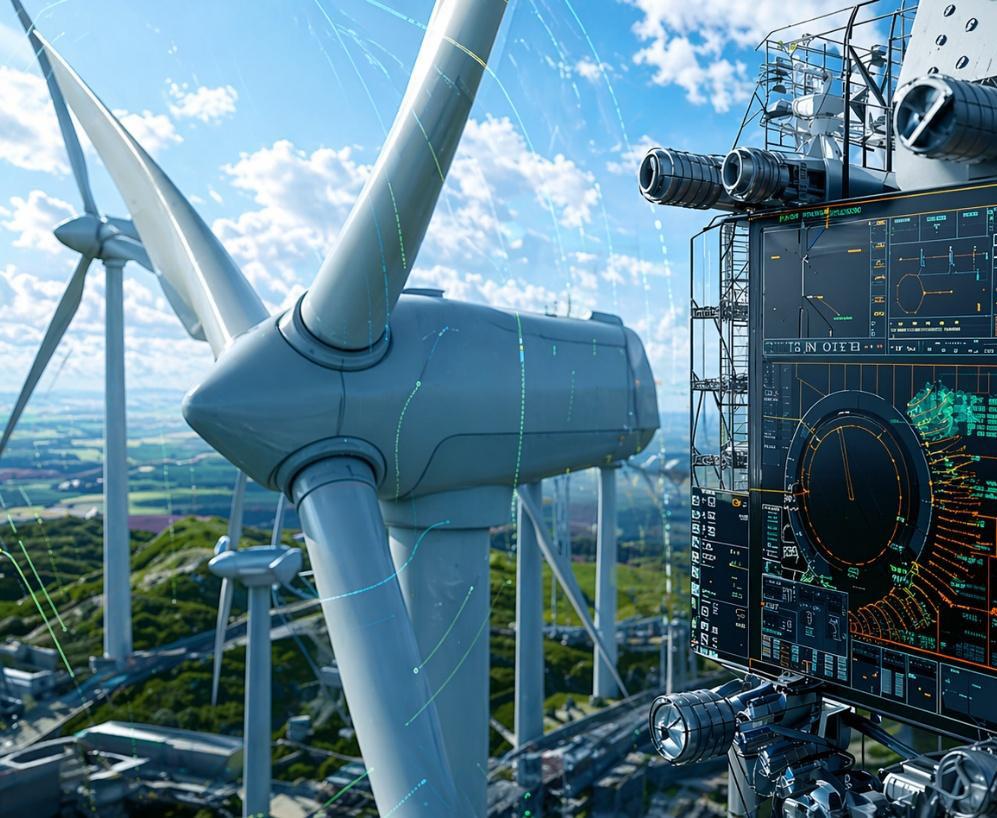
I like to frame it around 3 main pillars: People, Process and Technology.
When it comes to Technology, we bring to market platforms that enable building, validating and deploying Hybrid Digital Twins constructed from sensor data as well as physics simulations powered by the latest in AI/ML. Foundationally, it enables the ncept of virtual sensors, i.e., virtual predictions where a physical sensor is not feasible for the various reasons. The virtual sensor further enhances the traditional Digital Twin use cases for efficiency gains and predictive maintenance but also enables new ones to validate and commission green fields virtually, allowing designers and operators to leverage the technology across the
When it comes to our Process value stream, I typically break it into twining related processes and the project related processes. The twining process is very deeply tied to the Technology pillar where we have enabled an effective way to bring agnostic knowledge from measured data and/or physics simulation results into one single environment to product adaptive, high fidelity and fast digital assets that can easily be exported into containers or apps to be integrated into IoT platforms, Edge devices or other forms of automation platforms through APIs.
For the project process, we have put together a very robust Digital Twin engagement model that leverages technology maturity matrixes, business impact assessments, key personas… amongst others to facilitate project success and streamline ROI. It starts blending with our 3rd pillar, People. Yes, we do have personnel and partners with critical technical knowledge and experience to deliver, but also to minimize risks by avoiding common pitfalls and breaking project milestones into pieces of continuous value-add deliverables. One common example we see slowing down Digital Twin projects is to operate in verticals across the disciplines that need to be involved versus kickstarting with a more horizontal view
As a company, we operate in all industry verticals, and we bring that expertise also into the Digital Twin projects. Finally, as we embark on a new journey as part of Synopsys, our Digital Twin technology is positioned to deliver on the next generation use cases from silicon to systems.
What are the latest Digital Twining applications that you see rising in Energy?
What we are seeing is a big correlation to the world of AI. And I’m not talking about AI streamlining energy use cases which has been even a topic of this conference for a few years now. Rather, I’m talking about increasing dynamic AI workloads driving the needs for much more robust power and thermal management systems around Data Centers, which in turn is affecting several sub-
verticals related to Energy. From equipment providers to energy providers, to the hyper scalers to final consumers, there is a huge ecosystem, a system of systems to be designed and managed more efficiently. Digital Twin technologies, directly or indirectly, are at the center of delivering on these rapid changing requirements. We have a whole campaign around it and you should check out: https:// www.ansys.com/blog/meeting-energy-demands-ai-data-centers
How is Ansys, part of Synopsys positioned to bring Digital Twining innovation in these areas?
It goes back to my earlier comment about lifecycle value stream as well as our expanded technology and partnerships portfolio through becoming a part of Synopsys. We break our Ansys Twin technology into 2 main products: Twin Builder and TwinAI. They both leverage the latest in physics simulation and AI/ML to produce adaptive high fidelity digital assets that can be leveraged at design, validation and operational stages, both at the component and systems level. A very good example is being able to simulate and quickly understand the impact of various Data Center configurations to optimize PUE (power usage effectiveness).
With Synopsys, we are also extending that down to the chip level all the way through the value chain. An iconic example of that is our partnership with NVIDA for Digital Twin related activities amongst others. Read more here: https://news.synopsys.com/2025-1201-NVIDIA-and-Synopsys-Announce-Strategic-Partnership-toRevolutionize-Engineering-and-Design
What challenges and opportunities do you see with the advancements of AI in Digital Twining?
As we move from AI to AGI (artificial general intelligence) or even ASI (artificial super intelligence), the opportunities are numerous to streamline human life broadly speaking. If you talk specifically about where we are headed today in that journey and the next milestone of Physical AI, the main opportunity is automation at scale across all levels of society. When it comes to challenges, one of the main ones is validation, data and process, to certify the AI. In both cases, Digital Twins, specifically the ones backed up by physics such as Ansys Digital Twins, the technology is extremely relevant: A) to generate the synthetic data for validation, B) to quantify the uncertainty around predictions and C) to become one of the possible paths to deploy the brain behind the desired automation. You can learn more here: https://www.ansys.com/blog/explorerole-digital-twins-modern-industries
How can we learn more about Ansys, part of Synopsys Digital Twin technology?
You can contact me directly at vitor.lopes@synopsys.com but also leverage the various virtual materials we have available at https:// www.ansys.com/products/digital-twin
Trust Where Decisions Matter Most
By Ove Heitmann Hansen, Senior Principal Digital Trust, DNV

Artificial intelligence and digital twin technologies are rapidly moving from advisory tools to systems that influence operational and safety critical decisions across the energy sector. This shift fundamentally changes what is required of these technologies and of the leaders who deploy them. Trust is no longer optional.
This is not an abstract concern. AI enabled digital twins are already influencing decisions that affect asset integrity, personnel safety, environmental exposure, regulatory compliance, and financial performance. Organizations must be able to demonstrate that those systems are trustworthy.
This is why the conversation around digital twins and AI must evolve from innovation and efficiency to bankability and responsibility.
From digital potential to decision responsibility
For years, the value proposition of digital twins has focused on insight: better visibility into asset behavior, improved diagnostics, and predictive capability. That value still holds, but the stakes have risen. Today’s digital twins are increasingly: Embedded in operational workflows
• Connected to real time data streams
Enhanced with AI and machine learning Used to support decisions with safety and financial consequences
When a digital twin influences a decision on maintenance deferral, load dispatch, production optimization, or integrity management, it becomes more than a digital model; it becomes a decision model.
At that point, leaders must ask a different question:
Canwetrustthissystemwheredecisions matter most?
Designing AI enabled digital twins for safety critical environments
A digital twin is not a static model. It is a living representation of a physical asset or system, continuously evolving as new data, operating conditions, and analytical methods are introduced. In safety critical environments, that evolution must be controlled, transparent, and verifiable.
Consider pipeline operations. Digital twins are now used to assess integrity risk by combining SCADA data, inspection records, material models, and environmental conditions. These twins help operators prioritize maintenance, optimize operations, and extend asset life. The value is clear, but so is the responsibility. An incorrect assumption or unverified data source does not just impact costs; it can impact public safety and increase environmental risks.
Designing AI enabled digital twins for such environments therefore requires trust by design, from data provenance and model fidelity to governance, cybersecurity, and lifecycle management.
In practice, this trust is not created by intelligence alone. Commercial and delivery-focused AI establish the foundations: governed data, reusable workflows, and digital process discipline across engineering and operations. Without this layer, advanced analytics remain fragile. With it in place, intelligence AI can connect the enterprise end to end, enabling autonomous operations, predictive decision-making, and differentiated service experiences for both customers and internal teams. Transformational trust emerges when these layers work together, allowing organizations to scale intelligence responsibly, rather than experimentally.
Trust becomes fundamental, not optional
As AI moves into operational and safety critical contexts, trust is no longer a “nice to have.” It is what determines whether these systems can be scaled, automated, and relied upon. This is where assurance plays a decisive role.
DNV’s approach to digital twin assurance is built on a simple premise: digital systems that influence real world outcomes must be verifiable and defensible over time. This applies not only at the moment of deployment, but throughout the operational lifecycle of the asset and the digital twin itself.
Through DNV RP A204: Assurance of Digital Twins, DNV provides a structured framework for establishing and maintaining trust across four core dimensions:
Fidelity – Does the digital twin accurately reflect real world behavior across operating conditions?
• Robustness – Does it perform predictably when data quality degrades or conditions deviate from the norm?
Data provenance – Are data sources governed, traceable, and fit for purpose?
Lifecycle alignment – Does the twin remain valid as assets, environments, and use cases change?
DNV-RP-A204 sits within a sider DNV trust and security framework that recognizes digital twins as part of a broader digital ecosystem. This includes cybersecurity and information assurances practices, responsible AI frameworks, and lifecycle governance aligned with industrial safety and regulatory expectations. Together, these frameworks address not only model fidelity and performance, but also cyber resilience, access control, explainability, and protection against unintended system behavior, reinforcing trust as an end-to-end discipline rather than a point solution. These dimensions are not just technical criteria; they are preconditions for adoption, assurance and regulatory confidence.
In safety critical and regulated energy environments, such as grid operations, offshore installations, hydrogen systems, and nuclear assets, these dimensions are not just technical criteria. They are preconditions for adoption.
Why trusted AI is essential when digital twins influence operational safety
As digital twins increasingly incorporate AI, the trust challenge intensifies. AI enables digital twins to detect subtle patterns, adapt to changing behavior, and recommend actions that would be difficult, or impossible, for people to manually detect. But with that power comes a heightened obligation to ensure accountability.
DIGITAL TWIN
When AI influences:
• Load dispatch decisions in stressed grid conditions
Integrity assessments for aging infrastructure
Production or pressure limits in offshore environments
• Safety related alarm prioritization
...the system must be explainable, auditable, and bounded by clearly defined limits.
This is why trust is essential when digital twins influence operational safety.
The most effective digital twins today use hybrid modeling, combining physics based foundations with data driven learning. This approach preserves engineering transparency while allowing models to adapt to complex, non linear behavior. DNV strongly emphasizes this hybrid strategy, particularly in environments where purely data driven models would be unacceptable from a safety or regulatory perspective.
To support this evolution, DNV has developed assurance practices for AI enabled systems, including DNV RP 0510 and DNV RP 0671 , addressing transparency, explainability, governance, and alignment with emerging AI regulation such as the EU AI Act across safety-critical use cases.
Bankability requires trust across the lifecycle
From a leadership perspective, the question is not whether digital twins and AI can deliver value; they already do. The question is whether that value is repeatable, scalable, and defensible under scrutiny.
Bankable digital twins share common characteristics:
• They are embedded in validated decision processes
Their assumptions and limitations are understood
Their outputs can be explained to regulators and auditors

Their performance remains reliable as conditions change They are anchored to clearly defined operational or commercial problems, rather than technology ambition
• They demonstrate positive return on investment through measurable risk reduction, productivity gains, or asset performance improvement
Achieving this requires a continuous digital thread, connecting data, models, decisions, and outcomes across the asset lifecycle. It also requires robust data governance, cybersecurity treated as an operational integrity issue, and interoperability that avoids vendor lock in while enabling scale.
Transformational trust will define the next generation of energy systems
Digital twins are evolving rapidly: from dashboards to agents, from insight providers to operational collaborators. As their influence grows, so does the need for clarity, accountability, and trust.
The next phase of digital transformation in energy is not about adopting more AI. It is about trusting AI where decisions matter most.
Digital twins and AI technologies are no longer experimental in the energy sector—they are operational. Yet their ability to shape safer, more efficient, and more resilient energy systems depends on trust: trust in the data, the models, the algorithms, and the governance frameworks that surround them.
By advancing structured assurance frameworks, hybrid modeling approaches, and digital governance built for safety critical environments, DNV supports energy leaders in moving from digital experimentation to bankable, decision grade systems.
As we often state:
If you cannot trust your digital representation, technology, or data, you cannot use it in the real world. The future of energy will not be powered by intelligence alone. It will be powered by transformational trust — where decisions matter most.
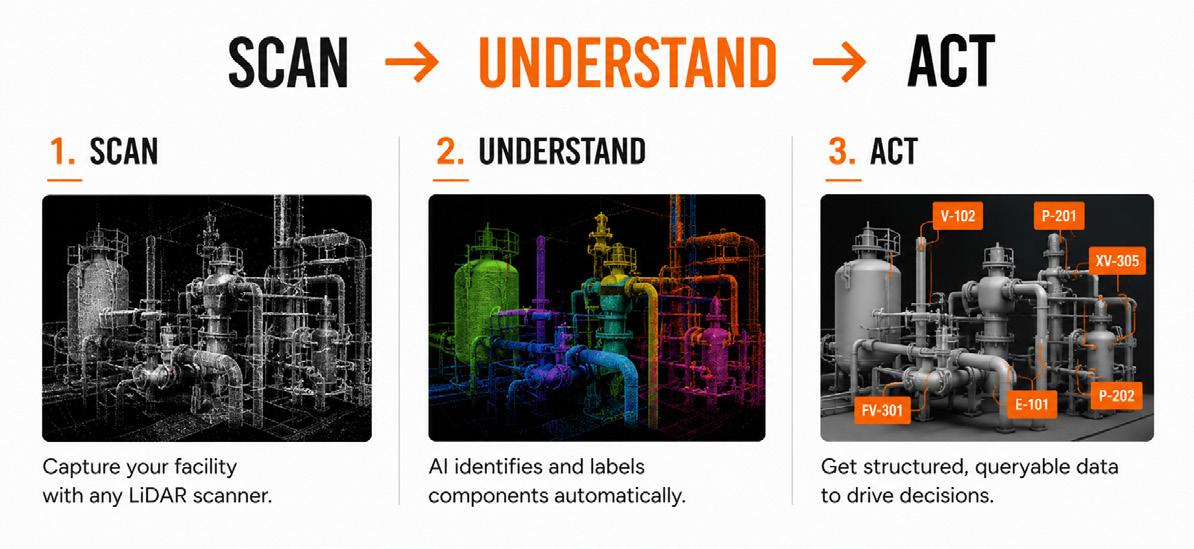
FocisAI turns laser scans into structured and classified intelligent asset data.
No manual modeling. No outdated drawings.
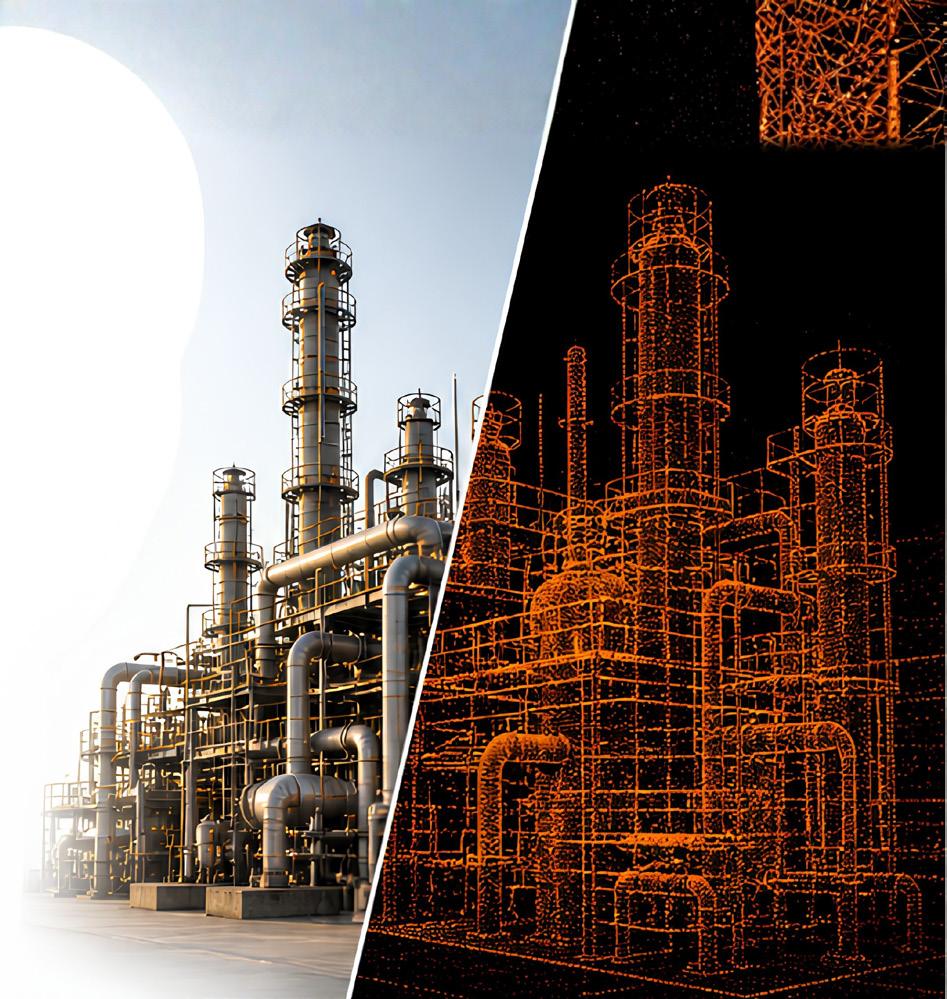


The energy industry is buying AI but not scaling it. Here is why.
By Shane McArdle, CEO, Kongsberg Digital

At CERAWeek just a short while ago, AI was everywhere. On stage, in the hallways, in every conversation about what comes next for energy operations. The ambition is real. The investment is real.
And yet, when you look past the announcements, most organizations deploying AI and more specifically, AI agents, are discovering the same uncomfortable truth: buying the capability is the easy part.
Making it work at scale – in production, in the hands of people who have to trust it with real decisions – is a different problem entirely. This is not a technology failure. The technology is ready but the capability to scale is lacking.
“Only 62% of organizations are experimenting with AI agents.”
McKinsey’s data shows 62% of organizations are experimenting with AI agents. However, scaling remains a challenge: only 23% have deployed them on a scale anywhere in their business, and fewer than 10% have achieved scale within any single, specific department. BCG found that 74% of companies are yet to show tangible value from their AI investment. The gap between aspiration and operational reality is widening.
The question worth asking is not “what can agents do?” We already know the answer to that. The question is: why aren’t we scaling them?
The trust problem
When an operator asks an AI agent why it recommends a particular course of action and the system cannot tell them, they stop using it. Not immediately, and not loudly. They just route around it. They go back to the whiteboard, the spreadsheet, the colleague they trust. The brilliant basics of how industrial work gets done.
McKinsey research confirms this pattern. In a 2024 survey, 40% of respondents identified explainability as a key risk in adopting AI – and yet only 17% said they were doing anything to mitigate it. Another gap, this time between recognizing a problem and doing something about it. This is where agents stall.
“Weonlytrustwhatwecanverify.Asanindustry,wehavetoomuchatstaketotake recommendations on faith.”
Shane McArdle, CEO, Kongsberg Digital
The people who work in complex industrial environments are not resistant to technology – if you are attending Future Digital Twin and AI, it is because you have lived this. Our industry has absorbed more change over the past two decades than most sectors. But look, we are a rational industry. We only trust what we can verify. And we have too much at stake to take recommendations on faith.
This is the organizational readiness problem, and it sits upstream of everything else. You can deploy the most capable agent in the world. If the workforce cannot see how it reasons, cannot challenge its conclusions, cannot understand when to override it – you have a liability, and not a tool.
Scale is not just speed
Looking outside the energy sector can help us understand what true scale looks like. Visma, one of Europe’s largest software companies, has shifted to an API-first development approach –validating whether an API solves a customer’s problem before any backend code is written. Only once the design is proven do developers build. It is an extraordinary statement of intent, and it points to where capable organizations are heading: workflows where AI does not just assist work, it performs it.
That is not where most energy operations organizations are today. Nor should we pretend it is, but the direction is not wrong.
“ThegapbetweenwhatAIcandoandwhat organizationshaveequippedthemselvestoabsorb isthestrategicproblemofthisdecade.”
Shane McArdle, CEO, Kongsberg Digital
The lesson from companies moving at that speed is not that we should try to match their pace in environments where physical safety and regulatory accountability are the stakes. The lesson is that the gap between what AI can do and what organizations have equipped themselves to absorb is the strategic problem of this decade. Every quarter spent in pilot mode, running the same proof of concept for the third time, waiting for conditions to be perfect, is a quarter that gap widens.
Most companies are stuck on the first step not because they lack ambition, but because they
have not yet built the internal scaffolding that lets people work alongside AI with confidence. At Kongsberg Digital we are actively building that scaffolding today inside our own operations: AI agents are already being applied across engineering, design and product management, and increasingly moved out of the conceptual phase into our daily workflows where practical value is built. The more we use AI internally, the more intuition we are building around what is possible with AI – and the more we understand how it can impact organizations and be scaled across business functions.
What does readiness actually look like?
It means your people understand, at least at a working level, how AI-generated recommendations are produced and what data informs them. Not every person, and not at a model-architecture level, but enough that the technology feels like a colleague whose reasoning you can follow – not a black box handing you instructions.
It means you have established where human judgement is non-negotiable and built that harness into the design of your agent workflows from the start, not retrofitted it after a nearmiss. Human-in-the-loop is not a compromise. In our complex industrial environments, having us in the loop is the only architecture that earns sustained adoption.
And it means you have done the unglamorous work on your data foundations. Not because the data needs to be perfect – it does not – but because an agent running on poorly contextualized data will make recommendations that feel wrong to experienced operators, and experienced operators who feel the system is wrong will stop trusting it. Once that trust breaks, it is extremely hard to rebuild. You cannot scale intelligence on top of chaos.
Our biggest constraint is courage
None of this is new thinking. We have been talking about digital transformation for years. But agents make the stakes higher, not lower, because agents act. They do not just inform; in the most advanced deployments, they recommend, initiate, execute. The cost of an adoption failure at agent level is not a dashboard nobody uses. It is a workflow that breaks, or worse, one that runs but quietly, in

directions that nobody intended.
Our biggest constraint is this: organizational courage . The willingness to redesign workflows, invest in workforce literacy and AI fluency, and build the harnesses that act as a protective layer so trust can be built in tandem with adoption. At this Future Digital Twin & AI, I expect we will hear a lot about what agents can do. I am more interested in talking about what it takes to make them work – for the operators who have to use them, the engineers who have to maintain them, and the organizations that have to stake their performance on them.
That conversation, I think, is the one we actually need.
When faster decisions become a hidden risk
As AI moves into operational control, the real challenge is no longer capability but consequence. Mark Venables argues that oil and gas must confront what happens when decisions are made at a speed that outpaces understanding.
There is a point at which a technology stops being interesting and starts becoming dangerous. Not because it fails, but because it works well enough to be trusted before it is fully understood. Oil and gas is approaching that point with AI and digital twins.
For years, the industry has been able to contain uncertainty through process. Decisions were slowed down, passed between disciplines, challenged, reworked, and ultimately signed off by people who understood both the physics and the risk. That friction was not inefficiency; it was a control mechanism. It ensured that when something went wrong, it did so within boundaries that were at least partially visible.
That mechanism is now being eroded, not deliberately, but because of progress. Systems that can interpret complex data streams, model behaviour, and recommend actions in near real time are beginning to bypass the very processes that once acted as a safeguard. The gain is speed. The loss is something far less visible, which is the ability to interrogate how a decision has been reached before it is acted upon.
There is a tendency to frame this as a question of trust in AI. That is too simplistic. The real issue is whether the industry understands the conditions under which these systems fail, and whether those failure modes align with the way operations are run.
In controlled environments, models perform well because they are operating within the boundaries of the data they have seen. In oil and gas, those boundaries are constantly shifting. Reservoirs behave differently as they deplete. Equipment degrades in ways that are not always linear or predictable. Chemical systems respond to small changes with disproportionately large effects. These are not edge cases, they are the normal operating conditions of the industry.
The danger lies in the mismatch between the apparent confidence of a system and the underlying uncertainty of the environment it is operating in. A model that is highly accurate most of the time can still be unreliable in the moments that matter most. Those
moments are precisely where traditional processes would have slowed things down, brought in additional expertise, and applied judgement. When that layer is compressed or removed, the consequences do not scale linearly.
What is often overlooked in discussions about digital transformation is that oil and gas is not just a data problem. It is a physics problem, a chemistry problem, and a systems problem. Digital twins that abstract away those realities may still look coherent, but coherence is not the same as correctness. A system can be internally consistent and still be fundamentally wrong.
None of this is an argument against AI. Quite the opposite. The potential is real, and in many cases already being realised. The ability to detect subtle deviations, to model complex interactions, and to respond in real time has the capacity to improve efficiency, reduce downtime, and enhance safety in ways that were previously unattainable.
The question is how that capability is governed. There is a strong case for reintroducing deliberate friction into systems that are otherwise optimised for speed. Not as a rejection of automation, but as a way of ensuring that critical decisions remain interpretable and challengeable. This does not mean returning to manual processes, but it does mean designing systems that expose their assumptions, their limitations, and the degree of uncertainty attached to their outputs.
The industry has always managed risk by understanding the systems it operates. As those systems become increasingly digital, that understanding must extend beyond the physical to the computational. Otherwise, there is a risk that decisions are made faster than they can be understood, and that is a far more dangerous position than any lack of data or compute.
AI will not fail because it is incapable. It will fail where it is assumed to be infallible. The distinction matters, and it is one that the industry will need to confront before speed becomes the dominant metric of success.