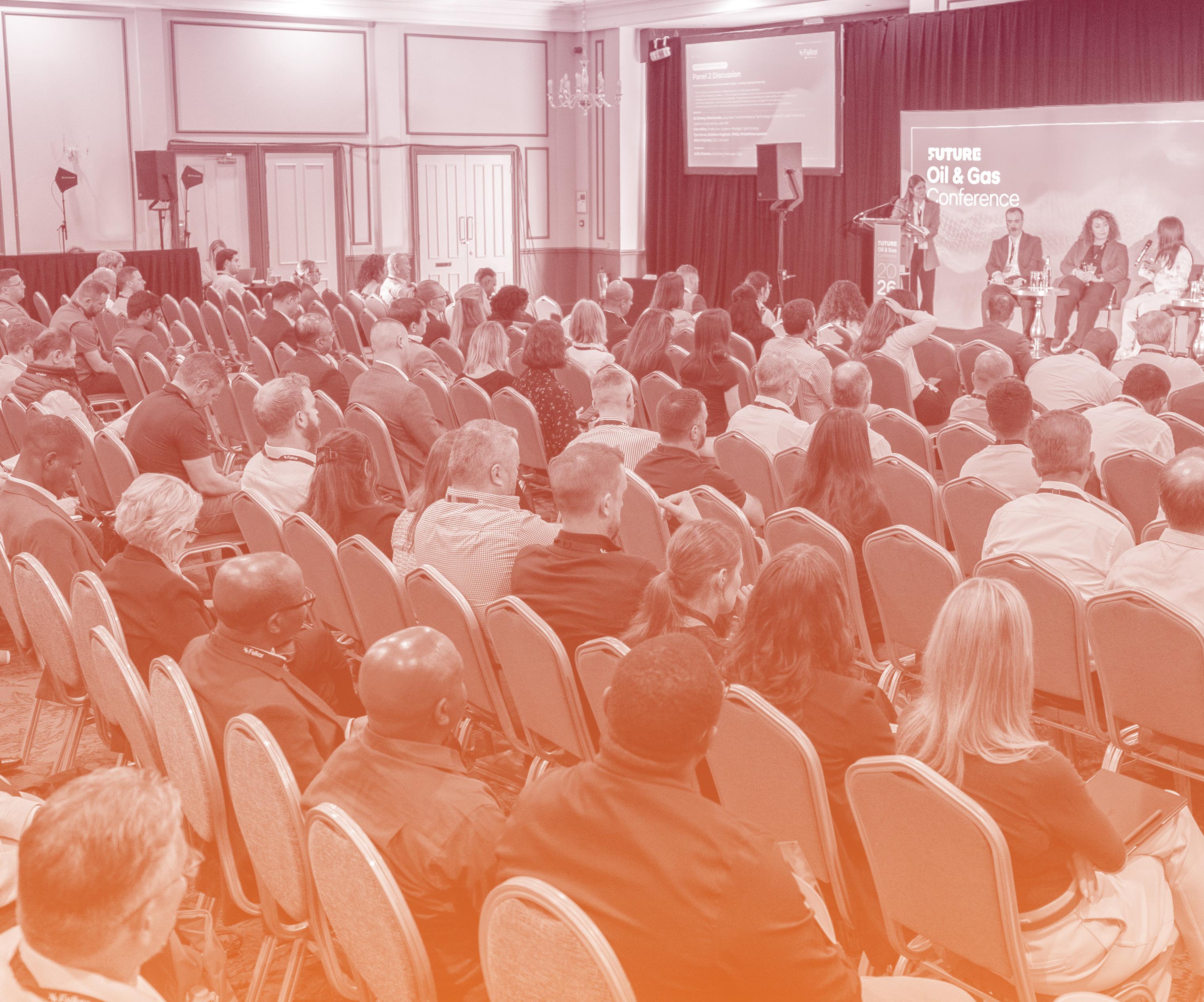



It was my pleasure to welcome delegates to Future Oil & Gas 2026 at Ardoe House in Aberdeen for two days of insightful discussion, collaboration and knowledge sharing. Bringing together industry leaders, technology innovators and energy professionals, the conference once again provided an important platform to explore how digital transformation is reshaping the future of the oil and gas sector.
What stood out throughout this year’s event was the clear shift in the industry’s priorities. The conversation has moved beyond exploring what artificial intelligence could achieve and towards deploying it responsibly, integrating it into operations and scaling it to deliver measurable business value. Organisations are now focused on building the governance, trusted data foundations and operational confidence needed to realise AI’s full potential.
Across the keynote presentations, panel discussions and thought leadership sessions, we explored how AI, digital twins and autonomous operations are transforming the way assets are managed and maintained. Discussions reinforced the importance of secure, connected data, interoperability and lifecycle governance, while recognising that successful digital transformation depends as much on people as it does on technology.
Preparing organisations for long-term change was another recurring theme. As AI becomes increasingly embedded within operational workflows, building workforce capability, preserving institutional knowledge and fostering collaboration across disciplines will be essential. Leadership, change management and AI literacy are becoming just as important as the technologies themselves.
The conference also highlighted the role digital innovation will play in supporting the wider energy transition. From improving operational efficiency and asset integrity to enabling emissions reduction and better decisionmaking, the discussions reflected an industry committed to delivering practical progress through collaboration and innovation.
I would like to thank our speakers, sponsors, exhibitors, partners and delegates for contributing to another successful edition of Future Oil & Gas. Your expertise and willingness to share real-world experience continue to make this event an invaluable forum for learning and collaboration. I hope the insights captured in this report will provide lasting value as we continue shaping a smarter, more connected and more sustainable future for the industry.
Adam Soroka CEO of Cavendish Group International
The annual Future Oil & Gas conference returned to Aberdeen for its 2026 staging on 24–25 June, with the impact of artificial intelligence (AI) and digital transformation on the energy industry at the forefront of discussion.
The forum’s usual mix of dynamic debate, knowledge sharing and networking opportunities attracted 264 delegates from 174 organisations to this year’s venue, historic Ardoe House, a 19th-century baronial mansion just outside Aberdeen.
Delegates represented a broad swathe of the energy industry, including major operators, energy services providers, AI solutions developers, industry associations and academia. Taking to the stage were speakers from leading operators, such as Shell, bp, ExxonMobil, Aker BP, MOL, along with voices from energy services firms including Falkor, Enablon, KBC, VEERUM Prometheus Group and many others.
Panel sessions, keynote presentations and roundtables covered a wide range of cutting-edge industry themes. Among topics up for discussion were the role AI is already playing in improving operational efficiency, resilience and profitability, how to blend digital technologies into workflows for maximum impact, workforce adaptation in a digital age, the importance of maintaining human accountability in an increasingly AI-oriented working environment and the challenges surrounding AI and data governance.
Adam Soroka, CEO of Cavendish Group and Future Events, said the strong conference line up reflected the value attributed to knowledge sharing at this pivotal moment for the industry.
“When we first staged this event four or five years ago, the discussions on AI were embryonic. Now they are not about whether we are going to apply AI, but how we are actually applying it in the energy industry right now. That sharpened focus on the practicalities has resulted in a great event and augurs well for next year’s agenda,” he said.
Menno Van Vechgel, IDT Manager, Information, Data and Analytics at Shell, said the conference provided an important opportunity to discuss how the industry could best respond to the massive pressure to scale up AI -driven solutions to meet huge energy demand growth, decarbonisation challenges and growing system complexity,
“The question is not just about whether we adopt AI, but how do we adopt it at scale, responsibly and effectively, and that is what this event is all about,” he said.
Shane McArdle, CEO of industrial digital solutions firm Falkor (formerly Kongsberg Digital) said the event provided an ideal forum for leading players to assess the opportunities and challenges of a fast-changing digital landscape.
“Automated processes have been part of the energy industry for decades, so we are no strangers to the questions of trust, oversight and control that come with advanced technology,” he said.
“What is different now is the pace at which AI is being implemented, and the speed at which governance structures and guardrails need to mature alongside it. That makes events like this important: they bring the industry together for the conversations we need to tackle these issues.”

Here’s what some of the experts said at Future Oil & Gas 2026:

ALESSANDRO SPERANZA, Global Technology Portfolio Manager at KBC
“We shouldn’t be doing AI for the sake of doing AI. Starting from the problem you need to solve has to be the focus.”

ÅSHILD HANNE LARSEN, CEO Of COOpEr8
“Pressure on pace of development and cost could be helped by collaborating more across companies.”

MARIANTE VAN DER MERWE, prOduCt ManagEr, at WOltErs KluWEr EnablOn
“If you have a connected platform then adding AI functionality becomes much easier.”

SHANE MCARDLE, CEO of Falkor (formerly Kongsberg Digital)
“Human-in-the loop is the right model for now, but we need to move to human-on-the-loop.”

MENNO VAN VECHGEL, IDT Manager, Information, Data and Analytics at Shell
“AI can run fast, but it is only as good as your data. Contextualised Data is the single most decisive factor for the success of your AI.”

ACHILLES GEORGIU, HEad Of data, aI & InnOvatIOn, at MOl
“A mix of youth and experience on an operational team is ideal.”
300+ Attendees Organisations
Don’t lock yourself into one solution for tackling a problem or workflow – design and build for change,
Menno Van Vechgel, IDT Manager, Information, Data and Analytics at Shell told the conference that flexibility was vital in such a fast-moving industry, given the possibility that current technology many already be outdated in a one or two years’ time.
“At Shell, we have learned from failures and successes, becoming more agnostic and building more flexibility into our Architecture at every layer. That means every component needs to become composable, whether it is an AI plugin, feature, workflow or it’s data. Using open standards is really key,” he said.
AI provides a set of tools that are changing the way the industry work and changing the pace at which the technology can provide value to operators, but there are dangers in deploying AI in the wrong context and through the wrong application.
Alessandro Speranza, Global Technology Portfolio Manager at KBC, told delegates:
“We shouldn’t be doing AI for the sake of doing AI. We should be doing AI when it matters, when it’s the right solution to our problem – starting from the problem you need to solve has to be the focus,” he said.
Leaders need to work on changing mindsets in their organisations. It’s not about whether AI or humans should be taking decisions, it’s about reinventing the way you engage with AI, Achilles Georgiu, Head of Data, AI & Innovation, MOL, told the conference.
“You need to empower your people not just to take advantage of AI, but also to be responsible for the outcome. This is not about AI, it’s more about the human side – how to reinvent ourselves,” he said.
Successful change management around AI-based solutions needs interaction with the ultimate users to get engagement and buy-in – and it has to be the right solution, Tyra Jones, Solution Engineer, EMEA, at Prometheus Group, said.
“You have to think about whether, once the solution is deployed, it is easy to use, easy to train, or easy to understand, Does the user need to go on a six- month course to learn how to use the AI? If so, then that’s not going to be very cost effective or productive for the business,” she told delegates.
The oil industry has been handling advanced process control and other automated technologies for years, and so is well accustomed to human oversight and responsibility on top of those processes.
That approach needs to be extended in the age of AI, one innovation and strategy manager at a leading operator told delegates.
“Using technology to get more automation will help us get to higher quality outcomes. But a human needs to be accountable for the outcome, if things go wrong. You can’t blame the technology,” he said.
From human-in-the loop to human-on-the-loop
People remain heavily involved in coordination of AI-driven processes – the humans-in-the-loop. But there is going to be a shift of emphasis according to Shane McArdle, CEO of industrial intelligence platform developer Falkor (formerly Kongsberg Digital).
“Human-in-the loop is the right model for now, but we need to move to human-on-the-loop, where people are managing self-improving systems – intervening only by exception, but remaining accountable for outcomes,” he said.
Get your data strategy right if you want to scale
Projects will not move beyond proof of concept unless the underlying foundations are solid. For success, you need a clear data strategy, good governance, and good data ownership where your data is well managed in a repository that is actually accessible to AI, Shell’s Menno Van Vechgel, told the event.
“AI can run fast, but it is only as good as your data. Contextualised Data is the single most decisive factor for the success of your AI. You may see small successes, but most of them will stall if the data is not good enough,” he said.
Falkor’s Shane McArdle agreed.
“You don’t put intelligence on top of chaos. You need a solid data platform, where you build a knowledge graph of your organization and where you have access to all your data when needed – even if that data needs to remain inside their source systems to meet regulation,” Falkor CEO Shane McArdle said.
Digital Twins do a great job of organizing information, but AI still needs trusted operational context to make the right decisions.
Meaghan Snethlage, VP of Business Development, at VEERUM told the audience: We need to adopt AI cautiously and progressively, but the question is no longer whether it will transform our operations—it already is. The real question is how well AI can understand our facility operations so it can deliver greater value and act with increasing autonomy in the future. Spatial and operational context are critical.
AI should not do your process hazard analysis for you, but it should make your job easier and more effective, according to Mariante van der Merwe, Product Manager, at Wolters Kluwer Enablon.
“AI is not suddenly going to start creating the entire data flow for your risk assessments – that will take work and effort, and it’s going to have legal and security implications. But if you have a connected platform then adding AI functionality becomes much easier. Trying to layer AI onto something disconnected is far more complex, because the platform itself isn’t set to support it,” she told the event.
Some speakers reported less impact on workforce numbers from AI implementation than they had thought might happen, with AI-based solutions replacing some tasks but creating a need for others.
“I’m becoming less and less concerned about jobs just disappearing – certain tasks will go or change, but higher productivity should also create room to employ more people in different areas,” Falkor’s Shane McArdle said.
Experienced hands can be cautious over the introduction of digital solutions, while young AI-savvy entrants to a company can be fearless about the consequences. Both approaches have their merits and downsides, so a mix of youth and experience on an operational team is ideal, MOL’s Achilles Georgiu told the conference,
“I think you need a good combination of skill sets. Experience is good but by itself can be a blocker, so it’s good to have that balanced by people who aren’t afraid of trying new solutions,” he said.
Collaboration within the oil and gas industry on data sharing and digital solutions has been easy to talk about but has proved harder to achieve. However, a number of organisations are seeking to change that.
Åshild Hanne Larsen, who is on secondment from Equinor as CEO of industry group CoOper8, said the benefits of digital collaboration were well documented, and would especially benefit areas where there are intense speed and cost pressures, such as maturing North Sea and Norwegian offshore fields.
“There is a lot of pressure on pace of development and cost that could be helped by collaborating more across companies. That is challenging, because there aren’t necessarily structures for shared incentives, but that’s exactly why the company that I’m now leading has been established,” she told the event.
CoOper8 has been set up by eight companies operating on the Norwegian continental shelf and in the adjacent UK North Sea to pool resources in order to improve data interoperability, deploy industry-wide solutions and cut costs.
“The Future Oil & Gas 2026 conference represents a unique opportunity to bring together highly regarded experts who address topics at the forefront of knowledge in artificial intelligence and automation, within a constructive and valuedriven perspective. I would particularly highlight that the approach adopted goes beyond a purely technical dimension, incorporating a structured reflection on the key challenges that must be overcome to ensure the responsible adoption and effective deployment of these technologies within the industry. In this context, special emphasis is placed on fostering acceptance and building trust among the various stakeholders involved in the decision-making process, particularly those who are not technical specialists.”
Director, Upstream & Digital Innovation Centre, Galp
“Really appreciated the Future Oil & Gas conference. It offered strong technical depth across a broad range of topics and plenty of opportunities for meaningful networking. The panels and presentations sparked engaging, grounded discussions, reflecting a positive yet realistic view of where the industry is heading and how technology can drive innovation, improvements, and business opportunities.”
Alessandro Speranza, Global Technology Portfolio Manager, Technology - Product Management, KBC
“Future Oil & Gas 2026 struck the right balance between practical AI delivery and the harder questions around governance, accountability and trust, exactly the conversation the industry needs to be having right now. The round tables on day two were a particular highlight, generating some of the most honest and useful discussion I’ve had with peers across the sector.”
Stuart Houston, Data Scientist, CNOOC
“This was our company’s first time at Future Oil & Gas, and we were impressed by the quality of the programme and participants from across the sector. The themes were timely and engaging, making it easy to have meaningful conversations. It is certainly one of the most engaging and valuable conferences I have attended in recent years.”
Steve Taylor, Principal Systems Engineer, ITI Group
“While I typically focus on purely technical conferences, I thoroughly enjoyed the opportunity to engage with a diverse range of professionals outside my usual sphere. It was particularly rewarding to receive such positive feedback regarding my presentation, as many attendees appreciated the real-world, practical application of AI, which offered a perspective they had not previously encountered. The quality of the programme and the calibre of the participants made for a truly insightful experience.”
Roderick Perez, Senior Expert Geoscientist, Energy Technology
“This was, in my view, the best edition of Future Oil & Gas I have attended. The programme featured excellent speakers, and I particularly valued the roundtable format. The event brought forward real use cases, both successes and pitfalls, from across the industry. It was also a great opportunity to connect with fellow transformation leaders, present some of the solutions we are currently developing, receive valuable feedback, and learn about other strategic approaches to leveraging AI across our organisations.”
Sofia Silvestre, AI Delivery Manager, Galp
“An inspiring conference with practical discussions and real-world AI use cases. It was great to see that the conversation has moved beyond whether AI creates value to how we can scale it responsibly and effectively. A fantastic opportunity to learn from industry experts and exchange ideas with peers.”
Achilles Georgiu, Head of Data, AI & Innovation, MOL
As a conclusion of our discussion, we agreed that the question of whether we lead AI or AI is leading us is not an OR question, but rather an AND. AI is already influencing leadership in general. It is already embedded in decisionmaking processes, and we increasingly rely on it for insights and recommendations. The most difficult question, however, is about accountability. Who stays accountable for a decision that was made with AI? We agreed that, for the time being, leaders remain responsible for every decision they make. AI can provide insights, alternatives, and recommendations, but leaders must continue to apply critical thinking and professional judgment before acting on them.
Trust was also a key topic of our discussion. Not only whether we can trust AI, but also how we create an environment where people feel empowered to make decisions in collaboration with AI. Building trust is not just about technology—it is about people, culture, and leadership. We also discussed the role of fear, motivating people through fear is rarely a good leadership approach. At the same time, we need to be open and honest with our teams. Some roles will inevitably be transformed or replaced by AI. Our responsibility as leaders is not to hide this reality, but to give people enough time, support, and opportunities to reinvent themselves and prepare for a future where humans and AI work together in hybrid teams, closely collaborating in creating value for the business.

ACHILLES GEORGIU, HEad Of data, aI & InnOvatIOn, at MOl
The roundtable explored how organizations can lead and sustain transformation in a future where AI becomes part of everyday work, covering leadership in human–AI teams, change fatigue, and embedding AI into real workflows.
A clear message emerged that the challenge is not deploying AI, but redesigning how work is organized and experienced. Participants described a shift from role-based structures to skill-based collaboration, where experts orchestrate both human and AI contributions. Leadership is evolving toward designing systems that ensure quality, accountability, and interaction between people and agents.
Trust was identified as the main barrier to adoption. Inconsistent rollouts, immature solutions, and limited transparency quickly erode confidence. At the same time, there is a risk that people disengage if AI performs strongly without requiring active oversight.
Capability, not access to technology, was seen as the main constraint. The pace of change makes it difficult to keep skills updated, highlighting the need to build practical competence, critical thinking, and confidence in using AI.
The human dimension of transformation was equally important. Change fatigue is real and often driven by uncertainty, fear of job impact, and loss of control. Sustaining transformation requires building trust, maintaining a sense of control, and clearly connecting change to purpose and value.
Finally, participants emphasized that AI creates value only when embedded into everyday workflows. Many initiatives remain in pilot due to lack of standards, limited training, unclear ownership, and insufficient organizational capacity to adopt new ways of working.
In summary, the shift is less about technology and more about leadership, trust, capability, and integrating AI into how work actually gets done.

MICHELLE WILLIAMS Head of Business Transformation, Aker BP
1. Introductions Each participant introduced themselves, their role, and provided a brief summary of where their organization is on its AI transformation journey.
2. Discussion Topic Participants explored the organizational and people-related barriers slowing AI adoption, with a focus on both business process and organizational challenges.
3. Open Discussion The conversation expanded to include:
AI capability maturity across organizations
Current approaches to capability building and upskilling
Perceptions of progress and readiness
Employee sentiment toward AI adoption
Examples of structured enablement approaches
BP: BP engineer described an approach to AI adoption supported by an AI Academy and formal learning pathways.
Resistance themes identified:
• Worry and uncertainty regarding AI’s impact
Learning and capability gaps requiring continued investment in training and support
Chevron: Chevron engineer shared that AI is increasingly embedded within existing workflows rather than treated as a standalone initiative but needs to be able to trust the solutions, ‘show me the proof’.
Resistance themes identified: Cautious adoption, with a focus on governance, risk management, and practical application
NOV: NOV discussed the use of ChatGPT and other AI tools while highlighting limitations in applying AI to more complex tasks.

STEPHANIE GOSEINE-MINDERHOUD
Senior Transformational Change Partner, LyondellBasell
Resistance themes identified:
Resistance to extending AI beyond simpler use cases
Concerns regarding reliability and effectiveness for higher-complexity work
CB&I: CB&I emphasized the importance of differentiating genuine business value from AI hype.
Resistance themes identified: Need for clearer business outcomes and measurable value
Skepticism towards AI initiatives perceived as technology-led rather than problem-led
Adura Energy: Adura Energy indicated that AI learning is largely self-directed and informal, with employees exploring tools independently.
Resistance themes identified: Inertia resulting from lack of formal enablement structures
Learning and capability gaps
Simultaneously strong enthusiasm and willingness to experiment
SLB: SLB described itself as being relatively early in its AI adoption journey and continuing to establish foundational capabilities.
Xodus Energy: Xodus Energy expressed optimism about AI’s potential while maintaining a pragmatic perspective on adoption challenges.
Resistance themes identified:
• Cautious optimism
Desire to balance opportunity with practical implementation realities
1. Trust is a Critical Adoption Barrier
A recurring message was that employees need evidence before they commit to AI-enabled ways of working.
Representative sentiment: “Show me proof.”
Participants agreed that demonstrations of tangible business value, successful use cases, and real-world outcomes are essential for building confidence and accelerating adoption.
2. Matching the Tool to the Problem
Several participants highlighted the importance of applying AI appropriately rather than indiscriminately. A useful metaphor emerged during the discussion: “Don’t send someone for an MRI when they need an aspirin.”
Organizations need clearer guidance on:
Where AI creates meaningful value
Which problems warrant advanced AI solutions When simpler approaches remain the better option
The discussion reinforced that successful adoption depends not only on access to AI tools, but also on developing judgment regarding when and how to use them.
Theme Description
Trust Deficit
Employees require evidence that AI delivers meaningful value.
Learning & Capability Gaps Lack of skills and confidence remain significant barriers.
Cautious Adoption Organizations are interested but progressing carefully.
Skepticism of Hype Focus on business outcomes rather than technology trends.
Inertia Limited formal enablement slows broader adoption.
Resistance for Complex Work Greater acceptance for simple tasks than high-complexity activities.
Optimism with Pragmatism Strong interest in AI, balanced by realistic expectations and governance concerns.
The roundtable theme was “Responsible AI in the Field: What’s Working, What’s Not?” and brought together practitioners to reflect openly on what their organizations should start, stop, and continue doing to deploy AI responsibly. Following a divergent brainstorming phase, participants voted on the ideas with the greatest impact in their point of view, and the top START initiatives were mapped onto a cost/benefit priority matrix to shape a shared roadmap
The strongest signals from the room centered on discipline and continuity, reinforcing that responsible AI is a longterm commitment, not a one-off project.
Continue defining governance and ownership - clarity on who owns AI systems remains foundational.
Continue talking, sharing, and informing - crossorganisational knowledge exchange on best practices and vendor evaluation.
Continue cross-functional alignment on key AI projects (top voted) - avoiding the pattern of stalling at the last hurdle due to late-stage misalignment.
Continue governing, cleaning, and managing data and ontologies to support better AI reasoning.
Continue committing to the long-term strategyoutcomes take time and consistency matters.
The STOP column revealed a shared frustration with immature or unfocused AI adoption practices.
Stop treating all AI applications as the same (top voted) - different use cases demand different governance, risk, and validation approaches.
Stop thinking every problem can be solved with AI (top voted)
SOFIA SILVESTRE AI Delivery Manager, Galp

Stop approaching challenges with AI first (top voted)start from the problem, not the technology.
Stop working in silos - both organisational and data silos block responsible deployment.
Stop using AI on tasks with no defined underlying process.
• Stop storing unstructured data uncritically.
Stop retrofitting success criteria after the fact.
Participants generated a rich set of START initiatives, with the following emerging as the highest-voted priorities:
• A shared industry definition of “Responsible AI” - a common vocabulary for the sector.
Data governance as a foundation - what data, where it lives, classification, and quality (top voted).
Safe application prototyping environments (top voted)
- enabling experimentation without production risk.
Training people to use AI responsibly - avoiding cognitive outsourcing, maintaining control, and promoting upward knowledge transfer within the workforce.
Measuring value with KPIs - identifying where in the value chain AI delivers real impact.
Combining inspection data into a single source of truth.
Regular fitness-for-service assessments for deployed AI. Promoting learning from AI
Top START initiatives mapped by Cost vs. Benefit The final activity mapped the highest-voted START initiatives onto a cost/ benefit matrix to help each organisation shape its responsible AI roadmap:
Quadrant
Quick Wins (low cost, high benefit)
Initiative
Educate on different AI technologies
Strategic Bets (high cost, high benefit) Clear scope & problem-statement definition
Strategic Bets (high cost, high benefit)
Interpretation
Immediate uplift - awareness reduces misuse and unrealistic expectations.
Requires discipline and process change, but foundational to success.
KPIs to measure value across the AI lifecycle Higher investment, but essential for justifying and sustaining responsible AI programmes.
The industry needs a shared language for Responsible AI - Without a common definition, governance efforts fragment.
Data governance is the recurring foundation - it appeared across START and CONTINUE, and dominated the voting.
Problem-first, not AI-first - Multiple votes converged on the idea that responsible AI begins with disciplined problem framing.
People matter as much as models -Training, crossfunctional alignment, and knowledge transfer were repeatedly emphasised
• Responsible AI is a long game - Participants aligned on the need for strategic patience and continuity.
This interactive roundtable explored how AI is reshaping human agency, collaboration patterns, and decision dynamics in operational environments. Participants reflected on both individual and collective effects of AI adoption, discussing observations, risks, opportunities, and actions needed to ensure humans remain genuinely engaged, accountable, and in control.
The discussion was initially framed around the human themes of attention, critical thinking, technical depth, creativity, confidence, resilience, ownership, collaboration patterns, overreliance, redistribution of roles, accountability and collective agency.
However, the discussion naturally expanded into broader technical and organizational challenges. Interestingly, participants frequently expressed human concerns through operational experiences involving data quality, governance, trust, accountability, workflows, and decision-making processes. This highlighted an important insight: many AI challenges are not purely technical issues but sociotechnical challenges that emerge at the intersection of technology, human behaviour, and organizational practice.
Individual Effects
Observations
Participants identified a range of changes associated with AI adoption:
Proliferation of AI proof-of-concepts without clear operational deployment or demonstrated business value.
Persistent concerns regarding data quality and the principle of “bad data in, bad data out.”
Growing “dashboard mentality,” where simplified indicators and summaries may replace deeper engagement with underlying information.
Limited use of objective data evidence in performance evaluation and decision making.
Growing concern regarding job security and future role evolution.
Organizational pressure to adopt AI, driven by the

DR. EDMARY ALTAMIRANDA
Business Transformation – Technology and R&D Lead Controls and Systems Engineering, Aker BP
perception that nobody wants to appear behind in AI implementation.
Lack of personalization in some AI-enabled workflows.
• Uncertainty regarding accountability when AI contributes to decisions.
• Changes in the nature of work, with increasing emphasis on validation, interpretation, and oversight rather than direct execution.
AI helping accelerate repetitive and routine tasks, improving efficiency.
Although many observations were framed as technical issues, they consistently pointed toward deeper human concerns.
Participants expressed concerns regarding how AI may reshape professional roles and expectations. The discussion suggested that AI is creating pressure not only to adopt new tools but also to continuously adapt skills and ways of working. Fear of being perceived as lagging behind AI adoption was noted alongside concerns regarding job security and future career relevance.
Repeated references to accountability revealed uncertainty regarding the role of humans in increasingly AI-supported decisions. Participants questioned where responsibility ultimately resides and how ownership can be preserved when recommendations are generated through AI-assisted workflows.
Several technical observations, such as dashboard-driven decision-making, automation of repetitive tasks, and increasing reliance on summarized outputs, led to a broader discussion regarding attention and cognitive engagement. Participants highlighted concerns that greater efficiency may come with reduced opportunities for deep analysis, reflection, and understanding. There was concern that over time professionals may spend more effort validating outputs and less effort developing deep technical expertise.
A recurring observation was that AI is reshaping human roles and responsibilities. Routine activities may increasingly be automated, but new responsibilities are emerging around supervision, governance, validation, assurance, orchestration, human oversight, and decision stewardship.
Participants identified several risks associated with AI adoption:
• Concerns regarding the costs associated with AI adoption and use. • Investments may fail to deliver expected value when efforts are concentrated on low-value use cases. Poor data quality leading to flawed outputs and decisions.
Inaccurate AI-generated results. Unclear governance of decision-making pathways.
• Uncertainty regarding where human oversight should be applied. •
• Low organizational traction and limited adoption. Engineering de-skilling and erosion of technical depth. Limited understanding of AI behaviour, uncertainty, and consequences. • Trust challenges. Perception that many AI initiatives remain at an R&D or experimental stage.
Several participants raised concerns regarding the balance between investment, cost, and realized value. The discussion suggested that the challenge is not simply investing in AI capabilities but ensuring that investments are focused on meaningful problems and generate measurable benefits. Participants noted that cost concerns are amplified when adoption remains limited, use cases do not progress beyond experimentation, or efforts are concentrated on initiatives with limited operational impact. These concerns collectively reflect broader challenges regarding trustworthiness, assurance,
governance, and long-term capability development.
Participants also identified significant opportunities: Working smarter through AI-assisted workflows.
• Accelerating routine and repetitive activities.
Improving workflow efficiency.
• Accelerating data cleaning, standardization, and governance efforts. • Faster identification of inconsistencies and misalignments.
Supporting limited human capacity.
Enhancing productivity and workflow execution. Importantly, participants generally viewed AI most positively when it was positioned as an augmentation capability rather than a replacement for human expertise.
Participants proposed several actions: Adopt an “Explain Before Execute” approach for AIsupported decisions. • Improve engagement and awareness around AI usage.
• Invest in trusted, clean, governed data foundations. Focus on augmentation rather than automation alone. Avoid overreliance on AI.
Monitor AI usage and impacts over time.
Clearly define human-AI boundaries and responsibilities. Establish oversight requirements aligned with levels of autonomy.
• Support workforce evolution from execution toward strategic decision-making.
• Develop governance frameworks, RACI models, ASOGs, HMI development, simulation environments, and training programs.
Ensure clarity regarding the intended role of AI and how it complements human expertise.
A recurring recommendation was that organizations should consciously design human-AI collaboration to strengthen human agency, preserve accountability, support critical thinking, and maintain meaningful human oversight.
Although less time was available to discuss collective impacts, several important themes emerged.
Observations
Participants observed that:
Existing organizational silos may be reinforced by AI implementations. • AI can facilitate knowledge sharing and idea generation. • Adoption is often strongly influenced by company policies and strategic direction. Significant effort is spent validating AI outputs, potentially reducing collaboration.
AI can free time for higher-value work. • AI should be viewed as augmentation capability that supports an accountable human decision-maker.
This last point generated particularly strong agreement and represents an important framing for future human-AI operating models.
Participants highlighted:
Reduced human interaction.
Increased effort spent checking outputs and validating information.
Time being devoted to verification activities rather than decision-making and collaboration.
Several participants expressed concern that AI may inadvertently reduce opportunities for challenge, debate, and collective learning if teams increasingly interact through individual AI-assisted workflows. Opportunities
The primary collective opportunity identified was: AI as an advisory and support capability, enabling betterinformed human decisions and increasing access to knowledge.
Actions
Participants suggested: Explicitly addressing siloed workflow development to avoid increasing organizational fragmentation.
• Improving access to trusted information to support decision-making.
Automating governance processes where appropriate to improve trust and efficiency.
Designing collaborative workflows that preserve human interaction, accountability, and collective decisionmaking.
• Reinforcing systems thinking and System of Systems approaches when designing AI-enabled organizations, workflows, and solutions.
Establishing human oversight mechanisms aligned with
autonomy levels, operational context, and associated risks.
Expanding workforce enablement beyond AI tool usage and prompt engineering to include systems thinking, critical evaluation, and decision-making skills.
Ensuring that domain experts understand the methods, models, and analytical approaches most relevant to their domain so they can appropriately challenge AI outputs, assumptions, and AI-supported designs.
Promoting cross-disciplinary understanding to strengthen collaboration between technical, operational, and business domains.
Exploring concepts from Artificial Life and collective intelligence as potential inspiration for designing more adaptive, coordinated, and resilient human-AI collaboration patterns.
A recurring recommendation was that organizations should deliberately design human-AI operating models that strengthen collective agency, collaboration, coordination, and meaningful human oversight across teams, workflows, and AI enabled systems.
One theme that strongly connected both the individual and collective discussions was the relationship between AI, attention, collaboration, and systems thinking.
AI is becoming increasingly integrated into everyday work through personalized tools, assistants, agents, and workflows. These capabilities improve efficiency and productivity. They also influence how people interact with information, make decisions, collaborate, and allocate their attention.
The discussion also reinforced that AI should not be viewed exclusively through the lens of Generative AI and individual productivity tools. Several participants represented domains such as control systems, automation, robotics, and autonomous operations. The discussion therefore extended beyond knowledge work and considered AI-enabled systems operating in physical and operational environments. This broadened the conversation from individual augmentation to questions of autonomy, authority, accountability, and human oversight in increasingly autonomous systems. This is particularly important in autonomous operations, where human oversight should be defined according to the level of autonomy, the operational context, and the associated risks. Higher levels of autonomy typically imply greater operational independence, adaptability, and decision authority. The relevant question is not only whether a human is involved, but what type of oversight is needed, when it is needed, and how it remains meaningful and effective.
Several participants highlighted concerns related to silos, accountability, governance, validation effort, reduced human interaction, fragmented workflows, and overreliance on AI. These concerns point to a broader challenge: preserving both human agency and collective agency in increasingly AI-augmented environments. They also highlight the importance of maintaining meaningful human oversight as autonomy levels increase.
The discussion highlighted the importance of adopting a System of Systems perspective when designing AI-enabled organizations, workflows, and operating models. Isolated AI tools, individual agents, and locally optimized workflows may create value within a limited scope, but they can also contribute to fragmentation at the organizational level. Organizational coherence, collaboration, decisionmaking, accountability, and shared understanding become increasingly important as AI-enabled capabilities become more distributed.
Participants also emphasized that workforce development should extend beyond AI tool training and prompt engineering. Effective human-AI collaboration requires AI literacy, systems thinking, domain knowledge, governance awareness, and an understanding of relevant analytical and modeling approaches. Professionals should also maintain awareness of the methods that are most relevant within their own domains so they can appropriately challenge AI outcomes, question assumptions, evaluate AI-supported designs, and exercise meaningful human oversight.
Another theme that emerged was the importance of strengthening collective intelligence. Several concerns raised during the discussion, including siloed behaviours, fragmented workflows, reduced collaboration, and fragmented decision-making, point to challenges associated with collective agency and coordination. Concepts from Artificial Life and collective intelligence may provide valuable inspiration for designing future AI-enabled organizations that are adaptive, resilient, and capable of coordinating effectively across people, teams, and AI-enabled systems.
The discussion ultimately suggests that the challenge is not simply developing more capable AI systems. The challenge is ensuring that individual human agency, collective agency, and system-level coherence evolve alongside technological capability. Attention, critical thinking, technical depth, collaboration, governance, systems thinking, and meaningful human oversight become increasingly important as organizations move toward more autonomous and AIenabled operating models.
1. AI is already reshaping human agency and decision dynamics, influencing how individuals work, learn, make decisions, access information, and interact with others.
2. Many technical concerns ultimately reflect deeper human concerns. Issues such as data quality, governance, explainability, proof-of-concepts, and trustworthiness were frequently discussed as technical challenges but were closely linked to concerns regarding accountability, ownership, confidence, human oversight, and decision quality.
3. Attention, critical thinking, technical depth, confidence, and resilience require deliberate reinforcement in AIaugmented environments. Participants questioned how these capabilities can be maintained and strengthened as AI becomes increasingly embedded in daily work.
4. Human roles evolution. AI is reshaping how responsibilities, authority, and decision-making are distributed across humans and AI-enabled systems. Human roles are increasingly shifting toward supervision, validation, orchestration, governance, human oversight, and accountable decision stewardship.
5. Human accountability and risk-based human oversight remain essential, regardless of the sophistication of AI systems or the level of autonomy deployed. In autonomous operations, oversight should be explicitly defined according to autonomy level, authority allocation, operational context, and associated risks.
6. AI should be viewed primarily as a human augmentation capability rather than a replacement for human judgment and decision-making. The objective is to strengthen human capabilities while preserving accountability, ownership, and informed decisionmaking.
7. Collective agency deserves as much attention as individual productivity. Participants highlighted concerns regarding silos, fragmented workflows, reduced human interaction, and overreliance on individualized AI support, all of which may weaken collaboration and collective decision-making.
8. System of Systems thinking is increasingly important in AI-enabled organizations. As AI-enabled capabilities become more distributed, organizations should design workflows, agents, and operating models as part of a coherent socio-technical system that supports human agency, collective agency, effective collaboration, organizational coherence, and meaningful human oversight.
9. Workforce development must extend beyond AI tools and prompt engineering. Professionals need awareness of the methods, models, assumptions, and analytical approaches relevant to their domains in order to appropriately challenge AI outputs, question AIsupported designs, and maintain meaningful oversight.
10. Future AI-enabled organizations should reinforce both human and collective intelligence. Concepts from Artificial Life and collective intelligence may provide useful inspiration for designing more adaptive, collaborative, and resilient human AI systems.
The discussion ultimately returned to a central question:
As AI-enabled systems become increasingly capable and autonomous, how do humans remain genuinely in control?
Participants recognized that the challenge is not simply technological. AI is increasingly influencing how people access information, make decisions, collaborate, and perform daily work. AI offers significant opportunities to improve efficiency, automate repetitive activities, and augment human capabilities. However, it simultaneously raises important questions regarding the preservation and strengthening of human agency.
Across both the individual and collective discussions, several capabilities emerged as particularly important to protect and reinforce:
Attention and focus
• Critical thinking
Technical depth and expertise
• Creativity and innovation
Confidence and resilience
Accountability and ownership
Collaboration and collective problem-solving
The discussion highlighted that remaining in control is not achieved simply by placing a human “in” or “on” a decision loop. In autonomous operations, human oversight must be deliberately designed according to the level of autonomy of the AI-enabled system, the operational context, and the associated risks. Oversight may take different forms, from direct approval and active supervision to monitoring, escalation, intervention, and assurance activities. It is important that oversight remains meaningful and effective, supported by appropriate governance mechanisms, active reasoning, continuous learning, clear ownership of decisions, and continuous assurance throughout the system lifecycle.
Participants also recognized that the challenge extends beyond individuals. As organizations adopt increasingly AIaugmented workflows, AI-enabled systems, and autonomous capabilities, attention must also be given to collective agency. Concerns regarding silos, fragmented workflows, reduced human interaction, overreliance on individualized AI support, and the integration of distributed AI-enabled capabilities highlight the need for deliberate design of collaboration patterns, shared understanding, collective decision-making, System of Systems coordination, and meaningful human oversight aligned with autonomy levels and associated risks.
Several participants emphasized that AI should be viewed as an augmentation capability that supports accountable humans. The objective is therefore not to replace human judgment and decision-making, but to strengthen them.
The discussion further highlighted the importance of reinforcing systems thinking and System of Systems approaches when designing AI-enabled organizations, workflows, and operating models. Future workforce development should extend beyond AI tool training and prompt engineering to include systems thinking, critical evaluation, domain-specific analytical methods, governance awareness, and the ability to challenge AI outcomes and AIsupported designs.
Finally, the discussion touched on the potential value of concepts from Artificial Life and collective intelligence as inspiration for designing future human-AI ecosystems, where both human and machine capabilities contribute to more adaptive, resilient, and effective collective behaviour. Ultimately, the future success of AI-augmented organizations will depend not only on the capabilities of AI systems, but also on their ability to create environments that reinforce attention, critical thinking, technical mastery, creativity, confidence, resilience, collaboration, collective agency, and appropriate human oversight.
The goal is not simply more automation. The goal is to ensure that human and collective agency evolve alongside technological capability, allowing both individuals and teams to remain engaged, informed, accountable, collaborative, and genuinely in control.
Around nine participants joined the table representing a mix of operators and technology providers. The session opened with a short framing from me before moving straight into discussion. It was a peer conversation about what it actually takes to move AI from roadmap to live operation.
Participants were asked to write down the one thing that had most slowed their organisation’s AI journey. The responses were varied, but a clear theme emerged around alignment - siloes both mental and physical, lack of clarity on direction and ownership, different stakeholders driven by different problems, and IT taking ownership of what are fundamentally operational challenges. That last point generated immediate recognition around the table and anchored much of the discussion that followed.
The table identified both barriers and enablers from their own experiences.
Barriers: IS/IT organisational dynamics, joint venture and partner complexity, cultural resistance to new ways of working, and fear of failure. In safety-critical environments, the tolerance for experimentation is low - creating a catch-22 where you need small failures to learn but the organisation actively discourages them. Enablers: Strong leadership sponsorship, starting small with well-defined problems, embedding tools into existing workflows rather than creating parallel processes, and maintaining a clear line of sight to value in terms of both efficiency and effectiveness.

GLEN MILNE Production Systems Manager, Spirit Energy
The table converged on a single message: Getting AI operational is less a technology problem and more an ownership problem. When the right person owns the right problem, the tools are there. The bottleneck is almost never the AI.
ADVISORY BOARD
Khaled Al Blooshi, VP, Digital Projects & Innovation, ADNOC
Shehzad Rehman, Global Head of IT & Technology, INEOS
Rolf Einar Saeter, Head of Emerging Digital Technologies Shell
Michel Teughels, ExxonMobil Product Solutions, Transformation & Innovation, Process Operations Product Manager, ExxonMobil
Stuart Houston, Data Scientist, CNOCC
Glen Milne, Production Systems Manager, Spirit Energy
Dr.Edmary Altamiranda , Business Transformational Technology & R and D Lead, Controls & Systems
Engineering Aker BP
Julia Benbow, Digital Innovation, Fuels & Feedstock, OMV
Shane McArdle, CEO, Kongsberg Digital
OPENING KEYNOTE SPEECH
Menno Van Vechgel, IDT Manager, Information, Data and Analytics, Shell
OPENING KEYNOTE SPEECH (DAY TWO)
Hamid Fehri, Senior AI Researcher, Shell
Achilles Georgiu, Head of Data, AI & Innovation, MOL
Michel Teughels, ExxonMobil Product Solutions, Transformation & Innovation, Process Operations Product Manager, ExxonMobil
Dr.Edmary Altamiranda , Business Transformational Technology & R and D Lead, Controls & Systems Engineering Aker BP
Ashild Hanne Larsen, VP Operations & Maintenance, Secondment as CEO, CoOper8 AS & Equinor
Glen Milne, Production Systems Manager, Spirit Energy
Michelle Williams, Head of Business Transformation, Aker BP
Pedro Santos, Head of Data Science, NEO NEXT +ENERGY
Bjarki Gudmundsson, Digital Manager, CDO, Shell
Euan Kennedy, Transformation & Technology Manager, North Sea, bp
Marco Ferraz, Head of Upstream & Digital Innovation Centre, Galp
Stephanie Goseine-Minderhoud, Senior Transformational Change Partner, LyondellBasell Joanne Van de Velden, Global
Continuous Improvement Manager, Shell
Daniel Mercado, Senior Pipeline Engineer, NEO NEXT +ENERGY
Edgar Leitao, Director, Upstream & Digital Innovation Centre, Galp
Sofia Silvestre, AI Delivery Manager, Galp
Deborah Beattie, Business Change Lead, Transformation & Technology, (North Sea), bp
Wouter de Klein, Senior Energy Leader and former VP Strategy for Shell, Independent
Shane McArdle, CEO, Falkor
Roderick Perez, Senior Expert, Geoscientist, Energy Technology
Rahul Kejriwal, CEO, Cenosco
Alessandro Speranza, PhD, Global Technology Portfolio Manager, KBC
Steve Taylor, Principal Systems Engineer, ITI Group
Stuart Houston, Data Scientist, CNOOC
Mariante Van Der Merwe, Product Manager, Wolters Kluwer Enablon Meaghan Snethlage, VP of Business Development, VEERUM
Anders Bagge Kohler, CEO, Floating Power Plant A/S
John Walden, CTO, Marine Technical Limits
Prashant Soni, CEO, VISCO
Pedro Alcantara, EVP & CRO, Falkor
Steven FitzGerald, Senior Solutions Consultant, SEEQ
Shubham Rajvanshi, Senior Director & Global Client Partner, L & T Technology Services
Calum Maclean, Projects Director, Marine Technical Limits
Tracey Pearce, Upstream Consulting Lead, Infosys Consulting
Ian Gaylard, Partner, Infosys Consulting
Avinash Darisa, Senior Client Partner, Infosys Consulting
Tyra Jones, Solution Engineer, EMEA, Prometheus Group
Julian Darbyshire, Sales Director, EMEA, Prometheus Group
Official Digital Twin Partner
Gold Sponsor