O F F IC IAL D I GI TA L TWI N PA RT N E R
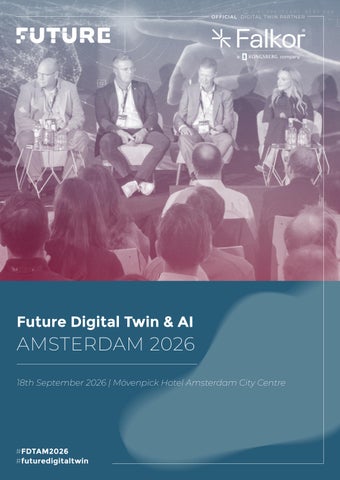
Future Digital Twin & AI
AMSTERDAM 2026 18th September 2026 | Mövenpick Hotel Amsterdam City Centre
#FDTAM2026 #futuredigitaltwin
Foreword by ADAM SOROKA I
t was a pleasure to welcome colleagues f rom
and effective human oversight. Understanding
across the energy and industrial sectors to
uncertainty, knowing when to intervene and
Future Digital Twin & AI Amsterdam 2026. Held
establishing who is responsible for decisions are
in collaboration with Shell, this year’s conference
essential to building confidence in these systems.
brought together industry leaders and technology specialists to share experiences, challenge
The discussions also reinforced the importance
assumptions and explore how AI and digital twins
of people. Successful transformation depends
can deliver lasting operational value.
on leadership, workforce development and collaboration across teams. Engineering knowledge
A central question throughout the day was
and operational experience remain vital, supported
how organisations can move beyond individual
by the skills and culture needed to make new
pilots and apply these technologies at scale. The
technologies part of everyday working practices
presentations and panel discussions explored the foundations needed to make this possible: trusted
For me, one of the most valuable aspects of the
data, common standards, interoperable systems
conference was the exchange between participants.
and a clear understanding of the operational
Bringing operators, technology providers and
challenges being addressed.
industry specialists together allowed colleagues to learn f rom shared challenges, consider different
From agentic AI and autonomous operations to
perspectives and build relationships that extend
physics-informed AI and offshore digital twins, the
beyond the event.
programme connected emerging technologies with practical industrial applications. Speakers
My thanks go to Shell, our advisory board, speakers,
explored their use across the asset lifecycle,
sponsors, exhibitors and everyone who joined us in
alongside the challenges of implementation,
Amsterdam. I hope this report, together with the
adoption and measuring return on investment.
presentation videos and audio recordings, offers useful insights to take back to your teams and helps inform
Governance and accountability were recurring
the next steps in your digital transformation journey.
themes. As AI becomes more closely integrated into industrial workflows, organisations need
Adam Soroka
clear decision boundaries, appropriate controls
CEO, Cavendish Group International
#FDTAM2026 #futuredigitaltwin
2
O F F IC IA L D I GI TA L TWI N PA RTN E R
Press Release
FUTURE DIGITAL TWIN & AI EVENT PROVIDES FORUM FOR DYNAMIC DEBATE The third annual Future Digital Twin & AI conference,
speakers f rom Shell, Falkor, Siemens, ExxonMobil,
held in Amsterdam on 18 September, played host
Petrobras, DNV, Enablon, Radix, VEERUM, Hazid
to a record number of speakers and delegates,
Technologies and many more.
participating in sessions that reflected the energy industry’s intensifying efforts to meet the challenges
Understandably, placing secure guardrails around
thrown up by the rapid evolution of artificial
AI in the energy sector was a hot topic at this year’s
intelligence.
event, given concerns voiced recently by big tech firms over their ability to keep their AI models
The conference, organised by Cavendish Group
contained.
International in collaboration with Shell, moved from its previous home at Shell’s Energy Transition
Thoughts were also shared on other key themes,
Campus Amsterdam to the Mövenpick Hotel in
such as ensuring interoperability of digital twins and
Amsterdam city centre to cater for the extra demand
other technology across and between organisations,
from those keen to hear from industry leaders
harnessing the benefits of AI while retaining high
and take advantage of the extensive networking
operational safety levels in the industry, and bringing
opportunities on offer.
the workforce along on a journey that involves radical change to working practices.
Rapid advances in AI capabilities fuelled much high level debate, weighing up the f resh opportunities
Adam Soroka, CEO of Cavendish Group and Future
opening up, along with the challenges involved
Events, highlighted the benefits of the collaborative
in implementing technologies that are constantly
environment provided by the conference.
being improved in order to make them future-proof. “Speaking to operators and companies, you discover Leaders charged with surmounting these challenges
they have a lot of the same aspirations and problems
from across the industry provided valuable insights,
around AI, so it’s great that events like this can get
including major operators, energy services providers,
everyone in a room to understand pain points, share
AI solutions developers, and industry associations.
successes and also to be inspired by each other,” he
Among those sharing their knowledge on stage were
said.
3
Press Release
Mike Ioannou, GM Global Digital & Technology Programs, at Shell underscored the value of the event at a time of rapid change in the industry. “Implementing AI leaves you with all sorts of tough choices about where you spend your time and money. The fantastic thing about this event is that it provides a great opportunity to try and work out what we should do about those challenges and use all the brain power in the room to come to our own conclusions about where we should go with them,” he said. Shane McArdle, CEO of Falkor, highlighted the role of the event in fostering collaboration across the industry. “Future Digital Twin & AI remains one of the most important forums for honest conversations about where our industry is heading. The Amsterdam edition stood out for a shared recognition that AI delivers the most value when it is grounded in industrial context, deployed in a safe and sensible way, and embedded in the way people work. The opportunity for our industry is enormous – it will be realised through technology, yes, but also through collaboration and execution,” he said.
#FDTAM2026 #futuredigitaltwin
4
O F F IC IA L D I GI TA L TWI N PA RTN E R
PANELLISTS Here’s what some of the experts said at Future Digital Twin and AI Amsterdam 2026:
MIKE IOANNOU GM Global Digital & Technology Programs, Shell ‘‘Even a year ago, I would never have predicted we could use LLMs to work effectively to simplify and
MEAGHAN SNETHLAGE
streamline more complex data layers, but here we
VP, Business Development, VEERUM
are, doing it.”
“As an industry, we have proven we can build a digital twin and the use it to fundamentally change the way an organization operates.”
JOE MCDONALD CEO, Hazid Technologies:
PEDRO ALCÂNTARA
“Adopting AI is like hiking; you can only go as
EVP & CRO, Falkor
fast as the slowest person, so we need to think
“We should move the boundary between decision-
how do we enable that slowest person to keep
making by humans and AI only where the evidence
to the pace.”
supports it.”
THOMAS SCHOCH Technical Lead Engineer, Digital Products & Solutions, Siemens
AJISH VARGHESE
Energy
Technology Lead, Harbour Energy:
“Having a co-creation process in place with
“The better the AI is tuned to how your company
customers to show greater interoperability is
functions and the insights you need to derive, the
a win-win situation.”
better the output you can get f rom them. This will probably get easier as AI models improve.”
5
STATISTICS
570+
23
Registered delegates
178
Organisations
38
Speakers
Sessions
76% Likely to attend event again
77% Rated the usefulness of the event as excellent or good
94% Would recommend the event to others
Company Activity
33%
21%
16%
Operators
Technology Companies
Independent Oil and Gas Companies
Job Function
20%
9%
Information Technology
Business Development
#FDTAM2026 #futuredigitaltwin
6
19% Engineering
O F F IC IA L D I GI TA L TWI N PA RTN E R
Key TAKEAWAYS Rapid LLM advances create both opportunities and challenges The sophistication of large language models is improving exponentially over time. That is opening up exciting new horizons for innovators developing digital twins and other AI-driven processes in the energy industry As Mike Ioannou, GM Global Digital & Technology Programs at Shell, told delegates: “We underestimated the pace of change with large language models in the last 18 months. Even a year ago, I would never have predicted we could use LLMsto work effectively to simplify and streamline more complex data layers, but here we are, doing it.” But he pointed out these advances are also highlighting the nature of challenges still to be overcome, especially around data quality. “Our experts can organize data so that LLMs can read it effectively and traverse it. But that also means your data quality requirements go on steroids. In the past, you couldn’t see all those data quality failures, but the LLM finds them. That’s both a curse, because you need to go do something about it, but it’s also an amazing gift, because it means we can look at actually semi-automating the data quality improvements that we couldn’t do before, ” Ioannou said.
Reliable data remains key to AI-driven innovations: getting it needs teamwork Reliable data is more important than having perfect data. That’s why pooling human resources within and between organisations is essential to the development of AI-driven digital twins. Shane McArdle, CEO, of digital twin tech firm Falkor, told the conference: “When you have enough people working on a similar data set, you can effectively crowdsource quality. So, instead of having small teams inside organisations trying to fix a problem by searching for a needle in a haystack, a joined-up approach can pretty much serve that needle up to them.” Italo Dourado Affonso, Digital Asset Maintenance, Petrobras underscored the importance of collaboration. “Whenever we feed data into LLMs, we need to bring the data owners together to help build how that data is consumed. You need a proper business process so that specialised agents can combined into a multi-agent infrastructure to answer more complex questions,” he said. In a discussion on the practical application of AI, Ajish Varghese, Technology Lead at Harbour Energy, noted that organisations do not need a large team to take advantage of LLMs and other AI technologies. “You can still get a lot of usefulness out of LLMs without perfect data, but obviously, the better the AI is tuned to how your company functions and the insights you need to derive, the better output you can get from them. This will probably get easier with time, as the AI models improve,” he said.
7
Key TAKEAWAYS Data access must improve, while remaining tightly controlled Recent high-profile system hacks involving global AI firms have underscored the dangers of exposing organisational data to poorly secured AI models. This is a real concern for the energy industry, given the sensitivity of proprietary data accessed as part of efforts to improve data sharing. Falkor’s McArdle said: “It’s less about the data itself and more about who can access it, and where. You need real rigour around permissions so access is locked down very tightly, while every piece of data can still be audited all the way back to its root.”
Trust may be more of a bottleneck to scaling than data quality AI advances are enabling the industry to extract value from imperfect datasets and resolve data issues more efficiently. But getting agreement on the data models remains a challenge. Tomasz Wiktorski, Principal Program Engineer, Future Data Operations, at Aker BP told delegates: “Data quality used to be the big challenge two or three years ago. Today, the harder question is who owns the fix, and who needs to be in the room to agree on the data model we’re aiming for. Generative AI allows us to implement changes very quickly once that agreement is in place. The bottleneck has shifted from technology to alignment. Technology now scales faster than organizational agreement.”
Trustworthy AI is not AI that never fails AI doesn’t need to provide perfect results to be useful, but it does need to be carefully monitored and contained, as Thomas Spatzier, Head of Platform Scaling & AI, Siemens Energy, told attendees. “Trustworthy AI is not AI that never fails. AI is based on mathematics and probabilities, so it will sometimes fail. But it has to have explicit boundaries. You have to be able to see what AI is doing and also contain the behaviour to limit the blast radius if necessary. Applications of AI are developed in iterative circles, so the whole lifecycle process of AI-based solutions has to be built in a proper way, and a common platform is essential for making this scale across use cases, environments and vendors,” he said.
#FDTAM2026 #futuredigitaltwin
8
O F F IC IA L D I GI TA L TWI N PA RTN E R
AI can be combined with well-understood models to boost trust Applying AI to problem solving for processes in facilities such as petrochemicals plants produces probabilistic answers which differ over time, and that raises trust issues. But keeping humans in the loop, who can then input these findings into more deterministic and well-understood models, such as simulations, can boost confidence in the outcome. Falkor’s Shane McArdle said: “You can route probabilistic models back through deterministic models. That gives you the speed, breadth of knowledge and reasoning of the probabilistic models, with the more constrained, slower deterministic models our industry knows very well validating that output and putting guardrails around it. The result is a hybrid approach that’s still very fast, but also robust enough to trust.”
AI can make decisions, but humans should be accountable for outcomes Trust in decisions made by AI is growing in some areas of the energy industry, allowing for greater autonomy, but people must be held responsible for the outcomes. “Where I see us going is the machine will make the decision, but we will always have a human being that is accountable for the outcome. We will never automate to a degree where everybody puts their hands up in the air and say it wasn’t me, it was the machine. That will not happen, but I’m very confident that we will allow the machine to make the decisions,” one technology leader at a supermajor told the conference.
Shifting the line between human and AI-led decision-making needs caution The prospect of fully autonomous AI-driven processes across the energy industry has considerable appeal, but as many speakers cautioned, it is a big step. An AI-based prediction can be wrong, but a human in the loop can catch it and make the final decision. Autonomous operations, on the other hand, act in real time in the physical world – if an action is wrong, your assets could be severely impacted. Joe McDonald, CEO of Hazid Technologies, told delegates that trust and effectiveness rather than autonomy for its own sake should be the objectives.
9
Key TAKEAWAYS “Autonomy is not a goal, it is an outcome of trust. Once a data layer is trusted, once the systems that are applying information intelligence to that data layer are trusted and the final button push along that chain is trusted, then autonomy is achieved,” he said. Pedro Alcantara, EVP & CRO, Falkor, said: “We will still see more decisions made by agents over time – that direction feels inevitable. But we will not get there by requiring human approval for every recommendation forever, and neither can we remove people before we trust the AI systems. We should move the boundary only where the evidence supports it.”
AI governance continues to evolve Rules governing AI is all areas of life are proving hard to develop and agree on, and the energy industry is no exception, even if progress is being made. Lars Meloe, Principal Consultant, Digital Trust Venture, Energy Systems at DNV said: “We help the industry with a suite of best practices enabling trust in digital twins, AI, data quality, cyber and more, while international standards are under development in a detailed way.” He commended the Norwegian authorities for encouraging the industry to come together to discuss this topic and develop regulation that is specific enough to apply to safe use of AI solutions within the sector.
Adopting AI across an organisation is a complex process Speakers stressed the challenge facing companies in accommodating the needs of people and departments with varying capacities to embrace AI, with the risk that the overall pace of adoption will be determined by the pace of the slowest. The challenge now is how to allow AI innovators within organisations to forge ahead, while still bringing along those facing difficulties in adapting. “It’s like hiking; you can only go as fast as the slowest person, so we need to think how do we enable that slowest person to keep to the pace, ” Hazid’s Joe McDonald said.
#FDTAM2026 #futuredigitaltwin
10
O F F IC IA L D I GI TA L TWI N PA RTN E R
Key TAKEAWAYS Scaling digital twins requires a holistic approach Digital twin deployment will only be successful when tackled in the round, Meaghan Snethlage, VP of Business Development at VEERUM told the event. “As an industry, we have proven we can build a digital twin and the use it to fundamentally change the way an organization operates. But the success of those programmes is dependent on repeatable architecture, measurable workflows, interoperability, and using tools or platforms that become easier to implement as you add on more facilities or programmes or projects,” she said.
Real interoperability requires close collaboration Thomas Schoch, Head of Technology and Innovation at Siemens Energy told the conference that to achieve system interoperability between organisations, a solution needs to be flexible and open, rather than creating a vendor lock-in. Overcoming concerns within companies over sharing IP or knowledge in this way requires a cooperative approach. “My experience is that having a co-creation process in place with customers to show greater interoperability is a win-win situation. This will then supersede the concerns and bring value in future,” he said.
Interoperability means more than data sharing Interoperability needs data sharing within or across organisations, but it also requires the ability to leverage use cases on top of a digital twin. That can be a particular challenge for larger companies with multiple production facilities, that require use cases working seamlessly across all plants, even if the underlying technology might be different, one head of a leading engineering firm told the event. “You need to have that industry standard interoperability, but also, on top of that, the data models and so on that you build into your digital twin layer should be interoperable with business processes that might vary from location to location,” he said.
11
Future Digital Twin TESTIMONIALS
“Future Digital Twin and AI in Amsterdam provided insights and opportunities for collaboration across operators, suppliers and vendors on AI and how we are all working to
“Future Digital Twin & AI 2026 brought
achieve business value from this technology
together an impressive mix of industry
with such great potential and equal risk. In
leaders and practitioners for open,
heavy industry, we must consider the right
thought-provoking discussions. I particularly
approach for both the technology we build
appreciated the focus on how AI must be
and the governance we set up around it. This
grounded in a human-governed semantic
event opened up real conversations about how
foundation, recognising the difference
we are all tackling this challenge and was well
between deterministic engineering
worth the time.”
information and the probabilistic nature of large language models,
Stephanie Goseine-Minderhoud
especially in process safety-critical
AI Transformation Change Lead,
environments.”
LyondellBasell
Johan Immerzeel, Principal Technical Expert, Upstream Production Optimisation & Surveillance, Shell
“I think the programme was well structured, moving f rom the foundation to integration. The balance between panel discussions and individual presentations made the day
“The Future Digital Twin & AI Amsterdam
quite enjoyable, and the selection of topics
2026 event delivered a highly relevant and
felt highly relevant to me.As expected
well-crafted programme exploring the
f rom an event hosted in Amsterdam, the
latest developments in AI and digital twin
participation of people from different
technologies. As a panellist and attendee,
locations and operators added an
I particularly valued the opportunity to
international dimension, increasing
engage with an impressive community of
the value of the global discussions and
industry leaders and technology innovators
brainstorming.Great event! I would certainly
on the ever-expanding possibilities of AI,
consider joining future editions as well..”
as well as the shared challenges of scaling solutions, strengthening governance, and
Jorge J. Buendia, Global Digital
delivering transformative outcomes..”
Transformation and AI Manager
Ajish Varghese Technology Lead, Harbour Energy
#FDTAM2026 #futuredigitaltwin
12
O F F IC IA L D I GI TA L TWI N PA RTN E R
“Awareness is growing in all parts of AI usage in the industry. The conference gave a very good overview related to AI maturity in the sector. Added value is key, technology development is another, and building trust and governance into the mix is moving up the ladder of importance. Lots of nice people
“The Future Digital Twin & AI Conference
to meet and discuss with, in a mix of new
provided an excellent platform to discuss the
friends, old f riends and business partners.
practical challenges and opportunities around
Cross-industry collaboration is still key;
Digital Twins, Industrial AI, interoperability
no one is enabling safe use of AI alone.”
and organisational transformation. The quality of both the programme and participants,
Lars Meloe
combined with representatives from leading
Principal Consultant, DNV
industrial organisations, created highly valuable discussions and networking opportunities.It was a pleasure to be part of the event and contribute through both a breakout session and a panel discussion.”
“In my opinion, the Future Digital Twin &
Bartlomiej Ahmida
AI conference in Amsterdam had a great
Marketing Manager, GDM Digital Integration
mix of topics, both for presentations and
Marketing Intelligence
panels. The presentation format with only 15 minutes was really good because it kept people focused on the main message and made it exciting for the audience to stay tuned. Also a really great networking opportunity. I’m really glad that I could join the event.” Thomas Spatzier Head of Platform “The 2026 Future Digital Twin and AI
Scaling & AI, Siemens Energy
conference was once again among the year’s most valuable digital oil and gas events. Its highly engaging panel sessions, insightful thought-leadership presentations, and a well-balanced mix of operators and vendors clearly explain why
“Future Digital Twin & AI Amsterdam
the event has doubled in size. Most valuable
continues to evolve as a genuinely valuable
of all, however, is the direct engagement
gathering for the industry. This year’s
among participants, which enables an
edition brought together a strong line-up
unrivalled exchange of insights..”
of senior leaders from across the energy and industrial sector, and the conversations, especially on governance and
Dr. Oscar Abbink
accountability in AI-augmented enterprises,
Director of Global Energy Technology
were substantive, not promotional.
and Innovation at S&P Global Commodity
Well worth the time!” Ragnar Alstad Head of Oil & Gas, Digital, Webstep
13
Advisory Board ADVISORY BOARD Khaled Al Blooshi, VP, Digital Projects & Innovation, ADNOC Martin R. Gonzalez, PhD, Innovation & Technology Principal, bp Michael Hotaling, Executive Advisor, ExxonMobil Athicha Dhanormchitphong, Digital Realities Ecosystem Architect, ExxonMobil Ram Seetepalli, Director, Data & Analytics & Digital Innovation, Motiva Enterprises LLC Rolf Einar Saeter, Global Emerging Technology Lead, Shell Dr.Edmary Altamiranda, Business Transformational Technology & R and D Lead, Controls & Systems Engineering Aker BP Adam Williams, Senior Manager, Engineering Technology & Design, Motiva Enterprises LLC Justin Piwetz, Asset Management Lead, bp Seth Taylor, Digital Twin Advisor and Technical Manager, Chevron Shane McArdle, CEO, Falkor
#FDTAM2026 #futuredigitaltwin
14
O F F IC IA L D I GI TA L TWI N PA RTN E R
Speakers SPEAKERS Mesbah Khan, Data Innovation Manager, Shell Susan Burrell, PO Digital Twin, ERP & Data Foundations, Shell Arnold Hes, Process Control, Digital & Instrument Manager, Shell Michel Teughels, ExxonMobil Product Solutions, Transformation & Innovation, Process Operations Product Manager, ExxonMobil Italo Dourado Affonso, Digital Asset Maintenance, Petrobras Michael Hotaling, Global Technology Scouting & Ventures Advisor, ExxonMobil Mariann Forsberg, Digital Continuous Lead, Shell Stephanie Goseine-Minderhoud, AI Transformation Change Lead, LyondellBasell Ajish Varghese, Technology Lead, Harbour Energy Heike Busse, Global Head of People Strategy & Experience, E-ON Mikael Wallen, IT & Data Delivery Lead, AkerBp Jorge J. Buendia, Global Digital Transformation & AI Lead, BASF Jim Wilton, VP of Product & Marketing, VEERUM Rolf Einar Saeter, Global Emerging Technology Lead, Shell Shane McArdle, CEO, Falkor Dr. Michael Wiedau, Chairman of the Board, DEXPI Johan Immerzeel, Principal Technical Expert, Upstream Production Optimisation & Surveillance, Shell Pedro Alcantara, EVP & CRO, Falkor John De Koning, President Europe & Middle East, Radix Engineering Madalina Florean, Director of AI, Cadmatic Partha Pratim Dev, Venture Manager, Offshore Engineering Structure, Rosenxt Hermias Hendrikse, Global Industry Development Lead, Siemens Digital Industries Software Joe McDonald, CEO, Hazid Technologies Prashant Soni, CEO, VISCO Bartlomiej Ahmida, Marketing Manager, Digital Transformation, Endress + Hauser Group Lars Meloe, Principal Consultant, Digital Trust Venture, Energy Systems, DNV Christoph Siemer, Co-Founder & COO, Deeplify Berdiyar Saurbayev, Managing Principal, Energy Consulting, EPAM Shubham Rajvanshi, Executive Advisor, RIVE Thomas Schoch, Technical Lead Engineer, Digital Products & Solutions, Siemens Energy Matthias Boelke, Chairman, IDTA Ragnar Alstad, Head of Oil & Gas, Digital, Webstep Thomas Spatzier, Head of Platform Scaling & AI, Siemens Energy Calum Maclean, Projects Director, Marine Technical Limits Oscar Abbink, Ph.D., Director, Global Energy Technology Solutions, S&P Global Energy Paul Tours, Associate Director of Solutions Consultants, Wolter Kluwer Enablon Jagadish (Jag) Gattu, CEO & Founder, UptimeAI Arun Govind, Chief Product Officer, RIVE
15
Thank You to Our Sponsors Official Digital Twin Partner
Gold Sponsors
Silver Sponsors
#FDTAM2026 #futuredigitaltwin
16
Thank You to Our Sponsors Innovation Partner
Bronze Sponsor
Exhibitors
Upgrading your steam grid
17
Our Attending Companies 579 BV
Equans
Marine Technical Limits
Siemens Energy
Equinor
MAROSTICA ADV
Simply Interconnect
A
Esmerillon Export Control
McDermott
Simreka
ABN Amro
Consultancy & Training
Memorial University
SLB
Advario
Ethics & Compliance MC BV
Metyis - Adaptfy
Sopra Steria
AIS-Support
Evonik
MJ Legal
Stadtwerke München
Aker BP
ExxonMobil
MySep Pte Ltd
Stedin
Allseas
F
N
Stena Line
Alphbase
Falkor
NAM
Sunoco Amsterdam Terminal
Ampelmann
FenriSEC
Neste
B.V.
ANGARA Global
Fluor
NNPC
SYMOIL BV
Aramco
Friesland Campina
NRG PALLAS
Synergy Construction
Assai Software Services B.V.
Fugro
Avantium
Fyllo BV
O
T
OFI
TAAP
Aker Solutions
SteelTrace
B
G
Oman Airports
TAQA
Baker Hughes
Gas & Low Carbon
ONE-Dyas
Technip Energies
BASF
Go Wombat
OQ
TechnipFMC
Bearingpoint
Gradyent
Orion S.A.
Techx-Advisory
Bilfinger Engineering and
GRCA Consulting
Ørsted
Tenaz Energy
OTconnect
TenneT
Consultancy BeNe Bluewater Energy Services
H
bp
Halliburton
P
TGE Marine Gas Engineering GmbH
BPP
Harbour Energy
P&G
Think Future X.0
Braskem
Haskoning
Petrobras
TotalEnergies
Bureau Veritas
Hazid Technologies
Petrogas E&P Netherlands
TrueSight BV
Business Technology
Helin Data
ProcessMinded
tsukat
Organization (BTO)
Henkel Global Supply Chain
TU Delft
HES
R
C
Hitachi Energy
Radix
U
CADMATIC
Hochschule Bremerhaven
RDVS
UptimeAI
Capgemini Invent
Honeycomb Software
Repsol
Carbon Haven
Howden Thomassen
Rijksoverheid
V
CEGAL
Compressors B.V.
RIVE
Van Oord
Robert Walters
Vattenfall
I
Rodenburg-BI
VEERUM
ICC Netherlands
Rosenxt Creation Center GmbH
Velogy
D
IDTA
Royal IHC
Vermilion Energy Netherlands
DataSnipper
IE Chemicals
Ryce Consulting
Viqal
deeplify
Integrated Project Controls
DEKRA
Intelecy
S
VTTI
DEXPI e.V.
iPS
S&P Global
Vysus Group
Dexter Energy
Iv
SABIC
Chane Cognite
Visco Norway AS
DIMATE GmbH
Saipem
W
DNV
L
SBM Offshore
Weatherford
Dow
Leiden University
SBP Offshore
Webstep
Dutch Shipmasters Association
Linde
Screenpoint Medical
Westhove Energie
LTTS
Seaman Solutions
Wintershall Noordzee
E
Ludwig Maximilian University of
Semantum Oy
Wipro
E.ON SE
Munich
Senedutch
Wolters Kluwer Enablon
EBN
LV Energy
SES Satellites
Wonderful
Ecolab
LyondellBasell
SGSI BV
Worley
Endress+Hauser
Shell
Eneco
M
SHV Energy
X
ENI
M. Corals
SHVE
xclerate B.V.
EPAM
Maastricht University
Siemens
Xoxoday
#FDTAM2026 #futuredigitaltwin
18
O F F IC IA L D I GI TA L TWI N PA RTN E R