W.E.B. DU BOIS
STATUS OF (METRO) BLACK ATLANTA 2025

EDITED BY:
DR. JOSEPH L. JONES &
DR. NYKIA GREENE-YOUNG


Copyright (c) 2025 by W.E.B Du Bois Southern Center for Studies in Public Policy, Clark Atlanta University. Digitally published in Atlanta, Georgia, United States of America. All rights reserved. The opinions herein do not necessarily reflect those of Clark Atlanta University. The mention of specific products or services within this publication does not constitute or imply a recommendationor endorsement by Clark Atlanta University or the W.E.B. Du Bois Southern Center for Studies in Public Policy unless so explicitly stated. All trademarks,copyrights, and corporate logos revert to their respective owners. Aside from the downloadable copies for personal use, this document may only be reproduced, transmitted, sold, or displayed with prior written approval from the W.E.B. Du Bois Southern Center for Studies of Public Policy of Clark Atlanta University. For citation purposes, researchers and students should use the following format: Joseph Jones and Nykia Greene-Young. 2025 Status of (Metro) Black Atlanta. (Atlanta: W.E.B. Du Bois Southern Center for Studies in Public Policy, 2025 www.cauduboispolicycenter.org/sba2025
ExecutiveSummary NykiaGreene-Young
The Status of Black Atlanta 2025 (SBA 2025), produced by the W.E.B. Du Bois Southern Center for Studies in Public Policy at Clark Atlanta University, is a comprehensive study examining the critical issues facing Black communities in Atlanta. The report underscores the urgent need for policymakers, both in government and the private sector, to address these challenges effectively Historically, this study has focused on the city itself rather than the broader metropolitan region to provide an accurate and current assessment of Black Atlanta's condition in key areas such as education, employment, health, housing, and criminal justice.
Atlanta’s population has steadily grown, particularly in the metropolitan area, leading to significant shifts in demographics, economic structures, and community landscapes. Gentrification has played a major role in these shifts, displacing many Black residents to surrounding cities and counties. In response, the SBA 2025 report has expanded its scope beyond the city limits to include an overview of Black populations in 11 metro-area counties: Fulton, Fayette, Forsyth, Henry, Cherokee, Clayton, Cobb, DeKalb, Newton, Rockdale, Douglas, and Gwinnett In this report we have colloborated with Partnership for Southern Equity (PSE) to provide the data for surrounding Atlanta Metro counties. This colloboration with PSE allows for a broader understanding of regional trends and the need for a more comprehensive analysis of Black communities in the greater Atlanta area.
SBA 2025 provides an in-depth analysis of the 2024 election and its impact on Georgia’s political landscape, reaffirming metro Atlanta as a key Democratic stronghold. The report examines voter trends from the 2020 and 2024 elections across multiple metro Atlanta counties, concluding that despite a decline in registered voters, increased voter turnout in eight of the ten counties signals a highly engaged electorate This rise in participation highlights the effectiveness of voter mobilization efforts and the growing political significance of the region
A key focus of the report is reproductive justice and maternal health in Atlanta and the state. The findings highlight the lack of legislative action addressing the disproportionate challenges faced by Black women, particularly concerning maternal health and reproductive rights. The report underscores that as healthcare becomes increasingly unaffordable and access to contraception more restricted, reproductive justice for Black women is at risk. Furthermore, repressive state laws that criminalize certain aspects of reproductive healthcare exacerbate these challenges. The intersection of maternal health and environmental factors is also explored, revealing that deteriorating living conditions, workplace stress, and family dynamics contribute to severe physical and mental health declines among Black women in Atlanta and its metro areas
Atlanta has long been a focal point for economic inequality, with the Black population disproportionately affected. Despite the city's rich Black cultural heritage and economic contributions, income disparities and displacement persist. The report examines trends in Black outmigration from the city, driven by a combination of economic pressures and gentrification.
Atlanta also faces a severe affordable housing crisis, exacerbated by skyrocketing prices, housing shortages, and decades of policy-driven challenges The report finds that gentrification, urban development, and income inequality have intensified these issues. While the current city administration has made progress in expanding housing development, more efforts are needed to meet demand, preserve legacy residents, and ensure affordable housing for working- and middle-class communities.
Criminal justice remains a pressing issue in Atlanta. The report explores the city and state's "tough on crime" stance, which intensified after the 2020 uprisings following George Floyd’s death. One key area of analysis is the controversial investment in "Cop City," highlighting the significant financial backing and political support for increased policing while neglecting community-based safety initiatives.
Additionally, the report addresses the legal challenges faced by Fulton County District Attorney Fani Willis, particularly concerning her prosecution of Donald Trump. It finds that the legislative and institutional interference in her office exemplifies how the "get tough on crime" approach is selectively applied, often targeting those without substantial political or financial influence. These factors contribute to systemic disparities that negatively impact Black communities in metro Atlanta.
The W.E.B. Du Bois Southern Center for Studies in Public Policy at Clark Atlanta University is dedicated to interrogating, reframing, and developing public policy solutions to improve the quality of life for Black communities in the American South. SBA 2025 provides a detailed examination of Atlanta’s progress and challenges, offering critical insights into existing policies and the need for progressive, impactful reforms.
This report serves as a vital resource for Black residents of Atlanta and the surrounding metro area, equipping them with the knowledge needed to understand the effects of public policy on their communities and advocating for meaningful change.
2024MetroAtlantaElections
JosephLJones
Introduction
The 2024 election cycle marked another critical moment in Georgia’s political landscape, particularly for African American communities in the metro Atlanta area. Long regarded as a hub for Black political power, Atlanta once again proved pivotal in shaping electoral outcomes, just as it did in 2020 when it played a key role in electing two Democratic Senators and shifting the balance of power in Congress. With its large Black population and reputation as a stronghold of Black political influence, the region became a focal point for both Trump and Harris, who dedicated significant time to courting these voters. This analysis focuses on voter trends from both the 2020 and 2024 elections across several metro Atlanta counties, centering on the African American vote and its influence on the region’s political dynamics. This examination will highlight how voter turnout, shifts in party support, and the changing demographic landscape in metro Atlanta could impact future elections.
African Americans in the Atlanta Metro
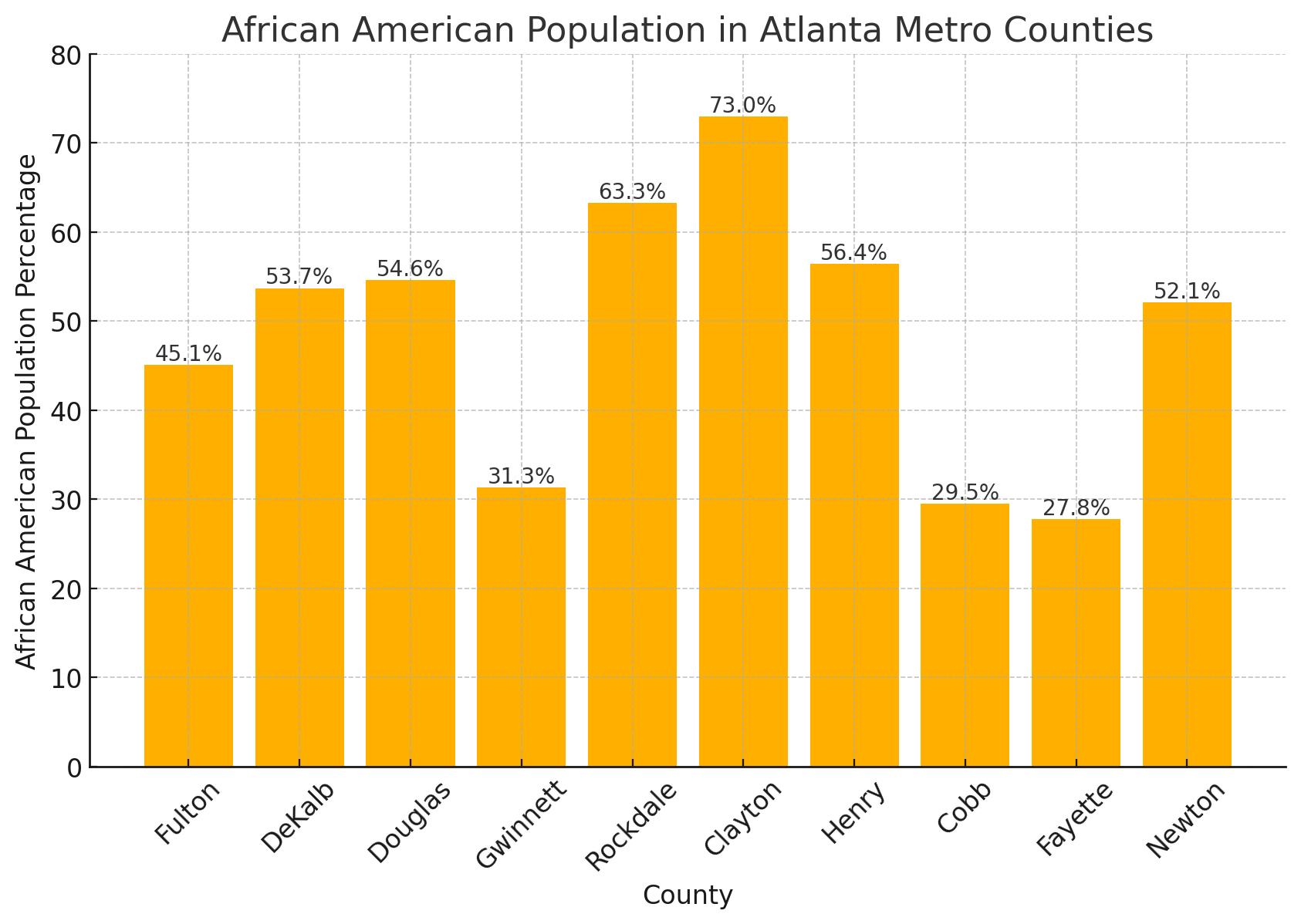
The African American population varies across metro Atlanta’s ten counties, shaping political trends and voter participation. Clayton County has the highest percentage (73.0%), making it a stronghold for Black political engagement and Democratic support. Rockdale (63.3%) and DeKalb (53.7%) also have majority-Black populations, reinforcing their Democratic lean. Douglas (54.6%), Henry (56.4%), Newton (52.1%), and Fulton (45.1%) have significant Black populations that influence elections. Cobb (29.5%) and Gwinnett (31.3%) remain politically competitive, while Fayette (27.8%) has the lowest percentage but is trending more Democratic. These demographics underscore Black voters’ central role in shaping regional elections.
Analysis of Voter Turnout by County in the 2020 and 2024 Elections
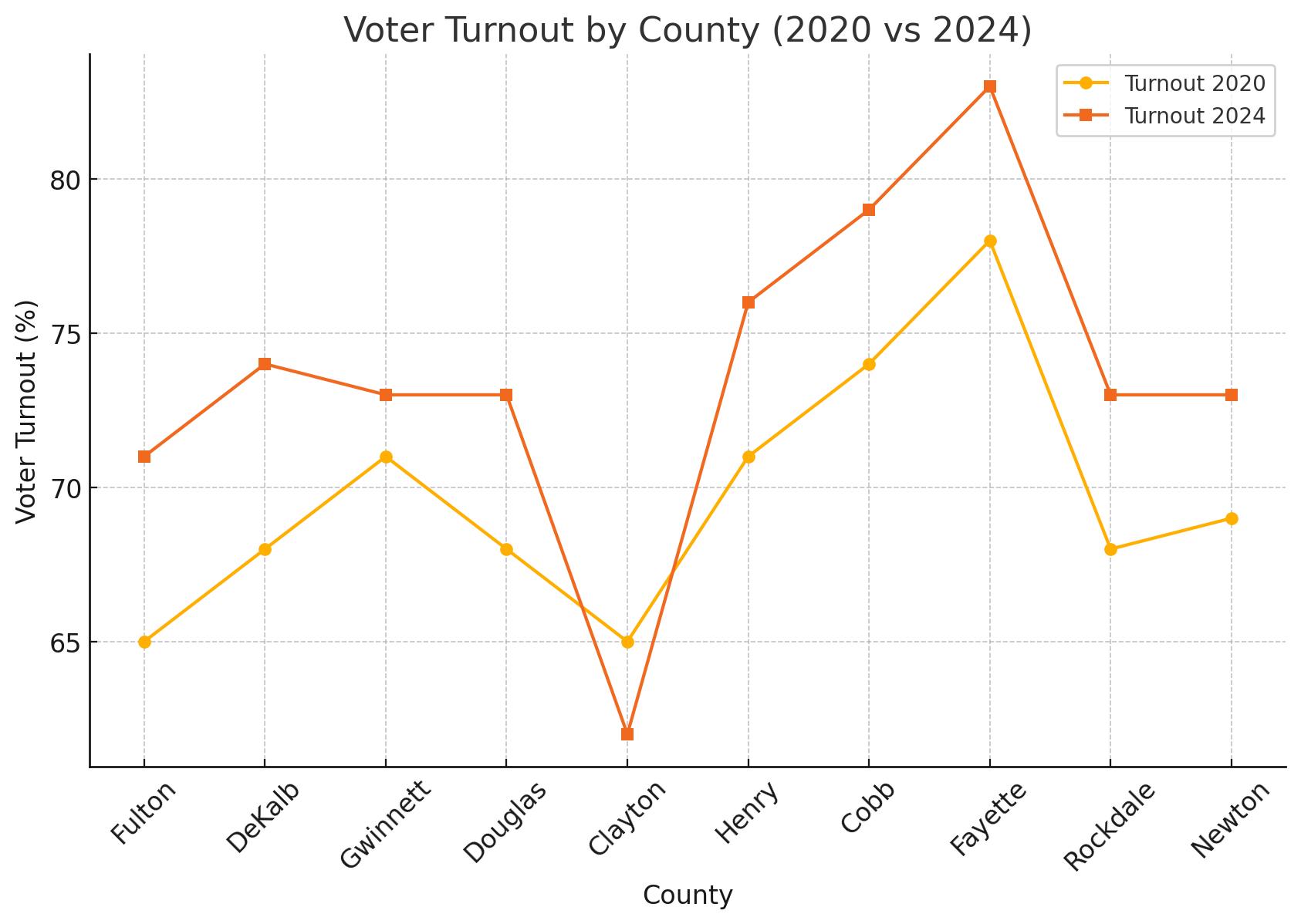
Voter turnout in metro Atlanta saw notable shifts between the 2020 and 2024 elections, with most counties experiencing increases while a few saw declines. These trends highlight evolving voter engagement, demographic changes, and the impact of political mobilization efforts across the region.
Fulton County, Georgia’s largest county, experienced an increase in turnout from 65% in 2020 to 71% in 2024, despite a decrease of 6% in registered voters. The total number of ballots cast grew by 2%, suggesting strong mobilization efforts despite a shrinking electorate. Similarly, DeKalb County’s turnout increased from 68% to 74%, though the number of ballots cast declined by about 1% due to an 8% drop in registered voters. This suggests that those who remained registered were more engaged in the election process.
Other counties also saw notable increases in turnout. Gwinnett County rose from 71% to 73%, with ballots cast increasing by 2%, reflecting sustained political interest in one of Georgia’s most diverse counties. Douglas County saw turnout climb from 68% to 73%, even as registered voters declined by 4%, indicating a more engaged electorate in 2024. Henry County had one of the most significant increases, jumping from 71% to 76%, with ballots cast growing by nearly 6%, reinforcing the county’s growing political significance.
Cobb County also saw a strong increase, rising from 74% in 2020 to 79% in 2024, with ballots cast increasing by 2%, despite a 4% decline in registered voters. Fayette County had one of the highest turnout rates in the metro area, climbing from 78% to 83%, with ballots cast increasing by 4%, reflecting high civic engagement among its suburban population. Rockdale and Newton counties followed similar trends, with Rockdale’s turnout rising from 68% to 73% and Newton’s from 69% to 73%, both showing a more engaged electorate.
In contrast, Clayton County was the only metro county where turnout declined, dropping from 65% to 62%. While the number of ballots cast remained steady, the county saw a 5% decline in registered voters, suggesting either voter apathy or reduced mobilization efforts in one of Georgia’s most Democratic-leaning counties.
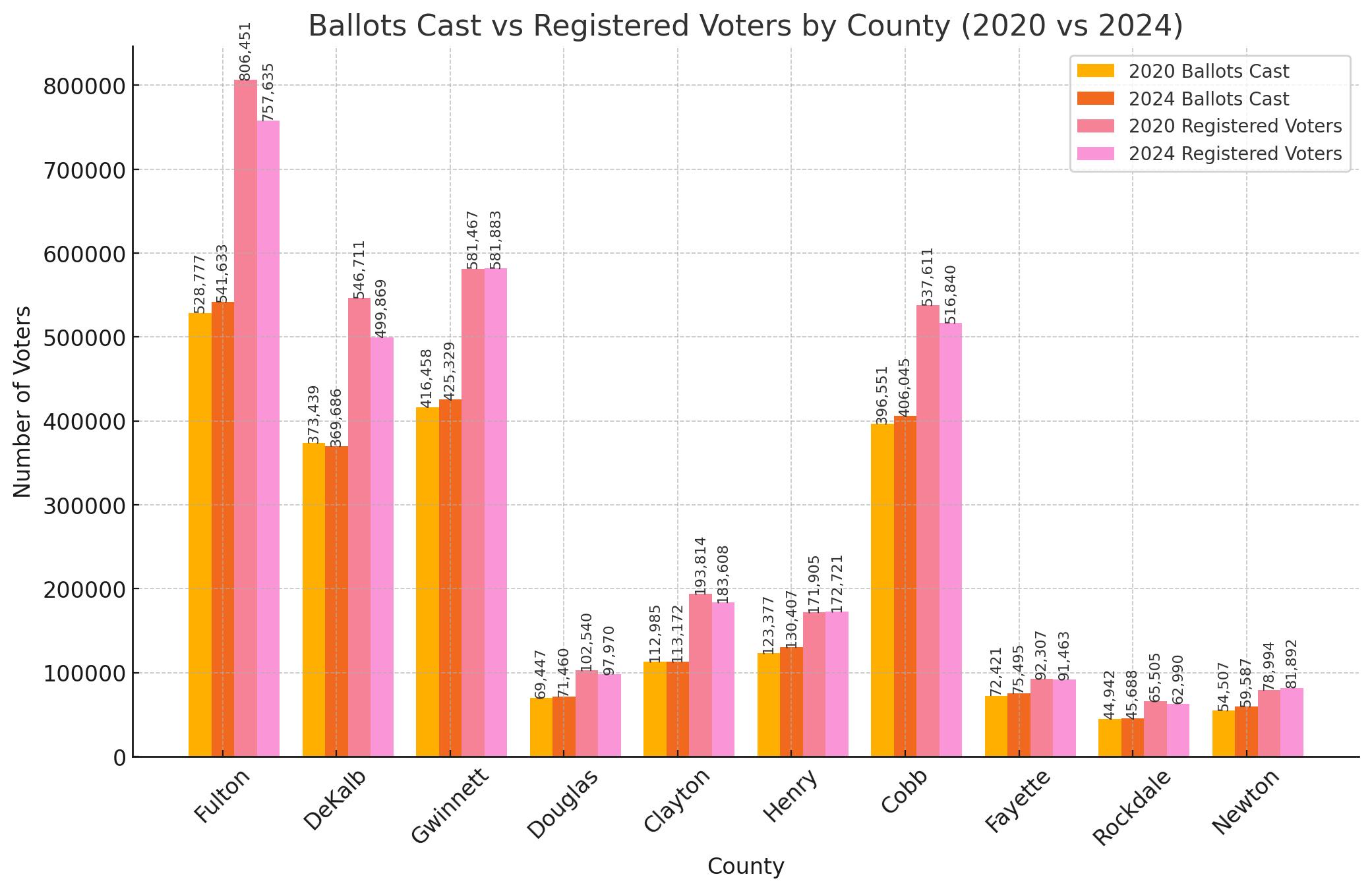
The chart comparing ballots cast versus registered voters across ten metro Atlanta counties for the 2020 and 2024 elections reveals significant trends in voter engagement. While most counties experienced a decline in registered voters between the two elections, the number of ballots cast either remained stable or increased This indicates a higher turnout rate and suggests more effective voter mobilization efforts in 2024.
A notable trend across nearly all counties is the decline in registered voters from 2020 to 2024. Fulton County, for instance, saw a drop from 806,451 registered voters in 2020 to 757,635 in 2024, a reduction of nearly 50,000 voters Similarly, DeKalb County lost about 47,000 registered voters, while Clayton County saw a decline of over 10,000 voters. Other counties, including Douglas, Rockdale, and Cobb, also experienced a decrease in voter registration. This could be attributed to factors such as changes in voter roll maintenance, population shifts, or barriers to voter registration.
Despite this decline, many counties witnessed an increase in ballots cast. In Fulton County, ballots cast increased from 528,777 in 2020 to 541,633 in 2024, meaning more people voted despite fewer registered voters. This suggests that voter participation was higher, potentially driven by increased voter awareness, strong political mobilization efforts, or more compelling election issues.
Counties such as Cobb, Henry, and Fayette saw significant jumps in turnout. Cobb County saw an increase in ballots cast from 396,551 in 2020 to 406,045 in 2024, despite a decline in registered voters. Similarly, Henry County saw an increase in ballots cast from 123,377 to 130,407, while Fayette County rose from 72,421 to 75,495. These numbers suggest that voter engagement efforts were effective in these areas, potentially fueled by changes in demographics and political interest.
While most counties experienced increased turnout, Clayton County was an exception, showing a slight decline in both ballots cast and registered voters. In 2020, 112,985 ballots were cast, but in 2024, that number slightly increased to 113,172, despite a reduction in registered voters. However, this did not translate into a significant increase in turnout percentage, indicating possible voter disengagement in the county.
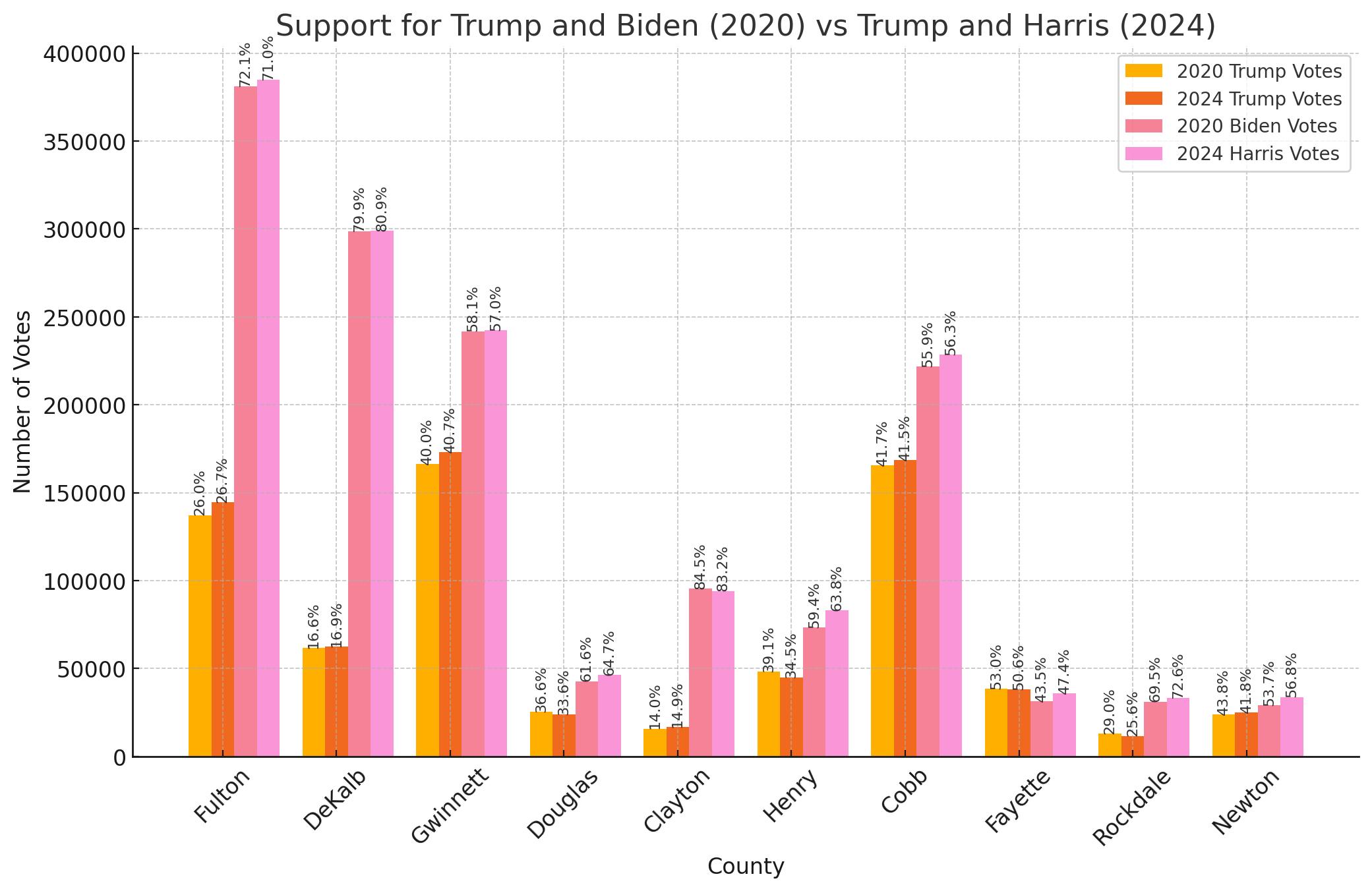
The 2024 presidential election in metro Atlanta reflected both continuity and subtle shifts in voter preferences compared to 2020. While Kamala Harris maintained strong Democratic support across most counties, there were slight declines in some areas. Donald Trump, on the other hand, made small gains in certain counties while losing ground in others, illustrating the ongoing political evolution of the region.
Fulton County, Georgia’s most populous and a Democratic stronghold, remained reliably blue, though Harris experienced a marginal drop-in support compared to Biden in 2020. Trump saw a slight increase in his vote share, but the overall landscape remained unchanged, with Democrats firmly in control. Similarly, in DeKalb County, another Democratic base, there was virtually no movement in voter preferences. Republican support remained unchanged from 2020, while Harris maintained nearly identical backing to Biden, reinforcing the county’s status as a Democratic bastion.
In Gwinnett County, there was a modest shift towards Republicans, with Trump slightly increasing his support while Harris saw a small decline compared to Biden’s performance. This suggests that while the county continues to lean Democratic, some voters moved toward the Republican ticket. Conversely, Douglas County experienced a reverse trend. Here, Harris outperformed Biden’s 2020 numbers, strengthening Democratic consolidation, while Trump lost support, signaling a continuing shift away from Republicans.
Clayton County, the most heavily African American county in metro Atlanta, remained overwhelmingly Democratic, though Harris experienced a minor dip compared to Biden. Trump, however, made a marginal gain, though it was not significant enough to alter the county’s deep blue identity. In contrast, Henry County showed one of the most notable Democratic gains in the region. Harris expanded her margin beyond Biden’s 2020 performance, while Trump’s support declined considerably. These changes reflect shifting demographics and an increasingly progressive electorate.
Cobb County, a historically competitive suburban county, remained in Democratic hands, with Harris slightly improving on Biden’s 2020 performance. Trump also saw a slight increase in his support, indicating that both parties remained highly engaged. Meanwhile, in Fayette County, a Republican stronghold, Harris made notable gains while Trump’s support declined. This marked one of the closest margins for a Democratic candidate in the county’s recent history, signaling a potential opening for Democrats in future elections.
Rockdale County continued trending Democratic, with Harris increasing her support while Trump’s backing diminished. Newton County saw both candidates gain in total votes, but Harris made a more significant jump, widening the Democratic edge. Trump’s percentage share declined slightly, reinforcing the broader trend of Democratic growth in this suburban area.
Conclusion
The 2024 election results in metro Atlanta reaffirm the region’s status as a key Democratic stronghold while also highlighting areas of continued political competition. Counties like DeKalb, Clayton, Rockdale, and Henry further solidified their Democratic leanings, with Harris maintaining or exceeding Biden’s 2020 performance. At the same time, Trump made slight gains in Gwinnett and Cobb but faced setbacks in others, such as Douglas and Rockdale. The narrowing margins in Fayette County underscore the region’s evolving political landscape, where demographic shifts and voter engagement efforts continue to shape electoral outcomes.
Despite a decline in registered voters in most metro Atlanta counties, increased voter turnout in eight of the ten counties signals a highly engaged electorate. The overall rise in participation, even amid registration declines, reflects the success of voter mobilization efforts and the region’s growing political significance. As metro Atlanta remains a decisive factor in Georgia’s elections, African Americans will continue to play a significant role in shaping elections in the years to come.
BlackMaternalHealth& ReproductiveJusticeinAtlanta
TiffanyWilliams
Introduction
The state of Black maternal health in Metro Atlanta is a pressing public health crisis shaped by systemic inequities in healthcare access, economic barriers, and legislative restrictions. Black women in Georgia, particularly those in Atlanta and surrounding counties, face disproportionate maternal mortality rates, severe health complications, and restricted reproductive choices due to state policies and environmental conditions. This essay explores the intersection of reproductive justice and environmental justice, emphasizing how these two frameworks are inherently linked in the lived experiences of Black women. As reproductive justice calls for the right to have children, not have children, and raise children in safe and sustainable communities, environmental justice ensures that these communities are free from pollutants, unsafe housing, and infrastructural neglect. Together, these movements are crucial to addressing the ongoing disparities in maternal and reproductive health among Black women in Metro Atlanta.
In a 2023 Georgia Delphi medical consensus, maternal health equity was defined as "the ultimate goal and ongoing process of ensuring optimal prenatal experiences and outcomes for everyone as the result of practices and policies free from interpersonal or structural bias that tackle current and historic injustices, social, structural, and political determinants of health impacting the prenatal period and life course." Despite this aspiration, Black maternal health in Metro Atlanta remains in crisis, with Black women being more than twice as likely to experience severe complications or die from pregnancy-related causes as white women.
A critical barrier to improving maternal health outcomes for Black women is access to care. Georgia has 159 counties, yet 82 of them lack OB/GYN facilities as of 2022. Even in Atlanta, which has the highest population density in the state, healthcare disparities persist due to the privatization of healthcare, cost barriers, and policies that restrict access to affordable care. Governor Brian Kemp’s Medicaid work requirements further exacerbate these challenges, disproportionately affecting Black women who struggle with economic instability, childcare, and employment security. Without consistent healthcare coverage, many Black women in Metro Atlanta are unable to receive adequate prenatal, birthing, or postpartum care, further contributing to negative health outcomes.
Legislation also plays a significant role in undermining reproductive justice for Black women in Metro Atlanta. Georgia’s restrictive abortion law, the Heartbeat Bill (HB 481), bans abortion after six weeks, before many women even realize they are pregnant. This legislation disproportionately harms Black women, who often face systemic barriers to early pregnancy detection and care. Advocacy groups argue that such policies reflect a broader agenda aimed at controlling reproductive autonomy, particularly in communities of color.
Reproductive justice extends beyond the right to abortion; it encompasses comprehensive maternal healthcare, access to contraception, and the ability to parent children in safe environments. In Metro Atlanta, Black women frequently navigate reproductive decisions within the context of economic precarity, inadequate healthcare, and systemic neglect. The criminalization of reproductive choices, along with barriers to contraception and maternal care, forces many Black women into precarious circumstances that endanger their health and well-being.
The fight for reproductive justice cannot be separated from environmental justice. Environmental factors such as air pollution, contaminated water, and exposure to industrial toxins disproportionately affect Black communities in Metro Atlanta. These environmental hazards contribute to adverse pregnancy outcomes, including preterm births, low birth weights, and fertility issues.
Decades of discriminatory zoning policies and economic disenfranchisement have placed many Black families in neighborhoods with high levels of pollution and poor infrastructure. For example, industrial pollution, chemical fires, and waste mismanagement in areas like Conyers and Atlanta’s Westside pose significant health risks to expectant mothers and young children. Additionally, Metro Atlanta has faced water crises and sewage contamination issues, further highlighting the environmental threats to Black maternal health. Reproductive justice demands that Black women have access to clean air, water, and safe living conditions as fundamental components of their right to reproductive autonomy.
Addressing the maternal health crisis in Metro Atlanta requires an integrated approach that combines healthcare reform, legislative advocacy, and environmental protections. Expanding Medicaid access, increasing the number of OB/GYN providers in underserved areas, and reversing restrictive abortion laws are essential steps in ensuring reproductive justice for Black women. Simultaneously, environmental regulations must be enforced to mitigate pollution and infrastructure failures that contribute to adverse maternal health outcomes.
Community-led initiatives, such as maternal health advocacy groups and environmental justice organizations, play a crucial role in pushing for policy changes and providing direct support to Black women. By centering the lived experiences of Black mothers and integrating reproductive and environmental justice frameworks, Metro Atlanta can take meaningful steps toward addressing the racial disparities in maternal health.
Conclusion
Black maternal health in Metro Atlanta is at the intersection of reproductive and environmental justice. Systemic barriers to healthcare access, restrictive reproductive policies, and environmental hazards have collectively created a crisis that disproportionately affects Black women. Ensuring that Black women can make reproductive choices in safe, healthy environments is not just a matter of personal freedom but a public health imperative. By advocating for policy changes, increasing access to quality healthcare, and addressing environmental injustices, we can move toward a future where Black women in Metro Atlanta can experience full reproductive autonomy and maternal health equity.
The continued failure to address these disparities exacerbates existing inequities and places Black women at further risk. Policies that promote access to comprehensive reproductive healthcare, protect Black communities from environmental degradation, and prioritize racial equity in maternal health are essential for lasting change. Lawmakers, healthcare professionals, and community advocates must work together to dismantle the structural barriers that contribute to maternal mortality and morbidity.
Ultimately, reproductive justice is about more than individual choice—it is about the collective well-being of Black women, their families, and their communities. The fight for reproductive and environmental justice in Metro Atlanta is a fight for dignity, autonomy, and the fundamental right to live in a society that values and protects Black life. Without decisive action, these injustices will persist, reinforcing a cycle of disparity that limits opportunities for generations to come. Therefore, it is incumbent upon policymakers, healthcare providers, and community organizations to commit to meaningful reforms that ensure Black women have the resources and protections they need to thrive. Only then can we achieve a future where reproductive and environmental justice intersect to support the full realization of Black maternal health equity.
2025SBAPolicyRecommendations
TheStateofBlackAtlanta(Metro)BlackMaternalHealthand EnvironmentalJustice
Policy should be drafted in partnership with county level government entities to created state funded program that address pregnancy and postpartum health risks of Black women patients.
Policy should be drafted to create research banks in partnership with county-based non-profit organizations providing services to Black expectant mothers and mothers of children up to age 3 regarding postpartum treatment in the mental and physical health spectrum.
Policy should be drafted to enforce industrial zoning governance and inform potential residents of the dangers of living in heavily industrialized spaces in Atlanta and the surrounding metro communities. This policy should also include annual reporting within industrialized zones that are readily available for access by residents. Manufacturing plants, labs, and chemical processing spaces should face more harsh penalties for creating hazardous environments within this same policy
Policy should be drafted to access the cleanliness of water and the revitalization of water sources within schools in Atlanta and the surrounding metro areas to ensure clean drinking water can be reintroduced into school water pipeline systems.
TamillHarris
Introduction
Atlanta has long been a beacon of Black excellence, culture, and economic opportunity From its role as the birthplace of the Civil Rights Movement to its emergence as the "Black Mecca," the city has been a hub of innovation, music, and entrepreneurship. At the 1995 Source Awards, Andre 3000 of OutKast famously declared, "The South got something to say," solidifying Atlanta’s place in the cultural mainstream. However, despite its legacy, Atlanta is experiencing a profound transformation driven by economic inequality and demographic shifts. Rising housing costs, income disparities, and urban renewal projects have forced many Black residents to leave the city, posing a risk to Atlanta’s distinct cultural identity This essay explores the impact of outmigration on Atlanta’s Black cultural landscape, tracing the historical context, current economic challenges, and the potential consequences of this shift.
Historically, Atlanta has been a city of resilience and reinvention. Following the Civil War, it became a major industrial center, and by the late 20th century, it had cemented itself as an international hub for travel and business. Black culture flourished in Atlanta, particularly from the 1970s through the 1990s, when Black residents constituted over 60% of the population This period saw the rise of Atlanta’s hip-hop scene, influential filmmakers, and a strong Black middle class
However, the forces of economic change have reshaped the city. White flight in the mid-20th century led to an increase in Black political power, but the 1996 Olympics marked the beginning of significant urban renewal projects that displaced many Black communities. Programs like HOPE VI led to the demolition of public housing projects without providing sufficient affordable alternatives, forcing many residents to relocate to suburban areas such as South DeKalb, South Fulton, and Clayton County. This trend continued through the early 2000s due to the housing crisis, and today, high living costs and gentrification continue to push Black residents out of Atlanta
Atlanta’s economic disparities have exacerbated the outmigration of Black residents. The median household income for White families is nearly three times higher than that of Black families. According to the Atlanta Civic Circle, the median wealth for White households is $238,355, while Black households hold a median wealth of just $5,180. This vast wealth gap means that rising home prices and rents disproportionately affect Black residents, making it difficult to remain in the city.
Currently, Atlanta’s median income is $77,655, while the median home price is $395,000. The cost of renting a one-bedroom apartment ranges from $1,500 to $1,800 per month, making housing increasingly unaffordable for many Black families. Mayor Andre Dickens has proposed a plan to create 20,000 housing units by 2026, but with only a small percentage set aside as affordable housing, the initiative is unlikely to address the full scope of the crisis.
As Atlanta’s Black population falls below 50%, the city risks losing the cultural vibrancy that has defined it for decades. Black artists, entrepreneurs, and community leaders have historically built Atlanta’s identity, turning struggle into creativity and resilience into economic opportunity. However, as longstanding Black communities disperse, the city’s cultural fabric is being diluted.
Similar shifts have occurred in other historically Black cities, such as Washington, D.C., where gentrification has transformed neighborhoods that once embodied Black cultural expression. Atlanta now faces the same challenge: balancing urban development with cultural preservation. The growing presence of White and other non-Black populations in historically Black neighborhoods raises concerns about the erasure of Black identity in areas that once thrived on community bonds and artistic collaboration.
The challenge ahead is ensuring that Atlanta remains a city where Black culture is not only recognized but actively preserved. This requires intentional policies that address economic disparities, promote affordable housing, and protect historically Black spaces. Instead of displacing Black communities, urban development should invest in them, fostering economic mobility and cultural sustainability.
Local government, businesses, and philanthropic organizations must collaborate to create inclusive development strategies that benefit all residents. Equitable economic opportunities, affordable housing initiatives, and cultural preservation efforts must be prioritized to ensure that the city’s Black cultural legacy endures.
Conclusion
Atlanta’s transformation is undeniable, but the city must confront the consequences of its economic and demographic shifts. The loss of Black residents due to rising costs and limited opportunities threatens the very essence of what has made Atlanta a cultural powerhouse. While new developments and economic growth bring prosperity, they must not come at the expense of the communities that built the city’s legacy.
To ensure that Atlanta remains a city where Black culture thrives, policymakers must adopt an inclusive approach that prioritizes cultural preservation and economic equity. This means implementing policies that prevent displacement, fostering Black homeownership, and investing in community programs that support Black artists and entrepreneurs. Without such efforts, Atlanta risks becoming another example of a city where economic development has erased the very culture that made it unique.
Moreover, the role of Black leadership and advocacy cannot be understated. Black community leaders, activists, and artists must continue to push for policies that protect and uplift their communities. Civic engagement, grassroots organizing, and strategic partnerships with local governments and private sector entities are essential in shaping the future of the city.
Atlanta’s cultural identity has always been rooted in resilience, creativity, and community. As the city moves forward, it must ensure that these values are not lost to gentrification and economic exclusion. Preserving Atlanta’s culture through equity and intentional development will not only sustain its legacy but also prove that Black culture is indispensable to the city’s success. The saying remains true: as Black culture goes, so goes Atlanta’s future. ,
2025 SBA Policy Recommendations
Cultural Outmigration: How Atlanta’s Income Inequality and Demographic Shift Impacts the City’s Culture
Return to the City should not be used as an initiative. For former residents and families who were displaced as a result of urban renewal, highway construction, HOPE VI, and gentrification, the city should make a pathway for them to return
Inclusionary Zoning with Cultural Retention Priorities, meaning developers in predominantly Black neighborhoods should be required to set aside space for said residents who return to the neighborhood or set aside space for legacy residents for this preferred housing
Protect cultural heritage. Designate areas like Oakland City, West End, Vine City, English Avenue, Southwest Atlanta, etc as Cultural Heritage Districts.
Wealth building opportunities that will prevent displacement or voluntary relocation.
IsAffordableHousingstilla challengeinAtlanta?
NykiaGreene-Young
Introduction
Atlanta, one of the fastest-growing cities in the United States, has long grappled with housing affordability challenges. Over the past few decades, a combination of rapid urban development, gentrification, and income inequality has made it increasingly difficult for many residents—particularly Black and low-income individuals—to afford housing within the city limits. The city's population growth, economic expansion, and new development projects have further exacerbated the shortage of affordable housing. While local leaders, including Mayor Andre Dickens, have implemented policies and programs to address these challenges, the housing crisis remains a persistent issue. This essay explores the key factors contributing to Atlanta's affordable housing crisis, the city's response, and the ongoing struggles faced by residents.
Between the 2010 and 2020 Census, Atlanta's metropolitan area saw an influx of over 80,000 residents, marking a population increase of more than 15 percent and bringing the total to six million. The region's employment base expanded by 5.4 percent since the onset of the COVID-19 pandemic, making it the fifth-largest job growth area in the nation. However, this economic expansion has not translated into accessible housing for all, particularly Black residents. The shortage of affordable housing has forced many legacy residents out of the city into surrounding counties where housing costs are more manageable.
According to the Bipartisan Policy Center, investments in Atlanta and surrounding suburbs have led to economic stimulation but have also contributed to rising housing costs. Mayor Dickens has co-chaired a bipartisan housing coalition advocating for federal policies to address the housing crisis, including a proposed $100 billion congressional fund to redevelop subsidized housing and $57 billion allocated to homelessness prevention efforts. Locally, his administration launched the Housing Help Center to support low-income and legacy residents, aiming to prevent displacement.
Gentrification, coupled with events such as the 1996 Olympic Games and increasing income inequality, has displaced thousands of longtime Atlanta residents. Many essential workers—teachers, firefighters, and police officers—can no longer afford to live in the city where they work.
According to the Atlanta Mission, Metro Atlanta is home to more than a quarter of Georgia’s homeless population, with an estimated 2,867 individuals experiencing homelessness in the city. The 2024 Point-in-Time Count revealed that homelessness rose by 7 percent compared to the previous year, largely due to rising rental costs. Alarmingly, Black individuals, who make up 43 percent of the city’s population, represented 86 percent of the homeless population. Many of these individuals are employed but unable to sustain the increasing cost of rent in Atlanta.
Mayor Dickens has taken steps to mitigate the crisis by securing 40 units of transitional housing for homeless individuals and committing to constructing 500 units of rapid housing. In December 2024, he unveiled additional housing units, reinforcing his administration’s commitment to providing shelter for the city's unhoused residents. Furthermore, the Mayor proposed a historic $60 million investment to build 700 affordable housing units by the end of 2025, including wraparound services for homeless individuals.
Despite efforts to expand affordable housing, development projects in Atlanta often prioritize luxury housing, contributing to displacement. The redevelopment of Centennial Yards, intended as a mixed-income residential area, initially included 60 affordable housing units. However, the developers backed out, opting to pay an $8.5 million penalty instead. While this penalty was redirected toward rebuilding homes for lower-income residents, the failure to include affordable units in Centennial Yards underscores a broader issue: large-scale developments often prioritize profit over equitable housing solutions.
Another controversial project is the redevelopment of the West End Mall, a historic community space, which will feature mixed-income housing, a hotel, and a medical office. While the development promises housing options, concerns remain about whether the new units will be affordable to longtime residents. Similarly, the Old Fourth Ward’s former Atlanta Medical Center site, located in an area where 31 percent of residents live in poverty, is slated for redevelopment, though access to affordable housing remains uncertain.
To combat housing inequities, the Atlanta City Council approved a $1.4 million revitalization plan for blighted properties on the city's west side. Many of these properties are foreclosures, and the city is using eminent domain to acquire and redevelop them. Additionally, Invest Atlanta announced the redevelopment of the former Atlanta Constitution building, which will provide nearly 200 below-marketrate rental units.
Recognizing the impact of predatory landlords, the city also introduced policies to hold property owners accountable for blighted housing. These policies include imposing property tax increases up to 25 times the normal rate on landlords who neglect their properties. Moreover, low-income renters facing uninhabitable living conditions have received assistance from the city, such as in the case of the Forrest Cove community. Following intervention from the Biden administration and the Department of Housing and Urban Development (HUD), 200 families were relocated after the property was deemed uninhabitable.
Conclusion
Atlanta’s affordable housing crisis remains a pressing issue despite concerted efforts by local government and advocacy groups. The city’s rapid growth, coupled with economic expansion and gentrification, has placed significant pressure on Black and low-income residents, forcing many out of their neighborhoods or into homelessness. While Mayor Dickens' administration has made strides in securing funding and implementing policies aimed at increasing affordable housing, systemic barriers persist.
Addressing the housing crisis requires a sustained, multi-pronged approach that includes stricter enforcement of affordable housing mandates, continued public investment in low-income housing, and stronger tenant protections. Additionally, urban planners and policymakers must work together to balance economic development with the preservation of affordable housing to ensure that displacement does not become an inevitable consequence of progress.
Collaboration with community organizations, nonprofits, and private developers is essential to creating sustainable housing solutions that benefit all residents. Atlanta's future depends on equitable housing policies that not only provide immediate relief but also establish long-term affordability. If the city can maintain its momentum and hold developers accountable for meeting affordable housing requirements, it can create a more inclusive urban environment that supports all residents—regardless of income level. Only through continued vigilance and innovation can Atlanta truly address its housing challenges and build a more equitable future.
2025 SBA Policy Recommendations
Is Affordable Housing still a challenge in Atlanta?
Policies to prevent displacement of residents.
Providing resources for affordable housing and partnering with employers and developing programs for employee assistance for housing.
Providing property tax exemptions.
Developing more supportive policy for home ownership. Create a pathway for legacy residents, particularly the middle-class, to return to the city through homeownership.
Minimize speculative real estate practices of developers and investors by capping the amount of land purchased by them around areas that are or will be revitalized by the federal, state, or local government.
Create a pathway to homeownership in surrounding areas for the Atlanta University Center and other colleges for students and faculty around each of the schools.
Improving tenant protections such as capping rent.
Prioritizing legacy residents within the city.
Creating retention plans for communities around the City to ensure they remain viable, affordable, livable and sustainable.
Atlanta’sBlackCommunities
CelesteWhite
Introduction
Crime and justice policies in the American South, particularly in Georgia, are shaped by unique sociopolitical realities that distinguish them from other regions. The "tough on crime" approach, which prioritizes public safety through punitive measures, has been central to legislative developments and political discourse in Metropolitan Atlanta. However, the interpretation and implementation of crime reduction strategies reveal disparities in their impact on Black communities. While statistical measures highlight crime fluctuations, these assessments often fail to account for broader systemic factors, including socioeconomic disparities and historical policing practices.
The intersection of crime policy, political decision-making, and public safety in Black communities is particularly evident in Atlanta’s recent developments, including the controversial "Cop City" project and legislative interventions that affect the prosecutorial discretion of district attorneys. This paper examines the implications of these policies on the well-being and safety of Black communities in Atlanta, with a focus on how legislative priorities shape crime narratives, policing strategies, and prosecutorial autonomy. The analysis underscores how financial investments in law enforcement and legislative interference in prosecutorial offices exacerbate systemic inequities rather than fostering genuine public safety.
The "Law and Order" Paradigm and Crime Measurement
The political rhetoric surrounding crime in Georgia, particularly in Metropolitan Atlanta, often relies on quantifiable measures such as crime rates and public sentiment surveys. The Federal Bureau of Investigation (FBI) compiles official crime statistics, while local and state reports track trends in violent and nonviolent offenses. Simultaneously, public perceptions of safety are assessed through surveys, capturing sentiments shaped by media narratives, personal experiences, and socio-political influences.
As Baumer and Rosenbaum (1980) suggest, public perceptions of crime are influenced by factors such as perceived neighborhood threats and behavioral adaptations. These perceptions, often detached from actual crime rates, contribute to policies that prioritize punitive measures rather than community-
centered solutions. In Metropolitan Atlanta, these dynamics have led to an aggressive "tough on crime" stance, disproportionately affecting Black communities and undermining historical resistance movements rooted in civil disobedience and activism.
"Cop City" and the Institutionalization of Aggressive Policing
One of the most contentious developments in Atlanta's crime policy landscape is the establishment of the Atlanta Public Safety Training Center, widely known as "Cop City." This initiative, heavily financed by the Atlanta Police Foundation and corporate donors, represents a significant expansion of law enforcement infrastructure. Situated in a predominantly Black neighborhood (Zone 6), the facility is emblematic of broader trends in urban policing that prioritize surveillance and militarization over community investment.
The financial backing for "Cop City" underscores the prioritization of law enforcement at the expense of community-based safety initiatives. The Georgia Less Crime Act Tax Credit (O.C.G.A 48-7-29.25 SB 361), which incentivizes individual and corporate contributions to police foundations, further entrenches this imbalance. The disparities in financial support for law enforcement versus community development highlight the systemic inequities embedded in Atlanta’s public safety policies.
Despite opposition from local residents and activists, the political and financial momentum behind "Cop City" remains strong. The implications for Black communities include increased surveillance, heightened police encounters, and a diminished sense of agency over public safety policies. These trends reflect a broader national pattern in which law enforcement expansion is prioritized over addressing root causes of crime, such as poverty, education disparities, and social inequality.
The "Get Tough on Crime" Agenda and Prosecutorial Independence
Beyond policing, Georgia’s legislative interventions in prosecutorial discretion further illustrate the "tough on crime" agenda’s impact on Black communities. The passage of Senate Bill 92 (SB 92) in 2023 established the Prosecuting Attorneys Qualifications Commission, a body with the authority to discipline, remove, or forcibly retire elected district attorneys. This move, widely seen as politically motivated, particularly targeted Fulton County District Attorney Fani Willis, who has been at the center of high-profile prosecutions, including the 2023 RICO indictment of Donald Trump and his associates.
The commission’s creation represents a significant departure from established legal oversight mechanisms, such as the Georgia Bar Association, which traditionally governs attorney conduct. By granting a politically appointed body the power to interfere in prosecutorial decisions, SB 92 undermines the independence of district attorneys and disrupts efforts to pursue justice impartially. The bill’s passage aligns with broader efforts to weaken progressive prosecution models that emphasize diversion programs and alternatives to incarceration.
SherryBoston,DistrictAttorneyforDeKalbCounty,highlightedtheimplicationsof prosecutorial interference in her decision to recuse her office from "Cop City" protester prosecutions Her stance underscores the increasing pressure on prosecutors to conform to punitive crime policies, even at the expense of legal integrity and public trust. The legislative targeting of prosecutors who advocate for criminal justice reform signals a broader attempt to consolidate political control over the judicial process, further marginalizing Black communities in the pursuitofjustice.
TheConsequencesforBlackCommunities
The intersection of aggressive policing policies and legislative overreach has profound implications for Black communities in Atlanta. The expansion of law enforcement infrastructure, coupled with efforts to curtail prosecutorial discretion, reflects a broader trend of prioritizing punitive measures over community-centered approaches to public safety. These policies reinforce historical patterns of racialized criminalization, disproportionately subjecting BlackAtlantanstosurveillance,arrest,andincarceration.
Moreover, the financial investments in policing contrast starkly with the underfunding of social services, education, and economic development initiatives. The emphasis on law enforcement expansion perpetuates cycles of povertyandcriminalization,ratherthanaddressingtherootcausesofcrime.Asa result, Black communities in Atlanta face heightened risks of police encounters, legalentanglements,andsystemicdisenfranchisement.
Conclusion
The examination of crime policies in Metropolitan Atlanta reveals a complex interplay between political priorities, legislative actions, and the lived realities of Black communities. The institutionalization of aggressive policing through projects like "Cop City," alongside legislative interference in prosecutorial discretion, underscores the persistence of racially inequitable approaches to publicsafety.
While policymakers justify these measures under the guise of crime reduction, their implementation disproportionately harms Black Atlantans, exacerbating historical injustices. The entrenchment of “tough on crime” policies diverts resources away from community-based solutions, reinforcing systemic disparities rather than fostering genuine public safety.
Moving forward, the challenge lies in advocating for policies that prioritize community well-being over punitive enforcement. This requires a shift in public discourse, legislative action that centers equity, and investments in social infrastructure that address the root causes of crime. By challenging the dominant narratives of law and order, Atlanta has an opportunity to reimagine public safety in a manner that genuinely serves its Black communities. Until then, the prevailing approach remains as burdensome as the crime it purports to combat.
2025 SBA Policy Recommendations
“Reconciling Law and Order and Public Safety for Black Metro Atlantans”
Legislative urgency
· The Georgia General Assembly must reject SB 528 Offenses Against Public Order and Safety. This bill proposes to re-categorize certain public protests as “domestic terrorism”. These public protests historically reflect First Amendment guarantees. The accused may be charged with felonies—crimes which are punishable by 1 or more years in jail/prison.
The Georgia General Assembly must develop legislation to remove use of Israeli Defense Forces in Atlanta Public Safety Training. The Georgia General Assembly should establish policy to ensure public interest of transparency by Public Safety philanthropic organizations.
Policy should include prevention of private and public funding for law enforcement training by Israeli Defense Forces.
· Public interests should be served by the creation of the Atlanta Public Safety Training Facility Oversight Commission.Those appointed to the commission should have residential addresses in metropolitan Atlanta OR a majority of appointees must have Zone 6 addresses.
Scope of the Commission’s authority, term limits, compensation etc. should be considered.
· Public interests should be served by the creation of the Atlanta Public Safety Training Facility Task Force. Responsibilities could include but not limited to 1) independent data collection and publication of arrest, 2) use of force, 3) patrol density/saturation, 3) evidence of Cop City leadership meetings with citizens, 4) documentation of citizen satisfaction.
Both Commission and Task Force budget funded by the Atlanta Public Safety Foundation (See below)
Legislative necessity
The Senate should introduce a bill requiring that a percentage of law enforcement investments from corporate foundations and philanthropic organizations be earmarked for diversion and evidenced based programs designed to prevent crime in marginalized Georgia communities – both rural and urban communities
·The Senate should introduce a bill preventing expansions or usage of further neighborhood properties or sites for simulations, practices, or additional training.
The Senate should introduce and promote a bill to protect the surrounding communities from daily operations of the Atlanta Public Safety Training Facility:
Noise ordinance (gunfire, explosions, police and fire sirens)
Environmental Casualties (Note: this is beyond the scope of the Criminal Justice focus, but is interdependent with environmental concerns.)
Water and soil contamination (MA)
Animal (Horse and dog) pollutants (feces, urine, diseases)
Office of District Attorney
Legislative
Urgency
Public interests require that the Senate introduce legislation requiring transparency and public access to investigations by Prosecutorial Oversight entity of Metro Atlanta District Attorneys.
The Senate must clarify distinctions of tasks between the July 2024 Prosecutorial Oversight entity and the existing Legal Ethics Committee.
Public interests require intentions to minimize redundancy of effort.
The Georgia General Assembly must establish support for prosecutorial discretion in the effort to minimize partisan micromanagement of the Office of the District Attorney.
Atlanta Metropolitan Area County Profiles
These county profiles were created by Partnership for Southern Equity's Research & Analytics team through the use of MySidewalk. Each data indicator includes information about its specific data source. Indicators were selected jointly by PSE and the W.E.B. DuBois Southern Center for Studies in Public Policy.
2024 Metro Atlanta Elections
African American County Population
https://www census gov/quickfacts/fact/table/fultoncountygeorgia/NES010222
https://www census gov/quickfacts/fact/table/rockdalecountygeorgia/PST045223
https://www census gov/quickfacts/fact/table/douglascountygeorgia/PST045222
https://www census gov/quickfacts/fact/table/dekalbcountygeorgia/PST045223
https://www.census.gov/quickfacts/fact/table/cobbcountygeorgia/POP060210
https://www.census.gov/quickfacts/fact/table/fayettecountygeorgia/SBO001217
https://www.census.gov/quickfacts/fact/table/henrycountygeorgia/PST045224
https://www.census.gov/quickfacts/fact/table/gwinnettcountygeorgia/PST045224
https://www.census.gov/quickfacts/fact/table/claytoncountygeorgia/PST045224
https://www census gov/quickfacts/fact/table/newtoncountygeorgia/PST045224
2024 General Election Sources
https://results sos ga gov/results/public/Georgia/elections/2024NovGen
2020 General Election Sources
https://results.sos.ga.gov/results/public/Georgia/elections/2020NovGenRec
Black Maternal Health & Reproductive Justice in Atlanta
https://www.georgiapolicy.org/news/addressing-georgias-healthcare-shortage/ https://www.cdc.gov/nchs/data/hestat/maternal-mortality/2021/maternal-mortality-rates-2021.htm https://bmcpublichealth.biomedcentral.com/articles/10.1186/s12889-023-15395-3
https://sph.emory.edu/features/2023/06/maternalmortality/#:~:text=Similar%20to%20the%20rest%20of,22 7%20pregnancy%2Drelated%20deaths%20p er
https://gbpi org/legislation-could-better-address-georgias-black-maternal-health-crisis/
Cultural Outmigration: How Atlanta’s Income Inequality and Demographic Shift Impacts the City’s Culture
Suggs, Ernie and DeAsia Paige The oral history of ‘the South got something to say’ How André 3000 and the 1995 Source Awards planted a flag and changed rap music The Atlanta JournalConstitution November 2, 2023
Newton, Cam Funk Friday with Cam Newton Podcast: Killer Miller November 1, 2024
Davis, Tiffany The US Census in the Past and Present VOLUME 3, ISSUE 1, January 22, 2009 Spelman College, Atlanta
Zewde, Sara. Theory, Place, and Opportunity: Black Urbanism as a Design Strategy for thePotential Removal of the Claiborne Expressway in New Orleans. Massachusetts Institute of Technoloy, Boston. 2010. P. 23.
[1]United States Census Bureau. Quick Facts: Atlanta City, Georgia. July 2023. U.S. Census Bureau QuickFacts: United States
Rental Market Trends in Atlanta, Georgia Apartments com November 2024
Glynn, Kendall White Atlanta Families Have 46 Times More Wealth Than Black Ones How Do We Fix That? A New Report On Building Black Wealth Offers Solutions Atlanta Civic Circle, January 17, 2024
Is Affordable Housing still a challenge in Atlanta?
Stokes, Stephanie., Georgia voters navigate rising housing costs as candidates promise fixes. WABE, NPR October 31, 2024 https://www wabe org/georgia-voters-housing-costs-2024election/
Mador, Jess , Redevelopment of former Atlanta Medical Center set to begin soon WABE, NPR , October 17, 2024 https://www wabe org/redevelopment-of-former-atlanta-medical-center-set-tobegin-soon/
Hudson, LaShawn , Mall West End developers promise community-first approach to redevelopment , WABE, NPR, October 1, 2024 https://www wabe org/mall-west-end-developerspromise-community-first-approach-to-redevelopment/ Keenan, Sean., Gulch developers punt on affordable housing, But the penalty paid on their $2 billion tax break could create (some) low-income units elsewhere. Atlanta Civic Circle. October 16, 2024 https://atlantaciviccircle.org/2024/10/16/atlanta-gulch-affordable-housing-trust-fund/
Hasen, Zachary and Sicurella, Savannah., Developer to turn empty Atlanta Constitution building into affordable housing. Atlanta Journal Constitution. November 6, 2024. https://www.ajc.com/news/business/developer-chosen-to-revitalize-old-atlanta-constitutionbuilding/3HWC5JMMHJE27JKZIFI6J7EJXA/
City of Atlanta., Affordable Housing Tracker., https://coaplangis.maps.arcgis.com/apps/dashboards/bd9a133a63c849eab0a721a0bb5d9475
Reynolds, Matt , Mayor Dickens celebrates new affordable housing complex in southwest Atlanta , The Atlanta Journal-Constitution October 8, 2024 https://www ajc com/news/atlanta-news/mayordickens-celebrates-new-affordable-housing-complex-in-southwestatlanta/WYICJTTCEVFGXJOFZDNKCJILVI/
Reynolds, Matt , Mayor Dickens’ task force proposes housing to-do list for next president , The Atlanta Journal Constitution November 5, 2024 https://www ajc com/news/atlanta-news/mayor-dickenstask-force-proposes-housing-to-do-list-for-next-president/LRPTJ5ZBQRFUZGDZTM23X5HQCQ/
Hansen, Zachary., Centennial Yards pays to forgo affordable units in first apartment tower., The Atlanta Journal-Constitution., October 29, 2024. ttps://www.ajc.com/news/business/centennial-yardswont-build-affordable-units-in-1st-tower-heres-why/RCIJJE6ZZZDWJLQ5NRFBTNUP6E/
Edward, Roz., Mayor Dickens to Push Owners of Blighted Properties to Make Repairs or Face tax increases., Atlanta Tribune. September 17, 2024. https://atlantatribune.com/2024/09/17/mayordickens-to-push-owners-of-blighted-properties-to-make-repairs-or-face-tax-increases/
Atlanta Mission , The State of Homelessness in Atlanta: 2024 Insights , Atlantamission org , https://atlantamission org/the-state-of-homelessness-in-atlanta-2024-insights/
Alcorn, Chauncey , Homeless Census Reveals a Rise in unhoused Black Workers in Atlanta, High housing costs are pushing many employed people out of their homes , Capital B Atlanta , July 11, 2024 https://atlanta capitalbnews org/homeless-count-black-workers/
Southern Poverty Law Center., Sheltering Injustice. A Call for Georgia to Stop Criminalizing People Experiencing Homelessness., January 29, 2024. https://www.splcenter.org/sheltering-injustice-report
Gaines, Jim., Atlanta opens rapid housing for the homeless., The Atlanta Journal Constitution. January 26, 2024. https://appnews.ajc.com/atlanta-opens-rapid-housing-for-the-homeless/content.html
Klurfield, Kristen and Ayaz, Sophia., A snapshot of Housing Supply and Affordability Challenges in Atlanta. Bipartisan Policy Center. November 30, 2023. https://bipartisanpolicy.org/blog/a-snapshotof-housing-supply-and-affordability-challenges-in-atlanta/
THE STATUS OF METROPOLITAN ATLANTA
RECONCILING “GET TOUGH ON CRIME” AND THE SAFETY OF ATLANTA’S BLACK COMMUNITIES
HTTPS://WWW LEGIS GA GOV/LEGISLATION/61292
HTTPS://ATLANTAPOLICEFOUNDATION ORG/ABOUT
HTTPS://WWW.UNITEDSTATESZIPCODES.ORG/ RICO, R.J (2024) ‘STOP COP CITY” ATTACKS HAVE CAUSED COSTS TO BALLOON FOR ATLANTA POLICE TRAINING CENTER, OFFICIALS SAY” (HTTPS://WWW.PBS.ORG)
HTTPS://ATLPRESSCOLLECTIVE COM/2023/05/01/THIS-IS-THE-ATLANTA-WAY-APRIMER-ON-COP-CITY/
BLACK ATLANTA METRO COUNTY PROFILES
HTTPS://WWW.CENSUS.GOV
HTTPS://DATA.CENSUS.GOV
HTTPS://WWW.BLS.GOV
CHEROKEE COUNTY
Population: Sex and Race
274,539 People
Total Population
50.5%
Total Female Population per capita
49.5%
Total Male Population per capita
Sources: US Census Bureau ACS 5-year 2019-2023 ACS data does not yet include more expansive questions about gender The authors of this report acknowledge that this excludes nonbinary residents and is, therefore, inaccurate The authors hope that future iterations of this report will be able to rely on Census data that includes nonbinary categories
Race/Ethnicity Totals
Sources: US Census Bureau ACS 5-year 2019-2023
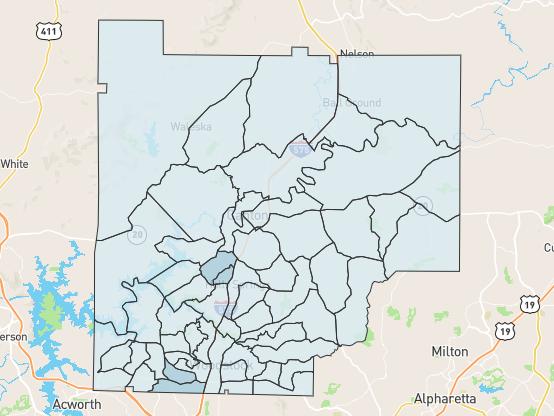
% Black Population by Census Tract in Cherokee
Sources: US Census Bureau ACS 5-year 2019-2023
Race by Employment Status
Household Economics & Education
Sources: US Census Bureau ACS 5-year 2019-2023
Sources: US Census Bureau ACS 5-year 2019-2023
Sources: EDFacts 2021-2022; US Census Bureau ACS 5-year 2019-2023 93% Students High School Graduation Rate
No data Students High School Graduation Rate - Black
94.6% Students High School Graduation Rate - White
39.5% College Educated
33.1%
Black or African American People with Bachelor's Degree or Higher Education per capita
40.2%
White People with Bachelor's Degree or Higher Education per capita
Sources: US Census Bureau ACS 5-year 2019-2023
Civic Engagement & Incarceration
Source: Georgia Secretary of State - https://sos ga gov/page/election-data-hub-turnout 80.8% Presidential Election 2024 Voter Turnout Turnout: 163,432 of 202,341 Active Voters
Source: GA Secretary of State Data Hub - https://sos ga gov/page/election-data-hub-turnout
People in Adult Correctional Facilities
Sources: US Census Bureau 2020
People in Juvenile Facilities
Health
Health Insurance Coverage Rates by Race
Sources: US Census Bureau ACS 5-year 2019-2023 Per civilian noninstitutionalized capita
Health Disparities by Race
Source: County Health Rankings 2017-2023 *% of Live Births **Among Medicare Enrollees
Empowered by mySidewalk Terms of Use
CLAYTON COUNTY
Population: Sex and Race
298,771 People
Total Population
53%
Total Female Population per capita
47%
Total Male Population per capita
Sources: US Census Bureau ACS 5-year 2019-2023 ACS data does not yet include more expansive questions about gender The authors of this report acknowledge that this excludes nonbinary residents and is, therefore, inaccurate The authors hope that future iterations of this report will be able to rely on Census data that includes nonbinary categories
Race/Ethnicity Totals
Sources: US Census Bureau ACS 5-year 2019-2023
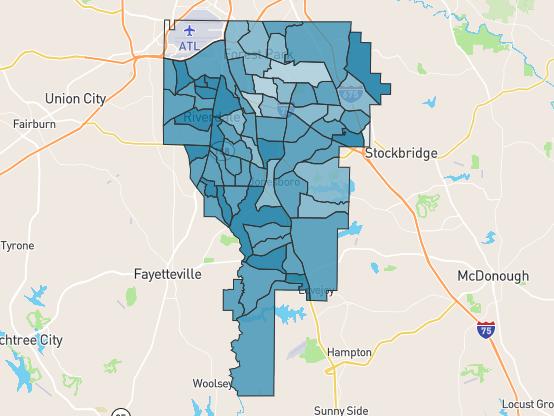
% Black Population by Census Tract in Clayton
Sources: US Census Bureau ACS 5-year 2019-2023
Race by Employment Status
Household Economics & Education
Sources: US Census Bureau ACS 5-year 2019-2023
Sources: US Census Bureau ACS 5-year 2019-2023
Students High School Graduation Rate 21.3% College Educated
76.3% Students High School Graduation Rate - Black
68% Students High School Graduation Rate - White
Sources: EDFacts 2021-2022; US Census Bureau ACS 5-year 2019-2023
23.4%
Black or African American People with Bachelor's Degree or Higher Education per capita
16.8%
White People with Bachelor's Degree or Higher Education per capita
Sources: US Census Bureau ACS 5-year 2019-2023
Civic Engagement & Incarceration
Source: Georgia Secretary of State - https://sos ga gov/page/election-data-hub-turnout 61.0% Presidential Election 2024 Voter Turnout Turnout: 113,113 of 185,474 Active Voters Total Voter Turnout by Race
Source: GA Secretary of State Data Hub - https://sos ga gov/page/election-data-hub-turnout
1,827 People in Adult Correctional Facilities
Sources: US Census Bureau 2020
88 People in Juvenile Facilities
Health
Health Insurance Coverage Rates by Race
Sources: US Census Bureau ACS 5-year 2019-2023 Per civilian noninstitutionalized capita
Health Disparities by Race
Source: County Health Rankings & Roadmaps 2017-2023 *% of Live Births **Among Medicare Enrollees
Empowered by mySidewalk Terms of Use
COBB COUNTY
Population: Sex and Race
769,152 People
Total Population
51.3%
Total Female Population per capita
48.7%
Total Male Population per capita
Sources: US Census Bureau ACS 5-year 2019-2023 ACS data does not yet include more expansive questions about gender The authors of this report acknowledge that this excludes nonbinary residents and is, therefore, inaccurate The authors hope that future iterations of this report will be able to rely on Census data that includes nonbinary categories
Race/Ethnicity Totals
Sources: US Census Bureau ACS 5-year 2019-2023
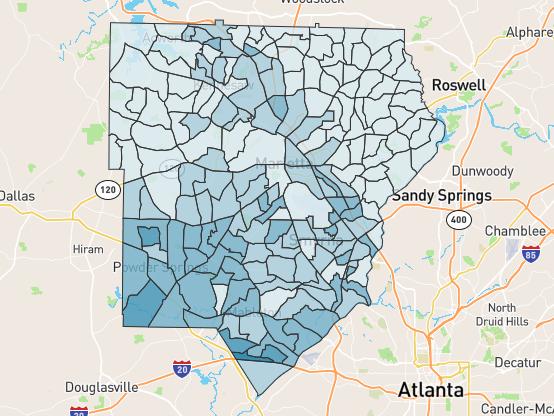
% Black Population by Census Tract in Cobb
Sources: US Census Bureau ACS 5-year 2019-2023
Race by Employment Status
Household Economics & Education
Sources: US Census Bureau ACS 5-year 2019-2023
Source: Georgia Secretary of State - https://sos ga gov/page/election-data-hub-turnout
Source: GA Secretary of State Data Hub - https://sos ga gov/page/election-data-hub-turnout
1,238 People in Adult Correctional Facilities
Sources: US Census Bureau 2020
203 People in Juvenile Facilities
Health
Health Insurance Coverage Rates by Race
Sources: US Census Bureau ACS 5-year 2019-2023 Per civilian noninstitutionalized capita
Health Disparities by Race
Source: County Health Rankings 2017-2023 *% of Live Births **Among Medicare Enrollees
Empowered by mySidewalk Terms of Use
DEKALB COUNTY
Population: Sex and Race
762,105 People
Total Population
52.5%
Total Female Population per capita
47.5%
Total Male Population per capita
Sources: US Census Bureau ACS 5-year 2019-2023 ACS data does not yet include more expansive questions about gender The authors of this report acknowledge that this excludes nonbinary residents and is, therefore, inaccurate The authors hope that future iterations of this report will be able to rely on Census data that includes nonbinary categories
Race/Ethnicity Totals
Sources: US Census Bureau ACS 5-year 2019-2023
% Black Population by Census Tract in DeKalb
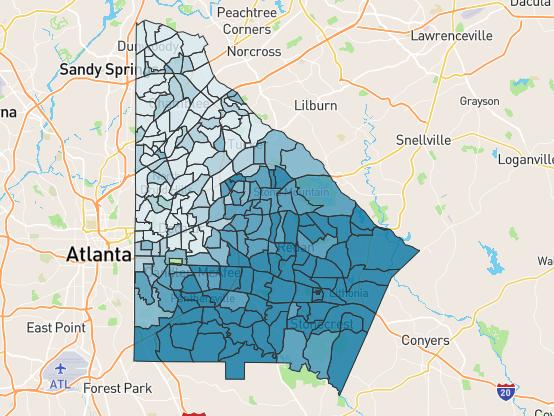
Sources: US Census Bureau ACS 5-year 2019-2023
Race by Employment Status
Household Economics & Education
Sources: US Census Bureau ACS 5-year 2019-2023
Students High School Graduation Rate 46.7% College Educated
76.5%
Students High School Graduation Rate - Black
32.2%
Black or African American People with Bachelor's Degree or Higher Education per capita
No data Students High School Graduation Rate - White 71.2%
Sources: EDFacts 2021-2022; US Census Bureau ACS 5-year 2019-2023
Engagement & Incarceration
Presidential Election 2024 Voter Turnout Turnout: 370,370 of 503,619 Active Voters
Source: Georgia Secretary of State - https://sos ga gov/page/election-data-hub-turnout
Voter Turnout by Race
Source: GA Secretary of State Data Hub - https://sos ga gov/page/election-data-hub-turnout
1,983 People in Adult Correctional Facilities
Sources: US Census Bureau 2020
297 People in Juvenile Facilities
Health
Health Insurance Coverage Rates by Race
Sources: US Census Bureau ACS 5-year 2019-2023 Per civilian noninstitutionalized capita
Health Disparities by Race
Source: County Health Rankings 2017-2023 *% of Live Births **Among Medicare Enrollees
Empowered by mySidewalk Terms of Use
DOUGLAS COUNTY
Population: Sex and Race
146,141 People
Total Population
52.3%
Total Female Population per capita
47.7%
Total Male Population per capita
Sources: US Census Bureau ACS 5-year 2019-2023 ACS data does not yet include more expansive questions about gender The authors of this report acknowledge that this excludes nonbinary residents and is, therefore, inaccurate The authors hope that future iterations of this report will be able to rely on Census data that includes nonbinary categories
Race/Ethnicity Totals
Sources: US Census Bureau ACS 5-year 2019-2023
% Black Population by Census Tract in Douglas
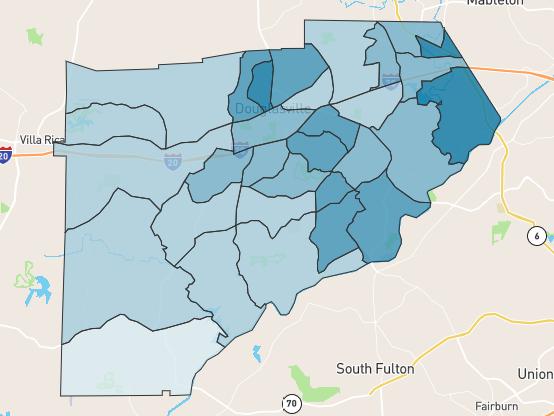
Sources: US Census Bureau ACS 5-year 2019-2023
Race by Employment Status
Household Economics & Education
Sources: US Census Bureau ACS 5-year 2019-2023
Students High School Graduation Rate 30.8% College Educated 87.5% Students High School Graduation Rate - Black 35%
Black or African American People with Bachelor's Degree or Higher Education per capita No data
High School Graduation Rate - White
Sources: EDFacts 2021-2022; US Census Bureau ACS 5-year 2019-2023
Source: Georgia Secretary of State - https://sos ga gov/page/election-data-hub-turnout
Source: GA Secretary of State Data Hub - https://sos ga gov/page/election-data-hub-turnout
People in Adult Correctional Facilities
Sources: US Census Bureau 2020
People in Juvenile Facilities
Health
Health Insurance Coverage Rates by Race
Sources: US Census Bureau ACS 5-year 2019-2023 Per civilian noninstitutionalized capita
Health Disparities by Race
Source: County Health Rankings 2017-2023 *% of Live Births **Among Medicare Enrollees
FAYETTE COUNTY
Population: Sex and Race
122,244 People
Total Population
51.4%
Total Female Population per capita
48.6%
Total Male Population per capita
Sources: US Census Bureau ACS 5-year 2020-2024 ACS data does not yet include more expansive questions about gender The authors of this report acknowledge that this excludes nonbinary residents and is, therefore, inaccurate The authors hope that future iterations of this report will be able to rely on Census data that includes nonbinary categories
Race/Ethnicity Totals
Sources: US Census Bureau ACS 5-year 2020-2024
% Black Population by Census Tract in Fayette
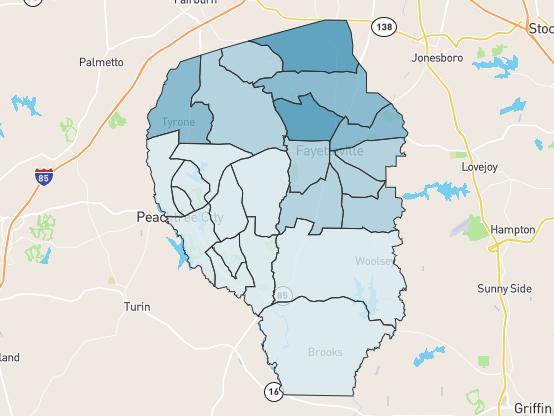
Sources: US Census Bureau ACS 5-year 2020-2024
Race by Employment Status
Household Economics & Education
Sources: US Census Bureau ACS 5-year 2020-2024
Students High School Graduation Rate
No data
Students High School Graduation Rate - Black
No data
Students High School Graduation Rate - White
Sources: EDFacts 2021-2022; US Census Bureau ACS 5-year 2020-2024
College Educated
52.5%
Black or African American People with Bachelor's Degree or Higher Education per capita
50.3%
White People with Bachelor's Degree or Higher Education per capita
Source: Georgia Secretary of State - https://sos ga gov/page/election-data-hub-turnout
Presidential Election 2024 Voter Turnout Turnout: 75,495 of 91,846 Active Voters Total Voter Turnout by Race
Source: GA Secretary of State Data Hub - https://sos ga gov/page/election-data-hub-turnout
People in Adult Correctional Facilities
Sources: US Census Bureau 2020
Health Insurance Coverage Rates by Race
People in Juvenile Facilities Health
Sources: US Census Bureau ACS 5-year 2020-2024 Per civilian noninstitutionalized capita
Health Disparities by Race
Source: County Health Rankings 2017-2023 *% of Live Births **Among Medicare Enrollees
FULTON COUNTY
Population: Sex and Race
1,068,507 People
Total Population
51.4%
Total Female Population per capita
48.6%
Total Male Population per capita
Sources: US Census Bureau ACS 5-year 2019-2023 ACS data does not yet include more expansive questions about gender The authors of this report acknowledge that this excludes nonbinary residents and is, therefore, inaccurate The authors hope that future iterations of this report will be able to rely on Census data that includes nonbinary categories
Race/Ethnicity
Sources: US Census Bureau ACS 5-year 2019-2023
% Black Population by Census Tract in Fulton
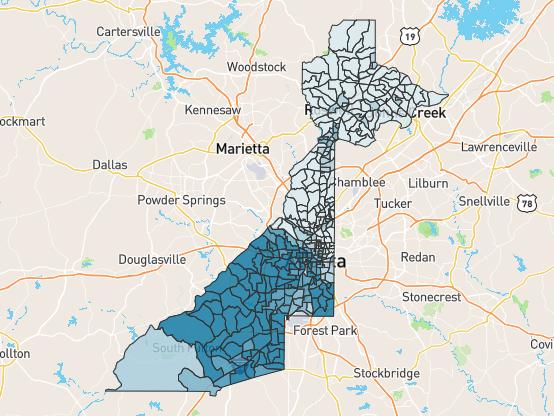
Sources: US Census Bureau ACS 5-year 2019-2023
Race by Employment Status
Household Economics & Education
Sources: US Census Bureau ACS 5-year 2019-2023
Sources: US Census Bureau ACS 5-year 2019-2023
Students High School Graduation Rate
College Educated 87.5% Students High School Graduation Rate - Black 37.5%
Black or African American People with Bachelor's Degree or Higher Education per capita 98% Students High School Graduation Rate - White
Sources: EDFacts 2021-2022; US Census Bureau ACS 5-year 2019-2023
75.4%
White People with Bachelor's Degree or Higher Education per capita
Sources: US Census Bureau ACS 5-year 2019-2023
Civic Engagement & Incarceration
Presidential Election 2024 Voter Turnout Turnout: 541,470 of 760,052 Active Voters
Source: Georgia Secretary of State - https://sos ga gov/page/election-data-hub-turnout
Source: GA Secretary of State Data Hub - https://sos ga gov/page/election-data-hub-turnout
7,475 People in Adult Correctional Facilities
Sources: US Census Bureau 2020
177 People in Juvenile Facilities
Health
Health Insurance Coverage Rates by Race
Sources: US Census Bureau ACS 5-year 2019-2023 Per civilian noninstitutionalized capita
Health Disparities by Race
Source: County Health Rankings 2017-2023 *% of Live Births **Among Medicare Enrollees
Empowered by mySidewalk Terms of Use
FORSYTH COUNTY
Population: Sex and Race
260,062 People
Total Population
50%
Total Female Population per capita
50%
Total Male Population per capita
Sources: US Census Bureau ACS 5-year 2019-2023 ACS data does not yet include more expansive questions about gender The authors of this report acknowledge that this excludes nonbinary residents and is, therefore, inaccurate The authors hope that future iterations of this report will be able to rely on Census data that includes nonbinary categories
Race/Ethnicity Totals
Sources: US Census Bureau ACS 5-year 2019-2023
% Black Population by Census Tract in Forsyth
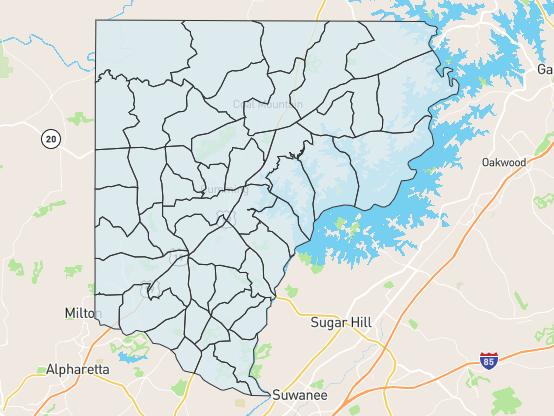
Sources: US Census Bureau ACS 5-year 2019-2023 © Mapbox © OpenStreetMap
Race by Employment Status
Household Economics & Education
Sources: US Census Bureau ACS 5-year 2019-2023
Source: Georgia Secretary of State - https://sos ga gov/page/election-data-hub-turnout
Source: GA Secretary of State Data Hub - https://sos ga gov/page/election-data-hub-turnout
People in Adult Correctional Facilities
Sources: US Census Bureau 2020
Health Insurance Coverage Rates by Race
People in Juvenile Facilities
Sources: US Census Bureau ACS 5-year 2019-2023 Per civilian noninstitutionalized capita
Health Disparities by Race
Source: County Health Rankings 2017-2023 *% of Live Births **Among Medicare Enrollees
GWINNETT COUNTY
Population: Sex and Race
966,972 People
Total Population
51%
Total Female Population per capita
49%
Total Male Population per capita
Sources: US Census Bureau ACS 5-year 2019-2023 ACS data does not yet include more expansive questions about gender The authors of this report acknowledge that this excludes nonbinary residents and is, therefore, inaccurate The authors hope that future iterations of this report will be able to rely on Census data that includes nonbinary categories
Race/Ethnicity Totals
Sources: US Census Bureau ACS 5-year 2019-2023
% Black Population by Census Tract in Gwinnett
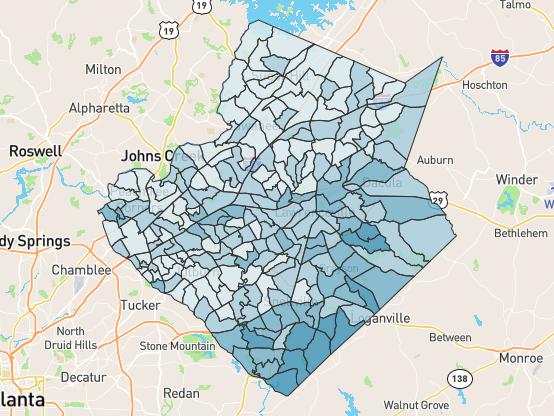
Sources: US Census Bureau ACS 5-year 2019-2023
Race by Employment Status
Household Economics & Education
Sources: US Census Bureau ACS 5-year 2019-2023
Engagement & Incarceration
Source: GA Secretary of State Data Hub - https://sos ga gov/page/election-data-hub-turnout
2,739 People in Adult Correctional Facilities 0 People in Juvenile Facilities
Sources: US Census Bureau 2020
Health Insurance Coverage Rates by Race
Health
Sources: US Census Bureau ACS 5-year 2019-2023 Per civilian noninstitutionalized capita
Health Disparities by Race
Source: County Health Rankings 2017-2023 *% of Live Births **Among Medicare Enrollees
Empowered by mySidewalk Terms of Use
HENRY COUNTY
Population: Sex and Race
245,417 People
Total Population
52.4%
Total Female Population per capita
47.6%
Total Male Population per capita
Sources: US Census Bureau ACS 5-year 2019-2023 ACS data does not yet include more expansive questions about gender The authors of this report acknowledge that this excludes nonbinary residents and is, therefore, inaccurate The authors hope that future iterations of this report will be able to rely on Census data that includes nonbinary categories
Race/Ethnicity Totals
Sources: US Census Bureau ACS 5-year 2019-2023
% Black Population by Census Tract in Henry
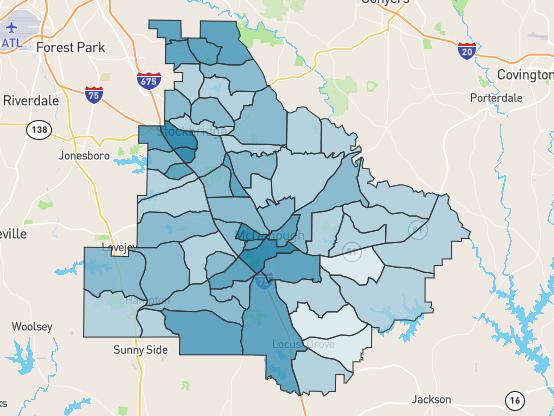
Sources: US Census Bureau ACS 5-year 2019-2023
Household Economics & Education
Sources: US Census Bureau ACS 5-year 2019-2023 Race by Employment
Sources: US Census Bureau ACS 5-year 2019-2023
Sources: EDFacts 2021-2022; US Census Bureau ACS 5-year 2019-2023 85.7% Students High School Graduation Rate
92%
Students High School Graduation Rate - Black
No data
Students High School Graduation Rate - White
28% College Educated
32.1%
Black or African American People with Bachelor's Degree or Higher Education per capita
23.6%
White People with Bachelor's Degree or Higher Education per capita
Sources: US Census Bureau ACS 5-year 2019-2023
Civic Engagement & Incarceration
Presidential Election 2024 Voter Turnout Turnout: 130,325 of 176,274 Active Voters Total Voter Turnout by Race
Source: Georgia Secretary of State - https://sos ga gov/page/election-data-hub-turnout
Source: GA Secretary of State Data Hub - https://sos ga gov/page/election-data-hub-turnout
Sources: US Census Bureau 2020
Health Insurance Coverage Rates by Race
Health
Sources: US Census Bureau ACS 5-year 2019-2023 Per civilian noninstitutionalized capita
Health Disparities by Race
Source: County Health Rankings 2017-2023 *% of Live Births **Among Medicare Enrollees
ROCKDALE COUNTY
Population: Sex and Race
94,293 People
Total Population
52.9%
Total Female Population per capita
47.1%
Total Male Population per capita
Sources: US Census Bureau ACS 5-year 2019-2023 ACS data does not yet include more expansive questions about gender The authors of this report acknowledge that this excludes nonbinary residents and is, therefore, inaccurate The authors hope that future iterations of this report will be able to rely on Census data that includes nonbinary categories
Race/Ethnicity Totals
Sources: US Census Bureau ACS 5-year 2019-2023
% Black Population by Census Tract in Rockdale
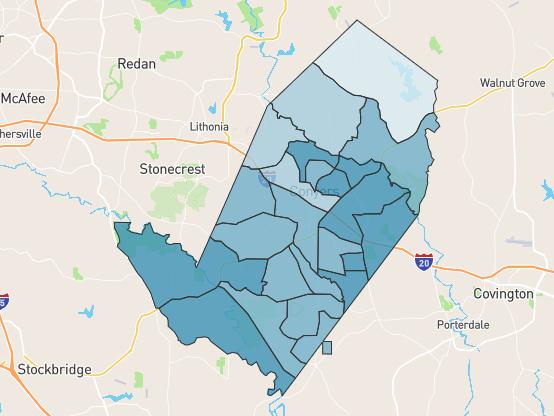
Sources: US Census Bureau ACS 5-year 2019-2023
Race by Employment Status
Household Economics & Education
Sources: US Census Bureau ACS 5-year 2019-2023
Source: Georgia Secretary of State - https://sos ga gov/page/election-data-hub-turnout
Source: GA Secretary of State Data Hub - https://sos ga gov/page/election-data-hub-turnout
Sources: US Census Bureau 2020
Health Insurance Coverage Rates by Race
Sources: US Census Bureau ACS 5-year 2019-2023 Per civilian noninstitutionalized capita
Health Disparities by Race
Source: County Health Rankings 2017-2023 *% of Live Births **Among Medicare Enrollees