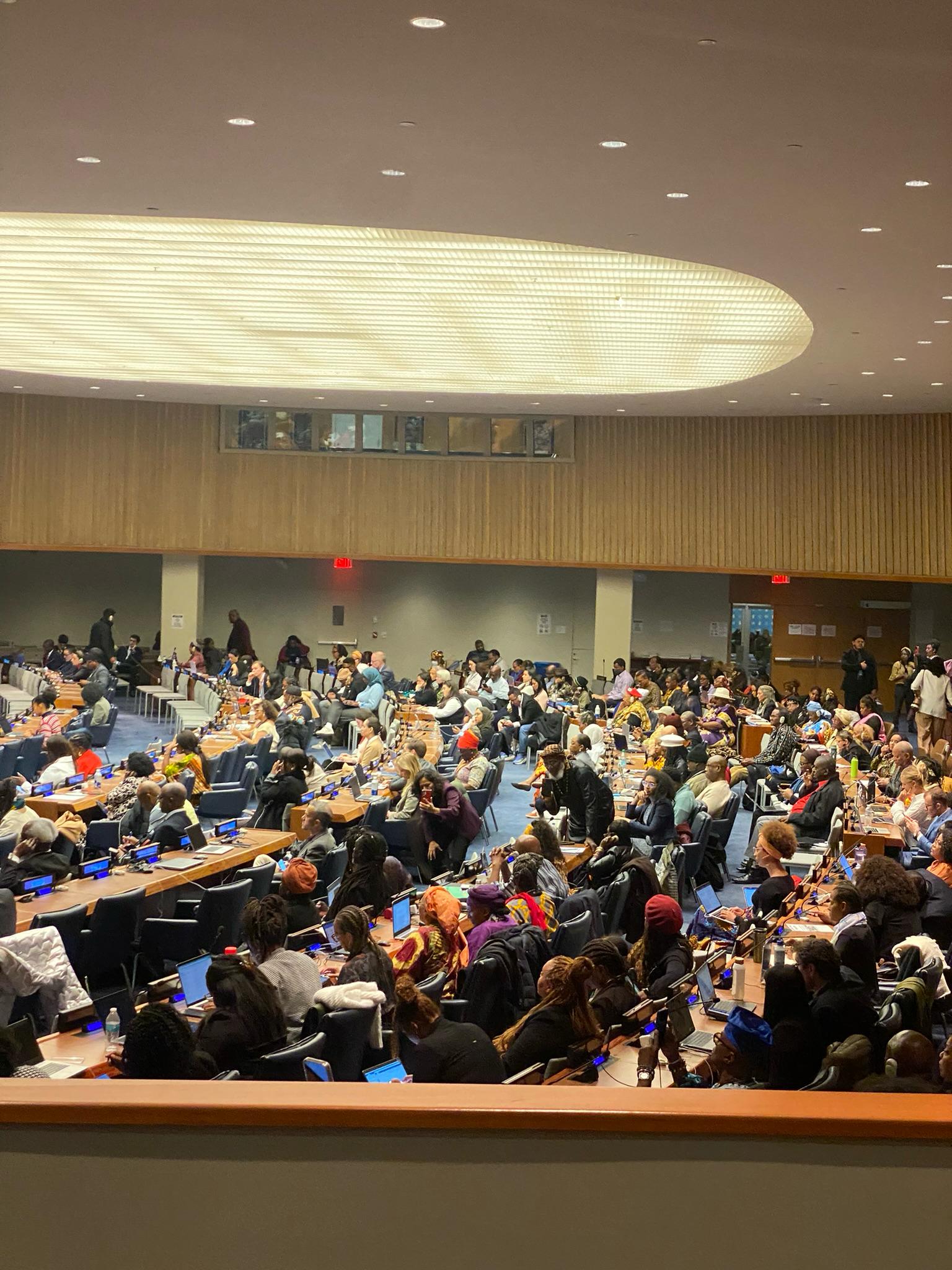

Executive Summary
Executive Summary
Introduction - Purpose and Scope
The Geographies of People of African Descent
Concerns and Advocacy of People of African Descent: A Pan Africa Perspective
Diaspora Communities of People of African Descent
• North America: Region Overview-Bonfas Owinga & Case commentaries: Canada by Tamanisha John; Mexico by Denise Quinlan; United States by Joseph Jones
• Central America: Region Overview-Bonfas Owinga &Case commentary: Belize Kurt Young
• South America and the Caribbean: Region Overview- by Bonfas Owinga & Case commentaries: Brazil by Luciano Cruz; Colombia by Charity Clay; Cuba by Kwasi Densu
• Europe: Region Overview-by Bonfas Owinga & Case commentaries: France by Fatiha Kaoues; United Kingdom by Hashim Gibrill & Cecil Gutzmore
• Asia: Region Overview-by Bonfas Owinga & Case commentary: India by Preya Bhattacharya
Towards a Global African Diaspora Liberation Index
Summary Observations by Klaudette Spencer
Contributors
Notes & Citations
The Status of Global Africa: Part 1 – Diaspora Communities of People of African Descent provides a comprehensive analysis of the lived conditions of African-descended populations outside sovereign African states. This volume adopts a Pan-African perspective, aiming to inform global strategies for combating racism, racial discrimination, xenophobia, and related intolerance. It focuses on non-sovereign diaspora communities across the Americas, Europe, Asia, and the Caribbean, offering policy-relevant data and commentary to support advocacy and international commitments.
Historically, these communities emerged through voluntary and forced migrations linked to exploration, enslavement, colonialism, and contemporary movements for work, education, and refuge. Despite their diverse locations, they share common experiences of systemic marginalization and cultural erasure. The report underscores the importance of recognizing these historical roots to understand present-day inequalities and to frame effective policy responses.
A major challenge identified is the lack of disaggregated racial and ethnic data in many countries. This data gap obscures inequalities and limits the ability of governments and organizations to design targeted interventions. Where data exists, it often reflects undercounts due to complexities of self-identification and social stigma. Accurate and inclusive data collection is essential for evidence-based policymaking and accountability.
The report documents persistent inequalities affecting African-descended populations, including economic marginalization, political underrepresentation, and limited access to education, healthcare, and housing. Structural racism and intersectional inequities remain pervasive, compounded by gender discrimination and systemic barriers. While some nations have introduced multicultural or anti-discrimination measures, these policies often remain symbolic and fail to dismantle entrenched disparities.
Despite these obstacles, African-descended communities exhibit strong resilience and advocacy. Grassroots movements and transnational networks mobilize for reparatory justice, climate justice, and inclusive development. Pan-African solidarity continues to shape activism across regions, as illustrated by case studies from Canada, Mexico, the United States, Brazil, Colombia, Cuba, France, the United Kingdom, Belize, and India. These examples reveal both shared struggles and diverse strategies for empowerment.
To advance equity, the report introduces the Global African Diaspora Liberation Index (GADLI), a participatory tool designed to measure well-being, self-agency, and systemic
inequities. GADLI emphasizes community involvement and disaggregated data collection to inform evidence-based policy and strengthen transnational advocacy networks. This approach seeks to create a framework for monitoring progress and promoting accountability.
In conclusion, the report calls for urgent action to expand data collection, enact substantive anti-racism policies, and support community-led initiatives. It advocates for coordinated global efforts to address systemic inequalities in education, health, housing, and justice, while advancing agendas for reparatory and climate justice. By fostering mutual understanding and collaboration, this work aims to improve the lived conditions of people of African descent worldwide.
Hashim Gibrill, Ph.D.
Joseph L. Jones, Ph.D.
Introduction - Purpose and Scope
The Status of Global Africa presents policy relevant data and commentary regarding the lived circumstances of People of African Descent as best as we can conceive of and capture them. Information is gathered to illuminate the common and diverse experiences of African and African diaspora countries and communities across the globe. The Status of Global Africa pursues a comprehensive, “Pan-Africa”, perspective in presenting data and commentary that embraces the African continent, the sovereign states of People of African Descent outside of Africa, and communities of People of African Descent around the world. The purpose is to provide a verifiable foundation for understanding our conditions and serving the needs of public policy advocacy and activism. This is in line with the United Nations commitments to acknowledge, prevent, and seek redress for “racism, racial discrimination xenophobia and related intolerance” in the past and the current day experienced by “Africans and people of African descent, Asians and people of Asian descent and indigenous peoples.”
The Status of Global Africa accepts that:
People who identify themselves as African descent [include] – but are not limited to: (a) victims of the transatlantic trade in enslaved Africans; (b) people of African descent who have migrated and are descendants of victims of the transatlantic trade in enslaved Africans; (c) all populations who migrated from African countries outside of sub-Saharan Africa and nationals who are of African descent; (d) all the communities of African descent that identify themselves or are recognized as ethnic groups native and/or tribal peoples in independent countries under other instruments of international human rights law.
Beyond the African continent and the Americas, this includes communities of people of African descent in Asia, Arabia, Europe, and Oceania.
The Status of Global Africa report is presented in three parts:
The Status of Global Africa: Part 1 (this current volume) focuses on diaspora communities of People of African Descent within multiracial, multiethnic countries in which other segments of the national population are predominant in terms of population size and/or resources and authority. Illustrating these non-sovereign diaspora communities, case study commentaries are presented illuminating the historical origins, contemporary presence, and current circumstances, priorities, political advocacy and activism of selected communities. The purpose is to provide a comparative illustration of commonalities and differences in the lived experiences of non-sovereign communities of the African diaspora. The case commentaries are limited in number, totaling 10: (North America) Canada, Mexico, United States; (Central America) Belize; (South America and the Caribbean) Brazil, Colombia, Cuba; (Europe) France, United Kingdom; (Asia) India Planned future reports will add to and diversify this number of case studies.
The Status of Global Africa: Part 2 (forthcoming) focuses on the independent countries and the remaining colonized and dependent territories of people of African descent outside of continental Africa. These countries and territories are located in South America, the Caribbean, Asia and Oceania. Again, socio-economic data and case study commentaries is gathered to illuminate the historical origins and current day social, economic, and political circumstances of selected African diaspora countries and territories. The purpose is to further develop our portrayal of the diversity of the African diasporic experience
The Status of Global Africa: Part 3 (forthcoming) focuses on the independent countries and the remaining colonies and dependent territories of continental Africa. Comparative data and case studies illuminate the similarities and differences in the socioeconomic profiles, cultures and politics of contemporary Africa. The purpose to provide systematic information and reflection to extend our Pan African understanding of Global Africa.
Taken together, the 3 parts provide a basis for mutual understanding and the pursuit of data support public policy advocacy among peoples of African descent. Data and commentary presented in The Status of Global Africa: Part 1 – Diaspora Communities of People of African Descent include:
• The Geographies of People of African Descent mapping and charting the extent of global Africa
• World regional overview and national case studies regarding the historical origins and current day presence of communities of People of African Descent across the globe
• Testimonies and advocacies of organizations and spokespersons of diaspora communities of People of African Descent illuminating shared and unique policy concerns and liberatory self-agency
• An introduction to our developing the Liberation Index. This index collects comparative, focused data for understanding the situations and aspirations of People of African Descent across the globe essential for evaluating and developing national and transnational liberatory public policy.
• Concluding comparative observations regarding the circumstances, advocacy and activism of diasporic communities of People of African Descent.
• Deliberations regarding contemporary and forward-thinking, liberatory public policy advocacy for diasporic communities of People of African Descent
Global Distribution of People of African Descent – circa 2020
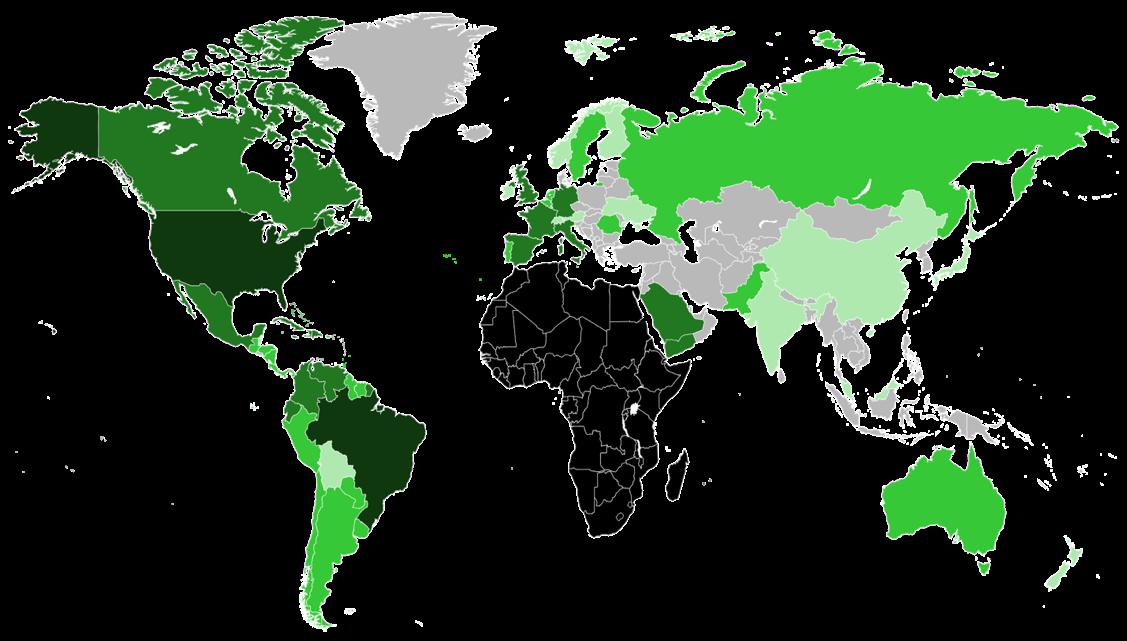
Based on Source: Allice Hunter
Diasporic communities of People of African descent exist across the globe. These communities have diverse origins and current day presence in the geographical locations where they are established. Prehistoric and historic communities of People of African Descent have been formed by two broad processes of migration - voluntary and forced. These migrations prompted by exploration, settlement, resettlement, fortune seeking, human trafficking, colonialism, rebellion, and refuge, are past and current realities. Currently migration for employment, education, and political refuge, and continuing nefarious human trafficking are prominent in the movements of African descended peoples across the globe. These contemporary migrations exist alongside the generational growth of established African diasporic communities. We have in the 3rd decade of the 21st century numerous and diverse African descended communities in the Americas, Europe, Arabia, Asia, and Oceania. These current day communities are varied in terms of population size, self-identification, resources, organization, political cohesion and power, and comparative standing and status in national populations.
Diaspora communities of People of African Descent live within multiracial, multiethnic countries in which other segments of the national population are predominant in terms of population size and/or resources and authority.
Social statistics regarding communities of people of African descent are often not available, or are incomplete. Racial and ethnic data are not collected in censuses that focus on national aggregate populations. The lack of disaggregated data undermines efforts to quantify and evaluate the well-being of people of African descent globally
Where racial and ethnic data are collected, self-identification as black, African, and mixed race takes place in social contexts of anti-blackness, colorism,” and racial hierarchies, often undermining the accuracy of community population numbers
Local and international non-government organizations are providing working estimates of the populations of African descended communities
Diasporic Communities of People of African Descent
African Diaspora Communities (with Estimated Populations <1 million)
Based on: National Censuses; Minority Rights Group; Others
African diaspora communities also exist in: Guyana (275,000), Pakistan (250,000), Portugal (230,000), Surinam (220,000), Argentina (150,000), Turkey (100,000), Belize (90,000), Russia (50,000), India (50,000)
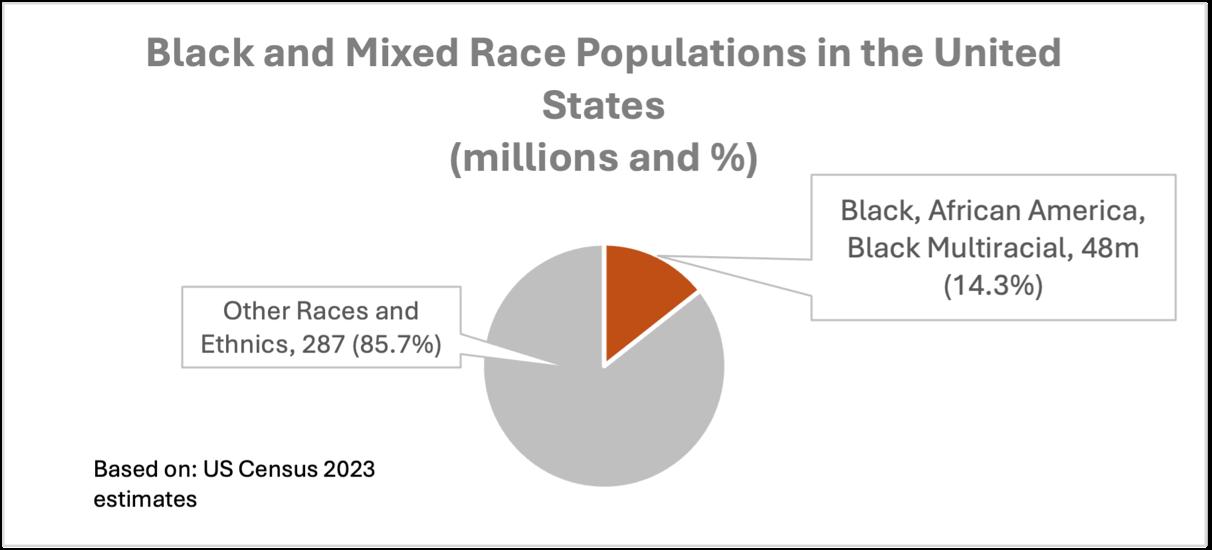
Diasporic Communities of People of African Descent in National Populations Some Examples
This SGAD report is published by the W.E.B. Du Bois Southern Center for Studies in Public Policy. We remember that from the last decade of the nineteenth century through the second third of the twentieth century, Du Bois provided a sustained presentation “to the world” regarding the history and place of Africa and extra-continental African descended communities and states in the global order. He labelled these social, historic, political, and economic locations in combination as “Pan-Africa,” or “the Africas.” Du Bois understood that continental Africa and its diaspora were intertwined in terms of the plight and freedom struggles of a race. This was not a unique understanding; it spurred the Pan African Conference and Congresses of the 20th century. Neither is it an archaic understanding; it underlies the purposes and visions of 21st century institutions, conferences, and programs of action regarding “People of African Descent.”
Notwithstanding much diversity, over the centuries continental Africa and its diaspora have expressed a clear sense of peoplehood. The 20th and 21st centuries include the history of PanAfricanism as an organized movement. This sense of community is significantly driven by a common experience of oppression and discrimination which has prompted resistance and struggles for self-determination. At heart Pan-Africanism is a manifestation of the feelings of peoplehood derived from common geographical and cultural origins, a history of battling political subordination, economic exploitation and racism, and a shared empathy. It is also a realization that combined energies can best serve common goals. Pan-Africanism has advanced the political condition of Africans and peoples of African descent. In the anti-slavery, anti-colonialism, national liberation, anti-apartheid, and anti-racist struggles, Pan-Africanist ideas and organizations have provided a widely-manifested basis for domestic unity and international solidarity, on the African continent and across the diaspora.
Contemporary pursuits under the umbrella of Pan-African organizations, forums and meetings concern redress, repair, reparative justice, self-determination, and solidarity related to the historic harms of enslavement, colonization, and new imperialisms. These matters are prominent in the deliberations of the Permanent Forum for People of African descent, and the call for a Second International Decade for People of African Descent intended to consolidate the successes and confront the omissions and still-to-be achieved goals of the 2015-2024 First International Decade for People of African Descent. These matters also figured centrally in transnational meetings, conferences, declarations and proclamations such as the 2013 launch of the CARICOM Reparations Commission, the 2014 and 2015 8th Pan-African congresses, the 2017 2nd Kwame Nkrumah Intellectual and Cultural Festival, the 2022 Accra Summit on Reparations and Racial Healing, and the 2023 Accra Reparations Conference.
Current day Pan African Themes and Advocacy include
¨ Building upon the spirit of the history and legacies of the Pan African conferences and congresses of the past.
¨ Pressing the demand for reparatory justice
¨ Detailing systemic racism and historical harm
¨ Recognizing that Black Lives Matter; African Lives Matter; Migrants Matter, and opposing all forms of racial discrimination and marginalization matters
¨ Highlighting the underfunding and roll backs of inclusive public policies
¨ Amplifying the concerns and voices of Women, Girls, and Youth regarding the design, implementation and evaluation of development plans and public policies
¨ Challenging cultural marginalization, appropriation, imposition, and the looting of cultural artifacts; and recognizing and embracing common and communal cultural values across Global Africa
¨
¨ Building a community of African-centered scholars, teachers, and policy specialists to educate ourselves, to gather disaggregated, focused data, build the curricula, train the teachers, design inclusive and alternative policies, etc.
¨ Utilizing our philosophical traditions and traditional practices – and countering Eurocentrism –to facilitate self-reliance, food sovereignty, environmental stewardship and repair, and agricultural regeneration
¨ Challenging environmental racism, and demanding climate justice initiatives
¨ Strengthening homeland-diaspora connections in support of sustainable community, national, and global African development initiatives
¨ Amplifying grassroots participation in national and international discourses and events
¨ Monitoring the progress and relevance of the global Sustainable Development Goals to people of African descent
¨ Addressing the causes, impacts, and avenues of recovery of war-torn spaces across Pan-Africa
¨ Calling out self-serving state actors who are in often violent contention with civil society groups
¨ Calling out the exclusion of continental African voices in international forums via visa denials and related discriminations
¨ Pursuing broad inclusivity among people of African descent – continental and diasporic – by opposing intolerance and extremism; opposing national and ethnic chauvinisms
¨ Voicing solidarity with all peoples oppressed, exploited, and marginalized by imperialism, and race, class and gendered supremacies
¨ Building upon the spirit of the history and legacies of the Pan African conferences and congresses of the past.
¨ Pressing the demand for reparatory justice
¨ Detailing systemic racism and historical harm
¨ Recognizing that Black Lives Matter; African Lives Matter; Migrants Matter, and opposing all forms of racial discrimination and marginalization matters
¨ Highlighting the underfunding and roll backs of inclusive public policies
¨ Amplifying the concerns and voices of Women, Girls, and Youth regarding the design, implementation and evaluation of development plans and public policies
¨ Challenging cultural marginalization, appropriation, imposition, and the looting of cultural artifacts; and recognizing and embracing common and communal cultural values across Global Africa
¨ Building a community of African-centered scholars, teachers, and policy specialists to educate ourselves, to gather disaggregated, focused data, build the curricula, train the teachers, design inclusive and alternative policies, etc.
¨ Utilizing our philosophical traditions and traditional practices – and countering Eurocentrism –to facilitate self-reliance, food sovereignty, environmental stewardship and repair, and agricultural regeneration
¨ Challenging environmental racism, and demanding climate justice initiatives
¨ Strengthening homeland-diaspora connections in support of sustainable community, national, and global African development initiatives
¨ Amplifying grassroots participation in national and international discourses and events
¨ Monitoring the progress and relevance of the global Sustainable Development Goals to people of African descent
¨ Addressing the causes, impacts, and avenues of recovery of war-torn spaces across Pan-Africa
¨ Calling out self-serving state actors who are in often violent contention with civil society groups
¨ Calling out the exclusion of continental African voices in international forums via visa denials and related discriminations
¨ Pursuing broad inclusivity among people of African descent – continental and diasporic – by opposing intolerance and extremism; opposing national and ethnic chauvinisms
¨ Voicing solidarity with all peoples oppressed, exploited, and marginalized by imperialism, and race, class and gendered supremacies
How are these commitments and agendas to be pursued and realized? We have stated elsewhere that:
“We live in an era of the historical denial of the ravages, rape, and social and psychological harm of the human trafficking and enslavement of African peoples and the imperialist despoilation of the African continent; an era of the rise and support of openly racist political movements and parties; an era of the steady
overturning and elimination of laws and public polices intended to redress and address past and current racial inequities; and an era of political and ideological attacks on academics and activists who dare to speak truth to power. At Clark Atlanta University we will continue to add our voice as scholars, educators, and activists to efforts to confront the historical distortion and present the Truth to our students, who must and will take up the burden and triumphs of the generational struggles of African peoples.”
The common task facing people of African descent is to design and pursue practical, effective ways to address these and related priorities of contemporary Pan-Africanism.
Building out the description of diaspora communities of people of African descent, the SGAD report provides below a global overview and case commentaries regarding the historical origins and current day presence of communities of People of African Descent. The purpose of the overview and commentaries is to 1) provide further details of the geographical extent of diasporic Africa, and 2) illustrate commonalities and differences in the lived experiences of African diasporic communities. The case commentaries are limited in number, totaling 10; future reports will add to and diversify this number. The individual case commentaries are shaped by the various analytical perspectives adopted by the authors. They all discuss community history and current concerns, priorities, political advocacy and activism.
Bonfas Owinga
North America comprises the United States, Canada, and Mexico. Afro–North Americans are people of African descent across these three countries, including African Americans, Black Canadians, and Afro-Mexicans. Most descend from Africans forcibly brought to the region during the trans-Atlantic slave trade to work on plantations. More recent African migration driven by economic opportunities, education, political instability, and family reunification has also shaped these populations.
Approximately 52 million Afro–North Americans live in the region: 47.9 million in the United States (14.1% of the population), 1.5 million in Canada (4.3%), and 2.6 million in Mexico (2%). The majority reside in urban areas; for example, 97.8% of Black Canadians live in cities.
Despite cultural and ethnic diversity, Afro–North Americans have long faced systemic racism and socio-economic disparities. In the United States, Black Americans are more than twice as likely as white Americans to live in poverty, have shorter life expectancy, higher unemployment, and significantly lower median wealth ($17,000 compared to $171,000). In Canada, the 2021 Census reported that 12.4% of Black Canadians lived in poverty, compared to 8.1% of the overall population. Afro-Mexicans also face disproportionately high poverty rates and limited access to basic services, with only 66.5% having tap water.
Nevertheless, Afro–North Americans have sustained rich cultural traditions and led ongoing struggles for equality through organizations such as the U.S. Civil Rights Movement, the NAACP, and Mexico Negro A.C. Their influence is visible in music (e.g., jazz, blues, gospel, and Mexico’s danza de los diablos), cuisine, politics, sports, art, science, and broader cultural life.
Tamanisha J. John
As advanced capitalist states founded on ongoing settler colonialism, African enslavement, and discrimination towards non-Anglo European migrants – Canada and the United States have some historical similarities in their treatment towards people of African descent. However, Canadian multicultural policies, and its brand of multiculturalism, have historically made it hard for racialized groups in Canada, including those of African descent, to address needs specific to their non-Anglo European communities. historically and in the present, Canada’s multicultural policies have acted as a shield for institutions and individuals in Canada that engage in racism and discrimination to gaslight racialized groups that experience social and systemic racism without redress.
People of African descent in Canada are both “a minority population in a white settler colony” and a “marginal population within the African diaspora” who exist “as a racialized population under a regime of neoliberal multiculturalism that affirms culture while it denies race and that fêtes diversity while it despises Blackness” (Hudson & Kamugisha 2014, pg. 3). This marginal position, alongside multicultural denials of anti-Black racism and discrimination, has meant that unlike African descended groups in the United States, African descended groups in Canada have “no constitutional, pop cultural, economic, legal, or political clout, especially when regarded nationally” (Clarke 2014, pg. 67). Simultaneously, Canada positions itself as “better than” the United States on issues of racism and discrimination, which has worked to quiet critique of the Canadian state and its policies towards racialized groups. It is commonplace to hear Canadians and Canadian institutions retort that racialized peoples would fare worse in the United States, which in turn implies that these groups should be “grateful” – thus quiet – on issues of racism and discrimination.
In Canada, people of African descent are engaged in activisms around materially addressing and combatting pervasive and systemic institutional forms of racism and discrimination in areas of public representation, higher rates of Black unemployment, high levels of food insecurity, over-policing of Black children in schools and neighborhoods, high rates of homelessness, less access to healthcare and family doctors, and Black neighborhoods having higher concentrations of lower incomes. The diversity of the Black population in Canada, coupled with the fact that many of those of African descent are new immigrants (52%) and non-permanent residents (44.3%) in Canada, has historically been advantageous to Canada’s multicultural framework.
Canadian multiculturalism thrives on division versus collective and solidaristic actions against racism and discrimination. A 2016 government profile of Black immigrants in Canada revealed that those of African descent came from over 125 different countries, spoke more than 100 mother tongue languages, and had over 200 ethnic/cultural classifications (Maheux & Do 2019). Historically, and prior to 2000, Black immigrants in Canada predominantly came from the
Caribbean region given imperial and commonwealth histories; by the end of 2000 and into the present, Black immigrants in Canada now predominantly come from the African continent. Black diversity in Canada have made “Black agendas” seem nonsensical.
The makeup of Black people in Canada, alongside the fact that they comprise a relatively small portion of the population has meant that Black people in Canada are “considered marginal economically and inconsequential politically” (Clarke 2014, pg. 75). even in those instances where true solidaristic fronts against anti-Black racism and discrimination in Canada are levied against the state or various institutions, these are frequently labelled by the Canadian state, and institutions, as foreign importation. “Afrocentrists” and anti-racism activists who seek, then, to rally likeminded and good-hearted persons, to struggle against “institutionalized racism” must fight official doubt with socioeconomic statistics” (Clarke 2014, pg. 68). until about 8 years ago, statistics on Black populations in Canada were scarcely collected. This data is now collected given advocacy work done by Black populations in Canada.
Still, even in instances where data is available, such as police violence which predominantly target Black and Indigenous populations in Canada, these are painted “as abhorrent, but aberrant, or as bizarre, or as an American importation” (Clarke 2014, pg. 69). African descended and Indigenous peoples in Canada are over policed and over-represented in Canadian prisons. While African descended people constitute 3.5% of Canada’s population and Indigenous people constitute 5% of Canada’s population, they make up close to 10% and over 30% of those incarcerated, respectively (Ahmad 2023). Though in the US the issue of mass incarceration and the racialization of policing and crime is well known, in Canada – and in external discussions about Canada – this is seldom discussed. Instead, Canada’s mass incarceration of these racialized groups is couched, and justified, in this language of “correction” per its broader multicultural assimilationist and integrationist political framework.
The importance of race relevant data collection for Black political advocacy in Canada must not be understated. For example, those of African descent in Canada tend to live in larger urban and metropolitan areas like Toronto, Montréal, Ottawa-Gatineau, and Nova Scotia (Maheux & Do 2019). Within these metropolitan areas Black people live in economically marginalized neighborhoods that tend to be overpoliced (Owusu-Bempah et. al 2021, pg. 539). A 2019 profile of Toronto as the largest metropolitan area with a sizeable Black population (1 in 11 people in Toronto are Black) found that:
• The dropout rate for Black students was 23% compared to 12% for White students.
o Black students are 4x more likely to be expelled than White students.
o Black students are 2.5x more likely than White students to be streamed into “applied programs” with negative impacts on graduation and post-secondary prospects.
• Black workers are 4x as likely as White workers to report experiencing racial discrimination in major decisions at workplaces in Canada.
• ¼ of Black people trust police to treat them fairly compared to ¾ of White people.
o Black people in Toronto made up 36% of cases where police used pepper spray on an individual, 46% of cases where police used a taser on an individual, and 57% of cases involving a police dog.
o Black Torontonians represent 70% of civilian deaths in police shootings, meaning that police are 20x more likely to kill a Black person than a White person.
The report authors note that “nearly half of Canadians believe discrimination against Black people is “no longer a problem” – even as 83% of Black people in Canada say they are treated unfairly at least some of the time” (DasGupta et al. 2020). Black students in Canada identified systemic and curricula problems with the Canadian education system, including: “differential treatment because of their race, the lack of Black and African-Canadian history and culture in the curriculum, and the absence of Black teachers” which leads to “feelings of alienation by educators who identify students as deficient as opposed to the education system” (Pillay 2023, pg. 62). These data helped to launch, in 2019, Policing-Free schools – providing Parents of Black Children (PoBC) advocacy tools to remove police from schools in Ontario the high Black unemployment rate in Canada results in the concentration of Black people in low-income areas that are heavily policed, and the large number of Black people that make up the homeless population in metropolitan areas like Toronto. The Black Class Action Secretariat (BCAS 2022) in Canada submitted a formal, and historic, complaint in 2022 to the United Nations against Canada and the Canadian Human Rights Commission. Currently, the United Nations is investigating anti-Black racism in Canada given that it believes sufficient evidence exists to review Canada’s “A status” (Paris Principles), especially given 2016 findings by the United Nations that there is systemic antiBlack racism in Canada’s criminal justice system (Paperny 2024 & BCAS 2024).
Denise Quinlan
Mexican colonial history reflects the rule of Spanish absolutism. Under this system, the Spanish Crown maintained control over its colonies through centralized authority and a rigid social hierarchy. Brought to Mexico through the transatlantic slave trade, Africans and their descendants were incorporated into this system as enslaved laborers and their presence and participation in colonial society complicated the rigid categories of the Spanish racial hierarchy.
African descendants exhibited agency within the colonial framework of Mexico, claiming their identities, and fighting for social status and political engagement within the constraints of absolutist governance and the Catholic doctrine. They contributed significantly to the formation of colonial Mexican society because religious institutions offered Afro-Mexicans a platform for contesting their conditions and asserting their humanity. The courts became spaces where they could articulate grievances and seek redress, and Afro-Mexicans used the language and practices of Christianity to advocate for their rights and challenge their subjugation (Bennett 2009).
Enslaved and free Afro-Mexicans engaged with Catholicism, not only as a religious framework but also as a means of participating in the colonial social order. Through baptism, marriage, and burial practices, Afro-Mexicans used Catholic sacraments to assert familial ties, social legitimacy, and claims to freedom. Enslaved Africans often insisted on Christian marriages, which afforded them a degree of social recognition and protection within the colonial system. Similarly, baptismal records served as evidence of their humanity and spiritual equality, rebuffing the dehumanizing impact of slavery (Bennett 2003).
The 2020 census marked the first time that people of African descent were officially counted in Mexico, recognizing nearly 2.5 million people as part of this demographic. The inclusion of Afro-Mexicans was driven by advocacy efforts and international pressure to address racial inequalities (Sue 2024). However, this official recognition reflects a superficial multiculturalism that celebrates cultural diversity without addressing systemic inequalities. Many Mexicans continue to perceive Blackness through the lens of stereotypes, exoticism, or invisibility, undermining the potential transformative impact of state policies.
Community leaders and activists play a crucial role in challenging stereotypes, promoting education about Afro-Mexican history, and pushing for policies that address systemic inequalities. These efforts reflect a broader struggle for racial justice and social inclusion in Mexico and the concern that state initiatives must go beyond symbolic recognition to address the structural inequalities faced by Afro-Mexicans. These include investing in education, healthcare, and economic development in Afro-Mexican communities, as well as challenging the societal attitudes
that perpetuate racism and colorism. Intersectional analyses show that race, class, and gender combine to shape Afro-Mexican experiences and the role that these identities play in contrasting state policies and popular perceptions.
Afro-Mexican communities are mostly found in Veracruz and the coast of Oaxaca and Guerrero. Veracruz is the place in which the Spanish disembarked enslaved people from Africa and in Oaxaca and Guerrero Afro-Indigenous traditions from colonial times endure, like the dance of the devils during the Day of the Dead. The Mascogos live in Coahuila state, which borders the U.S. They are descendants of Black Seminoles and of people who fled U.S. slavery in the 1830s after Mexico outlawed the practice. A majority of Mexicans consider themselves mestizos, or mixed race, and the racist caste system of the Spaniards considered Blackness the lowest societal status. This created a stigma around identifying as Black. However, to be counted in the census, Afro-Mexicans needed to claim their heritage and admit that it was difficult to acknowledge their “Blackness.” But young people are now claiming their identity, and inspiring hope in the community.
Afro-Mexicans face structural inequalities, including limited access to education, healthcare, and economic opportunities and these disadvantages are compounded by societal attitudes that marginalize and devalue Blackness. While state initiatives emphasize inclusion and equality, many Mexicans remain unaware of or resistant to these efforts. This disjuncture reflects deeper tensions within Mexico’s national identity, which has historically centered on mestizaje the blending of Indigenous and European heritages while marginalizing African contributions (Sue 2024).
Colorism contributes to the shaping of Afro-Mexican experiences. Afro-Mexicans who conform to Eurocentric beauty standards may experience some social advantages, but this does little to challenge the broader structures of racial inequality. In addition to colorism, culture plays a large role in shaping the daily lived experiences of Afro-Mexicans. Though their culture has gained visibility in recent years, particularly through tourism and cultural festivals, this visibility often comes at the cost of commodification, reducing Afro-Mexican identity to superficial representations that cater to external audiences. While cultural recognition can foster pride and solidarity within Afro-Mexican communities, it also risks reinforcing stereotypes and perpetuating inequalities.
For centuries, the contributions of Afro-Mexicans to Mexican culture and society were largely overlooked, with dominant narratives emphasizing the country’s Indigenous and Spanish heritage. This historical invisibility contributed to structural discrimination and socioeconomic disparities that persist today. Afro-Mexicans disproportionately experience poverty, particularly in rural areas, with limited access to infrastructure, employment opportunities, and quality education. Many Afro-Mexican communities rely on informal labor markets, agriculture, and subsistence activities, leaving them vulnerable to economic instability and environmental challenges, such as climate change (Jerry 2023).
Afro-Mexican history and culture have also been systematically excluded from school curricula and public discourse. This exclusion perpetuates stereotypes and diminishes the visibility of Afro-descendant contributions to national identity. Advocates have called for more inclusive education policies that reflect Mexico’s multicultural heritage and foster pride in Afro-Mexican identities. Black communities, particularly those in rural areas, also lack adequate medical facilities and services, and this issue was highlighted by the COVID-19 pandemic when Afrodescendant populations experienced a disproportionate adverse impact due to preexisting health inequities and economic hardship. And because Afro-Mexicans remain under-represented in political decision-making and public institutions, their ability to influence policies that directly affect their communities is limited. Efforts to increase Afro-Mexican participation in politics are ongoing but face significant barriers, including systemic racism and limited resources for political campaigns.
Economic development initiatives targeting Afro-Mexican communities have gained traction, particularly those focused on sustainable tourism, agriculture, and small business development. However, there is a need for greater government support for these initiatives, including funding, training, and infrastructure investments (Jerry 2023).
In keeping with the United Nations International Decade for People of African Descent 2015-2024, the Mexican National Program for Equality and Non-discrimination 2014-2018 included 13 lines of action for the Afro-descendant population, including proposals to increase the participation of Afro-descendant and indigenous women in the political sphere and in positions of popular representation. The Mexican government also launched a nationwide “I’m Afro! I acknowledge and it matters” campaign to encourage self-identification among people of African descent and implemented a special work programs in recognition of the International Decade initiative. It includes actions related to the legislative field and public policies that underpin recognition of people of African descent, the generation of statistical information, work on the prevention and elimination of racial profiling, policies to counteract hate speech, and various educational activities (United Nations 2024).
Opportunities exist for Afro-Mexican communities to leverage their recognition for greater political and social gains. The growing visibility of Afro-Mexicans in national and international forums has created new spaces for advocacy and solidarity (Jerry 2023) and these opportunities must be accompanied by concrete policy measures that address the root causes of inequality and support the development of Afro-Mexican communities.
Now that Afro-Mexicans have been officially recognized by their government and counted in demographic terms, questions of rights, resources, and representation are raised. This official recognition has opened up new possibilities for political advocacy and access to government programs targeting marginalized communities. However, it has also introduced challenges, including debates over the criteria for Afro-Mexican identity and tensions with other marginalized groups, such as indigenous communities, over the distribution of resources. The struggle for
recognition is inseparable from the struggle for substantive citizenship one that includes access to education, healthcare, political representation and participation in the public sphere. While the recognition of Afro-Mexicans in the census and other state initiatives represent progress, these efforts fall short of transforming the material living conditions of Afro-Mexican communities and underscore the need for a more robust approach to racial justice in Mexico, one that goes beyond symbolic gestures to address the systemic roots of inequality.
Joseph L Jones
The contemporary conditions of African American in the United States link back to the Trans-Atlantic Slave Trade over 400 years ago. Black people in America were subjected to centuries of physical enslavement, racial terrorism, systematic economic and political disenfranchisement and deliberate psychological and cultural attacks through both government and civil society. In the 21st century African American continue to struggle for liberation and equal treatment for full citizenship despite some significant civil rights gains in the mid 20th century.
African Americans constitute about 14% of the United States population which equals to about 48 million out of 335 million Americans. Over half of the Black population resides in the American South.1 African Americans continue to face unique challenges across various domains, including political representation, economic opportunity, social justice, and health.
While African Americans have made strides in political representation, challenges remain. Despite the increasing number of Black representatives in the US House, there is still underrepresentation in other areas of government. As of 2021, only about 10% of state legislators were Black, and there were only three Black US senators and one Black governor in office. This disparity is further compounded by voter suppression laws and partisan gerrymandering, which disproportionately affect African American communities.
However, there has been a significant increase in the number of Black members in Congress over the past 30 years, tripling to the current number of 62. This includes 59 Black representatives in the House and 3 Black senators. Notably, the first Black person to lead a major political party in Congress is Hakeem Jeffries.
Most recently the 2024 election between Vice President Kamala Harris and former President Donald Trump inspired most Black communities around the notion of a Black women becoming President of the United States. However, through her resounding defeat echoes of patriarchy and racism remain persistent in electoral politics where many Americans would not elect a woman and especially a Black woman to the highest office.
A conservative backlash has unleashed over the perceived progress of African American since Baraka Obama took office. Campaigns focused on voting suppression, removal of diversity, equity, and inclusion initiatives as well as a roll back of Affirmative Action policies in education are dismantling the civil rights infrastructure that so many Black Americans fought for during the Civil Rights and Black Power movements in the 1960s and 1970s.
In the past, African Americans were often excluded from the political process due to discriminatory laws and practices, such as poll taxes and literacy tests. The Civil Rights Movement
of the 1950s and 1960s led to significant changes in voting rights, with the passage of the Voting Rights Act of 1965, which outlawed discriminatory voting practices. Despite these advances, challenges to voting rights persist, with recent efforts to restrict voting access in some states.
Economic disparities continue to pose a major hurdle for African Americans. This disparity is rooted in a long history of systemic inequities, including the legacy of slavery and Jim Crow laws. Furthermore, ongoing issues such as discriminatory lending practices, limited access to quality education, and unequal employment opportunities perpetuate this gap.
In 2016, the median wealth for Black families was a mere $17,600, a stark contrast to the $171,000 held by white families. This gap has persisted and even widened over time, demonstrating the deep-seated nature of economic inequality. Homeownership, a cornerstone of wealth building, is significantly lower among African Americans. In 2022, only 45% of Black families owned homes, compared to 75% of white families. This disparity is a direct result of historical and persistent discriminatory housing policies.
The historical practice of redlining, where neighborhoods with a majority Black population were systematically denied access to mortgages and other financial services, has left a lasting scar on Black homeownership and wealth accumulation. Redlining led to racial segregation, concentrated poverty, and limited economic mobility for Black families. These effects continue to reverberate today. Black borrowers often face higher interest rates and stricter lending criteria, making it more difficult to secure loans for homes, businesses, or education.
This issue is compounded by unequal access to education. Inadequate funding for schools in predominantly Black neighborhoods, coupled with the “school-to-prison pipeline,” limits educational attainment and future economic prospects. In the workplace, African Americans continue to experience discrimination in hiring, promotions, and pay, hindering their ability to advance in their careers and build wealth. Furthermore, Black entrepreneurs often struggle to secure funding for their businesses, limiting their ability to create jobs and build wealth within their communities.
Addressing these multifaceted challenges requires a comprehensive approach that tackles both historical injustices and ongoing systemic barriers. Policies that promote fair lending practices, invest in quality education, expand access to capital, and enforce anti-discrimination laws are crucial for creating a more equitable economic landscape for African Americans.
Discrimination remains a persistent and deeply ingrained problem for African Americans, casting a long shadow over various aspects of their lives. Studies consistently reveal that a majority of Black adults report experiencing discrimination across a range of settings, including the workplace, interactions with law enforcement, and even in everyday social encounters. This pervasive discrimination significantly hinders their opportunities for advancement and creates a climate of fear and mistrust.
Racial bias continues to plague the education system. Black students are 3.8 times more likely to receive one or more out-of-school suspensions than white students, highlighting the stark reality of racial bias in school discipline. Black students face harsher disciplinary measures, lowered teacher expectations, and unequal access to quality education compared to their white peers. These systemic disparities contribute to lower academic achievement, perpetuating a cycle of disadvantage that limits opportunities for social mobility.
The legacy of racial segregation in the United States casts a long shadow over the education system. Despite the landmark Brown v. Board of Education Supreme Court decision in 1954, which declared state-sponsored segregation in public schools unconstitutional, de facto segregation persists. Black students often find themselves attending under-resourced schools with limited access to quality teachers, adequate educational materials, and advanced courses, hindering their academic growth and potential.
The cumulative impact of discrimination and educational disparities perpetuates a cycle of disadvantage for African Americans, limiting their access to opportunities and contributing to persistent economic and social inequalities. Addressing these systemic issues requires a multifaceted approach, including policy changes, increased investment in education, and ongoing efforts to combat racial bias and discrimination in all its forms.
African Americans face significant health inequalities in comparison to other racial groups in the United States. Several factors contribute to these health disparities. Social determinants of health, such as poverty, limited access to healthy food options, and environmental racism, play a significant role. These factors create barriers to maintaining good health and accessing quality healthcare. Additionally, African Americans often face challenges in obtaining health insurance, finding culturally competent healthcare providers, and accessing quality healthcare facilities. These disparities manifest in a variety of ways, including higher rates of chronic diseases and a lower life expectancy. African Americans are disproportionately affected by conditions such as heart disease, cancer, and diabetes. These diseases not only impact quality of life but also contribute to higher mortality rates.
The impact of these disparities is highlighted by the life expectancy data from 2021. While Asian Americans had the highest life expectancy at 84 years, followed by Hispanic Americans at 78 years, and white Americans at 76 years, Native Americans and Black Americans lagged behind with life expectancies of 65 and 71 years, respectively. These figures underscore the urgent need to address the underlying causes of health disparities and work towards a more equitable healthcare system for all.
Conclusion
The contemporary reality of African Americans in the United States can be seen as progress or degression. While the strides made in political representation and social equality are undeniable, a closer look reveals a stark reality where significant disparities persist in key areas such as economic opportunity, social justice, and health.
This necessitates enacting policies aimed at dismantling systemic racism and promoting economic justice, such as criminal justice reform, investment in education and job training programs in underserved communities, affirmative action initiatives, and policies that address the racial wealth gap. Simultaneously, empowering African American communities through investment in community-led initiatives, supporting Black-owned businesses, and promoting access to quality education and healthcare are vital steps towards self-determination and sustainable progress.
Continued efforts to raise awareness about systemic racism, implicit bias, and the historical context of racial inequality are crucial for fostering empathy and promoting understanding across racial lines. The journey towards a just and equitable society for African Americans is ongoing.
Bonfas Owinga
Central America includes Belize, Costa Rica, El Salvador, Guatemala, Honduras, Nicaragua, and Panama. Afro–Central Americans are people of African descent across these countries, most of whom descend from Africans enslaved between the 16th and 19th centuries to work in mines and plantations. Recent African migrants seeking safety, economic opportunity, and education have also contributed to the population. Around 1.9 million Afro–Central Americans live in the region, with many concentrated along the Caribbean coast.
Due to the legacies of colonialism and slavery, Afro–Central Americans continue to experience systemic racism and severe socio-economic inequalities. In several countries including Guatemala, Honduras, Nicaragua, and Panama up to 60% live in poverty and face higher illiteracy, lower life expectancy, and limited access to healthcare and education.
Afro–Central Americans have resisted oppression through community organizing and maroon societies. The Garifuna people of Belize, Guatemala, and Honduras represent one of the most prominent maroon-descendant communities. Their cultural contributions including music, cuisine, language, and religious traditions have significantly shaped the region’s identity and development.
Kurt B. Young
The evolution of the African experience in Belize can be defined by two pairs of intersecting historico-political dynamics manifesting themselves as local yet global, and repressive yet emancipatory. Historically, international forces associated with the involuntary migrations of Africans into the Americans were connected to the evolution of adverse domestic conditions afflicting African Belizean communities at the level of group-state relations. Over time, the movements produced by African Belizeans, in response to those harsh domestic conditions, consistently linked themselves to international forces, often at the level of Pan-African struggle.
This commentary presents a framework for harmonizing these four interconnected expressions – repression/resistance and local/international – as dualities consistently interacting in ways that have and continue to define the African Belizean experience. The framework situates 1) historical profile of African Belizean presence, 2) broad outline of the coexisting conditions and crises confronting Africa Belizean communities, and 3) the national and international dimensions of African Belizean Pan-African linkages.
After a period of Spanish control from the late 15th to the 17th century, British settlers, or “Baymen,” began colonizing the territory utilizing enslaved Africans for the cultivation and trade of logwood, mahogany and later sugar. The African presence in the settlement during the 19th century expanded with the arrival of “Black Caribe” maroons from St. Vincent via Spanish Honduras who now comprise Belize’s Garifuna ethnic group. By the formal establishment of British Honduras in 1871, the territory’s population included, in addition to the direct descendants of enslaved Africans and the Garifuna, the Creole (persons of African descent mixed with other ethnicities – mainly British), Mestizo, Hispanic, and the indigenous Mayan ethnicities. The invocation of “African” in the Belizean context was possible due to the historical and cultural impacts of the African presence on the formation of Belizean society. These impacts became woven into the political, economic and social fabric of the state.
According to the 2022 Population and Housing Census, the total population of Belize was 397,483 persons. (2022) That total resided in 110,719 households across the country, with 42.2 percent located in the urban areas and 57.8 residing in rural areas. African Belizeans – Creoles and Garifuna – represented a demographic majority from the mid 18th century to the late 20th century. By the 1990s, that majority declined; per the Census, African Belizean communities now represented nearly 30 percent wherein those who self-identify as Creole represented 25.2 percent; the Garifuna totaled 4 percent of the population. The largest group was the Mestizo/Hispanic/Latino population (51.7). The demographic shift has been attributed to African Belizean out-migrations abroad, coupled with inflows of mainly Mestizo immigrants from Mexico and Guatemala. (The Statistical Institute of Belize, 2022)
As has been the racial categorization discourse in other societies of the Americas (such as Cuba and Brazil) an important population-counting complexity remains the extent to which those who self-identify as Hispanic or Latin can be simultaneously classified as “of African origin.” Against that backdrop, a profile of the contemporary conditions facing African Belizean communities emerges that reflect certain historical, geographical and socio-economic particulars. Of the two sub-groups, Creole communities are concentrated primarily in the urban centers of Belize City and the capitol city of Belmopan, while the Garifuna population are based primarily in the predominantly rural Stann Creek District towns of Dangriga and Hopkins. Belize City, the previous capitol, is the nation’s political, economic, commercial and financial epicenter, and simultaneously the seat of the many of the socio-economic conditions faced by the African Belizean community.
In Belize City, the most prominent maladies facing African Belizean communities are unemployment and poverty. The 2010 Belize Country Poverty Assessment Report (CPA) found that the main causes of poverty were economic variables – high prices, low pay, no jobs, no work, world market prices, etc. (Harlow Group, Ltd., 2010: 14) Specifically, the report highlighted South Side Belize’s disproportionately high concentrations of crises associated with poverty, unemployment, poor housing and especially crime. (2010: 18) In the Garifuna situation, the CPA report indicated in 2010 that, the highest rate of poverty in the Stann Creek District was in Dangriga at 12 percent. (2010: 67) Similarly, the 2020 Abstract of Statistics report placed the highest numbers of murders in the Belize and Stann Creek districts that year, with 59 and 14, respectively. (Statistical Institute of Belize, 2020: 162). More recently, Amandala, the nation’s progressive and widely circulated periodical, reported a 42 percent increase in the homicide rate in 2024 compared to the same period in the previous year. (Ku, 2024)
The popular narratives that equate African Belizean community crises to internal inclinations to crime – and to the rise of gang activity, drug trade, and handguns – seldom confront the broader international sources of such local conditions. Paradoxically, the most consistent Belizean struggles against local and international sources of socio-economic conditions were those stemming from the African Belizean traditions of Black nationalism, Black Power, and Nonalignment. Prior to independence, Black nationalism in Belize was first institutionalized in the form of the British Honduras chapter of Marcus Garvey’s Universal Negro Improvement Association (UNIA) in 1920 and the United Black Association for Development (UBAD) in 1969 under the leadership of Evan X Hyde. (Hyde, 1995: 24-25) Marcus Garvey noted the prominence of the chapter, the organizational skills of Samuel Haynes (who he recruited into the UNIA leadership), and the immense financial contributions of Sir Isaiah Morter. (Young, 2009) Later, African Belizean Black nationalism directly impacted national politics in the late 1960s when UBAD signaled a radical Black power challenge to what Bolland referred to as “The middle-class leadership” of the pre-independence party structure. (2003)
Independence in the Caribbean and Central America from the late 1950s to the late 1980s was a period defined by the spread of revolutionary thought, burgeoning revolutionary movements, and cadres of popular revolutionary leaders. However, the revolutionary trajectory was somewhat different in Belize, where these socio-political dynamics unfolded within an intensifying Cold War
and the emergence of United States-led neo-liberal policy formations. It was UBAD’s level of Black nationalism, in the Belizean context, that revealed the tendencies towards liberal, outwardly oriented models of statecraft and development among the dominant parties, particularly the People’s United Party and the United Democratic Party. The path to autonomy from 1964 when the colony gained self-rule status to outright independence on September 21, 1981, under the leadership of Prime Minister George Price, was consistent with, yet diverged from, more radicalized regional situations in Cuba, Jamaica and Grenada.
As Belize resisted the institutionalization of UNIA’s nationalist and UBAD’s revolutionary politics, its posture vis-à-vis United States’ regional interests was one of compliance with and coexistence within the framework of U.S. strategic and economic policies towards the region. Thus, as Schoenhals illustrates, George Price shared a healthy relationship with Maurice Bishop and expressed support the Non-Aligned Movement. (1988). Yet, in the years after the 1983 assassination of Bishop, Price shifted towards policies that encouraged a post-independence relationship more with the United States at the expense of those with the progressive movements across the region and the African diaspora. Price’s pursuit of normalized relations with Washington coincided with retreating relationships with Fidel Castro even though Cuba (and Grenada) was unwavering in support for Belizean independence and sovereignty.
These observations present general parameters for framing the complexities of the African Belizean experience. The impacts of the African Belizean experience on contemporary national politics have been shaped by historical patterns related to the nature of African arrival and of the global forces that produced it. Belize, as a territory and a polity, has aways been a small stage upon which the tragedies of enslavement, colonization and imperialism have played out in the political relations between people, land and state. Slavery and colonialism in Belize set in motion two connected processes: 1) the dehumanization of Africans (and indigenous) as persons, and 2) a hierarchy of power that facilitated the systematic repression and exploitation of the communities Africans occupy. In many ways, the political history of the African Diaspora will continue to be defined by multiple struggles: to be human, to be free, on the ground and in the world.
Bonfas Owinga
Afro-Latinos are people of African descent throughout Latin America, most descending from enslaved Africans brought by European colonizers to work in plantations, mines, and households. They number approximately 150 million around 30% of the region’s population making one in four Latin Americans of African descent. They are highly urbanized, with large populations in Brazil and Colombia.
Afro-Latinos have a long history of resistance, from maroon rebellions to today’s regional networks such as the Afro-descendant Alliance for Latin America and the Caribbean (ARAAC). Brazil alone has more than 1,098 maroon communities, according to the Ministry of Culture. Yet Afro-Latinos continue to experience deep structural inequalities. Although they represent 30% of the population, they account for half of the region’s poor and are 2.5 times more likely to experience chronic poverty.
In Brazil, Afro-descendants make up 48% of the population but 64% of the poor and 69% of the extremely poor. In Colombia, they represent 26% of the population but 78% of those in poverty, with 80% living in extreme poverty and 30% illiteracy.
Despite these challenges, Afro-Latinos have enriched the region’s cultural, artistic, and political life through music and dance literature, religion, and vibrant traditions such as the Afro-Latino carnival festivals officially recognized in Brazil, the Bahamas, Cuba, and Trinidad and Tobago.
The Caribbean includes Jamaica, Haiti, the Bahamas, Antigua and Barbuda, the Dominican Republic, Guyana, Grenada, Trinidad and Tobago, Saint Kitts and Nevis, Saint Lucia, and other islands. Afro-Caribbeans also known as Black West Indians, Black Antilleans, or West Indian Creoles are people of African descent who constitute majorities in many Caribbean nations. Most descend from enslaved Africans brought between the 15th and 19th centuries to labor on sugar plantations and as domestic servants.
Today, Afro-descendants make up 97.5% of Haiti’s population and 84% of the Dominican Republic’s, though only 11% of Dominicans self-identify as Afro-Caribbean due to a long-standing emphasis on Spanish ancestry. Many Afro-Caribbeans speak Creole languages such as Haitian Creole, Jamaican Patois, and Saint Lucian Creole.
While socio-economic conditions vary across the islands, Afro-Caribbeans commonly face higher poverty and unemployment rates and limited access to education, healthcare, and housing due to the enduring impacts of slavery and colonialism. Despite these barriers, Afro-Caribbeans have profoundly influenced global culture through religions such as Santería, Vodou, Rastafarianism, and Winti, and through music and dance genres such as punta, reggae, and calypso.
Luciano Neves Cruz
Introduction
Brazil is known throughout the world as a country of deep miscegenation between whites of European descent, blacks of African descent and indigenous Brazilians. The Brazilian national identity has been created through the violence suffered by both blacks and indigenous Brazilians and through the denial of full citizenship to both. In a national project that began with the declaration of independence from Portugal in 1822, followed by the abolition of slavery in 1888 and the Revolution 1930, the racial question has always been camouflaged by mechanisms designed to deny as well as hide the discrimination against the black, brown sections of the population.
The myth of racial democracy has given Brazil a global reputation as a country without racial problems compared to, for example, the United States or South Africa. It has been proclaimed that in Brazil people of three different races live together in an atmosphere of complete harmony. Almost every time the subject of race comes up, some proud Brazilians - white, mixedrace and even some black, say: “Everyone is equal here. There is racism in the United States, not here.” In the past, there was a strong construction of the idea of Brazil as a “racial democracy.”
The myth of Brazil as a racial democracy began to spread through the work of Gilberto Freyre, a Brazilian social historian who in 1933 published his most famous work, Casa Grande e Senzala, translated into English as The Masters and the Slaves. In this work, Freyre highly glorifies the formation of the Brazilian population through the ubiquitous mixing of white Europeans, Black Africans, and Indigenous Brazilians. Freyre articulates that the result of such a racial mix created a unique Brazilian population capable of living in an atmosphere of complete harmony, in other words, in a “racial democracy.” Stanley Bailey (2004) writes: “This myth was a source of national pride during much of the 20th century, as Brazilians compared their reality to that of a segregated and racially violent United States” (2004, p.2).
A significant part of the work of the Unified Black Movement in 20th century were to debunk the myth of racial democracy and build a black consciousness to denounce the pervasive racial inequalities embedded in Brazilian society since the moment of its process of colonization by the Portuguese. The white and light-skinned classes always had complete economic, social, and political power in the country. (2003, p.70). As Chua (2003) notes, “Throughout Brazil the most prestigious and highest-paying jobs in business, politics, and universities are held by those with light skin. Chua also notes that there are millions of poor dark-skinned Brazilians who live in the ghettos of large cities and poor rural areas, working in low-paid jobs and filling up Brazil’s prisons (2003, p.72). Brazil’s criminal justice system deeply reflects the country’s racial and class inequalities due to the biases that the system has against black and brown Brazilians, especially those living in the favelas. These populations experience violent treatment and high rates of death at the hands of police.
Brazil was the largest slave society in the Americas. It was the last country in the Western Hemisphere to abolish slavery, only doing so in 1888, twenty-three years after the United States. About 45 percent of all Africans captured and shipped in the transatlantic slave trade went to Brazil, ten times more than the number of enslaved Africans who ended up in the United States. As the journalist and writer Laurentino Gomes (2022) notes, when Brazil gained independence from Portugal on September 7 of 1822, the country's population was overwhelmingly made up of black Africans and their descendants. Brazil was largely dependent on the labor of enslaved people and would remain so until the end of the 19th century. Buying and selling human beings was the biggest and the most profitable enterprise of imperial Brazil, it wasn’t just an activity, it was the basis of the entire organization of the Brazilian empire in the 19th century. The entire regime was heavily organized to extract the maximum profit from slavery.
Although slavery was abolished, Afro-Brazilians faced poverty, discrimination, and lack of protective policies or integration into society. Since the abolition of slavery, black Brazilians have been subjugated and expected to adapt to the country’s social order without any support from the state. As a result, they became the largest marginalized group especially in the ghetto in the large cities. At the end of the 19th century, Brazil had a population of about two million blacks and about one million non-blacks (2000:13).
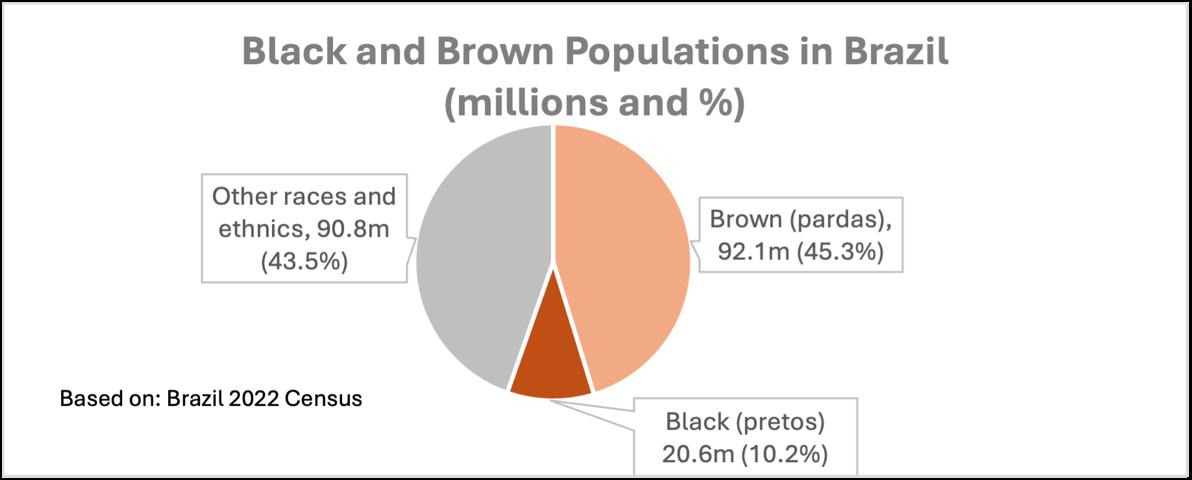
Brazil is the world’s fifth largest and the seventh most populous country in the world, with a population of more than 200 million people according to the Brazilian Institute of Geography and Statistics (IBGE). The Afro-Brazilian population, blacks and pardos is estimated at 53% of the population (IBGE). Brazil's black population is around 115 million, making it the second largest black country in the world, second only to Nigeria. Brazil is the first black country outside Africa. The sum of the black and brown parts of the Brazilian population is greater than the population of Ethiopia, the second most populous country on the African continent (Gomes, 2020).
The African diaspora has deeply influenced every aspect of Brazilian society, from the country’s demographics to its language, religion, cuisine, music, art, folklore and so on. Although black Africans were forbidden to practice their religions and forced to convert to Christianity, religions with African roots such as Candomblé and Umbanda are practiced in almost all regions of Brazil. The spiritual, cultural and social values of these religions represent a strong form of ancestral heritage and resistance for Afro-Brazilians. Another important aspect of the African diaspora in Brazil is the various musical genres created by black Brazilians. Popular genres such as samba, rap and funk have their origins in black culture. Samba, the most famous Brazilian music genre, has become a national symbol.
Even though the contribution of black Brazilians to the construction of Brazil is present in every aspect of the country, black Brazilians have always experienced the forces of racism, discrimination, lack of full integration in the socio-economic, educational and political arenas of Brazil. A notable aspect that historically contributed to the lack of full integration of blacks was the process of whitening that Brazil underwent after the abolition of slavery in 1888. Brazilian
political elites believed that Brazil would never develop and become a prosperous country because of its large black and brown population. It was from this perspective that Brazilian government, in the late 19th century and early 20th centuries, encouraged and subsided European immigration to Brazil, marginalizing the black Brazilian ex-enslaved people. May 13, 1888, symbolized the end of legal slavery in Brazil, but it was far from full freedom and citizenship. There were no laws or social programs to integrate the large population of former enslaved people.
In today’s Brazil, the struggles and resistance of black Brazilians have broken down several barriers to progress: there is greater access to higher education, employment, representation in the mass media, and a tentative increase in political representation. We can observe that younger black Brazilians have a greater sense of black identity and pride and are increasingly interested in preserving their culture. Black Brazilians are often engaged in constructive discussions at universities, in the mass media, in literature and in other areas about how to continue to fight against racism and build a more just Brazilian society.
Charity Clay
Colombia is a country in South America that borders both the Caribbean Sea and the Pacific Ocean. In addition, it has an Andes Mountain region, and Amazon Rainforest region, an Orinoquia region around the Orinoco River that is shares with Venezuela, and finally an Insular region comprised of the islands in both the Pacific and Caribbean.
Colombia is one of the most Afro-Descendant populated countries in the world; currently ranking 5th behind Brazil, the United States, Haiti and the Dominican Republic. Currently, the population is estimated at 53.4 million people with the 2005 census reporting 11% identifying as Afro-Colombian (Worldpopulationreview.com 2025) The Afro-Caribbean population are descendants of enslaved Africans and Maroons who were brought to the country by the Spanish in the 1500s mainly, through the port of Cartagena on the Caribbean Coast (Price 1996; Flores 2023 ). In the 1600s, Cartagena became the major South American entry point for the Transatlantic slave trade (Wheat 2011; Flores 2023). Africans from present day Angola, Congo, Ghana, Guinea Senegal and other countries were brought specifically to Colombia for their expertise in mining, farming, and construction (Pavy 1967)
In the Caribbean, enslaved Africans built colonial cities and in the Pacific they mined precious metals (Pavy 1967; Flores 2023). Across the country they worked on sugar plantations, grew crops and raised livestock and performed domestic and public service tasks (Flores 2023). Essential to Afro-Colombian identity is a tradition of resistance and rebellion. In 1529 one of the largest rebellions resulted in the coastal city of Santa Marta being burned to the ground and the establishment of the first Palenque (Price 1996; Flores 2023). Palenques are maroon communities of Self-Emancipated Africans . One of the most recognized communities is Palenque de Benkos named for Benkos Bioho, a Mandinka prince stolen from present day Guinea Bissau and brought to Colombia (Escalante 2017; Ferrari 2017). In 1599, he escaped along with a small group of between 20 and 30 enslaved Africans from various tribes to create a Palenque in the Montes de Maria region that would ultimately become recognized as the first Free Black republic in the Americas in 1603 (Ferrari 2017). In 2005, the community was proclaimed a “Masterpiece of the Oral and Intangible Heritage of Humanity” by UNESCO (UNESCO 2006)
Palenques were also very prominent in the Pacific region. In fact, the entire department of Choco is often considered a large Palenque because it encompasses the land of so many former communities (Davy 1967; Urrutia 2015). The Africans transported to the pacific to work on farms, plantations, and in gold mines were in constant rebellions with the Spanish. Maroons in the region refused to engage with the Spanish and maintained their African traditions in the rural areas of the region. Today, Choco is the Blackest department in Colombia with over 80% of its residents being Afro-Colombian (Urrutia 2015).
In 1810, Colombia gained independence from Spanish rule. Most of Simon Bolivar’s 4000 man army was comprised of Africans who fought for their freedom as well as the independence of Colombia (Reales 2007). In 1812, Cartagena outlawed the import of enslaved Africans, and in 1852, the country abolished slavery. Immediately after, the Country’s national position was to erase the African presence in Colombia through a process known as Blanqueamiento meaning “whitening” (Escobar & Chaves 2006). Similar forms of this process occurred across Latin America making whiteness synonymous with national identity. As resistance to this whitening process, Afro-Colombians in the Pacific remained in rural areas where they worked as farmers, miners and loggers as an alternative to the subordination they experienced in urban areas (EspanaEljaiek 2024). They experienced relative autonomy in the regions until their resource rich lands became targeted for profit.
As the only region in Colombia that borders both the Pacific Ocean and Caribbean Sea the location provided smooth access for products to be imported and exported. Because of the ancestral African farming practices that helped sustain the environment, the land was rich and its products of the highest quality (Espana-Eljaiek 2024; Flores 2023). As a result, Afro-Colombians became targeted for dispossession as government and foreign investors wanted to control the region. Part of removing Afro-Colombians for their lands has been the government's refusal to provide residents with access to education, healthcare, employment opportunities and political participation. These destitute conditions push many Afro-Colombians to leave in search of better opportunities (Ibarguen 2024). Afro-Colombians that remained in the region were targeted by government forces and corporations that hired paramilitary forces to use violence against the people to clear the land (Wouters 2001). In the 1970s, these lands in the pacific also became valuable to the growing illegal weapons and narcotics industries (Wouters 2001). This further intensified the violence targeting Afro-Colombians as Government forces, paramilitary forces hired by foreign agricultural industry investors and drug cartels with their own paramilitary forces fought to control the region (Wouters 2001)
Today, nearly 80% of Afro-Colombians in Choco live in poverty (Espana-Eljaiek 2024). They continue to suffer from government neglect fueled by a long history of systemic racism that leaves them without basic infrastructural resources like paved roads, clean water, electricity, and healthcare services (Prieto, Garcia-Esteves, & Ariza 2022; Espana-Eljaiek 2024). While the Peace agreement of 2016 included provisions to support agriculture in Afro-Colombian territories, the government has failed to subsidize the sustainable practices of Afro-Colombian farmers, to create and stabilize distribution across the country and internationally, and to create opportunities for Afro-Colombians to get their agricultural products to marketplace (Arocha 1998; Wouters 2022) In fact, Afro-Colombian farmers report being lowballed when they attempt to sell their agricultural crops.
These conditions drive many Afro-Colombians to leave for Bogota or stay and become involved with the illegal narcotics industry to survive. Their involvement includes becoming soldiers for various paramilitary organizations, either enacting violence on civilians and other
groups, or being involved in the economics of selling and trafficking drugs (Bratspies 2020; Ibarguen 2024). For those who stay in the pacific region and refuse to participate in the illegal industry, they face obstacles in their attempts to continue their ancestral tradition of farming due to the growing narcotics industry (Espana-Eljaiek 2024).
When Afro-Colombian land is taken over by paramilitary groups and used to grow coca plants, it brings extreme danger to civilians in the region because various armed paramilitary and government groups fight to control the growing, processing and transporting of the coca plant harvest (Bagley 1988; Bratspies 2020 ). Human rights activists have reported extreme violence against Afro-Colombian civilians by both government and paramilitary groups in regions where coca plants are grown (Thoumi et. Al 2002; Ibarguen 2024) By 1993, Colombia had become the world's largest producer of cocaine (Thoumi et. Al 2002 Ironically, Law 70 of the of the Colombian constitution passed the same year. The law was the first to recognize Afro-Colombians as an ethnic group and it provided legal protections to the people and their land and cultural heritage (Bratspies 2020). The law also included a provision to promote economic and social development in AfroColombian communities (Bratspies 2020). Unfortunately, the provisions of the agreement were not and have still not been honored (Bratspies 2020; Isaacson 2021). Afro-Colombian's in the pacific are being violently forced from their lands, their history and culture are not recognized in school curriculums or media programing, their communities still do not have basic infrastructure (Sanchez, Solimano & Formisano 2005; Ibarguen 2024). In fact, while celebrated as progress, much of the recent government supported development in the region is occurring at the expense of Afro-Colombians, their land, culture and human rights in similar ways to the narcotics industry (Espana-Eljaiek 2024)
Private corporations with western investors supported by the both government and the paramilitary groups have been able to use the violence in Afro-Colombian territories to displace residents from their land seizing it illegally through violence and intimidation to grow legal crops as well (Millian-Quijano & Pulgarin 2023). In the Tumaco region, which is over 90% AfroColombian, palm-oil corporations with foreign investors displaced residents from the land converting it to plantations making Colombia one of the world’s largest providers (MillianQuijano & Pulgarin 2023).
Afro-Colombians and Political Activism
In 2022, Colombians elected Francia Marquez as the first Afro-Colombian woman to hold the office. Marquez has a long history of freedom fighting for the environment, for AfroColombians and women in her country. Hailing from Cauca, the most Afro-Colombian populated state in the country, she fought against illegal gold mining in and contamination of the Ovejas river (2018 Goldman Prize Winner, 2025). Despite facing death threats from multiple sources, Marquez has been adamant about bringing change in for Afro-Colombian people. In December, at the First UN Permanent Forum of Afro-Descendants she made a call for UN States to pursue reparations for Africans and their descendants in the New World for the horrors caused by the transatlantic slave trade (Rodriguez 2023). She also insisted that conversations about climate justice are dedicated to the disproportionate exploitation of the land and water of Afro-Colombian communities (Rodriguez 2023). She will be the head of the new administration’s Ministry of
Equality that seeks to fulfill the 2016 peace agreements. Marquez’s commitment has inspired AfroColombians to continue and intensify their fright for equality.
Despite the struggles that Afro-Colombians face, they continue to be politically active. Lawyers, scholars, community organizers and artists have been on the front lines of the movement. Human rights lawyers fight for victims of government and paramilitary violence for AfroColombians to have their land and culture protected (Wouters 2001; Ibarguen 2024). Scholars have committed to writing and teaching about Afro-Colombian history and current conditions. In addition to teaching Afro-Colombian students, they are also increasing their public facing scholarship to spread the knowledge across the world, specifically throughout the African Diaspora and continent. Community organizers develop councils that meet with paramilitary groups, government officials, and private investors to express the concerns and advocate for the rights of Afro-Colombian residents (Ibarguen 2024). The Afro-Colombian National Peace Council is an umbrella organization that facilitates intergenerational conversations and initiatives for peace (CONPA PAZ 2021; Ibarguen 2024). Artists have continued to use their platforms in music, literature, fashion and other mediums to share and celebrate the history of Afro-Colombians and the present-day struggles to wider audiences (Ibarguen 2024).
Afro-Colombians have also embraced social media as an organizing tool. Recently, in October 2024, they organized a march of over 8000 Afro-Colombians in the capital city of Bogota, filling up the Plaza da Bolivar and setting up camp at the National university. This was the largest gathering of Afro-Colombians in the country’s history (Dario-red 2024; Ibarguen 2024). It was a successful march that brought together Afro-Colombians from across the country and drew attention from the African diaspora and continent that joined in solidarity and have written to their own governments to in support and solidarity.
Kwasi Densu
On December 9th, 2024, 240 delegates representing four continents and thirty nations, gathered in Cuba to participate in the historic conference “Cuba 2024 Decade for People of African Descent: Equality, Equity, Social Justice.” The goal was to explore the status of Afrodescendientes and assess the degree to which Cuban society has dealt with the question of racism since the Cuban Revolution in 1959. Understanding the sociohistorical context for the emergence of the conference can give us greater insight into the contemporary status of Cubans of African descent.
The conference was planned around the culmination of the International Decade for People of African Descent 2015-2024 (IDPAD). In 2013, the U.N. General Assembly adopted resolution 68/237, creating IDPAD, with the theme “People of African Descent: Recognition, Justice and Development”. Its stated goals were to create “a unique platform that emphasizes the important contribution made by people of African descent to every society, and promote concrete measures to stop discrimination and promote their full inclusion.”
The creation of IDPAD was an outgrowth of the U.N.’s Universal Declaration of Human Rights (UDHR) adopted in 1948, and the International Convention on the Elimination of All Forms of Racial Discrimination (ICEAFRD) adopted in 1966. Article 9 of ICEAFRD requires signatories to submit a biennial report “on the legislative, judicial, administrative or other measures which they have adopted” consistence with ICEAFRD’s antiracist values and policy goals. Historically, the Cuban Revolution perceives itself as a national expression of the institutionalization of the UDHR and the ICEAFRD, given its commitment to socialism and anticolonialism. In its fourteenth report it declared “the Cuban State has maintained a consistent attitude of condemning all forms of racial discrimination, as is evident in its legislation and its plans, as well as in the international commitments which it undertakes.”
Some would suggest however, that Cuba’s commitment to eliminate structural racism is at best contested, and too often contrasts sharply with the concrete, day-to-day experiences of African descendant communities. Leading Afro-Cuban intellectual Esteban Morales Dominguez had this to say, “in Cuba, racism has been approached historically more with the fear of creating social divisions than with a determination to end it. Blacks, mestizos, and many people of conscience have had to wait too long for a discussion. This is now causing contradictions and dysfunction in an extraordinarily humanistic society, which has struggled for social justice, equality, and egalitarianism.”
These sensibilities are confirmed by the historic and contemporary mobilization of members of civil society committed to antiracism and the development of alternative approaches to the Cuban national project. Organizations like Cofradía de la Negritud (Black Brotherhood),
Red Barrial Afrodescendiente (Afrodescendant Neighborhood Network), Comité Ciudadano de Integración Racial (Citizens Committee for Racial Integration), the Articulación Regional Afrodescendiente (Regional Network of People of African Descent Cuba Chapter ) and others, have sought to address the problem of racism through critiques of state policy, the development of alternative theories on race and Cuban society, and grassroots organizing through popular education strategies.
At the state level, the Union of Writers and Artists of Cuba (UNEAC) traditionally has served as a space open to exploring the “question of race”, the history, and culture of African descendant communities. In 2009 UNEAC established the Commission for the Fight Against Racism and Discrimination (CFARD). It later renamed CFARD the La Comisión José Antonio Aponte (José Antonio Aponte Commission or CJAP). José Antonio Aponte was a carpenter, sculptor, and member of the “free Black militia” in Havana Cuba. He was of Yoruba descent and a principal leader in a major rebellion against slavery in 1812. From 2012-2023 CJAP published ninety-seven bulletins addressing issues of race, international political economy, the history and culture of African descendant people in the Americas, and many other topics. Some activists, however, suggest that CJAP’s primary work has been with Cuban intellectual and political elites, limiting its capacity to be an instrument for fundamental change at the grassroots level.
The United States Embargo, the “New Economy”, and Racism
Historically U.S. foreign policy towards Cuba has promoted isolation, destabilization and regime change. This approach is codified in the U.S. embargo first initiated by the Kennedy administration in 1962. In response Cuba developed its historic relationship with the Soviet Union and the Council for Mutual Economic Assistance (CMEA) until its collapse in 1991. Without the support of the Soviet Union and the CMEA, Cuba was thrown into a crisis euphemistically called the Special Period in the Time of Peace (1991-2000). During this era the Cuban economy virtually collapsed. The population experienced severe food, medicine, and energy shortages. In response, a series of “experimental” economic reforms were introduced under Fidel and Raul Castro between 2000-2014. The reforms were characterized by incremental attempts at decentralization, privatization, and the development of new alliances with oil rich countries like Venezuela under the leadership of Hugo Chavez.
Within this international context tourism, and a strategic dependence on remittances, became new sources of income for the Cuban state. The détente reached by Raul Castro and the Obama administration in 2012, breathed “life” into the Cuban economy, expanding its access to goods, services, tourist markets, and foreign capital, unparalleled since its former relationship with the Soviet Union. Dubbed the “New Economy”, Cuba sought to transcend the historic limitations imposed by cold war politics while forging its unique path of development. With the influx of foreign capital, a surge in tourists from North America and Western Europe, and an increase in remittances from South Florida and Spain, racial inequality resurfaced in ways that popular discourse would suggest that Cuba had eliminated.
According to Alejandro de la Fuente and Stanley R. Bailey, a comparative study of census data from 1981, 2002, and 2012 suggest that “Cuba continued to be remarkably egalitarian in the early decades of the 21st century, even after the devastating impact of the Special Period of the
1990s.” This egalitarianism, however, was a function of the dominance of the public sector in Cuban society. Life expectancy, education levels, professional status, and income, all managed by the Cuba state, were relatively equal. For instance, in 2012 23.6% of the Cuban population who identified as Blanco (white) were professionals, scientists, and technicians, 23.6 who identified as Negro (Black) and, 22.7 who identified as Mestizo (mixed race). These trends, however, don’t replicate themselves in the New Economy i.e. the emerging private sector. Fuente and Bailey suggest that “Afro-Cubans have encountered significant barriers to access the growing private sector, which includes self-employment in tourist-related services such as housing rentals, restaurants, and transportation.”
In 2017 the Trump administration reversed the Obama administration’s policies towards Cuba, strengthening restrictions and sanctions. In 2019 the COVID-19 epidemic pushed Cuba’s tourist sector to the brink of collapse. In July of 2022 mass protests began to break out due to food and energy shortages not seen since 1994 following the collapse of the Soviet Union. Between 2022-2024 it is estimated that close to 1 million Cubans left the island seeking asylum. Major destinations include the United States, Mexico, and Spain. These migration patterns continue. As a result of the new economic reforms, hyperinflation, the circulation of the U.S. dollar, food shortages, the periodic collapse of Cuba’s energy grid, and the relative collapse of the tourist sector, a second Special Period in Peacetime has emerged in which the Cuban state has begun to “scale back” its historical role in subsidizing essential goods and services. Under these conditions racial inequality is expanding.
In November of 2019 Cuba’s Council of Ministers approved the National Anti-Racism and Racial Discrimination Program (NARRDP). “Its objectives include identifying the causes that encourage discriminatory practices; diagnosing possible actions to be developed provincially, locally, and by different branches of the economy and society; disseminating the historical-cultural legacy of Africa, our native peoples and other non-white peoples as part of Cuba's cultural diversity; and fostering organized public debate on racial issues within political, mass and social organizations, as well as their presence in the media.” NARRDP surfaced as a response to public debate over the realities of racial discrimination in Cuba. Cubans of African descent are over policed, overrepresented in the prison population, underrepresented in the lucrative tourist sector, and least likely to receive remittances from family members abroad.
The Cuban state’s official position on the matter is that racism, in the Cuban context, is not a “political problem, but a cultural one”. This definition of “culture” relegates racism to the realm of social relations and personal interactions born of older social patterns and beliefs inherited from the colonial and prerevolutionary periods. Cuba’s African descendant social movements continue to challenge these basic assumptions and approaches to the issue of racism in the Cuban context. This raises the perennial question, is the issue of African life and identity central or ancillary to Cuba’s contemporary, national character? In addition, does the state’s embrace of the notion “a single color in the spirit of Cuba” obfuscate the problem of racism or help to eliminate it? These questions remain unanswered.
Bonfas Owinga
Afro-Europeans an estimated 15 million people of African descent live throughout Europe, with the largest populations found in France and the United Kingdom. Most AfroEuropeans are concentrated in just a dozen countries. Their presence on the continent stretches back many centuries, beginning with early trade networks in the 2nd–4th centuries. African migration increased after the Black Death, when labor shortages led European societies to import tens of thousands of enslaved Africans. Later, European colonial expansion, including French assimilation policies that made some Africans colonial citizens, brought additional Africans to the continent.
In the 20th century, both world wars further shaped Afro-European demographics. African soldiers fought in Europe, and many settled there afterward. Following World War II, European nations recruited workers from the Caribbean and Africa to rebuild damaged infrastructure and support expanding industries symbolized by the 1948 arrival of Caribbean migrants aboard the Empire Windrush in Britain. More recent African migration has been driven by economic opportunity, political instability, and conflict in various regions of Africa.
Despite this long history, Afro-Europeans continue to face systemic discrimination across key institutions such as education, housing, employment, and policing. Nearly half report experiences of racial discrimination, and many encounter racial profiling and harassment. These inequities contribute to persistent socio-economic gaps, including higher unemployment and lower political representation in several countries.
Beginning in the 1950s and 1960s, widespread racial violence such as the Notting Hill riots in London and attacks targeting North and West Africans in France sparked a wave of Black activism across Europe. Organizations like the Black Liberation Front, the League of Colored People, and the New Black Movement mobilized communities to challenge racism, defend civil rights, and build solidarity networks. This tradition of resistance continues to shape Afro-European political and cultural life.
Despite significant challenges, Afro-Europeans have made substantial contributions to Europe’s cultural richness, intellectual development, and economic life. Their influence is visible in literature, arts, sports, music, scholarship, and community leadership. In some countries, such as the United Kingdom, Afro-descendant communities show strong educational outcomes, with higher rates of college or postsecondary attainment than the white population. Their resilience and cultural impact continue to enhance Europe’s diversity and societal growth.
Fatiha Kaouès
The status of Africans in France: mobilizations and political issues.
In 2024, according to the Institut national de la statistique et des études économiques (INSEE), there were 6.7 million people of African origin in France, representing almost 10% of the population. In the 1960s, African immigrants began to make social demands, before focusing from the 1980s on denouncing the racism and discrimination to which they were subjected, against a backdrop of massive growth for the main far-right party, the Front National.
By the end of the decade, a new generation of activists was expressing religious demands. This shift from ethno-racial categories to a religious register is the fruit of the failure of previous integration formulas. Indeed, the Marches pour l'égalité (Marches for Equality) organized by African-French within the militant associations SOS Racisme and Fédération des potes failed when their leaders were co-opted by the Socialist Party, causing them to lose their popular base.
From then on, the political organization of these minorities took place under the banner of Islam. Public authorities, for their part, are worried about the development of political Islam, which encourages them to support a more visible and therefore more controlled form of Islam. Paradoxically, it is the fear of a potentially fundamentalist Islam that leads France to respond to the demands of French Muslims for the development of their religion. As early as 1990, France set up the Conseil de réflexion sur l'Islam de France (CORIF), followed by the Conseil Français du Culte Musulman (CFCM) in 2003.
This institutionalization of Islam failed, however, for two reasons. Firstly, the top-down approach undermines the legitimacy of structures created without consultation. Secondly, the association of foreign chancelleries with this organization by the public authorities weighs heavily on French Muslims, trapped by rivalries between their countries of origin. In the mosques, Algeria and Morocco in particular, via their respective consulates, have constantly tried to influence the electoral choices in favor of their diasporas.
As a result, the French government has turned its back on the CFCM to create the Forum de l'Islam de France (FORIF) in 2019. One important issue concerns the construction of Muslim places of worship and cemeteries, the number of which is considered insufficient. Another demand from Muslims concerns the implementation of a status for imams (conferring salary and social protection), which would be a major step forward for the organization of Muslim worship. However, the public authorities have tried to control the entire process. For example, they excluded imams who refused to sign a document called the Charter of Principles. This kind of moral contract, adopted in January 2021 and which the imams were required to sign affirms Islam's “compatibility” with the Republic and denounces its “extremist currents”. Opponents criticize this as a breach of the principle of equality, insofar as it imposes obligations only on Muslim clerics, as well as an attack on French laïcité, which incorporates a principle of neutrality on the part of public authorities in matters of religion.
Among the African-French organizations mobilized against Islamophobia and racial discrimination, it is worth mentioning the Conseil représentatif des associations noires (CRAN), which was created in 2005 with the aim of defending the black populations of France who are victims of discrimination, even if its legal and preventive actions (such as the national discrimination barometer) concern all ethnic and religious minorities. Since its inception, it has campaigned for reparations linked to slavery and colonization, but to date has been unsuccessful. While the instruments for countering racist violence and discrimination have gradually improved in France, the political and judicial response remains largely inadequate. The persistence of racial discrimination goes hand in hand with a denial of its scale and institutional nature, as racism corrupts the police force, for example. This blindness must be set against the weight of colonial imagery that continues to permeate whole swathes of society, the media and political circles.
One of the main stumbling blocks to the realization of the political and religious rights of AfricanFrench lies in the security management implemented by the public authorities. These latter have put in place a highly contested legislative arsenal designed to combat “separatism”. The Law reinforcing respect for the principles of the Republic, passed in July 2021, has led to the closure of dozens of Muslim places of worship, the dissolution of numerous associations of AfricanFrench, and the much-publicized expulsion of several imams with controversial positions. This law follows on from numerous normative initiatives introduced by the political authorities over the past 15 years, which, according to political scientist Philippe Portier, illustrate a “security inflexion” in the French secular regime. Also known as the “separatism law”, it has been accompanied by the establishment of departmental divisions to combat Islamism and self segregation into community lines (« repli communautaire »), whose scope of action is very broad, even sanctioning sports clubs and restaurants accused of encouraging communitarian withdrawal.
A rhetorical shift can be seen from the defense of values of the Republic constantly invoked but never precisely defined, to separatism then to Islamist separatism whose terms are not further explained. The media in general have largely supported these developments, regularly saturating public debate with controversies about Islam around recurring themes such as the “Islamic headscarf”, the wearing of which is considered in itself by many analysts and politicians to manifest a form of proselytism. The result is a public debate which reveals a Manichean contrast between certain principles (such as gender equality and tolerance) supposed to define the essence of the French nation, and a retrograde exogenous culture imported mainly from Africa.
While accusations of communitarianism, or even support for terrorism, have affected a large number of African associations and people for decades, the law on separatism marks a real break in that it creates a state of exception. Justifying administrative dissolution procedures, it deprives these organizations of the essential instrument of the rule of law, i.e. judicial action. It is in this highly coercive context that the Council of Ministers has proceeded with the dissolution in 2021 of key organizations fighting Islamophobia, such as the Collectif contre l'islamophobie en France (CCIF) and the Coordination contre le racisme et l'islamophobie (CRI). In particular, these two organizations are accused of having blamed the political authorities for practicing institutional racism, and of having thus, according to the authorities, fanned the flames of resentment and hatred towards France among Afro-Muslim minorities.
In their place, the government announced the birth in February 2024 of the Association de défense contre les discriminations et les actes antimusulmans (ADDAM). This top-down organization is not yet popular with those concerned, most of whom don’t even know it exists. A harsh report by a team of researchers from the Observatoire des libertés associatives denounces serious infringements of associative freedoms and politically-motivated dissolutions carried out without formal proof of any offence or crime. Muslim schools are also affected by this repression, when the government decided to put an end to their state subsidies and condemning them to a precarious existence.
In her recent research on the subject, sociologist Diane-Sophie Girin notes that subsidized Muslim schools are treated unequally: they would be subject to much more frequent inspections and much harsher sanctions for similar reasons, compared with Christian and Jewish establishments. Besides, recent sociological research shows that this security policy has powerful deleterious effects on African activists, especially if they are perceived as Muslim and committed to defending their political rights, by not only hindering their means of financing and action but also discouraging their collective initiatives which they fear will incur too high a social or political cost. While the French government has promised to allocate additional funds to securing Muslim places of worship, which are often the target of Islamophobic attacks, it will have to rethink the security approach that has dominated political and media treatment of African-French minorities to address more efficiently the thorny issue of racial and religious discrimination.
This security perspective, if it were to be maintained, could only deepen the distance between African minorities and the French state, in the context of a persistent ebb in the collective organization of minorities that appears to be linked to low-key forms of repression or even stigmatization facilitated by the vague categories of communitarianism or separatism, which function as so many disqualifying labels.
The reason why anti-racist actions are « segmented » in this way (African associations fighting against discrimination affecting Africans, African-Muslim organizations fighting against Islamophobia) can be explained by the particular history of anti-racism in France. One of the oldest militant organizations, LICRA (Ligue contre le racisme et l'antisémitisme - League against racism and anti-Semitism, primarily involved in combating anti-Semitism) has taken on major political and media importance. Noting the very low level of investment by the authorities in the fight against racism affecting Africans and Muslims, the latter organized themselves following the LICRA model.
Cecil Gutzmore Hashim Gibrill
Introduction
In the 2021 United Kingdom Census 2.4 million people identified as Black British (“Black, Black British, Black Welsh, Caribbean or African”), constituting approximately 3.7% of the total UK (England, Scotland, Wales, Northern Ireland) 68 million population. Another 762,000 (1.3% of the population of England and Wales) identified as “Mixed White/Black African” or “Mixed White/Black Caribbean. Afro-Britons are currently the second largest African descended community in Europe. This commentary discusses the history and current day social, economic, political, and cultural presence of people of African descent in Britain. It highlights the long history of this presence. It provides an overview of the activisms and current day situations and Afro-Britons.
Visits and migration to and settlements in these islands of north-west Europe by continental and diasporic Africans span across British history, geography, and social structures. Beyond the prehistoric migrations, from the Roman invasion in the 1st century BCE through to the current day people of African descent have assumed a definite racial-cultural and socio-economic presence in the UK. Africans served as foot soldiers, commanding officers, and rulers in Roman Britain. Voluntary movements to and from Britain by Africans during medieval times (c. 500 – 1500 CE) relating to seafaring, commerce, diplomacy, artistry, and scholarship were followed and eclipsed by forced migrations centering on the trafficking and enslavement of African peoples. Evidencing the centrality of the UK in the transatlantic slave trade (up to 1807), human bondage in the colonized Americas (up to 1833,) and Africa-Europe-Americas triangular trade, (c. 1500s to 1900s) Afro-British communities emerged in major trading ports, industrial towns and commercial centers across the UK. The origin and development stories of Afro-British urban and rural communities is increasingly being researched and told.
Post-emancipation from enslavement, amid imperialism and war, African and Caribbean soldiers were enlisted to fight in colonial and world wars. People of African descent also came to the UK as scholars, teachers, technicians, artisans, health workers, clergy, seafarers, and wayfarers. They added to the growth and diversity of Afro-British communities. The Black presence in postWorld War II Britain has been constituted by mass labour and educational migration and generational growth. Migrants have come from across the African continent and the Caribbean spurred by the opportunities for employment, study, creativity, education, and political activism. These post-1945 (often popularly labelled “Windrush”) generation of migrants of African descent have laboured, studied, settled, biologically and culturally reproduced, politically resisted and sometimes returned to their historical lands of origin. The majority of post-1945 migrants of African descent have come from continental Africa.
There is a pervasive narrative that race relations and racism in the UK and in the US are not comparable. The argument is that enslavement had a miniscule presence in the British Isles, that racism in the UK is individualistic not systemic, that race relations are a matter of social difference not ingrained animosity. By extension, immigrant success is credited to an internationally exemplary British openness, not to immigrants’ efforts. Reality contradicts this narrative. Recurringly Afro-Britons have been subjected to political, legislative, and riotous attacks making clear that they were unwelcomed and regarded as alien.
In 1596 Queen Elizabeth called for the deportation of “Blackmoores.” Four centuries later (between1968 and 1978), leading politicians spoke of the “prospect of a bloody conflict” (Enoch Powell) and claimed British people [white] feared being “rather swamped” by to the growing presence of migrants from continental and diasporic Africa, and South Asia. Slogans of racist hate, anti-Black race riots (Cardiff 1919, Notting Hill 1956 and many more), the politics of discrimination, institutionally racist policing and discriminatory (“patrial”), increasingly restrictive immigration legislation feature prominently in the history of UK race relations.
Afro-Britons have resisted individual, institutional, and systemic discrimination and racism. Resistance and self-agency have taken many forms including flight from bondage, community and institutional building, cultural assertion, public intellectual and political party activism, mass protests and uprisings. In union halls, community halls, youth clubs, bookstores, frontline grassroots centers, study groups, political associations, and places of worship AfroBritons have organized, developed and spread their visions and programs, forged coalitions, raised funds, and taken to the streets to engage in direct actions.
Afro-British political movements across time include anti-colour bar and civil rights organizations, parent and student organizations, feminist-womanist formations, and black nationalist, black-Marxist, and Pan African organizations. Black politics have confronted racebaiting politics, racist policing, violent attacks, housing and employment discrimination, and miseducation. Emerging from and propelling the long history of varied resistance and self-agency, community activists such as John La Rose, Darcus Howe, Altheia Jones-Lecointe, Beenie Brown, Gloria Cummins, Linton Kwesi Johnson, Gus John, and Cecil Gutzmore have made notable contributions to raising awareness, building cultural and advocacy institutions, and uplifting the voices of Afro-Britons. Among many acts of resistance are the Notting Hill Carnival (1976) antipolicing uprising, the Lewisham (1977) anti-fascist street clashes, the Black People’s Day of Action (1981) anti-state mass protest, and the insurrections in Brixton (1981), and across England (Birmingham, Leeds, London, Liverpool, Manchester (2011).
Britain has been a prominent site of anti-racist and anti-imperialist politics. Britain was a major site of 20th century Pan African organization and activism, beginning in 1900 with the PanAfrican Conference in London. Activists and scholars of African descent connected resistance to racist oppression in the imperial centre with resistance to imperialism and race and class supremacists in the colonies and dependent territories. The 1945 historic Fifth Pan African
Congress in Manchester demanded “full and unconditional independence” for the colonized peoples and territories of Africa and the Caribbean, and for all colonized peoples.
Anti-enslavement, Pan-African, African nationalist, Caribbean nationalist, anti-colonial, anti-Apartheid, anti-racist and anti-imperialist movements have all found a home in Britain. Phyllis Wheatley, Anna Julia Cooper, Sylvester Williams, W. E. B. Du Bois, Marcus Garvey, Amy Ashwood Garvey, Amy Jaques Garvey, Kwame Nkrumah, Jomo Kenyatta, C L R James, Claudia Jones, Walter Rodney, and George Padmore have Britain among the sites of their political, social and cultural activism. Malcolm X, Martin Luther King, Jr., Angela Davis inspired many AfroBritons. Famously, Claudia Jones is buried next to Karl Marx in Highgate Cemetery. Her gravestone reads “VALIANT FIGHTER AGAINST RACISM AND IMPERIALISM WHO DEDICATED HER LIFE TO THE PROGRESS OF SOCIALISM AND THE LIBERATION OF HER OWN BLACK PEOPLE.”
Black Britannia in the 21st Century
The Afro-British community contributes substantially to the social, cultural, political, and economic fabric of the United Kingdom. Afro-Britons span the social spectrum and social endeavour. They include acclaimed scholars, educators, activists, politicians, journalists, entrepreneurs, actors, writers, filmmakers, musicians, cultural artists, sportspersons, and public intellectuals. African and Pan-Africa music genres, style, and cuisine are commonplace in British society. Across the UK economy, Afro-Britons engage in the broad array of professional, manufacturing, and commercial sectors. They are also part of parallel and marginal economies.
Gov.UK through the Office for National Statistics (ONS) gathers substantial, disaggregated data regarding British “ethnic groups,” including Black and African communities. The mass of ONS data reveal among many other social indicators: 3.1 million Afro-British (Black and Mixed ethnicities) constitute approximately 4% of the of the 68 million United Kingdom population. Afro-British communities exist largely in major urban areas. 50% of Black British live in London as do 31% of Mixed White/Black African and 26% of Mixed White/Black Caribbean ethnicities. Other Afro-British locations include Manchester, Liverpool, Birmingham, Coventry, Leeds, Sheffield, Aberdeen, Cardiff, and Belfast. Afro-Britons have a feeling of belonging to the UK. The steady growth of the total Black population (from 3.3% to 4.0% of the UK population between 2011 and 2021) is due both to organic community growth and continuing migration from across global Africa. The four leading migrant countries of origin in the past decade were Nigeria, Jamaica, Ghana, and Somalia. Migrants come for educational, employment, family unification, and asylum reasons. The median age of Afro-Britons is 32; significantly younger than the national median age of 40.
For Afro-Britons community and individual endeavor exist alongside persistent inequalities, and systemic racism. Black ethnic groups have significantly lower levels of household wealth than the White ethnic group. Afro-Britons receive between 4% and 15% less per hourly pay than the White ethnic group. Black ethnic groups have levels of unemployment two times the national average. From one-third to three-fifths of individuals of Black ethnic groups report experiencing racists insults, property damage, and physical assault. Public services such as policing, housing, education, health care (including disproportionate COVID deaths and Black
maternal and infant mortality) continue to be institutional sites of proven direct and structural discrimination and racism.
In 2023 the United Nations Working Group of Experts on People of African Descent expressed deep concern
“….about the human rights situation of people of African descent in the UK. Stark and unsustainable inequalities are underpinned by systemic racism, bias, racially disparate and discriminatory policing, and surveillance and control of people of African descent”
The UK government commissioned Casey Report 2023 found London’s Metropolitan Police Force to be a site of institutional racism.
Currently (2025) anti-migrant language and policy has been mainstreamed by the governing Labour Party, the opposition Conservative Party and the surging Reform Party. Introducing In May 2025 introducing the government White Paper Restoring Control Over the Immigration System Prime Minister Keir Stramer argued “we risk becoming an island of strangers” and outlined new immigration requirements entrenching official notions of what it means to be “British.” Prominent present-day political issues regarding the social status and wellbeing of AfroBritons center on racial profiling and inequities in criminal justice, education, housing, and healthcare, disputed residency rights, migration and asylum, compensation for illegal deportations, and reparations for enslavement and colonialism.
Alongside community-based politics and social movements, peoples of African descent are increasingly prominent in UK electoral party politics. Resulting from the 2024 UK general election 90 of the 650 Members of the British parliament are from “minority ethnic” backgrounds. The Afro-British politicians among this grouping are not like-minded; they cover the ideological spectrum of the major political parties. Kemi Badenoch, the current leader of the opposition Conservative Party, is of Nigerian descent; she embraces neo-liberal, neo-Thatcherite, “anti-woke” policy positions. The UK's current Deputy Prime Minister in the Labour Party government, David Lammy, is of Guyanese descent and is a centrist social democrat. Within the Labour Party, AfroBritish MPs, including Diane Abbott, and Dawn Butler (and previously Bernie Grant) have often been at political odds with centrist New Labour, and accused of race-baiting as they seek to amplify the political concerns of people of African descent in the UK and beyond.
Long standing community growth, sense of national belonging and political and economic self-agency exist in concert with anti-migrant rhetoric and attacks, white nationalist ideologies and movements, persistent inequalities, discriminations, and racism. These are the broad societal contours within which Afro-Britons live their multifaceted existence.
Bonfas Owinga
Afro-Asians also known as Black Asians or Blasians are a diverse population of people of African descent living across Asia. Most trace their ancestry to enslaved Eastern and Central Africans brought to the region during the Arab Slave Trade, where they served as soldiers, domestic workers, sailors, entertainers, palace guards, cooks, and plantation laborers. Additional waves of voluntary African migration occurring before, during, and after the slave trade also contributed to the growth of Afro-Asian communities. South Korea has the largest Afro-Asian population in the Far East , while the Siddis of India, the Sheedis of Pakistan, and the Kaffirs of Sri Lanka represent the largest and best-known communities in South Asia . Other Afro-Asian groups live in China, Yemen, Iran, the Maldives, and several other countries.
Afro-Asians remain among the least visible, least documented, and least studied Africandescended populations in the world. Religious conversion, intermarriage, geographic isolation, and assimilation into the lower tiers of local social hierarchies have obscured their histories and identities. Their long-standing marginalization has further eroded their sense of collective identity, shared culture, and diasporic consciousness.
Across Asia, Afro-Asians continue to experience systemic discrimination and social exclusion, compounded by historical economic marginalization. These conditions contribute to persistent poverty, unemployment, and limited access to quality education, healthcare, housing, and economic opportunities . In largely homogenous societies such as South Korea, Japan, and China, Afro-Asians are frequently stigmatized and perceived as outsiders . Even so, some progress has been made: in India, the Siddis of Gujarat and Karnataka qualify for Affirmative Action benefits, and several Siddi youth organizations have emerged to promote solidarity, empowerment, and community consciousness .
Despite their challenges, Afro-Asians have made significant cultural, artistic, and social contributions across the region. Their influence is especially evident in music through distinctive African rhythms, percussion traditions, and instruments used in performances such as dhamal or ngoma, chaush dances in India, and Bodu beru music in the Maldives . Afro-Asian communities have also shaped religious practices as spiritual healers and shrine caretakers and have left linguistic marks, with Swahili words appearing in Arabic and Urdu vocabularies. Their architectural contributions particularly in the design and construction of forts and mosques reflect their technical skills and cultural knowledge.
Preya Bhattacharya
Though there are very few people of African descent in India, there is one constitutionally recognized group, who are of African descent, and have lived in India, since 1st century C.E., that is the Siddis. Siddis were initially known as “Habshis.” According to the 2011 Indian Census, there are currently around 50,000 Habshis in India, (Karmwar and Smita, 2022, p. 58). Most Habshis live in the states of Gujarat, Maharashtra, Karnataka, Andhra Pradesh, and union territories of Goa, Daman and Diu. They follow a mix of Indian, and African cultural traditions, practice either Christianity, Islam, or Hinduism, and speak languages like Konkani, Urdu, and Marathi.
During the ancient era, between 1st - 3rd century C.E., Egyptian traders and importers brought Siddis to India, as slave musicians, and concubines (Singh 2023; Stewart 2015). During the medieval era, between 1200-1400s, rulers like the Delhi Sultanate, and Ilyas Shahi of Bengal, started to employ Siddis, as soldiers in their armies, and navies, which led to an increase in the migration of Siddis, from Africa to India (Singh 2023, Suzuki 2020, Mengesha 2003). Since then, Habshis have worked as soldiers, palace guards, and even created their own kingdoms, in different parts of India (Singh and Dalal, 2019, p.152; Bhattacharya 2018; Das and Upadhyai 2017, p.1385). During the modern era, between the years 1600s-1800s, the Portuguese, French, and British traders, and later colonizers, started to bring Habshis to India, as slaves. Along with Ethiopia, these Habshis were from neighboring East African countries of Kenya and Mozambique, and they helped Portuguese traders, construct houses, and churches, in the colonized territories, like modern-day Goa.
In 1843, the British East India Company abolished slavery in India. This helped Habshis become independent, though they still mostly worked as soldiers for the different princely states, in states like Gujarat, Karnataka, and Maharashtra, and union territories like Goa, Daman and Diu (Singh 2023). But, when the Indian Government implemented the 1947 Indian Independence Act, most Habshi soldiers lost their jobs, which led to a loss in their political and social status as well (Mengesha 2003, p. 97). To compensate for this, the Indian government started to provide subsidized housing, and pension for Habshi soldiers. Politically, the government adopted various constitutionally-based affirmative measures, like protecting Habshis as Scheduled Tribes (STs), in the states where they mostly live, which has helped Habshis gain access to reserved quotas/seats, in educational, economic, and political sectors (Karmwar and Smita, 2022, p. 59- 61). Despite these initiatives, Habshis still experience a wide range of political, economic, and social discrimination, in their everyday lives. I highlight the prominent current day concerns of the Siddi community, and the various political, economic, and social policies that have been adopted, to promote equality for Siddis in India.
First, politically, Habshis have a very low representation in state and national government offices. As an example, though Habshis in Gujarat participate in local governments, they still lack
representation at the state level (Péquignot 2020, p. 454). In Karnataka, Habshis have been recognized as a Scheduled Tribe, in the three districts of Uttara Kannada, Dharwad, and Belagavi. But, there are many districts where they are still recognized as OBCs (Other Backward Classes), rather than STs, which reduces their overall access to political, economic, and social benefits (Péquignot 2020, p. 453).
Second, economically, a majority of Habshis are still dependent on the informal economy, and temporary employment opportunities, rather than having access to stable jobs in the formal economic sectors (Arun 2022, p. 156). This has led to increased unemployment, and poverty, amongst Habshis (Arun 2022, p. 156). Moreover, though there are reserved employment opportunities, in the public sector, the private sector companies are not legally required to reserve seats, which has reduced the number of jobs reserved for Habshis.
Third, socially, Habshis often face ostracization, and exclusion, because of their physical features, skin color, caste, race, and ethnicity (Péquignot 2020, p. 451). Moreover, though Habshis have seats reserved in public schools, and public universities, they still face bullying, and discrimination when they attend schools (Arun 2022, pp. 147-148). Some villages don’t even have schools, so Habshis have to walk a long way to reach the nearest local school (Kumar and Dubey 2024, pp. 4-5). This has led to an increase in school dropouts amongst young Habshis, especially girls. There is also huge gender inequality amongst Habshis, as girls are usually not allowed to continue education, many of them are forced into early child-marriages, and have less access to healthcare, and economic independence, as compared to Habshi men (Kumar and Dubey 2024, pp. 3-6). Since Habshis have a patriarchal social system, women are usually not allowed to make household decisions, and/or participate in political decisions at the local community level, in the Siddi Panchayats (Kumar and Dubey 2024, p.6). In the last few years, this has encouraged the growth of new NGOs, that specifically focus on Habshi women equality, and empowerment, both within the community, and outside.
To address these issues, Habshis have started to form their own political associations, and economic cooperatives (Péquignot 2020, p. 454; Karmwar and Smita 2022, p. 61). For example, in Gujarat, Habshis have formed the “All Sidi Tribe Society Advancement Committee Surva”, which organizes safaris in the Gir forest of Gujarat (Péquignot 2020, p. 455). These initiatives have helped Habshis create new employment opportunities for themselves.
Economically, in the last few years, governmental and non-governmental organizations have started to apply microfinance programs, to encourage Habshis to set up their own businesses, especially for women. But, scholars have argued that these initiatives need to include vocational training, and adult literacy programs, which can help ensure better success of these businesses (Kumar and Dubey 2024, p. 7).
In the last few years, Habshis have also started to connect with one another, through online media platforms, like WhatsApp and Facebook (Péquignot 2020, p. 456). This has led to the growth of a pan-Habshi identity, both domestically, and internationally, specially with the help of UN initiatives like the International Decade for People of African Descent, 2015-2024.
In the future, the state and national governments need to play a bigger role in ensuring that Habshis across all states, and union territories, are able to access the same political, economic, and social rights, rather than in just a few districts (Kumar and Dubey 2024, p. 7). The government should also ensure that Habshis have equal access to hospitals, healthcare opportunities, roads, electricity, and clean sanitation facilities, along with establishing at least one school in every village, and locality, that Habshis live in (Kumar and Dubey 2024, p. 7).
Along with these political, economic, and social policy initiatives, there are many different governmental scholarships, provided by the Ministry of Tribal Affairs, specifically for Scheduled Tribes (National Tribal Fellowship Portal). These scholarships can help young Habshis access higher education opportunities, in India, and/or abroad, along with getting better job opportunities after graduation. But, Habshis are sometimes not aware of these existing opportunities. So, in the last few years, representatives from both governmental, and non-governmental organizations, along with Habshi community leaders, have started to play a more active role in communicating with Habshis, and making them aware of these scholarship opportunities.
In conclusion, Habshis are one of the historic communities, who have lived in India since the 1st century C.E. Despite their rich heritage, there has been a decrease in the political, economic, and social status of Habshis, especially in post-independent India. To address this, the state and national governments have adopted a variety of policies to help Habshis regain their status. Despite these policies, Habshis still face a number of political, economic, and social issues, in their everyday lives. Hence, in this report, I have suggested a few alternative policies that can help increase the rate of literacy amongst Habshis, especially in the Higher Education levels, which will help them gain stable formal economy jobs. These educational opportunities can also help address patriarchal social norms, related to gender inequality, and Habshi women’s rights.
Joseph Jones, Celeste White, Hashim Gibrill
The Status of Global Africa presents policy relevant data and commentary regarding the lived circumstances of People of African Descent. Information is gathered to illuminate the common and diverse experiences of African and African diaspora communities across the globe. The purpose is to provide a verifiable foundation for understanding our conditions and serving the needs of public policy advocacy and activism. W. E. B. Du Bois Du Bois admonished us “If we would solve a problem, we must study it.”
The Status of Global Africa builds out a Global African Diaspora Liberation Index (GADLI). The Liberation Index is built upon an Assets Perspective as opposed to Deficits Perspective. It highlights achievements, human and material assets, self-directed institutions, resistance and transformation. In so doing, it provides data for evidence-based transformation strategies. It also illuminates discrimination, injustice, oppression, inequalities, and racism experienced by African Descended People, providing data for evidence-based public policy evaluations, advocacy and interventions. It is also future oriented, exploring demographic trajectories, human and material resources trajectories, organizational, political, and ideological trajectories.
GADLI is intended to provide a comprehensive liberation index designed to:
1) quantify and evaluate the well-being of people of African descent globally
2) provide a data-rich resource regarding communities absent from existing databases
3) provide a comparative mechanism to identify and assess community strengths, assets, self-agency, inequalities and injustices
4) build a collaborative network for ongoing collection of data essential for evaluating and developing liberatory national and transnational public policies
The Liberation Index is a composite index. It clusters data around geographical, demographic, and economic profiles (a political economy sub-index); self-agency and accomplishments (an achievement sub-index); inequities, racism, and resistance (an oppression and resistance sub-index); and forward-looking trajectories (a futures sub-index). The Liberation Index gathers social data disaggregated data by race, ethnicity, sex, gender, age, and migration status. The critical absence of disaggregated data on people of African descent helps to obscure inequalities, hampering the ability of states and communities to respond effectively.
The Liberation Index draws upon and contributes to the commitments and work of organizations and formations that pursue a common goal of progressive transformation in the
conditions and circumstances of African Descended People globally. This is in the spirit of the history and legacies of the Pan African conferences and congresses of the past. Providing community grounded, verifiable, disaggregated data has practical use for scholars, researchers and policy makers interested in capturing global well-being and the common and unique circumstances of people of African descent.
Disaggregated data by race, ethnicity, sex, gender, age, and migration status can reveal significant disparities in access to healthcare, education, employment, housing, and justice systems. Such data is essential for creating evidence-based anti-racism policies and monitoring their effectiveness. A human rights-based approach to data collection, which emphasizes disaggregation, informed consent, and self-identification, is crucial because the absence of disaggregated data on people of African descent helped to obscure inequalities, hampering the ability of States to respond effectively.
The Liberation Index establishes sound methodology and documentation. It is driven by W. E. B. Du Bois’ research and advocacy strategy of engagement with scholars and activist across the regions of Global Africa. This strategy seeks inclusion, collaboration, comprehensiveness, and accuracy. Data collection must be participatory, transparent, accountable, and protect privacy to uphold the human rights of people of African descent and address their structural and social invisibility.
The initial compilation of the Global African Diaspora Liberation Index will appear as a stand-alone publication of the W. E. B. Du Bois Southern Center for Studies in Public Policy.
Klaudette Spencer
The commentaries focus on diaspora communities of People of African Descent within multiracial, multiethnic countries in which other segments of the national population are predominant in terms of population size and/or resources and authority. Taken together, they provide a comparative illustration of commonalities and differences in the lived experiences of non-sovereign communities of the African diaspora. The are ten commentaries in total, grouped by geographical region: (North America) Canada, Mexico, United States; (Central America) Belize; (South America and the Caribbean) Brazil, Colombia, Cuba; (Europe) France, United Kingdom; (Asia) India. Planned future reports will add to and diversify this number of case studies.
These commentaries present both data and comment. The data provide important socioeconomic, public policy, and cultural information. Disaggregated data highlighting the circumstances of African descended populations are often not collected – France does not collect census data disaggregated by race/ethnicity; Canada began to collect systematic statistics on Black populations in Canada a decade ago; Mexico began to officially count Afro-Mexicans in the 2020 census. Many Africa descended communities across the world are not captured in official government data. The absence of information obscures systemic inequalities, institutional and individual racism, and significant disparities in access to public services and private sector resources. Advocacy by national communities and international organizations for the inclusion of racial and ethnic data in national censuses is resulting in greater visibility regarding the prevalence and experiences of African descended communities. Nevertheless, insufficient community outreach and complexities of self-identification result in significant undercounts of people of African descent across the diaspora.
The commentaries identify common experiences of diaspora communities of people of African descent. In broad overview these include:
- the long and deep historic roots of African diaspora communities
- the rich contributions to the history and social, cultural, political, and economic fabric of their nations
- the systemic racism and social erasure experienced by people of African descent across the multiple, diverse geographic locations and social contexts
- the political resistance, policy advocacy, and cultural self-assertion in the face of systemic inequalities, racist bigotry, and gendered intersectional discrimination.
Highlighting these commonalities is especially important given current day efforts to erase histories of oppression and resistance from the public memory and public policy. African diaspora communities experience of marginalization, oppression, systemic racism and deep socio-economic and political inequalities. Also, throughout diasporic Africa self-agency and political resistance are sustaining and defending communities. In Brazil and Colombia, the erasure of the African presence was brought about by historical post-enslavement national policy. In current day Brazil the myth of racial democracy ignores pervasive race and class inequalities, including notably the state violence experienced by Black and Brown youths.
In Colombia, Afro-Colombian communities lack access to education, healthcare, employment opportunities and political participation, and experience systemic racism, economic exclusion and violent land seizures. In Canada and the United Kingdom official notions of multiculturalism hide a reality of systemic inequalities experienced by people of African descent. Policing, housing, education, health care, and employment are sites of systemic discrimination and racism. Similarly, in Mexico a national emphasis on cultural and racial mixing belies the fact that Afro-Mexicans face systemic inequality in education, healthcare, and employment. In France the national credo of Liberté, Egalité, Fraternité often rings hollow for people of African descent. African communities are not officially tallied, but face systemic discrimination, police violence, religious intolerance, and far-right racist nationalism.
In India the small but longstanding Siddi – Habashis community of African descent experience caste exclusions and other ethnic and tribe discrimination. In the United States the legacy of enslavement, racial violence and political exclusion shows itself in current day systemic inequalities in social justice, policing, housing, health, and economic well-being. In Belize, enmeshed in historical and current day local and global forces tied to slavery, colonialism, and neoliberalism, African Belizean communities confront crises of poverty, unemployment, poor housing, and marginalization. In Cuba the state’s condemnation of all racial discrimination often contrasts with the lived experiences of people of African descent. Disproportion policing and incarceration rates, and private sector economic discriminations and marginalization are highlighted by anti-racism researchers and advocacy organizations.
Building upon often longstanding resistance to oppression, current day advocacy and activism across the African diaspora have led to national recognitions of African descent communities and public policies intended to redress systemic inequalities and discrimination. National efforts have been energized and legitimized by international bodies such as the United Nations Permanent Forum for People of African descent, and The Second International Decade for People of African Descent. Despite national commitments and advances in political and economic inclusion, most often these policies are proving to be largely symbolic and ineffectualsystemic economic inequalities, police violence, racial discriminations continue.
In the shared history of oppression experience by people of African descent another one blossoms – a history of resistance, cultural pride, and demands for racial justice in pursuit of liberation. African Heritage is being reimagined through community organizing, digital platforms (social media), international advocacy, Pan-Africa cultural exchange and business relations. Across the world people of African descent contribute to the social, cultural, intellectual political, and economic fabric of diverse, multiracial nations. African and Pan-Africa language, religion, cuisine, music, and style are common. Black and African cultural pride and self-assertion are increasingly prominent.
These commentaries regarding diaspora communities of People of African Descent show us that a global Black consciousness exists, one that has the power to resist invisibility and to build global coalitions. This consciousness demands recognition, celebration, and support in the ongoing global fight against racism and the struggles to create just multiracial societies.
Preya BHATTACHARYA - pbhattacharya@cau.edu Department of Political Science, Clark Atlanta University, USA
Charity CLAY - clayc@rhodes.edu Institute for Race and Social Transformation, Rhodes College, USA
Luciano CRUZ - lcruz3@sdsu.edu Department of Sociology, San Diego State University, USA
Kwasi DENSU - kwasi.densu@famu.edu Department of History and Political Science, Florida Agricultural and Mechanical University, USA
Hashim GIBRILL – hgibrill@cau.edu Department of Political Science, Clark Atlanta University, USA
Cecil GUTZMORE - cecilgutzmore@yahoo.com Retired, London Metropolitan University, UK, and University of the West Indies, Jamaica
Tamanisha JOHN - tjjohn@yorku.ca Department of Politics, York University, Canada
Joseph L. JONES - jjones2@cau.edu Department of Political Science, Clark Atlanta University, USA
Fatiha KAOUÈS - fkaoues@yahoo.com Sociologist, National Centre for Scientific Research, France
Bonfas OWINGA - bowinga@cau.edu Department of Political Science, Clark Atlanta University, USA
Denise QUINLAN - dquinlan@cau.edu Department of Political Science, Clark Atlanta University, USA
Klaudette SPENCER - klaudette.spencer@students.cau.edu Department of Political Science, Clark Atlanta University, USA
Kurt YOUNG - kyoung@cau.edu Department of Political Science, Clark Atlanta University, USA
Celeste White-cwhite@cau.edu Department of Political Science, Clark Atlanta University, USA
Introduction-Purpose & Scope
World Conference Against Racism, Racial Discrimination, Xenophobia and Related Intolerance [2001]: Declaration and Programme of Action, p. 16.
The Chairperson’s Preparatory Documents for the Draft United Nations Declaration on the Promotion and Full Respect of The Human Rights of People of African Descent. Chairperson of The Intergovernmental Working Group on The Effective Implementation of The Durban Declaration and Programme of Action, page 5, note 26. Source Url.
W. E. B. Du Bois, “A Second Journey to Pan-Africa,” The New Republic, December 7, 1921, 39.
W. E. B. Du Bois, “Inter-Racial Implications of The Ethiopian Crisis: A Negro View,” Foreign Affairs, Oct. 1935, Vol. 14, Issue, 1, 89.
UN Permanent Forum on People of African Descent; 6th, 7th and 8th Pan African Congresses. Gibrill – Comments at 3rd Session of the Permanent Forum for people of African descent https://www.ohchr.org/en/events/sessions/2024/third-session-permanentforum-people-african-descent (17 April – Afternoon , Timestamp: 2:23:00).
Martinez, G and Passel, J (2023) Facts About the US Black population, available from https://www.pewresearch.org/race-and-ethnicity/fact-sheet/facts-about-the-us-blackpopulation/#:~:text=Contents
Domey, N and Natalka P (2024) The Diversity of the Black Population in Canada, available from https://www.150.statcan.gc.ca/n1/pub/89-657-x/89-657-x2024005eng.htm.
Rangel, J (2020) Infographics: Afro descendants in Mexico, the Wilson Center, available from https://www.wilsoncenter.org/article/infographic-afrodescendants-mexico
Domey, N and Natalka P (2022) The Diversity of the Black Population in Canada, available from https://www.150.statcan.gc.ca/n1/pub/89-657-x/89-657-x2024005eng.htm.
Joint Committee: The Economic Status of Black America 2020, available from https://www.jec.senate.gov/public/_cache/files/ccf4dbe2-810a-44f8-b3e714f7e5143ba6/economic-state-of-black-america-2020.pdf.
Rangel, J (2020) Infographics: Afro descendants in Mexico, the Wilson Center, available from https://www.wilsoncenter.org/article/infographic-afrodescendants-mexico
Canada Commentary
Ahmad, Safiyya. British Columbia Civil Liberties Association. 2023. “Canada’s Mass Incarceration of Indigenous Peoples - Part 1,” April 20, 2023.
Black Class Action Secretariat (BCAS). 2022. “BCAS Submits Historic Complaint to the United Nations against Canada.” Black Class Action.
Black Class Action Secretariat (BCAS). 2024. “Canada Under Investigation by UN Partner for Anti-Black Discrimination.” Globe News Wire, June 12, 2024.
Clarke, George E. 2014. “An Anatomy of the Originality of African-Canadian Thought.” Philosophy Documentation Center 20 (1/2): 65–82.
DasGupta, Nan, Vinay Shandal, Daniel Shadd, Andrew Segal, and CivicAction. 2020. “The Pervasive Reality of Anti-Black Racism in Canada: The Current State, and What to Do about It.”
Hudson, Peter J., and Aaron Kamugisha. 2014. “On Black Canadian Thought.” Philosophy Documentation Center 20 (1/2): 3–20.
Maheux, Hélène, and Deniz Do. 2019. “Diversity of the Black Population in Canada: An Overview.” 89-657–x. Ethnicity, Language and Immigration Thematic Series. Statistics Canada.
Paperny, Anna M. 2024. “Global Body Reviewing Allegations of Discrimination by Canadian Human Rights Commission.” Reuters, June 10, 2024, sec. Americas.
Pillay, Thashika. 2023. “Young Black Women’s Resistance to the Canadian Settler Colonial State Apparatus: Negotiating the Complexities of ‘Being Part of the System That Oppresses.’” International Organization for Migration 61:55–70.
Mexico Commentary
Bennett, H. 2003. Africans in Colonial Mexico: Absolutism, Christianity, and Afro-Creole consciousness, 1570-1640. Bloomington, IN: Indiana University Press.
Bennett, H. 2009. Colonial Blackness: A History of Afro-Mexico. Bloomington, IN: Indiana University Press.
Franco, Marina E. 2022. Being Black in Mexico: How this country is changing its views. Axios Latino. Date Accessed: January 2025. https://www.axios.com/2022/02/15/Blackmexicans-overlooked-recognition-mexico
Jerry, Anthony Russell. 2023. Blackness in Mexico: Afro-Mexican recognition and the production of citizenship in the Costa Chica. Gainesville: University Press of Florida.
Sue, Christina A, Fernando R, Telles, E. 2024. Black Disadvantage or Advantage? Misalignment between State and Popular Understandings of Blackness in Mexico. Socius: Sociological research for a dynamic world, 2024-01, Vol.10.
United Nations. 2024. The International Decade for People of African Descent 2015-2024. Date Accessed: January 2025. https://www.un.org/en/observances/decade-people-africandescent/actions-taken.
U.S. Census Bureau, “U.S. Census Bureau QuickFacts: United States,” last updated July 1, 2024, https://www.census.gov/quickfacts/fact/table/US/PST045224. The World Data, “US Population by Race 2025,” November 20, 2025, https://theworlddata.com/us-population-by-race/.
Pew Research Center, “Facts About the U.S. Black Population,” January 23, 2025, https://www.pewresearch.org/race-and-ethnicity/fact-sheet/facts-about-the-us-blackpopulation/.
Statista Research Department, “Median Household Wealth in the U.S. in 2016, by Race,” November 28, 2025, https://www.statista.com/statistics/639650/median-householdwealth/.
Lisa J. Dettling et al., “Recent Trends in Wealth-Holding by Race and Ethnicity,” FEDS Notes, September 27, 2017, Federal Reserve Board, https://www.federalreserve.gov/econres/notes/feds-notes/recent-trends-in-wealthholding-by-race-and-ethnicity-evidence-from-the-survey-of-consumer-finances20170927.html.
Rashawn Ray et al., “Homeownership, Racial Segregation, and Policy Solutions to Racial Wealth Equity,” Brookings Institution, September 1, 2021, https://www.brookings.edu/articles/homeownership-racial-segregation-and-policies-forracial-wealth-equity/.
National Association of Realtors, “Racial Minority Groups Increased Their Homeownership Rates While Still Facing Significant Homebuying Challenges,” February 20, 2024, https://www.nar.realtor/newsroom/racial-minority-groups-increasedtheir-homeownership-rates-while-still-facing-significant-homebuying-challenges.
U.S. Census Bureau via FRED, “Homeownership Rates by Race and Ethnicity: Black Alone in the United States,” updated December 12, 2025, https://fred.stlouisfed.org/series/BOAAAHORUSQ156N.
UNCF, “Education Inequality: K–12 Disparity Facts,” https://uncf.org/pages/K-12Disparity-Facts-and-Stats.
U.S. Department of Education Office for Civil Rights, “Civil Rights Data Collection: School Discipline Snapshot,” March 2014, https://www.ed.gov/sites/ed/files/about/offices/list/ocr/docs/crdc-discipline-snapshot.pdf.
Jing Liu, “Disciplinary Referrals, Teachers, and the Sources of Racial Disproportionalities,” Brookings Institution, January 30, 2023, https://www.brookings.edu/articles/disciplinary-referrals-teachers-and-the-sources-ofracial-disciplinary-disproportionalities/.
U.S. Department of Health and Human Services, Office of Minority Health, “Black/African American Health,” September 2025, https://minorityhealth.hhs.gov/blackafrican-american-health.
Elizabeth Arias, Jiaquan Xu, and Kenneth Kochanek, “United States Life Tables, 2021,” National Vital Statistics Reports 72, no. 12 (2023), https://stacks.cdc.gov/view/cdc/132418.
CDC (via BeautifyData), “US Life Expectancy at Birth By Race and Ethnicity in 2021,” updated October 12, 2024, https://beautifydata.com/us-cdc/life-expectancy-per-age-byrace-and-ethnicity-per-year/at-birth/2021.
Pew Research Center, “How U.S. Wealth Inequality Has Changed Since the Great Recession,” November 1, 2017, https://www.pewresearch.org/shortreads/2017/11/01/how-wealth-inequality-has-changed-in-the-u-s-since-the-greatrecession-by-race-ethnicity-and-income/.
Latoya Hill and Samantha Artiga, “What Is Driving Widening Racial Disparities in Life Expectancy?” KFF, May 23, 2023, https://www.kff.org/racial-equity-and-healthpolicy/what-is-driving-widening-racial-disparities-in-life-expectancy/
The Afro–Central Americans
Meadows, E (2005) “African American Music” In Azevedo, M.Ed. Africana Studies: A Survey of Africa and the African Diaspora, 3rd edition, Carolina Academic Press.
Rangel J (2020) Infographics: Afro descendants in Mexico, the Wilson Center, available from https://www.wilsoncenter.org/article/infographic-afrodescendants-mexico.
Bryce-Laporte, R (1993) “A Lesser-known Chapter of the African Diaspora: West Indians in Costa Rica, Central America” In Harris, J. ed, Global Dimensions of the African Diaspora, 2nd Edition, Howard University Press.
Howard, P (2004) Interpreting the African Diaspora in the Americas, available from https://ejournals.library.vanderbilt.edu/index.php/lusohispanic/article/view/3182/1369.
Morrison, J (2015) Behind the Numbers: Race and Ethnicity in Latin-America, American Quarterly: Politics, Business, and Culture in the Americas, available from https://www.americasquarterly.org/fulltextarticle/behind-the-numbers-race-and-ethnicityin-latin-america/.
Franco, J (1996) “Maroons and Slave Rebellion in the Spanish Territories” In Richard P, ed. Maroon Societies: Rebel Slave Communities in the Americas, Baltimore, John Hopkins Press.
Belize Commentary
2010 Belize Country Poverty Assessment, Harlow Group, Ltd.
2020 Abstracts of Statistics, Statistical Institute of Belize.
2022 Population and Housing Census, Statistical Institute of Belize.
Bolland, O. Nigel. (2003) Colonialism and Resistance in Belize. Barbados, Jamaica and Trinidad & Tobago: University of West Indies Press.
Hyde, Evan X. (1995) X Communication: Selected Writings. Belize City, Belize: Angelus Press, Ltd.
Ku, Kristen “Crime stats reveal rising murder rate.” Amandala, July 25, 2024
Schoenhals, Kai. (1988) “Belize and Revolutionary Grenada: A Partnership in the Caribbean, 1979-1983. In Central America: Historical Perspectives on the Contemporary Crisis, editor Ralph Lee Woodward. Jr., New York: Greenwood Press.
Young, Kurt. (2009) “The Case for a Belizean Pan-Africanism.” Journal of Pan African Studies. 2 (8).
South America & Caribbean Communities of African Descent
Afro-Latinos in Latin America and consideration for US policy (2009), available from https://www.everycrsreport.com/reports/RL32713.htm.
Afro-descendants in Latin America; Towards a Framework of Inclusion, Washington DC, World Bank, available from https://www.worldbank.org/en/region/lac/publication/afrodescendants-in-lac
Afro-Latinos in Latin America and consideration for US policy (2009), available from https://www.everycrsreport.com/reports/RL32713.htm.
Morrison, J (2007) Race and Poverty in Latin America: Addressing the Development Needs of African Descendants, United Nations Chronicle, available from https://www.un.org/en/chronicles/article/race-and-poverty-in-latin-america-addressingdevelopment-needs-african-descendants.
Afro-descendants in Latin America; Towards a Framework of Inclusion, Washington DC, World Bank, available from https://www.worldbank.org/en/region/lac/publication/afrodescendants-in-lac
Afro-Descendants in Latin America Live in Starkly Unequal Conditions that Impact Health and Wellbeing, available from https://www.paho.org/en/news/3-12-2021-afrodescendants-latin-america-countries-live-starkly-unequal-conditions-impact/
The African Diaspora in Latin America-available from https://www.culturaldiplomacy.org/index.php?en_program_diaspora_la.
Afro-Descendants in Latin America Live in Starkly Unequal Conditions that Impact Health and Wellbeing, available from https://www.paho.org/en/news/3-12-2021-afrodescendants-latin-america-countries-live-starkly-unequal-conditions-impact/, Retrieved on 01/20/2025.
Afro-descendants in Latin America; Towards a Framework of Inclusion, Washington DC, World Bank, available from https://www.worldbank.org/en/region/lac/publication/afrodescendants-in-lac/, Retrieved on 01/23/2025
Afro-Latinos in Latin America and consideration for US policy (2009), Available from https://www.everycrsreport.com/reports/RL32713.html, Retrieved on 01/18/2025
Bryce-Laporte, R (1993) “A Lesser-known Chapter of the African Diaspora: West Indians in Costa Rica, Central America” In Harris, J. ed, Global Dimensions of the African Diaspora, 2nd Edition, Howard University Press.
Cassidy, G. ed (2009) Dictionary of Jamaican English, 2nd Edition, Cambridge, Cambridge University Press.
Domey, N and Natalka P (2024) The Diversity of the Black Population in Canada, Available from https://www150.statcan.gc.ca/n1/pub/89-657-x/89-657-x2024005eng.htm, Retrieved on 01/15/2025
Franco, J (1996) “Maroons and Slave Rebellion in the Spanish Territories” In Richard P, ed. Maroon Societies: Rebel Slave Communities in the Americas, Baltimore, John Hopkins Press
Howard, P (2004) Interpreting the African Diaspora in the Americas, available from https://ejournals.library.vanderbilt.edu/index.php/lusohispanic/article/view/3182/1369 Retrieved on 01/14/2025.
Joint Committee (2020) The Economic Status of Black America 2020, Available from https://www.jec.senate.gov/public/_cache/files/ccf4dbe2-810a-44f8-b3e714f7e5143ba6/economic-state-of-black-america-2020.pdf, Retrieved on 01/23/2025.
Meadows, E (2005) “African American Music” In Azevedo, M.Ed. Africana Studies: A Survey of Africa and the African Diaspora, 3rd edition, Carolina Academic Press.
Martinez, G and Jeffrey Passel (2023) Facts About the US Black population, Available from https://www.pewresearch.org/race-and-ethnicity/fact-sheet/facts-about-the-usblack-population/#:~:text=Contents,U.S.%20Black%20population&text=An%20estimated%2048.3%20million%20people%2 0in%20the%20U.S.%20identified%20as,of%20the%20U.S.%20Black%20population
Morrison, J (2007) Race and Poverty in Latin America: Addressing the Development Needs of African Descendants, United Nations Chronicle, Available from https://www.un.org/en/chronicle/article/race-and-poverty-latin-america-addressingdevelopment-needs-african-descendants, Retrieved on 01/22/2025.
Morrison, J (2015) Behind the Numbers: Race and Ethnicity in Latin-America, American Quarterly: Politics, Business, and Culture in the Americas, Available from https://www.americasquarterly.org/fulltextarticle/behind-the-numbers-race-and-ethnicityin-latin-america/ Retrieved on 01/23/2025.
Rangel, J (2020) Infographics: Afro descendants in Mexico, the Wilson Center, Available from https://www.wilsoncenter.org/article/infographic-afrodescendants-mexico, Retrieved on 01/16/2025
The African Diaspora in Latin America-available from https://www.culturaldiplomacy.org/index.php?en_program_diaspora_la, Retrieved on 01/22/2025.
Brazil Commentary
Gomes, L. (2022). Escravidão: Da Independência do Brasil à Lei Áurea. Editora Globo. Vol. 3
Freyre, Gilberto, 1946. The Masters and the Slaves. New York.
Graham, Richard. 1990. The Idea of Race in Latin American, 1870-1940. Austin, TX: University of Texas Press.
Chua, Amy. 2003. Word on Fire. New York.
Silva, Denise Ferreira Da. 1998. “Facts of Blackness: Brazil is not Quite the United States...and Racial Politics in Brazil? 1” Social Identities, 4:2, 201-237.
Silva, Denise Ferreira Da. 2004. “An Introduction: The Predicament of Brazilian Culture. “Social Identities, 10:6, 719-734.
Twine, France Winddance. 1998. Racism in a Racial Democracy: The Maintenance of White Supremacy in Brazil. New Brunswick, NJ: Rutgers.
Colombia Commentary
“2018 Goldman Prize Winner.” The Goldman Environmental Prize. https://www.goldmanprize.org/recipient/francia-marquez/. Accessed February 13, 2025.
“A Process of Peace in the Middle of The War.” Third Report of the Ethnic commission. https://conpapaz.org/wp-content/uploads/2021/08/Informe_Capitulo_Etnico.pdf.
Accessed February 18, 2025.
Arocha, Jaime. “Inclusion of Afro-Colombians: Unreachable National Goal?” Latin American Perspectives, vol. 25, no.3, 70-89. Accessed February 8, 2025
Bagley, Bruce M. “Colombia and the War on Drugs.” Foreign Affairs, vol. 67, no. 1, 1988, pp. 70–92. JSTOR, https://doi.org/10.2307/20043675. Accessed February 8. 2025.
Bratspies, Rebecca. “’Territory is Everything’: Afro-Colombian Communities, Human Rights and Illegal Land Grabs.” Colombia Human Rights Law Review. Vol. 4, no. 2, 2020, pp. 293-323. https://hrlr.law.columbia.edu/hrlr-online/territory-is-everything-afrocolombian-communities-human-rights-and-illegal-landgrabs/#:~:text=Colombia%20has%20the%20one%20of,65%25%20Afro%2DColombian %20populations. Accessed February 11, 2025.
“Colombia: A Long Road to Peace After the Civil War | DW Documentary.” YouTube, uploaded by Dw Documentary, 19 December 2019. https://www.youtube.com/watch?v=xO6AnTc0OE8&t=1217s
“Colombia Killing the Peace | People and Power.” YouTube, uploaded by Al Jazeera English, 7 October, 2021. https://www.youtube.com/watch?v=xA0CKW-ykUs
“Colombia: Peace Agreement – Conclusions of the first session of the Permanent Forum
of Afro-Descendants of the UN.” Advocacy for Human Rights in the Americas. December 22, 2022. https://www.wola.org/2022/12/colombia-peace-agreement-conclusions-of-thefirst-session-of-the-permanent-forum-of-afro-descendants-at-the-un/. Accessed February 10, 2025.
“Colombia.” Worldpopulationreview.com. https://worldpopulationreview.com/countries/colombia#colombia-demographics. Accessed February 16, 2025.
“Colombia’s first Black vice president Francia Marquez vows to reduce inequality. Nbcnews.com. June 21,2022. https://www.nbcnews.com/news/latino/colombias-firstblack-president-francia-marquez-vows-reduce-inequality-rcna34518. Accessed February 21, 2025
Escalante, Aquiles. “Palenques in Colombia.” In: Anthropology Made in Colombia Vol. 1. University of Cauca Press 2017. Accessed February 23, 2025
Escobar, Marta Zambrano and Chamorro, Margarita Chaves. “From blanaueamiento to reindigenizacion: paradoxes of mestizaje and multicultural in contemporary Colombia.” European Review of Latin American and Colombian Studies, vol 80, 2006, pp. 5-23. https://erlacs.org/articles/10.18352/erlacs.9652. Accessed February 15, 2025
España-Eljaiek, Irina. “Chocó: A Historically Excluded Region.” In: Historic Racial Exclusion and Subnational Socio-economic Outcomes in Colombia. Latin American Political Economy. Palgrave Macmillan, Cham. https://doi.org/10.1007/978-3-031-474941_3
Ferrari, Ludmila. "Chapter 3. San Basilio de Palenque (Colombia): A performance of freedom". In Orality, Identity, and Resistance in Palenque (Colombia): An interdisciplinary approach. Benjamins Publishing Company, 2017, pp. 121- 145. https://doi.org/10.1075/coll.54.03fer.
“Final Agreement to end the armed conflict and build a stable and lasting peace.” University of Notre Dame. November 24, 2016. https://peaceaccords.nd.edu/wpcontent/uploads/2020/02/Colombian-Peace-Agreement-English-Translation.pdf. Accessed February 23, 2025.
Flores, John Jairo Caseres. Interview with Charity Clay; December 6, 2023. A Corner ofAfrican in Colombia. Independent Documentary film. 2024.
Ibarguen, Daniela. Interview with Charity Clay; December 1, 2024. A Corner of African in Colombia. Independent documentary film. 2024.
Isacson, Adam. “A long way to go: Implementing Colombia’s peace accord after five years.
Advocacy for Human Rights in the Americas. November 23, 2021. https://www.wola.org/analysis/a-long-way-to-go-implementing-colombias-peace-accordafter-five-years/. Accessed February 11, 2025.
Masterpieces of the Oral and Intangible Heritage of Humanity: Proclamations 2001, 2003 and 2005. UNESCO.org. https://unesdoc.unesco.org/ark:/48223/pf0000147344. Accessed February 8, 2025.
Millian-Quijano, Jaime; Pulgarin, Sebastian. “Oiling up the field. Forced internal displacement and the expansion of palm oil in Colombia.” World Development, vol. 162, February 2023. https://www.sciencedirect.com/science/article/pii/S0305750X22003205 Accessed February 26, 2025.
Pavy, David. “The Provenience of Colombian Negroes.” The Journal of Negro History, vol. 52, no. 1, 1967, pp. 35–58. JSTOR, https://doi.org/10.2307/2716599. Accessed February 12, 2025.
Price, Richard. Maroon Societies: Rebel Slave Communities in the Americas. Johns Hopkins University Press. 1996
Prieto, Amanda Vargas; García-Estévez, Javier; and John Fredy Ariza. “On the relationship between mining and rural poverty: Evidence for Colombia.” Resources Policy, Vol 75, March 2022. https://doi.org/10.1016/j.resourpol.2021.102443 Accessed February 22, 2025
Reales, Leonardo. “The contribution of the afro-descendant soldiers to the independence of the Bolivarian countries (1810- 1826). Journal of International Relations; Strategy and Security. Vol. 2, No. 2, 2007, pp. 11-31 https://www.redalyc.org/pdf/927/92720203.pdf
Rios, Laura. “Caminos de Liberacion: The Great Black Mobilization in Bogota.” dariored.com.
https://www.diario-red.com/articulo/america-latina/caminos-liberacion-gran movilizacion-negra-bogota/20241009180448036579.html Accessed February 21, 2025.
Rodriguez, Jesus. “What Colombia’s First Black VP Really Wants from the United States.” POLITICO Magazine. January 20, 2023. https://www.politico.com/news/magazine/2023/01/20/colombia-vp-marquez-00078617 Accessed February 15, 2025.
Sanchez, Fabio; Solimano, Andres; & Formisano, Michel. “Conflict, Violence, and Crime in Colombia. Understanding Civil War: Evidence and Analysis. World Bank 2005, pp. 119-159 https://www.jstor.org/stable/resrep02484.9. Accessed February 10, 2025
Thoumi, Francisco E. “Illegal Drugs in Colombia: From Illegal Economic Boom to Social
Crisis. The ANNALS of the American Academy of Political and Social Science. Vol. 582, no. 1, 2002, pp. 102-116. https://journals.sagepub.com/doi/10.1177/000271620258200108. Accessed February 25, 2025.
Urrutia, Luis Gilberto Murillo. “El Choco: The African Heart of Colombia. Journal of Pan African Studies, vol. 8, no 1, July 2015, pp. 256-60. https://www.jpanafrican.org/docs/vol8no2/8.2-12-El%20Choco.pdf
Wheat, David. “The First Great Waves: African Provenance Zones for the Transatlantic Slave Trade to Cartagena De Indias, 1570 1640.” The Journal of African History, vol. 52, no. 1, 2011, pp. 1–22. JSTOR, http://www.jstor.org/stable/23017646. Accessed February 12, 2025.
Wouters, Mieke. “Ethnic Rights Under Threat: The Black Peasant Movement Against Armed Groups’ Pressure in the Chocó, Colombia.” Bulletin of Latin American Research, vol. 20 2001, pp. 498-519. https://doi.org/10.1111/1470-9856.00027 Accessed February 10, 2025.
Cuba Commentary
“OHCHR and the International Decade for People of African Descent 2015-2024.” 2015. OHCHR. 2015. https://www.ohchr.org/en/racism/international-decade-african-descent.
“UNTC.” 2009. Un.org. 2009. https://treaties.un.org/Pages/ViewDetails.aspx?src=TREATY&mtdsg_no=IV2&chapter=4&clang=_en.
Committee, UN. 1999. “Consideration of Reports Submitted by States Parties under Article 9 of the Convention: International Convention on the Elimination of All Forms of Racial Discrimination: Concluding Observations of the Committee on the Elimination of Racial Discrimination: Cuba.” United Nations Digital Library System. UN,. February 10, 1999. https://digitallibrary.un.org/record/1487660?v=pdf.
Esteban Morales Domínguez, Gary Prevost, and August H Nimtz. 2013. Race in Cuba : Essays on the Revolution and Racial Inequality. New York: Monthly Review Press.,99
See Childs, Matt D, and Proquest (Firm. 2006. The 1812 Aponte Rebellion in Cuba and the Struggle against Atlantic Slavery. Chapel Hill: University Of North Carolina Press.
Fuente, Alejandro de la, and Stanley R. Bailey. 2021. Review of The Puzzle of Racial Inequality in Cuba, 1980s-2010s. Du Bois Review: Social Science Research on Race 18, no. 1: 80.
Pedro. 2020. “National Anti-Racism Program Advances during First Year.” Granma.cu. November 19, 2020. https://en.granma.cu/cuba/2020-11-19/national-anti-racismprogram-advances-during-first-year.
Sautié, Madeleine. 2024. “A Single Color in the Spirit of Cuba.” Granma.cu. December 9, 2024. https://en.granma.cu/cultura/2024-12-09/a-single-color-in-the-spirit-of-cuba.
Adi, H ed. (2019) Black British History: New Perspectives, Zed Books.
Blakely, A. (2008). The Black Presence in Pre-20th Century Europe: A Hidden History, Available from www.blackpast.org.
ENAR (2024) Afrophobia, Available from www.enar.org.
EU (2024) Being Black in the EU: Experiences of People of African Descent; European Agency for Fundamental Rights, Vienna.
Glynn, N ( 2018) A Historic Moment for Europeans of African Descent, Open Society Foundations, Voices, Available from https://www.opensocietyfoundations.org/voices/historic-moment-europeans-africandescent
Jefferson, A (2005). Contemporary Diaspora and the Future, In Azevedo, M., ed. African Studies: A Survey of Africa and the African Diaspora, 3rd Edition, CAROLINA Academic Press.
Ndiaye, M (2024). Afro-Europeans: A dynamic Identity, Available from https://www.nofi.media/en/2024/u/afro-europeans-a-dynamic-identity/92104 Otele, O (2023).
African Europeans: An Untold History, Basic Books.
Pew Research (2018). At least a million Sub-Saharan Africans moved to Europe since 2010, Global Attitudes and Trends, March 22, 2018
Project Implicit (2015), Harvard University, United States Stephen, S (2018). The African Diaspora in Europe Today, Black Perspectives, Available from www.aaihs.org.
France Commentary
https://www.insee.fr/fr/statistiques/2011101?geo=FRANCE-1
Beaud Stéphane, Masclet Olivier, « Des “marcheurs” de 1983 aux “émeutiers” de 2005. Deux générations sociales d’enfants d’immigrés », Annales. Histoires, sciences sociales, 61 (4), 2006.
Portier Philippe., L'Inflexion sécuritaire de la laïcité française, PUG, 2021, p. 2-9.
Amiraux Valérie, L'islam et les musulmans en Europe : un objet périphérique converti en incontournable des sciences sociales. Critique internationale, N° 56(3), p. 141-157.
https://www.lacoalition.fr/Loi-separatisme-Contrat-d-engagement-republicain.
https://www.aefinfo.fr/depeche/671928-il-y-a-une-difference-de-traitement-des-ecolesmusulmanes-par-rapport-a-celles-d-autres-confessions-ds-girin-sociologue
Kaouès Fatiha, «Entre visibilité et silenciation, l'association Lallab en questions », Mouvements, 2022/4 n° 112.
Beaud Stéphane, Masclet Olivier, op.cit., p. 84.1
United Kingdom Commentary
GOV UK, “ethnicity-facts-figures”
Peter Fryer, Staying Power: The History of Black People in Britain, Pluto Press, 1984. Jack Thorold, “Black Political Worlds in Port Cities: Garveyism in 1920s Britain,” Twentieth Century British History, Vol. 33, No. 1, pp. 1-28
Angela Saini, “Britain’s Racism Isn’t America’s: The United Kingdom needs to examine its own bigotries.” Foreign Policy, Fall 2023, pp. 94-97.
She wrote “there are of late divers Blackmoores brought into the Realme, of which kinde of people there are all ready here to manie … those kinde of people should be sent forthe of the lande.” National Archives, Elizabeth 1.
Christian Hogsberg, “Remembering the Fifth Pan-African Congress,” Leeds African Studies Bulletin No. 77 (Winter 2015/16) pp. 119-139.
GOV UK, “ethnicity-facts-figures”.
GOV UK, “ethnicity-facts-figures.” Patrick Butler, “Britain ‘not close to being a racially just society’, finds two-year research project,” The Guardian, 9 April, 2023.
UN Human Rights Council, Visit to the United Kingdom of Great Britain and Northern Ireland: Report of the Working Group of Experts on People of African Descent, Para. 17, p. 7.
Baroness Casey Review, Final Review, March 2023, p. 17
Gov UK “Immigration-White-Paper-Press-Conference” 12 May, 2025.
Afro-Asians
Alpers, E (1997). Africa Diaspora in North-West Indian Ocean, Comparative Studies of South Asia, 54(2)
Basu, H (2002). Indian-Siddi African Diaspora: A Query, A paper presented at the Conference on Culture Exchange and Transformation on the Indian Ocean World, University of California, Los Angeles.
Campbell, G. (2008). The African Diaspora in Asia In Prasad K and P, Angenot, eds. TADIA: The African Diaspora in Asia, Bangalore, India.
Diouf, S (2013). Asia's Africans, Available from https://live-legacyadmin.nypl.org/blog/2013/05/02/asias-africans
Eno, A. (2009). The abolition of Slavery and the Aftermath Stigma: The case of the Bantu people on the Benadir Coast of Southern Somalia, In G., Campbell (ed) Abolition and the Aftermath in Asia and Indian Ocean World, London, Frank Cass, pp. 76-96.
Harris J (1971). The African Presence in Asia: Consequences of the East African Slave Trade, Evanston Illinois, Northwestern University Press.
Herman, P. (1954). Conquest by Man: The Saga of Early Exploration and Discovery, New York, Harper
Ineke van Kessel (2006). Conference Report: Goa Conference on the African Diaspora in Asia: African Affairs, 105(20): 461-464.
Jayasuriya, S (2006). The Problem of Identifying an African Presence in Asia: What is in a Name? African and Asian Studies 5(3-4).
Jayasuriya, S (2011). South Asia's Africans: A Forgotten People History Workshop, available from https://www.historyworkshop.org.uk/diaspora/south-asias-africans/
Jayasuriya, S & Angenot, P (2006). The African Diaspora: Historical Gleanings, African and Asian Studies, 5 (3-4): 271-273.
Mampilly, Z (2001). The African Diaspora of the Indian Sub-continent, Available from https://www.the-south-asian.com/sept2001/Indo-Africandiaspora3.htm.
Minority Rights Group International (2015). Afro-Descendants: A Global Picture, Available from https://minorityrights.org/afro-descendants-a-global-picture/.
Mirzai, B. (2002). African Presence in Iran: Identity and its Reconstruction in the 19th and 20th centuries, Oure-mers, 89(336): 229–246, DOI:10.3406/outre.2002.3991
Obeng, P. (2003). Religion and Empire: Belief and Identity among African Indians of Karnataka, South India, Journal of the American Academy of Religion, 71(1):99-120 https://doi.org/10.1093/jaar/71.1.99.
Reicheneker S (2011). The Marginalization of Afro-Asians in East Asia: Globalization and the Creation of Subcultures and Hybrid Identity" Global Tides, 5, Article 6 https://digitalcommons.pepperdine.edu/globaltides/vol5/iss1/6.
Turk Volker (2024). People of African descent in Asia and the Pacific, Regional meeting on the International Decade for People of African Descent for Asia and the Pacific region, Geneva, Switzerland, Available from https://www.ohchr.org/en/statements-andspeeches/2024/01/people-african-descent-asia-and-pacific. Zeleza T (2010). African Diaspora Towards a Global History, African Studies Review 53(1): 1-19.
Karmwar, M, and Smita. 2022. “Tribal Development in India: A Case of Siddi Community.” Mekal Insights, Vol. VI, Issue 1 & 2. ISSN: 0975-010X. Available at: https://www.igntu.ac.in/MekalInsight/Vol6-Issue1-2-year-2022/7.pdf (accessed December 5, 2024)
Arun, P.S. 2022. “Siddis in India: the unexplored legacy of Africa’s diaspora”. Journal Of Indian History. Vol. XCIX. ISSN: 0022-1775. pp. 147-159.
Péquignot, S. 2020. “From ‘Afro-Indians’ to ‘Afro-global’ networking: contemporary identification and unification processes among Siddis”. South Asian History and Culture, 11:4, pp. 449-464, DOI: 10.1080/19472498.2020.1827599.
Singh, K. and Dalal, S. 2020. “Socio-Economic Dynamics And Livelihood Patterns In The Siddi Community”. Annals of the National Association of Geographers. Vol 40, Issue 1, ISSN: 0970-972X, DOI: 10.32381/ATNAGI.2020.40.01.10, pp. 151-162.
Kumar, D., & Dubey, M. 2024. “Mainstreaming of Siddhi Tribe in Gujarat: Exploring Issues and Challenges.” Contemporary Voice of Dalit, 0(0). https://doi.org/10.1177/2455328X241276923
Mengesha, A.G. 2003. “The Habshis”. International Journal of Ethiopian Studies. Vol. 1, No. 1 (Summer/Fall 2003). pp. 91-102. https://www.jstor.org/stable/27828821.
Singh, A. 2003. “The Habshi Dynasty of India”. Politics and History. Available on: https://daily.jstor.org/the-habshis-dynasty-of-india/ (accessed December 6, 2024).
Stewart, C.A. 2015. “Habshi and Sidi: Africans in the Deccan”. Available at: https://www.metmuseum.org/perspectives/habshi-and-sidi (accessed December 6, 2024).
Suzuki, H. (2020, January 30). African Diaspora in Asia. Oxford Research Encyclopedia of Asian History. Available at: https://oxfordre.com/asianhistory/view/10.1093/acrefore/9780190277727.001.0001/acref ore-9780190277727-e-34. (accessed December 6, 2024)
United Nations. International Decade for People of African Descent, 2015-2024. Available at: https://www.un.org/en/observances/decade-people-africandescent/background (accessed December 6, 2024)
W. E. B. Du Bois, “Science and Empire,” Dusk of Dawn: An Essay Toward an Autobiography of a Race Concept. [1940] (Millwood, New York: Kraus-Thomson Organization, 1975) 63.
United Nations Human Rights Office of the High Commission. Disaggregated Data to Advance the Human Rights of People of African Descent: Progress and Challenges. p. 7. [To be verified].