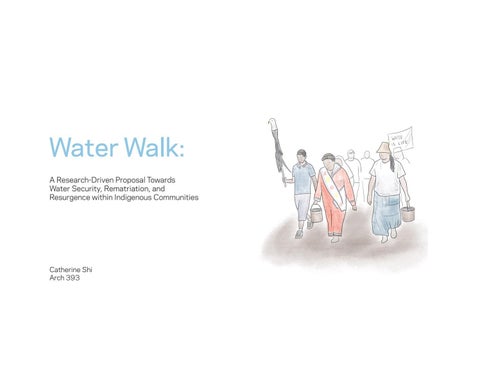
Water Walk: A Research-Driven Proposal Towards Water Security, Rematriation, and Resurgence within Indigenous Communities
Catherine Shi Arch 393
Table of Contents Agenda
3
Methodology
4
Developing a Framework
5
Nibi (Water) Walks
6
Water Quality in Indigenous Communities: The Issue at Large
8
Water Treatment Process
10
Current Water Governance Structure
11
Case Study: Grassy Narrows (P2 Day in the Life)
12
Oneida Nation of the Thames
17
Initial Precedents
19
Testing an Intervention (P3)
20
Decolonizing my Mindset
22
The Sweat Lodge
24
Towards a More Hollistic Proposal
26
Process Work
29
Bibliography
32
2
can there be any “How reconciliation in a country
where this kind of inequality is acceptable?
“
- Shoal Lake 40, Chief Erwin Redsky
Abstract Canada is deemed to be one of the most water-rich countries in the world, however, many First Nation communities in Canada still lack the fundamental right to clean drinking water, some of which have been persisting for decades. Throughout this studio, I have explored the factors contributing to this injustice, including the current water governance structure in place. I have researched several communities that have been impacted by the degradation of their waters, and the ultimate impact it’s had on their day to day life. I’ve come to understand the importance of water through a Feminist-Indigenous lens through reading many scholarly articles written by Indigenous women, grounded on Traditional Ecological Knowledge (TEK). Through experimentation, research, and thinking through drawing, this project turned profoundly from simply trying to provide a means for cleaning up the water in Indigenous communities, to getting behind the greater root of the problem.
3
Methodology As a non-Indigenous woman who grew up predominantly in Toronto, and had the privilege of never worrying about whether the water was safe to consume, it was difficult at first situating myself into this research. I have never been impacted by this water crisis, nor can I speak in place of the thousands of Indigenous Canadians who have been affected by this their whole lives. Through seeing many controversial designs by settler architects that clearly serve their own agenda more than the Indigenous communities they were designing for, it felt awkward and wrong to “design” for a population I could never truly know, and am not a part of. My research initially started with a simple Google search, and the reading of news articles about the water crisis. Although this gave me a good understanding of the basic facts and factors contributing to the crisis, many lacked the voices and perspectives of the Indigenous people affected by this. True insight and progress started to happen when I started reading journals and papers written by Indigenous women and scholars, encompassing TEK. Through this, I started to get a better understanding of Indigenous theories, concepts, and worldviews. I learned about the spiritual significance of water to Indigenous people.
TEK:
Traditional Ecological Knowledge; the evolving knowledge acquired by indigenous and local peoples over hundreds or thousands of years through direct contact with the environment. 4
As I researched and read, I visualized my findings through drawings, and tested ideas through collage. Similar to Indigenous ceremonies, this process was not linear, and involved lots of going back and forth, and testing of new ideas. Most of my drawings took the form of conceptual colleges - this drawing technique was not familiar to me, however the more I went through this project, the more I found myself gravitating towards this new form of representation. My proposal and works towards, and grounds itself upon Indigenous concepts of:
Rematriation:
“the reclaiming of ancestral remains, spirituality, culture, knowledge, and resources. It simply means back to Mother Earth, a return to our origins, to life and cocreation, honoring the life-giving force of the Divine Feminine.” (LaDuke, 2020)
Resurgence: the renewal and revival of cultural
practices after a period of time where they were not active, and re-claiming one’s Indigenous cultural identity “Indigenous resurgence means having the courage and imagination to envision life beyond the state.” (Corntassel, 2012)
Developing a Framework
Fig 1: Collage Exploring my Main Agenda
Water isnt simply a resource, or a commodity to be sold. Indigenous knowledge teaches us that water is a living entity and has a responsibility to fulfil, and the relationship between women and water is seen as “sacred and deeply spiritual. Indigenous women are responsible to the water, and the water reciprocates by supporting plants, animals, and people.
5
Nibi (Water) Walks Indigenous led, extended ceremonies to pray for the water. Through carrying an open vessel of water great distances, it aims to raise awareness towards water pollution, and reaffirm womens’ responsibility towards water.
Fig 2: Drawing Illustrating the Water Walk
6
7
Water Quality in Indigenous Communities
Water advisories are implemented by the government when the water in a certain area has proven not safe to drink. In 2015, there were a total of 162 long term drinking water advisories in effect, mainly concentrated in first nation communities. In 2015, Justin Trudeau vowed to end all boil-water advisories on First Nations reserves within five years. As of now however, well over the 5 year mark on Justin Trudeau’s promise, there are still 45 long term drinking water advisories in effect in over 32 First Nations communities in Canada.
Fig 3: Water Advisories
8
Fig 4: Collage depicting the Issue
9
Water Treatment Process
7 6 5
4
3 8 2
1
Fig 5: Axo Depicting the Process
1. Water Source
2. Screen
3. Coagulation & Flocculation
4. Sedimentation
5. Filtration
6. Disinfection
Lake or reservoir.
Removes and filters out large objects in water.
Floc settles to bottom of water supply due to weight.
7. Storage
8. Distribution
Chemicals with positive charge added to water to neutralize negative charge of dirt. Particles bind with chemicals to form larger particles called floc.
Disinfectant (chlorine) may be added to kill any remaining parasites, bacteria, viruses.
Water stored in municipality water tank.
To houses and businesses.
Clear water on top will pass through filters of varying compositions (sand, gravel, charcoal) and pore sizes to remove dissolved particles such as dust, parasites, bacteria, viruses, and chemicals.
10
Current Water Governance Structure within Oneida First Nation
Indigenous Services Canada
Water Operators
Outside Engineers
Technical Staff
Director of Operations
Chief and Council
Department of Public Works & Health Services
Health Canada
First Nation Government
Federal Government
Provincial Government
Municipal Government
11
Case Study: Grassy Narrows (P2) https://youtu.be/dbIUKfd9m14
Asubpeeschoseewagong First Nation, otherwise known as the grassy narrows first nation, is an Ojibwa First Nations community about an hour north of Kenora, consisting of around 1500 members. For almost 50 years, the river system—a foundational element of the Grassy Narrows culture—has been contaminated with mercury as a result of industrial pollution. Today, almost 90 percent of Grassy Narrows community members suffer from symptoms of mercury poisoning.
(Grand River MC, 2017)
12
13 Fig 6: Narrative Section through the Mercury Contamination
14 Fig 7: Protagonist Profile Card
Day in the Life of Ashley Forbister
15
16
Oneida Nation of the Thames Situating the Intervention in a More Local Context
Fig 8 (right): Site Plan
The Oneida Nation of the Thames is one of the six nations of the Iroquois Confederacy, known as the Haudenosaunee people. The community is located along the Thames River, 30km south of the city of London, and is home to 2,172 residents, with a total membership of 6,270. For the past 20 years, the community has been unable to drink the water from their taps, and rely on the same 18-litre blue jugs for drinking and cooking. In addition to being on a long term water advisory, they also deal with odours that come from the Green Lane Landfill located close to the reserve. 17
In 1876, the Government of Canada passed the Indian Act as a way to manage Aboriginal affairs in the country, thus Impacting how water resources are governed and managed in First Nations’ communities. The water distribution system in Oneida has failed to meet provincial standards dating back to 2006, with years of water testing showing dangerous pathogens such as E. coli flowing from the taps. The main source of water for the community is from an aquifer below the Thames River, however the Thames has been a dumping ground for waste, raw sewage and pollution for the city of London for years. In 2018, 266 million litres of raw sewage was released from London’s wastewater system in order to avoid basement flooding during heavy rains. London didn’t start notifying Oneida of sewage dumps until mid2018, says its leader, Jessica Hill, and even then, they are only notified after it has occurred. Historically there have been several sources of water in the Oneida community including wells, springs, creeks, and the Thames River, however that has slowly diminished as the water quality worsens.
18
Fig 9 (right): Collage depicting Issue in Oneida
Initial Precedents
Battambang WaterHall | OOA Architects
Spirit Garden | BrookMcllroy
Between the Waters | Studio Ooze
Fisher River Cree Nation Solar Farm
Between the Waters
Warka Water | Arturo Vittori
19
Testing an Intervention
Is a building... the answer?
Fig 10: Section through Intervention
This proposal seeks to act as a form of community-driven resurgence, where the control of water rightfully falls under the jurisdiction of Indigenous women. Through the ability to manage 20
their own water and use it in traditional ceremonies, the community is able to pass down their culture, spiritual teachings, and knowledge of the land between Elders and youth.
Fig 11: Plan of Intervention
21
Decolonizing my Mindset thinking through collage...
Up until this studio, I have always been accustomed to the idea of producing a final building as the final studio project, accompanied by highly technical floor plans, sections, and axos. It is with no surprise that my initial mindset with this project was to propose a final pavilion, or structure, or built form that would lend a hand in solving the issue I was studying. In reality, the water crisis in Canada is a highly overwhelming, and complex issue with no “silver bullet solution”.
Fig 12: Process Thinking Collage: Towards a Decolonized Future
Through grounding myself in more and more Indigenous theories, I started to step away from the idea of a building, or even a definitive solution per say. The reality is - architecture cannot solve all the world’s issues. What architects can do, is utilize the research capabilities and representation tools at their disposal to paint a clearer picture of the given situation. As I was reading about pathways to decolonization, I realized that I, too, needed to decolonize my current mindset, and my colonial ways of learning. 22
Fig 12: Using Readings Throughout the Project
As Anishinabe people strive to address the challenges we face in relation to the water in our communities, we must go beyond the “techno-fix” advocated by governments and others. There is too much of a reliance on science and technology to solve issues. These solutions tend to be shortsighted and do not deal with the root of the problem. There is no quick and ready answer for the challenges that we face. Water must be considered in a holistic fashion. Other aspects of Creation, along with people’s role in creating the current water crisis, must be included. While the tools of science, applied appropriately, can aid us, we must turn to the traditions and knowledge that did not fail us for thousands of years to find a real solution. While we face new challenges, the traditions are still as viable as they have always been.
“
“
- Traditional Knowledge: Considerations for Protecting Water in Ontario, Deborah McGregor
23
The Sweat Lodge
Traditional Uses of Water
Sweat lodges are heated, dome-shaped structures used by Indigenous peoples as a way to promote healthy living. The site of the lodge is chosen with great care. The direction of the doorway differs according to the teachings of the conductor. Most face east. Dome shape represents the womb of Mother Earth
When we leave this earth, we have to go through fire to get to the spirit world. When you enter the sweat lodge, you are seeking the help of the Creator and the spirits. The helping spirits are called into the sweat lodge by prayers, songs, drums or shakers. Fig 13: Drawing Illustrating the Sweat Lodge Ceremony
24
Before you enter the lodge, offerings such as Tobacco are made at the alter or sacred fire
In the past, the frame with buffalo or deer hid tarps and blanke
Once all participants are inside the lodge, the firetender begins to pass in the heated rocks, which are placed in the pit.
The frame of the lodge is made of a specific number of red willow, ash, birch, maple or jack pine saplings.
Cedar water is poured on the Grandmothers and Grandfathers, creating a cleansing steam in the lodge.
would be covered des. Today, canvas ets are used.
Specially chosen sweat rocks, called Grandmothers and Grandfathers, are collected and heated in the fire
Inside the sweat lodge, the participants sit in a circle around the central fire pit. The sweat lodge conductor usually sits at one side of the door, and they begin to pray.
25
Towards a More Hollistic Proposal: Thames River Water Walk
“
“
Walking becomes a way of inhabiting place through lived experience of movement. Walking is a way of becoming responsive to place; it activates modes of participation that are situated and relational. (Springgay and Truman, 2018)
How is water a teacher for me?
26
To heal water, we need to heal with the water through enacting respectful and reciprocal relationships with all life and water-as-spirit. (Brown, 2021)
“
“
Reconciliation without meaningful restitution merely reinscribes the status quo without holding anyone accountable for ongoing injustices. (Corntassel, 2012)
“
“
Water governs us, not the other way around. (Brown, 2021)
“
“
27
renaming of land
Stopping at waterways to give offerings Return and increased practice of traditions
City of London Water Operator
tobacco offerings
Indigenous Grandmother with copper pail
Indigenous woman teaching settler how to fish
Fig 14: Narrative Section resurgence of nature, revitalization of wildlife
28
Indigenous Affairs Officer drinking the water
PROCESS WORK
Test of Concept Collage
Sketch of Concepts
Study of Mercury in Waterways at a Grainular Level
Water Advisories - Initial Documentation
Water Governance Structure - Sketch
29
PROCESS WORK
Water Filtration Process - Sketch
Planning out my Collage....
Site Research
Very First Intervention Proposal... Testing Indigenous ways of mapping and understanding land
Initial Site Plan
30
PROCESS WORK
Studying the route of the Grand River Water Walk
Planning out my final drawings
31
BIBLIOGRAPHY Asikinack, William. “Sweat-Lodge Ceremony.” Sweat-lodge Ceremony - Indigenous Saskatchewan Encyclopedia - University of Saskatchewan. Accessed December 10, 2021. https://teaching. usask.ca/indigenoussk/import/sweat-lodge_ceremony.php. Brown , Shelby. “Water as Pedagogy .” Thesis, April 2021. https://doi.org/https://harvest.usask.ca/handle/10388/13348. Caibaiosai , Mary Anne. “How the Grand River Water Walk Came to Be.” A\J, May 21, 2019. https://www.alternativesjournal.ca/community/how-the-grand-river-water-walk-came-to-be/. Cave, Katherine. “Exploring the Influences of Institutions on Water Governance and Management: A First Nation Case Study.” Dissertation, University of Waterloo, 2012. Cave, Kate. “Water Song: Indigenous Women and Water.” The Solutions Journal 7, no. 6 (November 2016): 64–73. Corntassel, Jeff. “Re-Envisioning Resurgence: Indigenous Pathways to Decolonization and Sustainable Self-Determination.” Decolonization: Indigeneity, Education & Society 1, no. 1 (2012): 86–101. https://doi.org/https://jps.library.utoronto.ca/index.php/des/article/view/18627. “Finding a Solution to Canada’s Indigenous Water Crisis.” BBC News. BBC, August 26, 2018. https://www.bbc.com/news/world-us-canada-44961490. Hock, James. 2021. “Water Walk : A Research-Driven Guide to Clean Water in Indigenous Communities.” G. Graduate Research [Non-Thesis]. May 31. doi:http://dx.doi.org/10.14288/1.0397283. LaDuke, Winona, and Deborah Cowen. “Beyond Wiindigo Infrastructure.” South Atlantic Quarterly 119, no. 2 (2020): 243–68. https://doi.org/10.1215/00382876-8177747.
32
BIBLIOGRAPHY MacDonald, Rob. “Ontario Iroquoian Sweat Lodges.” Ontario Archaeology OA48 (1988): 17–26. McGregor, Deborah. “Traditional Knowledge: Considerations for Protecting Water in Ontario.” International Indigenous Policy Journal 3, no. 3 (2012). https://doi.org/10.18584/iipj.2012.3.3.11. Paridy, Caitlin Jakusz. “Learning from Manoomin: Restor(y)Ing Relationships between Anishinaabeg, Settlers, and More-than-Human Beings in the Great Lakes Basin.” Dissertation, University of Waterloo, 2021. Porter, Jody. “Children of the Poisoned River.” CBCnews. CBC/Radio Canada. Accessed December 10, 2021. https://www.cbc.ca/news2/interactives/children-of-the-poisoned-river-mercury poisoning-grassy-narrows-first-nation/. Poisson, David Bruser and Jayme. “This Is What 40 Years of Mercury Poisoning Looks Like.” thespec.com, July 24, 2016. https://www.thespec.com/news/ontario/2016/07/24/this-is what-40-years-of-mercury-poisoning-looks-like.html. Simpson, Leanne Betasamosake. “Land as Pedagogy: Nishnaabeg Intelligence and Rebellious Transformation.” Decolonization: Indigeneity, Education & Society 3, no. 3 (2014): 1–25. https://doi.org/https://jps.library.utoronto.ca/index.php/des/article/view/22170. Tauli-corpuz, Victoria. “Indigenous Peoples Had a Clear Vision for COP26, but It Has Not Been Delivered | .” The Guardian. Guardian News and Media, November 15, 2021. https://www.theguardian.com/ commentisfree/2021/nov/15/indigenous-peoples-clear-vision-cop26-not-delivered.
33