CatholicVoice Omnia possum in eo, qui me confortat
28 August - 10 September 2020
Only 0 Irel and/N I £2 UK
€/£1.5
Issue 298
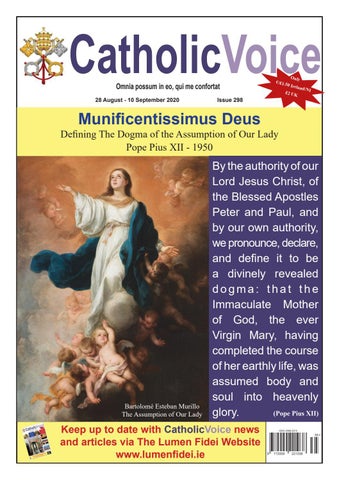
Munificentissimus Deus
Defining The Dogma of the Assumption of Our Lady Pope Pius XII - 1950
Bartolomé Esteban Murillo The Assumption of Our Lady
By the authority of our Lord Jesus Christ, of the Blessed Apostles Peter and Paul, and by our own authority, we pronounce, declare, and define it to be a divinely revealed dogma: that the Immaculate Mother of God, the ever Virgin Mary, having completed the course of her earthly life, was assumed body and soul into heavenly (Pope Pius XII) glory.
Keep up to date with CatholicVoice news and articles via The Lumen Fidei Website www.lumenfidei.ie
6 LIVES OF THE SAINTS
Catholic Voice
28th August 2020
Saint Bartholomew
Canon Joseph Heppelle I.C.K.S.P. During the month of August we celebrate the feast of one of the least known apostles, yet he is a saint with one of the most macabre attributes, his own flayed skin. The saint, of course, is Saint Bartholomew. In the synoptic Gospels (Matthew, Mark and Luke) Saint Bartholomew is only mentioned by name and no further details of his life or personality are given. Saint John does not mention him by name at all, but he does say a good deal about the calling of a certain Nathaniel, whom tradition has long identified with Bartholomew. In part this identification stems from the fact that Saint John associates Nathaniel with Saint Philip as the Synoptic evangelists associate Bartholomew with Saint Philip. Furthermore, the name Bartholomew is highly unlikely to be this saint’s first name, as in Hebrew it literally means “son of Tholmai.” It would be as strange as an Irishman sporting a given name of, for example: O’Toole. We are pleased to have received many positive comments about the new magazine size of CatholicVoice. This has been introduced to enable us to continue publishing during the current crisis. Please let your friends and family know that Catholic Voice is available in most of the newsagents that would normally sell it across the whole of Ireland. We hope to supply more churches when they reopen their doors and wish to thank our promoters who have been able to continue distributing despite churches being closed. If you wish to order a postal subscription or would like to sell copies of Catholic Voice to 6 or more people please Telephone:
00353 (0)59 8627268 or email editor@catholicvoice.ie
What is certain is that in the Gospel according to John, Saint Philip first told Nathaniel of Christ: “We have found him of whom Moses in the law, and the prophets did write, Jesus the son of Joseph of Nazareth.” (John. 1:45) To which, Nathaniel responded: “Can anything good come from Nazareth?” (John. 1:46) At first glance this response seems derogatory. The fact that Nathanael accepts Philip’s invitation to “come and see,” and our Lord’s own words that he is an “Israelite in whom there is no guile” (John. 1:47) shows, however, that his scepticism, unlike that of the Sadducees and Pharisees, was not motivated by pride. The words of our Lord surprises Nathaniel who wonders how this Rabbi could know him. Jesus answers: “before Philip called you, when you were under the fig tree I saw you.” (John. 1:48) We do not know what happened to Nathaniel under that fig tree, but as Pope Benedict XVI says, it is “obvious that it had to do with a decisive moment in his life.” (General Audience 4 Oct 2006) Saint Thomas Aquinas, in his commentary on John’s Gospel points out that there are two ways of conversion. One is through miracles, and the other is through prophecy or the revealing hidden things. Miracles have the disadvantage, however, that the evil one can often simulate them, whereas only God can reveal secrets be they hidden in the future, or in the heart of man. Nathaniel recognised that only God could have known what happened in his heart under that fig tree, and so from this moment on, he places all his trust in Jesus of Nazareth, exclaiming: “You are the Son of God, you are the king of Israel.” (John 1:49) There is an important lesson for us in the calling of Nathaniel. It is good to be a little “skeptical” at times. We must not believe everything just anyone happens to tell us, especially in matters of religion. As our Lord warns us in the Gospel: “there shall arise false Christs and false prophets…If therefore they shall say to you, Behold he is in the desert: go ye not out. Behold he is in the closets: believe it not.” (Matthew 24:24,26) We do have one advantage over the Apostles and Jews of the Old Testament. God has already given us His Word, Jesus Christ, and He has no other Word. So we are
28th August 2020
LIVES OF THE SAINTS 7
Catholic Voice
not waiting for a further revelation to complete the Bible. We already have all that we need to know to be saved. We can be certain, therefore, that any would be visionary who says otherwise is either a fake, or deceived by the devil. Little is known of Saint Bartholomew’s life after the Ascension. The Apostles had received the command from our Lord to preach to the ends of the earth. Saint Bartholomew is one of the Apostles who went beyond the borders of the Roman Empire to do just that. According to legend he preached the Gospel in various places of the Middle East and even to India. The Catholic Encyclopaedia (1907 edition) notes, however, that “India” was a broad term that could cover a wide area from Southern Arabia to India proper. Tradition holds that this apostle was martyred in Armenia, where the he had baptised a local king. The king’s brother, and his pagan priests, however, were not pleased with this turn of events, and so they put the saint to death in the particularly gruesome manner of flaying him alive. The king’s fate is unknown. Thus, Saint Bartholomew’s attributes are the flaying knives and his own skin. He is often depicted holding his skin in his hand (even if “another skin” covers his body). Michelangelo painted him in this way, in the famous Last Judgement scene in the Sistine chapel where the renaissance artist left his own self portrait in the skin of Saint Bartholomew. This apostle’s other attribute is a book, or a scroll in Eastern Icons. This probably refers
to Saint Matthew’s Gospel which the early Church historian Eusebius of Caesarea said Saint Bartholomew had taken with him to India. As our world descends ever more into its new paganism we christians could do with some more of the zeal which drove the apostles to carry our Lord’s name to the ends of the earth. Let us ask Saint Bartholomew to intercede for us that we may live according to the Faith and do what we can to draw our neighbours to the knowledge and love of our Lord Jesus Christ.
The
Dominicans A Passion For Truth Spares Nothing
"You never know how much you really believe anything until its Truth or falsehood becomes a matter of life or death to you." - C.S. Lewis Director of Vocations: Fr Colm Mannion OP
Mobile: 086-0864420 | Email: colm.mannion@dominicans.ie
12 MIND CONTROL
Catholic Voice
28th August 2020
The Mind Controllers Are After Your Children Part 4 - John Lacken Please pause for one moment and offer up one Ave for our bishops. Ave Maria, gratia plena, Dominus tecum. Benedicta tu in mulieribus, et benedictus fructus ventris tui, Iesus. Sancta Maria, Mater Dei, ora pro nobis peccatoribus, nunc et in hora mortis nostrae. Amen I was not a fan of history when I was in school and I remember my father trying to convince me of the importance of history and of the lessons to be learned therein. I now appreciate my father’s wisdom but unfortunately, whilst I now find certain historical topics to be of great interest, I have a lot of catching up to do when it comes to historical matters. This is by way of introduction to something that I came across very recently when researching for my article, which I find very interesting when one considers the great disrespect that is currently being shown to Jesus Christ, truly present in the Most Holy Eucharist. This disrespect for Jesus is said to be acceptable, on account of the corona virus. In 1863, Thomas Walter Perry who was assistant curate at the Church of England church, St Michael and all the Angels, in Brighton, wrote a letter in book format with the following hefty title. “Some Historical Considerations Relating To The Declaration On Kneeling, Appended To The Communion Office of the English Book of Common Prayer” This unusual title caught my attention, given that the norm for
receiving Holy Communion in the Catholic Church is on the tongue whilst kneeling. The declaration in question is from the second edition of Thomas Cranmer’s ‘Book of Common Prayer’ and dates from 1552. It was translated into modern English in 1662 and it reads as follows in the latter translation. “Whereas it is ordained in this Office for the administration of the Lord’s Supper, that the Communicants should receive the same kneeling; (which Order is well meant, for a signification of our humble and grateful acknowledgement of the benefits of Christ therein given to all worthy Receivers, and for the avoiding of such profanation, and disorder in the Holy Communion, as might otherwise ensue;)” To avoid any confusion amongst these protestants as to belief in the real presence, the declaration continues: “Yet, lest the same kneeling should by any persons, either out of ignorance and infirmity, or out of malice and obstinacy, be misconstrued and depraved; it is here declared, that thereby no Adoration is intended, or ought to be done, either, unto the Sacramental bread or wine, there bodily received, or unto any corporal presence of Christ’s natural Flesh and Blood. For the Sacramental bread and wine remain still in their very natural substances, and therefore may not be adored: (for that were idolatry to be abhorred of all faithful Christians;) and the natural Body
and Blood of our Saviour Christ are in heaven, and not here; it being against the truth of Christ’s natural Body to be at one time in more places than one.” It is quite astonishing that these early English protestants would kneel to receive what they believed to be symbolic, unconsecrated bread and wine, out of reverence for Christ and to avoid ‘profanation and disorder in the Holy Communion” More astonishing still, is the fact that our own bishops, contrary to the Canon Law of the Catholic Church, now seek to make Holy Communion in the hand mandatory for Catholics, whilst at the same time declaring that they believe that Jesus Christ is truly present, Body Blood, Soul and Divinity. In many of our Catholic Churches, the clergy are also insisting that Catholics stand to receive Jesus Christ. In his book ‘Characters of the Reformation’, Hillaire Belloc tells us the following about Thomas Cranmer. “Cranmer was never more than an agent though a willing agent — even in his heart of hearts an enthusiastic agent: a man who hated the Catholic Church and the Sacraments and in especial the Sacrament of the Altar and the Mass.” Cranmer was a forerunner of today’s ‘mind controllers’, gently leading the people away from the Catholic Church all the while maintaining and creating a false piety and devotion to error. In this regard Hillaire Belloc also tells us:
28th August 2020
MIND CONTROL 13
Catholic Voice
“Cranmer had great artistic power. He could frame a sentence of rhythmical and exquisitely beautiful English as no man has been able to do before or since. It is to him that the Anglican Church owes those prayers, “The English Prayerbook”, the diction and language of which have given it its strong hold upon the national mind. The Litany of the English Church is his — a wonderful document as far as artistry is concerned; presumably most of the Collects, the translation of the Prefaces of the Mass incorporated into the English service, and many other Catholic prayers similarly incorporated. His unique talent was not recognized in his lifetime; its effect upon men’s minds came much later; the strong affection which the average Englishman feels for the Book of Common Prayer and its fine phrases dates, not from Cranmer’s century but from the next. It is often the case with great artists in prose and verse; they need time to manifest their gifts and these are not apparent until long after they are dead.” Thomas Cranmer was used as an agent of the civil authority of his time in order to bring about the destruction of Catholic worship in England. Today, in Ireland and elsewhere in the world, the civil authorities are using an alleged health crisis, Covid-19, to change the rubrics of the Catholic Mass and to dictate to our bishops the method and manner of distributing and receiving Holy Communion. The state has no authority to dictate how the Sacraments of the Catholic church are celebrated and yet our bishops comply without question. I spoke with one lay Church manager recently, who told me that our Catholic churches would be shut down by the government if they do not comply with government directives.
I tried to explain that this was exactly the case for all of our Irish martyrs; they were faced with the choice of obeying the Catholic Church or obeying state directives. They were martyred because they refused to obey the state authorities. Our first duty is to worship and to obey God rather than obey the dictates of men especially when the dictates dishonour Jesus Christ in the Most Holy Eucharist. The end result of this capitulation to unjust government directives will be to further undermine belief in the Real Presence or Transubstantiation, and there will be a further falling away of baptised Catholics from the practice of the faith and, attendance at Holy Mass will continue to decline. The Council of Trent, in its thirteenth session declared as follows: “On Transubstantiation. And because that Christ, our Redeemer, declared that which He offered under the species of bread to be truly His own body, therefore has it ever been a firm belief in the Church of God, and this holy Synod doth now declare it anew,
that, by the consecration of the bread and of the wine, a conversion is made of the whole substance of the bread into the substance of the body of Christ our Lord, and of the whole substance of the wine into the substance of His blood; which conversion is, by the holy Catholic Church, suitably and properly called Transubstantiation.” Given this declaration, it is then obvious that we must adore Christ truly present in the Eucharist. The Council of Trent continues. On the cult and veneration to be shown to this most holy Sacrament. Wherefore, there is no room left for doubt, that all the faithful of Christ may, according to the custom ever received in the Catholic Church, render in veneration the worship of latria, which is due to the true God, to this most holy sacrament. For not therefore is it the less to be adored on this account, that it was instituted by Christ, the Lord, in order to be received: for we believe that same God to be present therein, of whom the eternal Father, when introducing him into the world, says; And let all the angels of God adore him; whom the Magi falling down, adored; who, in fine, as the