CatholicVoice Only 0 Irel and/N I £2 UK
€/£1.5
Omnia possum in eo, qui me confortat
3 July - 16 July 2020
Issue 294
St Aloysius
Hope:
The Cassock
Our Lady of Knock
& The Lily
Now on DVD
- page 2
- page 4
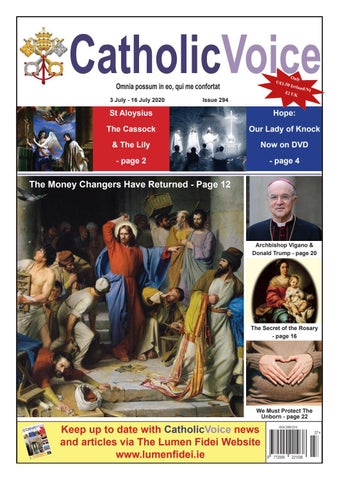
The Money Changers Have Returned - Page 12
Archbishop Vigano & Donald Trump - page 20
The Secret of the Rosary - page 16
We Must Protect The Unborn - page 22
Keep up to date with CatholicVoice news and articles via The Lumen Fidei Website www.lumenfidei.ie
2 SAINTS
Catholic Voice
3rd July 2020
The Saints Attributes Saint Aloysius Gonzaga: The Cassock and the Lily Canon Norman I.C.K.S.P. Saint Aloysius was born of noble parents on the 9th March 1568, in northern Italy, between Brescia and Mantua, in what at the time was the Duchy of Mantua. At the age of twelve, he began receiving spiritual direction from Cardinal and future Saint Charles Borromeo. His father planned for Aloysius to enter the military profession, as was the custom for sons of aristocrats. His military training started when he was very young, but he was also educated in languages and the arts. At age five, he was sent to a military camp.
afterwards beginning his theological studies. The saint suffered health problems all throughout his time in religious life. In addition to kidney disease, he also suffered from a skin disease, chronic headaches and insomnia. All of these trials he bore in patience and resignation.
In his fourth year of theology, a famine and pestilence broke out in Italy. Though possessed of a rather weak constitution, he immediately volunteered for work in caring for the sick. Though he devoted himself wholeheartedly to his tasks, he revealed to his spiritual director, Saint Robert Bellarmine,
His father enjoyed seeing the boy marching around the camp before a platoon of troops, however his mother and his tutor were less impressed with the vocabulary he gained from the experience of soldierly life. In 1581 he travelled to Spain with his father and brother; it was during this trip that he made the resolution of becoming a Jesuit priest. In 1584 he returned to his native Italy. His desire to become a Jesuit missionary persisted, and even though his father’s consent to his decision came with difficulty, after many requests and much persuading Aloysius finally succeeded in obtaining it. He renounced his heritage in his brother’s favour and pursued the religious vocation to which he felt so strongly called. He began his novitiate in the Jesuit Order in 1585 and accomplished brilliant studies in both philosophy and theology. He made his vows with the Jesuits on the 25th November 1587,
The Vocation of St Aloysius - Guercino (1591 - 1666)
3rd July 2020 Catholic Voice
SAINTS 3
that he was physically revolted by the ghastly sights and smells of the work of caring for plague victims. He had to struggle mightily to overcome his disgust. On the 3rd March, he came down with the plague himself, and died at the age of twenty-three on the 21st June 1591. He was canonised by Pope Benedict XIII in 1726. Saint Aloysius is invoked as a patron saint of Catholic youth and students, Jesuit scholastics, the blind and the sick. If one virtue stands out in his life more than any other, it is that of his angelic purity, a purity which he defended amidst the temptations of court life in Renaissance Italy. His life is therefore a wonderful example for the young in particular, especially in our era, in which the young are constantly pushed towards immodesty and unchaste behaviour by many elements of society and advertising. It should also be noted that this saint is a good heavenly patron for the month of June, the month of the Sacred Heart. In the work ‘The Devotion to the Sacred Heart’, Fr. John Croiset references the great devotion of Aloysius to the Sacred Heart of Our Lord. Images of Saint Aloysius often show him in a cassock and surplice, eyes fixed on a crucifix, owing to his custom of contemplating the dying Lord. He is often depicted with the lily flower; a reference to his inimitable purity of life. Another attribute often found with this saint is a crown of flowers in the hands of a descending angel, a reference to his death as a victim of the plague. For his heroic work with victims of this disease, which led to
his own death, he is sometimes portrayed alongside Saints Roch and Sebastian, these two being frequently invoked in times of pandemics. The remains of the saint are kept in the Church of St. Ignazio in Rome, in an exquisite urn of lapis lazuli with a wreath of silver festoons. His head was later taken to the basilica of his namesake at his native castle in northern Italy. Many churches and schools have been named for this saint throughout Europe and the United States, as well as in Ireland. The feast day of Saint Aloysius Gonzaga is traditionally kept on the 21st June, the date of his death. Prayer: “O Saint Aloysius, adorned with angelical manners, although I am thy unworthy servant, I recommend to thee in an especial manner the chastity of my soul and body; I conjure thee, by thy angelical purity, to commend me to Jesus Christ, the spotless Lamb, and to His most holy Mother, the
Virgin of virgins. Preserve me from every grievous sin; never suffer me to sully my soul with any impurity; whenever thou seest me in temptation or danger of sin, ward off from me every impure thought and affection, and awakening in me the remembrance of eternity and of Jesus crucified, imprint deeply in my heart the sentiment of the fear of God. Inflame me with divine love, in order that by imitating thee on earth, I may merit to enjoy God with thee in heaven. Amen.”
12 CHURCH MATTERS
Catholic Voice
3rd July 2020
The Money Changers Are Back In The Temple John Lacken Let us pause for a moment to say one Hail Mary for our Irish Bishops as public access for the laity to the life-giving Sacraments of the Catholic Church continues to be restricted. In my last article, I noted that it had been over eleven weeks since my wife, two of our children who are still living at home, and I, had been able to attend the Holy Sacrifice of the Mass. I had been speaking to a priest from a small rural parish some weeks previously, and he told me that he allows a few ‘trusted’ parishioners to attend Holy Mass and that if I wanted to visit him with my family we could stay at the parochial house and we would be able to attend Holy Mass. This priest, whose identity and location I must protect in these strange times in which we are living, also celebrates house Masses for those who ask him. I realised that I needed to get myself and my family to Holy Mass as I noticed an increase in the spiritual attacks and the temptations I was being subjected to. I was normally afforded spiritual protection by attending daily Mass and going to confession weekly and perhaps other aspects of my spiritual armour had not been properly refined and I found myself struggling. There is no greater defence against the devil than Holy Mass, Confession, and the other sacraments of the Catholic Church. In times of oppressive persecution, as Bishop Athanasius Schneider tells us from personal experience, there are other spiritual measures which Catholics should adopt, but these are not a
replacement for the sacraments. In our times, where the persecution of the Catholic Church is being hidden under the guise of a dangerous virus, most of us have not been well prepared to face the unexpected and sudden loss of the Sacraments. So, I decided that we were going to go to the Holy Sacrifice of the Mass and that we would go away for five days. It meant that we would have to travel beyond the unjust travel restrictions imposed by our unelected government. I began to wonder what I would say if I was stopped at a Garda checkpoint. When I told Anthony that I would be away for a few days he said to look upon it as a work assignment and to write about it in Catholic Voice. Those of us who work for newspapers are classed as ‘special’ people and we can go about our work despite pandemic restrictions. This is probably because the government needs willing accomplices in spreading the fear narrative propaganda and, whilst I am not one of those willing accomplices, I am nevertheless covered under the government’s exemptions for newspaper workers. It was quite bizarre to think that a Catholic family might be stopped by Gardaí and told to go home simply because we wanted to attend the Holy Sacrifice of the Mass. This is despite our constitution’s preamble which states: “In the Name of the Most Holy Trinity, from Whom is all authority and to Whom, as our final end, all actions both of men and States must be referred,…”
How I wish the actions of the men of Ireland and of our unelected government would follow this foundational principle of all Irish law. Instead, this principle is largely ignored. As we planned our departure, the government was beginning to lift restrictions, but I still began thinking of where Garda checkpoints were most likely to be and of how we could avoid them if possible. Should we avoid the motorways? Should we avoid the larger towns along the way? Should we leave in the early hours of the morning or travel by night? One of my sons, who also distributes a Catholic newspaper, had recently been travelling around the country so I asked him if he had come across any Garda checkpoints. He said there were none. It is hard to believe that here we are living in modern Ireland, yet behaving as if we are fugitives on the run or engaged in criminal activity simply because we want to go to Holy Mass. We are being persecuted for our belief in the necessity of the Sacraments of the Catholic Church, but nobody seems to be overtly attacking the Church or our beliefs. What we are experiencing is a deceptive and hidden persecution which has prevented Catholics worldwide from being able to adore Jesus Christ truly present at the Holy Sacrifice of the Mass and to receive Him as the necessary spiritual sustenance for both body and soul. In the end, we decided to leave in the morning, not too early, and to
3rd July 2020
Catholic Voice
CHURCH MATTERS 13
entrust our journey to the protection of the Holy Family whilst travelling to our destination by the normal route. It was the first Saturday of the month and, whilst we did see about four Garda cars, there were no checkpoints and we arrived at our destination without incident. The priest was delighted to see us and organised Holy Mass in the Church that evening with confessions beforehand so we could fulfil the requirements of the First Saturday Devotion of Reparation. I was to have the privilege of serving the Mass. On Sunday we were joined at Holy Mass by a parishioner and on Monday evening we had a Holy Hour of Eucharistic Adoration and Benediction of the Most Holy Sacrament. In all, we attended Holy Mass for five days, departing for home on Wednesday morning after Holy Mass. It was the first time in twelve weeks that we had the joy of attending Holy Mass. On the way home we stopped off at another Church and met with another priest. He was glad that the plan to re-open our Churches was finally coming together and that the faithful would at last be able to attend Holy Mass albeit with certain restrictions. As we started the final leg of our journey, I found myself becoming angry at what I believe to be the senseless deprivation for the faithful of access to the Sacraments for more than twelve weeks. We had just attended Holy Mass for five days, nobody was put at risk, and we had seen that it was possible for faithful priests to continue to minister to their people. Rather than give in to the anger, I decided that it was time to pray the family Rosary and to hand the whole sorry situation of our country over to Our Lady. The Glorious mysteries and the steady rhythm of the decades
brought wonderful peace to my heart and soul. During our stay, the priest commented on how strange it is to have to say Holy Mass in a locked and usually empty Church from which his parishioners are effectively banned. He must be very careful about letting faithful Catholics attend Holy Mass and about celebrating Holy Mass for Catholic families in their homes, otherwise he could be prevented from doing precisely what he was ordained to do, to offer sacrifice to God on behalf of the people and to administer the sacraments to the flock entrusted to his care. As the Catechism tells us: “In the ecclesial service of the ordained minister, it is Christ Himself who is present to His Church as Head of His Body, Shepherd of His flock, High Priest of the redemptive sacrifice, Teacher of Truth. This is what the Church means by saying that the priest, by virtue of the sacrament of Holy Orders, acts in persona Christi Capitis” (CCC 1548) Perhaps my views are simplistic or a little naïve, but I cannot imagine Christ locking the faithful out
of His Church because of some disease! When I read the Gospels and the Acts of the Apostles, I read stories of the sick being brought to Jesus and to the apostles in their hundreds. I read the story of Christ praising the men who removed the slates from their neighbour’s roof in order to bring a sick man into His presence. Today, the sick are told to stay at home, to stay away from Jesus in the Holy Sacrifice of the Mass just in case they become contaminated by coming into the Real Presence of Jesus Christ. It is interesting to look back at the Penal times. Wikipedia tells us: “Catholic clergy were expelled from the country and were liable to instant execution when found. Many recusants had to worship in secret at gathering places (such as Mass rocks) in the countryside.” Whilst they may not currently be executing our priests, my family just recently had to worship Christ in secret. Wikipedia also tells us that when the restrictions on the Holy Mass were being lifted “The quid pro quo