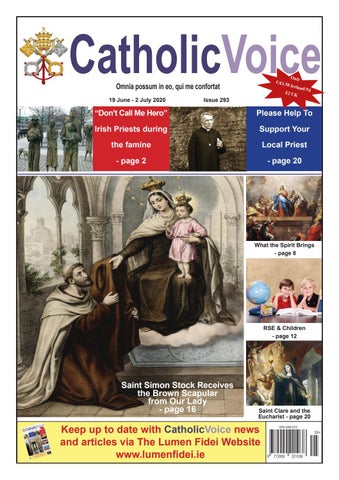
CatholicVoice Only 0 Irel and/N I £2 UK
€/£1.5
Omnia possum in eo, qui me confortat
19 June - 2 July 2020
Issue 293
“Don’t Call Me Hero”
Please Help To
Irish Priests during
Support Your
the famine
Local Priest
- page 2
- page 20
What the Spirit Brings - page 8
RSE & Children - page 12
Saint Simon Stock Receives the Brown Scapular from Our Lady - page 16
Saint Clare and the Eucharist - page 20
Keep up to date with CatholicVoice news and articles via The Lumen Fidei Website www.lumenfidei.ie
2 FAMINE PRIESTS
Catholic Voice
19th June 2020
“Don’t Call Me Hero” - The Catholic Attitude Fr William Slattery The most recent well-documented account of the attitudes and actions of priests during an epidemic occurred during the most devastating famine to hit Europe since the fifteenth century: the “Great Famine” in Ireland between 1845 and 1850. According to Amartya Sen, the Harvard historian of famines, “[in] no other famine in the world [was] the proportion of people killed as large as in the Irish famines of the 1840s.”[i] The cause was a blight that destroyed the potato crop — the staple food for three million of the nation’s 8.5 million people — killing one million persons by starvation and related diseases of fever, diphtheria, cholera, smallpox, dysentery and influenza and forcing another million into exile. When the famine struck, the Irish parish priests, though few in number and with minimal resources, rose to the occasion, acting according to their identity as spiritual fathers.[ii] Their heroism was repeatedly recognized by their political enemies. As a British government official seeking to alleviate the effects of the famine
wrote at the time, “all the Roman Catholic curates [assistant parish priests] . . . are labouring like tigers for us, working day and night . . . [without them] we could not move a stroke.”[iii] Even a revolutionary movement, the Young Irelanders, although bitter about the Church’s refusal to side with them, stated – somewhat hyperbolically – that the priests had cared for the people of their parishes “with a devotion unsurpassed in the annals of martyrdom”.[iv]
existence at the peak of the famine as follows:
Although they did as much as possible to alleviate the famine itself and its associated epidemic, the Catholics of Ireland wanted above all that their priests act as priests: to give them Holy Communion, hear their confessions, anoint them at their last hour, and remind them of Heaven. As Father Bernard O’Reilly, who accompanied his compatriots to exile in North America on the “coffin-ships” remarked, they wanted “the supreme consolation of an Irish Catholic - the last rites of his Church.”[v]
At these stations we have to remain up to five o’clock administering both consolation and instruction to the famishing thousands. . . The confessions are often interrupted by calls to the dying, and generally, on our way home we have to . . . administer the last rites . . . to one or more fever patients.
One priest, Father Hugh Quigley of Killaloe, narrated his daily
“We rise at four o’clock, when not obliged to attend a night call, and proceed on horseback a distance from four to seven miles to hold stations of [the sacrament of] confession for the convenience of the poor country people who . . . flock in thousands . . to prepare themselves for the death they look to as inevitable.
Arrived home, we have scarcely seated ourselves to a little dinner when we are interrupted by groans and sobs of several persons at the door crying out, “I am starving”, “if you do not help me I must die”, and “I wish I was dead”. In truth the priest must either harden his heart against the cry of misery or deprive himself of his usual nourishment to keep victims from falling at his door. After dinner, or perhaps before it is half- over, the priest is again surrounded by several persons, calling on him to come in haste, that their parents, or brothers, or wives, or children are “just departing”. The priest is again obliged to mount his jaded pony and endeavour to keep pace with the peasant who trots before him as a guide through glen and ravine and over precipice to his infected hut. This gives but a faint idea of the life of a priest here.”[vi]
Memorial of the Great Famine - Dublin
A newspaper account described another priest’s schedule:
19th June 2020 Catholic Voice
FAMINE PRIESTS 3
“On last Sunday and Monday week, the broken-hearted clergyman had to drag his own tottering limbs, with scarce an interval of rest, from one corpse to another. In the three subsequent days, exhausted, overcome, feeble and faint, he had still to continue his attendance on the dying; to pass continually from townland to townland; to look on corpse after corpse, to behold, renewed over and over, all the agonies and horrors.”[vii] Alongside all of this, priests often ended up performing the gruesome role of ensuring that the corpses were buried in coffins. People dreaded that they or their relations would be buried without a coffin, and it often fell to the priest to procure coffins, to coffin the dead, and to bury, Tobias-like, the victims of the pestilence.[viii] Father Troy of Skibbereen, County Cork narrated such an incident on January 10, 1847: “I went to the hut... provided with a coffin - had to creep in on my hands through an opening. The lifeless and putrid corpse was reclining against the wall...The poor wife and one of the children endeavoured to get to their knees (they could not stand) to help me to coffin his remains, but I had to beg of my curate to help us.” Father Thomas Quinn in County Clare told how: “I had, together with my curate, Rev. Mr. Reid, to convey by torchlight two successive nights, the remains of two persons who were abandoned by their own immediate family and friends.”[ix] The situation of the clergy in many parts of Ireland was similar to that described in this letter: “The priests are absolutely exhausted having to attend so many sick calls and in many instances are obliged to walk, their horses being unable to carry them through want of sufficient feeding and the priest not getting as much as would purchase oats for his horse.”[x] Some priests, perhaps many, even gave away most of their few personal belongings:
Irish Famine Family with Blighted Potatoes - Daniel McDonald (1821 - 1853)
“When the terrible scourge of the famine descended upon his [Father Timothy Kelly’s] parish from 1845 to 1847, his reaction to the prevailing distress was what one would expect of the pastor and the man sprung from the people. He was in every sense the father of his flock. He organized the provision of meals for the numbers who were starving and when every resource failed he sold all he had, even his horse, to buy food for his people.”[xi] It was no surprise, therefore, that as the famine devoured the country many of the clergy became almost as poor as beggars, without decent clothes or even a pair of shoes; indeed, some were almost starving. As a government inspector reported: “In some instances where priests were confined with fever, I found in their cabins nothing available beyond stirabout. . . . There was no tea, no sugar, no provisions whatever; in some of their huts the wind blew, the snow came in, and the rain dripped.”[xii] Moving constantly amid deadly disease and corpses took its toll among these valiant men. From 1847 to 1852 eight bishops died,
some at least from famine fever. The highly documented authoritative work, by Donal Kerr entitled ‘The Catholic Church and the Famine’ (Columba Press, 1996) states, “Many priests, religious brothers and nuns certainly died as a result of the Famine”. Another historian stated: ‘In 1847 at least thirty-six priests died of fever, sixteen of them during the month of May.’[xiii] Six priests died in Kerry. Of the sixty-four priests in the diocese of Kilmore, seven died in 1846-1847; at least
16 THE BROWN SCAPULAR
Catholic Voice
19th June 2020
THE BROWN SCAPULAR The brown scapular of Our Lady of Mount Carmel, was revealed to St Simon Stock in a celebrated vision with which the Mother of God favoured him on the 16th of July, 1251, at Cambridge. Holding the scapular in her hand, she said: “Receive, my beloved son, this scapular of thy Order; it is the special sign of my favour, which I have obtained for thee and for thy children of Mount Carmel. He who dies clothed with this habit shall be preserved from eternal fire. It is the badge of salvation, a shield in time of danger, and a pledge of special peace and protection” As a garment, the scapular is a broad piece of cloth, with an aperture in it for the head, which hangs down in front and at the back almost to the ground, as may be seen in the habits of the Carmelites, the Benedictines, and some other religious Orders. The scapular worn by the faithful is a symbol of that worn by the religious of the Order of Mount Carmel. In form it is essential that it should consist of two parts, each oblong or square, in accordance with the custom that has long been observed and is sanctioned by the Church, fastened together with two strings, so that one part may hang on the breast and the other on the back. When the Sacred Congregation was consulted as to whether it was lawful to make scapulars of an oval, round, or polygonal form, the response was that no innovation should be made; in other words, that the form up to that time in use should be retained as the only proper one. As regards the material of which it is lawful to make scapulars, it must be woollen cloth; cotton, silk, or other material is strictly forbidden; and by the word cloth is meant woven cloth, so that if threads of woollen were knit or worked with the needle into the form of a scapular it would not do. In colour the scapular must be brown or black. The habit of the Carmelites, of which it is a symbol, is brown, and hence that has always been regarded as the proper colour for the scapular; but it was maintained by some that the wool of a black sheep, inasmuch as it was the natural colour of the wool, and not dyed, would also be permitted. It is permitted, although it is not necessary, to ornament the scapular with needlework, even though
the ornamentation is of a different colour from that of the scapular; nor need such ornament be worked with woollen thread; silk, cotton, or other thread may be used. But it is essential that the necessary colour of the scapular should predominate. It is not necessary to work any image or picture on the scapular; it may, however, be done if the colour of the scapular is left to predominate.’ Who may be invested with the scapular? The Church not only permits, but also wishes that all the faithful should enroll themselves among the devout servants of Mary, as she wishes them to make use of all the means of grace which in her liberality she places within their reach ; and hence all Catholics may be lawfully and validly invested with the scapular, there being nothing in the bulls or briefs of the Sovereign Pontiffs to forbid it. Even infants who have not yet come to the use of reason may be invested; and when they attain to the years of discretion it is not necessary for them to be again invested, or to do anything more than simply to comply with the necessary conditions for gaining the indulgences, and immediately they will begin to reap these spiritual advantages. By whom can a person be invested ? By a priest of the Carmelite Order, or by any other priest duly authorized to invest with it. A priest who has power to invest others may also invest himself. Whatever formulas were heretofore permitted for investing, the priest must now use the one prescribed by Pope Leo XIII, July 24, 1888. But one priest cannot bless the scapular, and another invest a person with it; the blessing and investing must both be done by the same priest. What are the spiritual advantages of wearing the scapular? By wearing the scapular is meant that it be so adjusted upon the person that one part hangs on the breast and the other on the back, one of the strings passing over each shoulder. If both parts be carried on the breast, or both on the back, it is not wearing it, in the sense of the Church, and the person so acting would not be entitled to any of the graces or indulgences. Much less would a person be entitled to them who carried the scapular in his pocket. To keep the scapular about him in any way might indeed be a sign of devotion to
19th June 2020
Catholic Voice
THE BROWN SCAPULAR 17
THE SABATINE PRIVILEGE the Mother of God and of confidence in her protection, and as such would receive a fitting reward; but it would not in any sense be regarded as wearing it. It is not necessary that the scapular should be worn next the person; it may be worn over or under any part of the clothing. The religious who wear the large scapular are accustomed, as we know, to have it outside their habit. The spiritual advantages of wearing the scapular are fivefold: those which are received during life; those received at the approach of death; those after death; the Sabbatine indulgence or privilege; and the other indulgences granted to those who wear the scapular. And, first, as regards the advantages that may be received during life, it is to be remarked that the members of the Confraternity of the Scapular are associated with the religious Order represented by that scapular, which means that they participate in the fruit of all the good works of the religious belonging to that Order; that is, in the fruit of their prayers, meditations, Masses, fasting, penances, alms, and all else that goes to form the spiritual treasures of the Carmelite Order.
This privilege may also mean that sometimes, owing to the influence of the Blessed Virgin, the hour of death is postponed, to give an associate who is in sin a further opportunity of conversion; and writers add that this privilege may sometimes be exemplified in the case of obstinate and obdurate sinners when God permits death to come upon them when they are not wearing the scapular, either as the result of forethought or from indifference or neglect. In the third place, as regards the graces after death, the deceased members of the confraternity have a special share in the fruit of the daily prayers of the Order of the Carmelites and of the Holy Sacrifice, which they offer once a week, and occasionally at other times during the year, for the deceased Carmelites and associates of the Carmelite Confraternity. Fourthly, the meaning of the “Sabbatine indulgence” is this: the associates of the Scapular of Carmel enjoy, on certain conditions, the remarkable privilege known as the “privilege of delivery,” or the “ Sabbatine indulgence.” This privilege refers to, and is grounded on, the promise of the Blessed Virgin, made to Pope John XXII, to withdraw promptly from purgatory, and especially on the first Saturday after death, associates of the Scapular of Carmel. The account of this revelation to Pope John XXII is embodied in his famous Bull ‘Sacratissimo Uticulmine’, more commonly called the Sabbatine Bull, on account of the promise of deliverance on the first Saturday after death.
Secondly, the favours granted at the approach of death to those who devoutly wear the scapular are that there is for them, like for those who wear the other scapulars, a formula for a general absolution at the moment of death, independent of the ordinary “Last Blessing,” which all the faithful are privileged to receive at their departing hour, as may be seen in another part of this work. Persons wearing the scapular are also encouraged to hope for the special assistance of the Mother of St Simon Stock Receiving the Scapular Fifthly there are many indulgences God at the moment of death, Giovanni BattistaTiepolo (1696 - 1770) associated with the wearing of the Brown Scapular including a plenary as she promised to St. Simon indulgence on the day of investiture. The reader cannot, Stock: “He who dies clothed with this scapular shall not but conclude from what has been said that we possess suffer eternal fire.” This is what is called the “privilege in the Scapular of Our Lady one of the richest fountains of preservation.” It means that the Blessed Virgin, by of grace the Church in her liberality has opened to us. her powerful intercession, will draw from the divine treasury in favour of the associates special graces to Adapted from ‘The Sacramentals Of The Holy Catholic Church’ by Rev. A. A. Lambing, L.L.D. Imprimatur. help the good to persevere to the end and to move + Michael Augustine, Archbishop of New York. sinners to avail themselves of favourable opportunities September 1, 1899. of conversion before death seizes on them.