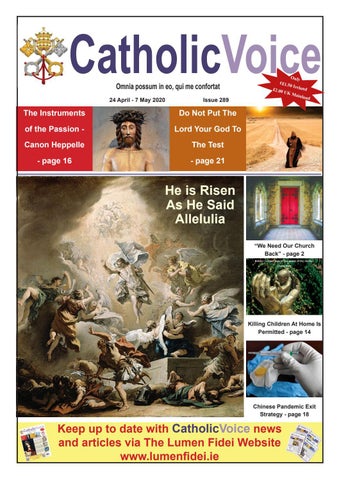
CatholicVoice Omnia possum in eo, qui me confortat
24 April - 7 May 2020
€£1.5
£2.00
Do Not Put The
of the Passion -
Lord Your God To
Canon Heppelle
The Test
- page 16
- page 21
0 Irel and UK M ainla n
d
Issue 289
The Instruments
Only
He is Risen As He Said Allelulia “We Need Our Church Back” - page 2
Killing Children At Home Is Permitted - page 14
Chinese Pandemic Exit Strategy - page 18
Keep up to date with CatholicVoice news and articles via The Lumen Fidei Website www.lumenfidei.ie
8 LITURGY Catholic Voice
24th April 2020
Remembering Past Times Mary Kearns
“We never knew the word “liturgy” but we were always aware of the seasons in the Church’s year.” Alice, now in her eighties reflects on her experience of the Church’s liturgy in the Ireland of the 1950s. The coming of spring meant the Triduum to St. Brigid. Then on the feast-day itself the first of February, there were pilgrimages to the holy well and to the shrine of the saint. But soon it was going to be Lent and that was a well-marked time of the year. Many got up for early Mass before work, and there were devotions in the evening. Fasting was on every day except Sunday and St. Patrick’s Day was looked forward to like an oasis in the desert of Lent. Life was lived against the background of the Church. There were always devotions and this meant the rosary, sermon and Benediction. There was the Monday night perpetual novena to Our Lady; Tuesday night, the men’s Confraternity and Wednesday the women’s Confraternity. We also had May Devotions, the novena to St. Joseph and October Devotions in honour of the holy rosary. Then there were devotions for Advent, but these were never so well attended. Mothers of families were busy with baking and other preparations for the coming of baby Jesus at Christmas. Everyone took part in the holy week ceremonies and the great celebration of the Lord’s resurrection meant that ladies had a new hat - an Easter bonnet! Every two or three years the parish mission took place, usually in the month of May. Alice remembers
“There might be a few people who didn’t go to the mission but I never knew any. Every seat in the church was full and if you didn’t go you had to be sick or have a new baby with no-one to mind it.” This was serious business and the mission priests were awesome figures. The first week was for the women and the second for the men. Separate sermons were given on the sixth and ninth commandments, the necessity of avoiding immodest conduct, impure thoughts and the occasion of sin. It would be improper to address these topics in mixed company. The commandments were dealt with individually. Alice remembers the sin of gossiping about the neighbours and how a person’s character could be defamed by calumny and detraction. If you told a lie about somebody it was calumny, but detraction was even worse because it was the truth about someone’s wrong-doing that you had no right to reveal. The
missioner’s voice thundered from the pulpit. Sins against honesty had people shifting uneasily in the pews. If you took so much as a pencil home from your place of employment you would burn in purgatory unless you made restitution. But there were lighter moments. The missioner often told a joke or two before he got down to serious matters. Alice chuckles as she recalls an incident involving a lady who suddenly remembered she had forgotten to turn off the cooker. She scribbled a note and indicated to her neighbours in the pews to pass it along to her daughter who sat at the end. However somebody misunderstood this intention and handed the note up to the pulpit. You can imagine the poor lady’s consternation when the missioner read aloud “Go home and turn off the gas.” The closing of the women’s mission was on Sunday afternoon as the
24th April 2020 Catholic Voice men’s week would begin that same evening “You couldn’t go to the closing unless you had a new hat, and maybe a new costume. Well I remember the sight of these beautifully dressed women on a sunny Sunday afternoon coming to the Church, each hatted and gloved to perfection. It was the beginning of summer and we were all decked out in our best.” June brought the other great feasts of the Church - the Ascension, Pentecost and Trinity Sunday. Pentecost was also known as Whitsunday and Whitmonday was a holiday as well. You were not supposed to swim in the sea until after Whitsunday. Then there was Corpus Christi. Every town had its procession through the streets. We walked in front of the Blessed Sacrament which was reverently carried under a canopy by the parish priest flanked by all the priests of the parish. They were all vested and were followed by clergy from the religious orders of the town. Then there was a break for the summer months until the Feast of the Assumption on the 15th August. Even so, every Sunday evening throughout the summer there were devotions in the church, and additionally on the first Sunday of the month there was a holy hour with Exposition. The Sundays were known as “Sundays after Pentecost” right up to the feast of Christ the King in October. This kept the significance of Pentecost always in mind. November, the month dedicated to the Holy Souls, began on the 2nd with men and women of all ages, praying the special prayers to gain a plenary indulgence for their departed relatives. On that day it was possible to gain this indulgence by praying for the Pope’s intentions
while visiting a church. Provided you fulfilled the conditions of Holy Communion and Confession, every time you went in and said those prayers you gained the indulgence. At every Catholic church you could see the people walking outside for a few minutes then going back into the church as every visit entitled you to a new indulgence and who would waste that opportunity? Of course every Catholic went to Mass on Sunday - the women with their heads covered and the men with heads bared. In fact the whole week was almost like a preparation for Sunday Mass. You wore your good clothes so these had to be washed and pressed in time. Nobody would wear a new pair of shoes until they had first worn them to Mass. Boys who wore short trousers until about fourteen, had to have knees scrubbed and girls were decked out with straw bonnets. On Saturday night all shoes were polished and Sunday clothes laid out. Children carried prayer books from which they would be expected to follow what the priest was doing at Mass - Latin on one side and English on the other. Ladies were
LITURGY 9
told if they wore a headscarf it should be a plain one without pictures of Lourdes or Rome as this could distract those who knelt behind them. Most ladies however, would wear a hat and not a scarf on Sunday. Headscarves were for daily wear, not for Sunday. Looking back on what it meant to be a Catholic in Ireland in pre-Vatican II days one can sense a rhythm of life structured around the Church’s liturgical year. Alice reflects: “There was a lot of strictness and the ones in authority were sometimes very hard. At the same time we had a sense of security and belonging to something bigger and better than ourselves. Everyone I knew was a Catholic and there was great respect for priests. I think what Pope John was trying to do by the Council was bring more love into the ordinary person’s experience of the Church without losing what we had. You can’t help thinking afterwards that maybe the baby got thrown out as well as the bathwater.” For catechesis and liturgical formation please email marykeenankearns@gmail.com 087 7794687
18 THE PANDEMIC Catholic Voice
24th April 2020
Exit Strategy The End of the Chinese Pandemic is in Sight Christopher Monckton of Brenchley
Hope is one of the three cardinal virtues. During these dark days, there does not seem to have been all that much of it around. So let me help. But first, warmest congratulations to Leo Varadkar, the Taoiseach, for having the courage to redeploy himself to the front line and resume his practice as a doctor so as to care for Irish victims of the Chinese pandemic. Now that much of the world is locked down, with politicians unable to say when or how the lock-downs will end, vast – but temporary – economic damage is being done. In a war, the capital stock without which no economy can recover quickly has been bombed flat and has to be rebuilt. But the Chinese virus does not flatten buildings, destroy factories, dams, roads and railways. The economy can – and will – pick up where it left off, as soon as the lock-downs can safely be brought to an end. First, though, are the lock-downs working? The answer is Yes, and I shall now prove it with the Lockdown Benchmark Test. The test compares the mean daily compound growth rates in Chinese-virus infections for a dozen countries and for the world excluding China, whose case and death statistics are demonstrably, deliberately, and dishonestly understated. The case growth rates are the mean rates for the successive seven-day periods ending on dates from March 14, when Mr Trump
Fig. 1. Mean compound daily growth rates in confirmed cases of COVID-19 infection for the world excluding China (red) and for 12 individual nations averaged over the successive seven-day periods ending on all dates from March 14 to April 5, 2020.
declared a national emergency, until the most recent data available at the time of writing. The benchmark graph shows that the various policies adopted by nearly all governments to inhibit transmission of the infection appear to be beginning to work. Spain, Italy and Norway are doing particularly well in bringing the case growth rate down. As the graphs shows, South Korea (the yellow line along the bottom) remains far and away the most efficient country at controlling the pandemic. It is unfortunate that Western countries, and particularly the useless Brussels tyranny-byclerk, could not achieve what South Korea has achieved. In South Korea, the lock-down has been strictly limited, allowing businesses to remain open. And yet the compound daily case growth
rate in that crowded country is the lowest in the world, at around 1%. Here is how they did it, direct from a correspondent in Seoul. First, testing, testing, testing. Anyone who feels ill calls a central number to arrange a free drivethrough test. Results are available not in 24-36 hours, as in the UK, but in just six hours. No one goes to doctors’ surgeries for testing, for that would make the surgeries a focus for transmission. Anyone flying into South Korea is tested and quarantined at home, where the authorities will telephone thrice a day to make sure you are there. Everyone coming in through the airport has a temperature test and those with fever are admitted immediately to a health centre. South Korea has carried out close to half a million tests, representing almost 1% of the population. Of
24th April 2020 Catholic Voice these, 10,000 were positive, or about 2%. Contrast that with the State of New York, where 30% of tests are proving positive. In South Korea 20,000 people with no symptoms – contacts of those found to be infected – are awaiting tests even though they are asymptomatic. Next, tracing, tracing tracing. The contacts of everyone found to be infected are actively traced. At the outset, some five cases in six were successfully tracked back to a known source, the index patient. Recently, the average success rate in contact-tracing has risen to 95%. If anyone is found to be infected, his whole family, contacts, church and workplace will be tested. If anyone in a nursing home the nursing home gets sick, all residents, all staff , all family members and all visitors are tested. If a co-worker gets sick, the whole business will be tested, together with those who share the building. All their contacts and family will be tested. If a hospital patient gets sick, all staff, all patients, all family and all visitors are tested. N ex t , se a r c h i n g , searching, searching. Beginning in Daeugu, where a large church congregation was the original focus of infection, all churches, nursing homes, mental institutions and other places where infection might pass readily are tested. Next, distance, distance, distance. All mass assemblies were cancelled as soon as China, having at first lied to the effect that the virus cannot transmit from human to human, admitted – catastrophically late – that it could.
Schools are closed, and an online school will open soon. Next, protect, protect, protect. South Korea’s chief medical officer – far and away the most impressive of the health officials I have seen interviewed – says that wearing a mask, however homemade, makes a significant contribution to controlling the spread of infection in public. Around nine-tenths of the South Korean population wear masks in public. To prevent panic-buying of masks, they are rationed to two per person per week. Hand-washing in South Korea is already standard practice, because the nation has had so much recent experience of epidemics originating in the squalid, filthy conditions that prevail in Communist China – SARS, MERS, swine flu H1N1 etc., etc. All unnecessary trips outside the home are forbidden. Go to work or to the food shop, but otherwise do not go out. Since even this partial lock-down may cause psychiatric problems for
THE PANDEMIC 19 some, mental health professionals are at the other end of a hot-line, waiting for anyone to call them for reassurance or advice. Next, inform, inform, inform. The South Korean civil defence organization are known as the yellow-jackets (for they wear hiviz jackets). The yellow-jackets provide factual briefings to the public twice daily. No politics: just the numbers and the facts. The sharing of information with the public is known to have an immensely reassuring effect. Next, encourage, encourage, encourage. The dead are honoured, the public are given encouragement. They thank everyone for their efforts. What, then, should our governments’ exit strategy be? What is needed above all, and what is still absent in most countries, is the capacity to test the entire population if necessary. Three forms of testing are necessary, the first two of them at whole-population scale. The first is an antigen test, which looks for