CatholicVoice Omnia possum in eo, qui me confortat
Date: 12 April 2020
€£1.5
£2.00
Fear No Evil
lead processions
In The Valley Of
against plagues
Death
- page 2
- page 5
0 Irel and UK M ainla n
d
Issue 288
Benedictine Monks
Only
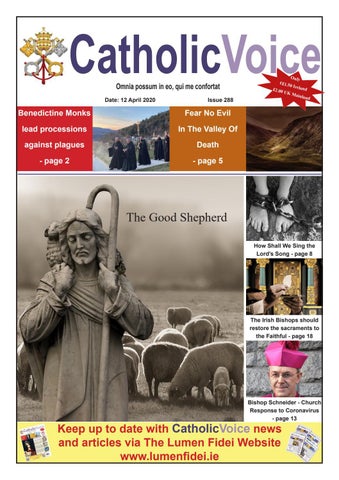
The Good Shepherd How Shall We Sing the Lord’s Song - page 8
The Irish Bishops should restore the sacraments to the Faithful - page 18
Bishop Schneider - Church Response to Coronavirus - page 13
Keep up to date with CatholicVoice news and articles via The Lumen Fidei Website www.lumenfidei.ie
8 LITURGY Catholic Voice
12th April 2020
How Can We Sing The Lord’s Song In A Strange Land Mary Kearns
With the exile of the chosen people to Babylon it seemed the practice of their Faith had come to an end. King Nebuchadnezzar sacked Jerusalem in the year 586 BC, destroying the temple and deporting most of the citizens to Babylon. No more sacrifices were possible on alien soil and the family of the covenant appeared to be extinguished. The chosen people were exiled in a strange land where they were disoriented and surely must have thought God had deserted them. What had happened to the promises that God made to Abraham? For different reasons, Ireland is now a strange land. While our buildings are still standing, they are devoid of a worshipping community. The sacraments are no longer publicly available and it is impossible to know how long this strangeness will last. No-one alive remembers St. Patrick’s Day not being celebrated; what is worse, we are unable to participate publicly in Holy Week ceremonies and the great solemnity of Easter We are doing the best we can and are grateful for the means of watching the holy sacrifice of Mass streamed live. As well as this, we can follow the liturgical year and be part of the universal Church by reciting the Liturgy of the Hours, formerly the Divine Office every day. In this way, the Lord’s song can still be sung although we are in a strange land just as the Jews learned to recite and sing their sacred scripture. The Liturgy of the Hours is made up of psalms, scripture readings and intercessions, with the greatest space being given to the psalms. The psalms are sacred poems or songs designed for worship; they remind us of our Jewish roots as this was how Our Blessed Lord prayed in his day. The Book of Psalms was the prayerbook of Jesus. From the
Gospels we know of his familiarity with scripture. On the cross Jesus prayed, “My God, my God, why have you forsaken me?” which is a quotation from Psalm 22 and Jesus also prayed, “Father, into your hands I commit my spirit” from Psalm 31. In his time, the Jews had set times for morning and evening prayer which was always scriptural. This is the origin of our own Liturgy of the Hours. Many laypeople are not conversant with the psalms; this might be because in the past, our spiritual needs outside of Mass were always fulfilled by pious practices. Those who attend particular devotions and novenas, who turn out in great numbers to get blessed with a saint’s relic or who gather to recite the Rosary and the Chaplet of Divine Mercy, evidently find that their need for communal prayer is satisfied this way. While these devotions are to be commended and have always formed a part of Catholic experience, they are nevertheless not the official Prayer of the Church. What then is so special about the Liturgy of the Hours? We can perhaps answer that question by
reading Sacrosanctum Concilium or one of the many volumes that have been written on the subject over the years since the Divine Office was revised and translated into the vernacular. It is possible however to understand the importance of praying with the Church by a few observations. Firstly, the Church praying the official prayer traditionally known as the Divine Office, is the voice of the Bride addressing the Bridegroom, Our Blessed Lord, Jesus Christ. This voice is the daily prayer of the Church united across the world at particular times of the day. The second reason the Liturgy of the Hours is of importance is that in praying it, the laity can reach the level of “full, conscious, active participation” desired by the Council. This is brought about by means of responses, acclamations, alternating psalmody and intercessions and by the sharing of the readings. When this is done in a communal setting, it is always preferable to private prayer. Thirdly, our understanding of the liturgy of the Mass is deepened by
12th April 2020 Catholic Voice our understanding of the Liturgy of the Hours which in common with Mass, has readings from both Testaments. The Old throws light on the New and the New is its fulfillment as the Mass is the sacrifice of the new law, the new and eternal covenant. The reading of scripture in the liturgy of the Mass and in the Divine Office, is of the greatest significance because it is offered by the Church universal, the Bride of Christ, and not just by an individual. In this way, throughout the liturgical year, the entire paschal mystery unfolds. The Church’s official prayer begins during the Advent weeks by preparing for the birth of the Saviour. It continues through his death and resurrection, through the Lord’s ascension into heaven, the coming of the Holy Spirit at Pentecost and it looks for and expects, the return of the Lord in glory. The Prayer of the Church helps to root us in the entirety of the central mystery of salvation. It is about the paschal mystery of Christ but is permeated by the presence of the Holy Trinity. We are reminded of this by reciting the “Glory be to the Father” at the end of each psalm and canticle. Jesus is the divine Bridegroom who listens to the voice of his Bride, the Church. I receive the prayer of My Church expressed in the age-old psalmody, already so familiar and so dear to My soul, and unite the prayer of the Church to My own ceaseless pleading before the Father in the heavenly sanctuary. It is this that confers upon the psalmody of My Church such impetratory power, such vehemence, such a resonance in the sanctuary of heaven. (In Sinu Jesu. p.253) Through daily repetition of sacred scripture, we are conversant with the Father, Son and Holy Spirit. Here is present the same One who not alone walked our earth, who died and rose again but who as the second person of the Blessed Trinity, is one with the Father and
the Holy Spirit. This is the Person we speak of in the Invitatory, the first psalm of Morning Prayer: “let us bow and bend low; let us kneel before the God who made us, for he is our God, and we the people who belong to his pasture, the flock that is led by his hand.” During the seventy years of captivity, the Jews grew spiritually in their relationship with God. They learned to place all their trust in him believing that one day they would return home. The prophets Isaiah, Jeremiah and Ezekiel understood this time as period for purging the people of their tendency to combine worship of idols with the worship
LITURGY 9
of the one true God. Exile was a time of penance for them and as a consequence, their allegiance to God flourished as never before. The present times pose a serious challenge for us when we are exiled from places of worship. Like the ancient chosen people we too can learn to place our trust in God and not in the world of materialism, consumerism and entertainment, the modern equivalent of false gods. For catechesis and liturgical formation: marykeenankearns@gmail.com Mobile: 087 7794687
18 SACRAMENTAL LIFE Catholic Voice
12th April 2020
The Irish Bishops Should Restore the Sacraments to the Faithful John Lacken Please can I ask you to pause for just a moment to offer up a ‘Hail Mary’ for our Irish Bishops in these extraordinary times in which we are living. In Ireland most of our Churches are closed, and most of the faithful cannot receive Holy Communion. In many places, the sacrament of confession has also been suspended and priests are being denied entry to hospitals and nursing homes and cannot administer the ‘last rites’ to dying parishioners. There are a few faithful priests who are still prepared to make sure that Catholics can receive Holy Communion and the sacrament of Confession, but they do this without the practical support of their bishops. Bishop Athanasius Schneider, in a recent interview with Life Site journalist Diane Montagna, said that he believes that, “the prevailing majority of bishops reacted precipitously and out of panic in prohibiting all public Masses and — what is even more incomprehensible — in closing churches. The reaction of Catholics varies from those who are angry, to those who are baffled, to those who are not really bothered by the temporary absence of the sacraments. What Catholics need to realise is that God is always in control of what happens in this world of ours. Nothing happens by chance and nothing happens without God permitting it. This is not to say that the coronavirus was leashed upon the world by God, but that God permits this plague for His own good purposes.
As St Claude de la Columbiere reminds us in his treatise on Divine Providence. “It is one of the most firmly established and most consoling of the truths that have been revealed to us that (apart from sin) nothing happens to us in life unless God wills it so. Wealth and poverty alike come from Him. If we fall ill, God is the cause of our illness; if we get well, our recovery is due to God. We owe our lives entirely to Him, and when death comes to put an end to life, His will be the hand that deals the blow. But should we attribute it to God when we are unjustly persecuted? Yes, He is the only person you can charge with the wrong you suffer. He is not the cause of the sin the person commits by ill-treating you, but He is the cause of the suffering
that person inflicts on you while sinning. God did not inspire your enemy with the will to harm you, but He gave him the power to do so. If you receive a wound, do not doubt but that it is God Himself who has wounded you. If all living creatures were to league themselves against you, unless the Creator wished it and joined with them and gave them the strength and means to carry out their purpose, they would never succeed. You would have no power over me if it had not been given you from above, the Saviour of the world said to Pilate. We can say the same to demons and men, to the brute beasts and to whatever exists. You would not be able to disturb me or harm me as you do unless God had ordered it so. You are sent by Him, you are given the power by Him to tempt
12th April 2020 Catholic Voice me and to make me suffer. You would have no power over me if it had not been given you from above. If from time to time we meditated seriously on this truth of our faith it would be enough to stifle all complaint in whatever loss or misfortune we suffer. What I have the Lord gave me, it has been taken away by Him. It is not a lawsuit or a thief that has ruined you or a certain person that has slandered you; if your child dies it is not by accident or wrong treatment, but because God, to whom all belongs, has not wished you to keep it longer.” He tells us “It is then a truth of our faith that God is responsible for all the happenings we complain of in the world and, furthermore, we cannot doubt that all the misfortunes God sends us have a very useful purpose. We cannot doubt it without imputing to God a lack of judgment in deciding what is advantageous for us.” St Claude reminds us to thank God for everything that His providence permits. I would say that not many Catholics have thought to thank God for permitting the coronavirus because so many are not properly catechised and have lost the supernatural outlook on life. The coronavirus pandemic will end as soon as God see that His purpose in permitting it has been fulfilled. In pondering on these things I imagined in my mind a conversation between Jesus and the Irish bishops which goes something like this Jesus: Bishop, Bishop, thou art careful, and art troubled about many things: But one thing is necessary, My Body, Blood, Soul & Divinity in the Most Holy Sacrament of the Altar. Those Catholics who desire to receive Me in Holy Communion at Holy Mass are seeking the better part.
Jesus: Bishop, lovest thou me more than these? Bishop: Yea, Lord, thou knowest that I love thee. Jesus: Feed my lambs. Jesus: Bishop lovest thou me? Bishop: Yea, Lord, thou knowest that I love thee. Jesus: Feed my lambs. Jesus: Bishop, lovest thou me? Bishop (grieved): Lord, thou knowest all things: thou knowest that I love thee. Jesus: Feed my sheep. Jesus: “I am the living bread which came down from heaven. If any man eat of this bread, he shall live for ever; and the bread that I will give, is my flesh, for the life of the world.” (John 6:51-52) Jesus: “Amen, amen I say unto you: Except you eat the flesh of the Son of man, and drink his blood, you shall not have life in you. He that eateth my flesh, and drinketh my blood, hath everlasting life: and I will raise him up in the last day. For my flesh is meat indeed: and my blood is drink indeed. He that eateth my flesh, and drinketh my blood, abideth in me, and I in him. As the living Father hath sent me, and I live by the Father; so he that
SACRAMENTAL LIFE 19 eateth me, the same also shall live by me. This is the bread that came down from heaven. Not as your fathers did eat manna, and are dead. He that eateth this bread, shall live for ever.” (John 6:54-59) In Ireland we can go out to get bread & milk, we can go out to get beer and wine, we can go out to get petrol, a young pregnant woman may also go for an abortion, we can go to the pharmacy to get medicine for our bodies, but thanks to the actions of our Bishops, the faithful cannot go to get medicine for their souls, we have been prevented from receiving Jesus Christ truly present in the Most Holy Eucharist, we have been prevented from receiving absolution for our sins in the sacrament of confession? If people can get these other material needs despite government restrictions, then there is no practical reason why the sacraments cannot be administered to the faithful. Are supermarkets somehow more hygienic and virus resistant that a Catholic Church? Catholics should not allow a secular ruler to decide what is essential for us. For Catholic families, receiving the sacraments is more important than receiving ordinary food, or clothing, or drink.