The Second Spring
b. The Second Spring CP002.indd 1
30/10/2025 17:24
The Second Spring St John Henry Newman Introduction by Andrew Nash, PhD
PRESS
b. The Second Spring CP002.indd 3
30/10/2025 17:24
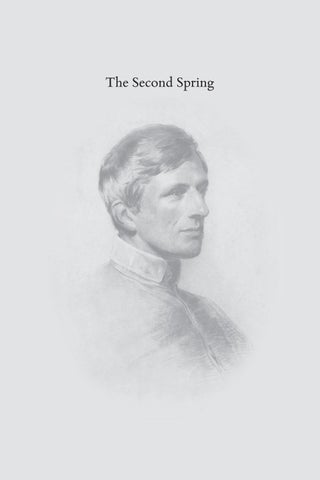
Cover image: Spring in Vatican City by Gabriella Clare Marino on Unsplash. Half title page: John Henry Newman by George Richmond, 1844. Mary Evans Picture Library. The Second Spring, first published in this edition in 2025 by CTS Press. CTS Press is an imprint of The Catholic Truth Society. 42-46 Harleyford Road London SE11 5AY Tel: 020 7640 0042. www.ctsbooks.org © 2025 The Incorporated Catholic Truth Society. All rights reserved. ISBN 978-1-78469-857-7
b. The Second Spring CP002.indd 4
30/10/2025 17:24
Contents About the Author..................................................................... vii Introduction by Andrew Nash, PhD........................................... 1 Second Spring.......................................................................... 13
b. The Second Spring CP002.indd 5
30/10/2025 17:24
About the Author
Dr Andrew Nash is a retired headmaster whose career included teaching English at The Oratory School. He is the editor of the critical editions of Newman’s Lectures on the Present Position of Catholics in England and Newman’s Essays Critical and Historical, Vol I.
vii
b. The Second Spring CP002.indd 7
30/10/2025 17:24
Introduction
I
n the autumn of 1850 a wave of anti-Catholic agitation broke out across Britain. Huge protest meetings were held; anti-Catholic sermons were preached; newspapers attacked the Pope; priests were abused in the streets; and Catholic churches had their windows broken. Sometimes the violence went much further. In famously genteel Cheltenham, the Reverend Francis Close, who later became a senior figure in the Church of England and even had a public school named after him, preached such an inflammatory sermon that his congregation went out and set fire to the local Catholic church. For the extraordinary feature of this anti-Catholic campaign was that it was inspired and led by the middle and upper classes of society, both clergy and laity; indeed it was publicly supported by no less than the Prime Minister of the day, Lord John Russell. What had sparked it off? In truth, it was simply an administrative re-organisation of the Catholic Church in England and Wales, a re-organisation which made no difference whatsoever to the rest of the population. Since the Reformation in the 16th century, Catholics in this country had been without the normal organisation of diocesan bishops. All the historic sees of Canterbury, York and the rest had of course been taken over by the new Church of England. Surviving Catholic communities were served by missionary priests, often Jesuits, trained abroad. It wasn’t until 1623 that Pope Urban VII appointed a Vicar Apostolic, a bishop with jurisdiction for the whole country but holding his authority directly from the Pope rather than as a diocesan bishop in his own right. This was later increased to four Vicars Apostolic, each presiding over a district such as the Midlands or London. 1
b. The Second Spring CP002.indd 1
30/10/2025 17:24
THE SECOND SPRING
The years of fierce persecution and then the relentless attrition of the Penal Laws had seen Catholics reduced to a small minority. But once conditions eased, the numbers of Catholics began to rise. According to one historian, between 1770 and 1850 the Catholic population of England increased nearly tenfold from about 80,000 to about 750,000. This was partly due to natural regeneration once the more severe Penal Laws had fallen into disuse. But numbers were also boosted by the arrival of Catholics from abroad. The French Revolution saw numbers of émigré Catholics fleeing to England to escape persecution. Many Irish Catholics came to England to find work and also to escape famine in Ireland. And then in the 1840s there began to be a succession of converts from the Oxford Movement – that extraordinary rediscovery of Catholic doctrine by clergymen of the Church of England, led by John Henry Newman. For a long time the attitude of many English Catholics had been: keep your head down and don’t make trouble. By the late 18th and early 19th century, Catholics did begin cautiously to ask if they might start to have some of their political and legal rights, but they often did so with an attitude of almost fawning humility towards the British government. The “Cisalpine Club” of liberal-minded English Catholics, opposing the Vicars Apostolic, were willing to accept a very minimalist version of loyalty to Rome, and even repudiate certain Catholic doctrines, in return for acceptance by the Protestant establishment. It wasn’t until 1829 that Catholic Emancipation was finally granted, and Catholics in Britain were now able to face the future with confidence. New churches were built, no longer chapels tucked away in back streets and disguised as secular buildings, but now often in the newly popular mediaeval style, especially after the conversion in 1834 of Augustus Welby Pugin, the great architect of the Gothic revival. To meet the needs of these growing Catholic congregations, in 1840 the number of Vicars Apostolic was doubled to eight. One of these was Nicholas Wiseman who was emerging as a key 2
b. The Second Spring CP002.indd 2
30/10/2025 17:24
Introduction
figure in English Catholic life. Born in Spain to an old Irish family, he had entered the priesthood and quickly made his name as a gifted scholar and linguist; he was appointed Rector of the English College in Rome at the age of 26. He met Newman when the latter visited Rome while still an Anglican in 1833, and he became intensely interested in the Oxford Movement, sensing its enormous potential. He was also in touch with major Catholic intellectuals associated with the revival of the Church going on in Europe, such as Lacordaire, Frederic Ozanam and Manzoni. Visiting England in 1835 he found the atmosphere among English Catholics still timid and set about infusing a new more outgoing spirit. In 1847 he was appointed pro-Vicar Apostolic of the London District, and he went to Rome to present to the Pope the request of the bishops and clergy for a proper hierarchy. The political upheavals of 1848 delayed things, but in 1850 Pope Pius IX issued the bull Universalis Ecclesiae re-establishing a Catholic hierarchy in England and Wales. Wiseman was now to be the first Cardinal Archbishop of Westminster. Filled with enthusiasm, he issued a pastoral letter entitled “From out of the Flaminian Gate”. In flamboyant, triumphalist style, he proclaimed that: Catholic England has been restored to its orbit in the ecclesiastical firmament, from which its light had long vanished, and begins anew its course of regularly adjusted action round the centre of unity, the source of jurisdiction, of light and vigour. Describing his own role as Archbishop of Westminster, he announced in due canonical form that: We govern, and shall continue to govern, the counties of Middlesex, Hertford and Essex, as ordinary thereof, and those of Surrey, Sussex, Kent, Berkshire, and Hampshire, with the islands annexed, as administrator with ordinary jurisdiction. 3
b. The Second Spring CP002.indd 3
30/10/2025 17:24
THE SECOND SPRING
It seems clear that he had no idea that this declaration would have the impact that it did. What he was announcing was, after all, merely a change in the way that English Catholics were to be organised. However, he had chosen to interpret this as being of enormous symbolic significance, and the British press took him at his word. Led by The Times, the papers saw this as an outrageous attempt by the papacy to claim jurisdiction over England. It was dubbed the “Papal Aggression” and was greeted with furious denunciations as an infringement of Britain’s Protestant freedom. The protest meetings and sometimes violent agitation that I have described ensued. Realising what a hornets’ nest he had stirred up, Wiseman published in November a conciliatory Appeal to the Reason and Good Feeling of the English People on the subject of the Catholic Hierarchy. In this he explained that his language had been misunderstood, and that he was only claiming jurisdiction over his Catholic flock, many of whom were among the very poor. His reasonable tone calmed things down, though a law forbidding the new bishops to use their titles was rushed through Parliament – it was never enforced and was quietly repealed a few years later. The new dioceses were now set up. The decision had been made not to re-establish the historic pre-reformation sees of Canterbury and so on. This was partly for fear of prosecution under a law of 1829 which forbade the use of the old titles “except by the clergy of the Protestant Church by law established”. But it was also a sensible decision to reflect the realities of population distribution in the new big industrial cities. There were thirteen sees in total: Westminster, which was the metropolitan see, and twelve suffragan sees: Southwark, Hexham, Beverley, Liverpool, Salford, Shrewsbury, Menevia and Newport, Clifton, Plymouth, Nottingham, Birmingham, and Northampton. In due course, these new sees were to lead to some fine new Catholic cathedrals, such as St Chad’s in Birmingham. But even before the architecture could be put in place, there was a marked 4
b. The Second Spring CP002.indd 4
30/10/2025 17:24
Introduction
change of episcopal style, at least as far as Wiseman was concerned. The Vicars Apostolic of former times had lived low-profile lives. They had no public “image”, indeed would have been invisible to the general population. Of one of them it was said that ‘he dug his own potatoes in his braces’. With the arrival of Cardinal Wiseman, all this changed. He was to be seen in London getting in and out of his carriage in his scarlet cardinal’s robes, and he had a high profile nationally. Newman, who had by now been a Catholic for five years, was not at first a great enthusiast for the restoration of the hierarchy. Always concerned with the education and development of the Catholic community, he saw other priorities: ‘We need seminaries, not sees,’ he said. Nevertheless, he had seen the “Papal Aggression” crisis as an opportunity for Catholics to explain their faith and defend the church. And although he hoped this would mainly be done by laymen, in 1851 he gave his Lectures on the Present Position of Catholics in England, hiring Birmingham Corn Exchange to deliver them. If you’ve never read these Lectures, you have a treat in store. They are full of satire on anti-Catholic prejudice and are an antidote for those who think Newman is always serious and heavy-going. In July 1852, the complete new Catholic hierarchy of England and Wales met for their first ever synod. The venue was Oscott College, whose impressive new buildings had been opened in 1838. It was intended as the showcase of revived English Catholicism. Designed by Pugin, it has at its heart a beautiful chapel, and it was here that the new hierarchy met. It was a magnificent occasion, and Newman was chosen to be the preacher. The sermon he delivered was “The Second Spring”. Newman rose superbly to the occasion, and the sermon was to become justly famous and indeed emblematic of the revived Catholic fortunes in England in the nineteenth century. It begins very quietly, almost meditatively, as Newman reflects on the natural 5
b. The Second Spring CP002.indd 5
30/10/2025 17:24
THE SECOND SPRING
order in which everything has a birth, a time of flourishing, decay and death, but then a rebirth in a continuous cycle of regeneration. But with human affairs it is different: ‘Powers of the world, sovereignties, dynasties, sooner or later come to nought; they have their fatal hour’ he says. ‘Man and all his works are mortal; they die, and they have no power of renovation.’ The tone is sombre, and at first you will find yourself wondering where Newman is going. This is partly a rhetorical strategy on his part. He is going to move on to soaring heights of oratory, and he knows that if you are aiming at an emotional high point, you have to start low. But his depiction of the waxing and waning of human affairs is also fundamental to his outlook. Newman was no facile optimist about the world or about human nature and human history. He had a strong sense of the rise and fall of empires and indeed of all human institutions. 19th century Englishmen and women were of course subjects of the biggest empire the world had ever seen, the British Empire, and in 1852 it was at its height and with no suggestion of decay. The English assumption was of cultural superiority and the sense that the Empire was the God-given outcome of England’s history, of which the 16th century Protestant Reformation was a key element, marking out the English as God’s chosen people to bring enlightenment and Protestant civilisation to the world, validated by the great wealth brought by the Industrial Revolution and Britain’s economic as well as military domination of the world. Newman, loyal Englishman as he was, knew that this Protestant narrative was deeply wrong because it ignored, indeed contradicted, the role of the Catholic Church. English civilisation had been built on the mission of St Augustine, sent to England by Pope St Gregory the Great in 595. It is impossible to imagine the culture and achievements of mediaeval England – from its magnificent cathedrals to the very nature of our Parliament – without the intrinsic influence running through it all of the Catholic faith. 6
b. The Second Spring CP002.indd 6
30/10/2025 17:24