b. Saint Paul - Children's_b. Saint Paul - Children's 27/08/2013 10:42 Page 1
Saint Paul
CTS Children’s Books
Contents The Apostle to the Gentiles ....................3
The first missionary journey ..................14
The young Saul ........................................4
Paul and Silas in jail ................................16
Standing before Stephen ..........................6
Another mission ......................................18
On the road to Damascus ........................8
In Jerusalem ............................................20
A new life ................................................10
Rome ........................................................22
A message for everyone ..........................12
Text by Silvia Vecchini Illustrations by Antonio Vincenti Translated by Simone Finaldi Saint Paul: Published 2009 by the Incorporated Catholic Truth Society, 40-46 Harleyford Road, London SE11 5AY. Tel: 020 7640 0042; Fax: 020 7640 0046; www.CTSbooks.org. Copyright © 2009 The Incorporated Catholic Truth Society in this English-language edition. ISBN: 978 1 86082 593 4 CTS Code CH 22 Translated from the original Italian Edition: San Paolo - ISBN 978-88-6124-087-2, published by Il Pozzo di Giacobbe, Corso Vittorio Emanuele 32/34, 91100 Trapani (TP), Italy © 2008 Crispino di Girolamo.
THE APOSTLE TO THE GENTILES
aul did not know Jesus personally and
was not one of the twelve. All the
same, he is sometimes called “The thirteenth apostle”. He is known as “the apostle to the gentiles” that is, the one who brought the Gospel to people who were not Jews. Paul was certainly the greatest missionary of all time. With his faith in the risen Christ, his energy, the witness of his life, his travels and his writings, he brought the Good News throughout the Mediterranean world of his time. He spread the message of Jesus: that salvation was for everyone.
3
THE YOUNG SAUL
aul was born sometime between 8 and 12 BC. He lived and grew up with his family in Tarsus in Cilicia, which is in western Turkey.
In the 1st century BC, Tarsus was a town on the border between East and West, there were plenty of Greeks, Romans and Anatolians in the port town, as well as a Jewish community. Paul’s family, of the tribe of Benjamin, were part of that community, and like all the Jews of the
time, he had two names, a Hebrew one “Saul”, and a Latin and Greek name, “Paulus.” Paul was a Jew but he was also a Roman citizen, like all the people of the city. This was a privilege given to Tarsus because the people had supported Julius Caesar. Paul’s father was a tent merchant and so Paul learnt to be a tent maker, a job that was useful to him on many occasions.
4
As a young man Paul went to school, he learnt Greek and was taught about the Greek culture of the time, then at a very young age he was sent to Jerusalem to receive a traditional Jewish education. His teacher was Gamaliel, the wisest and most famous Rabbi in the city. Very soon he knew the Law of Moses perfectly, as well as the oral traditions of his people, and he observed all the Law, as the other Pharisees did.
5
STANDING BEFORE STEPHEN
hen Paul finished studying he returned to Tarsus, and perhaps this is why he never met Christ when he was preaching. He
only went back to Jerusalem after ten years or so. When the young Paul came back to Jerusalem, he met the Christians. He heard that they were a dangerous sect threatening the Jews and their traditions. In the year 36, a young deacon from the first Christian community was put on trial. Paul agreed with those who wanted to get rid of the Christians and stop them preaching. They condemned Stephen to death and stoned him, while Paul watched. He was still young, so the men of Jerusalem left him in charge of their cloaks while they killed Stephen. 6
Paul was known as a zealous Pharisee, proud of his origins and ready to do anything to defend the faith of his fathers. That is why he was given the task of finding and arresting Christians during the first persecution in Jerusalem. Paul followed these orders, and, as he himself said, had many women and men who were disciples of Christ put in prison. One day, the council of the elders of the Jewish people gave him a letter to bring to the synagogue in Damascus. He was meant to arrest Christians and bring them back to Jerusalem, but something was about to change.
7
ON THE ROAD TO DAMASCUS
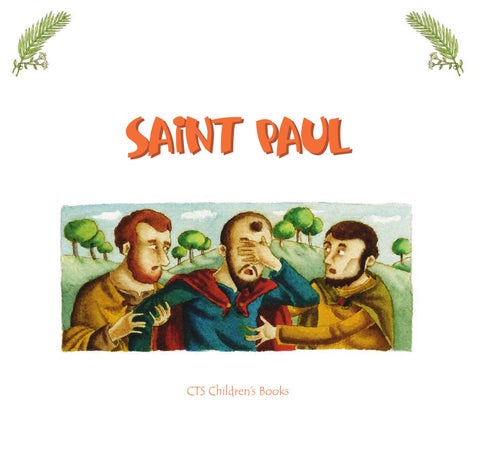
hen he got near enough to the city to see the walls, Paul was suddenly blinded by a light. He fell, overcome by the vision,
and while he was still wondering what was happening he heard a voice asking him, “Saul, Saul, why are you persecuting me?” The men travelling with him heard the voice but could see nothing and they were afraid. Paul understood the voice was really speaking to him. He fearfully asked, “Who are you Lord?” The voice answered, “I am Jesus, whom you are persecuting!”
8
The voice had said “Jesus”, the teacher of the people Paul was looking for. In that vision, Jesus had told Paul that to persecute his disciples was the same as persecuting him. While he kept his hands over his eyes to protect them, the voice continued and told him, “Now, get up and go into the city. There, you will be told what to do!”
Paul tried to stand and opened his eyes to look about him, but he could see nothing. Those on the road with him saw that he was in difficulty and helped him make his way into the city.
9
A NEW LIFE
eanwhile, in Damascus, Ananias, a disciple of Christ had a dream, instructing him to look after Paul. But Ananias was afraid,
because he knew that Paul had arrested and imprisoned many Christians. So the voice of the Lord said to him, “Go to him, because I have chosen him to be my instrument and to announce the Gospel to all peoples.” Ananias understood that the Lord had changed Paul’s heart, and there was nothing to fear from him. Ananias went to find Paul and
when he saw him he said, “My brother, Jesus has sent me to you, it was he who appeared to you on the road to Damascus. He has sent me to you, so that you can receive life and the Holy Spirit.” Ananias touched Paul and he could see once more. 10
Paul was baptised and began a new life. Nothing was ever the same because the meeting with Jesus on the road to Damascus had changed him completely. As he wrote in his letters, that day, Jesus had “captured” and “imprisoned” him forever. Paul passed some years in solitude in the deserts of Arabia. His heart, that had been full of hatred for Jesus’ followers, now felt something new. He had received instruction from Ananias, but his real teacher remained Jesus, who guided his heart, and showed him the greatness and originality of the Christian message.
When Paul returned to Damascus, he began to preach the Gospel, but those who used to be his friends no longer understood him. It seemed to them that he had abandoned the faith of his fathers, and they were shocked, the Pharisees turned against him and forced him to flee. 11