b. Saint John Marie Vianney_antoniodapadova 19/04/2010 09:44 Page 1
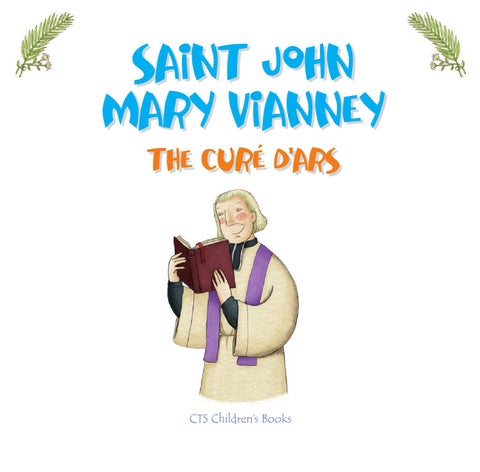
Saint John Mary Vianney The Curé Cure D’Ars
CTS Children’s Books
Contents A village parish ........................................3
A reader of hearts ....................................16
All aboard for the village of Ars! ............4
Nothing is impossible! ............................18
A simple childhood ..................................6
Patron Saint of Parish Priests ................20
A patient teacher ......................................8
Some thoughts of the Curé D’Ars ..........22
Father John ..............................................10 The little flock ........................................12
An image of John Mary Vianney ............23
A quiet little voice ..................................14
A Prayer ....................................................24
Text by Silvia Vecchini Illustrations by Giusy Capizzi Translated by Pierpaolo Finaldi
Saint John Mary Vianney - The Curé D’Ars: Published 2010 by the Incorporated Catholic Truth Society, 40-46 Harleyford Road,London SE11 5AY. Tel: 020 7640 0042; Fax: 020 7640 0046; www.cts-online.org.uk. Copyright © 2010 The Incorporated Catholic Truth Society in this English-language edition. ISBN: 978 1 86082 676 4 CTS Code CH 28 Translated from the original Italian Edition: San Giovanni Maria Vianney - Il Curato D’Ars - ISBN 978-88-6124-163-3, published by Il Pozzo di Giacobbe, Corso Vittorio Emanuele 32/34, 91100 Trapani (TP), Italy © 2010 Crispino di Girolamo.
A VILLAGE PARISH
n 1817 the tiny village of Ars in France was unknown to everyone except its 300 poor inhabitants. When Fr John Mary Vianney
arrived in his new parish he found that no one was very interested in God. Few people went to Sunday Mass and for most people, the only time they thought about God was when they made a quick examination of conscience before going to bed at night.
3
ALL ABOARD FOR THE VILLAGE OF ARS!
n just a few years, the little village of Ars had become
very important for the Christian life of all the nearby parishes and towns, and then
for all of France. Soon Ars had become famous all over Europe and great crowds came from far and wide to visit the village. From 1830 until 1845 the number of people who wanted to visit Ars was so great that a special ticket office was opened at Lyon train station which only sold tickets for Ars.
4
The ticket to Ars was different from other tickets. It was valid for eight days so that everyone who went had enough time to meet the parish priest and talk to him.
What was it that had suddenly transformed a tiny village into such an important place? Why were so many people travelling to Ars? Who was the parish priest that everyone wanted to see? Let’s step back in time and find out... 5
A SIMPLE CHILDHOOD
ohn Mary Vianney was born on 8th May 1786 to a family of farmers in Dardilly near Lyon in France. John was the fourth of seven
children. His family all prayed together and took special care of the
poor people who lived nearby. In 1789, when John was just three years old, the French revolution began. Very soon the whole of France was affected by the revolution and there was a lot of fear and violence. Many laws were made that discriminated against Christians. Churches were closed and many priests were forced to stop being priests. John’s family carried on going to Mass in secret. The priests who said the secret Masses had all refused to give up their mission and had remained faithful to Rome and to the Pope.
6
John was a good boy and grew up helping his parents look after sheep on the farm. His favourite game was a sort of hoop-la played with wooden rings. He wasn’t very clever or well-educated but he was a brave boy. Some of the priests who had refused to become priests of the revolution were secretly looked after on John’s parents’ farm. It was thanks to one of these priests who was hiding in a barn on the farm that John made his First Confession when he was 11 years old. He had to wait another two years before making his First Holy Communion in secret with another priest who was hiding on the farm. The courageous example of those priests who had risked their lives to give John the Sacraments of Reconciliation and the Eucharist made a deep impression on him. He knew that it was thanks to them that he had met God and the desire to be just like them began to grow in his heart.
7
A PATIENT TEACHER
hen John was sure that he wanted to become a priest, he told his family.
His father Matthew could not spare him from the farm, there was too much work to do and not enough money to pay for his studies at the seminary, so he had to wait. When he was twenty years old John was finally able to move to a village nearby called Ecully where Fr Balley the parish priest had a small school. John had only learnt to read and write at the age of seventeen and had only gone to the village school long enough to learn the basics. He soon found it very difficult at Fr Balley’s school. For three years he studied French and Latin but his grades were poor because he was a slow learner and had a bad memory. He often got discouraged but Fr Balley helped him and encouraged him to carry on. 8
In the meantime John was called up to join the army. He didn’t want to go and became a deserter which meant he had to stay hidden for a time. After many adventures he was able to go back home. He started his studies again with great difficulty and in 1815 was able to go to the seminary in Lyon. His first exam was a disaster and the fact that all the lessons were in Latin made things even more difficult. John went back to Fr Balley who once again helped him and encouraged him not to give up the studies he needed to complete in order to become a priest. The parish priest of Ecully turned out to be a patient teacher and a sincere friend. He continued to help John until he passed all the exams necessary to become a priest. 9
FATHER JOHN
inally after two years John was ready to become a priest. Everyone could see that even though he found studying difficult, he had made great progress. It was clear that he was a good, simple man whose vocation was sincere. The vicar general was sure that John had the makings of a good priest and that ‘God would do the rest’. At the age of 29, John was ordained on 12th August 1815. He was appointed as curate to help Fr Balley.
10
John began his life as a priest with his teacher and spiritual guide in Ecully. He lived an austere life and soon began to dedicate himself with great care and in a special way to the Sacrament of Reconciliation.
Two years later, Fr Balley died and Fr John was left by himself. A new parish was chosen for Fr John among simple people in the country, it seemed just right for a priest who was not that clever. John was sent to Ars en Dombes to become the new parish priest of the village. 11