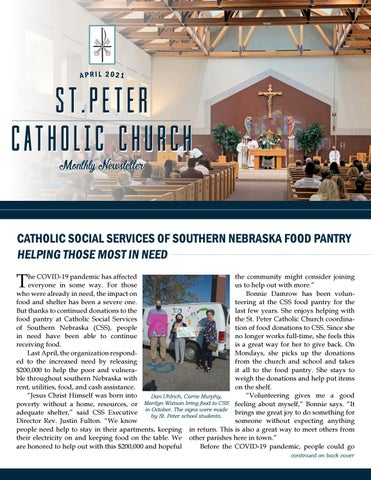
A P R I L 2 0 21
St.Peter C ath athoo lic li c Chu r ch Monthly Newsletter
CATHOLIC SOCIAL SERVICES OF SOUTHERN NEBRASKA FOOD PANTRY HELPING THOSE MOST IN NEED
T
he COVID-19 pandemic has affected the community might consider joining everyone in some way. For those us to help out with more.” who were already in need, the impact on Bonnie Damrow has been volunfood and shelter has been a severe one. teering at the CSS food pantry for the But thanks to continued donations to the last few years. She enjoys helping with food pantry at Catholic Social Services the St. Peter Catholic Church coordinaof Southern Nebraska (CSS), people tion of food donations to CSS. Since she in need have been able to continue no longer works full-time, she feels this receiving food. is a great way for her to give back. On Last April, the organization respondMondays, she picks up the donations ed to the increased need by releasing from the church and school and takes $200,000 to help the poor and vulnerait all to the food pantry. She stays to ble throughout southern Nebraska with weigh the donations and help put items rent, utilities, food, and cash assistance. on the shelf. “Jesus Christ Himself was born into “Volunteering gives me a good Dan Uhlrich, Carrie Murphy, Marilyn Watson bring food to CSS poverty without a home, resources, or feeling about myself,” Bonnie says. “It adequate shelter,” said CSS Executive in October. The signs were made brings me great joy to do something for by St. Peter school students. Director Rev. Justin Fulton. “We know someone without expecting anything people need help to stay in their apartments, keeping in return. This is also a great way to meet others from their electricity on and keeping food on the table. We other parishes here in town.” are honored to help out with this $200,000 and hopeful Before the COVID-19 pandemic, people could go continued on back cover
S t. pet er C atholic Ch ur ch
TEACHING BY EXAMPLE
“I
The Importance of Prayer in a Child’s Life
want to be just like Mom and Dad!” Perhaps nothing lifts a parent’s heart like hearing these words. While certainly affirming, such words also remind us of the great responsibility that comes with parenthood. Children often examine the lives of their parents when making decisions that will affect their own lives. For example, a young boy may dream of becoming a physician one day, just like his father. Or a young girl may hope to become a veterinarian, just like her mother. Could the same be said about their parents’ faith lives? Just as children learn traits and values from their parents, they should also learn the importance and great joy of developing a personal relationship with Christ. And the foundation of such a relationship is prayer — conversation with God. How should we go about teaching our children to pray? There are several methods, but none works as well as teaching by example. Begin teaching the importance of prayer by praying openly with your spouse. This teaches children that prayer is meaningful and important, and not just a ritual. Also, pray with your children — in the morning and in the evening. Show your sons and daughters the importance of beginning and ending each day in prayer. While a fortunate dilemma, it’s a dilemma nonetheless — Catholics face the challenge of discerning which prayers to use, considering the thousands available. A good rule of thumb is to start simple — maybe an Our Father or Hail Mary, and then move into something more complex — Hail, Holy Queen or Prayer to St. Michael the 2
Archangel, among others. Begin with prayers your children can pick up fairly quickly. Not only will this show them that praying can be fun and easy, but shorter prayers are also usually easier to understand. Teach your children the importance of spontaneous prayer, rather than just prescribed prayers. Spontaneous prayer is any prayer that is created at the same time it is offered. Another way to think of spontaneous prayer is “praying in your own words.” Structure spontaneous prayers according to the ACTS acronym — Adoration, Contrition, Thanksgiving, and Supplication. In layman’s terms, this means beginning each prayer with words of adoration, such as “You are the Lord God Almighty. I love you.” Move into a period of contrition, asking God’s forgiveness for the sins you have committed. Then, give words of thanksgiving, thanking God for the gifts He has given. Finally, spend time sharing with God your heart’s desires. These intentions can be personal or on another’s behalf. Following this format ensures that spontaneous prayer “covers all the bases,” and doesn’t become just a mental wish list. While God wants to hear and grant our wishes, He also expects words of adoration, contrition and thankfulness. The best time to begin praying with your children is right now. The sooner they learn about prayer, the sooner they can begin cultivating their own relationship with Jesus. Many parents even pray with their children before birth, hoping their unborn son or daughter can hear their words in utero. Remember, there is no better way to teach one’s children about the value of prayer than by example.
A Letter from Our Pastor
Celebrating Christ’s Resurrection Dear brothers and sisters in Christ,
H
ow did you feel at the end of the Palm Sunday Mass? You may not have noticed, but there was an abrupt shift of tone in that liturgy. It began with great joy, as we celebrated Jesus’ entry into Jerusalem to the acclamation of the crowds. But then the mood shifted to sorrow, despair even, when the Passion Gospel was read, for we heard the shouts of “Crucify Him! Crucify Him!” from those same crowds a few days later. Palm Sunday, of course, was the beginning of Holy Week, the most important week in the Christian year. The confusion of conflicting moods is spread through the week, especially during the Easter Triduum — from sundown Holy Thursday to sundown Easter Sunday. Holy Thursday offers us the glorious Mass of the Lord’s Supper celebrating the institution of the Eucharist before we pass to the sadness of the betrayal and arrest of Jesus in the Garden of Gethsemane. The next day brings us the Good Friday Liturgy of the Passion with our recognition of what our sins did to the Incarnate Son of God. Then, after a day of waiting as we mourn Jesus’ burial and repose in the tomb, we celebrate His victory over sin, Satan and death at the Easter Vigil on Saturday night or at the Masses the next day. If we have participated in all the main services of the Triduum, we arrive at Sunday evening exhausted but joyful. This year, Palm Sunday fell on the final Sunday of March, and we observe Holy Week and Easter Sunday early in April. That means we will spend most of April in the Easter Season, a period filled with joy and thanksgiving. Our gladness comes not only because Christ rose from the dead, but also because we benefit from it. As the Catechism of the Catholic Church (§654) puts it, “The Paschal mystery has two aspects: by his death, Christ liberates us from sin; by his Resurrection, he opens for us
the way to a new life.” In other words, Christ’s Resurrection is the source of our own future resurrection. St. Paul wrote about it to the Romans in the following words (Rom 6:5): “For if we have grown into union with him through a death like his, we shall also be united with him in the resurrection.” Eternal life in union with Christ — a hope for a new life beginning now and extending on into heaven — is the result of Jesus’ Resurrection. What greater grounds for thanksgiving can there be than this Easter hope? We should sing with joy about this promise from God! What’s more, Paul also wrote (Col 3:1-2): “If then you were raised with Christ, seek what is above, where Christ is seated at the right hand of God. Think of what is above, not of what is on earth.” Jesus’ Resurrection and His promise of a new life for us mean that we need to live in conformity with our status as adopted children of God. And how do we show our joy and our gratitude to God for this amazing gift He has given us? We join in worship and praise God by word and song. We share the Good News of Jesus’ victory over death with our family, friends and neighbors. And we offer back to the Lord a portion of the time, talent and treasure He has entrusted to us. Yes, the Easter message that we share in the benefits of Christ’s Resurrection is the ultimate foundation for all Christian stewardship. The Lord is risen, alleluia. In His Mercy,
Fr. Eric Clark, Pastor
3
S t. pet er C atholic Ch ur ch BECKY HUEBNER REFLECTS ON HER JOURNEY
W
hen Becky Huebner was received plains and reading the plaques in the into the Catholic Church at our shrine, Becky felt something stirring — Easter Vigil Mass two years ago, it the first “nugget” of a call to the Church was like arriving home after a very forming in her subconscious. long journey. For over a decade, Becky Several years later, when Christian had been searching for a faith that joined the Church, Becky and her husfelt complete and wholly fulfilling. band, Paul, attended RCIA classes at St. After reading countless books, being Peter and continued to learn more about touched by the exceptional beauty of the faith. Not long after, their daughter a shrine, witnessing two of her four Kate decided to join the Church, as well. children join the Catholic Church, and Again, Becky and Paul participated in exploring Rome during a visit for her the RCIA program here. Ever so slowson’s ordination to the diaconate, Becky ly, Becky — through her reading and knew this much was true — the Lord growing relationships with Catholics — was calling her to make a home right was drawing closer to the Church. here in His Church on earth. “In 2018, Paul and I went to Rome A lifelong Protestant to the age of for Christian’s diaconate ordination, 59, Becky and with her husband, Paul and that was the straw that broke the Becky Huebner started in the Lutheran church and later camel’s back,” Becky says. “Christian began attending Evangelical churches. There, the Hueb- had invited friends from many walks of life. This little ners found a love of community and the Word that ap- group of us gathered and spent a week together for pealed to them. However, Becky often found herself his diaconate. That week just changed my life. To sit thinking that something was missing. in Mass and have a common language even though “Over time, it began to feel like a square peg in a round we didn’t know the language and to have people who hole,” she says. “There were definitely some good things bring an amazing thread to this story share all of this there, but it felt like an incomplete picture.” together — I was dumbfounded. Suddenly, I had to be An avid reader, Becky one day picked up a book by a part of this thing called the Church. That is where Peggy Noonan entitled John Paul the Great: Remember- the good, true and beautiful were revealed to me.” ing a Spiritual Father. After reading it, Becky began to Returning from Rome, Becky once again embarked on look at the Catholic Church with new eyes. “Maybe,” she the RCIA journey here at St. Peter. And as the saying goes, thought, “there is something here after all.” the third time is the charm — at the end of this RCIA sesAround the same time, Becky’s son, Christian, was sion, Becky was received into the Church during the 2019 also doing a lot of soul-searching, with his faith journey Easter Vigil. running almost parallel to his mother’s. One day, the two Having come to the Catholic faith later in life, and with stopped to visit the Holy Family Shrine along I-80 in Gret- the inspiration of the conversions of two of her children, na. While taking in the incredible views of the Nebraska Becky chose a fitting patron saint for her Confirmation. 4
TO THE CATHOLIC CHURCH:
All In God’s Time
“I took Helena as my Confirmation saint because I got to be in her church in Rome where her relics of the cross are,” she says. “Also, her son was Constantine, who was a convert, and he was involved in her conversion. She didn’t convert until late in life but she did something impactful even late in the game, so she’s my inspiration.” Reflecting on the many ways that life has changed since she came into the Church, Becky is thankful for the sense of wholeness she has found in this new faith. “I feel like the world makes sense,” she says. “The convergence of intellect and faith shows that it doesn’t have to be an ‘either/or’ — it’s all part of the whole. I’m so excited to live in this world as a person of faith because the context is there now. The sacraments help point me and bring me to Him, and it gives my life new meaning, purpose, and joy.” Since becoming Catholic, Becky has jumped feet first into parish life here at St. Peter! She credits the warm welcome from fellow parishioners with helping her get involved. Thanks to an invitation from Katherine Norman, Becky began volunteering at the parish preschool. Adoration coordinator Katy Dornbos got her set up with a Holy Hour. Becky also attends a women’s Bible study and helps out with RCIA when needed. She is thankful to Carol Wathen, her sponsor, for inviting her to Bible Study and many other ministries and events at the parish. She is grateful for the ways that God has opened doors for her through these key people inviting her into the life of the Church. While the journey was a long and often winding one, Becky sees blessings in it all. She has immeasurable gratitude for all the people, places, and experiences that have led her to the Church. “Three times through RCIA, 15 years of study and people, and finally it was the Spirit,” Becky says. “And it’s been one of the great gifts of my life.”
Becky Huebner and her husband, Paul, with their son, Christian, on the occasion of his ordination to the diaconate in St. Peter’s Basilica.
Becky Huebner (front, center) with her husband, Paul, their four children, children-in-law and grandchildren, on the occasion of son Christian’s ordination to the priesthood
5
S t. pet er C atholic Ch ur ch STEADFAST IN FAITH AND DEVOTION:
St. Catherine of Siena On April 29, we celebrate the feast day of a doctor of the Church — one who remained absolutely devoted to living her life for Christ, even in the face of familial misunderstanding in her youth, and through societal opposition and turmoil during her later years. As stewards in our fast-paced, highly technical — and often fractured — world, we can always look to the life and example of St. Catherine of Siena, and strive to remain steadfast in our faith while facing our own modern-day challenges.
B
orn in mid-14 th-century Italy to a large family, and in the midst of a plague outbreak, St. Catherine of Siena was her parents’ 25 th child, although half of her siblings did not survive through childhood. Young Catherine resisted her family’s desire for her to marry — she even went so far as to begin fasting and cutting her hair short in protest. Her parents eventually relented, as Catherine strived to humbly serve her own family, treating her own father as Jesus, her mother as Mary, and her brothers as the apostles. Such was Catherine’s desire to remain in service to her own family that instead of entering a convent, she joined the Third Order of St. Dominic at age 18. This enabled her to continue serving her family at home, even as she was part of a religious society. In time, she learned to read and began giving her family’s own possessions to those in need — even though her parents didn’t necessarily approve of her entirely altruistic approach to service. 6
Continuing with her faithful devotion as part of the Third Order of St. Dominic, Catherine developed a following of her own, as she wrote letters offering spiritual encouragement and instruction. Controversy would ensue, as her writings began to comment on public matters through her firm lens of faith. In the midst of these spiritual developments, at age 21, Catherine underwent a profound change, as she experienced what she called her “mystical marriage to Christ.” Through this experience, she was directed to help the poor and the sick. Catherine began serving those in need in hospitals and homes, which inspired followers to assist in these important missions of service, love and mercy. Furthermore, she continued to comment on public matters, petitioning for peace in the midst of political fracture and strife. This continued through the Great Schism, beginning in 1378, as Catherine spent two years — the last years of her life — in Rome, praying and pleading for
unity in the Church, and for the cause of Pope Urban VI. By January 1380, Catherine was gravely ill, unable to eat or drink — shortly thereafter, she lost the use of her legs. At only 33 years old, she would pass away on April 29, 1380. She was canonized nearly a century later, in 1461. Despite her short life, St. Catherine of Siena made a profound impact on the Church through her spiritually direct writings, her work serving those in need, and in preserving the unity of the Church in the face of great societal upheavals — all while being singularly devoted to living a life for Christ. Her status led her to be declared a co-patron of Italy (alongside St. Francis of Assisi) in 1939. And in 1970, Pope Paul VI declared St. Catherine of Siena a doctor of the Church.
Why Do We Sing? BY MARY ODG AARD, DIRECT OR OF MUSIC MINIS TRY AT S T. PETER PARISH
O
ver the last year’s rollercoaster of changes, challenges, and curveballs, music in the liturgy has varied between silent Masses, to cantors only, to full congregational participation, with about every tier of options in between. St. Peter Parish has worked closely with LLCHD to ensure music is approached with caution and safety, while at the same time recognizing the need for music in our liturgy. Why? What’s so important about music in the liturgy? Why do we sing — not just sing AT Mass, but sing THE Mass? You’ve probably heard the phrase “ever ancient, ever new” — our Church is ever ancient, ever new. Every time we participate in the sacrifice of the Mass, we are joining the saints and angels in heaven, all proclaiming the same ancient prayers: “Glory to God in the Highest,” “Holy, Holy, Holy,” “We proclaim your death O Lord,” “Lamb of God,” etc. But why sing the Mass? Can’t we just as easily praise Him with spoken word? Certainly we can praise Him with spoken prayer, but we sing because the Mass is outside of the ordinary — in fact, the Mass is EXTRAordinary! Music elevates our hearts and minds to a special level beyond what is ordinary, familiar, and “safe.” It asks us to commit to a vocalized prayer with a deeper level of breath and fervor, reaching into the depths of our very being. It unites our voices truly as one voice on the same pitch, rhythm, and pulse. Furthermore, Scripture gives us at least 363 exhortations to sing — these are not just recommendations to sing to the Lord, these are commands to sing psalms and hymns of praise to Him. Jesus Himself sang at the very First Mass — the Last Supper — and as a practicing Jew, singing the psalms and ritual prayers was an integral part of worship. The Church has asked us to give chant — and specifically Latin chant — “pride of place” in our choice of music. Why? Isn’t it a dead language? Didn’t Vatican II tell us we can use our vernacular
to connect to the hearts of each person and cultivate active participation? Yes, that is true, and we do indeed use English as our primary language for music and spoken word. But Latin has been the language of the Church for about 1,700 years and is something beyond the ordinary. We allow ourselves to be lifted out of the vernacular norm and beseech the Holy Spirit to ennoble what is insufficient in our everyday language through chants that we sometimes don’t understand. Additionally, as earthly creatures, we are so caught up with time — because chant has no time signature, it takes us out of the habitual routine (and limiting nature) of time and allows us to enter the transcendental world outside of time and space (heaven!). There is no finality to chant, but rather the circular movement of the never-ending eternal — prayer that never ceases. But the Church also recognizes that not everyone enjoys chant or feels comfortable with it — that each person’s heart is moved in unique and singular ways. That is why we try to sing a combination of all styles of music — chant, traditional, contemporary. As a parish of 4,000 members, we have 4,000 individual preferences. Every song — whether chant, traditional, or contemporary — is very carefully chosen to reflect the readings and theme of each Mass. In fact, often we will sing latter verses in a well-known song because those verses better reflect what we are hearing that day. No matter the style of the music, the goal of us singing in one voice is to praise, worship, and adore our Lord in a “language” that is universal and transcendental. Through the constantly evolving directives of the past year, it has been incredibly edifying to continue to worship our Lord through music as a parish. Despite the adaptations and adjustments that we make, we are grateful to our pastors and all of our parishioners as we lift our hearts and voices to love, honor, worship, and adore Him as one body. 7
S t. pet er C atholic Ch ur ch 4500 Duxhall Dr. │ Lincoln, NE 68516 402-423-1239 │ www.saintpeterslincoln.com
MASS SCHEDULE: Saturday: 4:00 p.m. Sunday: 8:00 a.m., 9:30 a.m., 11:00 a.m. DAILY MASS Monday-Friday: 6:30 a.m., 8:15 a.m. Saturday: 8:15 a.m. CONFESSION: Monday & Friday: 7:00 a.m. - 8:00 a.m. Saturday: 3:00-4:00 p.m.
CATHOLIC SOCIAL SERVICES OF SOUTHERN NEBRASKA FOOD PANTRY continued from front cover
into the pantry to choose their own food. Now, staff and volunteers prepare boxes for pick-up. Our local location also has volunteers and staff delivering to elderly homebound individuals. Many of us have so much and never have to worry about feeding our families. For those who have lost a job or make minimum wage, food is sometimes sacrificed to pay utilities or rent. So, we must help those in need. Bonnie is continually amazed by the generosity of parishioners throughout the entire year, but especially
during our parish food drive months — July and October. There are also regular Friday donations from St. Peter Catholic School. “St. Peter Catholic Church parishioners and the school’s families are so very generous all year,” Bonnie says. Bonnie says she stays involved because serving those in need is the right thing to do. After all, “feed the hungry” is a Corporal Work of Mercy. She asks all parishioners to continue their generosity in providing to the CSS food pantry.
“Volunteering gives me a good feeling about myself. It brings me great joy to do something for someone without expecting anything in return. This is also a great way to meet others from other parishes here in town.” — BONNIE DAMROW Please refer to our parish bulletin for more information on upcoming food drives.