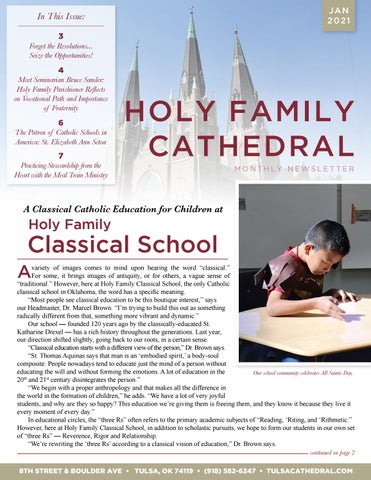
JAN 2021
In This Issue: 3 Forget the Resolutions... Seize the Opportunities! 4 Meet Seminarian Bruce Sander: Holy Family Parishioner Reflects on Vocational Path and Importance of Fraternity 6 The Patron of Catholic Schools in America: St. Elizabeth Ann Seton 7 Practicing Stewardship from the Heart with the Meal Train Ministry
HOLY FAMILY CATHEDRAL MONTHLY NEWSLETTER
A Classical Catholic Education for Children at
Holy Family
Classical School A
variety of images comes to mind upon hearing the word “classical.” For some, it brings images of antiquity, or for others, a vague sense of “traditional.” However, here at Holy Family Classical School, the only Catholic classical school in Oklahoma, the word has a specific meaning. “Most people see classical education to be this boutique interest,” says our Headmaster, Dr. Marcel Brown. “I’m trying to build this out as something radically different from that, something more vibrant and dynamic.” Our school — founded 120 years ago by the classically-educated St. Katharine Drexel — has a rich history throughout the generations. Last year, our direction shifted slightly, going back to our roots, in a certain sense. “Classical education starts with a different view of the person,” Dr. Brown says. “St. Thomas Aquinas says that man is an ‘embodied spirit,’ a body-soul composite. People nowadays tend to educate just the mind of a person without educating the will and without forming the emotions. A lot of education in the Our school community celebrates All Saints Day. 20th and 21st century disintegrates the person.” “We begin with a proper anthropology and that makes all the difference in the world in the formation of children,” he adds. “We have a lot of very joyful students, and why are they so happy? This education we’re giving them is freeing them, and they know it because they live it every moment of every day.” In educational circles, the “three Rs” often refers to the primary academic subjects of “Reading, ‘Riting, and ‘Rithmetic.” However, here at Holy Family Classical School, in addition to scholastic pursuits, we hope to form our students in our own set of “three Rs” — Reverence, Rigor and Relationship. “We’re rewriting the ‘three Rs’ according to a classical vision of education,” Dr. Brown says. continued on page 2 8TH STREET & BOULDER AVE • TULSA, OK 74119 • (918) 582-6247 • TULSACATHEDRAL.COM
HOLY FAMILY CATHEDRAL Holy Family Classical School Over the next three months, we will be highlighting each of these tenets, reflecting on their significance in our educational environment as we seek to form our young people into missionary disciples. Dr. Brown begins this initiative with a focus on instilling a sense of true reverence within our students, as a “precondition for all learning.” “Unless you have a degree of reverence toward those around you, towards your teacher, towards the material and towards reality itself, and towards the ultimate reality, God, you can’t get anywhere,” Dr. Brown says. “Once you have reverence, that is the predisposition for academic rigor. “A lot of education is irreverent, first of all to God, because it shuts God out of the picture,” he adds. “A lot of education is also irreverent to the person.” Dr. Brown hopes to re-instill a reverence for God at the heart of the school in a variety of different ways, from bringing the Blessed Sacrament into the center of the building, to praying the Liturgy of the Hours daily, with the teachers and staff in our chapel space. We also hope
continued from front cover
to emphasize reverence towards one another, and towards nature, with rules and routines being a fruit of respectful relationships. “Classicism is known, especially in our historical and architectural traditions, as having a special regard for nature — that is to say, things have a nature, persons have a nature, nature has a nature,” Dr. Brown says. “Reverence is not just an act of prayerful worship or adoration to God, but also reverence or respect, to ‘look again’ at the world around us, and the mystery and beauty of it, and also artistic imitations of it.” Dr. Brown encourages parents who find themselves intrigued by these priorities to consider the value of Catholic classical education for their children. “Do some soul searching and ask yourself, ‘What is my highest and best desire for my children in this world and the next?’” Dr. Brown says. “You need a school that is intentionally trying to build all ‘three Rs’ — the reverence, the rigor and the relationship. If you don’t have that, then you’re not going to be able to really help your children realize their best hopes and dreams in this life, and the next.”
For more information on the mission of Holy Family Classical School, please visit our website at www.holyfamilyclassicalschool.org.
2
JAN 2021
A Letter from Our Rector
Forget the Resolutions...
Seize the Opportunities! Dear Parishioners,
O
ne of the most unforgettable years in our lifetimes is finally over and 2021 is here! With the new year, I recommend we forget the notion of making resolutions. This new year presents us with opportunities to practice faithful stewardship — that is, to view the start of 2021 as a time for opportunities instead of resolutions, and to choose to be the disciples we are called to be. The choice is ours, as it has always been. I know all too well that each New Year’s Day on Jan. 1, we do more than just begin a new calendar year. We make all kinds of promises, articulate expectations, and express hopes, desires and dreams. I don’t know who started that custom, but I do know I have spent years attempting with the best intentions to follow my own resolutions, only to become disappointed that most are forgotten all too soon. Therefore, it occurred to me that this year, I need a new and fresh approach to this. Perhaps we all need a new perspective. After all, isn’t that what faithful stewards are best at? The to-do list for 2021 should be seen as a list of opportunities to practice the discipleship intended by Jesus — not just at the beginning of each year, but each day throughout the year when presented with opportunities to be a Christian disciple. In doing so, we are practicing the stewardship way of life. Maybe this year, each of us will be open to embracing the connection between discipleship and stewardship. Discipleship and stewardship are indeed closely linked, so much so that it clearly defines our Catholic spirituality and touches every aspect of the life of the Church. I hope that the same vision is clearly in your sight — the moment of discovery that stewardship is a way of life, a defining moment presenting opportunities to live what we believe, using our time, talents and treasure to reach others around us.
Therefore, as we close out one of the most unique years in modern history, and are at the start of a new year filled with promise and hopefulness, I ask you to join me in celebrating the opportunities that will present themselves during 2021. We need to keep our eyes, ears and hearts open to them. They will be there when we least expect them. Our Lord’s call to be faithful stewards of the gifts we have been given is already echoing in our hearts as we have concluded a season of giving in which God’s gift to us, Jesus Christ, remains the perfect gift that keeps on giving to each of us. If we continue to receive our Lord with grateful hearts, we can respond in our own way of giving time, talent and treasure back as opportunities to become Christ for others. I know that 2021 will be a year of great interest in what will happen in the world around us, and new opportunities will abound. Wait for them. Look for them. Treasure them when they become known. While resolutions always seem to be good ideas, opportunities are often what God has chosen for us to experience so that our lives may be more whole and fulfilling. Can you think of a better way to start a new year than to forget the resolutions, and instead seize the opportunities God has waiting for us? Sincerely yours in Christ,
Very Rev. Gary D. Kastl Rector 3
HOLY FAMILY CATHEDRAL
BRU
MEET SEMINARIAN
Holy Family Parishioner Reflects on Voca
W
hen Bruce Sander reflects on the path that brought him to Conception Seminary College in Missouri, there is a recurring theme — fraternity. Indeed, it is the many close connections that Bruce has formed over the years — with fellow altar servers, priests and, now, seminarian classmates — that give him the courage to continue seeking God’s will for his life. Growing up a parishioner of Holy Family Cathedral, Bruce was drawn to serving on the altar early on. He became an altar server at age 10 and continued into adulthood. “I got the altar server award when I was 18, and that is the age you typically stop serving,” he says. “But I continued. I had taken a leadership role in my teenage years, and one thing that was important was that I had really good fraternity with the other altar servers.” In addition to the close friendships Bruce enjoyed with his fellow altar servers, he had also found a role model in Msgr. Gier. “Msgr. Gier was my priest mentor,” Bruce says. “He is the priest I want to emulate, and the one I think of when I think about the priesthood. His homilies are one reason, but also his personality. He just has that unnamable quality where he can bring people together from all different backgrounds.” When Bruce was 18, he went on a series of seminary trips. He met Robert Williams (now a seminarian) and Fr. Robert Duck (now a priest serving in Stillwater). Once more, Bruce was inspired by meeting these fellow men of faith. However, he didn’t immediately discern a call to seminary. Instead, he went to community college, earning an associate degree in business administration. Grieving the loss of his mother to colon cancer in 2012, Bruce experienced a renewed reliance on his faith. He discovered his mother’s set of books on the Liturgy of the Hours, which brought consistency and structure to his prayer life. He returned to serving and being active in parish life at Holy Family. In 2016, he was asked to serve at the installation Mass for Bishop Konderla. God’s hand was in it all. “Who did I happen to run into after the Mass but Robert Duck!” Bruce says. “I hadn’t seen him in about eight years.
Seminarian Bruce Sander
I had trained him as an altar server, and we had a lot of great times on the seminary trips. I call these moments ‘Holy Spirit moments.’ I felt that spirit of discernment come alive in me again. It was something I had been procrastinating on, but this gave me the courage to reach out to Fr. Pratt and start the application process for seminary.” Bruce’s decision was further solidified when he made a pilgrimage to Rome for Fr. Duck’s ordination to the transitional diaconate and when he attended an ACTS retreat in Stillwater. Now in his third year of seminarian studies, he knows without a doubt that — whether he discerns a vocation to the priesthood or one to single or family life — he is exactly where God wants him to be right now. “Seminary is really a period of discernment,” Bruce says. “Whatever I do at the end of this, I’ll be better for continued on page 5
4
JAN 2021
UCE SANDER
ational Path and Importance of Fraternity it — I’ll be a better witness to the Gospel. If you go to seminary and don’t become ordained, it’s a win for the Church as well, because you’ll be a stronger Catholic leader in your community due to all the formation and education you’ve received. After two years of formation, my discernment of a vocation to the priesthood has definitely strengthened.” Once again, a sense of fraternity has played a strong role in Bruce’s spiritual growth. He points to the friendships of the seminarians at Conception Seminary as a highlight of his time there. “I would trust these guys with my life,” he says. God willing he is ordained a diocesan priest, Bruce would hold a special place in his heart for hospital and prison ministry, inspired by the servant heart of his godmother, Mary Jo Dixon, and the many good works she performed before her passing in 2020. And with all the wonderful priests he has gotten to know over the years, Bruce will have many great examples to follow.
“It’s very important to have a priest mentor,” he says. “Someone you have a good relationship with that you can turn to when seminary is getting rough. Someone you can see yourself emulating and that makes you think, ‘I could live that life he is living.’ Having a parish that supports vocations and establishing a connection with guys that are already seminarians is also important.” Reflecting on his path to seminary, Bruce is thankful for the fraternity of the many mentors and brothers in the faith who have helped him along the way. He also extends his gratitude to everyone at Holy Family Cathedral for their unwavering support. “The parishioners have always been supportive,” he says. “I would be altar serving and they would say, ‘Have you thought about being a priest?’ It was just a gentle and consistent encouragement over the years. I miss them and always enjoy seeing them during my break, and I thank them for all their prayers and support. I’m praying for them every day.”
“Seminary is really a period of discernment. Whatever I do at the end of this, I’ll be better for it — I’ll be a better witness to the Gospel. If you go to seminary and don’t become ordained, it’s a win for the Church as well, because you’ll be a stronger Catholic leader in your community due to all the formation and education you’ve received. After two years of formation, my discernment of a vocation to the priesthood has definitely strengthened.” — Bruce Sander
5
HOLY FAMILY CATHEDRAL The Patron of Catholic Schools in America:
St. Elizabeth Ann Seton
A
s the first American-born canonized saint, Elizabeth Ann Seton’s entrance into history was guided by Divine Providence. Born on Aug. 28, 1774, just months after the Boston Tea Party, Elizabeth’s childhood witnessed pivotal events in the formation of our country — the Continental Congress, the Declaration of Independence, and the American Revolution. At the time of the foundation of the new Republic, in a society predominately hostile toward Catholicism, a flower blossomed that would forever change the shape of education in the United States. Elizabeth Seton was born into a wealthy Protestant family in New York City. Her life, although materially blessed, was not without suffering.
6
Elizabeth’s biological mother died when she was only 3, and her younger sister, Catherine Josephine, died at the age of 2. A spark of faith, however, was visible even in her early childhood. When questioned about her sadness concerning her sister’s death, Elizabeth simply responded, “Kitty is gone up to heaven. I wish I could go there too.” Elizabeth grew into a beautiful woman, courted lavishly by handsome young men from prominent New York families. At the age of 19, she met a charming New York financier, William Seton, and the couple was wed in 1794. They remained in high society until her father-in-law’s passing, which left them to care for William’s seven younger siblings, along with three children of their own. Consequently, the Seton finances crashed. The couple traveled to Italy — it was here that William’s health failed him, and he died in December 1803. Providentially, Elizabeth was left in the company of a strong Catholic family where she witnessed the practice of the faith. In a letter to her sister, Elizabeth wrote, “My sister dear, how happy would we be, if we believed what these dear souls believe, that they possess God in the Sacrament, and that He remains in their churches...” After an eight-month stay, Elizabeth returned to America, and she began to investigate Catholicism more deeply. She was besought by Protestant friends
who hoped to dissuade her. At this time, Elizabeth prayed repeatedly, “If I am right, Thy grace impart, still in the right to stay. If I am wrong, oh teach my heart to find the better way.” In 1805, after much interior struggle, Elizabeth became Catholic. Abandoned entirely by her family and friends, she resolved her financial difficulties through teaching. In 1807, Elizabeth was invited to establish a Catholic school for girls in Baltimore. The task was daunting, and Elizabeth labored intensely, explaining how “from half past five in the morning until nine at night, every moment is full — no space even to be troubled.” After winters spent in continual hardship and sacrifice, the school flourished and, within years, Mother Seton planted the seed from which sprang the parochial school system — along with hospitals and orphanages. Before her death in January 1821, she was the active mother of five — although two of her daughters died young — and the spiritual mother of a full-fledged religious congregation known as the Sisters of Charity. She was canonized in 1975, and her feast day is celebrated on Jan. 4. Thanks to St. Elizabeth Ann Seton, the Catholic parochial school system remains vibrant and active. And as we celebrate Catholic Schools Week, we are thankful for the sacrifice of this loving wife, devoted mother, foundress and all-American saint.
JAN 2021
Mary-Claire (7) and Elizabeth (5) Grayless help load the family van for a meal delivery.
Practicing Stewardship from the Heart WITH THE
R
Meal Train Ministry
ecently, Meghan Grayless was reminded that true stewardship begins at home — that is, where the heart is. “My children and I were preparing a meal for someone,” says Meghan Grayless, who coordinates the Meal Train Ministry at our parish. “I had baked an extra cake, and I explained to them that we were going to bring it to our new neighbors to welcome them. I talked to them about how it would feel to be brand new in a place, and how we should reach out to people in this position.” Doing the Meal Train Ministry along with her children has helped her live out her motherhood in a meaningful way. “Serving in this ministry together shows my children how they can embrace a Christian way of living,” she says. “We believe that when we see that others in our parish community have needs, our family should respond to them, and support them.”
Meghan has also found that it is an ideal, family-friendly way to live out the stewardship vision from the home front. “I appreciate being able to do the Meal Train Ministry because I have four young children at home and it is hard for me to serve the parish in other ways,” she says. “It gives people a way to serve regardless of their state in life.” The Meal Train Ministry exists to support families or individuals that are experiencing sickness or death in the family, or the birth of a new baby. Ministry members bring them meals as needed. Meghan stepped into leadership for this ministry with the 2020 stewardship renewal and has been very pleased with the response she has received, as several have signed up to help already. She has also enjoyed sharing the deeper significance behind the ministry with others who are interested. “I have been explaining to people that this is a very continued on back cover
7
PO Box 3204 • Tulsa, OK 74101-3204 (918) 582-6247 • tulsacathedral.com
Meal Train Ministry
continued from page 7
personal, concrete way to fulfill a corporal work of mercy, which is what that the Gospels tell us to do,” she says. “For years, I have been setting up meal trains for people here and there, but never in an organized way. I am really excited for it to be done on a more regular, official basis!” Remembering how blessed she has been in her own life continually inspires Meghan to give her time and talent to the Meal Train Ministry. “I have been the recipient of meals many times,” she says. “I have experienced what a wonderful blessing it is when people bring you a meal after you have had a baby. It is a small thing but it can make a big difference in someone’s day.”
“Serving in this ministry together shows my children how they can embrace a Christian way of living. We believe that when we see that others in our parish community have needs, our family should respond to them, and support them.” — Meghan Grayless
If you would like more information on how to help out with this beautiful work of mercy, or to have a meal train organized for you or someone you know, please contact Meghan Grayless at 918-407-6792 or email her at meghan.grayless@gmail.com.