Antigo Area
Celebrating the Joys and Blessings of the Sacrament of Baptism
The Duncan Family Reflects on Baptismal Journey
Baptism is one of the most important events in the life of a Catholic. As the Catechism of the Catholic Church states, “Holy Baptism is the basis of the whole Christian life, the gateway to life in the Spirit” (1213). It is through the Sacrament of Baptism that we are cleansed of original sin and made new through the Holy Spirit.
James and Jessica Duncan excitedly celebrated the Baptism of their baby, Mary, into the Church last October. The event was a memorable moment for the Duncans.
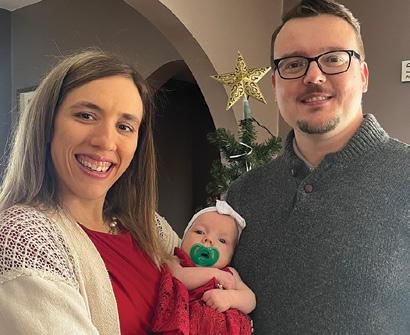
“For me, after Mary had been baptized, I had a vision of the heavens rejoicing to have another member in the family of God,” Jessica says. “I also felt like Mother Mary was holding my little Mary which led to a deep sense of peace in God.”
The Duncans moved to our community a few years ago. James is from the Milwaukee area, while Jessica is from the Twin Cities in Minnesota. James received a job offer teaching social studies at White Lake and moved to Antigo in August 2020, joining our parish at that time. Jessica moved to Antigo in June 2021, and Mary was born last year.
“Our first impression was that it is a very welcoming community,” Jessica says. “Coming into a new town, we both didn’t have anyone we knew in the area and so this parish provided us with a community of people to support us.”
The Duncans have enjoyed getting to know other members of the parish and have appreciated the support they have received from the community.
“I personally love all the people we have met and the welcoming parish family,” Jessica says. “We have made friends with a lot of the people of the parish, so much so that a lot of them have helped with our family.”
This included help with moving furniture into their new home when Jessica was pregnant, painting the nursery before Mary was born, and then watching the baby
continued on page 5
APRIL 2023
Jessica and James Duncan celebrated the Baptism of their baby, Mary, last October. They have enjoyed the welcoming community of our parish since joining several years ago.
Teaching By Example
The Importance of Prayer in a Child’s Life
“Iwantto be just like Mom and Dad!” Perhaps nothing lifts a parent’s heart like hearing these words. While certainly affirming, such words also remind us of the great responsibility that comes with parenthood.
Children often examine the lives of their parents when making decisions that will affect their own lives. For example, a young boy may dream of becoming a physician one day, just like his father. Or a young girl may hope to become a veterinarian, just like her mother. Could the same be said about their parents’ faith lives?
Just as children learn traits and values from their parents, they should also learn the importance and great joy of developing a personal relationship with Christ. And the foundation of such a relationship is prayer — conversation with God.
How should we go about teaching our children to pray? There are several methods, but none works as well as teaching by example. Begin teaching the importance of prayer by praying openly with your spouse. This teaches children that prayer is meaningful and important, and not just a ritual. Also, pray with your children — in the morning and in the evening. Show your sons and daughters the importance of beginning and ending each day in prayer.
While a fortunate dilemma, it’s a dilemma nonetheless — Catholics face the challenge of discerning which prayers to use, considering the thousands available. A good rule of thumb is to start simple — maybe an Our Father or Hail Mary, and then move into something more complex — Hail, Holy Queen or Prayer to St. Michael the Archangel, among others. Begin with prayers your children can pick up fairly quickly. Not only will this show them that praying can be fun and easy, but shorter prayers are also usually easier to understand.
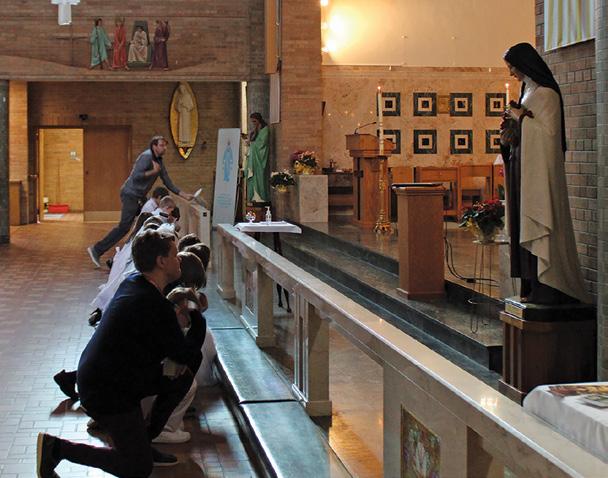
Teach your children the importance of spontaneous prayer, rather than just prescribed prayers. Spontaneous prayer is any prayer that is created at the same time it is offered. Another way to think of spontaneous prayer is “praying in your own words.” Structure spontaneous prayers according to the ACTS acronym — Adoration, Contrition, Thanksgiving, and Supplication. In layman’s terms, this means beginning each prayer with words of adoration, such as “You are the Lord God Almighty. I love
you.” Move into a period of contrition, asking God’s forgiveness for the sins you have committed. Then, give words of thanksgiving, thanking God for the gifts He has given. Finally, spend time sharing with God your heart’s desires. These intentions can be personal or on another’s behalf. Following this format ensures that spontaneous prayer “covers all the bases,” and doesn’t become just a mental wish list. While God wants to hear and grant our wishes, He also expects words of adoration, contrition, and thankfulness.
The best time to begin praying with your children is right now. The sooner they learn about prayer, the sooner they can begin cultivating their own relationship with Jesus. Many parents even pray with their children before birth, hoping their unborn son or daughter can hear their words in utero. Remember, there is no better way to teach one’s children about the value of prayer than by example.
Just as children learn traits and values from their parents, they should also learn the importance and great joy of developing a personal relationship with Christ. And the foundation of such a relationship is prayer — conversation with God.
2
Entering into the Triduum and a
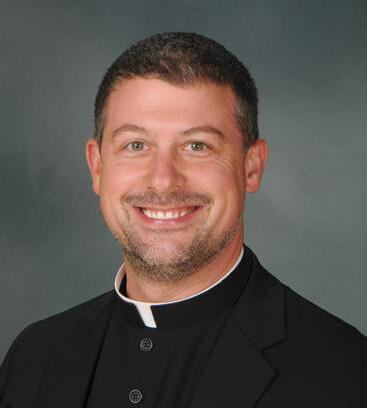
Before my family became Catholic, Easter was just another holiday. We dressed up in our “Sunday best,” went to church, hunted Easter eggs, and ate colored eggs and sweet rolls. We had a lovely day of faith, family, and food. Once my family became Catholic, we started participating in Lent. We gave up sweets as a family, fasted a little more, went to Confession during Lent, and entered more deeply into the penitential season. I started to love the octave of Easter (making your Easter candy last until Divine Mercy Sunday) and the 50 days until Pentecost. I thought there was nothing more to love about Easter. Then I became a priest and started to truly live the Triduum. The word “Triduum” means “three days.” It refers to the three movements of the Paschal Mystery. In the first movement, Jesus gathers His closest friends for an intimate meal. He gives them His three greatest gifts: the commandment to “love one another as I have loved you”, symbolized by the washing of the feet, the Eucharist, and the Priesthood. These three are in reality one gift. Jesus is preparing His disciples for the second day.
They go out to pray in the Garden of Gethsemane and Jesus is betrayed by His friend. His own people condemn Him for being the Son of God. He is then handed over to the Romans to be mocked, scourged, and crucified. Jesus dies at 3 p.m. on Good Friday and is laid in a tomb.
The third act is Easter Sunday. Jesus’ one perfect sacrifice destroyed sin; His resurrection offers us new life. We too can rise to a new life in Christ. This promise will ultimately be fulfilled on the Last Day at the end of time, but we don’t have to wait until then. New life in Christ is available right now.
I have come to believe that the Triduum is more than just a pious reenactment of Jesus’ death long ago. It is, in a mystical but real way, a participation in the death and resurrection of Jesus. When we come to Holy Thursday Mass, we take a seat at the Last Supper. At our Good Friday service, we kneel at the foot of the Calvary. On Easter Sunday, Jesus appears and says, “Peace be with you.” I want to invite you to try and attend all three services. I promise that if you make all three, you will be different. You will experience Easter as not just a day, or even eight days, but as the beginning of a whole new life.
Your brother in Christ,
Fr. Joel Sember Pastor
Triduum Schedule
Holy Thursday, April 6
6:30 p.m. – SS. Mary & Hyacinth
Good Friday, April 7
12 p.m. – St. Wenceslaus
3 p.m. – St. John
7 p.m. – SS. Mary & Hyacinth
Holy Saturday, April 8 Easter Vigil
8 p.m. – St. John
Easter Sunday, April 9
7 a.m. – SS. Mary & Hyacinth
9 a.m. – St. John
11 a.m. – St. Wenceslaus
3
A Letter From Our Pastor
Dear Parish Family,
Startingwith Adam and Eve in the Garden of Eden, God gave us the right to life. In that right, He also gave us the power to choose to love Him. Adam and Eve were given the Tree of Knowledge so that the choice to love and serve God was theirs. As we know, they chose to eat of the fruit, thus giving each and every person conceived afterward the stain of original sin. However, God in His infinite wisdom and love chose to save us from death through the sacrifice of His Son. Through Christ’s mission on earth, He gave us the Great Commission: “Go, there fore, and make disciples of all nations, baptiz ing them in the name of the Father, and of the Son, and of the Holy Spirit, teaching them to observe all that I have commanded you. And behold, I am with you always, until the end of the age” (Matthew 28:19-20).
The Sacrament of Baptism removes the stain of Original Sin and the baptized becomes a member of the church. Jesus was conceived without sin but He was still baptized by John the Baptist. This gave us Baptism as a sacrament that God uses to pour out His graces on us to help us follow Him and live a holy life so we can go to heaven and be with Him. God gives us the sacraments as a means to receive His Grace, not as a gate to withhold grace from us. The gift of Baptism is a gift that upholds our dignity and restores our souls to the perfection that God intended when He created us.
When Baptism is being sought for a child, the parents attend classes to learn about this important sacrament. First, parents meet with Fr. Joel and then attend a two-hour class with both Fr. Joel and Pete Schlegel. Pete has been a part of this ministry for about five years.
“My role is to let the families know what the Rite of Baptism is,” Pete says. “We explain why the sacrament is done this way and what the different symbols are. We really want them to know that they are welcomed into the church family and how we want them to be a part of it.”

These classes are only required for the first child being baptized in a family. There is a video the class also watches to learn a little more about the in-depth theology surrounding the Sacrament of Baptism. After the video, the class moves to the church to show what the Baptism will look like and explain some of the sacramentals such as the white outfit, oils, and the candle. Afterward, they return to the classroom for a talk from Fr. Joel about Salvation History.
“The importance of Baptism is not only to remove the stain of original sin but to also welcome them into the Church family where they are truly a part of the entire universal Catholic Church,” Pete says. “It puts that indelible mark on their soul that they are a Christian. Even if one falls away from the church or they no longer believe, that mark is still there.”
While Pete has been working with Fr. Joel in this ministry for many years, Deacon Andy Bures and his wife, Stephanie, will be taking over that role.
“We are looking forward to stepping into this ministry,” Deacon Andy says. “Young parents give me so much hope, though they don’t often see that. They sometimes think that they are being judged. But the younger generation is the hope that I see for our future. They are going to be the lamp on the hilltop — the beacon that people will look towards. Seeing them bringing their children to be baptized and bringing their children to continued on page 5
4
“Welcoming a new member to the church is always a celebration, whether it is a two-day-old baby or an elderly person baptized at the Easter Vigil. No matter how they got there, it doesn’t take away from the beauty of them being a member of the Catholic Church.” — Pete Schlegel
church, gives me hope for the future of the world. We need you — the world needs you.”
Recently, the church has seen an increase not only in infant Baptisms but also in older children being baptized. The church welcomes these families with open arms and encourages all who may not have yet had their children baptized to give them the gift of this sacrament.
“Families want to see and hear that they are accepted as they are,” Pete says. “We are here for them. We baptize out of love for the families and out of the love of Jesus that flows through us as we share it with others. Welcoming a new member to the church is always a celebration, whether it is a two-day-old baby or an elderly person baptized at the Easter Vigil. No matter how they got there, it doesn’t take away from
the beauty of them being a member of the Catholic Church.”
“We often see people who have drifted away from the church and as a result didn’t see the value of building the church community,” Deacon Andy says. “Then they get to be parents and you see the value of having a faith community to help keep you and your family on the straight and narrow. Through Baptism and having the strength of a good faith community, we have the support to weather the storms of the society and culture around us. The grace of the sacraments is a powerful part of protecting our children from the spiritual dangers in the world.”
The sacraments were instituted by Jesus during his life on Earth. They are a source of God’s grace poured out on us. The Church places a great amount of importance on proper instruction and reception of the sacraments.
Celebrating the Joys and Blessings of the Sacrament of Baptism
continued from front cover
so Jessica could attend doctor appointments.
“All of these acts of service have been a major grace to our family and we wouldn’t have this without the parish,” Jessica says.
Having received a bachelor’s degree in Theology and Catholic Studies, Jessica already had a thorough understanding of the Sacrament of Baptism.
“Baptism is important because, without it, we would not have salvation,” she says. “It is through Baptism that I can say that I am a daughter of God or James is a son of God because
it is in Baptism that we become united to the body of Christ. Why wouldn’t I want that for my beautiful child, to know that she is infinitely loved by the best Father there ever was, is, or will ever be?”
Jessica and James strive to live out their faith by praying daily, attending Mass every Sunday, and going to Confession regularly. James is also a Catechist for Faith Formation.
“Overall we try to live by example in our everyday lives,” Jessica says.
“It is in Baptism that we become united to the body of Christ. Why wouldn’t I want that for my beautiful child, to know that she is infinitely loved by the best Father there ever was, is, or will ever be?” — Jessica Duncan
5
Parents who would like to learn more about getting their children baptized may contact the parish office, 715-623-2024.
Why We Do What We Do at Mass
A Look at the Postures and Gestures During the Central Act of Catholic Worship

The Catholic liturgy includes many different gestures, postures, and symbols. As a Catholic, you are likely familiar with these practices, which include sitting, standing, and kneeling during Mass. But these gestures all have specific meanings and are designed to help us pray with all of our being: not only mind and soul, but body as well. To better understand the meaning behind these physical movements, we need to keep in mind two important aspects of the Catholic Mass — that the priest acts in the person of Christ, and that Jesus is present in the Eucharist.
Standing and speaking in the place of Jesus, the
Why We Sit During the Mass
After the Introductory Rite, we sit for the Liturgy of the Word. As we listen to the readings from the lectionary, sitting indicates our willingness to be students at the feet of Jesus. We also sit down for the Homily, as we pay close attention and take in what is being preached. We are seated again while the Eucharistic elements are being prepared: a gesture of anticipation, as we prepare ourselves for and eagerly await the climax of the Mass in the Eucharistic Prayer.
Why We Stand During the Mass
At the very beginning of the Mass, we stand for the Introductory Rite, which includes the Penitential Act. Here we acclaim the Kyrie Eleison, meaning “Lord, have mercy” in Greek. The Kyrie is an ancient Christian prayer in which we confess our sins to both our Almighty Father and our fellow Christians. Standing during the Penitential Act shows that we are owning up to our sinfulness and openly asking for the Lord’s mercy.
Standing is also a simple but
celebrating priest leads us with the gestures, traditions, and rituals that are part of the Order of the Mass, and we respond to these with our own actions and words. In this way, the Mass is much like a conversation and shared meal with Christ Himself. Secondly, Jesus is fully present in the consecrated Eucharist, in His Body, Blood, Soul, and Divinity. This is the Catholic doctrine of transubstantiation, which states that the bread and wine literally become Jesus during the Eucharistic Prayer of the Mass.
So, why do we assume each specific posture and make different gestures during the Mass, and what do they signify?
profound way of honoring and respecting Jesus during the Mass, both in the person of the priest and in the scriptures, especially the Gospel. While we sit for the first and second readings, we stand for the Gospel reading. The Gospel is the pinnacle of the Word of God and to hear it proclaimed aloud is a great honor, which is why we rise from our seats and proclaim “Alleluia” as it is opened. Just before the reading of the Gospel, we make a small sign of the cross with our thumb over our foreheads, lips, and hearts. This simple act is a symbolic request for God to impress His Word upon our minds, lips, and hearts. When the priest or deacon has finished reading the Gospel, he shows respect to the Word of God by kissing the Gospel. After the homily, we stand back up to pray the Nicene Creed as a Profession of Faith, once again standing firm in our ownership of our faith.
Why We Kneel During the Mass
Kneeling is the most humble posture of worship during the Mass. When we kneel, we completely surrender ourselves
to our Heavenly Father. We kneel during several parts of the Mass. After the Holy, Holy, Holy, we spend almost the rest of the Mass on our knees — an incredible act of faith and devotion by which we acknowledge that Jesus is personally present among us.
As we kneel during the Eucharistic Prayer, the priest’s many gestures are also precise and meaningful. He makes the Sign of the Cross over the bread and wine and proclaims Christ’s own words: “This is my Body,” and “This is my Blood”. As the bread and wine are consecrated, the priest kneels several times in front of the Blessed Sacrament to express reverence. Before or while receiving the Eucharist, it is traditional to kneel, bow, or genuflect to express your humility before God.
The Mass is rich with meaning — every element and gesture represents something profound and beautiful. When we understand them and take them to heart, each moment we spend at Mass will become more transformative and nourishing to our souls.
6
Responding to the Glory of
Christ’s Resurrection at Easter Dying, He Destroyed Our Death; Rising, He Restored Our Life
“He suffered under Pontius Pilate, was crucified, died, and was buried. He descended into hell.
On the third day He rose again from the dead” – Apostles’ Creed
As we come to the end of our Lenten journey toward Easter, let us take a moment to meditate on three pivotal lines from the ancient creed, which comprise the central events of our redemption.
Far from being a mere myth or legend, in Jerusalem around the year 30 A.D., Jesus Christ — the Son of God made man — was tortured at the hands of the Romans. He was flogged, beaten, spit upon, and crowned with thorns. He was made to carry the cross through the crowded streets to Golgotha and, once there, He was crucified — He was nailed to a cross and died. Just as someday we will each be laid in our graves, Jesus was laid in His.
The most obvious question that confronts the observer of this horrific reality is “why?” Luckily, Christ made the impetus for His self-sacrifice quite clear: “Just as Moses lifted up the serpent in the desert, so must the Son of Man be lifted up, so that everyone who believes in Him may have eternal life” (Jn 3:14-15).
The reasons Christ died on the cross are twofold, one negative and one positive. The negative cause is sin. Only in witnessing the cost of redemption — the death of the Son of God — can we begin to comprehend the profound magnitude of sin: “You have been purchased at a price,” says St. Paul (1 Cor 6:20).
Conversely, Christ willingly accepted the cross because of love. St. John famously says, “For God so loved the world that He gave His only Son, so that everyone who believes in Him
might not perish but might have eternal life” (Jn 3:16).
Uniting these two causes, St. Paul says, “God proves His love for us in that while we were still sinners Christ died for us” (Rom 5:8).
In His limitless compassion, Christ entered into the fullness of human suffering — physical torment, emotional agony and utter isolation — so that He might share complete solidarity with mankind. Accordingly, His passion and death not only accomplished our redemption, but by the cross, He also showed us the way to true discipleship. For Christ taught His disciples long before His crucifixion, “if anyone wishes to come after me, he must deny himself and take up his cross daily and follow me” (Lk 9:23).
Christ’s is the final and perfect covenant between God and man, and it is a covenant of love, with Christ Himself as its high priest. Nevertheless, this covenant is not based on love as popular culture conceives of it, but love as Christ displayed it: “The way we came to know love was that He laid down His life for us” (1 John 3:16).
Joined with the passion, Christ’s Resurrection is the key to the entire Gospel — for in rising from the dead, Jesus proved true His bold promises. He had prophesied to the apostles, “No one takes it from me, but I lay it down on my own. I have power to lay it down, and power to take it up again” (Jn 10:18). The Resurrection vindicates this promise and validates His teaching and miracles.
Furthermore, Christ, “the firstborn from the dead,” opened the door to eternal life and to new creation (Col 1:18). Out of the darkness of despair, the scattered and frightened disciples saw the risen Christ and were renewed and transformed. Filled with faith in the crucified and resurrected Savior, they evangelized the known world.
St. Paul summarizes the centrality of the redemptive power continued on back cover
7
Saint John the Evangelist
415 6th Ave.
Antigo, WI 54409
(715) 623-2024
stjohn@antigoareacatholicchurches.com
Saints Mary & Hyacinth
819 3rd Ave.
Antigo, WI 54409
(715) 623-4938
ssmh@antigoareacatholicchurches.com
Saint Wenceslaus
N5340 Church Rd. Deerbrook, WI 54424
(715) 627-2126
stwencel@antigoareacatholicchurches.com
Responding to the Glory of Christ’s Resurrection
at Easter continued from page 7
of the Easter Triduum with his characteristic zeal: “If Christ has not been raised, then empty (too) is our preaching; empty, too, your faith. Then we are also false witnesses to God, because we testified against God that He raised Christ, whom He did not raise if in fact the dead are not raised. For if the dead are not raised, neither has Christ been raised, and if Christ has not been raised, your faith is vain; you are still in your sins” (1 Cor 15:14-17).
This Easter, let us respond to the glory of Christ’s Resurrection by exclaiming, as St. Thomas the Apostle did, “My Lord and my God!” And may each of us be filled with faith in God of our salvation, hope in the rewards He has won for us, and love for Him who has deigned to bestow them on us.
This Easter, let us respond to the glory of Christ’s Resurrection by exclaiming, as St. Thomas the Apostle did, “My Lord and my God!” And may each of us be filled with faith in God of our salvation, hope in the rewards He has won for us, and love for Him who has deigned to bestow them on us.
MASS & CONFESSION TIMES SAINT JOHN: Masses: Monday, 8:15 a.m., Tuesday, 6:30 p.m., Wednesday, 8:15 a.m., Thursday, 8:15 a.m., Saturday, 6 p.m., Sunday, 9 a.m. Confession: Tuesday, 5:30-6:15 p.m., Saturday, 5:15-5:45 p.m. & Sunday, 8:15-8:45 a.m. SAINTS MARY & HYACINTH: Masses: Wednesday, 7:15 a.m., Friday, 7:15 a.m., First Saturday, 8 a.m. and each Saturday, 4 p.m., Sunday, 7 a.m. Confession: First Saturday following the 8 a.m. Mass & Each Saturday 3-3:45 p.m. SAINT WENCESLAUS: Masses: Tuesday, 8 a.m., Sunday, 11 a.m. Confession: Sunday, 10:15-10:45 a.m.
