SUMMER 2026 MAGAZINE
LEADERSHIP Bishop John J. McIntyre Auxiliary Bishop, Archdiocese of Philadelphia
Heather Huot Secretary and Executive Vice President, Catholic Charities of Philadelphia
Daniel Dougherty Jr. Chief Financial and Operating Officer, Catholic Charities of Philadelphia
Kathleen Bevenour Director, Family and Community Services
Dr. James Black Director, Youth Services Division
Michael Chorneiko Chief Information Office, Archdiocese of Philadelphia
Steve Colestock Chief Human Resources Officer, Catholic Charities of Philadelphia
Lizanne Hagedorn Executive Director, Nutritional Development Services
Matthew Hancock Director, Intellectual and Developmental Disabilities Services
James Kerrigan Director, Homeless Services
Suzanne O’Grady Laurito Director, Catholic Housing and Community Services
COMMUNICATIONS, MARKETING, AND PHILANTHROPY Kenneth A. Gavin Chief Communications Officer, Archdiocese of Philadelphia
Timothy Walz Director of Marketing, Catholic Charities of Philadelphia
Ellen Mansfield Director of Philanthropy, Catholic Charities of Philadelphia
Katie Rogers Media and Events Specialist, Catholic Charities of Philadelphia
Sue Denny Contributor
2
In this Issue 6 NEWS
Updates from Around Catholic Charities
10 NOURISHING AND SHELTERING
A Letter of Gratitude, A Career of Service
14 STRENGTHENING AND SUPPORTING Where Hope Finds a Home
18 STABILIZING AND ENRICHING
Walking with People Through Life’s Hardest Moments
22 EMPOWERING
Creating Opportunities for All
3
MESSAGE FROM THE
Secretary
Dear Friends, With nearly 40 ministries and programs of mercy and charity under the umbrella of Catholic Charities of Philadelphia, I am always grateful for opportunities like this magazine to share the remarkable ways our employees, volunteers, and generous donors are uplifting and empowering our neighbors throughout the fivecounty Philadelphia region. One of my favorite parts of each issue is introducing you to the dedicated individuals who bring our mission to life each day. Their stories remind us that behind every service offered and every life transformed is a person answering Christ’s call to serve others with compassion and respect. In this issue, you will meet Donna Fanelli, whose commitment to nourishing the hungry has been sustained for nearly 25 years by a heartfelt thank-you letter from a grateful parent. You will hear from Leslie Diaz, who witnesses families arrive at Casa del Carmen feeling overwhelmed and uncertain, only to leave with renewed hope and a path forward. You will also get to know Kate Baumgardner, whose Catholic Charities journey began as a 19-year-old intern and has grown into more than two decades of service, helping individuals and families navigate some of life’s greatest challenges. And you will meet Maureen Lewis, who shares how individuals with intellectual and developmental disabilities thrive in their communities when given the support, opportunities, and encouragement they deserve. Together, these stories reflect the heart of Catholic Charities: accompanying our neighbors, recognizing the God-given dignity of every person, and creating opportunities for individuals and families to flourish. Thank you for your prayers, generosity, and partnership. Through your support, hope is restored, lives are transformed, and our shared mission continues to grow. With gratitude and blessings,
Heather Huot, MSW, LSW Secretary and Executive Vice President Catholic Charities of Philadelphia
4
MESSAGE FROM THE
Bishop
Dear Brothers and Sisters, “Be merciful, just as your Father is merciful.” —Luke 6:36 In the sixth chapter of Luke’s Gospel, our Lord Jesus teaches us that to love God with all our heart, soul, and mind requires us to love our neighbors with equal devotion. We are called to care especially for those who cannot repay us— just as the Lord cares for us. The Church extends Christ’s love beautifully through Catholic Charities of Philadelphia and its nearly 40 programs of mercy and charity. I invite you to read the stories of compassionate care in this issue of Catholic Charities Magazine and to prayerfully discern how you can answer our Lord’s call. May God bless you,
Most Reverend John J. McIntyre Auxiliary Bishop of Philadelphia
5
NEWS
NINE MEN TRANSITION TO PERMANENT HOUSING St. John’s Hospice celebrated nine men who completed its residential program, marking the largest group in recent memory to leave the program with permanent housing, renewed stability, and a foundation for the future.
SENIOR HOUSING PROJECT NEARS COMPLETION Construction is nearing completion on St. Katharine Drexel Place, Catholic Charities’ newest affordable senior housing community. The 48-unit development in Northeast Philadelphia will provide older adults with safe, accessible housing and supportive services designed to help them age in place with dignity. Demand has already exceeded expectations, with more than 300 people requesting information about the community. “There has been more interest in this development than in any other development we’ve done,” said director Suzanne O’Grady Laurito.
ST. EDMOND’S RESIDENTS ENJOY PROM NIGHT
ST. FRANCIS VILLA CELEBRATES 10 YEARS Residents, staff, and supporters gathered to celebrate the 10th anniversary of St. Francis Villa, commemorating a decade of providing affordable housing, supportive services, and a vibrant community for older adults in Philadelphia. 6
Residents of St. Edmond’s Home for Children gathered for the ministry’s annual prom, which featured this year’s theme, “Glow Up the Night.” The special event provided children and young adults with intellecutal and developmental disabilities the opportunity to enjoy an evening of music, dancing, and celebration while creating lasting memories with staff and friends.
NEW DIRECTOR NAMED FOR IDD SERVICES
BACK-TO-SCHOOL DRIVE SUPPORTS HUNDREDS OF STUDENTS Catholic Charities of Philadelphia helped families prepare for the 2026–27 school year by distributing hundreds of backpacks, school supplies, books, food, and personal care items through back-to-school events at three Family Service Centers across Philadelphia.
Following several months of service in the role on an interim basis beginning in March, Matthew Hancock has been named Director of Intellectual and Developmental Disabilities Services. Bringing more than 20 years of experience in nonprofit leadership and organizational development, Hancock now leads our ministries dedicated to empowering individuals with intellectual and developmental disabilities through programs that promote dignity, independence, and inclusion.
The need was especially evident in Southwest Philadelphia, where organizers distributed approximately 200 backpacks, double the number originally planned. “The parents appreciate it. The money is just not there. Groceries are so expensive,” said Lola DeCarloColes, administrator of the Family Service Center. The event also brought together volunteers and community partners dedicated to supporting local families. Ginger Girard, a clinical instructor at Drexel University, praised the impact of Catholic Charities’ outreach efforts, noting, “People don’t understand on a whole how much the Catholic Church gives to the public. Of all the programs I’ve been involved with, I see that the Archdiocese gives more to the community than any other services I’ve ever been involved with.”
BLESSING HIGHLIGHTS SUMMER MEALS PROGRAM On July 8, Catholic Charities held its annual Blessing of the Summer Meals Program at St. Barnabas Catholic School in Southwest Philadelphia. The event highlighted the vital initiative that provides free breakfasts and lunches to children and youth throughout the Greater Philadelphia area when school is out of session, ensuring access to nutritious meals during the summer months. 7
NEWS
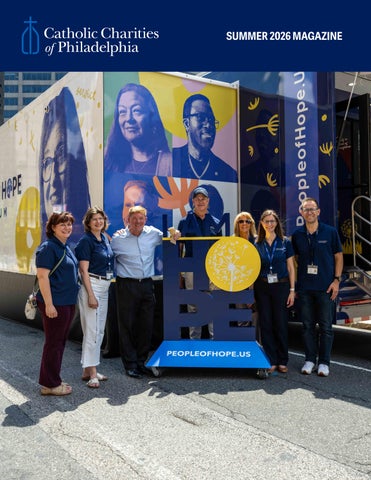
CATHOLIC CHARITIES HOSTS NATIONAL PEOPLE OF HOPE TRAVELING MUSEUM On June 25–26, Catholic Charities hosted People of Hope: Faith-Filled Stories of Neighbors Helping Neighbors across from the Cathedral Basilica of Saints Peter and Paul. The unique traveling storytelling museum is designed to demonstrate the profound impact of compassionate service. Visitors had the opportunity to witness first-person video accounts from staff and volunteers of Catholic Charities agencies across the country about meaningful and memorable encounters with families and individuals in need; share their own stories of hope and service through the on-site recording studio; explore U.S. and statelevel poverty data through visual displays; experience an interactive poverty simulation; and listen to audio book excerpts about poverty, social isolation, bridgebuilding and community action. 8
9
Three Decades of Service Donna Fanelli at her desk early in her career (left) and today (right). Over 40 years of service to the Archdiocese of Philadelphia, including the past 30 years with Catholic Charities of Philadelphia’s Nutritional Development Services, Fanelli has helped ensure children and families throughout the region have access to nutritious meals and essential food resources.
10
NOURISHING AND SHELTERING
A Letter of Gratitude, A Career of Service Inspired by a thank-you letter from a grateful parent, Donna Fanelli’s 30 years with Catholic Charities reflect a lasting commitment to feeding children and supporting families across the region.
I
By Sue Denny
n 2002, a Catholic school parent sent a letter addressed to Donna Fanelli at Catholic Charities of Philadelphia’s Nutritional Development Services, thanking her for feeding his daughter through a school lunch program. For nearly 25 years, Fanelli has kept that typed note, dated Oct. 28, 2002, tucked away in a desk drawer. “I go back to it from time to time, and it just reminds me of all the good that we do.” Fanelli has spent the last 30 years of her 40-year archdiocesan career with Catholic Charities, where she currently serves as an operations manager. Early on, she determined family eligibility for free or reduced lunches for a federal income-based nutrition program. “I would send the letters telling them what their status was,” Fanelli recalled. “Augustinus wrote directly to me . . . thanking me for providing meals for their child.” As new immigrants, the family found the school lunch program a huge help, Augustinus noted in the letter, adding that he was so happy to be able to provide a Catholic education for his daugh-
A thank-you letter received in 2002 remains a cherished reminder of the mission for Donna Fanelli.
ter. She was an eighth-grade student at Thomas Aquinas School in South Philadelphia. Stories like this are at the heart of why Catholic Charities exists. Fanelli’s belief—no one should have to struggle with hunger—aligns perfectly with the Gospel call to feed the hungry and Catholic Charities’ mission to ensure those facing food insecurity have access to nutritious food and vital resources. 11
Healthy food is essential to a child’s ability to learn, grow, and develop. “The meals the children are eating, these one or two meals in school, may be the only meals they’re having all day long,” she said. “To be able to provide that service is an incredible feeling.” Today, Catholic Charities continues to administer the federal nutrition program, among several ways it fulfills one of its four pillars of service: to nourish the hungry. Each school day, their program distributes an average of 7,600 breakfasts and 17,000 lunches to children throughout southeastern Pennsylvania.
“No matter what happens, we always make sure we get the meals to the sites for the kids each day.” DONNA FANELLI
ON CATHOLIC CHARITIES
More than 100 parochial, private, and charter schools participate. “It doesn’t matter what faith or denomination you are. We are here to help everyone,” Fanelli said. Free meals are available in schools in low-income areas enrolled in the federal Community Eligibility Program (CEP), created in 2010 to provide mealtime equity. Students can receive breakfast and lunch at no cost, regardless of family income.
FAR MORE THAN SCHOOL LUNCHES
Through its ministry to nourish the hungry, Catholic Charities focuses on two main areas— the federally funded Children’s Nutrition programs and the Community Food Program. Since the school year ended, it provided 366,000 meals to 256 summer programs and continued to feed 2,700 children in 65 12
daycare centers. Nearly 2,600 suppers are served per day. During the new academic year, Catholic Charities expects to work with 110 after-school programs and provide breakfast and lunch at 100+ schools. Between 2024–25, 166,000 people received 8.1 million meals. “We make it look seamless, but there’s so much that goes into it,” Fanelli said. As operations manager, she’s behind the scenes, coordinating with warehouse staff on routing, logistics, and solving problems related to equipment breakdowns, inventory shifts, and delivery delays. “No matter what happens, we always make sure we get the meals to the sites for the kids each day,” she said. Catholic Charities’ impact extends beyond children to the community at large. The Community Food Program distributes fresh, frozen, and non-perishable food to 50 pantries through federal funds, private donations, and food drives. Last year, schools and parishes collected 700,000 pounds for distribution to pantries and food cupboards throughout the five counties served by the Archdiocese of Philadelphia.
SNAP CHANGES AND INCREASED DEMAND
Catholic Charities’ commitment to alleviating hunger is more critical than ever due to cuts and
changes to the federal Supplemental Nutrition Assistance Program (SNAP), which reduced or eliminated food aid for millions throughout the country. For example, some refugees and asylum seekers, despite legally living in the U.S., are no longer eligible for SNAP (widely referred to as food stamps). As inflation and world events drive up the costs of food and other necessities, federal SNAP cuts exacerbate the ongoing affordability crisis. In this environment, families are often forced to realign their spending habits; some household funds that used to pay for rent, utilities, or gasoline go to groceries instead. Fanelli has noticed a definite increase in demand for food. “People don’t have enough money to buy what they need to feed their families,” she said. Thanks to Catholic Charities, many at-risk children are fed in the summer months and before, during, and after school. “We’re not only helping the students, but we’re also helping the parents. Meals their children eat in school—that’s money the parent is saving and can use toward other things,” she said. “If Catholic Charities was no longer providing these meals, there would be a lot of children who would go hungry,” Fanelli said. 13
STRENGTHENING AND SUPPORTING
Where Hope Finds a Home Inspired by her faith and a desire to serve others, Leslie Diaz connects vulnerable individuals and families with the support they need to thrive. By Sue Denny
S
everal years ago, a mother, father, and their two daughters, 1 and 3, fled their home in Ecuador to escape political and religious persecution. Their weeks-long journey was arduous, and they walked for days at a time with little food or water. During their difficult trek, the family repeatedly turned to prayer, with hope that they would soon find a new home. After crossing the Mexican border into the U.S. and turning themselves in to immigration authorities, their prayers were answered. They were released and loaded on a bus bound for Philadelphia. The exhausted family arrived in the middle of the night at a temporary welcome center in North Philadelphia run by the city in collaboration with local nonprofits and social service agencies. There, the family met with Leslie Diaz, a Catholic Charities of Philadelphia social worker.
14
Leslie Diaz stands outside Casa del Carmen in North Philadelphia, where she leads a team dedicated to connecting individuals and families with the resources, support, and opportunities they need to build stronger futures. 15
The reception hub offered temporary respite, interpretation services, legal consultations, and emergency health screenings for asylum seekers and other migrants arriving from the southern border. “When I sat across the table from them and they began to tell me about their journey, it was heartbreaking to hear,” Diaz said. “This family had such a huge struggle, yet their faith held them together. It was incredible to listen to how people overcome even the greatest adversities when they put God first.” Within weeks, four lives were transformed.
“The Church has always been a huge part of my life, and because of that, I’ve always wanted to help other people. My driving force is ... knowing that we’re making a difference just by being here, by our doors being open, by the services we provide.” LESLIE DIAZ
ON JOINING CATHOLIC CHARITIES
Catholic Charities and its partners helped the parents connect with legal services to begin the asylum process and apply for work permits. The agency located housing for the family and provided a security deposit and rental assistance. Case managers helped to enroll the two toddlers in daycare and reached out to the Sisters of St. Joseph for food and furniture. “The experience of that one family and being part of their journey . . . speaks to the work that we do,” Diaz said. Every day, Catholic Charities provides critical support to families, equipping parents with the tools and resources needed to build strong, stable homes.
FROM WELCOME CENTER TO CASA DEL CARMEN
Before her temporary assignment at the welcome center, 16
Diaz served briefly as Catholic Charities’ helpline coordinator. While based out of Casa del Carmen’s Family Service Center in North Philadelphia, the helpline serves all five counties in the Archdiocese of Philadelphia: Bucks, Chester, Delaware, Montgomery, and Philadelphia. Staffed from 8:30 a.m. to 4:30 p.m. Monday through Friday— with an online form available as well—the helpline connects people with everything from diapers to documentation, food to financial assistance, housing to hope. After the welcome center closed, Diaz returned to Casa del Carmen as a supervisor. She’s been the center’s administrator for nearly a year, overseeing daily operations, including the helpline, which responded to 5,000 calls from 2024 to 2025. She said it’s her responsibility to make sure individuals and families are referred to appropriate resources, both internal and external—“starting within, then working our way out to community partners.” Casa del Carmen’s center is one of four family service centers across the region, each the first point of contact for most people and parishes seeking assistance from Catholic Charities. Support and services provided at each center are tailored to the needs of the surrounding community. “The Casa del Carmen campus is a gem in the city of Philadelphia, right in the heart of the
Latino community,” Diaz said. In the last year, the Reese Street location served more than 18,000 individuals and families. People walk in feeling hopeless, she said. They leave filled with hope.
“The Church has always been a huge part of my life, and because of that, I’ve always wanted to help other people,” Diaz said. “My driving force is . . . knowing that we’re making a difference by just being here, by our doors being open, by the services we provide.”
Diaz manages a primarily bilingual staff of 10, plus interns and volunteers, and recently hired three new employees—a family community navigator and two educators. The additional staff will allow Casa del Carmen to ramp up its in-person and virtual educational offerings, expanding English as a Second Language (ESL) classes beyond Spanish and adding new anger management and financial literacy programs.
Casa del Carmen has been a pillar in the community for decades, Diaz said. If its doors were ever to close, neighborhood residents would lose access to invaluable resources, including those in highest demand: case management, a food pantry, and assistance with replacing lost or misplaced birth certificates. “And there would be babies without diapers or formula!”
Diaz oversees an onsite preschool, with 89 students, and The Cenacle at the Padre Pio Center on Church Street, a family nurturing ministry supporting pregnant women and new parents. A collaboration with the Pro-Life Union of Greater Philadelphia and the Capuchin Friars, The Cenacle provides diaper and food pantries, maternity clothes and baby items, parenting and pregnancy education.
Today, the family of four from Ecuador is settled in Philadelphia—stable and self-sufficient. Both parents are employed. Their daughters are enrolled in school. And their mother now volunteers at The Cenacle, cooking and cleaning.
SETTLED, STABLE, AND SELF-SUFFICIENT
“It was a true blessing to be part of that journey,” Diaz said. “It’s incredible to be able to be part of such an amazing team and organization.”
17
STABILIZING AND ENRICHING
Walking with People Through Life’s Hardest Moments From helping families secure safe housing to supporting women in recovery and older adults in need, Katherine “Kate” Baumgardner has spent nearly 25 years accompanying people on their journey toward stability, dignity, and healing.
M
By Sue Denny
ore than two decades have passed, yet Katherine “Kate” Baumgardner can still picture her very first client and their first home visit in a rundown Kensington rowhome.
THE EARLY YEARS It was 2002.
A recent college graduate and brand-new social worker, Baumgardner was working at Catholic Charities of Philadelphia, where she had interned as a 19-year-old undergraduate. The agency had a contract with the city’s welfare department to help implement the new work requirement in the early years of federal welfare reform. Home visits were common. Baumgardner remembers knocking on the front door—“it’s not on its hinges”—her new client answered. “She picked it up, moved it to the side, and let me in.” The woman returned the door to its frame, propping it shut with a 2 X 4. Baumgardner remembers seating herself at a table, hoping her new client wouldn’t notice as she casually flicked away bugs. 18
“I am blessed beyond measure to have these experiences professionally and to see God’s love in action.” KATE BAUMGARDNER
ON HER SERVICE WITH CATHOLIC CHARITIES
19
The living conditions were deplorable; when she returned a few weeks later, the house was boarded up with a bright yellow sign: DO NOT ENTER. After the house was condemned, the woman found temporary housing with family. Eventually, Catholic Charities was able to provide rental funds that allowed her and her adolescent sons to relocate to permanent housing, offering a long-term solution that empowered her family to rebuild their lives with dignity and hope. Baumgardner worked with the woman—she was of Puerto Rican descent and spoke limited English—to help relieve language barriers and other obstacles that prevented her from working. She drove her client in a ’91 Toyota Camry to medical appointments, to the local welfare office, and to enroll her boys in school. “We stabilized her. She moved into a real, cool house, and she was so happy. I’ll never forget it,” Baumgardner said. “When Catholic Charities left her, she was good. She was really, really good.”
MERCY HOSPICE
Fast forward about 15 years. Baumgardner was program director at Mercy Hospice, a safe and supportive residence operated by Catholic Charities for single women and mothers with young children who are in addiction recovery. Its integrated approach combines clinical care, parenting support, and life skills training to help women achieve long-term sobriety and stability. In early stages of recovery, it can be difficult for new clients to adapt to sober living. “When you join a place like Mercy, you change your ‘people, places, and things.’ The program helps our women feel not alone as they rebuild their lives without the numbing effect of substances.” “It’s a refuge, a rebirth, a fresh start,” Baumgardner added. “I was blessed to be a part of that,” she said. She 20
Kate’s service at various ministries throughout her career.
worked there from 2014 to 2018. She recalls an older mother with a 3-year-old son who successfully worked the program and, with Catholic Charities’ help, secured permanent housing. Baumgardner considers this one of her greatest professional achievements. She last saw this client about eight years ago at the annual Recovery Walk, a community event that raises money for recovery services and celebrates the power of recovery from addiction. The woman had become a leader in the recovery movement, helping others to overcome addiction and substance abuse. “Mercy Hospice saved my life,” she told Baumgardner more than once. Baumgardner has countless other stories of transformation, and she continues to pray for all her former clients. “I am blessed beyond measure to have these experiences professionally and to see God’s love in action.” Before taking on her current role, she also served in leadership positions at Catholic Charities’ Visitation Homes and Family Service Center in Bucks County, supporting families experiencing homelessness and displacement. Those experiences further deepened her commitment to Catholic Charities’ mission of helping people find stability, dignity, and hope.
A NEW CHAPTER
In October 2024, Baumgardner became Assistant Director serving Catholic Charities’ mission to stabilize and enrich the lives of older adults through affordable senior housing, senior centers, senior clubs, community nurse, and parish elder care programs. In 2025, Catholic Charities served 2,500 older adults in the five counties in southeastern Pennsylvania: Bucks, Chester, Delaware, Montgomery, and Philadelphia.
In a recent interview, Baumgardner highlighted St. Edmond Senior Community Center, located in the basement of St. Edmond Church in the West Passyunk neighborhood of South Philadelphia. The center is open 8:30 a.m. to 4:30 p.m. Monday through Friday. From seasonal fashion shows and free hot lunches to fitness classes and educational seminars, people aged 60 and older are provided with countless opportunities for socialization, exercise, and education. St. Edmond’s also offers valuable nutritional support beyond serving meals. With support from dedicated volunteers, the center operates a food pantry on Tuesdays and Thursdays. Visitors select their own groceries, including fresh fruits and vegetables, rather than receiving pre-packed boxes of food. By respecting individual choices, this pantry model reduces waste and creates a more dignified and empowering experience. Aligned with Catholic social teaching and Catholic Charities’ mission, “human dignity is always preserved,” Baumgardner said. “They really nail it here.” She can’t imagine a world without the social service programs offered by Catholic Charities. For nearly two decades, Baumgardner has witnessed firsthand how the organization’s mission transforms lives through faith and compassion. “Everybody needs help now and again,” she said. “People come to us because they’re upset, they’re broken, they’re angry, they’re sad. . . They come to us because they know that in some way God is going to help them.” After serving the Philadelphia region’s most vulnerable citizens for nearly a quarter century, it’s fitting that Baumgardner’s namesake is Saint Catherine Laboure. She is the patron saint of the elderly, the infirm, and the Miraculous Medal. “I couldn’t go a day without my girl,” Baumgardner said. “She is present in my work every day.” 21
EMPOWERING
Creating Opportunities for All After 17 years with Catholic Charities of Philadelphia’s Intellectual and Developmental Disabilities Services, Maureen Lewis continues to help individuals build skills, foster meaningful connections, and live lives of dignity, inclusion, and purpose. By Sue Denny
W
hen a client became seriously ill and hospitalized during the COVID-19 pandemic, the staff at Catholic Charities of Philadelphia’s Intellectual and Developmental Disabilities Services refused to give up on him. When he was released, weak and listless, staff rallied around him, encouraging him to eat, helping him to regain his strength, doing whatever they could to bring back his spirit. “What touched me was everybody wanted him to get better,” said Maureen Lewis, curriculum director of the Adult Training Facility on the Our 22
Lady of Fatima campus in Secane, Delaware County. “To see him become his old, happy self was just very heartwarming.” For Lewis, moments like these embody Catholic Charities’ mission to recognize the dignity of every person and the importance of accompanying individuals through life’s most difficult challenges. The mission goes beyond those receiving services. Two days a week, nine men climb into a van, load it with prepared meals, and set off to deliver them to homebound and older adults in the Philadelphia area.
A Community of Support Maureen Lewis (center) is pictured with staff and participants in Catholic Charities of Philadelphia’s day program for adults with intellectual and developmental disabilities. Together, they create an environment where individuals are encouraged to learn new skills, build relationships, and engage fully in their communities.
“We want to provide them with a meaningful day. We gear the activities to the individual and what they like to do.” MAUREEN LEWIS
ON CATHOLIC CHARITIES’ DAY PROGRAM
23
They’re not the typical Meals on Wheels volunteers—not retirees, not working adults with flexible schedules. They’re men with varying intellectual and developmental disabilities (IDD) enrolled in a day program at the Communities of Don Guanella and Divine Providence, part of Catholic Charities’ IDD Services. On their scheduled days, two groups arrive at Good Neighbor Senior Center in Sharon Hill or Friendship Circle Senior Center in Darby. Accompanied by Catholic Charities’ staff, the men work three-hour shifts and rotate duties—picking up meals, loading the van, and knocking on doors of each home on their assigned route. Their regular visits provide nutritious meals for older people who struggle with mobility issues, access to food, and meal preparation. They also offer socialization to isolated adults. “There are certain people they see on a regular basis,” said Lewis. “They’re making connections with the community.” The men look forward to delivery days. “They can’t wait. They ask if they’re going to work the next day,” Lewis said. “It’s a meaningful thing for them. They get to get out and do something for someone else.” 24
REMOVING BARRIERS, OPENING DOORS
Empowering people with IDD is one of Catholic Charities of Philadelphia’s four pillars of service—rooted in the belief that everyone deserves a life of purpose and inclusion. Exclusion and Isolation were the norm for much of the 20th century for people with physical and intellectual disabilities. They were often institutionalized or confined at home, with little independence or interaction with society. By the 1970s, advocates, professionals, and families began pushing back, arguing that people with disabilities can lead fulfilling lives in the community with the right support. Today, IDD Services carries that vision forward, offering programs to help clients develop skills, gain confidence, and contribute to their community—like the men delivering meals twice a week. “It’s important for them to have lives like all of us,” Lewis said. “I want everybody that comes here, individuals as well as our staff, to feel they’re part of the community.”
A CAREER OF SERVICE
Lewis joined Catholic Charities’ IDD Services in 2009, working seven years on the overnight shift
as a part-time direct care provider for three men at Divine Providence Village in Springfield, Delaware County. She later moved to the Adult Training Facility’s Community Outreach Program, spending her mornings helping clients build and maintain life skills with individualized lessons in washing hands before meals, exchanging money with a cashier, mastering a communication device, and more.
from 23 to their late 70s. Their support needs vary widely—some people are fairly independent while others require total care. The typical staff ratio is one caregiver to three clients. Lewis, curriculum manager since 2020, manages more than 50 employees, and she’s regularly struck by their dedication to this vulnerable population.
In the afternoons, she led client activities and outings: touring museums and nurseries, bowling and playing miniature golf, and dining at ethnic restaurants tied to lessons on different cultures.
Looking back, Lewis knows she made the right decision when she came to work for Catholic Charities 17 years ago. “It gave me an opportunity to be able to serve and also to grow professionally and grow in my faith.”
“We want to provide them with a meaningful day,” Lewis said, emphasizing that personal planning is key. “We gear the activities to the individual and what they like to do.”
She’s grateful to be part of this valuable and personally satisfying work. “I’ve always believed that we need to be doing some kind of service to be really true to our faith.”
The training center now serves about 120 adults with physical and intellectual disabilities, including autism and dementia. Clients range in age
For Lewis, holiness is lived in service to others—a belief that is reflected by her own career and the volunteer work of nine men. 25
GET INVOLVED
How You Can Help Whether through volunteering, donating, or spreading the word, everyone has a role to play in advancing the mission of Catholic Charities. We invite individuals, families, businesses, and faith communities to be part of this journey. When we come together in service, we don’t just change lives; we create a stronger, more compassionate world in the Philadelphia region and beyond.
3 EASY WAYS TO MAKE A DIFFERENCE
26
1. Scan the QR code 2. Visit ccphila.org 3. Call 215-854-7000
27
1601 Cherry Street, Suite 1100 Philadelphia, PA 19102 215-854-7000 28
ccphila.org