November 13, 2026
catholicnewsherald.com charlottediocese.org S E RV I N G C H R I ST A N D C O N N EC T I N G C AT H O L I C S I N W E ST E R N N O R T H C A R O L I N A
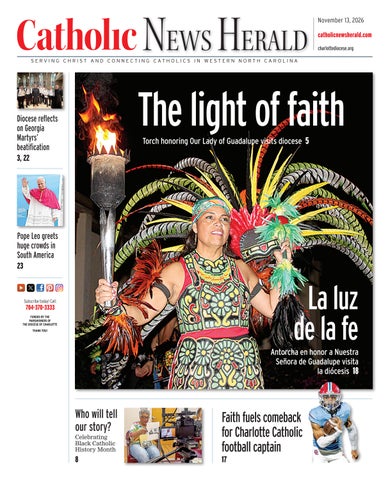
The light of faith
Diocese reflects on Georgia Martyrs’ beatification
Torch honoring Our Lady of Guadalupe visits diocese 5
3, 22
Pope Leo greets huge crowds in South America 23
La luz de la fe
Subscribe today! Call:
704-370-3333
FUNDED BY THE PARISHIONERS OF THE DIOCESE OF CHARLOTTE THANK YOU!
Antorcha en honor a Nuestra Señora de Guadalupe visita la diócesis 18
Who will tell our story? Celebrating Black Catholic History Month
Faith fuels comeback for Charlotte Catholic football captain
8
17
At a glance 2
catholicnewsherald.com | November 13, 2026 CATHOLIC NEWS HERALD
CATHOLIC ALL WEEK
NOVEMBER 13, 2026
Timely tips for blending faith & life
VOLUME 36 • NUMBER 4
1123 S. CHURCH ST. CHARLOTTE, N.C. 28203-4003 catholicnews@rcdoc.org
704-370-3333 PUBLISHER The Most Reverend Michael T. Martin, OFM Conv., Bishop of Charlotte
INDEX Contact us.....................................2 Español....................................... 18-21 Our Diocese............................. 4-13 Our Faith........................................3 Our Schools.............................16-17 Scripture.......................................3 U.S. news.....................................22 Viewpoints.............................26-27 World news........................... 23-25
N
ovember is a time to be thankful for those who give all of themselves by choosing a religious vocation. The month began with National Vocations Awareness Week – Nov. 1-8 in the United States. The week is dedicated to promoting vocations of priests, deacons and consecrated men and women religious (nuns and brothers) through prayer and education. Beyond the week, fall provides a quiet time of reflection ideal for renewing our prayers and support for those who are considering one of these vocations. Here are some ways to connect yourself or someone in your life with more information.
1 ASK THE QUESTION Father Brian Becker, director of formation at St. Joseph College Seminary and vocations promoter for the Diocese of Charlotte, encourages family members and friends not to underestimate the positive influence they can have in the lives of young people discerning vocations. “I speak to so many young men and women about their vocational journey, and usually somewhere in their story is a question from a parent, teacher, coach or catechist: ‘Have you thought of being a nun? Of being a priest?’” Father Becker said. “Most young people need a little encouragement. They need to know that others see in them what they’re suspecting that they see in themselves, a call to follow Christ more closely.”
2 EXPLORE THE CALL STAFF EDITOR: Trish Stukbauer 704-370-3392, tmstukbauer@rcdoc.org ADVERTISING MANAGER: Kevin Eagan 704-370-3332, keeagan@rcdoc.org MULTIMEDIA DESIGNER: David Puckett 704-808-4521, dwpuckett@rcdoc.org EDITORIAL TEAM: Kimberly Bender 704-370-3394, kdbender@rcdoc.org Lisa Geraci 704-370-3294, lmgeraci@rcdoc.org Troy C. Hull 704-370-3288, tchull@rcdoc.org Christina Lee Knauss 704-370-0783, clknauss@rcdoc.org Amelia Kudela 980-374-3411, arkudela@rcdoc.org Brian Segovia 704-370-3235, bmsegovia@rcdoc.org
If you or someone you know is contemplating a vocation, talk with your pastor, reach out to the diocese’s vocations promoter, read up on consecrated life and the various religious communities that exist, and contact communities that interest you. Many offer “come and see” days or retreats that are opportunities to learn more and to meet others who have accepted God’s call to religious life. For young men and women, there are summer discernment retreats offered by the Diocese of Charlotte and hosted at Belmont Abbey College: Quo Vadis Days for young men, and Duc in Altum for young women.
3 PRAY FOR VOCATIONS There are many prayers available online, but this simple one is a beautiful way to start: God our Father, we thank You for calling men and women to serve in Your Son’s Kingdom as priests, deacons and consecrated persons. Send Your Holy Spirit to help others to respond generously and courageously to Your call. May our community of faith support vocations of sacrificial love in our youth and young adults. Through our Lord Jesus Christ, who lives and reigns with You in the unity of the Holy Spirit, God, forever and ever. Amen. — Catholic News Herald
COMMUNICATIONS ASSISTANT/CIRCULATION: Maria De Ugarte 704-370-3333, catholicnews@rcdoc.org COMMUNICATIONS DIRECTOR: Liz Chandler 704-370-3336, lchandler@rcdoc.org ASSISTANT COMMUNICATIONS DIRECTOR: Patricia L. Guilfoyle 704-370-3334, plguilfoyle@rcdoc.org THE CATHOLIC NEWS HERALD is published by the Roman Catholic Diocese of Charlotte 26 times a year. NEWS: The Catholic News Herald welcomes your news and photos. Please e-mail information, attaching photos in JPG format with a recommended resolution of 150 dpi or higher, to catholicnews@rcdoc.org. All submitted items become the property of the Catholic News Herald and are subject to reuse, in whole or in part, in print, electronic formats and archives. ADVERTISING: Reach 165,000 Catholics across western North Carolina! For advertising rates and information, contact Advertising Manager Kevin Eagan at 704-370-3332 or keeagan@rcdoc.org. The Catholic News Herald reserves the right to reject or cancel advertising for any reason, and does not recommend or guarantee any product, service or benefit claimed by our advertisers. SUBSCRIPTIONS: $17.75 per year for registered families of the Diocese of Charlotte and $25 per year for all others. POSTMASTER: Periodicals Class postage (USPC 007-393) paid at Charlotte, N.C. Send address corrections to the Catholic News Herald, 1123 S. Church St., Charlotte, N.C. 28203.
Scan the QR code for this week’s recommended prayers and activities
Father John Putnam celebrates Mass at St. Mark Church in Huntersville. PHOTO PROVIDED BY AMY BURGER
Diocesan calendar of events EVENTS ARTS AT THE ABBEY: The Candide Quartet presents the music of Mozart and Mendelssohn at 8 p.m. Monday, Nov. 16, at the Abbey Basilica, 100 Belmont-Mt. Holly Road, Belmont. FRIENDSGIVING CELEBRATION: From St. Mark 45+ Singles, 12-5 p.m. Sunday, Nov. 22. RSVP for this potluck by Nov. 15 to 45plussingles@gmail.com. HOLIDAY CONCERT: 8 p.m. Monday, Nov. 30, Abbey Basilica, 100 Belmont-Mt. Holly Road, Belmont. The Abbey Chorus and music students will perform. HANDS FOR HAITI HOPE IN ACTION: Learn how a small Charlotte-based non-profit founded a school in Haiti 15 years ago that now teaches and feeds more than 400 students. Reservations are required for this free event.
Desserts and coffee (and a cash bar) will be provided from 7 to 8:30 p.m. Wednesday, Nov. 18, New Life Center Banquet Hall at St. Matthew Church, 8015 Ballantyne Commons Pkwy., Charlotte. Details: www.handsforhaiti.org.
Bishop Michael Martin, OFM Conv., will participate in the following events over the coming weeks:
PRAYER SERVICES IGBO MASS: 1 p.m. Sunday, Nov. 22, Our Lady of Consolation Church, 1235 Badger Ct., Charlotte. Details: 336-707-3625. MASS OF CONSOLATION FOR MISCARRIAGE LOSS: 9 a.m. Saturday, Nov. 14, St. Mark Church, 14740 Stumptown Road, Huntersville. Rosary at 8:30 a.m. Parents will be able to write their child’s name in a memorial book, and after Mass take home a candle that was lit in the sanctuary during Mass. Questions: respect.life@stmarknc.org.
NOV. 15-19 USCCB Plenary Assembly Baltimore, Maryland
NOV. 30 Atlanta Province Bishops’ Meeting * Atlanta, Georgia
NOV. 23 – 6 P.M. Confirmation Our Lady of the Assumption, Charlotte
* Denotes a private event.
Our faith
November 13, 2026 | catholicnewsherald.com CATHOLIC NEWS HERALD
3
Blessed are the meek Reflections on the Georgia Martyrs
Pope Leo XIV
Pope: Economic inequality threatens peace
T
he threat to world peace stems from economic imbalances linked to development that is “neither equitable nor respectful of creation,” Pope Leo said at his weekly general audience. “This is a far-sighted vision, which was unfortunately borne out towards the end of the last century and which we see even more clearly today,” he said Nov. 4. Pope Leo said at the heart of the economy is work, which allows people to develop as individuals, provide for their families, express their talents, participate in society and build a better world. But the Catholic vision of economic development must always be at the service of humankind and under human control, he said, citing the Second Vatican Council’s pastoral constitution, “Gaudium et Spes.” The pope also emphasized the council’s call to eliminate discrimination against vulnerable social groups and migrants. “Work must never be distorted to the detriment of people, the common good or creation,” the pope said. The real challenge, he said, is offering everyone opportunities to make the most of their abilities. Unemployment, exploitation and working conditions that endanger health or life itself are “unacceptable,” he said. Pope Leo reiterated that workers have both the right and the duty to participate in decisions affecting their work. . The pope’s reflection was a continuation of his series of talks on “Gaudium et Spes,” which teaches that those making decisions about economic planning have an obligation to provide for the needs of individuals while balancing present-day consumption with the needs of future generations. The document also touches upon the role of political authorities, he said. The pope emphasized that engagement in economic and political life in accordance with the Church’s social teaching is a way of building peace. “Politics that tends to the wounds of peoples and of those who suffer injustice offers grounds for hope for the future of humanity,” he said, encouraging young people to follow the example of those who have faithfully served in these fields.
Daily Scripture readings
DEACON MATTHEW NEWSOME catholicnews@rcdoc.org
H
alloween was a unique one for me this year: I was able to usher in the celebration of All Saints Day by participating in the Oct. 31 beatification Mass of Blessed Pedro de Corpa and companions, otherwise known as the Georgia Martyrs. These Franciscan friars – four priests and one lay brother – came to what is now the Georgia coast in the latter part of the 16th century as part of a larger missionary effort to evangelize the native peoples of what was then called “la Florida.” This Spanish territory included Florida and parts of modern day Louisiana, Mississippi, Alabama, Georgia and the Carolinas. Though not as well-known as the later Franciscan missions in the West, the earlier eastern missions left a significant footprint on the history of religion and culture in the Southeast.
PHOTOS PROVIDED
Deacon Matthew Newsome took a group of students from Western Carolina University to the beatification Mass of the Georgia Martyrs in Savannah. The group then went to the Church of the Nativity of Our Lord in Darien, Georgia. After the beatification, they were among the first to pray at the shrine where the first of the martyrs was slain.
Read more PAGE 22: “Georgia Martyrs beatified in Savannah”
A HUMBLE BACKDROP
Fray Pedro and his fellow friars were part of the ministry to the Guale people who lived along what is now the Georgia coast. They suffered martyrdom after a convert to Christianity named Juanillo, a Guale chieftain, sought permission to marry a second wife. This was common practice among Guale tribal leaders, but, as Fray Pedro explained, not something permitted for Christians. Unwilling to accept this answer, Juanillo struck Blessed Pedro down, sparking a wave of violence resulting in the murders of four other friars and the imprisonment of a fifth, who later escaped to tell the tale. Their beatification was the first in the Southeast, and only the sixth celebrated on American soil. I was pleased to mark this historic occasion with a group of college students from Western Carolina University, where I have ministered for the past 18 years. After the beatification Mass, we continued our pilgrimage to Darien, Georgia, to the Franciscan mission of Santa Domingo de Telaje, and where Fray Francisco de Veráscola was killed. There is a shrine to the Georgia Martyrs erected at the Church of the Nativity of Our Lady in Darien where we were able to pray – perhaps the first people to do so in the hours after their beatification. Compared to other shrines I have visited, this one is humble, consisting of a statue in a garden on the church grounds. There are no traces of the original mission structure to be found. But standing there among the palmettos, live oaks and Spanish moss, I
couldn’t help but feel a closeness to the missionaries and the hardships they endured for the sake of the Gospel (see 2 Timothy 1:8).
UNPACKING THE FRUITS
As is the case with every pilgrimage, the fruits of the journey don’t show themselves until after the voyage is complete. Unpacking from a pilgrimage means more than emptying your luggage. It means reflecting on the experience in prayer and meditation. The day of our return was All Saints Day, the gospel for which is Matthew 5:1-12, where Jesus teaches the Beatitudes. Everything Jesus says about blessedness runs counter to worldly wisdom. The world would count as blessed those who are rich, powerful and influential. Newsome Jesus says no – blessed are the poor, meek and persecuted. His description is a revelation of a truth. The very idea of “beatitude” hit home differently for me after witnessing these five martyrs being raised to the ranks of the blessed. I found myself wondering in what way Blessed Pedro and his companions exhibited these beatitudes. I’m sure they expressed the beatitudes in many ways in their ministry, but the one that kept coming back to me was their meekness. This may seem
“The LORD is my shepherd; I shall not want. In verdant pastures he gives me repose.” — Psalm 23:1-2, part of the daily readings for Nov. 22
counterintuitive to those who extoll their bravery in defense of marriage, but meekness does not equal weakness. If their witness proves anything, it is that true meekness often requires great courage. When Fray Pedro refused to grant permission for the Guale chieftain Juanillo to take a second wife, it was not out of a prideful refusal to give in to the convert’s request. It was a humble recognition that he had no authority to do so. Fray Pedro knew the Church’s teaching and so did Juanillo – otherwise he would not have sought the dispensation. But the friar was meek before a truth he could not change, whereas Juanillo wanted the truth to bend to his will. To recognize there is a truth greater than ourselves, even if pretending otherwise would save our lives, is a form of meekness. Fray Pedro’s meekness made him a martyr. His persecution for Christ’s sake made him a saint. One could say the same about all the beatitudes. It is through spiritual poverty, being peacemakers, hungering for justice, and the gentle endurance of persecution for the sake of Christ that we become blessed. This is what the martyrs see that the world does not. This is the revelation of Jesus Christ. May we all have the courage and the humility of the Georgia Martyrs. Blessed Pedro de Corpa and companions, pray for us. DEACON MATTHEW NEWSOME is the Catholic campus minister at Western Carolina University.
Snap the QR code (right) to get the Mass readings for every day, in English or Spanish, online at the U.S. Conference of Catholic Bishops’ website.
Our diocese 4
catholicnewsherald.com | November 13, 2026 CATHOLIC NEWS HERALD
For the latest news 24/7: catholicnewsherald.com
In Brief
Catholic Charities ushers in new era with board, changes to increase impact CHRISTINA LEE KNAUSS clknauss@rcdoc.org
CHARLOTTE — As a first step in a transformation to broaden its impact, Catholic Charities Diocese of Charlotte has appointed members to a new Governing Board of Directors that will give it more autonomy. Charlotte businessman and philanthropist David Longo was elected chair by the 13 board members appointed Nov. 3, with attorney Tom Mitchell selected vice chair. “Working alongside our dedicated staff, volunteers and supporters, we aspire to become the most innovative and impactful Catholic Charities organization in the country,” said Longo. “We are excited to build on this ministry’s strong foundation, expand
Scholarship honors legacy of Benedictine priest-scientist BELMONT — Belmont Abbey College has established the Father Arthur Pendleton Scholarship, a new academic scholarship for students pursuing the natural sciences. The scholarship honors the late Father Pendleton, a beloved monk of Belmont Abbey who taught chemistry at the college for decades. The Pendleton Scholarship is designed for students who plan to major in biology or biochemistry and have at least a 3.25 unweighted GPA. Each Pendleton scholar will receive $9,000 per year, renewable for up to four years. “Father Arthur showed generations of Abbey students that studying the natural world is a way of encountering the order and beauty of God’s creation,” said Dr. Brad Frazier, provost of Belmont Abbey College. “The Pendleton Scholarship program carries that legacy forward. Our students will conduct real research alongside faculty mentors and think seriously about how faith and science illuminate one another.” — Belmont Abbey College
Special collection for the Catholic Campaign for Human Development CHARLOTTE — A special collection for the Catholic Campaign for Human Development (CCHD) will be held across the Diocese of Charlotte Nov. 21-22. CCHD is one of the U.S. Conference of Catholic Bishops’ primary efforts to fight poverty at the grassroots across the United States. About 75% of the collection goes to support CCHD National Grant funding. The other 25% remains in the diocese for local grants (of up to $5,000) for non-profit organizations that are headquartered and fighting poverty in the diocese. Applications for 2027 are due via email by Monday, Feb. 15, 2027. Each grantee partners in some way with a Catholic parish or entity of the diocese, and the parish provides a letter of endorsement with the grant application. Find out more information and get the application starting Dec. 1 at www.ccdoc.org/ cchdcrs. — Deacon Jeff Font
BOARD, SEE PAGE 28
PHOTO PROVIDED
The new board, chaired by business leader David Longo (center back), is part of a reorganization to increase the agency’s ties to parishes and broaden its impact in the rapidly growing region. See list of board members, page 28.
Let God impact your profession, bishop tells attorneys CHRISTINA LEE KNAUSS clknauss@rcdoc.org
CHARLOTTE — Catholic attorneys, judges and other members of the legal profession took time Nov. 5 to pray and contemplate the role their faith in Christ plays in their daily work at the annual Red Mass at St. Patrick Cathedral. The tradition of the Red Mass has roots in Europe, where it was started by Pope Innocent IV in 1243 for the Ecclesial Judicial Court. The tradition spread over the centuries, and now Red Masses are celebrated in many nations to mark the beginning of the judicial year. In the U.S., the Red Mass is usually celebrated in the fall to coincide with the beginning of a new Supreme Court session. The liturgy takes its title from the fact that celebrants wear red vestments because it is a votive Mass of the Holy Spirit. The tradition of the Red Mass in Charlotte was revived in 2024 after a break – this was the 19th held in the diocese. Bishop Michael Martin offered a homily that asked attendees to focus on their faith in Christ as they go through the often challenging tasks of their daily work. “I’m so grateful that you place your professional lives on the altar with Jesus as an offering to God, who has given you gifts to enable you to do the wonderful work you do,” Bishop Maritn said. “He trusts you with the law, with justice on this Earth, and He gives you His Spirit.” The Gospel reading for the Mass from Matthew featured Christ speaking “woe” on the Pharisees for their strict interpretation of minor rules without focusing on larger issues of justice and mercy. Bishop Martin asked the congregation to focus on both of the modern interpretations of the word “woe.” First, he said, “woe” means negativity that can come to those who do their work without focusing on God’s Word. But he also asked the congregation to focus on “whoa,” which means a stopping point – a chance to focus on God’s presence in all of our daily lives, whether we work in the law or in other professions. “If there is one thing I would hope tonight’s celebration would encourage, it would be the courage of all of you in your professional lives to realize that in that breath, in that space between stimulus and response, is where you slow things down just enough to realize the presence of the Holy Spirit,” he said. He emphasized that God does not send His Spirit to the faithful at baptism and confirmation so it can impact only their personal lives, but also their careers. “His Spirit wants to impact your approach to your profession…in understanding more deeply the nuance that is so much a part of trying to define justice in the world,” he said.
CHRISTINA LEE KNAUSS | CATHOLIC NEWS HERALD
Bishop Michel Martin greets legal professionals after the Red Mass. “His Spirit wants to impact your approach to your profession,” Bishop Martin told them during his homily. The annual Mass was revived in the Diocese of Charlotte in 2024.
ORIENT TOWARD GOD
The Mass featured beautiful music offered by organist Gianfranco DeLuca and Will Esser as cantor, including a version of Cesar Franck’s “Panis Angelicus” as the Communion hymn. The evening ended with an inspiring version of the hymn “O God Beyond All Praising,” its second verse echoing the evening’s theme of serving justice: “Then hear, O gracious Savior, accept the love we bring, that we who know your favor may serve you as our king.” Austin Walsh, president of the St. Thomas More Society, said the annual Mass gives Catholic legal professionals the chance to remember the faith and integrity of the saint, the patron of lawyers, and to “orient their work towards giving glory to God.” “The Red Mass is a moving reminder that the practice of law is ultimately in service of well-ordered justice,” he said, “and that we cannot compromise our faith and formation to win a point.” After the liturgy, attendees took time to talk with Bishop Martin and each other. “It’s an opportunity to gather as a legal community and to see people we might sometimes see in court and professionally,” said Matthew Hoefling, a member of St. Vincent de Paul Parish in Charlotte who attended with several family members who are also attorneys. “It’s a chance for us to pray together and be together.”
November 13, 2026 | catholicnewsherald.com CATHOLIC NEWS HERALDI
5
Hundreds of people came out to greet the Guadalupan Torch at Our Lady of Guadalupe Parish in Charlotte and touch a replica of St. Juan Diego’s tilma on which a miraculous image of Our Lady of Guadalupe appeared in 1531 (left). TROY C. HULL | CATHOLIC NEWS HERALD
The light of faith
T
he annual Guadalupan Torch Run spent a week in the Diocese of Charlotte, winding through 11 parishes as a visible sign of faith, hope and connection. The relay pilgrimage in honor of Our Lady of Guadalupe began
Torch honoring Our Lady of Guadalupe visits diocese
Aug. 29 in Mexico City and ends Dec. 12 at St. Patrick’s Cathedral in New York City, covering more than 3,000 miles. The Marian fire symbolizes the light of faith, the love of Mary, and the hope of an immigrant community divided by a
shared border. The pilgrimage has taken place since 2002 and has become a symbol of hope for immigrants, bringing an image of Mary often touched by friends and family members on its journey to Hispanic communities across the United States.
Singers greeted the torch at St. James Church in Hamlet, while parishioners walked with it led by Father Huver Navarro at Our Lady of the Rosary Church in Lexington. It was the torch’s first visit to St. James (right), where it was greeted by dancers and a huge celebration. The colorful Aztec dancers perform in honor of Our Lady of Guadalupe.
More online At www.catholicnewsherald.com: Stories, photos and videos from the torch’s visit
6
catholicnewsherald.com | November 13, 2026 CATHOLIC NEWS HERALD
Pope Leo awards Triad Franciscans hold tribute as they find new ground Father Gary title of ‘Monsignor’ LISA M. GERACI lmgeraci@rcdoc.org
LISA M. GERACI lmgeraci@rcdoc.org
CHARLOTTE — Pope Leo has given Father Paul Gary, pastor of St. Luke in Mint Hill, the honorary title of “Monsignor” for exceptional service to the Church. “Monsignor” is a title granted by the pope, typically based on the local bishop’s recommendation. It is a rare honor from the Vatican, and it has been given to only a handful of priests in the Diocese of Charlotte since its founding in 1972. On the feast of All Saints Day, Bishop Michael Martin sent the news to priests. “Monsignor Gary’s 42 years of priestly ministry have had wide-ranging impact on people and parishes,” Bishop Martin told the Catholic News Herald. “He has built up the faith of the parishioners he has served and is well-known in our diocese for his loving and gracious spirit.” Monsignor Gary was surprised and humbled by the news. “I am deeply honored by becoming a Monsignor and I am extremely grateful to Pope Leo XIV and to my bishop, Bishop Martin, for bestowing this privilege upon me,” Monsignor Gary said. “It is not just my accomplishment, but something the whole parish can be proud of.” Monsignor Gary is widely known as the “construction priest.” His leadership as pastor of St. Philip the Apostle Parish Gary in Statesville and St. Luke Parish in Mint Hill resulted in new churches for those growing communities. While he was pastor and rector at St. Patrick Cathedral in Charlotte, he oversaw the completion of the parish’s Family Life Center. Father Gary grew up on Long Island in New York as a cradle Catholic. He was educated in Catholic schools along with his four brothers, including his identical twin, Peter Gary, who is a parishioner at St. Luke. He attended Mount St. Mary’s Seminary in Emmitsburg, Maryland, in 1980 and was ordained by Bishop Michael Begley at St. Patrick Cathedral on Feb. 11, 1984. His diocesan assignments ranged from parochial vicar at Immaculate Conception Parish in Hendersonville and St. John Neumann Parish in Charlotte, to pastor at St. Leo the Great Parish in Winston-Salem and St. Philip the Apostle Parish. In 1996, he became the pastor and rector of St. Patrick Cathedral in Charlotte, where he served until 2008. Then he was assigned to St. Luke as pastor, where he has spent the last 18 years shepherding its growing Catholic community. More than 200 St. Luke parishioners and friends voiced their congratulations on the parish’s Facebook post announcing the new title. “Congratulations to Monsignor Gary!” wrote Michelle Fabrize. “We are blessed to have such a faithful shepherd.” As Father Andrew Templeton, parochial vicar at St. Luke, noted, “This papal honor is not merely a recognition of past accomplishments, but also a testament to the many lives touched through Monsignor Gary’s priesthood and his faithful service to the People of God.”
GREENSBORO — Franciscan Father Louis Canino presided over an emotional tribute Mass for St. Francis of Assisi Oct. 31 for supporters of his ministry. “I didn’t want the year to go by without honoring St. Francis, not just his feast day but we had to celebrate the 800th anniversary (of his death),” said Father Canino, known better as “Father Louie.” The Mass hosted at St. Mary Church in Greensboro drew more than 200 people. It was the first Mass the group had celebrated since July, when their almost four-decade streak of Wednesday Masses at the Franciscan Center on Greene Street was put on hold. It was then that the group received notice that the center’s lease would not be extended. The Franciscan Center is where Father Louie ran a gift shop, offered Alcoholics Anonymous meetings, and presided over Wednesday Mass for the past 36 years. While running the center, he became available for whatever spiritual needs his inner-city neighbors brought to him – a confessor to the sinner, an advisor to the stressed, a waiter to the hungry, and a comforter to the broken. Drawing from that experience, Father Louie focused his homily on how St. Francis is relevant today. “If this legacy of St. Francis was emblazoned on the hearts of legions of people today, our community and our world would be in a better place,” Father Louie said. “It would resemble the Kingdom of God here on Earth.” The Franciscan Center regulars in the pews understood because they strive to follow that legacy. “We have been practicing what St. Francis has said and we live up to it,” said Mike Bohen, who teared up during the emotional Mass. “We need somebody that aspires to do more than go to church and go home. Father Louie inspires us in our faith.” In his homily Father Louie said, “St. Francis’ spiritual family grew and grew so much that three orders were founded by him.” In a similar way, the Catholic community in the Triad grew from Father Louie starting an experimental storefront in 1990.
LISA M. GERACI | CATHOLIC NEWS HERALD
Members of the community built around Greensboro’s Franciscan Center gather for a Mass celebrated by Franciscan Father Louis Canino at St. Mary Church. The center has moved to a new, smaller location after years of taking St. Francis’ missionary spirit to the streets of the city.
Father Louie’s street ministry was accessible to people who may not reach out to a parish priest but would open a shop door to converse with the humble man in a hooded brown habit. Kathleen Zeller, a parishioner at St. Pius
X, met Father Louie after she returned to her faith and visited the shop for a Bible. “He reminded me so much of a missionary priest,” Zeller said. “It was like a transformation for me. I begged him to let me volunteer … and we have been together every Tuesday ever since.” As he left the ambo, Father Louie told the story of a man he hitched a ride from while he traced the path of St. Francis. He never forgot the reason the man, who wasn’t a Catholic, told him he was in Assisi. “I want to catch the spirit of St. Francis,” he repeated, fighting back tears, and then instructed his group: “I want you and I to have the same burning desire to catch the spirit of St. Francis and continue to live his legacy here and now.”
More online At www.catholicnewsherald.com: Read more about the new Franciscan Center
Father Yumo earns canon law degree LISA M. GERACI lmgeraci@rcdoc.org
WINSTON-SALEM — Father Melchesideck Yumo is the newest member of a cadre of canon lawyers within the diocese. While pursuing his degree, he balanced his priestly duties as the parochial administrator of St. Benedict the Moor Church in Winston-Salem and Good Shepherd Mission in King. He graduated from Saint Paul University in Ottawa, Canada, with a master’s in canon law and his ecclesiastical licentiate in canon law. He will receive his certificate in January and is invited to walk in the graduation ceremony this June. The ordinarily two-year program took him four to complete. “Since I was serving in the parish and doing it online, I took the extended
Yumo
version,” he said. Each year he would make a mandatory in-person trip to the college for 10 days. He completed his last class in Rome, where he met Pope Leo XIV. “He greeted me,” Father Yumo said. “It was such a great honor
to meet him.” Father Yumo initially enrolled in the program because he felt compelled by his parishioners back in the Diocese of Buea, Cameroon. “I was motivated by the fact that there are many couples back in my home country who have been waiting for annulments. But they are unable to have them because the process takes too long,” Father Yumo said. “They do not have tribunals in every diocese. Before
coming here, I was serving at the Family Life Office, so I encountered many of those situations. I felt that studying canon law would provide the tools I need to help in that direction.” Father Yumo expressed his gratitude to his many well-wishers, including his old friends at St. Mark Parish in Huntersville – where he served as parochial vicar – his communities at St. Benedict the Moor and Good Shepherd, the Knights of Columbus, the Ancient Order of the Hibernians and Mary’s Women of Joy. They all have supported him through this journey for years and have showered him with congratulatory cakes, parties and love since his graduation. “They contributed so much to make it so I could achieve this,” he said. “I especially would love to thank Dr. Dennis and Monica Golden, who I consider my parents over here.”
November 13, 2026 | catholicnewsherald.com CATHOLIC NEWS HERALDI
Arnsparger
Gober
Asoh
Lawlor
Bond
McCanless
Cook
McNulty
7
Dominguez
Porras
Starczewski
Additional 2026-27 Presbyteral Council members appointed CHARLOTTE — Bishop Michael Martin, OFM Conv., has appointed 11 members to the Diocese of Charlotte’s Presbyteral Council, a group that advises the bishop in governing the diocese. They join a group elected by fellow priests in September to serve on the council. The changes reflect the new vicariate structure, announced and promulgated last month. The new members are: n Monsignor Roger Arnsparger, V.F.,
pastor and rector, St. Lawrence Basilica, Asheville n Father Paul Asoh, M.S.P, V.F., pastor, St. Mary Mother of God Parish, Sylva n Father Christopher Bond, pastor, St. Lucien, Spruce Pine, and St. Bernadette, Linville (reappointed) n Father W. Christian Cook, V.F., pastor, St. Pius X Parish, Greensboro (reappointed) n Father Julio Dominguez, pastor, St. Joseph Parish, Newton (reappointed) n Father Christopher Gober, V.F., St. Leo the Great Parish, Winston-Salem
(reappointed) n Father Mark Lawlor, V.F., pastor, St. Therese Parish, Mooresville n Father David McCanless, Campus Ministry chaplain at Wake Forest University (reappointed) n Father Paul McNulty, V.F., pastor, St. Michael the Archangel Parish, Gastonia (reappointed) n Father Adrian Porras, V.F., pastor, St. Barnabas Parish, Arden (reappointed) n Father John Starczewski, V.F., pastor, St. John Neumann Parish, Charlotte
(reappointed) Bishop Martin serves as president of the Presbyteral Council. All members of the Presbyteral Council are listed on the diocese’s website at tinyurl.com/4uucjrta. Required by Church law, the Presbyteral Council represents all priests in the diocese and is “like a senate of the bishop” (Code of Canon Law 495 §1), with about half the members elected by priests and others appointed by the bishop. — Catholic News Herald
PHOTOS PROVIDED
Flag retirement ceremony honors those who served MINT HILL — The Knights of Columbus held their annual Flag Retirement Ceremony Nov. 9 at St. Luke Church. The Knights, who collected more than 110 flags throughout the year, opened the ceremony with a formal salute by an honor guard made up of Fourth Degree Knights from several parishes. The ceremony is an important one for veterans, including organizer James Strauss. “I was a Vietnam veteran. I never saw combat, but I saw the people who came back and were spit on at the airport as I came back,” Strauss said. “The ability to honor the people around me who died for this country and suffered for this country holds a special meaning.” Under the U.S. Flag Code, if an American flag becomes worn, faded or torn, it must be properly disposed of, preferably by fire. The ceremony ended with a ceremonial burning in the fire pit in St. Luke’s outdoor Marian courtyard – the large statue of Our Lady of Guadalupe, patroness of the Americas, watching over them. Visit www.catholicnewsherald.com and our Facebook page for more Veterans Day coverage.
GUILIANA POLINARI RILEY AND LISA M. GERACI | CATHOLIC NEWS HERALD
When the saints go marching in In parishes and schools across the Diocese of Charlotte, children – and some adults – got into the spirit of All Saints Day by dressing as their favorite saints. At tinyurl.com/ yc5hhvnv, see more photos like these from Immaculate Conception Parish in Forest City and read about the celebration at St. Dorothy Parish in Lincolnton.
8
catholicnewsherald.com | November 13, 2026 CATHOLIC NEWS HERALD
Who will tell our story?
Discovering and preserving Black Catholic history
I
magine sitting at Mass beside a parishioner you have known for years. You know their name, you exchange greetings, maybe you have served on a committee together. But how much do you really know about them? Perhaps they remember attending Mass when they could not sit wherever they wanted or their parents attended a segregated Catholic school. The person sitting beside you may be carrying a chapter of Black Catholic history that they were never asked about.
MORE THAN WRITTEN WORDS
Each November, Black Catholic History Month invites us to celebrate the remarkable contributions of Black Catholics to the Church. We honor familiar names such as Venerable Augustus Tolton, Venerable Mother Mary Lange, Venerable Henriette Delille and Servant of God Sister Thea Adams Bowman, whose lives continue to inspire. But Black Catholic history extends beyond the individuals whose stories have been documented in books, museums and archives. Black Catholic history also lives in our families, parishes, ministries and communities; in faded photographs, old church bulletins, family Bibles and the experiences of ordinary people whose faith, perseverance and service helped shape the Black Catholic communities we know today. These stories may never make national headlines, but they are no less important to understanding our shared history.
PROVIDED AND LEAH HOLLOWAY | CATHOLIC NEWS HERALD
Capturing stories of the people in the pews around you and of clergy such as Father Marcel Amadi, pastor of Our Lady of Consolation Parish in Charlotte, can preserve Black Catholic history. Youth at Our Lady of Consolation are preserving the stories and placing them on the parish’s social media accounts.
We all need to know about the people who worshiped, served, persevered and helped build the Church before us.
HISTORY SITTING BESIDE US
Consider the wealth of history that may be present in our own pews. There are parishioners who remember a time when racial barriers shaped their experiences within the Church, those who witnessed the arrival of the first Black priest at their parish, and choir members who remember how Black sacred music became a more visible part of worship. Others remember the establishment of Black Catholic ministries, pilgrimages, cultural celebrations and efforts to create faith communities where their history, culture and traditions are reflected and celebrated. These are not simply personal memories. They are firsthand accounts of Black Catholic life, offering perspectives that historical documents cannot capture. Yet, how often do we take the time to ask about these experiences? How many stories remain untold because we assume there will be another opportunity
This photo of the former Our Lady of Consolation School – which closed in 1988 – was provided by parishioner Mary McDonald, a former educator there. Preserving these photos and moments in social media posts, videos and other accessible ways helps share stories from the past that might otherwise be lost. to hear them or that someone else will take the time to preserve them? Every generation carries memories that the next generation cannot recreate. Once those voices are gone, the opportunity to hear their stories firsthand disappears with them.
WHY TELL THE STORY?
February 2026 marked 100 years of commemorating Black history in America. In recognition of the centennial, Bishop Daniel E. Garcia and Bishop Roy E. Campbell Jr. encouraged Catholics to become “faithful stewards of memory” and “courageous witnesses to truth.” Their message reminds us that
preserving history is not simply honoring accomplishments. It also means acknowledging difficult experiences and ensuring that the lessons of the past are not forgotten. Dr. Ansel Augustine makes a similar point in his USCCB reflection, “Telling the Whole Story.” He emphasizes that Black Catholic history is essential to understanding the fullness of the universal Church. When these stories are absent, an important part of the Church’s identity and lived experience is missing. This is why the stories of everyday Catholics matter. We all need to know about the people who worshiped, served, persevered and helped build the
Church before us. Their stories help us understand how we arrived here and to see Black Catholic faith and culture as an integral part of the Church’s living tradition. As we learn these stories, we also become responsible for carrying them forward. Each of us has a place in that history: those who remember it, those who are discovering it and those who will one day tell the stories of our time. Our history not only tells us where we have been; it also helps all of us understand where we belong.
HOW WE TELL THE STORY
For generations, families, parishes and dioceses have preserved history through photographs, written records, newspaper articles, archives and
oral traditions. These remain invaluable resources. Today, the phone in our hands is another powerful tool for preserving history. It can turn a memory into a story that lives beyond that moment. Platforms such as Facebook, Instagram and YouTube allow us to share those stories in our own voices and introduce them to people far beyond our communities. Imagine what we could preserve if we looked at the conversations and memories around us. A story about growing up Black and Catholic could become a recorded conversation. An old photograph could provide an opportunity to identify the people pictured and tell what was happening at the time. The story behind a beloved song, ministry or tradition could reveal how a parish community became what it is today. These are the kinds of moments that can make us stop and say, “I never knew that.” A social media page is more than a place for announcements and event photographs. A twominute video featuring a longtime parishioner, a post pairing an old photograph with the story behind it, or a series highlighting moments from a parish’s history can make those memories accessible to a new audience. Stories can now travel much farther. We should view these familiar platforms not only as places to share what is happening now, but as tools for documenting the history unfolding around us.
WHO WILL TELL OUR STORY?
Some of the most valuable chapters of Black Catholic history may never be formally recorded. They are found in the lives of people who have helped shape our communities. Their stories deserve to be heard, remembered and preserved. As we celebrate Black Catholic History Month, perhaps the most meaningful thing we can do is begin a conversation. Invite a longtime parishioner to share a memory or experience. Record a family story. Identify the people in an old photograph and share the story behind it. Use the tools available to capture a piece of Black Catholic history and ensure it does not disappear. One day, future generations will want to know what Black Catholic life was like in our time, how we worshiped, how we served, how we faced challenges and how we carried our faith forward. Who will tell our story? We will. Continue exploring Black Catholic history, education, faith and life by following the Diocese of Charlotte’s African American Affairs Ministry and Our Lady of Consolation Church on Instagram. — Rosheene L. Adams, African American Affairs Ministry, Diocese of Charlotte
November 13, 2026 | catholicnewsherald.com CATHOLIC NEWS HERALDI
9
An Angel for Advent morning of St. Nicholas Day, Dec. 6. “When we read the book together, my second child, who was three at the time, realized the baby in the manger was the same Jesus who died on the cross,” she says. “She started crying as she put the pieces together for the first time about who the baby Jesus was and what Christmas is really about. It was such a beautiful moment together that I’ll never forget.” Her three daughters – ages 8, 5 and 2 – carry their angels around with them and fall asleep with them at night.
CHRISTINA LEE KNAUSS clknauss@rcdoc.org
CHARLOTTE — For years, parents have been moving an Elf on the Shelf who is prone to naughty acts around their homes to get children to behave in the days leading up to Christmas. Now, there’s a Catholic alternative with a Charlotte connection – an angel who teaches kids how to behave like Christ in the days leading up to His birthday, with no elfish spying for Santa involved! Meet the Advent Angel, an artisan-made doll developed by an Arizona-based author and broadcaster Catherine Fowler Sample, whose work has appeared on EWTN, CatholicTV and Relevant Radio. “Instead of putting energy into moving an elf around each day and all the staging that goes with it, Advent Angel puts that energy toward loving God and others,” Sample says. Sample, whose husband Brian is a Charlotte Catholic High School alumnus, came up with the idea about three years ago when she was thinking of a better way for her three daughters to observe Advent. She came up with the handmade angel that could be used to guide children – or anyone seeking a more meaningful season – through the days leading up to Christmas. A book and virtue cards – one for each day of advent – accompany the doll in a special kit, for children to follow as they go through the season. “It started as a desire to have a fun and faith-filled tradition for my own kids during Advent that would feel like more than just a countdown to Christmas,” she says. “I thought, wouldn’t it be cool to have the story of the first Christmas night told through an angel’s eyes?”
TAKING WING
Her husband supported her and the idea took wings. Sample and her sister sewed the first angel by hand at her dining room table. She brought the product out right before Advent three years ago and immediately received support from people in her
ENCOURAGING ACTS OF LOVE
AMELIA KUDELA | CATHOLIC NEWS HERALD
My Advent Angel, a toy that encourages children to live out Advent virtues, recently spent the day at the Diocesan Pastoral Center. Go online to www. catholicnewsherald.com to see what she did. community, including an Arizona priest who called the doll “just what the world needs.” “Sometimes we can get swept up in the secular aspects of the season, but I wanted something for my children that would allow them not just to focus on what are they going to get from Santa, but what can they give to Jesus?” she says. Sample wrote a book, “My Advent Angel,” which in rhyme tells the story of Christmas and its true meaning and introduces the angel to readers. “We can each play our part to honor the Lord/Tell the truth, be the best in all you do/Listen to your mom and dad, do every chore/Be kind to all and say your prayers too!” is one verse. In the year after she finished the angel dolls and the book, Sample and her husband gave them to her daughters on the
The positive response led Sample to develop a “Virtue Chart.” Over 28 days, participants can earn jewel and star stickers for practicing different virtues. The stickers stand for “the jewels and stars added to our heavenly crown through acts of love,” Sample says. Saints are paired with each virtue, and a deck of holy cards tells the story of each saint. There are Virtue Cards which have more than 100 everyday ideas on how to show love for Jesus and others. Advent Angel has also led to talks about virtue at home, Sample said. “My kids call it being ‘big-souled,’” she says. “When Advent comes, they start collecting toys to give away, put them in a basket, and say a prayer for whoever will receive them. It’s things like these that they do more of – small, ordinary acts of love – that stuck with them even more than I expected.” And while some kids start asking when Christmas is coming even before December arrives, Sample says her girls routinely ask, “When is Advent coming?” “I love that so much because that was the whole point – to make Advent more than a countdown to Christmas that we could celebrate together in a fun and faith-filled way.”
More online At www.catholicnewsherald.com: The angel visits diocesan offices At www.myadventangel.com: Lean more and order one
Ave Maria Mutual Funds – 10.375 x 6.26 Arroyo Ad | 2026 09
Your investments should honor your values, not compromise them. As someone who cares deeply about faith and family, and as a longtime supporter of Ave Maria Mutual Funds, I’ve always believed: where we put our money matters. Working with Ave Maria Mutual Funds has shown me you don’t have to sacrifice your principles for financial success. Every investment reflects Catholic teaching. That’s why I’m proud to stand with these funds.
RAYMOND ARROYO Fox News & EWTN Host
This testimonial may not be representative of the experience of other customers. “As a member of the Ave Maria Mutual Funds Catholic Advisory Board, I receive compensation from the Funds of approximately $14,000 per year, which I do not believe affects my objectivity. Such compensation for my time and advice is not payment for this endorsement. I truly believe in the mission of the Ave Maria Mutual Funds.” – Raymond Arroyo. Past performance does not guarantee future results. Schwartz Investment Counsel, Inc., a registered investment adviser established in 1980, serves as investment adviser for Ave Maria Mutual Funds and invests only in securities that meet the Funds’ investment and religious requirements. The returns may be lower or higher than if decisions were based solely on investment considerations. The method of security selection may or may not be successful and the Funds may underperform or outperform the stock market as a whole. All mutual funds are subject to market risk, including possible loss of principal. Request a prospectus, which includes investment objectives, risks, fees, charges and expenses and other information that you should read and consider carefully before investing. The prospectus can be obtained by calling 200-174-011525 | 20260706-5714755 1-866-283-6274 or it can be viewed at www.avemariafunds.com. Distributed by Ultimus Fund Distributors, LLC. Schwartz Investment Counsel, Inc. is not affiliated with Ultimus Fund Distributors, LLC.
10
catholicnewsherald.com | November 13, 2026 CATHOLIC NEWS HERALD LEFT PAGE
PAID ADVERTISEMENT
U.S. Catholics Join the Church in Guatemala to Provide Safe Shelter to the Suffering Poor Cross Catholic Outreach has launched a major effort to provide safe housing for destitute families in rural Guatemalan villages. It is asking U.S. Catholics to become part of that life-transforming mission of mercy through its “Safe Homes in Guatemala” campaign. The U.S.-based ministry, which has been recognized by the Vatican for its relief and development work in more than 90 countries, has a goal to build 240 storm-resistant homes to benefit 1,212 family members in 22 communities. While this appeal has many technical objectives, Cross Catholic Outreach President Michele Sagarino is focused on the individual families that will be impacted. “This is really about Maria and Ancelmo and families like theirs. The challenges they face every day are
ARCHDIOCESE OF LOS ALTOS
DIOCESE OF SUCHITEPÉQUEZRETALHULEU
heartbreaking. Maria and Ancelmo’s mud brick house has deteriorated so badly over the years that they’re afraid to let their children sleep in it. They’ve built a separate structure out of tin sheets for the kids, but you can hardly call that a home, she said. “It’s a situation that must grieve God — so it should be unacceptable to us too!” According to Sagarino, Cross Catholic Outreach is working alongside Catholic leaders in several dioceses and archdioceses to find solutions for families Maria and Ancelmo’s. The plans they have developed can produce life-transforming results — if U.S. Catholics will step forward to help support their work. “Our primary goal is to construct durable, concrete-block houses for the poorest families,” she explained. “The homes will have two bedrooms
DIOCESE OF SOLOLÁ-CHIMALTENANGO FRIENDS FOR HEALTH AND LIFE ARCHDIOCESE OF SANTIAGO DE GUATEMALA
DIOCESE OF ESCUINTLA
DIOCESE OF SANTA ROSA DE LIMA
Maria is praying for the miracle of having a safe home to raise her children. and a common area that can serve as a dining room and living room. Each will have a concrete foundation and walls, a galvanized metal roof, a sanitary bathroom, three secure metal doors and shuttered windows, providing a level of comfort and safety these families have never experienced.” Because the design is simple, the cost to provide a home is only about $21,000. “That is a large sacrificial gift for one donor or family to make, but many have done that and were so happy they got involved. Most had been looking for something specific and significant they could do to bless others,” Sagarino said. “This outreach was exactly what they were looking for because a home does more than offer safe shelter. It gives families a foundation for building a better life.” Serving the poor through the local Church also has important spiritual benefits, according to Sagarino. “When people learn local Church leaders love them and want a better life for them, it strengthens their faith and
restores their hope,” she said. “Many have felt isolated and unseen. They need to know we care about them.” Father Alejandro Garcia, director of the local Caritas ministry in the Diocese of Santa Rosa de Lima, has these words of encouragement for U.S. Catholics: “We pray for you. We pray that you continue to be generous, that you continue to be a valiant hand to those who are so needy among us. As Jesus said, ‘What you have done for the least of these, you have done also for me.’” Readers interested in supporting Cross Catholic Outreach’s housing programs and other outreaches can contribute through the ministry brochure inserted in this issue or send tax-deductible gifts to: Cross Catholic Outreach, Dept. AC06205, P.O. Box 97168, Washington, DC 20090-7168. Those interested in making gifts on a monthly basis can indicate that on the brochure in order to become a Mission Partner, or write “Monthly Mission Partner” on mailed checks to be contacted about setting up those arrangements.
Unique Christmas Catalog Created To Honor Christ and the World’s Poor Many readers may remember, as children, browsing through catalogs and circling the presents they wanted for Christmas. This Advent and Christmas season, Cross Catholic Outreach is offering a catalog too — but theirs is a very different one with a very different purpose. It is designed to bless both givers and receivers by using the holiday gift-giving tradition to help the world’s poorest families. Rather than displaying toys, neckties and jewelry, the Cross Catholic Outreach
Christmas Catalog offers food for hungry families, clean water and educational scholarships. It gives Catholics an opportunity to share the blessings in their lives with impoverished families by sponsoring practical and urgently needed items. Of course, it also offers blessings for children, like Box of Joy® gifts that provide toys, school supplies and rosaries to boys and girls who would otherwise receive nothing for Christmas. “Like most Christmas catalogs, ours offers lots of items so donors can choose something specific that resonates with
them. In addition, they can make a general gift to address the poor’s greatest needs,” explained Michele Sagarino, president of Cross Catholic Outreach. “When donors choose to support urgent needs around the world, they provide us and our Catholic ministry partners the ability to help where it is needed most. The priests and religious sisters we support really appreciate that flexibility. It’s an excellent way to empower their work among the poor.” This unique Christmas catalog is easy to find. Readers can link to it at the
ministry’s website (CrossCatholic. org) or they can reach it directly by entering the following web address: CrossCatholic. org/Christmas. “Our hope is that everyone will be blessed by the experience,” Sagarino said. “It’s a fitting way for us to celebrate the birth of our merciful Lord!” Scan this code to visit Cross Catholic Outreach’s Christmas Catalog webpage.
Box of Joy is a registered trademark of Cross Catholic Outreach.
November 13, 2026 | catholicnewsherald.com CATHOLIC NEWS HERALDI RIGHT PAGE
PAID ADVERTISEMENT
Guatemalan Families Living in Extreme Poverty Look to the Church for Renewed Faith and Hope Maria’s home is always full of faith, love and joy. Sometimes, however, her patchwork shack in the rural Guatemalan community of Japón Nacional B also holds discomfort and fear. First, there’s the water that floods in when it rains. “The beds get wet, and the floors get muddy,” said Maria, who lives with her husband, young son and grandson. High winds fill the family with fear. Recently, a strong wind knocked off part of the roof, so the family replaced the tin sheets and put heavy blocks on top. There’s also the problem of termites, which have created a nest about three feet long on the roof and are destroying the home’s wooden supports. For now, at least, the ceiling remains intact — but what drops from it causes the biggest scare. “A lot of snakes and scorpions fall from the roof,” Maria said. With her husband, Rodolfo, earning just $10 a day as a farm laborer, the family can’t afford a better home, so Maria turns to God. “I ask my Lord for a home because we have no money to pay for it,” she shared. “It’s heartbreaking to meet women like Maria who have never known what it’s like to be protected from the elements. In rural Guatemala, many families are trapped in extreme poverty, with few opportunities to improve their situation,” explained Michele Sagarino, president of Cross Catholic Outreach, a trusted Catholic relief and development ministry recognized by the Vatican for its effective humanitarian and spiritual programs. “When we witnessed the extreme needs of Maria’s family and so many others, we felt compelled to provide help — and our hope is that compassionate Catholics in the U.S. will want to get involved too.” Sagarino said that many of the communities Cross Catholic Outreach wants to serve can only be reached by dirt roads. These villages have little or no infrastructure, so parents there are raising their children without running water, suitable sanitation facilities or reliable electricity. Most of the men and women in these rural areas are small-scale farmers who work long hours planting, tending and harvesting corn and beans, defenseless against unpredictable weather. Their hard work may provide simple meals for their children, but it is rarely enough to fully cover their housing, health and educational expenses. Families without access to land for farming face even greater challenges.
Maria and her family urgently need a safer home that can withstand storms. They typically take work as day laborers, earning about $10 a day when work is available. The Church in Guatemala reports that those families typically earn between $125 and $190 a month — far too little to afford adequate housing. Ultimately, these families must make do with what they have, cobbling together plastic sheets, scrap metal and wood planks to build flimsy, unsafe shacks. “Our ultimate goal is to improve living conditions in those communities. We want to help families break free from the cycle of poverty that has plagued them for generations,” Sagarino said. “We’ve learned that providing safe homes plays a major part in improving lives, so we are making that our priority. As families move into safer, sturdier homes, their hope is restored and they have a foundation for building a better life.” Cross Catholic Outreach has been partnering with Guatemalan dioceses since 2013 to help rescue families from the poverty that keeps them malnourished, sick and devoid of hope. With the help of U.S. supporters, the
ministry has built more than 1,000 homes in Guatemala, in addition to providing educational scholarships for children, microenterprise investments for adults, feeding programs for the malnourished and more. Through its “Safe Homes in Guatemala” appeal, Cross Catholic Outreach is asking compassionate U.S. Catholics to serve as God’s instrument of mercy by funding the construction of 240 homes in several Guatemalan dioceses and archdioceses. Each home will include an earthquake-resistant design, a full bathroom and a self-
cleaning biodigester for wastewater. “The homes we will build are simple but sturdy, secure and sanitary,” Sagarino said. “They will change the lives of these families in profound ways, and the benefits will be lasting. Generational poverty has been a major factor in the hardships these families have been facing. Opening this door to generational prosperity will be a major step in the right direction. My prayer is that Catholics in the U.S. will want to play a role in that restoration of hope. Imagine what a powerful testimony of God’s love that would be!”
How to Help To fund Cross Catholic Outreach’s effort to help the poor worldwide, use the postage-paid brochure inserted in this newspaper, or mail your gift to Cross Catholic Outreach, Dept. AC06205, P.O. Box 97168, Washington, DC 20090-7168. The brochure also includes instructions on becoming a Mission Partner and making a regular monthly donation to this cause. If you identify an aid project, 100% of the donation will be restricted to be used for that specific project. However, if more is raised for the project than is needed, funds will be redirected to other urgent needs in the ministry.
11
12
catholicnewsherald.com | November 13, 2026 CATHOLIC NEWS HERALD
A joyfully Catholic, classical high school coming to Winston-Salem, NC, Fall 2027. For more details: https://www.chestertonacademywsnc.org
PHOTOS BY LISA M. GERACI | CATHOLIC NEWS HERALD
St. Therese Parish: Thriving at 80 MOORESVILLE — Bishop Michael Martin was on hand Nov. 8 as Father Mark Lawlor and the St. Therese Parish community marked their 80th anniversary with a Mass and celebration. The church, which started in a small, 100-seat chapel in downtown Mooresville in 1946, now serves more than 3,500 registered families on a 32-acre campus. St. Therese outgrew its church building twice, and after 10 years in the newest building, the church was overflowing with more than 1,200 parishioners who came to share in the joy. (The top left photo shows parishioners finding a relative’s name on the wall of donors who helped build the church.) “It’s really funny to see that we have become this big church so fast, that we needed this much more space,” longtime parishioner Liz Cappulletti said. “Still, some of the Masses are so crowded, but it is all good. It’s so great to see all the little kids. There are so many of them. If you don’t hear babies crying during Mass, there is no growth in your church.” Bishop Martin asked during his homily message, “Are you ready?” Cappulletti said she is more than ready for the future of St. Therese. Read more about the parish’s celebration online at www.catholicnewsherald.com.
November 13, 2026 | catholicnewsherald.com CATHOLIC NEWS HERALDI
13
Mercy Sister remembered by mayor, archbishop in Guam BELMONT — Mercy Sister Marian Arroyo passed away peacefully Oct. 24, 2026. A beloved Sister of Mercy, pastoral leader, administrator, mentor and woman of deep faith, Sister Marian devoted her life to the service of God and God’s people, especially in her beloved homeland of Guam. The Mass of Christian Burial was celebrated in Guam on Nov. 5, 2026. Born Sept. 26, 1954, in Agaña, Guam, Sister Marian received her early education at Cathedral Grade School and graduated from the Academy of Our Lady of Guam. In 1973 Sister Marian went to Sacred Heart College and pursued a degree in psychology. After graduating, she followed her call to religious life and entered the Sisters of Arroyo Mercy in 1976 in Belmont She made her perpetual profession of vows in 1982. Sister Marian later pursued studies in liturgical music at The Catholic University of America, preparing herself for a lifetime of ministry marked by compassion, wisdom and dedication to the liturgical and pastoral life of the Catholic Church. For more than three decades, Sister Marian served the people of Guam with
exceptional devotion. Beginning in 1996, she served as director of the division of pastoral ministries for the Archdiocese of Agaña, where she became widely respected for her leadership, pastoral vision and commitment to forming and supporting lay and ministerial leaders throughout the archdiocese. Her gifts as a leader and administrator also found expression within the Sisters of Mercy. She held a variety of leadership positions, which she faithfully carried out until her death. Archbishop Ryan P. Jimenez of Agaña shared deepest condolences with the Sisters of Mercy and Marian’s family. “On behalf of our entire Archdiocese of Agaña, we send our love and prayers to the Sisters of Mercy, Monsignor Bibi and the rest of the Arroyo family,” Archbishop Ryan said. “We share in the tremendous sorrow they are feeling at this time.” The archdiocese shared that Sister Marian was “a dear friend to so many in our island community and a devoted religious servant of God who rejoiced in bringing Jesus Christ to others through the charism of the Mercy Sisters and her special love and talent for music.” Governor of Guam Lou Leon Guerrero also shared her condolences. “On behalf of First Gentleman Jeff and Lieutenant Governor Tenorio, we join the people of Guam and the Catholic community in mourning the passing
Burnsville native’s IRA gift creates a lasting legacy BURNSVILLE — Burnsville native Harry R. Callahan took advantage of a beneficiary designation through his IRA to ensure the parish he loved remains a place of faith and solace for others. Callahan left more than $172,000 to Sacred Heart Mission in his hometown when he passed away on Nov. 16, 2022. His gift was divided equally, with half supporting the mission’s immediate needs. The other half established the Harry R. Callahan Memorial Endowment Fund to help with the parish’s general needs for years to come. “More and more people are choosing to leave IRA assets to the Callahan Church as a beneficiary designation,” said Gina Rhodes, director of planned giving for the Diocese of Charlotte. “Because the Church is a tax-exempt charity, it can receive those assets without paying income tax, allowing parishioners’ generosity to go even further.” Callahan was a graduate of Rutgers University and obtained a master’s degree in drama from the University of North
Carolina at Chapel Hill. He retired to Burnsville in 1992 after serving as technical director of the Raleigh Little Theater and later chairman of the Drama Department at St. Mary’s College. Callahan was known by friends for taking care of others in the congregation, particularly elderly parishioners whom he often took to lunch or helped with household chores. “Sacred Heart was his family. We were his family,” recalled Lorraine Whitson, a fellow parishioner and friend of Callahan’s. “There so many parishioners like Harry throughout our diocese who quietly give to their parishes without drawing attention to themselves,” noted Jim Kelley, diocesan development director. “A beneficiary designation is a practical way for people to leave a lasting legacy.” That sentiment was echoed by Father Anthony Mbanefo, pastor of Sacred Heart. “We appreciate the generosity of parishioners like Harry Callahan who remember our parishes in their estate plans,” said Father Mbanefo. “He was an active member of the parish and wanted to ensure that the community he valued is taken care of.”
Leave a legacy Interested in setting up a beneficiary designation with your IRA or life insurance or creating or adding to an endowment? You can establish an endowment in the Foundation of the Diocese of Charlotte by leaving a bequest in a will, a beneficiary designation from a retirement plan, a trust or annuity, or a gift of real estate, life insurance, cash or securities. For details, contact Gina Rhodes at 704-370-3364 or gmrhodes@rcdoc.org, Heidi Kelley at 704-370-3348 or hmkelley@rcdoc.org, or Virginia Garramone at 704-370-3297 or vilgarramone@rcdoc.org.
of Sister Marian Therese Arroyo,” the governor said in a statement. “Her gentle presence, wisdom, and enduring commitment to the community will be profoundly missed,” the governor continued. “We extend our heartfelt condolences to the entire Arroyo family and the Sisters of Mercy. We offer our love and prayers for her eternal rest and for comfort to all who grieve this immense loss.”
Sister Marian’s religious life was beautifully reflected in her ring motto, “Onus Meum Leve Est” – “My Burden Is Light.” Those who knew Sister Marian remember a woman of gracious presence, deep spirituality, gentle humor and unwavering dedication to others. She was a gifted musician, singer, liturgist, a trusted colleague, a compassionate mentor and a faithful Sister of Mercy. — Catholic News Herald
“ Is your family protected? ”
ESTATE PLANNING
|
PROBATE
¡HABLAMOS ESPAÑOL! St. Matthew’s Parishioner
Take our free risk assessment and call me today!
704 843 1446 www.ncestateplanninginfo.com ■
■
6406 Carmel Road, Suite 301 | Charlotte, North Carolina 28226
14
catholicnewsherald.com | November 13, 2026 CATHOLIC NEWS HERALD
The Room At The Inn Difference Who We Are
Licensed by NCDHHS and accredited by the Council on Accreditation, Room At The Inn is a prolife, Catholic m Catholic organization in the Diocese of Charlotte. National and state prolife leaders and organizations have re
Inspired by Pope St. John Paul the Great's encyclical, Evangelium Vitae, Room At The Inn is working to build a Every mother is different. Each child is loved.
Nussbaum Maternity Shelter and our Extended Stay Housing Walking Together with Single, Pregnant Women Experiencing Homelessness Our Nussbaum Maternity Shelter provides emergency residential maternity care to pregnant women, with or without previous children from anywhere in North Carolina. Once she delivers her baby, she transitions into our Supported Community Living Services facilities, where she and her children reside while completing their college or job training programs. Once they are ready, our Coming Home program provides case management, childcare scholarships, and financial and material support to these families allowing them to return to their home communities where they have supportive family and friends to walk with them as they begin their new lives.
Will You Walk With Us?
Your financial support helps make the Mercy of Jesus real and present to these mo envelope, scan the QR code, or visit www.roominn.org/donate to give today.
November 13, 2026 | catholicnewsherald.com CATHOLIC NEWS HERALDI
ministry and is listed in the Official Catholic Directory (P.J. Kenedy and Sons) as a ecognized our unique and transformational work with single mothers and children.
a Culture of Life across the state of North Carolina by walking with these families.
Where Hope Is Born
The Volunteer Center and MomWorks Walking Together with Single Mothers and Children Experiencing Poverty Our Volunteer Center, provides comprehensive services for single mothers experiencing homelessness or poverty allowing them to receive the job training and life skills education they need to become good parents and to develop selfsufficient lives. On-site services include: childcare, transportation, tutoring, career coaching and comprehensive parenting and life skills education. Our MomWorks is based at the Volunteer Center and focuses on helping our moms acquire the trainings and certifications they need to jobs offering living wages. A key feature of this program is our collaboration with Arise Health Training Institute and Pennybryn Retirement Community. Training leading to state certifications as CNA Is, Phlebotomists and Medication Aides are key offerings of this program. Our MomWorks program accepts single mothers experiencing homelessness or poverty from anywhere in NC. Limited short-term housing (up to 90 days), is available for these families living outside of the Triad area.
others and children, please use the enclosed
To Donate: Use the enclosed envelope, scan the QR code, or visit www.roominn.org/donate
15
Our schools 16
catholicnewsherald.com | November 13, 2026 CATHOLIC NEWS HERALD
TROY C. HULL AND LISA M. GERACI | CATHOLIC NEWS HERALD
The Christ the King High School community cuts the ribbon officially opening its expansion wing – the largest project the school has undertaken – celebrated on the 15th anniversary of the building’s creation. The expansion includes two new classrooms, a design lab, a band room and a weight room filled with new equipment. After the ceremony, students gathered for an afternoon of fun and games that included a color run - a race around the track during which participants are showered with colored powders.
Christ the King celebrates opening of $12 million expansion LISA M. GERACI lmgeraci@rcdoc.org
HUNTERSVILLE — The Crusaders’ school spirit filled the halls of Christ the King High School’s newly completed expansion wing during a Nov. 3 ribboncutting ceremony. “Christ the King was founded on faith and reason. Pope John Paul II wrote that faith and reason are like two wings on which the human spirit rises to the contemplation of the truth,” President Shaileen Riginos said. “Today, we open a new academic wing. May it be one more way our students rise toward truth.” Throughout the event, the student body broke out in song, dance and applause, honoring the original campus and the new addition – celebrating the twin wings, old and new, and the 15th anniversary of the building, which opened in 2011. The $12 million educational expansion project marked the largest building initiative CTK has undergone in its short history. The school that began humbly with 27 students was maxed to capacity this academic year with 453 students. Now, thanks to the addition, the building will be able to accommodate as many as 650 Crusaders. School leaders, students and parents toured the new facilities, which were blessed moments before by school chaplain Father John Cuppett.
The 17,000-square-foot space created a new rear entrance for the school. The main doors open into a spacious lobby that features a Crusaders spirit store, a concession stand and a new trophy case. The lobby branches out to two hallways before attaching to the rear gym entrance. The hallway on the left leads to a weight room – filled with new equipment – and a large band room. The hallway on the right features two new classrooms, one of which houses language arts while the other is shared by Spanish and performing arts classes. Farther down the right hall is a new design lab outfitted with woodworking tools for the industrial shop, woodworking and fine arts classes. “This gives students enough space to spread out and gives more opportunities for these guys to learn all different things,” said Sara Aiello, a parent with three
children enrolled at Christ the King. “This will give different avenues for kids to explore different interests.” The end of the hall opens into a new cafeteria, which holds 275 students, an attached commercial kitchen, and an outdoor 50-seat eatery. The original cafeteria is being remodeled into additional classroom space. “The food was not made here before – they had to bring in food everyday – but now it
is going to be made here all day,” said Anna Haynes, a junior. “Now, we are able to have breakfast, snacks and lunch. I am so excited to see this school grow like this.” Superintendent Greg Monroe also expressed his excitement for the addition and encouraged students to approach it with a sense of gratitude. “Have grateful hearts. I know you do. I know that is one thing that defines a Crusader, that we don’t take things for granted, but also when we have beautiful things around us please continue to rise to that challenge,” Monroe said. “Continue to pursue excellence. Continue to unlock our potential as a Crusader and as a member of our diocese.” In her address to the student body and faculty, Riginos expressed that these improvements demonstrate St. John Paul’s vision of faith and reason paired together to equal truth within the Crusader community. “St. John Paul II is a fitting patron for this building because there is a piece of his life in every room of it,” Riginos said. As a playwright, actor, stoneworker, philosopher and kayaker, he would appreciate each new room, she speculated. “He was not one thing, and neither are you,” she said. “The athlete belongs in the theater. The artist belongs in the weight room. The scholar belongs in the design lab. God didn’t make any of you to be just one thing. He made you in His image, and He made you on purpose.”
November 13, 2026 | catholicnewsherald.com CATHOLIC NEWS HERALDI
17
Charlotte Catholic High School senior Charles Patrick has returned to the football field after sitting out two seasons because of injuries. His dedication to the team and his reliance on his faith have led him to an incredible season and his role as team captain. (Below) Charles Patrick shares a moment on the sidelines with his parents and teammates. PHOTOS PROVIDED AND BY TROY C. HULL | CATHOLIC NEW HERALD
Faith fuels comeback for Charlotte Catholic football captain CHARLOTTE — For Charlotte Catholic senior Charles Patrick, football has always been more than a game. It was his passion, his community and a place where years of hard work were finally paying off. As one of the few sophomores to earn a starting spot on varsity in 2024, Patrick was living his dream. Then, on the first play, everything changed. He tore his ACL and both menisci (cartilage in the knee), beginning a painful journey that would require two surgeries and cost him two seasons of football. “For the first time in my life, I felt lost and found myself constantly replaying the split second that changed everything,” Patrick recalled. Determined to return stronger, Patrick attacked rehabilitation. But seven months after his first surgery, doctors delivered devastating news. His ACL graft had not healed properly, requiring another surgery. “For the second time in a year, I was devastated,” he said. With his football future uncertain, Patrick turned to something that would ultimately prove more powerful than his setbacks: his Catholic faith. “During my recovery, I paid closer attention to the messages I was hearing in church and kept hearing the same message: focus on what is ahead instead of what is lost,” Patrick said. “I began to believe I was hearing that for a reason.” Having recently completed his training as a Eucharistic Minister at St. Matthew Church, Patrick became more involved in serving his parish. He also found ways to serve his football team, attending practices and games, filming plays, assisting coaches, carrying water and offering encouragement to teammates from the sidelines.
“What was never difficult was finding ways to contribute to my team,” he said. Through those experiences, Patrick discovered that leadership didn’t require wearing a helmet or making a tackle. His commitment earned the respect of his coaches, who named him a team captain upon his return for his senior season. And what a return it has been. Patrick has emerged as a shutdown cornerback for the Cougars, recording multiple interceptions while blanketing opposing receivers. He’s also contributed dozens of tackles and sacks, returned both a punt and kickoff for a touchdown and even stepped in at running back and wide
receiver when injuries depleted the roster. Off the field, Patrick serves as Charlotte Catholic’s student body president and is an honor roll student. “Returning to competition after recovering from an ACL injury and two surgeries has made me even more grateful for the game,” Patrick said. “The experience reinforced the importance of resilience, sacrifice and servant leadership.” Now, Patrick hopes his remarkable senior season will earn him an opportunity to play football at the collegiate level, a dream that once seemed uncertain as he watched his teammates compete while he recovered.
But whatever opportunities lie ahead, Patrick says his faith will continue to guide him. “Throughout my recovery, my goal was always to give God the glory for whatever happened next,” he said. It’s a belief reflected in the hashtag he proudly carries: #AGTG, All Glory To God. After two surgeries, countless hours of rehabilitation and nearly two lost seasons, Patrick is determined to keep chasing his dream of playing college football, trusting that the same faith that carried him through his greatest setbacks will guide him toward whatever God has planned next. — Catholic News Herald
FACEBOOK.COM/ CATHOLIC NEWS HERALD ESPAÑOL
catholicnewsherald.com | November 13, 2026 18
La Antorcha Guadalupana hizo paradas en la Parroquia de St. James, en Hamlet (a la izquierda y arriba), y en la Parroquia de Nuestra Señora de los Caminos, en Thomasville. Los coloridos bailarines aztecas danzan en honor a Nuestra Señora de Guadalupe.
Más online En www.catholicnewsherald.com: Artículos, fotos y videos de la visita de la antorcha
La luz de la fe L
a tradicional Carrera Anual de la Antorcha Guadalupana permaneció durante una semana en la Diócesis de Charlotte, recorriendo 11 parroquias como un signo visible de fe, esperanza y unión. Esta peregrinación de relevo, en honor a Nuestra Señora de Guadalupe, comienza en la Ciudad de México y
Antorcha en honor a Nuestra Señora de Guadalupe visita la diócesis
termina en la Catedral de San Patricio, en la ciudad de Nueva York, recorriendo más de 3,000 millas. La llama mariana simboliza la luz de la fe, el amor de María y la esperanza de una comunidad inmigrante unida a pesar de estar dividida por una frontera compartida. Esta peregrinación se realiza desde 2002
y se ha convertido en un símbolo de esperanza para los inmigrantes. Durante su recorrido por las comunidades hispanas de todo Estados Unidos, lleva una imagen de la Virgen María que con frecuencia es tocada por amigos y familiares, como expresión de fe, devoción y unión.
November 13, 2026 | catholicnewsherald.com CATHOLIC NEWS HERALDI
19
Cientos de personas acudieron a recibir la Antorcha Guadalupana en la Parroquia de Nuestra Señora de Guadalupe, en Charlotte, y a tocar una réplica de la tilma de San Juan Diego, en la que apareció milagrosamente la imagen de Nuestra Señora de Guadalupe en 1531. PHOTOS PROVIDED AND BY TROY C. HULL, LISA M. GERACI | CATHOLIC NEWS HERALD
La antorcha recorrió la diócesis, haciendo paradas en (abajo, de izquierda a derecha) la Parroquia del Divino Niño, en Reidsville; la Parroquia del Inmaculado Corazón de María, en High Point; y la Parroquia de St. James, en Hamlet.
20
catholicnewsherald.com | November 13, 2026 CATHOLIC NEWS HERALD
Diácono Ramón Tapia
Arnsparger
Asoh
Cook
Eckert
Gamez
Gober
El amor se demuestra con nuestras acciones
A
mor con amor se paga. Estas palabras me las decía mi padre cuando yo era niño. Durante muchos años he reflexionado sobre ellas. Jesucristo, el Padre y el Espíritu Santo han pensado en ti desde antes de la creación del mundo. Dios te conoce y te ama desde toda la eternidad. Él te conoce por tu nombre y te creó único. Nunca habrá otra persona igual a ti, y nadie antes de ti ha sido como tú. Por eso, cuando hablamos del amor de Dios, no estamos hablando de algo lejano o abstracto. Estamos hablando de un amor personal. Dios te conoce, te llama por tu nombre y te acompaña en cada momento de tu vida. Hoy celebramos al Señor de los Milagros. Esta devoción nació en Lima, Perú, cuando un hombre de origen angoleño pintó la imagen de Cristo crucificado sobre una pared de adobe. Después, un terremoto destruyó muchas construcciones, pero la pared con la imagen del Señor permaneció en pie. Para el pueblo, aquello fue un signo de la presencia y del poder de Dios. La imagen del Señor de los Milagros nos recuerda que Cristo está presente en medio de su pueblo. Él está presente en nuestras alegrías, en nuestros sufrimientos, en nuestras dificultades y en nuestras esperanzas. Pero el Señor no solamente está presente en una imagen. El Señor se hace sacramentalmente presente en la celebración de la Eucaristía, y esto es el amor divino hecho carne. En la Eucaristía recibimos a Jesucristo, que se entrega por nosotros y nos enseña a vivir en el amor. En el Evangelio, Jesús nos dice cuál es el mandamiento más grande: amar al Señor, nuestro Dios, con todo el corazón, con toda el alma y con toda la mente. Y el segundo es semejante a este: amar al prójimo como a nosotros mismos. No podemos decir que amamos a Dios si no amamos a nuestros hermanos. El amor a Dios siempre debe manifestarse en la manera en que tratamos a las personas que están cerca de nosotros. Por eso, debemos preguntarnos: ¿quiénes son las personas que necesitan nuestra ayuda? Tal vez sea un vecino que vive al lado de nuestra casa. Tal vez sea un niño, un familiar, un padre, una madre, un esposo, una esposa o alguien que está pasando por un momento difícil. Muchas veces pensamos en los pecados que cometemos haciendo algo malo. Pero también existen los pecados de omisión: las ocasiones en que pudimos hacer el bien y no lo hicimos; las veces en que pudimos ayudar, acompañar, escuchar o consolar a alguien, pero decidimos no actuar. El amor no consiste solamente en palabras. El amor se demuestra con nuestras acciones. El amor nos mueve a acercarnos a los demás, a reconocer sus necesidades y a responder con generosidad. Recordemos que Jesús nos ha dado este mandamiento y vivámoslo cada día, porque seremos juzgados por nuestro amor. No seremos juzgados por cuánto tuvimos, por cuánto acumulamos ni por la posición que ocupamos. Seremos juzgados por la manera en que amamos a Dios y por la manera en que amamos a nuestros hermanos. Que esta celebración del Señor de los Milagros nos ayude a renovar nuestra fe. Que nos ayude a reconocer la presencia de Cristo en la Eucaristía y en cada persona que encontramos. Que nos ayude a vivir con un corazón más generoso, más compasivo y más dispuesto a servir. Que nuestra procesión, nuestros cantos, nuestras oraciones y nuestra reunión sean verdaderamente una expresión de adoración al Señor de los Milagros, que es Jesucristo, nuestro Señor. EL DIÁCONO RAMÓN TAPIA presta servicio en la parroquia de San Marcos en Huntersville. Esta columna fue tomada de su homilía del 25 de octubre, con motivo de la Conmemoración del Señor de los Milagros, que se celebró el domingo anterior a la festividad del 28 de octubre en Perú.
Lawlor
McNulty
Porras
Roberts
Starczewski
La diócesis reorganiza las vicarías para impulsar la colaboración entre las parroquias CHRISTINA LEE KNAUSS clknauss@rcdoc.org
CHARLOTTE — La Diócesis de Charlotte está reorganizando su estructura regional para agrupar las parroquias de manera más estratégica según su ubicación geográfica, facilitando así que el clero y las parroquias trabajen juntos y apoyen a sus crecientes comunidades católicas. La reestructuración también crea una nueva región alrededor del lago Norman, elevando a 11 el número total de regiones, conocidas como vicariatos. Los cambios hacen que las regiones sean más manejables y representan la primera reorganización importante de los vicariatos en casi 30 años.
Fueron aprobados por el Consejo Presbiteral y anunciados el 14 de octubre por el obispo Michael Martin, OFM Conv. Los cambios fueron promulgados oficialmente el 28 de octubre. El nuevo Vicariato del Lago Norman reúne nueve parroquias que abarcan el norte de Charlotte y la zona del lago Norman, Concord, Hickory y Newton. También incluye la escuela secundaria Christ the King, en Huntersville; el Ministerio del Campus de la Universidad de Carolina del Norte en Charlotte (UNC Charlotte); y el Centro de Conferencias Católico. El padre Mark Lawlor, párroco de la parroquia St. Therese, en Mooresville, dirigirá el nuevo vicariato. Los vicariatos sirven como un
vínculo fundamental entre el obispo y las parroquias locales, ayudando a coordinar el ministerio pastoral, fortalecer la comunicación y fomentar la colaboración entre las parroquias. Cada uno está dirigido por un “vicario foráneo”, un sacerdote designado por el obispo para brindar orientación pastoral y administrativa, ayudar a implementar las políticas diocesanas y fomentar el apoyo mutuo entre los sacerdotes de la región. Entre las principales razones de esta reorganización se encontraba el crecimiento de la población católica en los vicariatos que abarcaban extensas áreas geográficas. Los VICARIATOS, PASA A LA PÁGINA 28
San José celebra 25 años en su iglesia KANNAPOLIS — El 3 de octubre, la parroquia de San José celebró los 25 años de la dedicación de su actual edificio. Para conmemorar este importante acontecimiento, la comunidad, en su mayoría hispana, organizó una gran celebración el domingo 17 de octubre. La parroquia de San José, establecida por los Padres Redentoristas en 1944, dedicó su actual iglesia, con capacidad para 1,000 personas, en octubre de 2001, después de que se hiciera evidente la enorme necesidad de contar con más espacio. En aquel entonces, bajo el liderazgo del padre Álvaro Riquelme, la parroquia experimentó un crecimiento extraordinario, llegando a tener tres veces más feligreses hispanos que anglosajones. Hoy en día, la parroquia continúa creciendo y se ha convertido en un importante centro de la comunidad hispana, con dos misas dominicales en español. El 17 de octubre, la comunidad celebró esta ocasión con una Gran Kermés que ofreció platillos típicos de varios países de Centroamérica, como pupusas y tacos. También hubo un ambiente de carnaval, con juegos para los niños y presentaciones de artistas musicales.
Nohemí DamiánVázquez, quien ha sido testigo del crecimiento de esta comunidad durante los últimos 25 años, comentó que, a pesar de las tormentas que obligaron a trasladar la Kermés del sábado al domingo, el entusiasmo por la celebración fue grande. “Con la gente que tuvimos, todo salió muy bien”, expresó FOTO PROPORCIONADA Nohemí DamiánLa parroquia de San José celebró los 25 años de la dedicación de su Vázquez. “Todos actual edificio con una Gran Kermés. estaban felices de haber podido participar, y muchos se llenaron de bendecidos con tantas personas emoción por este logro de 25 años”. que han llegado y han contribuido Nohemí cuenta que la parroquia ha a construir y fortalecer la Iglesia sido un lugar muy importante en su durante estos últimos 25 años. vida durante estos 25 años. Su familia “Desde que comenzó el edificio ha asistido a la parroquia desde que actual, empecé a venir aquí”, comentó se estableció en su actual edificio Damián-Vázquez. “Podemos ver el en 2001. Además, ella ha servido crecimiento espiritual, podemos ver el en la comunidad como catequista impacto que ha tenido nuestra familia y proclamadora de la Palabra, y para ser una familia católica con también fue allí donde contrajo nuestras bases sólidas en nuestra fe”. matrimonio. Asimismo, señala que han sido — Brian Segovia
November 13, 2026 | catholicnewsherald.com CATHOLIC NEWS HERALDI
Santos de Uruguay, Argentina y Perú que conviene conocer
Papa León XIV
La desigualdad económica amenaza la paz
L
a amenaza a la paz mundial proviene de los desequilibrios económicos vinculados a un desarrollo “que no es equitativo y que no respeta la creación”, afirmó el Papa León XIV durante su audiencia general. Se trata de “una visión a largo plazo, que desafortunadamente encontró confirmación en la parte final del siglo pasado y que hoy constatamos aún más”, dijo el 4 de noviembre en la Plaza de San Pedro. El Papa León señaló que el núcleo de la economía es el trabajo, el cual permite a las personas desarrollarse como individuos, mantener a sus familias, expresar sus talentos, participar en la sociedad y construir un mundo mejor. Sin embargo, la visión católica del desarrollo económico debe estar siempre al servicio de la humanidad y bajo control humano, señaló, citando la constitución pastoral del Concilio Vaticano II, “Gaudium et Spes”. El Papa también hizo hincapié en el llamado del concilio a eliminar la discriminación contra los grupos sociales vulnerables y los migrantes. “El trabajo nunca puede ser tergiversado en detrimento de las personas, del bien común o de la creación”, puntualizó el Papa León. El verdadero desafío, señaló, es ofrecer a todos oportunidades para aprovechar al máximo sus capacidades. El desempleo, la explotación y las condiciones laborales que ponen en peligro la salud o la vida misma “no son aceptables”, afirmó. El Papa León reiteró que los trabajadores tienen tanto el derecho como el deber de participar en las decisiones que afectan su trabajo, incluso a través de los sindicatos, y de resolver los conflictos mediante el diálogo y la acción no violenta. La reflexión del Papa fue una continuación de su serie de catequesis sobre el Concilio Vaticano II, y específicamente sobre “Gaudium et Spes”, que enseña que quienes toman decisiones sobre inversiones financieras y planificación económica tienen la obligación de atender las necesidades de las personas y las comunidades, al tiempo que equilibran el consumo actual con las necesidades de las generaciones futuras. El documento también aborda el papel de las autoridades políticas, señaló, haciendo hincapié en que la comunidad política “existe en función del bien común”. “Y siempre hacia el bien común debe mirar el ejercicio de la autoridad política, que se estructura y obra según las circunstancias locales e históricas, pero siempre teniendo presente el bien de toda la familia humana”, dijo. Sus comentarios se produjeron un día después de que los votantes de su país natal, Estados Unidos, acudieran a las urnas para las tan esperadas elecciones de mitad de período.
21
E
n vísperas de la solemnidad de Todos los Santos, el 1 de noviembre, presentamos a 10 santos que conviene conocer de Uruguay, Argentina y Perú, países que el papa León XIV visitará del 6 al 17 de noviembre. n Santa María Francisca Rubatto (1844-1904): Santa María Francisca es la única santa canonizada de Uruguay, aunque hay otras causas de canonización en curso. Fue una religiosa italiana, fundadora de la congregación que hoy se conoce como Hermanas Capuchinas de la Madre Rubatto. Nació en Carmagnola, Italia, y murió en Montevideo, donde fue conocida por su amor a Jesús, su labor misionera y su dedicación a los pobres. Fue canonizada en 2022. Su fiesta se celebra el 6 de agosto. n San Benito de Jesús (1910-1934): También conocido por su nombre de bautismo, Héctor Valdivielso Sáez, san Benito fue un Hermano de las Escuelas Cristianas martirizado durante la Guerra Civil española. Nació en Buenos Aires, Argentina, de padres inmigrantes españoles que posteriormente regresaron a España. Fue uno de los 10 mártires de la Guerra Civil española canonizados por san Juan Pablo II en noviembre de 1999. Todos los mártires eran sacerdotes o hermanos religiosos que trabajaban en escuelas españolas durante la década de 1930, cuando miembros extremistas de un movimiento rebelde marxista encabezaron ataques contra sacerdotes y religiosos. San Benito y otros ocho miembros de los Hermanos de las Escuelas Cristianas, junto con un sacerdote pasionista, fueron fusilados. Su fiesta se celebra el 9 de octubre. n San José Gabriel del Rosario Brochero (18401914): San José Gabriel del Rosario Brochero, conocido cariñosamente como el «cura gaucho», nació en Argentina. Fue ordenado sacerdote para la arquidiócesis de Córdoba y pasó años recorriendo grandes distancias en mula para llegar hasta sus fieles. En un mensaje de 2013 con motivo de la beatificación del sacerdote —ceremonia programada antes de que el papa argentino fuera elegido pontífice—, el papa Francisco afirmó que el padre Brochero «no se quedó en la sacristía peinando ovejas», sino que salió en busca de las que estaban perdidas. El santo alcanzó especial reconocimiento por su atención a los enfermos y moribundos, dedicándose a garantizar que recibieran los sacramentos. Finalmente contrajo la enfermedad de Hansen, conocida comúnmente como lepra, posiblemente por compartir un mate con una persona infectada. Su fiesta se celebra el 16 de marzo. n Santa Nazaria Ignacia March Mesa (1889-1943): Santa Nazaria nació en Madrid y contó que sintió por primera vez el llamado a la vida religiosa cuando recibió su primera Comunión. Al escuchar una voz que le decía: «Tú, Nazaria, sígueme», respondió: «Te seguiré, Jesús, tan de cerca como pueda hacerlo una criatura humana». Debido a las dificultades económicas, su familia se trasladó a México, donde ingresó en la congregación de las Hermanitas de los Ancianos Desamparados, a pesar de la oposición de sus padres. Sintió un fuerte deseo de formar un grupo que fuera «una cruzada de amor en torno a la Iglesia». La hermana Nazaria dejó su congregación en 1925 y fundó una nueva orden, inicialmente llamada Congregación de las Hermanas Misioneras de la Cruzada Pontificia. Tres años después de recibir la aprobación diocesana, fue elegida primera superiora general de la congregación en 1930. A pesar de su delicado estado de salud, viajó
El papa Francisco reza durante la misa de canonización de Santa María Antonia de Paz y Figueroa, conocida como “Mamá Antula”, en la Basílica de San Pedro, en el Vaticano, el 11 de febrero de 2024. Ella es la primera santa de Argentina. VATICAN MEDIA | CNS
a Buenos Aires, donde vivió hasta su muerte. Varios años después de su fallecimiento, el Vaticano aprobó las constituciones de su congregación y la orden pasó a llamarse Congregación de las Misioneras Cruzadas de la Iglesia. Su fiesta se celebra el 6 de julio. n San Artémides Zatti (1897-1951): San Artémides Zatti fue un hermano salesiano y farmacéutico en Argentina, conocido por su dedicación al cuidado de los enfermos. Nació en 1880 en la ciudad de Reggio Emilia, en el norte de Italia. En 1897, su familia emigró a Bahía Blanca, Argentina. Allí prestó servicio durante más de 40 años como farmacéutico capacitado, enfermero y asistente de quirófano, además de encargarse del presupuesto y del personal del hospital. A san Artémides le diagnosticaron cáncer de hígado y murió en 1951. Su fiesta se celebra el 13 de noviembre. n Santa María Antonia de Paz y Figueroa (17301799): Santa María Antonia, una laica del siglo XVIII conocida en toda Argentina como «Mamá Antula», mantuvo viva la misión educativa de los jesuitas después de que la orden fuera expulsada de Argentina. Fundó la Casa de Ejercicios Espirituales, que todavía existe en la actualidad. Es la primera santa nacida en Argentina. Su fiesta se celebra el 7 de marzo. n Santo Toribio de Mogrovejo (1538-1606): Santo Toribio, nacido en España, enseñó Derecho en Salamanca hasta 1574, año en que fue nombrado inquisidor de Granada. En 1580, aunque todavía no era sacerdote, fue designado arzobispo de Lima, Perú, y recibió la ordenación episcopal en Sevilla. Tras llegar a Lima en 1581, dedicó 25 años a la labor misionera. Su ministerio incluyó sínodos diocesanos y provinciales, visitas pastorales por la extensa diócesis, reformas del clero y la elaboración de catecismos en lenguas indígenas. También introdujo órdenes religiosas europeas en Perú, abrió el primer seminario del Nuevo Mundo y alentó a los hombres indígenas a convertirse en sacerdotes. Su fiesta se celebra el 23 de marzo. n Santa Narcisa de Jesús Martillo Morán (18321869): Después de quedar huérfana durante su juventud en una zona rural de Ecuador, santa Narcisa se trasladó a Guayaquil, una importante ciudad costera, donde realizó trabajos manuales durante 15 años, mientras se dedicaba a la oración y a las buenas
obras. En 1868 viajó a Lima, Perú, y se alojó en el hospicio de los Hermanos Laicos de Santo Domingo. Esta mujer laica buscó la santidad mediante la oración y la mortificación personal. A menudo rezaba sola durante ocho horas al día y hacía penitencia durante cuatro horas cada noche; en ocasiones llevaba una corona de espinas o se suspendía de una cruz. Su fiesta se celebra el 30 de agosto. n Santa Rosa de Lima (1586-1617): Nacida en Lima, Perú, la pequeña Isabel de Flores recibió el nombre por el que sería más conocida gracias a una mujer indígena que trabajaba en su casa y que dijo que la niña era «como una rosa». Desde pequeña, santa Rosa practicó el ayuno y la mortificación. Cuando sus padres se negaron a permitirle ingresar en un convento y ella rechazó casarse, decidió vivir recluida en su propia casa. A los 20 años ingresó en la Tercera Orden de Santo Domingo. Utilizó una pequeña choza en el patio de su casa para rezar y atendió a niños pobres y ancianos enfermos en una enfermería de una sola habitación que instaló en la vivienda de sus padres. Murió a los 31 años y en 1671 fue declarada la primera santa de América. Su fiesta se celebra el 23 de agosto en el calendario universal. — OSV y Catholic News Service
Caring for Charlotte Area Catholic Families in Their Hour of Need Since 1926
Mc
FUNERAL SERVICE, INC. Charlotte 704-334-6421 Pineville 704-544-1412 Mint Hill 704-545-4864 Derita 704-596-3291
Our nation 22
catholicnewsherald.com | November 13, 2026 CATHOLIC NEWS HERALD
‘UNCONQUERED HERALDS OF CHRIST’
Georgia Martyrs beatified in Savannah SAVANNAH, Georgia — Five Franciscan friars killed in present-day Georgia for defending Church teaching in 1597 were beatified Oct. 31 in a Mass where Church leaders – including a group from Charlotte – considered their witness amid historical complexities and contemporary challenges. The Mass at the Savannah Convention Center began at 11 a.m. with Cardinal Frank Leo of Toronto, the papal delegate, as principal celebrant. “The 16th-century Franciscan friars from Spain, courageous missionaries ministering to the Guale people in La Florida, are bright lights for our journey of faith, as they reflect the light of Christ into the challenges and complexities of a wounded world,” he said in the homily. “It is imperative to remember those blessed souls who have gone before us, marked with the sign of faith, especially those who gave the supreme witness of their very lives.”
truth of the Gospel before their own safety.” It also established Sept. 22 as the martyrs’ liturgical memorial. With the official proclamation, the official beatification image of the five friars was unveiled to the hymn “Holy God, we praise thy name.” Drawing on traditional depictions of the martyrs, the artwork “The Georgia Martyrs” by Savannah artist Jared Matthew Seff won a contest for the official image held by the Diocese of Savannah.
1597 GUALE UPRISING
In 1597, the Spanish Franciscans Pedro de Corpa, Blas Rodríguez de Cuacos, Miguel de Añon, Antonio de Badajoz and Francisco de Veráscola were ministering at five missions along the coast and barrier islands of present-day Georgia when they were killed out of hatred for the faith by a band of Indigenous men between Sept. 14-17. The friars’ murders were prompted by Father de Corpa angering the heir to a Guale chiefdom, Juanillo, by telling him that as a baptized Christian, he could not follow his culture’s custom and take a second wife. Juanillo and his men killed the priest at a mission near the contemporary town of Eulonia, Georgia, before killing four of the other five Franciscan missionaries ministering in the area. The sixth friar, Francisco de Avila, was kidnapped and tortured for months before being set free. The incident is known as the 1597 Guale Uprising.
CHARLOTTE REFLECTIONS
Concelebrants included Charlotte Bishop Michael Martin, himself a Franciscan; Archbishop Gabriele Caccia, papal nuncio to the U.S.; Bishop Stephen D. Parkes of Savannah; Bishop J. Kevin Boland, bishop emeritus of Savannah; Archbishop Gregory J. Hartmayer of Atlanta; Archbishop José Rodríguez Carballo of Mérida and Badajoz, Spain; and Archbishop Joan-Enric Vives i Sicília of Urgell, Spain. Among the Charlotte clergy in attendance was Deacon Matthew Newsome (read his reflection on page 3), campus minister at Western Carolina University, who attended the beatification with a group of students from Western Carolina. “It was just gorgeous to see the universal Church really represented,” said Deacon Newsome, “to gather and to celebrate, it was a very uplifting experience.” That thought was echoed by Daniela Mendoza, a freshman at Western Carolina. “It felt like a gift from the Lord to come here,” said Mendoza, a parishioner at St. John the Evangelist in Waynesville. Seeing a beatification or canonization had been on her bucket list, and this event fulfilled her expectations. “It really felt like I was like a part of the universal Church,” she said. Cardinal Leo’s homily resonated with Deacon Newsome. “It really hammered home to me that the life that we’re called to live as Christians is meant to be different than the life of the world, different than the life that we led before,” he said. “Whatever the demands of that call might be, we shouldn’t shy away from them. “The second thing that really impacted me was just the closeness that I felt to the martyrs being here, and that was something that I wasn’t necessarily expecting,” he reflected. While he learned their stories before the trip, he felt closer “being here physically, being among the salt marshes and the Palmetto trees in the land where they literally gave their lives to spread the Gospel and to spread the truth and the joy of Jesus Christ to peoples that they had no obligation to. They were here out of sheer love for them and spilled their blood here in this soil. … It’s made me feel tremendously close to them, and I hope they keep accompanying me for quite a long time to come.”
WITNESS TO MATRIMONY
PROVIDED AND GEORGE MARTELL | OSV NEWS
Cardinal Frank Leo of Toronto, papal delegate and principal celebrant, delivers the homily during the beatification Mass for the five Georgia Martyrs on Oct. 31 at the Savannah Convention Center. (Left) Seminarians from St. Joseph College Seminary in Charlotte and Father Brian Becker, diocesan vocations promoter, join Charlotte Bishop Michael Martin for Solemn Vespers Oct. 30 at the Cathedral of St. John the Baptist in Savannah, Georgia, on the eve of the historic beatification of the Georgia Martyrs.
After the Mass, the students drove to Fort King George State Historic Site near Darien, Georgia, for a tour to learn more about the Guale people and the missionaries.
PAPAL LETTER
Near the beginning of Mass, Bishop Parkes made the official request for beatification to Cardinal Leo, briefly outlining the history of the friars’ cause. He noted that the Church is celebrating a Jubilee Year marking the 800th anniversary of the death of St. Francis of Assisi, the founder of the Franciscans. Bishop Perry read short biographies in English of each of the Georgia Martyrs,
drawn from contemporary accounts and records, followed by the biographies in Spanish read by Father Pablo Migone, the Diocese of Savannah’s vicar of mission advancement and one of the driving forces behind the effort to recognize the Georgia Martyrs formally as saints of the Church. Cardinal Leo then read aloud Pope Leo XIV’s apostolic letter proclaiming the five friars beatified. Archbishop Hartmayer, a Conventual Franciscan friar, read the letter in English, and Archbishop Vives i Sicília read the letter in Spanish. The letter, which Pope Leo signed in Rome Sept. 30, 2026, the feast of St. Jerome, called the Georgia Martyrs “unconquered heralds of Christ” who “placed the saving
In remarks after the beatification rite, Bishop Parkes said, “I truly believe that through the intercession of Blessed Pedro de Corpa and four companions there will be greater respect for the dignity and character of the sacrament of holy matrimony.” He continued: “May the witness of these holy men inspire fidelity between spouses called into the covenantal bond of holy matrimony and help to create a renewed commitment to the growth of faith-filled families in the state of Georgia and beyond.” In the homily, preached in English and Spanish, Cardinal Leo spoke about the martyrs’ witness to the truth of Church teaching and how their lives 400 years ago challenge Christians to more deeply embrace their faith today. In Spanish, the cardinal sent a special greeting to the delegation that came from Spain to share in this moment of faith and joy. With their beatification, “these newly minted blesseds are constituted powerful intercessors and extraordinary examples for every believer,” he said. “Fidelity to Christ himself is the glory of the martyrs,” Cardinal Leo said. “The Church considers martyrdom an exceptional gift, and as the fullest proof of life.” Cardinal Leo noted that the beatification coincided with the 250th anniversary of the signing of the Declaration of Independence in the United States and the 800th anniversary of St. Francis’ death. “Of the many gifts we can give to others, the faith is among the greatest,” he said. While Christians can share their time, resources and belongings, “preaching, teaching, sharing and witnessing to the faith is truly No. 1 on the list,” he said. — Trish Stukbauer, Maria Wiering and Lauretta Brown, OSV News
Our world
November 13, 2026 | catholicnewsherald.com CATHOLIC NEWS HERALDI
23
Pope Leo in Argentina: ‘We are all called to holiness’ COURTNEY MARES OSV News
CÓRDOBA, Argentina — Pope Leo traveled this month to Córdoba in central Argentina, where he recalled the example of Argentina’s saints – who spread the Gospel and tirelessly served peoples in a rugged frontier – while emphasizing the enduring importance of missions. Celebrating Mass outside an aircraft manufacturing facility on the outskirts of Argentina’s second-largest city on Nov. 10, Pope Leo spoke of St. José Gabriel del Rosario Brochero and St. María Antonia de Paz Figueroa, “who were called by the Lord and sent on mission, without even realizing how extraordinary their evangelizing work would be. Indeed, we too, like all Christians, are merely humble servants, and all we must do is fulfill our duty.” “We are all called to holiness. This is our task here on earth: to attain perfect union with God,” the pope continued. “This calling is always missionary: We must make known to others the beauty that we have come to know in Christ.” Pope Leo also cited other examples important for Argentine Catholics, telling the estimated 650,000 people attending Mass in Córdoba, “These saints and blesseds have already fulfilled their mission on earth. Today, it is our turn to follow the radiant example of holiness they have left with us.” Overflowing crowds welcomed Pope Leo on his way into Cordóba, an industrial city of 1.6 million residents some 430 miles northwest of Buenos Aires. The city is home to the Manzana Jesuítica – the Jesuit Block – which was founded by the Society of Jesus in 1599. Pope Francis spent two years in the early 1990s living there in an austere room as a Jesuit priest during a time of prayer and reflection. Pope Leo, who arrived in Buenos Aires on Nov. 8, urged Argentina’s civil leaders to safeguard democracy, protect the unborn and engage in respectful dialogue across political divides after meeting with President Javier Milei at the Casa Rosada presidential palace. The papal flight from Uruguay on an Aerolineas Argentinas plane dubbed “Pontifex Maximus” touched down at Buenos Aires International Airport after a short 40-minute flight. Milei, Argentina’s
libertarian leader since 2023, personally welcomed Pope Leo on the tarmac. Argentina is home to more than 43 million Catholics, according to the latest Vatican statistics from 2022, which state that more than 92% of the country’s population is baptized Catholic. However, according to the Pew Research Center, only 58% of adults self-identify as Catholic. People waving Vatican flags lined the avenues of Buenos Aires, nicknamed the “Paris of South America,” as the pope made his way to the Casa Rosada, where Milei resides, for a private one-on-one meeting with Argentina’s self-described “anarcho-capitalist” leader, who was raised Catholic.
‘TRIP HAD TO GO FORWARD’
A few days before, Pope Leo told journalists aboard his flight from Rome that he was “convinced that this trip had to go forward” following lung cancer surgery a little more than three weeks earlier. “I know some people were doubtful about this trip taking place. I confess that from the first day I had no doubt and was convinced that this trip had to go forward,” he said. He then opened his 12-day South American journey with a call for renewed evangelization in Uruguay, one of the region’s most secular countries, where Catholics make up just over a third of the population and nearly half claim no religious affiliation. He used the first address of his 12-day journey through Uruguay, Argentina and Peru to challenge the nation’s political leadership on abortion, euthanasia and a suicide rate that remains among the highest in the Americas.
CALLING FOR AGREEMENT
Pope Leo spoke after the Argentinian president in a diplomatic and measured tone, underlining the importance of ethical technological development, respect for the environment and the dignity of every human person. Democracy, the pope underlined, is “strengthened by the daily conduct of public life: through willingness to listen, through careful use of words, through the patient search for agreement, and through the ability to see those who think differently as fellow citizens with whom we
SIMONE RISOLUTI, VATICAN MEDIA | OSV
Pope Leo greets Marta Torres as he meets with staff and residents of the Don Orione “Little Cottolengo” in Claypole, Argentina, on Nov. 9 during his apostolic journey. share a common future.” “In this way, a spirit of trust is created, one that enables a society to deal with its differences without losing sight of the things that keep it united,” he said. “Those entrusted with public office are charged with a particularly demanding task. Authority is most authentic when it is exercised as service, when it looks beyond the immediate, and when it uses its power to promote the welfare of all,” Pope Leo added. Pope Leo’s speech to Argentina’s political authorities marked the end of public events on his first day in Buenos Aires. After leaving the presidential palace, Pope Leo was expected to hold a private meeting with members of the Augustinian Order at the apostolic nunciature before ending his day. Pope Leo will remain in Argentina until Nov. 11. The pope celebrated an outdoor Mass
Celebrating our 72nd Tree!
in the center of Buenos Aires, one of the most populous cities in Latin America, on the morning of Nov. 9 before meeting with social movements at the Catholic University of Argentina, with religious leaders at the Palacio San Martín, and with the local Catholic community at the Metropolitan Cathedral of Buenos Aires. The pope’s visit to Argentina is scheduled to culminate in a Mass at the Marian shrine of Our Lady of Lujan, Argentina’s patroness and one of its leading pilgrimage sites, on the morning of Nov. 11 before he flies north to his much anticipated “homecoming” in Peru later that day.
More online At www.catholicnewsherald.com: Follow continuing coverage of the pope’s trip to South America
Faith guides your life, why not your financial decisions?
1 PM & 4:30 PM SUN. DEC. 13 4 PM SAT. DEC. 12
Dale F. Halton Theater
For over 140 years, the Knights of Columbus has been committed to helping families plan their financial future and achieve economic security, a tradition carried on today through its insurance products.
Central Piedmont · 1206 Elizabeth Ave., Charlotte Free parking in CPCC Deck 4
Featuring ballet & lyrical dancers! Jennifer Ferreira Director of the Singing Christmas Tree Tammy Harris, Executive Director
Parishioners in the Diocese of Charlotte
SANTA IS COMING! Kids can meet Santa at the Sat. 1 PM and Sun. 4 PM shows.
Bob Gordon 516-551-7838
F R I E N D S & F A M I LY C O D E
for Friends of the Diocese of Charlotte
robert.gordon@kofc.org Fraternal Benefits Advisor
FAMCV20 Save 20% on tickets S CA N FO R T I C K E TS carolinavoices.org
Book a complimentary financial needs analysis today.
No purchase necessary. 1 Columbus Plaza, New Haven, CT 06510
24
catholicnewsherald.com | November 13, 2026 CATHOLIC NEWS HERALD
Local scientists present research to Pope Leo ahead of Peru trip TRISH STUKBAUER tmstukbauer@rcdoc.org
WINSTON-SALEM — If Pope Leo addresses environmental concerns as he is expected to during his Nov. 15 trip to Peru, decades of research by scientists from Wake Forest University will have informed his thinking. Four scientists from the Center for Amazonian Scientific Innovation (CINCIA) had the opportunity to put their work in the pope’s hands Sept. 30 at the Vatican. “It felt like Willy Wonka and Charlie and the Chocolate Factory where you get the golden ticket,” said lifelong Catholic Luis Fernandez of the experience. As the Wake Forest research professor of biology and CINCIA co-founder related, “There’s this gold-colored ticket with a little red corner that says your name and the party and the time.” That ticket allowed him and three colleagues to hand the pope their brief that documented mercury contamination caused by gold mining across Peru, Bolivia, Brazil and Colombia. “That evidence shows that mercury associated with gold mining does not stay at the mine – it moves through ecosystems and ultimately reaches people, including some of the Amazon’s most vulnerable Indigenous communities,” Fernandez said. Protecting vulnerable people and the integrity of the Amazon is important to the pope, who is a citizen of Peru and served as Bishop of Chiclayo. “We expect him to have a statement on the importance of preserving nature in
protecting Indigenous peoples,” Fernandez said. This isn’t the first pope to take an interest in CINCIA’s work. In 2018, Pope Francis visited Madre de Dios, Peru, to highlight the devastation of the rainforest and champion the rights of the people who have suffered from mercury pollution. The studies conducted by Wake Forest and CINCIA were included in a document the pope used to prepare for his trip. When they handed their research to Pope Leo, “we had a very short discussion,” Fernandez said, “but he said that this was an important issue, and we hope that he’ll carry the message and amplify it and speak for the rights of those that can’t be heard.” For Fernandez, who spent 12 years in Catholic school, the moment was beyond his imagination. “When I started 25 years ago as a scientist working on something that seems
Wake Forest University research professor Dr. Luis Fernandez and colleague Dr. Claudia Vega were part of a delegation invited to brief Pope Leo XIV on the environmental damage of gold mining in the Amazon. VATICAN MEDIA
as esoteric as gold mining in the Amazon, I never thought that I’d be talking to the pope about mercury pollution,” Fernandez said. “I was thinking about me 10 years old with my little white shirt and my little
T H E M E LV I N A N D R U T H W I T C H E R A D U LT D A Y C E N T E R A T P E N N Y B Y R N
day has purpose. Every Every person has support.
clip-on tie walking with my sister in her plaid school outfit. You just never imagine yourself doing … or even fathoming that it would be possible, so it was a little surreal.”
At Pennybyrn’s Melvin and Ruth Witcher Adult Day Center, every detail is designed to enrich the lives of older adults while offering support and respite for their caregivers. Our safe, welcoming and vibrant environment offers more than just care—it inspires joy, sparks learning and builds meaningful social connections. A thoughtfully planned variety of daily activities promotes better overall health, greater emotional well-being and a higher quality of life.
Contact us today to explore enrollment options or to schedule a visit Call (336) 821-4085
ENROLLING NOW
109 Penny Road • High Point, NC 27260
CNH
November 13, 2026 | catholicnewsherald.com CATHOLIC NEWS HERALDI
For the latest news 24/7: catholicnewsherald.com
In Brief
ANDRES CUENCA, REUTERS | OSV NEWS
Pope Leo greets well wishers as he arrives to celebrate a prayer vigil at Centenary Stadium in Montevideo, Uruguay, Nov. 7, during his apostolic journey to Uruguay, Argentina and Peru.
In FIFA stadium, Pope Leo tells 70,000 life in Christ is the goal MONTEVIDEO, Uruguay — Pope Leo XIV turned one of world soccer’s most historic venues into a place of prayer Nov. 7, telling 70,000 people in Montevideo’s Centenary Stadium that holiness, not mediocrity, is the ultimate goal of the Christian life. Addressing the crowd in the stadium built for the first FIFA World Cup, the pope urged Catholics in Uruguay to “be saints” and give themselves completely to God. Speaking in a country where soccer is often compared to a religion, he said true freedom and happiness are found in Jesus Christ. The pope also emphasized the real presence
of Christ in the Eucharist, encouraging people to spend time in Eucharistic Adoration and speak to Jesus “as you would to a friend.” During the evening vigil, young Uruguayans shared testimonies of conversion, including 22-year-old Giovanni, who said he discovered the faith after encountering a chapel and priest at the University of Montevideo. A married couple spoke about raising a Catholic family in secular Uruguay. Pope Leo directly addressed the country’s secularization, warning that a world built without God risks losing sight of the human person. He encouraged young people to embrace marriage, family life and generous service to others before leading the crowd in the Our Father and imparting his blessing.
House and the Senate. At least one lawmaker has continued to express support for the Pope Leo initiative. Rep. Wesley Bell, D-Mo., posted on X Nov. 6 that he had signed the letter. In their request, the lawmakers said that Pope Leo’s proposed visit “would offer a much-needed outlook as we navigate complex foreign and domestic issues.”
90+ U.S. lawmakers call for Pope Leo to address next Congress WASHINGTON, D.C. — A bipartisan group of more than 90 U.S. lawmakers urged House Speaker Mike Johnson to invite Pope Leo to address Congress, saying the U.S.-born pope’s “unique perspective” and “ties to our country” would be “a unifying force” for officials. On Oct. 30, Rep. Mike Thompson, D-Ca., and Rep. Brian Fitzpatrick, R-Pa., spearheaded a letter signed by 91 members of Congress asking Johnson and House Minority Leader Hakeem Jeffries to formally invite the Chicago-born pope to speak at a joint session in January. “As the first ever American-born pope, his unique perspective and ties to our country would serve as a unifying force for members of Congress,” said the lawmakers in their letter. “Following a divisive election, Pope Leo’s unifying message of service, compassion for fellow mankind, and the importance of human dignity would be especially timely.” The letter attracted media attention after the election, which saw Democrats regain control of both the
JAKUB PORZYCKI, REUTERS | OSV
People embrace one another near the Main Market Square after a Nov. 8 mass shooting in Krakow, Poland.
Pope Leo joins with Poland in mourning Krakow mass shooting KRAKOW, Poland — Six people were killed and over a dozen wounded Nov. 7 when a gunman opened fire at random passersby in Kraków’s Main Market Square, turning one of Europe’s best-known pilgrimage and tourist destinations into a scene of terror. Pope Leo XIV sent a telegram Nov. 8 to the mourning nation, saying the pontiff was “deeply saddened by the news of the fatalities and injuries resulting from the shooting in Krakow,” and that he expressed his “spiritual closeness” to “all those affected by this tragedy.” The attack began shortly after 3 p.m., when a 25-year-old Polish man drove into the square and opened fire with a military-style long gun,
according to police. Authorities later recovered additional firearms and ammunition from his vehicle. The suspect, who was wounded and arrested by police, had also allegedly killed his parents and sister before traveling to Kraków. As shock spread across Poland, Cardinal Grzegorz Rys of Kraków urged residents not to give in to fear or indifference. “We do not want to be, we cannot be, and we are simply unable to be indifferent at a time like this. We want, we need, and we must stand together,” he said. He called for prayers and a special Mass at St. Mary’s Basilica, which he later changed to the nearby St. Anne’s Church. Church leaders across the country expressed solidarity with victims and families. European leaders also condemned the attack, while investigators continued searching for a motive.
Monuments around the world to be lit up for ‘Red Week’ 2026 About 130 cathedrals, thousands of churches, and more than 125,000 people around the world are expected to take part in “Red Week” this month, with the European Parliament in Strasbourg, France, honoring the occasion by lighting up in red on Nov. 23. Red Week will take place Nov. 15–22, with Red Wednesday falling on Nov. 18 in most regions, although it will be observed on Nov. 25 in the Philippines. The name comes from the blood of martyrs and symbolizes solidarity with those persecuted for their faith. The observance began in 2016 by Aid to the Church in Need, an international Catholic aid organization and Pontifical Foundation of the Church. The week includes illuminating monuments in red, prayer vigils, testimonies and seminars on Christian persecution. — OSV News and Catholic News Service
2026 ADVENT RETREAT “Look, I am doing something new! Now it springs forth – can you not see it?” Isaiah 43:19 Thursday, December 3rd 9:30am–3pm
Cost:
$50, lunch included
Presenter: Sister Susan Schorsten, H.M.
As we journey through Advent and the Christmas season, can we see – really see the new that God is inviting us to? What might be the new God is doing in you? Inviting you to see? Might it be a deeper understanding of God’s humility, love and compassion? Jesus was born in a stable for there was no room in the inn. Jesus and His family had to flee their country from oppression and were migrants in a foreign land.
Where is our humble God being born today? In a hospital with a neonatal intensive care 'just in case' OR in a refugee camp OR a bombed out hospital in Ukraine, or Gaza or Iran or Haiti? How and where are you giving birth to God today? Thoughts to ponder as we prepare to celebrate Jesus’ birth today – in 2026!
The Rock Hill Oratory Center for Spirituality To register, visit: https://rockhilloratory.org/ center-for-spirituality/events/
25
Are you 70 ½ years or older?
Unlock your potential to make a difference. An IRA rollover gift to your parish, the diocese, Catholic school, agency, or the Foundation provides meaningful support without impacting your checkbook, and can maximize your giving potential. For more information, go to www.charlottediocese.givingplan.net or call Gina Rhodes at 704/370-3364.
Foundation of the Diocese of Charlotte
ViewPoints 26
catholicnewsherald.com | November 13, 2026 CATHOLIC NEWS HERALD
Batrice Adcock
Sister Hosea Rupprecht
Body literacy: Understanding and fostering a culture of life
B
ody literacy is increasingly recognized as an important component of Catholic education, particularly in conversations about Natural Family Planning (NFP). However, body literacy encompasses far more than learning to chart fertility to achieve or avoid pregnancy. It is a lifelong process of understanding, appreciating and responding to the remarkable gift of the human body. Body literacy invites Catholics to recognize that our bodies speak a language designed by God, revealing something meaningful about who we are and how we are created. At its foundation, body literacy means learning to understand the body’s anatomy, physiology and rhythms. For women, this includes understanding menstruation, hormonal changes, ovulation, fertility and how the menstrual cycle can communicate health information.
KNOWLEDGE EVERY WOMAN DESERVES
Such education should begin before puberty and continue through adolescence, adulthood and past menopause. It is not simply information needed by engaged couples preparing for marriage. It is knowledge every woman deserves throughout her life, regardless of her vocation or relationship status. Catholic teaching affirms that the human body is good because it is created by God to image the life-giving love of the Trinity. Our bodies are not obstacles to spiritual growth or merely biological projects to manage. They are integral to who we are. Understanding our bodies can therefore deepen our appreciation of the Creator and foster gratitude for His design. This perspective has profound implications for education. When young people receive accurate, age-appropriate information, they learn that their bodies are not shameful. They can approach physical changes with confidence, recognize when something may require medical attention, and develop a healthier appreciation of their God-given dignity.
BODY LITERACY MATTERS FOR MEN, TOO
Body literacy is equally important for men. Catholic education should help boys and men understand male anatomy, hormonal changes, fertility and the complementary nature of human sexuality. Fertility is not exclusively a woman’s responsibility. Men deserve the knowledge necessary to participate thoughtfully in conversations about sexuality, marriage and shared fertility. For married couples, this understanding can foster mutual respect, communication, responsibility and cooperation. Fertility awareness becomes a shared responsibility rather than a burden placed upon women alone. For male-female relationships in general, men are better prepared to support women they care for as they understand and appreciate them more (and vice versa), whether she is his sister, daughter, wife or spiritual directee.
BEYOND FAMILY PLANNING: LIFELONG EDUCATION
Natural family planning remains an important application of body literacy, allowing married couples to understand fertility within the Church’s teaching on marital love and openness to life. However, reducing body literacy to NFP overlooks its broader educational and spiritual significance. Body literacy begins with foundational education for children, develops through adolescence and personal health awareness, and eventually incorporates fertility education and family planning. It also continues through changing seasons of life. Ultimately, body literacy is an invitation to recognize the goodness of our bodies, respect the dignity of others, and understand human sexuality as a meaningful expression of God’s design. This understanding is foundational to fostering chastity and a pro-life culture, because it cultivates reverence for the body, respect for fertility, and an appreciation of the dignity of every human life. BATRICE ADCOCK directs the Natural Family Planning Program for the Diocese of Charlotte Marriage, Family and Life Office. For more information, contact her at bnadcock@rcdoc.org.
I
Had enough of ‘AI slop’? Champion human creativity
enjoy scrolling through social media at times just to relax or distract my mind when it feels overwhelmed. Yet, scattered between videos from my favorite creators lies all kinds of material that, while hyper-realistic, feels entirely unnatural. Other videos appear too perfect, too smooth and utterly devoid of meaning. With the rise of generative artificial intelligence has come the rise of what is being termed “AI slop.” It’s that mountain of AI-generated filler that increasingly inhabits social media, mostly for the purpose of catching our attention, getting clicks, inflating the statistics and keeping us in our feeds. As the percentage of AI slop on social media continues to climb, what does this trend mean for us who would rather celebrate the genius of human-created art rather than get sucked in by algorithm-driven dribble?
a moment to verify the source. While ethical creators clearly label AI-generated material, many others do not. Checking the origin of what you consume fulfills your responsibility to engage with technology mindfully. Second, prioritize human-created content and craftsmanship. Consider the long credits that roll at
HUMANS CREATE, AI GENERATES
the end of a film. They extend for minutes because hundreds of people poured their labor, skills and passion into that single story. Recognizing and supporting artists, writers, musicians and creators of any kind honors their labor and respects their God-given gifts. For example, when searching for workshop graphics, I use royalty-free sites such as Pixabay or Unsplash, but I intentionally filter for human-created media – leaving the mountain of AI images behind. Finally, slow down. Balance rapid social media scrolling with deeper, more meaningful encounters. Read a physical book, visit an art gallery or museum and appreciate the humanness of what you see. Even better, bring family or friends along. Take time to study the statues, paintings and stained-glass windows in your own parish church, letting that sacred beauty nourish your interior life.
When we evaluate AI, precision in our language matters. Humans create; AI generates. While crafting an effective AI prompt takes skill, the resulting product springs not from human ingenuity but from statistical probability. In his 1999 “Letter to Artists,” St. John Paul II reminded us that human artistic expression reflects God’s own creative power. Authentic art draws inspiration from something no machine possesses: human experience, suffering, emotion and reflection. No machine has the heart and soul of a person, as much as it might sound or look as though it does. When Pope Leo XIV met with a group of artists in Rome at the beginning of October, he emphasized that there is an “ontological difference between art and what a machine can generate through statistical calculation based on millions of images created by others.” At its very core, authentic culture and art “preserve the spark” of what it means to be human. Facing an endless stream of AI-generated content online naturally brings frustration. As the technical quality of these tools improves, the line between human craftsmanship and machine generation blurs. When we constantly have to guess whether a story, image or video is real, our capacity for empathy can easily decay into cynicism.
EMPLOY CRITICAL THINKING
Honing our critical thinking skills becomes paramount when dealing with the volume of AI slop online. Rooted in Catholic social teaching, how can our online habits honor human dignity and celebrate God’s truth, beauty and goodness? First, pause and evaluate. Learn to identify the subtle signs that distinguish human creation from AI generation. Ask critical questions such as who created this? Is there a real person behind this? Take
DON’T OUTSOURCE YOUR CREATIVITY
Recognizing the reality of “AI slop” does not mean we must reject technology altogether. We can use AI tools constructively without outsourcing our core creative gifts or eroding human dignity. The reward of awareness lies in being at peace in our own interior life and giving praise that we are made in the image and likeness of God. As baptized Christians called to be the salt of the earth and the light of the world, we cannot stop at merely spotting AI slop. Rather, we should actively seek to champion human creativity that reflects the goodness, truth and beauty of God. By insisting on authenticity in our media choices, we bear witness to the inherent dignity of the human person – a dignity no machine can ever replace. SISTER HOSEA RUPPRECHT, a Daughter of St. Paul, is the associate director of the Pauline Center for Media Studies.
November 13, 2026 | catholicnewsherald.com CATHOLIC NEWS HERALDI
27
‘We live in a moment when it is remarkably easy to separate ourselves from one another.’
Vincent del Real
Beneath our division lies a crisis of dehumanization
W
e have more ways to connect than ever before, yet many of us struggle to build relationships capable of carrying the weight of life. One layer to this loneliness is our growing inability to remain in relationship with people who disappoint us, disagree with us or hurt us. The crisis of division can become a crisis of dehumanization. We live in a moment when it is remarkably easy to separate ourselves from one another. Political differences divide families. Different perspectives end friendships. We organize ourselves into silos where most people think, vote and see the world as we do. Without realizing it, we can begin to treat disagreement as a question of dignity. But people do not lose their dignity because they think differently than we do. They do not lose their dignity because they make mistakes. They do not even lose their dignity when they sin.
their permanent identity. Our political divisions encourage us to categorize people quickly: good or bad, compassionate or hateful, with us or against us. You disagree with me: disposable. You voted differently: disposable. You failed: disposable. Eventually, we can protect ourselves from everyone who might disappoint, challenge or disagree with us, and then wonder why we are so lonely. Of course, forgiveness does not mean pretending nothing happened. Mercy does not eliminate accountability. Some relationships require boundaries, and reconciliation is not always possible or prudent. But even when boundaries are necessary, dignity remains. There are wounds too deep to overcome through good intentions. There are people whom, if we are truthful, we simply do not know how to love.
LEARN FROM THE PRODIGAL SON
Christianity is not asking us to manufacture feelings we do not possess. It is inviting us to allow God to give us a heart more like His. Perhaps in our prayer we can ask God to let us see people like He does, and to let us love like He does. Do not let us become the older son. Do not allow my wounds, my politics, my pride or even my certainty that I am right make me forget the dignity of the person in front of me. There is one final detail in the parable that gives me great hope. The father does not only run toward the younger son. He also goes outside to find the elder son. The father’s mercy is big enough for both. Perhaps our greatest task is not simply to determine who is right and who is wrong. Perhaps it is to become more like the father: people capable of truth without cruelty, disagreement without contempt, justice without abandoning mercy and forgiveness that leaves room for someone to come home. Because if we want to overcome our crisis of loneliness, we must also confront our crisis of division. And if we want to overcome our division, we must begin by refusing to dehumanize one another.
This is one of the great challenges of Christianity: learning to see another person as God sees them. I often think about the parable of the prodigal son. We know the younger son’s story well. He leaves his father, wastes his inheritance and eventually returns home broken. And yet, when the son returns, the father runs toward him. He knows exactly what his son has done. Yet he refuses to make his son’s failure his permanent identity. He embraces him, restores him and celebrates his return. We are called to become like that father. In the inability to love past our differences, many of us have become like the elder son. The elder son stayed home. He worked. He followed the rules. He could clearly identify everything his brother had done wrong. But when his brother came home, he could not rejoice. There is something painfully human about his reaction. When someone has hurt us, do we actually want that person to change? When someone admits, “I was wrong,” can we allow that person to become more than their mistake? When someone we have judged begins to change, repent or return to God, can we rejoice? Or have we become so attached to their guilt that we no longer know what to do with their conversion? Social media make it possible for someone’s worst moment to become
ASK FOR A HEART LIKE GOD’S
VICENTE DEL REAL is the founder and CEO of Iskali, a Catholic nonprofit dedicated to forming and empowering young Latino leaders. This column was written in collaboration with Maria De Leon-Sanchez.
Most-read stories on the web
‘Open the doors of your homes to Christ! Speak naturally to your children about Jesus, and remain united to Him.’ Pope Leo XIV
From online story: “Pope Leo celebrates Mass with 2.5 million people in heart of Buenos Aires” The Catholic News Herald reached the Facebook and Instagram feeds of more than 950,000 people in English and Spanish last month. The most talked about post? Coverage of the Georgia Martyrs beatification. Join the conversation: www.facebook. com/CatholicNewsHerald. On YouTube over the past 30 days ending Nov. 10, videos produced by the Catholic News Herald have been viewed more than 14,000 times. The most popular video? “Getting a little sticky at OLA School” Over the past 30 days ending Nov. 10, 35,000 visitors to www.catholicnewsherald.com have viewed a total of 52,000 pages. The top 10 trending headlines are: n Father Sheridan, diocese’s first schools superintendent, dies at 89...................................... 1,943 n Diocese restructures vicariates to boost parish collaboration.................................................. 1,821 n Relics of St. Bernadette to tour the diocese.................................................................................. 1,669 n Historic Asheville basilica celebrates reopening after renovations......................................... 1,081 n Diocese anticipates arrival of the Guadalupe Torch.......................................................................957 n Additional 2026-27 Presbyteral Council members appointed....................................................870 n Pope Leo awards Father Gary title of ‘Monsignor’..........................................................................673 n Waxhaw petitioners pledge commitment to new parish...............................................................587 n Catholic Charities adapts to manage growth.................................................................................. 565 n Local leaders call for more Catholics to join in fight against abortion......................................432
Join the conversation online
facebook.com/ catholic newsherald
@CatholicNewsCLT
Diocese of Charlotte
Pinterest.com/ charlottecnh
Catholicnewsclt
Letters policy The Catholic News Herald welcomes letters from readers. We ask that letters be originals of 250 words or fewer, pertain to recent newspaper content or Catholic issues, and be written from a perspective of Christian charity. To be considered for publication, each letter must include the name, address and daytime phone number of the writer for purpose of verification. Letters may be condensed due to space limitations and edited for clarity, style and factual accuracy.
The Catholic News Herald does not publish poetry, form letters or petitions. Items submitted to The Catholic News Herald become the property of the newspaper and are subject to reuse, in whole or in part, in print, electronic formats and archives. E-mail: catholicnews@rcdoc.org Mail: Letters to the Editor
Catholic News Herald 1123 S. Church St. Charlotte, N.C. 28203
28
catholicnewsherald.com | November 13, 2026 CATHOLIC NEWS HERALD
BOARD FROM PAGE 4
its reach and help more people flourish.” Longo has held a variety of civic leadership posts, including chairman of the Charlotte Regional Business Alliance, and has grown a small office furniture startup into one of the region’s premier workplace solutions companies. Catholic Charities is restructuring and pursuing other changes that include better facilities, deeper ties to parishes, and more guidance from communities across western North Carolina in identifying their most pressing needs. The newly formed Governing Board of Directors replaces the agency’s previous Advisory Board and will have
more authority to guide the agency’s work, approve policy, hire and evaluate the CEO, and implement changes in collaboration with Bishop Michael Martin. This structure aligns with best practices at many Catholic Charities agencies across the country. Wake Forest University professor Susan Danhauer will serve as board secretary, and two additional board members will be appointed in January. Members will serve three-year terms. Longo said he is grateful for Bishop Martin’s leadership and vision for service to others – and his call for evangelization. “Catholic Charities offers a powerful opportunity to put our faith into action,” he said. “Sharing Christ’s love by honoring the dignity of every person and responding to our neighbors in need.”
Catholic Charities’ Governing Board of Directors n Leandre Adifon is CEO of Bipv LumenGeo, a solar energy company, and founder and CEO of technology consulting firm Pyramid Base Technologies. He has extensive global experience in technology, innovation and engineering, and operations. n Dr. Suzanne Danhauer is a psychologist and tenured professor at Wake Forest University, a senior associate dean for faculty well-being, and director of the Center for Integrative Medicine. Her career has included leadership roles in integrative medicine, research and institutional wellbeing. n Shaun Dreyer is a Truist executive who previously worked at Wells Fargo and Bank of America. n Greg Efthimiou is a nationally recognized senior communications executive specializing in corporate and media relations, brand building, social media and community relations. He is vice president of communications for GoDaddy, the world’s largest website domain registrar. n Heather Finke coordinates “Walking With Purpose” Bible study for 100 women at St. Gabriel Church in Charlotte. She serves on the board of Heart Math Tutoring and previously served on the boards of TeachForAmerica, Belmont Abbey College and Charlotte Latin School. Also tutors elementary school children in math. n Donna Green is a community volunteer with a passion for education, evident in her roles as a math teacher at KIPP Academy and volunteer counselor at Roof Above, a Charlotte nonprofit dedicated to ending homelessness. n David Longo is founder, chairman of the board and CEO of CBI Workplace Solutions, a premier workplace solutions provider in the Southeast with locations in the Carolinas, Tennessee and Florida. He founded the Live Love Serve Foundation, a charitable organization that supports CBI associates in times of need and contributes to community causes. n Tara Mingledorff has more than 17 years
of experience in fundraising, communications and advocacy, with expertise in developing fundraising strategies and building coalitions. Her work with Castlebar Strategies includes leading fundraising programs for political campaigns, committees and nonprofits. n Tom Mitchell is chair and managing partner of Moore & Van Allen, a full-service commercial law firm with clients throughout the Southeast. He is a member of the Charlotte Executive Leadership Council, chairs the board of directors at Charlotte Center City Partners and is a member of the board of trustees at Johnson C. Smith University. n Father Adrian Porras, a priest in the Diocese of Charlotte for 25 years, is currently pastor of St. Barnabas Church in Arden. He is the newly appointed Vicar Forane for the Hendersonville vicariate and works with the western regional office of Catholic Charities in Asheville. n Mike Rizer is executive director of corporate citizenship at Ally Financial and president of the Ally Charitable Foundation. He is active in the Charlotte community and currently serves on the Social Justice Committee of Mercy Investments. n Dr. Sarah Schroth taught art history at the Atlanta College of Art and at the University of North Carolina-Chapel Hill, and served as adjunct professor at Duke University in the art and art history department from 1994 to 2019. The author of three books, she also served as curator for the Ackland Museum of Art, UNC-Chapel Hill, and was senior curator at Nasher Museum of Art at Duke. n Mercy Sister Rose Marie Tresp has more than 30 years of experience serving on the boards of hospitals and nonprofit organizations. Since 2008, she has served on the National Mercy Justice Team, where she advocates and educates on the Mercy Critical Concerns of immigration, the environment, non-violence, women’s issues and racism.
Southern Homes of the Carolinas David Fuller REALTOR / Broker
“Working For You is What I Do” davidfuller.broker@gmail.com 704-530-2632
VICARIATOS VIENE DE LA PÁGINA 20
líderes diocesanos señalaron que la amplitud de estas regiones dificultaba que los vicarios foráneos visitaran las parroquias, apoyaran a sus hermanos sacerdotes, organizaran reuniones regionales y equilibraran esas responsabilidades con sus propias obligaciones parroquiales. Los 11 vicariatos y sus respectivos vicarios foráneos designados son: Vicariato de Albemarle: padre Benjamin Roberts, sacerdote encargado de la comunidad católica de Waxhaw. Vicariato de Asheville: monseñor Roger Arnsparger, párroco y rector de la Basílica de St. Lawrence, en Asheville. Vicariato de Boone: padre Alfonso Gamez, párroco de la parroquia St. Francis of Assisi, en Lenoir. Vicariato de Charlotte: padre John Starczewski, párroco de la parroquia St. John Neumann, en Charlotte. Vicariato de Gastonia: padre Paul McNulty, párroco de la parroquia St. Michael the Archangel, en Gastonia. Vicariato de Greensboro: padre Christian Cook, párroco de la parroquia St. Pius X, en Greensboro. Vicariato de Hendersonville: padre Adrian Porras, párroco de la parroquia St. Barnabas, en Arden. Vicariato del Lago Norman: padre Mark Lawlor, párroco de la parroquia St. Therese, en Mooresville. Vicariato de Salisbury: padre John
Eckert, párroco de la parroquia Sacred Heart, en Salisbury. Vicariato de Smoky Mountain: padre Paul Asoh, párroco de la parroquia St. Mary Mother of God, en Sylva. Vicariato de Winston-Salem: padre Christopher Gober, de la parroquia St. Leo the Great, en Winston-Salem. Tres de los vicarios foráneos han sido designados recientemente: monseñor Arnsparger y los padres Asoh y Lawlor. Los otros ocho han sido reelegidos para un nuevo período. En su anuncio, el obispo Martin señaló que la diócesis tiene previsto ajustar otros ministerios, incluidos el Diaconado Permanente, el Ministerio Hispano y la Formación en la Fe, a los nuevos límites de los vicariatos, con el fin de mejorar aún más la coordinación regional. La estructura regional de la diócesis ha evolucionado desde su fundación en 1972, cuando inicialmente se organizó en cinco vicariatos: Asheville, Charlotte, Greensboro, Salisbury y Waynesville. En 1975, el mapa se rediseñó para establecer nueve vicariatos distribuidos en tres áreas geográficas: Piedmont (Charlotte, Gastonia y Greensboro); Central (Albemarle, Hickory y WinstonSalem); y Montaña (Asheville, Boone y Smoky Mountain). En 1997, Salisbury volvió a establecerse como vicariato, dando lugar a los 10 que existieron hasta ahora.
Más online En www.catholicnewsherald.com: Consulte en qué vicariato se encuentra su parroquia, según la lista de vicariatos
Nombrados nuevos miembros del Consejo Presbiteral CHARLOTTE — El obispo Michael Martin, OFM Conv., ha nombrado a 11 miembros para el Consejo Presbiteral de la Diócesis de Charlotte, un grupo que asesora al obispo en el gobierno de la diócesis. Estos se unen al grupo de sacerdotes elegidos por sus compañeros en septiembre para formar parte del consejo. Los cambios reflejan la nueva estructura de vicariatos, anunciada y promulgada el mes pasado. Los nuevos miembros son: n Monseñor Roger Arnsparger, V.F., párroco y rector de la Basílica de San Lorenzo, Asheville. n Padre Paul Asoh, M.S.P., V.F., párroco de Santa María Madre de Dios, Sylva. n Padre Christopher Bond, párroco de San Luciano, Spruce Pine, y Santa Bernardita, Linville (reelegido). n Padre W. Christian Cook, V.F., párroco de San Pío X, Greensboro (reelegido). n Padre Julio Dominguez, párroco de San José, Newton (reelegido). n Padre Christopher Gober, V.F., párroco de San León Magno, Winston-
Salem (reelegido). n Padre Mark Lawlor, V.F., párroco de Santa Teresa, Mooresville. n Padre David McCanless, capellán de la Pastoral Universitaria en Wake Forest University (reelegido). n Padre Paul McNulty, V.F., párroco de San Miguel Arcángel, Gastonia (reelegido). n Padre Adrian Porras, V.F., párroco de San Bernabé, Arden (reelegido). n Padre John Starczewski, V.F., párroco de San Juan Neumann, Charlotte (reelegido). El obispo Martin preside el Consejo Presbiteral. Los demás miembros del Consejo Presbiteral, incluidos los elegidos por sus hermanos sacerdotes en septiembre, figuran en el sitio web de la diócesis, tinyurl.com/4uucjrta. Establecido por el derecho de la Iglesia, el Consejo Presbiteral representa a todos los sacerdotes de la diócesis y es «como el senado del Obispo» (Código de Derecho Canónico, canon 495 §1).
A Carolina Voices Ensemble · 72 Years of Song
Carolina Carolers Bring the Sound of Christmas to Your Next Event ❧
Professional singers in Victorian attire for parish & holiday parties, offi fficce visits, tree lightings, weddings, senior living visits & family gatherings. Sponsor Perk: Give $1,000+ to the Singing Christmas Tree and receive one hour of caroling free.
— Catholic News Herald
Book Your Holiday Cheer
Available through January 1 Dates fi filll quickly — book early!
(704) 651-6362 Tammy Harris, Executive Director Parishioner in the Diocese of Charlotte
tharris@carolinavoices.org carolinavoices.org A 501(c)(3) nonprofi fitt arts organization