

MAY 29, 2026
VOLUME 35 • NUMBER 17
1123 S. CHURCH ST. CHARLOTTE, N.C. 28203-4003 catholicnews@rcdoc.org 704-370-3333
PUBLISHER
The Most Reverend Michael T. Martin, OFM Conv., Bishop of Charlotte
INDEX
Contact us 2A
Español 14-16A
Our Diocese 4-8A
Our Faith 3A
Our Schools 9-13A
Scripture 3A
U.S. news 18-19A
Viewpoints 22-23A
World news 20-21A
STAFF
EDITOR: Trish Stukbauer
704-370-3392, tmstukbauer@rcdoc.org
ADVERTISING MANAGER: Kevin Eagan 704-370-3332, keeagan@rcdoc.org
MULTIMEDIA DESIGNER: David Puckett 704-808-4521, dwpuckett@rcdoc.org
EDITORIAL TEAM: Kimberly Bender 704-370-3394, kdbender@rcdoc.org Lisa Geraci 704-370-3294, lmgeraci@rcdoc.org Troy C. Hull 704-370-3288, tchull@rcdoc.org Christina Lee Knauss 704-370-0783, clknauss@rcdoc.org Amelia Kudela 980-374-3411, arkudela@rcdoc.org Brian Segovia 704-370-3235, bmsegovia@rcdoc.org
COMMUNICATIONS ASSISTANT/CIRCULATION: Maria De Ugarte 704-370-3333, catholicnews@rcdoc.org
COMMUNICATIONS DIRECTOR: Liz Chandler 704-370-3336, lchandler@rcdoc.org
ASSISTANT COMMUNICATIONS DIRECTOR: Patricia L. Guilfoyle 704-370-3334, plguilfoyle@rcdoc.org
THE CATHOLIC NEWS HERALD is published by the Roman Catholic Diocese of Charlotte 26 times a year.
NEWS: The Catholic News Herald welcomes your news and photos. Please e-mail information, attaching photos in JPG format with a recommended resolution of 150 dpi or higher, to catholicnews@rcdoc.org All submitted items become the property of the Catholic News Herald and are subject to reuse, in whole or in part, in print, electronic formats and archives.
ADVERTISING: Reach 165,000 Catholics across western North Carolina! For advertising rates and information, contact Advertising Manager Kevin Eagan at 704-370-3332 or keeagan@rcdoc.org. The Catholic News Herald reserves the right to reject or cancel advertising for any reason, and does not recommend or guarantee any product, service or benefit claimed by our advertisers.
SUBSCRIPTIONS: $17.25 per year for registered families of the Diocese of Charlotte and $25 per year for all others
POSTMASTER: Periodicals Class postage (USPC 007-393) paid at Charlotte, N.C. Send address corrections to the Catholic News Herald, 1123 S. Church St., Charlotte, N.C. 28203.
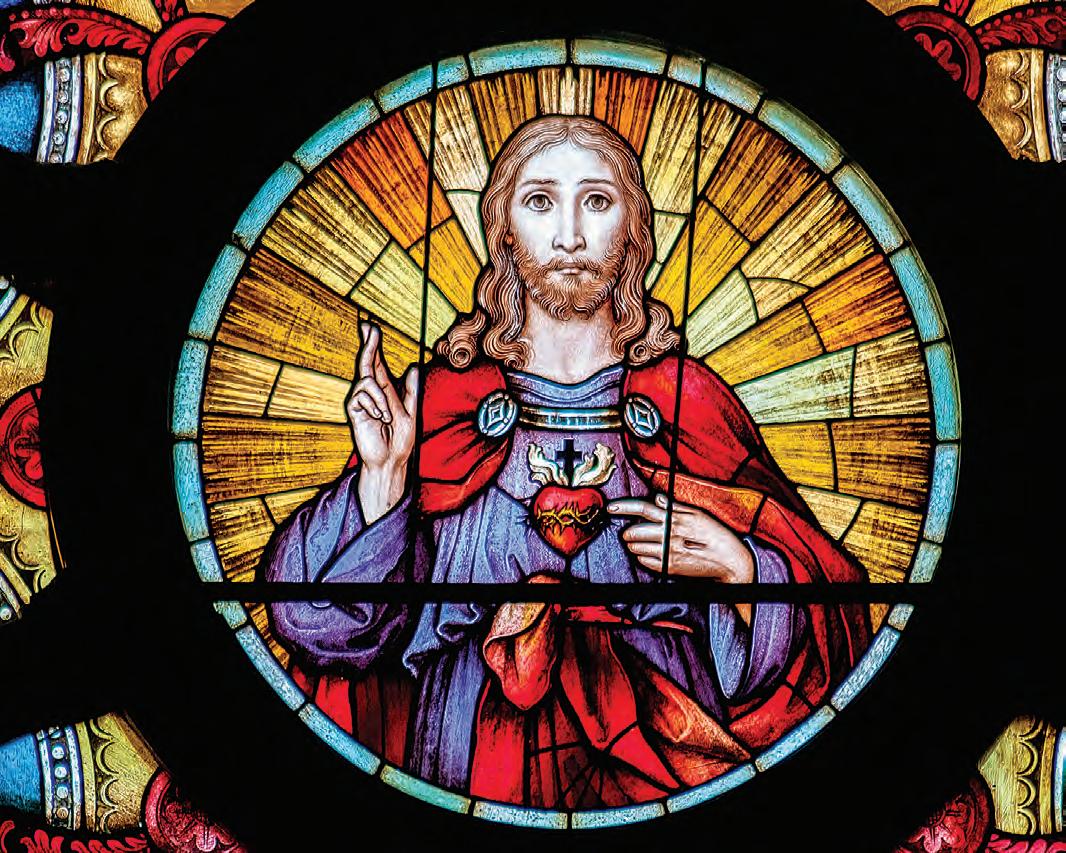
OnJune 11, the U.S. Conference of Catholic Bishops will formally consecrate the United States to the Sacred Heart of Jesus. Devotion to the Sacred Heart grew from 17th century revelations to St. Margaret Mary Alacoque in France, during which Jesus proclaimed His desire for the institution of a feast to honor His Heart. Pope Pius IX instituted the solemnity in 1865.
At its core, devotion to the Sacred Heart is all about God’s love for humanity. It is with this immense love that the Father gave His Son into our hands, that the Son delivered Himself up to death for us, and that the Father gives His Son and the Son gives Himself to us in the Blessed Sacrament on the altar. Devotion to the Sacred Heart is devotion to the love of God poured out for us in Jesus.
There are many practices Catholics use to carry out this devotion – among the most common are making a morning offering, participating often in Eucharist Adoration, making an act of consecration to the Sacred Heart and renewing it at least once a year, and making a First Friday Devotion. The latter entails going to Mass and receiving Holy Communion on the First Friday of every month for at least nine consecutive months and offering it for the reparation of sins committed against Jesus’ Sacred Heart and the Eucharist.
On June 11, the U.S. Conference of Catholic Bishops will formally dedicate the United States to the Sacred Heart of Jesus – the first national consecration of its kind. Church leaders describe the move as a meaningful way to commemorate the nation’s 250th anniversary and reflect on the unlikely rise of the world’s first large-scale self-governing republic in the modern era. The consecration comes at a moment of heightened political tension across the country, giving the ceremony added symbolic weight. Supporters say the act is intended as both a prayer for national healing and a reminder of the country’s spiritual foundations.
— Catholic News Herald, Catholic Encyclopedia, and OSV News
EVENTS
2026 NATIONAL EUCHARISTIC
PILGRIMAGE : The 2026 pilgrimage will make various stops through our diocese beginning Saturday, May 30, at Our Lady of Lourdes Church in Monroe and continuing May 31 at St. Vincent de Paul Church and St. Peter Church in Charlotte, and June 1 at churches in Statesville and Greensboro. Go to www. charlottediocese.org for details.
IGBO MASS : St. Mary’s Church in Greensboro will host an Igbo language Mass at 11:30 a.m. Sunday, May 31, at 812 Duke St., Greensboro. For more information, call 336-707-3625.
PROTECTING OUR DAUGHTERS Mary Summa, J.D., general counsel with the N.C. Values Coalition, will lead a talk on how parents can help protect their girls from
gender ideology and the abortion pill. The free event will be 7 p.m. Thursday, June 18, at St. Mark Church’s Kerin Center, 14740 Stumptown Road, Huntersville. Details: www.defendthefamily.org/protect.
45+ SINGLES FELLOWSHIP EVENT: Join St. Mark Parish’s 45+ Singles for fellowship and fun 5-8 p.m. Sunday, June 28, at Ed’s Tavern, 17044 Kenton Dr., Cornelius. Sign up at https://bit.ly/4nJa1kJ or email 45plussingles@gmail.com with questions.
PRAYER SERVICES
VIGIL OF THE TWO HEARTS: Vigil begins with 8 p.m. First Friday Mass on June 5, followed by Eucharistic Adoration and concludes with 8 a.m. First Saturday Mass June 6. St. Patrick Cathedral, 1621 Dilworth Road East, Charlotte. Details: www.defendthefamily.org/two-hearts.

Bishop Michael Martin, OFM Conv., will participate in the following events over the coming weeks:
MAY 30 – 9 A.M. Liturgy of Ordination to the Holy Priesthood St. Mark Church, Huntersville
MAY 31 – 9 A.M.
Mass for the 2026 National Eucharistic Pilgrimage St. Peter Church, Charlotte JUNE
Christ is present in the liturgy – in the word that is proclaimed, in the sacraments, in the ministers, in the community and most of all in the Eucharist, Pope Leo XIV said.
“Let us allow ourselves to be shaped from within by the rites, symbols, gestures and above all by the living presence of Christ in the liturgy,” he said during his general audience talk in St. Peter’s Square May 20.
Pope Leo continued his series of catechesis on the Second Vatican Council, but introduced the next conciliar document he wanted to focus on: the council’s constitution on the sacred liturgy, “Sacrosanctum Concilium.”
“This document teaches that the liturgy immerses us in the mystery of Christ’s passion, death, resurrection and glorification,” he said.
“Indeed, Christ is present in the word that is proclaimed, in the sacraments, in the ministers, in the community, and most of all in the Eucharist,” he said.
He said the “Council Fathers sought not only to undertake a reform of the rites, but to lead the Church to contemplate and deepen that living bond which constitutes and unites her: the mystery of Christ.”
“Indeed, the liturgy touches the very heart of this mystery: it is at once the space, the time and the context in which the Church receives her very life from Christ,” he said.
“The Christian mystery: the Paschal event, that is to say, the passion, death, resurrection and glorification of Christ, which is made sacramentally present to us precisely in the liturgy, so that every time we take part in the assembly gathered ‘in His name’ we are immersed in this mystery,” he said.
The liturgy helps sustain the faithful, encouraging and renewing them “in their commitment to faith and in their mission,” and it helps form “an open community, welcoming to all,” he said.
The liturgy must be translated into and lived throughout one’s daily life, “in an ethical and spiritual dynamic,” he said. It demands “a faithful existence, capable of making concrete what has been experienced in the celebration: it is in this way that our life becomes a ‘living sacrifice, holy and acceptable to God’, fulfilling our ‘spiritual worship.’”

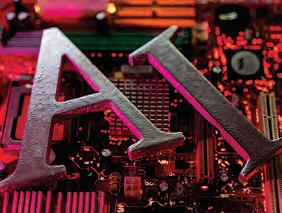
ICan intelligent extraterrestrial life exist? Here’s what Catholic thinkers say
Scripture readings
f rational, extraterrestrial beings exist, what would be God’s relationship to them?
A once purely speculative musing has taken on new meaning with the May 8 data disclosures from the U.S. Department of Defense on alleged encounters with “unidentified anomalous phenomena,” or UAPs.
UAPs – once known as “unidentified flying objects,” or UFOs have long been a source of public fascination. Catholic theologians and scientists have also been thinking about their implications for how humanity sees itself in relation to God
The general consensus is that the existence of extraterrestrial intelligent beings does not upend the Church’s theology of creation.
Christopher Baglow, director of the Science & Religion Initiative of the McGrath Institute for Church Life at the University of Notre Dame in Indiana, addressed this question in a 2021 lecture. His starting point was with humans and extraterrestrials sharing God as their creator, thus giving extraterrestrials “capacity for a special relationship with God in which they can know God and respond to Him with freedom and love.”
“God would love them, and want to share His life with them,” he said.
St. John Paul II expressed a similar idea when asked by a child if aliens were real.
“Always remember,” the late pontiff said, “they are children of God as we are.”
While the Catholic Church teaches nothing definitive on extraterrestrial life, Catholic intellectuals have considered the question. In the 15th century, German Cardinal Nicholas of Cusa, a philosopher and theologian, speculated that God’s creativity made intelligent life on other planets probable.
Jesuit astronomer Brother Guy Consolmagno asked a key question pointblank with the title of his 2014 book, “Would You Baptize an Extraterrestrial?” Co-
authored with Jesuit Father Paul Mueller, the book answers its title question in the affirmative – but only if the extraterrestrial asked for baptism, as the sacrament must be freely given and received.
Brother Consolmagno served as the director of the Vatican Observatory from 2015 to 2025. “Any entity – no matter how many tentacles it has – has a soul,” he told The Guardian in 2010.

for other intelligent species. Dominican Father Thomas F. O’Meara, a retired theology professor at the University of Notre Dame, said Jesus’ incarnation was a “unique” event.
Christian apologist C.S. Lewis explored that question in a 1930s space trilogy. He argued that rational beings on other planets may continue to live in an unfallen relationship with God and therefore not require the Redemption.
“A lot of people think that the recognition that there are non-human intelligences would change religion, eradicate religion or fundamentally discredit it, but I don’t think so at all,” said Diana Walsh Pasulka, professor of religious studies at the University of North Carolina at Wilmington. “Within the major religions, there’s wisdom there with respect to how to deal with nonhuman intelligence.”
A Catholic, Pasulka sees a connection between contemporary reports of UAPs and medieval descriptions of phenomena in the sky, and her work has led to correspondence with aerospace engineers and members of the U.S. Space Force. In a March interview Pasulka said, “In the United States government right now, there are many people who believe in UFOs, in UAPs.”
“There is, incidentally, a high percentage of devout Catholics in the military who study this,” she added. “They believe there are probably a variety of phenomena. Some they would categorize as being caused by angels and demons.”
Current observatory director Jesuit Father Richard D’Souza agreed.
“They would be children of God,” D’Souza said of extraterrestrial beings in 2025. “I believe in a benevolent Creator. He is behind everything.”
Among the questions theologians –including the famed, 20th-century Jesuit theologian Father Karl Rahner – have considered is whether the Incarnation would have been repeated on other planets
are the light of the world. A city set on a mountain cannot be hidden. Nor do they light a lamp and then put it under a bushel basket; it is set on a lampstand, where it gives light to all in the house.”
— Matthew 5:14, part of the daily readings for June 9
In March, Vice President JD Vance, a Catholic, drew attention to the theory of aliens as fallen angels, saying in a podcast that he thought aliens are demons, and that spiritual warfare is the easiest explanation for “extra-natural phenomenon.”
On May 5, Will Rahn of The Free Press published a podcast episode titled “These Two Catholics See Signs of God in UFOs” featuring Pasulka and New York Times opinion writer Ross Douthat.
“Most Catholics are pretty comfortable with a set of categories that are real but invisible,” Douthat said.
Snap the QR code (right) to get the Mass readings for every day, in English or Spanish, online at the U.S. Conference of Catholic Bishops’ website.

For the latest news 24/7: catholicnewsherald.com
Wedding anniversary Mass scheduled for Oct. 11
CHARLOTTE — The Diocese of Charlotte’s annual Anniversary Mass for couples celebrating 25 and 50 years of marriage will be offered at 2 p.m. Sunday, Oct. 11, at St. Patrick Cathedral. Bishop Michael Martin, OFM Conv., will be the celebrant.
A reception will be held after the Mass, sponsored by the diocese’s Family Life Office. Couples who are celebrating their 25th and 50th wedding anniversaries in 2026 will receive a special certificate commemorating their anniversary. Limit of two guests per couple. To register and receive a certificate, please sign up at www.charlottediocese.org/event/weddinganniversary-mass.
— Catholic News Herald
BELMONT — During its third annual Celebration of the Arts dinner and reception May 1, Belmont Abbey College awarded Simon Donoghue a Lifetime Achievement Award for his decades of dedication and service to the college and the performing arts community.
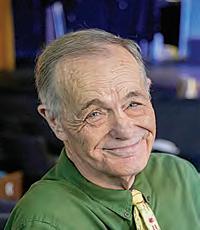
Donoghue served for 48 years as director of the Abbey Players, one of the longest-running theater troupes in the state. Besides being a playwright, actor and director, Donoghue is a teacher and mentor. Throughout his 50-year tenure, Donoghue built a campus community and developed collaborative relationships with local performing arts groups. Under his leadership, the Abbey Players brought in local professionals, expanding the network of community theater in the Carolinas. He also played a vital role in the renovation of the Haid Theatre in 1987 and the establishment of the performing arts as a recognized academic department, with majors, minors, and a premier scholarship named for Father John Oetgen.
— Belmont Abbey College Summer 2026 CRS Rice Bowl Mini-Grant round now open
CHARLOTTE — Catholic Charities Diocese of Charlotte is accepting applications for the Summer 2026 Catholic Relief Services Rice Bowl Mini-Grant Program. Entities working to address hunger and poverty in the diocese may apply for $1,000 grants by Friday, July 17. Guidelines, eligibility details and the application form are available at www.ccdoc. org/cchd-crs. Completed applications should be emailed to jtpurello@ccdoc.org.
The Rice Bowl Mini-Grant Program is funded through the annual Lenten CRS Rice Bowl collection. For every $3 collected in the annual Rice Bowl Lenten Program that support CRS overseas projects, $1 stays in the Charlotte diocese. Depending on available funds, one or two grant rounds are held each year.
PATRICIA L. GUILFOYLE plguilfoyle@rcdoc.org
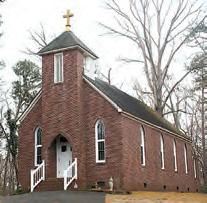
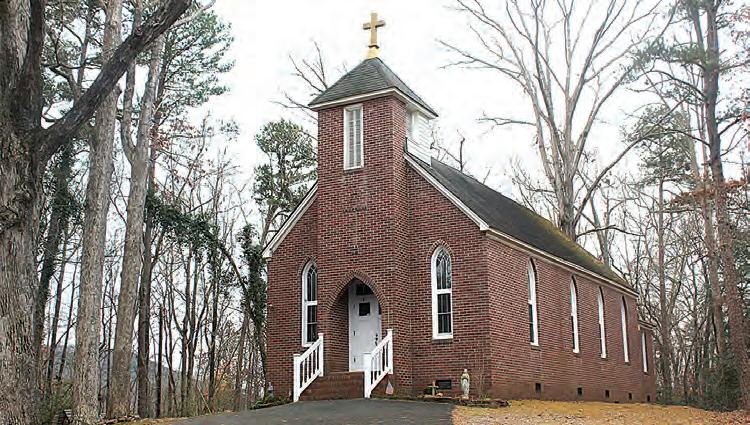
CHARLOTTE — Effective July 1, Queen of the Apostles Parish will assume pastoral care of St. Helen Mission, bringing the neighboring congregations together again under the same parish leadership.
The Diocese of Charlotte announced the transfer May 22, moving St. Helen from under the care of Our Lady of Consolation Parish in Charlotte, which has overseen the mission since 2000.
Located in Spencer Mountain, St. Helen sits within Queen of the Apostles’ parish boundaries and is located about eight miles away from the Belmont church. The mission was previously under Queen of the Apostles’ pastoral care in the 1960s and again in the 1990s.
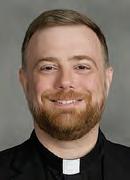
Father Paul Buchanan, Queen of the Apostles’ pastor, will now serve St. Helen’s congregation of more than 50 families.
“I am looking forward to getting to know the community of St. Helen anew as I begin to serve as pastor,” Father Buchanan said. “I fondly remember visiting St. Helen in the early 2000s with the Capuchin friars, and I recall celebrating Mass at St. Helen on the second Sunday after my priestly ordination in 2014. It will be a joy to pick up the thread of that history as we journey together.”
St. Helen and Queen of the Apostles
share deep historical roots. Both were founded by the Benedictine monks of nearby Belmont Abbey.
The Benedictines established St. Helen in the mid-1910s to serve local Black Catholics. The red brick church was designed by Benedictine Father Michael McInerney and built on land donated by Robert Gardin, a local convert to Catholicism whose descendants still worship there today.
That area of Gaston County is booming, and Father Marcel Amadi, parochial
administrator of Our Lady of Consolation Parish, said the transfer will help better serve St. Helen’s congregation, thanks to its proximity. It also will enable him to focus on Our Lady of Consolation Parish and its major church renovation campaign.
“Our Lady of Consolation will continue to share a special bond with St. Helen, one that has greatly enriched both churches,” Father Amadi said. “Please keep our communities in your prayers as we enter this new chapter.”
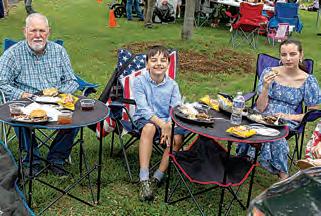
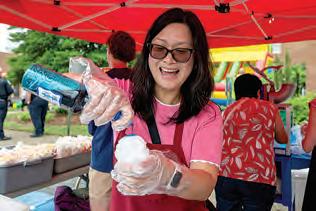
BELMONT — Queen of the Apostles Church celebrated Pentecost in style with their annual parish celebration. After the 10:30 a.m. Mass on May 24, the parish gathered for a BBQ picnic on the front lawn with games and entertainment for children and adults of all ages.
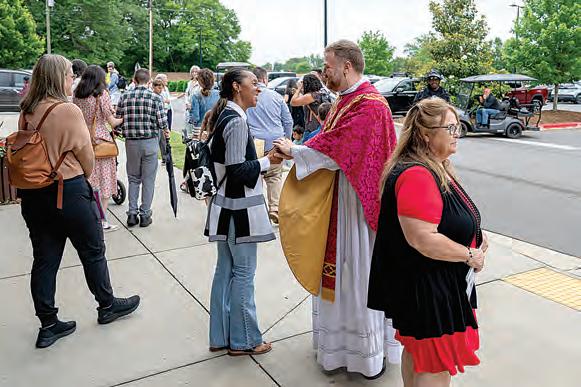
In his homily for Pentecost at St. Patrick Cathedral in Charlotte, Bishop Martin invited people to be “all in” – allowing the Holy Spirit to break down walls and empower us to build God’s Kingdom with the gifts we’ve been given. Through the Holy Spirit, we are called to bring God’s mercy, healing and forgiveness to a wounded world, he said. Watch his full homily on the Diocese of Charlotte’s YouTube channel: www.youtube.com/ DioceseOfCharlotte.
— Catholic News Herald
‘MUFFINS
LISA M. GERACI lmgeraci@rcdoc.org
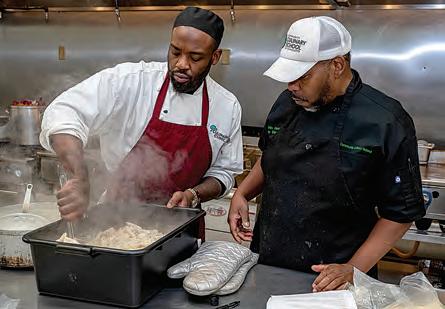
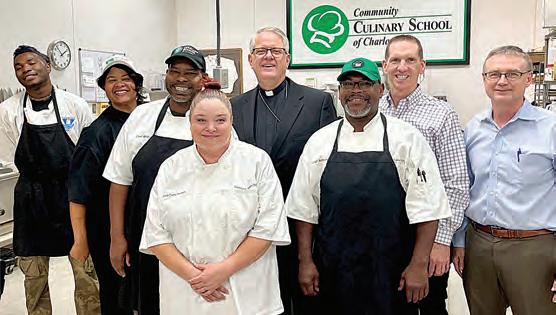
CHARLOTTE — When Bishop Michael Martin arrived in Charlotte, one of the first orders of business was to choose a caterer to help him host small gatherings for visiting dignitaries, priests and seminarians, employees and parishioners. His executive assistant presented him with a variety of options – from big-name local chefs to corporate caterers to mom-and-pop shops. The bishop was immediately drawn to the Community Culinary School of Charlotte, a nonprofit chef training and job placement program for people facing barriers to employment: criminal records, substance abuse issues, homelessness and poverty.
“I tried them out my first week in town and loved their food and the professionalism of their approach,” Bishop Martin said. “And you can’t argue with their mission to give people a second chance through a culinary career.”
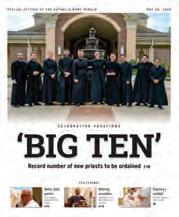
The culinary school has now cooked for the bishop 14 times –twice just this month – serving up their specialty “airline” chicken with an appetizer of Maryland crab cakes for a dinner with incoming deacons, and four days
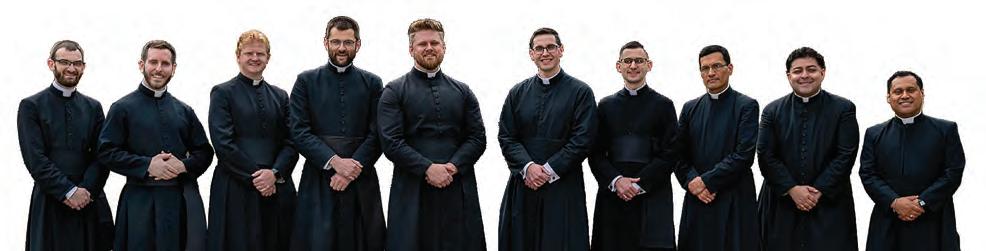
later offering grilled lemon-butter salmon and risotto for the diocese’s record class of 10 men on the eve of their ordination to the priesthood.
“At first I was intimidated, but Bishop Martin is the most downto-earth guy you’ll ever meet,” said Culinary Director Chef Alvin Howard, laughing. “We are both from Baltimore, and Oriole fans. At first, I tried making all these fancy dishes, but all he really wanted was some chicken and mashed potatoes.”
GIVING THEM TOOLS
Ron Ahlert, a fine-dining chef in Paris and New York City, joined the Community Culinary School in Charlotte more than 30 years ago because he wanted to give back by imparting his expertise to those on the margins – a familiar theme of Bishop Martin’s.
It’s a relationship that brings pride – and exposure to Catholicism – to his students, who help prepare and serve meals for the bishop. It’s more than mere coincidence, it’s God’s providence, said Ahlert, who grew up Catholic and, through this engagement, has begun to re-examine his faith and attend Mass.
During his tenure, Ahlert and his team have guided more than 1,200 chefs through the school’s tuitionfree, 14-week training program, paid
for through grants and donations.
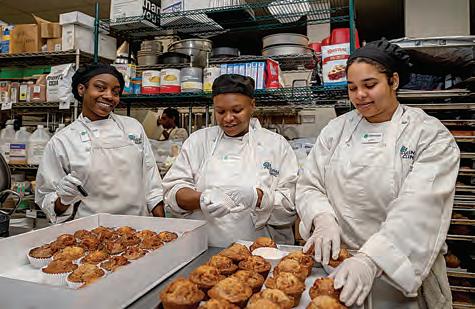
To get in, there’s a “knife test,” which evaluates applicants’ acumen in the kitchen. Only about half the 50 or so applicants for each class are accepted, and from there, most everything is free, a cost of roughly $10,000 per student.
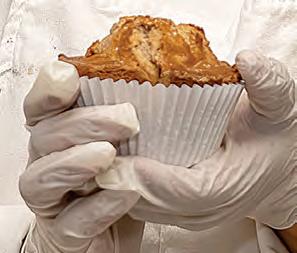
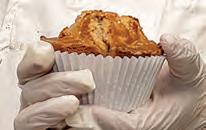
“Instead of math and English, we teach muffins and sauce …” Ahlert said. “We give them every tool to be successful – the uniforms, free meals, bus passes, wrap-around services, the whole deal. Not everybody makes it.”
“Some folks come to us assimilating after incarceration, some with recovery issues, or some stuck because minimum wage in North Carolina is $7.25,” he said. Culinary students earn twice that. Those who do graduate generally
populate local restaurants, catering companies and bakeries. Others open eateries or food trucks.
Chef Alvin manages the relationship with Bishop Martin and often brings along graduates of the program. They prep the meals at the school’s kitchen off Monroe Road and finish the dining experience in full view of the bishop and guests at his home – which one night included all the bishops of the Atlanta Province.
The bishop’s kitchen is now a familiar and comfortable space for Chef Alvin, where he chats with his new buddy and shares secret hometown recipes – such as the Smith Island cake he served at the recent deacon dinner, the official state dessert of Maryland.
Smith Island is a remote fishing community in the Chesapeake Bay. The cake features eight to twelve ultra-thin layers of yellow cake stacked with rich chocolate fudge icing between layers and slathered over the outside.
Chef Kam Allen assisted Chef Alvin with the bishop’s recent dinners. A graduate of the program, she’s come a long way from difficult times, and now works for the culinary school as a pastry chef.
Allen grew up inspired to follow in her grandmother’s footsteps as a baker but says poor life choices
CHARLOTTE — Diocese of Charlotte photographer Troy Hull received national honors from the Associated Church Press during the organization’s convention May 15 in Toronto.
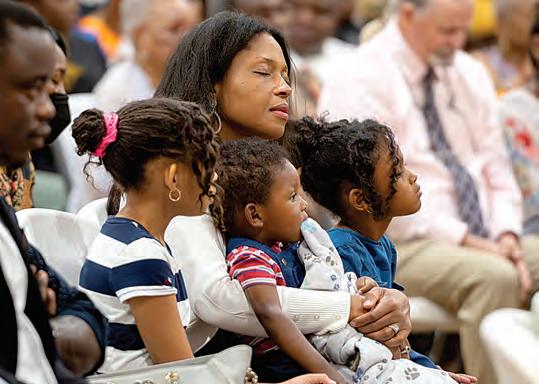
Hull earned an Award of Merit (second place) in the Visual Communications: Photo Spread or Essay in Print category for his Black Catholic History Month photo essay in the Nov. 7, 2025, edition of the Catholic News Herald that highlighted moments of faith, family and community. The centerpiece image was photographed during Mass at Our Lady of Consolation Church in Charlotte.
He also received an Award of Excellence (first place) in the Single Photo with Article category for an image he captured during summer Totus Tuus camps. The honors recognize Hull’s work documenting the life of the Church and capturing images that reflect the faith and diversity of the Catholic community in western North Carolina.
held her back, landing her in jail more than once.
“When I first started the program, I was on the verge of being homeless,” said Allen, who is now preparing to move into her own apartment. Working with the bishop, she said, has been “very eye-opening.”
“I learned a lot. They treated me with open arms right when I walked in. It was really cool, and it seems like they liked the food because they ate pretty much everything.”
Allen’s success, like that of so many other students, is gratifying, said Ahlert: “When you see the fruit from the seeds you plant, you want to plant more.”
It’s also gratifying, he says, to see the bishop drop by the school’s dine-in café at 9315 Monroe Road for lunch, planting seeds of his own.
“A bishop walking in here – that is a big deal,” Ahlert said. “It’s funny. It’s like I’m coming full circle spiritually. That is a sign to keep going in the direction of Catholicism, where I’ve been headed.”
Want to donate?

At www.communityculinary.org: Learn more about the program and how to help

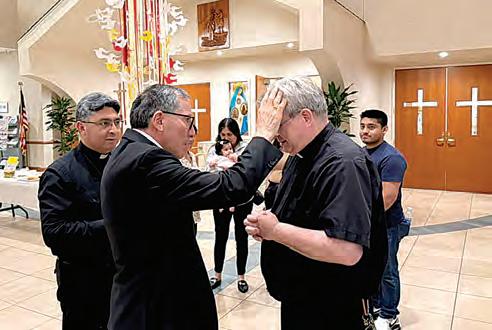
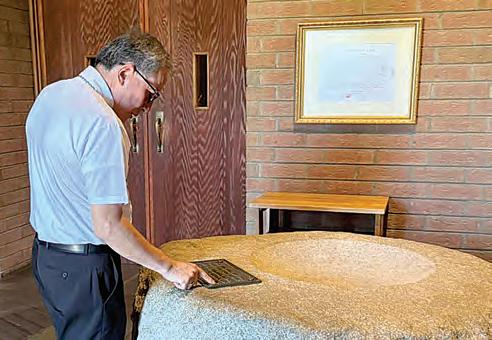
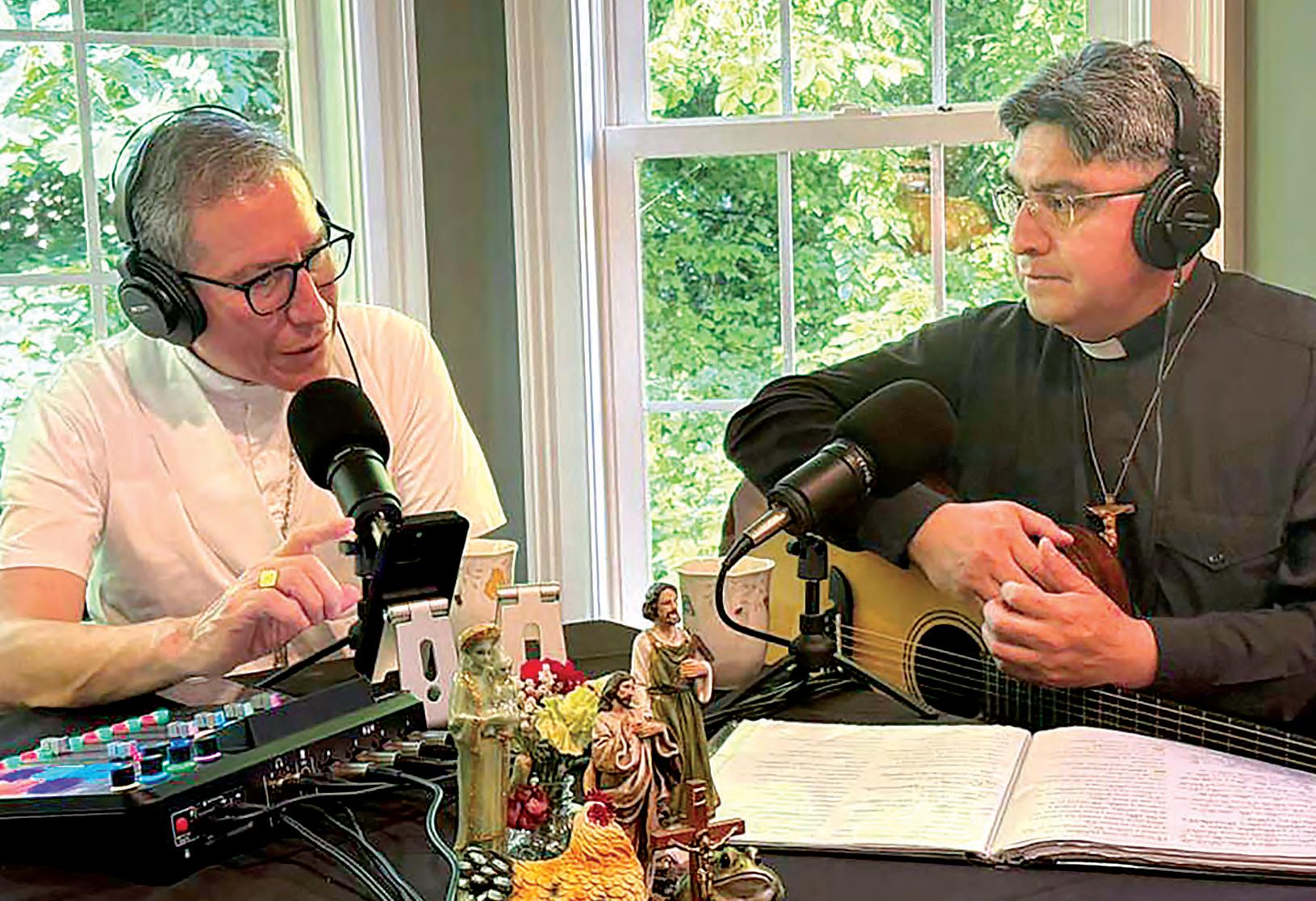
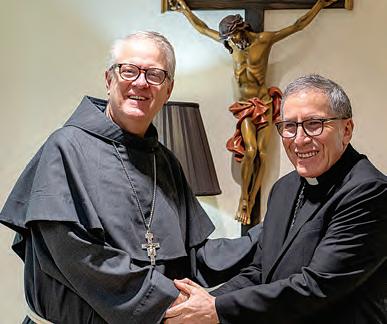
MOORESVILLE — Bishop Pedro Alberto Bustamante López of the Diocese of Huánuco, Peru, visited the Diocese of Charlotte from May 5-22. His trip primarily focused on strengthening connections between the two dioceses and promoting a missionary appeal for a new AM radio initiative in Peru.
During his visit, Bishop Pedro spent most of his time with
BRIAN SEGOVIA bmsegovia@rcdoc.org
fellow Huánuco priest Father Huver Navarro at St. Therese in Mooresville, where he celebrated Mass and participated in a variety of community events.
Bishop Bustamante met with Bishop Michael Martin to discuss ways to continue the strong relationship between their two dioceses. He also visited Our Lady of Guadalupe Church in Charlotte, where he met with Vincentian Father
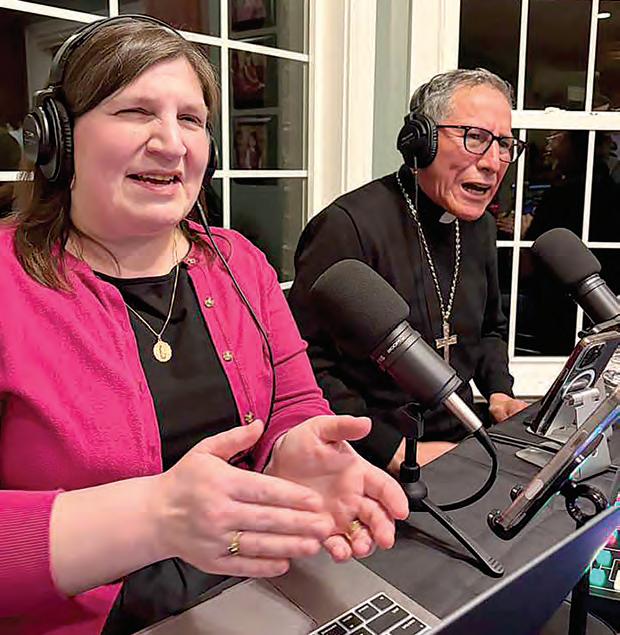
Marvin Navas, pastor, and also visited nearby Belmont Abbey College. On May 20, he presided over confirmations at Our Lady of Guadalupe and St. Therese, where he had the opportunity to interact with many parishioners. He also hosted his DH Radio program, “Jesucristo al encuentro de los hermanos del campo,” live from Mooresville each morning. Read more at www.catholicnewsherald.com
first profession of vows in 1950.
CHRISTINA LEE KNAUSS clknauss@rcdoc.org
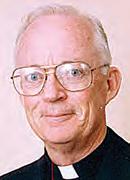
HIGH POINT — Father James Kenneth Solari, 95, who had been the oldest priest in the Diocese of Charlotte, passed away Friday, May 15, 2026, at Pennybyrn in High Point.
The Mass of Christian Burial was celebrated Tuesday, May 26, 2026, at Belmont Abbey followed by interment in the abbey cemetery.
He was born in Richmond, Va., on July 31, 1930, the oldest child of James Kenneth Solari and Frances Meagher Solari, and was the brother of Benedictine Abbot Placid Solari of Belmont Abbey. His parents were devout Catholics who raised their six children to know and love the faith.
After attending Benedictine High School, a military school in Richmond founded by the Benedictine monks, the young James Solari entered Belmont Abbey College. It was there during his freshman year that he first felt called to the priesthood. It was the example of daily Mass with the Benedictine monks that attracted his attention.
He entered the Benedictine community as a novice, an intensive period of discernment to monastic life, and made his
Because Belmont Abbey College was a junior college at the time, he transferred to St. Benedict’s College in Atchison, Kansas, to complete his undergraduate degree in philosophy. He then returned to Belmont Abbey, professed his final vows as a Benedictine monk and studied in the seminary there for a year.
Then, Benedictine Abbot Vincent Taylor sent him to Rome to earn a licentiate in sacred theology from the Benedictine-run Pontifical Athenaeum of Saint Anselm, also known as the Anselmianum or Sant’Anselmo. He was ordained to the priesthood in 1955 at a Benedictine Abbey in Assisi.
After graduating from Sant’Anselmo, the young priest went to the Pontifical Biblical Institute in Rome, run by the Jesuits, to learn about Sacred Scripture for a second licentiate, from 1957 to 1959.
In 1959, Father Solari returned to Belmont Abbey, where he became part of the theology faculty and later taught in the seminary that was once there. On weekends, he celebrated Sunday Masses at various parishes in Charlotte and
elsewhere and offered advice to students considering religious life.
In 1968, Father Solari went to The Catholic University of America in Washington, D.C., to earn a doctorate in theology. Two years later, he returned to Belmont Abbey College and served as its academic dean until 1978.
During that time, he also pursued a lifelong love of aviation, took lessons at the Gastonia airport and earned his pilot’s license. He flew frequently over the next 10 years and often to destinations where he could offer Mass. North Myrtle Beach in South Carolina was one such destination – he would fly there on the weekends to offer Mass at a local parish before flying back to Gastonia.
In 1978, his ministry took a new turn and he became a parish priest, serving the new parish of Holy Family in Clemmons, followed by St. Michael the Archangel Parish and School in Gastonia.
He saw firsthand the great need for priests in the growing Diocese of Charlotte, so in 1983 he petitioned Rome for a dispensation from his monastic vows to serve as a diocesan priest.
Father Solari was incardinated into the Charlotte diocese in 1983. His first assignment as a diocesan priest was as pastor at St. Eugene Parish in Asheville, and
he then moved to St. Leo the Great Parish in Winston-Salem.
After his retirement from active ministry in 2000, he served as interim pastor at St. Pius X Parish in Greensboro, St. Philip the Apostle Parish in Statesville, and St. Michael in Gastonia. His final assignment, beginning in 2008, was as chaplain at Pennybyrn in High Point, where he was also a resident. In 2005, he established the Solari Family Endowment Fund in the Foundation of the Diocese of Charlotte to benefit MiraVia and Catherine’s House, both in Belmont. He is survived by his sisters, Helen Preston (Robert) and Katherine Swindell; two brothers, William Solari (Sylvia) and Benedictine Abbot Placid Solari; his sister-in-law, Catherine Dart Solari; and numerous nieces and nephews, grandnieces and grandnephews.
He was preceded in death by his parents and his brother, Richard Solari.
In lieu of flowers, donations may be made to the Solari Family Foundation with the Diocese of Charlotte, 1123 S. Church St., Charlotte, N.C. 28203, www. charlottediocese.org; or to The Frances and Kenneth Solari Scholarship Fund at Belmont Abbey College, 100 Belmont-Mt. Holly Road, Belmont, N.C. 28012, www. belmontabbeycollege.edu.
McLean Funeral Directors of Belmont was in charge of arrangements.
BRIAN SEGOVIA bmsegovia@rcdoc.org
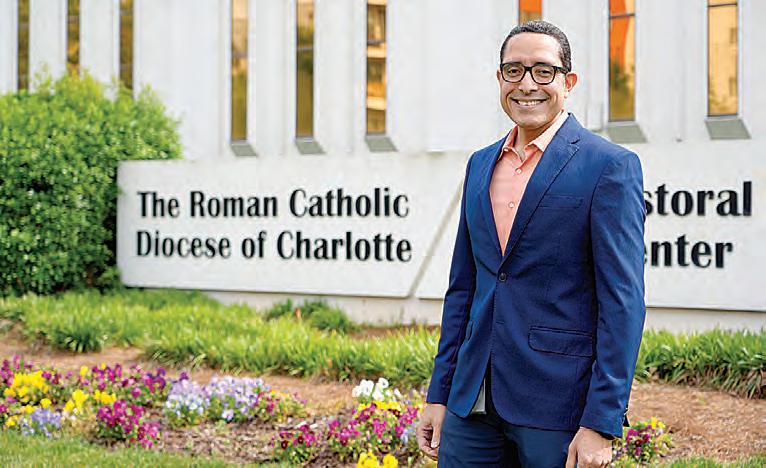
CHARLOTTE — Newly appointed as director of the Hispanic Ministry Office for the Diocese of Charlotte, Steven Samol is bringing to the role a lifelong journey of faith and service shaped by years of ministry within the Hispanic Catholic community. Named to the position in April, Samol became the first layperson to lead the office, which was previously been headed by priests or religious. He will coordinate diocesan Hispanic ministry efforts, working alongside pastors and parish leaders to support pastoral needs, foster fuller participation in parish life, and help implement the National Pastoral Plan for Hispanic Ministry.
The son of immigrants and shaped through experiences of pain, conversion and mission, Samol speaks with the Catholic News Herald about how a personal encounter with God transformed his story and led him to serve the Church with passion, especially by accompanying the Hispanic community in the United States:
CNH: Could you tell us a little about your personal story and what has shaped you up to this point in your life?
Samol: I am the son of immigrants, and for many years I carried a deep feeling that I didn’t belong, that I was neither from here nor from there. To make that experience even harder, my parents divorced, and I also did not know whether I belonged to one family or the other. I hated being asked, “Where are you from?” because it made me aware of my doubts and the shame of feeling out of place.
But God had a plan. I had a very powerful personal encounter with Him. At age 14, during a retreat that my mother practically forced me to attend, on the third day, during a prayer for the outpouring of the Holy Spirit, the Lord gave me a deep and undeniable peace. In that moment, something changed and gave me a new certainty: I belong to God. I am His son. And I have a home in His Church. Since then, my path
has been to respond to that love, allowing Him to form me and following Him wherever He has called me, in different countries and situations, always as a missionary disciple.
CNH: How did your faith journey begin and how has it evolved over the years?
Samol: My faith journey began when I was little, living with my grandmother, who taught me to pray and read the Bible. However, my true conversion happened at age 14 during that retreat. Since then, I have continued growing in my relationship with the Lord, discovering more and more my identity as a beloved son of God.
My faith has matured into the desire to follow Christ, imitate Him and allow Him to transform me so that I may belong completely to Him.
Today I can say with conviction: God is my Father.
CNH: When did you begin to feel that God was calling you to ministry or service in the Church?
Samol: Very early in my conversion I began serving. I remember that at only 15 years old, I was invited to give a talk at an adult retreat. I loved the experience of serving.
The encounter with God not only transformed my life but also awakened in me the desire that others might experience it, too. Over time I understood that my calling was to be a missionary disciple: not only to believe, but to share – with my life and my words – what God has done in me. Throughout the years, that calling has taken shape in different opportunities for service, always with the certainty that it is the Lord who guides the way.
CNH: How do you see the path that led you to this new role in the Diocese of Charlotte?
Samol: Looking back, I clearly see God’s faithfulness in every stage of my life. He has guided our journey – my wife’s and mine – through
different countries, always calling us to serve. In recent years I strongly felt God’s love for Hispanics in the United States, but I never imagined that would become this mission. Today I see my arrival in the Diocese of Charlotte as part of God’s plan: an invitation from the Father to continue serving with passion and openness.
CNH: How do you understand this new role in the Diocese of Charlotte, and how would you like to lead Hispanic ministry at this stage?
Samol: I understand this role as a call from God to serve, helping more people experience that the Church is their home, the family of God. The vision of Bishop Michael Martin deeply resonates in my heart – a pastoral ministry that proclaims the Gospel while also demonstrating God’s love by making it visible in people’s lives. My desire is to accompany, listen and create spaces where Hispanics can encounter Christ and discover that they are not foreigners or strangers, but members of God’s family: a pastoral ministry where the Gospel is proclaimed with words and demonstrated with concrete love.
CNH: What part of your faith experience would you like people to know?
Samol: I would like people to understand that my life is marked by a very concrete experience: going from feeling like someone who did not belong to discovering that I am the Father’s son and part of His family.
God has also given me the gift of marriage. The best thing that has happened to me in my life is marrying my wife, Saylí. She and I have experienced moments of joy, but also moments of the cross – including the loss of two unborn children, who are now in heaven – and even so we have experienced that God is faithful and never stops sustaining us.
If anything defines my journey, it is that certainty born at that retreat: God is my Father, His family is where I belong. And together with my wife, I have found my home.
And from there, I want to invite others: If you have ever felt out of place or like you don’t belong, I want you to know this: in God the Father, there is a home for you. The Church is the house of God, and it can also be your home.
LISA M. GERACI lmgeraci@rcdoc.org
CHARLOTTE — Catholics across western North Carolina are invited to join a nationwide celebration of faith and history as the 2026 National Eucharistic Pilgrimage visits the Diocese of Charlotte on Saturday to Tuesday, May 30-June 2.
Themed “One Nation Under God,” the National Eucharistic Pilgrimage will stop at five churches in the diocese as it journeys 1,500 miles up the East Coast to Philadelphia for the Fourth of July and America’s 250th anniversary.
This year’s route is named after St. Frances Xavier Cabrini, the first American saint. The pilgrimage began on Pentecost in St. Augustine, Florida, and will end near Independence Hall, where the Declaration of Independence was signed.
for a Holy Hour and Mass. Churches in Charlotte, Statesville and Greensboro will also host the pilgrimage with Holy Hours and Masses. All are welcome.
For pilgrims Mary Carmen Zakrajsek and Raymond Martinez, the journey is both spiritual and personal.
“I am excited to meet all these Catholic communities,” Martinez said. “We want the entire nation to experience Our Lord through the Eucharist. We will carry your prayer intentions and place them at the foot of the monstrance in prayer.
“The Catholic Church has been a major part of our country’s history, and this pilgrimage gives us an opportunity to link to the greater Church, going forth in discipleship as we are called,” said Deacon Jim Bozik of St. Peter Parish in Charlotte, who is co-organizing diocesan festivities.
The “monstrance-mobile” – featuring a window allowing people to view the Blessed Sacrament – and nine young adult “perpetual pilgrims” will stop first at Our Lady of Lourdes Church in Monroe after crossing into the diocese from South Carolina. There, people can meet the pilgrims and join them
Eventually we will leave them at the altar with Christ after our last procession.”
On Sunday, May 31, Bishop Michael Martin will celebrate Mass at St. Peter Church in Charlotte, the oldest active parish in the diocese, followed by a meetand-greet with the pilgrims.
Sunday evening, people can enjoy a free theater screening of “Cabrini,” the film about the saint’s advocacy for immigrants and the Church’s role in American history. St. Matthew, the diocese’s largest parish, will co-sponsor the exclusive screening. Advance ticket reservations are required.
Like Mother Cabrini, diocesan co-organizer Deacon Herb Quintanilla is an immigrant, and he sees the pilgrimage as a celebration of both faith and opportunity.
“Everyone comes to America to have a better life, a safer life. This is one of the greatest countries in the world because if you work hard and study, you can make it,”
Don’t miss this historic event!
The National Eucharistic Pilgrimage will stop in the Diocese of Charlotte at:
1. SATURDAY, MAY 30 – Our Lady of Lourdes Church in Monroe: Eucharistic Adoration from 3:30 to 4:30 p.m., followed by 5 p.m. Mass
2. SUNDAY, MAY 31 – St. Peter Church in Charlotte: Mass with Bishop Michael Martin at 9 a.m., followed by a meet-and-greet with the pilgrims
3. SUNDAY, MAY 31 – St. Vincent de Paul Church in Charlotte: 2 p.m. Spanish Mass, followed by Eucharistic Adoration and procession
4. MONDAY, JUNE 1 – St. Philip the Apostle Church in Statesville: 9 a.m. Mass, followed by Eucharistic Adoration
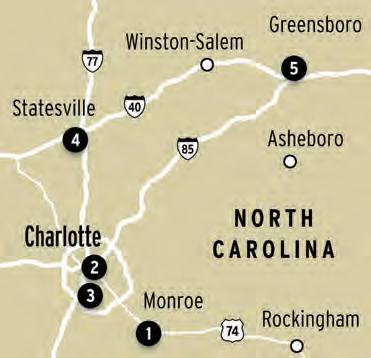
5. MONDAY-TUESDAY, JUNE 1-2 – St. Pius X Church in Greensboro: 4-5 p.m. Eucharistic Adoration and procession from 3:45-4:15 p.m., followed by 5:15 p.m. Mass; and 8:30 a.m. Mass on Tuesday, June 2. (Consider bringing a non-perishable item for the Greensboro Urban Ministry Food Pantry.)
Note: Parishes may add other events – please see each parish’s website or bulletin for details.
said Deacon Quintanilla, who moved from El Salvador. “This is an immigrant country, and that is why we have so many Catholics – the Irish, the Italians, the Polish, and the Latin Americans. This country has grown up Catholic.”
Zakrajsek said the pilgrimage also reflects the spiritual journey of the nation itself.
“Just like us as pilgrims walking this route, our country is also on pilgrimage. We are going to follow Him through the streets. We are going to bring Him to the poor. We are going to fall on our knees before Him in
worship. This is an opportunity to live out the Gospel, to be united as a country, and to ask Him to bless us and to heal us, one soul at a time.”
More online
At www.charlottediocese.org/nationaleucharistic-pilgrimage : Get details about the National Eucharistic Pilgrimage as it passes through the Diocese of Charlotte, including Mass and Holy Hour times, locations, movie screening reservations, and more.
MURPHY — Father George Martin Kloster Jr. has been called “a priest for the people” by those who knew and worked with him – as well as an intellectual, world traveler, and man who served God and his parishioners, using whatever resources he had to make the lives of others better.
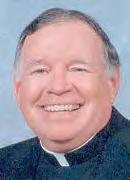
So when Father Kloster saw an opportunity to provide long-term support for the two churches he led for 15 years prior to his retirement in 2013, he took full advantage of it. Using the proceeds from the sale of his home in his estate, he created two Father George Kloster Endowment funds. One funds the general needs of St. William Parish in Murphy and one funds the general needs of its mission, Immaculate Heart of Mary in Hayesville.
“Father Kloster was completely committed not just to the churches and the two communities in the counties they serve, but to the whole community,” said Bob McGinnis, a 30-year parishioner in Hayesville. “He was a man who opened his arms to everyone and served on so many important community organizations that had an impact in both communities.”
George Martin Kloster Jr. was born on Oct. 28, 1943, in Utica, New York, and moved to Clayton at the age of 10, where his father was the manager of a textile
Interested in setting up – or adding to – an endowment to benefit your parish or Catholic school? You can establish an endowment in the Diocese of Charlotte Foundation by leaving a bequest in a will, a beneficiary designation from a retirement plan, a trust or annuity, or a gift of real estate, life insurance, cash or securities. For details, contact Gina Rhodes at 704370-3364 or gmrhodes@rcdoc.org.
mill. He studied theology at the Pontifical North American College and was ordained on Dec. 20, 1968.
His generous spirit extended beyond his local parish. He served on the North Carolina Council of Churches in many capacities, including as president from 1986 to 1988, and received its Distinguished Service Award in 1991.
In 2013, he was named Catholic Charities USA Volunteer of the Year, and a portion of U.S. 64 in western North Carolina was named in his honor – the “Rev. George Kloster Highway” – recognizing his commitment to church, civic and community affairs in Clay and Cherokee counties. He loved to travel and led several pilgrimages. Don Stillwagon, who was on
‘SENT FORTH IN FAITH’
CHRISTINA LEE KNAUSS clknauss@rcdoc.org
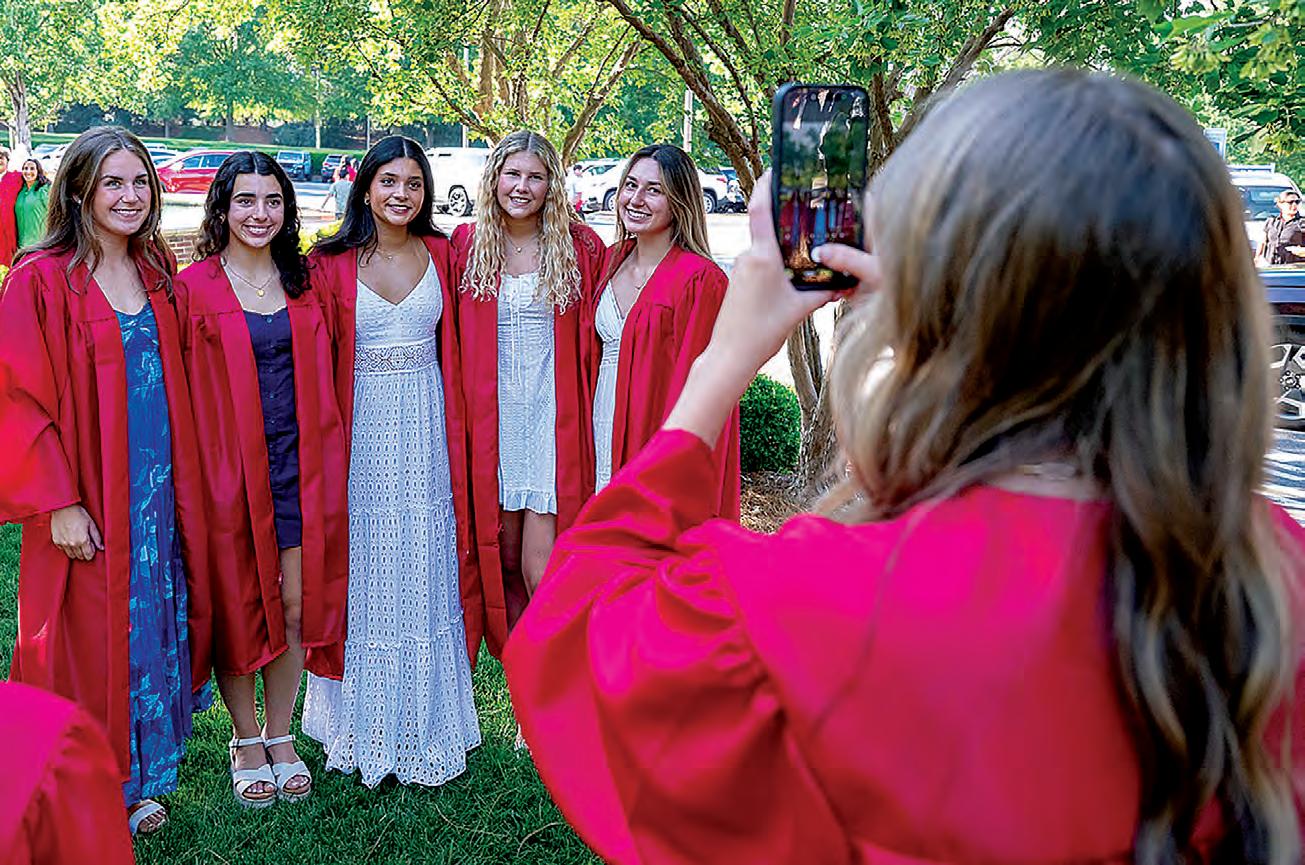
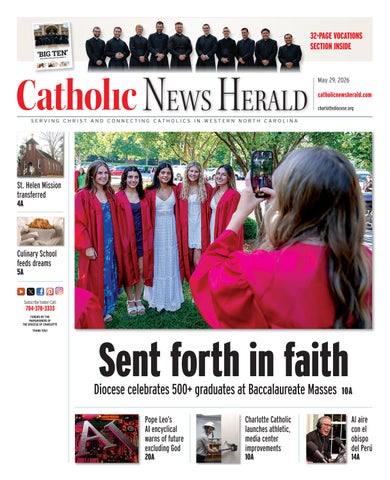
CHARLOTTE — Across the diocese, more than 500 graduating seniors are gathering this month with family and friends for Baccalaureate Masses, giving thanks to God before taking the next step into their futures.
The largest of the diocese’s high schools, Charlotte Catholic High School, celebrated the 324 members of its class of 2026 May 19 at St. Matthew Church with a Baccalaureate Mass offered by Bishop Michael Martin.
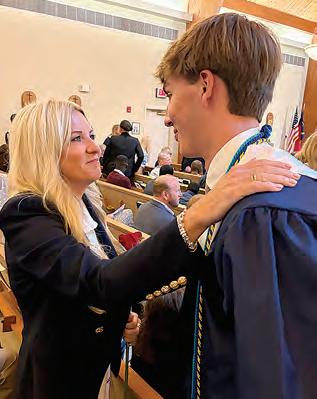
Baccalaureate Masses were also held for Bishop McGuinness High School grads on May 22 at Holy Cross Church in Kernersville, and for Christ the King High School grads on May 26 at St. Mark Church in Huntersville. Baccalaureate Masses are faith-filled celebrations typically held a day or so before graduation.
At Charlotte Catholic, Bishop Martin reminded the congregation of the night’s message of both expectation and gratitude.
“This is a night of great joy in the way God has been at work in
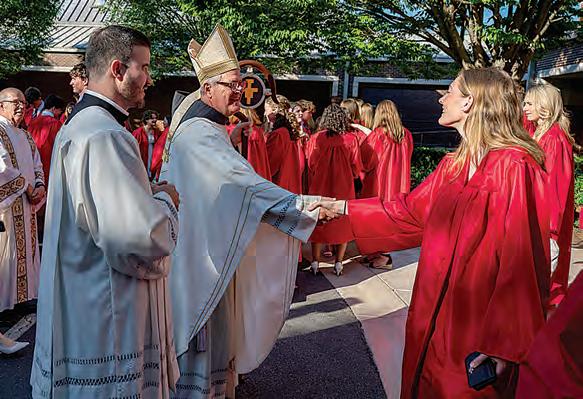
these graduates,” he said, after the seniors processed into the church clad in their red graduation gowns.
In his homily, Bishop Martin referenced the 2004 film “National Treasure,” and got laughter from the pews when he reminded the seniors that none of them had been born when it was released.
In that movie, a group of treasure
hunters search for a fictional Revolutionary War treasure map that is written in invisible ink on the back of the Declaration of Independence and can only be seen through a special set of glasses. He used that implausible plot line as a metaphor for the ways students should approach the special gifts of the faith they’ve been given by
Catholic education. The past four years can be used as a lens, he said,
“to see the great treasure which is your life – a lens the world won’t give you, and without it the fullness of life, the true richness can’t be found. That lens is Jesus Christ.”
“It is only when we see our experience through the lens of Jesus that we are able to appreciate
who we are, what our purpose is and how we can proceed, and take the next step to what comes as life commences,” he said.
Bishop McGuinness High School’s chaplain Father Christopher Brock celebrated their Baccalaureate Mass at Holy Cross Church.
“Bishop McGuinness Catholic High School seeks to form the faith, character and intellect of its students, and this gives you a solid foundation on which to build your future,” Father Brock said.
During the Mass, graduates kept the school’s tradition of presenting their mothers with roses.
Noting the importance of the education he and fellow graduates received, senior Devon Stalek said one of the most important skills he and classmates have learned is how to care for each other.
“This school is like a family,” Stalek said. “It’s a small, tight-knit community, and we all care about each other so much.”
As Father Brock told students, “Remember what God has done for you...so when you go through difficult times in the future…He will be there to support you.”
—Georgianna Penn contributed.
CHRISTINA LEE KNAUSS clknauss@rcdoc.org
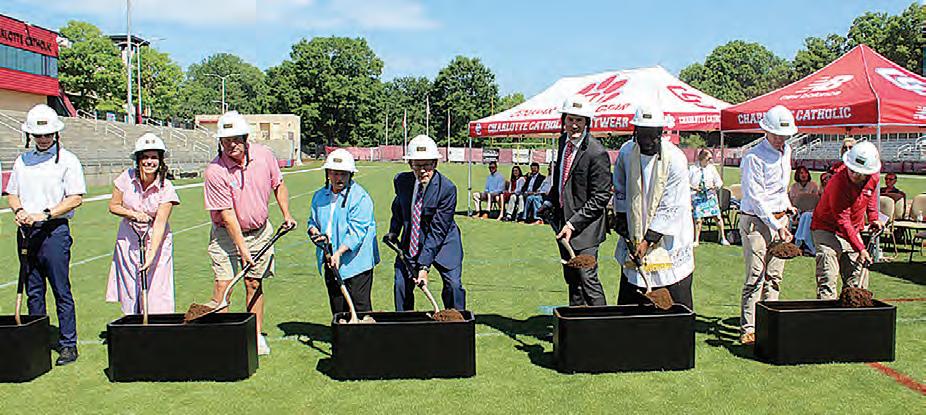
CHARLOTTE — Charlotte Catholic High School broke ground on the first phase of improvements to its campus Tuesday May 19 with a ceremony on the school’s athletic field.
Students, parents, benefactors, diocesan staff and members of the community turned out for the event celebrating the beginning of the project, which will include upgrading the existing field and sideline to premium artificial turf and renovating the existing media center into a multi-faceted student life center.
The improvements are being funded by a capital campaign, Grounded in Tradition: Focused on the Future, which launched in February. The campaign aims to raise $8.5 million for several large projects to enhance student life at the school, including the new turf and media center improvements.
Plans for the next phases will move forward once additional funding milestones are reached. They include transforming a small office building recently purchased by MACS and adjacent
to the campus into the Computer, Technology and Engineering Innovation Center, which will support classes in engineering, robotics and other technologies. Finally, the new field house and flexible space complex will be designed to offer a multi-purpose hub that will include areas for sports performance, recovery
and athletic training, dedicated spaces for health and wellness education and team meetings, and a flexible space that can easily be transformed from classrooms to larger spaces for after-school activities.
Mercy Sister Paulette Williams, who was principal at the school from 1980 to 2000,
spoke at the ceremony and called it “an exciting day in the life of Charlotte Catholic High School.”
Kurt Telford, head of school at CCHS, spoke to the students in the stands about the role the improvements will play in their lives: “This project is ultimately about you and the generations of students who will be with you
and follow you,” Telford said. “The spaces we celebrate today will create new opportunities for learning, innovation, competition, unity and most importantly faith formation. One day you will be able to look back and say you were here when this exciting new chapter in our school’s history began.”
Work on turfing the field is set to begin June 1 after the school’s lacrosse and girl’s soccer teams complete post-season play, and work on the new student center will take place during the summer.
School officials said the goal is to have the new field ready for the beginning of football season and for the student life center to be complete by the time teachers return in August.
The total cost for all phases of the improvement project is expected to reach $10.5 million, which includes a $2 million contribution from the Mecklenburg Area Catholic Schools Capital Fee.
Choate Construction is the contractor for the project, and Little and Associates are the architects working on the improvements.
This year’s Senior Class was awarded over $13 milli on in scholarships
Aguirre, Angeline Ayselle
Aho, Morgan Lucia
Andress, Lydia Mae
Arnold, Oliver Jacob
Azzara, Anthony Joseph
Ball, Samuel Matthew
Ballenger, Emma Grace
Bourgeois, Grace Elaine
Briody, Grace Margaret
Briody, Sarah Madeline
Brown, Aubrey Elizabeth
Cachat, Benjamin
Cary, Julian Rafael
Casanova, Ramon Alexander
Chom, Arop JukArop
Christopher, Sophia Brynn
Clothier, Cole Allen
Cornatzer, Jacob Quang
Crite, Gabriella Sage
Crite, Olivia Faith
D’Accio, Francesca
Dancausse, Adrian Louis
Dancausse, Alexia Victoria
Deese, Colby Douglas
Dinh, Quynh
Drab, Ella Caroline
Eaton, Caleb Wesly
Edwards, Madeline Victoria
Essma, Anna Kathleen
Fohn, Sofia Marie
Allegheny College
Appalachian State University
Arizona State University- Tempe
Auburn University
Baylor University
Belmont Abbey College
Bethany College, West Virginia
Bluefield University
Boston College
Boston University
Brevard College
Bryn Mawr College
Ca' Foscari University - Italy
Campbell University
Case Western Reserve University
Catawba College
Charleston Southern University
Clemson University
Coastal Carolina University
College of Charleston
Davidson College
Davidson Davie Community College
Denison University
Duke University
Duquesne University
East Carolina University
Eastern Connecticut State University
Eastern Mennonite University
Elizabeth City State University
Elon University
Frail, Susannah Butler
Fries, Nicholas James
Gaylord, Mary Elizabeth
Grunwald, Emery Agnes
Guerriero, Patrick George
Guzman Valiente, Asael
Hadgu, Beliul Yonas
Hamilton, Heather Lynn
Heafner, Laney Kristina
Hedrick, Ella Christine
Hill, Sophia Marie
Hoffend, Hailey Emma
Jewell, Alessio Carmelo
Keefe, Aiden Louis
King, Dylan Clarence
Kirkland, MacKenzie Rose
Knick, Madalyn Marie
Kuhl, John William
Lachow, Julian Christopher
Laney, Carson Ruth
Lavelle, Caroline Reeves
Leon, Jacquelin Sofia
Lipscomb, Ava Elizabeth
Litchfield, Lillian McGinnis
Little, Dylan Harper
Long, Grady Paul
Lopez-Rincon, Avril
Lynch, Anderson Lanier
Ma. Natalie Meilin
Marip, Nicholas Abawm
Martin, Sara Rose
Marty, Emersen Grace
Maryo, Abigayl Raymond
McCann, Amelia Olivera
Miller, Hudson Childs
Moore, Jenna Eve
Morrissey, Carson Edward Thomas
Moya, Grant Xavier
Namen, Ainsely Kathryn
Nguyen, Eric Pham
O’Connell, Adam Michael
Pape, Emily Catherine
Pape, Mary Grace
Passwater, Lyla Grace
Perez Fernadez, Daniella Stephanie
Pfauth, Everest Andrew
Pickle, Caroline Lennon
Pinder, Elizabeth Marie
Read, Karridy Grace
Reynolds, William Finley
Riazzi, Curtis John
Ruiz, Christian John Paul
Schrage, Sophia Jayne
Schultheis, Samantha Jean
Schultz, Lillian Josefine
Seivers, Brianna Madison
Showers, Lauren Caroline
Skeeles, Alexa Jeanne
Skoteiniadis, John Gregory
Florida Atlantic University
Florida Gulf Coast University
Florida Institute of Technology
Florida State University
Fordham University
Forsyth Technical Community College
Furman University
George Mason University
Georgetown University
Greensboro College
Guilford Technical Community College
Hampden-Sydney College
High Point University
Hudson Valley Community College
Indiana University Bloomington
Jacksonville University
James Madison University
Johnson & Wales University, Charlotte
Lees-McRae College
Lenoir-Rhyne University
Liberty University
Louisiana State University
Marquette University
Meredith College
Millersville University of Pennsylvania
Mississippi State University
Muhlenberg College
Newberry College
North Carolina A & T
North Carolina State University
Northeastern University
Ohio University
Palm Beach Atlantic University
Penn State University Park
Pfeiffer University
Pitzer College
Pratt Institute
Purdue University
Queens University of Charlotte
Radford University
Randolph College
Roberts Wesleyan University
Rose-Hulman Institute of Technology
Saint Anselm College
Saint Leo University
Saint Louis University
Salisbury University
Savannah College of Art and Design
School of the Art Institute of Chicago
Shenandoah University
The Ohio State University at Columbus
The University of Alabama
The University of Arizona
The University of Kansas
The University of North Carolina at Chapel Hill
The University of North Carolina at Charlotte
The University of North Carolina at Greensboro
The University of Tennessee
The University of Utah
Tusculum University
University of Colorado Boulder
Smith, Christopher Everett
Sosa Parada, Joseph
Stalek, Devon Patrick
Staudinger, Arthur William
Stewart, Benjamin David
Strothman, Shayna
Styers, Tristan Ryan
Sullivan, Claire
Sullivan, Shannon
Tavenner, Warren Geoffrey Taylor, David Aldridge
Terry, Margaret Katherine Tesoniero, Amelie Elizabeth Thompson, Thomas Carl Nyaho Tillis, Tyler Joseph Valente, William Rocco
Van Dyke, Natalie Marie
Varner, Alison Kate
Villa, Philip Roy
Walter, Sofia Roxanne
Warren, Vincent Vaughn
Webster, Lily Catherine
Wheeler, Grayson Patrick Williams, David Ashton Willis, Gabrielle Renee Winters, Lily Okoshi Michaela Wolff, Amelia Naomi
Yancey, Aidan Christopher Zavala, Arturo Isaias
University of Connecticut
University of Dayton
University of Florida
University of Georgia
University of Kentucky
University of Miami
University of Michigan - Dearborn
University of Mississippi
University of North Carolina Asheville
University of North Carolina School of the Arts
University of North Carolina Wilmington
University of Northwestern Ohio
University of Oklahoma
University of Oregon
University of Pittsburgh
University of Richmond
University of Rochester
University of South Carolina-Columbia
University of South Florida
Ursinus College
Villanova University
Virginia Commonwealth University
Virginia Tech
Wake Forest University
Warren Wilson College
Washington and Lee University
Western Carolina University
Wingate University
Winston-Salem State University
Wofford College
LISA M. GERACI lmgeraci@rcdoc.org
CHARLOTTE — Holy Trinity Middle School has received a $1,000,229 grant from Shea Homes for upgrades to its athletic field and fine arts classrooms.
The existing athletic field will be regraded, a drainage system added and then topped with synthetic turf, new lighting, team benches and markings.
The fine arts classroom upgrades include upfitting the current chorus, art and band rooms and hallways with modernized flooring, lighting and instructional equipment.
Holy Trinity and the diocese will be responsible for the remaining $572,000 of the $1,572,229 cost of the project, which is slated to be completed this summer.
“We are overwhelmed by the continued support from the Shea family and appreciate their commitment to Catholic education,” the
school’s President Kevin Parks said. “As the second largest school in the diocese, we are excited for these upgrades and renovations that will help better educate our students for upcoming generations as well as today.”
The facility upgrade is one piece of a larger $11.5 million three-phase, multi-year enhancement project focused on readying the school to launch a blended learning model to better serve its growing student body of 1,038.
The new learning model is expected to be unveiled for the 2026-2027 academic year, when the school is set to be renamed “Holy Trinity Catholic Academy” to reflect its continued commitment to an inclusive, faithbased learning environment.
Phase I, completed in August 2025 for $3 million, remodeled an outdated 1950s administrative building, creating innovative spaces for science labs, modern faculty offices and conference areas and added a classroom dedicated to theology studies.
“After seeing the benefits of the administrative building this past summer, our community is very excited for these enhanced learning spaces,” Parks said.
This past April, the Bulldogs broke ground
for Phase II, the $7 million Begley building renovation and expansion that is anticipated to be completed this summer.
Existing classrooms and restrooms will be remodeled, eight classrooms will be added in a new second floor above the library and hallways will all connect to an upgraded internal stairway for improved access.
Shea Homes is one of the most significant philanthropic supporters of Catholic education across the country, assisting more than 1,000 Catholic schools with grants providing for renovations, new construction and expansion projects.
Over the past 30 years, the charity has granted an estimated $12.2 million toward school projects in the diocese, assisting Holy Trinity Middle, St. Ann and Our Lady of the Assumption schools in Charlotte, Immaculata in Hendersonville, St. Michael the Archangel in Gastonia, Our Lady of Grace in Greensboro, Our Lady of Mercy in WinstonSalem, and Sacred Heart in Salisbury.
“This extraordinary gift will allow Holy Trinity to address needs that impact students’ educations,” said Jim Kelley, diocesan director of development. “We are so grateful
to John Shea Jr. and his family for the transformational partnership we have with Shea Homes.”
Though the grant was a major stepping stone, a future Phase IV will require additional funding. It includes new landscaped walking paths, a cafeteria and outdoor dining upgrade, and upgraded stage fixtures for the school’s performing arts program. Along with structural changes, curriculum and leadership goals have shifted, adding three theology teachers and a dean of student life.
This past year, the school also moved to a president-principal leadership model that saw former principal Parks taking on the role of president.
The new curriculum will use a codivisional approach, with single-sex (all-girl or all-boy) core classes and co-ed electives. While currently being used for theology and social studies classes, this instructional method will be phased in over the next three years, being fully implemented in the 20262027 academic year for the sixth grade, the seventh grade the following year, and the eighth-grade level during the 2028-2029 year.
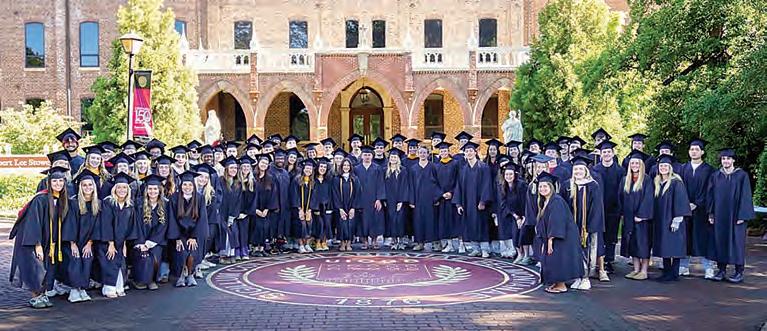
BELMONT — Belmont Abbey College celebrated its 148th commencement ceremony on May 16, honoring 309 graduates – including three Diocese of Charlotte seminarians – and marking a milestone in the college’s 150th anniversary year.
The day began with a baccalaureate Mass on the piazza of the Abbey Basilica, presided over by Abbey alumnus Bishop John Joseph McDermott of Burlington, Vermont. The graduation ceremony followed, led by Chancellor Abbot Placid Solari, O.S.B., and the college’s new president, Dr. Jeffrey W. Talley, who welcomed families, friends, faculty and staff to the celebration of years of study and dedication.
“Today, we celebrate not only the remarkable achievements of our graduates but also the enduring spirit of Belmont Abbey College,” Talley said. “Each of these students has demonstrated excellence in academics, leadership and service, and we
are inspired by the virtues and character they carry into the world. As we honor our 150th anniversary, we are reminded that the values instilled here will guide them for a lifetime,”
This year’s graduating class included diocesan seminarians Matthew Hennessey, Theodore Holthe and Jeremy Smith as well as 26 nursing students, 10 students who completed new motorsports management degrees and 27 psychology graduates, many of whom were headed to graduate school.
A significant number of student-athletes also graduated this year, demonstrating dedication both on the field and in the classroom. Among this year’s honorees, Addie Galek, a senior on the women’s soccer team, was named the recipient of Conference Carolinas’ 2025-26 Murphy Osborne Award. In addition, 10 athletic teams earned the Messick Award, while the college’s athletic department received the overall Messick Award for the year – the
highest sportsmanship honor within the conference. These achievements reflect the college’s mission to cultivate sport and virtue while fostering the holistic development of body, mind and soul.
the building crew at St. William Parish, developed a friendship with Father Kloster and accompanied him on several trips, including a cruise through the Adriatic and later through Europe.
“When we landed in town, there would normally be an old historic church and Father would have Mass,” recalls Stillwagon. “He would link the progression of Christianity in the region to his homily. He had done his research.”
His intelligence was coupled with a call to serve, said Stillwagon. “He didn’t want one of his parishioners needing a hand and him not know about it.”
“He was down to earth and he was
committed, but he definitely was a man of God who loved the community. He didn’t just preach the gospel, he lived it,” added McGinnis.
Father Kloster died in 2020, but those he served will never forget him.
“This is the 23rd endowment named for a priest or bishop in our diocesan foundation,” said Jim Kelley, diocesan development director. “Most of those endowments were established in the priests’ estate plans. Just like Father Kloster, more and more individuals are leaving real estate gifts in their estate plans. Contributing to or starting an endowment in the name of a priest or a bishop who has impacted them is a wonderful way for parishioners to ensure the legacy of these men who have dedicated their lives to serving others.”
— Courtney McLaughlin
Several legacy families celebrated another child’s graduation, demonstrating the enduring values and strong sense of community instilled by Belmont Abbey College across generations. Susan Reid, a member of the 5th Honors College cohort majoring in Great Books and minoring in Classical Languages, was named the 2026 valedictorian. The graduating class also includes 22 Honors College Scholarship students, 24 Hintemeyer Catholic Leadership Scholarship scholars, who are continuing the Abbey’s long tradition of forming men and women of faith and service.
A highlight of the ceremony was the presentation of the 2026 Abbey Student of the Year award to Caroline Gutierrez. The Abbey Student of the Year recognizes a student who exemplifies engagement, leadership and academic and extracurricular excellence. In a cherished tradition unique to Belmont Abbey, the
award recipient delivers a speech in place of a traditional commencement speaker, offering personal reflections and inspiration to fellow graduates.
In her remarks, Gutierrez encouraged her classmates to embrace their unique calling and lead with courage and conviction: “Each of us has been given a unique purpose in this life, and the Abbey has helped us to foster it. One of my favorite quotes is by St. Catherine of Siena. She says, ‘Be who God made you to be and you will set the world on fire.’ So, class of 2026, I encourage you to carry this wisdom with you and share your unique light and gifts with the world. Be brave and stand firm in the morals and values that guide your heart. This is what Belmont Abbey has taught us, that in all things, we may strive for excellence and virtue.”
Belmont Abbey College also conferred honorary degrees on Bishop John McDermott of Burlington, Vermont, and Jesse Aaron Grapes, former headmaster of Benedictine High School in Richmond, Virginia. Both honorees were recognized for their contributions to education.
— Trish Stukbauer and Belmont Abbey College
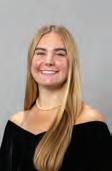
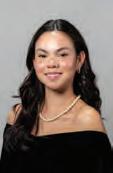
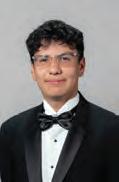
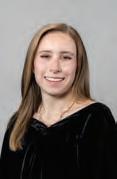
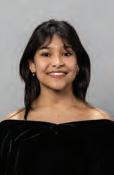
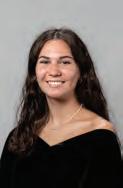
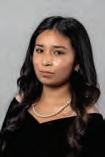
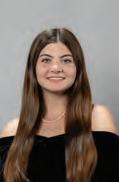
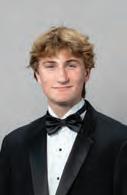
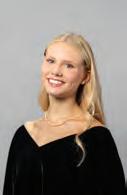
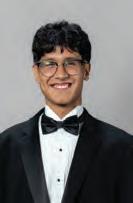
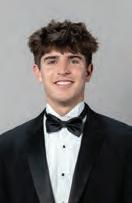

BRIAN SEGOVIA bmsegovia@rcdoc.org
MOORESVILLE – Durante su visita, Obispo Pedro Alberto Bustamante López de la Diócesis de Huánuco, Peru, pasó la mayor parte de su tiempo con el también sacerdote huanuqueño, el padre Huver Navarro, en la parroquia Santa
Teresita en Mooresville, donde celebró la Misa y participó en diversos eventos comunitarios. El obispo Bustamante se reunió con el obispo Michael Martin el 13 de mayo para dialogar sobre ideas para continuar fortaleciendo la sólida relación entre sus dos diócesis. El 18 de mayo, visitó la parroquia Nuestra Señora de Guadalupe en Charlotte, donde se reunió con el párroco, el padre Marvin Navas, y
también visitó el cercano Belmont Abbey College. El 20 de mayo, presidió las confirmaciones en Nuestra Señora de Guadalupe y en Santa Teresita, donde tuvo la oportunidad de interactuar con numerosos feligreses. También condujo en vivo su programa de Radio DH, “Jesucristo al encuentro de los hermanos del campo”, desde Mooresville a las 6 a.m. todos los días.
uno
AND
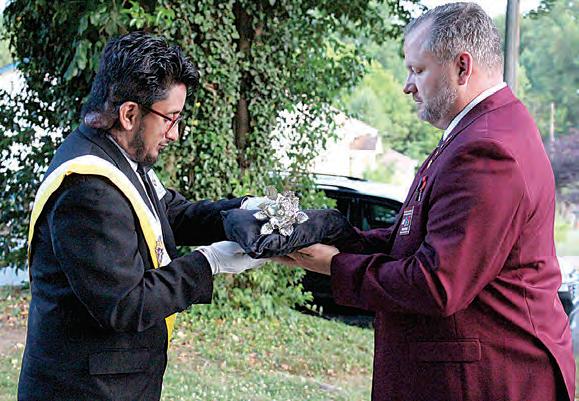
WINSTON-SALEM — La parroquia de San Benito el Moro, en Winston-Salem, recibió recientemente la visita de la Rosa de Plata, un apreciado símbolo de devoción a la Santísima Virgen María que actualmente recorre Estados Unidos y Canadá. Antes de iniciar su peregrinación actual, la rosa se expuso en la famosa Basílica de Nuestra Señora de Guadalupe, uno de los santuarios marianos más importantes del mundo. Los miembros del Consejo de Caballeros de Colón de San Benito
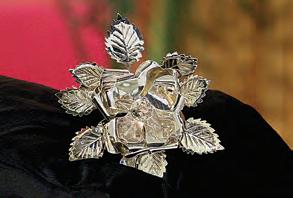
el Moro actuaron como anfitriones en la ocasión. A ellos se unieron el párroco, el P. Yumo; el agente de campo Miguel Flores; y varios responsables de la fraternidad.
Con la ayuda del P. Peter Michael Rusciolelli, dirigieron una liturgia llena de oración y emotiva en honor a Nuestra Señora de Guadalupe, reflexionando sobre su presencia maternal en la vida de la Iglesia.
La celebración brindó a los feligreses la oportunidad de profundizar en su devoción mariana y unirse en oración por la protección de la vida, el fortalecimiento de las familias y la renovación espiritual de sus comunidades.

¡Próximamente en la Diócesis de Charlotte!
30 de mayo – 2 de junio
Monroe | Charlotte | Statesville | Greensboro
nacional a través de la Diócesis de Charlotte
Orar
Santa misa, adoración eucarística
“Cabrini” proyección de película Ver Apoyar Catholic Charities Dar
¡Todos los eventos son GRATIS – todos son bienvenidos!
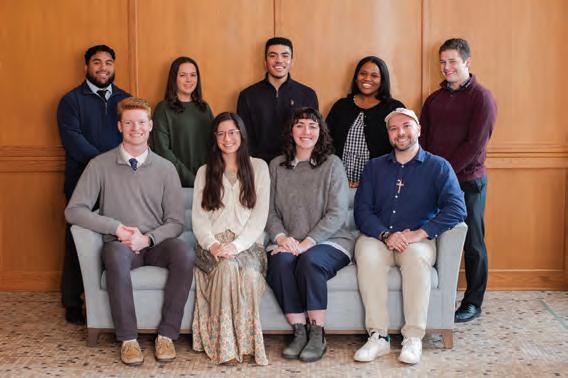

Conoce a los Peregrinos:
Paradas de la peregrinación:
• Our Lady of Lourdes Church
• St. Vincent de Paul Church
• St. Peter Church
• St. Philip the Apostle Church
• St. Pius X Church
Proyección exclusiva:
7 p.m. domingo 31 de mayo Gratis – se requieren reservaciones
Copatrocinada por la Parroquia de San Mateo de Charlotte
¡Escanea para más información!


Cristo está presente en la liturgia –en la palabra proclamada, en los sacramentos, en los ministros, en la comunidad y, sobre todo, en la Eucaristía – afirmó el Papa León XIV.
“Dejémonos moldear interiormente por los ritos, por los símbolos, por los gestos y, sobre todo, por la presencia viva de Cristo en la liturgia”, dijo durante su discurso en la audiencia general en la Plaza de San Pedro el 20 de mayo.
En su discurso principal, el Papa León continuó su serie de catequesis sobre el Concilio Vaticano II, pero presentó el siguiente documento conciliar en el que deseaba centrarse: la constitución del concilio sobre la sagrada liturgia, “Sacrosanctum Concilium”.
“Este documento enseña que la liturgia nos sumerge en el misterio de la pasión, muerte, resurrección y glorificación de Cristo”, dijo en su resumen a los fieles de habla inglesa.
“Cristo sigue actuando, presente en la Palabra proclamada, en los sacramentos, en los ministros que celebran, en la comunidad reunida y, sobre todo, en la Eucaristía”, afirmó al leer su resumen a los fieles hispanoparlantes.
Al redactar esta constitución, dijo que “los Padres conciliares quisieron no solo emprender una reforma de los ritos, sino también llevar a la Iglesia a contemplar y profundizar en ese vínculo vivo que la constituye y la une: el misterio de Cristo”.
“La liturgia, en efecto, toca el corazón mismo de este misterio: es a la vez el espacio, el tiempo y el contexto en el que la Iglesia recibe de Cristo su propia vida”, dijo el Papa León en su discurso principal en italiano.
“He aquí, pues, el Misterio cristiano: el acontecimiento pascual, es decir, la pasión, la muerte, la resurrección y la glorificación de Cristo, que precisamente en la liturgia se nos hace sacramentalmente presente, de modo que cada vez que participamos en la asamblea reunida ‘en su nombre’ estamos inmersos en este Misterio”, expresó.
La liturgia ayuda a sostener a los fieles, animándolos y renovándolos “en su compromiso de fe y en su misión”, y contribuye a formar “una comunidad abierta y acogedora para todos”, dijo el Papa León.
La liturgia que se celebra debe traducirse y vivirse en la vida cotidiana, “en una dinámica ética y espiritual”, dijo. Exige “una existencia fiel, capaz de hacer concreto lo que se ha vivido en la celebración: es así como nuestra vida se convierte en ‘sacrificio vivo, santo y agradable a Dios’, realizando nuestro ‘culto espiritual’”.
LINDSAY SCHLEGEL OSV News
Así como la Iglesia Católica dedica el mes de mayo a María, de igual modo consagra el mes de junio al Sagrado Corazón de Jesús. Emily Jaminet --esposa, madre de siete hijos, autora y conferencista-- profesa una profunda devoción al Sagrado Corazón, el cual describe como “un corazón herido y quebrantado y, sin embargo, un corazón perfecto. Jesús desea ofrecernos sanación, esperanza, consuelo y fortaleza a través de la recepción de su amor, viviendo en ese amor y compartiéndolo con los demás”.
Jaminet es la autora de “Secrets of the Sacred Heart: Twelve Ways to Claim Jesus’ Promises in Your Life” (Ave Maria Press) y directora ejecutiva de la “Sacred Heart Enthronement Network”. En esta entrevista --la cual ha sido editada y condensada para mayor claridad--, Jaminet comparte de qué manera esta poderosa devoción puede servir como guía para conducir la vida.
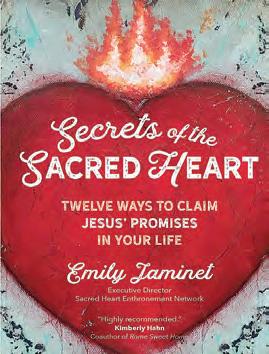
Los creyentes se hallan inmersos en una gran batalla espiritual, y la entronización representa un medio poderoso para que la familia haga suyas las palabras del libro de Josué (24,15): “Yo y mi familia serviremos al Señor”. Independientemente de las pruebas y tensiones que usted esté atravesando, Jesús desea caminar a su lado en su vida cotidiana. Él anhela formar parte de la vida católica diaria y fortalecer a la familia --o al individuo-- para que crezca en santidad al vivir conforme a la voluntad de Dios.
Schlegel: ¿Qué frutos ha visto desde que llevó a cabo esto en su propio hogar?
Jaminet: Cuando entronizamos el Sagrado
para nuestro estado de vida, y hemos llegado a valorar los importantes títulos de Jesús asociados a esta devoción: amigo, hermano, salvador, protector y proveedor.
SANADOS Y FORTALECIDOS
Schlegel: ¿Cómo ha sido testigo de la experiencia de otros respecto a esta devoción, en su labor con Sacred Heart Enthronement Network (la Red de Entronización del Sagrado Corazón)?
Jaminet: He sido testigo de cómo familias han superado pruebas difíciles, tales como enfermedades, desempleo, adicciones, y momentos complejos y desafiantes en la crianza de los hijos. El Sagrado Corazón ofrece su amor a cada uno de nosotros. Cuando acogemos este amor, podemos comenzar a trabajar junto a Jesús para ser sanados y fortalecidos.
Lindsay Schlegel: ¿Qué fue lo que te atrajo, como mujer, al Sagrado Corazón de Jesús?
Emily Jaminet: El amor perfecto. Como esposa y madre con una vida ajetreada, me di cuenta de que no podía vivir únicamente de mi propio amor; necesitaba beber de la fuente eterna de amor del Corazón de Jesús. Tuve la dicha de crecer en una hermosa familia católica que ha honrado y amado esta devoción durante generaciones, por lo que me resultó sencillo adoptarla e incorporarla a mi propia vida.
LAS FAMILIAS ESTÁN ESTRESADAS
Schlegel: ¿Qué significa “entronizar su hogar”?
Jaminet: La entronización es el deseo de cumplir las palabras que Jesús dirigió a Santa Margarita María Alacoque en la década de 1670. En una visión, Él le dijo: Expón y honra mi Corazón, y serás bendecida (“Dondequiera que esta santa imagen fuera expuesta para ser honrada, Él derramaría Sus gracias y bendiciones”). Se trata de una ceremonia en la que se invita a Jesús a entrar en el hogar (o en la escuela, la parroquia o el lugar de trabajo) y se le otorga autoridad sobre quienes allí residen. Se asigna un lugar de honor a una imagen o estatua del Sagrado Corazón. La entronización constituye un punto de partida para permitir que Jesús guíe a los miembros del hogar hacia una mayor cercanía con Cristo.
A mediados del siglo XX, el padre Mateo Crawley Boevey, un apóstol de la entronización del Sagrado Corazón, albergaba un profundo deseo de ayudar a fortalecer a las familias frente a la ola de modernismo y relativismo que las estaba desintegrando. En su época, este fenómeno se manifestaba a través de las arduas condiciones laborales en las fábricas y la pobreza; hoy, sin embargo, lo observamos en una desenfrenada pérdida de la fe.
Las familias nunca han estado tan agobiadas ni sometidas a tanta presión.
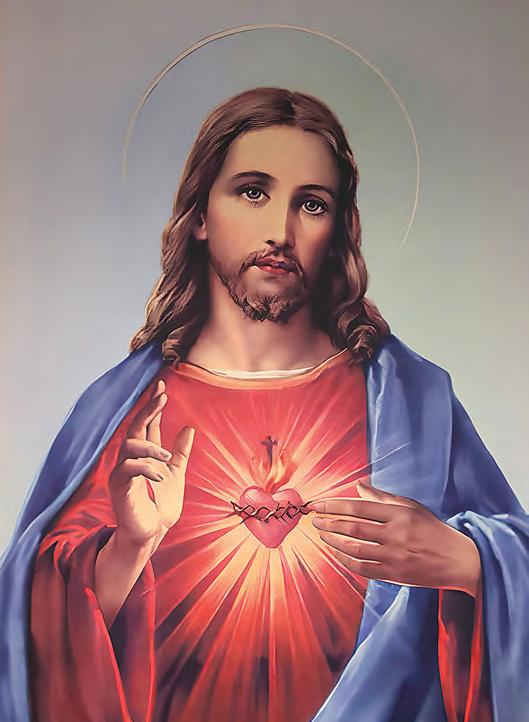
BOB ROLLER | OSV NEWS
Se observa una pintura del Sagrado Corazón de Jesús durante la Misa del Domingo de Ramos en la Iglesia del Sagrado Corazón en Prescott, Arizona, el 13 de abril de 2025.
Corazón en nuestro hogar allá por 2013, nunca hubiera podido imaginar una vida centrada en este apostolado. Me gusta decir que la entronización del Sagrado Corazón me ha brindado unos nuevos lentes para ver mi vida y el impacto que puedo tener en los demás. Deseo cultivar un corazón más grande y más semejante al de Cristo, que sea sensible y amoroso hacia mi familia, mis amigos, mi comunidad y el mundo entero. Esta es una devoción de esperanza, de sanación y una vía para que todos tengan un nuevo comienzo. Mis hijos han hallado mucho consuelo en las imágenes presentes en el hogar, donde rezamos, donde conversamos sobre la vida y donde yo busco fuerzas para seguir adelante cuando me siento cansada o agotada. Jesús nos ayuda a mi esposo y a mí en nuestra labor de padres. Él nos concede todas las gracias que necesitamos
Ninguna familia vuelve a ser la misma después de la entronización. ¿Por qué? Porque se invita a Jesús a entrar en el hogar, a sacar a la luz aquello que debe ser revelado y a sanar lo que necesita sanación. ¿Quién no necesita eso?
He escuchado testimonios conmovedores de personas solteras que saben que ya no viven en soledad; Jesús está siempre con ellas. (Escribo precisamente sobre este tema en mi libro). Schlegel: ¿Cómo funciona la entronización?
Jaminet: La entronización consta de tres fases: preparación, entronización y vivencia.
La preparación incluye un triduo (tres días) de oración, aunque siempre se puede optar por un periodo de preparación más extenso. Lo más importante es que se busque vivir la fe y acoger a Jesús. La entronización difiere de la consagración personal. La consagración es la decisión de establecer una alianza con el Señor; la entronización es la decisión de acoger a Jesús, ofreciéndole un trono para que habite en el hogar, y de vivir con la firme convicción de que uno representa a su familia, o habla en su nombre, incluso si sus miembros no son practicantes de la fe. Si usted se muda, la entronización le acompaña. No obstante, recomiendo renovar la entronización como un medio para recordar el amor de Jesús y reenfocar a la familia. Nosotros procuramos renovar nuestra entronización cuando necesitamos recibir gracias especiales. He sido testigo directo de vidas transformadas gracias a la entronización del Sagrado Corazón, cuando las personas buscan honrar a Jesús y acoger al Sagrado Corazón en sus vidas.
May 30 - June 2 Monroe | Charlotte | Statesville | Greensboro
Join the Blessed Sacrament on its nationwide pilgrimage through the Diocese of Charlotte
Holy Mass, Eucharistic Adoration PRAY

Support Catholic Charities GIVE
movie screening
All events are FREE – everyone welcome!
Meet the Pilgrims:
Pilgrimage stops at:
• Our Lady of Lourdes Church
• St. Vincent de Paul Church
• St. Peter Church
• St. Philip the Apostle Church
• St. Pius X Church
Exclusive screening:
7 p.m. Sunday, May 31
Free - reservations required
Co-sponsored by St. Matthew Parish of Charlotte
GINA CHRISTIAN OSV News
WASHINGTON, D.C. — The nation’s Catholic bishops have a full agenda for their annual spring meeting, with topics including safe environment protocols, sainthood causes, the Synod on Synodality and the consecration of the U.S. to the Sacred Heart of Jesus.
The U.S. Conference of Catholic Bishops will gather June 10-12 for its spring plenary assembly in Orlando, Florida.
Archbishop Paul S. Coakley of Oklahoma City will open the public sessions with his first address as USCCB president, having been elected during the conference’s annual fall meeting in November 2025.
Also addressing the bishops will be Archbishop Gabriele G. Caccia, who was appointed as papal nuncio to the U.S. in March, having previously served as the Holy See’s permanent observer to the United Nations. Archbishop Caccia succeeded Cardinal Christophe Pierre, who turned 80 in January and had served in the post since 2016.
The USCCB noted that the agenda for the June assembly “has not yet been finalized and is subject to change,” but that votes are expected on several action items.
Among those items are a revision to the USCCB’s “Charter for the Protection of Children and Young People,” adopted in 2002 as a number of clerical abuse scandals emerged. Commonly called the Dallas Charter, the document lays out a comprehensive set of procedures for addressing allegations of sexual abuse of minors by
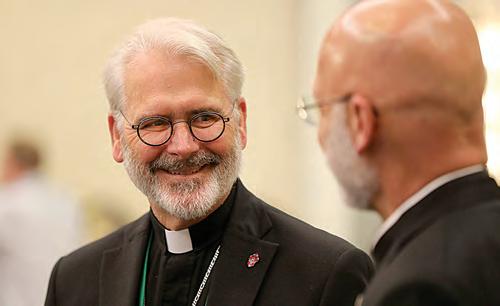
Catholic clergy, and includes guidelines for reconciliation, healing, accountability and prevention of abuse.
Also on the agenda are episcopal consultations for two canonization causes: that of Monsignor Joseph Francis Buh, a 19th-century Slovenian missionary priest who ministered to the Ojibwe people of northern Minnesota; and John Rick
Miller, a 20th-century American businessman who founded For the Love of God Worldwide, a private association of the faithful promoting consecration to God through the Sacred Heart of Jesus and the Immaculate Heart of Mary.
The USCCB Committee on Divine Worship will round out the agenda’s action items, presenting portions from two texts for consideration: a new edition of the Lectionary for Mass, which provides the Scripture readings and psalm for each day’s liturgy; and the 2025 Roman Missal-Liturgy of the Hours Supplement.
The bishops will also discuss the implementation and evaluation of the Synod on Synodality, as well as feedback from their November dialogues on “Forming Consciences for Faithful Citizenship,” the USCCB’s teaching document on the political responsibility of Catholics.
Discussions will examine Catholic prison ministry, the USCCB’s involvement with the Intercontinental Guadalupan Novena honoring the 500th anniversary of the Marian apparitions in Mexico City, and World Youth Day 2027 in Seoul.
SEATTLE — Devotion to the Sacred Heart of Jesus, which signifies “the divine response to the wounded human heart,” is “more timely than ever,” said Archbishop Paul D. Etienne of Seattle in a pastoral letter released May 18, inviting the faithful of the diocese “to rediscover this beautiful devotion.”
The letter, titled “Learn from Me for I Am Meek and Humble of Heart,” lays out the case for a renewed appreciation of the theology and practice of devotion to the Sacred Heart.
The archbishop exhorted families to enthrone an image of the Sacred Heart in their homes, and parishes to revive the First Friday devotion, a practice that has waned over the decades. Archbishop Etienne observed the document comes as the nation’s Catholic bishops will consecrate the U.S. to the Sacred Heart to mark the 250th anniversary of the country’s founding.
Noting the upcoming consecration of the U.S., Archbishop Etienne asked, “What would it look like for us as a nation to live this consecration – mutual love, respect for persons, loving the neighbor, working for peace?”
San Diego
‘attack on the sacred dignity of all human life,’
SAN DIEGO — Catholic bishops are expressing their grief and support following a deadly May 18 shooting at a mosque complex that killed three adults, including a security guard. The two teen suspects were later found dead of apparent self-inflicted gunshot wounds.
Following the attack, Bishop Michael M. Pham of San Diego released a message saying the faithful there “stand united in solidarity and prayer with the Muslim community.”
In a May 19 statement, Archbishop Paul S. Coakley of Oklahoma City, president of the U.S. Conference of Catholic Bishops, said he and his fellow bishops “extend our profound sorrow” following the shooting.
The bishops “stand with” the center’s chief imam, Taha Hassane, as well as “the entire Muslim community, and all who mourn in the wake of this senseless violence, affirming our shared commitment to the dignity of every human life and the rejection of hatred in all its forms,” Archbishop Coakley said.
Law enforcement is investigating the shooting as a hate crime.
House
WASHINGTON, D.C. — A White House official recently expressed a desire to work more closely with churches and faith-based leaders in efforts to confront both drug and human trafficking and assist in recovery.
Victor Avila, assistant director of the Office of National Drug Control Policy, made the comments during a May 14 panel discussion on
SIMONE ORENDAIN OSV News
CHICAGO — Clergy and religious have begun ministering daily to those being held at an Immigration and Customs Enforcement facility in suburban Chicago – for now – after almost a year of trying to have regular visits.
Groups from the Chicago-based Coalition for Spiritual and Public Leadership started going daily to the ICE processing facility in Broadview May 15, following a federal judge’s preliminary injunction in April.
The temporary order prohibited the Department of Homeland Security from imposing a total ban on pastoral visits at the facility 12.5 miles west of downtown Chicago, while CSPL’s lawsuit seeking permanent regular pastoral visits is pending. It also compelled DHS and ICE to permit the visits and work out with CSPL terms for the visits.
Michael Okinczyk-Cruz, CSPL executive director, said that since May 15 at least three and sometimes as many as five ministers have entered the facility.
CSPL, a Catholic social justice organization, has welcomed ecumenical and interreligious groups to also minister to those at Broadview. According to Okinczyk-Cruz, several of their members joined the Catholics and have entered.
He described the visits as “very meaningful” for those detained and said the May 17 visit included anointing for several men, one of whom said in Spanish that he felt like he had “come alive again”
border security and immigration enforcement hosted by the America First Policy Institute’s Hispanic Leadership Coalition in Washington, D.C.
“We need to get the Church involved,” he said, referencing a ONDCP report that emphasizes the importance of faith-based partners.
The report, issued this month, details the administration’s drug control strategy and states the office will ensure access to evidencebased prevention and recovery programs that are faith-based. It lists faith leaders as important partners and advocates and encourages them to use their role to promote a social norm that is opposed to using drugs and supportive of treatment.
Avila told EWTN News that he hopes churches can assist in the realm of human trafficking, noting that much of it “happens in plain sight.”
Both the Vatican and the U.S. Conference of Catholic Bishops have been outspoken on the issue of human trafficking in recent years, with the Vatican hosting an international conference last year on the issue and the U.S. bishops running programs and promoting policies to combat human trafficking.
WASHINGTON, D.C. — A group of U.S. bishops, most from the U.S.-Mexico border region, wrote a May 20 letter to members of Congress expressing “grave concern” with budget legislation that would provide an additional $72 billion for immigration enforcement.
The letter came the same day Senate Republicans on the Budget Committee
advanced the measure, and the day after it was advanced by the Senate Homeland Security and Governmental Affairs Committee.
The letter to members of Congress was signed by 14 U.S. bishops. They wrote that the potential additional funds would follow previous legislation that already “provided an unprecedented $142 billion to DHS for the arrest, detention, and deportation of immigrants across the country.”
“As pastors, we remain troubled by how immigrants, the vast majority of whom have committed no crimes and have built equities in the country, have become targets for enforcement, with their God-given human dignity and human rights being violated on a daily basis,” they wrote.
after receiving the anointing oil.
“The power of the spiritual accompaniment in this pastoral care, it’s not to say that it solves every single challenge or problem here,” explained Okinczyk-Cruz, but he noted “how profoundly vital it is for our immigrant siblings to be accompanied during these moments of profound trauma and fear and separation.”
He said the people being processed with “fear in their eyes and sadness in their voice” are often separated from their children, siblings and loved ones “whose lives have been completely upended and torn apart,” as described by the ministers who have been inside.
Of the migrants most at risk of arrest and deportation by ICE, about 80% are Christian – the majority of whom (61%) are Catholic, according to a joint Catholicevangelical report published by World Relief and the U.S. Conference of Catholic Bishops.
CSPL sued the Trump administration in November demanding access to the facility, claiming its members’ religious freedom rights had been violated. It also argued weekly pastoral visits to the facility were allowed for more than a decade prior to the Trump administration’s ramped-up immigration crackdown in the Chicago area that started in September 2025.
U.S. District Judge Robert W. Gettleman said in the April 7 preliminary injunction the plaintiffs demonstrated the “likelihood of success on the merits of their” religious freedom claim.
over 140 years, the Knights of Columbus has been
helping families plan their nancial
and achieve economic security, a tradition carried on today through its insurance products.
What does it mean to safeguard our humanity? That question is at the heart of Pope Leo XIV’s much anticipated first encyclical, “Magnifica Humanitas: On Safeguarding the Human Person in the Time of Artificial Intelligence.”
COURTNEY MARES OSV News
VATICAN CITY — Pope Leo XIV published his landmark encyclical on artificial intelligence, “Magnifica Humanitas,” on May 25, comparing the attempt to build an AI future that excludes God to the Tower of Babel and underlining the need to safeguard human dignity as it is “threatened by new forms of dehumanization.”
“The risk of dehumanization – of building a future that excludes God and reduces the other to a means – is an ancient and ever-new temptation that today takes on a technical guise,” Pope Leo wrote in his first encyclical, “Magnifica Humanitas: On Safeguarding the Human Person in the Time of Artificial Intelligence.”
“In the era of artificial intelligence, when human dignity is threatened by new forms of dehumanization, ours is the pressing duty to remain profoundly human. We must lovingly safeguard the grandeur of humanity bestowed upon us and revealed in its fullness in Christ, the splendor of which no machine can ever replace,” he said.
THE ‘BABEL SYNDROME’
Pope Leo opens the first encyclical of his pontificate by saying that humanity today faces a pivotal choice: “either to construct a new Tower of Babel or to build the city in which God and humanity dwell together.” Using the biblical Genesis narrative, the pope warns against the “‘Babel syndrome,’ namely the idolatry of profit that sacrifices the weak” and the pretense that everything, “including the mystery of the person,” can be translated into “data and performance.”
“Calling for prudence, rigorous evaluation and even, at times, a slower pace in adopting AI does not mean opposing progress; instead, it is an exercise of responsible care for the human family,” he wrote.
CRYPTOCURRENCY TO ‘LORD OF THE RINGS’
The lengthy document is divided into five chapters and touches on wide-ranging issues related to AI, including the prospect of massive unemployment, the future of education, the protection of human freedom, excessive screen time for young
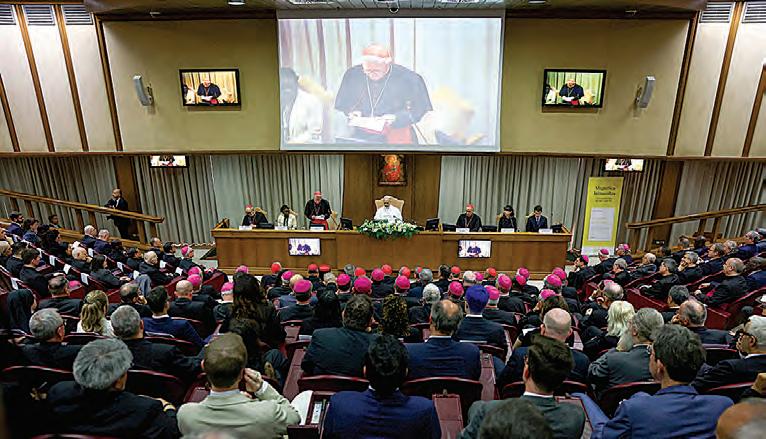
Pope Leo XIV attends the presentation of “Magnifica Humanitas” at the Vatican’s
encyclical of his papacy, it focuses on the rise of artificial intelligence and its likely
people, cryptocurrencies, economic disparities, transhumanism, cyberattacks and the application of Catholic social teaching principles. The final chapter of the encyclical is dedicated to AI in warfare and the need for “rigorous ethical constraints.” and proactive peacebuilding.
In “Magnifica Humanitas,” Latin for “Magnificent Humanity,” the pope calls on Christians to take a proactive role in building the future by cultivating community and in-person relationships, educating young people to love wisdom, spending time with the poor and the lonely, being a voice for justice, defending objective truth, and treating the digital world as “a new continent to be evangelized.”
“It is not our part to master all the tides of the world, but to do what is in us for the succour of those years wherein we are set, uprooting the evil in the fields that we know, so that those who live after may have clean earth to till,” he wrote, quoting J.R.R. Tolkien’s “Lord of the Rings: The Return of the King.” He added that it is “small and steadfast acts of fidelity that serve as a bulwark against dehumanization.”
‘SLOWING THINGS DOWN’
The idea of a “more moral AI” is not enough if that morality is only determined by a few, he notes. “What is needed is a more active political involvement that is capable of slowing things down when everything is accelerating, and of protecting the opportunities for communities still to be able
The Vatican has launched a website for Pope Leo XIV’s historic encyclical on artificial intelligence, featuring a summary of the text, chapterby-chapter infographics in several languages, and an explanatory video: www.magnificahumanitas.org/en
to participate and ask questions.”
The
GOD CREATED HUMANS FOR COMMUNION
He writes that AI promises efficiency, but the “new ways” of working are not necessarily better, describing how “contrary to the advertised benefits of AI, current approaches to technology can paradoxically de-skill workers, subject them to automated surveillance and relegate them to rigid and repetitive tasks.”
“When efficiency becomes the ultimate measure of value, human beings are tempted to see themselves as a project to be optimized rather than as persons called to relationship and communion,” he said.
CATHOLIC SOCIAL DOCTRINE
Pope Leo XIV places his encyclical on the age of AI within the context of the magisterial tradition of Catholic social doctrine, also known as Catholic social teaching.
He signed “Magnifica Humanitas” on May 15 – the 135th anniversary of “Rerum Novarum,” Pope Leo XIII’s foundational 1891 social encyclical on labor and capital written during the first Industrial Revolution.
The connection was intentional, he notes: “While new economic and technological networks can generate exclusion, isolation and dependencies, the Church – nourished by the Eucharist – is called to make visible a different paradigm, one that preserves human connections, gives a voice to the invisible and ensures that processes are aimed at respecting people’s dignity.”
n Latin for “Magnificent Humanity,” the title is drawn from the opening words of the text as rendered in Latin, as is customary for papal encyclicals. Those words state, in its English translation, “Humanity, created by God in all its grandeur, is today facing a pivotal choice: either to construct a new Tower of Babel or to build the city in which God and humanity dwell together.”
n The document is about 42,000 words long and spans five chapters. The first chapter traces the development of Catholic social doctrine. The second chapter dives into the substance of Catholic social teaching. The third chapter explores the challenges artificial intelligence presents to humanity; the fourth chapter hones in on safeguarding truth, work and freedom; and the fifth chapter focuses on the implications of AI in warfare.
n “Magnifica Humanitas” touches on the prospect of massive unemployment, the future of education, the protection of human freedom, excessive screen time for young people and technology addiction, data ownership, cryptocurrencies, economic disparities, environmental impacts, transhumanism and posthumanism, and cyberattacks and other forms of warfare.
n Despite its challenges, AI is not to be inherently feared. “Technology should not be considered, in itself, as a force antagonistic to humanity,” he writes.
n Pope Leo underlines the critical need for developing a process for discernment to guide the development of AI. “The task of building today must place our relationship with God at its center,” Pope Leo writes.
n People cannot be reduced to machines, measured for their efficiency and valued for their “optimization.” Artificial intelligence “threatens to normalize an anti-human vision,” Pope Leo writes.
n Robust ethical consideration should be given to AI’s impact on war. Pope Leo is particularly concerned that AI, “detached from ethics and responsibility, will render decisions about life and death more rapid and impersonal, and will present the use of force as an immediate and viable option.” He also gives criteria for using AI in war.
n “Magnifica Humanitas” is actually all about relationship. Throughout the encyclical, Pope Leo points to humanity’s relationship to God and relationship to each other.
n Whatever the future holds, humanity’s meaning is rooted in Jesus Christ. “No computational system, however sophisticated, can create a heart that gives itself, or a conscience that discerns good from evil” Pope Leo writes. “This human face is the fullness toward which history is moving.”
n It calls for personal conversion. The pope proposes “a sober yet demanding program of Christian life with which we can navigate this epochal change in the light of the Gospel” centered on “contemplating God’s plan,” receiving the Eucharist, “building a world centered on the common good,” and praying in union with Mary.
“Pope Leo’s first encyclical “Magnifica Humanitas” is so helpful at this historic time in our world. Like the Industrial Revolution of his namesake Pope Leo XIII in the 19th century, Artificial Intelligence is revolutionizing the world as we know it, and the Church then and now stands ready to offer safeguards that value human dignity above all else. As important as technology can be, our Holy Father shows us that we are likely to miss the mark when we place production over process. Pope Leo calls us to value truth, freedom and work as we utilize technologies that can make the world a better place. This isn’t the Catholic Church lamenting
progress; rather, it is our pontiff calling humanity to live into its best expression for the common good while never disregarding the importance of the person. He reminds us that technologies meant to empower can also enslave, as all of us know who have found ourselves lost at times without our phones! At a time when so many people struggle with the effects of isolation, some of which can be caused by technological overdependence, Pope Leo challenges us to uphold the human connection as paramount as we utilize artificial means in appropriate ways.”
— Bishop Michael Martin, OFM Conv.
ENUGU, Nigeria — A statue of the Blessed Virgin Mary remained untouched after a fire severely damaged sections of Mother of Christ Specialist Hospital in Nigeria’s Catholic Diocese of Enugu on May 10, the administrator at the facility said.
In an interview with ACI Africa, the sister service of EWTN News in Africa, on May 12, Sister Maria Chinaemerem Igwe said the incident has strengthened the faith of many Catholics and drawn other Christians to the hospital to pray and witness what she described as an extraordinary occurrence.
The Nigerian member of the Immaculate Heart of Mary Mother of Christ said the fire broke out around 10 p.m. after most staff members had retired for the day.
“As I was coming, I saw flames going above the roof. Everybody around, nurses, workers, and students, had gathered trying to pour water through the windows because the fire had already broken the glass,” Sister Maria recounted.
She noted that the fire destroyed the reception area, administrative offices, the CCTV control room, the doctors’ lounge, and part of the children’s ward before firefighters from the Enugu State Fire Service contained the blaze.
“Everything in the secretary’s office was burnt to ashes – computers, printers, scanners, and documents. The CCTV room also got destroyed. The doctors’ lounge, which included
chairs, tables, televisions, and refrigerators, was burned,” the hospital administrator said.
Sister Maria attributed the incident to a possible power surge linked to unstable electricity supply.
Amid the destruction, however, the Marian statue beside the administrator’s office door was left undamaged, despite nearby objects being affected by the flames.
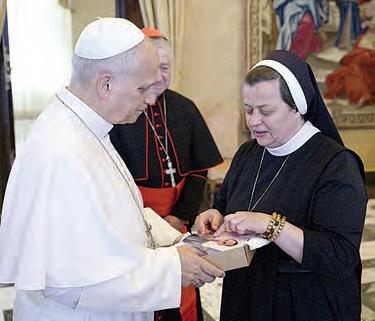
VATICAN CITY — A Ukrainian nun serving in a city on the front lines met with Pope Leo XIV during a private audience with members of a papal society, handing him images of two Ukrainian soldiers in captivity and pleading with him to “end the war.”
Basilian Sister Lucia Murashko was among those in a delegation of board members from the Catholic Extension Society. The group, led by the organization’s chancellor, Cardinal Blaise J. Cupich of Chicago, met with the pope May 18. Along with the photos of the captured
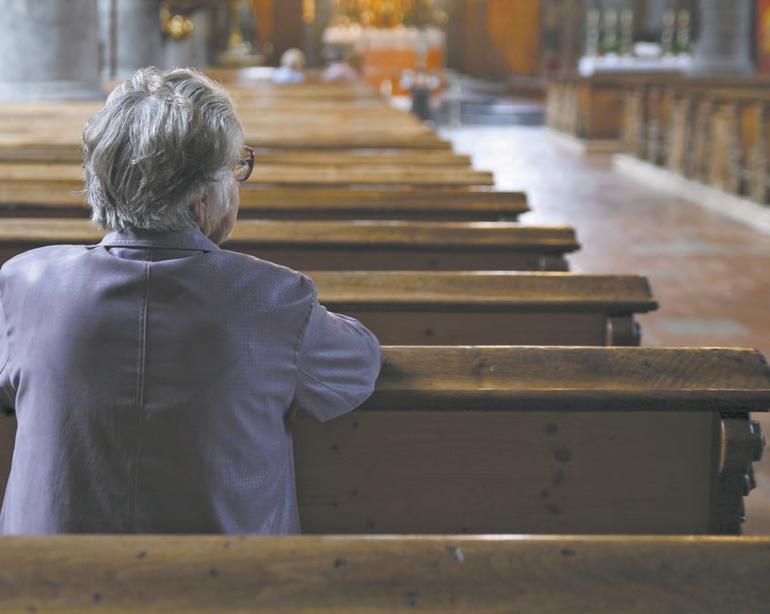
soldiers, Sister Lucia gave Pope Leo an icon of the crucified Christ and sorrowful Mary, as well as the prayers and pleas of those she serves in Ukraine.
“They said, ‘Please tell him about our life, how we struggle here, and how we need his help,’” said Sister Lucia, adding that petitioners affirmed they “would not surrender” to Russian occupation, which has seen the Ukrainian Greek Catholic Church banned and brutalized under Russian forces.
KINSHASA, Congo — Uganda’s Catholic bishops are urging calm and prayer after the government postponed this year’s Uganda Martyrs Day celebrations because of a growing Ebola outbreak in Central Africa.
The annual June 3 pilgrimage to Namugongo Shrine near Kampala typically draws millions of worshipers from across the region, including neighboring Congo, where the outbreak is centered.
Ugandan President Yoweri Museveni said the decision followed consultations with health officials and religious leaders, warning that large crowds could accelerate the spread of the virus.
Church leaders asked pilgrims already traveling to return home and instead mark the feast in local parishes.
The outbreak, linked to the rare Bundibugyo strain of Ebola, has killed more than 220 people in Congo and neighboring Uganda.
Catholic leaders and aid agencies, including Catholic Relief Services, are expanding education and emergency response efforts as fears and misinformation continue to spread. An American doctor who contracted Ebola in Congo has been flown to Germany for treatment, along with his wife and four children.
WASHINGTON, D.C. — The number of executions around the globe in 2025 surged to the highest recorded figure in 44 years, a new Amnesty International report said.
The May 17 report, titled “Death Sentences and Executions 2025,” comes soon after a recent video message from Pope Leo XIV marking 15 years since the abolition of the death penalty in his home state of Illinois.
Amnesty International recorded executions last year of 2,707 people across 17 countries including the United States, which carried out 47. The international total, which includes at least 2,159 executions in Iran, is the highest number recorded by the group since 1981.
However, the group cautioned that its tally does not include what it believes to be thousands of executions carried out in China.
In his April video message, Pope Leo said, “The Catholic Church has consistently taught that each human life, from the moment of conception until natural death, is sacred and deserves to be protected.”
— OSV News and Catholic News Service
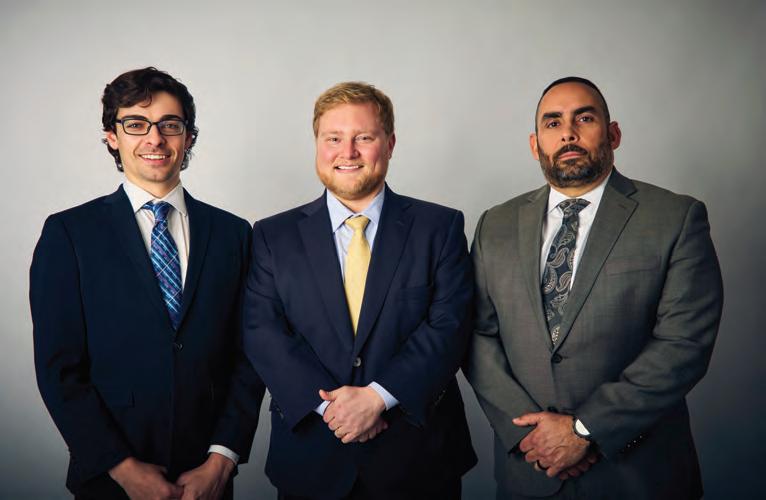

Laura Kelly Fanucci
Family life is hard. In case no one has reminded you of that lately, let me be the one. Whether you’re in the stage of diapers and bottles, wiping faces and losing sleep, or worrying about the children who have grown – the now-adults making their stumbling way through a suffering world – families will always be holy, hard, humbling schools of love.
Sometimes we look to Scripture and ask, “Does anything here speak to my life today?” Especially when biblical times, societies and structures differ sharply from our own, we may be more likely to seek support, advice or models for our daily struggles from more contemporary sources. But the Gospels do offer refreshing, realistic and surprisingly relevant stories for the struggles we face as families.
WEEPING AND BEARING WITNESS
Take Mary Magdalene, the first to encounter the Risen Christ. In the Gospel of John, she stands weeping at the empty tomb. Yet because she is willing to enter fully into her grief, she alone is there to meet the Lord (John 20:1-18). Her witness reminds us that God is always making a way to meet us in grief and loss, even after deep trauma, as Jesus did for Mary.
Or take the story of Peter sitting on the shore with the friend he denied. What searing regret he must have felt –and what a shocking twist for Jesus to offer nothing but mercy, extending the greatest second chance of all time: “Simon, son of John, do you love me?” (John 21:15-19). Peter teaches us that forgiveness after deep hurt is the way of the Christian life. Like Jesus, we must keep offering forgiveness. Like Peter, we must keep answering yes to love.
The struggles of families – and the ordinary work that keeps us going – are all over the Easter Gospels. Thomas reminds us how often we feel confused, left out or misunderstood, even among those who know us best. Sometimes it takes time, humility and a willingness to show up again to see the truth before us.
The myrrh bearers (the men and women who cared for Jesus’ body after His death) underscore the quiet holiness of tasks of care. Like Nicodemus and Joseph of Arimathea, we can carry our heavy burdens together. Like the women who brought oil and spices to anoint Jesus’ body, we learn how the smallest offerings let us care for Christ in each other.
MEETING US WHERE WE ARE
Notice where Jesus meets His disciples after the Resurrection. In a house in Emmaus, breaking bread over dinner. On the lakeshore, after a long night of fishing. On the road, when His friends were grieving and aimless. In locked rooms, where they huddled together in terror. God will meet us in the same places. Over ordinary meals, in daily work, on the road. In the midst of grief, loss and fear.
The gritty humanity of the first disciples ranks among the greatest gifts that God gave us. We do not have ancestors in faith who got everything right, whose families always flourished, whose faith never wavered or whose witness was perfect. Instead, we got sisters and brothers just like us: longing, loving but losing their way and stumbling back to God, over and over again.
What goodness of God, to give the gifts we need: real companions, rich stories and relentless grace. In the family of faith, even in our hardest days, we are never alone on the road.
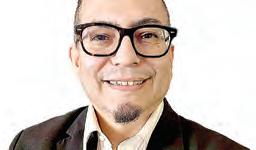
Silvio Cuéllar
It was a Sunday in the month of May, and Sergio Jiménez stood in front of a packed church at Blessed Sacrament Church, ready to make a brief invitation at the end of Mass.
Sergio, a member of the diocesan men’s retreat team “Cámbiame a Mi Señor” (“Change Me, Lord”), was there to invite the faithful to participate in a May 15-17 retreat at the Immaculate Conception Spiritual Renewal Center in Putnam, Connecticut.
With simplicity and conviction, Sergio invited other men to come to know Jesus more closely. He was sharing good news: the opportunity to grow as better Christians, fathers, sons and husbands.
His invitation reminded me of the words of Jesus before His ascension into heaven: “Peace be with you … go and make disciples of all nations” (Matthew 28:19). That call is still alive today, and people like Sergio help make it a reality.
The “Change Me, Lord” retreats began nearly 25 years ago as an effort of the Hispanic Ministry Office of the Diocese of Providence to invite the faithful to take that first step closer to the faith. The retreat offers an opportunity to step away from the routines of daily life, hear real-life testimonies from men whose lives have been transformed and experience a personal encounter with Jesus.
‘Every time I visit a parish with a Hispanic community, I see so much life, so many families and so many opportunities to grow in faith.’
Father Bob Beirne
In that encounter, many discover a profound peace and receive the abundant blessings God has prepared for those who listen to His call.
Thousands of people have participated in these retreats, both men and women. As a fruit of the experience, many have become actively involved in their parishes and now serve as leaders in various ministries, offering their talents in service to the Lord.
FINDING AND SHARING PEACE
Sergio shared how, at one point in his life, he had drifted away from the Lord, without peace or joy in his heart. Through this retreat, he was able to personally experience God’s love and mercy, finding the peace he had been searching for.
After that experience, he decided to become involved with the organizing team, made up of men from different parishes who generously offer their time, talent and treasure in service.
“I wanted to share with others what I had received, so they too could experience the love and peace that God offers us when we open our hearts to him,” Sergio said.
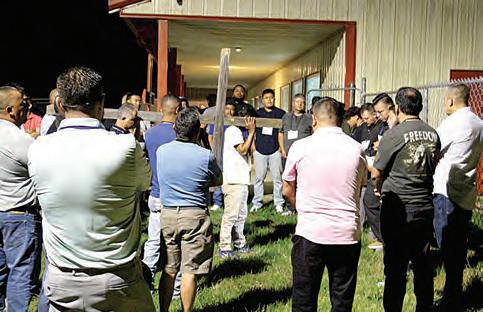
I was blessed to be part of the original team for several years, and I personally experienced the blessings of this ministry when I invited my father to attend the retreat more than 20 years ago. That experience helped change the direction of his life, bringing him closer to God, and he later served in the church choir for many years.
Years later, before his health declined and the Lord called him home, he had the opportunity to accompany me once again on the men’s retreat. It is an experience I still carry in my heart and remain grateful to have shared with him.
For several months now, a committed group of 15 men on the team has been preparing every detail so participants can experience a blessed weekend capable of becoming a turning point in their lives.
All men over the age of 18 are welcome to participate and experience this beautiful retreat: a different kind of weekend to share with others, reflect on the direction of their lives and grow – with God’s help – into better fathers, sons and husbands.
I remember the words of a priest friend, Father Bob Beirne, who is now retired and, even at 92 years old, continues serving by celebrating Masses. On several occasions he told me, “Every time I visit a parish with a Hispanic community, I see so much life, so many families and so many opportunities to grow in faith.”
As Pope Leo XIV recently reminded us, the Church grows when it goes out to encounter others with hope and love. That evangelizing mission remains alive today in our Hispanic communities.
It was beautiful during that meeting to witness the fruits of the Fifth National Encuentro of Hispanic Ministry through a spirit of collaborative pastoral work. I saw a living Church, serving with great dedication to fulfill Jesus’ call before His ascension into heaven: “Go and make disciples of all nations.”
SILVIO CUÉLLAR is a writer, liturgical music composer and journalist who formerly was coordinator of the Diocese of Providence’s Hispanic ministry office and editor of its newspaper, El Católico de Rhode Island.
Writing to the Church at the ancient city of Galatia (now in modernday Turkey), St. Paul the Apostle declared, “For freedom Christ has set us free; stand fast therefore, and do not submit again to a yoke of slavery” (Galatians 5:1).
St. Paul was addressing the specific issue of whether, and to what extent, aspects of ceremonial Mosaic law were still binding on Christians. It was not political commentary or a statement about the relationship of Christians to the government.
Nonetheless, St. Paul’s admonition can, at least by analogy, teach us something about how Christians should think about political freedom, including the freedom purportedly secured by the Declaration of Independence, the 250th anniversary of which we are commemorating this summer.
“We hold these truths to be self-evident,” the Declaration asserted in 1776, “that all men are created equal” and “endowed … with certain unalienable Rights, (including) Life, Liberty and the pursuit of Happiness.”
Echoing this passage in 1787, the Preamble to the U.S. Constitution declares that its purpose is, among other things, to “secure the Blessings of Liberty to ourselves and our Posterity.”
While these are assertions of moral and political principles that most Catholics embrace, the anniversary of the Declaration of Independence is an opportunity to examine how we understand human liberty and how that is compatible with the American idea of freedom. If, as St. Paul declares, “for freedom Christ has set us free,” how does this resonate in American political life?
St. Paul’s equivocal use of the word “freedom” teaches us that liberty is not simply the absence of constraint on our choices or actions. Rather, that notion of freedom – the ability to choose among contrary options – is for the greater purpose of achieving full human freedom. We are set free from unreasonable constraints to our liberty, but that is not the complete definition of Christian freedom. Indeed, if we stop at freedom as lack of constraint, we are ultimately endorsing a false notion of freedom as
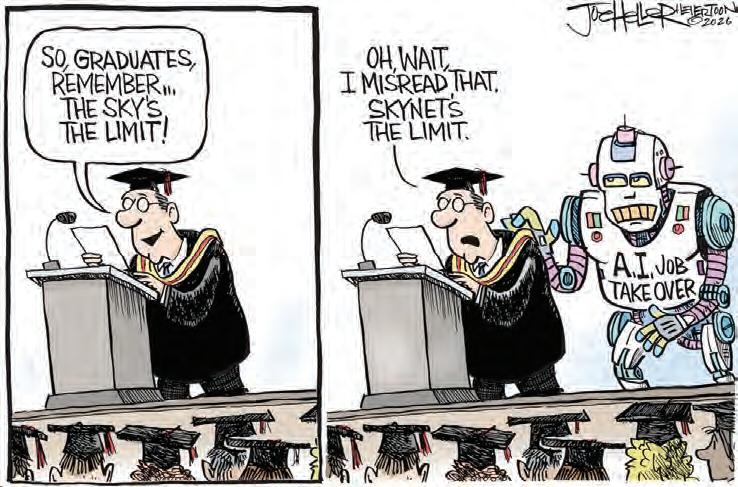
Regarding the news brief in the Catholic News Herald’s May 1 edition titled, “Pope Leo encourages death penalty abolitionists,” Pope Leo XIV’s witness to efforts to abolish the death penalty is morally courageous and sets an example for all of us.
understood in Catholic theology.
On Oct. 8, 1995, then-Pope John Paul II delivered a homily at Baltimore’s Camden Yards baseball stadium during his pilgrimage to the United States. “Today, the challenge facing America is to find freedom’s fulfillment in the truth,” the pope explained, the truth “that is intrinsic to human life created in God’s image and likeness.”
Complete freedom is achieved in using our political freedom to embrace the truth about God and man. “The truth shall make you free,” declares Jesus. If we stop at defining freedom merely as the ability to make contrary choices, we have failed in St. John Paul II’s – and Jesus’ – admonition. The absence of constraint is the means to freedom, not the end itself.
THE TRUE PURPOSE OF FREEDOM
The central political question, St. John Paul II explained, is not how we can maximize personal choices, but rather “how ought we to live together?” – and we cannot find an answer to that question outside a proper understanding of the nature and purpose of freedom. What is that purpose?
“Every generation of Americans needs to know that freedom consists not in doing what we like,” St. John Paul II explained, “but in having the right to do what we ought.”
This is a salutary lesson for us American Catholics as we celebrate the 250th anniversary of our assertion of political independence. The freedom secured by the Declaration, the Revolutionary War and the Constitution is merely the possibility of authentic freedom. As Catholics, we are challenged to witness to the relative goodness of that political freedom for the purpose of embracing the fullness of freedom found in the truth of the Gospel. Can we celebrate freedom as an absence of constraint? Yes, certainly. But is that the highest form of freedom? Our faith tells us it is not.
If we do not use our political freedom to embrace the fullness of truth, we have nothing to celebrate.
KENNETH CRAYCRAFT is a professor of moral theology at Mount St. Mary’s Seminary and School of Theology in Cincinnati and author of “Citizens Yet Strangers: Living Authentically Catholic in a Divided America” (OSV Books).
Heinous acts of violence cannot be undone. Victims and their families unquestionably need consolation and support. However, killing the killers only perpetuates the cycle of violence. Capital punishment – be it lethal injection, lethal gas, firing squad or electrocution – is permanent, final and irreversible. Execution leaves no chance for redemption for the perpetrator. It also does not allow for the exoneration of the wrongfully-convicted innocent.
Our state and national justice systems legally allow capital punishment; morally, God’s justice and mercy do not.
ANNE MCDONALD COCHRAN lives in Indian Trail.
The Catholic News Herald welcomes letters from readers. We ask that letters be originals of 250 words or fewer, pertain to recent newspaper content or Catholic issues, and be written from a perspective of Christian charity.
To be considered for publication, each letter must include the name, address and daytime phone number of the writer for purpose of verification. Letters may be condensed due to space limitations and edited for clarity, style and factual accuracy.
The Catholic News Herald does not publish poetry, form letters or petitions. Items submitted to The Catholic News Herald become the property of the newspaper and are subject to reuse, in whole or in part, in print, electronic formats and archives.
E-mail: catholicnews@rcdoc.org
Mail: Letters to the Editor Catholic News Herald 1123 S. Church St. Charlotte, N.C. 28203
‘Let us be challenged by Mary’s example of humility, active faith and obedience.’
Pope Leo XIV
From online story: “Pope remembers attempt on St. John Paul, calls Mary the Church’s ‘perfect model’”

The Catholic News Herald reached the Facebook and Instagram feeds of more than 1.8 million people in English and Spanish in 30 days ending May 26. The most talked about post? Coverage of taking steps toward a new Waxhaw parish. Join the conversation: www. facebook.com/CatholicNewsHerald
On YouTube as of May 26, videos produced by the Catholic News Herald have been viewed more than 15,000 times. The most popular video? “Meet our newest priests” video series. So far this month, 50,000 visitors to www.catholicnewsherald.com have viewed a total of 75,000 pages. The top trending headlines are:
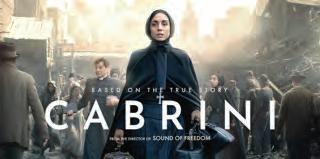
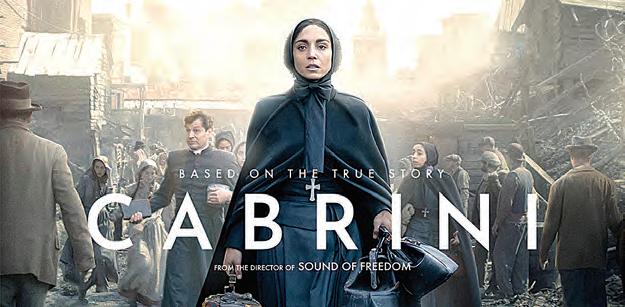

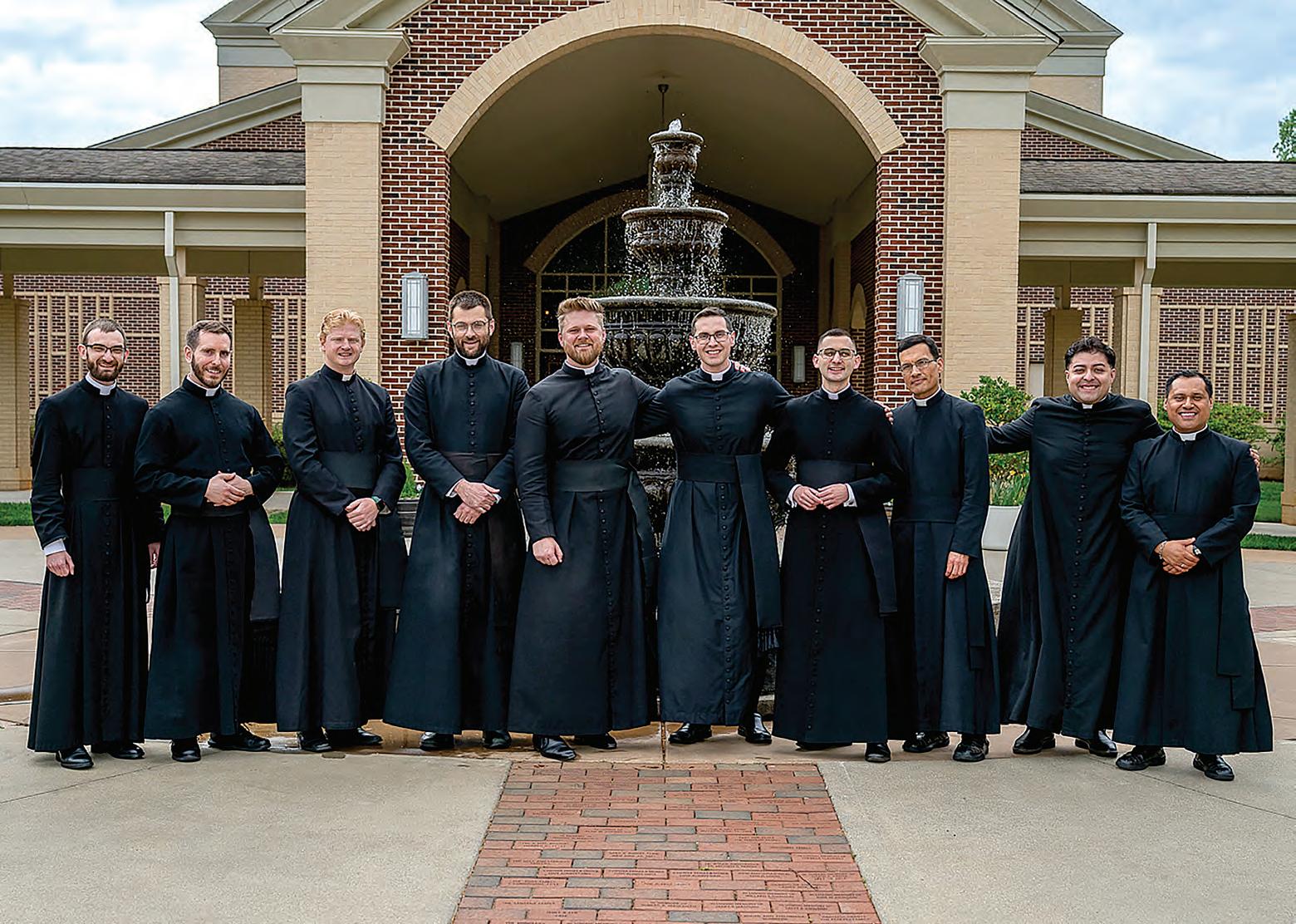
FEATURING:
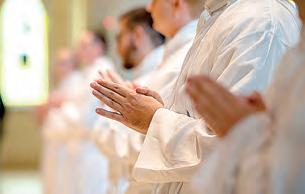
Discerning
CHRISTINA LEE KNAUSS clknauss@rcdoc.org
CHARLOTTE — The upcoming ordination of 10 priests for the Diocese of Charlotte not only represents a historic landmark, it is also a sign of a continuing diocesan-wide commitment to vocations that reaches every corner of the Catholic experience – from formation at parishes and schools to the halls of St. Joseph College Seminary and in the hearts of individuals and families.
The May 30 ordination, which will be celebrated by Bishop Michael Martin at St. Mark Church in Huntersville, follows the ordinations of six men in 2025 and closely approaches the previous record of seven achieved in both 2000 and 2024.
With only two priests retiring this summer, this year’s new ordinands will join 145 priests now serving in some capacity for a Catholic population that now tops 575,000.
The record year of ordinations was the result of ongoing growth in vocations driven by the increased awareness built up over the past few decades, said Vocations Director Father John Eckert, who took over the role last July, succeeding longtime director Father Christopher Gober.
“I certainly have not had a lot of downtime since I took on this role, but that’s been such a good thing,” Father Eckert said. “It’s exciting to be welcoming 10 new brother priests, and I’ve loved getting to accompany them in this time of formation.”
“Since I started this work, I’ve realized I’m inheriting the good work of so many people who have built up what we have in this diocese,” he said. “We’re very blessed because we have a good overall climate for vocations, including supportive parishes and parishioners, pastors and other priests leading by example, and mothers and fathers who are encouraging their children to explore their vocation in life.”
Juan González Hernández, one of the 10 who will be ordained May 30, said his family’s witness played a decisive role in his priestly vocation. Watching his brother celebrate Mass after he was ordained sparked a question in his young heart: “What if I myself become a priest one day, like my brother?”
A large part of the growth has come from a commitment across the diocese to encourage young people – like Deacon Hernández – to consider how God is calling them, Father Eckert said.
That’s evident in the growth of vocations summer camps.
Under Father Gober, two vocations camps were launched: “Quo Vadis Days” in 2014 for young men and “Duc in Altum” in 2016 for young women. The
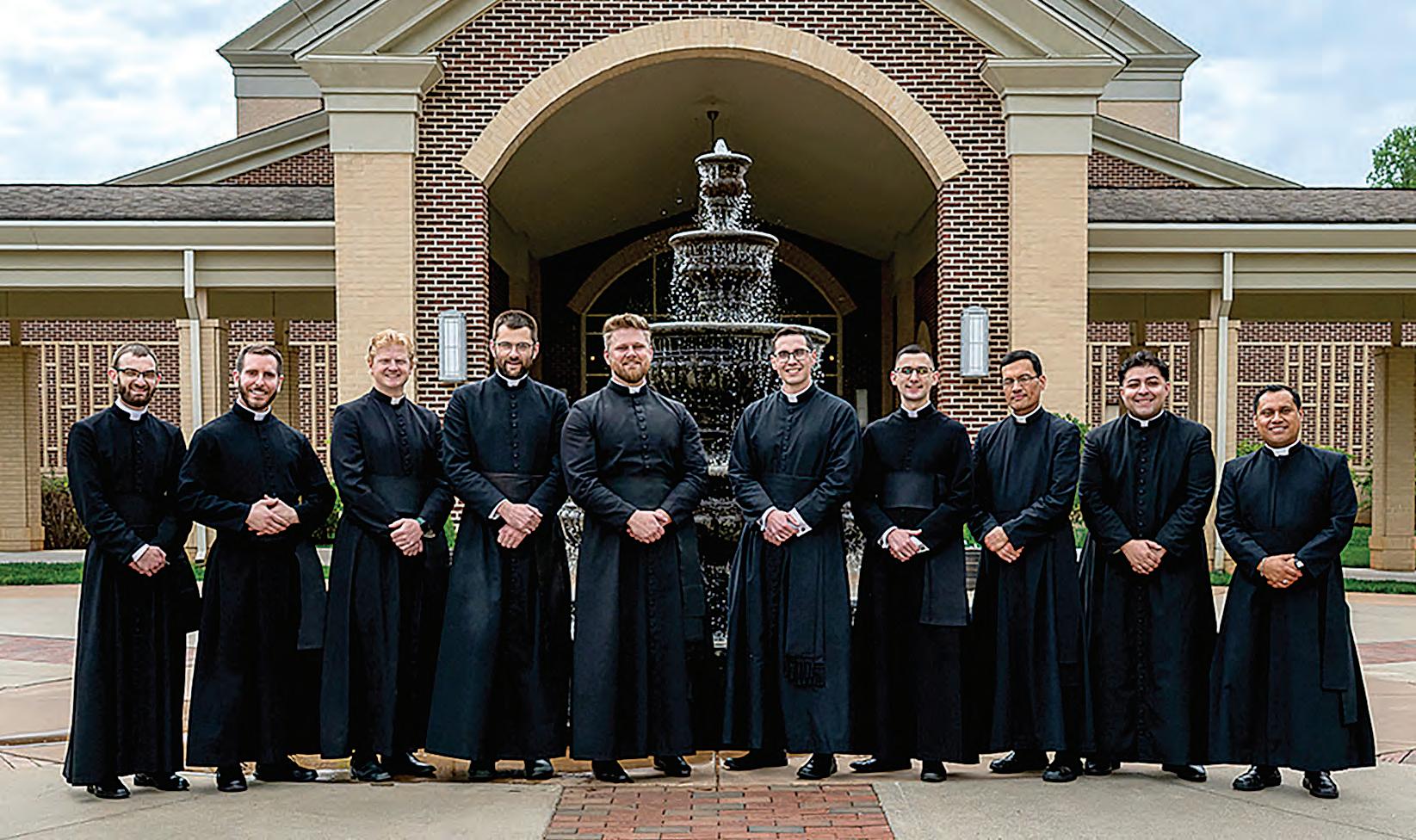
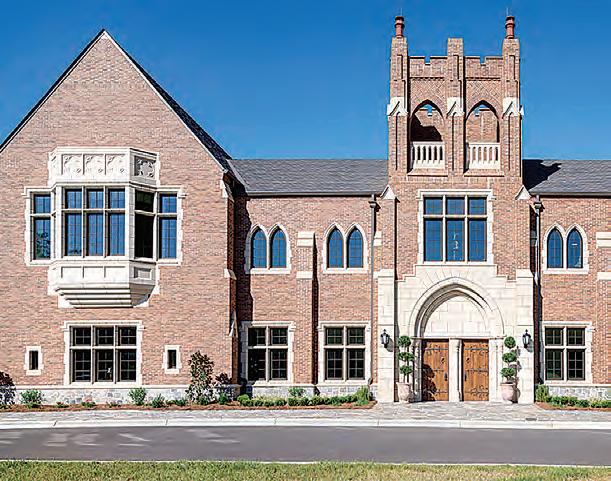
programs have helped thousands of teenagers explore potential religious vocations through prayer, talks and fellowship. There is also a discernment day for young women called “Talitha Koum.” All are held at Belmont Abbey College.
Diocesan leaders also cite the profound impact of St. Joseph College Seminary in Mount Holly, which was founded by thenBishop Peter Jugis in 2016. Eight of this year’s ordinands studied
there before advancing to major seminary. The other two lived there during their pastoral years of ministering to a parish.
At the college seminary, men discern the priesthood while earning a bachelor’s degree at nearby Belmont Abbey College before going on to theology studies at major seminary.
For Deacon John Cuppett, who played baseball at Belmont Abbey College, it was in that supportive college environment
that his childhood desires for the priesthood “came crashing back.”
“Many years ago, seeing the desperate need for priests, Bishop Jugis and his clergy made the cultivation of vocations the highest priority,” said the seminary’s rector Father Matthew Kauth.
“From this earnest prayer arose many endeavors from Quo Vadis to St. Joseph College Seminary,” Father Kauth said.
“We are now reaping the harvest of 20-plus years of labor. It didn’t just happen. God has blessed our efforts and a culture of vocations has been established – yielding increasing returns, just as Christ said it would. Now, we must cultivate and care for those vocations and give thanks to God.”
Father Brian Becker, director of formation at the college seminary, said it’s been exciting to watch the current class progress through their studies and said, “it’s now a time of great joy to celebrate their reaching the altar.”
“It’s a real inspiration to see so many men willing to lay down their lives for Christ,”
Father Becker said. “It gives hope to us priests who have been ministering for some years to see men with great vigor coming to join the ranks, and it gives great inspiration to young men considering becoming priests themselves to see so many men answering the call.”
Deacon James Tweed echoes his fellow ordinands in telling men who might be discerning a priestly vocation to embrace that call.
“Do not be afraid to trust Him, even when the path is unclear. God’s call is a gift,” he said.
As the diocese moves into the future, Father Eckert urges all of the faithful not to rest there on this record, but to continue fostering vocations.
“The momentum we’ve had needs to continue, and it’s important that we never take the gift of the faith for granted,” he said. “We’re in an exciting time right now, with news like the addition of a new parish in Waxhaw, but we have to make sure we don’t take that for granted. People need to continue to stay engaged in loving their parishes and sharing the love of Jesus. When we’re all living that way, it encourages young men and young women to want to share in that.”
— Kimberly Bender contributed.
More online
At www.catholicnewsherald.com : Get to know our new priests and deacons
On the Diocese of Charlotte’s YouTube channel View the ordination Masses for both priests and deacons and hear from our newest priests in videos
Deacon Robert Bauman
scholarship, where I played as a second baseman for four years.
Age: 31
Home parish: St. Ann in Charlotte
Born and raised in: Wilmington
Interests/hobbies: Hiking, disc golf, running and reading at a local coffee shop
Summer assignments in the diocese: Sacred Heart in Salisbury, Our Lady of Mercy in Winston-Salem and St. Lucien/St. Bernadette Mission (Spruce Pine and Linville)
When did you first realize you had a call to the priesthood? “During an eight-day Ignatian silent retreat.”
What advice do you have for someone thing about the priesthood? “Be patient and unafraid! The Lord has a plan to make you a great saint if you let Him, but you have to let Him work in His timing, not anxiously grasping for an answer whether or not to go to seminary, but rather trusting that the Voice of Peace will guide you in His time and in His way.”
Deacon Michael Camilleri
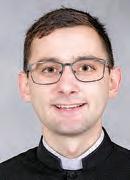
Age: 26
Home parish: St. Elizabeth in Boone
Born in: Florida
Raised in: North Carolina
Interests/hobbies: Learning languages and calligraphy
Summer assignments: St. Jude in Sapphire, Our Lady of the Mountains in Highlands, St. Gabriel in Charlotte
When did you first realize you had a call to the priesthood? “I first heard the call to the priesthood when I was very young – 3 or 4 years old. My family loves to talk about how I used to ‘play Mass,’ which is actually one of my earliest memories. I lost sight of the vocation in late elementary school until right before high school. I wanted to go into computer science. While preparing to enter high school, by the grace of God, I decided to pursue what He put on my heart from that early age, and I entered the college seminary.”
Deacon Daniel Chaves Peña
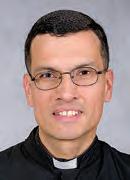
Age: 44
Home parish: Immaculate Conception, Hendersonville
Born in: Bogotá, Colombia; moved to New Jersey in 1993
Faith journey: His journey of formation led him to missions in Peru from 2016 to 2018, and then to Rome, where he earned his Baccalaureate in Sacred Theology in 2021. In 2023, Chaves joined the Diocese of Charlotte’s seminary program.
When did you first feel a calling to the priesthood? “When I got to what was going to be my last year of high school, I ran crosscountry and I was doing pretty well. I had many scholarship offers from universities here in the United States, and in the final race of the state championship in New Jersey, I collapsed just before reaching the finish line. They rushed me to the ER, and they told me it was my sugar levels – they were extremely low. That began a crisis not only health-wise, but spiritually. And I wasn’t getting better. I had relapses, so the decision was made for me to return to Colombia with my mom.”
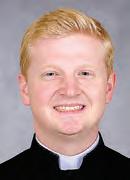
Age: 28
Home parish: St. Leo the Great in WinstonSalem
Born in: Cary
Raised in: Four Oaks
Vested by: Father Jose Palma Torres
Interest/hobbies: Sports and the outdoors, including hiking and camping
Summer assignments: Missionary work with the order of Jesus Crucified in Louisiana
When did you first realize you had a call to the priesthood? “During high school I was interested in joining the seminary after I graduated. However, I did very little in pursuing it and soon it faded into the background. From then on and up until college it was a fun idea, but nothing more. After high school I attended Belmont Abbey College on a baseball
“During my time at the Abbey, I met Matthew Harrison, a Charlotte seminarian. I informed him of my past dream of becoming a priest and he invited me to visit St. Joseph College Seminary. I did, and then all my previous desires and hopes for the priesthood came crashing back. I quickly sought help in my discernment with the diocesan Vocations Office. My senior year at the Abbey, I started spiritual direction with Father Brian Becker, the diocese’s promoter of vocations, and he helped me tremendously by answering all my questions, fears and thoughts regarding my vocation. Together we discovered that my call to the priesthood was very real, and he referred me to Father Christopher Gober, diocesan vocations director, to begin the process of applying.”
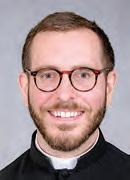
Age: 31
Home parish: St. Dorothy in Lincolnton
Born in: Villingen, Germany
Interests/hobbies: Chess, fitness and spiritual reading
Summer assignments: St. Patrick Cathedral in Charlotte, St. John the Evangelist in Waynesville and St. John the Baptist in Tryon
When did you first realize you had a call to the priesthood? “The first time I can remember when I had a calling was when I was waiting in the confession line as a kid. Many years later in my mid20s, after living a worldly and superficial life, it was Our Lord once more who called me to serve Him as a priest.”
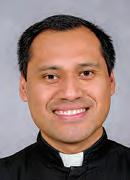
Age: 35
Home parish: Immaculate Conception in Hendersonville
Raised in: Mexico City
When did you first feel a calling to the priesthood? “It was the day that my brother was ordained a priest in 1997 when I was just about to turn 7 years old. On that day, the light bulb in me lit up and I asked myself, ‘What if I myself become a priest one day, like my brother?’”
What was it like to continue your studies by leaving for Spain? “My brother, a priest, and two of my sisters, who were cloistered nuns, lived there. My brother studied in Spain while in seminary and my sisters were also a part of the institute Obra de Amor, which brought them to Spain. Having them there was helpful, because even though it was a new experience for me, I could be close to my family and learn from them.”
What does it mean to you to be able to serve the Hispanic community? “I have lived in many different places with a variety of cultures. I feel as though I mold well to both communities, the Anglo and Hispanic communities. So the idea that my mentor at Immaculate Conception in Hendersonville, Father Andrés Gutierrez, has mentioned is to create a singular and strong community out of both of those cultures. That way, people do not show divisions but, rather, the Church becomes a place where everyone feels like one community.”
What will it mean for you to become a priest? “It is a radical change in my life, because after this moment I will be a representative of not only the Church, but of Jesus Christ. Of course, the responsibility is much bigger, but I am also conscious that God’s grace, the prayers of the faithful and a spiritual life, help to take charge of that weight.”
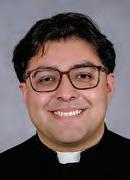
Age: 30
Home parish: Our Lady of the Americas in Biscoe
Raised in: Zitácuaro, Michoacán, Mexico Interests/hobbies: “Expanding my knowledge of different cultures, such as Japanese, Korean, Filipino and many others; watching TV and movies and a football fan of La Liga, the Premier League and other leagues.” Summer assignments: Immaculate Conception in Hendersonville and St. Francis of Assisi in Lenoir
When did you first realize you had a call to the priesthood? “If I had to decide a moment in my life when I first realized, it was when I was helping my pastor, Father Ricardo Sanchez, to close the church one night. After locking all the doors of the church, turning off all the lights, and making sure no one was left behind, I met with my pastor at the sanctuary to say goodbye. We were the only ones left at the
church, and he asked me a question I have not forgotten: ‘Bryan, do you want to be a priest?’ Before I could respond, he said, ‘Before you answer, look at the Tabernacle; you are not going to answer to me but to God.’ ‘Great,’ I thought to myself. ‘Now, I can’t lie or give an incomplete answer.’ I thought, ‘If this is God’s will, I will give it a shot.’ Shortly after, I told my pastor, ‘Yes.’ This first step was accepting that God called me to enter the seminary.”
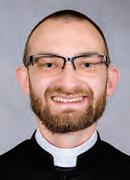
Age: 25
Home parish: Immaculate Conception in Forest City
Born in: Kansas
Raised in: Rutherfordton
Interests/hobbies: Running, skiing, euchre, reading and piano
Summer assignments: Holy Cross in Kernersville, St. Lucian and St. Bernadette in Spruce Pine/Linville and St. John the Baptist, Tryon
When did you first realize you had a call to the priesthood? “There were several points growing up that I remember seriously considering it as an option. But I really started taking it seriously during Quo Vadis Days in the summer of 2018. Throughout the course of that week, spending time in prayer and learning about the priesthood, it seemed to me that the priesthood was the summation of everything I wanted out of life, particularly the way in which the life of a priest is completely dedicated to one thing: the service of God.”
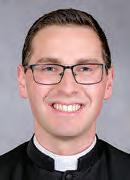
Age: 25
Home parish: St. Ann in Charlotte
Born in: Racine, Wisconsin
Raised in: Charlotte
Interests/hobbies: “I enjoy playing guitar in my free time and reading a good novel (right now I’m reading Dostoevsky’s “Brothers Karamozov”). I’ve also found that I enjoy learning languages. Right now, I’m working on Spanish and would like to one day work on French (maybe even Italian and German).”
Summer assignments: “I participated in the St. Joseph Workers’ program where myself and my brother seminarians traveled around the diocese performing different odd jobs like lawn mowing, mulch spreading, painting. After entering theology, I spent my summers at St. John the Baptist Parish in Tryon, St. Mark Parish in Huntersville and Our Lady of Grace Parish in Greensboro.”
When did you first realize you had a call to the priesthood? “I always knew I wanted to be a priest, so I entered St. Joseph College Seminary straight out of high school. I first felt the call to the priesthood when I was about 5 years old, and the feeling never left me. So, when St. Joseph’s opened in 2016, I knew what I had to do.”
Deacon James
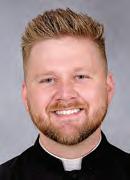
Age: 31
Home parish: Sacred Heart in Brevard Interests/hobbies? Working out, writing poetry and prose, walking in the woods, oil painting and hosting friends
Who is your favorite saint? “The Blessed Virgin Mary. When I’m with her, I feel very close to Jesus.”
What is your favorite Bible verse? “For she is a breath of the power of God, and a pure emanation of the glory of the Almighty; therefore nothing defiled gains entrance into her. For she is a reflection of eternal light, a spotless mirror of the working of God, and an image of his goodness” (Wisdom 7:25-26).
What was your journey of discernment like?
“There were moments when I sensed I was set apart for something special, though I couldn’t yet see what that would be. Then came the moment during a Steubenville retreat in Atlanta. I was completely unprepared – the thought had never even entered my mind. I did not want this path, and I could not have imagined choosing it myself. Yet, in that moment, I felt an irresistible movement within my heart. It was as if the Lord spoke my name in a way that embraced my whole being, drawing me with a love both commanding and tender. Almost before I knew it, I stood. In that moment, I understood with clarity and joy that my life belonged to Him.”
Any advice for men considering the priesthood? “The joy, peace and purpose that come from embracing God’s plan for your life far surpass any earthly attachment. Do not be afraid to trust Him, even when the path is unclear. God’s call is a gift.”
CHRISTINA LEE KNAUSS clknauss@rcdoc.org
CHARLOTTE — La próxima ordenación de 10 sacerdotes para la Diócesis de Charlotte no solo representa un hito histórico, sino también una señal de un compromiso continuo en toda la diócesis con las vocaciones, que alcanza cada rincón de la experiencia católica, desde la formación en parroquias y escuelas hasta los pasillos del Seminario Universitario San José y los corazones de personas y familias.
La ordenación del 30 de mayo, que será celebrada por el obispo Michael Martin en la Iglesia San Marcos en Huntersville, sigue a las ordenaciones de seis hombres en 2025 y se acerca al récord anterior de siete alcanzado tanto en 2000 como en 2024.
Con solo dos sacerdotes jubilándose este verano, los nuevos ordenandos de este año se unirán a los 145 sacerdotes que actualmente sirven de alguna manera a una población católica que ya supera los 575,000 fieles.
El año récord de ordenaciones fue resultado del crecimiento continuo de las vocaciones impulsado por una mayor conciencia construida durante las últimas décadas, dijo el director de Vocaciones, el padre John Eckert, quien asumió el cargo en julio de 2025, sucediendo al padre Christopher Gober.
“Ciertamente no he tenido mucho tiempo libre desde que asumí este cargo, pero eso ha sido algo muy bueno”, dijo el padre Eckert. “Es emocionante dar la bienvenida a 10 nuevos sacerdotes hermanos, y me ha encantado acompañarlos durante este tiempo de formación.
“Desde que comencé este trabajo, me he dado cuenta de que estoy heredando la buena labor de tantas personas que han construido lo que tenemos en esta diócesis”, dijo. “Somos muy bendecidos porque tenemos un buen ambiente general para las vocaciones, incluyendo parroquias y feligreses que apoyan, párrocos y otros sacerdotes que lideran con el ejemplo, y madres y padres que animan a sus hijos a explorar su vocación en la vida”.
El diácono Juan González Hernández, quien será ordenado el 30 de mayo, dijo que el testimonio de su familia desempeñó un papel decisivo en su vocación. Ver a su hermano celebrar la Misa después de ser ordenado despertó una pregunta en su joven corazón: “¿Y si yo mismo llegara a ser sacerdote algún día, como mi hermano?” Gran parte del crecimiento ha surgido de un compromiso en toda la diócesis para animar a los jóvenes —como el diácono Hernández— a considerar cómo Dios los está llamando, dijo el
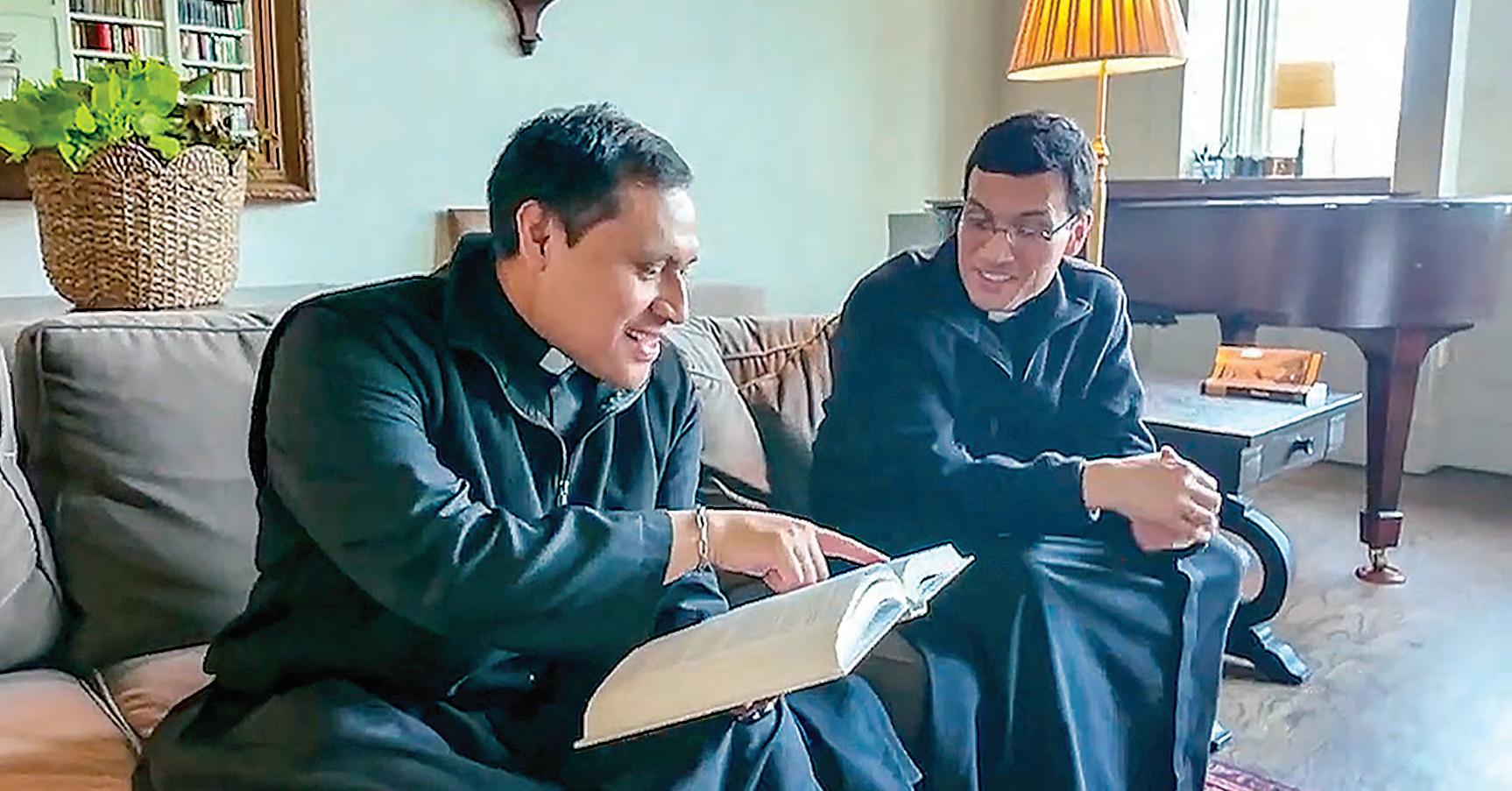
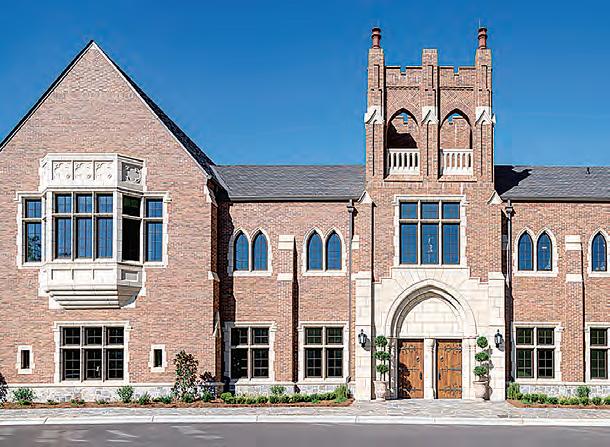
padre Eckert. Eso es evidente en el crecimiento de los campamentos de verano vocacionales. Bajo la dirección del padre Gober, se lanzaron dos campamentos vocacionales: “Quo Vadis Days” en 2014 para jóvenes varones y “Duc in Altum” en 2016 para jóvenes mujeres. Los programas han ayudado a miles de adolescentes a explorar posibles vocaciones religiosas mediante la oración, charlas y convivencia. También existe un día de discernimiento para mujeres jóvenes llamado “Talitha Koum”. Todos se llevan a cabo en Belmont Abbey College. Los líderes diocesanos también
destacan el profundo impacto del Seminario Universitario San José en Mount Holly, que abrió en 2016 y fue fundado por el obispo Peter Jugis. Ocho de los ordenandos de este año estudiaron allí antes de avanzar al seminario mayor. Los otros dos vivieron allí durante sus años pastorales sirviendo en una parroquia.
En el seminario universitario, los hombres disciernen el sacerdocio mientras obtienen una licenciatura en el cercano Belmont Abbey College antes de continuar hacia el seminario mayor.
Para el diácono John Cuppett, quien jugó béisbol en Belmont Abbey College, fue en ese
ambiente universitario de apoyo donde sus deseos de infancia por el sacerdocio “regresaron con fuerza”.
“Hace muchos años, al ver la necesidad desesperada de sacerdotes, el obispo Jugis y su clero hicieron del cultivo de vocaciones la máxima prioridad”, dijo el rector del seminario, el padre Matthew Kauth.
“De esta oración sincera surgieron muchos esfuerzos, desde Quo Vadis hasta el Seminario Universitario San José”, dijo el padre Kauth. “Ahora estamos cosechando el fruto de más de 20 años de trabajo. No ocurrió simplemente por casualidad. Dios ha bendecido nuestros esfuerzos y se ha establecido una cultura de vocaciones que está dando frutos cada vez mayores, tal como Cristo dijo que sucedería. Ahora debemos cultivar y cuidar esas vocaciones y dar gracias a Dios”.
El Padre Brian Becker, director de formación del seminario, dijo que ha sido emocionante ver cómo la clase actual ha progresado a lo largo de sus años de formación y afirmó que “es un momento de gran alegría celebrar que han llegado al altar”.
“Es una verdadera inspiración ver a tantos hombres dispuestos a entregar sus vidas por Cristo”, dijo el Padre Becker. “Nos da esperanza a los sacerdotes que hemos estado ejerciendo el ministerio durante algunos años ver a hombres con gran vigor unirse a nuestras filas, y también brinda una gran inspiración a los jóvenes que están considerando hacerse sacerdotes al ver a tantos
hombres responder al llamado”. El diácono James Tweed coincide con sus compañeros ordenandos al decirles a los hombres que podrían estar discerniendo una vocación sacerdotal que acepten ese llamado.
“No tengan miedo de confiar en Él, incluso cuando el camino no esté claro. El llamado de Dios es un regalo”, dijo.
Mientras la diócesis avanza hacia el futuro, el padre Eckert exhorta a todos los fieles a no conformarse con este récord, sino a seguir fomentando las vocaciones.
“El impulso que hemos tenido necesita continuar, y es importante que nunca demos por sentado el don de la fe”, dijo. “Estamos viviendo un momento emocionante ahora mismo, con noticias como la incorporación de una nueva parroquia en Waxhaw, pero debemos asegurarnos de no dar eso por sentado. La gente necesita seguir comprometida en amar a sus parroquias y compartir el amor de Jesús. Cuando todos vivimos de esa manera, eso anima a jóvenes hombres y mujeres a querer participar también en ello”. — Kimberly Bender contribuyó.
Más online
En catholicnewsherald.com : Conozca a nuestros nuevos sacerdotes y diáconos.
En el canal de YouTube de la Diocese of Charlotte : Vea las misas de ordenación tanto de sacerdotes como de diáconos y escuche a nuestros sacerdotes más recientes en videos.
Diácono Robert Bauman
Edad: 31
Parroquia de origen: St. Ann en Charlotte Nació y creció en: Wilmington
Intereses/pasatiempos: Senderismo, disc golf, correr y leer en una cafetería local Asignaciones de verano: Sacred Heart en Salisbury, Our Lady of Mercy en Winston-Salem y St. Lucien / St. Bernadette Mission en Spruce Pine / Linville.
¿Cuándo se dio cuenta por primera vez de que tenía un llamado al sacerdocio?
“Durante un retiro ignaciano de silencio de ocho días.”
Diácono Michael Camilleri
Edad: 26
Parroquia de origen: St. Elizabeth en Boone
Nació en: Florida
Creció en: Carolina del Norte
Intereses/pasatiempos: Aprender idiomas y caligrafía
Asignaciones de verano: St. Jude en Sapphire, Our Lady of the Mountains en Highlands, St. Gabriel en Charlotte ¿Cuándo se dio cuenta por primera vez de que tenía un llamado al sacerdocio?
“Escuché por primera vez el llamado al sacerdocio cuando era muy pequeño, a los 3 o 4 años. A mi familia le encanta hablar de cómo yo solía ‘jugar a la misa’, lo cual es en realidad uno de mis primeros recuerdos. Perdí de vista la vocación al final de la primaria hasta justo antes de la secundaria. Quería dedicarme a la informática.
“Mientras me preparaba para entrar a la secundaria, por la gracia de Dios decidí seguir lo que Él había puesto en mi corazón desde aquella temprana edad, y entré al seminario universitario.”
Diácono Daniel Chaves Peña
Edad: 44
Parroquia de origen: Immaculate
Conception, Hendersonville Nació en: Bogotá, Colombia; se mudó a Nueva Jersey en 1993.
Camino de fe: Su proceso de formación lo llevó a misiones en Perú de 2016 a 2018, y luego a Roma, donde obtuvo su Bachillerato en Sagrada Teología en 2021. En 2023, Chaves se unió al programa de seminario de la Diócesis de Charlotte.
¿Cuándo sintió por primera vez el llamado al sacerdocio?
“Cuando llegué al que iba a ser mi último año de secundaria, corría campo traviesa y me estaba yendo bastante bien. Tenía muchas ofertas de becas de universidades aquí en los Estados Unidos y, en la carrera final del campeonato estatal en Nueva Jersey, me desplomé justo antes de cruzar la meta. Me llevaron de emergencia al hospital y me dijeron que era por mis niveles de azúcar: estaban extremadamente bajos. Eso inició una crisis no solo de salud, sino también espiritual. Y no mejoraba. Tuve recaídas, así que se tomó la decisión de que regresara a Colombia con mi mamá.”
Diácono John Cuppett
Edad: 28
Parroquia de origen: St. Leo the Great en Winston-Salem
Nació en: Cary
Creció en: Four Oaks
Revestido por: Padre José Palma Torres
Intereses/pasatiempos: Deportes y actividades al aire libre, incluyendo senderismo y campamento
Asignaciones de verano: Trabajo misionero con la orden de Jesús Crucificado en Luisiana ¿Cuándo se dio cuenta por primera vez de que tenía un llamado al sacerdocio?
Cuppett jugó béisbol en Belmont Abbey College y clarificó el llamado mientras estaba en la universidad.
“Durante la secundaria estaba interesado en entrar al seminario después de graduarme; sin embargo, hice muy poco para perseguirlo y pronto quedó en el olvido. Desde entonces y hasta la universidad era una idea agradable, pero nada más. Después de la secundaria asistí a Belmont Abbey College con una beca de béisbol, donde jugué como segunda base durante cuatro años.
“Durante mi tiempo en la Abbey conocí a Matthew Harrison, un seminarista de Charlotte. Le conté sobre mi antiguo sueño de convertirme en sacerdote y me invitó a visitar el Seminario Universitario St. Joseph. Lo hice, y entonces todos mis deseos y esperanzas anteriores sobre el sacerdocio regresaron con fuerza. Rápidamente busqué ayuda para mi discernimiento en la Oficina Diocesana de Vocaciones. En mi último año en la Abbey, comencé dirección espiritual con el Padre Brian Becker, promotor de vocaciones de la diócesis, y él me ayudó muchísimo respondiendo todas mis preguntas, temores y pensamientos respecto a mi vocación. Juntos descubrimos que mi llamado al sacerdocio era muy real, y él me remitió al Padre Christopher Gober, director diocesano de vocaciones, para comenzar el proceso de solicitud.”
Diácono Maximilian Frei
Edad: 31
Parroquia de origen: St. Dorothy en Lincolnton
Nació en: Villingen, Alemania Intereses/pasatiempos: Ajedrez, acondicionamiento físico y lectura espiritual
Asignaciones de verano: St. Patrick Cathedral en Charlotte, St. John Church en Waynesville y St. John the Baptist en Tryon ¿Cuándo se dio cuenta por primera vez de que tenía un llamado al sacerdocio? “La primera vez que recuerdo haber sentido un llamado fue cuando esperaba en la fila para la confesión siendo niño. Muchos años después, ya en mis veintitantos, después de vivir una vida mundana y superficial, fue Nuestro Señor una vez más quien me llamó a servirle como sacerdote.”
Diácono Juan González Hernández
Edad: 35
Parroquia de origen: Immaculate
Conception en Hendersonville
Creció en: Ciudad de México ¿Cuándo sintió por primera vez el llamado al sacerdocio? “Fue el día en que mi hermano fue ordenado sacerdote en 1997, cuando yo estaba a punto de cumplir 7 años. Ese día se encendió una luz dentro de mí y me pregunté:
‘¿Y si algún día yo también me convierto en sacerdote, como mi hermano?’”
¿Cómo fue continuar sus estudios al irse a España? “Allí vivían mi hermano sacerdote y dos de mis hermanas, que eran monjas de clausura. Mi hermano estudió en España mientras estaba en el seminario y mis hermanas también formaban parte del instituto Obra de Amor, lo que las llevó a España.
“Tenerlos allí fue de ayuda porque, aunque era una experiencia nueva para mí, podía estar cerca de mi familia y aprender de ellos.”
¿Qué significa para usted poder servir a la comunidad hispana? “He vivido en muchos lugares diferentes con una variedad de culturas. Siento que me adapto bien tanto a la comunidad anglo como a la hispana. Así que la idea que ha mencionado mi mentor en Immaculate Conception en Hendersonville, el Padre Andrés Gutiérrez, es crear una comunidad única y fuerte a partir de ambas culturas. De esa manera, las personas no muestran divisiones, sino que la Iglesia se convierte en un lugar donde todos se sienten parte de una sola comunidad.”
¿Qué significará para usted convertirse en sacerdote? “Es un cambio radical en mi vida, porque después de este momento seré representante no solo de la Iglesia, sino de Jesucristo. Por supuesto, la responsabilidad es mucho mayor, pero también soy consciente de que la gracia de Dios, las oraciones de los fieles y una vida espiritual ayudan a llevar ese peso.”
Edad: 30
Parroquia de origen: Our Lady of the Americas en Biscoe
Creció en: Zitácuaro, Michoacán, México Intereses/pasatiempos: “Expandir mi conocimiento de diferentes culturas, como la japonesa, coreana, filipina y muchas otras; ver televisión y películas y ser aficionado al fútbol de La Liga, la Premier League y otras ligas.”
Asignaciones de verano: Immaculate
Conception en Hendersonville y St. Francis of Assisi en Lenoir
¿Cuándo se dio cuenta por primera vez de que tenía un llamado al sacerdocio? “Si tuviera que decidir un momento en mi vida en que me di cuenta por primera vez, fue cuando estaba ayudando a mi párroco Ricardo Sánchez a cerrar la iglesia una
noche. Después de cerrar todas las puertas de la iglesia, apagar todas las luces y asegurarse de que nadie quedara dentro, me reuní con mi párroco en el santuario para despedirme. Éramos los únicos que quedábamos en la iglesia, y él me hizo una pregunta que nunca he olvidado. ‘Bryan, ¿quieres ser sacerdote?’ Antes de que pudiera responder, dijo: ‘Antes de responder, mira el Sagrario; no me vas a responder a mí sino a Dios.’ Genial, pensé para mí mismo. Ahora no puedo mentir ni dar una respuesta incompleta. Pensé: ‘Si esta es la voluntad de Dios, lo intentaré.’ Poco después, le dije a mi párroco: ‘Sí.’ Este primer ‘paso’ fue aceptar que Dios me llamaba a entrar al seminario.”
Edad: 25
Parroquia de origen: Immaculate Conception en Forest City
Nació en: Kansas
Creció en: Rutherfordton
Intereses/pasatiempos: Correr, esquiar, euchre, leer y tocar piano
Asignaciones de verano: Holy Cross en Kernersville, St. Lucian and St. Bernadette en Spruce Pine/Linville y St. John the Baptist en Tryon
¿Cuándo se dio cuenta por primera vez de que tenía un llamado al sacerdocio? “Hubo varios momentos mientras crecía en los que recuerdo considerar seriamente esta posibilidad. Pero realmente empecé a tomarlo en serio durante los Quo Vadis Days en el verano de 2018. A lo largo de esa semana, pasando tiempo en oración y aprendiendo sobre el sacerdocio, me pareció que el sacerdocio era la culminación de todo lo que quería en la vida, particularmente la manera en que la vida de un sacerdote está completamente dedicada a una sola cosa: el servicio a Dios.”
Diácono Peter Townsend
Edad: 25
Parroquia de origen: St. Ann en Charlotte
Nació en: Racine, Wisconsin
Creció en: Charlotte
Intereses/pasatiempos: “Disfruto tocar guitarra en mi tiempo libre y leer una buena novela (ahora mismo estoy leyendo Los hermanos Karamázov de Dostoyevski). También he descubierto que disfruto aprender idiomas. En este momento estoy trabajando en mi español y me gustaría algún día aprender francés (¡quizás incluso italiano y alemán!).”
Asignaciones de verano: “Participé en el programa St. Joseph Workers, donde mis compañeros seminaristas y yo viajábamos por la diócesis realizando distintos trabajos como cortar césped, esparcir mantillo y pintar. Después de entrar en teología, pasé mis veranos en la parroquia St. John the Baptist en Tryon, St. Mark Parish en Huntersville y Our Lady of Grace Parish en Greensboro.” ¿Cuándo se dio cuenta por primera vez de que tenía un llamado al sacerdocio? “Siempre supe que quería ser sacerdote, así que entré al Seminario Universitario St. Joseph justo después de la secundaria.
“Sentí por primera vez el llamado al sacerdocio cuando tenía unos cinco años, y ese sentimiento nunca me abandonó. Así que, cuando St. Joseph’s abrió en 2016, supe lo que tenía que hacer.”
Edad: 31
Parroquia de origen: Sacred Heart en Brevard
¿Cuáles son sus pasatiempos? Entrenar, escribir poesía y prosa, caminar por el bosque, pintar al óleo y recibir amigos.
¿Quién es su santo favorito? “La Santísima Virgen María. Cuando estoy con ella, me siento muy cerca de Jesús.”
¿Cuál es su versículo bíblico favorito?
“Porque ella es un soplo del poder de Dios y una pura emanación de la gloria del Omnipotente; por eso nada manchado entra en ella. Porque es reflejo de la luz eterna, espejo sin mancha de la actividad de Dios e imagen de su bondad” (Sabiduría 7:25-26).
¿Cómo fue su camino de discernimiento? “Hubo momentos en los que sentía que estaba apartado para algo especial, aunque todavía no podía ver qué sería. Luego llegó el momento durante el retiro Steubenville en Atlanta. Estaba completamente desprevenido: la idea ni siquiera había cruzado por mi mente. Yo no quería este camino y no podía imaginar elegirlo por mí mismo. Sin embargo, en ese momento sentí un movimiento irresistible dentro de mi corazón.
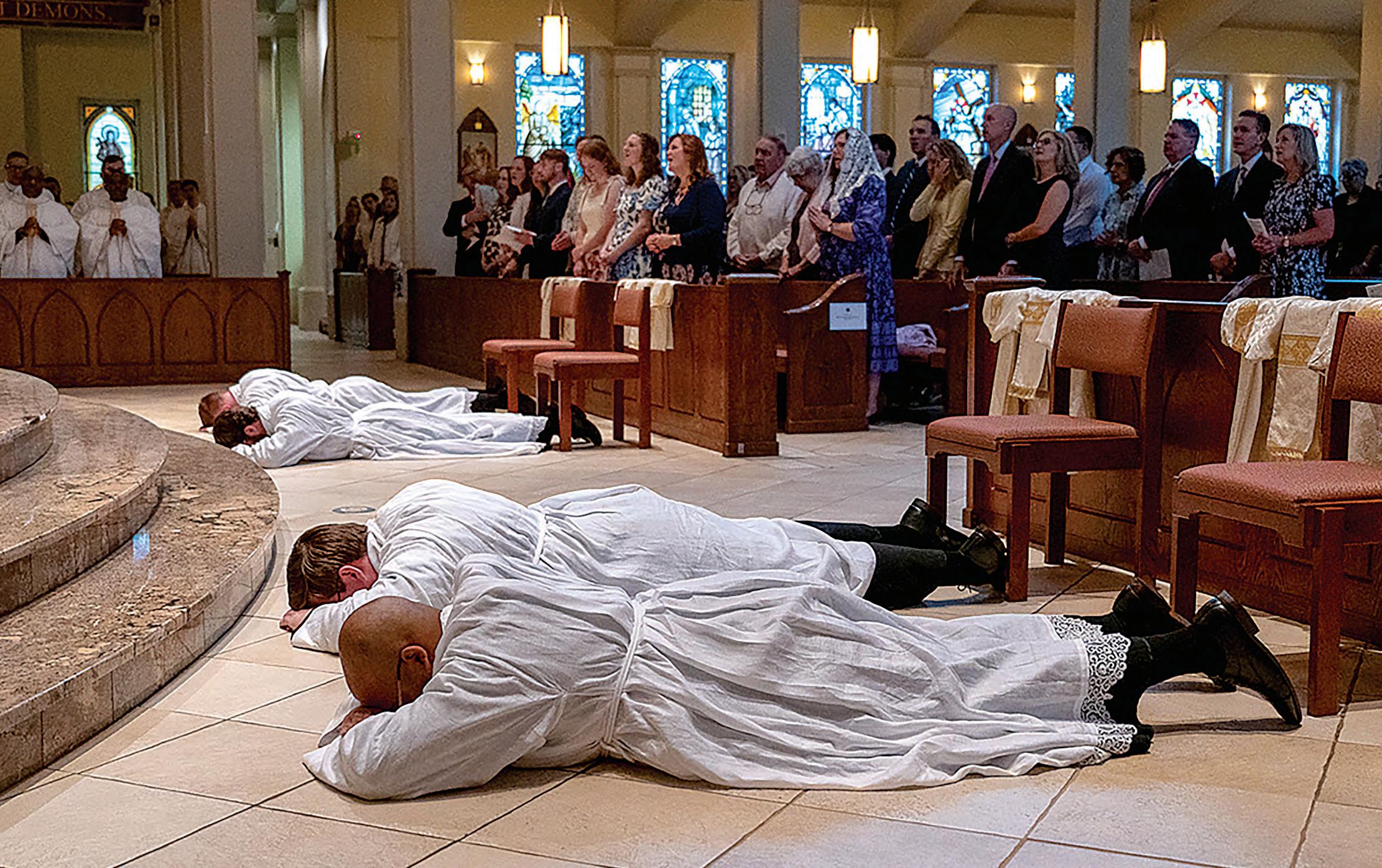
LISA M. GERACI lmgeraci@rcdoc.org
— On Pentecost weekend, despite the rain, sunshine streamed through stained-glass to spotlight the four seminarians as they were ordained as transitional deacons at St. Mark Church in Huntersville, taking them one step closer to priesthood.
Bishop Michael Martin, OFM Conv., celebrated the May 23 bilingual ordination Mass, where more than 700 family members and friends gathered. A long line of clergy processed into the crowded church, while the Perpetual Hope Gospel Choir from Our Lady of Consolation Church in Charlotte and the choirs of St. Patrick Cathedral and St. Mark Parish hit the high notes as they sang “Praise, My Soul, the King of Heaven.”
LIVES OF SACRIFICE
After the Gospel reading, the four seminarians, James Johnson IV from Our Lady of Consolation and Bradley Loftin, Patrick Martin and Connor White, all of whom had attended St. Mark Parish since childhood, were presented to the bishop by Vocations Director Father John Eckert.
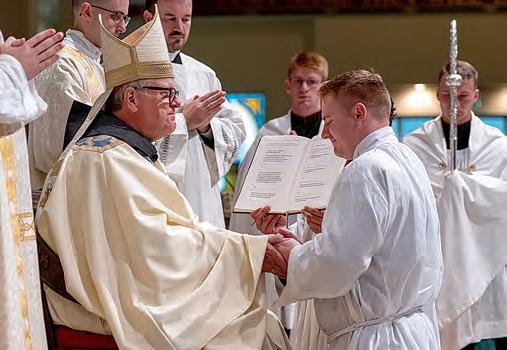
Johnson is one of an estimated nine Black Catholics to be ordained nationally this year, according to Black Catholic Messenger.
Bishop Martin’s message to the newly ordained deacons was simple but challenging: to get on “God’s level” – to truly serve – one must die to themselves.
“The four of you have to allow your lives to speak to all
of us who need to appreciate a different level so that we can understand what God is talking about,” the bishop told them. “Your lives need to be so compelling that the world comes to understand that other level.”
The four men knelt before the bishop, placing their hands in his and vowing respect and obedience, while the congregation experienced glimpses of that higher level radiating from the faithful young men who committed themselves to lives of humility and charity.
During his homily, Bishop Martin compared the duties of a deacon to a Swiss Army knife – stepping in to help wherever needed.
The men promised to go forth and proclaim the Gospel at Mass, preach homilies, prepare the altar for the Eucharist, distribute Holy Communion, bring Viaticum to the dying, and officiate at baptisms, weddings and funerals.
The four seminarians then prostrated themselves face down on the floor during the Litany of Supplication, offering their entire lives to God.
Bishop Martin laid his hands upon the men, saying the prayer of ordination and invoking the Holy Spirit while passing down spiritual authority and the grace of office.
The newly ordained deacons then entrusted mentor clergy to cover their albs with new vestments symbolizing
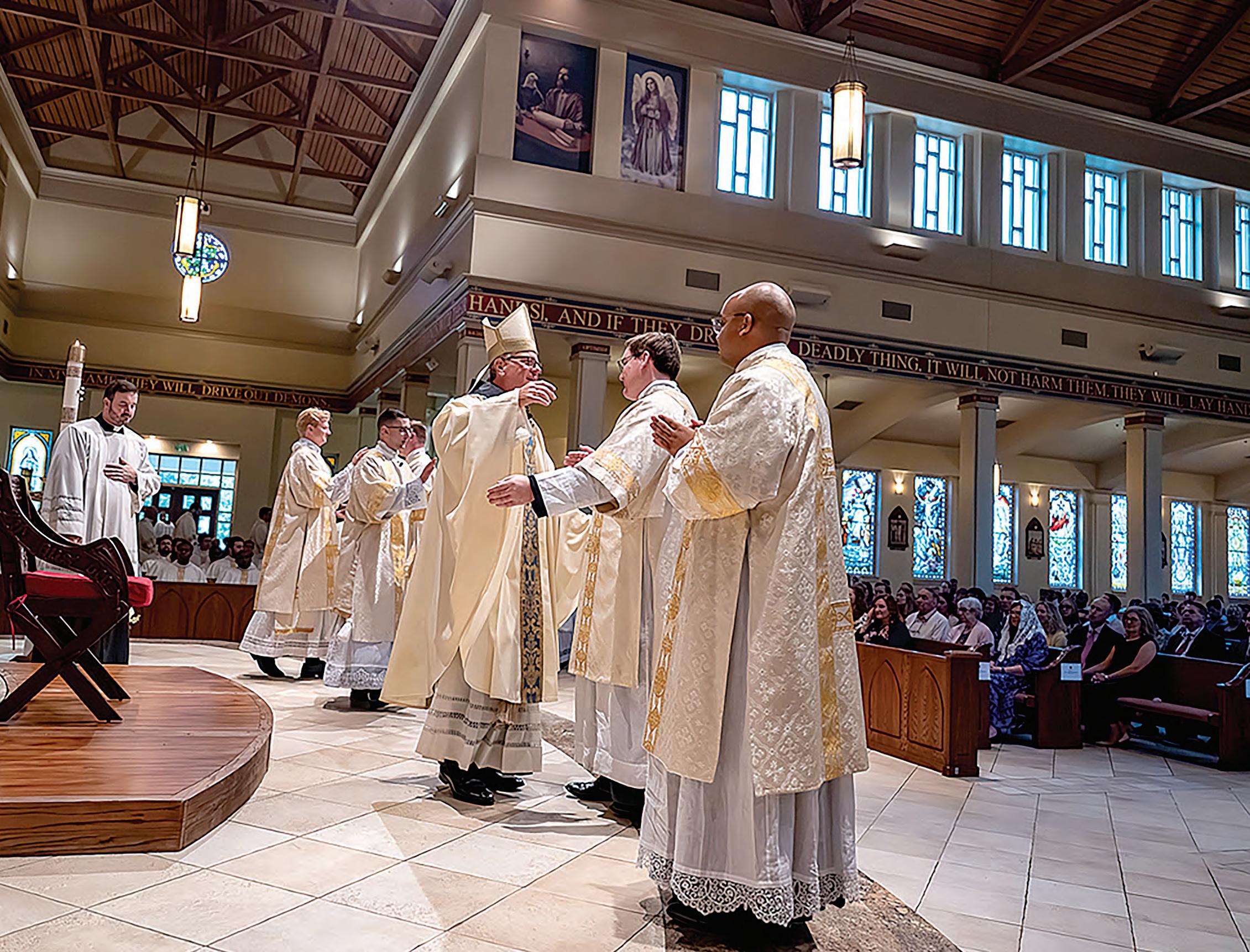
their new positions. Deacon Martin had his father, Deacon Tom Martin, secure the stole over his left shoulder, while Deacon Johnson had his mentor, 88-year-old retired Deacon Curtiss Todd, dress him with the wide-sleeved dalmatic, which will be worn during liturgies. Soon-to-bepriests Deacon John Cuppett and Deacon Bryan Ilagor vested Deacon White and Deacon Loftin.
Donned in their new vestments, the deacons knelt before the bishop, for the third and last time, receiving the Book of the Gospels.
“Believe what you read, teach what you believe, and practice what you teach,” the bishop instructed each one.
With more than 40 priests and deacons present, the bond of brotherhood was palpable as clergy members shook the hands of the new deacons, welcoming them with the Kiss of Peace.
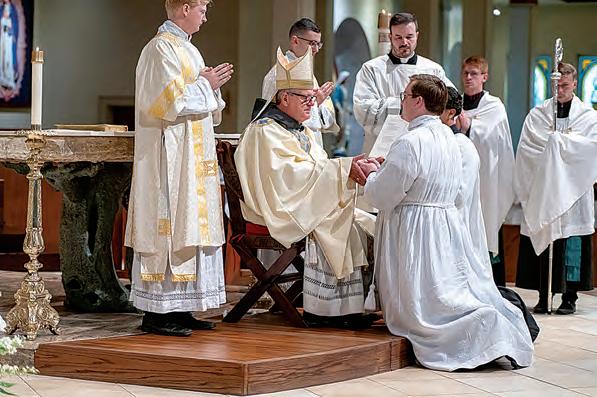
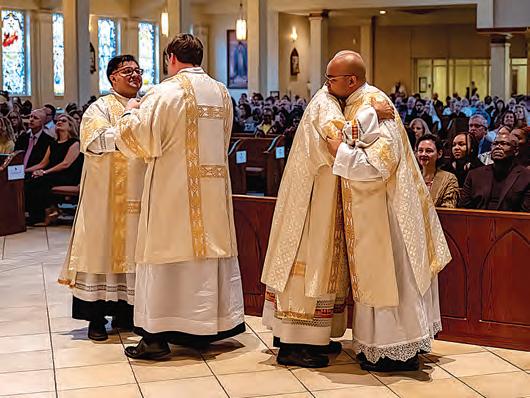
Afterward, Deacon Tom Martin shared that vesting his son Patrick was an emotional moment: “It was a true honor when I was vested almost five years ago, but to do it for my own
it was even
more so. When I was vesting him, I told him that his grandfather would be very proud of him, and then I cried. My dad was a deacon as well, so he is a third-generation deacon.”
was a child.
“I always knew when he was a little boy that he was going to become a priest,” Gellineau said. “It was just something about him. I knew, and he is on his way there.”
Dr. Carl Semmler, president of Christ the King High School, sat in the back of the church, smiling as he watched two of his former students graduate to the next level spiritually.
“I do think family, friends, parents and teachers of each of them have worked so hard for so many years to plant seeds,” Semmler said. “It is great to see that the Holy Spirit watered that vocation and these young men responded generously. It is a blessing and a fulfillment of the good work that God began in them.”
The newly ordained are called “transitional” deacons instead of “permanent” deacons, a distinction that reflects their intent to serve a year in pastoral, liturgical and educational preparation before being ordained into the priesthood. Deacon is the first of three ranks of holy orders; the other two are priest and bishop.
As the men embarked on the next step in their journey toward priesthood, Bishop Martin congratulated them.
“I am so excited for who you are and who you will be as deacons and future priests,” he said. “You’re helping us to see another way. Know that we are with you in your self-denial for the sake of the Kingdom. We are with you in your dying to yourselves, and we look forward to the tremendous fruit that God will bring forth from your sacrifice because, as Jesus tells us, that’s how we see Him.”
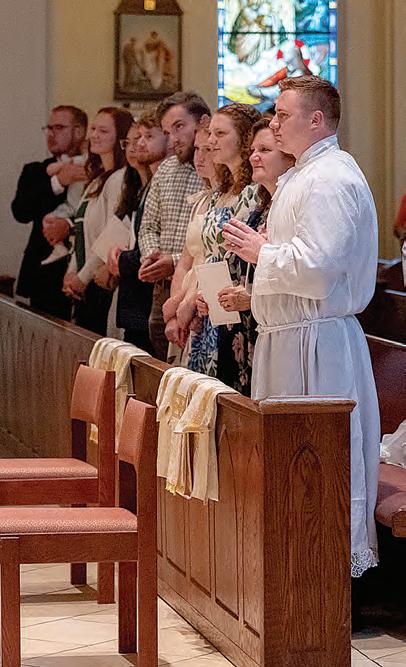
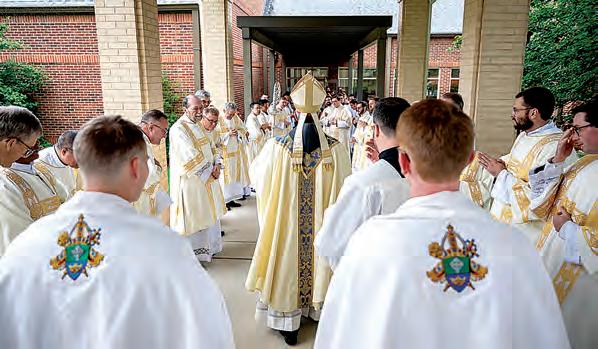
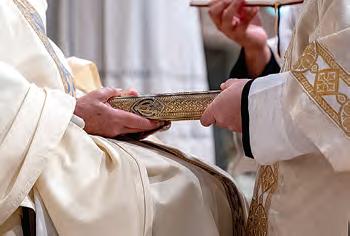
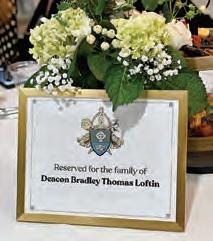
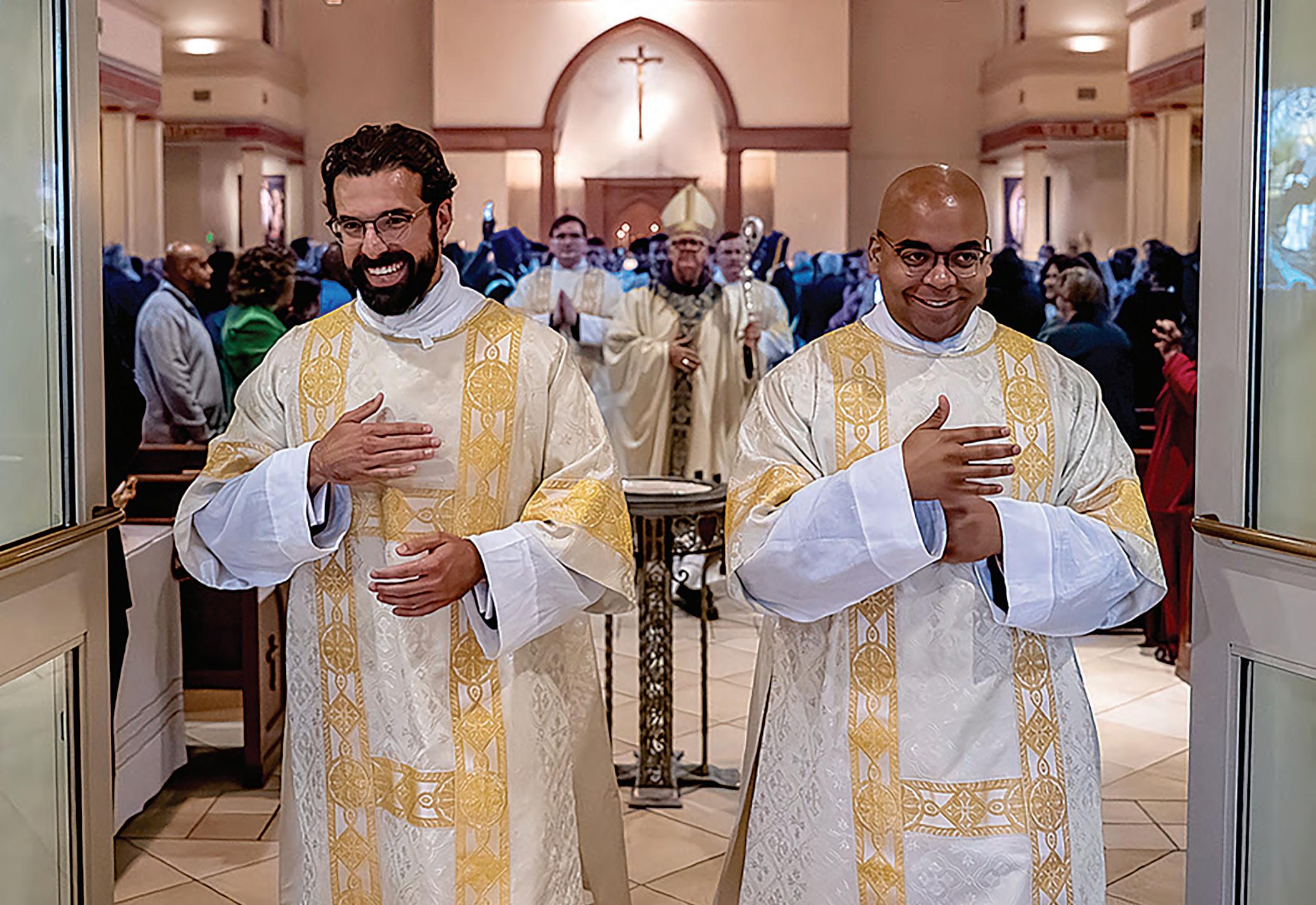
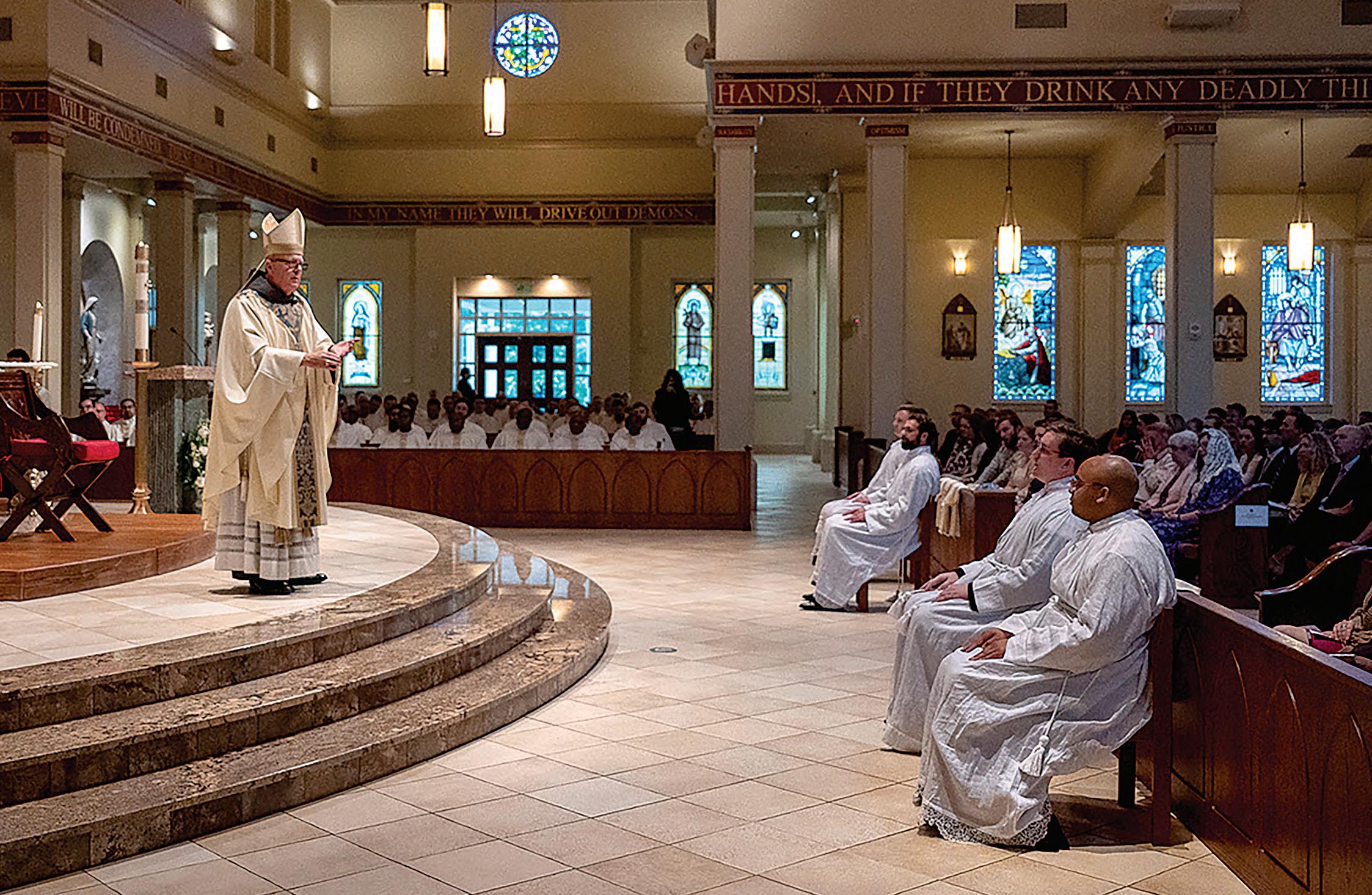
El obispo Martin les dice a los diáconos que alcancen un nivel más alto de servicio a los demás “muriendo a sí mismos”
LISA M. GERACI lmgeraci@rcdoc.org
— Este fin de semana de Pentecostés, la lluvia no pudo impedir que los rayos del Espíritu Santo penetraran las ventanas de vitrales y descansaran sobre los cuatro seminaristas ordenados diáconos transitorios en la Iglesia St. Mark en Huntersville, acercándolos un paso más al sacerdocio.
El obispo Michael Martin, OFM Conv., presidió la Misa bilingüe de ordenación el 23 de mayo, donde se reunieron más de 700 familiares y amigos. Una larga fila de miembros del clero entró en procesión a la iglesia llena, mientras el Coro Góspel Perpetual Hope de la Iglesia Our Lady of Consolation en Charlotte y los coros de la Catedral St. Patrick y de St. Mark alcanzaban notas altas al cantar “Praise, My Soul, the King of Heaven”. Después de la lectura del Evangelio, los cuatro seminaristas – James Johnson IV de Our Lady of Consolation y Bradley Loftin, Patrick Martin y Connor White, quienes asistieron a la parroquia St. Mark desde
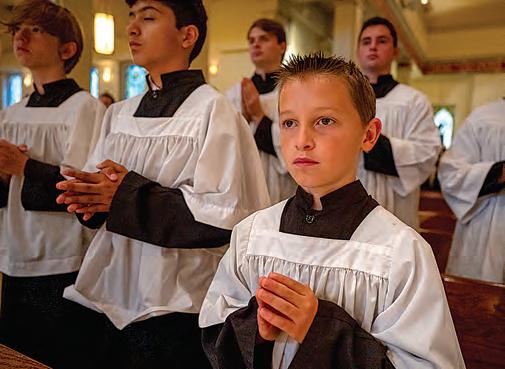
la infancia – fueron presentados al obispo por el director de vocaciones, el padre John Eckert. Johnson es uno de aproximadamente nueve católicos afroamericanos que serán ordenados este año a nivel nacional, según Black Catholic Messenger.
El mensaje de Pentecostés del obispo Martin para los nuevos diáconos fue simple pero difícil: para alcanzar el “nivel de Dios” – para servir verdaderamente – uno debe morir a sí mismo.
“Los cuatro tienen que permitir que sus vidas hablen a todos nosotros que necesitamos apreciar un nivel diferente para poder entender de qué está hablando Dios”, dijo el obispo. “Sus vidas deben ser tan convincentes que el mundo llegue a comprender ese otro nivel”.
Los cuatro hombres se arrodillaron ante el obispo, colocando sus manos entre las de él y prometiendo respeto y obediencia, mientras la congregación experimentaba destellos de ese nivel superior que irradiaban de los fieles jóvenes comprometidos con vidas de humildad y caridad.
AYUDANDO DONDE SEA NECESARIO
Durante su homilía, el obispo Martin comparó las funciones de un diácono con una navaja suiza: alguien que interviene para ayudar donde sea necesario.
Más tarde prometieron salir a proclamar el Evangelio en la Misa, predicar homilías, preparar el altar para la Eucaristía, distribuir la Sagrada Comunión, llevar el Viático a los moribundos y oficiar bautizos, bodas y funerales. Luego, los cuatro seminaristas se postraron boca abajo en el suelo durante la Letanía de Súplicas, ofreciendo sus vidas
DIÁCONOS, PASA A LA PÁGINA 10B
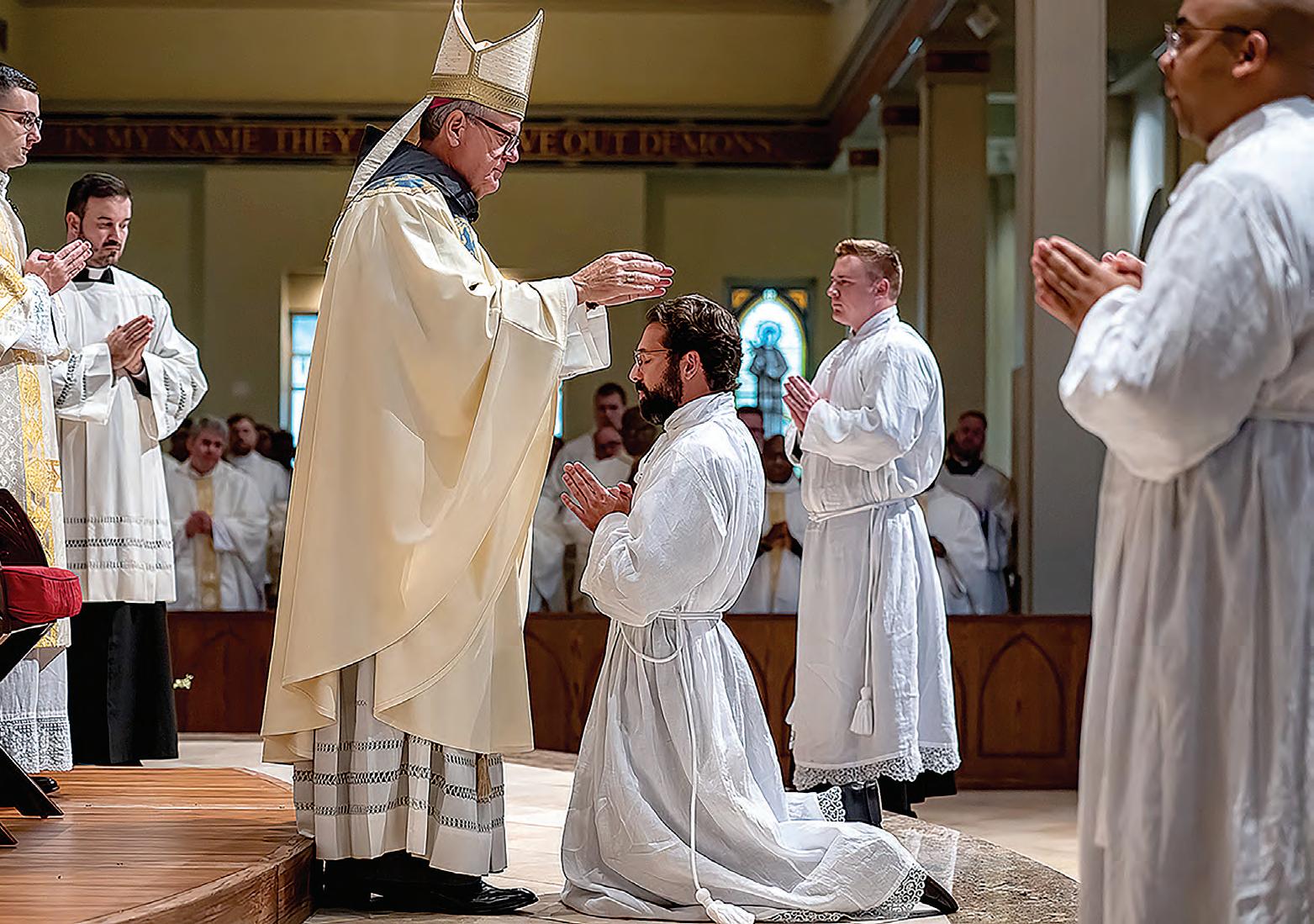
VIENE DE LA PÁGINA 9B
enteras a Dios.
El obispo Martin impuso las manos sobre ellos, pronunciando la oración de ordenación e invocando al Espíritu Santo mientras transmitía autoridad espiritual y la gracia del ministerio.
Los nuevos diáconos luego encomendaron a clérigos mentores cubrir sus albas con nuevas vestiduras que simbolizaban sus nuevos cargos. El diácono Martin hizo que su padre, el diácono Tom Martin, colocara la estola sobre su hombro izquierdo, mientras que el diácono Johnson pidió a su mentor, el diácono retirado Curtiss Todd, de 88 años, que lo revistiera con la dalmática de mangas anchas que usará durante las liturgias. Los futuros sacerdotes diácono John Cuppett y diácono Bryan Ilagor vistieron al diácono White y al diácono Loftin.
CREER, ENSEÑAR, PRACTICAR
Vestidos con sus nuevas vestiduras, los diáconos se arrodillaron ante el obispo por tercera y última vez para recibir el Libro de los Evangelios. “Crean lo que leen, enseñen lo que creen y practiquen lo que enseñan”, ordenó el obispo a cada uno.
Con más de 40 sacerdotes y diáconos
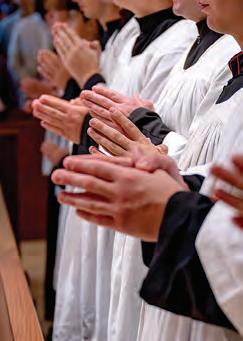
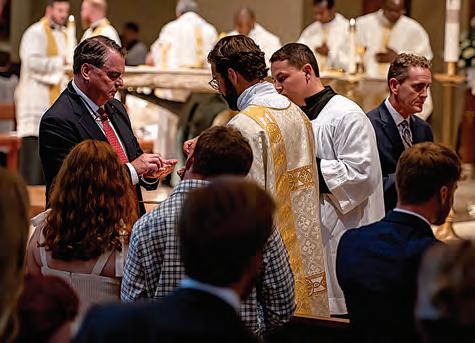
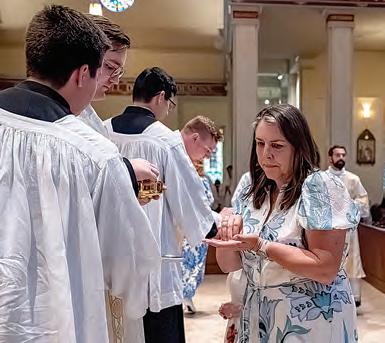
(De izquierda a derecha) La congregación aplaude a los diáconos recién ordenados. El diácono Connor White y el diácono Bradley Loftin distribuyen la Sagrada Comunión a una iglesia que estaba llena de más de 700 feligreses.
presentes, el vínculo de hermandad era palpable mientras los miembros del clero estrechaban las manos de los nuevos diáconos, dándoles la bienvenida con el Beso de la Paz.
Después, el diácono Tom Martin compartió que vestir a su hijo Patrick fue un momento emotivo: “Fue un verdadero honor cuando fui revestido hace casi cinco años, pero hacerlo por mi propio hijo fue aún más especial. Mientras lo vestía, le dije que su abuelo estaría muy orgulloso de él, y entonces lloré. Mi padre también fue
diácono, así que él es un diácono de tercera generación”.
Regina Gellineau, miembro de larga trayectoria de Our Lady of Consolation, ha observado y rezado por el diácono Johnson desde que era niño.
“Siempre supe, desde que era un niño pequeño, que iba a convertirse en sacerdote”, dijo Gellineau. “Había algo especial en él. Yo lo sabía, y va camino a lograrlo”.
El Dr. Carl Semmler, presidente de Christ the King High School, estaba sentado al
fondo de la iglesia sonriendo mientras veía a dos de sus antiguos alumnos avanzar espiritualmente al siguiente nivel. “Creo que la familia, los amigos, los padres y los maestros de cada uno de ellos han trabajado muy duro durante muchos años para sembrar semillas”, dijo Semmler. “Es maravilloso ver que el Espíritu Santo regó esa vocación y que estos jóvenes respondieron generosamente. Es una bendición y la realización de la buena obra
PASA A LA PÁGINA 11B
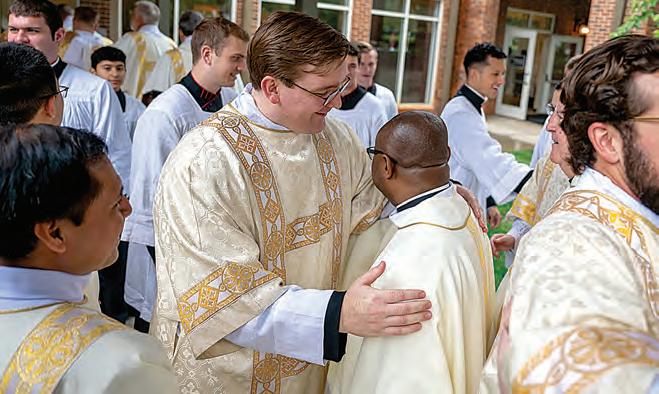
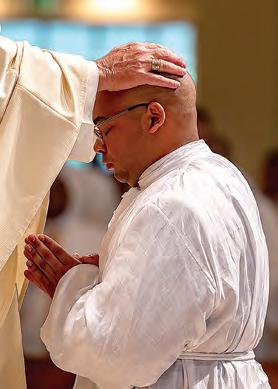
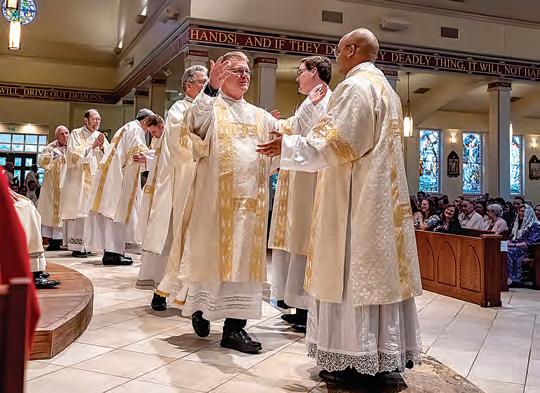
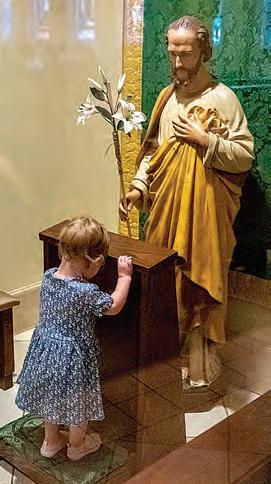
VIENE DE LA PÁGINA 10B
que Dios comenzó en ellos”.
A los recién ordenados se les llama diáconos “transitorios” en lugar de diáconos “permanentes”, una distinción que refleja su intención de servir un año en preparación pastoral, litúrgica y educativa antes de ser ordenados sacerdotes. El diaconado es el primero de los tres grados del orden sagrado; los otros dos son el sacerdocio y el episcopado. Mientras los hombres daban el siguiente paso en su camino hacia el sacerdocio, el obispo Martin los felicitó.
“Estoy muy emocionado por quienes son y por quienes serán como diáconos y futuros sacerdotes”, dijo. “Nos están ayudando a ver otro camino. Sepan que estamos con ustedes en su negación de sí mismos por el bien del Reino. Estamos con ustedes en su morir a sí mismos, y esperamos con ilusión el inmenso fruto que Dios hará surgir de su sacrificio porque, como nos dice Jesús, así es como lo vemos a Él”.
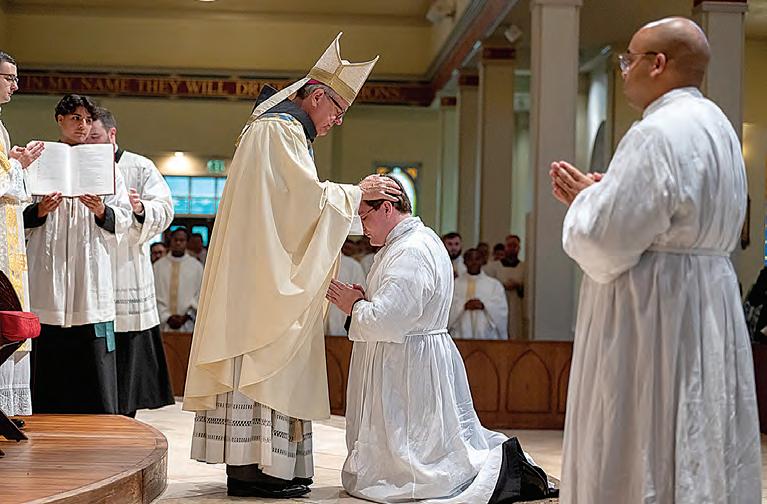
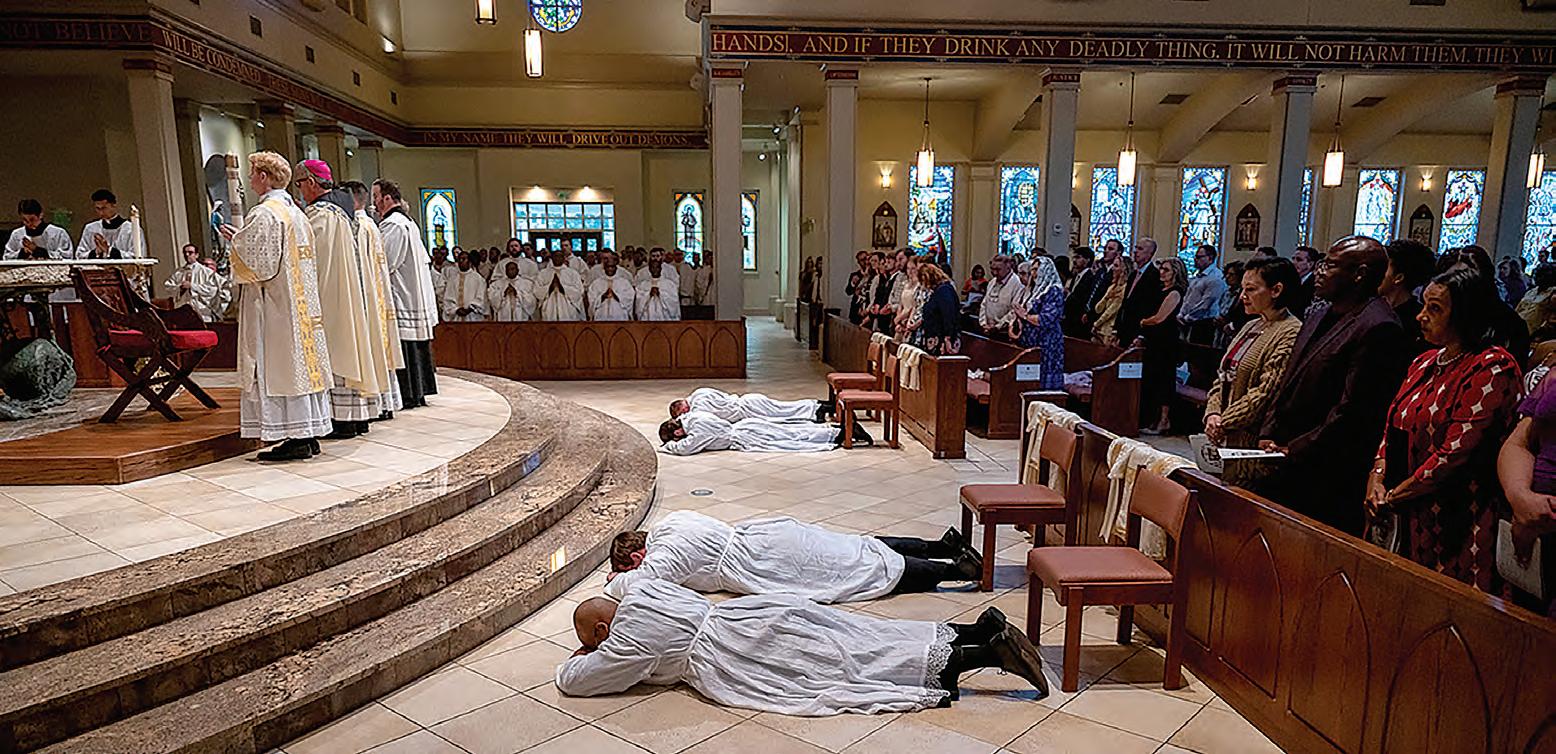
Deacon James Johnson
Age: 26
Home parish: Our Lady of Consolation in Charlotte
Favorite saints: Venerable Augustus Tolton and St. Joseph
Favorite prayer: Litany of Humility, which trains the heart to desire to do the will of God for His glory rather than my own
Hobbies: Traveling and learning about new cultures
What is one of the biggest lessons you’ve learned about the faith as a seminarian?
“I’ve learned about the true universality of the Church, something I’d never really thought about until seminary. Before that, I went to Our Lady of Consolation and that is how I saw the Church for many, many years. Since coming to seminary, I’ve visited all sorts of different parishes, seeing the spirituality and the charisms that they have. That has helped me understand we’re not a uniform Church. There’s a diversity in ways of showing our faith, which is a beautiful thing.”
Deacon Bradley Loftin
Age: 26
Home parish: St. Mark, Huntersville
School: St. Mark Elementary, Christ the King High School, St. Joseph College Seminary
Status: Started Mount St. Mary’s Seminary, Cincinnati, August 2022
Hobbies: Golf, fishing, cooking, coaching football and tutoring
Favorite saints: Mary, St. Joseph the Carpenter and St. Philip Neri
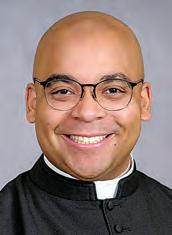
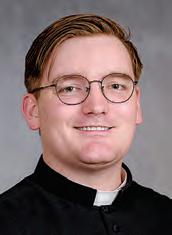
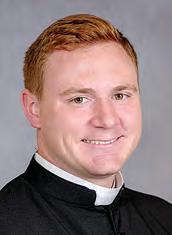
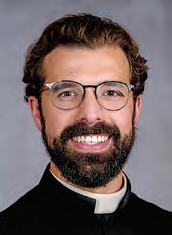
Age: 25
Home parish: St. Mark, Huntersville
Schooling: Home-schooled, St. Joseph College Seminary, Mount St. Mary’s Seminary in Cincinnati
Hobbies: “I’m really big into athletics. I grew up playing soccer and swimming and still like to play soccer in seminary. I spend time playing with my brother seminarians, and we have a makeshift team. I’ve also gotten into weight lifting and in recent years got into marathon running – I started that my first year here in Ohio. I train with fellow seminarian Connor White, who is an avid runner. The training is a great way to let our brains reset. It helps me to regulate and re-engage. Every spring I’ve been running a marathon called the Flying Pig here in Cincinnati, which takes its name from the city’s history as a leader in the pork industry.”
Who is your favorite saint? “The saint I hold most dear is St. John the Evangelist – I have a statue on my desk of him looking at me right now. I chose him as my confirmation saint, and he’s been my go-to saint on multiple levels since then. I’m the middle child of my family and the youngest boy, and seeing John the Evangelist, John the Beloved, as the youngest of the apostles was impactful to me, because as the youngest boy I felt some competition growing up. I saw that John was the youngest but was also impactful. He has a special relationship with Christ, a closeness to our Lord, and was particularly there with Him during the Passion. He was the one who helped Our Lady through the Passion.”
Deacon Connor White Age: 26
Home parish: St. Mark, Huntersville Colleges: Elon University and St. Joseph College Seminary
Degrees: Philosophy and Latin
Theology: Mount St. Mary’s Seminary and School of Theology (Athenaeum of Ohio)
Summer assignments: Holy Cross (Kernersville), St. Margaret Mary (Swannanoa) and St. Francis of Assisi/St. Frances of Rome (Jefferson and Sparta).
What are some of your hobbies? I love running and playing golf with family and friends. I also enjoy reading, cooking with friends and making coffee/espresso-based drinks.
When did you first realize you had a call to the priesthood? “I first began discerning a call to the priesthood during my confirmation retreat around the beginning of high school.”
Why did you decide to become a priest in the Diocese of Charlotte? “I was born and raised in the Charlotte area, so this diocese is home. I received the sacraments here and attended Catholic school (K-12) at St. Mark and Christ the King. I feel called to minister to this diocese, as this is where my faith has been cultivated and vocation fostered.”
Do you feel a special devotion to any saints? “My closest saint-friends are St. Elizabeth of the Trinity and St. Therese of Lisieux. They both have taught me how to pray and charitably live with others. St. Elizabeth emphasizes the Divine Indwelling (the Holy Trinity residing within the soul of a baptized person), something I was immediately drawn to. I also have devotions to other priest-saints: St. Thomas Becket, St. John Fisher and St. Pius X.”
More online
At www.catholicnewsherald.com : Read more about each of the four deacons
Diácono James Johnson
Edad: 26 años
Parroquia de origen: Nuestra Señora de la Consolación en Charlotte Santos favoritos: el Venerable Augustus Tolton y San José
Oración favorita: La Letanía de la Humildad, que entrena el corazón para desear hacer la voluntad de Dios para Su gloria y no para la mía propia
Pasatiempos: Viajar y aprender sobre nuevas culturas
¿Cuál es una de las lecciones más importantes que has aprendido sobre la fe como seminarista? “He aprendido sobre la verdadera universalidad de la Iglesia, algo en lo que nunca había pensado realmente hasta el seminario. Antes de eso, iba a Nuestra Señora de la Consolación y así veía la Iglesia durante muchos, muchos años. Desde que llegué al seminario, he visitado todo tipo de parroquias diferentes, viendo la espiritualidad y los carismas que tienen. Eso me ha ayudado a entender que no somos una Iglesia uniforme. Hay diversidad en las maneras de mostrar nuestra fe, y eso es algo hermoso.”
Diácono Bradley Loftin
Edad: 26 años
Parroquia de origen: San Marcos, Huntersville
Escuelas: Escuela Primaria San Marcos, Christ the King Catholic School, Seminario San José
Estado: Comenzó en el Seminario Mount St. Mary’s, Cincinnati, en agosto de 2022
Pasatiempos: Golf, pesca, cocina, entrenar fútbol americano y dar tutorías
Santos favoritos: María, San José Obrero y San Felipe Neri
Inspirado por: Padre John Putnam y Padre Paul McNulty
Diácono Patrick Martin
Edad: 25 años
Parroquia de origen: San Marcos, Huntersville
Educación: Educación en casa, Seminario San José, Seminario Mount St. Mary’s, Cincinnati Pasatiempos: “Me gustan mucho los deportes. Crecí jugando fútbol y nadando, y todavía me gusta jugar fútbol en el seminario. Paso tiempo jugando con mis compañeros seminaristas, y tenemos un equipo improvisado. También me he interesado en el levantamiento de pesas y, en los últimos años, en correr maratones; comencé con eso en mi primer año aquí en Ohio. Entreno con el compañero seminarista Connor White, quien es un corredor apasionado. El entrenamiento es una gran manera de despejar la mente. Me ayuda a regularme y volver a enfocarme. Cada primavera he corrido un maratón llamado Flying Pig aquí
en Cincinnati, que toma su nombre de la historia de la ciudad como líder en la industria porcina.” ¿Quién es tu santo favorito? “El santo que más aprecio es San Juan Evangelista; tengo una estatua de él en mi escritorio mirándome ahora mismo. Lo escogí como mi santo de confirmación y desde entonces ha sido mi santo de referencia en muchos niveles. Soy el hijo del medio de mi familia y el menor de los varones, y ver a Juan Evangelista, Juan el Amado, como el más joven de los apóstoles fue impactante para mí, porque como el menor de los hijos varones sentía cierta competencia al crecer. Vi que Juan era el más joven pero también tuvo un gran impacto. Tiene una relación especial con Cristo, una cercanía con Nuestro Señor, y estuvo especialmente presente con Él durante la Pasión. Fue quien ayudó a Nuestra Señora durante la Pasión.”
Edad: 26 años
Parroquia de origen: San Marcos, Huntersville
Universidades: Universidad Elon y Seminario
Universitario San José
Títulos: Filosofía y Latín
Teología: Seminario y Escuela de Teología Mount St. Mary’s (Athenaeum of Ohio)
Asignaciones de verano: Holy Cross (Kernersville), St. Margaret Mary (Swannanoa) y St. Francis of Assisi/St. Frances of Rome (Jefferson y Sparta)
¿Cuáles son algunos de tus pasatiempos? Me encanta correr y jugar golf con familiares y amigos. También disfruto leer, cocinar con amigos y preparar café y bebidas a base de espresso.
¿Cuándo te diste cuenta por primera vez de que tenías un llamado al sacerdocio? Comencé a discernir un llamado al sacerdocio durante mi retiro de confirmación, al inicio de la preparatoria.
¿Por qué decidiste convertirte en sacerdote en la Diócesis de Charlotte? Nací y crecí en el área de Charlotte, así que esta diócesis es mi hogar. Aquí recibí los sacramentos y asistí a la escuela católica (K-12) en San Marcos y Christ the King. Me siento llamado a servir en esta diócesis, ya que aquí se cultivó mi fe y se fomentó mi vocación.
¿Sientes una devoción especial por algunos santos? Mis santos amigos más cercanos son Santa Isabel de la Trinidad y Santa Teresita de Lisieux. Ambas me han enseñado cómo orar y vivir caritativamente con los demás. Santa Isabel enfatiza la Morada Divina (la Santísima Trinidad habitando en el alma de una persona bautizada), algo que me atrajo inmediatamente. También tengo devoción a otros santos sacerdotes: Santo Tomás Becket, San Juan Fisher y San Pío X. Más online En www.catholicnewsherald.com:
Rejoicing with the newly ordained priests and deacons of the Diocese of Charlotte.
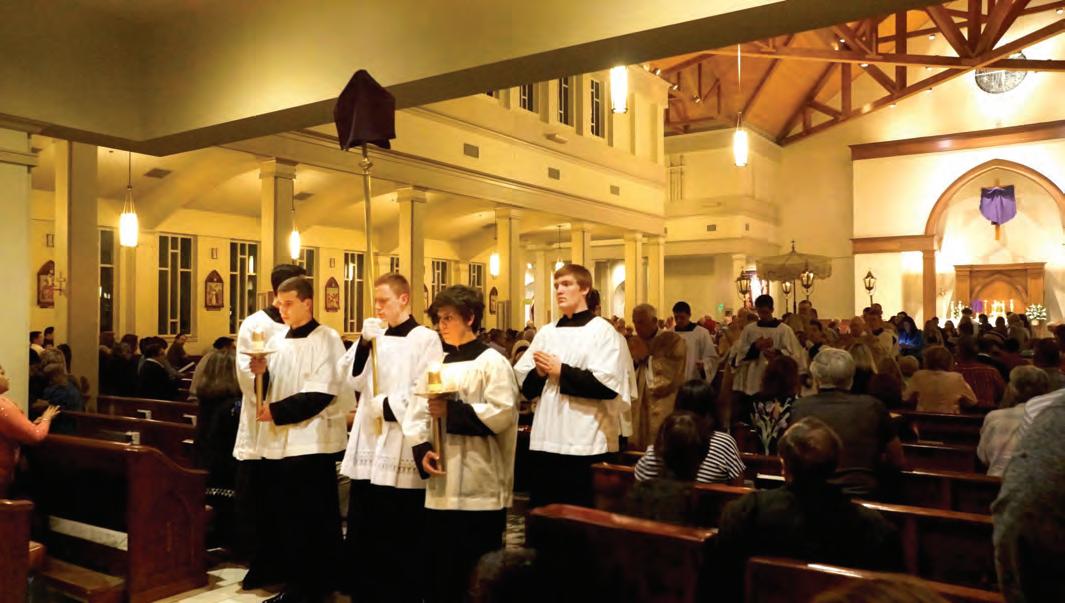
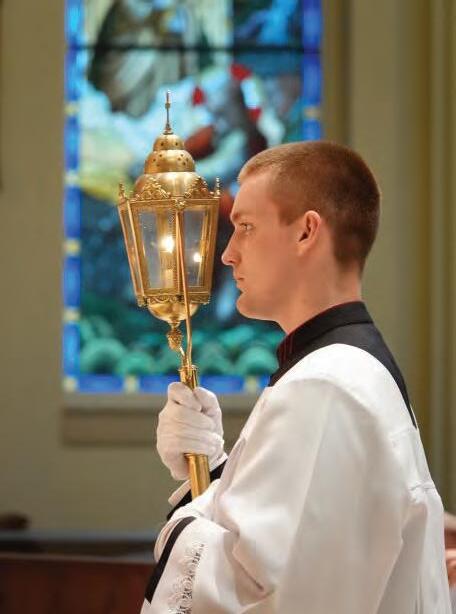
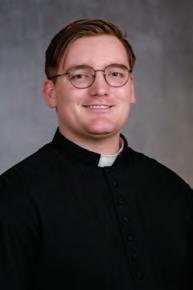
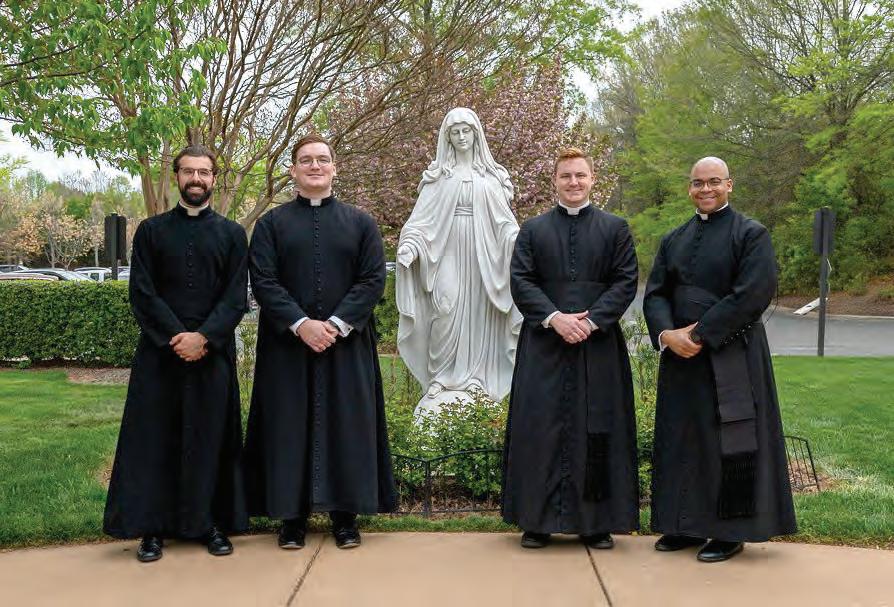
Three parishioners now ordained deacons preparing for the priesthood.
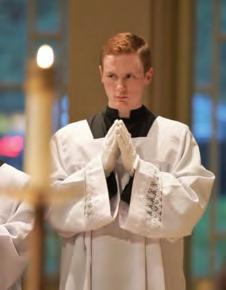
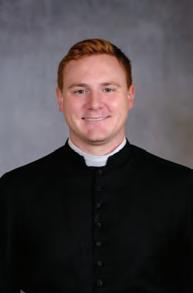
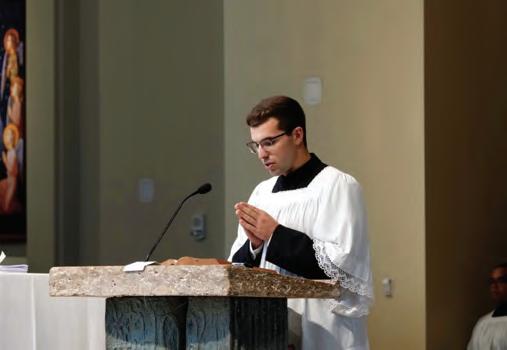
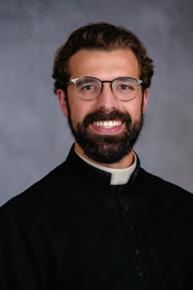
Congratulations To our Newly Ordained Priests
Thank you for your witness, your sacrifice, and your yes to Christ and His Church.
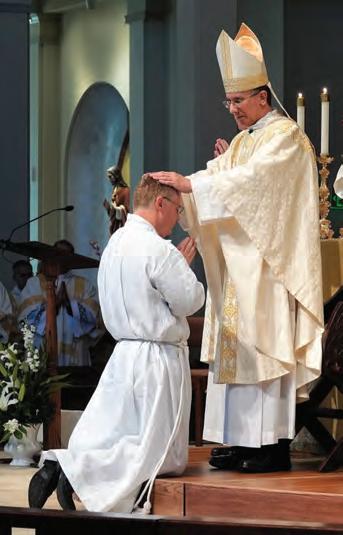
Celebrating 5 years of Ordained Ministry
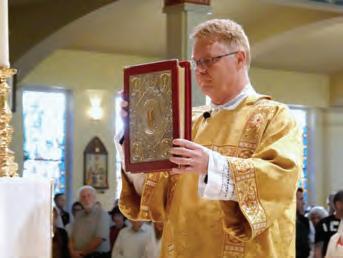
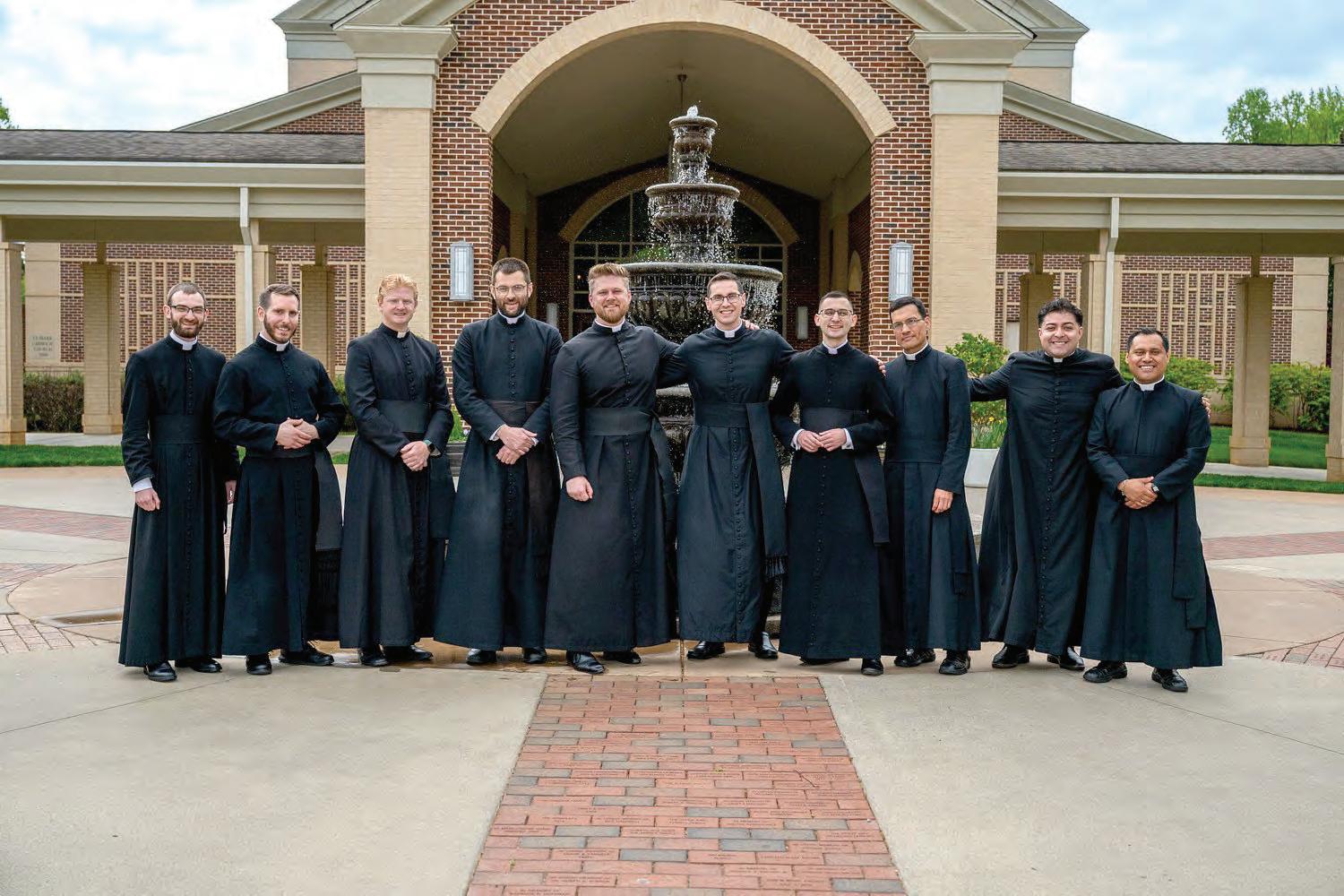
Vocations grow in the life of the Church through families, friendship, prayer, and the encouragement of faithful parishioners.
We rejoice with all those ordained for the Diocese of Charlotte and with the men of St. Mark continuing to answer Christ’s call. Thank you to the many parishioners who support seminarians, priests, and deacons through their prayers, encouragement, and generosity.
Please continue to pray for vocations and for all those called to Holy Orders.
COURTNEY MCLAUGHLIN catholicnews@rcdoc.org
GASTONIA — One of the first things you notice about Deacon Bill Melton is his sense of humor. He laughs that there are “a lot of Deacon Bills in the diocese,” which is why most people simply call him Deacon Melton.
He jokes that he “can’t resist a uniform,” and has the career path to prove it. From EMT to volunteer firefighter, police officer, private investigator, Methodist minister and now a deacon serving St. Michael the Archangel Parish in Gastonia, helping others in times of crisis has always been central to his life.
William S. Melton Jr. was born in Charlotte on April 23, 1966, and raised in Mount Holly in the United Methodist Church. He attended Sacred Heart Grade School in Belmont, which was established by the Sisters of Mercy. That early encounter changed his path.
“I didn’t know what Catholics were, but I was impressed by the Mass,” he recalls.
During his teenage years, he remained active in the Methodist Church while also serving as a volunteer firefighter with the East Gaston Volunteer Fire Department and as an EMT with the Mount Holly Lifesaving Crew.
He headed to Belmont Abbey College after high school and discerned a calling to become a United Methodist minister, eventually being assigned to two small churches in Union County. “During that time, I quickly realized that wasn’t what I was being called to do,” he says. “I was better suited to become a police officer.”
Three days after college graduation, he joined Mecklenburg County Police, which later merged with Charlotte Police to form what is now the Charlotte-Mecklenburg Police Department.
His winding career path continued with the Gaston County Police Department, where he rose to the rank of captain. He later became a licensed private investigator before returning to Belmont Abbey College as director of campus safety and emergency management for 18 months.
He married his wife, Laurie, in December 1990. The couple later welcomed two children, Jacob and Kathleen.
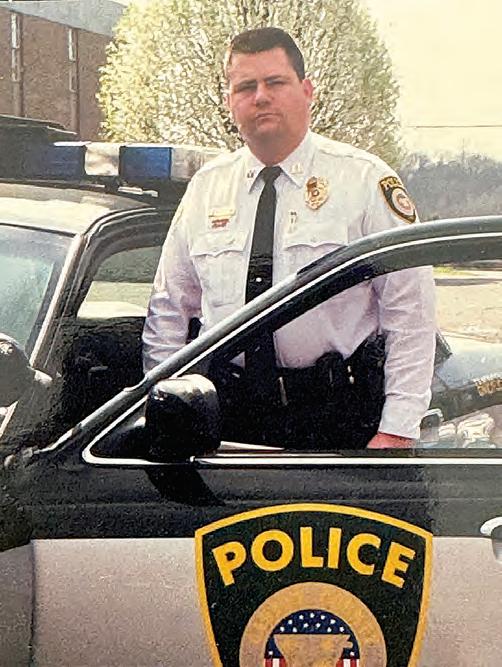
Deacon Melton says he first felt an “inkling” that he was being called to serve faith soon after his conversion to
Catholicism in 1994. His wife converted a few years later.
He read “The Faith Explained” by Father Leo Trese and other spiritual writings in an effort to better understand where God was leading him.
He began lay ministry training, and after a few stops and starts, entered the discernment process in earnest. “The Holy Spirit operates in Its own time,” he says.
He likens discernment to a sea voyage. “I was like a ship at sea with all sails up, and the Holy Spirit was guiding the ship,” he says. “Then there comes a point where you can take the helm.”
‘I didn’t know what Catholics were, but I was impressed by the Mass.’
Deacon Melton was ordained on Sept. 25, 2021. “That was the COVID class,” he chuckles.
As a deacon, he goes wherever he is needed. “I don’t have a will in the parish,” he explains. “I try to help wherever the pastor needs.”
That includes assisting with Mass and being on-site in emergency situations or other crises. “I call it a uniform presence – talking to people and reassuring them, no matter what happens, God is always there.”
Deacon Melton is still an active as a firefighter/EMT with the East Gaston Volunteer Fire Department and as a police chaplain with the Gaston County Police Department, and he teaches incident response curriculum to responders.
The situational awareness skills he developed in public safety, he says, now help him anticipate needs and support pastors in ways that extend beyond the visible work of ministry.
“We see the world from where we sit,” he says. “Those experiences help give the pastor a kind of peripheral vision.”
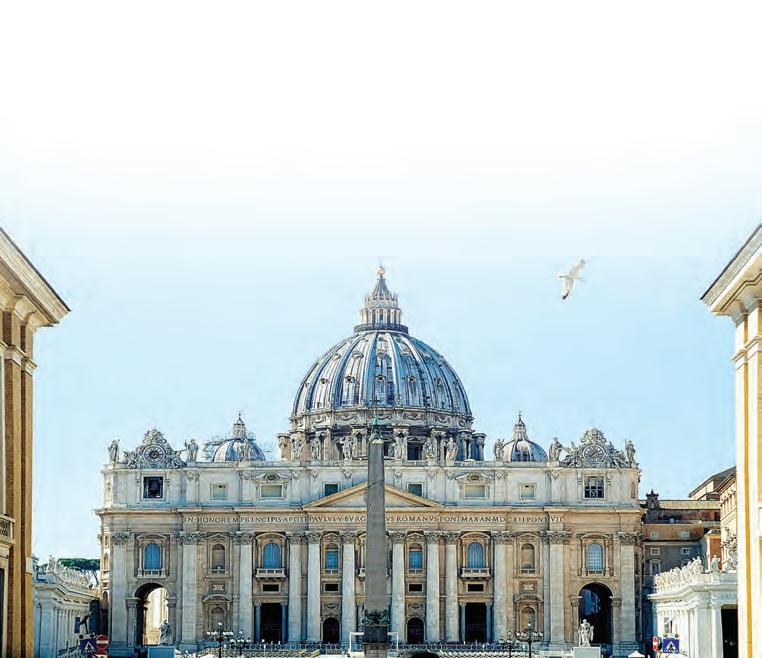
Danube River Cruise – April 2027
Divine
2027 Italy – 2028


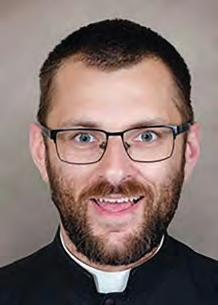

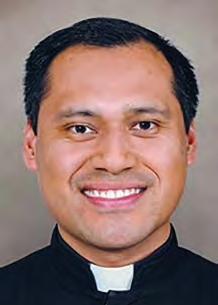
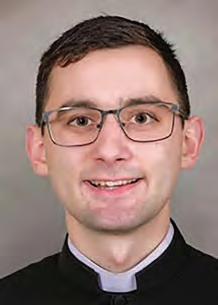
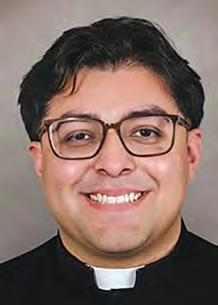
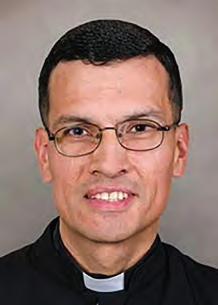
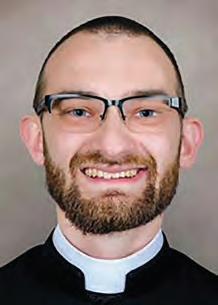
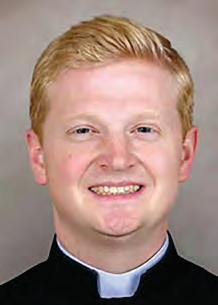
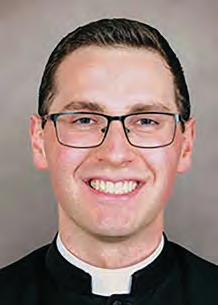
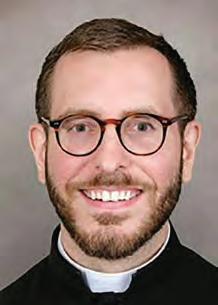
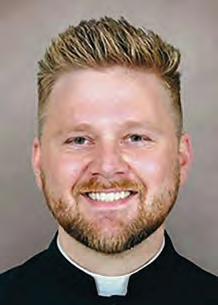
“If some of you hear the call to follow Christ more closely, to dedicate your entire heart to Him, like the Apostles John and Paul...
...because you have nothing to fear when the prize that you await is God Himself, for Whom, sometimes without ever knowing it, all young people are searching.” be generous, do not be afraid,

- Saint John Paul II
Very Rev. John J. Eckert, V.F. Director of Vocations (704) 370-3353
1123 South Church Street Charlotte, NC 28203-4003 vocationsmail@rcdoc.org
vocationsmail@charlottediocese.org


Father Diógenes D. Araúz González, CM
Father Cory Catron
Father Michael S. Debesay
Father David McCanless
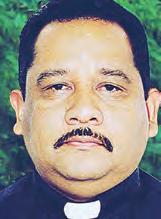
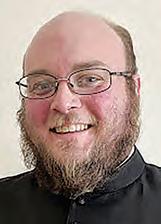
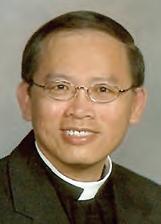
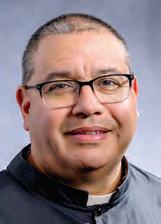
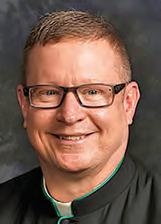
Deacon
Deacon
Deacon
15 YEARS
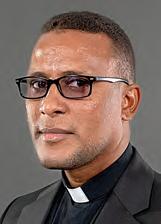
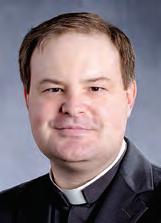
30 YEARS
Father Innocent C. Amasiorah
Father Fidel Melo
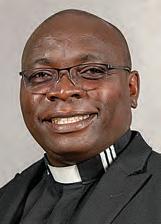
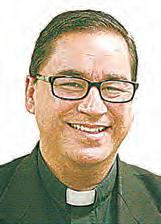
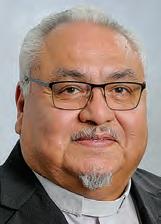
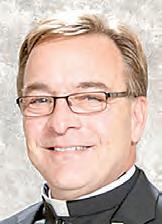
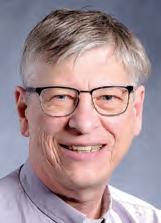
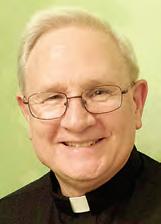
Deacon Larry Lisk
Deacon John Martino
Deacon Brian McNulty
Deacon
Deacon
Deacon
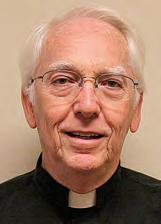
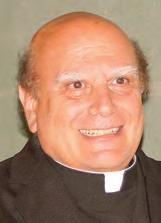
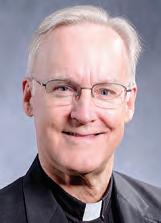
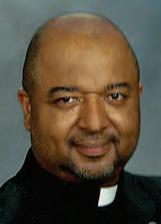
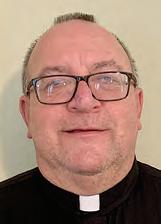
40 YEARS
Deacon Jeffrey Evers
Deacon Dario Garcia-Ospina
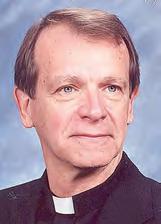
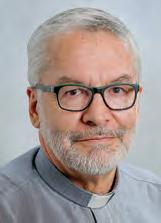
15 YEARS
Father Brendan Buckler
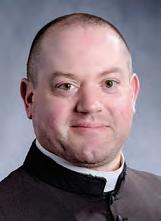

40 YEARS
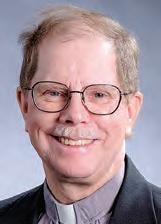
45 YEARS
Deacon Clarke Cochran
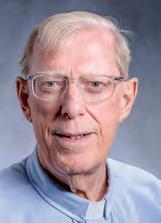
25 YEARS
Deacon
Deacon
Deacon
Deacon

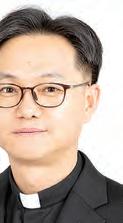
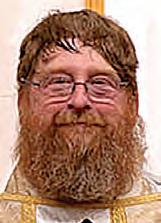
45 YEARS
Father Francis Cancro
Father José Antonio Juya
Father Gnanapragasam Mariasoosai
Father Carl DelGiudice
Father John Michalowski, SJ
20 YEARS
Father Alejandro Ayala
Father James Stuhrenberg
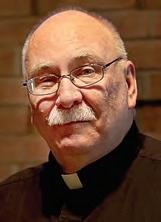
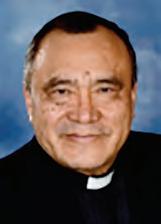
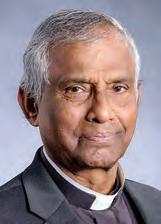
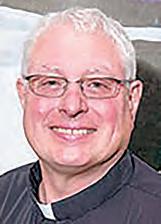
20 YEARS
Deacon James L. Atkinson
Deacon David Boissey Sr.
Deacon Mark Diener
Deacon Walter Haarsgaard
Deacon Edward Konarski
Deacon John Kopfle
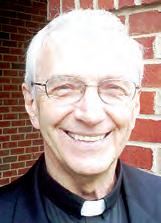
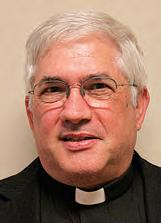
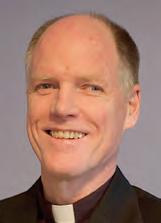
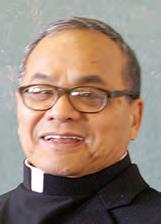
50 YEARS
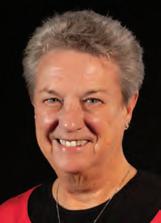
25 YEARS
Father Robert Ferris
Father James Duc Duong
Father Tien Duong
Father Adrian Porras
Father Christopher Roux
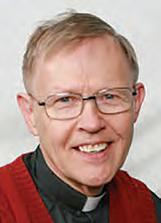
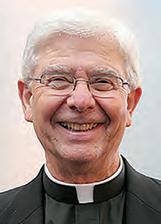
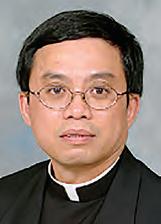
50 YEARS
Father John D. Hoover
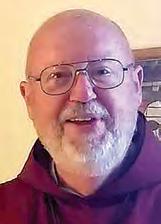
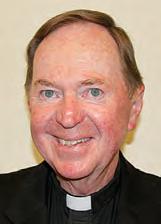
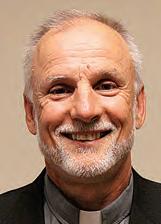
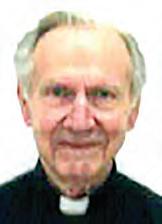
60 YEARS
30 YEARS
Deacon Larry O’Toole
70 YEARS
Father Catron’s priestly journey has taken him all over the world
LISA M. GERACI lmgeraci@rcdoc.org
WINSTON-SALEM — Father Cory Catron, pastor of Our Lady of Mercy Parish, is celebrating 10 years of priesthood and is fascinated by the doors God has opened for him since his first “yes,” during his ordination in 2016. Then-Bishop Peter Jugis told him early
‘Just
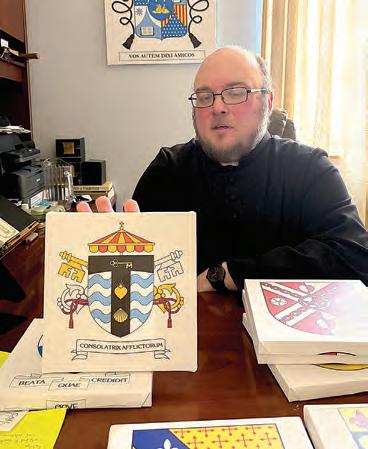
priest,” he explains. “I never belonged to anyone’s clique but got along with everybody. Apparently, there is an invisible sign on my forehead that says, ‘Ask this guy for advice.’ I have always been the big brother, the friend, the one that everyone goes to for counsel.”
COLLEGE DAYS
He wasn’t looking for a Catholic college, but while checking his email spam folder, Belmont Abbey College popped up.
“It was small and close to home, and I could apply online for free. And, when I did, I got in,” he says.
He went to visit, and as soon as he turned off the exit ramp, he felt at home, he says. “I took one look at the campus and knew that is where I needed to be.”
While priesthood was a vaguely
to realize politics didn’t mesh with his personality. Instead, he followed that still, quiet voice into the priesthood.
He graduated from Belmont Abbey College and continued on to the Pontifical College Josephinum in Columbus, Ohio.
During his ordination, he remembers, he felt more like himself than ever and he thanked God.
“I remembered my fifth birthday, and my mom said, ‘You are 5 now.’ I said, ‘I don’t feel 5,’” he says. “That is what ordination day felt like. I didn’t change that day. I arrived at where I have always been.”
THE FRUITS OF PRIESTHOOD
“Every day I feel further confirmation of who I am, and I know this is where I was meant to be,” Father Catron says.
From learning Spanish and traveling
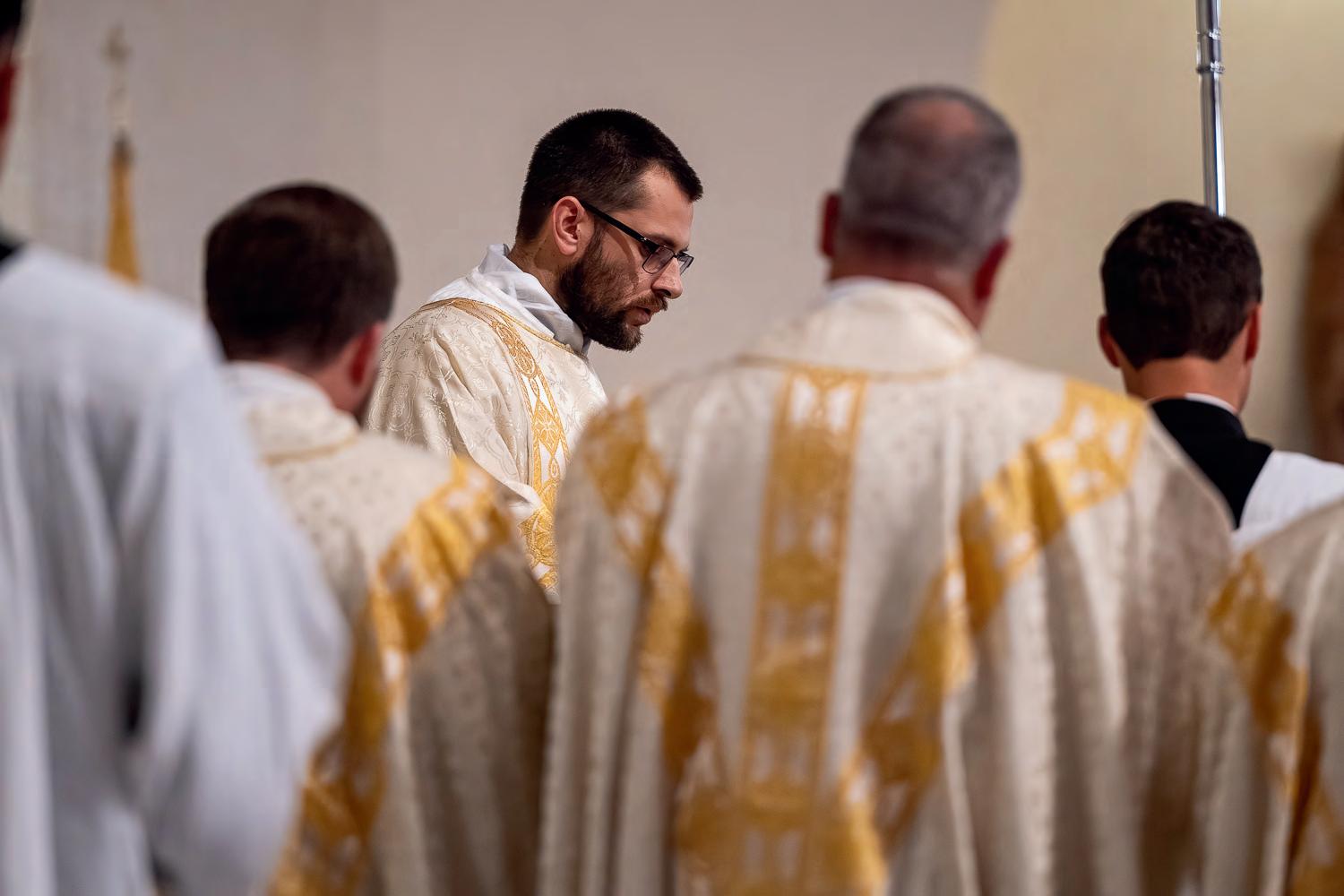
The Parish of St. Ann in Charlotte congratulates her 3 sons on their ordination to the Priesthood of Jesus Christ!
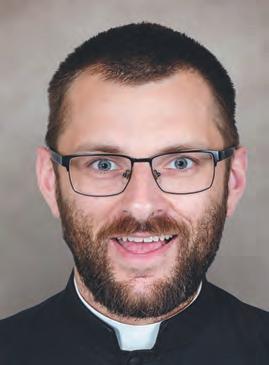
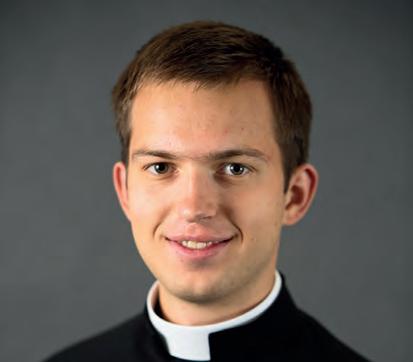
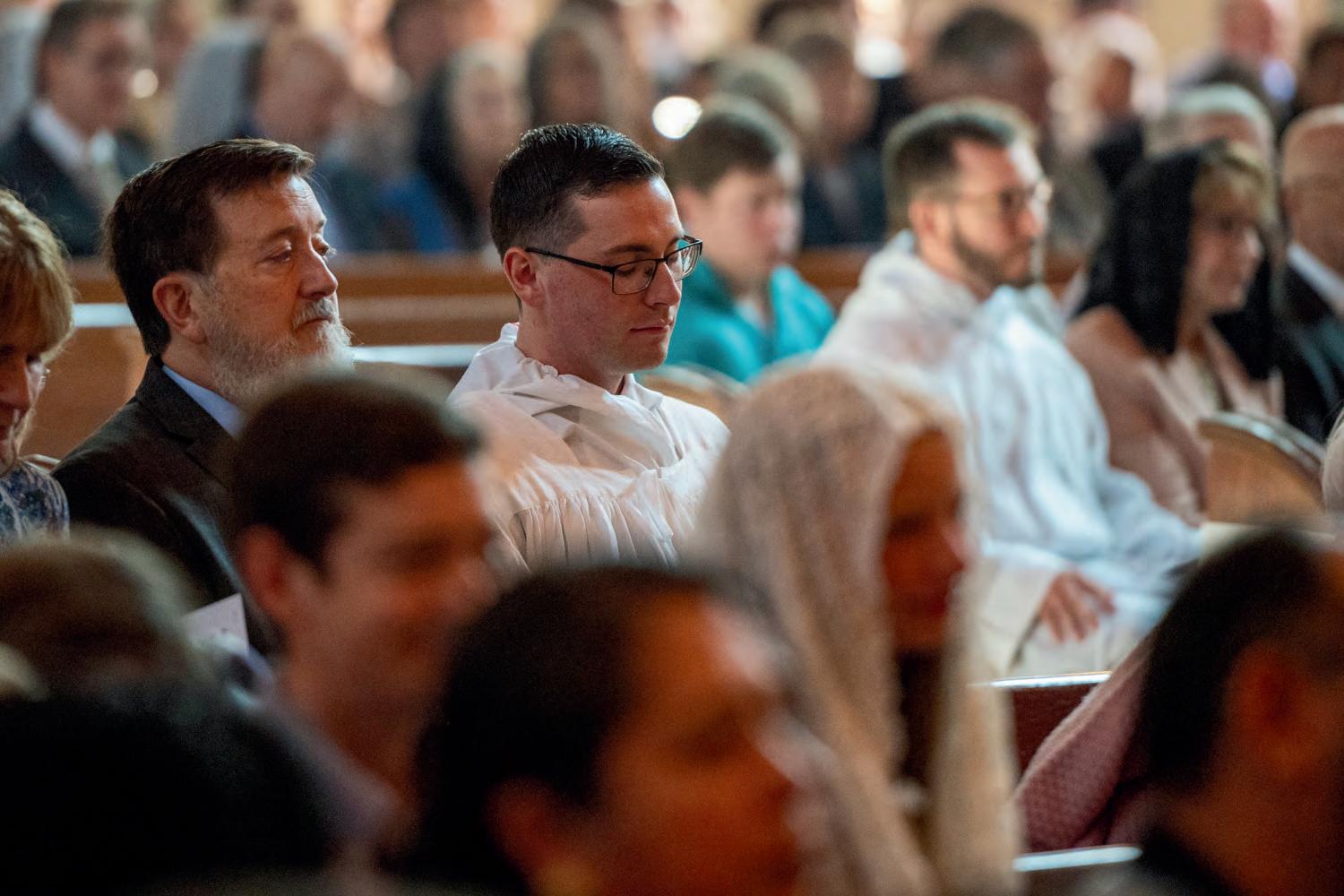

With joy and gratitude, the parish family of Our Lady of Consolation Catholic Church congratulates
on his Ordination to the Diaconate.
As the parish where your faith journey began, we give thanks for your answer to God’s call. It has been a blessing to watch your vocation grow within this community.
May the Lord guide you as you begin your ministry and serve His people with a faithful heart.
Rev. Father Marcel Amadi, EdD, PhD Parochial Administrator and the Parish Family of Our Lady of Consolation
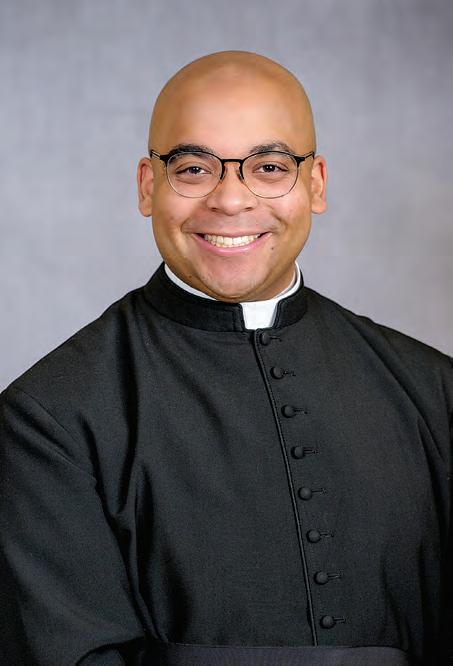
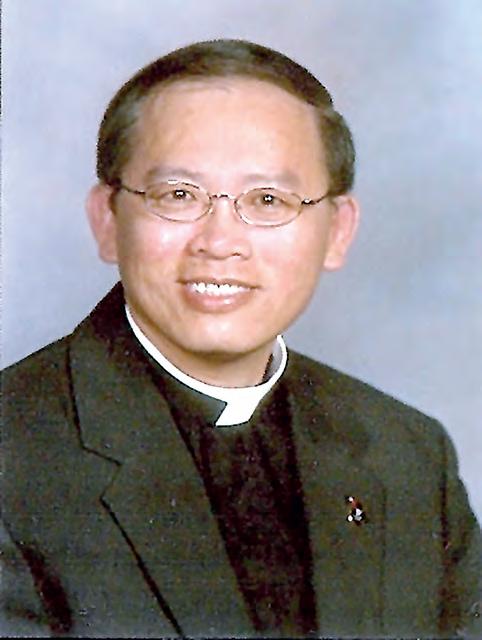
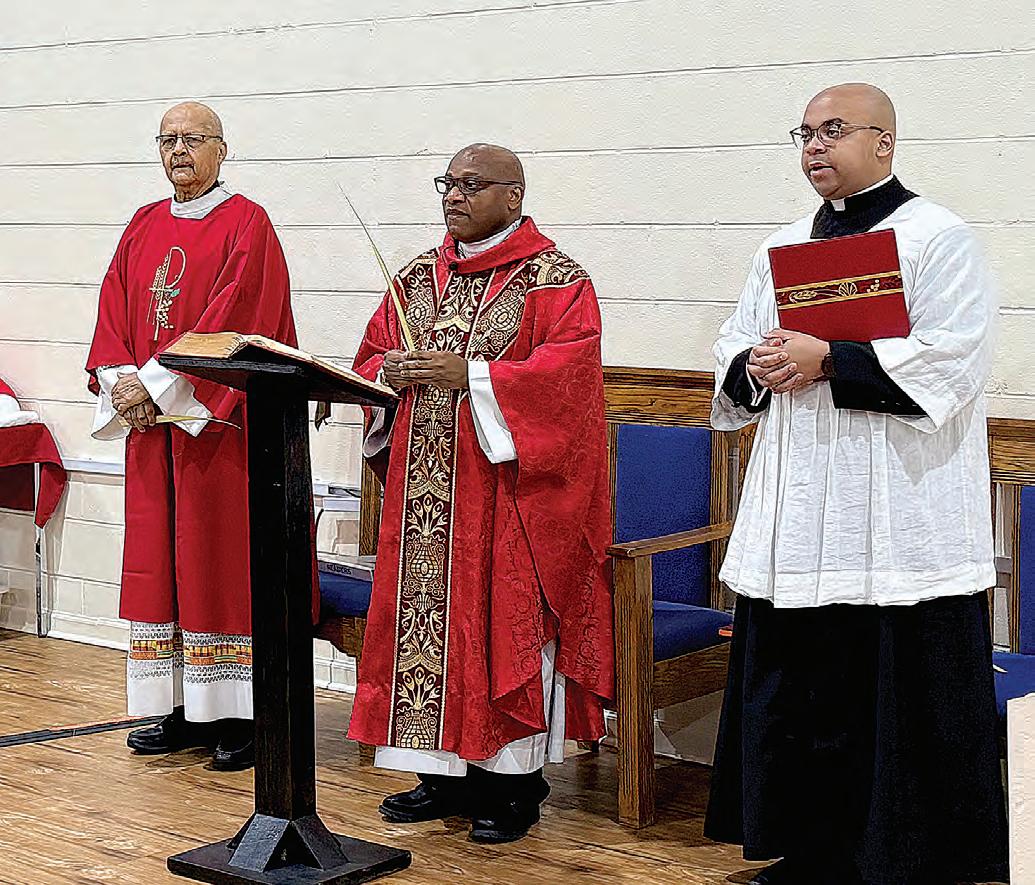
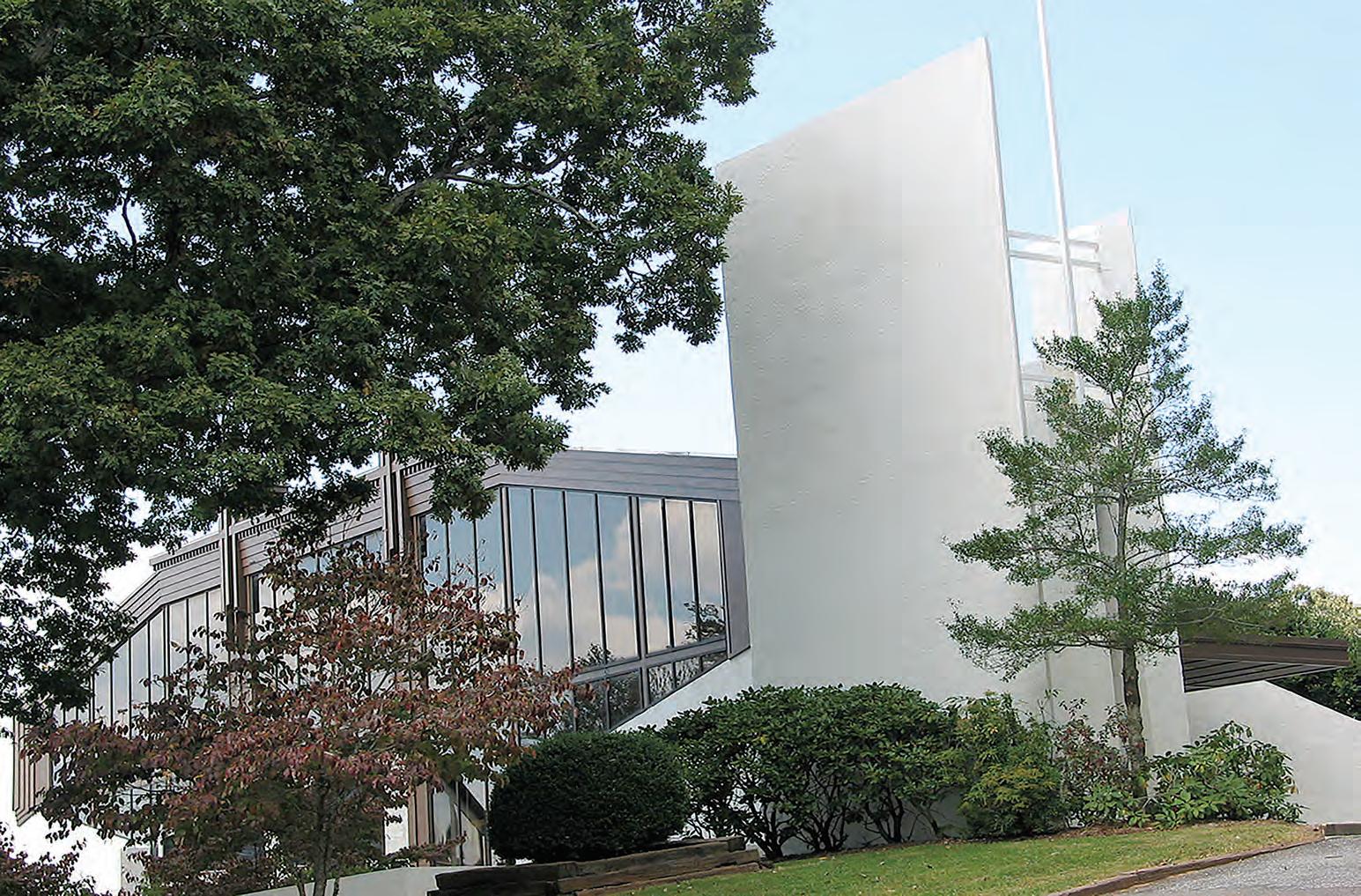
eacon David and the parishioners of St. Francis of Assisi Franklin congratulate Fr. Tien Hung Duong and his brother Fr. Duc James Hung Duong on the 25th Anniversary of their Ordination and we pray for God's continued blessing on them.
You are a priest forever…
HEBREWS 7:17
l diácono David y los feligreses de San Francisco de Asís Franklin felicitan al padre
Tien Hung Duong y a su hermano El padre P. Duc James Hung Duong en el 25º aniversario de su ordenación y oramos por la bendición continua de Dios sobre ellos.
Tú eres sacerdote para siempre…
HEBREOS 7:17
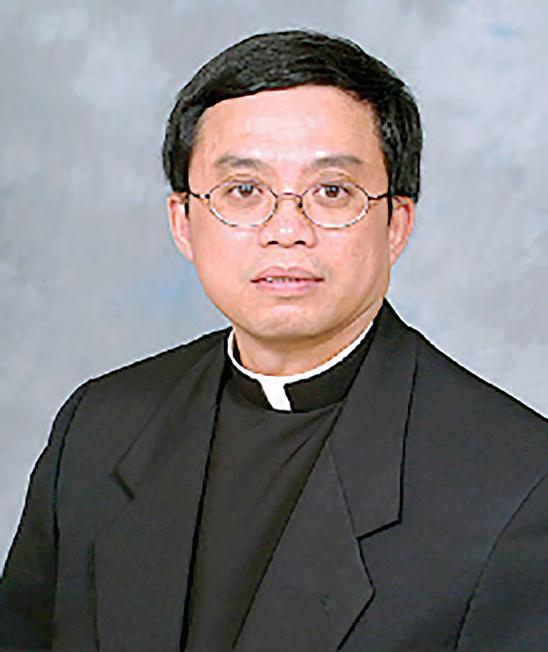
never had a second thought of giving up the call’
Editor’s note: This article on Father Tien Duong and his brother Father Duc James Duong was originally published in June 2016 on their 15th ordination anniversary. We are re-running it in honor of their 25th anniversaries.
FRANKLIN — The story of Father Tien Duong, his brother Father Duc James Duong (now retired) and their family is a story of survival and grace.
The two priests of the Diocese of Charlotte are celebrating the 25th anniversary of their ordinations this year – a testament to their tenacity and their faith, given the circumstances of their lives in fleeing Vietnam and coming to the United States.
Father Tien grew up in a family with 10 brothers and sisters (eight boys, two girls) in Saigon. The family was very faith-filled and active in their parish.
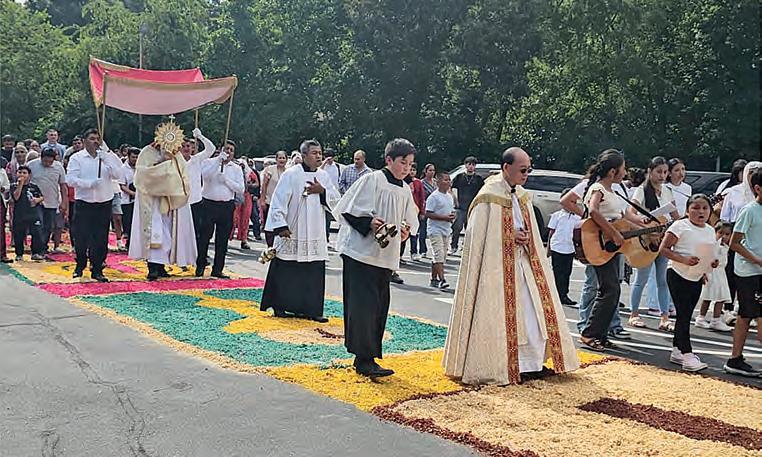
“I believed that I wanted to become a priest even before I received my first Communion,” Father Tien recalls. “I went to minor seminary as a sixth-grader in 1973.”
Just like all those who had family members involved in the armed forces of South Vietnam, their family endured a great deal of hardship after the Communists took control in Vietnam, Father Tien notes, particularly when his father was arrested and put in a labor or “re-education” camp.
“I escaped by boat with my brother, now Father (James) Duc Duong, for the first time, but it was not successful and we were put in prison. The second escape occurred in 1989 with my younger brother, and we ended up at Galang refugee camp in Indonesia,” he says.
Father Duc James Duong and Father Tien Duong will celebrate Mass at 8:30 a.m. Sunday, May 31, at St. Joseph Vietnamese Church in Charlotte. The two priests will also celebrate at 4 p.m. Mass on Saturday, June 6, followed by a reception and at 9 a.m. and 11:30 a.m. (Spanish) Masses on Sunday, June 7, at St. Francis of Assisi Church in Franklin.
A few years later, he was able to follow the rest of his family to the United States, and they settled in Charlotte. It was then that Father Tien resumed his efforts to become a priest. He went to Central Piedmont Community College for two years, then studied philosophy for two years at St. Joseph Seminary College in Covington, La., before graduating from St. Vincent Seminary in Latrobe, Pa.
“I was ordained by Bishop (William) Curlin with my brother (Father Duc Duong) and with Father Bob Ferris and Father Kurt Fohn on June 2, 2001, at St. Gabriel Church, which was also my first assignment as associate pastor,” he says.
During his years of ministry, Father Tien served as associate pastor at St. Gabriel
DUONG, SEE PAGE 31B
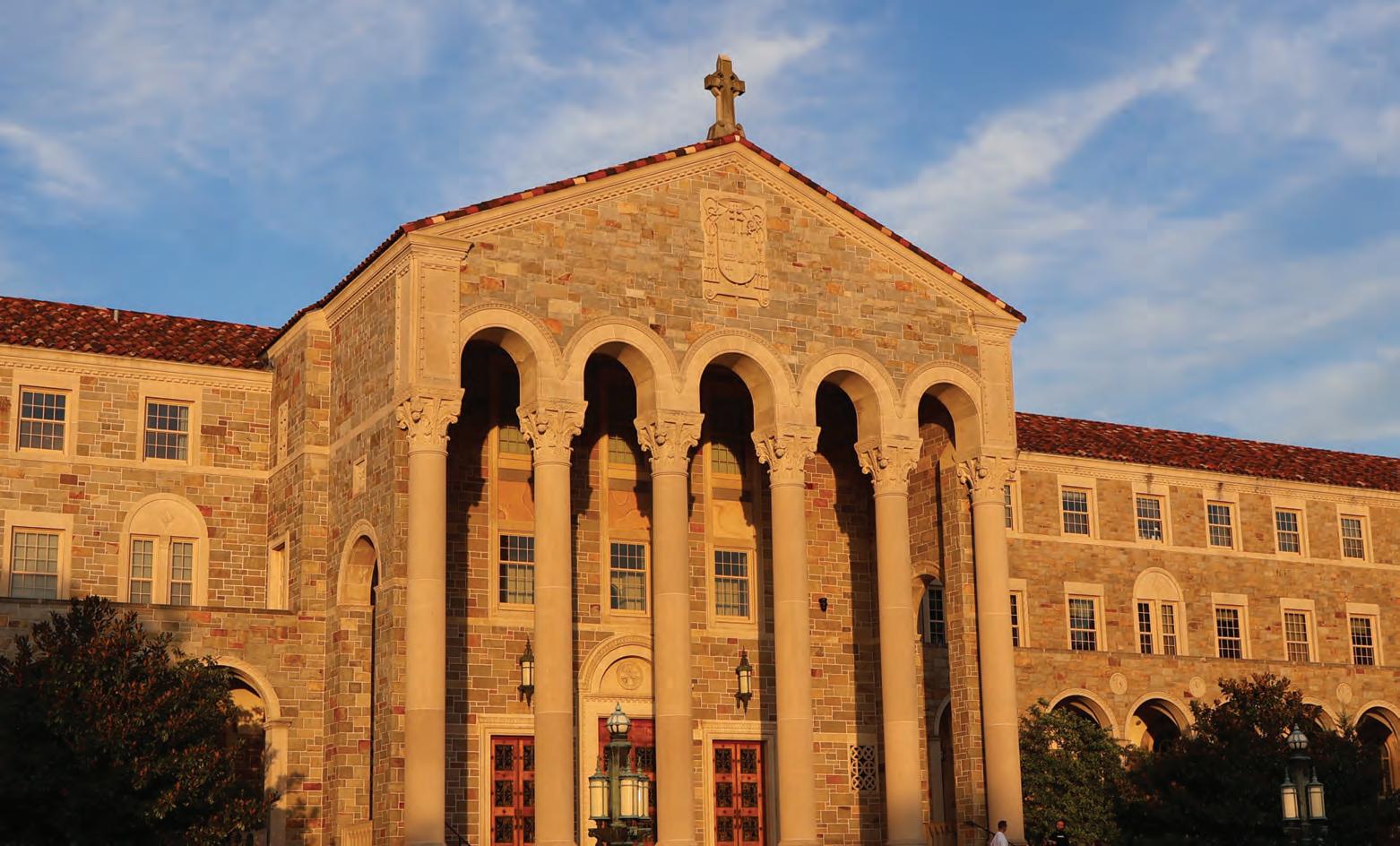
Congratulations on your ordination and thank you for being part of our Seminary community! May the Diocese of Charlotte be blessed by your priestly ministry.
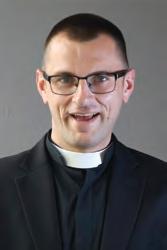
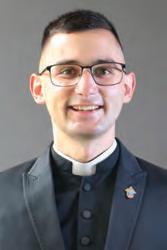
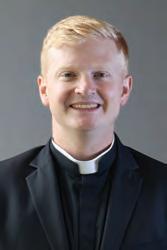
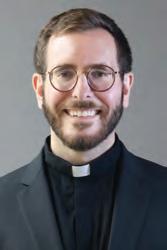
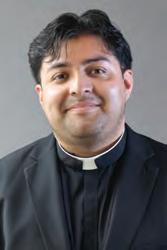
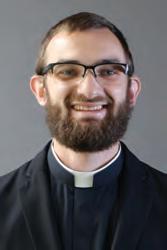
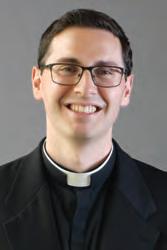
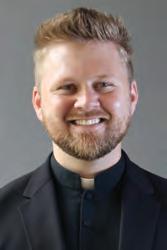

‘Do what you love’: Sister Janis celebrates 60 years of teaching,
COURTNEY MCLAUGHLIN catholicnews@rcdoc.org
ELKIN — For Sister Janis McQuade, SSJ, there was never much doubt about what she wanted to be when she grew up.
“I always wanted to be a Sister,” she said. “I never had any doubts and was never homesick a day in my life.”
As she celebrates 60 years with the Sisters of St. Joseph, she carries a quiet confidence rooted in her belief that God continues to guide her wherever she is called to serve.
Sister Janis grew up in a closeknit Catholic family in Bryn Mawr, Pennsylvania. One of eight children, faith and family were everything to her. “Church is just who we were. Everything revolved around the church and parish life.”
ROOTS OF HER VOCATION
After high school, she entered the Sisters of St. Joseph and began the congregation’s formation process while attending Chestnut Hill College, where she earned a bachelor’s degree in education. She later received a master’s degree in theology and pastoral ministry from La Salle University. She took her final vows as a Sister of St. Joseph in 1973.
“I felt that calling deep in my heart,” she said. “God puts it in your heart and you don’t know how that mystery is going to unfold, but it does.”
She began her ministry in education, teaching in New Jersey, Maryland, Virginia, Delaware and Washington, D.C., among other locations.
“I taught every grade in all types of
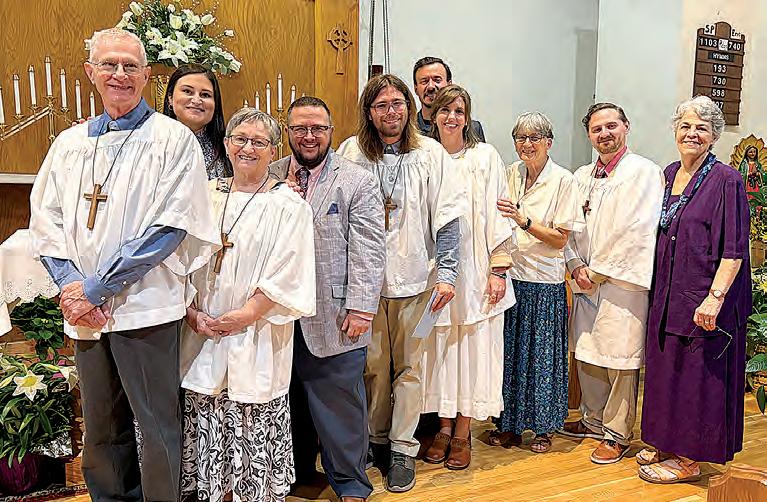
socioeconomic environments,” she said.
In 1981, she transitioned into pastoral ministry at Our Lady of Mercy Church in Winston-Salem, where she worked in faith formation, RCIA, children’s ministry and a variety of other parish responsibilities for nine years.
She continued pastoral ministry at St. Thomas More Church in Chapel Hill before returning home to care for her ailing father while continuing ministry work there.
After her father’s passing, she spent a year at Charlotte Catholic High School before once again returning north to help care for her mother and sister.
In 2006, she was offered a position at St. Stephen Mission in Elkin. The mission church has approximately 90 households and serves a diverse congregation with members from Central and South America,
the Caribbean and Vietnam.
“We are pretty eclectic and intergenerational,” she said.
As the primary onsite pastoral presence, she handles much of the dayto-day ministry. Her work includes parish administration, accompanying families in sacrament preparation, family faith formation and other milestones on their faith journeys.
“You become part of their family and they become part of your faith journey,” she said.
Unlike some of the larger churches where she served, the smaller community of St. Stephen allows Sister Janis to cultivate personal relationships –something central to the purpose of the Sisters of St. Joseph. “It was nice to be in relationships with people,” she said.
“People trust you with their stories and their faith journey.”
She encourages those who feel they are being called to religious life to have a healthy prayer practice and develop a strong relationship with Jesus. She also advises attending weekly Mass and finding a spiritual director or mentor.
“Talk to someone who is living the life and find out if that is a fit for you,” she said.
This year marks significant milestones for both St. Stephen Mission and Sister Janis. As the church celebrates its 70th anniversary, Sister Janis is marking nearly 20 years of ministry there.
“It seems like I just walked in the door yesterday,” she said. “It’s a blessing, it’s pure grace on God’s part that you get to do what you love.”
Immaculate Conception Forest City would like to congratulate our first parish vocation to the priesthood,

We will all be praying for him as he starts his journey as a servant of the Lord who acts
“In
Persona Christi”.
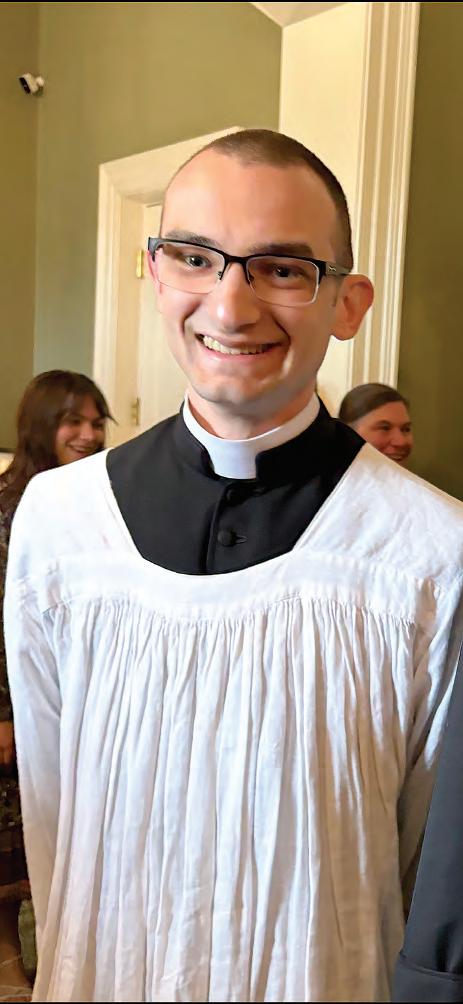
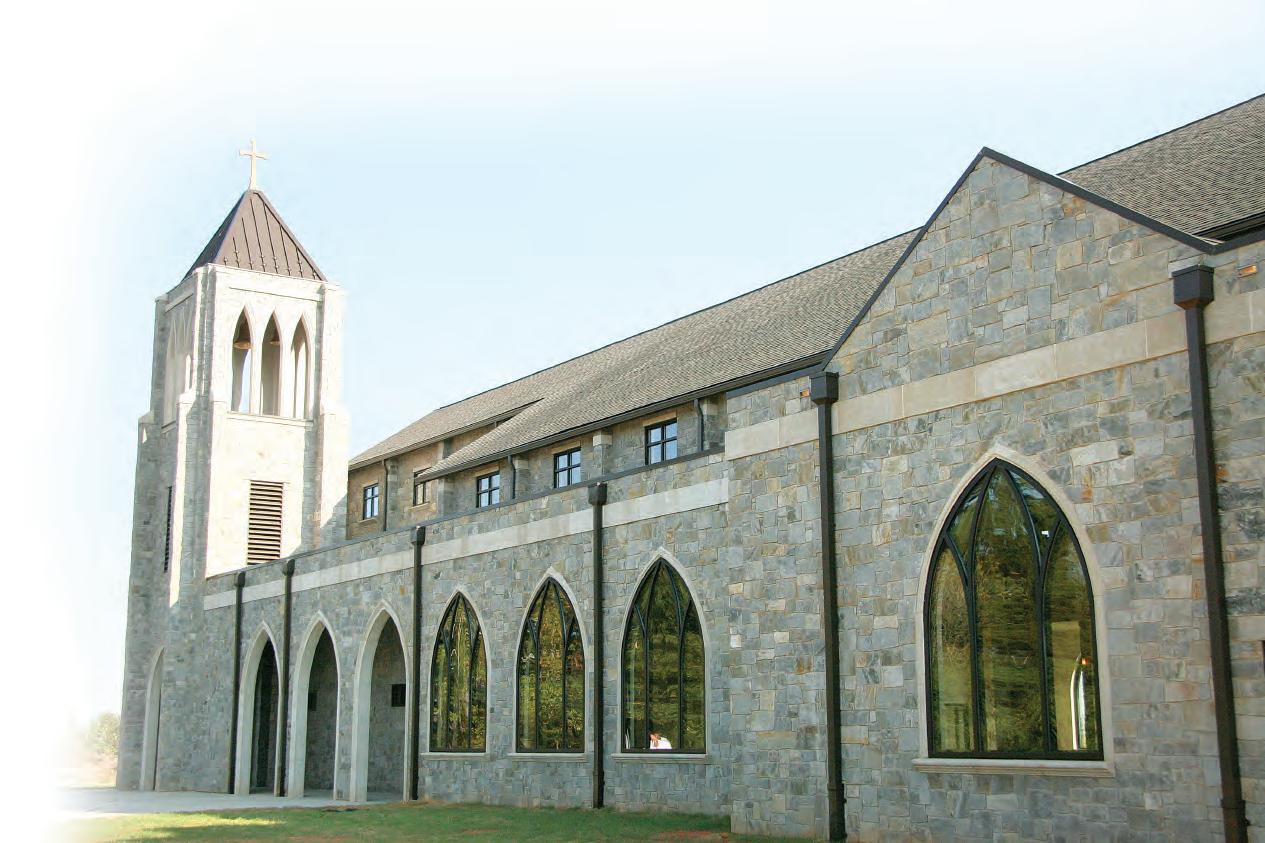
We rejoice in his first Mass at our parish on May 31 at 9 a.m.
‘YOU WILL BE MY DEACON’
LISA M. GERACI lmgeraci@rcdoc.org
GREENSBORO — Deacon Pierre K’Briuh is approaching 90 and says that daily life is becoming a challenge.
“My head is a little clouded, and my body is physically deteriorating,” he says.
Yet when Deacon K’Briuh talks about his faith – and serving St. Mary’s in Greensboro for the past 25 years, his wife, eight children and 16 grandchildren – he is unable to contain his joy.
“I have my own soccer team here,” he laughs.
“I just pray one day God will grant me a priest out of this family. I prayed for vocations, and He answered my prayer through the diaconate, but I am still all alone.”
By “alone,” he is referring to his ministry of leading local Catholic Montagnards –immigrants from the central highlands of Vietnam – for the past two decades. North Carolina has the largest population of Montagnards outside of Vietnam. They fled persecution after the fall of Saigon and gravitated to North Carolina through their relationship with the U.S. Army Special Forces stationed at Fort Bragg.
The community of about 20,000 lives in Charlotte, Greensboro and Raleigh, and
though mostly Protestant, Catholics, like Deacon K’Briuh’s family, desire to practice their faith in their native tongue and with familiar traditions.
FROM THE HIGHLANDS TO THE TRIAD
Deacon K’Briuh grew up herding buffalo in South Vietnam. He was sent to school as a teenager, where he learned both his career and his faith.
The year was 1954. The French had relinquished control to the newly sovereign Republic of Vietnam, and he was baptized.
“I was the first in my family to ever convert to Catholicism,” he says.
He eventually got married, had children, and started working as a liaison officer between his tribe and the South Vietnamese government.
In 1975, when the North Vietnamese captured Saigon, he watched his life collapse and he was placed in a reeducation camp for three years. The brutal conditions and manual labor should have left him exhausted, but he was unable to sleep amid fears for his wife and children.
ESCAPE BY BOAT
Released in 1978, he arrived home to find everything seized by the government and realized his family needed to escape. He did so with help from the Church.
“The priests and the nuns found a way, so I asked them if I could be included,” he recounts, and despite his lack of funds, he promised to repay them later.
years
He left in a small fishing boat, crowded in with 24 Catholics who had no idea how to navigate on the open water.
“We had the help of God and our prayers, and that’s all,” he says. “We were surrounded by sharks, and I didn’t know how to swim. I just knew for sure that I would be at the bottom of the ocean. But I needed to save my family by protecting my own life. If I died, what would happen to them?”
A French boat rescued them, bringing them to Singapore. Eventually, the Green Berets helped him reach North Carolina.
“When I was in the camp, I was worried about my family’s survival. When I got out, I was worried how I was going to feed them, and now that I came here, I was worried how I was going to get them here,” Deacon K’Briuh recalls.
“In my life…let’s just say, I never got too much sleep.”
The process took nine years, but he was finally able to bring his wife and children to Greensboro.
Yet he didn’t stop there. He helped resettle another 600 Montagnard refugees to North Carolina.
PAYBACK’S A GIFT
The nuns who aided his escape never asked K’Briuh for payment, but the Church still settled his account.
Then-Bishop William Curlin overheard K’Briuh sharing his testimony one day at St. Mary’s in Greensboro and approached him, saying, “You will be my deacon.”
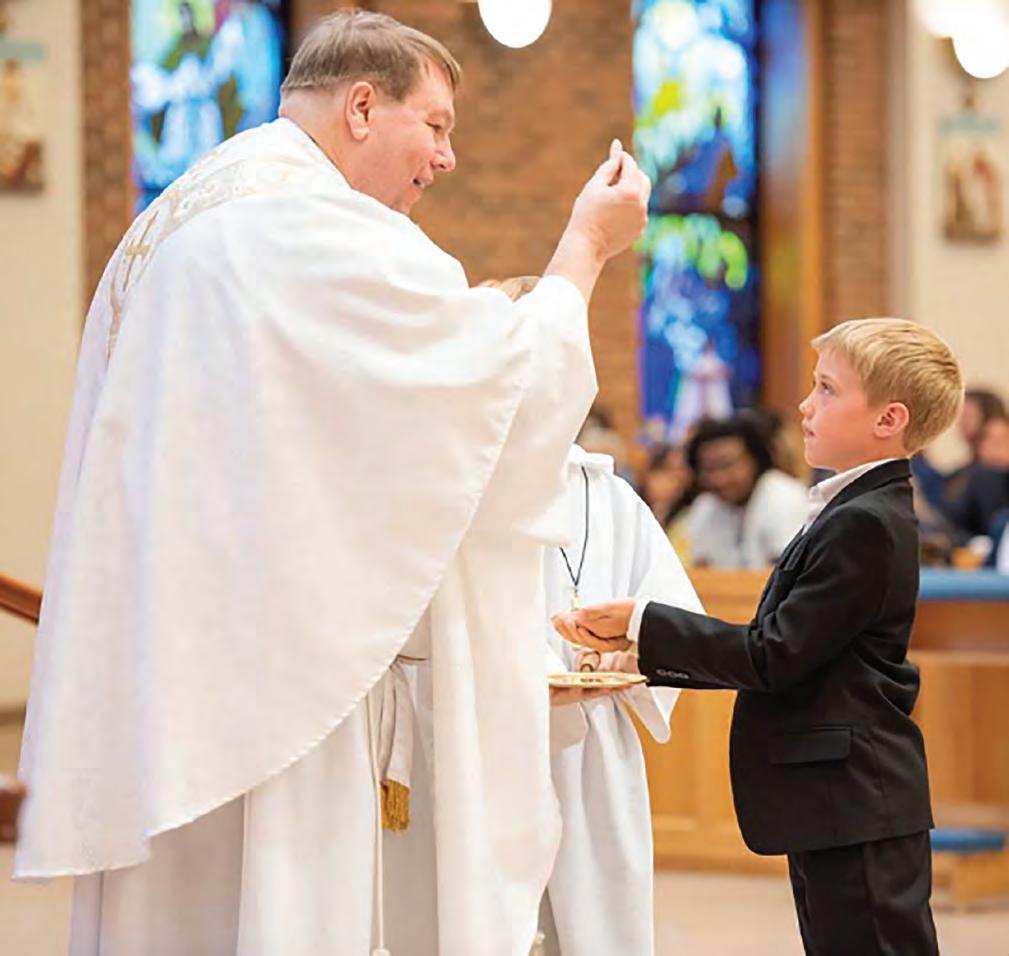
‘This church... is a pool of love and community.’
Deacon Pierre K’Briuh
K’Briuh accepted the new task as a gift.
“Because of the good grace God has provided me, I could not refuse,” he says.
St. Mary’s Parish gave him the opportunity to attend Mass in his own dialect, with his fellow Montagnard community.
But Deacon K’Briuh serves and is inspired by all people.
“St. Mary’s attracts the poor, the rich and everybody else. We have all kinds of tribes, ourselves, the lowland Vietnamese, Africans and Latin Americans,” he reflects.
“This church, which was built for Black minorities, now has all minorities pulled together. It is a pool of love and community,” he says.
For Deacon K’Briuh, it is vital for the Church to preserve that rich diversity by including the Montagnard community.
“Right now, we don’t have any priests that speak our language,” he says, “and that is why I really want my prayer quickly answered for a Montagnard priest so they can teach our own people again.”
Congratulations and heartfelt gratitude to our pastor, as he celebrates 20 years of priestly ministry.
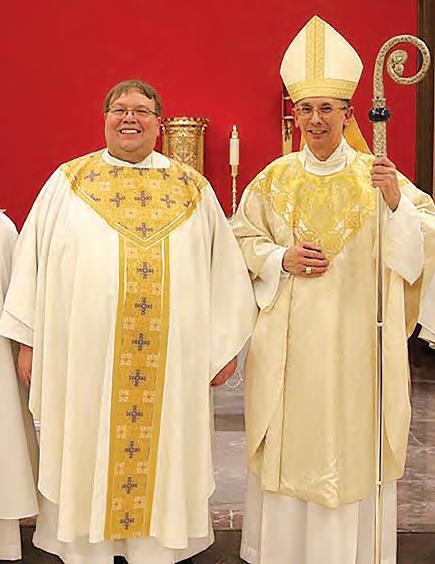

Thank you for your faithful service, generous heart, and devoted care for our Holy Family parish.
May God continue to bless you abundantly
We give thanks for your “yes” to Christ and pray for many more years of joyful priesthood.
LISA M. GERACI lmgeraci@rcdoc.org
LENOIR — As Deacon Stephen Pickett marks 20 years of ordained ministry, the 71-year-old St. Francis of Assisi parishioner is reflecting on the faith, family and witness that shaped his vocation and continues to guide his preaching.
Known for heartfelt, Spirit-filled homilies, Pickett said the words parishioners hear are not his own, but the Lord’s.
“My homilies come from God and are never mine,” he smiles. “I have written things, and the Lord has told me not to use those. I have torn them up and gone off the cuff... I empty myself out and let the Lord come in. My hope is that it touches a heart, it changes a life and it brings someone closer to our Lord.”
As he looks back on two decades of ordained ministry, Pickett returns often to the roots of his vocation. A Catholic from birth, he was baptized at St. Ann Church in Fayetteville.
“I am told that my baptism was the first integrated baptism in the Diocese of Raleigh,” he says.
Being an African American in Cumberland County wasn’t easy in the 1950s. Although Fayetteville’s public schools did not integrate until 1962, St. Ann opened its integrated Catholic school in 1956 – just in time for Pickett and his sisters and brothers to attend.
The priests and sisters faced strong opposition, and Pickett watched with
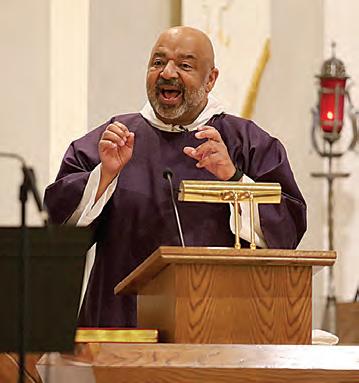
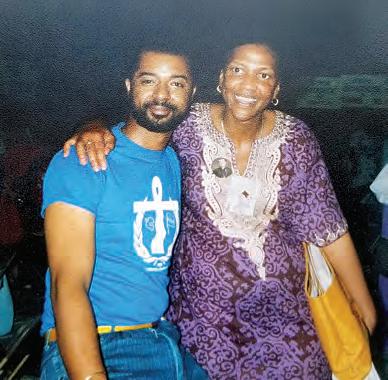
admiration as his pastor defended his flock.
“Father William Ryan kicked down a wall and fired the construction company when a worker said, ‘The people starting with an N did not matter.’”
He and his classmates were confronted with racist rhymes on their walks home from school, he recalls. “In my mind I realized you had those people and then you had the Catholic kids. And these Catholic kids were different.”
“I didn’t grow up with hatred in my heart for people. I grew up by the example of my parents, my parish, and my school community,” he says. “We are all people of the highest God. We are all trying to get
Thank you Deacon John and Deacon Herbert for your commitment and service to our parish.
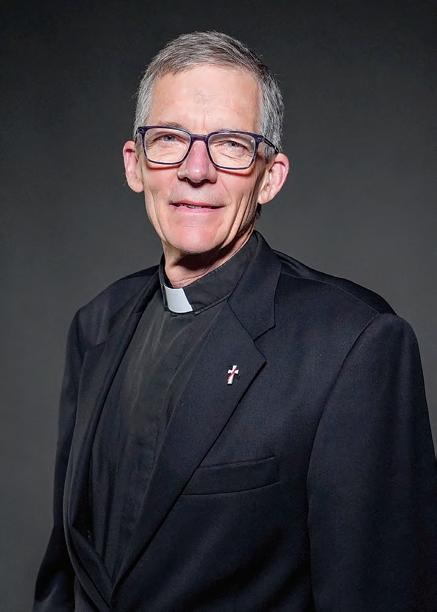

it,” he says. “They put the possibility in my heart. We need more images that look like the people in our parishes, so they know God wants them to serve as well.”
At 15, Deacon Pickett boldly announced to everyone he would be ordained.
“I always wanted to serve the Lord,” he says. “But, I knew I would be married.”
He met his wife, Deborah, at a CME church while giving a Black history talk. They have now been married 35 years.
“We met that day and have been together ever since,” he laughs.
Deborah converted to Catholicism, and they attribute their marital happiness to prayer and faith.
Before moving to St. Francis of Assisi, he was in discernment and formation at Our Lady of Consolation. He was ordained in 2006.
to a place called heaven. We use the word ‘race’ wrong – there is only one race, the human race.”
His faith and family taught him that human dignity comes from God, not man. Even so, he credits the faces of his youth with helping awaken his call to serve.
“I am a deacon because I became what I saw. Father Joseph Lawson Howze, who later became Bishop Howze, was at my house being fed by my mother. We had three African American seminarians. I saw Father Wilton Gregory before he was a cardinal, Father Martin Carter and the religious brothers – all African American men of God.”
“If you can believe it, you can achieve
“It was all God’s timing. I came out of the pew and onto the altar,” Deacon Pickett says. “God is here at St. Francis, and good people are here.”
Deacon Pickett says the Franklin parish’s growth reflects more than demographics.
“Father (Alfonso) Gámez gives us more opportunities to experience the sacraments,” he explains. “Because of that and his love, I have seen an increase in this parish from the cradle to the grave.
“I consider ourselves a bright light on the hill. My hope is that we grow and that young men from this parish will spring up to become priests and deacons.”
We joyfully congratulate Saint Leo parishioner, John Cuppett, on his ordination to the Holy Priesthood.
With grateful hearts, we thank God for the gift of his vocation and for his generous “yes” to the Lord’s call. It has been a blessing to witness his journey of faith, formation, and joyful service.
Congratulations, Father John Cuppett!
As he begins this sacred ministry, we assure him of our continued prayers and support.
May the Lord bless him abundantly as he serves His Church.
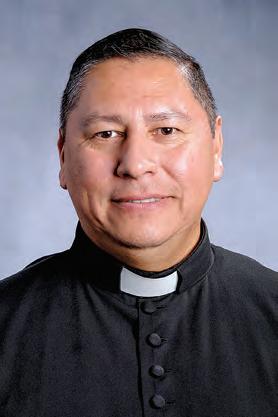

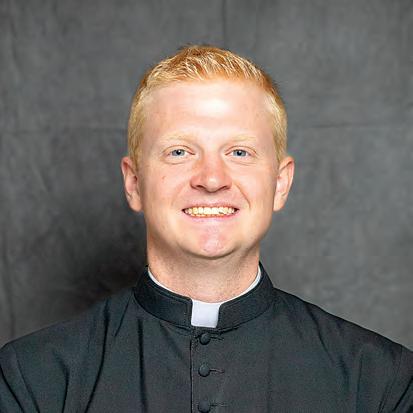
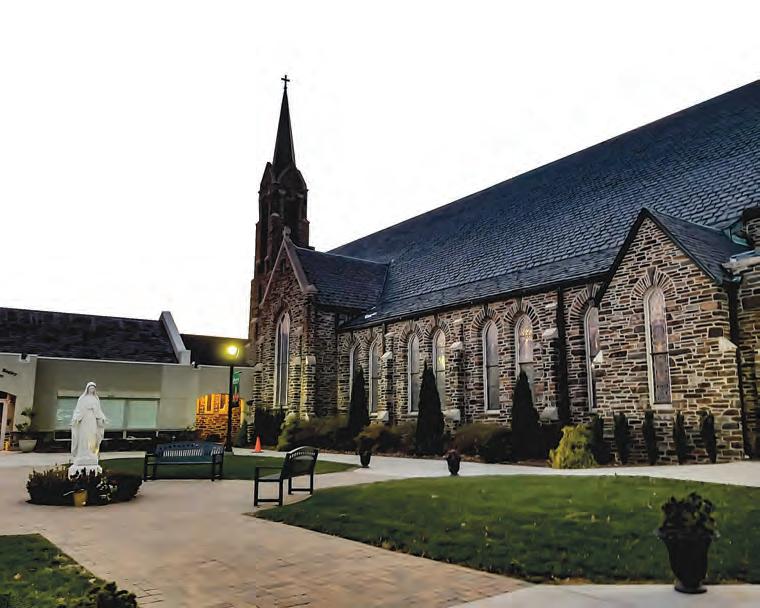
LISA M. GERACI lmgeraci@rcdoc.org
CHARLOTTE — Deacon Joseph Becker is celebrating five years of ordained ministry at St. Matthew Parish and his first year serving as assistant formation director for the diocese’s Permanent Diaconate program.
The call to serve runs deep in the Becker family. His son, Father Brian Becker, directs formation for first-year seminarians at St. Joseph College Seminary and serves as the diocese’s vocations promoter. Another son, Mark Becker, is enrolled at the college seminary. Their daughter, Deena, lives in Northern Virginia with her family, including three boys.
Deacon Becker and his wife of 46 years, Tammy, remain active at St. Matthew Parish, their spiritual home since the church’s founding in 1986.
“We jumped in right away. I was on the parish council from the very beginning. My wife was involved in faith formation,” he says.
GROWING UP CATHOLIC
Deacon Becker grew up in Cincinnati, attending Catholic elementary school and graduating from a Jesuit-run Catholic high school.
“There is no story about awakening in my faith, because I have always been living in the faith. It has always been front and center in my life,” he says.
His first career was in the theme park industry. He worked at Kings Island outside Cincinnati, where he met his wife. What began as a seasonal job eventually became a career. After college, he took a permanent position and later invested in six theme parks, including Carowinds.
“That’s how we got to Charlotte,” he says. “But we ended up selling our business to Paramount Studios in the early ’90s.”
At age 35, he found himself looking for a new chapter. Though too young to retire, he was recruited to serve as CEO of the American Red Cross in the Charlotte region and later was asked to lead the organization’s national
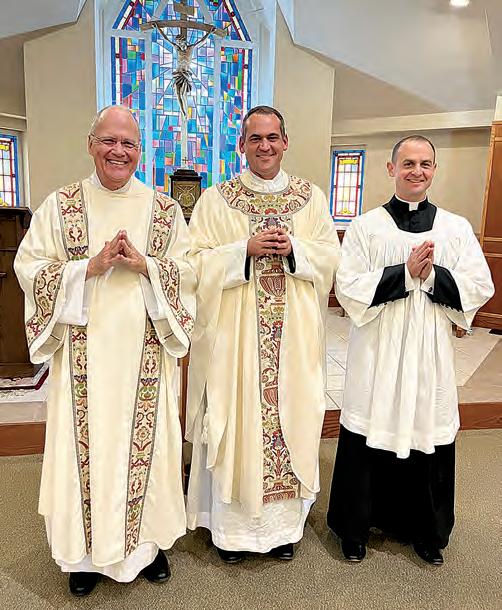
Disaster Relief Services.
When he retired in 2017, becoming a deacon was not part of his plans.
“I never quite got a text from the Lord saying, ‘I would



like you to become a deacon,’ but what I did get came step by step,” he explains.
A desire to deepen his faith led him to enroll in lay ministry classes, which at the time were a prerequisite for diaconate formation.
“The more I learned, the more I wanted to learn,” he recalls.
At the end of the two-year program, he was invited to explore the possibility of becoming a deacon. He and Tammy spent time in prayer and discernment.
“It took a while to discern what God was leading me to do,” he says. “That was not my plan for retirement. I was just going to be one of those men that hangs around the parish and volunteers for all these different ministries, and travels a lot, and plays some golf. Man plans, God laughs, as they say!”
For Deacon Becker, learning to serve after years spent leading as a corporate executive was a humbling transition.
“My role as a deacon is to be attentive and present and do what God leads,” he says. “I’ve tried to set aside that part of my professional career that was planning, organizing, directing and staffing, and to be more responsive to what the Lord needs.”
Alongside his ministry at St. Matthew, Deacon Becker also helps form future deacons for the diocese. The Permanent Diaconate program currently includes a class of 14 men preparing for ordination in January and another class of 12 men who have recently begun formation.
“A lot of being deacons isn’t necessarily what you do – it is who you are,” he says. “We are ordained and configured as Christ the servant.”
Faith has always been fundamental to the Becker family, although Deacon Becker admits he was surprised when his oldest son began discerning the priesthood.
“That was an exciting message to hear that Brian was

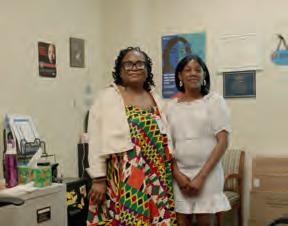
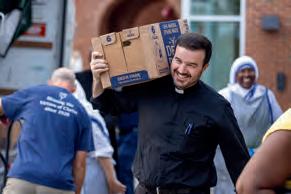
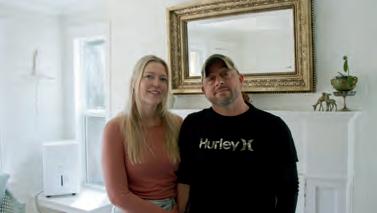
CHRISTINA LEE KNAUSS clknauss@rcdoc.org
ASHEVILLE — Deacon Mike Zboyovski doesn’t need elaborate phrases to describe his 25 years as a permanent deacon in the Diocese of Charlotte.
“It’s been absolutely great in every way!” he says when asked how life has been since he was ordained in 2001.
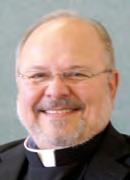
A native of Missouri, Deacon Zboyovski always felt a call to serve the Church and attended a minor seminary discerning a call to the Vincentian order when he was still in high school. A vocation wasn’t right for him at the time, however, and he left seminary to attend the University of Missouri, where he earned a degree in chiropractic and acupuncture. He moved to the Asheville area and worked in that field for nearly 30 years, but always stayed close to the Church.
He and wife Jan, who have been married for 49 years and have two sons and a daughter, were always active in their parishes, but he felt a call to serve in a deeper way.
Several people, including the late Father Jim Solari, encouraged him to follow that call and become a permanent deacon, and he did.
Since that day, Deacon Zboyovski has been based at St. Eugene Parish in Asheville – his
church home for more than 40 years – and he has worked in a variety of ministries, most notably the Order of Christian Initiation of Adults, the process by which people become Catholic. He served in that ministry for several years before becoming a deacon, and he has remained active in the ministry at St. Eugene and now serves as chair of the diocese’s OCIA commission.
“People I knew invited me to work in both OCIA and prison ministry, and that was a stepping stone in my ministry, because it opened my eyes to the various ministries available,” he says. “OCIA has always been a dear spot in my heart, just journeying with individuals on their particular walk and watching them come into the fullness of the faith. There’s a powerful exchange that takes place in those months.”
He especially enjoys helping parishes develop “the pastoral type of care and the open arms” that come with year-round OCIA ministries, and he has seen a steady growth in the number of people seeking out the program, especially in the Hispanic community.
“It’s just beautiful to see people come into the Church,” he says. “Even after (Hurricane) Helene, it was amazing to see how many people were interested in inquiring into the Church – often after they had helped out at one of our parishes from a secular standpoint after the storm. That work they did was the stimulus for many to ask about the Church and inquire, and many have ended up getting involved in OCIA.”
JOURNEYING INTO PRISON MINISTRY
Deacon Zyboyovski has also been
With great joy and gratitude, the parish family & staff of Our Lady of the Assumption Catholic Church honors two devoted servants of the Church.
Congratulations to Deacon David Reiser on 15 years of ordained ministry.
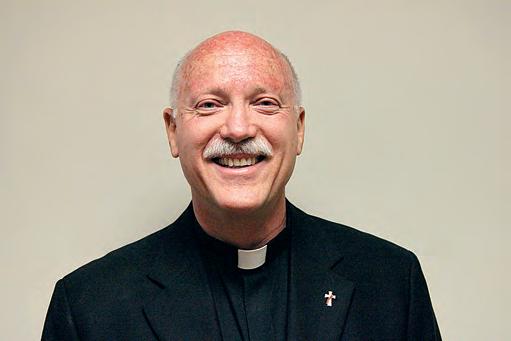
Congratulations to Deacon Kevin Williams on 20 years of ordained ministry.
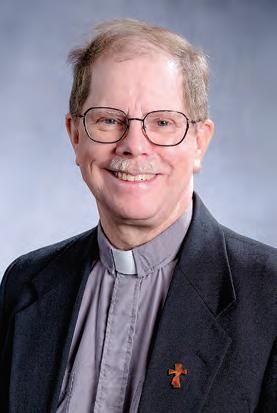
We also give special recognition and sincere thanks for his 20 years of dedicated service as Business Manager of our parish. His commitment to serving both the Church and our parish family with humility and generosity is deeply appreciated.
We are grateful for his faithful service, steadfast commitment to the Church, and the many years he has devoted to ministering to God’s people.
As a parish community, we are blessed to celebrate these important milestones and to thank both Deacons for their faithful service and dedication to Christ and His Church. May the Lord continue to guide and bless them both abundantly in the years ahead.
involved in prison ministry for many years. He leads a weekly service for inmates at Craggy Correctional Center, and he stays on call for ministry needs at the Buncombe County Detention Center.
Bringing Christ’s love to people who are not able to attend Mass at a parish church has been one of his greatest joys as a deacon.
“I love being able to bring the beauty and the sense of community we have at St. Eugene – the kindness and love and welcome – to extend that to people outside of the parish,” he explains. “Whether it’s prison inmates, people in retirement centers or nursing homes, or others who can’t attend Mass personally anymore – to be able to bring the presence of Christ to them has been a great ministry.”
Deacon Zboyovski also takes great joy in serving at the parish that has been his home for so long.
“It is just honestly such an awesome community, and a diverse community,” he says.
“One of the really chief charisms of St. Eugene is that of hospitality and welcoming. We usually do a little ‘meet and greet’ before Mass begins, and we acknowledge visitors to the parish, and I have had so many people tell me they love it because they come from a home parish where people don’t really talk to each other. They’ve told me they feel at home at St. Eugene, and that type of atmosphere has been wonderful to work in.”
St. Eugene marked his anniversary with a celebration on May 16, and he and wife Jan hope to make a celebratory trip to Italy in the future.
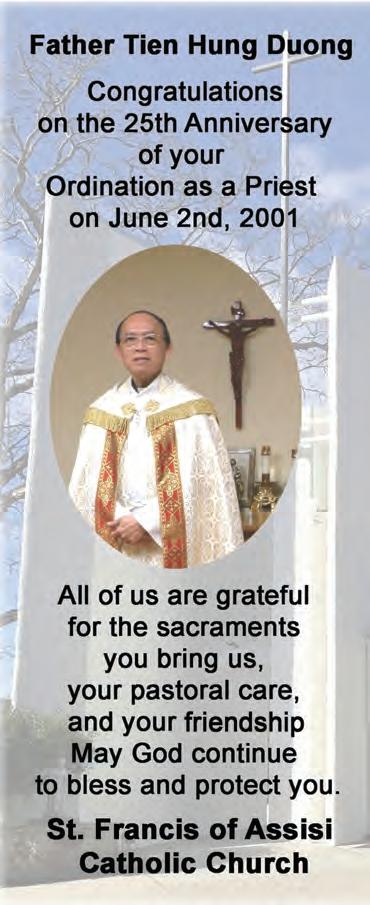
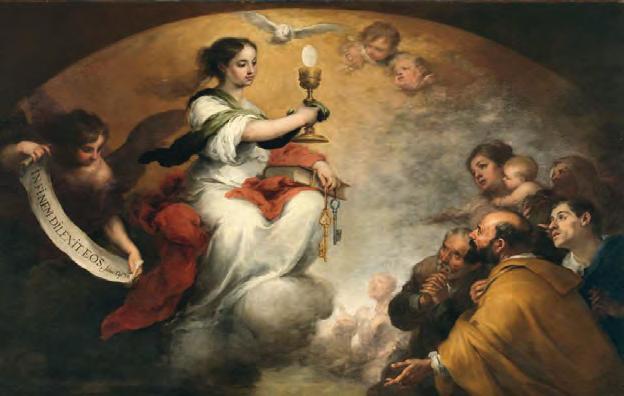
BRIAN SEGOVIA bmsegovia@rcdoc.org
CHARLOTTE — From a young age, Deacon Eduardo Bernal had a missionary heart, although he never imagined the paths God had prepared for him.
In 1990, when he emigrated from El Salvador to Glen Cove, New York, as a young adult,he felt called to serve those most in need.
“I’m not an office person; I belong in the streets, serving among the people,” Deacon Bernal said.
While serving as a missionary at St. Patrick’s Parish in Glen Cove alongside Vincentian priests and seminarians, he began to feel drawn to being a deacon.
“Without really knowing why, the diaconate caught my attention from a young age,” he recalled.
In 2000, he arrived in the Diocese of Charlotte to work in Hispanic Ministry, thanks to Vincentian Father Vincent Finnerty, who at the time directed the ministry under then-Bishop William Curlin.
He first served for eight months in the Winston-Salem Vicariate and then spent 15 years coordinating communities in western
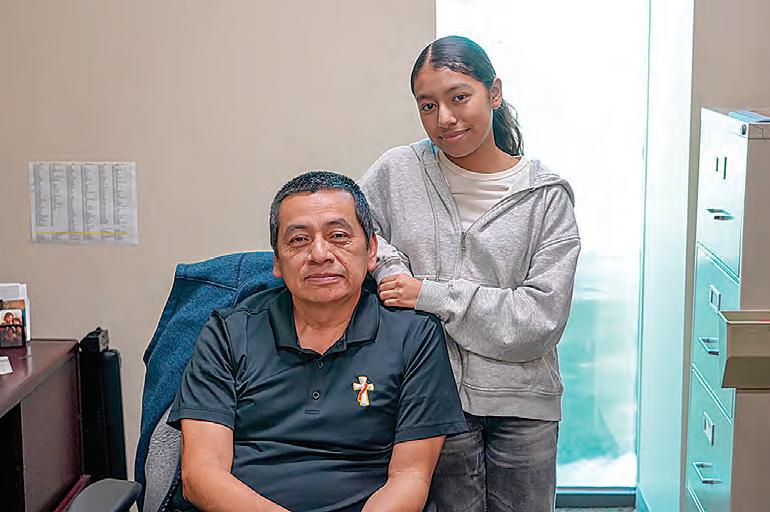
North Carolina, including the Smoky Mountains and Asheville vicariates. There, he fully lived the missionary experience he had long desired, helping communities without nearby parishes and accompanying immigrants through transitions.
“When I arrived, there was only one parish with (a Spanish) Mass,” Bernal said.
“There was a great deal of need, and I truly lived a complete missionary experience.”
In 2004, having reached the required age
to enter seminary, he began his formation. However, in 2010, with only one year left before ordination, he discovered that God had other plans for him: marriage.
“I realized that my plans, although good, were not God’s plans,” he said.
He decided to discern his vocation to marriage alongside Brenda, whom he had met years earlier in Winston-Salem. He explains that his deacon formation helped him recognize personal barriers that
had prevented him from considering that possibility.
“My plan was to be ordained and then go as a missionary to another part of the world, but marriage was never part of my plan,” he said.
After marrying and starting a family with the birth of their daughter, Mónica BernalArroyo, he said his faith and trust in God grew even stronger.
“I used to live only to work and sleep. When I got married, my life changed,” he explained.
In 2015, he resumed his preparation to become a deacon – this time with the full support of his wife, which also strengthened his spiritual life.
On Sept. 25, 2021, he was ordained a permanent deacon by then-Bishop Peter Jugis. He describes the moment as a turning point in his life: “As I walked out of St. Mark’s Church, newly ordained, a couple from Guadalupe approached me asking for a blessing. I froze with emotion,” he recalled. “In that first month, the one who had been invisible became visible.”
Five years later, Deacon Bernal continues his missionary-inspired work at Our Lady of Guadalupe Parish, where he still sees great needs within the local Hispanic community.
He said he feels closer than ever to the faithful and he is grateful for the trust of those who come to share personal aspects of their lives with him. He also hopes to inspire other men to discern a vocation as a deacon.
“Through the diaconate, I came to know a new face of the Church, even after many years of service,” Deacon Bernal said. “A whole new world opened up for me.”
‘Se abrió un mundo completamente nuevo’
El diácono vive su llamado misionero a través de su ministerio
BRIAN SEGOVIA bmsegovia@rcdoc.org
CHARLOTTE — Desde joven, el Diácono Eduardo Bernal tuvo un corazón misionero, aunque nunca imaginó los caminos que Dios tenía preparados para él en su búsqueda vocacional.
En 1990, cuando emigró de El Salvador a Glen Cove, Nueva York, siendo un joven adulto de solo 20 años de edad, Bernal sintió el llamado a servir a los más necesitados.
“Yo no soy de oficina; soy de la calle, de servir entre la gente”, dijo el Diácono Bernal. Mientras que participaba en los grupos de jovenes en la parroquia St. Patrick’s de Glen Cove conocio y pudo convivir con sacerdotes vicentinos y seminaristas, y comenzó a sentirse atraído por el diaconado. Mientras participaba en los grupos de jóvenes de la parroquia St. Patrick’s de Glen Cove, conoció y convivió con sacerdotes vicentinos y seminaristas, lo que despertó en él una atracción por el diaconado.
“Sin saber por qué, desde joven el diaconado me llamó la atención”, recordó. En el año 2000, el Diácono Bernal llegó a la Diócesis de Charlotte para trabajar en el Ministerio Hispano, gracias al sacerdote vicentino Vincent Finnerty, entonces
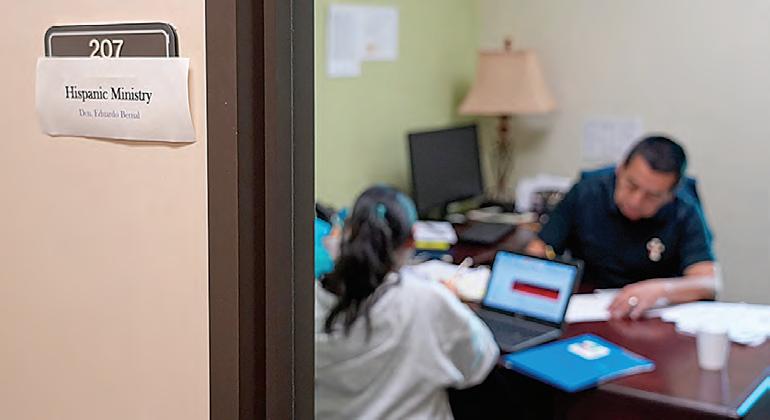
El diácono Eduardo Bernal aparece en su oficina con su hija, Mónica Bernal-Arroy. Sus planes de ser misionero tomaron una nueva dirección cuando conoció a su futura esposa.
director del ministerio bajo el obispo
William Curlin.
Primero sirvió ocho meses en la vicaría de Winston-Salem y luego pasó 15 años coordinando comunidades en las montañas del oeste de Carolina del Norte incluyendo las vicarías de Smoky Mountains y Asheville. Allí vivió plenamente la experiencia misionera que deseaba, ayudando a comunidades sin parroquias cercanas y acompañando a inmigrantes en su transición.
“Cuando llegué, solo había una parroquia con Misa”, dijo el Diácono Bernal. “Había mucha necesidad y realmente viví una
experiencia misionera completa”.
En 2004, ya con la edad requerida, inició su formación diaconal en el programa diocesano de formacion para el Diaconado permanente. Sin embargo, en 2010, cuando le faltaba un año para la ordenación, descubrió que Dios tenía otros planes: el matrimonio.
“Me di cuenta de que mis planes, aunque buenos, no eran los planes de Dios”, expresó.
Bernal decidió discernir su vocación matrimonial junto a Brenda, a quien había conocido años antes en Winston-Salem. Explica que su formación diaconal le ayudó a reconocer barreras personales que le
impedían considerar esa posibilidad.
“Mi plan era ordenarme y luego irme como misionero a otra parte del mundo, pero no contemplaba el matrimonio”, dijo.
Tras casarse y formar una familia con el nacimiento de su hija, Mónica BernalArroyo, asegura que su fe y confianza en Dios crecieron aún más.
“Yo vivía solo para trabajar y dormir. Cuando me casé, mi vida cambió”, comentó. En 2015 retomó su preparación para el diaconado en Charlotte, esta vez con el apoyo total de su esposa, lo que fortaleció también su vida espiritual.
El 25 de septiembre de 2021, Eduardo Bernal fue ordenado diácono permanente, un momento que describe como un antes y un después en su vida.
“Al salir de la iglesia de San Marcos, recién ordenado, una pareja de Guadalupe se acercó para pedirme una bendición. Me quedé congelado por la emoción”, recordó. “En ese primer mes, el que era invisible se volvió visible”.
Cinco años después, el Diácono Bernal continúa su labor misionera como clérigo ordenado en la parroquia Nuestra Señora de Guadalupe, donde sigue viendo grandes necesidades en la comunidad.
Al reflexionar sobre este tiempo, asegura sentirse más cercano que nunca a los fieles y agradece la confianza de quienes se acercan a compartir aspectos personales de sus vidas. Ahora también espera motivar a otros hombres a discernir una posible vocación al diaconado permanente.
“Con el diaconado conocí una nueva cara de la Iglesia, aun después de muchos años de servicio”, dijo el Diácono Bernal. “Se me abrió un mundo nuevo”.
CHRISTINA LEE KNAUSS clknauss@rcdoc.org
CHARLOTTE — As Deacon
David Reiser celebrates 15 years of serving as a deacon, he also looks back on a life filled with many interwoven journeys that combined to bring him to where he is today – including a nudge from a future saint.
“15 years went fast – I stayed busy,” he said recently from an office at Our Lady of the Assumption Church off Shamrock Drive, where he served as business manager until December 2025 in addition to being deacon.
His secular career – 40 years of experience in law enforcement, crisis response and aviation –alone could spark hours of stories.
A former police officer in Illinois, he joined the Federal Bureau of Investigation where he worked as a special agent and pilot, with postings in Detroit, Minneapolis, Charlotte, Puerto Rico and Quantico, Virginia.
ROOTS IN ISRAEL
But his journey of faith began in Israel, where he was born to a Jewish family who moved to the United States when he was in his teens. While living in Israel, he visited sites around the Holy Land.
“A curiosity was always there –something about the Holy Spirit,” he says. “When we moved to the U.S., we lived in New York, and all my neighbors were either Jewish or Catholic, and through curiosity I looked into the Scriptures and the prophets.”
His love of flying later led to pursuing an aviation degree at the Jesuit-run St. Louis University, where he was invited to a nondenominational Christian service on Palm Sunday in 1977.
“I realized that this prophet named Jesus Christ was the Messiah and I accepted Christ,” he says.
He attended nondenominational and Baptist churches for several years until a conflict with a pastor kept him away.
Years later, while posted in San Juan with the FBI, he met a Catholic woman named Maria who invited him to attend Mass with her. In the celebration of the Eucharist, he recognized its ties to the Passover meals celebrated with his Jewish family – and all his studies and curiosity came together.
“The first time I went to Mass, I knew that I was home,” he says. The woman who took him to Mass later became his wife. They have three children and five grandchildren.
An FBI posting in Charlotte led him to attend Mass first at St. Patrick Cathedral and then at Our Lady of the Assumption in Charlotte, where he went through what was then the RCIA program.
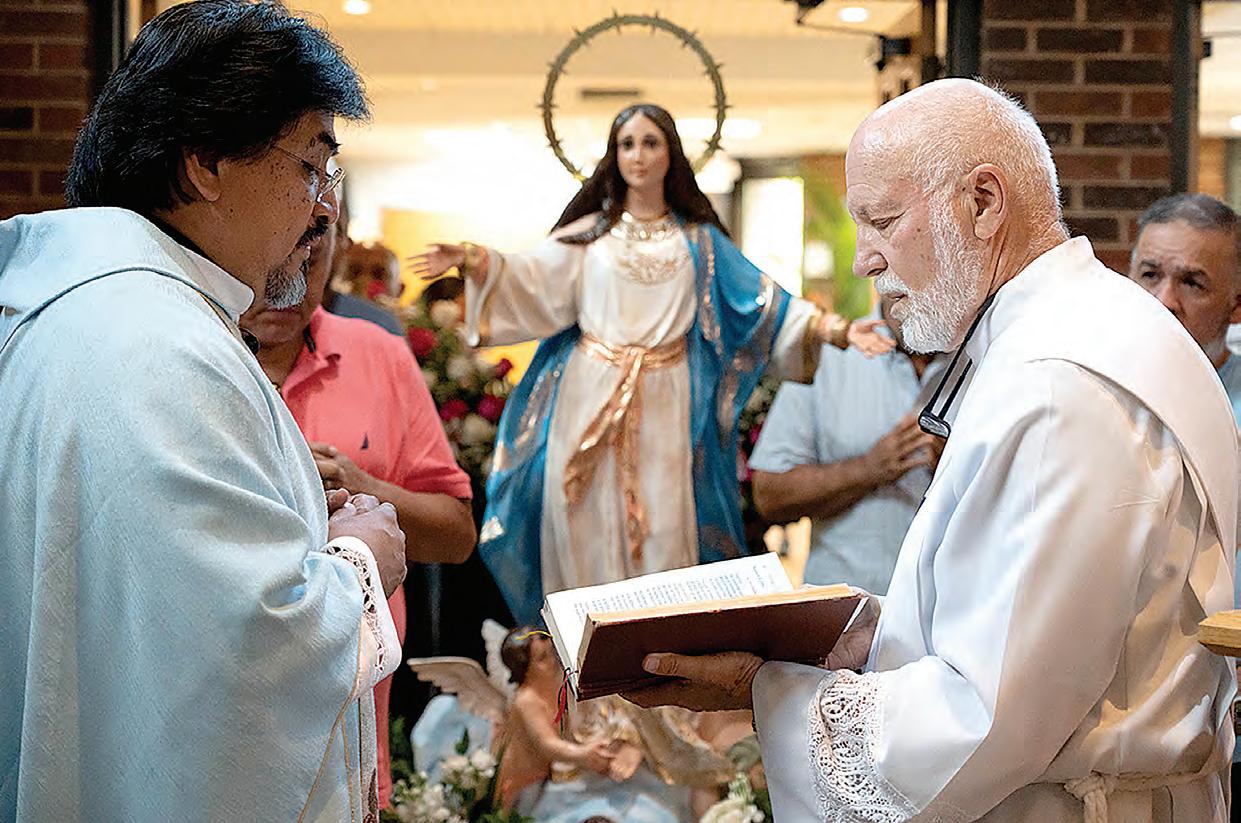
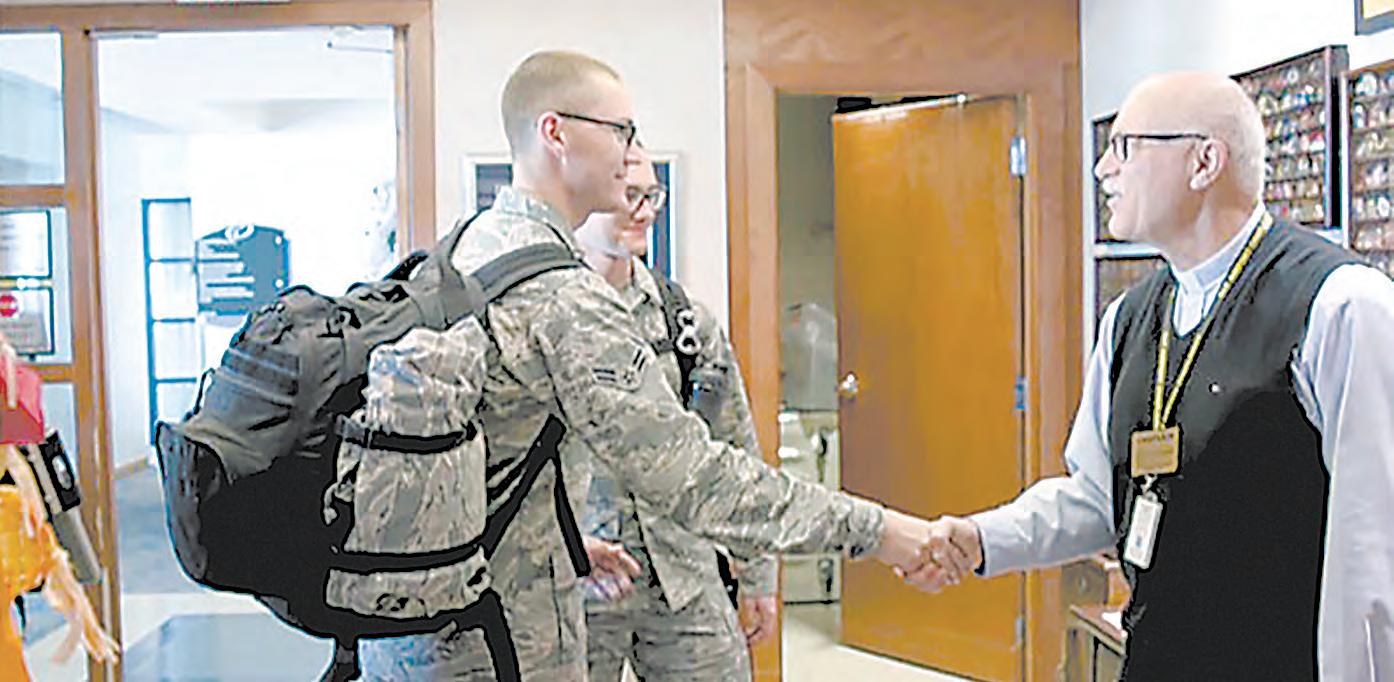
He became Catholic in 1993.
He was later inspired to serve the Church by two deacons he knew, as well as from St. Teresa of Calcutta, whom he met when he served on her security detail during her 1995 visit to Charlotte.
“She talked to my wife and to me, and she asked me to tell her about my faith,” he says. “She said, ‘Continue to pursue your faith and grow spiritually.’”
He took her words to heart and
was ordained as a deacon in 2011.
Since then, he has faithfully served at Our Lady of the Assumption – helping to run faith formation classes and other ministries at the increasingly diverse parish.
He has witnessed the dramatic growth of the Hispanic community and an infusion of immigrants from Myanmar (formerly Burma) and other nations. His fluency in Spanish
has helped his ministry.
“I’m proud of just growing with the growth of the Church and being able to help people,” he says.
His Jewish background has also helped, he says. “I have a much deeper understanding of the Old Testament, the words of the prophets and how that leads into the New Testament and points to Christ. It’s a much clearer point of reference I sometimes use in my preaching.”
Deacon Reiser also offers the love of Christ to the thousands who travel daily through Charlotte-Douglas International Airport in his role as executive director of Inter-Faith Chaplaincy, a role he assumed in 2021.
Through the ministry, volunteers pray or talk with travelers facing crises such as death or illness or just dealing with difficult times. In 15 years of airport ministry, he’s dealt with everything from immigrant families who were stranded in Charlotte to three traveler deaths, including two people who died on planes and one in the terminal itself.
“It’s a ministry of presence –we don’t proselytize,” he says. “Someone might ask if we can pray together, or they just might want to talk because their mother is dying or they’re having problems with their children. Day to day, you don’t know what you’re going to run into.”
Overall, he says his 15 years of ministry have been guided by the voice he first heard on his explorations as a child in the Holy Land.
“It’s the Holy Spirit – it really is. If you’re open to the Holy Spirit, you’re going to recognize that Jesus Christ is the One who came to redeem us.”
If you or someone you know is contemplating a vocation to the priesthood, as a deacon or to religious life, check out the following general resources online. Talk with your pastor, reach out to the diocese’s vocations promoter, read up on consecrated life and the various religious communities that exist, and contact communities that interest you. Many offer “come and see” days or retreats that are good opportunities to learn more and meet others who have already accepted God’s call to religious life.
For young men and women, there are also summer discernment retreats offered by the Diocese of Charlotte and hosted at Belmont Abbey College: Quo Vadis Days for young men, and Duc In Altum and Talitha Koum for young women. Information about the 2027 retreats will be posted next spring online at www.charlottediocese.org/ vocations. Overall, remember: Don’t be afraid to reach out and ask questions!
n Father John Eckert, vocations director: vocationsmail@rcdoc.org
n Father Brian Becker, vocations promoter: bjbecker@rcdoc.org
n www.foryourvocation.org: Set up by the U.S. Conference of Catholic Bishops, dedicated to the promotion of vocations to the priesthood and consecrated life for both men and women. They are also on Facebook and YouTube.
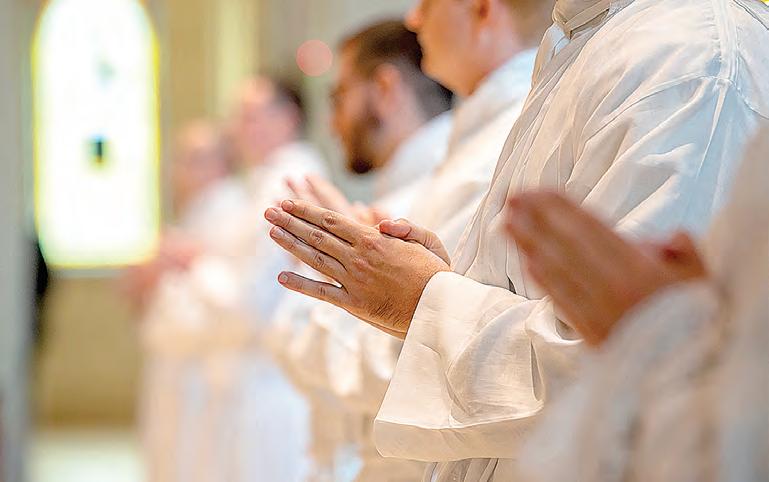
Talking with your pastor or the diocesan vocations promoter is a first step for someone discerning a religious vocation. In addition, there are many online resources that can answer basic questions and guide people.
There are resources for parents and teachers, questions to ask yourself if you feel God is calling you, videos of vocation stories from priests and religious all over the U.S., and more.
n www.religiouslife.com: The Institute for Religious Life’s website, with plenty of resources for both men and women interested in a vocation or those who wish to support religious life.
n Not sure what religious communities are out there that might be a good fit for you?
Check out www.religiousministries.com. Search this database to find a men’s or women’s religious community, whether you wish to become a priest, nun, brother or lay missioner, or just want to find out more about living a religious life.
n www.cloisteredlife.com: Aims to bring to attention the gift of cloistered and monastic life in the Church, sponsored by the Institute for Religious Life.
n www.cmsm.org: The Conference of Major Superiors of Men serves the leadership of the Catholic orders and congregations of the more than 17,000 vowed religious priests and brothers in the U.S.
n www.religiousbrotherhood.com: Sponsored by the Institute for Religious Life specifically to increase awareness of the specific charism of religious brotherhood in the U.S.
n www.cmswr.org: The Council of Major Superiors of Women Religious (CMSWR) is a canonically approved organization, founded in 1992, to promote religious life in the U.S. n www.lcwr.org: The Leadership Conference of Women Religious (LCWR) is an association of the leaders of congregations of Catholic women religious in the U.S.
If you would like to know more about deacons and their ministry or feel you may have a calling, please contact Deacon David Faunce, director of formation, at dmfaunce@rcdoc.org or Deacon Joseph Becker, assistant director of formation, at jcbecker@rcdoc.org. Details can be found online at www.charlottediocese.org/ vocations/diaconate. — Catholic News Herald
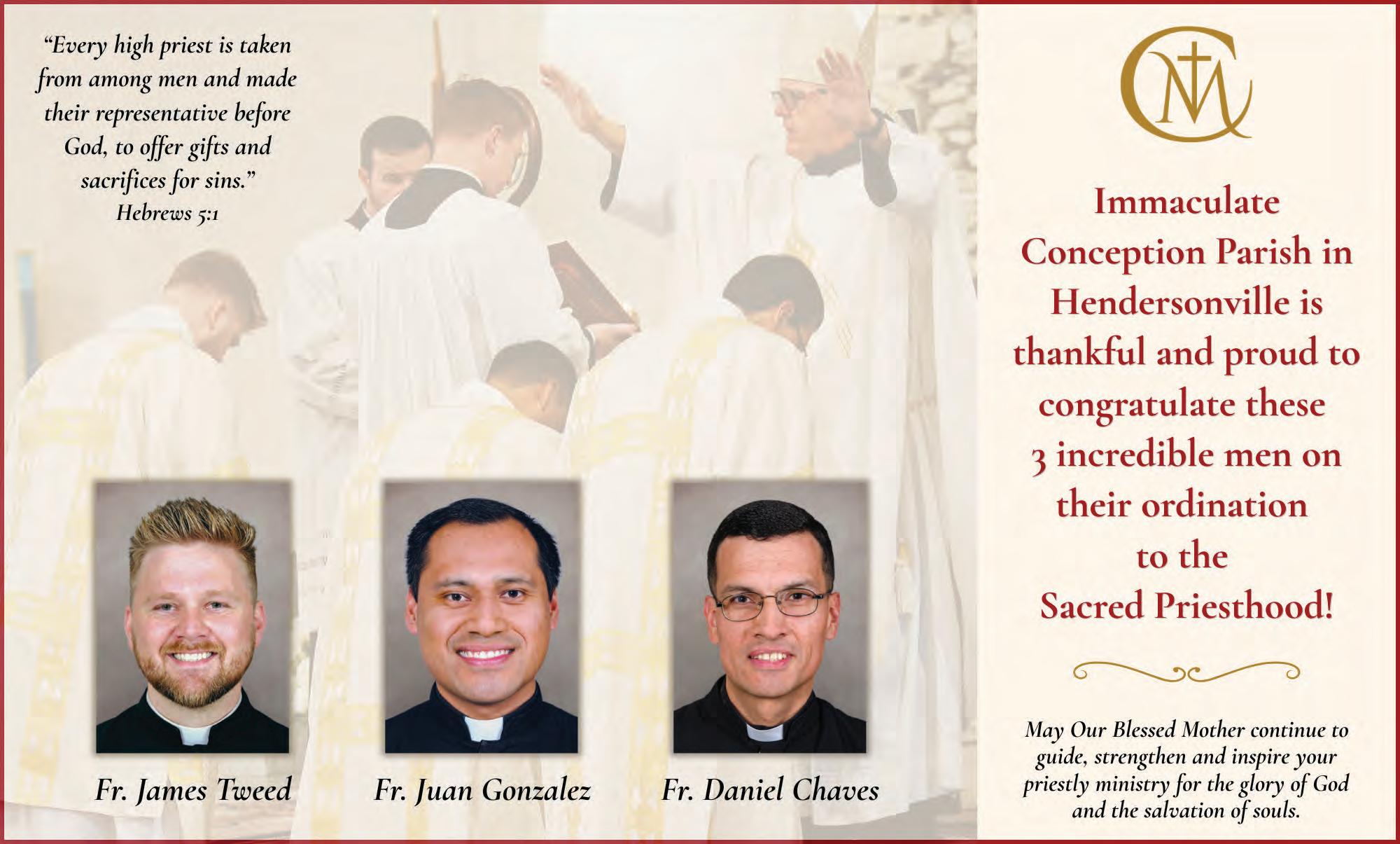
‘Give them joy’
GRAHAM — Joyful prayer and song in both Spanish and English filled Blessed Sacrament Church April 25, when Atlanta Archbishop Gregory J. Hartmayer, OFM Conv., ordained his brother friar, Edgar Iván Varela, OFM Conv., to the priesthood.
“Go to the margins,” Archbishop Hartmayer told him. “You know what it is like to come from a family that crosses borders, that speaks two languages, that carries the faith from one world to another. Many of the people you serve will carry those same stories. Meet them there. Franciscan poverty is not only material; it is a poverty that creates space for others to encounter God.”
Principal concelebrants were Our Lady of the Angels Province’s Minister Provincial Father Michael Heine, OFM Conv.; Vicar Provincial Father Gary Johnson, OFM Conv.; Prefect of Formation Father John Koziol, OFM Conv.; and Blessed Sacrament’s pastor, Father Vincent Rubino, OFM Conv. Deacon Michael Pray of the Diocese of Springfield served as deacon. Charlotte Bishop Michael Martin, OFM Conv., also belongs to Our Lady of the Angels Province.
Father Heine cited their order’s founder in his remarks.
“Ordained in the spirit of St. Francis of Assisi, whose 800th anniversary of his transitus into heaven we commemorate this year, Friar Edgar embraces a priesthood rooted in humility, fraternity, and joyful service, offering his life so that others may encounter the mercy and love of Christ,” said Father Heine.
The son of Maribel and Manuel Varela, Father Edgar was born in Phoenix. He has four siblings: Yessenia, Erica, Sergio and German, and several nieces and nephews. He was
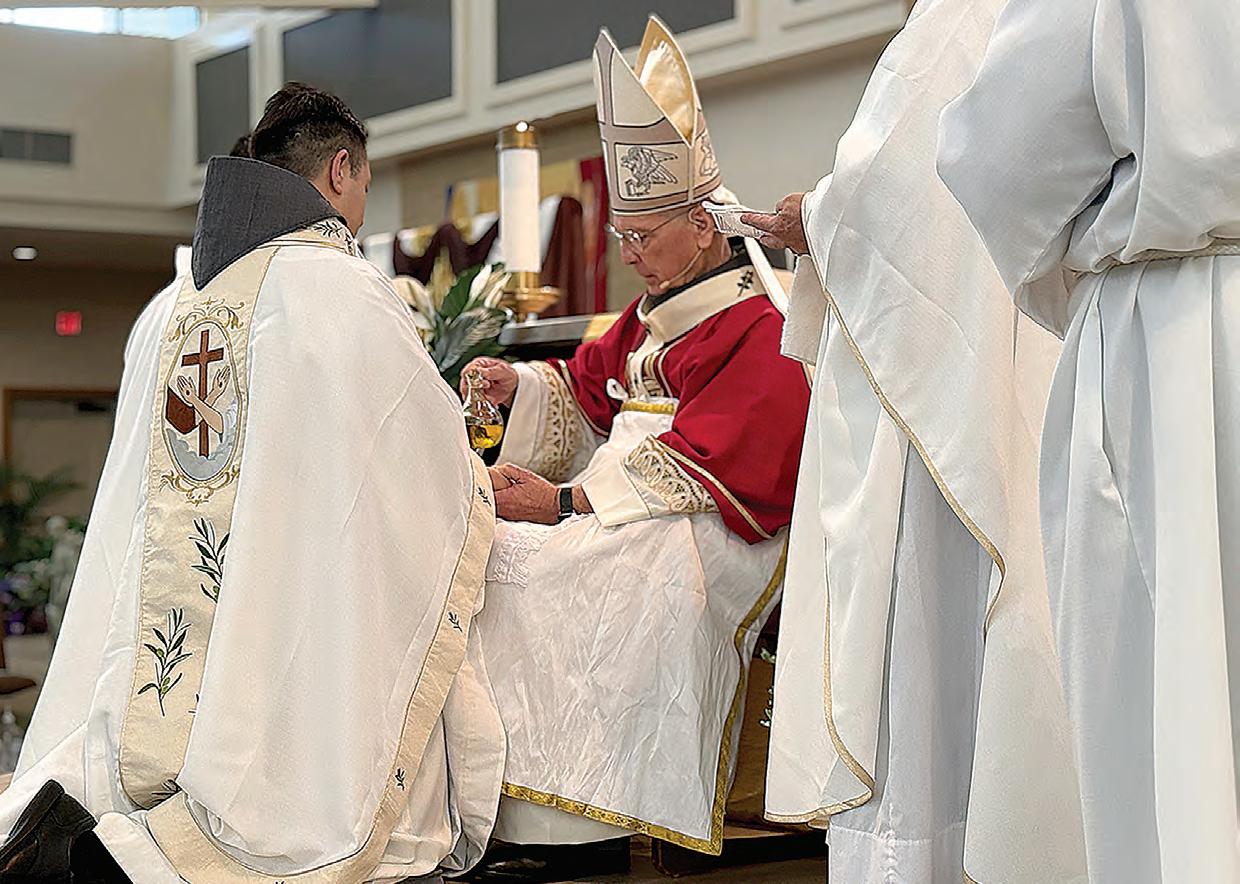
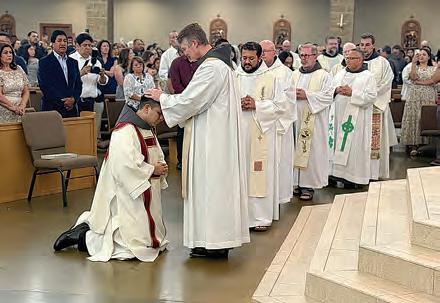
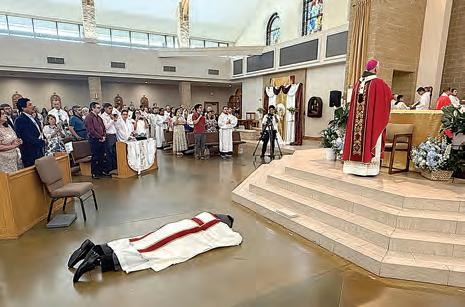
awarded a bachelor’s degree in Philosophy from Loyola University in Chicago and earned Master of Divinity from The
Catholic University of America. He served as a deacon at St. Stanislaus Basilica in Chicopee, Massachusetts.
“It is a great blessing for me to receive the ministry of priesthood,” Father Varela said.
“I receive this gift, not just for
myself, but considering that it is for the Church. Through this ministry, I hope to bring Christ’s presence, love and mercy to all, and most especially to the forgotten, the exiled and the outcast.
“Please pray for me as I begin this wonderful ministry as a Franciscan friar-priest. Let us together pray for more vocations to religious life and priesthood,” he said.
Archbishop Hartmayer concluded with some advice: “Be joyful. Francis sang. He laughed. He called the sun his brother and the moon his sister. The world already has enough grim religion. Give them joy. The joy of the Resurrection. The joy of the Gospel. The joy of a man who has found the one thing necessary and given everything for it.”
Franciscan from St. Matthew Parish to be ordained to priesthood
of St.
Parish in Charlotte, will be
to the priesthood May 30 by Cardinal Archbishop
of
Year of St. Francis, is a member of the Province of the Sacred Stigmata of St. Francis.
His path to the priesthood began at St. Patrick Elementary School in Smithtown, New York, then continued at St. Anthony High School in Huntington, New York. He earned a degree in philosophy at St.
John Vianney College Seminary in Miami and completed his studies at Immaculate Conception Seminary at Seton Hall in South Orange, New Jersey. His parents are Pat and Ralph Sullivan also of St. Matthew Parish. He will celebrate his first Mass of Thanksgiving May 31 at St. Ann Church in Hoboken. He will celebrate
a Mass of Thanksgiving at his home parish, St. Matthew in Charlotte, at a date to be determined after receiving his priestly assignment from his province.
— Ralph H. Sullivan
‘Eternal rest grant unto them, O Lord, and let perpetual light shine upon them.’
Please pray for the repose of the souls of these clergy and religious who have died since June 2025:
n Father Vincent de Paul Alagia died Jan. 23, 2026, at the St. Claude La Colombière Jesuit Community in Baltimore, age 99. He was a Jesuit for 79 years, and a priest for 67 years. Following ordination, Father Alagia devoted himself to secondary education. Beginning in the 1970s, Father Alagia’s ministry increasingly focused on retreats, spiritual direction and marriage spirituality. He served as retreat director and later director at the Jesuit House of Prayer in Hot Springs, North Carolina. Father Alagia served at St. Peter Parish in Charlotte for more than 10 years.
n Father John Aurilia died Jan. 13, 2026, at St. Francis of Assisi Friary in Wilmington, age 85. He entered the Capuchin Franciscan order in Montemarano, Italy, and was ordained a priest in 1966. He served as secretary to Pio of Pietrelcina – the future saint better known as Padre Pio – before coming to the United States, where he worked with the Italian community in northern New Jersey. From 1995 to 2009, he served as pastor of Immaculate Conception Parish in Hendersonville, during the decades when the Capuchin friars staffed the parish. Under his tenure, the parish successfully raised
the funds necessary to build its present church, which was dedicated in 1998.
n Father James Michael Byer died Feb. 3, 2026, aged 73. Born in Cleveland, Ohio, he learned of a need for priests in the then-mission Diocese of Charlotte and he was ordained to the priesthood by Bishop Michael J. Begley, the diocese’s first bishop, in 1981. During nearly five decades of priestly ministry in the diocese, Father Byer served at 10 parishes, including St. Gabriel and St. Ann in Charlotte, Holy Spirit in Denver, Holy Trinity in Taylorsville, Our Lady of Grace in Greensboro, Sacred Heart in Brevard, St. Leo the Great in Winston-Salem, St. Margaret of Scotland in Maggie Valley, and St. Philip the Apostle in Statesville. In 1994 Father Byer was appointed spiritual director of the Hispanic Community of Charlotte (now Our Lady of Guadalupe Parish).
n Father Jude Thaddeus DeAngelo, OFM Conv., a Franciscan friar of the Our Lady of the Angels Province, died Nov. 18, 2025, in Syracuse, New York. He professed with the Conventual Franciscans and was ordained to the priesthood on May 26, 1984, in Albany. After serving in New York and New Jersey, he commenced 25 years of service as a campus minister In 1997, first at Wake Forest University in Winston-Salem (1997-2010) and then at The Catholic University of America in Washington, D.C. (2010-2022).
n Sister Maureen Dees died Dec. 8, 2025. Professed with the Sisters of Mercy for 80 years, Sister Maureen dedicated her life to faith, education and service and touched countless lives with her kindness, humor and unwavering commitment to others. She taught in many Catholic elementary schools in the dioceses of
We extend our prayerful best wishes to Deacon John Martino and Deacon Ed Konarski on the 20th Anniversary of their ordination.
Charlotte and Raleigh, including Sacred Heart in Salisbury. Upon her retirement, Sister Maureen volunteered at Catherine’s House in Belmont and supported her fellow Sisters of Mercy.
n Father Carl Edwin Kaltreider died June 11, 2025, age 82. For more than 46 years, he served parishes across western North Carolina, including in Marion, Eden, Asheville, Andrews and Shelby. While at St. Lawrence in Asheville, he played a key role in securing the church’s designation as a minor basilica by the Holy See in 1993. His final and longest assignment was as administrator of Our Lady of the Angels Mission in Marion. It was there that he established the first Hispanic Knights of Columbus council in North Carolina (Council 17058).
n Sister Marilyn Helene King died April 8, 2026, at Sacred Heart Convent-Marian Center, age 86. Professed with the Sisters of Mercy in 1960, the San Francisco native was particularly interested in theology. She was sent to St. Paul University, the University of Ottawa and the Graduate Theological Union, where she completed a doctorate degree in 1975. These studies equipped her to teach high school, college and adult religious education. In 2014, she and Trappistine Sister Genevieve Durcan founded The Laura in Lebanon, Kentucky, as a contemplative residence where others could come for retreat and reflection.
n Deacon Michael Langsdorf, died April 6, 2026, age 72. The Philadelphia native was ordained a deacon for the Diocese of Charlotte by then-Bishop William G. Curlin. His served his home parish, Holy Family in Clemmons, for nine years. In 2004 he was assigned to Divine Redeemer Parish in Boonville, where he coordinated the English-language youth
faith formation program and conducted sacramental preparation classes for baptisms and confirmations.
n Father Thomas Patrick Norris died Friday, Jan. 9, 2026, age 79. He was a professed member of the Oblates of St. Francis de Sales or 60 years and a priest for 52 years. He initially moved to North Carolina to serve as campus minister at Greensboro College, Guilford College and University of North Carolina-Greensboro. After two years in college ministry, Father Norris was assigned to parish ministry, serving as assistant pastor at Immaculate Heart of Mary Parish in High Point. In 1997, Father Norris was transferred to St. Mary Parish in Goldsboro, where he served as parochial vicar and then pastor. In 2012, Father Norris returned to Immaculate Heart of Mary Parish, where he served as acting pastor from 2017-2018.
n Sister Mary Antonette Schmidt, a spiritual director, educator and ministry leader, died June 13, 2025. A Sister of Mercy for six decades, she served in numerous ministries, including as retreat director at the Jesuit House of Prayer in Hot Springs, coordinator for young adult ministry for the Diocese of Charlotte, and at various hospitals and retreat centers in several states.
n Retired Deacon Dr. Ronald David Sherwood, PhD, died Oct. 23, 2025. He was ordained a deacon in the Diocese of Youngstown, Ohio, in 1977. He served the Church first in Ohio, and after he and his wife Vicky moved to North Carolina, he served at St. Mark Parish in Huntersville from 2004 until his retirement in 2013. He was also a U.S. Navy veteran.
— Catholic News Herald
The parish family of St. Vincent de Paul would like to congratulate our priests
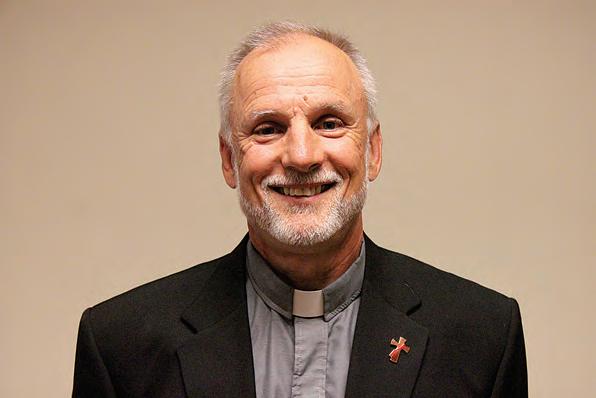

Thank you for your dedicated service to St.
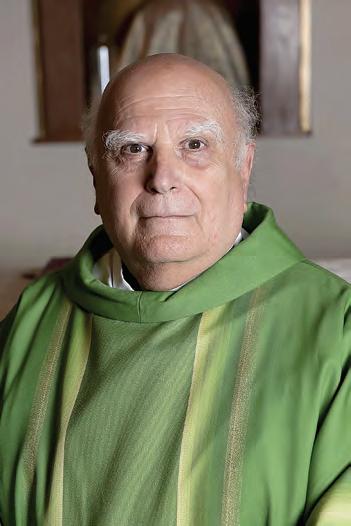
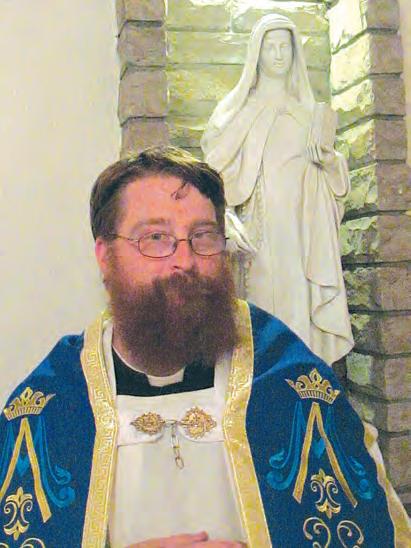
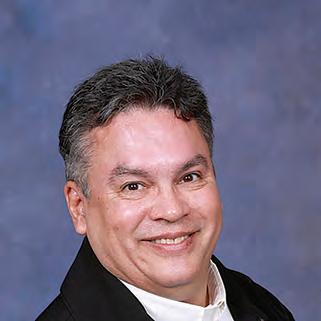

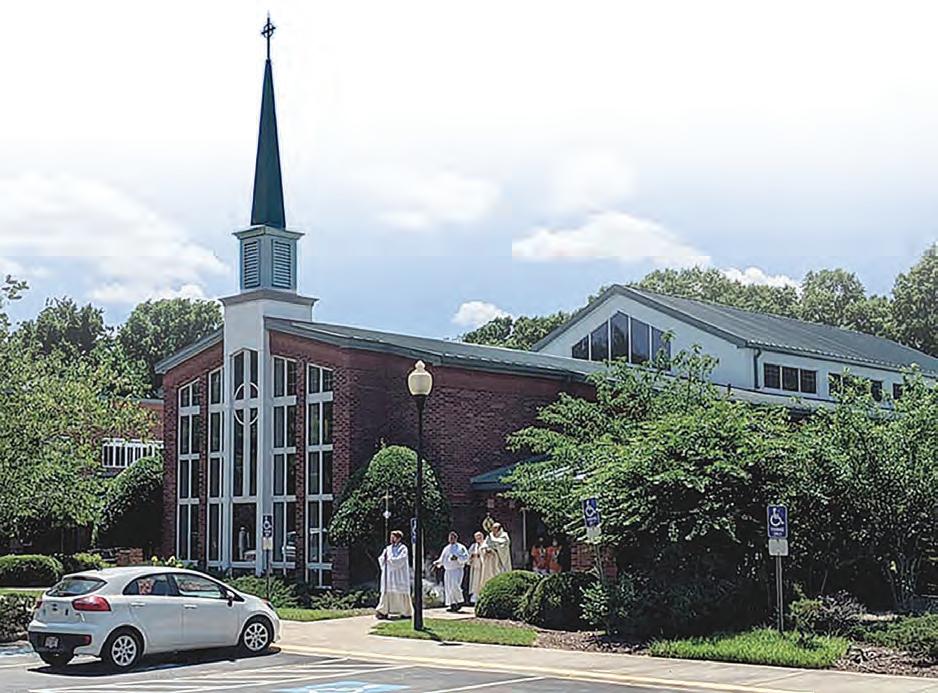
“We must love our neighbors as being made in the image of God and as an object of His love.”


– St. Vincent de Paul
Our seminarians’ education is possible thanks to the generosity of parishioners who give to the annual Diocesan Support Appeal, through Seminarian Education second collections in November and on Easter Sunday, distributions from seminarian endowments held in the diocesan foundation, and those who contribute gifts to the Seminarian Education Campaign.
The Foundation of the Roman Catholic Diocese of Charlotte also has 34 endowments designated for seminarian education, totaling over $25 million:
n Monsignor Thomas Burke Seminarian Endowment Fund
n Beatrice A. Chase Endowment Fund
n Teresa Loh Jui Choon and Alexander Sim Seminarian Education Endowment Fund
n Conklin Endowment Fund
n Loraine Cox and C. Richard Cox Seminarian Education Endowment Fund
n Doris and Walter Dietrich Endowment Fund
n Di Pietro Family Endowment Fund
n Mr. A. Steven and Dr. Donna S. Ellington Endowment Fund
n Fabrey Endowment Fund
n FFHL Vocation and Seminarian Support Endowment Fund
n James and Elizabeth Hedgecock Seminarian Endowment Fund
n Dick Kelly Endowment Fund
n Knights of Columbus Council #770 Seminarian Support Endowment Fund
n Seminarian Michael G. Kitson Memorial Endowment Fund
n Lee Endowment Fund
FROM PAGE 20B
Parish, then served in-residence for a few months at St. Mark Parish in Huntersville.
He says he “came to the top of the mountain in Highlands at Our Lady of the Mountains for three years, and then came down to Franklin,” where he has served as pastor of St. Francis of Assisi Parish since 2008.
“The love of people, the cold weather and the love for people in the mountain area have kept me here since,” he says.
He believes people would be surprised to know that one of the things he loves most about living in western North Carolina is the cold weather, even though he grew up in the tropical climate of South Vietnam.
About his priestly ministry, Father Tien shares, “My spiritual director at seminary and other friends asked me, ‘If God will not choose you, what would you do?’ My answer was very simple. I never had a second thought of giving up the call. God calls, and I will answer, and God will never turn His face away from me. He will provide!”
“I am doing God’s will, and it is not easy to fulfill His will,” he continues. “When you try to fulfill His will, certainly people will not like it as they look at it with human wisdom. And that is true for me as a priest, as well.”
n Don and Teresa Meanor Endowment Fund
n John and Marianne Polickoski Endowment Fund
n Priests Support Endowment Fund
n William E. Rabil, Sr. and Rosalie Daye Rabil Family Endowment Fund
n Reverend Timothy S. Reid Endowment Fund
n Eugene and Carmen Rossitch Endowment Fund
n Edward C. and Joan F. Ruff Seminarian Endowment Fund
n Matthew Scheible Endowment Fund
n Dr. Marvin L. Schrum and Paula B. Schrum Education Endowment Fund
n Seminarian Assistance Endowment Fund
n Seminarian Education Endowment Fund
n Abdou J. and Edna S. Showfety Seminarian Education Endowment Fund
n Stephen D. Showfety Endowment Fund
n Judith and Michael Simac Endowment Fund
n St. Lawrence Council (1695) RSVP Endowment Fund
n St. Lucien Catholic Church Seminarian Scholarship Endowment Fund
n Father Wilbur Thomas Memorial Endowment Fund
n Valentine Family Seminarian Education Endowment Fund
n Vocations Endowment Fund
Each year, people also have the opportunity to celebrate the faithful service of our retired diocesan priests, as well as show gratitude to the priests currently serving in the diocese, by contributing to the diocese’s Priests’ Retirement and Benefits second collection.
— Catholic News Herald
‘Trust in God’s power and wisdom.’
Father Tien Duong
“However, my big lesson that I learned when I was in the refugee camp was: Trust in God’s power and wisdom. And another one when I studied philosophy: God will provide.
“So, no matter what others criticize or misunderstand, gossip or even slander, or the tasks I thought, ‘How can I do them?’, at that time God reminds me of these two lessons.”
He also credits his guardian angel for assistance.
Like his brother priests, Father Tien says, “the Eucharist (visiting, adoring, receiving) is the key for me today as a priest and also for those who want to discern the vocation to the priesthood. That is the key that Jesus uses to open my heart, mind and soul, and I have to let Him do so sincerely.
“I do not want to ‘do a show’ for people to see. I want to do it for Jesus, and then Jesus is the one to show it to His people.”
— Catholic News Herald
discerning the priesthood – such a special moment in our family,” he says.
Later, his younger son Mark – a Marine officer training to be an aviator – also
discerned a call to the priesthood. He is now in the seminary, sponsored by both the military and the diocese.
These days, Deacon Becker jokes that the family roles have reversed spiritually: “Father Becker is now my spiritual father. We joke about it, but soon, God willing, I will have two spiritual fathers.”
In the academic year just ended, we have been blessed to have 44 seminarians in both major seminaries and at St. Joseph College Seminary who are discerning God’s call to serve you as priests in the Diocese of Charlotte. Your prayers and financial assistance pay for a portion of tuition, room & board that will help assure the diocese of having priests to shepherd the Catholic population in western North Carolina for years to come.
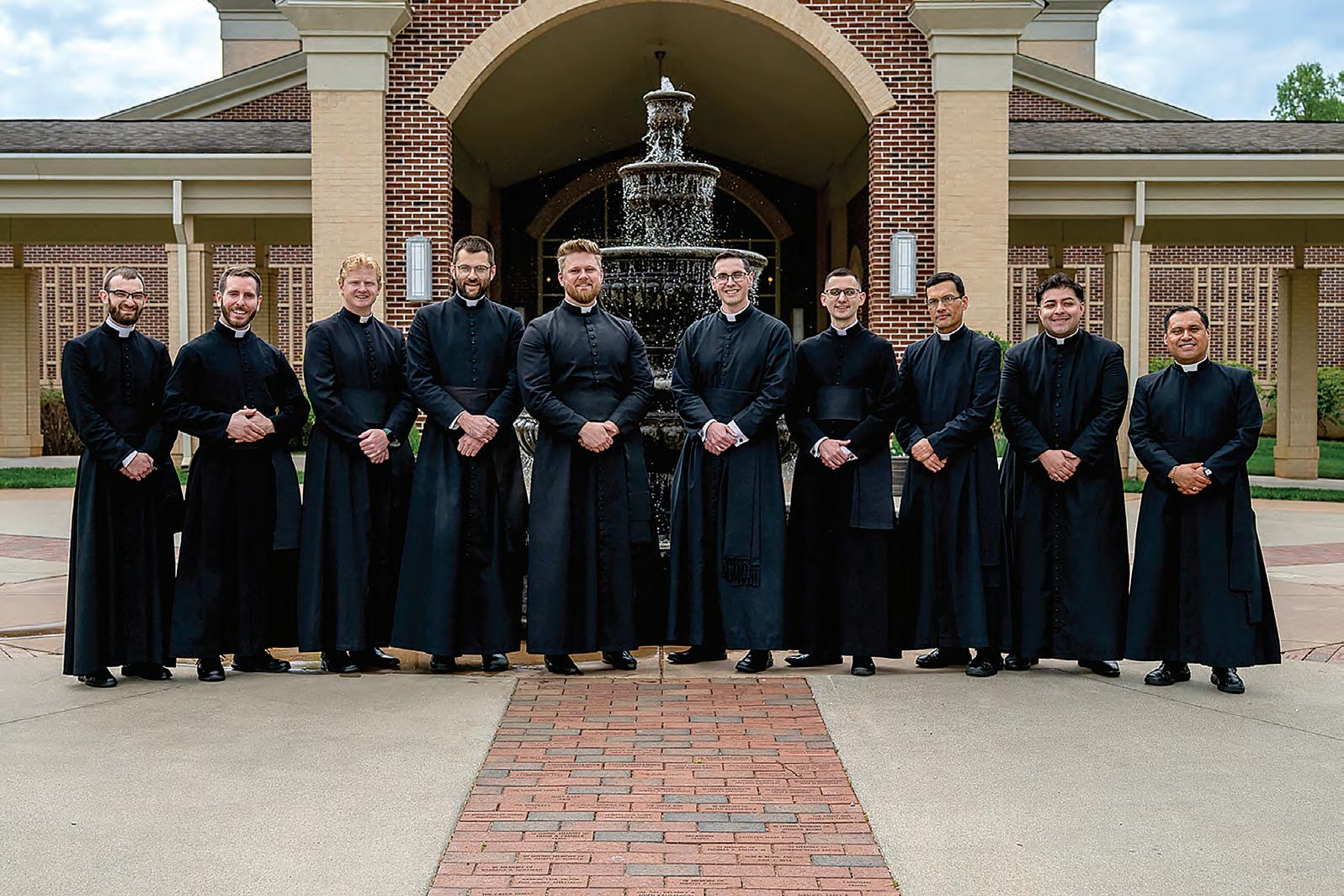
from left: Fr. Michael Lugo, Fr. Maximilian Frei, Fr. John Cuppett, Fr. Robert Bauman II, Fr. James Tweed, Fr. Peter Townsend, Fr. Michael Camilleri, Fr. Daniel Chaves Pena, Fr. Bryan llagor and Fr. Juan Gonzalez Hernandez who will be ordained as priests for the Diocese of Charlotte on May 30, 2026.
Join us in celebrating these holy priests as we invite you to invest in the bright future of our vibrant diocese. (Click on Seminarian Education)
NC