

MAY 15, 2026
VOLUME 35 • NUMBER 16
1123 S. CHURCH ST. CHARLOTTE, N.C. 28203-4003 catholicnews@rcdoc.org 704-370-3333
PUBLISHER
The Most Reverend Michael T. Martin, OFM Conv., Bishop of Charlotte
EDITOR: Trish Stukbauer
704-370-3392, tmstukbauer@rcdoc.org
ADVERTISING MANAGER: Kevin Eagan
704-370-3332, keeagan@rcdoc.org
MULTIMEDIA DESIGNER: David Puckett 704-808-4521, dwpuckett@rcdoc.org
EDITORIAL TEAM: Kimberly Bender
704-370-3394, kdbender@rcdoc.org Lisa Geraci 704-370-3294, lmgeraci@rcdoc.org Troy C. Hull 704-370-3288, tchull@rcdoc.org Christina Lee Knauss 704-370-0783, clknauss@rcdoc.org Amelia Kudela 980-374-3411, arkudela@rcdoc.org Brian Segovia 704-370-3235, bmsegovia@rcdoc.org
COMMUNICATIONS ASSISTANT/CIRCULATION: Maria De Ugarte 704-370-3333, catholicnews@rcdoc.org COMMUNICATIONS DIRECTOR: Liz Chandler 704-370-3336, lchandler@rcdoc.org
ASSISTANT COMMUNICATIONS DIRECTOR: Patricia L. Guilfoyle 704-370-3334, plguilfoyle@rcdoc.org
THE CATHOLIC NEWS HERALD is published by the Roman Catholic Diocese of Charlotte 26 times a year.
NEWS: The Catholic News Herald welcomes your news and photos. Please e-mail information, attaching photos in JPG format with a recommended resolution of 150 dpi or higher, to catholicnews@rcdoc.org All submitted items become the property of the Catholic News Herald and are subject to reuse, in whole or in part, in print, electronic formats and archives.
ADVERTISING: Reach 165,000 Catholics across western North Carolina! For advertising rates and information, contact Advertising Manager Kevin Eagan at 704-370-3332 or keeagan@rcdoc.org. The Catholic News Herald reserves the right to reject or cancel advertising for any reason, and does not recommend or guarantee any product, service or benefit claimed by our advertisers.
SUBSCRIPTIONS: $17.25 per year for registered families of the Diocese of Charlotte and $25 per year for all others
POSTMASTER: Periodicals

EVENTS
DILEXI TE : Catholic Charities and the Sisters of Mercy will host a reflection by Deacon Scott Gilfillan on Pope Leo XIV’s apostolic exhortation “Dilexi Te” on Saturday, May 23. Doors open at 10 a.m. for the program, which runs from 10:30 a.m. to 1:30 p.m. at Immaculate Heart of Mary Church, 4145 Johnson St., High Point. RSVP to scaeducation@ccdoc.org.
2026 NATIONAL EUCHARISTIC
PILGRIMAGE : The 2026 pilgrimage will make various stops through our diocese beginning Saturday, May 30, at Our Lady of Lourdes Church in Monroe and continuing May 31 at St. Vincent de Paul Church and St. Peter Church in Charlotte and June 1 at churches in Statesville and Greensboro. Go to www.charlottediocese. org for details.
IGBO MASS : St. Mary’s Church in Greensboro will host the next Igbo language Mass in the diocese at 11:30 a.m. Sunday, May 31, at 812 Duke St., Greensboro. For more information, call 336-707-3625.
SUNG VESPERS : The Cathedral High School Choir will lead sung vespers at 5 p.m. Sunday, May 17, at St. Patrick Cathedral, 1621 Dilworth Road East, Charlotte.
VIGIL OF THE TWO HEARTS: Vigil begins with 8 p.m. First Friday Mass on Friday, June 5, followed by Eucharistic Adoration and concludes with 8 a.m. First Saturday Mass June 6. St. Patrick Cathedral, 1621 Dilworth Road East, Charlotte. For details, go to www.defendthefamily.org/two-hearts.
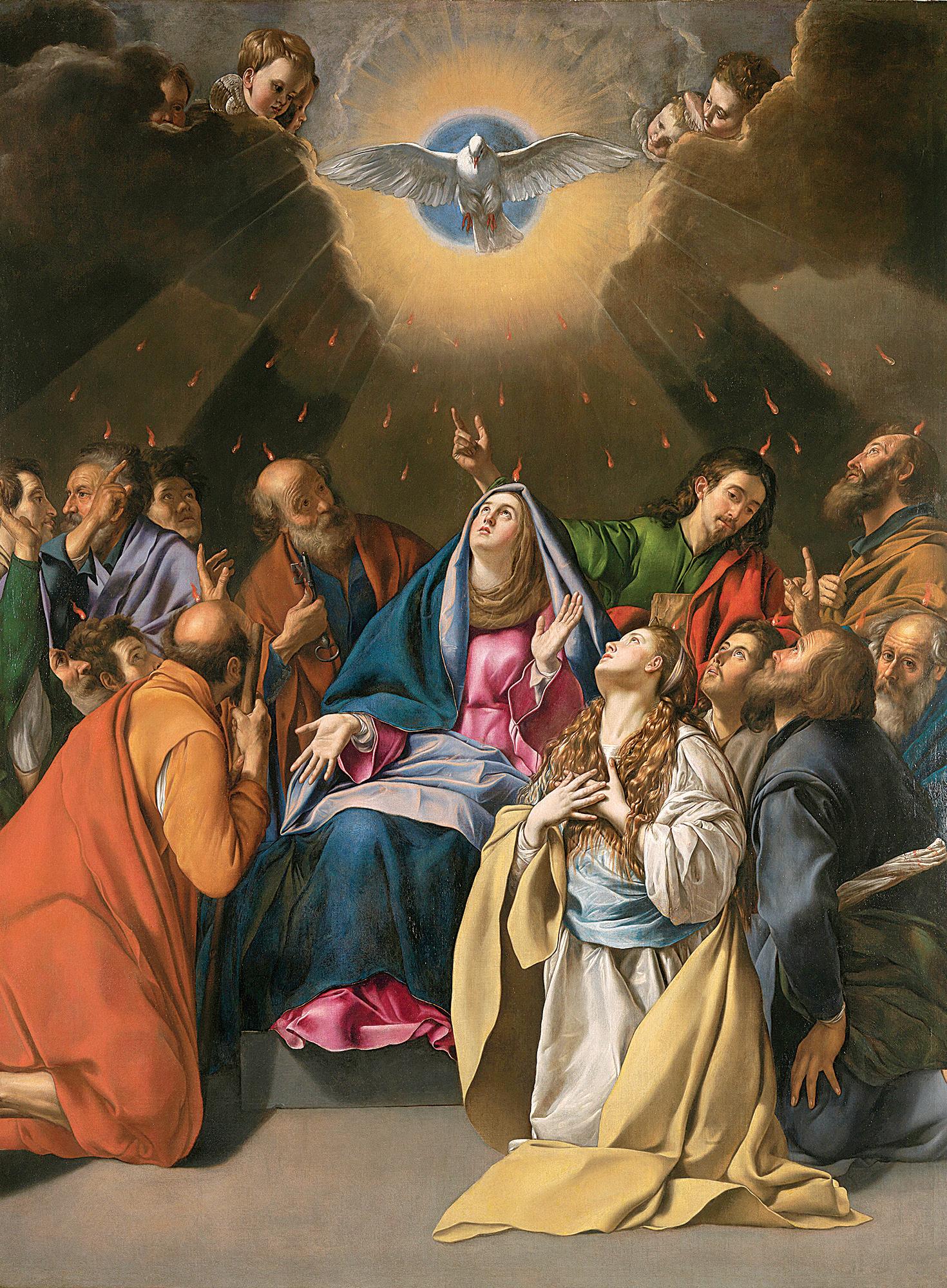
commemorates the descent of the Holy Spirit upon the Apostles, 50 days after the Resurrection of Christ, which this year falls on May 25. The feast gets its name from the Greek word “pentekoste,” meaning 50th. Here’s more about this day and what it means:
ARRIVAL OF THE HOLY SPIRIT
At the first Pentecost, Peter, Mary, the apostles and their followers were gathered in the upper room in Jerusalem, where Jews from all over the world were still in town celebrating the end of Passover. A great wind blew and a flame appeared as a tongue of fire, which split itself into individual flames above the heads of all those present. The Holy Spirit came upon those gathered and each began to speak in tongues. Despite the fact many had no common language, they were perfectly able to understand one another.
As those in the room went out among the crowd to spread the Good News, some accused those speaking in tongues of being intoxicated. Peter explained to the crowd that this was the work of the Holy Spirit, as prophesied in Scripture, and began preaching to them. Peter then called on those present – about 3,000 people – to be baptized. That moment firmly established Peter as the leader of the faith – the “rock” Jesus had previously told him he would become – and is known as the birthday of the Church.
The timing of these feasts is where the concept of the novena – nine days of prayer –originated. Acts 1 says that Mary and the apostles prayed together “continuously” for nine days after the Ascension, leading up to Pentecost. Traditionally, the Church prays the novena to the Holy Spirit in the days before Pentecost. Look for that and other novenas online.
— Catholic News Herald, Catholic Encyclopedia, Catholic News Agency and Catholic Online
Bishop Michael Martin, OFM Conv., will participate in the following events over the coming weeks:
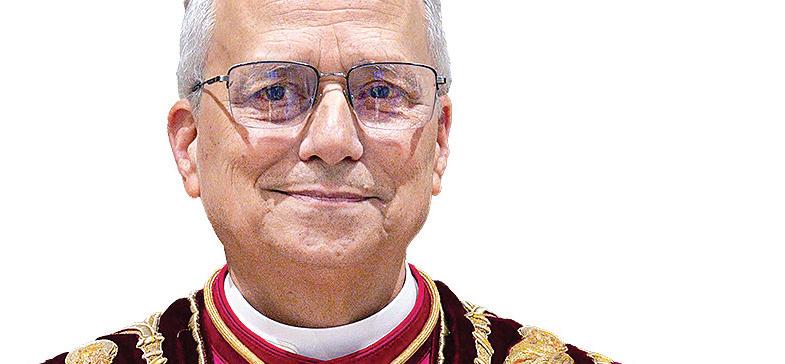
Marking the anniversary of the attempted assassination of St. John Paul II and the feast of Our Lady of Fatima, Pope Leo XIV said Mary is the “perfect model” of what the Church is called to be and urged Catholics to imitate her “humility, active faith and obedience.”
During his May 13 general audience in St. Peter’s Square, the pope dedicated his catechesis to Mary, reflecting on her role as “model,” “mother” and “pre-eminent member” of the Church through the teaching of the Second Vatican Council’s dogmatic constitution “Lumen Gentium.”
The date marked 45 years since St. John Paul was shot and seriously wounded in St. Peter’s Square during a general audience in 1981. The Polish pope was struck twice while passing through the square in his open popemobile. He was rushed to the hospital, where it was discovered that no vital organ was pierced. He later credited his survival to the protection of the Virgin Mary and maintained a devotion to Our Lady of Fatima.
The shooter, Mehmet Ali Agca, was apprehended immediately and later visited by the pope who forgave him and called for his pardon. After serving 20 years in an Italian prison, he was deported to his country of Turkey in 2000.
The pope was shot May 13, 1981, the anniversary of the first of the Fatima apparitions, and the feast of Our Lady of Fatima. Three children were tending sheep May 13, 1917, when they had a vision of the Blessed Virgin Mary. The apparitions continued once a month until Oct. 13, 1917. The children said Mary asked them to promote devotion to her Immaculate Heart and to pray the rosary daily to bring peace to the world.
Pope Leo said that the Church turns its gaze to the Shrine of Our Lady of Fatima today, where Mary delivered a message of peace.
“In that place, so dear to Christianity, numerous pilgrims from the five continents gather today: their presence is a sign of the need for consolation, unity, and hope of the people of our time,” he said in Italian.
Pope Leo said Mary is the model of what the “Church is meant to be,” because her “unconditional ‘yes’ shows us how to be members of the Church.”
JEFF ZIEGLER OSV News
Even though God has already “said everything” through Jesus Christ, as the Church teaches, some Christians throughout the centuries have attested that they have seen or heard Jesus, the angels or the saints, especially the Blessed Mother.
Thus “throughout the ages, there have been ‘private’ revelations, some of which have been recognized by the authority of the Church,” as the Catechism of the Catholic Church teaches (67). “They do not belong, however, to the deposit of faith. It is not their role to improve or complete Christ’s definitive Revelation, but to help live more fully by it in a certain period of history.”
In this month dedicated to Mary, here is a look at some of the most influential approved Marian apparitions.
OUR LADY OF GUADALUPE
On Dec. 9-12, 1531, Our Lady appeared four times to St. Juan Diego Cuauhtlatoatzin on the hill of Tepeyac near Mexico City.
“Know for certain, least of my sons, that I am the perfect and perpetual Virgin Mary, mother of Jesus, the true God, through whom everything lives, the Lord of all things near and far, the master of heaven and earth,” she said. “It is my earnest wish that a temple be built here to my honor.”
Our Lady asked Juan Diego to make known her request to Bishop Juan de Zumárraga. The bishop asked for a sign. When Juan Diego saw Our Lady again, she directed him to a hilltop where he saw a flower garden; he cut the roses and placed them in his cloak, or tilma. When he returned to the bishop, he opened his tilma. The roses fell to the floor, and the image of Our Lady of Guadalupe appeared miraculously on his tilma.
In 1754, Pope Benedict XIV approved Our Lady of Guadalupe as patroness of Mexico, and St. John Paul II named her “patroness of the Americas” in 1999.
OUR LADY OF THE MIRACULOUS MEDAL
In 1830, the Blessed Virgin Mary appeared three times to St. Catherine Labouré (1806-1876), a member of the Daughters of Charity of St. Vincent de Paul. The second time, she saw Mary crushing a serpent, with rays coming forth from her hands. She also saw the words, “O Mary conceived without sin, pray for us who have recourse to you,” and heard a voice say, “Have a medal made on this model. Those who will wear it with confidence will receive great graces.”
The archbishop of Paris consented to the request. In 1980, St. John Paul II made a pilgrimage to the chapel in Paris where St. Catherine saw the apparitions.
OUR LADY OF LOURDES
Our Lady appeared 18 times to St. Bernadette Soubirous in 1858 in Lourdes, a town in southwestern France.
Bishop Bertrand-Sévère MascarouLaurence of Tarbes-et-Lourdes approved the
apparitions in 1862. In 1911, St. Pius X wrote that the Lourdes shrine “surpasses in glory, it seems, all others in the Catholic world.”
OUR LADY OF LA SALETTE
In 1846, Our Lady appeared to two French children, Maximin Giraud and Mélanie Calvat, in southeastern France. She deplored sins of blasphemy, the refusal of most villagers to attend Mass in the summer
Peter 1:24-25, part of the daily readings for May 27
and the lack of fidelity to Lenten discipline. “If my people do not obey, I shall be compelled to loose my son’s arm,” she warned. “It is so heavy I can no longer restrain it.” Bishop Philibert de Bruillard of Grenoble approved the apparition in 1851.
OUR LADY OF KNOCK
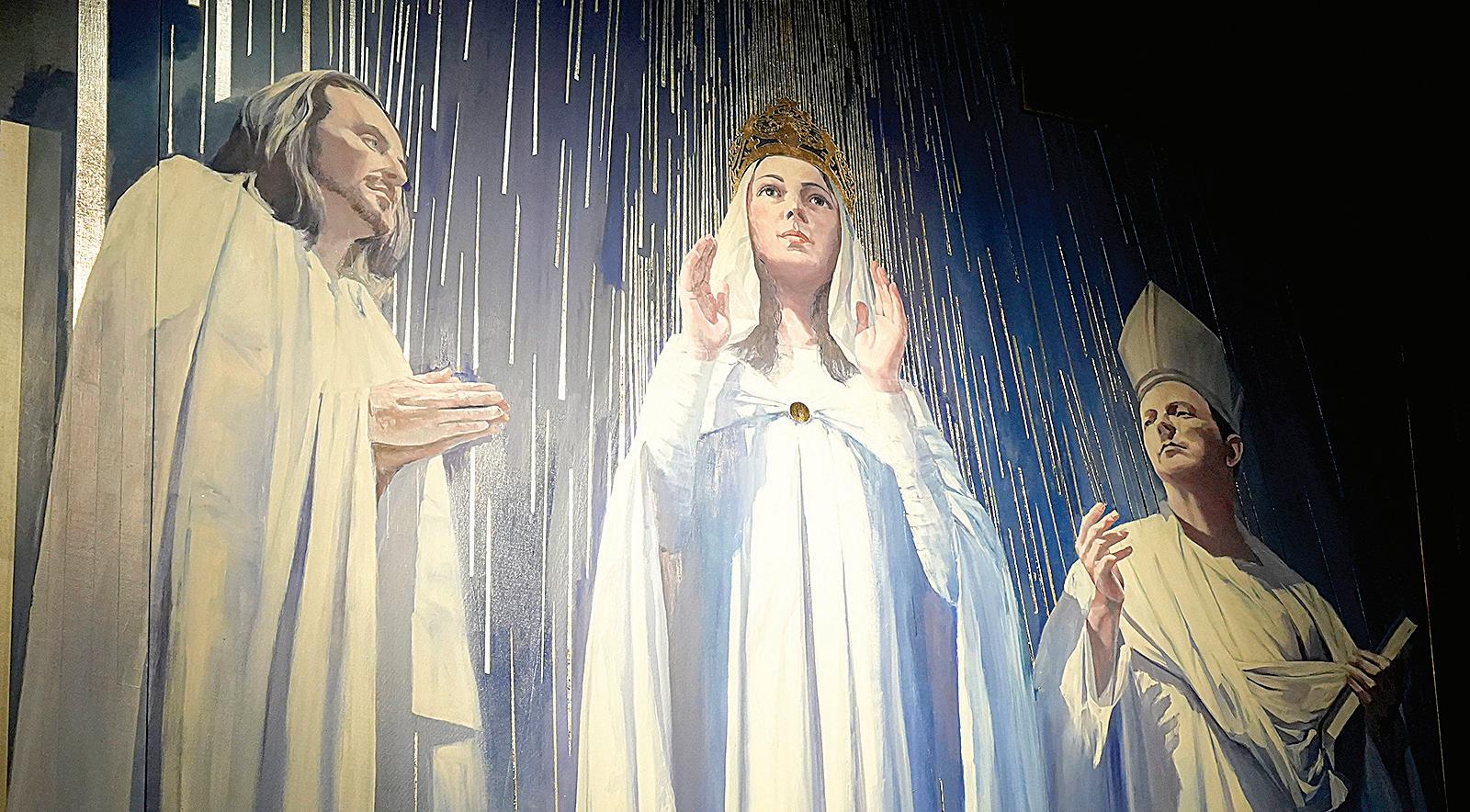
In 1879, 15 people of all ages in Knock, Ireland, witnessed an apparition of the Blessed Mother, St. Joseph and St. John the Evangelist on a rainy evening; the Blessed Mother prayed but did not speak. Within months, Archbishop John McHale of Tuam found their testimony credible, and the site soon became a place of pilgrimage.
In 1979, St. John Paul II celebrated Mass at Knock and dedicated the Basilica of Our Lady, Queen of Ireland. “From that day of grace, 21 August 1879, until this very day, the sick and suffering, people handicapped in body or mind, troubled in their faith or their conscience, all have been healed, comforted and confirmed in their faith because they trusted that the mother of God would lead them to her son, Jesus,” he said.
OUR
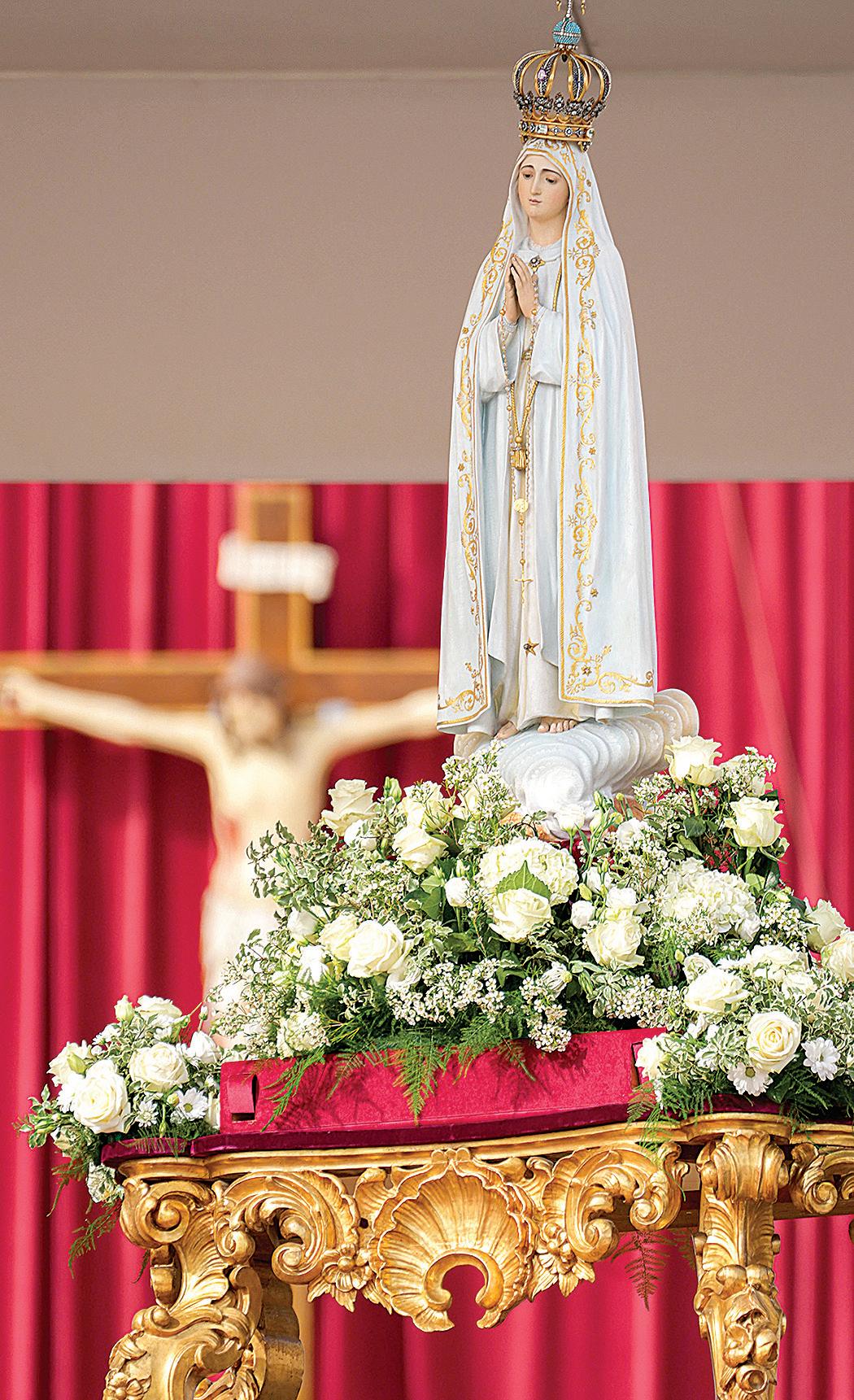
In 1917, Our Lady of the Rosary appeared for six consecutive months to three Portuguese children: Venerable Lúcia Santos, St. Jacinta Marto and St. Francisco Marto. Her message was one of prayer, atonement and devotion to her Immaculate Heart.
“Say the rosary every day to bring peace to the world and an end to the war,” she said. “And after each one of the mysteries, my children, I want you to pray in this way: O my Jesus, forgive us our sins, save us from the fire of hell. Take all souls to heaven, especially those who are most in need.”
During the final apparition on Oct. 13, Our Lady requested the construction of a chapel, and 70,000 onlookers witnessed the sun dance in the sky. Bishop José Alves Correia da Silva of Leiria-Fátima approved the apparitions in 1930.
Snap the QR code (right) to get the Mass readings for every day, in English or Spanish, online at the U.S. Conference of Catholic Bishops’ website.

New parish to branch out of St. Matthew, one of the nation’s largest parishes
PATRICIA L. GUILFOYLE plguilfoyle@rcdoc.org
CHARLOTTE — For the first time in decades, the Diocese of Charlotte is moving toward creating a parish in the Charlotte area, an unmistakable sign of the region’s surging Catholic population.
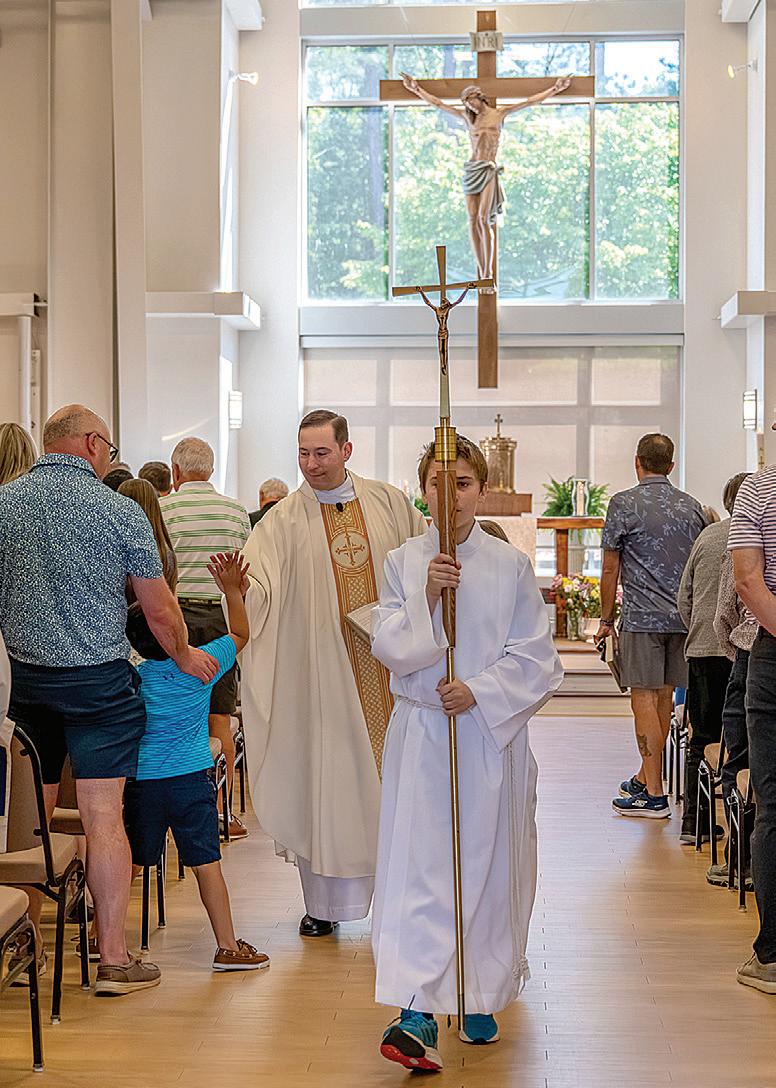
St. Matthew South in Waxhaw, the thriving satellite campus of St. Matthew Parish, may become the permanent spiritual home for thousands of Catholics in southern Mecklenburg and Union counties – a move that had Sunday Mass attendees applauding when they heard the official news. (Read about parishioners’ reactions below.)
The historic step, approved by Bishop Michael T. Martin, OFM Conv., in consultation with diocesan and parish leaders, comes as the number of Catholic families in the area has increased 38% over the past decade.
“This is a moment of celebration – and a testament to the work of the Holy Spirit,” Bishop Martin said. “People are finding a home at our Waxhaw campus, and we want to honor the faith and engagement of this growing Catholic community by creating an independent parish.”
“Growth is the challenge of our time,” he said, “and we must manage this growth so it leads to deeper faith in Jesus.”
Details about the new parish – including its name – are some of the next steps the community will need to discern. Bishop Michael T. Martin, OFM Conv., is appointing Father Benjamin Roberts to help build what will be the diocese’s first new parish in decades. (Read more on page 5.)
Once the community is prepared, the
process of establishing the parish will take as little as a few months. The pace will be determined by the people and their readiness to move forward, diocesan leaders said. The process will become official with a decree from the bishop.
The new parish will continue using the St. Matthew South building at 4116 Waxhaw-Marvin Road. The 32-acre campus includes a 16,000-square-foot multipurpose facility that doubles as the church and classroom space.
Exact parish boundaries have yet to be determined, but the territory is expected to include portions of Union County within the 28173 ZIP code.
Approximately 4,000 Catholic families live in that area – up from 2,900 when St. Matthew South opened in 2014. Local Catholics have the option of attending Mass in Waxhaw, at St. Matthew’s main campus in Charlotte, or at neighboring churches in Monroe or across the state line in Indian Land, South Carolina.
Parishioners who currently belong to St. Matthew Parish will not be required to join the new parish. Instead, diocesan leaders said families living within the new parish area will be invited to participate as the community takes shape.
This marks one of few times the diocese has erected a parish by dividing an existing parish. In 1997, St. Mark in Huntersville was formed from territory drawn from multiple surrounding parishes. In 2007, St. Joseph Vietnamese in Charlotte was elevated from a community to a parish. Most recently in 2022, the diocese elevated St. Jude in Sapphire to parish status from a mission of Brevard’s Sacred Heart Parish.
The transition marks a significant moment for St. Matthew Parish, which – with more than 11,000 registered families – is among the largest Catholic parishes in the United States. Diocesan leaders say the creation of a Waxhaw parish reflects the Church’s constant mission to reach out and serve more people.
“We are not dividing our parish – we are expanding the Church’s presence,” said Father Patrick Cahill, St. Matthew’s pastor.
“This is about strengthening our unity by ensuring that every person has a place where they can belong, worship and grow in faith.” Father Cahill will work in collaboration with diocesan leaders and Father Roberts as boundaries are defined, parish resources are separated, and families in the new territory are identified – all part of laying
WAXHAW, SEE PAGE 14
CHRISTINA LEE KNAUSS clknauss@rcdoc.org
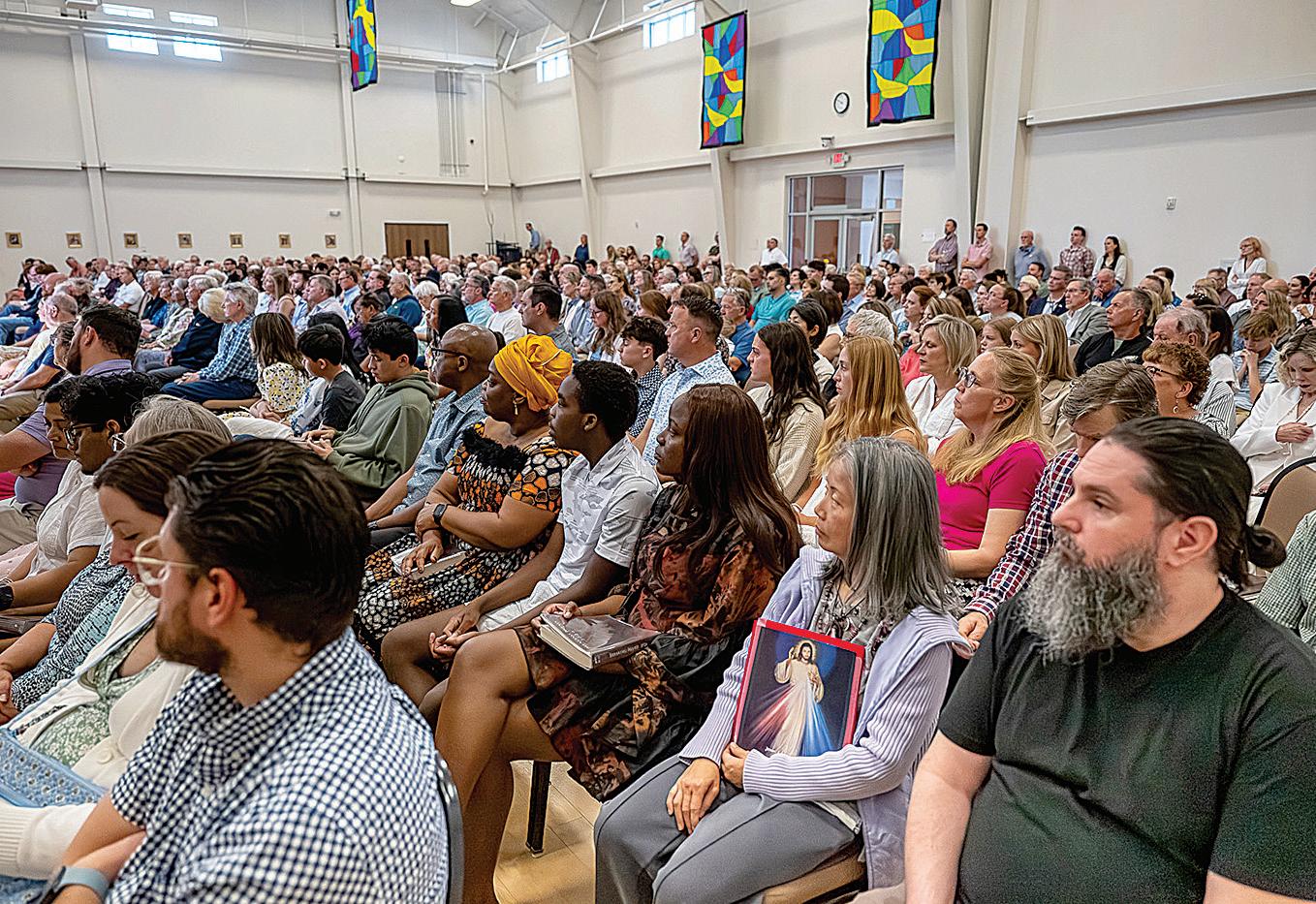
WAXHAW — Parishioners applauded at St. Matthew Parish’s Waxhaw campus Sunday when Father Patrick Cahill announced that the booming congregation is taking the first steps toward becoming its own parish.
Pastor of St. Matthew in south Charlotte, Father Cahill celebrated all three Masses at the parish’s satellite campus last weekend, announcing the change at the start of his homily.
“This is a blessed moment in the history of the diocese,” said Father Cahill, who celebrated the very first Mass at the satellite campus in 2014. “It’s a time to thank God for His divine providence that has brought us here.”
The news sparked both praise and reflection for long-time parishioners and newcomers, most of whom were happy with the development in the life of their community.
“I’m thrilled – absolutely thrilled –because we’ve waited a long time for this,” said Joan Ondrof, a member of St.
Matthew Parish for 18 years who has been coming to the Waxhaw campus since its inception.
Father Cahill will work in collaboration with diocesan leaders and Father Benjamin Roberts (read more on page 5).
Until the parish is formally established, Father Roberts will work alongside Father Cahill as “Priest in solidum” (meaning “jointly” or “equally”) as boundaries are defined, parish resources are separated, and families in the new territory are identified.
Once the community is prepared, the process of establishing the parish can take as little as a few months (read details above).
For some, the need for a new parish was obvious, as the number of Catholics in southern Mecklenburg and Union counties continues to grow. Weekend Masses regularly draw more than 1,600 people.
“We are elated and so excited that this dream is finally coming together,” said Theresa Peters, who drives to Waxhaw from her home over the border in Lancaster, South Carolina. “Hopefully
starting a new parish will help us continue to build community here in the Waxhaw area.”
“I think it’s great – it shows that the Church is expanding in this area,” said Waxhaw resident Franklin Lim. “It’s great to see the growth of the Church.”
Some were more hesitant about separating from St. Matthew.
“I was shocked to hear this, and I think it’s going to be hard and a little sad,” said Lucy Reyes, who lives just across the state line in Indian Land, South Carolina. “I don’t want to lose the community and fellowship we have with the St. Matthew Parish. But I guess we’ll have to see where God leads us.”
The addition is also bringing change to Our Lady of Lourdes Parish in Monroe as Father Roberts leaves after 14 years as pastor.
While parishioners and staff at Our Lady of Lourdes said they will miss working with Father Roberts, they think he’s a good choice for the new project.
REACTION, SEE PAGE 14
PATRICIA L. GUILFOYLE plguilfoyle@rcdoc.org
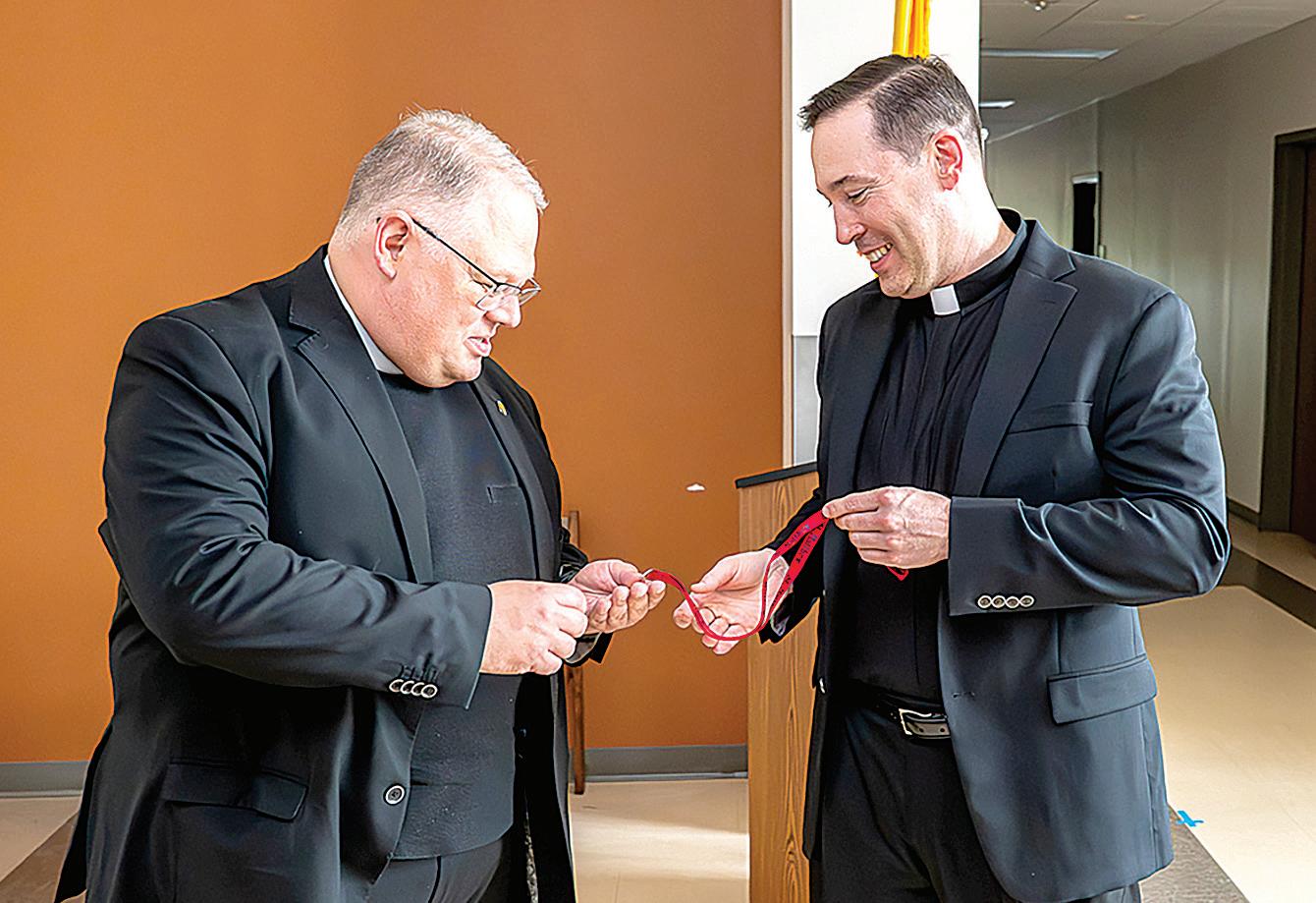
CHARLOTTE — As the Diocese of Charlotte prepares to create a Catholic parish in Waxhaw, Bishop Michael T. Martin, OFM Conv., is appointing Father Benjamin Roberts to help build what will be the diocese’s first new parish in decades.
Effective July 1, Father Roberts will leave his role as pastor of Our Lady of Lourdes Parish in Monroe after 14 years to serve the Waxhaw Catholic community alongside Father Patrick Cahill, pastor of St. Matthew Parish. Until the parish is formally erected, Father Roberts will hold the Church title of “Priest in solidum” (meaning “jointly” or “equally”) with Father Cahill serving as “Moderator Priest in solidum.”
Together, the two priests will work with parishioners to form a new community separate from St. Matthew: determining boundaries, dividing resources and gearing up for staffing, programs and other needs of an independent parish. Currently, the Waxhaw satellite church offers three weekend Masses that draw a total of about 1,600 people, besides youth and adult faith formation classes, confessions, Adoration, community service work and more.
“Father Roberts is the perfect match for this post,” Father Cahill said. “He grew up in this area. He’s a man of humility and good humor, and a gifted leader. I am looking forward to working with him as the founding pastor there and supporting him in any way I can.”
Father Roberts reflects similar affinity: “Creating a new parish from within an existing parish – especially one as vibrant and active as St. Matthew – will require collaboration and trust, and I am confident this will be a smooth transition.”
“We have such great respect for each other,” he said, “and for the work that we both do.”
The two priests have known each other for years. Both attended St. Charles Borromeo Seminary in Pennsylvania and were ordained for the Charlotte diocese two
years apart. Both have also guided their parishes through major challenges – Father Roberts rebuilding after a devastating fire at Our Lady of Lourdes Church in 2020, and Father Cahill leading St. Eugene Parish and Asheville Catholic School through Tropical Storm Helene’s aftermath.
LOCAL SON WHO LOVES HISTORY
Father Roberts is very familiar with the region and its rapid growth.
He grew up in nearby Lancaster, South Carolina, where his parents still live. And since 2012, he has served as pastor of Our Lady of Lourdes in Monroe, the other Catholic church in Union County.
He has watched the area boom – from southern Mecklenburg and Union counties to neighboring Lancaster County, South Carolina – including the development of Ballantyne and Indian Land spurred by the building of Highway 521.
His mother, Patti Roberts, says she’s grateful this new assignment will enable him to continue his regular visits home, and she looks forward to seeing how the Waxhaw church will develop under his leadership.
“Ben’s very outgoing and he has a love of people, and God has given him a lot of skills that I know will come in handy. We’re very, very proud of him,” she said.
She recalled how young Ben, born during America’s bicentennial in 1976, developed an early love for history while growing up amid the rich heritage of the Waxhaw area, originally home to the Waxhaw Indians and later, future President Andrew Jackson.
For Father Roberts, history – like ministry – is about people, both the privileged and the marginalized.
“History tells a whole story,” he said, “and we’ve come to a greater consciousness that with history, there are stories we leave out. It’s important for us to know all the stories.”
In this historic moment for the Waxhaw community, he said, “I have to listen to a lot of stories, and hear about the stories of the
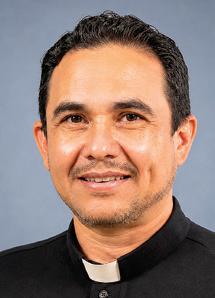
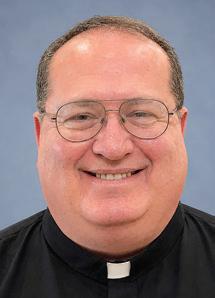
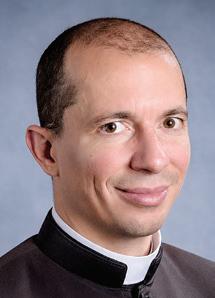
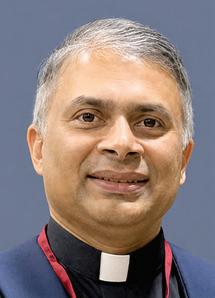
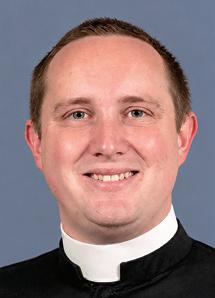
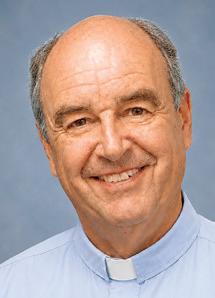
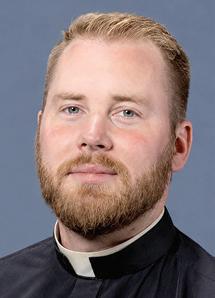
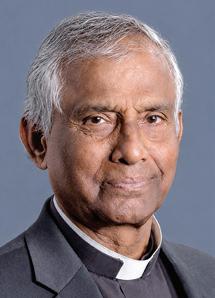
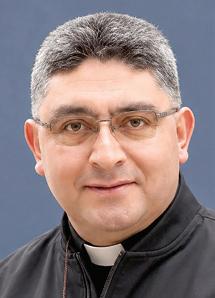
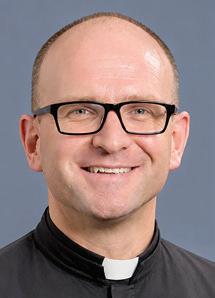
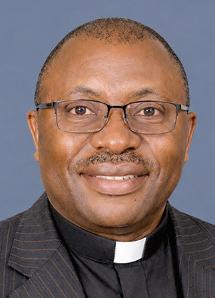
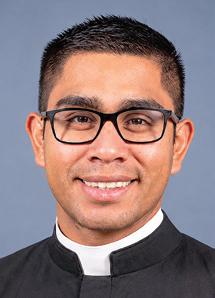
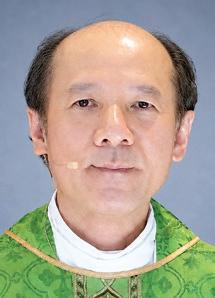
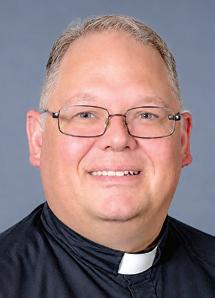
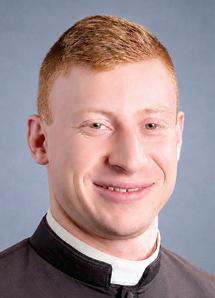
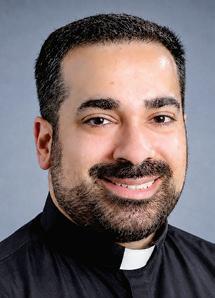
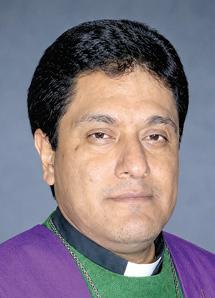
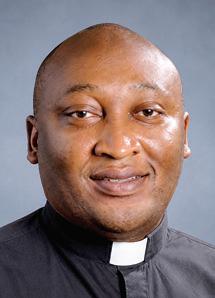
CHARLOTTE — Bishop Michael T. Martin, OFM Conv., announces the following priest assignments effective July 1, 2026, unless otherwise noted:
n Rev. Oscar D. Benavides: From parochial administrator of Our Lady of the Rosary Parish in Lexington to parochial vicar of Our Lady of the Assumption Parish in Charlotte
n Rev. Herbert T. Burke Jr.: From pastor of Immaculate Conception Parish in Forest City to parochial vicar of St. Matthew Parish in Charlotte
n Rev. Jason M. Christian: To parochial vicar of Holy Cross Parish in Kernersville
n Rev. Binoy P. Davis: From parochial vicar of St. Matthew Parish in Charlotte to parochial administrator of Immaculate Conception Parish in Forest City
n Rev. Matthew W. Dimock: From parochial vicar of Sacred Heart Parish in Salisbury to parochial vicar of Our Lady of Mercy Parish and Our Lady of Fatima Mission in WinstonSalem
n Rev. John D. Hanic: Retiring as pastor of St. John Baptist de La Salle Parish in North Wilkesboro and St. Stephen Mission in Elkin
n Rev. Aaron Z. Huber: From Chaplain of Christ the King High School and priest in residence at St. Mark Parish in Huntersville to parochial administrator of St. Margaret Mary Parish in Swannanoa
n Rev. Gnanapragasam Mariasoosai: Retiring as pastor of St. Joseph of the Hills Parish in Eden
n Rev. Huver E. Navarro-Vigo: From parochial vicar of St. Therese Parish in Mooresville to parochial administrator of Our Lady of the Rosary Parish in Lexington
n Rev. David F. O’Connor: From parochial vicar of Immaculate Conception Parish in Hendersonville to parochial administrator of Our Lady of Lourdes Parish in Monroe
n Rev. Engelbert Ofon: From parochial vicar of St. Therese Church in Mooresville to parochial administrator of St. John Baptist de La Salle Parish in North Wilkesboro and St. Stephen Mission in Elkin
n Rev. José A. Palma Torres: From parochial vicar of Our Lady of Mercy Parish and Our Lady of Fatima Mission in WinstonSalem to parochial administrator of St. Joseph of the Hills Parish in Eden and Holy Infant Parish in Reidsville
n Rev. Peter T. Pham: From priest in residence at St. John Neumann Parish in Charlotte to chaplain for Charlotte-Area Hospitals
n Rev. Benjamin A. Roberts: From pastor of Our Lady of Lourdes Parish in Monroe to serving the faithful at the Waxhaw campus of St. Matthew Parish as a priest in solidum with Father Patrick Cahill, moderator priest in solidum. Father Roberts will lead them in the process of becoming their own parish.
n Rev. Peter M. Rusciolelli: From parochial vicar of St. Leo the Great Parish in WinstonSalem to parochial administrator of St. Benedict the Moor Parish in Winston-Salem and Good Shepherd Mission in King, effective Dec. 31, 2026
n Rev. Jonathan D. Torres: Returning from sabbatical to parochial vicar of Sacred Heart Parish in Salisbury
n Rev. Nohé Torres Vizcaino: From parochial administrator of Holy Infant Parish in Reidsville to return to his home diocese of Ciudad Valles, Mexico
n Rev. Melchesideck W. Yumo: From parochial administrator of St. Benedict the Moor Parish in Winston-Salem and Good Shepherd Mission in King to return to his home diocese of Buea, Cameroon, effective Dec. 31, 2026
PATRICIA L. GUILFOYLE AND KIMBERLY BENDER catholicnews@rcodc.org
CHARLOTTE — The Diocese of Charlotte will ordain a record 10 priests on May 30, the largest ordination class in diocesan history and one that is continuing a trend of growth in vocations.
This milestone follows last year’s class of six priests, which approached the previous record of seven achieved in both 2000 and 2024.
The record-breaking class fills diocesan Vocations Director Father John Eckert with gratitude for all those who have been involved in helping these young men.
“We’re so blessed here in the Diocese of Charlotte with our families who support vocations, our parishes, our pastors and parochial vicars, the chaplains at the high schools and colleges,” he said.
“Bishop Michael Martin likes to point out often that God is a God of abundance, not a God of scarcity, and we’re seeing the fruits of that this year,” Father Eckert said.
With only two priests retiring this summer, the ordinands will join 145 priests serving in some capacity for a Catholic population that now tops 575,000.
Diocesan leaders credit in part the impact of St. Joseph College Seminary in Mount Holly, which opened in 2016. Eight of this year’s ordinands studied there before advancing to major seminary. The other two lived there during their pastoral years of ministering to a parish.
At the college seminary, men discern the priesthood while earning a bachelor’s degree at nearby Belmont Abbey College before going on to major seminary.
Not only is it one of the largest ordination classes in the diocese’s 54-year history, the 2026 ordination class reflects the continued growth and diversity of the Church in western North Carolina.
Six of the men were not born in North Carolina – and only Deacon James Tweed is a native of the diocese – but the region’s growth drew them or their families here.
Two of them – Deacon Daniel Chaves Peña from Colombia and Juan González Hernández from Mexico – moved here
during their seminary studies. Deacon Maximilian Frei hails from Germany, and Deacon Bryan Ilagor was born in Pinehurst but raised in Mexico.
The group’s average age is 30, and they took different paths to the priesthood – from scientists and athletes to missionaries and musicians – but they all share a willingness to trust God’s call wherever it leads.
Some discovered their calling as children, while others found it later in life through retreats, personal crises, friendships or years of discernment.
For Deacon Chaves, the turning point came after a devastating health crisis ended his hopes of an athletic career.
“I realized life ends and things aren’t just fun or passing time,” he said. “You face reality.” After an Ignatian retreat, he reached a conviction that changed his life:
“I can’t live with myself if I say no. It was so clear – God was calling me,” he said.
Others describe quieter beginnings.
Deacon Michael Camilleri remembers “playing Mass” as one of his earliest childhood memories before rediscovering his vocation as a teenager.
Deacon Peter Townsend said he first sensed the call at just 5 years old, and “the feeling never left me.”
Deacon Ilagor recalls serving one night at his parish when his pastor asked him, “Bryan, do you want to be a priest?” The moment, he said, forced him to answer honestly before God, “If this is God’s will, I will give it a shot.”
Deacon Robert Bauman heard his call right after college. Several pursued other dreams before they decided to enter seminary.
Deacon John Cuppett played baseball at Belmont Abbey College before former desires for the priesthood “came crashing back.”
Deacon Tweed studied molecular biology and neuroscience and considered careers in archaeology, marine biology and medicine. Yet God revealed a deeper purpose, he said. “My heart had been made entirely for Him,” he explained.
Deacon González said his family’s witness played a decisive role in his vocation. Watching his brother celebrate Mass after ordination sparked a question in
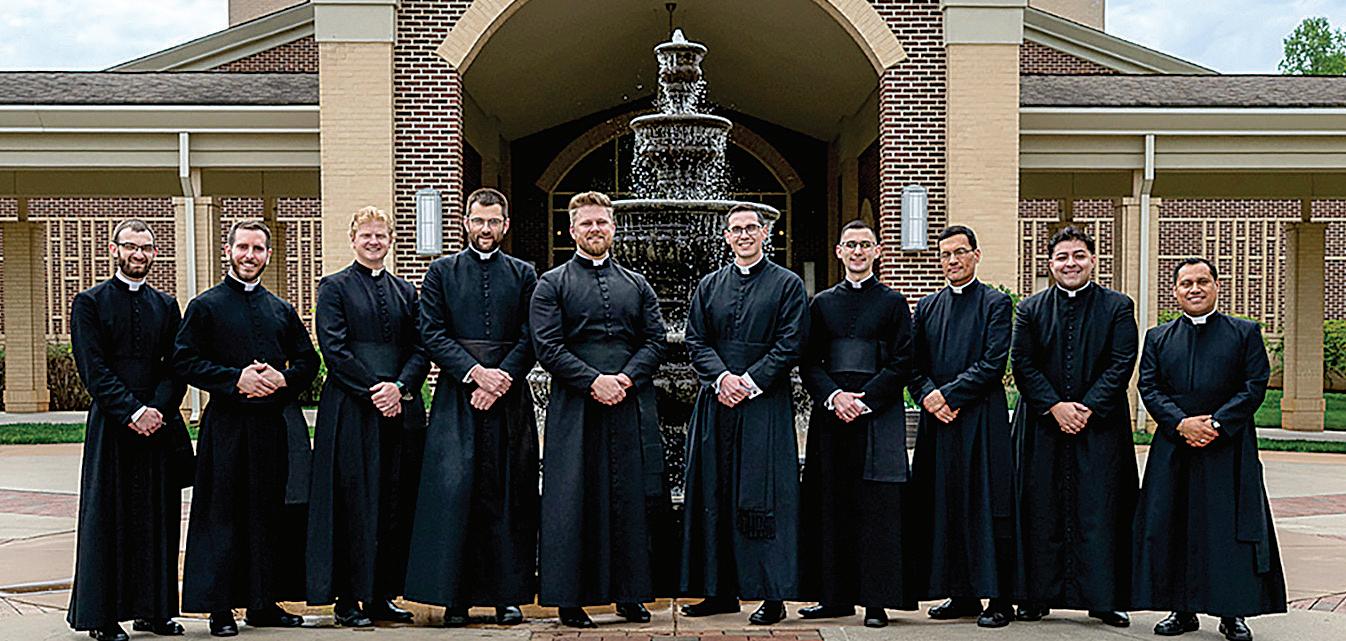
All are welcome to attend the 9 a.m. ordination Mass on Saturday, May 30, at St. Mark Church, 14740 Stumptown Road, Huntersville.
Seating: Once seating inside St. Mark Church is at capacity, overflow seating will be in the St. Mark School Gym. Ushers will direct people upon arrival.
Additional parking: St. Mark’s parking lot will fill quickly, so overflow parking with shuttle service will be available starting at 7:30 a.m. from nearby Grand Oaks Elementary School at 15410 Stumptown Road.
Reception and first blessings: Stay for the reception and light refreshments after Mass at 11 a.m. in the Monsignor Kerin Center. The new priests will offer first blessings from 1 to 3 p.m. inside the church.
Can’t attend in person? Watch from anywhere with our livestream of the ordination Mass, live starting at 9 a.m. on the diocese’s YouTube channel. Subscribe to get notifications and updates about live streams, Shorts, premieres and more.
his young heart: “What if I myself become a priest one day, like my brother?”
The 2026 ordinands’ hobbies are as varied as their vocation stories: hiking, chess, calligraphy, disc golf, literature, oil painting, classical music and sports. Yet despite their different interests and paths to the priesthood, the future priests describe their anticipated ministry in similar terms: surrender, trust and joy. They describe priesthood not simply as a profession, but as a complete gift of self. Priesthood is “the summation of everything
I wanted out of life,” especially “the service of God,” said Deacon Michael Lugo. Deacon Tweed echoes his fellow ordinands in telling men who might be discerning a priestly vocation: “Do not be afraid to trust Him, even when the path is unclear. God’s call is a gift.”
— Catholic News Herald
More online
At www.catholicnewsherald.com : Get to know our future priests
KIMBERLY BENDER kdbender@rcdoc.org
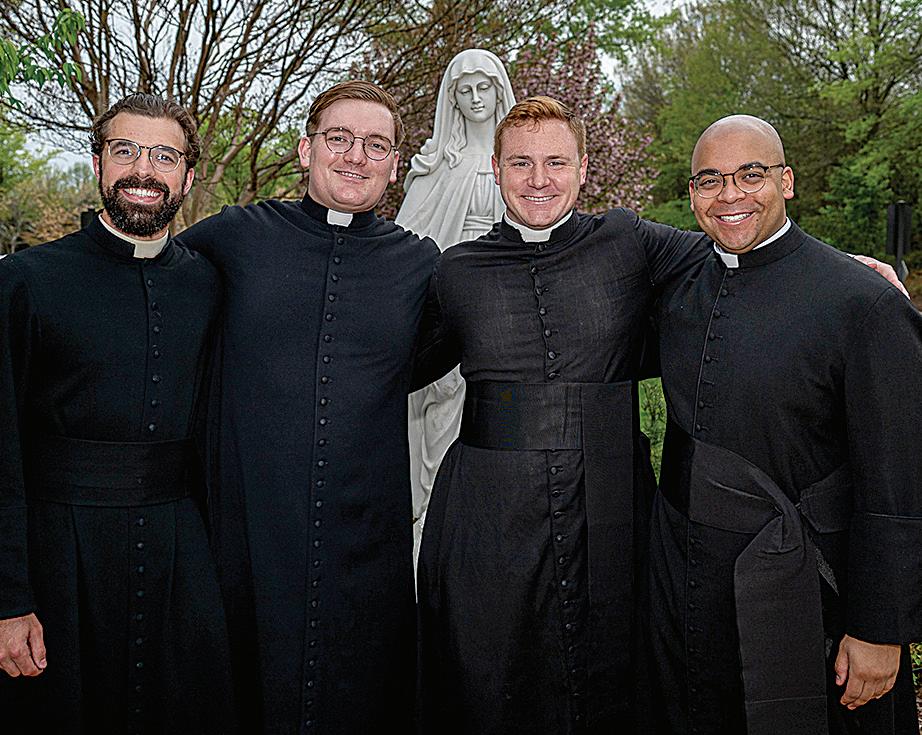
CHARLOTTE — Four seminarians will be ordained deacons this month as they take this step toward the priesthood together for the Diocese of Charlotte. Bradley Loftin, Patrick Martin and Connor White, all from St. Mark Parish in Huntersville, and James Johnson IV from Our Lady of Consolation in Charlotte will be ordained deacons May 23 at the home parish for three of them.
All four men are studying theology at Mount St. Mary Seminary in Cincinnati, Ohio, after graduating from St. Joseph College Seminary.
Loftin, who attended Catholic schools in the diocese, graduated from Christ the King High School. He credits his high school chaplain at the time, Father Paul McNulty, and his pastor, Father John Putnam, for fostering his vocation.
He first heard the call when he was a junior at Christ the King High School.
“I realized that the life I was living
wouldn’t fulfill me. I wanted to sacrifice my life for something noble, and I knew I wasn’t living a life that would make me happy,” Loftin said.
White, who attended school with Loftin since kindergarten, also looks to Father McNulty as a priestly role model.
“Living the Catholic life is not a solo endeavor, and I have met some of my closest friends in school, some of whom are also in seminary,” White said.
Martin grew up seeing his parents active in his parish. His father, Tom Martin, serves as a deacon at St. Mark and his mom Heather is a cantor.
Johnson, who has served as the president of the National Black Catholic Seminarians Association, pursued his vocation after a being asked if he considered becoming a priest by three people after three different Masses he assisted with as an altar server during one weekend.
Since entering the seminary, he said he’s learned about the true universality of the Church.
“I’ve visited all sorts of different
parishes, seeing the spirituality and the charisms that they have. That has helped me understand we’re not a uniform Church. There’s a diversity in ways of showing our faith, which is a beautiful thing,” Johnson said.
All four have chosen deacons to place
their vestments on for the first time during the ordination Mass.
Loftin will be vested by Deacon Bryan Ilagor, who will become a priest on May 30. He said he chose Deacon Ilagor because he’s a great example of service.
White’s running partner Deacon John Cuppett, who will be ordained a priest the following Saturday, May 30, will be vesting him. Johnson will be vested by Deacon Curtiss Todd from Our Lady of Consolation. Martin has chosen an old friend and retired St. Mark Parish deacon to vest him — Deacon Louis Pais.
After their ordination, these four men will be transitional deacons and will continue their studies on the path to becoming priests next summer.
All are welcome at the 9 a.m. ordination Mass at St. Mark Church, 14740 Stumptown Road, Huntersville.
More online
At www.catholicnewsherald.com : Read more about each of the four deacon candidates
LISA M. GERACI Lmgeraci@rcdoc.org
EDEN — Father Gnanapragasam Mariasoosai, pastor of St. Joseph of the Hills Parish in Eden, is retiring this July. This year also marks his 45th anniversary as a priest on May 10 and his 75th birthday.
The parish of 300 members he has served for eight years is large in faith and love, he said.
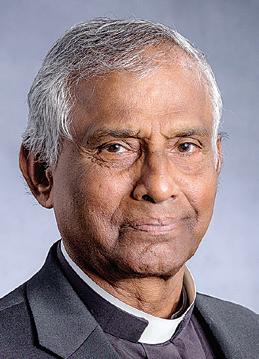
“The people are very nice, kind and cooperative,” said Father Mariasoosai.
“Sometimes they may not understand my English, but even then, they continuously love me and inspire me.”
When Father Mariasoosai cracks jokes in his homilies, he is always impressed with their laughs and encouraging smiles.
“I love saying Mass regularly and keeping people connected to the Lord Jesus Christ,” he said.
The congregation has worked to improve the church, raising money to build a protective landscaping wall around the church and rectory and adding stairs and an accessible parking lot.
“These may not be huge projects, but we did it and everyone supported it, and they are so happy with everything,” he said.
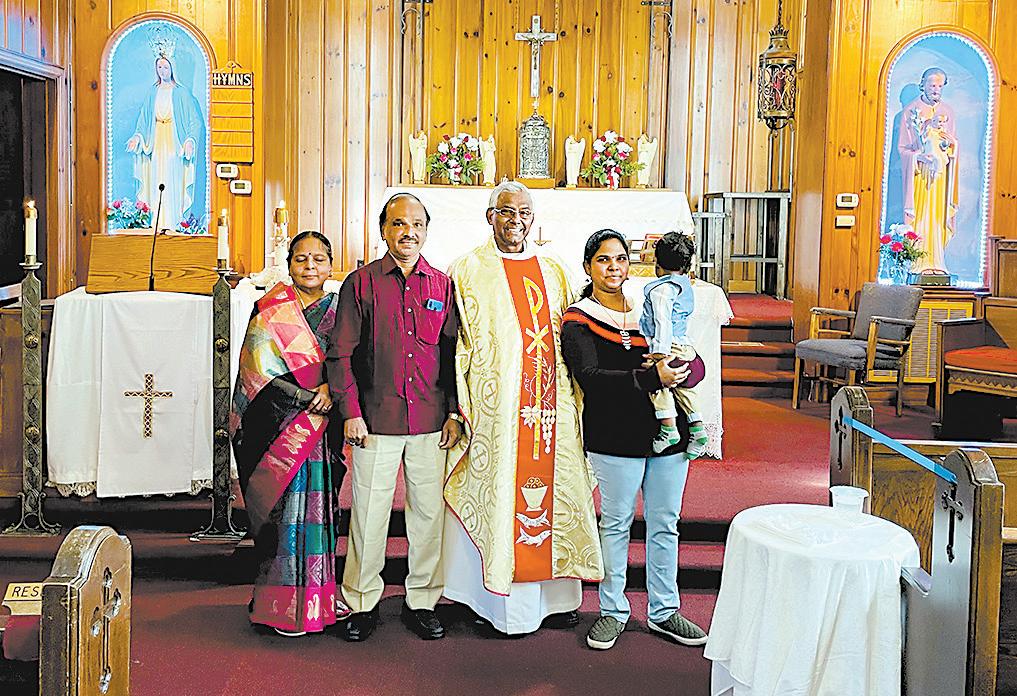
A CRADLE CATHOLIC FROM INDIA
Ordained a priest for the Archdiocese of Madurai, India, in 1981, Father Mariasoosai, a native of Tamil Nadu, India, helps bridge the gap for IndianAmerican Catholics.
He travels to Holy Cross Church in Durham monthly to celebrate
Mass in his native language, Tamil.
He was raised and baptized Catholic beside his two brothers and two sisters. When he was 3, his father died. Through difficult times, his mother held steadfast to the faith, raising her children to pray the rosary, give to the poor, go
FATHER
to daily Mass, and sacrifice time for God and others.
Father Mariasoosai said, “My mother sacrificed so much for us. She taught us everything, and she is the only reason I was ever able to become a priest. She died in 2003 but still lives on in my heart.”
After being ordained, Father
Mariasoosai spent 19 years in India as a diocesan priest. His favorite part, he said, was “watching the children learn and grow in faith and love.”
He then spent three years in Jamaica, first studying in Kingston and then ministering in a small parish in Spanish Town.
Father Mariasoosai retires amid health issues.
“Last year, on the 27th of December, while I was saying Saturday Mass, after we said Our Father, I collapsed and I went to the emergency room. I stayed there for 5 hours,” he said. “I don’t know the reason, but maybe the sugar levels caused it.”
Plus, as he grows older, standing for long periods during Mass is taking its toll, he said.
His retirement plans are unclear for now, he said.
“I want to stay here, in the Charlotte diocese, for a couple more years if my health cooperates.”
He also plans to spend time visiting friends in London, Canada, and, of course, India.
Father José Palma Torres will step in as parochial administrator upon Father Mariasoosai’s departure. But before he leaves, he wants his parishioners and their new shepherd to keep his words in their hearts.
“Put Jesus in the center of your life,” Father Mariasoosai said. “Surround yourself with everything Jesus. With God, everything is possible.”
‘At every place I’ve gone, something terrific has happened’
CHRISTINA LEE KNAUSS clknauss@rcdoc.org
NORTH WILKESBORO — The path to the priesthood was a long and winding one for Father John Hanic, who is retiring July 1 after 23 years as pastor of St. John Baptist de La Salle Parish.
It started in his birthplace of Massachusetts, led through an attempt at seminary, marriage, fatherhood, a career at Sears, Roebuck and Co., and then back to his original calling.
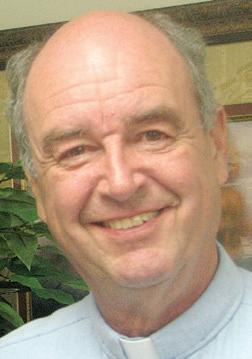
He had wanted to be a priest for as long as he could remember, he said, and he did go to seminary, but there was one problem.
“Back then to be in seminary you had to be proficient in Latin – you had to read it, write it, speak it, and I was very poor and inefficient in languages,” he said. “I didn’t do well.”
A year of Latin immersion didn’t help. He left the seminary, took a job with Sears, married and became father to a son and daughter. The marriage ended in divorce,
and he became a single parent. He still felt called to serve the Church, so he took a job as secretary at his home parish in Massachusetts.
In the mid-1970s, he felt called to become a deacon, but struggled to find a diocese that had a program. A visit to Bishop Michael Begley in Charlotte reignited his childhood dream.
“He said ‘I don’t have a permanent diaconate program, but what you’re going to do is study to be a priest for me,’” Father Hanic recalled.
Bishop Begley sent him to seminary in Massachusetts so he could be with his family, and in 1983, he moved his children to North Carolina and began his journey of shepherding parishes.
SERVING AT SIX PARISHES
“At every place I’ve been, something terrific has happened,” he said of the six parishes he has served in the diocese.
While he was pastor at Our Lady of Mercy in Winston-Salem, he worked with Sister Janis McQuade of the Sisters of St. Joseph of Philadelphia to establish an RCIA program (now OCIA) for those who desired to become Catholic.
“That experience really changed my vision and understanding of how people
embrace the faith and become part of the Church,” he said.
At St. James in Hamlet, he helped make needed changes. When he arrived at Our Lady of the Assumption Church in Charlotte, he learned of plans to build the current church on Shamrock Drive and helped bring them to fruition.
“I spent so much time there as the church was being built,” he said. “I helped lay some shingles on the roof. I laid a brick in the church. I contributed in every way I could.”
From there, he went to St. Joseph of the Hills in Eden for two years and spent seven years as chaplain at Holy Trinity Middle School.
Finally, he arrived at St. John the Baptist de La Salle in North Wilkesboro at the foot of the Blue Ridge Mountains, and its mission, St. Stephen in Elkin, where he has ministered for the past 23 years.
It was in North Wilkesboro that he overcame his inability to learn languages.
The parish’s Hispanic community was booming, and Father Hanic was struggling to learn enough Spanish to celebrate Mass.
He traveled to Mexico at the invitation of a priest from the Diocese of Chiapas in Mexico. There, he was invited to celebrate Mass at a basilica near the shrine of Our
Lady of Guadalupe. The only problem? All of the texts were in Spanish.
A religious sister offered to help him pronounce the words.
“A little group of people had come for the Mass, and that was the first time I ever celebrated Mass in Spanish, and when I got back here, I found that I could celebrate the Mass for the community here in Spanish,” he said.
Learning the traditions of the Hispanic community has been one of his greatest joys, he said. He added a building to better accommodate the hundreds who attend Spanish Mass on Sundays.
As retirement approaches, he said, he will miss the strong relationships he’s forged.
“There will be things to do – I can help out in different parishes, celebrate a weekend Mass – but it won’t be the same as being here with the people every day and being able to celebrate with them every weekend,” Father Hanic said.
“Celebrating the Eucharist with the people is what I love the very best. That will be the hardest thing for me to let go. This journey of the priesthood and coming to retirement is overwhelming and mysterious. How is God working in this phase? I don’t know, but it will be a new adventure.”
LISA M. GERACI lmgeraci@rcdoc.org
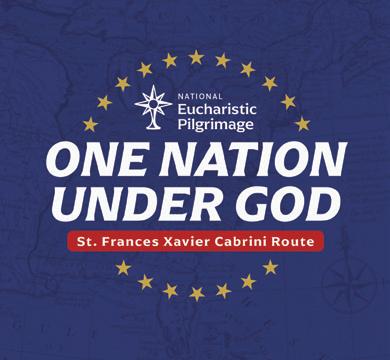
— Catholics across the Diocese of Charlotte are invited to join a nationwide celebration of faith and history as the 2026 National Eucharistic Pilgrimage visits western North Carolina Saturday to Tuesday, May 30-June 2.
Themed “One Nation Under God,” the National Eucharistic Pilgrimage will stop at five churches in the diocese as it journeys 1,500 miles up the East Coast to Philadelphia for the Fourth of July and America’s 250th anniversary.
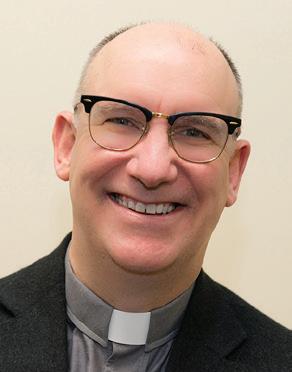
This year’s route is named after St. Frances Xavier Cabrini, the first American saint. The pilgrimage begins in St. Augustine, Florida, and ends near Independence Hall, where the Declaration of Independence was signed.
“The Catholic Church has been a major part of our country’s history, and this pilgrimage
As it visits the diocese, historic pilgrimage celebrates our shared faith, unity
Don’t miss this historic event!
The National Eucharistic Pilgrimage will stop in the Diocese of Charlotte at:
n SATURDAY, MAY 30 – Our Lady of Lourdes Church in Monroe: Eucharistic Adoration from 3:30 to 4:30 p.m., followed by 5 p.m. Mass
n SUNDAY, MAY 31 – St. Peter Church in Charlotte: Mass with Bishop Michael Martin at 9 a.m., followed by a meet-and-greet with the pilgrims
n SUNDAY, MAY 31 –St. Vincent de Paul Church in Charlotte: 2 p.m. Spanish Mass, followed by Eucharistic Adoration and procession
n MONDAY, JUNE 1 – St. Philip the Apostle Church in Statesville: 9 a.m. Mass, followed by Eucharistic Adoration
n MONDAY-TUESDAY, JUNE 1-2 – St. Pius X Church in Greensboro: 4-5 p.m. Eucharistic Adoration and procession from 3:45-4:15 p.m., followed by 5:15 p.m. Mass; and 8:30 a.m. Mass on Tuesday, June 2. (Consider bringing a non-perishable item for the Greensboro Urban Ministry Food Pantry.)
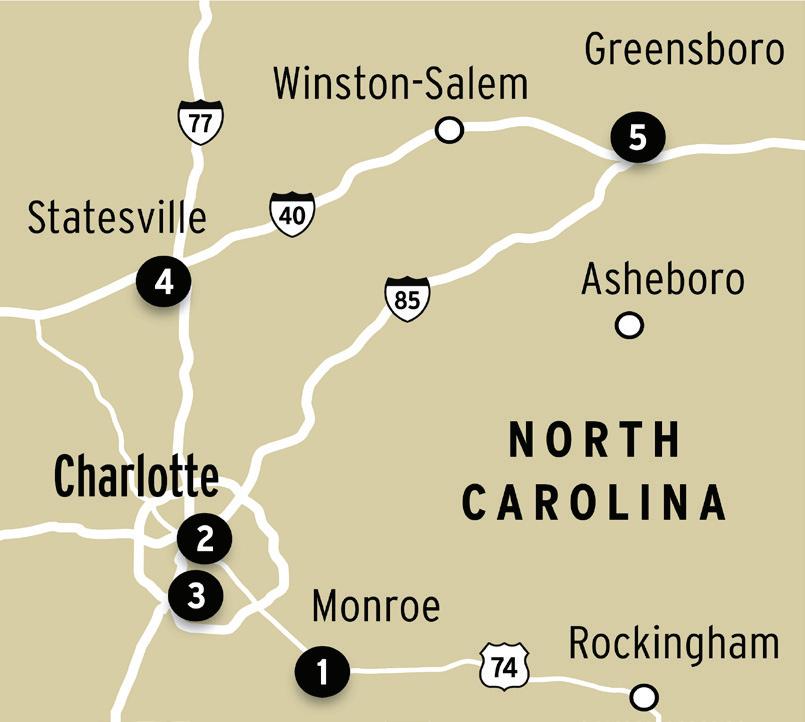
Note: Parishes may add other events – please see each parish’s website or bulletin for details.
gives us an opportunity to link to the greater Church, going forth in discipleship as we are called,” said Deacon Jim Bozik of St. Peter Parish in Charlotte, who is coorganizing diocesan festivities.
The “monstrance-mobile” –featuring a window allowing people to view the Blessed Sacrament –and nine young adult “perpetual pilgrims” will stop first at Our Lady of Lourdes Church in Monroe after crossing into the diocese from South Carolina. There, people can meet the pilgrims and join them for a Holy Hour and Mass.
Churches in Charlotte, Statesville and Greensboro will also host the pilgrimage with Holy Hours and Masses. All are welcome.
For pilgrims Mary Carmen Zakrajsek and Raymond Martinez, the journey is both spiritual and personal.
“I am excited to meet all these Catholic communities,” Martinez said. “We want the entire nation to experience Our Lord through the Eucharist. We will carry your prayer intentions and place them at the foot of the monstrance in prayer. Eventually we will leave
them at the altar with Christ after our last procession.”
On Sunday, May 31, Bishop Michael Martin will celebrate Mass at St. Peter Church in Charlotte, the oldest active parish in the diocese, followed by a meet-and-greet with the pilgrims.
Sunday evening, people can enjoy a free theater screening of “Cabrini,” the film about the saint’s advocacy for immigrants and the Church’s role in American history. St. Matthew, the diocese’s largest parish, will co-sponsor the exclusive screening. Advance ticket
reservations are required.
Like Mother Cabrini, diocesan coorganizer Deacon Herb Quintanilla is an immigrant, and he sees the pilgrimage as a celebration of both faith and opportunity.
“Everyone comes to America to have a better life, a safer life. This is one of the greatest countries in the world because if you work hard and study, you can make it,” said Deacon Quintanilla, who moved from El Salvador. “This is an immigrant country, and that is why we have so many Catholics – the Irish, the Italians, the Polish, and the Latin Americans. This country has grown up Catholic.”
Zakrajsek said the pilgrimage also reflects the spiritual journey of the nation itself.
“Just like us as pilgrims walking this route, our country is also on pilgrimage. We are going to follow Him through the streets. We are going to bring Him to the poor. We are going to fall on our knees before Him in worship. This is an opportunity to live out the Gospel, to be united as a country, and to ask Him to bless us and to heal us, one soul at a time.”

At www.charlottediocese.org/ national-eucharistic-pilgrimage : Get details about the National Eucharistic Pilgrimage as it passes through the Diocese of Charlotte, including Mass and Holy Hour times, locations, movie screening reservations, and more.

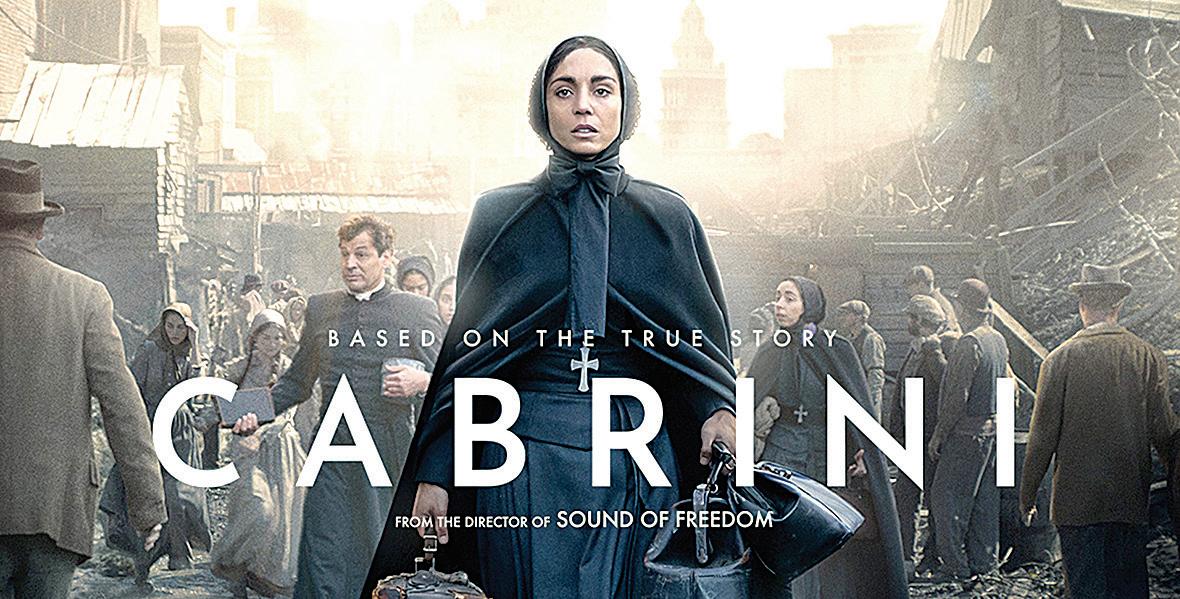
Take the family out Sunday, May 31, to enjoy a free, exclusive screening of the hit movie about Mother Cabrini – patron of the National Eucharistic Pilgrimage – at Regal Stonecrest at Piper Glen in Charlotte. Seating is limited; advance ticket reservations required (no walk-ins). Doors open at 6 p.m., show starts at 7 p.m. Co-sponsored by St. Matthew Parish. Reserve your seat online at www.charlottediocese. org/national-eucharistic-pilgrimage.

Parents, help your student stay rooted in faith. Scan to complete the short sur vey.
Scan the QR code to discover a Catholic Campus Ministr y at your future college. Stay connected to your faith right from the star t Class of 2026—what’s next? The infor ma tion you share will be sent to the campus minister a t your selected school to personally invite your student to Ca tholic Campus Ministr y this fall.



His Excellency
Michael T. Martin, OFM Conv. Bishop of Charlotte
requests the honor of your presence at the
TRISH STUKBAUER tmstukbauer@rcdoc.org
CHARLOTTE — Connecting college students to Catholic resources is expected to be easier than ever, thanks to a new partnership the Diocese of Charlotte has struck with the Newman Connection.
The national non-profit organization surveys high school seniors and provides more comprehensive data about graduating seniors to their college of choice. Knowing more about what college students are looking for, what college they are attending, and how to connect with them will enable the diocese’s Campus Ministry leaders to better reach and serve these young people.
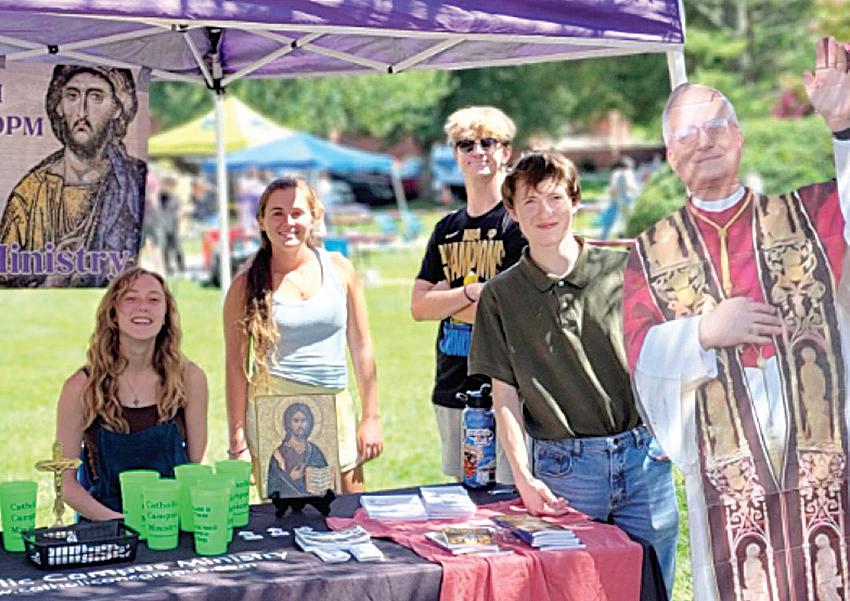
“Today, very few colleges and universities share the religious belief of their incoming students with campus ministers, Catholic or otherwise, if the college even asks its incoming students about their religious belief at all,” explained Darien Clark, the diocese’s director of Campus and Young Adult Ministry.
Rev. Mr. Robert Warren Baumann II
Rev. Mr. Michael Patrick Camilleri
Rev. Mr. Daniel Eduardo Chaves Peña
Rev. Mr. John Warren Cuppett
Rev. Mr. Maximilian Karl Frei
Rev. Mr. Juan González Hernández
Rev. Mr. Bryan Gabriel Ilagor
Rev. Mr. Michael James Lugo
Rev. Mr. Peter James Townsend
Rev. Mr. James Conner Tweed of
Saturday, the 30th day of May
Two thousand twenty-six at nine o’clock in the morning
Saint Mark Catholic Church 14740 Stumptown Road
Huntersville, North Carolina
Light reception immediately following Monsignor Joseph A. Kerin Family Center
Newman Connection’s process has students input their data themselves, so that contact information can be shared. There is a separate online form for parents to share more details with Campus Ministry before their student arrives on campus in the fall.
What that means for campus ministers like Deacon Matthew Newsome at Western Carolina University is they don’t need to wait for Catholic students to discover Catholic Campus Ministry.
“We can be proactive in inviting students into opportunities to grow in their faith,” he said.
As Newman Ministry President and Founder Matt Zerrusen notes, “Too often, students show up to campus without ever being personally invited into the Catholic community. What’s happening in the Diocese of Charlotte is different. Their campus ministers now can reach out before students arrive, so instead of hoping students show up, they’re being personally welcomed.”
That personal invitation is critical, agrees Scott Salvato, campus minster at Davidson College. In his unique position as a chaplain employed by the private college, he has had access to the email addresses of students who self-identify as Catholic – a luxury most campus ministers have not had until now. That has enabled his student leadership team to reach out to incoming freshmen before they arrive on campus.
“So many things are so impersonal today,” he said. “Having students reach out to them one-on-one and ask, ‘Would you like to get together for coffee?’ or ‘Do you want to come to lunch with me and my friends?’ or ‘Do you want to walk over to Mass together?’ is a much different experience.”
For students like Davidson senior Rosa Ramirez, that personal outreach was key. She had not regularly attended Mass before coming to Davidson, and at first she wasn’t interested in getting involved in religious activities. Far from her home in Rosharon, Texas, and missing a sense of community, she tagged along with dorm mates to a Thursday night dinner hosted by Catholic Campus Ministry.

“The upperclassmen I met that first night kept recognizing me around campus and in class, and they continued inviting me to events,” she recalled. “Within a few weeks, I found myself going to CCM events most days of the week and spending time with other Catholics outside of them. They motivated me to stay connected to my faith, and I haven’t missed Mass since.”
Confirmed at the Easter Vigil, Ramirez is eager to take her faith with her as she graduates and heads to law school this fall.
“Looking back, getting connected to CCM didn’t just bring me back to my faith, it completely shaped my college experience by giving me a sense of community and confidence that I didn’t have when I arrived.”
CHARLOTTE — A one-word shift in the title of a key diocesan office emphasizes the breadth and depth of the ministries it manages, according to its new director.
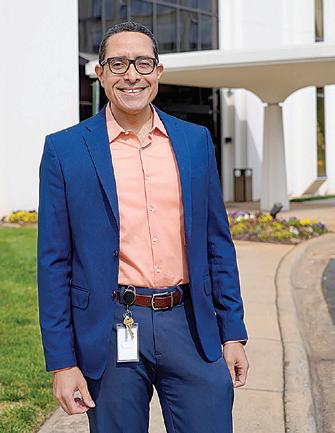
The former Office of Marriage and Family Life has changed its name to the Office of Marriage, Family and Life, said Dawn Fitzpatrick, who assumed the director’s role in April.
“It became obvious to me that the scope of what our office does is more than marriage and family, it also has everything to do with life issues. It makes sense that life should have its own spot there in our title,” Fitzpatrick said. “We want to make sure that everyone knows that life issues have a home here in the diocese.”
The emphasis on the dignity of the
human person from conception through natural death is a cornerstone of Catholic social teaching and is under fire in areas ranging from abortion to physician-assisted suicide and the death penalty, she said.
“There are so many things in today’s world that are contrary to life, so we want to make sure that people are aware that we are advocates for life and we have ministries in place to help,” Fitzpatrick said.
The change also elevates the work the office does with families at every stage of life.
“We want families to embrace life and for us to help them to do so,” she said.
For more information, visit www. charlottediocese.org, call 704-370-3237, or find them on Facebook and Instagram. — Trish Stukbauer
‘Jesus was a great crewmate’
Group celebrates 10 years of bringing Jesus into the workplace
CHRISTINA LEE KNAUSS clknauss@rcdoc.org
CHARLOTTE — It’s not often you meet a Catholic whose faith journey includes receiving the Eucharist in space, but that was the story former NASA astronaut and devout Catholic Kevin Chilton shared May 7 with members of the Charlotte chapter of Legatus, an organization of Catholic business executives.
Chilton’s story began with a fascination with flight nurtured in California that led him to become an astronaut and a four-star general in the U.S. Air Force. His testimony is the type of programming Legatus members have heard for the past decade as they seek to live a dynamic Catholic life. Founded by Domino’s pizza CEO Tom Monaghan in 1987, the goal of Legatus (Latin for “envoy” or “ambassador”) is to help high-level business leaders grow in their faith and learn how to share and preserve Catholic values in a hypersecular atmosphere. It has more than 5,500 members across 90-plus chapters primarily in the United States, Canada and Mexico.
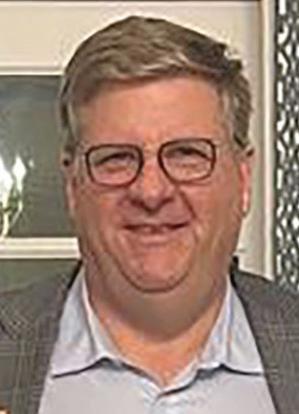
The Charlotte chapter is celebrating its 10th anniversary this year and recently received an honor to enhance that milestone. President Kevin Scully, an architect who attends St. Mark Parish in Huntersville, was honored as the organization’s 2026 “President of the Year,” primarily for growing the chapter.
Scully first joined Legatus in Fort Wayne, Indiana, and was excited to become part of the Charlotte chapter when he moved here in 2022.
“It’s certainly humbling to receive an honor like this, and
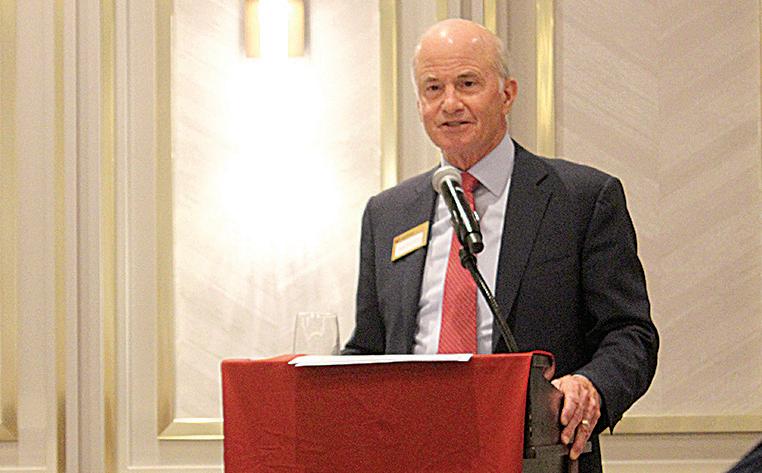
CHRISTINA LEE KNAUSS | CATHOLIC NEWS HERALD
Astronaut Kevin Chilton shares his experiences in space and his faith journey with members of Legatus May 7. The group of Catholic business executives focuses on helping leaders bring faith into their workplaces.
it’s been great to step into the chapter here and help it grow,” he said. “Legatus definitely has helped me strengthen my faith because you’re surrounded by other strong Catholic leaders. We can lean on each other and learn from each other.”
At monthly meetings, members go to confession, pray the rosary and attend Mass, share fellowship time, and listen to speakers like Chilton selected for both their life experiences and their powerful faith messages.
Chilton deftly illustrated how his faith was interwoven through his career with the Air Force and with NASA, the most moving part being his description of receiving the Eucharist in space. Catholic astronauts can get permission from their diocese to take a pyx containing consecrated Hosts so they can receive the sacrament in orbit.
He first shared the Eucharist with another Catholic astronaut as a pilot on the space shuttle Endeavour in 1992, while crew members were struggling to repair a satellite. The next morning, a solution to the problem was found.
On his second Endeavour trip, he received the Eucharist
in profound silence while the shuttle orbited on the dark side of Earth and then faced the sunlight. In 1996, while serving as commander of the shuttle Atlantis, Chilton received the sacrament after a historic docking with the Russian space station Mir.
“Having the opportunity to receive the Body of Christ while orbiting God’s creation, this beautiful planet, pictures don’t do it justice,” Chilton said. “It’s just so phenomenal to look down on it. You feel so small and so humbled by this gift.”
Chilton talked about how God’s providence led him to the greatest opportunities in his life, and also shared his struggles with understanding the miracle of the Mass.
He encouraged members to read the Gospels repeatedly to fully understand their message and to cherish the union they have found with Jesus and with others through the Mass.
“We have the opportunity to witness a miracle each time we go to Mass,” he said. “And Jesus was a great crewmate for me on all three flights.”
Listening to speakers like Chilton is an inspiring part of what draws member David Anderson, a member of St. Matthew Parish in Charlotte, and his wife to Legatus.
“Through Legatus, you build some amazing relationships with like-minded people that will last a lifetime,” he said.
Sharon Hania, who runs a consulting firm, was introduced to the organization in Savannah in 2014. In 2015, she and a few others asked then-Bishop Peter Jugis for permission to bring Legatus to the diocese.
“I just saw a gap in the Charlotte business community –there didn’t seem to be a dedicated space for Catholic leaders to discuss and live out their faith,” she said.
As the organization has grown, Hania like other members has felt its influence.
“It is absolutely a bunch of people who study, live and spread their faith through both their personal and professional lives,” Hania said. “Legatus encourages you to live out your faith with integrity and courage. Business is such a secular environment, and we aim to form our members to be ambassadors for Christ.”
LISA M. GERACI lmgeraci@rcdoc.org
CHARLOTTE — Crusader football alum Bradley Loftin is spending less time throwing Hail Marys and more time praying them as he closes in on a major goal on the way to the priesthood by being ordained a deacon May 23.
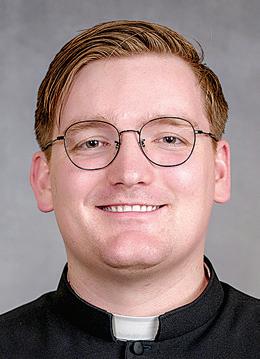
Loftin, 26, along with four other members of his 2018 graduating class at Christ the King in Huntersville, opted to attend St. Joseph Seminary on the path to the priesthood – a pivot he said surprised some classmates and family members.
“I didn’t really think I was going to be a priest until I was 16,” Loftin said.
That call came during his junior year while visiting the Missionaries of the Poor brothers in Monroe on a school retreat. During Eucharistic Adoration he heard a statement that later became his life mission.
“The brother that changed my life forever said, ‘Stop asking God what you want from Him, and start asking Him what He wants from you,’” Loftin remembered. “It was in that moment that I could feel so clearly that God wanted me to be a priest. That is what He made me for.”
At the time, recruiters were chasing him to play college football, yet the urge to discern a priestly vocation became a gamechanger. Quo Vadis Days, a diocesan-wide vocation discernment camp for young men, sealed the deal – the priesthood was the team he wanted to join.
“That is where I met Father [John] Putnam, and once I got connected with him, it became very clear that God was calling me,” Loftin said. “He gave me a lot of support and guidance, and from there it was history.”
As he learned more in the seminary about what being a priest entails, he felt increasingly confident that God made him for that purpose.
Though he traded in his football jersey for a cassock in
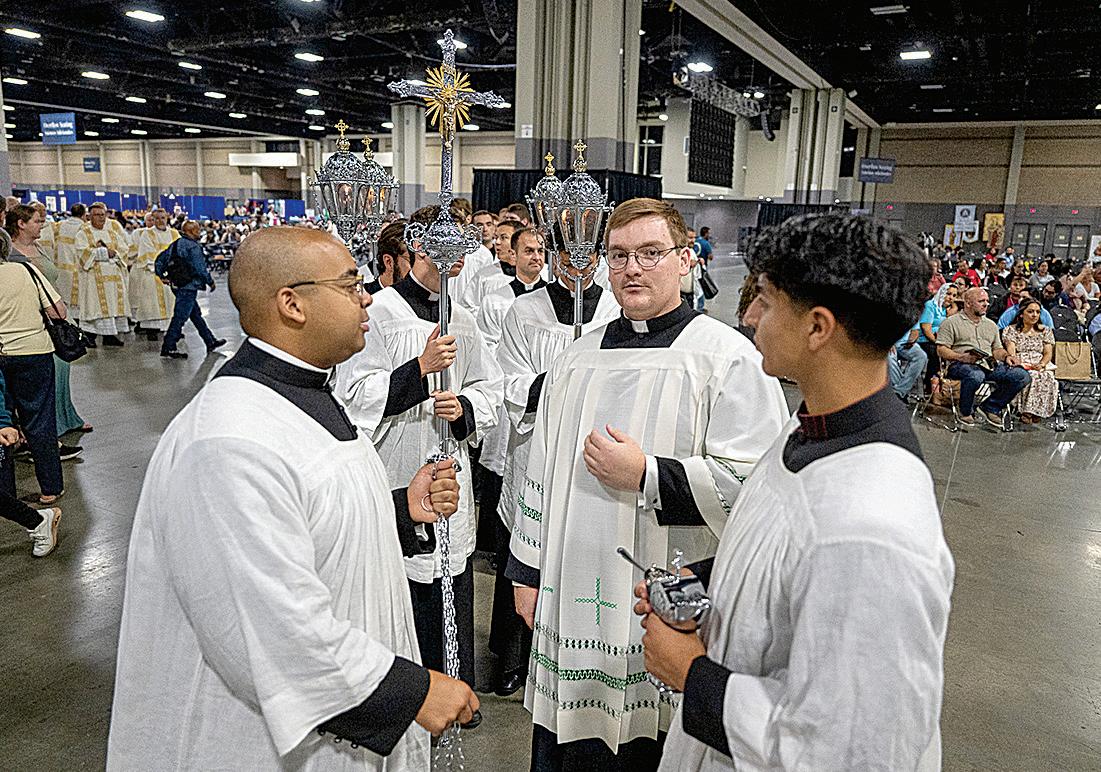
Seminarian
2018, Loftin hopes to keep coaching and teaching as both a deacon and, eventually, as a priest.
“Helping coaches watch football film and prepare the teams on what they need to do in their positions is still very much a passion of mine,” Loftin said. “Being a product of the Catholic school system and going through MACS my entire life has made a real impact on me. I love to help and see young people grow in their studies and grow closer to Christ. Catholic schools are a real launching point for our young people.”
While his entire family is thrilled, Loftin is most excited for his two Catholic grandmothers to attend his ordination – Mary Gallagher, a member of St. Leo the Great in Winston-Salem, and Fran Loftin, a parishioner at St. Therese in Mooresville.
“Having both of them there for my ordination is going to provide a lot of peace and consolation for me,” he said. “It is the first time in my life that the Church will confirm the vocation that I have felt. To lie down on the floor of my own home parish and to say, ‘Everything I have is for you; nothing I have is for me.’ I promise to serve you and your people until the day I die …’ is so exciting. It gets me more amped up than a football game ever did, that’s for sure.”
From: Huntersville
Age: 26
Home parish: St. Mark, Huntersville
School: St. Mark Elementary, Christ the King High School, St. Joseph College Seminary
Status: Started Mount St. Mary’s Seminary, Cincinnati, August 2022
Hobbies: Golf, fishing, cooking, coaching football and tutoring
Favorite saints: Mary, St. Joseph the Carpenter and St. Philip Neri
Inspired by: Father John Putnam and Father Paul McNulty
Why did you pick Deacon Bryan Ilagor, who will become a priest on May 30, to be the person to vest you?
He is a friend I can count on 100% and a very great example of service. I met him at St. Joseph’s our first year. Our rooms were right next to each other, so he always came over and hung out. It was like having another roommate. He would always lie on the floor, and we would just talk.
What are you looking forward to about your summer assignment at St. Eugene Parish in Asheville?
As a deacon, I am able to take the ministry of the Church into all these different places. So, when I think of being assigned to St. Eugene in Asheville, I am thinking of going into Asheville, the heart of the mountains, and proclaiming the Word of God there in every type of situation I come into.
More online
At www.catholicnewsherald.com : Read more about the four deacon candidates
LISA M. GERACI lmgeraci@rcdoc.org
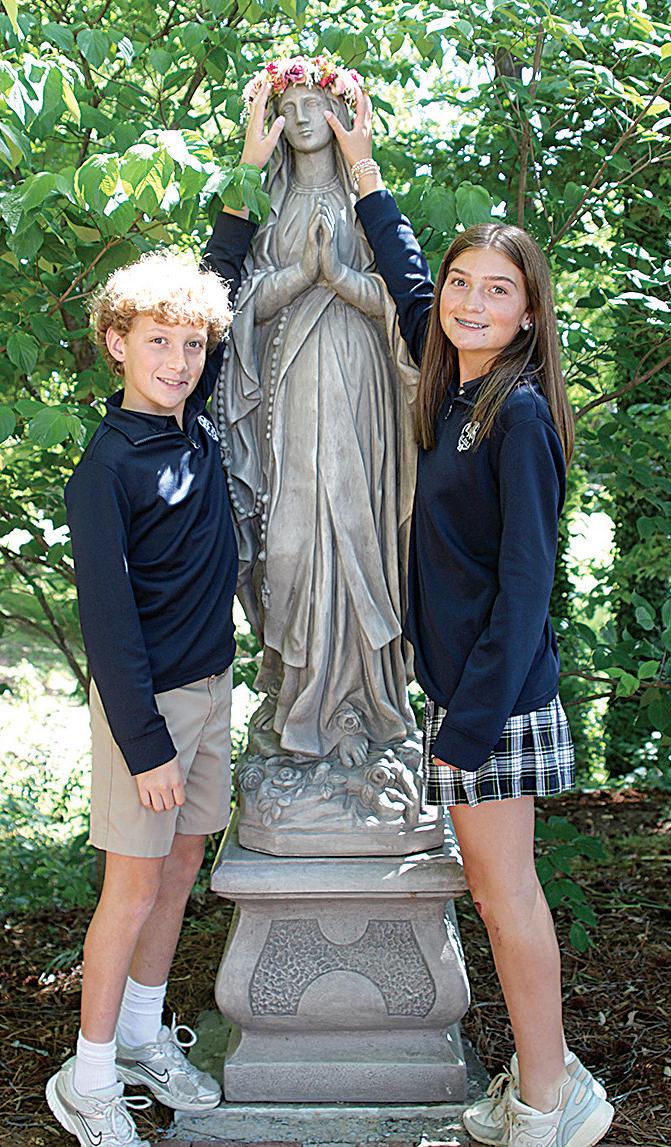
GREENSBORO — Father Christian Cook, pastor of St. Pius X Parish in Greensboro, sprinkled holy water over the new Marian prayer garden and Our Lady of Lourdes statue for its dedication May 12.
The year-long project came together just in time for the May crowning during which students placed flowers at the feet of their heavenly mother, which followed First Holy Communion and Confirmation on May 8.
“We are just so grateful,” said St. Pius X School’s Principal Antonette Aguilera. “We had a lot of really great people come out and advise us. And so many donors support us.”
The new prayer and reflection space borders the school and the church and overlooks the playground. The design originated from a watercolor rendering painted by local artist Chip Holton.
“He is a community member who loves this school,” Aguilera said. “We were sold on it, and excited to move forward with his design.”
The painting has come to life in a cross-shaped brick pathway set inside a circle, with four patches of synthetic turf dividing the landscape into four equal sections – resembling a Host.
Eight white curved benches line the circle. The main focus is an 8-foot statue of Our Lady of Lourdes.
“We scoured the country to find a Lourdes statue,” Aguilera said. “Our Lady of Lourdes is special to us because
(former pastor, the late) Monsignor Anthony Marcaccio was a Knight of Malta, and we have such a strong Malta presence here. She seemed fitting for us as a school to carry on his memory.”
Leading up to the Marian garden is a
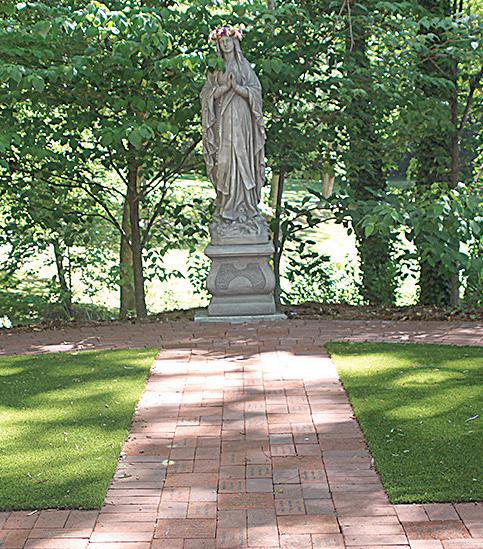
line of “Hidden Rose” apple trees.
“This all began prior to our 2025 gala. We had a Marian garden already, but it needed some refreshing,” Aguilera explained. “It was not very accessible. We wanted to create a shared space for the parish and the school to pray and
gather and honor our Blessed Mother.”
The new garden was erected beside the older one, memorializing the legacy of those who founded it.
The steps leading down to the space were made by an Eagle Scout and were installed before Monsignor Marcaccio’s death.
“Monsignor bought the smaller Mary over here, and this cross behind her is the original lintel that was above the original convent founded by the nuns,” Aguilera said.
The project cost approximately $20,000, which was funded by a recent gala and donations for engraved memorial bricks and benches.
Aguilera said donors dedicated bricks to create a special place where they could pray for loved ones whose graves are too far away to visit regularly or to commemorate events such as a graduation, wedding or anniversary.
Parishioner Mary Thacker sponsored five bricks, one for each of her grandchildren, all of whom attended St. Pius X School.
“This is beautiful and is in such a perfect spot. It is such a wonderful place to meditate and pray,” Thacker said.
Monsignor Marcaccio already has a brick, as do the Sisters of the Holy Names of Jesus and Mary, and whenever a teacher retires, a brick will bear their name.
“It is almost like a historical timeline for us, and eventually it will be,” Aguilera said. “People that are part of our history can now stay solidly here.”
Catholic Charities Diocese of Charlotte invites the public to attend its annual Spirit of Hope and Vineyard of Hope fundraisers, supporting Catholic Charities’ work serving neighbors in need across two regions of our diocese.
These evenings are critical sources of support for Catholic Charities’ work in western North Carolina. During each event, attendees will hear inspiring stories of lives changed and be invited to give a financial gift to help neighbors facing hunger, hardship and moments of crisis. Proceeds go directly to strengthening families, building communities and
reducing poverty.
The Asheville region’s Spirit of Hope fundraiser will begin at 5:30 p.m. on Thursday, May 21, at Highland Brewing Company, 12 Old Charlotte Highway. in Asheville. Funds raised will benefit local programs in the 13 westernmost counties of North Carolina.
Charlotte’s Vineyard of Hope will be held at 5:30 p.m. on Friday, May 29, at The Revelry North End, 701 Keswick Ave. in Charlotte. Proceeds raised will benefit Catholic Charities’ programs in the Charlotte region.
Both events are free to attend, but registration is required and space is limited.
To register or make a gift, visit www. ccdoc.org/VOH for Vineyard of Hope or www.ccdoc.org/SOH for Spirit of Hope. — Catholic News Herald
BELMONT — Belmont Abbey College’s Schola program is open for registration.
This week-long summer program offers an opportunity for high school students to read classic works of literature and philosophy, take part in discussions with faculty from Belmont Abbey’s Honors College, experience Charlotte’s culture and recreation and meet new people.
Schola is designed to help participants nurture their faith by participating in daily Mass, Adoration and prayer with the
Benedictine monks from Belmont Abbey. The theme for the July 5-11 program is “Love and Friendship.” It is open to in-state and out-of-state students who will have completed one year of high school by this summer.
The cost for the week-long session is $750, which includes room and board on campus and cultural and recreational activities. Learn more and register at https://bit. ly/3QRBZhL
— Catholic News Herald
LISA M. GERACI
lmgeraci@rcdoc.org
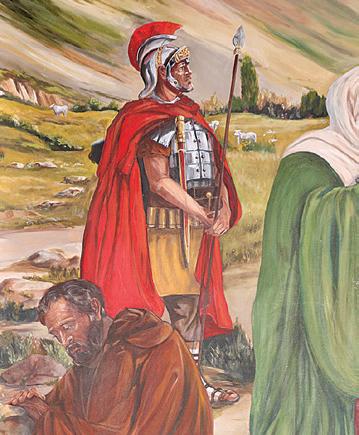
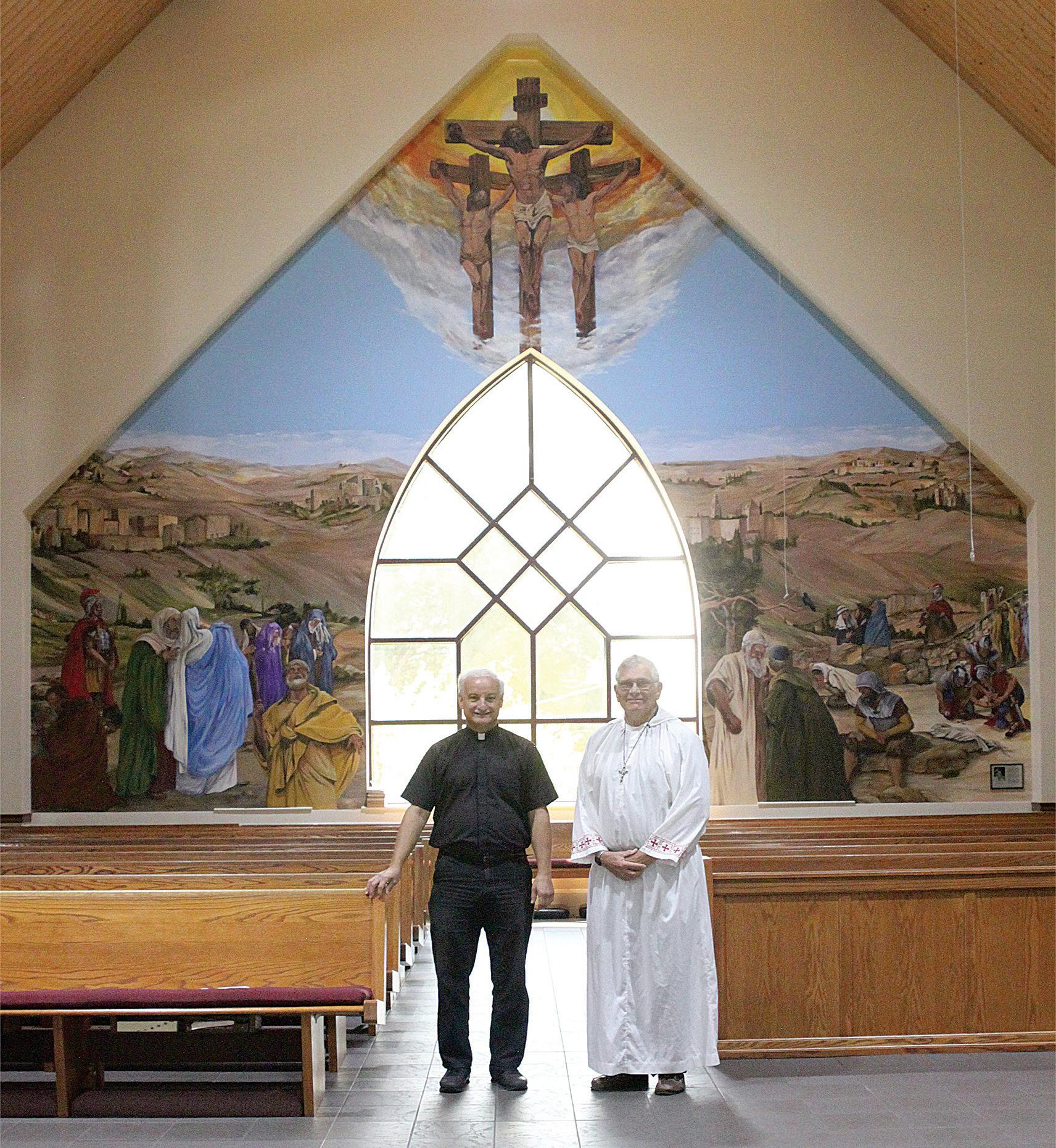
— Good Friday was two months ago, but for members of St. Aloysius Parish, that day will live on through the installation of a mural painted by local Catholic artist Lisa Autry.
The mural captures a powerful portrayal of the Crucifixion that has brought parishioners to their knees in prayer and quiet reflection.
“I think it is amazing. I love what it is adding to our church, the atmosphere of it,” said Carrie Socha, who has been a parishioner for three years.
The work took about nine months to complete. What started as an 8” x 11” computer sketch was unveiled as a 34’ x 21’ life-size piece covering much of the left wall of the church.
Autry, who finished the last paint strokes during the Easter season, got emotional at the sight of her work.
“I was painting the blood and bruising right during Easter time,” Autry said. “I have never painted the Crucifixion, so it was very touching. I just tried to show all the emotions of everyone that would have been there on the darkest day of human history.”
That emotion emanates from the expressions of the twodimensional biblical characters on the walls into the hearts of parishioners in the pews.
“While I am praying, it makes me feel like I am part of that moment,” Socha said.
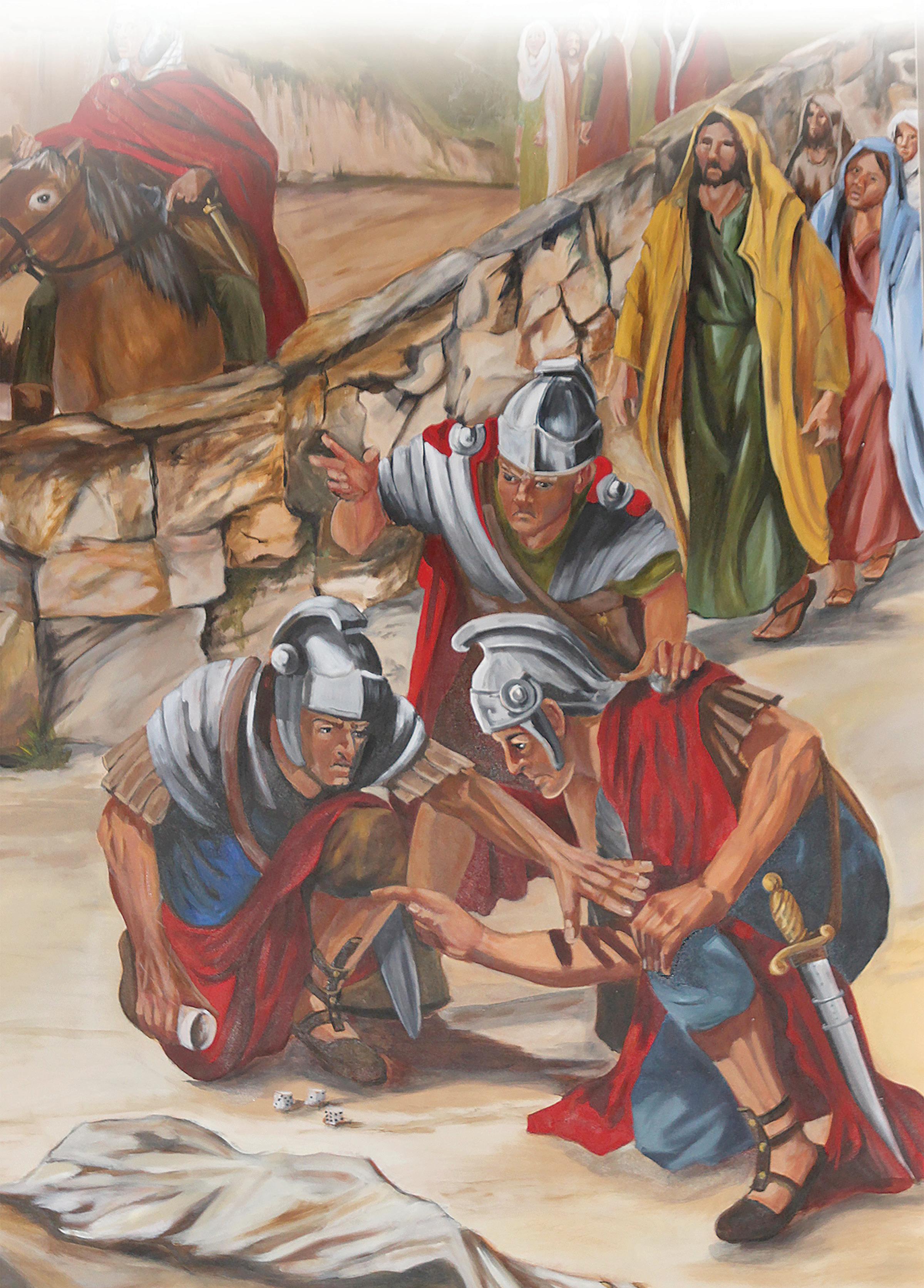
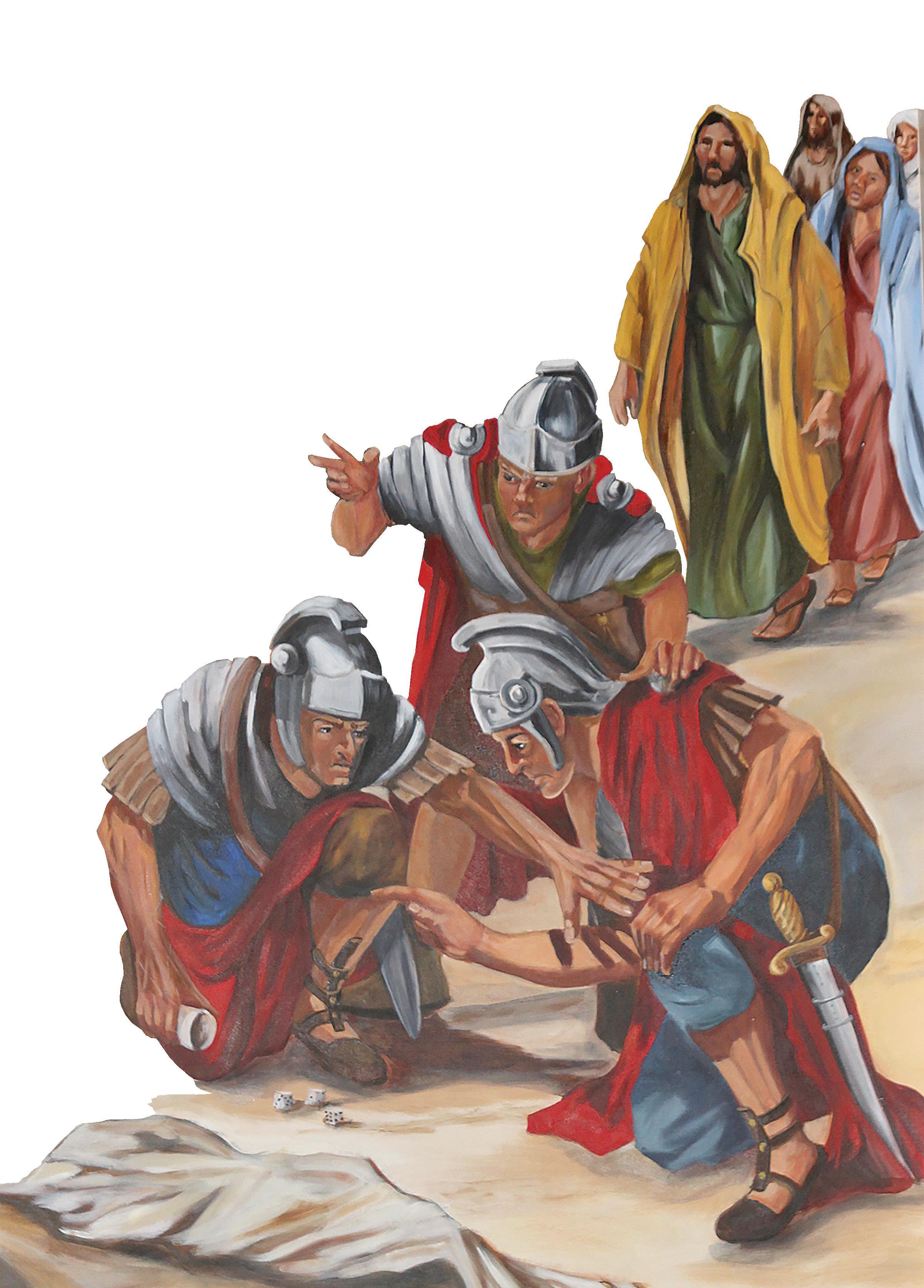
The mural depicts guards rolling dice for Jesus’ tunic while another soldier sits alone with the realization that he helped kill the true “King of the Jews.” Joseph of Arimathea waits in
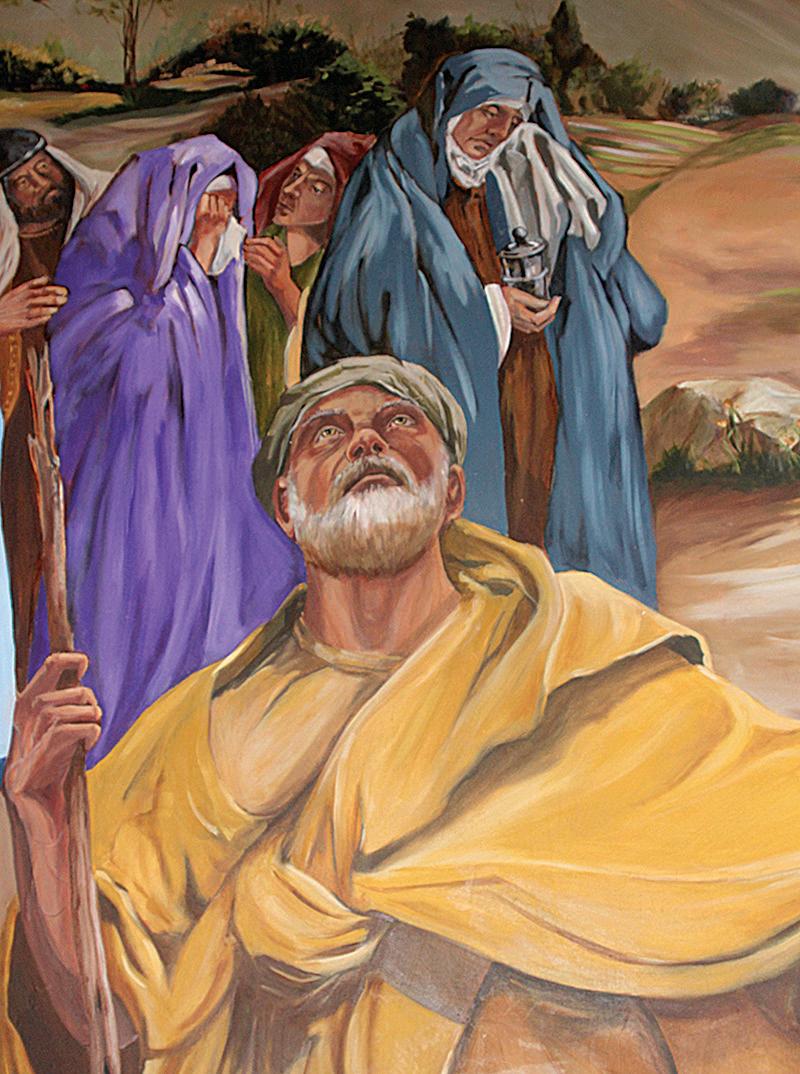
dice. They seem totally oblivious,” shared Father Larry LoMonaco, pastor of St. Aloysius. “I mean, the greatest thing in history happens, and they are sitting there rolling dice. Lisa really figured out how to bring this to life.“
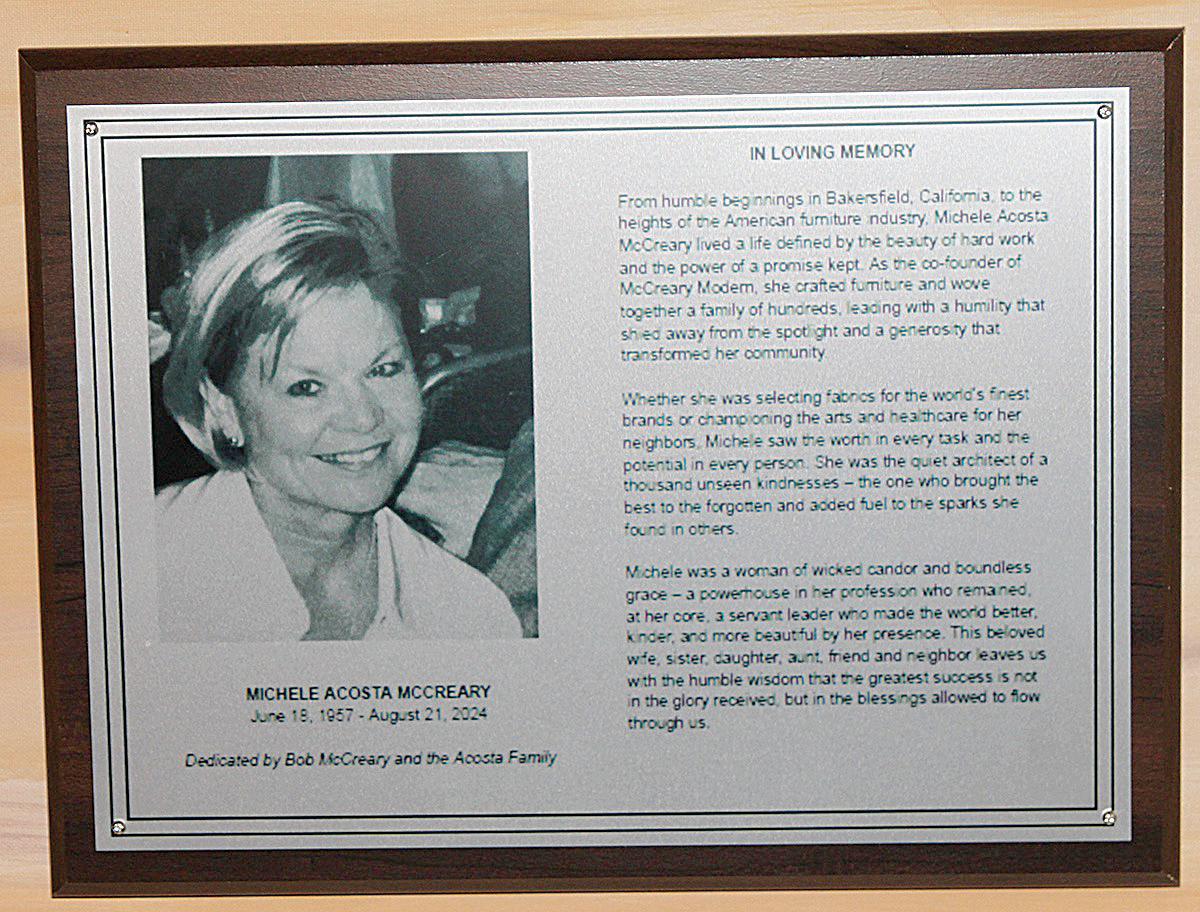
The artwork was dedicated to the late Michele McCreary, co-founder of McCreary Modern Inc., a furniture manufacturer with more than 800 employees at six plants throughout North Carolina. Even though they are not Catholic, her husband, one of the artwork’s two benefactors, arranged her funeral at St. Aloysius Church in 2024 and wanted a way to honor her there. A plaque highlighting her life sits at one corner of the work.
Planning for and creating the mural took about a year.
“It has been my experience that if you truly pray and take yourself out of the equation, and let it happen, God will work it out,” Father LoMonaco said. “Because we are on God’s time, He is not on our time.”
Though the mural is complete, Father LoMonaco has already hired Autry to design another on the adjacent wall to depict Christ’s birth in Bethlehem, complete with the Magi and a manger.
“I just pray a lot and ask the Lord what He wants to be done. And I thought the idea would be nice,” Father LoMonaco said. “But, I give Lisa artistic license. Just like you don’t want to tell a priest what to preach, you don’t want to tell an artist what to paint.”
despair to procure the body of Christ while Mary Magdalene and Jesus’ mother Mary weep. Jesus and the two thieves hang on three crosses in the distance, while the world around them reacts, some in mourning and changed forever by the death of Christ, others indifferent.
“It tells a story. I like the part where the guys are rolling the
After Father LoMonaco tackled a long string of parish maintenance projects, the time felt right to finally focus on the beautification of the church.
“I got all the important stuff done. The elevator, the heating system and the AC, and now it is nice to have some art,” Father LoMonaco said.
the groundwork for a new parish community.
A new parish will allow for more pastoral care while strengthening a sense of community closer to home, Father Cahill said.
The Waxhaw campus hosts three weekend Masses that draw a total of about 1,600 people, large faith formation classes for children and adults, weekly confessions and Eucharistic Adoration, as well as social activities such as coffee and donuts after Sunday Mass.
St. Stephen Maronite Community also uses the facility for its liturgies.
For Father Cahill, the historic moment comes full circle. In 2008, he celebrated the first Mass for Waxhaw-area Catholics at Weddington High School. The community eventually moved to using St. Margaret of Scotland Episcopal Church in Waxhaw before the current facility was built.
“The people there have been asking for a church there since my first days at St. Matthew,” Father Cahill said. “It’s beyond exciting to see the growth and progress that has been made.”
“Now we get to birth a new parish from St. Matthew. How many parishes get to be a part of something that special? Especially during our parish’s 40th anniversary year, seeing something like this unfold is a sign of God’s love and abundance.”
people who are there (at the parish) and all the people who want to come there.”
FROM CONVERT TO PRIEST
Baptized Episcopalian and raised Lutheran, he converted to Catholicism while in college, studying philosophy and seeking answers to life’s questions.
St. Ignatius of Antioch’s Letter to the Romans, written in 107 on his way to Rome to be fed to lions in the Colosseum, deeply influenced him. In it, Ignatius wrote: “Let me be food for the wild beasts … I am God’s wheat and shall be ground by their teeth so that I may become Christ’s pure bread.”
This “very early witness to the whole of the Catholic faith,” he recalled, inspired him to consider Catholicism.
He listed all the reasons he was Lutheran, he said, then “crossed them off. And one day I just drove – I found the Catholic church in Statesville where I was living (at the time) and knocked on the door of the rectory, and Father Peter Fitzgibbons opened the door.”
Their conversations began his journey into the Church and eventually to the seminary for the Charlotte diocese.
He was ordained in 2009 and served at parishes in Greensboro and Salisbury before becoming pastor in Monroe.
During his 14-year pastorship, the largely Hispanic parish has grown to 2,000 families, expanded its faith formation programs, and developed a popular annual “Eucharistic Triduum” that attracts more than 1,000 people each June. The campus has also undergone major improvements
– including an interior renovation, Marian grotto and new parish office to replace what was destroyed in the 2020 fire.
Father Roberts also serves as the diocese’s ecumenical officer and vicar forane of the Albemarle Vicariate. He chairs the Presbyteral Council and serves on the College of Consultors, advisory groups for the bishop.
Over the years, he has earned several advanced degrees in preaching, theology and leadership, taught at seminaries across the country, and presented nationally on preaching and pastoral ministry.
Despite his academic work and other responsibilities, the role he says he loves most is that of parish priest.
His years in ministry and his theological background have shaped his understanding of what a parish is, Father Roberts says, and what he hopes to nurture in the Waxhaw community.
He’s excited about the future, especially prospects for a new church and perhaps eventually a school on the 32-acre property along Waxhaw-Marvin Road.
“I already have a hard hat – I know how to build stuff,” he jokes, referencing the rebuilding effort in Monroe after the 2020 fire.
Yet, he emphasizes, a parish “is a people that has buildings, not buildings that have people.”
A parish gathers to worship God and then goes out to share His love with others, he said.
As the Waxhaw Catholic community begins this historic new chapter, Roberts says he looks forward to walking alongside its people in faith.
A parish is also a pilgrim community, he said, and “a pilgrim community only moves as fast as we can carry each other.”
FROM PAGE 4
Cantor and organist Bradley Stiver has worked with Father Roberts since 2019 and said his ability to collaborate and build relationships is top-notch.
“He’s a pretty incredible boss, very, very kind and caring for staff – and he creates an environment where staff members’ ideas are heard,” Stiver said. “He’s a very kind human being who gets crazy ideas in the very best way. He’s an incredible preacher who leads from the pulpit, and he values being a pastor and being a shepherd, so I think he’ll be a remarkable leader in Waxhaw.”
Parishioner Lizeth Ildefonso has known Father Roberts for much of her life. He gave her First Communion and confirmed her, and as she’s entered adulthood, she values the relationships he builds with parishioners.
“He has been so involved with the parish – he is one of the best priests I’ve ever met,” Ildefonso said.
“He has always led with faith and always called and invited anyone to come to the church. He is someone you can talk with easily, and he has also helped connect people in the parish,” she said.
Ildefonso, a data analyst, said Father Roberts has introduced her to other parishioners in her field.
“He has done so much community outreach in our parish, and he has helped families and young adults both in growing and learning more about their faith,” she said. “I think him being open to communicating and to being welcoming is going to be very helpful in starting a new parish.”



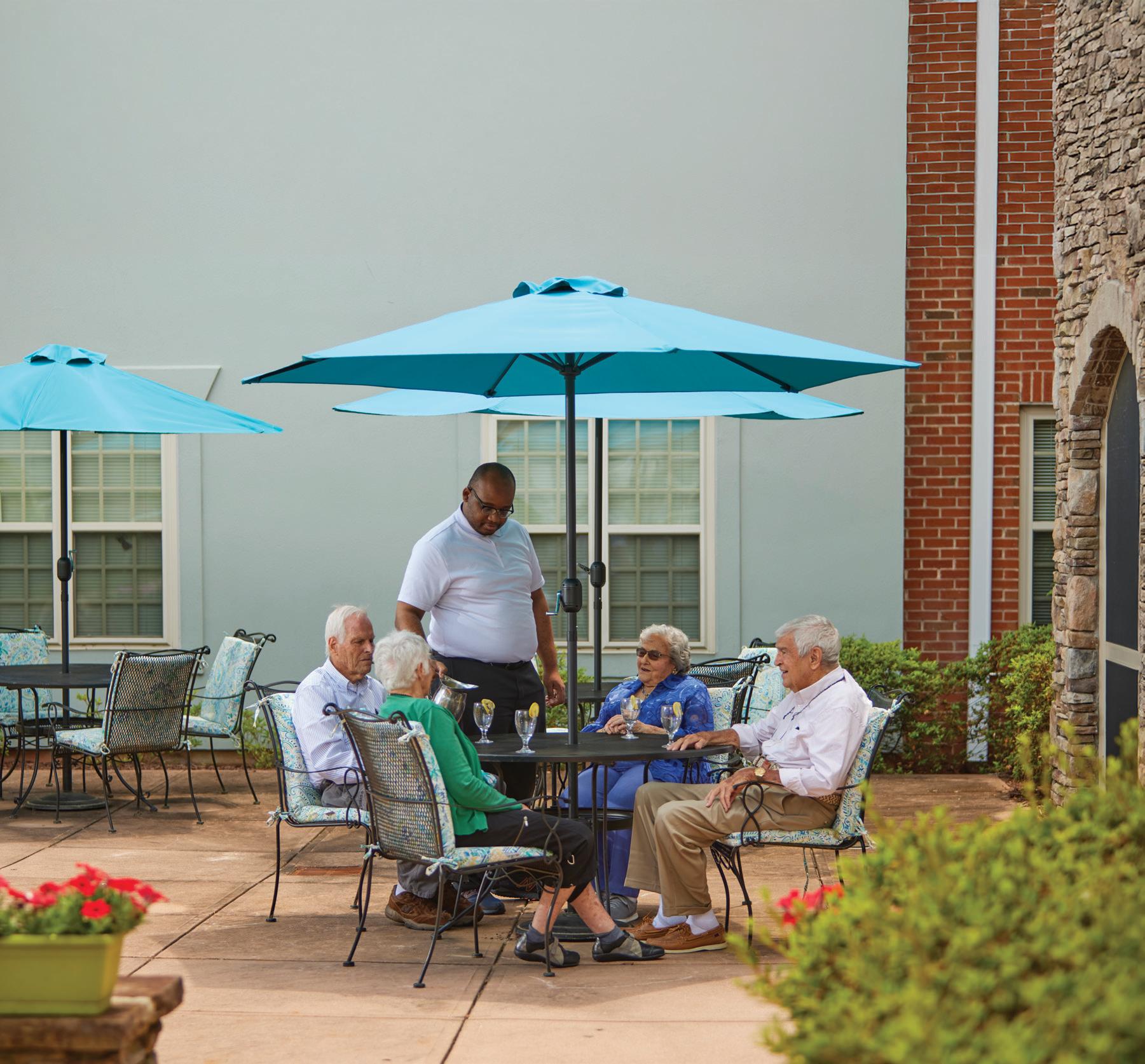
At Pennybyrn’s Melvin and Ruth Witcher Adult Day Center, every detail is designed to enrich the lives of older adults while o ering support and respite for their caregivers. Our safe, welcoming and vibrant environment o ers more than just care— it inspires joy, sparks learning and builds meaningful social connections. A thoughtfully planned variety of daily activities promotes better overall health, greater emotional well-being and a higher quality of life.

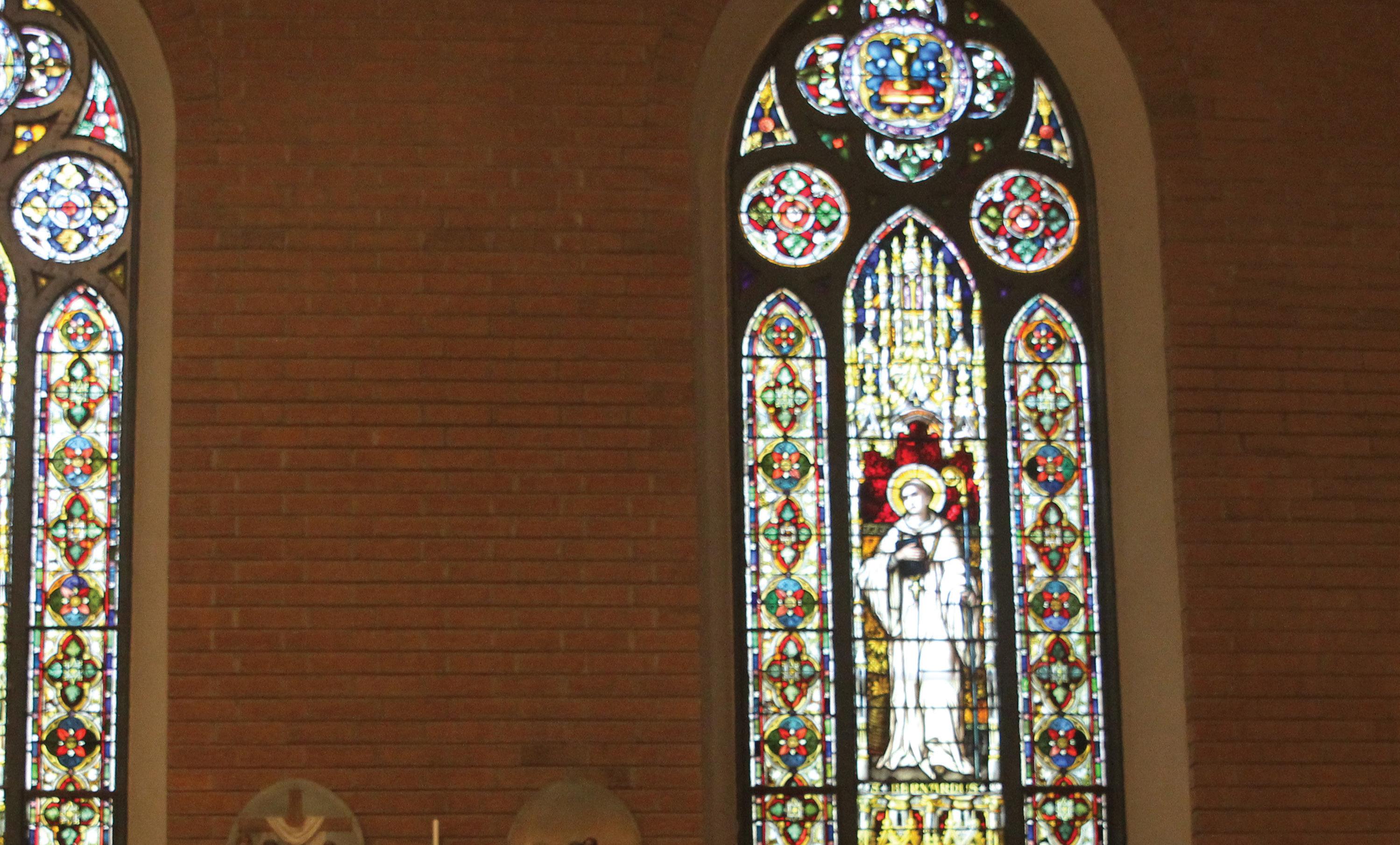
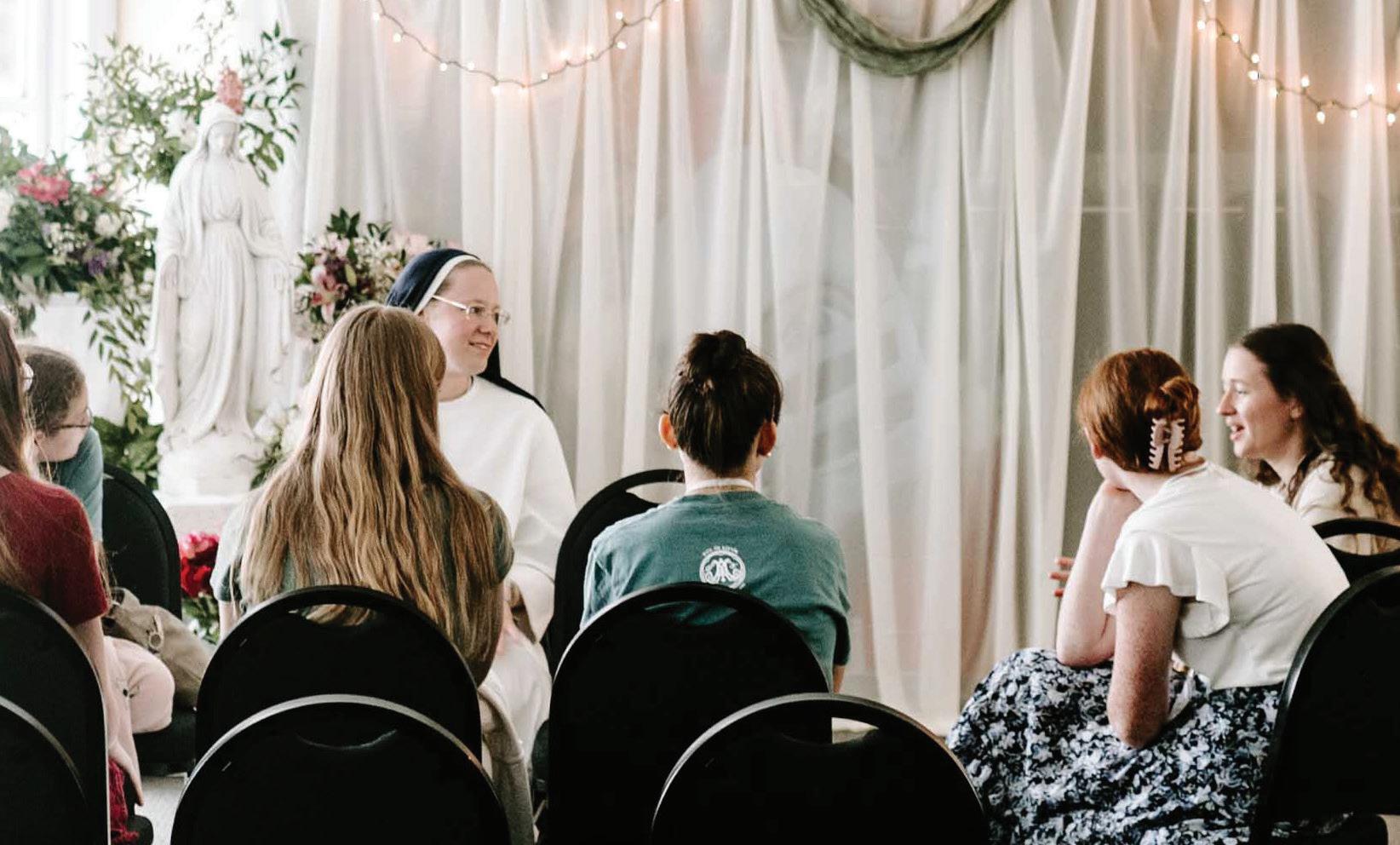
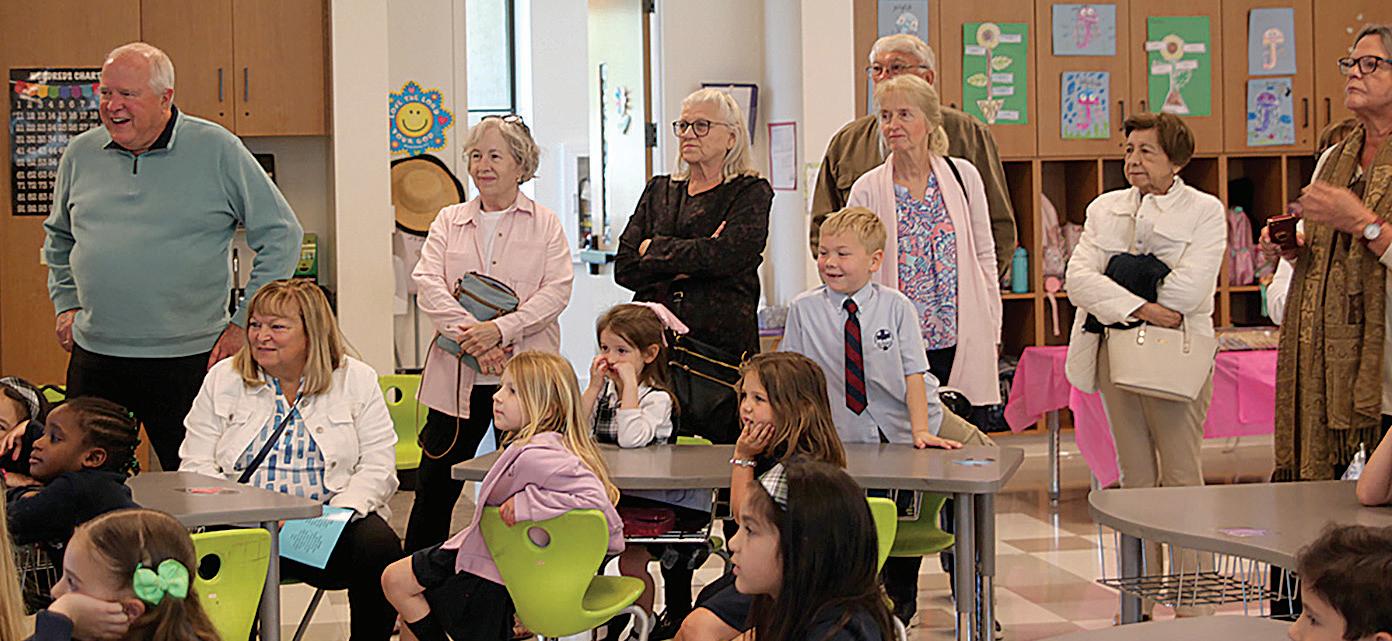
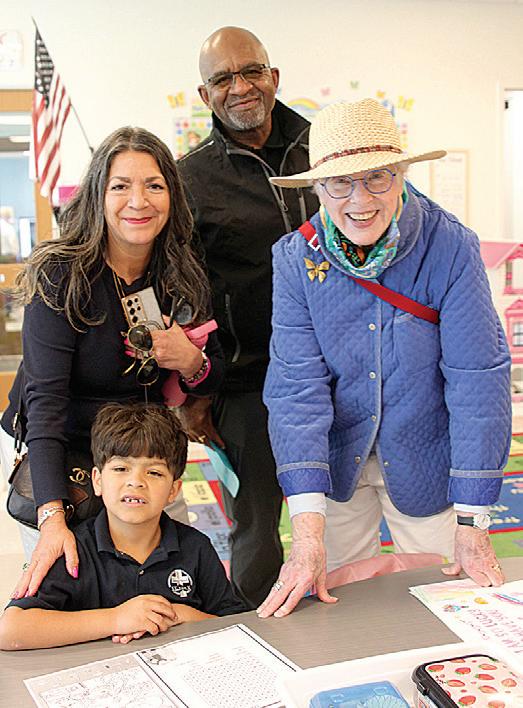
GREENSBORO — Grandparents filled St. Pius X Church for a morning of laughter, hugs and fun during this year’s Grandparents’ Day celebration. With grandchildren by their sides, they prayed a living rosary. Fifty seventh- and eighth-grade St. Pius X students represented each bead and led the prayers, offering their individual prayer intentions – most using the occasion to pray for their grandparents present at the church.
Afterward, grandparents followed students down hallways that were covered with appreciation notes and drawings addressed to them. Grandparents then visited classrooms and watched their little ones sing and dance or sat together while they colored or played games.
A tribute in blue and white
HUNTERSVILLE — After nine years of administrative guidance, Christ the King students and staff bid farewell to beloved president Dr. Carl Semmler.
He won’t be far as he transitions into his new role as executive director of Catholic Identity, Operations and Capital Improvements for the Diocese of Charlotte’s Catholic Schools Office.
His fan club of 435 students and 60 staff gobbled down donuts decorated in Crusader colors – white frosting and blue sprinkles – with students repeating the pun, “‘Donut’ know what we’re going to do without you.”
Greg Stump, art teacher and stained-glass artist, designed a memento for Semmler, a commemorative plaque made from Polish blue glass.
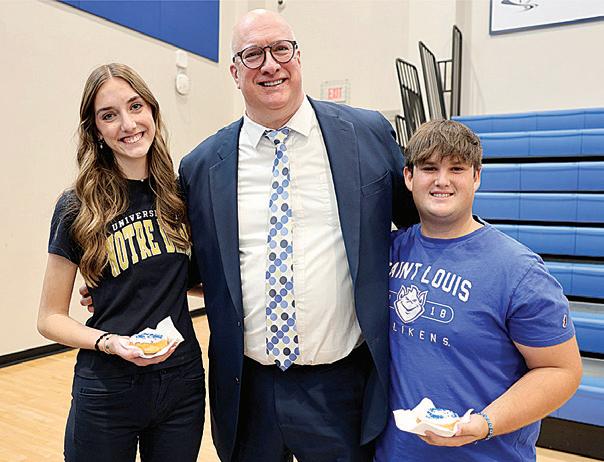
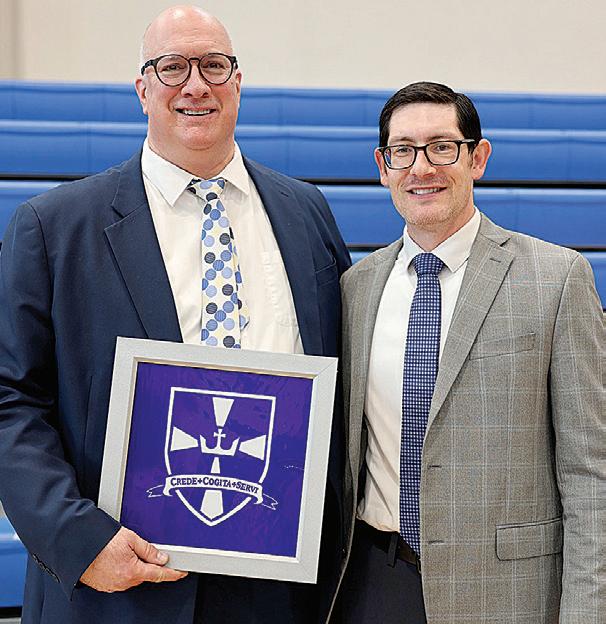
“This is the same glass used to make the St. John Paul II glass window in the chapel, something Dr. Semmler has admired for years,” Stump said.
Embedded in the glass is the white CTK crest with its mantra, “Crede + Cogita + Servi,” Latin for “Believe, Think, Serve.”
Although he is leaving the school, Semmler ended the event by reassuring all: “once a Crusader, always a Crusader.”
— Lisa M. Geraci
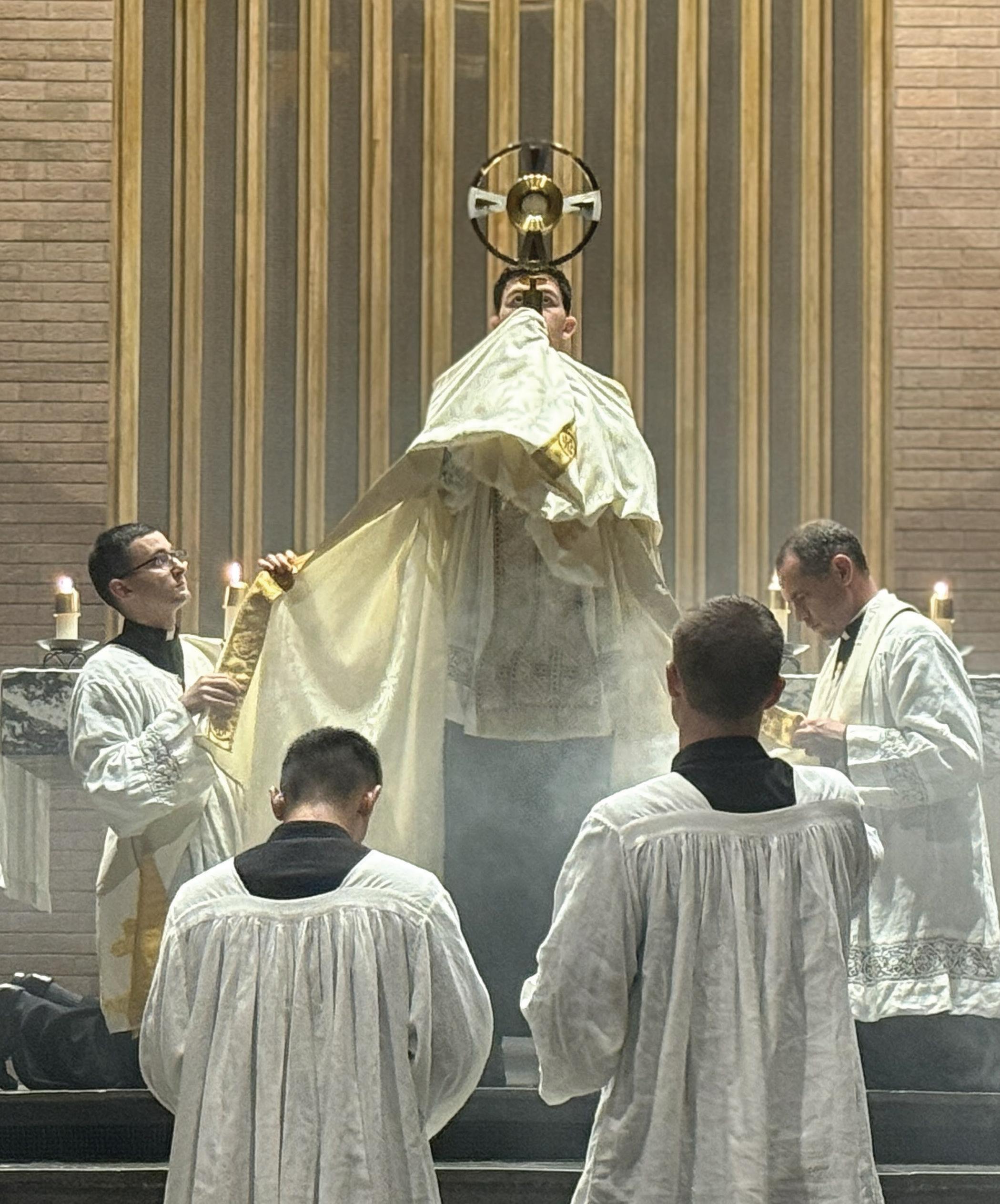

catholicnewsherald.com | May 15, 2026
BRIAN SEGOVIA bmsegovia@rcdoc.org
CHARLOTTE — Tras ser nombrado nuevo director de la Oficina del Ministerio Hispano de la Diócesis de Charlotte en abril, Steven Samol compartió el camino de fe y pertenencia que ha marcado su vida y su vocación. Como el primer director laico en la historia de la diócesis, Samol coordinará todas las áreas del ministerio hispano, trabajando junto a párrocos y líderes parroquiales. Además, apoyará las necesidades pastorales, promoverá una participación más plena en la vida parroquial y supervisará la implementación del Plan Pastoral Nacional para el Ministerio Hispano. Hijo de inmigrantes y formado a través de experiencias de dolor, conversión y misión, Samol habla sobre cómo un encuentro personal con Dios transformó su historia y lo llevó a servir a la Iglesia con pasión, especialmente acompañando a la comunidad hispana en Estados Unidos.
CNH: ¿Podrías contarnos un poco sobre tu historia personal y lo que te ha formado hasta este punto de tu vida?
Samol: Soy hijo de inmigrantes y, durante mucho tiempo, viví con la sensación de que no pertenecía, de que no era ni de aquí ni de allá. Para empeorar esa experiencia, mis padres se divorciaron, y tampoco sabía si pertenecía a una familia o a la otra. Odiaba que me preguntaran: “¿de dónde eres?”, porque me hacía consciente de mis dudas y de esa vergüenza de sentirme fuera de lugar.
¡Pero Dios tenía un plan! Tuve un encuentro personal muy fuerte con Él. A los 14 años, en un retiro al que fui prácticamente obligado por mi mamá, el tercer día, durante una oración de efusión del Espíritu Santo, el Señor me regaló una paz profunda. Esa paz cambió mi corazón y me dio una certeza nueva: yo pertenezco a Dios, soy su hijo y soy parte de su Iglesia. Desde entonces, mi camino ha sido responder a ese amor, dejándome formar por Él y siguiéndolo donde me ha llamado, en distintos países y realidades, siempre como discípulo misionero.
CNH: ¿Cómo comenzó tu camino de fe y cómo ha evolucionado a lo largo de los años?
Samol: Mi camino de fe comenzó de pequeño, viviendo con mi abuela, quien me enseñó a orar y a leer la Biblia. Sin embargo, mi verdadera conversión ocurrió a los 14 años, en ese retiro. Desde entonces, he ido creciendo en mi relación con el Señor,
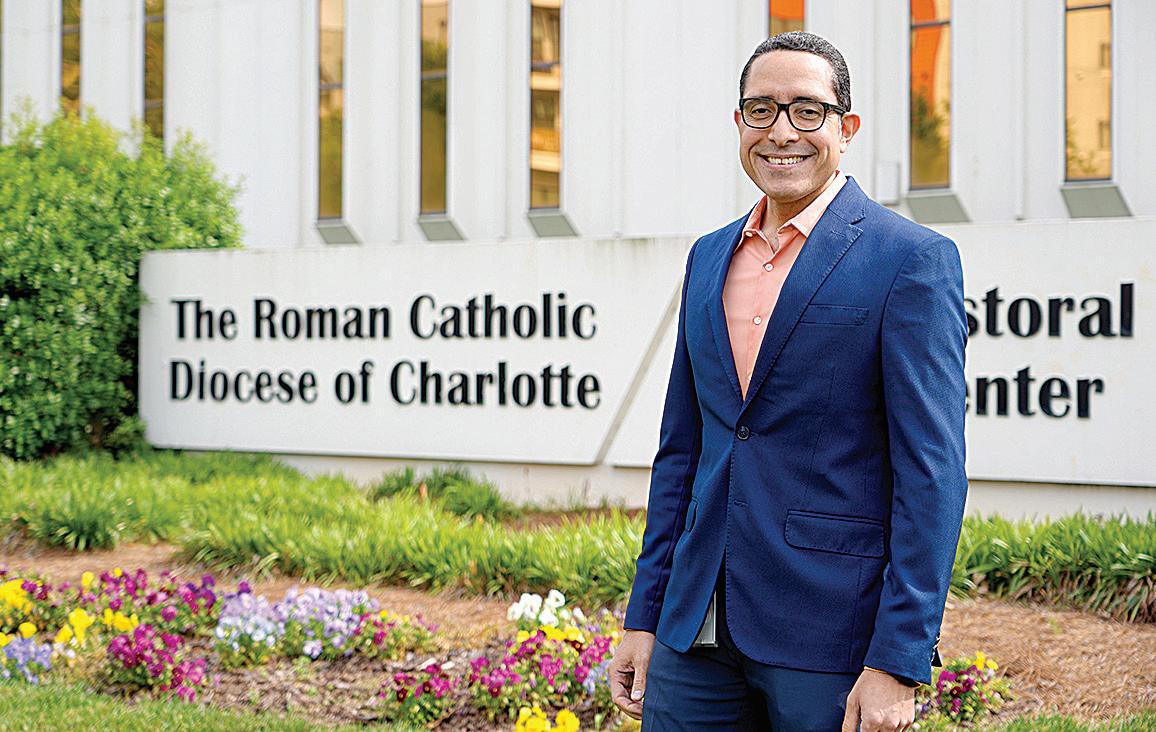
descubriendo cada vez más mi identidad como hijo amado de Dios. Mi fe ha madurado en el deseo de seguir a Cristo, imitarlo y permitir que Él me transforme para pertenecer totalmente a Él. Hoy puedo decir con convicción: Dios es mi Padre. CNH: ¿Cuándo empezaste a sentir que Dios te estaba llamando al ministerio o al servicio en la Iglesia de una manera más específica?
Samol: Desde muy temprano en mi conversión comencé a servir. Recuerdo que, con solo 15 años, me invitaron a dar un tema en un retiro de adultos. ¡Me encantó la experiencia de servir!
El encuentro con Dios no solo transformó mi vida, sino que despertó en mí el deseo de que otros también pudieran vivirlo. Con el tiempo entendí que mi llamado era a ser discípulo misionero: no solo creer, sino anunciar con mi vida y con mis palabras lo que Dios ha hecho en mí. A lo largo de los años, ese llamado se ha ido concretando en distintas oportunidades de servicio, siempre con la certeza de que es el Señor quien guía el camino.
CNH: Mirando hacia atrás, ¿cómo ves el camino que te llevó a este nuevo rol en la Diócesis de Charlotte?
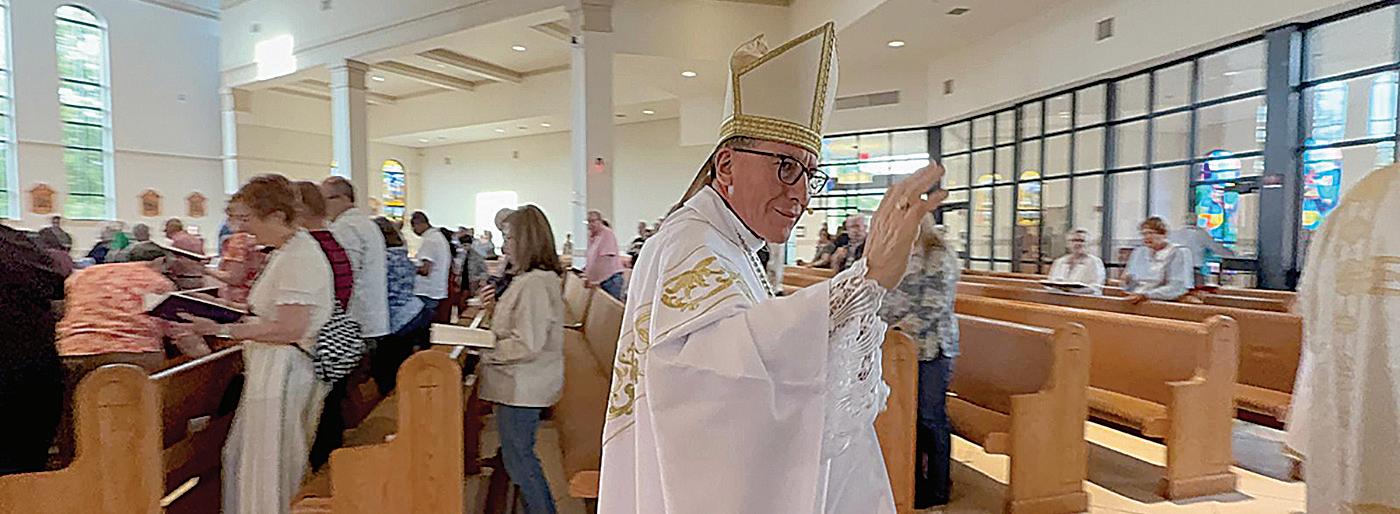
Considere unirse a los más de 2 millones de miembros de la organización fraternal católica más grande del mundo y registrándose en línea hoy en: www.kofc.org/joinus/es
Por tiempo limitado - Membresía en línea GRATISUse el código de promoción (BLESSEDMCGIVNEY)
Hoy veo mi llegada a la Diócesis de Charlotte como parte del plan de Dios: una invitación del Padre a seguir sirviendo con pasion y disponibilidad.
CNH: ¿Cómo entiendes este nuevo rol en la Diócesis de Charlotte y cómo te gustaría liderar el ministerio hispano en esta etapa?
Samol: Entiendo este rol como una llamada de Dios a servir, ayudando a que más personas puedan experimentar que la Iglesia es su hogar, la familia de Dios.
Resuena mucho en mi corazón la visión del Obispo Martin de una pastoral que anuncia el Evangelio y a la vez demuestra el amor de Dios haciéndolo visible en la vida de las personas.
Mi intención es acompañar, escuchar y crear espacios donde los hispanos puedan encontrarse con Cristo y descubrir que no son extranjeros ni forasteros, sino miembros de la familia de Dios: una pastoral donde el Evangelio se proclame con palabras y se demuestre con amor concreto.
CNH: ¿Qué parte de tu experiencia de fe te gustaría que la gente conociera o entendiera mejor sobre ti?
Samol: Me gustaría que las personas entendieran que mi vida está marcada por una experiencia muy concreta: pasar de sentirme alguien que no pertenecía, a descubrir que soy hijo del Padre y parte de su familia.
Dios también me ha regalado el don del matrimonio. Lo mejor que me ha pasado en mi vida de fe es casarme con mi esposa, Saylí. Ella y yo hemos vivido momentos de alegría, pero también de cruz –incluyendo la pérdida de dos hijos no nacidos, que ahora están en el cielo –, y aun así hemos experimentado que Dios es fiel y que nunca deja de sostenernos.
Si algo define mi camino, es esa certeza que nació en ese retiro: Dios es mi Padre, su familia es donde pertenezco y junto a mi esposa está mi hogar.
Y desde ahí, quiero invitar a otros: si alguna vez te has sentido fuera de lugar o sin pertenecer, en Dios Padre hay un hogar para ti. La Iglesia es la casa de Dios que también puede ser tu casa.
Also online
At www.catholicnewsherald.com : Read the English version of this interview with Steven Samol, the diocese’s new Hispanic Ministry director
Samol: Mirando atrás, veo claramente la fidelidad de Dios en cada etapa de mi vida. Él ha guiado nuestro caminar —el de mi esposa y el mío – a través de distintos países, siempre llamándonos a servir. En los últimos años sentía con fuerza el amor de Dios por los hispanos en Estados Unidos, pero nunca imaginé que eso se concretaría en esta misión.
CHARLOTTE — El martes 5 de mayo, la Diócesis de Charlotte recibió la visita de Monseñor Pedro Alberto Bustamante López, obispo de Huánuco, Perú, fundador e impulsor de los programas de DH Radio en Perú, una iniciativa que une a las comunidades de Huánuco, Charlotte y el mundo entero a través de temas de evangelización. Monseñor Pedro llegó a Carolina del Norte como invitado del padre Mark Lawlor, párroco de Santa Teresa, quien mantiene una amistad con la Diócesis de Huánuco desde hace casi 20 años, y del padre peruano Huver Navarro, originario de Huánuco, quien ha servido de vínculo entre ambas diócesis. La visita de Monseñor Pedro tiene como propósito fortalecer los lazos entre Charlotte y Huánuco, además de realizar un llamado misionero para ayudar a financiar la compra del transmisor para la frecuencia 800 AM de DH Radio en su diócesis de origen y así continuar evangelizando. El miércoles 6 de mayo, después de realizar el programa matutino de DH Radio desde Mooresville, el obispo de Huánuco, acompañado por el padre Huver Navarro, visitó la parroquia Santa Teresa en Mooresville. Allí saludó al padre Mark Lawlor, conoció a los demás trabajadores de la parroquia y bendijo a las personas que encontró durante su recorrido, así como las instalaciones de dicha parroquia. El obispo de Huánuco permanecerá en Carolina del Norte hasta el 22 de mayo. — Brian Segovia
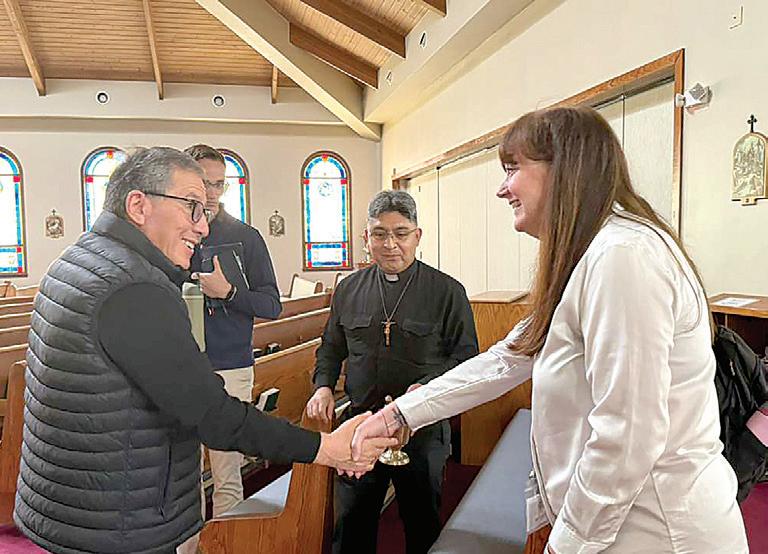
lmgeraci@rcdoc.org
— Se invita a los católicos de toda la Diócesis de Charlotte a unirse a una celebración nacional de fe e historia mientras la Peregrinación Eucarística Nacional 2026 visita el oeste de Carolina del Norte del 30 de mayo al 2 de junio.
La Peregrinación Eucarística Nacional – con el tema “Una Nación Bajo Dios” – hará paradas en cinco iglesias de la diócesis mientras recorre 1,500 millas por la Costa Este rumbo a Filadelfia para el Día de la Independencia y el 250.º aniversario de Estados Unidos.
La ruta de este año lleva el nombre de Santa Francisca Javier Cabrini, la primera santa estadounidense. La peregrinación comienza en San Agustín, Florida, y termina cerca del Independence Hall, donde se firmó la Declaración de Independencia.
“La Iglesia Católica ha sido una parte importante de la historia de nuestro país, y esta peregrinación nos brinda la oportunidad de conectarnos con la Iglesia universal, saliendo adelante en el discipulado como somos llamados a hacerlo”, dijo el diácono Jim
PEREGRINACIÓN EUCARÍSTICA NACIONAL
¡No se pierda este evento histórico!
La Peregrinación Eucarística Nacional hará paradas oficiales en la Diócesis de Charlotte en:
n EL SÁBADO 30 DE MAYO – Iglesia Nuestra Señora de Lourdes en Monroe: Adoración Eucarística de 3:30 a 4:30 p.m., seguida de la Misa a las 5 p.m.
n EL DOMINGO 31 DE MAYO – Iglesia San Pedro en Charlotte: Misa con el Obispo Michael Martin a las 9 a.m., seguida de un encuentro con los peregrinos
n EL DOMINGO 31 DE MAYO – Iglesia San Vicente de Paúl en Charlotte: Misa en español a las 2 p.m., seguida de Adoración Eucarística y procesión
n EL LUNES 1 DE JUNIO – Iglesia San Felipe Apóstol en Statesville: Misa a las 9 a.m., seguida de Adoración Eucarística
n EL LUNES 1 DE JUNIO Y EL MARTES 2 DE JUNIO –Iglesia San Pío X en Greensboro: Adoración Eucarística y procesión de 3:45 a 4:15 p.m., seguida de la Misa a las 5:15 p.m.; y Misa a las 8:30 a.m. el martes 2 de junio. (Considere traer un artículo no perecedero para la despensa de alimentos del Ministerio Urbano de Greensboro.)
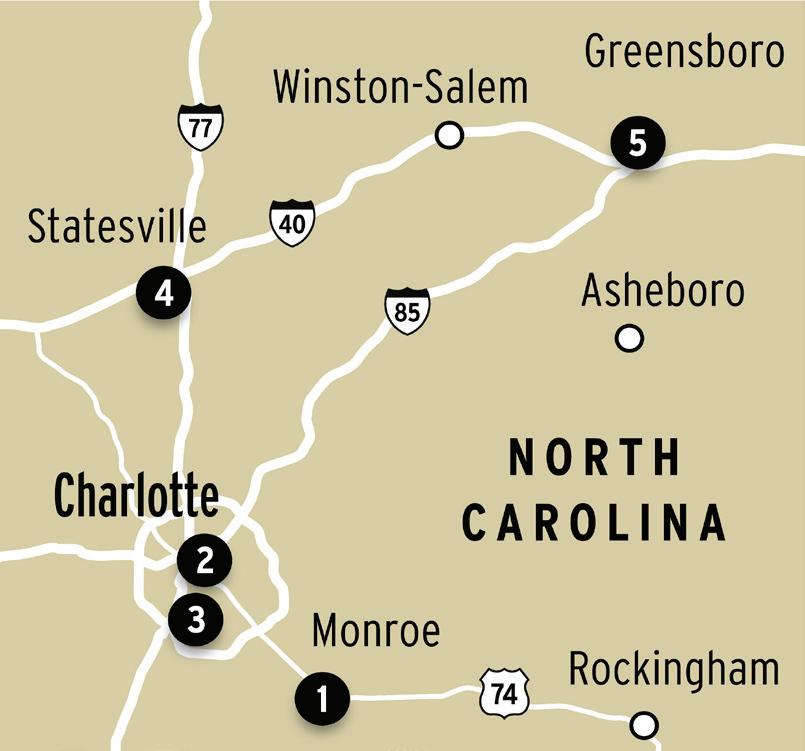
Las parroquias pueden añadir otros eventos; por favor consulte el sitio web o boletín de cada parroquia para más detalles.
Bozik de la parroquia San Pedro en Charlotte, quien está coorganizando las festividades diocesanas.
El “monstrance-mobile” – que cuenta con una ventana que permite a las personas ver el Santísimo Sacramento – y nueve jóvenes adultos “peregrinos perpetuos” entrarán a la diócesis a través de la Iglesia Nuestra Señora de Lourdes en Monroe. Allí, las personas podrán conocer a los peregrinos y unirse a ellos para una Hora Santa y la Misa. Iglesias en Charlotte, Statesville y Greensboro también recibirán la peregrinación con Horas Santas y Misas.
Para los peregrinos Mary Carmen Zakrajsek y Raymond Martinez, el viaje es tanto espiritual como personal. “Estoy emocionado de conocer todas estas comunidades católicas”, dijo Martinez. “Queremos que toda la nación experimente a Nuestro Señor a través de la Eucaristía. Llevaremos sus intenciones de oración y las colocaremos al pie de la custodia en oración. Finalmente las dejaremos en el altar con Cristo después de nuestra última procesión”.
El domingo 31 de mayo, el
obispo Michael Martin celebrará la Misa en la Iglesia San Pedro en Charlotte, la parroquia activa más antigua de la diócesis, seguida de un encuentro con los peregrinos.
La noche del domingo, las personas podrán disfrutar de una proyección de la película “Cabrini”, sobre la defensa de los inmigrantes por parte de la santa y el papel de la Iglesia en la historia estadounidense. San Mateo, la parroquia más grande de la diócesis, copatrocinará esta proyección exclusiva. Se requieren boletos por adelantado. Al igual que la Madre Cabrini, el coorganizador
diocesano diácono Herb Quintanilla es inmigrante, y él ve la peregrinación como una celebración tanto de la fe como de las oportunidades.
“Todos vienen a Estados Unidos para tener una vida mejor y más segura. Este es uno de los mejores países del mundo porque si trabajas duro y estudias, puedes salir adelante”, dijo Quintanilla, quien se mudó desde El Salvador. “Este es un país de inmigrantes, y por eso tenemos tantos católicos: los irlandeses, los italianos, los polacos y los latinoamericanos. Este país ha crecido siendo católico”.
Zakrajsek dijo que la peregrinación también refleja el camino espiritual de la propia nación.
“Así como nosotros, como peregrinos, caminamos esta ruta, nuestro país también está en peregrinación. Vamos a seguirlo por las calles. Vamos a llevarlo a los pobres. Vamos a arrodillarnos ante Él en adoración. Esta es una oportunidad para vivir el Evangelio, para unirnos como país y para pedirle que nos bendiga y nos sane, un alma a la vez”.
Más online
En www.charlottediocese.org/ national-eucharistic-pilgrimage : Obtenga detalles sobre la Peregrinación Eucarística Nacional mientras pasa por la Diócesis de Charlotte, incluyendo horarios y lugares de Misas y Horas Santas, reservaciones para la proyección de la película y más.
Lleve a la familia el domingo 31 de mayo para disfrutar de una proyección exclusiva y gratuita de la exitosa película sobre la Madre Cabrini – patrona de la Peregrinación Eucarística Nacional – en Regal Stonecrest at Piper Glen en Charlotte. El cupo es limitado y se requieren boletos reservados con anticipación (no se aceptarán personas sin reservación). Las puertas abrirán a las 6 p.m. y la película comenzará a las 7 p.m. Copatrocinado por la parroquia San Mateo. Reserve su asiento online en www.charlottediocese. org/national-eucharistic-pilgrimage
Con motivo del aniversario del atentado contra San Juan Pablo II y de la festividad de Nuestra Señora de Fátima, el Papa León XIV afirmó que la Virgen María es el “modelo perfecto” de lo que la Iglesia está llamada a ser e instó a los católicos a imitar su humildad, amorosa fe y obediencia.
Durante su audiencia general del 13 de mayo en la Plaza de San Pedro, el Papa León dedicó su catequesis a la Virgen María, reflexionando sobre su papel como “modelo”, “madre” y “miembro excelentísimo” de la Iglesia a través de la constitución dogmática “Lumen Gentium” del Concilio Vaticano II.
La fecha marcaba los 45 años desde que San Juan Pablo II fuera baleado en un atentado que lo dejó gravemente herido en la Plaza de San Pedro, durante una audiencia general en 1981. El pontífice polaco recibió dos disparos mientras atravesaba la plaza en su papamóvil descapotable. Fue trasladado de urgencia al hospital, donde se descubrió que ningún órgano vital había sido perforado. Más tarde atribuyó el que hubiera sobrevivido a la protección de la Virgen María y mantuvo una devoción de por vida a Nuestra Señora de Fátima.
El autor de los disparos, Mehmet Ali Agca, fue detenido de inmediato y más tarde recibió la visita del Papa, quien le perdonó y pidió su indulto. Tras cumplir 20 años en una prisión italiana, fue deportado a su país, Turquía, en el año 2000.
El pontífice recibió un disparo el 13 de mayo de 1981, aniversario de la primera de las apariciones de Fátima y fiesta de Nuestra Señora de Fátima. Tres niños pastoreaban ovejas el 13 de mayo de 1917 cuando tuvieron una visión de la Santísima Virgen María. Las apariciones continuaron una vez al mes hasta el 13 de octubre de 1917.
Los niños contaron que María les pidió que promovieran la devoción a su Inmaculado Corazón y que rezaran el rosario a diario para traer la paz al mundo.
El Papa León dijo que la Iglesia dirige hoy su mirada al Santuario de Nuestra Señora de Fátima, donde María transmitió un mensaje de paz.
“En ese lugar, tan querido para el cristianismo, se reúnen hoy numerosos peregrinos de los cinco continentes: su presencia es un signo de la necesidad de consuelo, unidad y esperanza de la gente de nuestro tiempo”, dijo.
El Papa León dijo que María es el modelo de lo que “la Iglesia debe ser”, porque su “sí incondicional nos muestra cómo ser miembros de la Iglesia”.
“Dejémonos inspirar por el ejemplo de humildad, fe amorosa y obediencia de María”, dijo a los angloparlantes tras su discurso.
“Respondamos generosamente con amor, engrandeciendo a Dios en nuestros corazones y recibiendo fuerza de los sacramentos”.
Calificó a María de “icono del Misterio”, afirmando que en ella se revela el plan de salvación de Dios a través de su libre aceptación de la voluntad de Dios.
Según la tradición hispánica, que recogen los calendarios mozárabes, siete discípulos del Apóstol Santiago: Torcuato, Segundo, Indalecio, Tesifonte, Eufrasio, Cecilio y Hesiquio, fueron enviados por san Pedro y san Pablo a evangelizar España. Las muchas tradiciones en torno a la cristianización de nuestro país atribuyen a éstos, conocidos como los siete varones apostólicos, hechos históricos que otros atribuyen a Santiago; la imprecisión se debe a la falta de fuentes documentales. No está claro si eran romanos, griegos o indígenas; tampoco la ubicación de las siete iglesias que fundaron, y de las que fueron obispos (la única que parece segura es Iliberis, Elvira, sede del famoso Concilio, cuyo primer obispo, según el Códice Emiliano, fue Cecilio). No obstante, parece probada la existencia de un texto original del siglo V, que sirvió de base al Martiriologio de Lyon (año 806), al relato de Rodrigo Cerrato (siglo XIII) y a la liturgia mozárabe, donde se recogían los primeros recuerdos de la Iglesia en España.
Según la más depurada
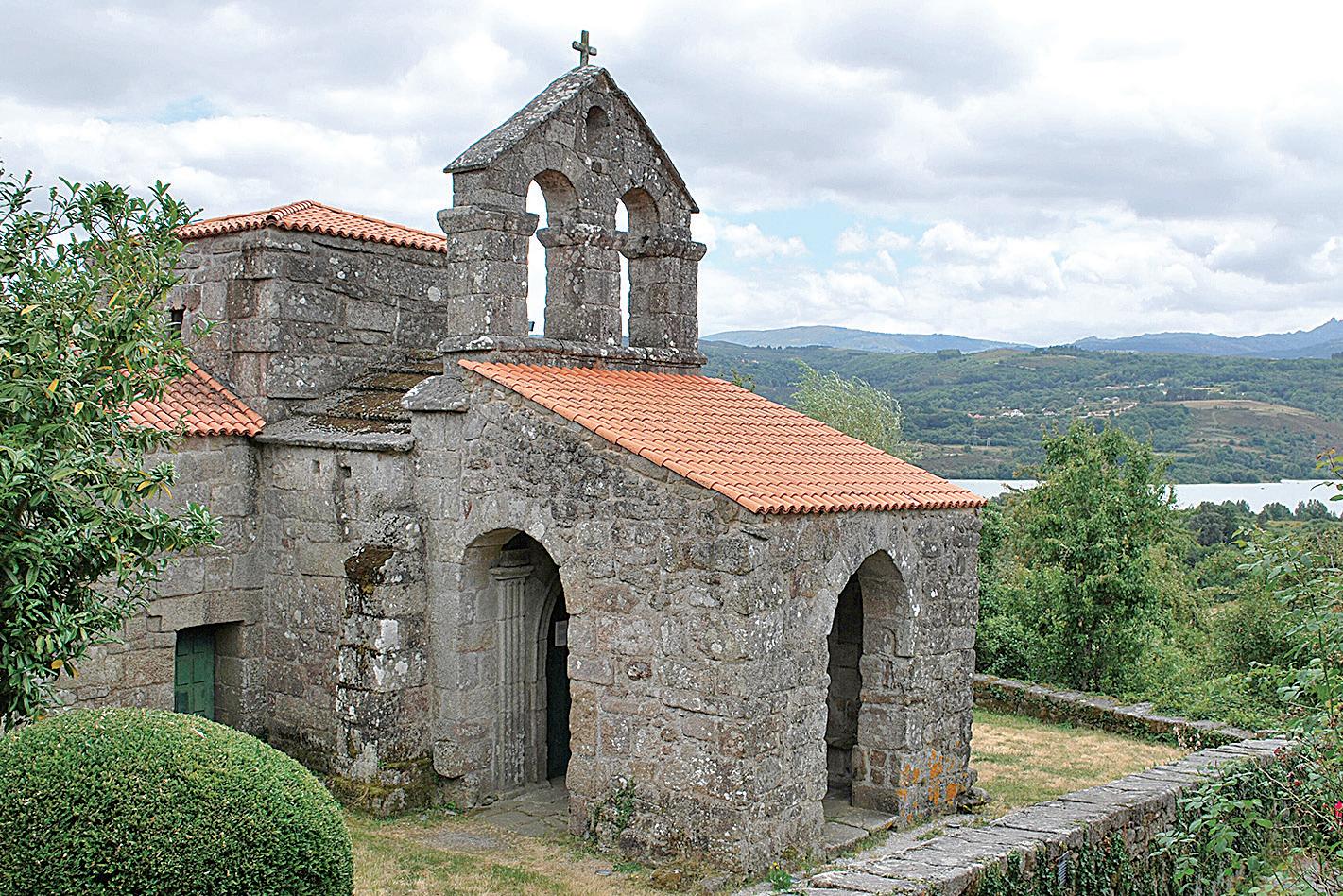
tradición hispánica, corroborada por varios documentos, los restos de san Torcuato y san Eufrasio descansan en Galicia; el primero estuvo mucho tiempo en la iglesia visigótica de Santa Comba de Baños, de Bande, y actualmente están en la iglesia de Celanova (Orense); los de san Eufrasio descansan en Santa María de Mao, en la diócesis de Lugo. El Papa Juan Pablo II en su primer viaje a España del año
1982 pronunció las siguientes palabras refiriéndose a nuestra nación: “...fue conquistada para la fe por el afán misionero de los Siete Varones Apostólicos”.
Breve historia del Santuario de San Torcuato en Gaudix (Granada - España)
La Ermita-Sepulcro de San Torcuato de Face Retama, fue erigida en Santuario Diocesano en honor del Patrón San Torcuato, fundador de esta Iglesia local, por Decreto
del Sr. Obispo de la Diócesis, Don Juan García-Santacruz Ortiz, es el lugar sagrado donde, según la tradición, fue martirizado el primer obispo de Europa (s. I d.c.) y patrón de la ciudad de Guadix y estuvieron enterrados sus restos. Estos restos, fueron trasladados en el siglo X a Celanova, Galicia, difundiéndose su veneración por el Norte Peninsular. La catedral de Guadix conserva un total de tres reliquias de San Torcuato: El santo brazo que bendice a los accitanos cada 15 de mayo, la mandíbula que se trajo para la iglesia de San Torcuato (Hospital) y una tercera -y poco conocida por no encontrarse expuesta a la veneración de los fielesllamada del calcáneo. La Puerta de Baçamarín pasó a llamarse de San Torcuato a partir del año 1593 con motivo de la entrada solemne de las reliquias del Santo traídas del Monasterio de San Rosendo de Celanova (Orense) y en su interior alberga un pequeño oratorio.
La fachada está dedicada a San Torcuato y fue trazada por el arquitecto Gaspar Cayón.
— ACI Prensa
Visita de reliquias de 36 mártires cristeros es un llamado a vivir la fe con valentía
KIMMY CHACÓN Angelus, OSV News
LOS ÁNGELES — Para algunas de las personas sentadas en las bancas de la Catedral de Nuestra Señora de los Ángeles, la visita de 36 reliquias pertenecientes a mártires de la Guerra Cristera de México significó mucho más que historia.
“Mi bisabuelo estuvo allí durante la Cristiada (la guerra)”, dijo Kathleen Orosco, de la Iglesia St. Mary of the Assumption en Whittier. El abuelo de Orosco, entonces un niño, era llevado a caballo mientras soldados federales perseguían a los combatientes cristeros, en medio de una ola de anticlericalismo extremo que se extendía por México.
En una ocasión, contó ella, su bisabuelo dejó al niño – su abuelo – junto a un río para adelantarse y advertir a otros sobre la llegada de las tropas, ayudándolos a escapar.
Desde entonces, la familia ha visitado su pueblo natal de Colotlán, Jalisco, donde aún quedan recuerdos del conflicto. Orosco recordó haber visto marcas de bala y lugares donde fueron ejecutados mártires.
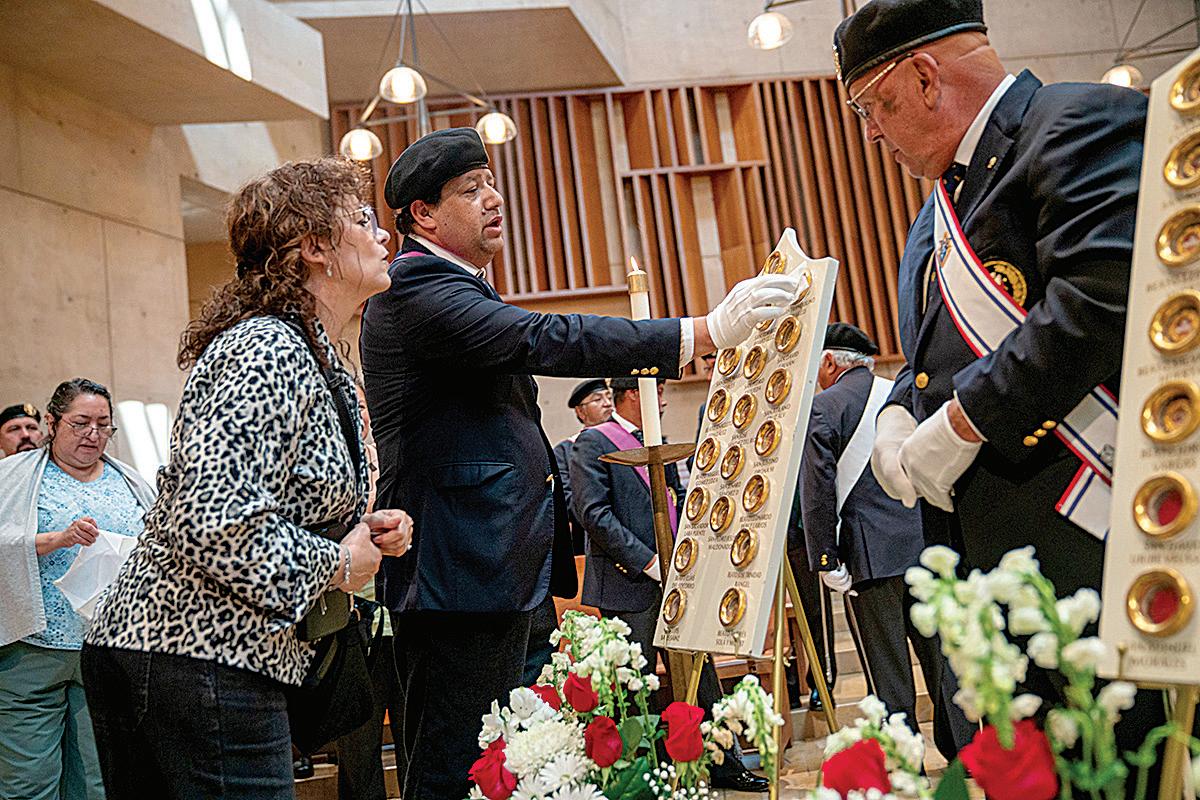
JOHN RUEDA, CORTESÍA DE LA ARQUIDIÓCESIS DE LOS ÁNGELES | OSV NEWS
Un Caballero de Colón venera las 36 reliquias de los mártires de la Guerra Cristera de México en la Catedral de Nuestra Señora de los Ángeles en Los Ángeles el 18 de abril.
“Me conmueve saber que personas dieron su vida por Cristo”, dijo. Orosco y su familia estuvieron entre los cientos de personas que acudieron el 18 de abril a un congreso de un día para conmemorar los 100 años del inicio de la Guerra Cristera (1926-1929), durante la cual miles de católicos –incluidos muchos sacerdotes – fueron ejecutados durante un levantamiento popular
contra las leyes anticlericales vigentes entonces en México. Después de su paso por la Catedral de Nuestra Señora de los Ángeles, las reliquias recorrieron varias otras iglesias de la arquidiócesis y de la Diócesis de Orange durante dos semanas. La última parada en la Arquidiócesis de Los Ángeles fue el 4 de mayo en la Iglesia St. Matthias, en Huntington Park. El congreso en Los Ángeles
incluyó conferencias de historiadores expertos sobre la guerra, una misa celebrada por el arzobispo José H. Gómez y un panel de discusión por la tarde con preguntas de los participantes.
Para algunos, el día representó una oportunidad única para ayudar a sus hijos a ver el catolicismo desde otra perspectiva.
María, originaria de Guadalajara, dijo que creció escuchando historias de los cristeros contadas por su abuela. “Eran rancheros sencillos que no tenían mucha educación, pero tenían una fe muy fuerte, y murieron por ella”, dijo a Angelus, medio de comunicación de la Arquidiócesis de Los Ángeles. “Siempre me ha parecido algo muy hermoso”.
Los mártires, añadió, animan a los católicos a tener el valor de vivir esa fe abiertamente.
“Se trata de no tener miedo de decir: ‘Esta es mi religión’, y defenderla”, afirmó. “Es lo que nos ha sostenido en cada etapa de la vida. Si Dios no me ha abandonado, entonces yo no debería quedarme callada cuando llega el momento de hablar”.

¡Próximamente en la Diócesis de C harlotte!
30 de mayo – 2 de junio
Monroe | Charlotte | Statesville | Greensboro
Únase al Santísimo Sacramento en su peregrinación
nacional a través de la Diócesis de Charlotte
Santa misa, adoración eucarística Orar
“Cabrini” proyección de película Ver Apoyar Catholic Charities Dar
¡Todos los eventos son GRATIS – todos son bienvenidos!
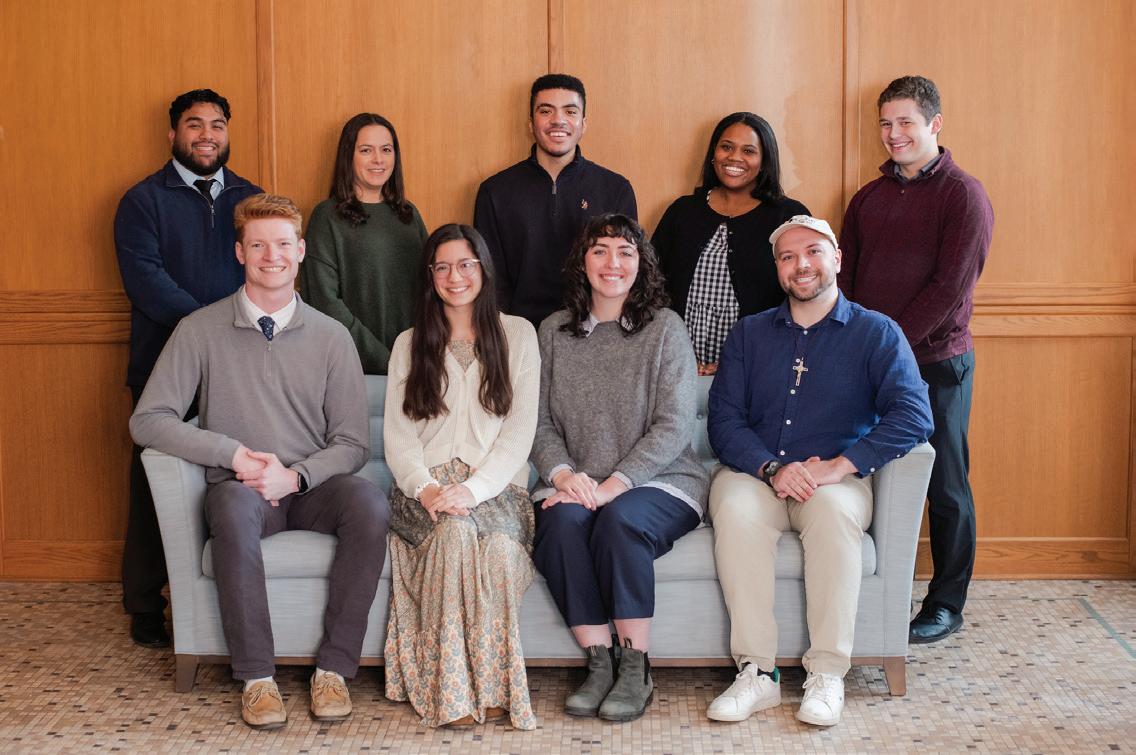
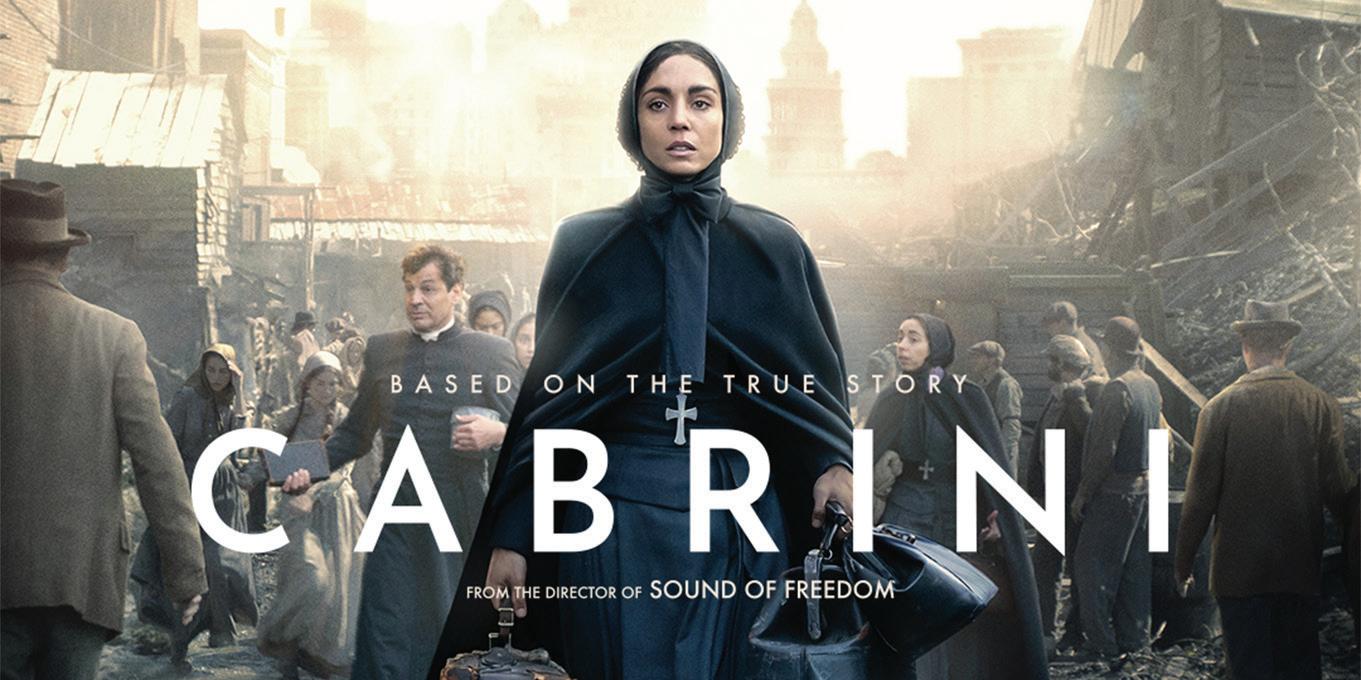
Conoce a los Peregrinos:
Paradas de la peregrinación:
• Our Lady of Lourdes Church
• St. Vincent de Paul Church
• St. Peter Church
• St. Philip the Apostle Church
• St Pius X Church
Proyección exclusiva:
7 p m domingo 31 de mayo Gratis – se requieren reser vaciones
Copatrocinada por la Parroquia de San Mateo de Charlotte
¡Escanea para más información!


SIMONE ORENDAIN OSV News
QUINCY, Illinois — The first publicly recognized Black Catholic priest in the United States – who has already had 40 potential miracles through his intercession investigated – is now getting his own national shrine in western Illinois where he grew up and once served.
On April 29 the Diocese of Springfield, Illinois, announced plans for a national shrine for Venerable Augustus (Augustine) Tolton (1854-1897), one of the “saintly seven,” referring to the group of African Americans recognized as “servant of God” or “venerable” who have active sainthood causes.
The diocese launched a fundraising campaign for the renovation of a long-dormant church on the site where Father Tolton, who was regarded in his day as the first African American priest of the country, celebrated his first Mass in the U.S. after his ordination in Rome in 1886.
Church leaders said plans would be underway for St. Boniface Church in Quincy, Illinois, to get a $5 million-plus makeover.
Bishop Thomas J. Paprocki of Springfield blessed a plaque from the city of Quincy, where Father Tolton grew up, ministered and is buried, designating the church a landmark property.
The bishop told OSV News a lot of work was needed on
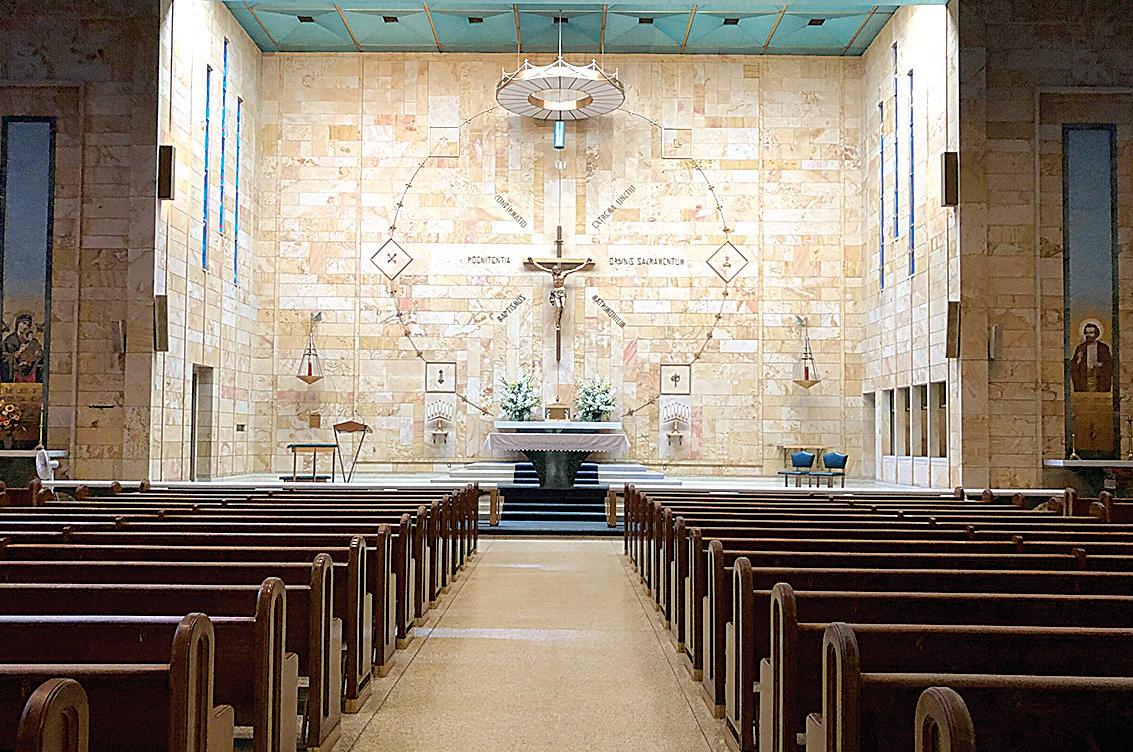
to devout Catholic parents who suffered the injustice of slavery. When he was 9, his mother, Martha Jane Tolton, escaped with her three children across the Mississippi, reaching the safety of Union Army lines, to save them from slave traders. The family then settled in Quincy.
After one month at St. Boniface School, where white parents threatened to remove their children, young Augustine transferred to St. Peter’s Parish, where priests and religious sisters mentored him and nurtured what they saw was a vocation to the priesthood.
However, no U.S. seminary would accept a Black vocation to the priesthood, so his mentors sent him to study in Rome. Father Tolton was ordained at St. John Lateran Basilica, the pope’s cathedral in Rome, in 1886. He expected to serve as a missionary in Africa but instead was sent to Quincy, where he became pastor at St. Joseph Church, a mission of St. Boniface Parish.
status, we want to go ahead with creating the shrine there, renovating the building.”
He said another $5 million to $7 million would be needed to include landmarks from Father Tolton’s life and Catholic formation in Quincy as part of the planned pilgrimage

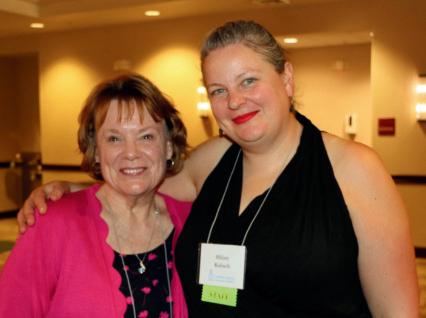
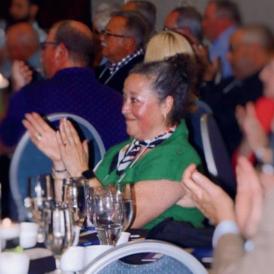
At St. Joseph, Father Tolton ministered to both African Americans and white Americans. He successfully sought a transfer to Chicago in 1889, where he served Black Catholics, mostly at St. Monica’s Parish in Chicago’s South Side, a part of the city known for its ties to Pope Leo XIV, who is also of African American descent. Father Tolton died there eight years later, aged 43, of heatstroke.
Retired Chicago Auxiliary Bishop Joseph N. Perry, vice postulator of Father Tolton’s canonization cause, remarked on St. Boniface as the designated shrine site.
“It’s something of a roundabout to see the shrine, established as the place that kind of rejected him as a school child,” Bishop Perry told OSV News.
He said a shrine signals “the degree of intensity of interest that is out there, for him.” He remarked how “absolutely remarkable” it is for a person still steps away from sainthood to have a designated shrine.
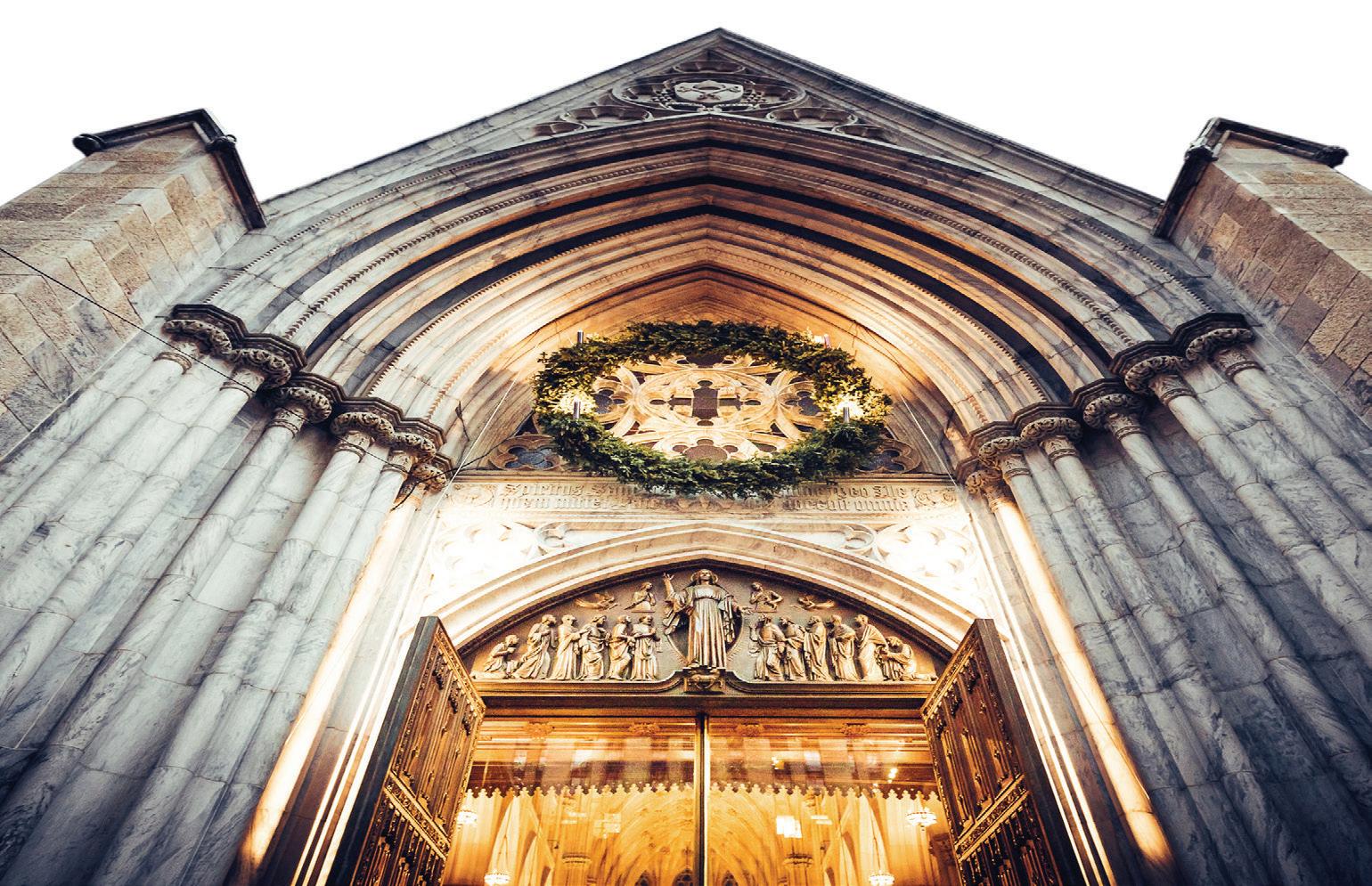
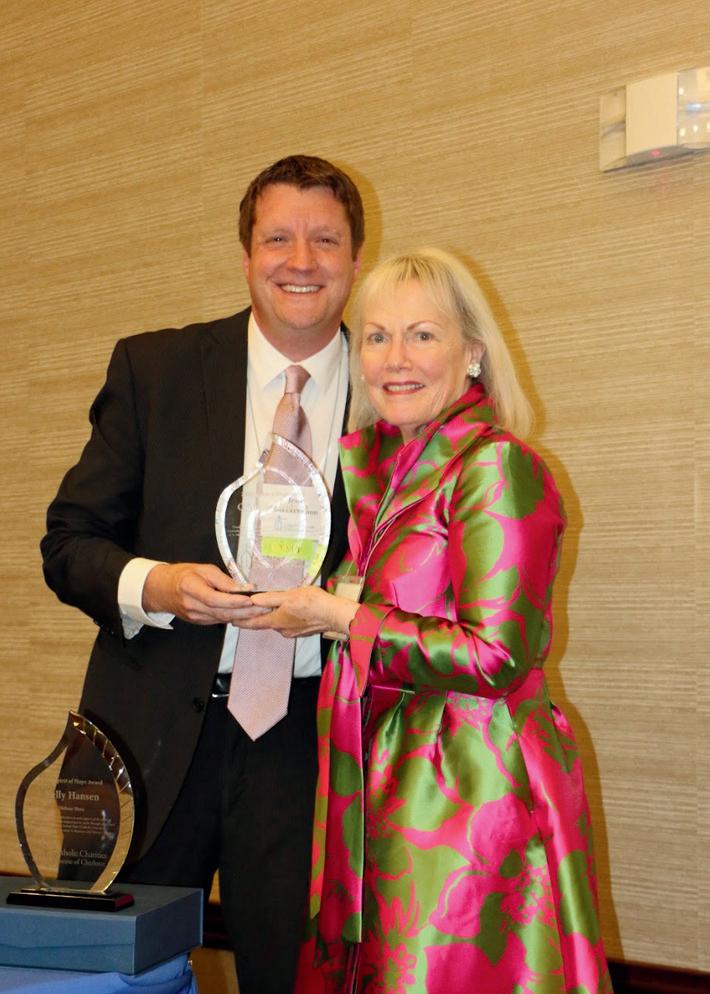
For more information, go to www.charlottediocese.givingplan.net or
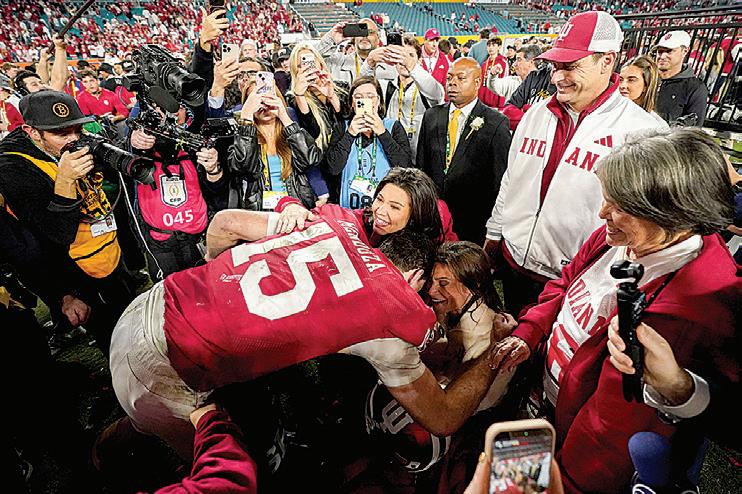
GRACE HOLLARS-IMAGN IMAGES VIA REUTERS | OSV NEWS
Hoosiers quarterback Fernando Mendoza, a Catholic and No. 1 pick in the NFL draft, embraces his mother after winning the College Football Playoff National Championship Jan. 19.
MIAMI — Quarterback Fernando Mendoza made headlines not just for his record-breaking season, but for a deeply personal decision to honor his mother instead of seeking the spotlight on football’s biggest stage.
The 2026 Heisman Trophy winner led Indiana University to its first NCAA Division I national championship and was selected No. 1 overall in the NFL Draft on April 23 by the Las Vegas Raiders.
But instead of attending the high-profile event in Pittsburgh, Mendoza chose to stay home in Miami. Speaking days before the draft on “The Rich Eisen Show,” Mendoza said he wanted to share the moment with those who shaped his journey – family, mentors and friends.
At the heart of that choice were his Catholic faith and his mother, Elsa, who has long battled multiple sclerosis, a debilitating disease affecting the central nervous system. Travel would have been difficult for her. His mother’s strength in her battle with the disease is also the source of his resilience.
“I see her fighting every single day, and with a smile on her face,” Mendoza told Eisen. “So there’s no excuse for me to have a bad day, bad play or bad game.”
That perspective forms the foundation of his life. It is inseparable from his Catholic faith, which he practices openly and consistently.
CHICAGO — A lighthearted story about a customer service call from Pope Leo XIV is drawing widespread attention and offering
many Catholics a glimpse of the pope’s ordinary side.
Augustinian Father Tom McCarthy, the incoming provincial superior of the Midwest Augustinians, said he has been surprised by the reaction since sharing the anecdote at an April 29 gathering for fathers and sons at Sts. Peter and Paul Parish in Naperville, outside Chicago.
According to Father McCarthy, the former Cardinal Robert Prevost – now Pope Leo XIV –called his Chicago bank several months after his election to update his phone number and account information.
After answering multiple security questions, the pope was reportedly told the changes could not be made unless he appeared at the bank in person.
Father McCarthy said Pope Leo explained that would be difficult because he was “out of town.” When he finally added, “Would it matter if I tell you I’m Pope Leo?” the customer service representative hung up on him.
The issue was later resolved after a fellow Augustinian contacted the bank president, who agreed to make the change rather than risk losing “the account of the pope.”
SAN FRANCISCO — Gov. Gavin Newsom, D-Calif., announced May 8 a first-in-the-nation program to provide 400 free diapers to every newborn in the state.
Newsom, a Catholic who is seen as likely to seek his party’s 2028 presidential nomination, cast the effort as part of an affordability strategy.
His office said the program would leverage the “bulk purchasing power of the state” to challenge “high prices from major brands.” “California is taking on the cost of raising a family head-on – delivering free school meals, making preschool free for every four-year-old, expanding after-school programs, and now making sure parents leave the hospital with the basics their newborn needs,” Newsom said in a statement.
The Urban Institute estimated in 2025 that nearly 8 million children in the U.S. live in families that struggle to afford enough diapers. The same organization said the average cost of diapering one child is about $100 a month, but families report “only being able to pay a median of $65.”
belonging to martyrs from Mexico’s Cristero War was about more than history for some of the people in the pews at the Cathedral of Our Lady of the Angels in Los Angeles.
“My great-grandpa was there during the Cristiada (war),” said Kathleen Orosco from St. Mary of the Assumption Church in Whittier. Orosco and her family were among the hundreds who turned out April 18 for a one-day congress marking 100 years since the beginning of the Cristero War (1926-1929). During the war thousands of Catholics – many priests among them – were executed in a popular uprising against anti-clerical laws in Mexico at the time.
Following their stop at the Cathedral of Our Lady of the Angels, the relics toured several other churches in the archdiocese and the Diocese of Orange for two weeks. The last stop in the LA Archdiocese was May 4 at St. Matthias Church in Huntington Park.
Maria was among the attendees. She grew up hearing stories of the Cristeros from her grandmother. The martyrs encourage Catholics to have the courage to live that faith openly, she said. “It’s about not being afraid to say, ‘This is my religion,’” and to defend it, she added.
Please pray for the following deacons who died during the month of May:
John Doyle 5/16/1992
Josef Vandermeer 5/19/2000
Robert T. Murphy 5/16/2025
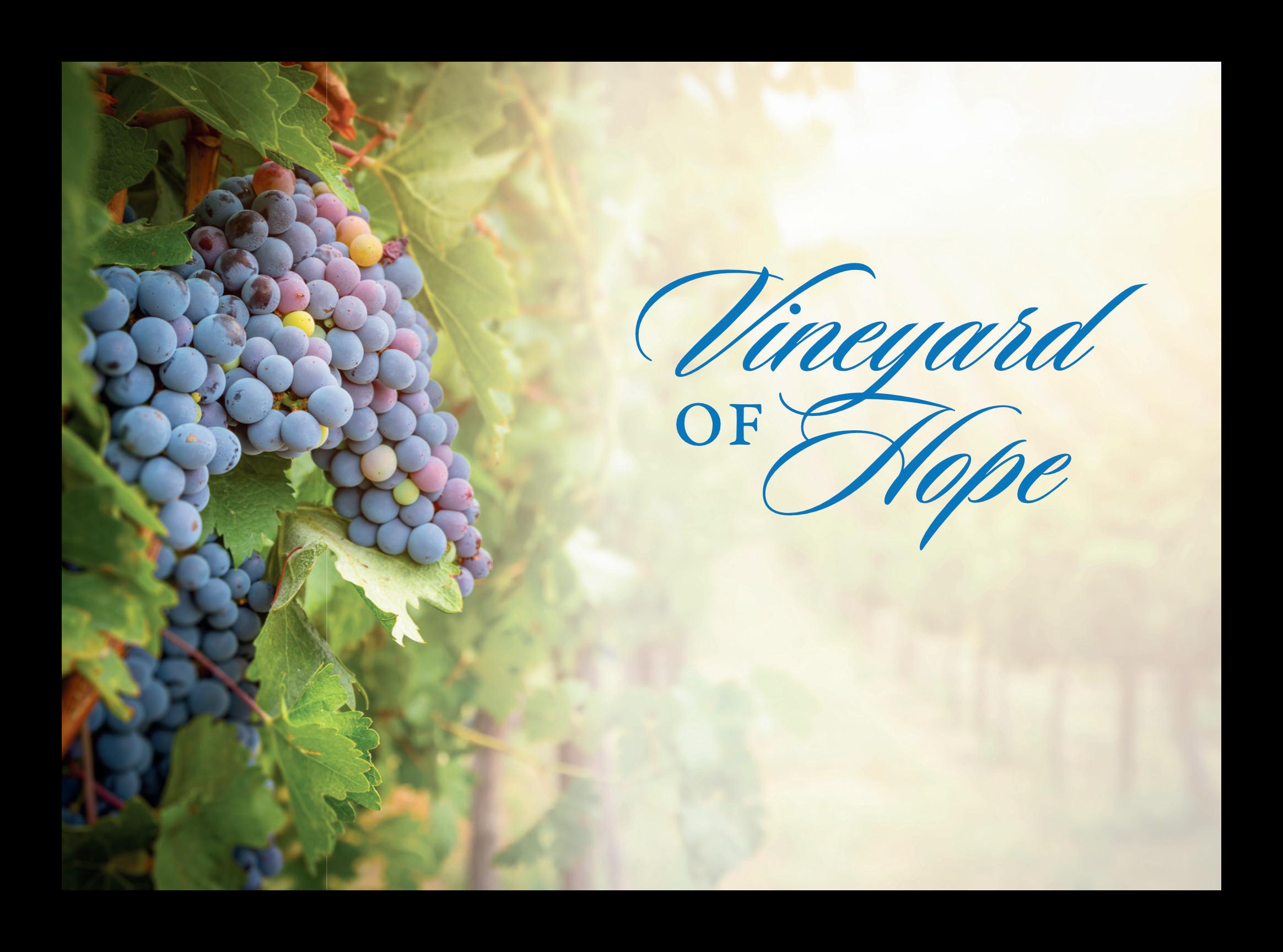

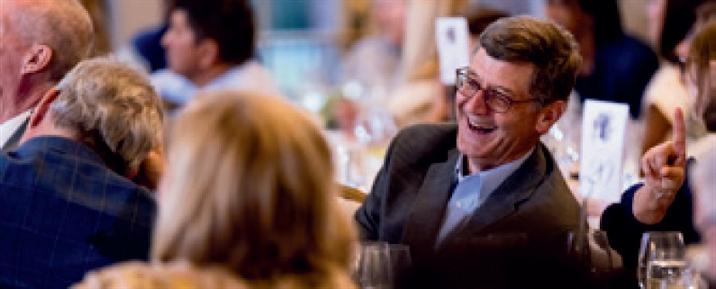
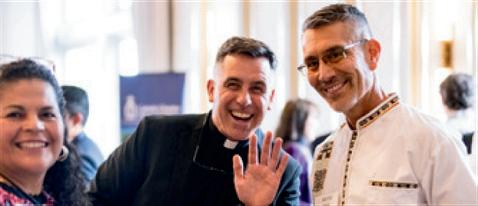
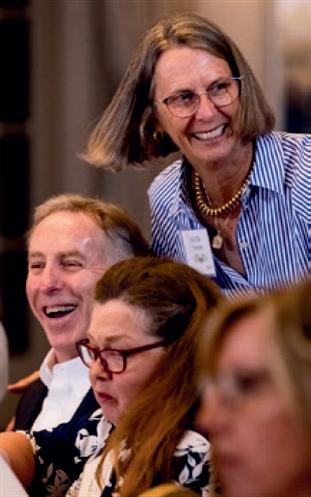
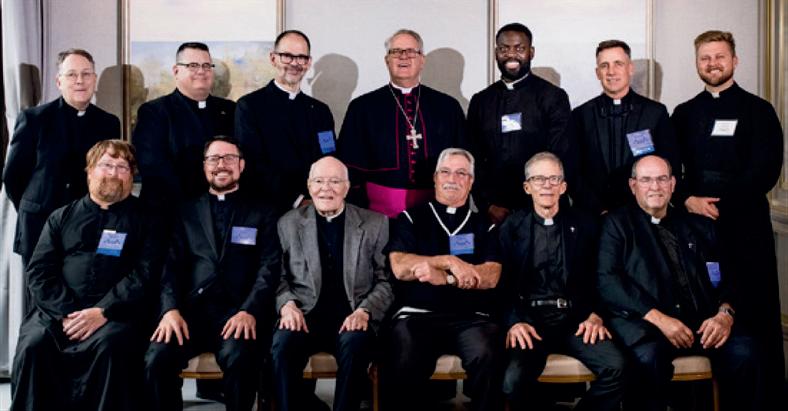
Friday, May 29, 2026 5:30 p.m. @ The Revelry

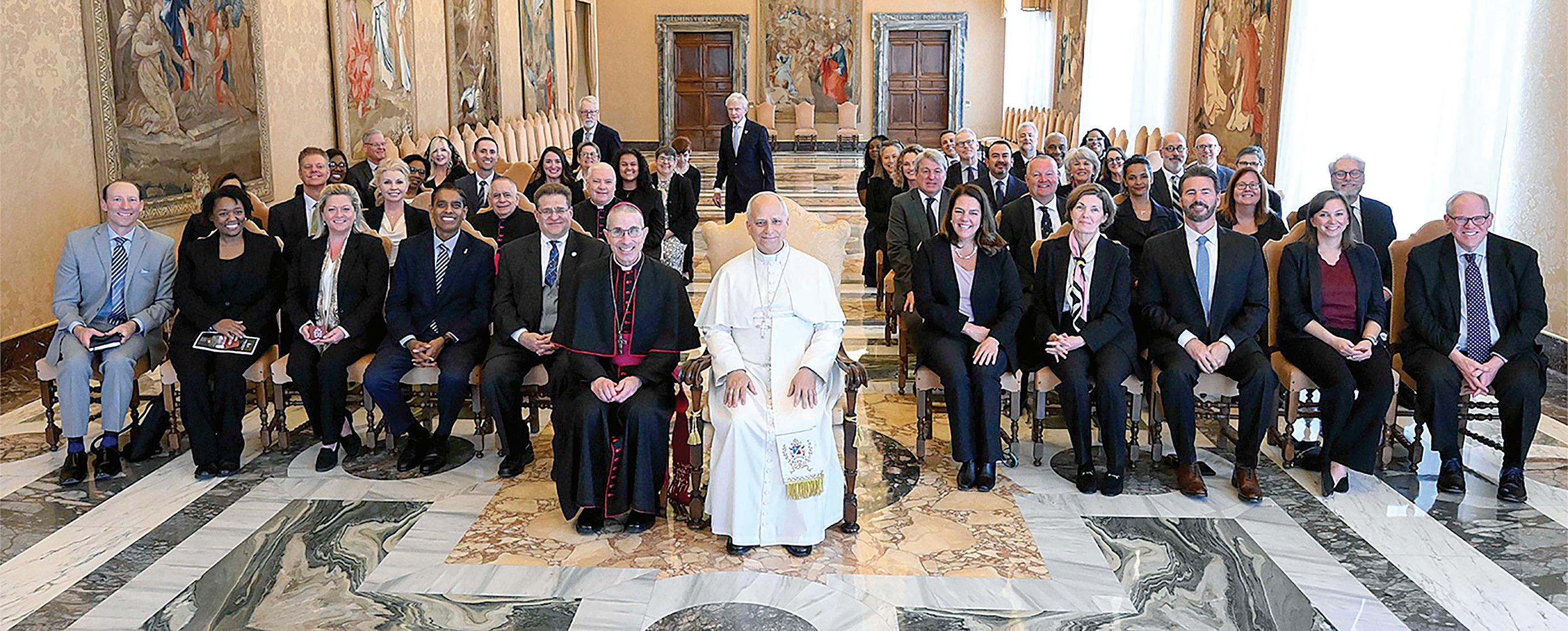
VATICAN CITY — Pope Leo XIV met the leadership of Catholic Charities USA in an audience at the Vatican on May 4, offering words of encouragement to one of the country’s largest disaster relief networks as it navigates growing demand for food and basic services to aid the poor in the United States.
“It was a truly humbling experience to have met with Pope Leo XIV as part of board service with Catholic Charities USA,” said Gerard Carter, executive director and CEO of Catholic Charities Diocese of Charlotte. “His Holiness reminded us several times in his remarks that all of those engaged in the Church’s charitable work should never lose heart – even in the face of challenges – because the Lord has promised us: ‘I am with you always’ (Mt. 28:20). I come back even more deeply dedicated to our shared work of charity across the diocese.”
Kerry Alys Robinson, president and CEO of Catholic Charities USA, spoke after the papal audience about Catholic Charities’ Gospel-driven mission, its emergency food response amid disruptions to federal food stamp programs, and the new “People of Hope” initiative currently traveling the country that will be in the Diocese of Charlotte Dec. 7-8.
She said the encounter with Pope Leo XIV left the delegation “deeply moved and confirmed in our commitment to serve poor and vulnerable people of all backgrounds … to bring merciful love and aid to people who need it the most, wherever they are suffering.”
In Pope Leo’s speech to the organization’s
board of directors and senior staff, the pope encouraged their work to “seek to find solutions to inhumane situations, to alleviate the suffering of individuals and families, and to relieve the burden of those who are weighed down by hardship and strife.”
‘His Holiness reminded us several times in his remarks that all of those engaged in the Church’s charitable work should never lose heart.’
Gerald Carter Executive director and CEO, Catholic Charities Diocese of Charlotte
The pope also acknowledged the difficulties inherent in charitable work, from securing sufficient resources to combating discouragement, and he urged them not to lose heart.
“I am fully aware that the Catholic Charities agencies in the United States of America are by no means immune from these challenges,” the pope said. “Yet it is precisely when we are confronted with
such obstacles that we must learn to hear Jesus’ voice saying to us once again, ‘I am with you always!’”
The papal audience comes at a moment when “many Americans are struggling to make ends meet,” Robinson said, describing how donors to Catholic Charities stepped up to fill in the gap following disruptions to federal nutrition programs.
When funding for the Supplemental Nutrition Assistance Program, known as SNAP and commonly referred to as food stamps, was disrupted during the 43-day shutdown of the federal government in 2025, Catholic Charities USA launched an emergency fundraising appeal.
Catholic Charities was ultimately able to provide 2.5 million tons of food to families facing hunger, distributing 100% of donated funds directly to local Catholic agencies and food distribution partners.
“When Americans are made aware of the names and the faces of hungry people, they want to help,” Robinson said.
She noted that the organization has seen a rise in private giving as donors become more aware of hardship at the local level, “We’re seeing an increase in anxiety around just the basics.”
“Catholic Charities USA is the official disaster response agency of the Catholic Church in the U.S. and the third largest in the country, second only to the Red Cross and Salvation Army, but the only one without a congressional mandate to serve as such,” she said.
“When there is a flood or a wildfire or a hurricane, I just see people rushing in to help,” she added. “I see the goodness that is common to all of us, and the desire to
be part of a solution, to kind of be bridge builders, to be people of mercy and hope – and that covers the full theological and political spectrum.”
During the audience, Robinson presented Pope Leo with a bound edition of “People of Hope: Faith-Filled Stories of Neighbors Helping Neighbors,” a book filled with stories of people Catholic Charities serves, drawn from the organization’s new traveling museum of the same name.
The museum, housed in a retrofitted semi-truck and made possible by a nearly $5 million grant from Lilly Endowment Inc., features 42 first-person video testimonials from Catholic Charities staff and volunteers across the country. It began a three-year national tour in March and is expected to visit more than 150 communities across the U.S., including Charlotte in December.
The book was offered as a gesture of gratitude to Pope Leo, who in a letter to the Catholic Charities network last fall called its members “agents of hope.”
“I have never seen such unity in the Catholic Church. And I’ve worked for the Catholic Church since I was 14,” Robinson said. “This is a moment in the United States where we feel enormously supported by Catholic bishops for all of the work we do. And I think that they are speaking increasingly with a unified voice, reminding all Catholics and people of goodwill about the Gospel mandate to be merciful, that you cannot separate authentic Christian life from care for and love of the poor.”
— Catholic News Herald and OSV News
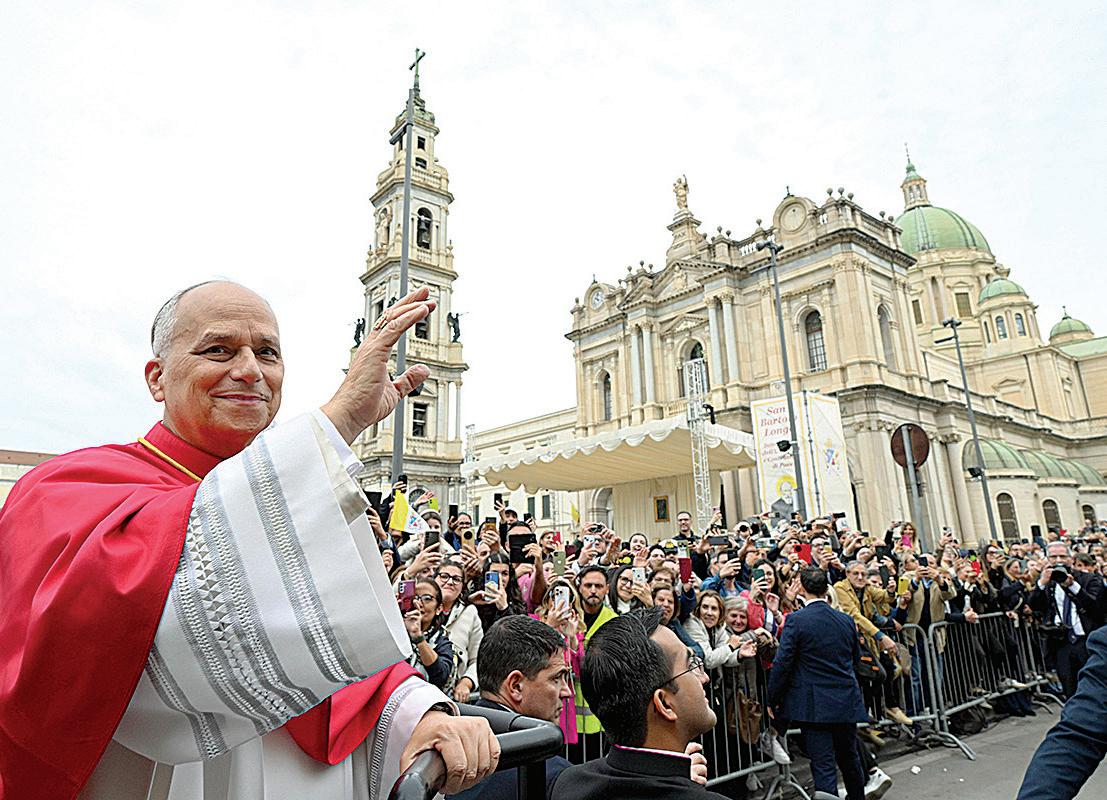
hospitalized nationwide since March 15.
Caritas Bangladesh, along with hospitals and clinics run by Catholic religious sisters, is providing care and public health education in both cities and remote communities.
Sister Mary Piusha, who oversees St. Paul’s Hospital in the Diocese of Khulna, said Catholic health workers are informing patients about measles symptoms and providing rapid treatment when cases arrive.
Families are feeling the crisis firsthand.
Belal Hosain, whose 12-month-old son was hospitalized in Dhaka, said he fears for his child’s life after witnessing other children die. Church leaders say Catholic institutions continue to play a major role in Bangladesh’s healthcare system despite Christians making up less than 1% of the population.
In 2025, Bangladesh’s Health Ministry halted measles-rubella vaccine procurement through UNICEF, in favor of an open tender process – despite repeated warnings about possible disruptions in immunization services, reports say.
with the University of Arizona’s Steward Observatory.
Along with Pope Leo XIII, the newly named asteroids are a nod to Oratorian Father Giuseppe Lais, an astronomer who served as the observatory’s deputy director for 30 years; Cardinal Pietro Maffi, archbishop of Pisa, who was observatory president from 1904 until his death in 1931; and Jesuit Father Florent Constant Bertiau, a Belgian astronomer who founded the observatory’s computer center in 1965.
The Vatican Observatory said the names for the four asteroids discovered by Cernis and Father Boyle were recently unveiled in the April 13 edition of the International Astronomical Union’s WGSBN (Working Group on Small Bodies Nomenclature) Bulletin.
An asteroid receives a name after its orbit and likely future trajectory can be sufficiently ascertained.
is expected to make an official visit to France in late September.
Church leaders say the trip would likely include stops in Paris and at the Marian shrine of Lourdes, though the Vatican has not yet confirmed the itinerary or dates.
Cardinal Jean-Marc Aveline of Marseille said discussions with the pope have already produced a preliminary schedule. Reports in France point to a possible visit around Sept. 19, just months before the country enters the campaign season for the 2027 presidential election.
Preparations are underway in Lourdes, where Bishop Jean-Marc Micas of Tarbes and Lourdes said Pope Leo is expected to celebrate Mass, lead the famous torchlight procession, and spend the night at the sanctuary.
The bishop described the atmosphere among staff and pilgrims as one of “great joy.”
Pope Leo marks anniversary of election at
POMPEII, Italy — Pope Leo XIV marked the first anniversary of his election May 8 with a pilgrimage to the Marian Shrine of Our Lady of the Holy Rosary in Pompeii, entrusting his pontificate to the Virgin Mary.
Celebrating Mass before an estimated 20,000 people, the pope recalled that his election in 2025 coincided with the feast of Our Lady of Pompeii.
“I therefore had to come here to place my ministry under the protection of the Blessed Virgin,” he said.
The Augustinian pope’s first year included international trips, canonizations and jubilee events. In his homily, Pope Leo spoke at length about the importance of the rosary and urged Catholics to place their hope in Christ.
“Brothers and sisters, no earthly power will save the world, but only the divine power of love,” he said.
Pope Leo also honored St. Bartolo Longo, the former satanist turned saint who founded the Marian shrine and its charitable works for orphans and prisoners’ children.
The pope closed with a renewed appeal for peace amid ongoing global conflicts. He continued his pastoral visit with a trip to the nearby city of Naples before returning to Rome by helicopter in the evening.
DHAKA, Bangladesh — Catholic charities and Church-run clinics in Bangladesh are stepping up measles awareness and treatment efforts as the country faces a deadly outbreak that has killed at least 336 children since mid-March.
Government health officials say more than 32,000 suspected measles patients have been
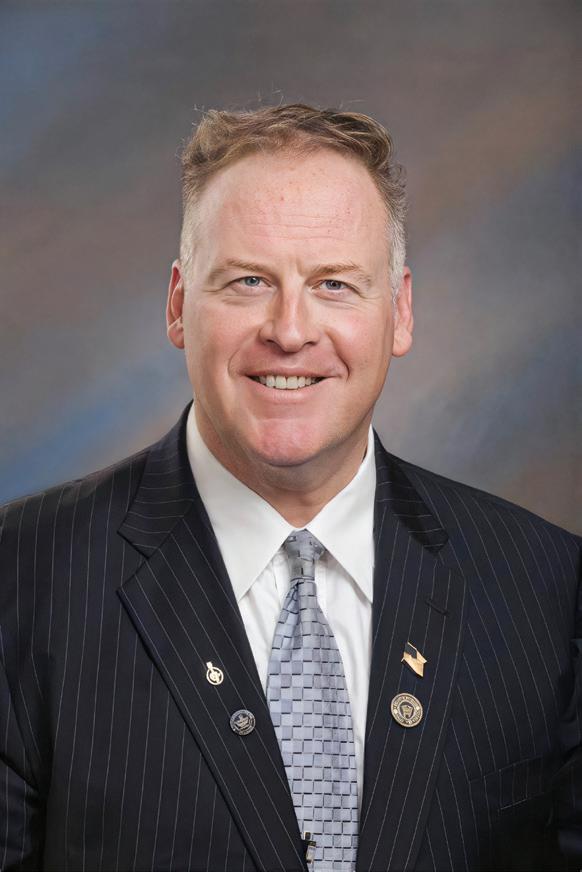
CASTEL GANDOLFO, Italy — The Vatican Observatory announced in an April 29 press release that an asteroid has been named in honor of Pope Leo XIII, who formally reestablished the observatory in 1891.
Also known as “minor planets,” asteroids are rocky leftovers from the formation of the solar system some 4.6 billion years ago, NASA notes on its website.
The Pope Leo XIII asteroid is one of four discovered by Lithuanian astronomer Kazimieras Cernis and Jesuit Father Richard P. Boyle, a Vatican Observatory astronomer. The pair detected the bodies using the Vatican Advanced Technology Telescope on Mount Graham, Arizona, constructed in partnership
PARIS — Ahead of the first anniversary of his election to the chair of St. Peter, the French bishops’ conference announced Pope Leo XIV
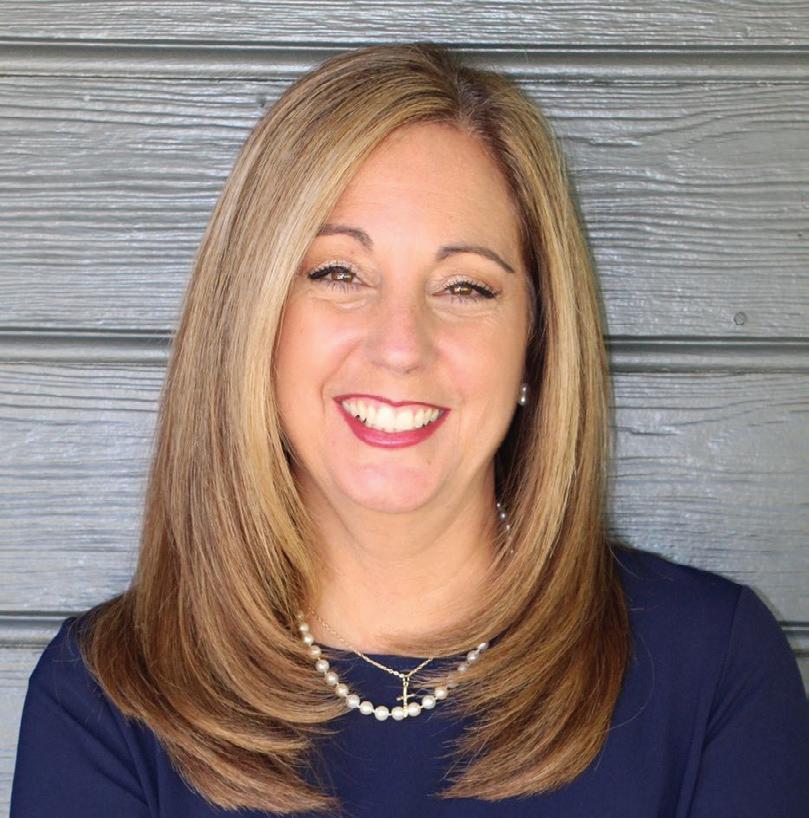
The visit would mark Pope Leo’s first trip to France as pontiff and could include appearances at Notre Dame Cathedral and the Collège des Bernardins in Paris. The bishops say the pope has often expressed admiration for France’s spiritual heritage and a strong desire to visit the country officially.
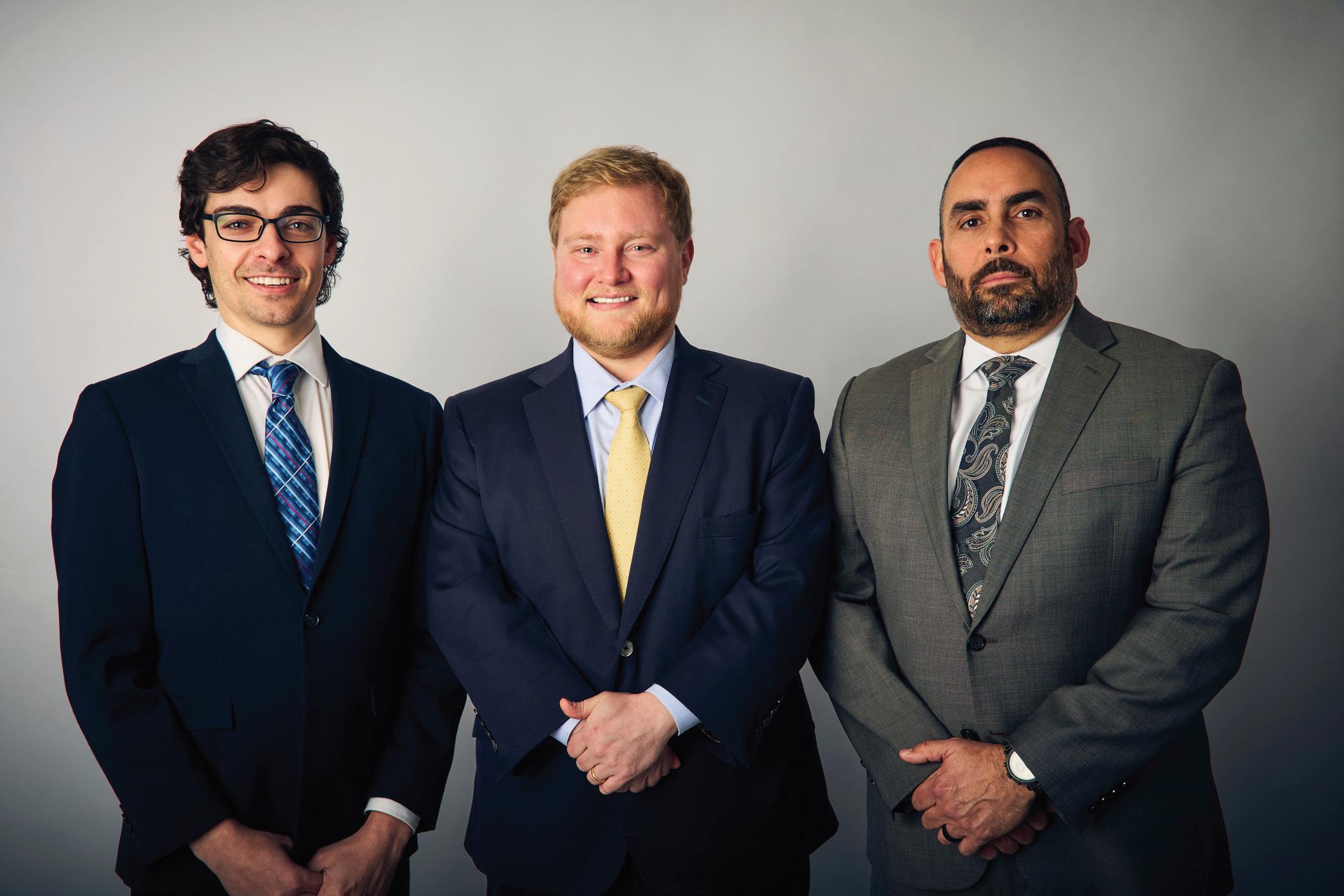

One of our Cub Scout students gleefully showed me his brandnew compass. A compass is a fantastic contraption – almost magical. It points north because of something we cannot see: Earth’s magnetic field. It is a consistent, unfailing mechanism, a quiet gift of creation that helps us navigate this wondrous planet. For the faithful, it’s difficult not to see in it a reflection of God’s providence – an ordered system placed in the world to guide us.
I often think of this when I consider our students’ internal compasses. With increasing frequency, I find myself talking with them about what they believe is funny, normal or harmless behavior: a viral challenge to eat something dangerously spicy or destroy the property of another, a joke that mocks another culture or race. Not funny. Not harmless.
But they don’t see it that way at first. Why? Because we have placed prematurely in their hands a powerful tool – the internet –and it has scrambled their internal compasses.
IS THE LAUGHTER JOYFUL OR UNKIND?
Some adults are able to measure what they encounter online against a well-formed moral sense, grounded in a strong foundation of faith and reason. Many of us learned, without today’s constant noise, to distinguish what is right from what is wrong, what is kind from what is cruel, what is worth saying and what should never be repeated. But we cannot simply pass that discernment to our children through osmosis. We cannot assume they will “pick it up.” The phone and the internet are tools that many adults struggle to navigate wisely; for children and teenagers, the challenge is even greater.

Sometimes I sit with a student and watch a video they’ve quoted. Together, we look not just at the clip, but at what follows –the stream of suggested content filling the right column of the YouTube feed. We ask: Is that laughter genuine, born of joy, or is it masking something dark and unkind?
Again and again, I see that young students cannot tell the difference without guidance. An adult is laughing, so it must be funny. The video received many “thumbs up likes,” so it must be good. A girl who weighs zero pounds is presented as beautiful, so it must be desirable. A boy sits with scantily clad girls draped about him, so he must be successful. And slowly, imperceptibly, our children’s sense of “true north” begins to shift.
ARE OUR OWN COMPASSES TILTED?
Many of us, if we’re honest, walk around with compasses that are slightly off – tilted this way or that by the influences we’ve absorbed. An internal compass, like the physical one aligned to Earth’s magnetic field, is a gift from God. It deserves protection, attention and care.
The world has a powerful ability to disrupt that alignment. When it comes to children, we carry a responsibility to clear away what interferes, to guide them patiently by dedicating time to the realignment of our own compasses to true north – the place where faith, virtue and a clear understanding of right and wrong can take root and grow.
Christ is risen! Alleluia! We’ll be saying (and singing) that refrain and others like it until Pentecost, which this year isn’t until the end of May. And well we should! The resurrection of Jesus is the irreplaceable centerpiece of our faith. So much so that St. Paul devoted a substantial portion of his First Letter to the Corinthians addressing those who thought otherwise.
“If Christ has not been raised, your faith is futile and you are still in your sins. Then those also who have died in Christ have perished. If for this life only we have hoped in Christ, we are of all people most to be pitied” (1 Cor 15:17-19).
Pitiable indeed. The entire point of the cross is the empty tomb. The whole reason for Christ’s sacrificial death was to change death as we knew it – to make death a door instead of a wall, a bright beginning instead of a bitter end.
THE RAISING OF A WIDOW’S SON
This was clear, if not explicit, in the public ministry of Jesus. The raising of Jairus’ daughter early on in Galilee and the last great sign in John’s Gospel – the raising of Lazarus – show us where the rabbi from Nazareth intends to go. But the third recorded story of Jesus raising the dead – the son of the widow of Nain – rarely gets our attention. And that’s unfortunate, because the account has a lot to teach us about the mission of Christ in the world.
Recorded only in Luke’s Gospel, the raising of the widow’s son occurs before the other more famous miracles and less than 10 miles from Nazareth. The scene is sadly familiar and dominated by what we have been forced to accept as a non-negotiable fact of life: death. As Jesus, His disciples and a large crowd approach Nain, they meet a line of mourners in procession at the gates. “A man who had died was being carried out. He was his mother’s only son, and she was a widow; and with her was a large crowd from the town” (Lk 7:12).
I imagine that is not all Jesus saw. The procession of death had been going on, uninterrupted, since humanity’s exile from Eden. One by one, year after year and age after age, death came to every soul. The son of the widow of Nain was simply next in a long line stretching before and after him; his widowed mother, yet another casualty consigned to loneliness and loss until the day she, too, would be carried out of town.
I think Jesus saw all of it that day, the entire and unending procession of death. Perhaps that was the source of His compassion and the reason He chose to intervene. “Then He came forward and touched the bier, and the bearers stood still. And He said, ‘Young man, I say to you, rise!’ The dead man sat up and began to speak, and Jesus gave him to his mother” (Lk 7:1415).
Suddenly, the crowd who had accompanied Jesus and the crowd who had accompanied the corpse were at a loss. “Fear seized all of them” (Lk 7:16). Death, after all, is what we expect, and most of us live our lives in ways that accommodate it. Loss is sad, but inevitable. Life is short. All good things must come to an end.
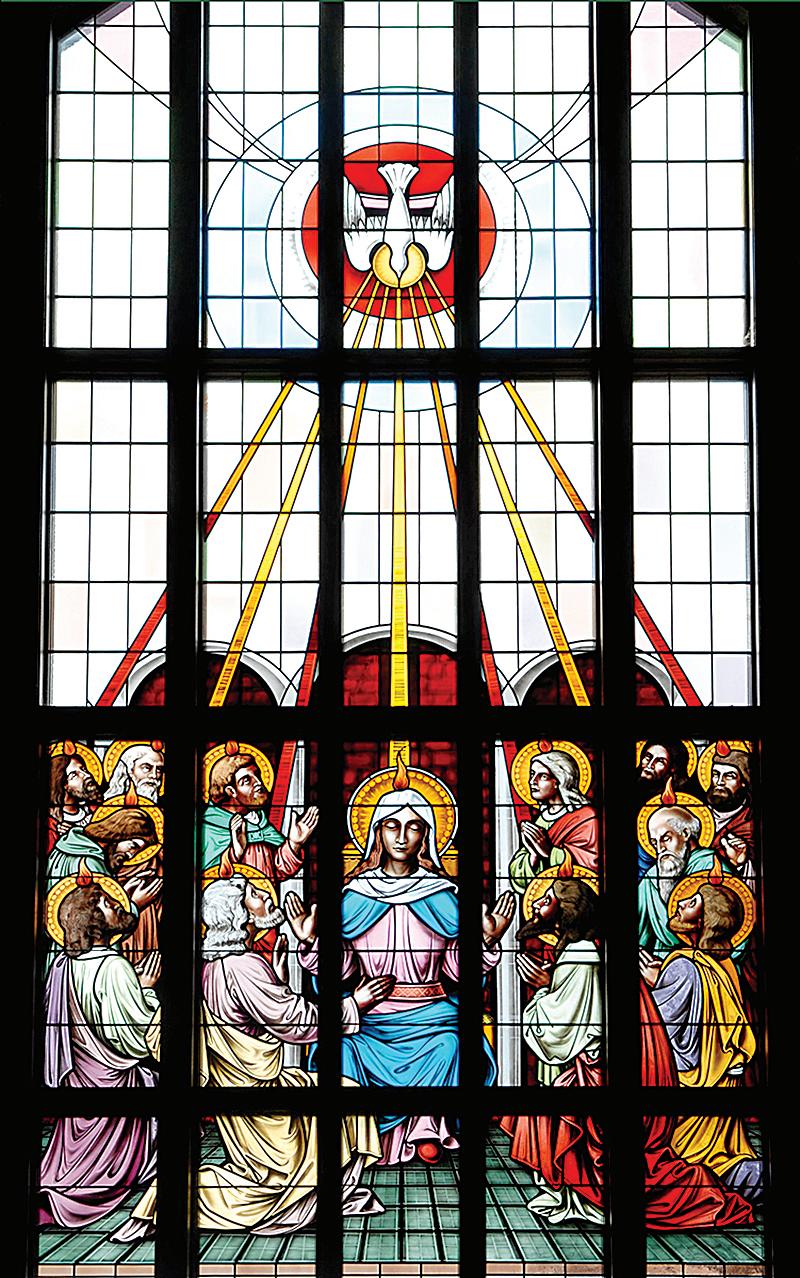
But none of that is enough for Jesus. Christ does not accept the inevitability of death. He does not allow it to have the last word. Our Lord does not join the funeral cortege or stop to pay respects. Nor does He comfort or counsel the widow. Instead, Christ reaches out and commands the archenemy to retreat. He restores the young man to life and to his mother.
Jesus does this not simply to evoke the memory of Elijah and the widow of Zarapheth, but to begin the divine campaign that will vanquish the enemy. Ironically, He does this by dying Himself, another only son of another (presumed) widow.
This stirring Gospel account is an icon of what Jesus intends to accomplish for every one of us. The Lord of life comes to do what no one else can – interrupt the procession of death. Whatever is dead or dying in us, Jesus comes to disrupt it. Sin, selfishness, fear, anger, addiction – all the works of death we have learned or chosen to accommodate – are destroyed by the Risen Lord. Christ is Risen! And so are we!
“War is not always inevitable. It is always a defeat for humanity. International law, honest dialogue, solidarity between states, the noble exercise of diplomacy: These are methods worthy of individuals and nations in resolving their differences. … War is never just another means that one can choose to employ for settling differences between nations.” — St. John Paul II
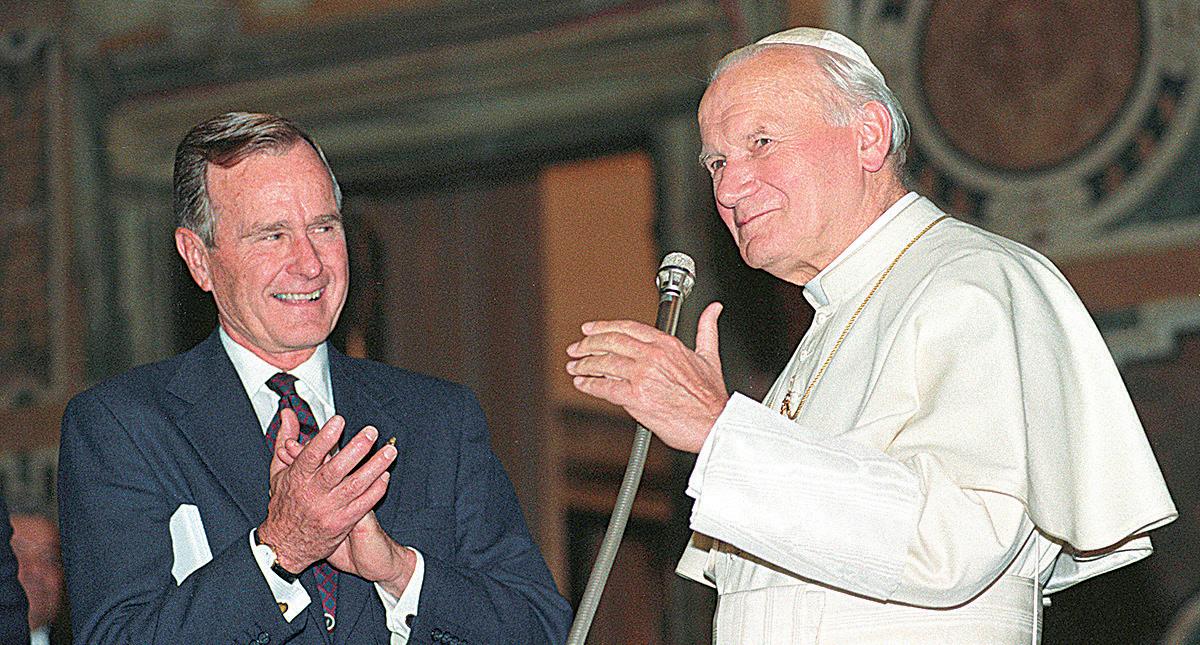
With those words, a pope sought to deter a war initiated by the United States in the Middle East. The pope was St. John Paul II, and the quagmire he sought to prevent was the second Gulf War, begun by President George W. Bush in 2003. John Paul went to great lengths in a futile effort to prevent that war, even sending his personal emissary to the White House to argue his case.
Fast forward to 2026, and another pope again warned a U.S. president that war is a defeat for humanity.
‘SEARCH, ALWAYS, FOR PEACE’
“I would simply say, once again, what I said in the ‘Urbi et Orbi’ message on Sunday: asking all people of goodwill to search, always, for peace and not violence; to reject war, especially a war which many people have said is an unjust war, which is continuing to escalate and which is not resolving anything,” Leo XIV said April 7. Pope Leo was responding to the rapidly escalating attack on Iran by U.S. and Israeli forces. The war was accompanied by increasingly bellicose rhetoric and soon expanded into Lebanon.
When President Donald Trump made profane threats to destroy Iranian civilization by wiping out such civilian infrastructure as power plants, water treatment plants and bridges, Pope Leo XIV rebuked those comments as “a threat against the entire people of Iran” and “truly unacceptable.”
The world’s news media, for understandable reasons, has focused on the world’s two most prominent Americans in such direct conflict. Subsequent statements by President Trump attacking Pope Leo in very personal terms only fed the controversy.
A DEFEAT FOR HUMANITY IN MANY WAYS
But for Catholics, it is important to remember that this is not the first time that a pope has challenged a president. Not as a
Most-read stories on the web
‘The Church is invested with the mission of speaking clearly to reject everything that mortifies life and prevents its development.’
Pope Leo XIV
From online story: “The Church must speak clearly, decisively against all evil, pope says”
politician but as a spiritual leader, the pope speaks from the perspective of the Church’s centuries of thought regarding war and its consequences.
In the case of the Iraq war, early claims of victory by President Bush (“Mission Accomplished”) proved premature. The reasons used to justify the war (weapons of mass destruction) turned out to be erroneous, and the cost in terms of U.S. and Iraqi lives was huge. We continue to live with the damage to our own soldiers and their families. The social upheaval in Iraq gave rise to ISIS and further regional conflict. Meanwhile, the country’s Christian minority has shrunk almost to the vanishing point.
It was, in short, a defeat for humanity in multiple ways.
It is too soon to tell all the evils that will be unleashed by the U.S. and Israeli war on Iran. The excuses for launching the war are many but, from a moral point of view, unsatisfying. As Pope Leo’s comments implied, the attack does not conform to the standards of Catholic teaching about just wars, including just and clear cause, a last resort, reasonable outcome of success and proportionality.
U.S. CATHOLIC LEADERSHIP MORE UNIFIED
American Catholics have been politically divided for some time. Often one’s support for, or opposition to, the war is likely to have more to do with one’s political stance than with a careful consideration of the pope’s words and Church teaching. However, the president’s policies and his verbal attacks on the pope have had one unintended consequence: U.S. Catholic leadership is more unified and less polarized than it has been in many years as it rallies around Pope Leo.
Let us hope that it has a similarly unifying effect on Catholics in the pews.
GREG ERLANDSON is an award-winning Catholic publisher, editor and journalist whose column appears monthly at OSV News. Follow him on X @GregErlandson.

The Catholic News Herald reached the Facebook and Instagram feeds of more than 1.5 million people in English and Spanish last month. The most talked about post? Coverage of Father Benjamin Roberts’ new assignment. Join the conversation: www.facebook. com/CatholicNewsHerald.
On YouTube over the last month ending May 13, videos produced by the Catholic News Herald have been viewed more than 12,500 times. The most popular video? Meet our newest priest video series.
Over the last 30 days ending May 13, 50,000 visitors to www.catholicnewsherald.com have viewed a total of 75,000 pages. The top 10 trending headlines are:

The Catholic News Herald welcomes letters from readers. We ask that letters be originals of 250 words or fewer, pertain to recent newspaper content or Catholic issues, and be written from a perspective of Christian charity.
To be considered for publication, each letter must include the name, address and daytime phone number of the writer for purpose of verification. Letters may be condensed due to space limitations and edited for clarity, style and factual accuracy.

The Catholic News Herald does not publish poetry, form letters or petitions. Items submitted to The Catholic News Herald become the property of the newspaper and are subject to reuse, in whole or in part, in print, electronic formats and archives.
E-mail: catholicnews@rcdoc.org
Mail: Letters to the Editor Catholic News Herald 1123 S. Church St. Charlotte, N.C. 28203
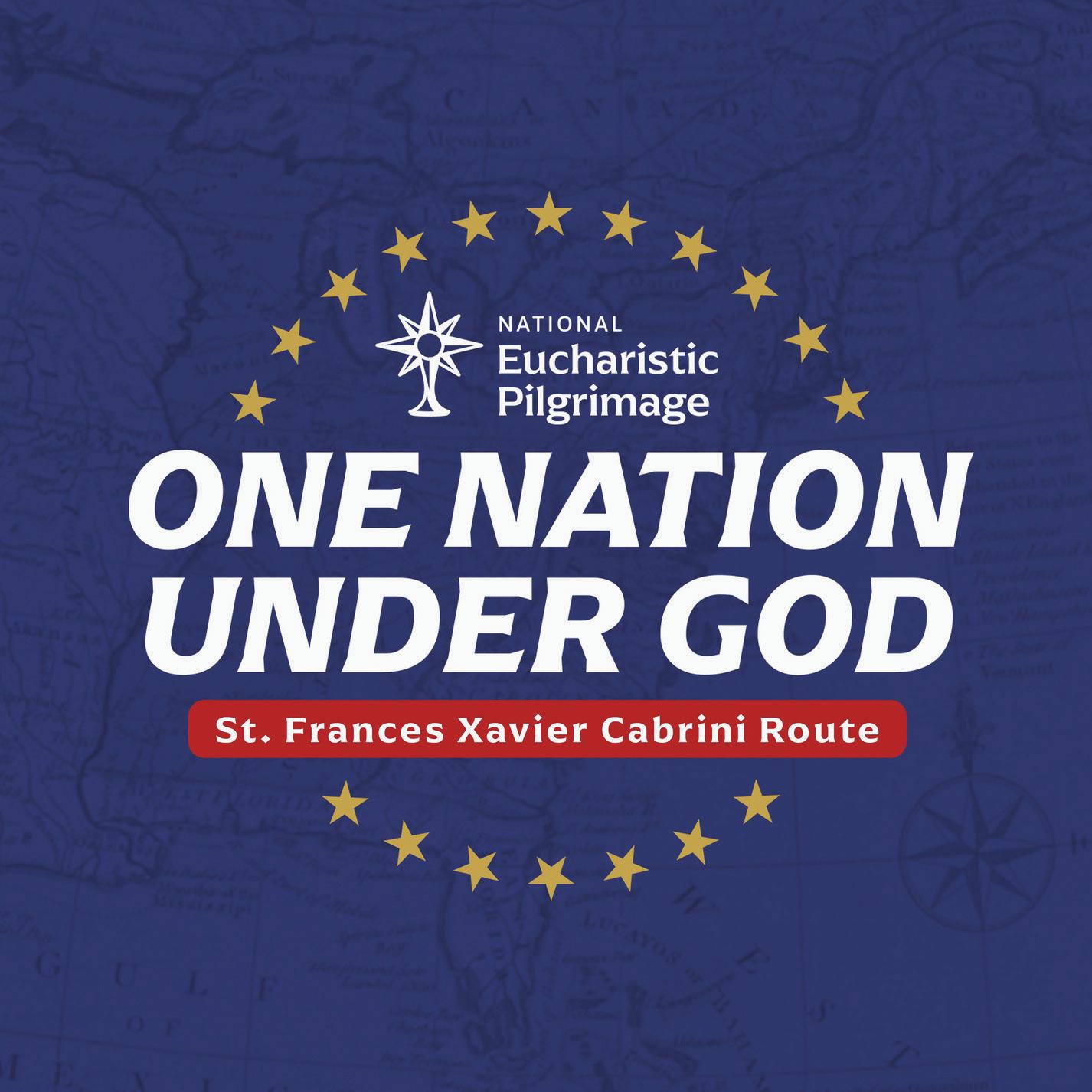
May 30 - June 2
Monroe | Charlotte | Statesville | Greensboro
Join the Blessed Sacrament on its nationwide pilgrimage through the Diocese of Charlotte
Holy Mass, Eucharistic Adoration PRAY

“Cabrini” movie screening WATCH Support Catholic Charities GIVE
All events are FREE – ever yone welcome!
Meet the Pilgrims:
Pilgrimage stops at:
• Our Lady of Lourdes Church
• St. Vincent de Paul Church
• St. Peter Church
• St. Philip the Apostle Church
• St. Pius X Church
Exclusive screening:
7 p m Sunday, May 31
Free - reser vations required
Co-sponsored by St. Matthew Parish of Charlotte