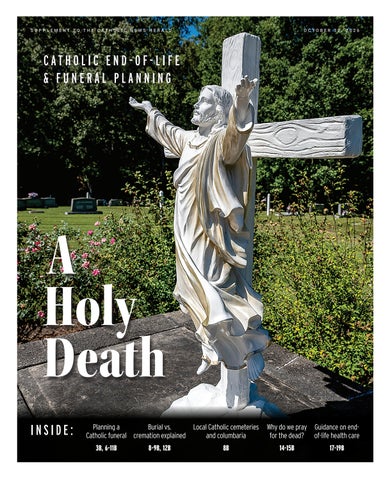
SUPPLEMENT TO THE CATHOLIC NEWS HERALD
OCTOBER 30, 2026
CATHOLIC END-OF-LIFE & FUNERAL PLANNING
A Holy Death INSIDE:
Planning a Burial vs. Local Catholic cemeteries Catholic funeral cremation explained and columbaria 3B, 6-11B
8-9B, 12B
8B
Why do we pray Guidance on endfor the dead? of-life health care 14-15B
17-19B
2B
catholicnewsherald.com | October 30, 2026 CATHOLIC NEWS HERALD
What Catholics believe about the last four things DAVID WERNING OSV News
A
t the end of our earthly lives, our faith tells us there will be four last things: death, judgment, hell and heaven. Reflecting on such topics in
November is appropriate. Clearly, bringing Jesus’ saving acts to bear upon the four last things makes all the difference.
FEDERIGO FEDERIGHI
“The Last Judgment,” painted between 1336 and 1341 by Buonamico Buffalmacco, is located in the Camposanto Cemetery in Pisa, Italy.
Without faith, death can be seen in a merely utilitarian way. Rather than being an experience that one “lives,” including reflecting on it and preparing for it, death becomes something to be forestalled at all costs. The Christian sees the four last things as parts of a very real and profoundly meaningful life with God that extends beyond the grave. Indeed, life cannot be understood fully without acknowledging all four. Each of them reflects God’s love and mercy and justice in its own way. Given the promises of Jesus – that He would, once and for all, destroy the power of death and open the gates of heaven – every Christian should develop a healthy appreciation of the last things.
Death Among the four last things, death is seen by both believers and nonbelievers as the end of the physical existence human beings enjoy on this earth, but that’s where the agreement ends. A faithless view stops at the grave. The Catholic Church, on the other hand, sees death within the context of God’s revelation. Based on Scripture and tradition, and ultimately on Jesus’ witness, the Church recognizes death as the just punishment for the freely chosen sins of human beings.
God desired sons and daughters who would choose freely to love each other and their Creator. Human beings, however, instead invited death into the world by committing the original sin: rejecting the world as
‘The Christian life sees the four last things as parts of a very real and profoundly meaningful life with God.’ God created it and asserting themselves as equals to God. Hence the separation from God and the loss of mortal life. God responds by honoring the relationship with human beings, even though they did not. In a word, God’s response is Jesus. Jesus has saved the world through His life, death and resurrection. Human beings now can accept salvation, to turn back to God by receiving His forgiveness and yielding to His will and, after dying themselves, to enter eternal life. Understood in the light of Jesus, death takes on a new meaning. It no longer has power over a person who abides in Jesus. Therefore, death can be greeted with serenity
when it comes. Passing from this life to the next is simply moving from one way of living in Jesus to another. The meaning is this: For one who remains faithful to Jesus, life is changed, not ended, at death.
Judgment The Church’s teaching on death can have both a comforting and sobering effect. It is comforting to know that life continues, but the fact that one’s time on this earth is limited should bring a weightiness to one’s decisions. The basic meaning of the Church’s teaching about judgment is that the choices one makes have value. God determines the value of one’s choices and metes out the appropriate reward or punishment. This teaching tends to evoke two dominant feelings: fear and satisfaction. Fear is not a bad feeling to have if one is living a sinful life; it might even prompt one toward conversion. Fear, in the sense of awe, is appropriate, too, for God can judge everyone and every act in perfect justice and mercy. Satisfaction is the other common feeling, which is good if by “satisfaction” one means a sense of contentment about God’s ultimate victory over all evil. LAST THINGS, SEE PAGE 4B
October 30, 2026 | catholicnewsherald.com CATHOLIC NEWS HERALDI
3B
Understanding and planning Catholic funerals MICHAEL R. HEINLEIN OSV News
C
atholic funerals express the Christian hope in eternal life and the resurrection of the body on the last day. Every component of Catholic funeral rites should express these fundamental beliefs and hopes. Instead of what sometimes is called “a
celebration of life,” a funeral is really a privileged opportunity to return to God the gift of the deceased, hoping to usher them into paradise with the aid of our prayers. Our love for the departed is expressed after death, above all else, in our prayer for them.
LOLA GOMEZZ | CNS
Pallbearers carry the casket of Pope Francis into the Basilica of St. Mary Major in Rome April 26, 2025, ahead of his burial. No matter how simple or elaborate a Catholic funeral is, its basic aspects remain the same. Whenever possible, the church recommends that the family should be involved in planning the funeral rites – from choices of texts and readings to music and liturgical ministers. Parish staff should guide family members through the process. Death is a new beginning for Christians. “In the face of death, the Church confidently proclaims that God has created each person for eternal life and that Jesus, the Son of God, by his death and resurrection, had broken the chains of sin and death that bound humanity” (Order of Christian Funerals (OCF), 1). This maxim guides the Christian approach to funerals. There needs to be direct communication with the parish and funeral home. Usually, funeral homes are fully aware of each parish’s expectations and regulations. But it is important to be in communication with the parish directly.
MAKING DECISIONS
One of the first decisions to be made is whether the deceased will be buried or cremated. The church’s tradition prefers burial over cremation. However, cremation is allowed, so long as this option is not chosen to express anything contrary to the hope in the resurrection of the body. More and more families are opting for cremation today with hopes to decrease funeral expenses. In either case, a place of burial needs to be chosen.
Bodies are to treated in a fitting and dignified way, consonant with the human dignity that should be afforded everyone, as we are made in the image of God. Cremated remains must be buried – not placed in the home, spread on land or at sea, etc. This need not be only in a cemetery grave, but perhaps a parish columbarium
‘The wake also is a time for devotions that might have been significant in the faith life of the deceased.’ – or niches, akin to mausoleums. Burial at sea is also permitted, so long as the body or cremated remains are in a sealed container (not spread openly). In cases of burial, choices regarding attire should recall the respect to be shown toward the body. Consideration should be given to display some Christian symbols in or near the casket at the time of a wake or to be buried with the deceased, such as a crucifix, rosary or Bible.
The church advises that, where possible, friends and family should be included in taking part in the preparation of the body. It is preferable that a funeral Mass be celebrated in the presence of the body of the deceased, but not required. As the Order of Christian Funerals states, “The Mass, the memorial of Christ’s death and resurrection, is the principal celebration of the Christian funeral.” There are times, however, that a funeral Mass might not be preferable or might not be permitted. This should be discussed with parish staff during the planning stages. If a funeral Mass is not chosen, it is desirable that a memorial Mass should be scheduled for the deceased’s intention at a later date. If Mass is not chosen, a funeral Liturgy of the Word and final commendation of the deceased is celebrated. These may be conducted at the church, the funeral home, in a chapel at the cemetery or even at the graveside.
WAKES AS PRAYER
Wakes, or viewings, are opportunities for family and friends to come together, console one another, and recall the impact the deceased had on them. Though typically in a funeral home, this is sometimes conducted in a church facility. Wakes find their origins in the Christian celebration of FUNERALS, SEE PAGE 4B
4B
catholicnewsherald.com | October 30, 2026 CATHOLIC NEWS HERALD
LAST THINGS FROM PAGE 2B
Hell After a person has been judged, he or she will spend eternity in one of two states: hell or heaven. (Many people think of “hell” and “heaven” as places, but they are more accurately denoted vis-à-vis the relationship with God.) Hell is defined by the Church as the “state of definitive self-exclusion from communion with God and the blessed” (CCC 1033). God’s judgment in such a case would be to allow the person’s choice to take effect, as the Catechism relates: “God predestines no one to go to hell; for this, a willful turning away from God (a mortal sin) is necessary, and persistence in it until the end” (CCC 1037). The very mention of “hell” can cause some people to cry “unfair.” How could a loving and merciful God allow anyone to suffer eternal damnation? Other people ignore hell and maintain that Jesus, who loves everyone, will also save everyone. To understand hell, the Church directs people to the mystery of freedom, which is a gift human beings have from God. It enables the person “to initiate and control his own actions” (CCC 1730). But freedom also means that the person is responsible for his or her choices. Ultimately, saying no to hell means saying yes to God. Again, God does not want robots who are forced to love Him, but true sons and daughters who choose to love Him and their brothers and sisters in freedom. Nevertheless, if they have the freedom to
love, then they also must have the freedom not to love. The latter leads to hell.
Heaven The alternative to hell is heaven: “This perfect life with the Most Holy Trinity – this communion of life and love with the Trinity, with the Virgin Mary, the angels and all the blessed – is called ‘heaven.’ Heaven is the ultimate end and fulfillment of the deepest longings, the state of supreme, definitive happiness” (CCC 1024). And just as a person gets to hell by how he or she lives on earth, so it is with heaven. The crucial difference is that the person who chooses heaven uses his or her freedom to make every effort at yielding to and accepting God’s grace. Another difference is that a person can get to hell by oneself, but getting to heaven involves the whole body of Christ, as St. Paul reminded the Corinthians: “encourage one another and build one another up” (1 Thes 5:11). The essence of heaven is the relationship that human beings enjoy with the Holy Trinity. If a person joins this work now, he or she will experience its perfection in heaven. The four last things properly understood in the context of Jesus’ life, death and resurrection need not be so ominous. For example, the story is told about St. Bonaventure eating a meal with his fellow friars. One of them asks Bonaventure what he would do if Jesus were to initiate the Last Judgment at that very moment. And Bonaventure answers, “I’d finish eating my soup.” It captures well the peace, even in the face of death and judgment, of one who abides in Jesus.
FUNERALS FROM PAGE 3B
vigils, often associated with major events or feasts. The vigil for the dead is intended to be dedicated to prayer for the deceased. The church supplies a liturgical rite for wakes to be celebrated by a sacred minister of the church; they may be celebrated by a lay minister in some cases. This is a combination of readings, a brief homily or reflection, prayers and possibly music. The wake also is a time for devotions that might have been significant in the faith life of the deceased, such as the rosary or the Divine Mercy chaplet. Another option for the wake is to celebrate the Office of the Dead from the Liturgy of the Hours – the church’s daily prayer, composed of psalms, readings and prayers.
GOD SPEAKS THROUGH READINGS
During the funeral, the readings from Scripture “provide the family and the community with an opportunity to hear God speak to them in their needs, sorrows, fears and hopes” (OCF, 22). There are four readings for a Catholic funeral. The parish staff usually provides families with readings from which they can choose. The readings should be one each from the Old and New Testaments (though during the Easter season both readings come from the New Testament) in addition to a Gospel passage. There also is a psalm, which is usually sung. Be aware that there are a variety of readings, particularly for use in unique or special circumstances. Special prayers are a key part of the liturgy. The orations of the presiding
minister address God on behalf of the entire church in their prayer for the deceased. In addition to general orations, there are a variety of options that may be suited to more specific circumstances – such as for a young person, for one who suffered a long illness or for one who died suddenly, etc. The music chosen for a Christian funeral “should express the paschal mystery of the Lord’s suffering, death, and triumph over death and should be related to the readings from Scripture” (OCF, 30). As a resource to those planning funerals, many parishes will often have a list of appropriate hymns. “The music at funerals should support, console, and uplift the participants” (31). There are normally three hymns chosen for use: at the entrance, at the preparation of the gifts and at the reception of Communion, in addition to musical settings for the Mass responses. There also is what is called the song of farewell, sung at the end of the funeral Mass during the final commendation. Moments of silence are important, too, to “permit the assembly to reflect upon the word of God and the meaning of the celebration” (OCF, 34). Because many roles for volunteers at funerals are liturgical, great care must be taken to ensure that these ministers are well trained and suitable. You may wish to choose readers for the first and second readings, to present the gifts at the offertory or to serve the Mass. In addition to liturgical ministers, there might be the need for pallbearers (usually six) or representatives of the family or close friends to place the pall and Christian symbols on the casket or near the cremated remains.
CF CC Carolina Funeral Service & Cremation Center Funeral Service Direct Cremation Church Services
Cremation Services International Shipping of the deceased
Pre-Planned & Pre-Paid Arrangements
Steve Kuzma Funeral Service Licensee
Leslie Pina Office Administrator & Hispanic Relations Funeral Service Intern (se habla español)
5505 Monroe Road, Charlotte, NC 28212 | 704-568-0023 cfccbusiness@carolinafuneral.com www.carolinafuneral.com
October 30, 2026 | catholicnewsherald.com CATHOLIC NEWS HERALDI
5B
How to help a grieving friend LORENE HANLEY DUQUIN OSV News
Some people know instinctively how to help a grieving person. But for most of us, dealing with someone else’s grief is a little more uncomfortable. We might be at a loss for words. We might be uncertain about what to do. We might not know how to respond to the raw emotions a grieving person exudes. Our greatest temptation might be to avoid the person or ignore the situation. But that is the worst thing we can do. The word “bereavement” means “to be torn apart.” It describes the deep emotional wound caused by the death of a loved one. Grief is not an illness or a disease. It is a normal human reaction to the painful void that death creates. Grief is the process by which healing takes place. Each person experiences grief differently, but most people find themselves struggling through five key areas: accepting the reality of the death, feeling the pain of loss, adjusting to life without the person, repositioning the person as a memory and finding new meaning in life.
HELP BY LISTENING
There is no magic formula for dealing with a grieving person. The best way to reach out to someone will depend on your relationship with that person and where he or she is in the grieving process. If you don’t have a close relationship with the person grieving, you still might be the first person they have seen since the news of their loss. If the death just occurred, let the person know that you are saddened to hear the news. Expressions of genuine sympathy offer the assurance that someone else cares. You will know instantly whether the grieving person wants to share the details of what happened. Most people in the early stages of grief struggle with shock and disbelief. Telling the story of what happened allows them to come to grips with the reality of the death. You can help by listening. A good listener doesn’t interrupt or try to change the way the person is feeling. A good listener just listens. When grieving people begin to share their story, they sometimes get emotional. Assure the person that it’s OK to cry or to express anger or frustration. Don’t say: “I know how you feel,” “You’ve got to be strong.” “It’s a blessing in disguise.” “God never gives us more than we can handle.” Instead, say: “I can’t imagine how painful this must be.” “It’s okay to cry.” “What I’m hearing you say is.” “Anytime you want to talk.” Immediately after a death, grieving people are often in a state of shock. They may be
uncertain of what needs to be done. You can ask if they need help: Making phone calls to let family members and friends know what happened; shopping for food or supplies; preparing food; caring for children or pets; picking up family members from the airport; helping with arrangements for the wake, funeral or burial; creating memory boards with photos for the wake; or designing a program for the funeral Mass.
SHARE YOUR MEMORIES
A wake allows people to pay their last respects to the deceased and to comfort the bereaved. You can help by sharing your own memories and ways that person impacted your life. These kinds of stories add to the memory bank of grieving family members. You can also be present for prayers at the wake service or for the recitation of the rosary or Divine Mercy Chaplet. Keep the grieving family members in your prayers. If you are unable to attend the wake, sending a sympathy card or a Mass card with a heartfelt note can be a real consolation for the family. Some funeral homes also invite online messages. A grieving person will also appreciate your presence at the funeral. Catholic funerals allow us to give the person to God with renewed hope in the resurrection of the body and eternal life. You can also help by serving as a greeter and distributing funeral programs, taking part in an honor guard, or helping with the liturgy as an altar server, reader or Eucharistic minister. Some parishes offer
a funeral meal after the burial. Or you can assist at a family reception by bringing food, helping with set up and clean up, and just being available for any need that arises. The grieving need a good friend long after the funeral. Within a few weeks, visits, cards, meals and other special attention come to an end. Grieving people often feel alone and afraid. They may experience insomnia, fatigue, headaches and other physical symptoms of grief. They may suffer from mood swings, restlessness, forgetfulness and the inability to concentrate.
What most people do not realize is that the most difficult time for a grieving person is between the fourth and the ninth month after the death. Holidays and anniversaries can be particularly painful. As special days approach, memories of past holidays surface and feelings of loss intensify. Your presence throughout the year after the death can make a profound difference in the life of a grieving person. Meanwhile, honor confidentiality. When grieving people share their fears, failures, disappointments and difficulties, they expect that you will not tell anyone else what they said. The simple rule of thumb is: Don’t share what anyone has told you unless you have the person’s explicit permission. The only exception is if you suspect that the person needs outside intervention. For example, you might feel the need to seek help for someone if there are signs of excessive weight loss, neglecting basic self-care, the use of drugs or alcohol, or suicidal thoughts. These may be indications of clinical depression. Grief has no timetable. People grieve at different intensities for different lengths of time. You will know that someone is nearing the end of their bereavement when they show signs that they are adjusting to their new life: They begin to laugh again, they express gratitude, their energy increases, they show interest in doing things, their memories become comforting instead of painful, and they feel a sense of hope for the future. Until then, remember: A good listener just listens.
LEGACY OF FAITH • MAKE A LASTING IMPACT • STRENGTHEN THE MISSION
When you don’t have words...
• INCLUDE THE CHURCH IN YOUR ESTATE PLAN
Hope’s Harbor offers God’s comfort. Scripture is paired with space for reflection in this award-winning journal by Catholic News Herald Editor Trish Stukbauer. Use it for your grief journey or get it for someone you love.
hopesharbor.carrd.co
FOR MORE INFORMATION, please contact
Gina Rhodes
Heidi Kelley
Director of Planned Giving
Planned Giving Officer
(704) 370-3364
(704) 370-3348
gmrhodes@rcdoc.org
hmkelley@rcdoc.org
Foundation of the Diocese of Charlotte
6B
catholicnewsherald.com | October 30, 2026 CATHOLIC NEWS HERALD
Catholic funeral rites explained ‘At the death of a Christian, whose life of faith was begun Introduction Upon the death of a loved one, please contact the funeral home so that they may assist you in in the waters making the necessary funeral arrangements. We encourage parishioners to do pre-planning of baptism and to make a difficult time easier for your family. Funeral home services are very willing to help in this process. strengthened at youNormally, the funeral home will contact the parish to secure the date and time of the funeral. the Eucharistic At St. Mark we will do everything we can to accommodate family needs, but please know that a busy parish the church may be in use for table, the Church asother events during the time period first chosen. Once the date and time have been decided, the family will be contacted by one of the parish intercedes priests or deacons to plan the Mass of Christian Burial and other funeral rites. This involves on behalf of choosing readings, hymnody and discussing how family and friends might be involved in the funeral liturgy. While there is always an the deceased element of the funeral rites that are personalized to reflect the life of the deceased, it should During a Mass of Christian Burial, a pall is draped over the coffin of the deceased to symbolize the baptismal garment, and a because of its always be remembered that Christians celebrate crucifix and a Bible – symbols of Christian life – are placed on top. Before the final commendation, the deceased is sprinkled the funeral rites to offer worship, praise and with holy water and incensed. The sprinkling is a reminder that through baptism the person was marked for eternal life and to God for the gift of a life which incensation signifies respect for the body as the temple of the Holy Spirit. confident belief thanksgiving has now been returned to God, the author of life and the hope of the just. The Mass, the that death is memorial of Christ’s death and resurrection, is united in the kingdom of light and peace (“Order Church, are to be practicing members of the the principal celebration of the Christian funeral of Christian Funerals,” no. 129). Catholic Church. (“Order of Christian Funerals,” no. 5). The funeral Mass includes the reception of not the end, nor Catholic funeral rites consist of three principal the body, the celebration of the Liturgy of the LITURGY OF THE EUCHARIST parts or movements: the vigil or wake, the Mass Word, the Liturgy of the Eucharist, and final At the funeral Mass, the community having Christian Burial, and the burial rites. Each of commendation and farewell. been nourished by the Word of God, turns for does it break the ofthese is discussed briefly here: spiritual nourishment to the Eucharistic sacrifice in which the community with the priest offers to bonds forged in RECEPTION OF THE BODY the Father the sacrifice of the New Covenant. The The rite of reception takes place at the Liturgy of the Eucharist takes place in the usual beginning of the funeral liturgy or Mass. manner. Members of the family or friends of the life.’ Vigil for the Deceased It begins with the greeting of the family, the deceased should bring the gifts to the altar. EDITOR’S NOTE: St. Mark Church in Huntersville has produced this guide to funeral planning that is applicable for Catholics. While each pastor sets his own guidelines within the Church’s “Order of Christian Funerals,” we offer this guide as a reference for your family to consider and discuss:
MARY ANN LUEDTKE | CATHOLIC NEWS HERALD
Order of Christian Funerals, no. 4
More online At www.usccb.org/ prayer-and-worship/ sacraments-andsacramentals/ bereavement-andfunerals: Get more information on Catholic funeral guidelines, prayers, suggested readings at funeral Masses, and more
At www. catholicsensibility. wordpress.com/ funeral-rites: Read the entire Order of Christian Funerals as well as explanations of each section
(or Wake)
The Vigil for the Deceased is the principal rite celebrated by the Christian community in the time after death and before the funeral liturgy. “At the vigil the Christian community keeps watch with the family in prayer to the God of mercy and finds strength in Christ’s presence,” “Order of Christian Funerals,” no. 56.) The Vigil can be celebrated at the funeral home, the home of the deceased or at the parish church. During the course of the Vigil service, there will be a brief proclamation of the Word of God, intercessory prayer, and blessing. If someone in the family would like to offer a personal remembrance of the deceased (eulogy) this may be done at the conclusion of the Vigil service.
sprinkling of the coffin with holy water as a reminder of baptism, and the placing of the pall which symbolizes the baptismal garment. If the family so chooses, they may drape the pall over the coffin of the deceased. The entrance procession follows with the ministers leading the coffin and family members into the church. During the procession an entrance hymn will be sung. The family remains standing with the remainder of the congregation in the pews until the conclusion of the opening prayer. It is our practice at St. Mark to place a crucifix and Bible on the coffin at the conclusion of the entrance procession. These symbols of Christian life are carried in the entrance procession and can be placed on the coffin by family members if the family chooses to do so. Otherwise, they will be placed by one of the ministers.
Funeral Liturgy/ Mass of Christian Burial
LITURGY OF THE WORD
The funeral liturgy is the central celebration of the Christian community for the deceased. At the funeral liturgy the community gathers with the family and friends of the deceased to give praise and thanks to God for Christ’s victory over sin and death, to commend the deceased to God’s tender mercy and compassion, and to seek strength in the proclamation of the Paschal Mystery. Through the Holy Spirit the community is joined together in faith as one Body in Christ to reaffirm in sign and symbol, word and gesture that each believer through baptism shares in Christ’s death and resurrection and can look for the day when all the elect will be raised up and
After the opening prayer, the Liturgy of the Word begins. The readings include an Old Testament reading (during the Easter season the first reading is taken from the Acts of the Apostles or the Book of Revelation), a Responsorial Psalm (sung), a New Testament reading and a Gospel reading. The Order of Christian Funerals provides a complete listing of the Scripture readings that can be used in the funeral rites, and the family is encouraged to assist in making the selections of readings for the funeral. In addition, members of the family or friends of the deceased are invited to assist by serving as readers. During the funeral Mass, those who read, since they are exercising a ministry of the
FINAL COMMENDATION AND FAREWELL
The final commendation is a final farewell by the members of the community, an act of respect for one of their members, whom they entrust to the tender and merciful embrace of God. During the rite, the body is again sprinkled with holy water and incensed. The sprinkling is a reminder that through baptism the person was marked for eternal life and incensation signifies respect for the body as the temple of the Holy Spirit.
PROCESSION TO THE PLACE OF COMMITTAL
At the conclusion of the funeral liturgy, the procession is formed and the body is accompanied to the place of committal. This final procession of the funeral rite mirrors the journey of human life as a pilgrimage to God’s kingdom of peace and light, the new and eternal Jerusalem.
Rite of Committal The rite of committal, the conclusion of the funeral rites, is the final act of the community of faith in caring for the body of its deceased member. In committing the body to its resting place, the community expresses its hope that, with all who have gone before marked with the sign of faith, the deceased awaits the glory of the resurrection. It normally takes place beside the grave or mausoleum where the remains of the deceased are to be placed. — “Funeral Planning Guide for the Mass of Christian Burial,” St. Mark Church in Huntersville
October 30, 2026 | catholicnewsherald.com CATHOLIC NEWS HERALDI
The right to a funeral liturgy Church law stipulates that funeral services are a right, not a privilege, of all members of the Church, both the faithful and the catechumens (Canons 1176; 1183, §1). The Order of Christian Funerals also provides for the celebration of funeral rites for children whose parents intended them to be baptized (Canon 1183, §2). “Christians celebrate the funeral rites to offer worship, praise, and thanksgiving to God for the gift of a life which has now been returned to God, the author of life and the hope of the just. The Mass, the memorial of Christ’s death and resurrection, is the principal celebration of the Christian funeral.” (“Order of Christian Funerals,” no. 5) “At the funeral liturgy the community gathers with the family and friends of the deceased … – to give praise and thanks to God for Christ’s victory over sin and death, – to commend the deceased to God’s tender mercy and compassion, – and to seek strength in the proclamation of the paschal mystery. Through the Holy Spirit the community is joined together in faith as one Body in Christ to reaffirm in sign and symbol, word and gesture that each believer through baptism shares in Christ’s death and resurrection and can look to the day when all the elect will be raised up and united in the kingdom of light and peace.” (“Order of Christian Funerals,” no. 129)
‘As you consider the funeral, try to remember that planning a funeral is not a burden, but a privilege. Think of the funeral as a gift to the person who died as well as his friends and family. It is a chance for all to think about and express the value of the life that was lived. It is also a chance to say goodbye.’ “Preparing for Funeral Liturgies,” St. Matthew Church in Charlotte
A mourner has some quiet time at the grave of a loved one at Northlake Memorial Gardens in Huntersville.
Non-practicing Catholics may receive Catholic funerals It is an unfortunate reality that many baptized Catholics no longer practice their faith and may consider themselves to have been away from the Church for too long to be ever welcomed again by the Church. Such individuals or their families may feel uncomfortable in a church and ultimately decide against having a Catholic funeral. By our baptism, however, we have been made equal in dignity before the Lord, and the Church, our Mother, bears the suffering of all those who became her sons and daughters through baptism. Thus, the Church offers funeral rites (including a funeral Mass) even for nonpracticing Catholics and, under certain circumstances, for non-Catholic Christians. Although the deceased may not have participated fully in the life of the Church on earth, the Church longs for her separated children to share in Christ’s blessings. She desires to pray for them and with their loved ones so that their sins may be forgiven and they may dwell forever in the presence of God in heaven. — “Catholic Funeral Planning Guide,” Diocese of Portland, Maine; Canon 1183, §3
What about miscarried or stillborn babies? Depending on the possibility of your collecting the remains, the baby should be named and buried. If you are in a hospital, the remains of the baby will be sent to the pathologist. You should request that you receive the remains. Most hospitals have little caskets which they offer you. If the baby is more developed you may need to obtain a larger casket from a funeral director. You should ask your pastor for a Mass of Christian Burial and bury the baby appropriately and in a marked grave. — “Catholic Funeral Guide,” St. Michael Church in Gastonia
7B
PHOTO PROVIDED BY AMY BURGER
‘Now and at the hour of our death’ We prepare for eternal life by choosing to love and follow God now, in our daily lives and decisions. For example, through prayer and regular reception of the sacraments, especially confession and the Eucharist, we obtain grace to live in ever-deeper communion with God and with one another in lives of faith, charity and justice. We ask for Our Blessed Mother’s help now, and we entrust ourselves to her further as we “surrender ‘the hour of our death’ wholly to her care.” (Catechism of the Catholic Church, 2677) — USCCB
What is the ordinary manner of preparing for death and burial? n Save and/or purchase insurance to properly provide for a casket, funeral services and burial. n Remember that the Church desires the full body to be present for the Mass of Christian Burial and for the body to be buried in a cemetery. n Leave instructions that someone will call the priest when death seems close. n Ensure that someone will call the priest for the last rites (confession, anointing and Communion) before death. n Ensure that someone will call the priest when death occurs. n The Prayers for the Dead are to be prayed. (Editor’s note: See pages 12-13B for more info.) n The body is prepared for burial by the funeral directors. n Arrange for someone to meet with the funeral director to begin preparing for the funeral rites.
How should I prepare for a good death? n Live a Catholic sacramental life. n Develop a Catholic understanding of life and death. n Pray to St. Joseph, patron of a happy death. n Develop an understanding of the Catholic funeral rites. n Prepare with a good confession, the anointing of the sick, and Communion as “Viaticum.” Make sure someone
calls the priest. If you are going to have surgery which requires general anesthetic, ask the priest to hear your confession and administer the sacrament of the sick before you go to the hospital. n If you are going to be in the hospital or any nursing care facility, be sure to list the parish priest, deacon and others from the parish whom you wish to visit; otherwise, they will not be able. n Make advanced plans with your parish priest for the funeral rites; read the policies of your parish for funerals. n Save for the expenses of a proper Catholic funeral; most people have insurance policies for this. n Talk with family members and your attorney. Be sure your legal documents give a Catholic understanding of caring for the sick and dying. Be sure your will provides for food and water to be given until you cannot assimilate it as a part of ordinary care when appropriate. Appropriate ordinary means of life support should also be given where there is hope of cure. Think of appointing a Health Care Power of Attorney with your instructions to be followed. (Editor’s note: See pages 14-17B for more info.) n Make provisions for your funeral in your will; remember that your requests must be in agreement with your parish priest and the Church. n Contact a funeral home to make pre-arrangements. n Purchase a burial site. — “Catholic Funeral Guide,” St. Michael Church in Gastonia
Joseph, Patron of Dying and Solace of the Afflicted What a blessed death to see God before you die and for God Himself to tell you to go. This was Joseph’s gift from his Son, who would hand His father over to His Father. Thus has Christ entrusted Joseph to have particular intercessory power for all those at the moment of death.
More online At www.yearofstjoseph.org: Learn more about St. Joseph’s virtues and titles, find intercessory prayers to St. Joseph, and more educational resources from the Diocese of Charlotte’s Year of St. Joseph
8B
catholicnewsherald.com | October 30, 2026 CATHOLIC NEWS HERALD
BURIAL VS. CREMATION
Catholic cemeteries are important in the life of the Church. Cemeteries St. Frances of Rome Mission, Sparta St. Helen Mission, Spencer Mountain (parishioners only) St. Francis of Assisi Church, Jefferson
Cemeteries with columbaria Our Lady of Annunciation, Albemarle Immaculate Conception Mission, Canton Holy Family Church, Clemmons (parishioners only) Holy Cross Church, Kernersville Sacred Heart Church, Salisbury (Right) St. James the Greater Church in Concord is one of seven parishes in the diocese that have both a traditional cemetery and a columbaria. Other parishes have one or the other option.
St. James the Greater Church, Concord St. John the Evangelist Church, Waynesville
Columbaria only St. Eugene Church, Asheville (parishioners only)
PHOTO PROVIDED
St. Elizabeth Church, Boone
Cemeteries vs. columbaria in the Diocese of Charlotte? Did you know? In general in the United States, burial options include: in-ground burial with monument graves, flush marker graves, lawn crypts or family estate lots; above-ground burial in mausoleums; and cremation with interment in mausoleum niches, columbaria, or in-ground in cremation graves or lawn crypts.
Church law (Canon 1240) stipulates, “Where possible, the Church is to have its own cemeteries or at least areas in civil cemeteries that are designated for the deceased members of the faithful and properly blessed.” Because of limited space at many parishes across the diocese, a cemetery on parish grounds is not always practicable. Identifiably Catholic sections in public cemeteries have become an alternative option, as well as columbaria on parish grounds. But columbaria for cremated remains cannot be the only option provided. Diocesan policy states: “If a parish wishes to make a columbarium available to the faithful, it will also make available at the same location as the columbarium, spaces for burial of the bodies of the deceased. The number of spaces available for placing cremated remains in a columbarium shall not be more than the number of spaces available for burial of bodies of the deceased. The expectation is that more spaces will be available for burial of the bodies of the deceased than spaces in a columbarium for the placing of cremated remains, since burial of the body is the norm of Christian burial.” At www.catholicnewsherald.com: Read the Diocese of Charlotte’s policy on cemeteries and columbaria Every Catholic cemetery features a crucifix as a reminder of Christ’s victory over death and the promise of our own resurrection. Pictured is Sacred Heart Parish cemetery in Salisbury. FILE | CATHOLIC NEWS HERALD
Sacred Heart Church, Brevard (full) St. Joan of Arc Church, Candler (full) St. Gabriel Church, Charlotte (full) St. Matthew Church, Charlotte St. Peter Church, Charlotte St. Thomas Aquinas Church, Charlotte St. Vincent de Paul Church, Charlotte (full) Immaculate Heart of Mary Mission, Hayesville St. Aloysius Church, Hickory Christ the King Church, High Point Immaculate Heart of Mary Church, High Point (full) Our Lady of the Mountains Mission, Highlands St. Paul the Apostle Church, Greensboro St. Pius X Church, Greensboro (full, with waiting list) St. Margaret of Scotland Church, Maggie Valley (full) St. Luke Church, Mint Hill (full) St. William Church, Murphy St. Margaret Mary Church, Swannanoa St. Leo the Great Church, Winston-Salem (full) St. Francis Springs Prayer Center, Stoneville
Public cemeteries with Catholic sections Stanly Gardens, Albemarle
‘The Church earnestly recommends that the pious custom of burying the bodies of the deceased be observed; nevertheless, the Church does not prohibit cremation unless it was chosen for reasons contrary to Christian doctrine.’ Canon 1176, §3
Sharon Memorial Park, Charlotte Westlawn Cemetery, Clemmons Mt. Zion Community Cemetery, Cornelius Northlake Memorial Gardens, Huntersville Forest Lawn East Cemetery, Matthews
October 30, 2026 | catholicnewsherald.com CATHOLIC NEWS HERALDI
9B
BURIAL VS. CREMATION
If cremation is desired for legitimate reasons, the Church prefers that the funeral liturgy occur before cremation. Cremated remains are always to be buried or interred.
‘Although cremation is now permitted by the Church, it does not enjoy the same value as burial of the body. The Church clearly prefers and urges that the body of the deceased be present for the funeral rites, since the presence of the human body better expresses the values which the Church affirms in those rites.
How should a Catholic plan for cremation? First , discuss your questions with a knowledgeable pastor or parish staff person. Second, if your decision is to be cremated, make your wishes known in your will or in documents designed to help plan your funeral and burial. Provide copies of these documents to family members, your pastor, funeral home, or Catholic cemetery. Lastly, as you plan, keep in mind the therapeutic value to your family of celebrating the full funeral liturgy with the body present.
When should cremation take place? The Church prefers that cremation take place after the full funeral liturgy with the body. Sometimes, however, it is not possible for the body to be present for the funeral liturgy. When extraordinary circumstances make the cremation of the body the only feasible choice, pastoral sensitivity must be exercised by all who minister to the family of the deceased. Think of cremation of the body and committal of the remains as the conclusion of a funeral with the body.
What does a Catholic do with the cremated remains after the funeral liturgy is completed? The Church requires that the cremated remains be either buried in the ground in a cemetery or placed in a mausoleum or columbarium, preferably in a Catholic cemetery. The Church recommends that the place of burial or entombment be permanently memorialized with a traditional memorial stone, crypt/niche front, or bronze plaque, minimally marking the name and dates of birth and death of the deceased person. Since the human body was the temple of the Holy Spirit during life, was fed at the Eucharistic table, and will share in the bodily resurrection, contemporary cultural practices like scattering the cremated remains over water or from the air or keeping the cremated remains at home are not considered reverent forms of disposition that the Church requires. Other practices such as commingling cremated remains or dividing up cremated remains among family members or friends are not acceptable for Catholics. — www.catholic-cemeteries.org
TROY C. HULL | CATHOLIC NEWS HERALD
The columbarium at St. James the Greater in Concord is a quiet place to pray and remember.
CREMATION: Q&A on the proper handling of ashes CATHOLIC NEWS SERVICE
WASHINGTON, D.C. — In 1963, the Vatican Congregation for the Doctrine of the Faith issued an instruction permitting cremation as long as it was not done as a sign of denial of the basic Christian belief in the resurrection of the dead. The permission was incorporated into the Code of Canon Law in 1983 and the Code of Canons of the Eastern Churches in 1990. Church law, however, had not specified exactly what should be done with “cremains,” so several bishops’ conferences asked the congregation to provide guidance. That request led to “Ad resurgendum cum Christo” (“To Rise With Christ”), an instruction “regarding the burial of the deceased and the conservation of the ashes in the case of cremation,” issued Oct. 25, 2016. The document was approved by Pope Francis after consultation with other Vatican offices and with bishops’ conferences and the Eastern Churches’ synods of bishops. The document has prompted many Catholics to ask whether it changes any regulations about cremation. Catholic News Service provided some of those questions to the staff of the U.S. Conference of Catholic Bishops’ Secretariat of Divine Worship to be answered: Q: The 2016 document from the Congregation for the Doctrine of the Faith spells out regulations regarding cremation. Does it change anything in how the Church in this country has regulated this issue? A: No, the document from the CDF doesn’t change anything for us in this country. For example, we already have permission to have a funeral Mass in the presence of cremated remains. What the instruction does do, however, is reiterate the Church’s preference for the burial of the body in normal circumstances, and, when cremation is necessary, its insistence that the remains be properly interred. Q: If the document says that traditional burial is preferred, does that mean cremation is wrong? A: If the Church saw cremation as “wrong,” it wouldn’t permit it. Sometimes cremation can truly be necessary. However, the ancient custom and the preference of the Church is to bury the body, whenever possible. Q: What should I do if I’ve already scattered the ashes? A: We can’t change the past, of course, and if you truly didn’t realize at that time that it shouldn’t be
done, then you shouldn’t burden yourself with guilt. Remember that what happens to a person’s body after death has no bearing on what happens when that person’s soul meets the Lord on judgment day. However, you might wish to offer extra prayers for the person’s happy repose. Q: If I plan to donate my body to science, after which it will be cremated, is that OK? What if the laboratory disposes of these ashes? A: This would seem to be a valid reason for cremation. However, it would be important to make sure that arrangements are made for a funeral Mass, and that a trusted relative or friend is able to receive the remains and see to their proper burial. Q: How do I convince my dad to let me bury my mother’s ashes, which he now has at home? A: Only you would know the best way to approach a situation like that, and it would depend a lot on his reasons for keeping the remains and on his own personal faith. Perhaps making him aware of the Church’s preference would be enough to convince him? Or the assurance that his own earthly remains will one day be buried alongside those of his wife? Also, the Vatican’s instruction itself articulates some compelling reasons: “The reservation of the ashes of the departed in a sacred place ensures that they are not excluded from the prayers and remembrance of the Christian community. It prevents the faithful departed from being forgotten, or their remains from being shown a lack of respect…” (5). Q: Many people die and are never buried properly. Perhaps they die at sea or in an explosion or whatever. Why is the Vatican worried about something like this when there are so many other problems in the world? A: This instruction isn’t concerned with those kinds of situations. Burial at sea is necessary at times, as is cremation. The main purpose for this instruction is to help foster a healthy respect for the human body, even after death, especially in light of the move in recent years away from traditional burial in favor of more expedient and economical means. Where contemporary culture today may well question what difference it makes, the Church is reminding us to recall that the human body is an integral part of the human person deserving of respect even after death. The earliest Christians buried the bodies of their dead, and this set them apart from many of their contemporaries. We bury our dead out of reverence for God our Creator, and as a sign that we look forward to the resurrection on the last day.
Order of Christian Funerals’ Appendix on Cremation, no. 413
‘The cremated remains of a body should be treated with the same respect given to the human body from which they come. This includes the use of a worthy vessel to contain the ashes, the manner in which they are carried, and the care and attention to appropriate placement and transport, and the final disposition. The cremated remains should be buried in a grave or entombed in a mausoleum or columbarium. The practice of scattering cremated remains on the sea, from the air, or on the ground, or keeping cremated remains at the home of a relative or friend of the deceased are not the reverent disposition that the Church requires.’ Order of Christian Funerals’ Appendix on Cremation, no. 417
catholicnewsherald.com | October 30, 2026 10B CATHOLIC NEWS HERALD
Funeral pre-planning guide Use these worksheets to plan your funeral service or as a guide to discuss your wishes with your family Preparing and planning now can assure the type of funeral service appropriate for your loved one. Often times pre-planning and even pre-
funding your funeral arrangements can not only provide peace-of-mind to you, but also to those who suffer emotionally at the time of their loss.
Full name: _____________________________________________________________________________ Social Security Number: __________________________________________________________________________ Date of birth: ________________________________________________________ Place of birth: _____________________________________________________________________________________________________ Father’s name: _________________________________________________________________________ Mother’s maiden name: __________________________________________________________________________ Education: ______________________________________________________________________________________________________________________________________________________________________________ Marital Status: ____ Married
____ Never Married
____ Widowed
____ Divorced
Married to: _____________________________________________________________
Date: ______________________________
Place: ______________________________________________________
Children: ________________________________________________________________________________________________________________________________________________________________________________ Places lived: ___________________________________________________________
Employment: __________________________________________________________
_______________________________________________________________________
_______________________________________________________________________
_______________________________________________________________________
_______________________________________________________________________
Civil, fraternal and other involvement: _____________________________________________________________________________________________________________________________________________________ ________________________________________________________________________________________________________________________________________________________________________________________ If you are a veteran, complete this information or attach copy of discharge: Veteran of which war? _________________________________________________
Place of Enlistment: _______________________ Date of Enlistment: __________
Service Number: _____________________ VA Claim Number: ______________
Place of Discharge: ________________________________
Branch of Service: ____________________ Rank: __________________________
Date of Discharge/Retirement: __________________________________________ County in which my discharge is on file with Clerk/Registrar of Deeds: ______
People to be notified immediately: ________________________________________________________________________________________________________________________________________________________ ________________________________________________________________________________________________________________________________________________________________________________________ Obituary announcement to be sent to: _____________________________________________________________________________________________________________________________________________________
IMPORTANT DOCUMENTS Collect the following important papers and documents, and tell your family where they are kept: * Military discharge * Mortgage(s) and deeds * Will * Birth certificate * Attorney * Bank account information * Insurance policies * Stocks/bonds
* Safe deposit box * Cemetery deed * Living will or advance directive * Durable Power of Attorney
* Health Care Power of Attorney * Computer/website passwords
FUNERAL PRE-PLANNING DETAILS I have a pre-need funeral trust established with: ____________________________________________________________________________________________________________________________________________ I have a funeral insurance policy with: __ ___________________________________________________________________________________________________________________________________________________ I have looked at caskets/urns/burial vaults and would prefer: ___________________________________________________ _____________________________________________________________________________ I have considered a marker or monument and would prefer: ___________________________________________________ ______________________________________________________________________________ Memorials may be made to: ___________________________________________________ ___________________________________________________________________________________________________________
CEMETERY INFORMATION Cemetery preferred: _________________________________________________________________________
Address: _______________________________________________________________
Phone: _________________________________________________________________ I ____ own ____ prefer Type of burial rights: ____ Ground burial
____ Columbarium
____ Mausoleum
____ Lawn crypt
If owned, name of burial right holder is/are: ____________________________________________________________________________________________________________________________ Legal description of burial rights: ____ Lot # ____ Section ____ Row
____ Block
Grave number: __________________________________________________________________
CREMATION I would prefer to be cremated.
____ Yes
If cremation, what type of disposition? ____ Burial
____ No ____ Niche
Cremation vault: ____ Yes
____ No
Donation of organs or body? Describe: ____________________________________________________________________________________________________________________________________________________
October 30, 2026 | catholicnewsherald.com CATHOLIC NEWS HERALDI
11B
Funeral rites planning form FUNERAL HOME: _________________________________________________________________________ Address: ________________________________________________________________________________________ _________________________________________________________________________ Phone: _________________________________________________________________________________________
PLACE OF SERVICE: _______________________________________________________________________________________________________________________________________________________________________ (Church name) (Address)
____ Funeral Mass Casket:
____ Memorial Mass
____ Open during Wake
____ Church Service
____ Cemetery/Chapel
____ Graveside
____ Closed during Wake
Type of casket:
____ Wood
____ Metal
____ Cremation coffin
____ Other: ______________________________________________
Cremation – Type of urn:
____ Wood
____ Bronze
____ Marble
____ Other: ______________________________________________
Clergy (if preferred): _____________________________________________________________________________________________________________________________________________________________________ Musical selections (in keeping with the liturgy; please consult priest or music minister): ________________________________________________________________________________________________________________________________________________________________________________________ ________________________________________________________________________________________________________________________________________________________________________________________ Liturgy of the Word desired readings (please consult priest or parish office): Old Testament: ______________________________________________________________ Responsorial Psalm: _________________________________________________________ New Testament: _____________________________________________________________ Gospel: _____________________________________________________________________ Will family place a pall on casket? Use incense?
____ Yes ____ Yes
____ No ____ No
Lector 1: __________________________________________________________________________________ Lector 2: _________________________________________________________________________________ Prayers of the Faithful: _____________________________________________________________________ Offertory Gifts: ____________________________________________________________________________
____ Cross or Bible placed on casket?
WAKE/COMMITTAL SERVICE Wake/Rosary Service: ____ Yes Viewing: ____ Public
____ No
____ Private
Location: _______________________________________ Officiant: _________________________________________________________________________________
____ None
Participating organizations at Wake or Committal Service (military, fraternal, lodge, etc.): ________________________________________________________________________________________________________________________________________________________________________________________ ________________________________________________________________________________________________________________________________________________________________________________________ Flag (Committal Service only): ____ Draped
____ Folded
Clothing preference: ____ From current wardrobe
____ New
Presented to: ______________________________________________________________________________________________________________ ____ Other: ___________________________________________________
Description/color: ________________________________________________________________________________________________________ Personal accessories:
____ Wedding band ____ Eyeglasses ____ Other
____ Stays on ____ Stays on ____ Stays on
____ or Returned to: ___________________________________________ ____ or Returned to: ___________________________________________ ____ or Returned to: ___________________________________________
Pallbearers: ________________________________________________________________________________________________________________________________________________________________________________________ (Name) (Relationship) (Phone #) ________________________________________________________________________________________________________________________________________________________________________________________ (Name) (Relationship) (Phone #) ________________________________________________________________________________________________________________________________________________________________________________________ (Name) (Relationship) (Phone #) ________________________________________________________________________________________________________________________________________________________________________________________ (Name) (Relationship) (Phone #) ________________________________________________________________________________________________________________________________________________________________________________________ (Name) (Relationship) (Phone #) ________________________________________________________________________________________________________________________________________________________________________________________ (Name) (Relationship) (Phone #) ________________________________________________________________________________________________________________________________________________________________________________________ (Name) (Relationship) (Phone #) ________________________________________________________________________________________________________________________________________________________________________________________ (Name) (Relationship) (Phone #)
SPECIAL INSTRUCTIONS (Include floral preferences, notes, awards, life achievements, pictures, obituary requests, items to be placed with the remains, etc.) ________________________________________________________________________________________________________________________________________________________________________________________ ________________________________________________________________________________________________________________________________________________________________________________________
NOTE: Share a copy of this funeral Mass plan with your family, your funeral home (if you have a pre-plan), and your parish office.
At www.catholicnewsherald.com: Download a copy of these forms to use with any funeral home or funeral pre-planning guide
catholicnewsherald.com | October 30, 2026 12B CATHOLIC NEWS HERALD
BURIAL VS. CREMATION
Water cremation and body composting fail to respect the body as a sacred vessel FATHER NOAH C. CARTER catholicnews@rcdoc.org
In a time when we seemingly embrace new technologies every day, alkaline hydrolysis and body composting have been gaining attention as potential alternatives to the traditional practices of full body burial and total incendiary cremation and interment in the Catholic Church. While these practices have sparked discussion, guidance from the U.S. Conference of Catholic Bishops is clearly not in favor of these methods. Alkaline hydrolysis, sometimes referred to as “water cremation,” “resomation,” or “aquamation,” has been more widely available in recent years from the funeral service industry in the United States. The process involves the reduction of human remains in a heated solution of water and a robust alkaline mixture, which leaves behind minerals and bone fragments that are then collected and returned to the family. In body composting, the human body is placed in plant matter in such a way as to speed the decomposition of the body. This process does not yield any discernable remains to be buried or interred. At the moment, the universal Church has not issued a definitive teaching on these novel practices, but bishops and pastors throughout the world have generally opposed Carter them for many years. The Church has always preferred the burial of the entire body or, otherwise, the committal of the remains of an incendiary cremation in a permanent resting place. This ancient practice is due to the Christian belief that the body is the sacred vessel. The body is animated by a soul directly created by God and endowed with the intellect and will. God spiritually nourishes men and women through their bodily experience of the sacraments that communicate sanctifying grace to the soul. Alkaline hydrolysis and body composting, however, are generally understood to violate the sacredness of the human body, as if the body is ordinary material that can be dissolved or eradicated after this earthly life is finished. Instead, we know that Christ will raise our bodies and transform them in the life to come. Our cemeteries, church yards and columbariums become a place of joyful hope in the resurrection and places to pray for the faithful departed. With growing awareness of these new technologies, the U.S. Conference of Catholic Bishops’ Doctrine Committee offered an official statement to guide individuals and families in choosing the best option for the treatment of the human body after death. In the March 2023 statement, U.S. bishops’ Doctrine Committee Issues Statement “On The Proper Disposition of Bodily Remains,” Catholics are reminded that the Church considers burial as the most appropriate method, expressing faith in the resurrection. Cremation is permitted except when it is for reasons contrary to the Catholic faith or the cremated remains will be divided or scattered. The committee evaluated alkaline hydrolysis and human composting, concluding that these methods do not meet the Church’s requirements for respecting the bodies of the deceased. Concluding its statement, the committee said that Catholics may not choose these new methods of body disposal, and emphasized the importance of respecting bodily existence throughout life and after death, reflecting faith in the resurrection. FATHER NOAH CARTER is director of the diocese’s Divine Worship Office and pastor of Holy Cross Parish in Kernersville.
TROY C. HULL | CATHOLIC NEWS HERALD
A 720-niche columbarium is a natural extension of the prayerful atmosphere at St. Francis Springs Prayer Center in Stoneville. The columbarium’s architecture was inspired by the bucolic setting and features four semi-circular stone walls, each housing three rows of niches.
Vatican offers guidance on handling cremains CAROL GLATZ Catholic News Service
VATICAN CITY — The Vatican Dicastery for the Doctrine of the Faith upheld a rule mandating that the ashes of the deceased be preserved in a consecrated place, but it also said family members could request “a minimal part of the ashes” be kept in a sacred place “of significance for the history of the deceased person.” The dicastery also said a parish or diocese could establish “a defined and permanent sacred place” where the cremains of multiple people would be commingled and preserved together. The permission came in a “note” from the dicastery in response to a letter from Italian Cardinal Matteo Zuppi of Bologna requesting clarification about the preservation of ashes. The Vatican published the note signed by Cardinal Víctor Fernández, dicastery prefect, Dec. 12, 2023; it said it was approved by Pope Francis Dec. 9, 2023. Cardinal Zuppi said his archdiocese had been seeking “to give a Christian response to problems arising from the increasing number of people desiring to cremate the bodies of the deceased and scatter their ashes in nature.” An archdiocesan commission he set up to study the matter wanted to ensure people were not compelled to scatter ashes due to the economic costs of burial, and it wanted to give guidance regarding what to do with ashes once the term for their preservation in a cemetery had expired. The cardinal asked that, given “the canonical prohibition against scattering the ashes of the deceased, is it possible to prepare a defined and permanent sacred place for the commingled accumulation and preservation of the ashes of the
baptized, indicating the basic details of each person so as not to lose the memory of their names, similar to what occurs in ossuaries.” The dicastery’s note upheld its recommendation to preserve ashes in a special urn and to keep ashes “in a sacred place, such as a cemetery, or in an area dedicated to this purpose.” “An attitude of sacred respect” must be had toward the ashes of the deceased person, which are to be kept in “a sacred place suitable for prayer.”
of significance for the history of the deceased person.” The dicastery had issued an instruction in 1963 permitting cremation as long as it was not done as a sign of denial of the belief in the resurrection of the dead. However, since Church law had not specified exactly what should be done with “cremains,” the dicastery provided further guidance with the 2016 instruction, “Ad resurgendum cum Christo” (“To Rise with Christ”).
Preserving the ashes of the departed in a sacred place ‘ensures that they are not excluded from the prayers and remembrance of their family or the Christian community.’ The faith teaches that “the body of the resurrected person will not necessarily consist of the same elements that it had before it died. Since it is not a simple revivification of the corpse, the resurrection can occur even if the body has been totally destroyed or dispersed,” it said. Therefore, the dicastery said, “a defined and permanent sacred place can be set aside for the commingled accumulation and preservation of the ashes of deceased baptized persons, indicating the identity of each person so as not to lose the memory of their names.” In addition, “the ecclesiastical authority, in compliance with current civil norms, may consider and evaluate a request by a family to preserve in an appropriate way a minimal part of the ashes of their relative in a place
That instruction emphasized the Church’s recommendation to follow the pious practice of burying the dead in cemeteries or other sacred places, as it is one of the corporal works of mercy. Anonymous burial or scattering of ashes is not compatible with the Christian faith, it said. Preserving the ashes of the departed in a sacred place “ensures that they are not excluded from the prayers and remembrance of their family or the Christian community.” “The conservation of ashes of the departed in a domestic residence is not permitted,” the 2016 instruction said, except for “grave and exceptional cases.” “The ashes may not be divided among various family members,” it said.
October 30, 2026 | catholicnewsherald.com CATHOLIC NEWS HERALDI 13B
When families face loss, Burial Assistance Program offers hope
Anointing of the Sick: A gift of grace in the Holy Spirit WHAT IS ANOINTING OF THE SICK?
Anointing of the Sick is a sacrament in which a person who is ill is anointed with blessed oil and prayed over by a priest. It is meant not only for people who are dying, but for anyone who seeks forgiveness, comfort, and strength from Christ the Divine Physician. If you are suffering serious illness or facing surgery, or if you are an elderly person whose frailty has become more pronounced, you are encouraged to seek this sacrament. The hoped-for effect is that – if it is God’s will – the person be physically healed of illness. But even if there is no physical healing, the primary effect of the sacrament is a spiritual healing by which the sick person receives the Holy Spirit’s gift of peace and courage to deal with the difficulties that accompany serious illness or old age.
Joe looks at photos of his late wife, Lisa, who died unexpectedly in 2014. With help from Catholic Charities Diocese of Charlotte’s Burial Assistance Program, he was able to give his wife a dignified burial.
LAST RITES
PHOTO PROVIDED BY CATHOLIC CHARITIES DIOCESE OF CHARLOTTE
CHARLOTTE — “It was a tragic day — a very tragic day. I lost someone who I cared for deeply, who I loved with all my heart.” That’s how Joe, a participant of Catholic Charities Diocese of Charlotte, remembers the morning in 2024 when his wife, Lisa, suddenly passed away. She had left for work as usual – only to be struck and killed by a car minutes later. In the days that followed, Joe discovered that grief often comes with another burden: the cost of laying Lisa to rest. For many families, funeral and burial expenses – often totaling between $10,000 and $15,000 – are an overwhelming financial challenge. For those already struggling to make ends meet, the unexpected cost deepens the emotional weight of loss. Amid that heartbreak, Catholic Charities offers something families need most: hope. In the wake of profound grief, Catholic Charities’ Burial Assistance Program stands as a living expression of mercy, offering hope and practical help when families face one of life’s hardest moments.
A FAITH-ROOTED MISSION
One of the Church’s corporal works of mercy is to bury the dead, upholding the dignity of every
person even in death. Since 1994, when Mecklenburg County ceased funding indigent burials, Catholic Charities has worked in partnership with funeral homes, social workers, local officials and caring community members to fill that void. What began in Mecklenburg County has now expanded to serve all 46 counties across the Diocese of Charlotte, ensuring that families throughout western North Carolina can access respectful burial or cremation support.
SERVING AMID GROWING NEED
The burial program is designed for families who have no insurance, cannot negotiate payment plans, or lack the resources for traditional funeral costs. In the past year, Catholic Charities assisted with 199 dignified burials or cremations across the diocese. “Walking alongside families in their grief can be very hard,” says Sylvia Sekle, Direct Assistance Coordinator in Charlotte. “But offering even a small measure of relief gives me hope – hope that they can feel honored in loss, not crushed by it.”
COMPASSION IN PARTNERSHIP
Catholic Charities handles eligibility screening and program
Offering hope through action According to the National Funeral Directors Association and other national sources, the cost of a dignified farewell (2026 estimates) is: n $8,300 – Average cost of a traditional funeral with viewing and burial n $9,995+ – Average total including burial vault and cemetery fees n $6,200–$6,500 – Average cost of a funeral with cremation and viewing n $10,000–$12,000+ – Typical full-service funeral and burial in many areas For families already facing hardship, these costs can be devastating. Catholic Charities’ Burial Assistance Program helps ensure that every person is laid to rest with dignity,
coordination at no cost to grieving families. Financial assistance comes from the generosity of individual donors, parishes and civic groups. Local funeral homes play a vital role as partners, offering services at reduced or flexible rates where possible. “Donors and funeral homes are the backbone of this ministry,” says Dr. Gerard Carter, CEO of Catholic Charities. “Through their generosity and partnership, we can live out the Church’s mission – offering hope, compassion and dignity even in the depth of loss.”
RESTORING HOPE THROUGH DIGNITY
Joe still becomes emotional when he speaks of Lisa and the support he received. “I didn’t know where to turn. I didn’t know what to do. The funeral home told me about Catholic Charities, and the person there was extraordinary – kind, respectful and dignified. She treated me like a human being.” With Catholic Charities’ help, Joe was able to bury Lisa with dignity. In that act, he found a glimmer of hope in his grief. “They gave me hope,” he says quietly. “Hope that things would be OK – and they were.” - Catholic Charities Diocese of Charlotte
regardless of financial means.
How you can help give hope Your gift directly supports families in need of burial assistance.
MAKE A DONATION Visit www.ccdoc.org/donate or 704-370-3349 to learn more.
BECOME A PARTNER IN COMPASSION Funeral homes, parishes and community organizations can partner with Catholic Charities to provide compassionate, affordable burial options. Contact Amber Reeves at alreeves@ ccdoc.org or 980-514-3440 to learn more.
PRAY FOR THOSE WHO MOURN Join us in prayer for all who grieve the loss of a loved one. Your prayers bring comfort, peace and the hope of eternal life.
The last rites (also known as the Commendation of the Dying) are the last prayers and ministrations given, when possible, shortly before someone’s death. In general, under normal circumstances, last rites for a Catholic might include the sacraments of Penance, Anointing of the Sick, and Holy Communion. When Holy Communion is administered to a Catholic who is dying, it is called “viaticum” – food for the final journey, Christ accompanying us with the hope of resurrection with the food of heaven.
REQUIREMENTS
Any baptized Catholic who has reached the age of reason (usually around the age of 7) and is in danger due to sickness or old age, facing surgery, or near death may request the sacrament of Anointing of the Sick. Search the Diocese of Charlotte’s parish directory online at www.charlottediocese.org to find a priest near you. If you have a sacramental emergency (a Catholic who is in imminent danger of dying and wishes to receive last rites), call the church nearest your location, ask for a priest and tell them it is a sacramental emergency.
FAQs Does a person have to be dying to receive Anointing of the Sick? No. This sacrament is certainly used for that purpose, but it is also efficacious for people who are facing surgery, awaiting a diagnosis or experiencing serious health concerns. Reception of the sacraments when a Catholic is near death is called “last rites.” The last rites (also known as the Commendation of the Dying) are the last prayers and ministrations given, when possible, shortly before someone’s death. In general, under normal circumstances, last rites for a Catholic might include Anointing of the Sick, as well as the sacraments of Penance and Holy Eucharist.
Can you be anointed only once? No. A person can receive this sacrament multiple times.
Do you have to be Catholic to receive this sacrament? A baptized non-Catholic can receive this sacrament in certain limited situations, particularly if they are at the point of death. Contact a parish near you for more information.
catholicnewsherald.com | October 30, 2026 14B CATHOLIC NEWS HERALD
MEMORIALS
Many parishes have bereavement ministries or grief support groups. Check your parish’s website or bulletin, or call the parish office. Offering Masses for the dead The Catechism of the Catholic Church states: “From the beginning the Church has honored the memory of the dead and offered prayers in suffrage for them, above all the Eucharistic Sacrifice, so that, thus purified, they may attain the beatific vision of God” (1032). It is normal to have a Mass offered as soon as possible for the deceased. Most people leave provision for this in their wills. When possible the “month’s mind,” a Mass on the one-month anniversary and then on other anniversaries, is a good practice. If Masses are not available on those days in your parish, your parish priest may be able to send them to be offered in the missions. Arranging a Mass for a deceased loved one is easy. Simply contact a Catholic church in the community where you would like to have the Mass celebrated, or at your own parish if you would like to attend the Mass. A stipend of usually $5-$20 per Mass is offered for the priest who will offer the Mass. Every parish has a Mass offering book, usually kept at the parish secretary’s desk, so that when you call or stop by the parish it is easy to ask for a Mass intention. Sometimes you may be able to pick a specific day to have the Mass celebrated in memory of the deceased, but at times you may have to accept whatever date is available. You will receive a Mass card from the parish with the time, date and church name where the Mass will be offered. You can give the Mass card to the family of the deceased so they know when the Mass will be offered in their loved one’s honor. Don’t forget to mark down the details on your own calendar so that you can attend the Mass or remember to offer your prayers on that day.
Why is it important to have a grave? Our cemeteries are places of great sign value as were the catacombs of old. The grave and the marker are visible signs that a person did live and that it mattered that he or she lived. Years from now someone will walk by our graves and remember us and that it was important that we lived and died. Cemeteries are places of catechesis about death and they are places of prayer in the context of the communion of saints and our waiting for the final coming of the Lord. We visit the grave often to pray for the deceased and we decorate the graves regularly, especially on Nov. 2, All Souls’ Day. — “Catholic Funeral Guide,” St. Michael Church in Gastonia
PHOTO PROVIDED BY AMY BURGER
Praying for the dead is a spiritual work of mercy.
Why do we pray for the dead? CAROL ZIMMERMANN Catholic News Service
WASHINGTON, D.C. — Praying for the dead might not make sense to nonbelievers but for Catholics it is part and parcel of the faith tradition, rooted in Old Testament readings and supported by the Catechism and the Church’s funeral liturgy. “Our faith teaches us to pray for the dead,” said Bishop Edward K. Braxton of Belleville, Ill., in a 2015 All Saints’ Day reflection, stressing that although people hope that those who die are with God and the angels and saints, it is not necessarily a guarantee. “Scripture teaches that all of the dead shall be raised. However, only the just are destined for the kingdom of God,” the bishop wrote. According to the Catholic Encyclopedia, the clearest Bible reference about prayers for the dead is from the Second Book of Maccabees. When soldiers were preparing the bodies of their slain comrades for burial they discovered they were wearing amulets taken from a pagan temple which violated the law of Deuteronomy so they prayed that God would forgive the sin these men had committed. The New Testament echoes this notion in the second letter of Timothy when Paul prays for someone who died named Onesiphorus, saying: “May the Lord grant him to find mercy from the Lord on that day.” The Catechism of the Catholic Church also has something to say about prayers for the dead, stating: “All who die in God’s grace and friendship, but still imperfectly purified, are indeed assured of their eternal salvation; but after death they undergo purification, so as to achieve the holiness necessary to enter the joy of heaven” (1030). The Roman catacombs where early Christians were buried also were places of prayer. Today, prayers for the dead begin at the moment of death, often when family members are gathered around the bedside of the person who has died. Prayers for death and grieving are among the “Catholic Household Blessings and Prayers,” published in 2007 by the U.S. Conference of Catholic Bishops, that includes prayers immediately after death, prayers for mourners, prayers at the graveside and a more general prayer for the dead. Of course these prayers continue in the funeral liturgy, which is the “central liturgical celebration of the Christian community for the deceased,” according to the U.S. Conference of Catholic Bishops’
Did you know?
overview of Catholic funeral rites, online at www.usccb.org/prayer-and-worship/ The acronym “RIP” or bereavement-and-funerals/overview-ofR.I.P. is an abbreviation catholic-funeral-rites.cfm. of the Latin phrase The funeral liturgy, the website points “requiescat in pace” out, is “an act of worship, and not merely or the English “Rest in an expression of grief.” peace.” It is a time when the Church gathers with the family and friends of the deceased “to give praise and thanks to God for Christ’s victory over sin and death, to commend the deceased to God’s tender mercy and compassion, and to seek strength in the proclamation of the Paschal Mystery,” it adds. The prayers in the funeral liturgy express hope that God will free the person who has died from any burden of sin and prepare a place for him or her in heaven. “The funeral rite is a prayer for the dead, designated by the Church as the liturgy of Christian burial,” wrote Bishop Braxton in his reflection. He noted that many parishes “regularly disregard” the emphasis of this liturgy by printing funeral programs which say: “the Mass of the Resurrection: A Celebration of Life,’ even though the person has obviously not yet been raised from the dead.” According to the Catechism, most Catholics who don’t merit hell still need purification before entering heaven and pass through a state when they die that the Church describes as purgatory. In a question-and-answer page on www.BustedHalo.com, a Paulist-run website, Paulist Father Joe Scott said praying for the dead has “further origins in our belief in the communion of saints.” The priest, an associate pastor at St. Paul the Apostle Catholic Community in Los Angeles, added that living members of this communion can “assist each other in faith by prayers and other forms of spiritual support.” “Christians who have died continue to be members of the communion of saints,” he wrote. “We believe that we can assist them by our prayers, and they can assist us by theirs.”
Pray regularly for the faithful departed, especially on Nov. 2 (All Souls’ Day).
October 30, 2026 | catholicnewsherald.com CATHOLIC NEWS HERALDI 15B
MEMORIALS Prayers for the dead The Mass is the highest form of prayer in the Church, and the most effective prayer that could be said on behalf of those who have gone before us. In Masses for the dead, and especially funeral Masses, “the Church offers the Eucharistic sacrifice of Christ’s Pasch for the dead so that, since all the members of Christ’s Body are in communion with one another, what implores spiritual help for some, may bring comforting hope to others.” (“General Instruction of the Roman Missal,” 379)
PRAYING WITH THE DYING
GREGORY A. SHEMITZ | OSV
A woman holds a rosary as she prays at a grave on All Souls’ Day at Holy Sepulchre Cemetery in Coram, New York, on All Souls’ Day 2025. Commemorating death anniversaries can be an important part of the grieving and healing process.
With death anniversaries, many find comfort in rituals Many cultures celebrate the death anniversary of loved ones by gathering together as families and sharing special foods. Catholics often mark the anniversary of a loved one’s death by attending Mass or having a Mass offered for the deceased. Catholics also celebrate feast days which are the anniversaries of saints’ deaths. The anniversaries of deaths of loved ones will likely not be celebrated in the same manner as they are for major saints: with festivals and parades through streets, but recollections on this day share the same idea: recalling when one’s life on earth ended and eternal life began. For many people, the idea of being festive on the anniversary of someone’s death is hard to imagine and might never happen, but for those grieving a loss there are signs that healing has begun and that comfort or renewed strength is present. Father Eamon Tobin, pastor of Ascension Catholic Community in Melbourne, Fla., who wrote a parish column about coping with loss, says signs of healing after grief include:
CAROL ZIMMERMANN Catholic News Service
WASHINGTON, D.C. — A tricky thing about grief is that it is not a one-shot deal. Although it is often strongest when it’s first experienced, it can sneak up at any time. It especially reappears on the anniversary of the death of a loved one. Some have labeled these days as “deathversaries” and even though they are days that can bring up painful memories, they should not be ignored nor do they need to be completely depressing. The internet, which is not always a place of solace, actually has plenty of advice for coping with anniversaries of a loved one’s death. Websites including www.modernloss.com or www.whatsyourgrief.com offer the following suggestions: n Take flowers to the gravesite or other place where you remember your loved one. n Look at old photos and home videos or put digital photos into photo album. n Volunteer with a charity or cause your loved one liked, or make a donation to the charity in his or her name. n Host a dinner party and invite those who knew this person best and cook foods they liked or gather at the person’s favorite restaurant. n Do something your loved one would have enjoyed. n Write about your loved one; write them a letter or plant a tree in their name. n Take the day off work. n Ask friends or family members for help. The Mayo Clinic, based in Rochester, Minn., notes on its website, www.mayoclinic.org, that reawakened grief can occur years after a loss, particularly when people are confronted with reminders of their loved one’s death. The site advises people to be prepared,
FILE | CATHOLIC NEWS HERALD
Pictured is a statue of St. Joseph at St. Thomas Aquinas Church in Charlotte. St. Joseph is patron of the dying. especially for anniversary reactions and to plan a distraction for the day or reminisce about the relationship. It reiterates some of the suggestions previously mentioned and also urges people to allow themselves to “feel a range of emotions. It’s OK to be sad and feel a sense of loss, but also allow yourself to experience joy and happiness. As you celebrate special times, you might find yourself both laughing and crying.” “There’s no time limit for grief, and anniversary reactions can leave you reeling. Still, the intensity of grief tends to lessen with time,” it adds.
n Being able to talk about your loved one in a more comfortable manner. n Realizing that while “life is not the same, it can be good again.” n Grief becomes less engrossing. n New inner resources are developed or strengthened. “Grief work, though very painful,” he writes, “is good and holy.” The priest also wrote that “grief is the way God intended for us to deal with loss.” He said the “world’s way is denial. It tells us to ‘move on’ even before we have started to grieve. Grief work (and it is work) is the only thing that will heal our loss or at least help us to live with it.”
As death approaches, the Church stays close to the one who is dying, to give comfort and support. The family should ask that Communion be brought to the dying (this is called “Viaticum,” Latin for “food for the journey”). Members of the local church may wish to join the family in a vigil of prayer. After the person’s death, the family is encouraged to continue praying, and to participate in the preparation of the vigil (wake) and funeral liturgies. The following prayer may be recited with a dying person, alternating with times of silence. The Our Father, Hail Mary and Glory Be are also appropriate. The dying person may also be signed on the forehead with the cross, as was done at baptism. Holy Mary, pray for me. St. Joseph, pray for me. Jesus, Mary, and Joseph, assist me in my last agony.
IMMEDIATELY AFTER DEATH The following prayer may be recited immediately after death and may be repeated in the hours that follow: V. Eternal rest grant unto him (her), O Lord. R. And let perpetual light shine upon him (her). V. May he (she) rest in peace. R. Amen. V. May his (her) soul and the souls of all the faithful departed, through the mercy of God, rest in peace. R. Amen.
AT THE GRAVESIDE O God, by whose mercy the faithful departed find rest, send your holy Angel to watch over this grave. Through Christ our Lord. R. Amen. At www.usccb.org/prayers/ prayers-death-and-dying: Find more prayers and Scripture readings for the dying and for the dead At www.catholicnews agency.com/resources/ prayers: Find more prayers, including a prayer to St. Joseph for a holy death
catholicnewsherald.com | October 30, 2026 16B CATHOLIC NEWS HERALD
What is pre-planning? Pre-planning is making your cemetery and funeral arrangements before your death. This allows your wishes to be known, thus eliminating an incredible burden on your loved ones during the very stressful and painful hours after your death. Pre-planning is a concrete sign of your love for surviving family members.
What are the benefits of pre-planning? The most obvious benefit is that you will relieve your loved ones of the burden of making your cemetery and funeral arrangements at a time of tremendous grief. Your advance planning will give your family the guidance they need to feel comfortable that they are carrying out the decisions you made. Pre-planning may prevent disagreement among survivors at an emotionally charged time and can assure that emotional over-spending does not occur. By pre-planning and pre-funding cemetery and funeral arrangements, you might be creating exempt assets should you ever have to go on public assistance. The costs of cemetery property have been escalating at the rate of 100 percent every 10 years. By purchasing in advance, you are locking in today’s pricing.
At what age should I consider pre-planning cemetery and funeral arrangements? Adults of any age who make their own decisions should have a plan. Like your will, it can be revised throughout your life as needs change. In general, the earlier you preplan the more options you have. Your cemetery and funeral options
will probably never cost less than they do today. Statistics show that 43 percent of all deaths are unexpected; we are not guaranteed any tomorrows. In our culture, few families are comfortable discussing death and loss. This is just one of those things that does not get easier as time goes by. Now is the best time for you to get your plan in order.
Why should I choose to be buried in a Catholic cemetery? First and foremost, Catholic cemeteries are a vital part of our Church’s heritage of caring for and burying the bodies of the dead in blessed ground — one of the corporal works of mercy. — www.catholic-cemeteries.org
Can I donate my body to a university? Yes. But you must be sure that the body will be buried properly when the experimentations are completed. In this case a Mass should be offered for the deceased.
Also online At www.ncbfs.org: Learn more about preneed funeral trusts, funeral insurance, cremation vs. burial costs, and how to calculate funeral costs
‘A person tends to die as he has lived. If my life has been a journey with the Lord, a journey of trust in His immense mercy, I will be prepared to accept the final moment of my earthly life as the definitive, confident abandonment into His welcoming hands, awaiting the face to face contemplation of His Face. This is the most beautiful thing that can happen to us: to contemplate face to face the marvelous countenance of the Lord, to see Him as He is, beautiful, full of light, full of love, full of tenderness.’ — Pope Francis
At www.catholicnewsherald.com: See a list of local parishes’ funeral planning guides
General Audience of Nov. 27, 2013
Visiting a cemetery? Here are some recommendations DIEGO LÓPEZ COLÍN EWTN News
It’s common for people to go to cemeteries to spend time at the graves of their loved ones, but what should you do while you are there? On All Souls’ Day In Mexico, for example, families typically visit the graves of their loved ones to clean them, light candles, and bring food, drinks and objects that the deceased enjoyed in life. Many people also bring flowers and, in some cases, even hire musicians to pay tribute to their deceased. Father Vicente Eliamar Vega Carrales, head of life ministry for the Diocese of Saltillo in the Mexican state of Coahuila, said that “prayer for the faithful departed” is what is most important. Vega emphasized the value of visiting the final resting place of loved ones, since “it helps us meditate on our own death” and because “it can help us pray more intensely for the faithful departed.” The priest especially recommended offering Masses, prayers, the rosary, sacrifices, alms, and good works on behalf of “the souls of our loved ones and all the souls in purgatory.” This, he pointed out, “is what is authentically Christian and offers a true benefit to those who have died.” The priest also noted that on All Souls’ Day, a plenary indulgence can be obtained (under the usual conditions) for the soul of a loved one, family member or friend.
Visiting a grave ‘allows us to make the pain of our loss more bearable.’ Laura Vanessa Villafán Velázquez Psychologist, the Listening Center
Laura Vanessa Villafán Velázquez, a consulting psychologist at the Listening Center located in the Plaza Mariana of the Guadalupe Basilica in Mexico City, said that the tradition of visiting the graves of the deceased “allows us to make the pain of our loss more bearable, and even able to adjust to it.” She noted that this tradition offers “a time to connect with one’s spiritual life and with prayer.” The expert assured that “it’s healthy to continue visiting our dead at their graves,” since this practice “allows us to understand death, our losses, and gives a different meaning to our lives.” Villafán pointed out that mourning is a process that varies with each loss and that relying on commemorations such as All Souls’ Day and anniversaries are actions that, as mourners, “will help us to keep the memory of our dead forever and in a different way, without pain.”
October 30, 2026 | catholicnewsherald.com CATHOLIC NEWS HERALDI 17B
END-OF-LIFE CARE
Life itself is always a good, and is a quality that can never be lost. Ordinary/ proportionate vs. extraordinary/ disproportionate means of preserving life Ordinary or proportionate means are those that (in the judgment of the patient assisted by health care professionals) offer a reasonable hope of benefit and do not entail an excessive burden or impose excessive expense on the family or the community. A person has a moral obligation to use ordinary means. Extraordinary or disproportionate means are those that (in the judgment of the patient assisted by health care professionals) do not offer a reasonable hope of benefit, do entail an excessive burden, or do impose excessive expense on the family or the community. A person may forgo extraordinary means.
A note on general principles regarding end-of-life care
Nutrition and hydration In principle, there is an obligation to provide patients with food and water, including medically assisted nutrition and hydration for those who cannot take food orally. Medically assisted nutrition and hydration become morally optional when they cannot reasonably be expected to prolong life or when they would be excessively burdensome for the patient or would cause significant physical discomfort.
Euthanasia and assisted suicide Euthanasia is an act or omission that of itself or by intention causes death to alleviate suffering. Catholics may never condone or participate in euthanasia or assisted suicide in any way. Dying patients who request euthanasia should receive loving care, psychological and spiritual support, and appropriate remedies for pain and other symptoms so that they can live with dignity until the time of natural death. — National Catholic Bioethics Center. Learn more online at www.ncbcenter.org.
No summary can substitute for thorough catechesis, but some general principles are clear. We are entrusted by God with the gift of life, and in response, we care for our lives and health in obedience and gratitude to our Creator. This obliges us to make use of appropriate, effective medical care. However, even effective treatments may at times impose such a great burden that we, in good conscience, may forgo or discontinue them. This applies even to life-sustaining treatments. Of course, nothing should be done or deliberately omitted to hasten death. The Church affirms the inviolable dignity of every person, regardless of the duration or extent of the person’s incapacity or dependency. Nothing diminishes the unchangeable dignity and sanctity of a person’s life, or the obligation to protect and care for it. In principle, assisted feeding and hydration should be provided unless it cannot sustain life or is unduly burdensome to the patient, or if death is imminent whether it is provided or not. Moreover, no one should choose suicide, nor counsel or assist another to take his or her own life.
DISCERNING TREATMENT OPTIONS
Judging the effect and burden of treatments can be difficult, especially as death draws near. To understand health facts and treatment options, we need professional medical advice. To understand Catholic moral teaching, we need to consult Church teaching and those who can faithfully explain it.
SPEAKING WITH LOVED ONES
After informing our consciences, we need to inform our families. If we are unable to make decisions, they
most often have legal authority to make surrogate decisions on our behalf. Or we may designate a health care agent by a durable power of attorney. Though it is often helpful to also have written, signed documentation, no living will “check box” can ever replace clear conversations about our faith-guided principles. The best option is to choose an agent who will make medical decisions on our behalf in accord with our Catholic faith and Church teaching. We should also inform family of our pastoral care preferences, and make clear that after death, we desire prayer, funeral rites and Christian burial.
ACCOMPANIMENT BEFORE AND AFTER DEATH
Those who are sick should not be alone, as multiple popes have reminded us in messages for the annual World Day of the Sick. Patients who have serious or life-threatening illnesses, as well as their families, can be provided with physical, psychological and spiritual care through team-based palliative care. Hospice care can provide similar integrated care for those nearing death and for their families. Pastoral care is integral to both palliative and hospice care, and includes making available the sacraments: Eucharist, confession, anointing of the sick and Viaticum. It also includes supportive prayer and support for decision-makers. It may be helpful to familiarize ourselves with local services available in preparation for our own passing or that of loved ones. Even after death, accompaniment continues. Our prayers can help those who are being purified in purgatory, so it is a spiritual work of mercy to pray for those who have died. — USCCB
The Church affirms the inviolable dignity of every person, regardless of the duration or extent of the person’s incapacity or dependency.
catholicnewsherald.com | October 30, 2026 18B CATHOLIC NEWS HERALD
END-OF-LIFE CARE
What kind of legal documents or arrangements about your end-of-life medical care should you have? An “Advance Medical Directive” and “Durable Power of Attorney for Health Care” (or “Health Care Proxy”) are legal documents that take effect if the patient becomes incompetent. Even though these documents can be written without the assistance of an attorney, some states give them considerable legal weight. An Advance Medical Directive specifies what medical procedures the patient wishes to receive or to avoid. (An Advance Medical Directive sometimes is called “A Living Will,” but because of its association with the advocacy of euthanasia, we have chosen to avoid this phrase.) Durable Power of Attorney specifies a particular individual (variously called a “proxy,” “agent,” or “surrogate”) to make medical decisions on behalf of the patient (or the “principal”) when the patient is no longer able to do so. When neither of these instruments is drawn up, the task of making important medical decisions usually falls to the family. Most states have laws governing the use and implementation of the Advance Medical Directive and Durable Power of Attorney. All hospitals and health care facilities are required by law to provide written information to the patient about the right
Caring for Charlotte Area Catholic Families in Their Hour of Need Since 1926
Mc
to accept or refuse medical treatment and the right to formulate an Advance Directive and/or designate Durable Power of Attorney. The health care facility must also provide written policies stating how the patient’s Advance Directive or Durable Power of Attorney will be implemented. People should remember that they do not have to sign any Advance Directive given to them by the hospital.
More online At www.ncbcenter.org: What are the Church’s teachings on end-of-life decisions and how difficult will it be to follow them? Must we endure a great deal of pain? What if I am no longer able to make medical decisions for myself? Order or download a copy of “A Catholic Guide to End-of-Life Decisions,” which describes how you might approach end-of-life decisions in light of the teachings of the Church.
WHICH ONE SHOULD YOU CHOOSE?
FUNERAL SERVICE, INC. Charlotte 704-334-6421 Pineville 704-544-1412 Mint Hill 704-545-4864 Derita 704-596-3291
Make certain that your Advance Directive forbids any action that the Catholic faith considers to be immoral, such as euthanasia or physician-assisted suicide. (A Catholic hospital, in any case, will not follow a directive that conflicts with Church teaching.) Once a directive is made, copies should be distributed to the agent and anyone else the patient deems appropriate. One should periodically review the provisions of an Advance Directive and, when there is a revision, all previous copies should be destroyed. The usefulness of an Advance Directive,
in advance. When drawing up an Advance Directive, therefore, one should focus on general goals rather than on specific medical procedures. Assigning Durable Power of Attorney is preferable to an Advance Directive because it leaves decisions in the hands of someone whom the patient has personally chosen. A proxy agent also can be more sensitive and responsive to the decision-making that is necessary for a given case. When assigning Durable Power of Attorney one should choose an agent of good moral character – someone who is known to be capable of making sound decisions under stressful circumstances. The agent should know the teachings of the Church and possess the practical wisdom to apply them to changing circumstances. An agent, of course, must also survive the patient. One may designate alternate agents in case one’s first choice, for some reason, is unable to act. A good agent makes decisions for the patient in light of what the patient would choose if able to do so. The proxy, therefore, should be very familiar with your moral convictions and wishes. When there is an Advance Directive from you, this should be the guide. When there is not, the agent must act on the oral instruction that has been given. Sometimes, however, acting in your best interests means ignoring instructions that are obviously unwarranted or clearly immoral. No agent is bound to carry out actions that conflict with morality and the faith.
ALSO NOTE which gives specific instructions for care, is limited because of its inflexibility. If circumstances change significantly between writing the Advance Directive and its implementation, the instructions may be of little value to those acting on a patient’s behalf, or may even hinder their freedom to make good decisions. There may also be a problem of interpreting the document when it is not clearly written. An Advance Directive oftentimes does not allow for adequate informed consent because one must make a decision about a future medical condition which cannot be known
“ Is your family protected? ”
When formulating any Advance Directive and discussing end-of-life issues, avoid using the expression “quality of life” because it is used by advocates of euthanasia to suggest that some lives are not worth living. While illness and other circumstances can make life very difficult, they cannot diminish the inestimable worth of each human life created by God. Life itself is always a good, and is a quality that can never be lost. Still, we need not cling to this life at all costs (what’s called “therapeutic obstinacy”), since the life to which we have been called in Christ is incomparably better. — National Catholic Bioethics Center
Faith guides your life, why not your financial decisions? For over 140 years, the Knights of Columbus has been committed to helping families plan their financial future and achieve economic security, a tradition carried on today through its insurance products.
ESTATE PLANNING
|
PROBATE
¡HABLAMOS ESPAÑOL! St. Matthew’s Parishioner
Take our free risk assessment and call me today!
704 843 1446 www.ncestateplanninginfo.com ■
■
6406 Carmel Road, Suite 301 | Charlotte, North Carolina 28226
Bob Gordon 516-551-7838
robert.gordon@kofc.org Fraternal Benefits Advisor
Book a complimentary financial needs analysis today.
No purchase necessary. 1 Columbus Plaza, New Haven, CT 06510
October 30, 2026 | catholicnewsherald.com CATHOLIC NEWS HERALDI 19B
END-OF-LIFE CARE
Frequently Asked Questions What is the difference between foreseeing death and intending death?
and the teachings of the Catholic Church.
What is the difference between an advance directive and a POLST?
The difference ultimately lies in the intentionality of the patient or health care professional. A person should never intend in any way the death of a patient or the hastening of a patient’s death. Sometimes it is difficult to determine whether a medical decision made during end-of-life care includes such an intention. Certain means can be used to alleviate a patient’s pain, for example, by a physician who foresees that the patient’s life may be shortened as a result (as an indirect, non-intended but tolerated effect of the therapy), but similar means could be used to intentionally shorten a patient’s life.
An advance directive is a legal document that allows a person to identify a proxy or surrogate decision maker and express his wishes about receiving or forgoing health care, including life-sustaining treatment, in the event that he is no longer able to communicate such wishes. An optimal advance directive is written in general terms that identify principles on which a surrogate is to base decisions, made with the assistance of a physician, in the specific health care situation encountered by the patient. A POLST is a medical order about receiving or forgoing lifesustaining treatment that takes effect from the moment the health care provider signs it, even if the patient is competent and not terminally ill.
Are proportionate or ordinary means the same for everyone? Basic care (such as nutrition and hydration, pain relief, antibiotic treatment, and postural change) is generally the same for all patients and should always be provided. The evaluation of proportionate or disproportionate means, however, is based on objective and subjective factors for an individual patient. For example, total parenteral nutrition may be a proportionate means in an industrialized country but a disproportionate means in a developing country, where it is not affordable or is technically too difficult to administer. A treatment may also be disproportionate because it is futile or because it causes complications that are too hard for the patient or the patient’s family to bear.
Why is the designation of a health care proxy or surrogate morally preferable to use of a POLST?
What ethical problems are there with advance directives? The right of patients to self-determination can lead them to include morally illicit requests in advance directives, such as requests to have ordinary care withdrawn. An effective therapeutic alliance between a physician, a patient and the patient’s proxy is the best way to address end-of-life issues. Requests made by a patient in an advance directive may preclude therapeutic dialogue, preventing such an alliance. A patient may react to an illness or a specific therapy differently than expected, or medical advances occurring after a directive was written may change the patient’s treatment options in unexpected ways. In such situations, an advance directive may prevent objective moral analysis. Advance directives are often difficult to interpret and apply in the actual circumstances encountered by health care professionals, relatives and proxies. Advance directives that do not differentiate between proportionate and disproportionate treatments may be promoted by pro-euthanasia associations as a first step toward acceptance of euthanasia.
What is a Provider Orders for Life-Sustaining Treatment (POLST)? A Provider Orders for Life-Sustaining Treatment (POLST) is a medical order specifying whether life-sustaining treatment is to be used or withheld for a specific patient in various circumstances. It carries the signatures of the health care provider and sometimes the patient. It differs from a do-not-resuscitate order
LISA M. GERACI | CATHOLIC NEWS HERALD
A new statue of Christ the King graces the columbarium at Christ the King parish in High Point. The statue was purchased from Vietnam by parishioners and friends at St. Joseph Vietnamese Church in Charlotte just in time for All Souls’ Day last year. and a traditional advance directive in that it is actionable from the moment it is signed by the health care provider, even if the patient is still competent and is not terminally ill. One reason given for use of a POLST and similar instruments is the avoidance of futile or unwanted treatment. Even without a POLST, however, patients are never obligated to submit to health care procedures whose burdens outweigh therapeutic benefits. Decisions about forgoing life-sustaining treatment should be made at the time and in the circumstances in which the decisions are needed (not years ahead), and they should be made by the patient or the patient’s surrogate in consultation with the patient’s attending physician, in line with the patient’s known wishes and best interest (not by health care workers who are strangers to the patient but have access to his POLST). The details of a patient’s medical condition at a specific time need to be considered when such decisions are made, including the imminence of anticipated death, the likely risks
and side effects of treatment, the suffering treatment is likely to cause, and the expense to the patient’s family and community. An optimal advance directive is written in very general terms. Instead of specifying treatment, it designates a health care proxy or surrogate who will make decisions if the patient is incompetent, someone who knows the will of the patient
Unless death is imminent, it is virtually impossible to compare the benefits and burdens of treatment before a patient has encountered a specific health care situation. Thus, pre-signed checklists of treatments to be received or withheld are not helpful for making decisions based on the best interest of the patient and consistent with the patient’s wishes. A well-informed proxy who knows the patient, understands the values held by the patient, and respects the natural moral law can provide a far better understanding of how the patient’s wishes are to be respected than can a general checklist that is not tied to any specific patient care situation. — National Catholic Bioethics Center
More online At www.ncbcenter.org: Find more resources and helpful guidelines on end-of-life care
catholicnewsherald.com | October 30, 2026 20B CATHOLIC NEWS HERALD
Opportunities for giving E
verything we have, everything we are, and everything we will become is a gift from God. As stewards of those gifts, we are called to return a portion of our time, talent and treasure in gratitude for God’s great bounty. The Diocese of Charlotte – with its parishes, offices, agencies, schools and outreach ministries – has many ways for you to give back in gratitude to God:
Donate online Secure donations can be made online via credit card or direct debit at www. charlottediocese.org/donations for: Catholic Charities Catholic Conference Center Catholic Schools Catholic Campus Ministry Charlotte Catholic High School Capital Campaign Christ the King High School Capital Campaign Diocese of Charlotte Prison Ministry Diocesan Support Appeal (DSA) Eucharistic Congress Marriage, Family & Life Office Priests’ Retirement & Benefits Collection Seminarian Education Campaign St. Joseph College Seminary
Donations of furniture and household goods are accepted at various locations for Catholic Charities. See below and call them for current needs.
Planned giving and endowments
PHOTOS PROVIDED BY CATHOLIC CHARITIES DIOCESE OF CHARLOTTE
There are multiple ways to donate to the parishes, offices, agencies, schools and outreach ministries with the Diocese of Charlotte as well as the diocese as a whole.
Donate by mail Donations in any amount may be made via mail directly to the Diocese of Charlotte, or to any of the ministries mentioned at left. Checks should be made payable to the particular program (as listed above), except for Campus Ministry, which should be made payable to the Roman Catholic Diocese of Charlotte. Please designate in the memo section of your check where your gift should be directed. Please send donations to: Diocese of Charlotte Attn: Finance Office 1123 South Church St. Charlotte, NC 28203-4003
Making a gift in your will
Securities (stocks, bonds, mutual funds) Gifts of stock may be made via electronic transfer or by physical certificate. The Diocese of Charlotte maintains a brokerage account with Wells Fargo Advisors for the purpose of processing electronic transfers to the diocese for the benefit of the diocese or any of its parishes, schools or agencies. Refer to the Stock Donations Form section at www.tinyurl. com/89nm2ft8 for detailed guidance on initiating a transfer of stock.
Many people choose to contribute to the future of the Church in western North Carolina through planned gifts, including real estate, life estate, retirement account plans, life insurance policies, charitable gift annuities, charitable remainder trusts, and gifts made through a will, living trust or beneficiary designations. The Foundation of the Roman Catholic Diocese of Charlotte aims to provide longterm financial stability for the diocese and its parishes, schools, ministries and agencies. Through endowments and other planned gifts, it provides a means to generate income to help sustain the long-term strength and viability of Catholic institutions in western North Carolina. The foundation currently has almost 400 endowments.
Catholic Charities Diocese of Charlotte offers a Wee Care Shoppe that allows parents to receive essential baby supplies needed to care for newborns and toddlers.
To leave a bequest to the Church in your will, use the following language: n For a parish, Catholic school or Catholic agency, the listing should be: “Michael T. Martin, Bishop of the Roman Catholic Diocese of Charlotte, or his Successors in Office for the (name and city of parish, school or agency).” n For the diocese, the listing should be: “Michael T. Martin, Bishop of the Roman Catholic Diocese of Charlotte, or his Successors in Office.” n For the Diocese of Charlotte Foundation, the listing should be: “Foundation of the Roman Catholic Diocese of Charlotte to be added to or establish the (name) endowment fund.” n For more information, contact Gina Rhodes at 704-370-3364 or gmrhodes@rcdoc.org.
Help a neighbor in need: Help Catholic Charities Donate online Donate securely online at ccdoc.org/donate, using a credit or debit card or EFT/ACH.
Donate by mail Donations may be mailed to: Catholic Charities Diocese of Charlotte Attn: Central Processing Office 1123 South Church St. Charlotte, NC 28203-4003 Checks should be made payable to Catholic Charities Diocese of Charlotte. (Please include your address and daytime phone number.)
Double the impact of your donation with an employer’s matching gift. If you would like to donate via stock, IRA contribution, family foundation or charitable gift fund, call 704-3703349.
Food donations Catholic Charities Diocese of Charlotte’s food pantries in Charlotte, Winston-Salem and Asheville rely heavily on donated food and nonfood items for weekly distribution to clients. For food pantry locations and drop-off times, visit ccdoc.org/donate-grocery-items.
Vehicle donations Catholic Charities also has opportunities for you to donate your car, truck, RV, boat, motorcycle or other vehicle. For details, visit www.ccdoc.org/donate/donate-cars-vehicles, or call (toll-free) 855-930-GIVE or 855-9304483 to speak with Catholic Charities’ partner, Charitable Auto Resources.
Furniture, household items Catholic Charities depends on donations of gently used furniture and household items to
prepare a comfortable, welcoming home for families in the area as well as for homeless vets and other partner agencies. Donated items must be clean and in good repair. Needs evolve seasonally, so please check ccdoc.org for up-to-date information.
Volunteer Volunteers are always appreciated. Visit ccdoc.org/volunteer for the latest opportunities in Asheville, Charlotte and Winston-Salem. — Catholic Charities Diocese of Charlotte