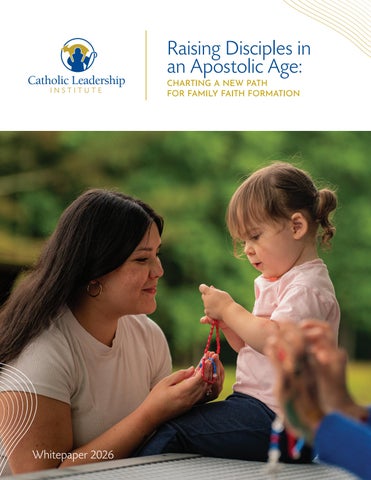
Raising Disciples in an Apostolic Age: CHARTING A NEW PATH FOR FAMILY FAITH FORMATION
Whitepaper 2026
Contents Introduction 1 The Family in God’s Plan
2
The Family in An Apostolic Age
5
Receiving the Kingdom Like a Child
7
Building a Parish Culture of Discipleship
10
Family as Catalyst for Parish Renewal
15
Assessment: Parish Life for the Family
16
Conclusion: “Family, Become What You Are”
21
The Church as the Family of God “ The family is the original cell of social life. It is the natural society in which husband and wife are called to give themselves in love and in the gift of life. Authority, stability, and a life of relationships within the family constitute the foundations for freedom, security, and fraternity within society. The family is the community in which, from childhood, one can learn moral values, begin to honor God, and make good use of freedom. Family life is an initiation into life in society.” — Catechism of the Catholic Church, 2207
Introduction The Catholic Church in the United States is navigating a new cultural reality after decades of decline in religious affiliation and a surge in secular beliefs uprooting Christian principles that have, in recent memory, guided the practice of faith in family life. Now, faith itself is no longer commonly passed down from one generation to another, and families often find themselves being redefined by modern belief systems outside of Christianity. Amid the complexity of today’s culture, many current models of faith formation no longer adequately accompany Catholic families, leaving significant spiritual and formational needs unmet. The Church’s apostolic identity calls for Her leaders to meet families in their current needs, nourishing their spiritual lives and ministering to them in their challenges, so that new generations can be rooted in religious beliefs, moral frameworks, and a renewed transmission of faith.
Only About 15% of children raised in Catholic households remain practicing adults. – The Future Faithful Families Project, Center for Applied Research in the Apostolate (CARA) and the Peyton Institute.
Catholic Leadership Institute offers this whitepaper to examine how families are experiencing faith today and to propose renewed pastoral pathways for the Church to walk with parents in forming their children as lifelong disciples. Drawing from a series of three Virtual Symposiums on Raising Disciples in a Post-Christendom World: Charting a New Path for Family Faith Formation, participants engaged in the following three areas of family life and formation: 1. Foundations of Family Life in the Church in Modern Times 2. Envisioning Children’s Faith Formation and Family Accompaniment Across Life Stages 3. Creating a Healthy Parish Culture for Children and Families This whitepaper represents the voices of over 400 leaders from across the nation—a diverse group of clergy, consecrated religious, parish and apostolate leaders, parents, and educators serving and formed in varying methods and ministries pertaining to the family and children in the Church. This diversity fostered rich dialogue and a communal response to an equally communal need. Beyond dialogue and discussion, participants also considered actionable steps for parishes to better provide for families and their children. The focus of this symposium’s research is parents of children under 18 years of age. Because not all families are alike, the reader is encouraged to apply insights into various family contexts. The conversations did not extend to Catholic schools, given the pastor’s responsibility for the sacramental and pastoral care of the parish community as a whole. The fruit of this symposium series presents a simple but significant shift: the family is not simply a subset of the parish community to serve and be served. Instead, the family is a foundational lens through which the parish learns to become the communion of love, discipleship, and mission that God intends the Church to be. When families flourish, the parish flourishes.
Raising Disciples in an Apostolic Age: Charting a New Path for Family Faith Formation • 1
The Family in God’s Plan The family is not simply one pastoral priority among many, nor is it merely a demographic essential to the future of the Church. Rather, the family is the primary context in which disciples are formed and the lens through which the Church Herself learns how to become a healthier ecclesial community. If the Church seeks renewal in an apostolic age, She must look first to the ordinary rhythms of family life, where faith is received, witnessed, practiced, and passed from one generation to the next.
Rather, the family is the primary context in which disciples are formed and the lens through which the Church Herself learns how to become a healthier ecclesial community.
The Church teaches that the Christian family is “a communion of persons, a sign and image of the communion of the Father and the Son in the Holy Spirit.” Raising and educating children in this community reflects the creative work of God. The family is “called to partake of the prayer and sacrifice of Christ” and is called to a Gospel mission.1 This understanding is rooted in God’s own plan, choosing the family as the place where Jesus Christ entered the world and was formed in human life. Likewise, the Second Vatican Council’s description of the family as the “domestic church” in Lumen Gentium (11) recognizes that the life of the Church is first lived within the home before it is expressed in the parish. When the Church considers the family, She rediscovers how disciples are truly made—not primarily through programs or information, but through relationships, witness, shared life, and daily conversion. The renewal of the parish, therefore, begins not by addressing gaps in formation or rethinking ministry opportunities, but by asking what the Church can learn from the way God has always formed His people through the family.
1 Catechism of the Catholic Church, no. 2205.
2 • Catholic Leadership Institute
Parents: From Religious Consumers to Missionary Disciples In an apostolic age, one of the greatest shifts the Church must make is in how She sees parents. Often, parents are treated as religious consumers who are required to support faith formation through their attendance, financial aid, and transportation. While these responsibilities are important, they are a continuation of another, higher calling. Parents are the first formators of faith for their children. As such, the need to reach parents as consumers becomes, instead, the need to help parents encounter Christ and grow as missionary disciples. In the symposiums, some participants called for additional parental resources, believing that if parents know more, then children will too, and noting that children often learn better from observation than instruction. Like the catechumens of the early Church, parents need initiation as much as instruction. One of the most effective ways to form children is to support the adults who love them. Children learn faith first through relationships, imitation, and daily witness before they learn it through formal teaching. Knowledge becomes fruitful only when it grows from the soil of lived faith. This mindset shift calls the Church to move away from approaches centered on requirements, corrections, and expectations, and toward accompaniment marked by listening, encouragement, discernment, and authentic relationship. Meeting Families Where Christ Already Is The Church joyfully proclaims the truth, beauty, and goodness of family life as revealed by God. At the same time, an apostolic Church recognizes that many families today live within circumstances far removed from that
ideal. Divorce, separation, single-parent households, grandparents raising grandchildren, stepfamilies, blended families of various religious experiences, and other complex realities are increasingly common. Rather than seeing these realities first as obstacles, the Church has an opportunity to see them as places where Christ is already at work. As Pope Leo XIV reminds us, the Church “actively participates in the processes by which society grows and is organized,”2 offering Her contribution toward a more just and fraternal society. Foremost, this opportunity for pastoral care requires leaders in the Church to reflect on how Christ is present to a given family in their particular situation and to help identify the next step to take for them to grow closer to Him.
The symposiums repeatedly affirmed that children are fully capable of being disciples regardless of family circumstances. In many cases, children become the very ones who draw parents, grandparents, or guardians back to the life of the Church. This surprising truth reinforces an essential lesson for an apostolic age: the Church does not begin with what families lack, but with the grace already at work within them. From that foundation, She accompanies every family toward the fullness of life in Christ. The Church’s vision for the family is not simply an ideal to be admired but a reality to be cultivated. Yet this work now unfolds within a missionary context unlike that of previous generations. To chart a new path forward, the Church must understand the world in which today’s families are living. +
2 Leo XIV, Magnifica Humanitas, no. 19.
Raising Disciples in an Apostolic Age: Charting a New Path for Family Faith Formation • 3
4 • Catholic Leadership Institute
The Family in An Apostolic Age A New Reality for Family Faith Formation in Apostolic Times Charting a new path for family faith formation begins with recognizing the world in which families now live. The Church is ministering in an apostolic age, a missionary context where the Gospel Message is more commonly proclaimed through external movement toward others, rather than presumed influence within our immediate circle. Families are no longer supported by a broadly Christian culture but are called to become the primary place where faith is encountered, lived, and handed on to future generations. To better understand and chart a course forward, symposium participants examined both the cultural realities facing families today and the methodological assumptions that continue to shape parish life. They also identified areas where family faith formation is bearing lasting fruit, providing signs of hope and direction for the path ahead. Several cultural barriers were identified from the impact of secular society in North America: Secular Cultural Barriers • Changing Family Structures and Realities: Families today navigate increasingly diverse and complex realities, including single parenthood, blended families, cohabitation, grandparents raising grandchildren, and other nontraditional family structures. These realities often require greater flexibility, personal support, and pastoral sensitivity than traditional formation models assume. • Competing Cultural Priorities and Narratives: Families are immersed in a culture that often prioritizes achievement, activity, and personal fulfillment over spiritual formation. As a result, faith can become secondary to competing demands and narratives that shape identity, belonging, and purpose. • Time, Capacity, and Family Pressures: Many families operate under significant time, energy, and financial pressures that limit their ability to engage intentionally in faith formation. Work demands, busy schedules, and the realities of modern family life often leave parents feeling overwhelmed and operating in survival mode. One participant who identified themselves as a parent in Catholic ministry noted: “The church is competing for time with well-funded secular children’s activities, athletics, and entertainment. Parents have a responsibility to raise their children in the faith. However, parents are tired. They are giving most of their energies to their jobs in order to sustain themselves and their children.”
“ Brothers and sisters, Christendom no longer exists! Today we are no longer the only ones who create culture, nor are we in the forefront or those most listened to. We need a change in our pastoral mindset, which does not mean moving towards a relativistic pastoral care. We are no longer living in a Christian world, because faith… is no longer an evident presupposition of social life; indeed, faith is often rejected, derided, marginalized and ridiculed.” – Pope Francis, Christmas Address to the Roman Curia Saturday, 21 December 2019
Raising Disciples in an Apostolic Age: Charting a New Path for Family Faith Formation • 5
Participants acknowledged additional barriers, including formation methods limited by outdated principles, derived from a time when Christianity was a common practice and belief system across broader culture. In some cases, culture has shifted, but methods have not adapted accordingly. Some methodologies unintentionally hinder, rather than strengthen, family faith formation. Methodological Barriers • Formation Focused on Knowledge Rather Than Discipleship: Many formation models emphasize religious instruction and sacramental preparation while giving less attention to personal discipleship rooted in lived encounter with Christ. As a result, success is often measured by participation, attendance, or sacramental completion rather than ongoing conversion, intimacy with God, and a life increasingly shaped by the Gospel. • Models Built on Assumed Family Realities: Many parish structures and formation approaches were developed for a more uniform family experience and often struggle to effectively engage families whose circumstances differ from traditional assumptions. Some models presume that children are schooled in their faith at home and see virtue modeled for them by their parents or other adults, and others assume that single-income households are the norm. • Systems Built for Maintenance Rather Than Mission: Many parish systems remain oriented toward serving already-engaged Catholics through programs and events rather than cultivating pathways of discipleship. Missionary outreach must begin with knowledge of the People of God and what they need on different levels, without patronizing participants. • Lowered Expectations: Not all religious formation and catechesis in the Church are created equal, and some methods reach families and children with diluted doctrine or comfortable theology that the invitation itself to participate is lacking in richness. Joseph Cardinal Ratzinger, in his letter to Catechists and Religion Teachers in 2000, referred to the temptation to diminish Jesus to a mere man by making Him a “Jesus to our size, a Jesus possible and comprehensible within the parameters of our historiography.” • Action Over Contemplation: The most important part of faith formation is prayer. Methods for religious formation for families and children that focus mainly on activities leave little room for prayer and especially for silence and contemplation.
6 • Catholic Leadership Institute
The new reality of the apostolic age invites an equally ancient practice of apostolic activity within the Church, where dioceses, parishes, and communities exercise their creativity and reach out to families beyond inherited models. Among thriving Catholic communities in the secular world, three common habits emerge to produce lasting spiritual fruit. Three Key Habits of Thriving Catholic Families 1. Oriented by Faith: Thriving Catholic families see raising disciples as a central purpose of family life. This shared mission shapes priorities, decisions, and commitments, helping families place Christ at the center of the home and orient family life toward the spiritual flourishing of their children. This can look like prioritizing Sunday Mass while at home or away, choosing extracurricular activities around core faith practices, setting a way of life for all members of the household that includes values such as kindness or generosity, and setting time aside to serve others as a family. 2. Parents Live the Faith They Teach: Children are formed primarily through the witness of the adults around them. Parents, grandparents, and other trusted adults transmit faith most effectively by living it, praying, seeking forgiveness, practicing sacrificial love, participating in the sacramental life, and fostering their own relationships with God. Faith is rooted in credibility before it is ever taught. Some examples of modeling faith include parents’ praying individually and together, practicing forgiveness, exercising virtue, and seeking one’s own relationship with God through Scripture. 3. Faith Practices are Woven Into the Home: Thriving Catholic families intentionally weave faith practices into the ordinary rhythms of daily life. Through prayer, sacramental participation, conversations about God, and celebrations of the liturgical year, faith becomes a lived reality rather than an activity reserved for church or religious education. In some families, this approach includes praying daily together, offering a prayer before meals, celebrating each child’s baptismal anniversary, following the liturgical year through art, food, and celebration, and offering a prayer for safe travels when getting in the car. While the practical application might look different in each family context, the end goal remains the same, so that the life of faith is not only believed and pursued but lived in communion with one another. +
Receiving the Kingdom Like a Child In order minister effectively to the family, leaders in faith must also renew their understanding of the child’s place within the Church. Instead of viewing children primarily as “future adults” or recipients of religious instruction, they must be regarded as current disciples. Children, regardless of their age, possess their own relationship with God, their own gifts for the Church, and their own capacity to participate in the life and mission of Christ, drawing others to Jesus Christ. Pope Leo XIV reflected this reality in a letter addressed to children published in Popotus on March 19, 2026, describing them as restorers of beauty in the world and reminding adults that they “can help the grown-ups to see it.” The child is not a placeholder for future Christians, but a present member of the Body of Christ whose life reveals something essential about the Kingdom of God: “…unless you turn and become like children, you will not enter the kingdom of heaven,” (Matthew 18:3). An apostolic Church recognizes that as baptized members, children are living signs of what every Christian is called to be: sons and daughters of the Father, heirs to the Kingdom, and members of God’s family. Their openness, dependence, trust, and capacity for wonder reveal important truths about discipleship itself. The child is an integral part of the life of the Church, and this conviction reframes the entire conversation about family faith formation. Symposium participants found three key areas where the child plays an important role in the Church.
“ I have seen this original vision of God, imprinted within the hearts of children — young and adolescent — bring parents back into the Church. Parents will often enroll in OCIA and complete their own sacraments of initiation and convalidate their marriages, while concurrently enrolling their children in sacramental formation and learning ways to participate in the parish community as a family.” – Symposium Participant
Raising Disciples in an Apostolic Age: Charting a New Path for Family Faith Formation • 7
Fathers and their sons go fishing with missionaries in the Archdiocese of Atlanta.
Three Ways Children Reveal Christ As a disciple, the child—a term inclusive of all children, ages 0-18 years old, in the context of this whitepaper—reveals Christ to the Church. Rather than a passive audience to faith, children are cultivators of faith who participate with the rest of the community, show others how to be attentive to God’s love, and demonstrate a life of bold witness in the modern world. Liturgical Participant Children possess a natural openness to the language, symbols, and rhythms of worship. Their participation in the liturgy often demonstrates a capacity for reverence and engagement that challenges common assumptions about their readiness for spiritual life. Children frequently: • Show deep attentiveness to sacred signs, symbols, and rituals. • Readily adopt the language of prayer and faith. • Participate sincerely in liturgical gestures and postures. • E xpress a desire to be close to the altar and the action of worship. • Approach visible liturgical roles with seriousness and care. • Offer simple yet profound prayers when invited to speak from the heart.
8 • Catholic Leadership Institute
Spiritual Knower Children are capable of knowing and encountering God in ways that are often overlooked by adults. They engage mystery naturally, ask profound questions, and possess a remarkable openness to transcendence. Children often: • A sk deep questions at surprisingly young ages. • Intuitively grasp moral and spiritual truths. • Demonstrate a capacity for contemplation and silence. • Encounter God through beauty, wonder, and awe. • Show an awareness of Christ’s presence in the Eucharist. • Relate to God with authenticity and trust. Witness Children do not simply receive faith; they also communicate it. Through their trust, joy, honesty, and openness, they become powerful witnesses within families and parish communities. Children often: • Inspire parents and grandparents to return to or deepen their practice of the faith. • Rekindle reverence and wonder in adults. • Demonstrate trust in God through simplicity and authenticity. • Point others toward what is most essential in the Christian life. • Evangelize through innocence, joy, and genuine belief.
Jesus announced that the Kingdom of Heaven belonged to children and called his own disciples to be like them. (Matthew 18:3 and 19:14). The same holds true today: the very model of the greatest in Heaven is the smallest among us. An Apostolic Church Learns the Language of Children An apostolic Church begins by knowing the people She is called to evangelize. If children are truly disciples—not merely “future disciples”—then the Church must seek to understand how they naturally encounter Christ throughout childhood. Learning the language of childhood does not change the Gospel; it enables the Church to proclaim the same Gospel in ways that guide children toward mature discipleship. Across the symposium, participants independently described common stages of children’s spiritual development and the unique ways faith is fostered within each. Their observations consistently mirrored portions of the Four Planes of Development honored in Catechesis of the Good Shepherd, a Montessori-based model of faith formation that similarly emphasizes meeting children according to their developmental and spiritual readiness.
The Four Planes of Development Dr. Maria Montessori’s Framework • Infancy (Birth – 6 Years) • Childhood (6 to 12 Years) • Adolescence (12 – 18 Years) • Maturity (18 – 24 Years)
The Young Disciple Encounters God Through Relationship From birth through around age six, children experience faith before they can explain it. They encounter God through loving relationships, beauty, ritual, repetition, and silence, and they possess a deep capacity for awe and wonder without doubt or distrust. The witness of parents and trusted adults, the rhythms of family prayer, the sights and sounds of the liturgy, and the security of belonging become the first language through which they come to know God’s love. Formation at this stage is less about explanation than about immersion in a life of faith.
“ Being like children is not going backward but safeguarding a key to see the essential in everything, to find surprising answers even to the most difficult questions.” – Pope Leo XIV
“ Children truly are the family’s greatest treasure and most precious good.” – Pope Benedict XVI, December 2005
The Growing Disciple Seeks Meaning As children mature, wonder gives way to curiosity, especially children between the ages of six to 12. They begin asking deeper questions about God, truth, goodness, belonging, and their place within God’s story. They want adults who welcome their questions, take their faith seriously, and help them discover that the Gospel speaks to everyday life. Stories of Scripture and the saints, meaningful participation in parish life, opportunities to serve, and relationships with trusted mentors help children connect what they believe with how they live. The Disciple Who Finds Purpose Adolescence is a season of discernment and personal ownership when young people wrestle with identity, vocation, relationships, suffering, and the credibility of Christian witness. More than easy answers, children ages 12-18 seek authentic companionship from parents, peers, mentors and other trusted adults whose lives reflect the Gospel they proclaim. They long to contribute, to be trusted with meaningful responsibility, and to discover that the Church has a place for their gifts. They require authentic mentorship, space for honest questions without judgment, and opportunities to connect faith with real life. Rather than expecting children to conform immediately to adult patterns of faith, the Church must enter their experience with the same humility and attentiveness that has always characterized authentic evangelization. In this way, the Church can better support every child in his or her lifelong journey and growth in discipleship. +
Raising Disciples in an Apostolic Age: Charting a New Path for Family Faith Formation • 9
Building a Parish Culture of Discipleship The Church needs a revival of the family. Parents are called to be the primary educators and witnesses of faith for their children, while the parish exists to strengthen that vocation through the sacramental life, authentic community, and ongoing formation. In order to do this, a new path must be charted that meets the modern family and changes some of the ways dioceses, parishes, and their leaders operate. The parish in particular is the spiritual home where families encounter Christ together, participating in the sacramental life of the Church, deepening their faith, and fostering meaningful relationships. The parish strengthens what begins in the home. As the Family of God, the parish is also called to model family life itself by embodying the qualities of a healthy family—belonging, unconditional love, spiritual parenthood, mutual care, shared responsibility, forgiveness, hospitality, and so much more. In a culture where families experience isolation, brokenness, or instability, the parish is especially needed as a visible source of connection for which every family longs. For this reason, healthy parish life is not primarily a family ministry issue; it is a parish culture issue. Families flourish when the entire parish is organized around relationships, belonging, and shared mission, rather than only programs and services. Parish life requires apostolic renewal, and symposium participants identified guiding principles that can assist in cultivating a culture where families, and ultimately all disciples, can thrive. The recommendations and key learnings below are followed by an assessment on Parish Life for the Family, a practical resource that helps parish leaders evaluate their current efforts and discern opportunities for growth.
6 RECOMMENDATIONS FOR PARISH RENEWAL 1. Shift from Programs to Relational Belonging Focus: Re-direct transactional, program-centered ministry to that of relational discipleship where individuals and families are known, needed, and accompanied throughout their faith journey. Rather than viewing programs as the primary means of engagement, every ministry, sacramental encounter, and parish interaction should become an opportunity to build relationships that foster belonging and lifelong discipleship. A parish shaped by relational belonging: • Ensures that families are known by name, recognized as essential members of the community, and accompanied through life’s milestones—not only during sacramental preparation. • Creates intentional opportunities for people to be welcomed, listened to, and personally invited into parish life. • Communicates in ways that invite participation and personal connection rather than merely sharing information or imparting knowledge. • Creates accessible pathways for people to enter community, grow in faith, and become active participants in the mission of the parish, where sacraments become springboards into paths of ongoing relationships with the parish community. • Prioritizes discipleship before requirements. • Forms parish mission, values, and all practices (including formation of leaders and volunteers) to see relationshipbuilding and accompaniment of one another as a central focus for parish life.
10 • Catholic Leadership Institute
2. Create a Parish that Honors the Child as a Disciple Focus: Recognize children as active disciples who are capable of knowing Christ, participating in the life of the Church as its members, and contributing to its mission. Parish liturgy and communal life should reflect the dignity, spiritual capacity, and unique gifts of children by creating a culture in which they are welcomed, formed, and empowered to live as disciples alongside the entire community. A parish that sees the child as a disciple: • Recognizes children as disciples today, not simply future members of the Church. • Creates opportunities for children to encounter Christ through a vibrant sacramental life, prayer, works of mercy, and active participation in the liturgy. • Embraces the whole child, including the parts that need to move, get hungry, have big emotions, and are still learning how to navigate silence, prayer, and sacred moments. • Supports parents by welcoming the messiness of raising children, inviting them to sit in the front rows of the parish, and building a culture that affirms parents who bring their children to Mass.
• Welcomes children for the entire Mass inside the same worshiping space as the rest of the community, giving them an experience of faith modeled by others and a place of belonging as they are—without removing them for Children’s Liturgy of the Word, relying on babysitting, or relegating them to cry rooms. • Encourages children to serve according to their age and gifts and calling them out in tangible ways (asking children to read at Mass, lead group prayer, serve meals, etc.). • Understands faith formation as a way of life lived throughout the parish and home—not something confined to a classroom or sacramental program. • Ensures that parish life is accessible and hospitable to children of varying ages, abilities, and family circumstances so every child can participate fully, by lowering holy water fonts in church, adding changing tables to bathrooms, and so forth. • Builds an intergenerational culture where children learn from adults and adults are continually renewed by the faith, wonder, and witness of children.
Raising Disciples in an Apostolic Age: Charting a New Path for Family Faith Formation • 11
3. Become Mentors and Witnesses of Faith
4. Accompany Families Through Life Transitions
Focus: Cultivate a parish culture where faith is passed on through intentional relationships across generations, making mentorship a normal and expected part of discipleship. Motivated by a personal relationship with Jesus Christ, the parish should foster a community in which people of every age receive and share the gift of faith through authentic relationships, sacramental life, and everyday witness. A parish that values mentorship and witness:
Focus: Walk with individuals and families through key life transitions—both joyful and difficult—so that faith is experienced as a steady source of support, meaning, and relationship with Christ and the Church. These moments of transition often create openness to deeper connection, making them important opportunities for the parish to be present, attentive, and relational. A parish that accompanies families through transitions:
• Encourages every parishioner—not only clergy or catechists—to see themselves as both a disciple and a disciple-maker with and for families of the parish.
• Recognizes that life transitions are privileged moments for encounter with Christ and renewed engagement with the Church.
• Creates an intergenerational culture where children, youth, adults, and older parishioners learn from, encourage, and accompany one another in their spiritual journeys.
• Intentionally keeps track of families’ growth and changes, reaching out to support people through major seasons of life rather than waiting for them to ask for help.
• Integrates mentorship naturally into parish life so that relationships develop around worship, service, formation, and everyday community rather than through isolated programs. • Provides opportunities for mentorship and spiritual companionship among older and younger couples, young adults, and teens so that example and lived experience can be modeled and handed down. • Models discipleship through the visible witness of parish leaders, volunteers, and parishioners whose lives reflect the joy of following Christ.
12 • Catholic Leadership Institute
• Walks with families particularly through moments of transition such as: – welcoming a new baby or preparing for Baptism – beginning religious education or entering Catholic school – engagement and marriage – infertility, adoption, foster care, miscarriage, or pregnancy loss – illness, caregiving, disability, aging, and declining health – death, grief, divorce, and bereavement – children leaving home, retirement, relocation, career changes, or other major life transitions
• Responds to these moments with prayer, presence, listening, encouragement, practical support, and personal invitation into parish life.
• Meets with parents and pastor in a 1:1 to understand their needs, challenges, schedules, and questions about raising children in the faith.
• Helps families remain connected beyond sacramental celebrations by fostering ongoing relationships, community, and opportunities for continued growth, inviting the entire parish to join in these efforts.
• Creates regular opportunities for parents to encounter Christ through prayer, retreats, testimony, small groups, and spiritual support.
5. Offer Holistic Support of Families in the Parish Focus: Walk with families in the full context of their lives by listening to their experiences, creating environments of genuine belonging, and providing practical and spiritual support that enables lifelong discipleship. When families are known, welcomed, and supported in both ordinary and challenging circumstances, they are better able to live their vocation as missionary disciples. A parish that accompanies families in an integrated way: • Regularly seeks input from families, identifies barriers to participation, and adapts parish life to meet evolving needs. • Creates belonging through intentional hospitality, accessible spaces, inclusive communication, resources for those with behavioral needs, childcare options, and safe environments where every family feels welcomed and valued. • Provides practical care (meals, transportation, childcare), fostering meaningful relationships through mentoring and small groups, and connecting families with parish and community resources when additional support is needed. • Recognizes that discipleship is lived throughout the week—in homes, workplaces, schools, and neighborhoods, not only during parish programs or Sunday Mass. • Creates an environment where families experience authentic friendship, mutual support, and a genuine sense of belonging rather than simply receiving services. 6. Strengthen Parents to Model Faith at Home Focus: Empower parents to become the primary witnesses of faith in their homes by providing opportunities for personal encounter with Christ, practical formation, ongoing accompaniment, and simple tools that help families live the faith in everyday life. Rather than preparing children apart from their parents, the parish should form the whole family and empower parents to confidently lead their children in discipleship. A parish that strengthens parents:
• Provides practical formation that teaches parents how to pray with their children, read Scripture together, celebrate the liturgical year at home, have faith conversations, and respond to difficult cultural and moral questions. • Offers flexible pathways for formation through in-person gatherings, online resources, take-home materials, and peer communities that fit the realities of family life. • Connects parents with mentors and other families who can encourage them through similar stages of parenting and discipleship. • Integrates parents into parish life by inviting them to serve, pray, learn, and grow alongside their children rather than simply bringing their children to parish programs. Parish Leadership Across every recommendation and insight that emerged from the symposium, participants consistently identified parish leadership—particularly the pastor—as essential to renewal. They agreed that meaningful change begins with a shift in mindset: one that moves beyond maintaining existing structures toward intentionally cultivating a parish culture that supports families and forms missionary disciples. The Priest as Culture Builder Throughout the symposium, one theme emerged consistently: lasting renewal begins with leadership. While every member of the parish has a role in supporting families, pastors and parish leaders establish the culture that allows discipleship to flourish. Beyond stewarding the sacramental life of the Church, the pastor is uniquely positioned to cultivate a parish culture where families are known, relationships are prioritized, disciples are formed, and others are equipped for mission. Parish renewal will occur not when priests become more productive, but when they create environments where disciples multiply.
Raising Disciples in an Apostolic Age: Charting a New Path for Family Faith Formation • 13
This leadership is expressed in three primary ways: Set the Vision The pastor establishes a clear mission that unites parish ministries around discipleship, family life, and relational belonging. Model Accompaniment The pastor demonstrates the very culture he hopes to build through personal encounter, listening, hospitality, mentorship, and visible witness. Call Forth Others Rather than carrying ministry alone, the pastor identifies individual gifts, forms leaders, and invites parishioners to become disciple makers who accompany families throughout parish life. Diocesan Support Many of the recommendations presented in this whitepaper require systems, expertise, and resources beyond the capacity of individual parishes. Dioceses play a vital role by providing shared formation, mentor development, pastoral planning, Safe Environment training, technology such as customer relationship management (CRM) systems, and other resources that enable parishes to build a sustainable culture of discipleship for families.
14 • Catholic Leadership Institute
Catholic Apostolates and Ministries The Catholic Church in North America is blessed to be served by a wide variety of Catholic apostolates and ministries that support dioceses, parishes, and families in faith formation and family life. Each ministry brings its own unique charism and expertise, often helping remove cultural and methodological barriers through resources, formation, mentorship, and practical support that individual parishes may not have the capacity to provide on their own. Working in collaboration with dioceses and parishes, these partners in faith expand the Church’s ability to accompany families and strengthen discipleship in an apostolic age. Parish Laity and Volunteers Parish renewal depends upon people more than programs. Volunteers, ministry leaders, mentors, grandparents, and parishioners all become witnesses of faith whose relationships shape parish culture. As families are strengthened, every member of the parish is invited to participate in the shared work of accompaniment, making volunteer formation just as important as ministry development. +
Family as Catalyst for Parish Renewal The Christian community is a family of families3 and is itself the family of God. Community and family are, each for the other, a constant and reciprocal point of reference: while the community receives from the family an understanding of the faith that is immediate and connected in a natural way to the affairs of life, the family in turn receives from the community an explicit key for using faith to reinterpret its experience.4 What we find in these recommendations is a startling truth for our current reality: families are the catalyst for renewal in the parish. When parishes turn their attention to the family, they turn their attention to the whole Body of Christ. In this way, the family is like leaven in the life of the Church: strengthening and renewing the whole community from within. Renewing parish life can begin with building a parish culture capable of sustaining families. The relational, intergenerational, and accompaniment-based practices required for family flourishing are the same practices that foster flourishing among nearly every other demographic in the parish. Families are not merely the target population for faith formation; they are the lens through which the parish learns to become a healthier ecclesial community. • What is built for families strengthens the entire parish. When parents, children, grandparents, and caregivers are known, welcomed, and accompanied, the same practices naturally benefit new parishioners, catechumens, students, single adults, empty nesters, and others seeking belonging. • Families reveal strength and pain spots in parish culture. Parents quickly recognize whether communications are clear, expectations are realistic, relationships are genuine, and support is available. Children, through their experience of welcome, participation, and belonging, often reveal the same realities in visible ways. Together, they provide an honest measure of a parish’s culture. • As members of the family, children reveal whether a parish actually believes its own theology. Are children visible? Are they serving? Are they welcome? Are they 3 Amoris Laetitia, Pope Francis (87) 4 Pontifical Council for the Promotion of the New Evangelization, Directory for Catechesis, no. 229
“ The Church is a family of families, constantly enriched by the lives of all those domestic churches. “In virtue of the sacrament of matrimony, every family becomes, in effect, a good for the Church.” - Amoris Laetitia, (87)
being accommodated physically? Are they being integrated into worship? These questions apply not only to the child, but they also serve as a litmus test to discover whether or not the parish believes that baptism is a gift, that discipleship is universal, that every member has gifts, and that the Church is a family. If a parish cannot make room or meet a five-year-old in his or her faith journey, the parish likely struggles to make room for others. • Families reshape how the parish thinks about belonging. A family’s daily reality draws attention to the relationships and structures that sustain Christian life— marriages, grandparents, mentors, friendships, households, schedules, physical spaces, liturgical participation, and practical support. Building a parish that supports family life creates a community where all people can flourish. • Parents and children form one another and the parish. Parents witness faith through sacrificial love, perseverance, and daily discipleship, while children draw adults deeper through their wonder, trust, simplicity, and openness to God. Together, their relationship enriches parish life in ways that no program can manufacture, reminding the Church that discipleship is lived most powerfully in relationship. +
Raising Disciples in an Apostolic Age: Charting a New Path for Family Faith Formation • 15
Assessment: Parish Life for the Family The recommendations in this study summarize the experiences, theories, and collaboration of the Church and Her many members. And yet, the Church struggles to practically apply these concepts, leaving families and children at risk of growing without faith. How the Church responds in this moment can change the course of Catholic formation of families and children in North America for generations to come. To aid parishes and dioceses in practical application, Catholic Leadership Institute collected the learnings from all three symposiums and created a self-assessment for parishes. It is offered as a starting place for parishes to begin brainstorming and integrating actionable steps into their own communities. This assessment is meant to guide further conversation and enhance support for the family. Just as not all families are created equal, so all parishes are not the same.
16 • Catholic Leadership Institute
EVERY FAMILY
Known
Strongly Disagree
Disagree
Neither
Agree
Strongly Agree
Not Sure
Our pastor meets individually with every family to know who they are and better understand their needs. Our pastor meets with all new families who register at the parish. We pair new families with mentor families to help connect them to parish life. Our pastor or sacramental director meets with every family before sacramental preparation begins, not to explain requirements, but to hear their story and begin/ grow a lasting relationship. We maintain meaningful relationships before, during, and after every sacramental milestone through intentional follow-up and accompaniment. Every family knows who to contact at the parish during moments of joy, crisis, or transition. Our parish creates parent-to-parent support groups. (Examples: young families, parents of teenagers, caregivers, adoptive and foster families, grandparents raising grandchildren, and families navigating disability, and grief.) We organize parish care teams that coordinate practical support for families during difficult moments. (Examples: meal trains, transportation, childcare, home visits, for births, illnesses, surgeries, unemployment, caregiving, or family crises.) Our ministry leaders regularly extend personal invitations to families to participate in parish life based on their interests, gifts, and stages of life.
Raising Disciples in an Apostolic Age: Charting a New Path for Family Faith Formation • 17
EVERY FAMILY
Connected
We organize a “matching” system (Example: Adopt-aGrandparent) that intentionally connects families with elderly parishioners. Our parish warmly welcomes children at Mass. (Examples: encouraging families to sit toward the front and embracing children’s voices as a sign of a living Church.) Our priests regularly speak directly to children in their homilies, inviting them into the Gospel in ways they can understand. We evaluate our facilities through the eyes of a child and a young family to better provide for their needs. (Examples: child-accessible holy water fonts, children’s prayer resources, step stools, nursing areas, changing stations, family restrooms, adaptive seating, and accessible spaces.) Our parish provides opportunities for children and youth to serve in liturgy, parish ministries, leadership, and works of service. Our parish removes practical barriers to families’ participation in the Sacraments and parish events. (Examples: providing childcare, transportation assistance, and scheduling around rhythms of family life.) We regularly offer intergenerational events that encourage families to pray, serve, and celebrate alongside every generation. We host gatherings for families experiencing similar seasons of life (new parents, new married couples, families with young children, parents of teenagers, caregivers, empty nesters, etc.).
18 • Catholic Leadership Institute
Strongly Disagree
Disagree
Neither
Agree
Strongly Agree
Not Sure
EVERY FAMILY
Supported
Strongly Disagree
Disagree
Neither
Agree
Strongly Agree
Not Sure
Our parish intentionally cares for those experiencing loss and grief of family members and loved ones. Our parish ensures that a priest or member of the clergy offers pastoral support to men and women navigating the annulment process. Our parish implements a parish Customer Relationship Management system (or similar database) to maintain current family profiles and establish parish workflows so births, baptisms, marriages, illnesses, deaths, graduations, moves, and other life events naturally prompt pastoral outreach. Our parish invites households to update family information, interests, and life changes annually so pastoral care remains personal and timely. Our parish/diocese trains clergy, staff, and volunteers in trauma awareness, mental health awareness, and appropriate referral practices. Our parish makes Safe Environment training available to parishioners on a regular basis. We intentionally reconnect with families who have become less engaged in the Sacramental life of the parish. Our parish upholds a parish pastoral plan centered on family discipleship, relational belonging, and children’s spiritual formation.
Raising Disciples in an Apostolic Age: Charting a New Path for Family Faith Formation • 19
EVERY FAMILY
Formed
Our parish moves beyond classroom-centered religious education toward relational methods of formation, such as Catechesis of the Good Shepherd. Our parish provides regular opportunities for parents and children to pray, worship, learn, and serve together. (Examples: Family Masses, Family Adoration Hours, etc.) We model practical faith during parish gatherings to encourage practice at home, such as family prayer, Scripture reflection, meal blessings, liturgical celebrations, and faith conversations. We recognize all children, no matter their age, as active disciples by incorporating them into our parish mission, pastoral plan, leadership formation, and catechetical philosophy. Our parish helps parents navigate the joys and challenges of family life through the lens of Catholic discipleship. (Examples: Counsel, training, workshops, and discussion groups.) Families preparing for sacraments are matched with mentor families who share their experience, encouragement, and witness throughout the journey. Our parish offers parents and caregivers catechesis and formation resources that guide parents in practicing the faith at home. Our parish celebrates and prays for significant family milestones throughout the year (births, anniversaries, graduations, adoptions, military service, retirement, and times of loss), reinforcing that the Church accompanies families in every season of life.
20 • Catholic Leadership Institute
Strongly Disagree
Disagree
Neither
Agree
Strongly Agree
Not Sure
Conclusion: “Family, Become What You Are” The family is the ordinary place where faith is first encountered, practiced, questioned, handed on, and celebrated. When the Church strengthens families, She is returning to the very pattern through which Christ entered the world and continues to form His disciples. The findings of this whitepaper require leaders in the Church to wrap their arms around the family in a new way. Rather than presenting another collection of parish initiatives, these insights are an invitation to examine parish life through a different, creative lens. Every ministry, policy, formation opportunity, liturgical celebration, and pastoral decision benefits from one simple question: Does this help families become disciples of Jesus Christ? St. John Paul II reminded the Church in his exhortation Familiaris Consortio that every family “finds within itself a summons that cannot be ignored.” The same could be said of the Church Herself. In this apostolic age, the summons before us is not simply to preserve the faith, but to raise disciples who will joyfully hand it on to the next generation. As St. John Paul II continued: “Family, become what you are.” The future of parish renewal will not be determined by what programs the Church creates, but by whether the Church once again learns to think, love, accompany, and form disciples as a family. +
About Us Catholic Leadership Institute (CLI) provides bishops, priests, religious, deacons, and lay persons in the Roman Catholic Church with worldclass, pastoral leadership formation and consulting services that strengthen their confidence and competence in ministry, enabling them to articulate a vision for their local church, to call forth the gifts of those they lead, and to create more vibrant faith communities rooted in Jesus Christ.
301 Lindenwood Dr. #310 | Malvern, PA 19355 catholicleaders.org | (610) 363-1315
©2026