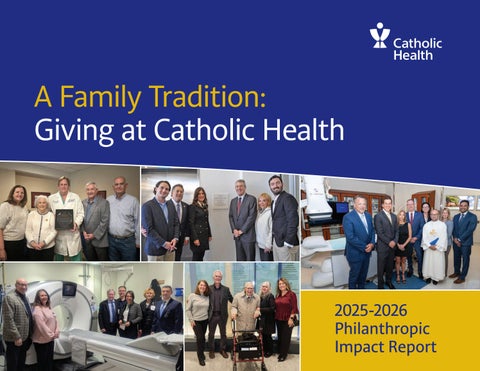
A Family Tradition: Giving at Catholic Health
2025-2026 Philanthropic Impact Report
Contents 3 A message from Salvatore F. Sodano, Executive Chairman, Catholic Health 4 Generational Anchors: How families shape the future of Catholic Health 10 Donor spotlight: Q&A with Cherie and Daniel Serota 12 The Power of Your Legacy 16 A Tradition of Foresight and Compassion: Catholic Health’s Legacy Society 18 Donor spotlight: Q&A with The Lambert Family 20 Fundraising events around Catholic Health 23 Highlights from around Catholic Health 24 26 28 29 30 31 32 33
Good Samaritan University Hospital St. Francis Hospital & Heart Center ® Mercy Hospital St. Catherine of Siena Hospital St. Charles Campus St. Joseph Hospital Good Shepherd Hospice Home Care
34 A message from Peggy Maher, Chief Development Officer, Catholic Health
2
A message from Salvatore F. Sodano Executive Chairman, Catholic Health In health care, we often speak of advanced technology, emerging new therapies and clinical milestones. Yet at the heart of every breakthrough—every recovery and every moment of comfort—there is a simple truth: it is all about people. At Catholic Health, our life-changing work is anchored by the human connection that stems from us all being children of God. It is defined by the expertise and deep empathy of our people, rooted in our mission to bring Christ's healing mission and the mission of mercy to all people. It is centered on the dignity of each patient as a unique individual, ensuring that care is both customized and compassionate. Finally, it is sustained by the powerful commitment of our donors, who give from their heart. Your personal belief in our vision is what fuels our progress. People are the reason for our excellence, and you will read why in the pages that follow. In this year’s Catholic Health Philanthropic Impact Report, you will see how your personal partnership directly empowers our dedicated care teams, helping us to transform the lives of the patients we are privileged to serve across Long Island. Thank you for your humanity, your trust and your continued generosity. Together, we are making health care on Long Island the best it can be.
3
Generational Anchors How families shape the future of Catholic Health
4
P
hilanthropy represents an investment in the future, yet its foundation is often rooted in the past. Across Catholic Health, our hospital campuses are more than places of clinical excellence. They are the safe harbors where families have experienced lifesaving interventions, found compassion in moments of extreme vulnerability, and watched their loved ones regain their independence. For many dedicated supporters on Long Island, this deep gratitude has blossomed into a multigenerational philanthropic commitment. By passing the torch of philanthropy from one generation to the next, these families ensure that the world-class, compassionate care that protected their parents and children will endure to serve neighbors for decades to come.
The Greve Family
A flourishing family tree at Good Samaritan University Hospital For Bill Greve, a relationship spanning more than six decades with Good Samaritan University Hospital is beautifully intertwined with the history of his own family. The connection began in September 1959, just four months after its opening, when his three-year-old daughter Margie fell ill with nephritis, a condition that was fatal in 75% of cases at the time. The trajectory of Margie’s life changed the moment she was admitted. “Thanks to the quick diagnosis and the wonderful care she received at Good Sam, she recovered,” Bill recalls. Today, she is 66 years old, living a full life—a future made possible by the hospital’s earliest medical teams. The hospital’s life-saving impact continued a few decades later, in November 1994, when Bill’s daughter Janet suffered a hemorrhage while delivering her fifth child, due to placenta previa. Requiring 14 pints of blood and three days on a ventilator, her survival was uncertain, but the expertise and determination of the anesthesia, medical and nursing teams all combined to save her life. Finally, in April 1997, Bill and his late wife Sylvia were out to dinner and he began to feel unwell. His doctor sent him to Good Samaritan’s emergency
Debra Del Vecchio
|
The Greve Family—Janet Quinn, John Greve, J. William Greve, Margaret Milward, Katherine Camp—at the Good Samaritan University Hospital VIP Donor Event celebrating the opening of the Patient Care Pavilion
room, where he was quickly assessed to need a five-way bypass and transferred to St. Francis. He credits, “the quick action of the emergency room staff and my doctor” with his survival. Bill’s enduring philanthropic support is driven by a profound personal debt of gratitude. “I owe my life and the lives of two of my daughters to the talented and dedicated staff of Good Samaritan,” says Greve. He continues to give back to ensure that the talented and dedicated staff can keep the family trees of other community members flourishing for generations to come.
Good Samaritan University Hospital
“ Thirty or forty years ago, my father, Carmen Nuzzi, was a cooling and heating specialist, and
he was instrumental in maintaining the HVAC system at Good Samaritan University Hospital. He was always running off to Good Sam to do something! Dad really enjoyed being here; he loved children, and it was really a big part of our family’s life. Now, my family and I are proud to dedicate the Del Vecchio Family Pediatric Emergency Room in his memory, as part of the new Patient Care Pavilion.”
Del Vecchio’s relationship with Good Samaritan University Hospital indeed dates back to her father’s time working with the hospital, but her connection continues today as she serves on the Catholic Health Board of Directors. She also believes deeply in giving back, philanthropically supporting both Good Samaritan University Hospital and St. Francis Hospital & Heart Center®. 5
The Bahnik Family
Fueling continuous innovation at St. Francis Hospital & Heart Center
®
The Bahnik family has turned a multigenerational appreciation for world-class medical care into a powerful catalyst for future innovation at St. Francis Hospital & Heart Center ®. The family’s connection began more than two decades ago when the late Roger Bahnik and his wife Lore established a close bond with Dr. Harry Barbaris, the hospital’s Director of Surgery until 2007. Over the years, the hospital became a place of safety for the family. “We’ve come to St. Francis in moments of vulnerability when someone needed medical attention. We’ve been grateful to have worldclass medical care there,” daughter Michèle Bahnik Mercier says. “It’s given us a great sense of security to have such a wonderful institution right here on Long Island.” Roger and Lore ensured their connection to the hospital will continue through their children. Today, Michèle serves as president of the Bahnik Foundation and her brother Claude serves as vice president and treasurer. They carry the torch forward, remembering something their late father said to them: “It’s never a fun thing when you have to be in a hospital, but being at St. Francis makes it a little easier, getting great care, surrounded by such compassionate people,” Mercier recalls.
Susan Bell Phelps
Kevin Mercier, Michèle Bahnik Mercier, Marie Bahnik and Claude Bahnik
The Bahnik Foundation has focused its philanthropy on keeping St. Francis at the leading-edge of medicine, dating from their first donation decades ago until today. The Bahnik Foundation has funded the medical library and a hybrid robotic lab and most recently made a transformative commitment to the Cardiology Innovation Research Fund. “We care deeply about St. Francis,” says Mercier. “It’s incredibly rewarding for all of us to see the real-world impact of cardiac research. We're really proud to partner with the hospital and to pave the way for future breakthroughs.”
| St. Francis Hospital & Heart Center “ The lifesaving heart surgery I received at St. Francis Hospital as a child shaped the course of my life. More than 67 years ®
later, I remain profoundly grateful for the compassion shown to me and my family during a time when they were not sure I would survive.”
At six years old, Phelps underwent open-heart surgery at St. Francis Hospital. Although she was young, she has vivid memories of the compassionate care she received and recalls waking up the morning after her surgery to find her surgeon, Dr. Francisco, asleep at the end of her bed. She was later told that he stayed with her all night because he was not certain she would survive and did not want her to be alone. Today, after many thoughtful conversations, Susan and her husband chose to include St. Francis in their estate plans because they wanted to share the blessings of their lives with others, making a difference in the lives of so many. Susan says she gets great comfort to know that long after she and her husband are gone, they will help ensure that future generations receive the same compassionate, life-changing care that she was fortunate to receive. 6
The Creighton Family
Championing community and connection at St. Catherine of Siena Hospital For Bob and Cathy Creighton, St. Catherine of Siena Hospital is truly a family affair rooted in deep community pride. While both Bob and Cathy experienced the hospital’s exceptional professionalism and care firsthand as patients in 2005 and 2007, it was the deeply personalized care given to Bob’s parents in 2024 that solidified their generational devotion. Bob’s father, the late Bob Creighton, had to be admitted to the ICU, so the family dropped off his wife, Geraldine Creighton, at the front of the hospital and asked her to wait as they parked the car. She decided to walk ahead—and ended up falling. Medical staff members whisked her into the Emergency Room, where she was found to have a small hemorrhage in her head. Geraldine was admitted to the ICU in a room right across from her husband. Recognizing how much the couple missed their daily routines, the nursing staff went above and beyond to help the couple feel connected. “They were married 65 years, and my mother-in-law had her routine with her husband,”
Cathy says. “One of those things was that they would eat dinner together while watching Yankees games, and they would have their ice cream.” The nurses wheeled her bed into her husband’s room, gave them dinner and ice cream, and ensured they could watch Bob and Cathy Creighton the Yankees game, side-by-side. It’s that kind of personalized care, matched with sophisticated technology and tender, human compassion, that leads Cathy and her family to continue to support St. Catherine of Siena and inspired Cathy to serve as a foundation board member. “As a community hospital, it’s very important that St. Catherine’s is supported, promoted and acknowledged,” Cathy says. “I want to do what I can to help.”
The Murray Family
Generations dating back to a Mercy Hospital beginning Francis X. Murray, Mayor of Rockville Centre for 15 years, estimates that nearly 100 members of the Murray family have been born at Mercy Hospital. He can date it back to his grandparents, William J. and Josephine Murray, who had 13 children, the last four of whom were born at Mercy Hospital. His parents, Eugene J. and Mary Lou Murray, had eight children; Fran and his wife Barbara have five children; and even three of their grandchildren all have been born at Mercy. “And that’s just one side of the family!” he jokes. The Mercy connection also deepened through his father’s oldest sister, who took her vows and entered the Nursing Sisters of the Congregation of the Infant Jesus (CIJ) founding order. She served as head nurse at Mercy Hospital and taught nursing at neighboring Molloy University. In 1978, Murray’s third daughter Susan was born with a cramped intestine, and the doctors at Mercy saved her life. From that day on, he promised to
always support and raise money for Mercy Hospital—and he’s never stopped. “Mercy Hospital continues to be a big part of our community, consistently providing tremendous service and care to our residents,” says William J. and Josephine Murray, parents Murray. “The hospital and its of Francis X. Murray staff have always been very special to me, and so I continue to stay very involved.” Over the years, Mayor Murray has served as the president of the Mercy Hospital Foundation, president of the Friends of Mercy and a member of Mercy’s Board of Trustees. 7
The Fitzpatrick Family: Investing in the health of the neighborhood at St. Charles Campus* For Mary and John Fitzpatrick, St. Charles Campus is more than a health care provider; it is a vital thread woven through their family’s history. The couple’s deep-rooted commitment to the campus grew from witnessing the transformative, consistent care provided to their own parents during their times of need. When Mary’s mother suffered a stroke, the proximity and quality of the rehabilitation center allowed the family to stay connected during a difficult recovery. The impact was even more striking for Mary’s father, who arrived at the facility in a critically weakened state. “The rehab facility here was amazing. They took him from being bedridden to getting back to a normal life, being physically able to do all the tasks of daily living,” Mary shares. “When we brought him back to visit months after, they couldn't believe he was moving the way he was.”
John and Mary Fitzpatrick with Lisa Busso, RN, Director of Emergency Department and Critical Care and Jeffrey Wheeler, DO, Director of Emergency Medicine
Because St. Charles has played such a pivotal role for their family, John and Mary are dedicated to ensuring it remains a pillar for future generations of Long Islanders. Today, John channels this gratitude into leadership as the Chairman of the Foundation Board, working alongside Mary, a long-time member of the Friends of the Foundation. Together, they have seen firsthand how philanthropic support translates into life-changing medical outcomes.
“When you give to St. Charles, the money goes right to work in your community,” John says. “It makes you feel good to be helping your community.” Through their leadership, they are establishing a legacy of healing that ensures future generations of Long Islanders will always have a reliable, compassionate health care anchor.
Jack Russell
|
*Operating as a campus of Good Samaritan University Hospital as of July 1, 2026.
St. Charles Campus
“ My love for St. Charles has endured throughout my life, as has my gratitude for the nuns and staff who were everything to me during those formative years. They continue to hold a special place in my heart.”
At the age of four, Russell was struck by polio, leaving him paralyzed from the neck down. In 1941, St. Charles Hospital (as it was known then) was the area’s leading center for children afflicted with polio, so his parents made the trip to Port Jefferson to get him treatment. Russell lived at the hospital for five years (three months of that spent in the iron lung) while he recuperated. Today, Jack is 86 and lives in Florida. He credits St. Charles and the sisters from the Order of the Daughters of Wisdom for keeping him alive and fostering a miraculous recovery. His life-altering experience at St. Charles has motivated him to stay connected throughout the last 80 years through his annual support of the Annual Fund and countless hours of volunteering, both at St. Charles and many other organizations. 8
The Kroll Family
A lasting heart health legacy at St. Francis Hospital & Heart Center
®
The profound impact of St. Francis Hospital & Heart Center ® on the Kroll family began unexpectedly on a summer day in 1987, when Janet Kroll had to rush her husband Jerome to the emergency room. They had recently moved back to Long Island and were expecting guests for lunch and a dip in the community pool. “We were very excited, and lo and behold, at noontime, I took Jerome to St. Francis with a heart attack,” says Janet. They quickly realized that the hospital situated practically in their backyard was not just close, but also clinically excellent. “We fell in love with the caregivers, both the doctors and nursing staff. I remember thinking, ‘Aren’t we the lucky ones?’” Janet recalls. Deeply moved by the exceptional medical care and nurturing nursing staff that allowed Jerome to safely return home—and later saved his life again with a quadruple bypass in 1994—the Krolls became lifelong champions of St. Francis. Their commitment culminated in providing the funds to establish the St. Francis Kroll Family Center for Heart Failure and Circulatory Support. This pivotal gift helped Edward Lundy, MD, PhD, establish the Left Ventricular Assist Device (LVAD) Program at St. Francis. Specialists use LVAD for advanced heart failure and as a bridge-to-transplant when a patient is waiting for a heart transplant.
Janet Kroll (second from left) and family were honored by Edward Lundy, MD, PhD (third from left), Surgical Director of the Kroll Family Center for Heart Failure and Circulatory Support, on the 10th anniversary of the center being established with the family’s support
Since Jerome’s passing in 2017, Janet has passed on this connection to her adult children, who remain involved and accompanied Kroll to the program’s 10th anniversary celebration, ensuring the Kroll family legacy remains an irreplaceable piece of their identity. Janet hopes the connection to St. Francis will remain special for everyone in her family. “There are other places, but nothing replaces our St. Francis,” she says.
Moving Forward Together While these nine families have walked unique paths, their narratives share a common heartbeat. Each began with a moment of medical vulnerability and evolved into a generational legacy of profound gratitude and leadership. Through their continuous support of capital campaigns, specialized research and clinical expansions, these families are doing far more than honoring the care their families have received—they are actively shaping the future of medicine here on Long Island. It is because of multigenerational champions like the Greves, Bahniks, Creightons, Murrays, Fitzpatricks and Krolls that our hospitals can continue to deliver the clinically excellent, deeply personal care that defines the Catholic Health experience for every patient, every time.
This is who we are at Catholic Health: We are people of service, people of excellence and we are grateful for the example of those who participate in this noble enterprise. 9
Q
Donor spotlight
Q&A with
Cherie and Daniel Serota In late 2025, the Serota Family dedicated the main elevator bank at St. Francis Hospital & Heart Center ® in memory of Cherie’s father, Arthur Siegel. Here, Cherie and Daniel explain their special connection to St. Francis. 10
“ I always felt the job we had, more
important than any other, would be to raise our children and nurture them and make them whole. To encourage our children, and they in turn will encourage their children, to do the right thing and be good people. You must show them by example, and that’s what they learn.”
— Excerpt from The Art of Life by Arthur Siegel
Q
What was your family’s first encounter with St. Francis Hospital, and how did that experience shape your view of its mission?
In 2004, Arthur was rushed to a nearby hospital and transferred to St. Francis, where the advanced cardiac care he needed was available. After he underwent a quadruple bypass, Daniel—who had experience caring for loved ones through serious medical situations—prepared everyone for what lay ahead: with a surgery of this magnitude, the recovery would be challenging. Yet when we saw Dad in the recovery room shortly after surgery, he was awake, calm and more comfortable than we had expected. The only pain he mentioned was in his left toe, from a blanket tucked in too tightly. In that moment, we were profoundly grateful that this complex procedure was performed at St. Francis. In the years that followed, it became clear that St. Francis had a culture unlike other hospitals we encountered. The environment was nurturing, patient-centered, and deeply reassuring. Everyone made us feel cared for and in steady hands.
Q
How has the hospital impacted multiple generations of your family?
Nearly 20 years later, at age 92, Arthur returned to St. Francis. The years between those admissions were a gift—decades of life made possible, in part, by the care he received and the renewed strength of his heart. During that time in the ICU, we saw the phenomenal nursing care he received, and were impressed by the level of respect, dignity and privacy they afforded us. We have many physicians in the family, including Cherie’s brother Evan, and the care team was always respectful and inclusive. Dad was constantly surrounded by his children, grandchildren and greatgrandchildren. Each of our sons spent quality time with him: Jonathan flew in from California and sat with Dad for hours, keeping him entertained with Mel Brooks movies. Chase visited during his first year of law school to spend oneon-one time, gleaning wisdom from Arthur’s bedside. And Stephen came every single day from his home in Manhattan—sometimes simply holding his hand in silence. Lots of other family spent time with dad as well, including our nephew Jordan who flew in from Hawaii, and his other grandchildren Ariana and Gabby, along with their spouses. His great-grandchildren read him stories, sang
songs and even performed dances. Dad was always surrounded by love, and the St. Francis care team made sure we all had the private time we needed, even in the ICU.
Q
What legacy do you hope to leave through your commitment to service and philanthropy?
rthur wrote a book, “The Art of Life,” with a chapter devoted to teaching others by example. We were both raised by parents who taught by example, and we have parented our children in the same way. When Daniel was growing up, his grandmother opened her home to Holocaust survivors, who would stay until they could get settled and always had a seat at the table over the holidays. Daniel’s parents raised him to give back to the community, as well. Our own parenting closely followed the example set in our own childhood homes. We had a twice-yearly tradition for our children to pack holiday baskets for those in need. We also “adopted” households in nearby neighborhoods, providing food, diapers and clothing. During high school, our children created their own initiatives focused on service, philanthropy and meaningful impact. For the past 12 years, Daniel has served as both Mayor and Police Commissioner of the Village of Brookville, a role for which he receives no compensation. It was important to us that our boys grow up watching him balance his career as a real estate developer with a commitment to public service. They learned the importance of giving back, especially to institutions like St. Francis that mean so much to our family. It is our greatest hope that these traditions of service and philanthropy continue in their own homes.
Q
What would you say to someone who is considering making their first gift?
Making a gift is a meaningful way to give back and help ensure others receive the same exceptional care. Arthur’s care at St. Francis was enriched by the generosity of people he never knew. Their gifts touched his life, and it is gratifying for our family to carry that spirit of giving forward. You may not know the next person whose loved one is being cared for at St. Francis, but your generosity will undoubtedly help them. All contributions, big or small, make a difference.
11
The Power of Your Legacy F
or over a century, our supporters have invested in the lives of their fellow Long Islanders by advancing exceptional and highly patient-centered medical care at Catholic Health. While many are familiar with immediate donations, planned giving offers an alternative way to make an extraordinary impact on the future of health care right here on Long Island without reducing a person’s current income or diminishing their savings. Why consider a planned gift?
A planned gift is more than just a financial strategy; it is a profound opportunity to answer fundamental questions about what our lives stand for and how the world is better because we make it so. It is an expression of one's personal values that ensures high-quality care for future generations. A planned gift allows individuals and couples to support their specific passions, as they can designate their contribution to a particular hospital, campus or program, or wherever it is needed most. Because many of these arrangements are revocable, our donors maintain the flexibility to easily revise plans if circumstances change. Further, these methods allow donors to maximize their impact. For instance, directing a gift from a traditional IRA can provide larger tax savings than donating cash.
12
A meaningful legacy for everyone A common misconception is that legacy gifts are reserved only for the extraordinarily wealthy. In truth, leaving a bequest is an opportunity available to absolutely everyone. The most impactful gifts do not come from vast fortunes, but from caring individuals who simply love their local hospital and want to ensure its future.
Common ways to give Planned giving is designed to be simple and practical, often requiring nothing more than a single paragraph in a will or a simple update to a beneficiary form. A bequest made through a will or trust is one of the easiest ways to give because it doesn’t impact savings during one’s lifetime. Similarly, beneficiary designations allow someone to name a charity to receive funds from a retirement plan, insurance policy or bank account by simply completing a form with a plan administrator. For those looking for lifetime benefits, a charitable gift annuity provides a way to receive fixed income for life while designating the remainder for charitable benefit, while charitable trusts can be used to either provide a donor with income or shelter assets for heirs, alongside a gift to charity.
At-a-glance: Some examples of planned giving options Your Charitable Goal:
Make a gift that costs nothing right now
Turn an old asset into immediate impact
Protect your heirs from heavy taxation
Reduce your adjusted gross income
Your Simple Method:
Bequest in a Will or Trust: Name one or more charities to receive a specific dollar amount or percentage of your estate.
Life Insurance Policy: Transfer ownership of a fully paid policy you or your heirs no longer need.
Retirement Asset Designation: Name one or more charities as beneficiaries of your IRA, 401(k) or 403(b) account.
Qualified Charitable Distribution (QCD): Make a gift directly from your traditional IRA. People 70.5 years or older can make a QCD.
Your Personal Benefit:
Does not alter your current income or cash flow; completely revocable if your life circumstances change.
Qualify for an immediate income tax deduction and lower your overall taxable estate.
Reduce the income tax burden on heirs by allowing these funds to benefit a charitable organization.
Exclude the amount from your adjusted gross income and create a tax-advantaged way of giving to a charitable organization.
Start your legacy today A planned gift allows our donors’ generosity to endure and ensures the future of outstanding, patient-focused health care in our community. In the pages that follow, discover the inspiring stories of four everyday neighbors who used these exact tools to align their values with the future of Catholic Health.
13
Bernadette D. Curry, PhD, RN, FAAN A lifetime of perspective at St. Francis Hospital & Heart Center ®
Dr. Bernadette Curry’s relationship spans more than twenty years with St. Francis Hospital & Heart Center ® and Catholic Health—and has been viewed through almost every lens imaginable: as a nurse, a nursing committee member, the Dean of the School of Nursing at Molloy University, and ultimately, as a patient. In 2018, Curry spent 57 days at St. Francis Hospital fighting a severe infection, an experience that left an indelible impression on her. She witnessed firsthand the profound dignity with which every patient was treated, noting how the hospital president knew every staff member’s name and asked about their families. Driven by a desire to ensure this exceptional culture of bedside professionalism outlasts her, Curry chose to include St. Francis in her future financial plans. She emphasizes that exceptional health care does not just happen by chance—it requires deliberate foresight. By establishing a planned gift, Curry ensured her support would never be an afterthought, creating a lasting commitment to the clinical excellence and genuine care she spent her entire career championing.
14
Mariette P.C. Major
A centennial memorial at Mercy Hospital The incredible endurance of a planned gift is finely illustrated by the legacy of Mariette P.C. Major, a longtime resident of Rockville Centre. Born in 1884, Mariette was the wife of Henry “Harry” Major, whose father, Alfred S. Major, was an internationally renowned banknote engraver famous for designing the United States Columbian Exposition stamps. Mariette and Henry lived a quiet, meaningful life on Long Island. When Mariette drew up her last will and testament in July 1972 at the age of 88, she looked toward the future of her community and chose to name Mercy Hospital as a primary beneficiary of her residual estate. Mariette passed away in October 1972, but her vision did not end there. Decades later, as her trust prepares for its final distribution, this enduring planned gift is actively coming to life—allowing Mercy Hospital to invest in its staff and facilities, proving that a love for one’s community can echo across centuries.
Mike Virgilio
Dreaming bigger for Good Samaritan University Hospital As his children approached the milestone of graduating from high school, Mike Virgilio found himself reflecting deeply on what it means to leave a lasting legacy for the next generation. Wanting to pay his family’s good fortune forward, Virgilio sought a way to make a genuinely transformative impact at Good Samaritan University Hospital, but he wanted to maximize his capabilities. The solution lay in a blended approach to planned giving. By combining manageable annual contributions with a beneficiary designation naming the hospital as a partial recipient of his Individual Retirement Account (IRA), Mike unlocked a level of giving he never previously thought possible. He describes planned giving as an “insurance policy for your philanthropy,” offering a reliable avenue to ensure your community goals are realized, regardless of what life throws your way. By leveraging his residual retirement assets, Virgilio was able to dream bigger, securing the future of Good Samaritan and creating a safe, healthy community for his children.
Marita Demenus
Creative generosity at St. Francis Hospital & Heart Center® Marita Demenus proved that making a major philanthropic impact does not require liquidating your savings or changing your daily budget. While attending a Catholic Health Legacy Society luncheon last summer, Demenus was deeply moved by a presentation on how donor funding can advance excellent care. Living just minutes away from St. Francis Hospital & Heart Center®, she and her husband Manfred felt a profound sense of gratitude for the compassionate care they had received there over the years and knew it was time to give back in a significant way. Flipping through a planned giving brochure at her table, Marita realized she held the perfect asset: a fully paid whole life insurance policy that her family no longer needed. By simply transferring ownership of the policy directly to St. Francis Hospital and naming the hospital as the sole beneficiary, Demenus secured an immediate charitable tax deduction and reduced the taxable portion of their estate. Her creative gift was designated to the President’s Fund, providing leadership with vital resources readily available to address urgent priorities.
Designing Your Legacy Though these individuals all came from different walks of life, they are united by a shared realization: you do not have to be a multimillionaire to leave an extraordinary mark on the world. Anyone, at any stage of life, can use a planned gift to create a lasting impact and shape the future for the better.
Lyn and Nick Casale, Chairs of Catholic Health’s Legacy Society
Together, these acts of foresight and generosity ensure that Catholic Health’s tradition of outstanding, compassionate care will remain a permanent guidepost for Long Island. By designing your own legacy today, you can look to the future with deep satisfaction, knowing that your gratitude will live on, healing neighbors you may never meet.
Scan to make a difference
Support compassionate care across Long Island. Scan the QR code or visit us online to make a secure donation today.
15
A Tradition of Foresight and Compassion: Catholic Health’s Legacy Society The Legacy Society pays tribute to individuals who have chosen to invest in the future of health care across Long Island. Through thoughtful planned gifts—including bequests, charitable gift annuities, appreciated securities, life insurance and other arrangements—these donors establish a lasting foundation for Catholic Health’s network of five hospitals across six campuses, home care, hospice and outpatient services. Members of the Legacy Society ensure that our tradition of compassionate care continues far beyond their own lifetimes, and their generosity inspires others to join them in empowering Catholic Health to serve future generations for years to come. We are profoundly grateful for the enduring commitment of our Legacy Society members. Below, we proudly recognize those who have made this vital pledge. We have made every effort to ensure the accuracy of this list. Please accept our apologies for any errors or omissions. You may contact us at development@chsli.org. Members of the Legacy Society
Elizabeth Calabro*
Frances G. Dapper*
Ellen J. Benson*
Catherine* and Dom Camera
Kathleen Davis*
Roseann and Al Campagnola
Edna M. Delloiacono*
William Adams*
Andrew Berkowitz*
Fortuna Adessa*
David M. Bernstein*
Margaret Ann Alford*
Susan and Arnold Blair
Frances Amicone*
Raymond Blaszky*
Belle Amodeo*
Virginia Bolla
Anthony Anzalone*
Gerard Bottini*
Michael Apollo
Emilie Van Bourgondien*
Patricia Astor* Francis Xavier Attonito May G. Austin*
Susan and Tom* Brahms Joan Brakman
Victor A. Canevari* Doris Cantor* Lyn and Nick Casale Barbara Casey* Robert B. Catell Daris Chasas* Esther Chassen*
John Brancaccio*
William J. Christie
Lorraine and Barry Bangel
Wilbur F.* and Dorothy Breslin
Fern and Hersh Cohen John and Gloria Confort*
Virginia and Bernard Bartley*
Cleola H. Broere*
Virginia Ann Connors*
Mary J. Brown*
Mary V. Cunningham*
John Beaman*
Aniko and Philip* Burzo
Dr. Bernadette Curry
Millicent and Maurice Bellah*
Louise O. Butler*
Charles S. Daily*
Joel S. Balsam*
16
Marion Benischek*
Charles E. DeClerck* Thelma J. Demarco* Nancy and Frederick DeMatteis* Mr. and Mrs. Manfred Demenus
Sharon and Michael Falcone Thomas J. Fanning, Sr. Gerald S. Fine* Melvin Finkelstein* Barbara Fitzgerald* Robert and Jacqueline Forman Carolyn Fostel*
Kathleen and Dan Denihan
Mary E. Fowler*
Gregor Denning*
Barbara Fredel*
Maria DiFasano
William P. France* Barry Friedberg*
Frances B. Garvey* Geraldine and Leonard* Genovese Robert and Susan Gershin Eleanor Giammarino* Kathy Giamo Robert Gianguzzi & LeeAnne Landon John Van Gibson* Edward E. Giles Anna M. Gill* Gertrude Gill*
Susan Friedman-Russo
Bertha Goggins* Ruth Gold
Lilian Ebbitt*
Harrison and Patricia Fuller Family Trust
John J. Gorman*
Rose Eletto*
Agnes T. Funk*
Hugh M. Graham*
Patricia Ellis*
Elizabeth Gaeta*
Charles A. Greiner*
Carol L. Failla*
Maud Gallagher*
Bill and Sylvia* Greve
James J. Dolan* Anne Wilson Duerden*
Alice M. and Abraham J.* Gross Mary and Dino Guiducci* Augusta M. Gulden* Joan and Leo Haberman* Pat and Rick Hachemeister John and Becky Halleron Olga V. Hargis* Martha M. Harr* Maria E. Harris Daniel P. Hays* Theresa Heckman Gertrude E. Helwig* Richard D. Hemley Florence and Edwin Hess* Alfred B. Heuther* Caroline A. and Timothy D. Holden Lewis S. Hollins* Giulia M. Honsberger* William S. and Adele R. Horizon* Marie G. Hormann* Mary Howell* Rosetta Hugo* Thomas P. Huller* Patricia Ierardi Mildred Jacobs* Catherine F. Jacobsen* Robert W. Jacobsen*
Marian H. Johnson* Dorothy Julier* Emmy M. and Raymond P. Kane* Marcia Kaplan-Mann Inge K. Kauders* Eileen J. Kavanagh* Margaret Keene* Chester L. Kelting* Jane D. Keresey* Agnes J. Kestner* Irma Keppler Kiene* Rose Zimmerman Koehler* Janet and Jerome* Kroll Joseph C. Kugler* Virginia Lack* Joseph Edward Landy* Jeffrey A. Lang
Frances Florence McCarthy*
Louise Perrotta
Mark Sampson*
Gerald Tambasco*
Herbert J. McCooey
William Peterman*
B.M. Sandman*
James M. Taylor*
Emilia and Daniel Petrasek
Anthony Santasine*
Peter Tedesco*
Paul A. Pezar*
David and Lin Schlyer
Kathryn Z. Teigland*
Anne T. Schwab
Hugo Todebush*
Laura Schweber*
Jacqueline TommasoPolon*
Robert C. McCormick, MD* Margaret McDevitt* Arlene* and John McGrotty Virginia McGuire* Donald G. McKeon* Nora Meade* Jean J. Mersand* Riva Metcalf Selma R. Miller Irma M. Monahan* Victor T. Mouillerat* George A. Mulligan* Nancy K. Munson* Allen E. Murray*
Marilyn and Patrick Lanza
Dolores Musto*
Ina* and Larry Lind
Francis Neilson*
Hyman Livingston*
Allene B. Newins*
Marie Logothetis*
Horace D. Newins*
Patricia Lopiparo
Peter L. Nolan*
Gabriella Losasso*
William and Jacqueline O'Brien
Grace H. Lovatt* Francis Lyle Lunson Catherine T. Maas* Anne Maione Yvette and Joel Mallah* Joyce M. Marchand* Gloria Marsloe*
Kenneth Myslicki*
Mary Carolyn O'Connor* Nina P. Oliva Frank J. Ollari* Lawrence Orilia* Vito Parisi* Kathleen C. Peer*
Susan and Alan Phelps Arlene Pinkus* Brian M. Poissant Joseph A. Pollicino* Linda L. Pons Kay Porter* Dorothy E. Pullis* Frank Quattrocchi* Regina Quick* Alexander Rekow Katherine L. Renzulli* Maria Richard * Lindsey J. Rockwell*
The Serra Family Joan Durso Serra Henry H. Shepard* Edward E. Shorin* William Slome David H. Smalbach Margaret F. Smith* Ronny Soderstrom* Werner Sonn* Thomas L. Spadaro* Sonja Caron Stein*
Florence Rose*
Lotte and Murray Steingart*
Benjamin J. Rosof*
Charles W. Steinmetz*
Carmen Russo*
Herminie Helen and Frank Strnad*
Rosemarie Russo* Nancy Russo-Rumore Michael J. Ryan* William F. Ryan* Henry E. Salzhauer
Sylvia and Howard Swanson*
Anne Marie Troiano* Robert Typermass William P. Urig Judith Van de Walle Dorothy VislockySteigerwald* Joan* and Robert F. Vizza Caroline T. Voege* Rose M. Volpe* John F. Wagner* Margot and Kenneth Walker Eleanor Wetzel* Gabriel Wiesenthal Thomasena Wimmer* Eugene D. Zanger*
Agnes G. Szemere*
Patricia and Domenico* Zuzzi
Iracema Talbott
*Deceased
Your generosity powers our mission
Every breakthrough, comfort and cure starts with support like yours. Help transform care for patients and families across Long Island. Scan the code to make a gift today.
17
Donor spotlight
Q&A with
Dr. Joseph Lambert with his partner, Dr. Marc Kirschner, sitting on the steps outside their medical practice. Dr. Kirschner is still practicing at South Bay Cardiovascular, West Islip today
The Lambert Family The Lambert family, consisting of eight siblings, their spouses and families, came together in fall of 2025 to dedicate a plaque in memory of their father for Good Samaritan University Hospital’s new Patient Care Pavilion. Here, the Lambert children talk about their father’s legacy, and why they felt so compelled to support Good Samaritan in his memory. 18
Q
What was your family’s first encounter with Good Samaritan University Hospital, and how did that experience shape your view of our mission?
Our father, Dr. Joe Lambert, was a city boy who, with his wife Genevieve and their first few young children, moved to Long Island in the late 1940s. After service in the U.S. Navy and the completion of his medical training, he opened a solo practice in Bay Shore. He was an active participant in the effort that gave birth to Good Samaritan University Hospital and served as chief of its Department of Medicine from the hospital’s opening in 1959 until 1985. Over the years, his small practice grew into what is today a large cardiology practice, now part of Catholic Health. Good Samaritan remained a major part of our father’s life until his passing in 2008. Even after retiring from active practice, he volunteered with a group of other retired physicians in an outreach program that the hospital had set up to provide free basic medical care to underserved individuals in the community.
Q
Q
How has seeing the hospital’s growth over the years—from its early days to the current modernization—impacted your commitment?
If our father were alive today, we are all convinced he would have been absolutely thrilled and proud to witness the 2025 opening of Good Samaritan’s new Patient Care Pavilion, and how Good Samaritan has grown from its beginnings in 1959 as a local community hospital into the advanced medical center it is today. It was for that reason that we saw the opening of the new Pavilion as the perfect occasion to make our first joint family donation to Good Samaritan—one made in our father’s memory and memorialized by a meaningful plaque in the emergency department waiting room, honoring his service to Good Samaritan. Our story may be unique, but the need for philanthropic partnership at Good Samaritan is universal. We encourage everyone here on Long Island to think of Catholic Health—and Good Samaritan in particular—as a particularly well-deserving recipient of your generosity.
Has the hospital impacted multiple generations of your family?
Not only was Good Samaritan important to our father, but all eight of us have also had our lives touched in many ways over the years! Our youngest sibling was born there, another was a pediatrician with staff privileges at Good Samaritan, and one had the opportunity to continue, in a small way, our dad’s legacy by serving as a member of Good Samaritan’s Board of Trustees for more than 20 years—including a three-year stint as Board Chair. As for succeeding generations, literally dozens of Dr. Lambert’s grandchildren and great-grandchildren were born at Good Samaritan, and the connection continues to this day, three generations later. Two grandchildren work at Catholic Health, and his newest offspring was born prematurely earlier this year at Good Samaritan, spending her first five weeks of life being lovingly and skillfully cared for in its NICU.
Dr. Joseph Lambert with Sisters of the Daughters of Wisdom at Good Samaritan University Hospital 19
Fundraising events around Catholic Health Catholic Health and its entities hold fundraising events throughout the year to both celebrate our patient-focused health care and raise valuable funds to support our hospitals. From golf tournaments to gala dinners and everything in between, thousands of people come together to partner with us and further our mission of excellent health care. We look forward to you joining us at one of our many events next year!
Good Samaritan University Hospital
Mercy Hospital
1 1 1: Joseph Manopella, President of Mercy Hospital and St. Joseph Hospital; Shan Ahmed, DO; Gloria DiSciullo; and TJ Murray, President of the Friends of Mercy, at the Friends of Mercy Ball 2: Nils and Meaghan Bosch at the Friends of Mercy Ball
2
3
1: Most Reverend John O. Barres, Bishop of the Diocese of Rockville Centre; Justin Lundbye, MD, President of Good Samaritan University Hospital; Colton Raio; Christopher Raio, MD, 2025 Physician of the Year; Jenny Raio; Alexa Raio; and Gary Havican, Interim President & CEO, Catholic Health at the Good Samaritan Gala
3: The team from Ocean Financial Federal Credit Union at the Mercy Hospital Foundation Golf Classic
2: 2025 Good Samaritan University Hospital Golf Classic, Samaritan’s Cup Winners from Progressive Emergency Physicians: Howard Brown, MD, Stephen Elliot, MD, Joseph Chirayil, MD and Eric Decena, MD 3: Gary Richard with Anthony Guida, MD, Family Medicine at the Patient Care Pavilion donor event 20
2
3
St. Catherine of Siena Hospital
St. Francis Hospital & Heart Center
®
1 1: Michelle Serra, Paula Lucore, Leslie Guerci and Linda Shlofmitz at the 2025 St. Francis Hospital Foundation Gala
1
2: Thomas J. Fanning, Sr., Chair, St. Francis Hospital Foundation Board of Directors; Michèle Bahnik Mercier and Claude Bahnik of The Bahnik Foundation, honorees of the 2 gala; and Charles L. Lucore, MD, MBA, President of St. Francis Hospital at the St. Francis Hospital Foundation Gala
2
3
3: The Lostritto family and friends gathered in support of the 2025 St. Francis Hospital Foundation Golf Classic
1: Suffolk Anesthesiology Associates at the St. Catherine of Siena Hospital Foundation Gala 2: Donna Napolitano-Conti and Al Conti at the St. Catherine of Siena Hospital Foundation Gala 3: Rich Brown; Chris Nelson, President of St. Catherine of Siena Hospital; Rick Schmidt, St. Catherine of Siena Hospital Foundation Board Chairman; Joseph Manopella, President of Mercy Hospital and St. Joseph Hospital; and Christian Maguire at the St. Catherine of Siena Hospital 24th Annual Golf Classic
3 21
St. Charles Campus Operating as a campus of Good Samaritan University Hospital as of July 1, 2026
2
3
1: Gregg Jarit, MD; Liz Fichera; Steven Puopolo, MD; Katherine Puopolo; Jamie Sileo; and Michael Sileo, MD at the St. Charles Hospital Foundation Gala 2: Mary Van Tuyl and Mary Fitzpatrick at the St. Charles Friends of the Foundation Pumpkins and Pinot Luncheon
1
3: John Fiordelisi; Marianne Fiordelisi; Laura Buzzetta; and Jim Buzzetta, St. Charles Foundation Board Member at the St. Charles Hospital Foundation Golf Tournament
Good Shepherd Hospice 1: Volunteers at the 5th Annual Hospice Brunch 2: Stephen McLoughlin, honoree and recipient of the 2025 Good Shepherd Hospice Community Award, presented in memory of Kathleen Fabio 3: Stephen McLoughlin pictured with Robert C. Fabio, husband of the late Kathleen Fabio, and their children Robert J. Fabio, Timothy Fabio and Kelly Fabio
1 22
2
3
Highlights from around Catholic Health
Good Samaritan University Hospital St. Francis Hospital & Heart Center ®
Mercy Hospital St. Catherine of Siena Hospital St. Charles Campus St. Joseph Hospital Good Shepherd Hospice Home Care 23
Good Samaritan University Hospital
The space to heal: How generational care and philanthropy built the new Patient Care Pavilion More than 65 years ago, the Daughters of Wisdom founded Good Samaritan University Hospital with a strong conviction that “our ministries call us not only to serve God’s people, but to be God’s presence in their midst, as neighbors and colleagues. Our doors are open to all." As the hospital grew from a cherished local facility into a major regional medical center for Long Island—marked by milestones like opening the Baxter Pavilion in 1970 and the dedication of the Center for Emergency Medicine and Trauma in 2001—that core mission has never wavered.
Today, the sisters’ founding vision has culminated in Good Samaritan’s most transformative expansion yet: the recent opening of its 300,000-square-foot Patient Care Pavilion. Doubling the square footage of the hospital, the six-story Pavilion represents a massive leap forward in clinical capabilities. The entire first floor serves as a state-of-the-art emergency department with dedicated zones for pediatrics, adults, trauma and behavioral health. It also features 16 hightech operating rooms and the latest imaging technology. Yet, among all the clinical advancements, it is the Pavilion’s fourth floor that has become the quiet star of the show. Featuring 36 private patient rooms— each thoughtfully designed with private bathrooms and spacious, comfortable layouts—the floor represents a profound shift in how inpatient care is delivered on Long Island’s south shore.
The Daughters of Wisdom founded and built Good Samaritan University Hospital 24
A blueprint born from community generosity The road to all-private rooms began a few years ago with a targeted effort to transform care for the hospital’s youngest families. “Many hospitals in the tri-state area were built at a time when room sharing was the norm,” explains Dr. John Vullo, DO, Chairman of the Obstetrics and Gynecology Department at Good Samaritan University Hospital and Associate Chair of Women’s Health Services for Catholic Health. “It wasn’t unheard of for multiple women and their newborns to share a postpartum room as they recovered from delivery. But we strove for single rooms to optimize recovery and prioritize privacy.” In 2022, backed by community partners who believed deeply in the power of philanthropy, Good Samaritan renovated and opened 19 private rooms on the MotherBaby Unit. Its success in patient experience proved to be an important step on the way to opening the Patient Care Pavilion.
Good Samaritan University Hospital
Cared for across generations For Gail and Richard Sullivan, Good Samaritan’s rich history is interwoven with their own family’s personal milestones. “Nine of our 13 grandchildren were brought into the world by the loving hands of the Mother-Baby Unit at Good Samaritan, starting with Onelia back in 2008,” Richard says. “Her parents, our son Jay and daughter-in-law Lonna, were also born there. So there is quite a history!” Because of this deep connection, the Sullivans understand that exceptional health care relies on more than modern brick and mortar. “Patient care is at the center of everything Good Samaritan does,” the Sullivans reflect. “Seeing the hospital evolve from where our children were born to this incredible new Pavilion means so much. It ensures our grandchildren—and one day, their children—will have the highest standard of care right here in our community.”
Richard and Gail Sullivan, center, surrounded by their children and grandchildren
The future of healing is personal The opening of the Patient Care Pavilion is part of Catholic Health’s ongoing commitment to transforming our facilities into premier, state-of-theart centers for healing. But specialized trauma units, advanced imaging and private recovery spaces do not happen through hospital budgeting alone. They are fueled by donors with foresight and vision for the future of health care.
For more than 65 years, Good Samaritan has cared for generations of Long Islanders with both compassion and clinical excellence. By supporting the hospital today, philanthropists are investing in a future where every patient receives world-class care in an environment that honors their humanity. Together, we are ensuring that Good Samaritan remains a trusted health partner for every family, every patient, every time.
25
St. Francis Hospital & Heart Center
®
Building bright futures: The Broadridge Research Scholar Program Students from New York Institute of Technology (NYIT) who aspire to pursue careers in medicine or biological sciences now have a powerful new opportunity to deepen their passion for health care through the Broadridge Clinical Scholars Program. This dynamic collaboration between Catholic Health, NYIT and Broadridge Financial Solutions is designed to support rising talent and help prepare the next generation of clinician-scientists.
“On behalf of Catholic Health, I am proud to thank Broadridge Financial Solutions and express our appreciation for NYIT’s important partnership,” says Salvatore F. Sodano, Executive Chairman, Catholic Health. “Together with these two powerhouses, this program ensures that the future of clinical research looks bright.” Modeled on successful clinical mentorship initiatives, this innovative program provides selected students with the dedicated time, advanced resources and elite mentorship necessary to enhance their skillsets as they pursue their professional dreams. Broadridge Research Scholars receive a year of financial support, allowing them to fully immerse themselves in a rigorous, high-level research environment without distraction. The two inaugural Broadridge Research Scholars, Elina Sarecha and Sanketh Kumar—both outstanding NYIT biological sciences alumni currently thriving at the NYIT College of Medicine—exemplify this path. They are each taking a dedicated year
Elina Sarecha 26
Sanketh Kumar
away from their medical school coursework to immerse themselves in advanced clinical science and to create for themselves a comprehensive foundation in scientific inquiry and clinical investigation. Beginning in summer 2026, the scholars are conducting their research at the Catholic Health Institute for Cardiovascular Research at St. Francis Hospital’s DeMatteis Center. The scholars are benefitting from invaluable clinical exposure and elite mentorship, completing their research experience under the guidance of the institute’s director, Ziad Ali, MD. As a world-class clinical expert who also serves as Director of Investigational Interventional Cardiology and Director of Cardio-Nephrology at St. Francis Hospital & Heart Center®, Director of the Angiographic Core Laboratory at Cardiovascular Research Foundation and as Clinical Associate Professor of Medicine at Columbia University Medical Center, Dr. Ali is able to provide these rising superstars with an unparalleled environment of scientific growth.
St. Francis Hospital & Heart Center®
Central to this experience is a deep dive into the mechanics of medical research, offering scholars hands-on experience in clinical research and fully engaging them in the peerreviewed publication process. Beyond active participation in studies leading to peer-reviewed publications, the scholars will have the opportunity to participate in the annual research symposium hosted jointly by Catholic Health and NYITCOM in early 2027. This initiative represents a powerful circle of philanthropy: empowering local talent to gain world-class research experience so they can eventually serve the community as the leading health care voices of tomorrow. “We are proud to support the Broadridge Research Scholar Program and invest in the future of these talented students,” says Richard J. Daly, Founder and Chair Emeritus of the Board of Broadridge Financial Solutions and
On behalf of Catholic Health, I am proud to thank “Broadridge Financial Solutions and express our appreciation
for NYIT’s important partnership. Together with these two powerhouses, this program ensures that the future of clinical research looks bright.” —Salvatore F. Sodano Executive Chairman, Catholic Health
a proud NYIT alumnus. “For Broadridge, a global financial technology company headquartered on Long Island, the initiative reflects our ongoing commitment to support education, health care and the communities where our associates live and work. Both Catholic Health and NYIT have been our trusted partners in a shared vision to foster excellence and equip the next generation with the tools they need to succeed. It is deeply gratifying to help these promising future clinicians pursue
their dreams, and we are proud of the opportunities this program creates.” The Broadridge Research Scholars Program was established with the vision that every dedicated student deserves a clear path to success in the medical sciences. This meaningful partnership with Broadridge Financial Solutions ensures that the journey into medicine remains robust and deeply experiential, creating a lasting impact on the lives of these scholars and the patients they will one day treat.
27
Mercy Hospital
A new standard of care: The transformative power of philanthropy at Mercy Hospital Health care at its best is a partnership between dedicated professionals and the community it serves. In 2025, Mercy Hospital reached a historic milestone that embodies this synergy, achieving the prestigious Pathway to Excellence® designation from the American Nurses Credentialing Center (ANCC). While this honor celebrates clinical excellence, it is also a powerful testament to the impact of the visionary support provided by the Mother Cabrini Health Foundation.
Christopher Ruppert, Vice President of Patient Care Services and Chief Nursing Officer at Mercy Hospital, surrounded by Mercy nursing leadership and professional governance clinical nurses as they celebrate receiving the news that they achieved the Pathway to Excellence® designation 28
Investing in the heart of the Hospital
A vision for the future
Nurses are the heartbeat of our hospitals. They are the primary point of contact for patients and the frontline of compassionate care. However, the national landscape for nursing has faced unprecedented challenges, from workforce shortages to burnout. Recognizing that a healthy community requires a thriving nursing workforce, the Mother Cabrini Health Foundation awarded Mercy Hospital a transformative multiyear grant through its Nursing Initiative.
For Mercy Hospital, the Pathway to Excellence designation is not the finish line, but rather a launchpad. The foundation laid by this achievement has set the hospital on a clear trajectory toward Magnet® recognition, the highest national honor for nursing excellence.
This wasn't just a donation; it was a catalyst. The funding was specifically designed to help Mercy pursue the Pathway to Excellence framework—an industry-leading standard that creates a cultural shift in a hospital, where nurses feel empowered, valued and equipped to lead. The impact of this empowerment radiates far beyond the hospital walls. Research consistently shows that when nurses are supported and inspired by their work culture, patient outcomes improve, mortality rates decrease and the overall quality of care rises. By investing in the Pathway journey, philanthropy is directly elevating the standard of health care.
Reflecting on the relationship between this philanthropic investment and the hospital’s increasing momentum, Mercy Hospital President Joseph Manopella notes, “The support we’ve received from the Mother Cabrini Health Foundation is more than a gift; they have fueled a movement toward excellence that will define Mercy for generations. This designation proves that when philanthropy aligns with mission, we can create an environment where our caregivers thrive, our patients heal faster and our entire community grows stronger.” The story of Mercy’s Pathway designation is a reminder that the most profound changes in health care often begin with an act of generosity. Through the Mother Cabrini Health Foundation’s commitment, Mercy Hospital is not only recruiting the best talent, but is also ensuring that those caregivers have the resources to provide the “Spirit of Mercy” to every patient they encounter.
St. Catherine of Siena Hospital
Heart of the community: transforming cardiac care at St. Catherine of Siena Hospital As a cornerstone of the Smithtown community, St. Catherine of Siena Hospital provides high-quality care for patients at every stage of life. The hospital’s long-standing commitment to the future of Long Island is now taking a significant step forward with a vital transformation of its cardiovascular services.
Central to this progress is the extensive renovation and upgrade of the hospital’s 15-year-old cardiac catheterization laboratory. This specialized environment is where physicians perform critical, minimally invasive procedures to diagnose and treat heart conditions, including using small tubes called catheters to open blocked arteries with balloons or stents. By integrating state-of-the-art technology and enhanced facilities, the new cath lab ensures that St. Catherine of Siena remains at the forefront of heart health, offering the community more advanced service options and a significantly improved patient experience. This historic effort has been made possible through the vision, foresight and inspiring philanthropy of the Banyan Tree Roots Foundation. Their transformational gift represents a pivotal investment in the health of the community, serving as a catalyst to elevate the standard of care available close to home. With their support for this ambitious project, the Banyan Tree Roots Foundation is playing an integral role in shaping the next generation of heart health in the area.
Kyle and Melissa Alfond of the Banyan Tree Roots Foundation, in the newly renovated cath lab
The role of the cath lab The impact of a modernized cath lab is profound, offering faster diagnosis and treatment that allows patients to receive the vital help they need more quickly, which is often lifesaving in cardiac care. These advanced techniques typically result in less pain and fewer complications, while new imaging systems and enhanced comfort support the overall safety and ease of the procedure. Because of these advanced tools, many treatments can now be performed on an outpatient basis, leading to shorter recovery times and less disruption to the daily lives of patients and their families. Reflecting on the Banyan Tree Roots Foundation’s commitment to the project, president Kyle Alfond shared his motivation for supporting this initiative. “When we learned about the plans for the new cardiac catheterization lab, we knew we had to be a part of it,” he notes. “St. Catherine of Siena has been here for our community for decades, and we wanted to ensure that our neighbors in Smithtown have access to the quickest, safest and most up-to-date heart care available. Seeing this technology come to life is a point of great pride, and we hope it inspires others to join in supporting the incredible work being done at this hospital.”
29
St. Charles Campus
A visionary gift brings state-of-the-art imaging to St. Charles Campus On July 1, 2026, St. Charles began operating as a campus of Good Samaritan University Hospital, an integration that allows Catholic Health to further strengthen its programs and regional hospital network. Patients can expect the same high-quality care, with access to a broader network of physicians and services.
In emergency medicine, every second is mission critical. When a patient arrives at the Emergency Department, the trajectory of their healing depends on swift, precise diagnostics. Thanks to an outstanding act of generosity from Belle Terre residents Vesna and Tomislav Kundic, St. Charles Campus now has a greatly enhanced quality of care, ensuring that lifesaving clarity is available the moment it is needed most. Their dedication of a brand-new, state-ofthe-art CT scanner—permanently housed within the recently expanded Emergency Department—marks a transformative leap forward for the campus’ clinical capabilities. Enhancing emergency capabilities
Stephen Coccaro, MD, Foundation Board Member; Wendy Mulzoff, Director of Radiology; Jim O’Connor, President; Tomislav Kundic; Vesna Kundic; Lisa Busso, RN, Director of ED and Critical Care; Dominick Pernice, Chief Operating Officer 30
The arrival of this advanced technology follows the 2024 unveiling of St. Charles’s Emergency Department expansion. That initial project successfully added 4,000 square feet, 10 new treatment bays, and optimized patient flow to better serve the community. The Kundics toured the new facility at its ribbon-cutting ceremony and were impressed with the project’s scope, yet they envisioned that even more could be done to care for the community. The Kundics recognized that a physical expansion without dedicated emergency
imaging left an incomplete circle of care. They stepped forward with remarkable generosity to fund both the CT scanner and the specialized renovation needed to house it, directly in the heart of the department. “We knew that leaving a state-of-the-art department without its diagnostic core meant patients would still have to wait or be moved during their most fragile moments,” Vesna and Tomislav share. “We wanted to ensure our neighbors have immediate access to lifesaving technology the very second they need it.” St. Charles President Jim O’Connor emphasizes that this addition is a pivotal milestone in the campus' history, translating directly to a higher quality of overall patient care. “In moments that can feel completely overwhelming and uncertain,” O’Connor notes, “this scanner will bring clarity, reassurance and hope.” For the families of Long Island, the Kundic family’s gift means faster answers, minimized anxiety, and the swift initiation of targeted therapies. It stands as an enduring testament to what can be achieved when a donor’s compassionate vision aligns seamlessly with medical excellence to put patients first.
St. Joseph Hospital
Building health care careers and elevating patient care at St. Joseph Hospital In the face of an unprecedented national health care workforce shortage, St. Joseph Hospital is pioneering an innovative solution that simultaneously addresses critical staffing gaps and fosters deep socioeconomic mobility on Long Island. Building upon the success of a pilot initiative launched in 2024, which celebrated its first graduating class of 13 certified professionals in March 2025, St. Joseph Hospital has formally expanded its Nursing Assistant Training Program. Backed by a transformative three-year grant, this vital funding will empower 120 low-income individuals to embark on stable, high-impact health care careers through 2028.
Within the health care profession, Nursing Assistants represent an exceptional entry point into the professional pipeline, serving as a potential stepping stone toward eventually becoming a Licensed Practical Nurse or Registered Nurse. By requiring only a high school diploma or GED for admission, the Nursing Assistant Training Program at St. Joseph Hospital dismantles traditional structural barriers to professional advancement. It opens doors specifically for individuals from historically underrepresented communities, offering an immediate, accessible route into the medical field. The program’s design addresses the systemic financial challenges that frequently deter aspiring health care workers. Trainees undergo a rigorous curriculum that seamlessly blends classroom didactic learning, hands-on skills and real-time clinical rotations. Simultaneously, they receive a wage while training and are guaranteed full-time union employment at St. Joseph Hospital upon graduation, complete with compensation above the New York State minimum wage. The role of philanthropy
Hunter Margolnick, part of the Nursing Assistant Training Program
“We are absolutely thrilled to partner with St. Joseph Hospital in funding the expansion of its Nursing Assistant Training Program,”
says Mother Cabrini Health Foundation Senior Program Officer Marc Damsky. “This initiative represents exactly what impactful philanthropy should do: it dissolves traditional financial barriers, creates immediate living-wage careers, and directly invests in a diverse workforce that reflects the community it serves. Seeing these passionate individuals achieve their credentials and step into vital roles makes a profound, measurable difference in local health care.” Investing in diversity This deliberate investment in skilled work is vital for the region. Research demonstrates that a culturally and linguistically representative health care workforce greatly improves patient access, satisfaction and clinical outcomes. By cultivating an internal cadre of highly skilled nursing assistants, the hospital ensures that patients see themselves reflected in their care providers. Ultimately, the vision extends well beyond entry-level roles. Leveraging the Catholic Health tuition reimbursement program, St. Joseph Hospital pledges ongoing institutional backing to support these graduates as they climb the clinical ladder. By turning trainees into future nursing leaders, this philanthropic partnership bridges equity gaps, fills critical vacancies and elevates patient care from the bottom up. 31
Good Shepherd Hospice
Good Shepherd Hospice preserves dignity when every moment counts In the quiet sanctuary of the Good Shepherd Hospice Inpatient Units in Port Jefferson and Rockville Centre, the focus is always on life, dignity and peace. While many find comfort in home hospice, medical complexities often require the specialized environment of an inpatient unit. At both campuses, private rooms and 24-hour clinical support provide a home-like setting for patients in their final days. However, a real and upsetting challenge arises when insurance benefits for inpatient care are exhausted. For families whose loved ones are nearing the end of life and need inpatient care, this creates an unthinkable crisis. To ensure care is never interrupted by financial hardship, Good Shepherd Hospice established the Compassionate Care Program. This donor-funded safety net serves as a vital supplement for eligible patients at our inpatient facilities. When insurance coverage ends, the program begins, allowing patients to remain in a place of professional caregiving and spiritual support. It removes the crushing weight of mounting costs, ensuring that clinical care, symptom management and chaplaincy services continue without pause.
32
“The true impact of this program is the peace of mind it restores to families,” says Tarek Zetoune, MD, Chief Medical Officer at Good Shepherd Hospice. “Instead of navigating insurance paperwork, a spouse can spend the day at the bedside or share a final meal in the family dining room, remaining fully present in the moments that matter most. We are truly blessed that this mission is sustained entirely by the generosity of our community.” The Compassionate Care Program protects the dignity of our patients and ensures that at the end of life, the only thing that remains is love.
Patients at both the Port Jefferson and Rockville Centre Inpatient Units are cared for round the clock, with families and visitors always welcome
Home Care
Empowering care, enhancing lives: The community impact of AI in home health For the thousands of vulnerable residents across Long Island, the future of home-based health care is becoming more personal and accessible through a pioneering investment in Artificial Intelligence (AI). Home Care is redefining community health by launching an AI-enabled support system designed to remove the digital and administrative barriers that often separate clinicians from the families they serve. By streamlining insurance authorizations and routine communications, this groundbreaking program ensures that the organization’s most valuable resource— the specialized skill of its 200-plus nurses— is directed exactly where it belongs: at the bedside of elderly and chronically ill patients. “Our primary mission has always been to bring compassionate care into the heart of the home, and this technology is a powerful tool to ensure that mission is felt by every patient we visit,” says Mary Frawley, AVP of Home Care Nursing. “By leveraging AI to handle the back-office burdens, we are giving our nurses the
gift of time: time to listen, to educate and to provide the high-quality clinical care that keeps our community healthy and independent. This isn't just about efficiency; it’s about making sure that every Long Islander in our care receives the dedicated, focused attention they deserve to live their healthiest life at home.” The impact on the Long Island community is profound, as this initiative directly addresses the challenges of an aging population that requires increasingly complex care coordination. When our nurses are freed from the estimated 20% of their day currently lost to administrative paperwork, the result is a massive reinvestment of time into our community. This translates to more frequent clinical interventions, quicker response times for patient inquiries and a significant reduction in the anxiety that often accompanies home recovery.
By allowing providers to focus on healing rather than insurance forms, the AI-enabled support system facilitates faster treatment while helping to preempt unnecessary hospital readmissions that may strain both family resources and the health care system. As AI moves deeper into our daily work life, Home Care looks forward to bringing in the best of what AI offers, enabling our caregivers to spend as much time as possible focusing on direct care for our patients.
33
A message from Peggy Maher Chief Development Officer, Catholic Health It is a special privilege to be able to serve hospitals which have rich and storied histories, some of which go back over 100 years. In large part, this is because our hospitals have grown and evolved in tandem with the Long Island community. Every day, I hear such wonderful stories from our grateful patients. They tell me about the many ways Catholic Health hospitals, hospice and home care are deeply intertwined with their personal histories and the lives of those they love. A baby born, a broken heart repaired, a beloved parent given dignity during their final days…these are the events that mark the stages of our lives. I believe the story of Catholic Health is the story of the families—friends and neighbors—for whom we care. With this in mind, we designed this year’s Philanthropic Impact Report to reflect family vignettes from that shared history. I hope you enjoyed reading these pieces and seeing how generations of Long Islanders have looked to our caregivers when the need arises. If you have a story of your own, I hope you will share it by emailing me at development@chsli.org. I would love to hear from you! Thank you for choosing to be a part of our mission by supporting our caregivers’ work with your giving. Your help inspires and encourages us, and it ensures we can always provide high-quality, compassionate care to every patient, every time. Together, we are writing the next chapter in this remarkable history of caring.
34
35
Thank you Because of you, hope shines bright.
The future of exceptional health care depends on dedicated supporters like you. Help us continue changing lives. Scan the QR code to make a tax-deductible gift.
Follow Catholic Health!
catholichealthli.org