CHRISTMAS 2025
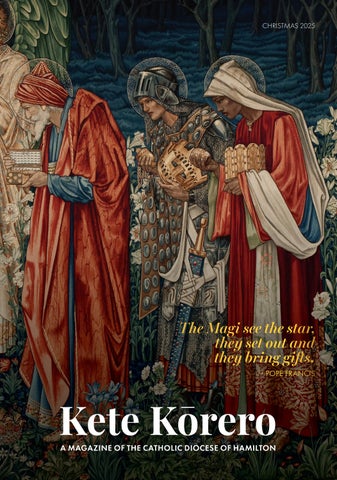
The Magi see the star, they set out and they bring gifts. - POPE FRANCIS
Kete Kōrero A MAGAZINE OF THE CATHOLIC DIOCESE OF HAMILTON
CONTENTS 02
EDITORS NOTE
03
BISHOPS LETTER
05
YOUR PRAYERS ARE BEING ANSWERED
06
SAINTS, STUDENTS AND CREATIVE GIFTS
08
RETREAT DATES FOR 2026
09
ONLY GOD KNOWS WHERE YOUR GIFT MAY LEAD YOU
12
COMMUNION, PARTICIPATION AND MISSION
14
LIVING SYNODALITY
15
GIFTS OF THE SPIRIT REFLECTION TOOL
19
CENTENARY CELEBRATION AT ST PATRICK’S, PUTĀRURU
22
33 HOURS OF ENCOUNTER
24
SEND ME, DIOCESAN FAMILY WEEKEND
26
THE RIPPLE RESULTS PODCAST
26
MINISTRY OF THE EAR
27
FROM CLASSROOM TO CATHOLIC BIBLICAL JOURNAL
28
AN EVENING AT THE CONCLAVE
29
UNITY IN PRAYER FOR KIRIKIRIROA
30
TITUS TIDBITS
Publisher: Catholic Diocese of Hamilton Editor: Kirsty Muir | kirstym@cdh.org.nz Design and Photography: Taila Burton-Gollop Proofreader: Patricia Parsons Advertising: kete@cdh.org.nz Sign up for more Kete online news: ketekorero.cdh.nz Phone: 07 856 6989 Postal: PO Box 4353, Hamilton East 3247 ISSN number: 2357-2221 Deadline for content: 16 February 2026 @catholicdioceseofhamilton youtube.com/CatholicDioceseofHamiltonNZ COVER: Edward Burne-Jones, Adoration of the Magi, 1890, tapestry, Wikimedia Commons.
EDITOR’S NOTE While I may not have many to compare it to, if this is what a Jubilee Year is, I can’t wait for the next one! This year, we have journeyed together through laughter and tears, and above all, the promise of spiritual renewal has been joyfully fulfilled. We have shared special celebrations, not to forget enjoying a special Jubilee-themed birthday cake along the way. In September I travelled ‘across the ditch’ to Aussie’s capital. We belong to the Australasian Catholic Press Association and every year they hold both a conference and an awards ceremony. Kete Kōrero came away with the “Most Improved Publication Winner” for 2024, which honoured its remarkable transformation, vibrant new design, fresh editorial tone, and greater inclusivity. Thank you all for your continued support of our diocesan publication. This Christmas timed edition brings together three threads woven through the life of our diocese this year: our gifts and talents, the call to journey together in synodality, and our Jubilee highlights. I chose the image of the three Wise Men because I feel their story holds
02
all three. Their gifts remind us that what we carry is meant to be offered. Their journey toward Christ reflects our own synodal path, walking together and seeking the light that guides us. Perhaps in this Jubilee Year, their pilgrimage reminds us of following that light, heading toward Christ and being transformed. My hope is that these pages shine with that same sense of offering, journey, and renewal. To complement this issue, Cardinal John Dew and David Wells who both visited our diocese this year, have recorded videos on using your gifts and talents. Keep an eye on our social media pages for these highlights or our recent Clearly (our online monthly newsletter). Wishing you all a joyful and blessed Christmas. Do not forget that Christmas does not end on 25 December. May your travels be safe, your gatherings grace-filled, and may Christ’s light guide you into the year ahead.
From the Office
BISHOP RICHARD LAURENSON
That is why the wish “Merry Christmas” is a perfectly good thing to say, even in the face of tragedy. We are expressing the joy of having been saved by the Lord, of living under his rule, and looking forward to the day when his Salvation is visited upon us, and we enter the realm of Heaven ourselves. In the meantime, we live here in this world, sad and sinful that it is, but bright and joyful it can be under Christ. Over the past three years, Pope Francis called the Church to walk a journey together through the Synod on Synodality. The Final Document (2024) gathers the fruit of that worldwide discernment. It is not another set of abstract reflections to be filed away. Instead, it is a roadmap for renewing the life and mission of the Church at every level — universal, national, diocesan, parish, and communal. The Church is most herself when all the baptised walk together, listen together, discern together, and carry forward the Great Commission together. The Final Document highlights three movements that shape this renewal.
The Christmas Season is upon us, and these days are marked by frenetic activity, major feasting, and then promises to diet or fast or something equally difficult to achieve. All this is, in fact, a good thing. The Major Feasts of Christmas and Easter simply must be marked by feasting, and all that entails. To feast is a good thing. Christian Feasting, though, is always marked by the reality of our lives. Many of us can find reasons not to feast, but to mourn instead. We have seasons marked out for that as well. Advent and Lent focus us on sorrow for our sins and preparation for these feast days. Advent is preceded by a month when we remember and pray for our beloved dead, and those who have no one to pray for them.
When we live our lives according to the rhythm of the faith, we become more resilient to the shocks and tragedies that come our way.
• Communion — the call to rediscover the deep unity given in baptism, and to make that unity visible in how we relate, dialogue, and decide. • Participation — recognising that every baptised person carries gifts for the Church’s mission, and that authentic governance involves listening, shared discernment, and collaborative structures. • Mission — a reminder that synodality is not an inward exercise. Its purpose is a Church more capable of proclaiming Christ in today’s world: attentive to the poor, open to those on the margins, and courageous in facing the realities of our time. The Final Document offers concrete tasks for dioceses and bishops as we move into the “implementation phase.” This next stage is to be carried out locally, guided by the bishop but involving the whole People of God. 1. 2. 3. 4. 5. 6. 7. 8.
Initiate an Implementation Phase Form or Strengthen Synodal Teams Reach Out to Diverse Groups Promote Joint Reflection and Discernment Report and Accountability to Rome Encourage New Forms of Ministry & Governance Structural Renewal & Synodal Authority Mission & Dialogue
Since then, Francis has gone to God, and we have a new Pope. The Holy Father, Leo, wishes us to continue this synodal journey in courage. Each diocese is asked to establish or strengthen a synodal implementation team, responsible for coordinating local PHOTO BY DEEARN STRAWBRIDGE
03
reflection, gathering insights, and supporting parishes, schools, communities, and agencies. Bishops are to launch and oversee the implementation process, determining its timeframe and methods, and ensuring it is rooted in prayer, discernment, and broad participation. We are at this particular stage in our implementation of forming and establishing a Diocesan Synodal Team. So far, a small team have been ‘voluntold’, and have willingly undergone some formation and are looking to gather some others to join them. Please keep them in your prayers. (Voluntold is when bishop “asks” those he employs….) Dioceses are encouraged to review their governance and decision-making structures, clarifying how consultation and deliberation work, strengthening finance councils and pastoral bodies, and involving lay experts - including women - in real positions of responsibility. Bishops are asked to foster a more synodal exercise of authority: transparent, participatory, and grounded in pastoral closeness. There are many things we already do in the diocese that express this. Around the world, many Diocesan Finance Councils (DFC) consist of the bishop and two priests and one layman. In Hamilton, since Bishop Gaines, we have had a DFC of Bishop, the Vicar General, and up to eight lay, men and women, from different parts of the diocese with a diverse skill set. We have had a Diocesan Pastoral Council (DPC), formed with parishioners from around the Diocese. The DPC fell into abeyance at the transfer of Bishop Steve to Auckland. I wish our new Diocesan Synodal Team to pick up this role in a dynamic way, and help me discern what a new DPC might look like. We are called to integrate synodality into mission. Structures are important, but they serve a larger purpose: forming a Church that accompanies people, proclaims Christ with joy, and stands alongside those who suffer. I wish, over time, to bring an aspect of Synodal decisionmaking into our parishes. This is different to consensus decision making, so we have to learn afresh what it might mean in our parishes. • There has to be a real and possibly difficult decision to make: e.g. shutting a church, how to evangelise in this community, how to manage when the priest lives 25km away. • There has to be a willingness to listen to God, and to each other - not once, but at least twice, before even proposing a solution. • There has to be humility to allow the decision maker, the pastors mostly, to make a decision and then support it, even if we would not have made that decision ourselves. There is a deep history of syndodality in the church. It is understood as the Church’s journeying together in 04
communion, discernment, and mission under the guidance of the Holy Spirit. Starting with the Council of Jerusalem (Acts 15), which serves as the foundational paradigm for synodal practice, this is where apostles, elders, and the whole assembly discerned God’s will amid controversy over the inclusion of Gentiles. After the debate, the actual decision was made by St Peter and announced by St James. Subsequent centuries reveal numerous expressions of this dynamic. These include local and ecumenical councils, provincial synods, and emerging structures that fostered communal listening, decision-making, and fidelity to apostolic tradition. Too often we look to the BIG events like Nicea, Lateran, Trent or Vatican II to express Synodality. These are important, but the church action of listening to the Holy Spirit should be an everyday thing. The move by Pope Francis is to try and make that everyday thing a deliberate reality. Let’s keep an eye and ear out for what happens next in our Diocese along these lines. In the meantime, Merry Christmas, Happy New Year, and have a true holiday even if it only be for a few days this time of year.
From the Office
YOUR PRAYERS ARE BEING ANSWERED! At a recent staff meeting in the Holy Cross Seminary in Auckland, the Rector mentioned that with the likely number of seminarians coming to the Seminary next year, it may be a struggle to accommodate them all. Another member of staff quickly replied, “Well, that’s a good problem to have, isn’t it?”
FR RICHARD SHORTALL SJ
T
his year we have twenty-four seminarians at Holy Cross. Given that the number of first-year seminarians entering next year might be in double digits, what does this suggest? Well, perhaps this situation tells us that your prayers for vocations to the diocesan priesthood are being heard!
Drury. Both Michael and I are old boys of Francis Douglas Memorial College in New Plymouth.
Since the beginning of this year, I have been driving once a month to the Seminary in Ponsonby to offer sessions of Spiritual Direction to the ten non-first-year seminarians.
This task of being involved in the spiritual formation of your seminarians is one that Fr Smith and I take very seriously. It is one that we both enjoy very much.
The fourteen first-year seminarians are being offered Spiritual Direction by Father Michael Smith SJ, a fellow Jesuit who grew up in Eltham. Both of us belong to the Australian and New Zealand Jesuit Province. He also works with staff and parents at St Ignatius of Loyola Catholic College in
Please continue to keep our seminarians in your prayers – particularly the four from our diocese. You might also consider asking the Holy Spirit’s wisdom upon those of us involved in their formation as your future priests.
While planning my response to the schedule asked of me during this Jubilee Year of Hope as a Missionary of Mercy, I was not expecting to be given a new ministry role.
PHOTO SUPPLIED.
05
Gifts and Talents
SAINTS, STUDENTS AND CREATIVE GIFTS SHINE NEW FAMILY BLOCK AT AQUINAS COLLEGE
Aquinas College is delighted to announce the unveiling of the newly renovated Family Block! This beautiful space now serves as the dedicated home for all Religious Education (R.E.) classrooms. They have intentionally created a more welcoming and inspiring environment for students to explore the Hope found in Jesus Christ. Their aspiration is that the influence of the Saints within these walls will help every member of the Aquinas family grow in their journey to holiness.
YEAR 11 DISCIPLESHIP CLASS: REPORTED BY GRACE ERSKINE-SHAW AND EMMA SWAIN (FEAT. MADISON BROWN)
T
he team wanted to include students in a meaningful way by giving them the opportunity to create digital artwork that highlighted important figures of the Church. This project was completed in the Art Faculty, led by Kelly Saunders. As a result, each classroom in the R.E. block now displays digital illustrations created by Year 10s, which portray a Saint or Martyr who devoted their life to Christ. We interviewed the eight Year 10 artists behind these saint-inspired works to learn about the challenges they encountered while creating their pieces, the reasons behind their choice of saints, and the personal connections they had with them. Each artist also shared how long it took to bring their dedicated creations to life. The artists are: Piper Lee, Matilda Parry, Teresa Zhu, Matai McNicholl, Bella Skogstad, Kiana Schoeser, Georgia-Rose McFarlane, Anna Hawke, and Year 11’s Emma Swain. Personal Connections to the Saints Students chose their saints based on both inspiration and research, leading to thoughtful personal connections. • Teresa and Matilda’s artworks were both related through family ties or a shared name, with Matilda choosing a saint connected to children. • Bella recalled learning about her chosen figure in primary school. • Kiana selected a younger saint she felt students could easily relate to. • Seeking novelty, Anna was curious about a saint she hadn’t heard of and connected deeply with his qualities of resilience and perseverance. • Piper was similar, drawing a Saint she didn’t know. • Georgia-Rose and Matai both chose their saints as part of their confirmation experience, with GeorgiaRose also appreciating her saint’s unique interests, as he loved the outdoors.
The Artistic Challenges Describing the most challenging part of creating their saint artworks, the students highlighted a variety of artistic difficulties they faced throughout the process. • Piper found that getting the skin tones right was the hardest part. • Matilda and Bella both mentioned struggling with symmetry and precise details, especially around the facial features. • Teresa and Anna focused on capturing the right art style, working to make their pieces look more cartoonlike and cohesive. • Matai found refining the outlines to be the most challenging step. • Kiana said that choosing the right color combinations took time and experimentation. • Georgia-Rose shared that the biggest challenge was making the figure look realistic and human.
The saints teach us that heroic virtue is not about being flawless, but about, seeking forgiveness after falling, resilience in the face of suffering and opposition, and choosing to love with extraordinary courage in ordinary circumstances. PHOTOS SUPPLIED.
06
Despite these difficulties, each student persevered and produced a piece that reflected both creativity and growth. The hard work of our Year 10 students has culminated in beautiful and authentic artwork. Mr. Dalton (Principal) was extremely impressed by the incredible talent demonstrated by our students and is delighted by the way this space has been transformed by the artwork to be an inspiring and faith-filled environment.
Aquinas College always has an open invitation to any parishioners in the Diocese who want to come and witness and celebrate our faith through these amazing displays.
ST THÉRÈSE OF LISIEUX BY BELLA
ST JOHN PAUL II BY EMMA
ST CATHERINE OF SIENA BY PIPER
ST ANDREW DŪNG-LAC BY TERESA
ST CARLO ACUTIS BY MATAI
OUR LADY BY GEORGIA ROSE
07
RETREATS 2026 TYBURN MONASTERY, NGAKURU
FEB
17 - 22 February LENTEN RETREAT
MAR
13 - 15 March
APR
10 - 12 April
MAY
8 - 10 May
JUN
19 - 21 June
JUL
17 - 19 July WOMENS RETREAT
SEP
18 - 20 September
NOV
20 - 22 November 22 - 27 November ADVENT RETREAT
CLUNY RETREAT CENTRE, TAURANGA
MAR
6 - 8 March 8 - 13 March LENTEN RETREAT
APR
19 - 24 April
TO BOOK GO TO www.cdh.org.nz/retreats 08
Gifts and Talents
Only God knows where your gift may lead you “There are different kinds of gifts. But they are all given to believers by the same Spirit” (1 Corinthians 12). “You are the world’s seasoning, to make it tolerable.” Knowing your gift to honour God and bless others is a calling each of us needs to know and use.
GARY PARKER
M
any of us wrestle with this concept, as I did. Looking back, I see it now as a journey paved by God. Born with music and lyrics running through my veins, I served as an altar boy for seven years at St Joseph’s, Fairfield, while attending Marist and St John’s College in Hamilton. It wasn’t until my senior years, when my musical colleague Noel O’Donnell and I entered and won the Hamilton Diocesan Talent Song Quest with a song I had written, that I realised the potential of the gift God had given me. That song, “Peace for My Mind,” was later featured on Radio Hauraki after we also made the finals of the Auckland Summer Show Talent Quest. My creative outlet had mostly been writing stories published in the New Zealand Catholic newspaper Zealandia. So despite not playing a musical instrument at that time, I found other musicians who took a liking to what I wrote and would team up with me. One was Chris Thompson—later to become the Manfred Mann singer of “Blinded By The Light”—who also happened to be Captain of my University rugby team. During my time at Hamilton Teachers’ College,
SOME OF THE JOSHUA BAND ( LEFT TO RIGHT) GRAHAM PARKINSON, MYSELF, FRANCIS KARL, PHIL REDMORE. PLAYING AT WILLOW PARK CHRISTIAN CENTRE.
I joined a folk group that competed successfully in a few talent quests, but it wasn’t until meeting my wife Geraldine that I finally learned guitar. Her encouragement was the spark I needed to keep developing my gift. A significant break came when Radio Waikato ran a “Write Lyrics for Elton John” competition while he was touring New Zealand. Elton himself judged the top six entries and chose mine as first. I didn’t even know much about him at the time but received concert tickets, a tape recorder, and his Goodbye Yellow Brick Road album — which I played endlessly. I later came to learn his lyric writer, Bernie Talpin was raised Catholic, something I came to realise regarding many top international musicians and lyricists including Don McLaine and Bruce Springsteen as well as others who had Jewish backgrounds; Paul Simon, Bob Dylan and Neil Diamond to name a few. The win encouraged me to write more, despite there being no real outlet for the songs. Deep down I desired to write songs of worship and praise but didn’t know how. Although 09
some referenced Christ’s name, they were not worshipful. “Lookin’ for the Promised Land” was one of these that became a highly streamed song, once the age of digital recording presented itself 20 years later. In 1987, after moving to Taupō for a teaching position, Geraldine and I started a combined Catholic/Anglican prayer group in our home. Having been involved with the Catholic Renew programme, we wanted to continue sharing faith with others. With the arrival of our fourth child, evening commitments were difficult, but God blessed our little Antioch. Two kind nuns, Sister Lynn and Sister Beverly, looked after our youngest two once a month, so Geraldine could have a break. Towards the end, each member was prayed over requesting the presence of the Holy Spirit in their lives. I had never seen people slain in the Spirit before and when my very pragmatic wife fell backwards while being prayed over I realised something very powerful was happening. I asked for prayer and though not slain in the Spirit, both Geraldine and my lives were changed as were those of others attending. Two went on to become ministers in the Anglican church. Geraldine became a much-wanted vocalist for praise and worship singing within both Catholic and Anglican groups and I began writing songs of praise and worship. Later, when I took a position at Waiariki Polytechnic in Rotorua, we again started a prayer group. Once again we started a combined home prayer group that included a number of devout Catholics including Jack and Anna Ponting. Out of this came a local branch of the Joshua Men’s Fellowship, which met monthly in the crypt of St Michael’s Church. It began small but quickly grew, with up to 30 men travelling from all over the region — Tauranga, Whakatāne, Taupō, Putāruru, Te Aroha, and Hamilton. I led the praise and worship, forming a band that included David Jones on piano, Phil Redmore on lead guitar, and Francis Karl on bass. As the fellowship expanded, two Methodist musicians joined us — Graham Parkinson and Brian Worthington — both of whom brought great talent and faith. Graham later converted to Catholicism. When we were invited to lead worship for the National Joshua Men’s Gathering at Willow Park in Auckland, I called on drummer Bill Meehan, whom I’d met at a Charismatic Conference. Together, with help from Hamilton musicians Mike Conroy and Tony Frogley (who proved their worth to be greater than gold), the band played for national events and recorded everything on reel-to-reel tapes with Warkworth sound engineer Peter Cornwall. Years later, those same recordings became part of the Joshua Band’s Emmaus Road album — now streaming worldwide. After ten years at the polytechnic, I returned to secondary teaching at John Paul College. Geraldine and I also led music for the 5.00 p.m. Mass at St Mary of the Cross MacKillop, and from there were invited by principal Patrick Walsh to lead weekly praise sessions at the college hostel. For three years we enjoyed this ministry with students until the hostel closed. Patrick later asked me to establish a youth group which met following the 5.00 p.m Mass, once a month that Mass became the monthly College Youth Mass. Many students showed remarkable musical ability, both vocally and in instrument playing, and I suggested recording an album of original songs together. Latest song, sung by the Joshua band out now - music.drm.co.nz/the-gift 10
PHOTOS FROM TOP TO BOTTOM: PETER, ASHLEIGH AND ANGELA RECORDING IN THE STUDIO FOR WORLD YOUTH DAY. GERALDINE & GARY SINGING AT A HEALING SERVICE LED BY FR JOHN RAE, IN THE ST MARY’S PARISH HALL, ROTORUA. SONGWRITER, POET AND ARTIST - GARY PARKER. NEW ALBUM - NO GREATER LOVE. ALL PHOTOS SUPPLIED.
We called the group Metanoia and began recording at Tui Studio in Rotorua. To fund the project, I approached Bishop Denis Browne for a loan from the Diocese, which he humbly agreed to — provided I paid it back! Around that time, I applied to have the band perform at World Youth Day 2008 in Sydney. Out of 600 applications from around the world, ours was one of 20 selected. It was an incredible blessing. By selling CD’s we repaid the loan and helped to fund the band members to go to Sydney. While I couldn’t attend because of a new job, the students, under the care of teachers Owen Kowelewski and Maree Stuart, represented John Paul College beautifully, performing songs of faith for young people from around the world. Time passed as record and video shops closed and recording studios disappeared. The digital age had come and the music industry took a new turn. God’s timing is amazing and I decided to make the most of it in promoting His Word through music. I had submitted songs I was writing to the Christian Parachute organisers and attended one of
their song-writer’s conventions in Auckland. It was through them that I became aware of the digital songs distribution organisation DRM. I decided to embrace it — transferring older recordings and Metanoia’s songs to digital formats and distributing them through DRM. Though I had to teach myself home recording from scratch — hundreds of pages of manuals and many failed attempts — the effort paid off. Slowly, the songs began reaching listeners across the world. Today, I still receive reports from DRM showing which countries have streamed the music — the U.S., India, and sometimes, surprisingly, Iraq. One song, “Before You Lord,” recorded over 600 streams from 25 countries in a single month. Payments are tiny, but that’s not the point. The joy is knowing that a song of praise might touch a heart somewhere across the world. Marketing music is a lottery and getting onto essential playlists is costly. I leave it to the Lord to take the songs to the hearts and lives He desires.
They are the gifts given for me to share and only He knows where they may lead. To listen go to the web page: www.cyberdour.com or contact me cyberdour@gmail.com.
11
Synodality
SYNOD ON SYNODALITY:
COMMUNION, PARTICIPATION, MISSION. KIRSTY MUIR
A
s our diocese prepares to focus intentionally on synodality in 2026, I was invited earlier this year to participate in a formation programme that would help us take these steps well. The NZCBC (New Zealand Catholic Bishops Conference) was piloting a national Communal Apostolic Discernment Facilitators Course. This was in response to what the bishops recognised, echoed by the Synod in Rome: the Church needs people who can accompany processes of ecclesial discernment at the local level. Twelve of us from across Aotearoa, including Fr Adam and myself from our own diocese, committed to this six-month pilot. The participant criteria was simple yet searching. The first: being “a person of serious prayer” - tick. The last: being “committed to supporting the growth of God’s reign” - also tick as well as encouraging. But the one in the middle: having “a desire to grow in freedom and a willingness to confront their unfreedoms” - made me pause. What might surface? And would I be ready? Still, with the intention of helping our diocese deepen its understanding of the Church’s discernment tradition, I said yes. Our first gathering was in April at the Magnificat Retreat Centre in Featherston. I arrived feeling somewhat unworthy among people who seemed far more experienced. But once immersed in the rhythm of prayer, silence, listening, and communal discernment, I realised God had placed each of us there for a reason. The week brought unexpected spiritual growth, guided by our facilitators, Fr Michael Smith SJ, whose very presence embodies Ignatian spirituality, and Lucienne Hensel from the Archdiocese of Wellington, who lives synodality with depth, clarity, and humility.
12
shaping a shared call. We engaged deeply with Church documents, especially the Final Document from the Synod on Synodality: Communion, Participation, Mission. Guest speakers Rocio Figueroa, Manuel Beazley, and Bishop Steve Lowe widened our perspectives and reminded us that synodality is always enriched by many voices, especially those not often heard. This year taught me that synodality is not a trend or a new invention. Before this course, it was a word I associated mainly with Pope Francis, yet I have since discovered its deep roots throughout our rich history, often in places I had never connected with it before. From the apostles in Acts 15, who listened, prayed, and discerned together, to the early councils and periods of reconciliation, to the assemblies of the first millennium, the Church has long practised forms of shared discernment. This tradition culminated in Vatican II’s renewed emphasis on shared responsibility within the Church and continued with Pope Benedict XVI, who highlighted the co-responsibility of the People of God. The requirement that once frightened me most, confronting my unfreedoms, became a doorway into deeper freedom. The course reshaped the way I pray, facilitate, collaborate, and listen. With Bishop Richard’s full support and encouragement, our diocese will establish a Diocesan Synodal Team in 2026. The details are still being discerned, but the direction is clear: we are committing to walking together, listening deeply, and trusting the Holy Spirit. Without the Spirit, synodality is only a process. With the Spirit, it becomes mission. As fellow participant Amy Armstrong from Dunedin Diocese shared:
Between intensives, we met monthly on Zoom, each sharing a project where we had practised elements of communal discernment in our own communities. The encouragement and quiet confidence in that group were unlike anything I had ever experienced, and almost without noticing, we were becoming facilitators in the making.
“.... when Church leaders pause, pray and truly listen ….. Something new begins to take root: a way of being Church that is Spirit-led, inclusive, and alive with hope.”
By the time we gathered again in September at St Francis Retreat Centre in Auckland, we were no longer strangers from five dioceses but trusted companions
*Turn to page 14 to read about a recent experience in Gisborne. What began as a simple Faith Formation visit unfolded into a living example of synodality in practice—listening, discerning, and walking together as the People of God.
Synodality
Living Synodality AT ST MARY’S, STAR OF THE SEA
ALISON CARROLL
I
n the spirit of the Church’s synodal journey, where isolation at the “farthest outposts” can sometimes dim the light of communal faith, one of my first diocesan visits as Faith Formation Manager took me to Gisborne - the parish most distant from the Cathedral in the Diocese of Hamilton. This experience beautifully exemplified the themes of synodality as outlined in the Final Document of the Synod which calls the Church to foster deeper communion among the faithful, active participation of all the baptised, and a renewed commitment to mission through listening and discernment. Far from being a mere administrative stop, this visit became a living embodiment of the Church’s “specific modus vivendi et operandi,” rooted in Trinitarian communion and the co-responsibility of the entire People of God. Fr. Mark Field welcomed me with genuine hospitality, inviting parishioners to gather for an open discussion on refining faith formation opportunities. Over light refreshments - a simple act of breaking bread - we engaged in a time of open and honest dialogue. With humility, we shared personal and parish experiences, acknowledging our strengths and struggles in a society where the Gospel’s counter-cultural message challenges secular norms. Yet, amid the shifting demographics in the Catholic Church in New Zealand we discerned opportunities for unity. This wasn’t top-down planning but true participation: laity, clergy, and visitors together voicing insights, actively contributing in the discernment process. A common theme of the conversation was the enthusiastic recollections of past Alpha courses under Msgr. Frank Eggleton’s leadership. Parishioners praised how Alpha
14
fostered hospitality, built community, and served as an “on-ramp” for newcomers and the disconnected, gently guiding them toward deeper encounters with the faith. Following this collaborative conversation, Fr Mark took the idea to the parish council, and made a decision to take the planning to the next stage. He then invited anyone interested in helping to run Alpha to a follow-up session. When I returned, ten enthusiastic parishioners gathered to explore the purpose and practicalities of Alpha. Together, we examined how Alpha proclaims the kerygma with joyful clarity; offers a gentle, welcoming entry into the Church’s life; renews the faith of long-time parishioners; builds community; sparks a culture of hospitality and invitation; and forms new leaders. As a group, we discerned a best-practice approach: beginning with a small pilot Alpha to build confidence and capability, then expanding to a full programme. This phased model reflects the Synod’s recommendation for thoughtful experimentation and evaluation in local contexts, ensuring synodality bears real fruit without burdening parish structures. This Gisborne journey has pivoted the parish toward mission, nurturing a culture of hospitality that draws others to Jesus. It reflects the Synod’s core invitation: to deepen communion through listening, to empower the laity through meaningful participation, and to move forward together in mission. In Gisborne, this is neither abstract theology nor an opportunity for the laity to usurp the leadership proper to the ordained priesthood; rather, it is the lived reality of a community walking side by side, attentive to the Spirit, and joyfully sharing the Gospel.
GIFTS OF THE SPIRIT
A Catholic Reflection Tool
WHAT ARE SPIRITUAL GIFTS? Spiritual gifts (charisms) are special graces given by the Holy Spirit to baptised Christians for the building up of the Church and the advancement of God’s Kingdom. They are not given for personal status, achievement, or selffulfilment, but for service and mission. Charisms are: Given by the Holy Spirit - for others and the mission of the Church - Discerned over time through prayer, fruit, and feedback. The Holy Spirit is "the principle of every vital and truly saving action in each part of the Body." He works in many ways to build up the whole Body in charity: by God's Word "which is able to build you up"; by Baptism, through which he forms Christ's Body; by the sacraments, which give growth and healing to Christ's members; by "the grace of the apostles, which holds first place among his gifts"; by the virtues, which make us act according to what is good; finally, by the many special graces (called "charisms"), by which he makes the faithful "fit and ready to undertake various tasks and offices for the renewal and building up of the Church." CCC798
Every Christian has been given gifts — but not every Christian has discovered them yet. This reflection is simply a starting point — a way to begin thinking about how God may be working through your life and gifts. The Catholic Church has a rich and beautiful tradition of discernment, inviting us to listen deeply for the movements of the Holy Spirit. For those who wish to explore their gifts more intentionally, we encourage participation in Called and Gifted — a formal and prayerful discernment process that helps individuals discover and develop their unique spiritual gifts for the service of the Church and the world.
HINT: Read the back page before reading the centre tick sheet - this will help you to discern as you read through the questions.
15
Charism Discernment Questions ENCOURAGEMENT
LEADERSHIP
Building others up in faith and confidence • Do I naturally notice when someone needs support or reassurance? • Do people seek me out when they are discouraged? • Do my words restore hope or confidence in others?
Inspiring and guiding others toward God’s mission • Do I see what needs to happen and gather others toward it? • Do people follow when I set direction? • Do I influence faith groups toward growth and mission?
PASTORING / SHEPHERDING Guiding and caring for a group spiritually • Do I feel responsible for the spiritual well-being of a group? • Do people grow in faith when I walk with them? • Do others turn to me for guidance and care?
MERCY Responding with compassionate love to those in need • Do I respond instinctively to those who suffer? • Do I feel deep compassion and want to take action? • Do people say they feel understood or comforted by me?
SERVICE Meeting practical needs with joy • Do I enjoy helping behind the scenes? • Do I notice practical needs and meet them quietly? • Do I feel energised by helping tasks succeed?
KNOWLEDGE Understanding deep truths of the faith • Do I love learning about Scripture and the Church? • Does understanding truth come easily to me? • Do others benefit from what I learn and share?
16
APOSTLESHIP Pioneer spirit for starting ministries and mission • Do I love starting new ministries or initiatives? • Do I see possibilities and want to build what is missing? • Do others join in when I begin something for the Church?
EVANGELISM Drawing others to Christ and His Church • Do I get excited when sharing Jesus and the Church? • Do others come closer to faith after talking with me? • Do I naturally invite others to prayer, Mass, or faith conversations?
HEALING God working through someone to restore wholeness • Do others experience spiritual or physical healing when I pray? • Do I feel drawn to pray for healing when I see need? • Are people restored or consoled through my presence or prayer?
Tick gifts where you consistently experience joy + fruit + others affirming it.
PROPHECY
ADMINISTRATION
Speaking God’s truth to build up the Church • Do I sense when God wants to speak encouragement or challenge? • Do others say my insights help them follow Christ? • Do I love truth and feel compelled to share it with compassion?
Organising people and resources for mission • Do I organise people and systems naturally? • Do I enjoy planning and making sure mission happens? • Do groups become more effective when I’m involved?
TEACHING
CRAFTSMANSHIP / ART / MUSIC
Communicating faith clearly and faithfully • Do I love helping others understand the faith? • Do people say I explain things clearly? • Do others grow in knowledge and confidence through me?
Creating beauty that glorifies God • Do I create beauty that lifts hearts to God? • Do people encounter God through the things I make? • Do I love using creative skills for the Church?
WISDOM
HOSPITALITY
Offering prayerful insight and perspective • Do people come to me for spiritual guidance? • Do I instinctively see God’s perspective? • Do others experience peace or clarity after speaking with me?
Creating environments of welcome and belonging • Do I love welcoming people and helping them belong? • Do people feel at home around me? • Do I enjoy opening my home or serving others?
INTERCESSION
GIVING
Persistent prayer for others’ needs • Do I feel called to pray deeply and persistently for others? • Do I see answers to prayer regularly? • Do people ask me to pray for them?
Sharing resources generously for God’s work • Do I delight in providing for others’ needs? • Do I look for ways to financially support mission? • Do I trust God to provide for me when I give generously?
FAITH Exceptional trust in God for big things • Do I trust God boldly even when others hesitate? • Do I inspire confidence and trust in God in others? • Do I sense God calling me to pray big prayers?
* The results of this Charism Inventory are for informational and reflection purposes only. It is designed as a tool to help you explore potential areas where you might be gifted.
17
PRAY: Ask the Holy Spirit to reveal and strengthen your gifts. Come, Holy Spirit, fill the hearts of Your faithful and enkindle in them the fire of Your love. Send forth Your Spirit, and they shall be created, and You will renew the face of the earth. Heavenly Father, in Your infinite goodness, grant us the wisdom to see the gifts You have given us and the courage to use them for Your glory. Open our minds and hearts to Your will, that we may discern Your voice and be guided by Your grace to build up Your Church and serve our community. Amen. SCRIPTURE: “All of us, in union with Christ, form one body, and as parts of it we belong to each other. Our gifts differ according to the grace given us. If your gift is prophecy, then use it as your faith suggests; if administration, then use it for administration; if teaching, then use it for teaching. Let the preachers deliver sermons, the almsgivers give freely, the officials be diligent, and those who do works of mercy do them cheerfully.” Romans 12:5-8 NOTICE: Where do you see consistent fruit? Where do others grow? TEST: Try serving in ways that match your possible charisms. Your Spiritual Gifts do not appear and disappear as you pass through the doors of your church! The special gifts God has given you are with you always. They are meant to also be used in your daily life to bring glory to God and serve the needs of others. LISTEN: Pay attention to feedback from trusted Catholics.
Inspired? Here’s how to learn more and continue your discernment. The Diocese of Hamilton will run a ‘Called and Gifted’ Discernment Process in 2026. For expressions of interest please scan the QR Code.
Every baptised disciple is called to mission. Your gifts are given for the renewal of the Church and the salvation of the world. COME HOLY SPIRIT — MAKE US FULLY ALIVE FOR YOUR MISSION. 18
Jubilee Year Highlights
100 YEARS OF FAITH: CENTENARY CELEBRATION OF ST PATRICK’S PARISH, PUTĀRURU
St. Patrick’s Parish, Putāruru, celebrated a milestone of faith on Sunday 30 November 2025. A celebration of one hundred years of faith, community, and service. The centenary brought together parishioners past and present, clergy, religious, and friends from near and far in a day filled with prayer, remembrance, and thanksgiving.
KATRINA SIMPSON
T
he festivities began with a Centenary Mass celebrated by Bishop Richard Laurenson, with Fr Robert Sharplin (current parish priest), visiting priest Fr Mohan Kumar Belavendram (Rotorua) and aided by Deacon Carey (Tokoroa) and five altar servers. Paul Dykstra warmly welcomed everyone - from the treasured parishioners in their nineties to the youngest and newest. He also acknowledged the Marist Sisters, whose presence has been integral to the parish. Their dedication and hard work, particularly in establishing St. Mary’s Catholic School, has left a lasting legacy, and the school remains a vibrant and cherished part of parish life today. The gathering remembered the tragic passing of Sister Rose O’Meara SM, with many of her family attending to honour her lifelong commitment to education and parish service. Sister Mary Dore SM, who had served as principal at the time, had also hoped to be present, but sadly passed away in early November. Paul also expressed gratitude for the sacrifice and generous service of the Mill Hill Fathers, particularly their support of the Māori parishioners and community.
BISHOP RICHARD BLESSES THE NEWLY UNVEILED PLAQUE FOR THE SISTER ROSE O’MEARA MEMORIAL GARDEN - TOP VISITING MARIST SISTERS FROM AUCKLAND - BOTTOM
19
Following the Mass, a procession made its way through the church and school grounds and along the surrounding streets. At its head was the historic Sacred Heart of Mary banner, carried proudly as a link to the parish’s early years. Behind it came the children of St. Mary’s Catholic School, waving the flags of their countries of origin, a vibrant display of the parish’s multicultural community. The Kapa Haka group performed with pride and spirit, weaving Māori culture and Catholic tradition together in a moving celebration of identity and faith.
1
The congregation then gathered for the unveiling and blessing of plaques and the dedication of the Sister Rose O’Meara Memorial Garden, a peaceful and prayerful space honouring her legacy and the many who have faithfully served St. Patrick’s Parish across the generations. The day concluded with refreshments and an exhibition of historic photographs in St. Mary’s Hall, the original St. Patrick’s Hall, where stories, laughter, and memories were shared among old friends and new faces alike. Photographs spanning the parish’s century-long journey, reminded all present of the faith, generosity, and fellowship that have built and sustained this community. As the centenary celebrations drew to a close, a deep sense of gratitude filled the hearts of all who attended, for the past 100 years of blessings, and for the promise of faith and hope that will guide St. Patrick’s Parish into its next century.
“The oldest parishioner with the honour of cutting the cake” 2
20
3
“Celebrating our past with thanksgiving, living our present with joy, and looking to the future with faith.”
4
PHOTOS SUPPLIED. PHOTOS FROM THE DAY KIRSTY MUIR. 1. SISTER ROSE WITH SCHOOL CHILDREN IN FIJI 2. FAMILY OF SISTER ROSE, HER SISTER SEATED MIDDLE 3. BISHOP DELARGEY BLESSES THE NEW ST PATRICK’S CHURCH IN 1966 - TOP RIGHT 4. CLERGY AND ALTAR SERVERS
21
Jubilee Year Highlights
THIS IS MY BODY: 33 Hours of Encounter “The Eucharist is real, and this exhibition and adoration made it tangible for our community.” Juanita Raman, Youth Worker for the Cathedral of the Blessed Virgin Mary, shares a reflection on the ways parishioners, students, and visitors experienced Christ in a profoundly personal way during the exhibition and the 33-hour encounter of adoration.
JUANITA RAMAN
“Oh my gosh. It’s actually real. It’s all real.”
T
hat teenager’s words echoed in my heart — words I heard again and again from parishioners, school students, and visitors from the wider community, each sharing how the exhibition made the mystery of the Eucharist come alive in a new way. Between March and May, we hosted an exhibition on Eucharistic Miracles: moments across history when the consecrated host has revealed itself as the flesh and blood of Christ. The exhibition was accompanied by a first-class relic of Saint Carlo Acutis, the millennial saint who used the internet to share the beauty of the Eucharist with the world. As the exhibition drew to a close, we wanted to respond to what God had stirred within our community. We wanted to end with an encounter. The most fitting response? Adoration. Not a brief vigil, but a 33-hour encounter with Him, one for every year Christ lived on earth.
For 33 hours, incense filled the Church, prayers rose, and heaven met earth. The foyer of the Cathedral was lined with more boards displaying the Eucharistic Miracles. The main body of the Cathedral became a sanctuary of stillness, intercession, and adoration of the Real Presence. In the late hours of the night and early hours of the morning (what I like to call the “power hours”) people stayed awake and kept our Lord company by candlelight, sustained by whispered prayers and a few sugary snacks. Our schedule was designed as an open invitation for every heart to enter, moving from moments of silence, to the Divine Office and our “special events.” We opened with children’s Adoration — little voices, big questions, individual benediction, and wide-eyed moments of wonder as they connected the Eucharistic miracles to the presence of Jesus on the altar. Spread across the foyer with colouring sheets in hand, these “Kids Ado” sessions reminded me that Jesus is for everyone — not just the adults. After beautiful Eucharistic motets drawn from our Church’s sacred tradition, the custodians of the exhibit from Oceania Faith Journey shared stories that moved from the Eucharistic miracles to their own experiences, reminding us that Christ is as present now as He was then. The Vigil Mass in the final quarter of the encounter drew the heart of the liturgy, PHOTOS SUPPLIED.
22
Jubilee Year Highlights
and was followed by contemporary praise and healing Adoration, where individuals came forward for individual benediction. People of all ages and walks of life came forward for an intimate moment with the Divine Healer, the Friend who will never leave. By the end of the encounter it felt as if every part of our parish family had gathered — old, young, devout, and searching — each finding their place at the feet of Jesus. This encounter was a highlight for our parish, and many shared that they would never see the Eucharist in the same way again. The Eucharist is real and this exhibition and adoration made it tangible for our community. In this Jubilee Year of Hope, this exhibition and encounter reminded us that “hope does not disappoint” and through these Eucharistic miracles, we encountered the one who is never far. The Eucharist is the Real Presence, the living reminder that Christ is with us still. It is my prayer that this encounter made that truth tangible for our community.
“When we face the sun we get a tan… but when we stand before Jesus in the Eucharist we become saints.” - CARLO ACUTIS: MILLENNIAL TEEN AND SAINT
23
Jubilee Year Highlights
SEND ME: Annual Diocesan
Family Weekend
Our annual Diocesan Family Weekend was held in Rotorua on the weekend of 10 - 12 October. Twenty Seven families, some seasoned attendees, some attending for the first time, descended on the grounds of the St Mary Church and School complex. With a theme of “Here am I, send me” (Isaiah 6:8).
T
he weekend began with a BBQ dinner on Friday evening., Saturday we listened to insightful speakers from those in different vocations, shared our family life highs and challenges in small groups, we enjoyed the hospitality of St Mary’s school with bouncy castles and swimming pool, before closing the day with Praise and Worship. The highlight for most however on the Saturday, was the incredible Adoration and Benediction, with many commenting - they had never encountered the Lord in such a powerful way. We celebrated Mass on Sunday together with the St Mary’s community, given that the 12th of October was St Carlo Acutis’ feast day, we were blessed to have a first class relic of his in our presence. Deearn Strawbridge shares a small reflection on her family’s experience. “I had been praying for a long while before the family camp about how to manage my vocation as a mother and a wife with the necessary commitments that come with just living. This was weighing on me. My top priority in life is directing my family towards Heaven, how do I successfully do that while juggling all of the other things? We weren’t going to attend the camp, I felt like there was just too much going on. But last minute we decided it would be good for the children to meet more catholic families. We only went for a day, but in one day God gave me a peace there that I had not felt in a long time. The message I received from the talks we attended, were an answer to the questions I had been asking God.
The testimony of both speakers had very similar foundations, to be surrounded by God! To surround your children by the faith, with faith filled people and religious vocations, let them see you quietly serving the church. Encourage them to sit with Jesus for a while if they are passing the church. If we want them to know God, surround them with Him! For the first time ever we got to experience adoration and benediction for our very own family. We met so many families who desire to lead their families to God. We experienced reconciliation, a time of quiet and a time of praise. I got to spend time with other mothers who were so encouraging and inspiring. We ate together, shared our experiences with one another and the children started, what I hope will be, eternal friendships.
24
milies on the a gift for all fa e er w s nt Fo mmunity Holy Water ember in our co t example of a m e more ea liv gr s a , ilie nd m ke fa wee nts to to help le ta d ore an fo fts gi churchnz r m using their Check out @little e. m ho at lly ica liturg
I only went expecting our children might meet new friends, but what I didn’t expect was to meet Jesus there, in the families we met, in the people that served us, and most beautifully, in the real presence of the Eucharist. No matter what obligations we have to work, or necessary commitments required for living that pull us every which way, our vocation is to simply surround ourselves and our families with the faith. Be expectant that when you go to family camp, Jesus will meet you there.” 25
Jubilee Year Highlights
The Missionary of Mercy’s
Ministry of the Ear
As this Jubilee Year of Hope draws to a close, here is a brief account of the unique contribution that we as a diocese have made to this special year.
In this Jubilee Year, a special project was set in motion by Marian Greene, Catholic Development Fund Manager and now, official host of the Ripple Results Podcast! A single act of support to The Catholic Development Fund (CDF) can spark a wave of change and this feature offers a glimpse into these ripples results across the Hamilton Diocese. The podcast guests provide first-hand insight into how the CDF helps to provide the financial resources that enable them to fulfil their inspiring and varied roles within the Diocese of Hamilton. You will hear about communities uplifted, projects brought to life, and faith put into action. The guests discuss the impact of their work on both our local and wider communities, and how they envision this evolving in the future. Listen along as we explore the ripple results that begin with a single purpose and radiate with meaning. Scan the QR code for a direct link to the CDF website or search ‘The Ripple Results’ on all major podcast platforms. Brought to you by the Hamilton Catholic Development Fund and with support from Free FM89.
26
F
ollowing the request made at a gathering of your priests with Bishop Laurenson in October 2024, a schedule was drawn up by Monsignor Trevor Murray and Kirsty Muir to enable parishioners to have access to our own Diocesan Missionary of Mercy – Fr Richard Shortall SJ. When he commissioned the Missionaries of Mercy in 2016, Pope Francis told them that theirs was to be the ministry of the ear – a ministry of listening to those who desired to be heard. The response during this Jubilee Year of Hope to the opportunity of having such a conversation has been overwhelming. As our Missionary of Mercy, Fr Shortall has visited 28 churches where he has sat listening to 259 individuals. A second round of visits was also conducted for the Hamilton and Tauranga clusters. Parishioners have been willing to entrust their stories, their questions, their worries to Fr Shortall who in turn has quietly, gently and faithfully listened to each person without judging. Although not able to offer a magic wand to solve so many stories of pain and sorrow, he has noticed that often the person left these sacred conversations somehow lighter of step. Offering this ministry that was instituted by Pope Francis, has been a graced part of the Jubilee Year of Hope for our diocese. It has been an experience that has left Fr Shortall feeling a deep sense of privilege and gratitude to God for these times of special listening.
Jubilee Year Highlights
From Classroom to Catholic Biblical Journal Andrew Duncanson is a Religious Education and Geography teacher at Aquinas College in Tauranga who has recently graduated with a Master of Theology from Otago University. He has used his gifts and talents to write and have his paper published in the Catholic Biblical Quarterly, the peer-reviewed journal of the Catholic Biblical Association of America. We are proud to celebrate his achievement in this Year of Jubilee and wanted to find out more about his paper.
INTERVIEWED BY ANNA FRANCIS, LEADER OF LEARNING - RELIGIOUS EDUCATION What was the idea behind your paper? It is about the Synoptic Problem – that is, figuring out why the Gospels of Matthew, Mark, and Luke overlap so much. I agree with the “Farrer hypothesis”. According to this hypothesis, Mark’s Gospel was written first, then Matthew used Mark’s Gospel as his main source of information. Finally, Luke used both Mark’s and Matthew’s Gospels. My essay offers new arguments in support of this hypothesis. How long was the process? The essay is roughly half of an Honours dissertation I wrote in 2023. I submitted it to the journal on 10 January 2024
and received the reviewer’s reports on 30 March 2025. It was a very long wait! The reviewers recommended publication after revision, so I sent it back to the editor after making the necessary improvements. After the copy editor made some final changes, it was finally published in October. What would you say to budding biblical scholars? Be open to changing your mind when new evidence comes your way. If you are learning any biblical languages, such as Greek, try to do a little work on it everyday.
27
Jubilee Year Highlights
AN EVENING AT THE CONCLAVE PARISH OF ST MARY, STAR OF THE SEA, GISBORNE
The Hamilton Diocese was fortunate to host Cardinal John Dew twice recently as he continues to travel across the country for speaking engagements. October began with his visit to St Thomas More in Mount Maunganui, attracting parishioners from as far afield as Taupō, Rotorua, Whakatane and Hamilton. He then concluded the month with a visit to Gisborne. Gina Lean shares her reflection on his visit.
GINA LEAN
A
t the end of October, our parish was truly blessed to welcome Cardinal John Dew, who came to share his experiences of travelling to Rome for the conclave that elected our new Pope, Leo XIV. From the moment he began to speak, there was a hush of interest - everyone knew we were about to hear something special. With warmth and grace, Cardinal John recounted how he first heard of Pope Francis’ passing - not from Rome, but in a simple phone call from his sister. From there, he took us on the journey to Rome, describing his memorable moments: the procession from the Pauline Chapel to the Sistine Chapel, the singing of the Litany of the Saints, and the solemnity of walking into the Sistine Chapel, sitting among his fellow cardinals, and finding himself not far from the man who would soon become our new Holy Father. He also shared the story of a special ring he carried with him - the Good Shepherd ring, which had belonged to Cardinal Delargey, who had ordained him in 1976 on Good Shepherd Sunday. Although it was not his official cardinal’s ring, he kept it in his pocket during the conclave, touching it often as a reminder of the role of the Pope as the Good Shepherd and of the responsibility and prayer 28
behind the decision they were about to make. The ring became a powerful symbol of faith, guidance, and prayer throughout the proceedings. While careful to share only what he was allowed, Cardinal John’s storytelling was vivid and deeply personal. He explained that the whole experience was “steeped in prayer,” a time of quiet listening to God’s voice and trusting in the guidance of the Holy Spirit. Despite the weight of the responsibility, his words painted a picture of faith, humility, and hope - qualities that clearly shine in his own character. After the talk, we gathered to share refreshments, including delicious fruit cake and a cheeky little nip of port. Cardinal John mingled easily, answering questions and enjoying the company. He was friendly, down-to-earth, and genuinely “one of us.” It was a wonderful evening - uplifting, faith-filled, and deeply human. We left feeling grateful not only for his stories, but for the humble and joy-filled spirit of the man who told them. PHOTOS BY GINA LEAN
Ecumenical
From a man at Table Thirty-Six MIKE BAIRD
A
t 6:15 on a frosty Hamilton morning, I found myself chiseling ice off the car window and quietly wondering, “Why am I doing this?” The answer was simple enough to push me forward: “Because prayer moves God’s hand.” That conviction carried me into the Claudelands Events Centre, where the sixth annual Hamilton Prayer Breakfast was already humming with anticipation. Organised by Hamilton Pastors and Christian Leaders, with support from the New Zealand Christian Network, the event drew hundreds of believers representing every denomination I could think of.
led by church leaders. The prayers touched on civic life, families, and the well-being of the city’s institutions. Sitting at my table, joining in prayer not only with fellow Catholics but with Christians from across the spectrum, was powerful.
The sight of so many gathered in one place to pray— Catholics, Baptists, Pentecostals, Anglicans, and more— was deeply encouraging. Instead of differences, unity was the order of the day, echoing the event’s theme of standing together for our nation, our regions, our churches, and our whānau.
For me, the highlight came at the end. Arden Morunga, Head Boy of Saint John’s College, stood confidently in his full college uniform, badges gleaming, and delivered the final blessing in Te Reo and English. His faith and conviction were remarkable.
A live band, made up of musicians from various churches, lifted the room with music both familiar and new. The crowd sang heartily, and I was reminded of Saint Augustine’s words: “He who sings prays twice.”
Was the early alarm and frozen car worth it? Absolutely. Leaving the hall, I was struck again by the mystery and truth of what had brought us all together: prayer really does move God’s hand.
The formal programme opened with welcoming addresses from Hamilton Mayor Paula Southgate and dignitaries from Kīngitanga and Tainui followed by focused times of prayer
PHOTO SUPPLIED BY LIZ TOANIKERE-JENSEN, MANIFEST LOVE CHURCH: ARDEN MORUNGA, HEAD BOY FOR ST JOHN, DELIVERS THE FINAL BLESSING AND PRAYER.
29
Titus Tidbits
GOD GIVEN GIFTS Do I notice when someone is sad? Do others ask me for help or guidance? Do I want to help people right away if I see them hurting? Do I see little jobs that need doing? Do I like talking about Jesus to others? Do I help groups grow and do good things? Do others join when I start something? Do I love truth and want to share it gently? Do people say I explain things well?
Do people ask me for advice? Do I love learning about Scripture and the Church? Do people ask me to pray for them? Do I want to pray for sick or hurting people? Do I pray big, brave prayers? Do I like planning and sorting things? Do I love making beautiful things? Do I like making people feel welcome? Do I like giving things to people who are in need?
This Christmas, celebrate Jesus’ birth by discovering the amazing gifts and talents God has given you—like the shepherds’ joy or the Magi’s treasures! As the Year of Hope ends, let’s use our special abilities to share love and light up the world, just as Baby Jesus brings hope to everyone. Use the path below as an activity to talk to God about your gifts and talents He has given you.
3.
START I am good at talking about Jesus, like the time:
ME!
_______________________________________ _______________________________________ _______________________________________
One of my gifts or talents is: ______________
2.
_______________________________________ _______________________________________
1.
How can I use this talent I mentioned hopefully? (e.g., If I am good at drawing, could I make a card for someone lonely?)
Colour the hills green for growth!
30
I am good at helping: ________________ _______________________________________ _______________________________________
Hope idea: Share it by helping someone at home.
4.
HIDE MY TALENTS
SHARE MY TALENTS
Choose and colour the treasure chest you will follow!
EVERYONE WHO USES WHAT HE HAS WILL GET MORE. — CF. MT 25:29
5.
I like to sing these Christmas Carols:
__________________________________________ __________________________________________ __________________________________________ __________________________________________ __________________________________________ __________________________________________ Hope idea: Sing a carol to spread joy!
6.
God gifts each of us with talents, and what we do with these talents is our Gift back to God. A simple prayer: “Thank you, God, for my gifts!”
MERRY CHRISTMAS! The gifts God has given you are meant to bless the world. Use them with humility, and be bold in hope! Photobooth Fe and Luce created by Aquinas College students. Featured are Hazel and Dylan.
All my talents lead to Jesus. In 2026 I hope to: ___________________________________ ___________________________________ ___________________________________ ___________________________________ ___________________________________
31