ORDINARY TIME 2026
Kete Kōrero A MAGAZINE OF THE CATHOLIC DIOCESE OF HAMILTON
From the Office
FROM THE BISHOP’S DESK The Beauty of Ordinary Time As I wrote last Easter, ‘the Church does not have a mission so much as the Mission of Jesus has a Church’. The Lord, having gathered to Himself Apostles, trained them, Died and Rose for them, then sent them into the world to: Go, Make disciples, Baptise and “Teach them to observe everything I have commanded you”. (Mat 28:16-20)1 So now the Church finds herself in Ordinary Time. We find ourselves in the back end of Winter, where the weather is colder and damper and worse than the beginning of the season. It’s easy to think of beauty in the heat of summer, less so in our Diocesan Experience of winter. So what is beautiful about Ordinary Time? Firstly, the name. Like many things in the church the outward appearance belies the inner reality. By Grace: Water Washes — not dirt but sin. A Raised Hand — strikes not but declares Forgiveness. Bread and Wine— food made Divine. Christmas— not a day but a Season. And there is so much more. Ordinary Time does not mean “Meh Time”, boring time, that sort of ordinary. No, it means Ordered Time, Structured Time, Time to learn and ponder the teaching of Jesus, passed on by the apostles to the Church and recorded by her in the Scriptures (and other documents like the Didache). Week after week we are taught by Jesus in what he says and does. As Disciples we walk with him, and learn from him as we watch and listen to him.
For example, from the Assumption to All Saints, we will be covering the following on Ordinary Time Sundays from Matthew. 20th The Assumption of Our Lady (Our destiny awaits) 21st Peter and the Keys (the Prime Minister of the King) 22nd The cross and following Jesus (Pick it up and haul it along) 23rd Conflict in the Church (always painful - requires humility to solve) 24th Parable of the unforgiving servant (don’t be like this) 25th Parable of the workers in the vineyard (Why be envious because God is Generous) 26th Parable of the two sons in the vineyard (who actually does the will of God?) 27th Parable of the wicked tenants (Take care lest the kingdom be given to another) 28th Parable of the wedding feast (Everyone is invited into the church) 29th Give to God what belongs to God (which is everything) 30th The greatest commandment (Love God, Love Neighbour) 31st All Saints Day (The new Law of Jesus)
1 For all you grammaticians, the capitals are deliberate. eMphasis if you will, but more importantly a riff off Proper Nouns. The Divine Pronoun is Proper, but these Divine Verbs have a properness all their own - Died, Rose, Go, Make, Baptise, Teach. ✠R
02
Kete Kōrero | Ordinary Time 2026
PHOTO BY DEEARN STRAWBRIDGE
From the Office
As disciples of the Lord, we take these instructions seriously and seek to implement them in our personal lives and in our Family life. We ponder the Law of the Lord Day and Night (Ps 1:2). ‘Law’ means ‘the Word’, or ‘instructions’ of the Lord, after all God speaks — it becomes. That is the meaning of Divine Law. Jesus has spoken, and we learn to obey. Secondly, part and parcel of Parish life is the help to achieve all this. Ordinary Time has the specific focus of Discipleship. The synodal learning we are undertaking is one way to do this. Small groups doing Bible study, or exploring the faith (aka Faith Formation2) is another. Retreats are offered, Lenten Studies, and all sorts of other good things are ways in which we can deepen our knowledge and Love of God. We even get speakers from time to time who come to visit Hobbiton and share a little of their wisdom. Even if they would not be our first choice for entertainment, it is good to challenge ourselves to go and listen to people who Love the Lord. In Third place are the other challenges of living the Christian Life. The Foundation of holiness is our personal prayer, fasting and almsgiving. The Archangel Raphael taught Tobit (12:8-9) “Prayer with fasting and alms with righteousness are better than riches with iniquity. Better to practise almsgiving than to hoard up gold. Almsgiving saves from death and purges every kind of sin.” and in Sirach 3.30 we see “As water extinguishes a blazing fire, so almsgiving atones for sin.” Jesus himself said: When you give alms, pray, fast (Mat 6) not if. This lead to what we know as 2 Clement to say “Fasting is better than prayer, but almsgiving better than both”. We are used to the calls for prayer and fasting. The seasons of Lent and Advent do that in spades. We are less tolerant (or at least me) of the multiple opportunities every year for that third leg of the stool, Almsgiving. There are a ton of asks: Peter’s Pence; Caritas; PMS; Seminary, Bishop’s, Common Good, and SVDP being the most ubiquitous. Last August we started a deliberate approach for the local, namely your Parish. All parishes run on the oily rag principle. Usually about 5% under enough - with no
Alison Carroll is employed specifically to promote and facilitate this in our parishes. Contact her at allisonc@cdh.org.nz and if your PP agrees, she is most willing to come and give ideas and options. 2
strategic maintenance plan in place. What is missing from all parishes is at least 10% of the building value, just to stop it falling down. This is untrendy, and we struggle to fund it, but is very needed. True almsgiving is not about the trendy projects (World Vision’s starving children, or Red Cross’ latest Disaster) but the unglamorous: Alms to keep the parish going; the priest fed; and the local poor encouraged is the challenge I place before you. If your Parish is to be the place of Discipleship, of Ordered Time, and not “meh time” it needs your help, your time, your place and, frankly, your money. Please consider this call with a generous heart, and thank you.
+ BISHOP RICHARD LAURENSON
PARISH PL ANNED
cdh.org.nz/giving “If we are to be faithful to the instructions of Jesus to spread the Good News, then this legacy of giving must continue each and every generation.” -Bishop Richard Parish Planned Giving flyers available this August
Kete Kōrero | Ordinary Time 2026
03
From the Office
EDITOR’S NOTE | Where the Holy Spirit Leads There is something both humbling and beautiful about putting together each edition of Kete Kōrero. I usually begin with a theme in mind, convinced I know where the magazine is heading. Yet, without fail, the Holy Spirit seems to have other ideas. As the stories arrive, some commissioned - others finding their way to my inbox, pages slowly fill, articles related to my original ideas begin to weave together like threads in a tapestry towards something new. Themes emerge that by no amount of planning could I have quite possibly orchestrated. Once again, I find myself quietly surprised (yet not) by the Holy Spirit. Only weeks ago, our Diocese welcomed hundreds of pilgrims as we received the major relic of St Carlo Acutis. In a young man who above all else loved God, but also loved computers, football and friends, we were reminded that holiness is not reserved for the extraordinary. It is the universal call of every baptised person. We have a few young writers in this issue, who reflect beautifully on what Carlo's witness means for their own lives, reminding us that the saints still speak to every generation. Many of the stories in these pages also feel deeply personal. As a mother raising three teenagers, I know what it is like to navigate a world filled with endless screens, constant noise and no shortage of conflicting advice about what it means to live well. At this particular stage of my life, Pope Leo XIV's Magnificat Humanitas, building on the work of Pope Francis and those before him, speaks with refreshing clarity about the dignity of the human person and our call to authentic human flourishing. His words are neither complicated nor fashionable. They are simply the Gospel, spoken with wisdom for our time.
You will also find a feature on mental wellbeing. It is a subject close to my own heart. Like many people, I have experienced seasons when faith has not removed struggle but has quietly carried me through it. The Church has always understood that Christ meets us not only in our strengths but also in our wounds. There is hope, there is healing, and there is no shame in seeking help while entrusting ourselves to the Lord. Our plan for this edition was centred on The Beauty of Ordinary Time, with a particular focus on the Transfiguration of the Lord. As publication dates shifted and some articles changed, I wondered if that thread had been lost. Instead, I think the Holy Spirit simply wove it differently. From the beauty of our oceans to the changing seasons around us (literally and figuratively), from the witness of the saints to the quiet work of grace in our own lives, we are invited to glimpse the glory of God shining through the ordinary. Ordinary Time is not ordinary at all. It is in the ordinary days, the conversations around the dinner table, the beauty of creation, the witness of the saints, the challenges we carry, the Mass we celebrate together, that Christ continues to reveal Himself and gently draw us closer. I pray that somewhere in these pages, you will catch a glimpse of Him too.
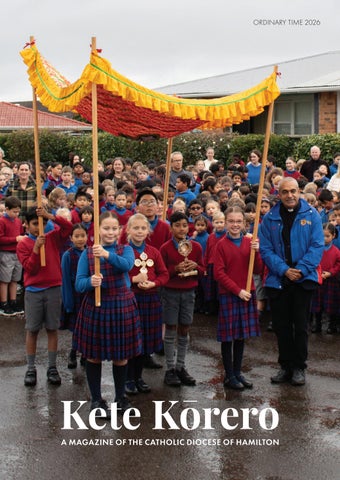
Publisher: Catholic Diocese of Hamilton Editor: Kirsty Muir | kirstym@cdh.org.nz Design: Cath Waller Design Proofreader: Patricia Parsons Advertising: kete@cdh.org.nz Sign up for more diocesan news: www.cdh.org.nz/terourou Phone: 07 856 6989 Postal: PO Box 4353, Hamilton East 3247 ISSN number: 2357-2221 Deadline for content: 9 November 2026 @catholicdioceseofhamilton youtube.com/CatholicDioceseofHamiltonNZ COVER: St Mary’s Catholic School, Rotorua
04
Kete Kōrero | Ordinary Time 2026
This year, 15 August falls on a Saturday. Our Bishops want the entire Catholic community to attend Mass on our patronal feast day. It makes sense, then, for them to do what they have done - transferring the celebration of this Solemnity to Sunday, the 16th of August.
E QUESTI
O
W
S
Our first bishop, Bishop Pompallier, concluded his first Mass in Aotearoa New Zealand on January 13th, 1838 at Totara Point by solemnly placing our country under the patronage of Our Lady, Assumed into Heaven. It was a hugely significant action. It is important that the Feast of the Assumption be a day when all Kiwi Catholics make a special effort to honour Mary.
ER
N
Why has the Solemnity of the Assumption been moved to Sunday this year?
H
From the Office
M
EE
T WISDO
M
This issue answered by
Monsignor Frank because their bodies will be resurrected on the Last Day; just as Mary’s was resurrected soon after her death. Our country has become so secular. Many New Zealanders have lost all sense of God and the sacredness of the human body. We need Mary’s intercession. And we are so blessed to have her patronage.
This gives every parish a golden opportunity to honour Our Lady in a very special way on a day when we can expect our churches to be packed. It is a day for processions, for rosaries, for a special Mass honouring our dear Mother, our Patron in Heaven.
On this our patronal feast day we pray: Mary, Assumed into Heaven, please pray for our beloved country, Aotearoa New Zealand.
On this day we especially ask Mary to intercede before God’s throne for our country because the corruption of morals in Aotearoa New Zealand is a frightening reality. By extolling the resurrected and glorified body of Mary we are reminded of the inherent dignity and goodness of every human person’s body. All human persons are sacred
Have a question for a future issue?
“
We'd love to hear from you. Email your question to kete@cdh.org.nz, and one of our senior clergy, religious or lay leaders will answer for you.
It is important that the Feast of the Assumption be a day when all Kiwi Catholics make a special effort to honour Mary.
Kete Kōrero | Ordinary Time 2026
05
Formation
Eyes Wide Open JOANNA KEARNEY I have been pondering in my heart an experience my twenty-year-old daughter shared with me last week. Four years into her medical degree, she frequently heads to the great outdoors to replenish her spirit. On this particular occasion, the sunset was so beautiful that she found herself quietly weeping. For a fleeting moment, she had glimpsed the transcendent—something beyond words, something that touched her soul. Her tears were an instinctive response to a deep longing: a desire to fully comprehend the beauty before her and to hold on to the joy it awakened within her. The moment passed, but it was not forgotten. As she made her way back down the path and returned to the routines of her ‘ordinary’ life, a profound sense of gratitude washed over her. She had not gone searching for the moment; rather, it had come to her. With eyes wide open, she had recognised its transcendent quality and it filled her with hope and wonder. And so it is time once again to celebrate the Feast of the Transfiguration, when Peter, James, and John accompanied Jesus up the mountain—no doubt, like my daughter, with little expectation of what they might encounter. Initially, they are described as “very sleepy,” biblical language for spiritual inattentiveness. Yet they become “fully awake” as “the appearance of his face changed, and his clothes became as bright as a flash of lightning.”
“
With eyes wide open, she had recognised its transcendent quality and it filled her with hope and wonder.
06
Kete Kōrero | Ordinary Time 2026
In Luke’s account, Jesus has only recently tried to explain to his disciples that he must suffer, die, and rise again. His words leave them bewildered and afraid, unable to see beyond his humanity. Here, however, as Jesus is joined by Moses and Elijah, and as the voice from the cloud declares, “This is my Son, whom I have chosen; listen to him,” the disciples begin to grasp the fullness of his divinity. They are granted not only a glimpse of the divine but also a foretaste of the Resurrection itself. The hope and wonder born from that encounter can only have fueled their steps as they descended the mountain and returned to the uncertainties that lay ahead. G. K. Chesterton memorably suggested in Orthodoxy that God never tires of the rising and setting of the sun, savouring each day as a kind of “theatrical encore.” Like a child, God remains eternally young, “abounding in vitality,” with a spirit “fierce and free,” delighting in things repeated and unchanged. By contrast, Chesterton laments that we grow old and weary through sin. If sin does not blind us entirely, it at least dulls our senses to the moments of transcendence that permeate everyday life. The Feast of the Transfiguration, then, is an invitation to keep our eyes wide open to those moments that stop us in our tracks and leave us speechless—whether encountered in nature, in human endeavour and relationship, or in prayer. It invites us to embrace the wonder and mystery they reveal and, ultimately, to renew our hope and trust in the promise of the Resurrection.
Community
Atawhai Assisi MARIETTE, ON BEHALF OF MONSIGNOR FRANK Bishop Richard and Mons Frank concelebrated Mass at Atawhai Assisi on Sunday the 12th of July. The new altar, containing a relic from St Clare of Assisi, was consecrated by Bishop Richard. We are very grateful to Louis Fick (CEO) for a recent refurbishment of the chapel space which has also been repainted and recarpeted. These changes have all enhanced our sacred space. Residents, families, volunteers and supporters all enjoyed a delicious morning tea after Mass.
OUR MISSION: “To provide a quality caring service for older people, in a Christian environment”
WE PROVIDE: Retirement Village - Rest Home - Hospital Care - Respite Care - Day Programme CONTACT US: Retirement Village: David McGeorge: 021 0289 1213 | gmsupport@tamahere.co.nz Care Service: Sharon Leela Paul: 027 224 4412 | gmcare@tamahere.co.nz
Kete Kōrero | Ordinary Time 2026
07
From the Office
Celebrating Our People Congratulations! The work done by our longserving Catholic Prison Chaplain, Russell Woodhouse (Tongariro), in partnership with his wife Te Waiora, has been recognised by Tira Tūhāhā Prison Chaplaincy Aotearoa (TTPCA), elevating him to Level 3 status - the first chaplain in New Zealand ever to be so recognised. It is the highest recognition possible in the current competence measurement protocols used by TTPCA. In addition to upholding strong Catholic values, Russell expertly integrates tikanga into his ministry in ways that have proved innovative and effective. This recognition by his peers is something unique and very special.
Not for profit - for people! THE CATHOLIC DEVELOPMENT FUND PROMISES YOU: • A socially responsible investment opportunity • Interest on your investment • Zero fees • The opportunity to help your Bishop fulfill his works in your diocese • An investment that aligns with Catholic values • The Bishop’s guarantee that your funds will be returned to you when needed
Talk to us now! Belong to something better!
0800 843 233
08
Kete Kōrero | Ordinary Time 2026
Community
The Upper Room GRACE MADSEN, YOUTH GROUP ATTENDEE AND HELPER On the 29th of May, St Joseph’s Holy Family Youth Group in Morrinsville hosted a buffet dinner for the elderly of our parish. For one special evening, our hall was transformed into a restaurant named "The Upper Room," where we had the privilege of hosting 16 of our senior parishioners. The night began with our youth enthusiastically serving dinner and drinks to the guests. After a delicious dessert, the evening concluded with a heartfelt sing-along led by the youth and their leaders. It was incredibly heartwarming to see our elderly standing arm-in-arm, singing "Auld Lang Syne" with the younger generation. By the end of this spirit-filled night, our youth were glowing with joy and pride, having hosted an evening of fellowship and love. PHOTOS SUPPLIED
Kete Kōrero | Ordinary Time 2026
09
Life in the Church
The Diocesan Visit of the Pilgrim Relics of St Carlo Acutis: Celebrating faith, fellowship, and the Eucharistic legacy of St Carlo Acutis across the Diocese of Hamilton. KYREE CATENA Kyree Catena is a Year 8 student at John Paul College, Rotorua. At St Mary’s Parish, he serves as a lector and coordinates the Ministry of Altar Servers. Kyree wrote this article to share St Carlo’s inspiring legacy of modern holiness and Eucharistic devotion with other young Catholics across the diocese. PHOTOS BY KIRSTY MUIR
10
Kete Kōrero | Ordinary Time 2026
Life in the Church
From 14–16 June, the Diocese of Hamilton was blessed to welcome the Pilgrim Relics of St Carlo Acutis to Rotorua. Over three grace-filled days, parishioners, clergy, religious, students, and pilgrims gathered in prayer, reflection, and fellowship to honour the life and witness of the young Italian whose deep love for Christ and the Eucharist continues to inspire Catholics throughout the world. The visit provided a unique opportunity for people across the Diocese to encounter the story of Carlo Acutis, a teenager who used his gifts and talents to share the Gospel and whose devotion to the Eucharist shaped every aspect of his life. Through liturgies, prayer, pilgrimage, catechesis, and veneration of the relics, many were encouraged to deepen their relationship with Christ and renew their commitment to the faith. The pilgrimage began on Sunday, 14 June, with the arrival of the relics at St Michael’s Catholic Church, Rotorua, where they were welcomed with a traditional Māori welcome. Holy Mass was celebrated by Fr Prakash, with Monsignor Anthony Figueiredo and Fr Mohan concelebrating. Pilgrims then processed from St Michael’s Catholic Church to St Mary’s Catholic Church while praying the Rosary. Carrying the relics through the streets of Rotorua was a visible witness of faith and a reminder of the communion of saints that unites the Church across time and place.
“
Being part of the St Carlo Acutis pilgrimage was a profoundly moving experience that showed me holiness is truly achievable for young people today. Seeing our community unite in prayer before his relics made the communion of saints feel incredibly real and alive right here in Rotorua
At St Mary’s Catholic Church, the relics were welcomed by the parish community during the 10.00 am Mass. Monsignor Anthony celebrated alongside Fr Mohan, Fr Prakash, and Deacon John. During his homily, he reflected on his experiences travelling with Carlo’s relics around the world and shared stories of faith, hope, and conversion inspired by Carlo’s example. A particularly significant aspect of the pilgrimage was its engagement with young people. Carlo’s witness as a teenager makes him especially relatable to students and young Catholics, and the visit provided many opportunities for youth to learn more about his life and spirituality. Youth engagement continued through activities organised by the Hamilton Youth Office in collaboration with youth groups from around the Diocese. Young people gathered for fellowship, games, prayer, and opportunities for confession and veneration, strengthening friendships and growing together in faith. A highlight of the pilgrimage was the Diocesan Youth Mass, celebrated by Bishop Richard alongside Monsignor Anthony, Fr Prakash, Fr Mohan, Fr Isaac, Deacon John and eight altar servers.
Kete Kōrero | Ordinary Time 2026
11
Life in the Church
On Monday, the relics were taken on hikoi from St Mary’s Church to John Paul College. Accompanied by Monsignor Anthony, Fr Prakash, and representatives from Catholic schools across the Bay of Plenty, pilgrims walked together in prayer while reciting the Rosary and singing Māori Catholic hymns. Upon arrival at John Paul College, the relics were welcomed with a whole-school pōhiri. Representatives of Ngāti Whakaue, school leadership, staff, and students warmly welcomed the pilgrims and visitors. The occasion reflected the rich partnership between Catholic faith and Māori culture that is so evident within our Diocese.
Youth and pilgrims from across the Diocese gathered to celebrate the Eucharist and give thanks for the many graces received during the visit. In his homily, Monsignor Anthony spoke of Carlo’s enduring legacy and the universal call to holiness. His message reminded all present that sainthood is not reserved for a select few but is a calling given to every Christian. Throughout the three-day visit, pilgrims had many opportunities to pray before the relics through Eucharistic Adoration, the Sacrament of Reconciliation, communal prayer, and veneration. These moments reflected the spiritual practices that were central to Carlo’s own life. Carlo often referred to the Eucharist as his “highway to heaven”, attending Mass frequently and developing a profound devotion to Christ in the Blessed Sacrament from a young age. Time spent in Adoration invited pilgrims to draw inspiration from Carlo’s example of faith and devotion. The Rosary also featured prominently throughout the pilgrimage, with pilgrims praying together, seeking the intercession of Our Lady and reflecting on Carlo’s love for Mary.
12
Kete Kōrero | Ordinary Time 2026
Monsignor Anthony addressed the assembled students and staff, sharing insights into Carlo’s life and encouraging young people to recognise that holiness is attainable in everyday life. Following the welcome, the relics were processed to MacKillop Chapel, where they remained available for veneration and for visits from Religious Education classes throughout the day. The Diocese is grateful to John Paul College, Ngāti Whakaue, and the many schools that participated in the pilgrimage and contributed to such a meaningful day, travelling from Ōpōtiki, Taupō, Matatā, and Tauranga. Another special moment of the pilgrimage was the visit to Tyburn Monastery in Ngakuru. The sisters welcomed the relics into their community for a time of prayer and veneration, joining the wider Diocese in giving thanks for the blessings of the pilgrimage. Their quiet witness reflected the same deep Eucharistic devotion that shaped Carlo’s life. The following day, the relics visited St Mary’s Catholic Primary School and St Michael’s Catholic Primary School. At both schools, students welcomed the relics with enthusiasm, prayer, and reverence. At St Mary’s Catholic Primary School, the relics were welcomed with haka
Life in the Church
and waiata before being placed in a central location for prayer and veneration. Monsignor Anthony and Kate Hobbs shared their experiences accompanying the relics across New Zealand and spoke about the importance of living a life centred on Christ. Students from both schools had the opportunity to learn about Carlo’s life, pray together, and venerate the relics, discovering that holiness is possible at any age. Evening sessions led by Monsignor Anthony and Kate Hobbs provided further opportunities for formation and reflection. Through personal testimonies and stories from their experiences accompanying the relics, they encouraged participants to deepen their faith and recognise God’s presence in their own lives. These sessions concluded with shared meals and fellowship, strengthening the bonds between parishioners and visitors. As the relics departed Rotorua, many reflected on the lasting impact of the pilgrimage. Through prayer, worship, catechesis, and fellowship, the visit brought the Diocese together in faith and inspired many through the witness of a young man whose love for God continues to touch hearts around the world. The Diocese of Hamilton extends its sincere gratitude to Monsignor Anthony Figueiredo and Kate Hobbs for
“
Through prayer, worship, catechesis, and fellowship, the visit brought the Diocese together in faith and inspired many through the witness of a young man whose love for God continues to touch hearts around the world.
including our Diocese in the New Zealand pilgrimage of the relics. We also thank Bishop Richard, diocesan staff, parish leaders, clergy, schools, volunteers, and all who contributed their time and talents to make the visit such a memorable and prayerful occasion. May the example and intercession of St Carlo Acutis continue to inspire us to grow in holiness, deepen our love for the Eucharist, and live as joyful witnesses of the Gospel in our homes, schools, parishes, and communities.
Kete Kōrero | Ordinary Time 2026
13
Pastoral
“I have seen the Lord”
When faith feels hidden. JUANITA RAMAN Juanita serves as Youth Minister for Life Teen Hamilton at the Cathedral of the Blessed Virgin Mary and is training to become a registered Clinical Psychologist. She is passionate about sharing the joy of the Gospel with people of all ages, whether through messy games, music, cups of tea, or a good old-fashioned chat. As Catholics, we believe that God sees us, knows us and loves us infinitely more than we could ever imagine. Yet there are seasons when we struggle to feel any of it, when prayer feels empty and when God seems silent. So, what happens when we can’t feel or see what He is doing? The word ‘feeling’ often gets a bad reputation in the church. But we are human beings, with a rational intellect and an emotional life that is shaped through our embodied experience. The aim of our faith is not to switch off our intellect or suppress our emotions. It is to bring them both
together before the Lord and lay them at His feet. St Ignatius of Loyola speaks about consolation and desolation. He described consolation as a period when our souls become “inflamed with love of [our] Creator and Lord,” a period when we experience God’s presence, peace and joy. Desolation is often likened to spiritual dryness, a time when God seems distant and discouragement and doubt begin to settle in. In my work and study, I have come to understand that one of the deepest aches of the human heart is to be known, seen and loved. I spend a lot of time sitting with people in their suffering and desolation. One of the first things that I learned is this: healing does not begin when we ignore our suffering, but when we name it. As Catholics, we are invited to go one step further: to bring our named sufferings to the feet of Jesus. Through the Psalms we see people bringing every emotion imaginable before God, with the trust that He can hold what feels too heavy for them to carry alone. The things in our hearts can surprise us, but they don’t surprise Him. Throughout Scripture, we see that God is often at work in ways that are not immediately recognised. Mary Magdalene stood at the tomb, distraught and grieving. She was unable to recognise Him in His risen body and even mistook him for the gardener. However, when He called her by name, He revealed Himself amid her suffering. She knew that it was Him. She then went on to be the Apostle to the Apostles, sharing the Good News, saying “I have seen the Lord.” Mary Magdalene reminds us that even when Christ seems absent, He is often closer than we realise, revealing Himself in the midst of suffering. I also think of the older brother in the parable of the prodigal son. He followed his father, did everything he was expected to do and felt shortchanged and unseen
14
Kete Kōrero | Ordinary Time 2026
Pastoral
“
Healing, then, is not the absence of wounds, but an ongoing encounter with the One who loves us through them.
when the prodigal son returned. When the older brother complained to his father, the father said, “everything I have is yours.” Some of us might feel like the older brother, frustrated with the lack of spiritual consolation we feel, or as if we are fumbling in the darkness. But those words that he said to the brother are true for you; everything he has is yours, whether you feel it or not. And then there is Mother Teresa, who lived for decades in what others described as a “dark night of the soul.” Throughout her ministry to the poorest of the poor, she described feeling unwanted by God and experiencing profound spiritual emptiness. And yet, even in that darkness, she remained faithful in prayer and in service by rooting her life in the sacraments. So perhaps closeness to God is not measured by what we feel, but by the choice to stay with Him when we cannot feel Him at all. These three examples show us that desolation does not equal abandonment. It is often in these periods of life where faith is stretched and shaped into something more deeply real.
Javelin Prayers Javelin prayers are brief prayers that lift the heart to God in moments when words are hard to find. Brother Lawrence of the Resurrection describes them as “merely a thought of Him from time to time, a little act of adoration, sometimes to ask for His grace, sometimes to offer Him your sufferings…” They are especially helpful in seasons of spiritual dryness, when prayer feels difficult. They gently turn our hearts back to God and remind us that He is always near, even when we cannot feel His presence. Here are some examples: • “Jesus I trust in you.”
Jesus does not ask us to numb our pain, He asks us to bring it to Him so that He can enter it with us. He wept at the tomb of Lazarus, experienced betrayal and anguish in the garden of Gethsemane. He cried out in pain and heart ache from the Cross: “My God, my God, why have you forsaken me.” He has experienced the fullness of human life and wants to journey through ours with us.
• Praise the Lord – a reminder that God is worthy of praise in every season. Come Holy Spirit.
Healing, then, is not the absence of wounds, but an ongoing encounter with the One who loves us through them. It is not about fixing ourselves, denying pain, or trying to suppress it to “be a good Christian.” It’s about allowing Christ to meet us there and transform our suffering into a place of deeper communion with Him.
• Everything I have is yours – a reminder for when you feel like he has abandoned you.
Like Mary Magdalene, Mother Teresa and even the older brother, there may be seasons when we struggle to recognise what God is doing. We may feel distant, abandoned or unable to see Him at work. In these moments, we are invited to remain, persevere and trust. He is still present. Still healing. Still redeeming. Still calling us by name and one day, in ways we may not yet see, we too will be able to say: “I have seen the Lord.”
• I am your beloved one. • I have seen the Lord – a reminder for when you feel like you can’t see him.
Helpful practices: • Litany of trust by the Sisters of Life • Seek spiritual direction • Consider healing prayer through CRANZ healing ministries
Kete Kōrero | Ordinary Time 2026
15
Every month Pope Leo entrusts his Worldwide Prayer Network with prayer intentions that express his great concerns for humanity and for the mission of the Church. His monthly prayer intention is a global summons to transform our prayers into “concrete actions”; it is a compass for the mission.
OCTOBER
For mental health ministry Let us pray that the mental health ministry be established throughout the Church, helping to overcome the stigma and discrimination of persons with mental illnesses.
Mental health is part of our human well-being, and no one should face life's struggles alone. Alongside professional care, supportive relationships, and the love of our communities, the Church also invites us to draw strength from prayer and the communion of saints. The saints featured here are not included because they necessarily experienced mental illness themselves. Rather, we have chosen ones that are companions who can walk with us through different aspects of mental wellbeing. Their lives speak of hope, trust, perseverance, identity, courage, and peace, reminding us that God is present in every season of our lives. Ask for the intercession of the Saints.
16
Kete Kōrero | Ordinary Time 2026
MOTHER TERESA
For those experiencing inner darkness, loneliness, or struggling to trust God Although Mother Teresa spent her life radiating joy and serving the poorest of the poor, she also endured many years of spiritual darkness. St John Paul II reflected that even in her deepest struggles, she remained faithful, clinging to prayer before the Blessed Sacrament and placing her trust in God's mercy. Her life reminds us that faith is not the absence of darkness, but the decision to keep walking with Christ through it. She also recognised that one of the deepest forms of suffering is loneliness, often saying that "the greatest poverty is to be unwanted."
Recommended Read Come Be My Light
Prayer St Teresa of Calcutta, you remained faithful even when the path was dark. Pray for me, that I may trust in God's mercy, persevere in prayer, and recognise Christ's loving presence even in my suffering. Amen.
A collection of Mother Teresa's private letters, revealing her decades of spiritual darkness and unwavering trust in God. A comforting read for anyone who has ever wondered why God can sometimes feel silent.
ST IGNATIUS OF LOYOLA For those struggling with intrusive thoughts, scrupulosity, anxiety, or learning to trust God’s mercy
Before becoming the founder of the Jesuits, Ignatius experienced intense scruples and relentless selfexamination. He found himself trapped in cycles of fear and guilt, searching endlessly for certainty and peace. Over time, he discovered that God was not calling him to live in fear, but to trust in His mercy and recognise the gentle voice of the Holy Spirit. His Spiritual Exercises continue to help countless people discern between thoughts that lead to fear and those that lead to the peace of Christ. His life reminds us that God does not ask us to be ruled by anxiety, but invites us to rest in His faithful love.
Prayer St Ignatius of Loyola, you learned to trust God’s mercy over fear. Pray for all who struggle with anxious or intrusive thoughts. Help us to recognise the voice of Christ, to reject fear that does not come from Him, and to grow in peace, freedom, and trust. Amen.
Recommended Read The Spiritual Exercises A timeless guide to prayer and spiritual discernment that has helped Christians for centuries recognise God’s gentle voice amid fear, anxiety, and uncertainty.
ST DYMPHNA
For those experiencing mental illness, anxiety, emotional distress, or caring for a loved one St Dymphna is one of the Church’s best-known intercessors for people living with mental illness and emotional suffering. Although little is known about her short life, Christians have turned to her for centuries, asking her prayers for those experiencing anxiety, depression, confusion, and other mental health challenges. Her witness reminds us that every person possesses immeasurable dignity and deserves to be met with compassion, understanding, and hope.
Prayer
Recommended Read The Life of St Dymphna
St Dymphna, compassionate friend of all who suffer, pray for those experiencing mental illness and emotional distress. Help us to know God’s peace, surround us with loving support, and remind us that we are never alone. Amen.
Read online the story of this young saint and the enduring hope she offers to those facing mental and emotional struggles.
ST MAXIMILIAN KOLBE
For those seeking freedom from addiction, unhealthy habits, and destructive patterns St Maximilian Kolbe dedicated his life to proclaiming God’s love and hope, even in the darkest circumstances. Today, many people ask for his intercession when battling addiction or supporting someone on the journey to recovery. His life reminds us that Christ’s love is always stronger than fear, despair, or the chains that bind us. Healing is often a journey taken one day at a time, and no one has to walk it alone.
Prayer
St Maximilian Kolbe, pray for all who struggle with addiction and for those who love and support them. Obtain for us courage, perseverance, and hope, trusting always in the healing mercy of Christ. Amen.
Recommended Read Maximilian Kolbe An inspiring account of a saint whose courage, hope, and unwavering trust in God continue to encourage people facing life’s greatest battles.
ST CARLO ACUTIS
For teenagers facing the pressures of growing up Carlo Acutis understood the challenges of being a young person in the modern world. Surrounded by technology, friendships, school, and the pressures of everyday life, he discovered that lasting peace wasn’t found in popularity or success, but in a friendship with Jesus. His love of the Eucharist, kindness towards others, and joyful faith remind young people that they are deeply loved by God and created with a unique purpose.
Prayer
St Carlo Acutis, pray for young people facing anxiety, loneliness, peer pressure, comparison, and uncertainty about the future. Help them discover their true identity in Christ, find strength in prayer, and know they are never alone. Amen.
Recommended Read My Son Carlo A moving account of Carlo’s life, told by his mother, revealing how his ordinary faith, love for the Eucharist, and joyful witness continue to inspire young people around the world. Kete Kōrero | Ordinary Time 2026
17
Our Faith
A “Bishop’s Digest”
MAGNIFICA HUMANITAS BY BISHOP RICHARD Part One. (Part two will be in the next Kete Kōrero)
The Two Ways: Babel or New Jerusalem
Building for the Common Good
Pope Leo XIV approaches the Church’s social teaching on artificial intelligence through a biblical choice: Building Babel or rebuilding Jerusalem, the City of Man or the City of God. The Gospel must engage real human life, and the Church’s social doctrine remains a living guide to human dignity and justice.
Building Jerusalem requires a relationship with God, acceptance of human limits, shared responsibility and courageous collaboration. It also demands language that enlightens rather than humiliates, avoiding both naïve optimism and unfounded fear.
New Things of Our Time Digitalizations, artificial intelligence and robotics are transforming society at an unprecedented pace. Every advance carries risks when not directed toward the common good. Technology shapes decisions, culture and imagination, giving humanity immense power over itself. We are living through a profound “change of era” whose consequences are not yet fully known.
Two Biblical Images: Babel and Nehemiah Babel represents human pride and self-sufficiency. Seeking unity without God, it produced confusion and division. Nehemiah offers a different model: rebuilding Jerusalem through shared responsibility, listening, cooperation and participation by all members of society. Technology likewise can heal, educate and connect, or divide and exclude. It is never neutral, because it reflects the values of those who design and use it. The real choice is not whether to embrace technology, but whether we are building Babel or rebuilding Jerusalem.
18
Kete Kōrero | Ordinary Time 2026
Remaining Human In the age of AI, our task is to remain deeply human. No machine can replace the dignity revealed in Christ. Like Nehemiah, we must pray, plan wisely and work together, placing God first and the human person at the centre of every decision.
The Social Teaching of the Church: The Catholic Church lives and works in the world. She desires to help people grow closer to God and one another, while we build a society that is fair, peaceful and caring. Governments and public institutions have their own responsibilities. The Church offers moral guidance, encourages people to seek the common good, and supports those who work for justice and peace. The Church has a beautiful gift to share: God’s truth. Truth does not change. It helps us make good choices in our daily lives. It inspires us to change unfair rules in society and show Jesus’ love to everyone.
Our Faith
Anyone who looks for truth, goodness, and beauty is a teammate. Together, we can protect the dignity of every single person and take care of God’s creation. The Church’s Social Doctrine is not a political plan competing with others. It is a foundation to help everyone work together for the good of all. Social Doctrine is a shared discernment. The Truth is a gift to be shared, not something to be locked away.
Truth is not a territory to be defended, but a good to be shared. The Church does not claim to have ready-made answers for every problem in every place. Different countries and communities face different challenges. For this reason, Catholic communities are encouraged to study their own situations carefully and apply the principles of the Gospel in ways that meet local needs.
From Leo to Leo Modern Catholic Social Teaching began with Pope Leo XIII and has been developed by many Popes since then.
Pope Leo XIII (1878–1903)
St Paul VI (1963–1978)
Looked at the lives of factory workers during the Industrial Revolution. He wrote Rerum Novarum (“Of New Things”). He taught that workers deserve dignity, fair treatment and just wages. Human work is more important than profit alone.
Peace is more than the absence of war. True peace grows when people experience genuine human development and better living conditions. The Gospel offers a vision of the human person, relationships, authority and the common good that is still capable of guiding economic, political and cultural choices today.
Pope Pius XI (1922–1939) Expanded these ideas. Justice involves both individual actions and social and economic structures. He introduced the principle of subsidiarity, which says that decisions should be made as close as possible to the people affected by them.
St John Paul II (1978–2005) Highlighted the dignity of work, the importance of human freedom and the need for economic systems to serve the human person.
Pope Pius XII (1939–1958) Reflected on the need for peace among nations. He warned against building society on power or self-interest and called for an international order based on justice and respect for human dignity.
St John XXIII (1958–1963) Taught that a healthy society must be built on four solid pillars: truth, justice, love, and freedom.
The Second Vatican Council (1962–1965)
Pope Benedict XVI (2005–2013) The economy must help the common good. He reminded us that charity must always be paired with truth, otherwise it becomes weak.
Pope Francis (2013–2025) Reminds us that the earth belongs to everyone. He critiques our “throwaway culture” and warns us not to let technology control our lives. He reminds us that changing the world always starts with a personal relationship with Christ.
Explained that talking with the world is not a “trick”, it is our mission. The Gospel is like yeast in bread dough, it can help transform society from within.
Kete Kōrero | Ordinary Time 2026
19
Our Faith
Foundations of Social Doctrine The Human Person: Image of the Triune God: People are called to communion with God. Our deepest vocation is to enter into the Trinitarian dynamic of love received and shared. God as Love is the source of Social Doctrine. By becoming human, the Son of God enters history, takes on human flesh, and unites us to the Love of the Father, Son and Holy Spirit.
Individuals matter. Families matter. Communities matter. Large social programmes or political movements have value only if they help real people flourish.
Created for relationship, every human is planned, willed and created by God to enter into communion with him, with others and creation.
Principles of Social Teaching
God’s love for each person is unconditional. Nothing can erase the value of a human life. Everyone has equal dignity. Human dignity does not depend on ability, wealth or position, nor on good or bad choices made; it is a gift that precedes and transcends each person. Different aspects of dignity. Moral: Personal choices and actions. Social: how we treat other people. Existential personal self-worth.
“
The Church’s Social Doctrine is not a political plan competing with others. It is a foundation to help everyone work together for the good of all.
20
Human rights arise from human dignity. They are not gifts from governments but belong to every person simply because they are human. These rights must be respected in practice, not merely on paper. People need real access to education, employment, healthcare, participation in society and protection under the law.
Kete Kōrero | Ordinary Time 2026
The Common Good is a non-negotiable value, as is the promotion of life. It consists in “the sum total of social conditions which allow people, either as groups or as individuals, to reach their fulfilment more fully and more easily.” (GeS 26) It means a society where people work together and are responsible for one another. Governments promote unity, protect the vulnerable and ensure everyone can contribute to society. It includes respect for nations and cultures, with a right to preserve identity and contribute their unique gifts to the wider human family. The Universal Destination of Goods. Everyone has a right to use these goods to survive, now and in the future. This means immaterial and cultural goods also. God created the earth’s resources—like clean water, soil, air, and trees—to sustain the entire human family.
PHOTO: ST VINCENT DE PAUL HAMILTON FACEBOOK PAGE
Our Faith
Private property is a right that is subordinate to this Universal Destination of Goods. This also applies to new Goods like technology, data, digital platforms and artificial intelligence. and should be regulated so as to respect the environment, avoid waste and prevent new forms of exploitation of people. Subsidiarity means decisions are made at the most local level possible. Families, local communities, schools, churches and voluntary organisations all have important roles to play. Higher authorities should protect the freedom and creativity of each smaller group. This encourages participation, responsibility and creativity. It helps ensure that power is not concentrated in the hands of a few. In the digital age, subsidiarity challenges powerful technological and economic organisations to act transparently and responsibly. Solidarity: realising that our futures are all tied together. As Pope Francis says, “No one is saved alone.” We live in a world connected by digital networks and global trade. This “accidental” connection only becomes true solidarity when we make a conscious choice to care for one another. Solidarity is a virtue that requires us to protect our neighbours, especially those who are struggling. This means ensuring that AI, algorithms, and new technologies help everyone, not just a few rich companies.
Social Justice is a hands-on way of following Jesus. A society is truly just when its laws and systems allow everyone—especially the weakest—to live a dignified life. Often, unfairness doesn’t just come from one person. It includes “structures of sin”—unfair economic and cultural systems that create inequality. Today, global networks and AI are changing how we learn and talk. Justice demands that we don’t let these digital tools create new exclusions and poverty. The treatment of migrants and refugees is an important test of social justice. People forced to leave their homes should be treated with dignity, promoting the right to remain in one’s homeland and efforts made to address the causes of displacement. Integral Human Development means to grow completely, as a whole person, including spiritual, moral, cultural, social and environmental well-being. A society is truly successful when people are able to flourish in all dimensions of life. This means helping every person grow. True development puts people ahead of money. As new technologies continue to develop, we must ask: Do these innovations help people become more human, more compassionate and more united?
FDANZ Member
We are dedicated to providing Catholic families with genuine personal care consistent with the traditions and practices of the Church.
82 Grey Street, Hamilton East Phone: 07 211 4654 | Website: www.ana-maria.nz
“Our family supporting your family.”
Kete Kōrero | Ordinary Time 2026
21
Pastoral
Most of our lives are not lived on mountaintops, nor are they lived in the great celebrations of Holy Week and Easter. They are lived in Ordinary Time. Yet every Sunday, the Church celebrates the Paschal Mystery, Christ’s passage through death to new life, inviting us to recognise that same pattern at work in our own lives. In this reflection, Fr Philip Billing explores the Paschal Mystery, the pattern of death and new life that lies at the heart of the Christian life. It is a reminder that even when we cannot clearly see the light, God continues to lead us through endings, new beginnings and transformation.
A spirituality of the Paschal Mystery – To make an end is to make a beginning: Knowing how to go on in a new and uncertain future. FR PHILIP BILLING
22
Kete Kōrero | Ordinary Time 2026
“
Pastoral
Unless a grain of wheat falls into the ground and dies, it remains only a single grain; but if it dies, it yields a rich harvest. (John 12:24)
These words define Paschal Mystery. In order to come to a fuller life and spirit, we must constantly be letting go of present life and spirit. To understand this and for it to have any meaning and be a lived reality, it’s important to distinguish between the following: There are two kinds of death. There is terminal death, a death that ends life and possibilities. There is the Christian reality of Paschal death. Paschal death, like terminal death, is real, however while ending one kind of life, it opens the person undergoing it to receive a deeper and richer form of life. There are two kinds of life. There is resuscitated life, when one is restored to former life and health, for example Lazarus who returns to his former way of life, a life in which he would have to die again. There is the Christian reality of resurrected life. Resurrected life is not the restoration of one’s former life but the reception of a radically new life, for example the resurrection of Jesus, a richer and fuller life. He would not have to die again. Paschal Mystery is about paschal death and life. Within this mystery life and the spirit are not the same thing and are often given to us at a different time. After the resurrection of Jesus for example, the disciples are given the new life of Christ, but only sometime after, at the Pentecost event, they are given the spirit for the new life that they are already living. The Paschal Mystery is a process of transformation within which we are given both new life and new spirit. It begins with suffering and death, moves onto reception of new life, spends some time grieving the old and adjusting to the new, and finally, only after the old life has been truly let go of, is the new spirit given for the life we are already living. We see all this in the great mystery of Jesus’ own Passover from death to life. There are five distinct moments within the Paschal Cycle: Good Friday, Easter Sunday, the forty days leading up to the Ascension, the Ascension, and Pentecost. Each of these are part of a single process, an organic one, and each needs to be understood in relation to the others to make sense of Paschal Mystery. Each is part of one process of transformation, of dying and letting go so as to receive new life and new spirit. 1. Good Friday: ‘the loss of life – real death’ 2. Easter Sunday: ‘the reception of new life’ 3. The Forty Days: ‘a time for readjustment to the new and for grieving the old’
4. Ascension: ‘letting go of the old and letting it bless you, the refusal to cling’ 5. Pentecost: ‘the reception of new spirit for the new life that one is already living’ Put in more colloquial language and stated as a personal paschal challenge for each of us: 1. ‘Name your deaths’ 2. ‘Claim your births’ 3. ‘Grieve what you have lost and adjust to the new reality’ 4. ‘Do not cling to the old, let it ascend and give you a blessing’ 5. ‘Accept the spirit of the life that you are in fact living’ This is not something we undergo just once, for example the moment of our earthly death, but rather it is something we undergo daily, in every aspect of our lives - death of a partner, family member or friend; broken relationships; loss of bodily and mental health; loss of employment; the loss of dreams and what could have been. There are many deaths and many risings and various Pentecosts. The Paschal Mystery is the secret to life. Ultimately our happiness depends upon properly undergoing it. An illustration of this for me comes from Ronald Rolheiser and his beautiful Easter reflection on ‘Refusing to cling’. I can liken myself to Mary Magdalene standing in front of the empty tomb in John’s Gospel (John 20:11-18). If I do not ‘not cling’ to what was but be ready to surrender, surrender self-centeredness, to surrender to mystery, then it is possible to discover God as resurrection waiting to bless me with new life, a new way of understanding myself, my relationships with others, and my relationship with God. Rolheiser (1998) writes, “what lies behind Jesus’ reticence to let Mary touch him? Mary Magdala herself, had we ever found her gospel, would perhaps explain it this way”: I never suspected Resurrection to be so painful to leave me weeping. With joy to have met you, alive and smiling, outside an empty tomb With regret not because I’ve lost you but because I’ve lost you in how I had you – But I know that … if I cling you cannot ascend and I will be left clinging to your former self … unable to receive your present spirit. The above is an excerpt from “Mary Magdala’s Easter Prayer,” in Forgotten Among the Lilies, by Fr Ronald Rolheiser, p. 176. Reflection taken from extracts from: Rolheiser, R. (1998). Spirituality of the paschal mystery. In R. Rolheiser. Seeking spirituality: Guidelines for a Christian spirituality for the Twenty - first century (pp. 137-157). Hodder and Stoughton.
Kete Kōrero | Ordinary Time 2026
23
Pastoral
The Ministry of Presence ON CALL CHAPLAIN The names have been changed and no location given to maintain privacy. My phone woke me from a deep sleep. I had to answer; I was the on-call chaplain at the local hospital.
Chris's parents looked at me and nodded their welcome, unable to find the words to speak.
A hurried shower helped wake me a little more. When we're called, we never know what awaits us. We must be ready for anything. This call carried added urgency. I was asked to come immediately to the Intensive Care Unit, leaving no time for my morning coffee.
Noticing from the room label that Chris was Catholic, I gently asked whether they would like me to call a priest.
As I walked through the ICU doors, I was met by the familiar mechanical rhythm of ventilators and monitors sustaining the breathing and circulation of critically ill patients. There was a bed with a small family group of what I assumed were parents and young children.
Again, just a nod. We are fortunate to work alongside generous priests who willingly respond at any hour. I rang the priest on call, and he assured me he would come immediately. One of Chris's siblings, the child who had greeted me, looked at me anxiously. "Will he be alright?". I answered honestly. "I'm not sure."
The nursing staff told me that the patient was a young boy named Chris. Earlier that day, while riding his bicycle, he had collided with the side of a moving truck. His injuries were such that he was not expected to survive.
After a brief silence, I turned to her and gently asked, "Is there anything you'd like me to do for you or your family?" Is there anything you would like to do for your brother Chris?
His parents sat quietly beside his bed, fear and hope etched on their faces. It was such a sad tableau.
She thought for a moment before quietly saying, "Could we pray together?"
Before I could introduce myself, a young voice asked, "Who are you?", "I'm Kyle," I replied. "I'm the chaplain on call. If it's alright with you, I'd like to stay with you and Mum and Dad for a while."
"Of course". Together we prayed the Our Father and the Hail Mary. She seemed content for the moment and turned back to her brother - I continued praying silently. The parents remained remarkably composed despite their unimaginable anguish. When our eyes met, I offered a gentle smile of compassion. There were no words capable of easing their burden.
“
My presence that night could not remove the family's pain. It could not change the outcome. But for a little while, they did not have to walk that road alone.
24
Kete Kōrero | Ordinary Time 2026
Pastoral
Their day had begun like any other. Now they were living every parent's nightmare. A little later, one of the nurses asked if I would speak with a man who had just arrived in the waiting room. She knew who he was, he was the driver of the truck. The poor man was visibly shaken. He apologised repeatedly, then said he thought he should leave. I suggested that if he wished, he could remain quietly nearby and keep his own anonymous vigil. He chose to stay. It took great courage. The priest arrived and began celebrating the Sacrament of the Anointing of the Sick, including the Last Rites. The prayers of the Church are ancient, gentle and deeply comforting. When the person being prayed for is a child, one petition asks God to "caress him, shelter him and keep him in your tender care." The anointing with holy oil was profoundly moving reaching back into antiquity. It cannot remove grief, but it often brings a measure of comfort. It reassures families that their loved one is now entrusted into God's loving hands. Chris was now prepared for the final leg of his earthly journey, soon entering into life with God in paradise. For his parents, perhaps the anointing offered the strength to place their beloved son into the hands of God who had first given him to them. As we stood at the bedside, everyone was simply watching Chris, hoping against hope but then slowly and quietly, the realisation settled upon us all. He was near death, his injuries beyond treatment. In the background, a specialist transplant team arrived. With the family's consent already given, they prepared for the gift of organ donation. Some families find comfort knowing that, even in death, their loved one can offer life or hope to others. For some, it becomes part of healing. Other cultures and faith traditions understandably see this differently, and every family's wishes deserve respect. The parents were gently taken to a nearby room while the necessary procedures were completed. Nothing was said. Then we heard the machines fall silent. Our time in the ICU was over. We returned briefly to thank the extraordinary ICU staff who had cared so compassionately for Chris. They were deeply moved by what they had seen. An orderly waited quietly nearby.
ended in a nightmare A subsequent investigation confirmed it had been a tragic accident. No one was at fault. Chris's parents invited me to attend his funeral; it was there I witnessed one of the most extraordinary acts of forgiveness I have ever seen. The truck driver had come. That alone took immense courage. When they saw and recognised who he was Chris's parents embraced him. Instead of anger, they offered understanding. Instead of blame, they offered compassion. I have never forgotten that moment. Thankfully there are not many Chris stories. Many of our visits as chaplains are with elderly people approaching the natural end of life. In these times our ministry extends beyond the patient. We accompany spouses, children, grandchildren and friends as they take those final steps together. Each one with its unique history and poignancy. The death of a young person, however, carries a different kind of sorrow. It is almost impossible to comprehend. After experiences like these, we rely heavily on our colleagues. We debrief together, support one another and meet with our supervisors. Chaplains also need care if we are to continue caring for others. My presence that night could not remove the family's pain. It could not change the outcome. But for a little while, they did not have to walk that road alone. I continue to pray for Chris's family, trusting that, as time softens the sharpest edges of grief, they will know that their beloved son rests in the peace of Christ. As I walked back to my car, the sun was beginning to rise. When I arrived home, I put the kettle on and poured the coffee I had missed earlier that morning. Sitting quietly in my kitchen, a single tear rolled unbidden down my cheek. I whispered a simple prayer for Chris and for everyone who loved him. Still dressed, I drifted into an uneasy sleep. Not long afterwards, the phone rang again. The hospital. "Could you come and bless a room?" A gentler task this time, I thought. While I was there, I decided I would also call into ICU to check in on them after such a sad loss in the unit – our wonderful medical staff need support too.
Now another journey would begin. The planning of a funeral - The long days of grief - Learning how to live with an empty chair at the family table.
Hospital chaplains have the privilege of walking beside people during some of the most difficult moments of their lives. Ours is a ministry of presence, compassion and accompaniment for those who are frightened, grieving, or facing the unknown.
The family no longer wished to speak. They simply wanted to go home together. An ordinary day had
Please remember hospital chaplains—and all who care for the sick and dying—in your prayers.
Kete Kōrero | Ordinary Time 2026
25
Called to Serve
Never See a Need Without Doing Something About It The Heart of Matatā Honoured with a Papal Medal BRIDGET RIKA Te Kura o Hato Hohepa ki Matatā (St Joseph’s Catholic School, Matatā) was saved through the determination of a community that refused to let it close. At the heart of that effort was Terry Murphy, whose leadership helped guide the school through one of the most challenging periods in its history. His decades of faithful service to the school, parish, and wider community have now been recognised with the prestigious Benemerenti Medal, a Papal honour bestowed for distinguished service to the Catholic Church.
For those connected to Te Kura o Hato Hohepa ki Matatā, this honour comes as no surprise. In 2013, Te Kura o Hato Hohepa ki Matatā faced one of the most challenging periods in its history. With the school under threat of closure, uncertainty hung heavily over the community. A dedicated group of supporters rallied together to save the kura. Fundraisers worked tirelessly, volunteers gave
countless hours of service, professionals donated their expertise, and drivers travelled daily to collect students from Te Teko, Edgecumbe, and Whakatāne. While many contributed to the effort, strong leadership was needed to guide the school through the crisis. That leader was Terry Murphy. A new Board of Trustees was formed during this period, and Terry was elected Chairperson, a role he has held for the past 13 years. Combined with his earlier years of board service, Terry has devoted more than 30 years to the governance and wellbeing of the school. His leadership, vision, and unwavering belief in Catholic education played a pivotal role in ensuring the survival of Te Kura o Hato Hohepa ki Matatā. Today, the school continues to flourish, thanks in no small part to his commitment and determination. Those who know Terry speak not only of his leadership but also of his deep sense of service. He lives the value of aroha tētahi ki tētahi — loving and caring for one another — through his daily actions. He is often described as someone who embodies the words of St Mary MacKillop: “Never see a need without doing something about it.” Over the years, Terry has secured a school van and taken responsibility for its upkeep, provided pastoral care and support for whānau, carried out maintenance work around the school, and freely given countless volunteer hours wherever help was needed. His commitment remains as strong as ever. Even while unwell recently, Terry could still be found at the school clearing overgrowth and weeding along the fence line,
26
Kete Kōrero | Ordinary Time 2026
Called to Serve
From left to right: Jess Murphy, Carmel Murphy, Terry Murphy, Trish Murphy (wife), Rebecca Salter and Vinnie Murphy
quietly serving his community with characteristic humility. Behind Terry throughout this journey has been his wife, Trish, whose support, generosity, and commitment have also contributed significantly to the life of the school.
measured, but it will be remembered with gratitude for many years to come.
At a special gathering attended by current and former students, staff, whānau, and community members, we had the opportunity to thank Terry and Trish for their years of dedicated service.
As we celebrated this well-deserved recognition, there was a shared sense that the Benemerenti Medal honours not only Terry's service to the Church, but also a lifetime spent caring for others, strengthening our community, and ensuring future generations of tamariki have the opportunity to learn and thrive at Te Kura o Hato Hohepa ki Matatā.
Their dedication, generosity, and service have touched the lives of countless people and helped shape our kura into the special place it is today. The impact they have made on our school and community cannot be
Nō reira, Terry and Trish, tēnā kōrua. Your aroha, commitment, and unwavering support have been a blessing to our kura and community. This Papal honour is a fitting tribute to a lifetime of faithful service.
A personal approach to wealth. Talk to us today at the Hamilton Branch for all your investment needs.
Hamilton Branch P: 07 838 1818
E: hamilton@craigsip.com
CRAIGSIP.COM
Craigs Investment Partners Limited is a NZX Participant firm. The Craigs Investment Partners Limited Financial Advice Provider Disclosure Statement can be viewed at craigsip.com/tcs.
Kete Kōrero | Ordinary Time 2026
27
Season of Creation
Wonder Beneath the Surface
The Ocean, Responsibility and Our Shared Home BELLA MUIR Marine scientist, ocean photographer and videographer.
What is the Season of Creation? The Season of Creation is the annual ecumenical celebration of prayer and action for our common home. Observed from 1 September (the World Day of Prayer for the Care of Creation) to 4 October (the Feast of St Francis of Assisi). As followers of Christ from around the globe, we share a common call to care for Creation.
2026 Ecumenical Theme Living Waters Immersion in Living Water (Ezekiel 47:9,12) Inspired by Ezekiel’s vision of life-giving water flowing from God’s sanctuary, this year’s theme reminds us that God’s gift of water brings life, healing and hope. It invites us to become faithful stewards of creation, working together to protect the precious ecosystems on which all life depends.
28
Kete Kōrero | Ordinary Time 2026
PHOTOS BY BELLA MUIR
Season of Creation
We are delighted to share this reflection from a young marine scientist Bella Muir, whose passion for the ocean is both personal and purpose driven. Bella grew up in the small coastal town of Tairua and has been obsessed with the ocean for as long as she can remember. Having recently graduated with a degree in Marine Science from the University of Waikato, Bella hopes to make a difference for our oceans through both her scientific work and her love of photography and videography. Through her experiences beneath the surface, she offers us a glimpse into a world of extraordinary beauty. Drawing on both her lived experience and scientific knowledge, she also reminds us of the care our oceans now so urgently need. As you read, may you be inspired to look more closely, to wonder more deeply, and to consider the small but meaningful ways each of us can help care for this precious part of our common home.
Sun rays break through the ocean’s surface as I look upwards. Bands of light dancing between kelp fronds and illuminating the schools of Kōheru that swim past me. Kingfish occasionally dart through the school, their bands of yellow flashing as I stare in awe. If I’m lucky, maybe a bronze whaler shark will make an appearance, its dominance felt in the way it demands attention with every effortless movement. Twenty metres below the surface I’ve never felt more alive, at peace, at home. Biologists say the fluid we develop within in the womb closely resembles seawater; maybe it’s no coincidence that I find the greatest comfort once again wrapped in the sea’s salty embrace. The more time I spend underwater, the more I realise how different my relationship with the ocean is than most others. We often talk about ‘saving’ the ocean as it is something separate from us, yet many Pacific cultures have understood something very different for centuries the ocean isn’t just a resource, but an extension of us. If we look at Māori culture, this is seen through the concept of kaitiakitanga (guardianship), and how we should see ourselves not as owners of the sea but its stewards. One whakataukī (proverb) has always stayed with me: ‘‘Ko au te moana, ko te moana ko au… I am the ocean, and the ocean is me.” Read poetically, this is a way of describing belonging and responsibility, an invitation to care for the ocean as a shared gift, not to treat it as something we own. I’ve experienced this many ways through my life, but especially when travelling. While diving in Papua New Guinea, and Indonesia, I saw children no older than ten spending their time playing with homemade spears with just a dive mask. No wetsuits, no fins, just complete confidence in the ocean that had raised and fed their families for generations. They simply seemed to be part of the ocean. The ocean’s future is our future. Even if you’ve never dipped your toes in the sea, the ocean has shaped every breath you’ve ever taken. Tiny organisms called phytoplankton float through the sea photosynthesising
- taking in sunlight and carbon dioxide to produce oxygen! These little creatures are responsible for over half of the oxygen we breathe and can store enormous amounts of carbon dioxide when they sink to the seafloor. This carbon storage regulates our climate, making the atmosphere an inhabitable temperature to live in. No matter how far from the ocean you live, your life is tied to the health of the sea. Despite this, our seas are continually exploited due to human greed. Currently New Zealand alone removes up to 400,000 tonnes of fish per year from our oceans. 70-75% of this catch is obtained through bottom trawling. This involves dragging an enormous steel net along the seafloor. Designed to catch species such as Hoki, the nets are non selective; Sharks, rays, octopus, and deep-sea corals are just some of the victims that become bycatch, often dying before they can be discarded. As the net drags along the seabed it also destroys habitats that have taken centuries to form and releases carbon that has been locked away in the ocean floor.
“
Particularly threatened are marine organisms which we tend to overlook, like some forms of plankton; they represent a significant element in the ocean food chain, and species used for our food ultimately depend on them. (Laudato Si’ §40)
Kete Kōrero | Ordinary Time 2026
29
Season of Creation
To say to stop fishing though, is a naive solution to a complex problem. For thousands of years coastal communities have harvested seafood sustainably. The challenge today is the scale to which fish is being taken. Across the world everyone feels entitled to the access of fish, it is no longer a local food source but a global commodity. Today’s commercial fleets can harvest more fish in a single trip than small communities used to catch in years. I don’t think the answer is no fishing, I think it is better fishing. Small scale local fishing businesses that fish with rod and reel or short long lines, that then come in and sell their fish at the dock to restaurants or the public - no middle man. Supporting small-scale fisheries, asking where our seafood comes from, choosing to eat fish that were selectively caught, are all ways we can reduce our impact. When enough people choose differently, industries eventually will too. Education is the most powerful step we can take towards a healthier ocean. Watch documentaries, learn how your fish is caught, put on a mask and see what’s out there. I am humbled each time I descend for a dive, below the surface life continues even if no one is there to witness it - manta rays soar through the blue abyss, a crab scuttles to find a new shell, whales sing out to one another, kelp grows taller. A healthy ocean is essential for a healthy future - ko au te moana, ko te moana ko au.
“
Nature cannot be regarded as something separate from ourselves or as a mere setting in which we live. (Laudato Si’ §139)
30
Kete Kōrero | Ordinary Time 2026
Titus Tidbits
Bee Fact
One in every three bites of food we eat depends on pollinators like bees. That’s one more reason to thank God for His amazing creation!
Ocean Fact
Tree Fact
Trees clean our air, provide homes for wildlife, and can live hundreds of years. That's one more reason to thank God for His amazing creation!
The ocean produces around half of the oxygen we breathe! It is home to so many amazing creatures and helps keep our planet healthy. That's one more reason to thank God for His amazing creation!
Titus' Challenge Can you complete these before the next issue? Spot a butterfly in your garden or local park.
Diocesan Synodal Group Earlier this year, Bishop Richard appointed members of the Diocesan Synodal Group (DSG) to help guide the next stage of our diocesan synodal journey. Since then, the group has begun facilitating formation sessions in parishes across the Diocese, listening to local communities and encouraging reflection, prayer and conversation as we continue walking together. A diocesan roadmap has also been developed to help shape this journey. To learn more or to view the roadmap, visit www.cdh.org.nz/
synodality
We would love to hear from you. If you have questions, ideas or would like to know more about the work of the Diocesan Synodal Group, please contact us at dsg@cdh.org.nz.
Plant a swan plant (or help someone who has one). Learn the four stages of a butterfly's life cycle. Spend five minutes quietly watching God's creation. Pick up five safe pieces of litter with an adult. Thank God for the beauty of His creation. DSG Members (from left): Fr Adam Kirkeby, Kirsty Muir, Alison Carroll and Fr Richard Shortall SJ
“THE FUTURE IS PEACE” By Maoz Inon & Aziz Abu Sarah. Published by Canongate (Canongate.co.uk)
REVIEWED BY SISTER MARY PHILIPPA REED. In Israel some 30 years ago Maoz, from a founding Zionist family, and Aziz, son of a dispossessed Palestinian family, were hereditary enemies. A tentative meeting led to a wary friendship, and that friendship drew them into a rare sense of brotherhood based on absolute honesty, patient listening and a deep personal feeling of each other’s pains and fears. In the years since, Maoz and Aziz have become more and more actively involved in Israeli-Palestinian peace-making, undeterred even by the personal heartbreaks of family deaths and destruction from terrorist attacks from their rival cultures. The dual authorship of this book is witness to their conviction that peace in Israel ( or anywhere else in the world) can never be imposed from above by authority’s laws and penalties. True peace, they say, can come only from a multicultural leadership which listens patiently and allows itself to feel the hurts and fears of contending groups, encourages the forgiveness of past wrongs, and shares goods fairly and compassionately to the benefit of all, without privilege or unbridled power for anyone. This book is a message of hope for anyone who is concerned at the bitterness and savagery of conflict in many parts of the world today. Maoz and Aziz stress what more and more thoughtful people are beginning to realize, peace can come when enemies begin to listen sensitively, open themselves to reconciliation, and respond actively with a truly spiritual and a truly human commonsense.
Kete Kōrero | Ordinary Time 2026
31
h s i r a P
GRANT APPLICATIONS
OPEN
1ST SEPTEMBER CLOS ING 3 0 T H SEPT WWW.COMMONGOOD.ORG.NZ/GRANTS/