Friday, October 17th 2025 Established 1905 27 Brickdam, Stabroek, Georgetown, Guyana Year 120, No. 40
Pope Leo urges every Catholic
VATICAN CITY (CNS) — In separate videos recorded in English, Spanish and Italian, Pope Leo XIV urged every Catholic parish around the globe to observe World Mission Sunday Oct. 19 and take up the annual collection that supports Catholic missionary work. “When I served as a missionary priest and then bishop in Peru, I saw first-hand how the faith, the prayer and the generosity shown on World Mission Sunday can
transform entire communities,” said the Chicago-born pope. As an Augustinian priest, he served in the missions in Peru from 1985 to 1999 and then as apostolic administrator and later bishop of Chiclayo from 2014 to 2023. In the video message, released Oct. 13, Pope Leo encouraged all Catholics to pray on World Mission Sunday “particularly for missionaries and the fruitfulness of their apostolic labors.” (please turn to p12)
CELAM to launch global training on the study and implementation of the Synod - p2 Just and lasting peace possible through establishment of Palestinian state - p3 A Christian Perspective on Social Issues - p4 Holy Rosary celebrates Feast Day - p4 Sunday Scripture - p5 Shea celebrates Feast Day - p6 World hunger is ‘collective failure,’ pope says on World Food Day - p7 Amid historic deal, Gaza pastor says little is left after ‘tsunami’ of destruction - p8 Children’s Page - p9 Growing in Grace Week 70 - p10 Ancient “communion bread” with Jesus image found in Turkey - p12 Cathedral Centenary celebrations - p14 Baptism at Sacred Heart - p14
Vatican's Diwali message: With (Vatican News) - The Dicastery for Interreligious Dialogue sends well wishes to those celebrating the Hindu feast of Deepavali, and invites Christians and Hindus to "join hands in both small and great ways to nurture peace in our homes, communities and societies." "As believers rooted in our respective faith traditions, and as people united by shared values and
a common concern for peace, may we – Hindus and Christians, together with those of other religions and all people of goodwill – join hands in both small and great ways to nurture peace in our homes, communities and societies." This was at the heart of the message of the Vatican’s Dicastery for Interreligious Dialogue to those celebrating the Hindu feast of
Deepavali (or Diwali), this year being celebrated on Monday, October 20. The letter, with the theme, "Hindus and Christians: Building world peace through dialogue and collaboration in the spirit of Nostra Aetate," was signed by the Dicastery’s Prefect, Cardinal George Jacob Koovakad, and its Secretary, (please turn to page 12)
Bishop’s Engagements Sunday October 19th 07:30hrs – Mass at St. Joseph the Worker, Linden 10:00hrs – Mass at Our Lady of Mount Carmel, Wismar 15:00hrs – Mass at Our Lady of Lourdes, Silver Hill, Soesdyke Monday, October 20th 06:00hrs – Mass at the Cathedral of the Immaculate Conception, Brickdam Wednesday, Oct 22nd 09:00hrs – AEC Zoom Meeting
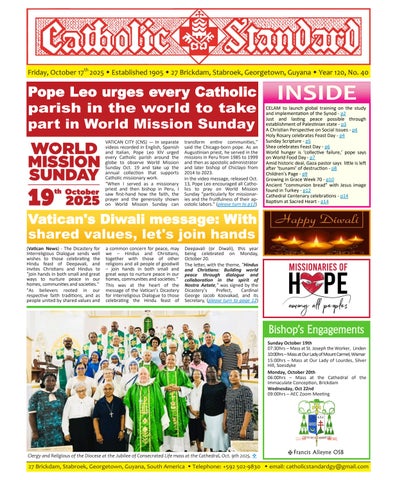
Clergy and Religious of the Diocese at the Jubilee of Consecrated Life mass at the Cathedral, Oct. 9th 2025. ❖
Francis Alleyne OSB
CATHOLIC STANDARD Friday, October 17th 2025
Page 2
CELAM to launch global training on the study and implementation of the Synod (Vatican News) - Starting 20 October 2025, the Council of Catholic Bishops from Latin America and the Caribbean, widely known by its acronym, CELAM, will launch a global digital training platform focused on the study and implementation of the Final Document of the Synod on Synodality. The initiative for this unprecedented international programme of formation is the Pan-American Synodal Ecosystem, dubbed “Together”, responding to the Synod on Synodality call by offering a free, intercontinental Massive Open Online Course (MOOC) exploring the key themes arising in the Synod on Synodality Final Document.
The Jubilee Prayer
Massive Open Online Course on Synodality In a message made available to Vatican News, CELAM stated that the formation programme will feature international experts — including theologians, pastoral agents, and canon lawyers — most of whom have participated in the Synod on Synodality and the Synod of the Church in Italy. “The Synod on Synodality has entered its third phase — reception — calling on the universal Church to translate discernment into concrete actions that transform relationships, structures, and pastoral priorities, in light of the Final Document of the XVI Ordinary General Assembly of the Synod of Bishops (2021–2024),” the CELAM statement reads.
Father in heaven, may the faith you have given us in your son, Jesus Christ, our brother, and the flame of charity enkindled in our hearts by the Holy Spirit, reawaken in us the blessed hope for the coming of your Kingdom. May your grace transform us into tireless cultivators of the seeds of the Gospel. May those seeds transform from within both humanity and the whole cosmos in the sure expectation of a new heaven and a new earth, when, with the powers of Evil vanquished, your glory will shine eternally.
More than 10,000 invited to register
May the grace of the Jubilee reawaken in us, Pilgrims of Hope, a yearning for the treasures of heaven. May that same grace spread the joy and peace of our Redeemer throughout the earth. To you our God, eternally blessed, be glory and praise for ever.
Amen
Subscribe to the Catholic Standard - it’s free! Message us giving your name & number at +592 701-7639. Send us an email at catholicstandardgy@gmail.com under the heading CS Subscription, and include your name.❖
Catholic Standard For 120 years, the Catholic Standard has been sharing the Gospel of Jesus Christ. Now reaching 10,000+ followers on Catholic Media Guyana Facebook plus going straight to your inbox and WhatsApp, our vibrant weekly e-paper is a trusted source which delivers informative and inspiring stories from across the diocese and around the world. Want to promote your business or event? Advertise with us! Call 675-4542 or email catholicstandardgy@gmail.com ❖
According to CELAM, this formation programme and global initiative are “a collaboration between the Latin American and Caribbean Episcopal Council (CELAM), through its theological centre CEBITEPAL, the Latin American Confederation of Religious (CLAR), the Jesuit School of Theology at Santa Clara University (JST–SCU), the Latin American Observatory of Synodality, and the World Union of Catholic Women’s Organizations (UMOFC).” CELAM expects the participation of “more than 10,000 people worldwide.” The organisers encourage participants in Africa and Asia to register. Participants will include “Bishops, clergy, religious men and women, pastoral workers, lay movements, parishes, and ecclesial communities — who will gain a deeper understanding of the Final Document in order to finally put it into practice.” The course will be available in English, Spanish, and Portuguese. To register, visit: https:// together.celam.org ❖
CATHOLIC STANDARD Friday, October 17th 2025
Page 3
Just and lasting peace possible World Mission Sunday 2025
A Palestinian woman walks on the rubble of her destroyed home in Gaza City Oct. 15, 2025. She now lives in a tent after getting displaced during the Israel-Hamas war. (OSV News photo/Ebrahim Hajjaj, Reuters) (OSV News) — Patriarchs and heads of the churches in Jerusalem said in a joint Oct. 14 statement they “rejoice at the recent enactment of the ceasefire in Gaza, and the release of those held captive,” which they hailed as “auspicious moment,” noting “the work of peacebuilding has only just begun.” Recognizing “the enormous efforts of all those in the international community who worked relentlessly to accomplish this major achievement,” they said they “hope and trust that this first stage of the ceasefire truly signals the end of the Gaza War, and that any further disagreements between the parties will be resolved through negotiation and mediation, applying the utmost restraint, rather than the resumption of hostilities.”
Truce called fragile The truce, commentators say, is fragile in the Middle East after the signing ceremony in Egypt Oct. 13, where President Donald Trump said that “phase two has started” of a peace deal between Israel and Hamas. Easing some of the biggest tensions, Israel received the remains of two more hostages Oct. 15, hours after the Israeli military said that one of the bodies previously turned over was not that of a hostage, The Associated Press reported.
As part of the deal, four bodies of hostages were handed over by Hamas on Oct. 14, following four on Oct. 13 as Israel has been awaiting the return of the bodies of 28 hostages. The Gaza Health Ministry said the total number of 90 bodies were returned to Gaza for burial, with a forensics team examining the remains saying they showed signs of mistreatment, AP reported.
Region ‘has suffered long enough’ The patriarchs for their part said that “our region as a whole has suffered long enough” and now “is clearly the time to embark upon the very long pathway of healing and reconciliation that is so profoundly needed between Palestinians and Israelis.” Church leaders of the Holy Land underlined an “impressive global mobilization” with the Sharm el-Sheikh peace summit that “will soon materialize into a wide-scale humanitarian operation” for Palestinians in Gaza “that continue to suffer displacement, death, injuries, hunger, and loss of livelihood.” They said that “food, clean water, fuel, and medical supplies,” are urgently needed along with “temporary shelters and medical facilities,” before “the massive clearing and rebuilding of destroyed homes, businesses, and civilian infrastructure” starts.
West Bank ‘settlement expansions’ The patriarchs and heads of churches expressed their concern for continuous violence in the West Bank “in connection with settlement expansions there.” “We therefore appeal to the concerned parties and the international community as a whole to widen the scope of the current negotiations to include an end of the Occupation of both the West Bank and Gaza, leading to the establishment of a Palestinian state living side-by-side in peace with the present State of Israel.” “Only in this way,” the patriarchs said, “will a just and lasting peace be truly established in the Holy Land and throughout the larger Middle East.”
Gaza’s 3 Christian communities The patriarch extended their words of encouragement to the three Christian communities in Gaza — the Holy Family Parish, St. Porphyrios Orthodox Church, and those serving at Al-Ahli Anglican Hospital. “Your perseverance in faith amidst the immeasurable hardships of the past two years has served as a shining example for us all,” assuring prayers and support. They asked that God shepherd the region “toward that golden age of peace so long envisioned by the prophets and sages of old” and for which “our Lord Jesus Christ himself gave up his own life, rising to new life beyond the grave.”❖
World Mission Sunday is celebrated on the second to last Sunday of October, this year it will be marked on October 19th. This annual observance was instituted 99 years ago in 1926 by Pope Pius XI’s Papal decree. World Mission Sunday is a special day that unites Catholics worldwide in prayer, solidarity, and support for the Church’s mission efforts. On World Mission Sunday, Catholics gather to celebrate the Eucharist and to contribute to a collection for the work of evangelization around the world. This annual celebration gives us a chance to reflect on the importance of mission work for the life of the Church. It reminds us that we are one with the Church around the world and that we are all committed to carrying on the mission of Christ, however different our situations may be. This year’s theme —“Missionaries of Hope Among the Peoples”—is a call to embody the love of God, poured into our hearts by the Holy Spirit (cf. Rom 5:5). The collection on World Mission Sunday supports the Pope’s missions in some of the most vulnerable places on earth. This year’s theme reminds us that our prayers and sacrifices bring light to those in darkness. ❖
CATHOLIC STANDARD Friday, October 17th 2025
A Christian Perspective on Social Roads - a frightening reality By GHK Lall The mere thinking of Guyana’s roads is enough to bring on a migraine. Roads are a cluster of disorder and chaos. At times, it seems as if every driver is for himself, and whoever gets squeezed out of their space, well, it is just the way, and just another day on the roads in Guyana. Because riders, walkers, and cart operators also are very much a part of developments on local roads, they have to be factored into the consideration. If how a population uses its roads is a measure of its civility, then Guyana would easily qualify as a country overrun by hordes of barbarians. There are traffic laws, but the enforcers of the law are too often aiders and abettors of those who are violators of the law. Senior traffic officers give delightful speeches intended to be reassuring to law-abiding road users. Then there are the contradictions in plain sight. Helmetless motorbike riders weaving in and out of traffic at high speeds, and ranks in the vicinity either watch without lifting a finger, or pretend not to see. What order can be brought out of the disorder that is twofold? One is the traffic violator, the other is the rulebreaker condoner. Next, the number of vehicles on the roads is simply staggering. There is no place to go. During the height of the rush hours (morning and evenings), the main roads resemble a long, unending parking lot arrayed in a line. The good news is that the day is almost over. The bad part is that more vehicles are on the seas heading to Guyana, and next week and next year will be tighter, then still tighter. At this rate, it would require a whole new network of roads involving hundreds of kilometers to make a difference, to help to ease through the now all-day congestions. Shouldn’t there be a slowing down of imports? Who wants to be left behind in the race for that symbol of achievement, despite the great pressures that come with owning and maintaining a vehicle? For their part, drivers and other road users who follow the rules have thrown up their hands in frustration and mounting despair. They look for relief from the law, and that’s a
nonstarter. They stay in their lanes and stay within the speed limits, and that could become a source of road rage. Aggressive and obnoxious drivers (lawless ones, too) add to the stresses of driving, make a difficult situation unbearable. Speeding and road rage call for a special kind of handling, if only to send a clear message to other prospective violators. Penalties for road rage incidents, of necessity, should be harsh on the pocket and, depending on the details of the incidents themselves, freedom should be curtailed, and licenses suspended. It goes without saying that all of this demands clean and continuous enforcement that is professional, principled, levelheaded, and truly committed to a policy of zero tolerance. To put differently, no roadside negotiations, no senior level interventions. In terms of speeding, I would recommend that local lawmakers take a look at Florida’s super speeding law, with an eye to introducing and enforcing some version of that here. When a driver flies at so many miles above the speed limit, then the penalties intensify and multiply. Drunk driving is a troubling situation across Guyana
and, once again, only the best in professional traffic enforcement will make a dent in what is a hidden scourge on local roads. The culture of intervention from the heights, and colluding in breaking of the law (giving some drunk driver a pass) has to stop. I doubt whether Guyana has people on both sides of that equation to make this possible. One side is the high-placed interveners who make phone calls; the other side is of those manning a roadblock bowing to that type of influence, pressure. In a sense, driving under the influence can be said to have its influencers, protectors. Pedestrians have little room to move, since business extensions and parking priorities take precedence over those who have to walk and navigate dangerous public spaces. There is usually only one loser when encounters go wrong. Laws have their part. But when they are ignored or scorned, when not enforced to the fullest, then the daily ordeals continue, and the horrible media reports dull the senses. Many in this country are good at talking, saying the right things. Yet, the wrongs grow in number. The manner in which roads are used stand and condemn what Guyana says is good about itself.❖
Holy Rosary celebrates Feast Day
On Sunday, October 12, 2025, the Church of the Holy Rosary, David Street, Kitty, Georgetown, celebrated its Feast Day. During the Holy Mass,
the parish also crowned Our Lady. After Mass, parishioners gathered for brunch and a mini concert. (Catholic Media Guyana FB).❖
Page 4
Prayer for our Priests
Gracious and loving God, we thank your for the gift of our priests. Through them, we experience your presence in the sacraments. Help our priests to be strong in their vocation. Set their souls on fire with love for your people. Grant them the wisdom, understanding, and strength they need to follow in the footsteps of Jesus. Inspire them with the vision of your Kingdom. Give them the words they need to spread the Gospel. Allow them to experience joy in their ministry. Help them to become instruments of your divine grace. We ask this through Jesus Christ, who lives and reigns as our Eternal Priest. Amen
CATHOLIC STANDARD Friday, October 17th 2025
Page 5
Responsorial Psalm: Psalm 120 Response: Our help is in the name of the Lord who made heaven and earth. 1. I lift up my eyes to the mountains: from where shall come my help? My help shall come from the Lord who made heaven and earth. Response 2. May he never allow you to stumble! Let him sleep not, your guard. No, he sleeps not nor slumbers, Israel’s guard. Response 3. The Lord is your guard and your shade; at your right side he stands. By day the sun shall not smite you nor the moon in the night. Response 4. The Lord will guard you from evil, he will guard your soul. The Lord will guard your going and coming both now and for ever. Response FIRST READING: Exodus 17:8-13 As long as Moses kept his arms raised, Israel had the advantage The Amalekites came and attacked Israel at Rephidim. Moses said to Joshua, ‘Pick out men for yourself, and tomorrow morning march out to engage Amalek. I, meanwhile, will stand on the hilltop, the staff of God in my hand.’ Joshua did as Moses told him and marched out to engage Amalek, while Moses and Aaron and Hur went up to the top of the hill. As long as Moses kept his arms raised, Israel had the advantage; when he let his arms fall, the advantage went to Amalek. But Moses’ arms grew heavy, so they took a stone and put it under him and on this he sat, Aaron and Hur supporting his arms, one on one side, one on the other; and his arms remained firm till sunset. With the edge of the sword Joshua cut down Amalek and his people.
The four pillars of parish stewardship are hospitality, prayer, formation and service. Today’s readings show us the immense value of prayer and the privileged place it must have in our
SECOND READING: 2 Timothy 3:14-4:2 The man who is dedicated to God becomes fully equipped and ready for any good work. You must keep to what you have been taught and know to be true; remember who your teachers were, and how, ever since you were a child, you have known the holy scriptures – from these you can learn the wisdom that leads to salvation through faith in Christ Jesus. All scripture is inspired by God and can profitably be used for teaching, for refuting error, for guiding people’s lives and teaching them to be holy. This is how the man who is dedicated to God becomes fully equipped and ready for any good work. Before God and before Christ Jesus who is to be judge of the living and the dead, I put this duty to you, in the name of his Appearing and of his kingdom: proclaim the message and, welcome or unwelcome, insist on it. Refute falsehood, correct error, call to obedience – but do all with patience and with the intention of teaching.
individual lives and our in parish community. Our Lord Himself calls us to prayer — and persistence in prayer — in the Gospel passage from Luke. Jesus tells the parable of the nagging widow who finally wears down the judge with her unrelenting persistence in her pursuit of a just ruling from him on her behalf. Jesus goes to great lengths to describe this judge, saying he “neither feared God nor respected any human.” Yet even this corrupt judge responds with
GOSPEL: Luke 18:1-8 God will see justice done to his chosen who cry to him. Jesus told his disciples a parable about the need to pray continually and never lose heart. ‘There was a judge in a certain town’ he said ‘who had neither fear of God nor respect for man. In the same town there was a widow who kept on coming to him and saying, “I want justice from you against my enemy!” For a long time he refused, but at last he said to himself, “Maybe I have neither fear of God nor respect for man, but since she keeps pestering me I must give this widow her just rights, or she will persist in coming and worry me to death”.’ And the Lord said ‘You notice what the unjust judge has to say? Now will not God see justice done to his chosen who cry to him day and night even when he delays to help them? I promise you, he will see justice done to them, and done speedily. But when the Son of Man comes, will he find any faith on earth?’❖
a just judgment because of the widow’s persistence. Jesus uses this outlandish example to draw a vivid contrast between a reluctant, dishonest judge and our loving, all-merciful Father. If even a bad judge will give a good result in response to a persistent request, how much more (infinitely more) eagerly and perfectly will our good Father respond to our persistent prayers to Him. If he delays in responding, if he provides a different response from the
one we were expecting, we can remain confident and trusting in His goodness, knowing that His response, whenever it comes and in whatever form, will be the very best one for us. Our job then, as Christian stewards, is simply to remain faithful to our relationship with God through prayer. We must lean on each other in our communities — family and parish — as we support each other in prayer. A strong pillar of prayer will make all our other stewardship efforts fruitful. ❖ [www.catholicsteward.com/blog/ ]
CATHOLIC STANDARD Friday, October 17th 2025
Gospel Reflection
Shea celebrates Feast Day On Tuesday October 14th, the Catholic Community of St Edward’s, Shea, South Rupununi, Region 9, Essequibo, Guyana, joyfully celebrated their 72nd Parish Feast. The celebration began with Holy Mass, followed by a beautiful mini-concert of songs and a short history of the Church in Shea. Fr. Joel Thompson SJ also presented the community with the new Wapichan Proclaimers (New Testament recordings in Wapichan) and Wapichan children’s Bibles. St Edward the Confessor, a king of England, was known for his deep faith, humility, and love for the poor. May his example inspire us to lead with peace and kindness, and may the flame of faith continue to burn brightly
in the South Rupununi.❖(Adapted from Catholic Media Guyana FB)
Prayer is never a substitute for action, an excuse for doing nothing. Rather it is a spur to action. It is not an escape from life but it is a journey into the very meaning of life. Prayer helps us to stand on our own two feet before God and the world with all its sorrows and joys, its pains and pleasure, its ups and downs, and to accept full responsibility for the choices we make in our lives. Both the First Reading and the Gospel remind us of the importance of persevering in prayer, but not in the sense of talking and doing nothing. We may see people, including ourselves, as either “pray-ers” or “do-ers” but today’s Readings teaches that those who pray must also do and those who do must also pray.
Jesus suggests that we pray constantly and never lose heart. But for most of us prayer can be a lonely activity and it sometimes seems to be unproductive. Nothing appears to come out of it. However, our prayers are answered, not when we get what we ask for, but when we become aware of the closeness of God. A sick person’s prayer is not necessarily answered by the disappearance of the pain or the disease, but by a sense of the presence of God and the assurance that the illness is not a punishment from God. A sense of God’s presence means that God has not abandoned us and this must be a very good feeling. Prayer may not change the world for us but it can give us the courage to face the world we struggle in.❖ [From: Journeying with the Word of God, The Religious Education Department, Diocese of Georgetown, Guyana ]
Page 6
Pope Leo XIV meets Brazilian President Luiz Lula da Silva in the library of the Apostolic Palace at the Vatican Oct. 13, 2025. (CNS Photo/Vatican Media) ROME (CNS) — During a private audience with Pope Leo XIV, Brazilian President Luiz Inácio Lula da Silva invited the pope to the upcoming U.N. Climate Change Conference, being held for the first time in the heart of the Amazon region. However, “due to the Jubilee, the pope told us that he will not be able to participate, but guaranteed Vatican representation in Belém,” the president said in a post on X after the audience Oct. 13.
The pope did add that he “intends to visit Brazil at the appropriate time,” Lula wrote. Pope Leo “will be very well received, with the affection, hospitality and faith of the Brazilian people.” The Vatican did not release a communique after the meeting due to its private nature. Lula said on X that he and his wife, Janja, “had an excellent meeting with His Holiness, Pope Leo XIV, at the Vatican. We talked about religion, faith, Brazil and the immense challenges we face in the world.”
The president also “congratulated the Holy Father on his Apostolic Exhortation ‘Dilexi Te’ and his message that we cannot separate faith from love for the poorest.” “I told him that we need to create a broad movement of indignation against inequality, and I consider the document a reference that needs to be read and practiced by everyone,” wrote Lula, whose “social-liberal” platform and policies have sought to narrow the gap between the rich and the poor by balancing the interests of private industry and organized labor to create a kind of consensus. Lula was in Rome taking part in the U.N. Food and Agriculture Organization’s World Food Forum Oct. 10-17. He wrote that he told the pope about the forum, “and how, in two and a half years, we have removed Brazil from the ‘Hunger Map’ for the second time,” which presents estimates of hunger and food insecurity. And now, he wrote, “we are taking this debate to the world through the Global Alliance Against Hunger and Poverty,” which seeks to speed up the implementation of the Sustainable Development Goals regarding poverty and hunger. Brazil will be hosting the 30th U.N. Climate Change Conference, or COP30, and Lula invited Pope Leo to attend, “considering the historical importance of holding a Climate Conference for the first time in the heart of the Amazon.” ❖
CATHOLIC STANDARD Friday, October 17th 2025
Page 7
Journeying with the Word of God
MAKING THE WORD OF GOD YOUR OWN Step 1: Look at today’s Readings prayerfully.
Pope Leo XIV addresses government leaders and representatives during a ceremony marking the 80th anniversary of the U.N. Food and Agriculture Organization (FAO) in Rome Oct. 16, 2025. (CNS photo/Lola Gomez)
ROME (CNS) — “Allowing millions of human beings to live — and die — as victims of hunger is a collective failure, an ethical aberration, a historical fault,” Pope Leo XIV said on World Food Day. The pope drove across Rome Oct. 16 to address world leaders and government representatives at the headquarters of the U.N. Food and Agriculture Organization. In addition to marking World Food Day, the delegates were celebrating the 80th anniversary of FAO’s establishment. In his speech, Pope Leo decried the fact that while humanity has made huge advances in technology, medicine, agriculture and transportation, 673 million people go to bed hungry each night, and 2.3 billion people cannot afford a healthy diet. The FAO statistics are not just numbers, he said; “behind each of these numbers is a broken life, a vulnerable community.” “This is not a coincidence, but the clear sign of a prevailing insensitivity, of a soulless economy, of a questionable model of development, and of an unjust and unsustainable system of resource distribution,” Pope Leo insisted. Perhaps referring to the situation in Gaza, but also to other war zones, the pope said that “current conflict scenarios have brought back the use of food as a weapon of war.”
‘Those who suffer from Afghanistan, Mali, the Central Republic, Yemen and hunger are not strangers’ African South Sudan, to name just a few A global conviction that “deliberate starvation as well as the intentional obstruction of access to food for communities or entire peoples, constitutes a war crime” seems to be slipping away, he said. The “cruel strategy” of using food as a weapon of war, the pope said, “condemns men, women and children to hunger by denying them the most basic right: the right to life.” While governments have an obvious role in addressing hunger, Pope Leo said no one can consider the problem to be someone else’s responsibility. “Those who suffer from hunger are not strangers,” he said. “They are my brothers and sisters, and I must help them without delay.” Hunger “is a cry rising to heaven, demanding a swift response from every nation, from every international body, from every regional, local or private entity,” he said. “It is a battle that belongs to us all.”
No one can look the other way “How can we explain the inequalities that allow a few to have everything, while so many have nothing?” Pope Leo asked. And, he said, “How can we fail to remember all of those who are condemned to death and hardship in Ukraine, Gaza, Haiti,
places on the planet where poverty has become the daily bread of so many of our brothers and sisters?” No individual or government can look the other way, the pope said. “We must make their suffering our own.” “We cannot aspire to a more just social life if we are not willing to rid ourselves of the apathy that justifies hunger as if it were background music we have grown accustomed to,” the pope said. Failure to act, even for individuals, he said, is to be “complicit in the promotion of injustice.” “We cannot hope for a better world, a bright and peaceful future, if we are not willing to share what we ourselves have received,” Pope Leo said. “Only then can we affirm — with truth and courage — that no one has been left behind.” ❖
1st Reading: We read of the first battle the Israelites fought after their deliverance from Egypt. They are victorious, not through their power, but through the power of God who came to them through Moses. 2nd Reading: Paul instructs Timothy to live by the sound teachings that was passed on to him since childhood and to be earnest in preaching the message of Jesus. Gospel: Jesus urges his disciples to pray continually and never to grow discouraged. The parable which he tells them is simple but it offers us an important lesson.
Step 2: Applying the values of the Readings to your daily life. 1.“When we pray we do not always get what we want from God. We should therefore pray, not for what we want, but for what we need.” How does this statement make sense to you? 2.The Gospel speaks of God coming to the help of his “chosen”, those who are sometimes called to suffer for their faith. How comfortable are you with the thought that you are God’s chosen? 3.“Prayer will not change the world for us but it will certainly give us the courage to face up to what the world throws at us.” What is this statement saying to you? 4.Faith in God is a living reality. Faith will wither and die if it is not lived. This is why we are urged to pray continually and never lose heart. Would you agree with this?
Step 3: Accepting the message of God’s
Word in your life of faith.
Prayer is important to the life of a Christian. It helps to make our hopes and intentions clearer to us. Through prayer we come to understand what is important in our lives and what is petty. It helps us to discover our true selves and our real needs, the pains we ignore and the longings we forget. Prayer as a habit is an act of self-purification.
Step 4: Something to think & pray about 1. Reflect on these questions: How do I pray to God in times of trouble? Am I comfortable with expressing my feelings in my own words or do I feel I must say special set prayers? 2. Pray to God for forgiveness for the times when you might have given up hope and refused to pray. 3. Pray for those who put their lives on the line in the struggle for justice.❖ [From: Journeying with the Word of God, The Religious Education Department, Diocese of Georgetown, Guyana ]
CATHOLIC STANDARD Friday, October 17th 2025
Page 8
little is left after ‘tsunami’ of destruction “But God has always helped us … and must also help us in the moral aspect, that is, by giving encouragement. Now, it’s perhaps the most important thing, because these days, people are going back to where their homes were,” the steadfast pastor said. “Even some — who still knew their homes or parts of their homes were still there — have now returned and found nothing,” he said.
Questions remain for future in Gaza
A drone view shows Palestinians walking past rubble following the withdrawal of the Israeli forces from the area, amid a ceasefire between Israel and Hamas in Gaza City, Oct. 12, 2025. (OSV News photo/Reuters) (OSV News) — Historic momentum was felt across the Middle East as thousands gathered Oct. 11 in Tel Aviv, Israel, for the last mass gathering before the hostage release which took place Oct. 13, and tens of thousands of Palestinians started to make their way back to their homes in northern Gaza Strip. But those Palestinians have returned to see only mostly rubble left, with Father Gabriel Romanelli, the pastor of Gaza City’s Catholic parish, saying the entire enclave has experienced a “tsunami” of destruction. Hundreds of aid trucks slowly made their way out of a gigantic Rafah crossing queue into Gaza early morning Oct. 12 — a territory exhausted, starving and flattened after a two-year war that started after Hamas, the Palestinian militant group ruling Gaza, carried out a surprise attack on Israel, killing 1,200 people in massacres perpetrated in southern Israeli communities Oct. 7, 2023. The ensuing war has led to an estimated 67,000 Palestinian dead and 170,000 injured, the vast majority believed to be civilians. At the same time in the Vatican, Pope Leo XIV called for the warring to lay down their weapons in the presence of the original statue of Our Lady of Fatima. “Disarm your hands and, even more importantly, your hearts. As I have said before, peace is unarmed and disarming,” Pope Leo said. “It is not deterrence, but fraternity; it is not an ultimatum, but dialogue. Peace will not come as the result of victories over the enemy, but as the fruit of sowing justice and courageous forgiveness.”
Destruction in Gaza likened to a natural disaster Meanwhile, one Palestinian woman making her way to her home told the news outlet Oct. 12, “The scale of destruction is indescribable.”
Father Romanelli, lightly injured in the leg during the Israeli military strike on the Holy Family Parish compound July 17, attempted to put into words the scale of Gaza’s tragedy. “What’s happened here is something analogous (to) a tsunami,” he said in a video posted on his YouTube and X social media feeds. “Do you remember when we saw the photos, the live images of the tsunami many times? How everything was utterly crushed, right? It’s literally like that” in Gaza, he said Oct. 11. “There are entire neighborhoods like that; and in every neighborhood there are many houses like that,” he said. The Catholic priest added that just as with a natural disaster there are fears of subsequent waves, the same feeling is palpable among Palestinians. “There’s fear that there will be, that there will be other waves, and that fear is there. I mean, there’s the fear that war will return, there’s the fear that the parties won’t respect them, even those who have made commitments,” Father Romanelli said.
Peace deal a sign of hope He said the peace deal is a clear sign that “something has changed” and “everyone is fed up with the war.” “For the first time in at least many years, many countries that … disagree on politics, foreign policy, domestic policy … have agreed to say that, in addition to freedom, they must release the hostages and prisoners, that Gaza must be rebuilt, that people must live on their land, that Palestinians can live here in the strip … it’s absolutely essential,” he said. Father Romanelli said the big question now for the diminished Palestinian Catholic community in Gaza — of whom around 500 sheltered in the Holy Family Parish — is “OK, now what
do we do? How do we do it?” now that initial peace deal is agreed upon. “From a spiritual point of view, we have always tried to help them and continue to help, to pray, to encourage them,” Father Romanelli said. He emphasized that the priests and religious in the parish were assisting the faithful “by celebrating the liturgy, prayer, adoration; always being ready for spiritual direction, for confession, for groups.” They did this even though “it may be very difficult, because we ourselves are in the same place, so sometimes oneself … has no strength, or is powerless.”
Many questions remain pressing to answer, the pastor said, from how Gaza will be governed, how humanitarian aid will be distributed, to “reconstruction, cleaning the streets, bulldozers, diesel … gasoline, electricity, drinking water, the possibility of going to the sea,” he said. The priest pointed out that “sometimes the only water available is seawater for everything, for their needs, for cooking, for bathing.” He said it was unclear, as of Oct. 11, whether people were even permitted to approach the seaside. He said, “You can see the pain in people’s expressions. There are so many orphans everywhere, so many childless parents.” But he said he still remained hopeful that “with the help of God and so many men and women of good will … this can be done.” “Just as the populations that suffered the tsunami … were able to lift their heads and rebuild their lives — hopefully, Gaza can also rebuild its life,” Father Romanelli said. “May there be peace in everything … that we can enjoy a long period of peace between Palestine and Israel is not impossible,” he said. But the priest added, “It will take a long time.”❖
CATHOLIC STANDARD Friday, October 17th 2025
Page 9
Again and Again Dear Boys and Girls, Jesus once told a story that showed us that when we want our Heavenly Father to do something for us, that we should keep on praying and not give up. The story that Jesus told was about a woman who went to a judge and said, "My rights are being violated. Protect me!" At first, the judge refused to do anything, but the woman kept asking him. Finally, he said, "I will see that this woman gets justice because she keeps bothering me! If I don't help her, she will wear me out." "So what makes you think God won't step in and help his children, when they keep on crying out for help? Won't he stick up for them? I assure you, he will" Jesus said. Our Heavenly Father loves to do nice things for us. He also wants what is best for us and he has the wisdom to know what is best. But don't forget, he likes to hear us ask, again and again. Father, we know that you hear us when we pray and you answer in the way that is best for us. Help us to be faithful to pray. In Jesus' name we pray. Amen. ❖
[ NFC - Sources: http://www.sdc.me.uk , http://www.catholickidsbulletin.com/, http://www.sermons4kids.com , http://www.salfordliturgy.org.uk, young-catholics.com & https://thekidsbulletin]
CATHOLIC STANDARD Friday, October 17th 2025
Page 10
Seek Mary in the Holy Rosary
Dear Editor, Saying the rosary should be a time of conversation with Our Blessed Mother Mary, who speaks softly to her children. Even though we do not see her, she is spiritually present. A child rarely looks at himself or herself but gazes intently at his or her mother. It is the mother who looks at her children. She is the one who looking at them can say how beautiful they are, how precious they are and how
good they are. Immaculate Mary welcomes us into her maternal heart. Entrust yourself to her and she will provide for you. She provided for the embarrassed couple at the wedding feast at Cana in Galilee. It is the truth that Mary was free from the guilt of original sin. She was conceived immaculate. Living in a sinful world, she shared in the pain of the world but not in its wickedness. She is our mother in suffering but not in evil. She overcame evil completely by good. This was entirely due of course to her son Jesus’ redemption. It is not surprising that the life of perfect
obedience which was lived by Jesus should be lived in the greatest perfection by a woman. “Let what you have said be done to me” (Lk 1:38) Male and female, he created them (Gen. 1:27). The true Eve is created along with the true Adam. Mary is part of the mystery of Our Lord, Jesus Christ. God has chosen the Blessed Virgin Mary as part of his wise plan for our Salvation. We are eternally grateful to her. Let us seek her in the Holy Rosary. Leon Jeetlall
GHRA: Proposed Constitutional Reform Commission should not be under political party control Dear Editor, Reforming the Constitutional Reform Commission (CRC) will prove a more constructive test of whether the radically different composition of Parliament augurs for more constructive politics, or simply prolongs the traditional tedious confrontation. From its inception in 1999 the last CRC was expertly managed by senior members from both Government and opposition, as Chair and Secretary of the Commission. The current CRC was conceived with no regard to the spirit of the Herdmanston Accord, which remains the most realistic fundamental guide to constitutional reform in Guyana. The Accord aimed to ensure that the interests of sectors were represented rather than particular organizations, with the ruling party doing no more than indicate the number of representatives to be assigned to each sector, leaving sectors to determine the manner of choosing their representatives. Effective control by one party is the core violation of the Herdmanston spirit which sought to re-tool governance mechanisms in ways which encouraged and enabled Guyanese to relate to people who would normally find excuses not to talk to each other. The Accord sought to embody a process for reconciliation and healing of society, following the violence of 1997. In other words, as the reform process develops the society begins to heal and be reconciled, rather than antagonistic factions developing a blueprint to be implemented in future by others. The
constitutional reform process itself must be a healing process. These hopes were, in part, embodied in the legislation to be used in future CRC. Constitutional (Amendment no.6) of 2001. The pertinent clauses of that Act are as follows: 119A (1) The National Assembly shall establish a Standing Parliamentary Committee for Constitutional Reform and 119B: In its work the Committee shall have power to co-opt experts. In light of this approach to Constitutional reform as a continuous process of reconciliation the Guyana Human Rights Association (GHRA) strongly urges that the ruling party amend its proposals both for the composition and scope of the proposed Commission, along the lines of that legislation. The State selecting which civic sectors should provide members and which individuals should represent them reflects the Government’ distrust towards non-party involvement in governance activities. Rather than the positives which a more inclusivelystructured CRC could generate, a polarized initiative would suggest more concern on the part of the organizers to be able to say the event happened rather than for any benefits it might produce. The GHRA recognizes that the culture of civil society in Guyana to date has not reached the levels to which the Herdmanston Accord aspires. As a society Guyana is culturally insecure, not having attained the democratic confidence to trust our legal and administrative institutions to protect us from corrupt
or ambitious individuals. We are all challenged to accept that someone with different opinions can hold the same principles as we do. With this in mind, should the ruling party insist on identifying particular individuals or organizations to serve on Commissions or Boards in general, such candidates ought to submit themselves to a process of validation by the sector it is intended they represent. Alternatively, depending on the circumstances, the sectors identified for inclusion should take steps to choose their own representatives, ignoring any specific unilateral recommendations the ruling party may make. At a minimum any individual or organization specifically nominated by the ruling party for membership of the CRC should seek the approval of the leader of the opposition, presumably from WIN, in order to rid itself of any taint of partisanship. In any event, at the end of the day whatever recommendations emerge from a CRC will need parliamentary approval before becoming law, thereby rendering unnecessary the current level of party control of the Commission. A Commission with a majority of members drawn from the non-political party sector, chosen by procedures not subject to ruling party pressure and under an independent chairperson is the only guarantee that a Constitutional Reform process will come to fruition. Executive Committee Guyana Human Rights Association
By Renika Anand
The Acceptance of Impermanence Pema Chödrön, a buddhist nun, once said “Impermanence is a principle of harmony. When we don't struggle against it, we are in harmony with reality." The idea of impermanence is one that rarely troubles us when we are young. Neither our lives nor the things which fill our lives seem impermanent when time is a road that stretches out in front of us in a seemingly indefinite manner. Nevertheless, the very quality of being human goes hand-inhand with the inevitability of many different forces. As we grow, we may realise that we often lose things which we believe are very important to us, and that the loss can be difficult to accept. However, we must learn to anchor ourselves in things that are not material - in things that are not impermanent. It is not wrong to place value and respect on some of the material items that support us during our lives, but we must always remember that these things are not the goal of our lives, they are only a part of it. “Therefore I tell you, do not worry about your life, what you will eat or drink; or about your body, what you will wear. Is not life more than food, and the body more than clothes?” Matthew 6:25 ❖
CATHOLIC STANDARD Friday, October 17th 2025
Page 11
CATHOLIC STANDARD Friday, October 17th 2025
Page 12
Ancient “communion bread” with Jesus image found in Turkey events: intense heat charred the loaves, then low-oxygen burial and stable temperatures preserved surface details, including the inscription and stamped imagery. Teams plan microscopy and tomography to identify grains and baking techniques, which could illuminate both diet and worship in middle Byzantine Anatolia. The discovery lands in a place that is foundational for Christians worldwide. Much of today’s Turkey was home to early Christian communities — from Paul’s journeys across Asia Minor to the Seven Churches named in early sources — and key councils such as Nicaea (in modern İznik) that shaped creeds recited to this day, and where the Pope will visit next month. Most famously, in Antioch (presentday Antakya, Hatay province), “the disciples were first called Christians,” as recorded in Acts 11:26. That single line anchors Turkey’s claim as one of Christianity’s earliest cradles and a crossroads where the "Jesus movement" took on a public name For Catholics, the resonance is immediate. The Catechism teaches that at
the heart of the Eucharist are bread and wine — “signs of the goodness of creation” — that become Christ’s Body and Blood (CCC 1333). Now, creation’s simplest food arrives across 13 centuries bearing thanksgiving to Jesus. The farmer-Christ motif also echoes the Gospel image of the sower, inviting believers and seekers alike to see holiness seeded in ordinary work and daily bread. The pastoral dimension is just as striking. Stamping gratitude into dough before baking turned a staple into a proclamation: God provides; we give thanks. Even the charred crusts preach across time about dependence, generosity, and the way worship can be kneaded into common life. As analysis proceeds, scholars expect more insights — from cereal types to oven technology — offering a rare, tangible bridge between present-day prayer and the tables of early Christians in Anatolia. Whether you approach this as archaeology, art history, or faith, the message impressed on that ancient loaf still fits the human heart: gratitude.❖
(Aleteia) - Archaeologists in Turkey's Karaman province have uncovered five carbonized loaves from the Byzantine era — one stamped with an image of Jesus and a Greek inscription that reads, “With gratitude to the blessed Jesus.” The breads were found at Topraktepe, ancient Eirenopolis, and dated to the 7th–8th centuries A.D. What sets the find apart is the
iconography. Instead of the familiar Christ Pantokrator, the image presents Jesus as a sower or farmer — an agrarian motif that would have spoken directly to local communities whose faith, labor, and lands were intertwined. The other loaves bear Maltese cross impressions, strengthening the case that these were used liturgically, likely as communion breads. How did bread survive 1,300 years? Researchers point to a rare chain of
Pope urges every
Vatican's Diwali message (From Page 1) Recalling Pope Leo XIV's words to build bridges, the Vatican officials reaffirm that "interreligious understanding and collaboration must find a place in our daily lives and become a natural way of living together."
Task entrusted to all
“Your prayers, your support will help spread the Gospel, provide for pastoral and catechetical programs, help to build new churches, and care for the health and educational needs of our brothers and sisters in mission territories,” the pope said. According to the Pontifical Mission Societies USA, funds collected on World Mission Sunday support: “82,498 seminarians in formation; 258,540 religious sisters providing care and catechesis; (and) 844,000 catechists sharing the faith at the grassroots.” The funds also help sustain “12,000 health care centers; 8,750 orphanages and homes for the elderly” and have helped with the construction of 570 new churches, it said. In the video, Pope Leo asked Catholics to “reflect together on our baptismal call to be ‘missionaries of hope among the peoples,'” and to commit themselves again “to the sweet and joyful task of bringing Christ Jesus our hope to the ends of the earth.” The annual papal message for World Mission Sunday is released in February. Pope Francis had chosen “Missionaries of Hope Among All Peoples” as the theme for the 2025 celebration. ❖
Msgr. Indunil Janakaratne Kodithuwakku Kankanamalage. The feast of Deepavali, which in Sanskrit means “row of oil lamps” and is one of the most important Hindu feast days, celebrates the victory of truth over falsehood, light over darkness, and good over evil.
May the festival brighten your lives In their letter, the Vatican officials began by expressing their wish that the festival of lights "brighten your lives and bring happiness, unity and peace to your families and communities!" They recalled that the eighth day after Deepavali this year will mark the sixtieth anniversary of Nostra Aetate (28 October 1965), the Catholic Church’s landmark document that encouraged Catholics around the world to engage in dialogue and collaboration with people of other religious traditions. On this diamond jubilee, Cardinal Koovakad underscored, Nostra Aetate calls us to renew our commitment to promoting interreligious dialogue as a
path to peace. "During this festive season," he said, "we invite you to join us in reflecting on how Christians and Hindus, together with people of all faiths and goodwill, can strengthen our shared efforts for peace through dialogue and collaboration in the spirit of Nostra Aetate." Such a spirit is rooted in “promoting unity and love among people, indeed among nations” by focusing on “what people have in common and what draws them to fellowship.”
Much more progress to be made While much progress has been made since Nostra Aetate, much more has to be done. "In today’s world, where mistrust, polarization, tensions and divisions are on the rise," the Vatican officials underscored, "interreligious dialogue is more necessary than ever. It must continue to sow seeds of unity and harmony, becoming a beacon of hope for all."
The Holy Father, they reiterated, reminds us that fostering a culture of dialogue and collaboration for peace is “a task entrusted to all, believers and non-believers alike, who must advance it through reflection and a praxis inspired by the dignity of the person and the common good.” Only by working together, they said, can we secure and sustain a peace founded on truth, justice, love, and freedom (cf. John Paul II, Message for the Celebration of the World Day of Peace, 1 January 2003).
Role of the family and religious traditions In the text, the Dicastery officials highlight the role of the family as the primary place of education in life and faith, with a preeminent role in nurturing these values. Religious traditions also have a crucial responsibility in fostering peace, with religious leaders bearing the moral duty to lead by example – encouraging their followers to respect diversity and to build bridges of friendship and fraternity. They also remembered the role of educational institutions and the media to likewise play essential roles in shaping hearts and minds toward peaceful coexistence. Finally, the message concludes with an invitation for Christians and Hindus to join hands together in both small and great ways "to nurture peace in our homes, communities and societies."❖
CATHOLIC STANDARD Friday, October 17th 2025
Page 13
CATHOLIC STANDARD Friday, October 17th 2025
Page 14
Cathedral Centenary Celebrations Saint of the Week By Francis Canzius The Cathedral will celebrate 100 years since it was opened by His Lordship Bishop Galton in December 1925. This ended over 10 years of construction by the British construction company Considere Construction. The Cathedral was designed by Sir Leonard Stokes, who was President of the Royal Society of British Architects. A Festival of Trees is planned for November 17 and 18 2025. Parishes all around Georgetown Sir Leonard Stokes, architect of the up to Plaisance on the east, Little Cathedral of the Immaculate Conception Diamond to the south and Malgre
Tout to the west are invited to display trees in addition to professional persons. The event will be open from 9:00am to 5:00pm each day. Admission is free. This is the first event of this kind to be held in Guyana and a fitting way to celebrate the centenary. This will be followed by the Feast Day Mass in December and the Festival of Carols on December 12. The Festival of Carols, now in its 54th year, was the idea of Fr. Patrick Conners SJ, while he was acting Administrator of the Cathedral in 1968. ❖
Baptism at Sacred Heart
On Sunday October 12 we gathered with hearts full of gratitude and joy to celebrate the baptism of 6 beloved children. This is the beginning of their spiritual journey. Baptism is a profound sign of God’s grace and love, embracing each child and their family as part of the wider Catholic Community. It is a commitment made not only by
the children and their families but also by the Sacred Heart Congregation, who promise to nurture and support them as they grow in faith. Fr. George, during Mass called the mothers forward to receive a special blessing. We offer prayers for these 6 children. We pray for guidance, wisdom, and protection as they
embark on their spiritual path. May their lives be filled with love, kindness and the presence of God in all that they do. We also pray for their families that they may continue to support and encourage their children as they grow in understanding and faith.❖ (Sacred Heart Roman Catholic Church Guyana FB).
October 22nd: St. John Paul II “Open wide the doors to Christ,” urged John Paul II when he was installed as pope in 1978. Born in Wadowice, Poland, in 1920, Karol Jozef Wojtyla had lost his mother, father and older brother before his 21st birthday. Karol’s promising academic career at university was cut short by the outbreak of World War II. While working in a quarry and a chemical factory, he enrolled in an “underground” seminary in Kraków. Ordained in 1946, he was immediately sent to Rome where he earned a doctorate in theology. Back in Poland, a short assignment as assistant pastor in a rural parish preceded his very fruitful chaplaincy for university students. Soon he earned a doctorate in philosophy and began teaching at Poland’s University of Lublin. He was appointed auxiliary bishop of Kraków in 1958. He attended all four sessions of Vatican II and contributed especially to its Pastoral Constitution on the Church in the Modern World. Appointed as archbishop of Kraków in 1964, he was named a cardinal three years later. He was elected pope in October 1978. In time, he made pastoral visits to 124 countries He promoted ecumenical and interfaith initiatives. His 1979 visit to Poland encouraged the growth of the Solidarity movement there and the collapse of communism in central and eastern Europe 10 years later. He began World Youth Day and travelled to several countries for those celebrations. In his 27 years of papal ministry, John Paul II wrote 14 encyclicals and five books, canonized 482 saints and beatified 1,338 people. Pope Benedict XVI beatified John Paul II in 2011, and Pope Francis canonized him in 2014.❖