Friday, January 9th 2026 Established 1905 27 Brickdam, Stabroek, Georgetown, Guyana Year 121, No. 1
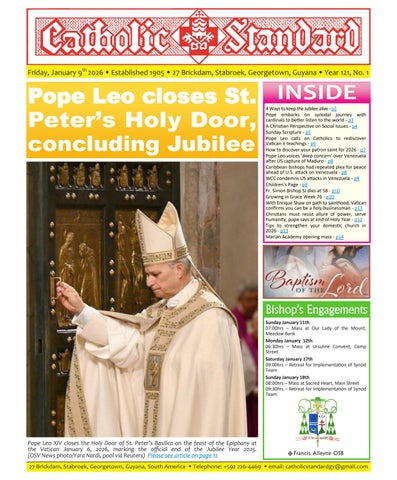
Pope Leo closes St. , .❖
4 Ways to keep the Jubilee alive - p2 Pope embarks on synodal journey with cardinals to better listen to the world - p3 A Christian Perspective on Social Issues - p4 Sunday Scripture - p5 Pope Leo calls on Catholics to rediscover Vatican II teachings - p6 How to discover your patron saint for 2026 - p7 Pope Leo voices 'deep concern' over Venezuela after US capture of Maduro - p8 Caribbean bishops had repeated plea for peace ahead of U.S. attack on Venezuela - p8 WCC condemns US attacks in Venezuela - p8 Children’s Page - p9 Fr. Simon Bishop SJ dies at 58 - p10 Growing in Grace Week 76 - p10 With Enrique Shaw on path to sainthood, Vatican confirms you can be a holy businessman - p11 Christians must resist allure of power, serve humanity, pope says at end of Holy Year - p12 Tips to strengthen your domestic church in 2026 - p13 Marian Academy opening mass - p14
Bishop’s Engagements Sunday January 11th 07:00hrs – Mass at Our Lady of the Mount, Meadow Bank Monday January 12th 06:30hrs – Mass at Ursuline Convent, Camp Street Saturday January 17th 09:00hrs – Retreat for Implementation of Synod Team Sunday January 18th 08:00hrs – Mass at Sacred Heart, Main Street 09:30hrs – Retreat for Implementation of Synod Team
Pope Leo XIV closes the Holy Door of St. Peter’s Basilica on the feast of the Epiphany at the Vatican January 6, 2026, marking the official end of the Jubilee Year 2025. (OSV News photo/Yara Nardi, pool via Reuters) Please see article on page 12
Francis Alleyne OSB
CATHOLIC STANDARD Friday, January 9th 2026
Page 2
Back-to-School Blessing
4 Ways to keep the Jubilee alive: Pope’s
Back-to-School Blessing at the Cathedral of the Immaculate Conception, Sun. January 4th (Catholic Media Guyana FB)
departs for new appointment We extend heartfelt thanks and prayerful best wishes to Fr. Jayapaul Polisetti, IVE, as he leaves our Diocese to take up a new appointment in the United States. He faithfully served the communities at Santa Rosa, Moruca, Region 1, Essequibo, Guyana, from November 1 2021. We are deeply grateful for his generous ministry and wish him every blessing in his new role.❖ (Adapted from Catholic Media Guyana Facebook)
(Aleteia) - As Pope Leo XIV began a new cycle of catechesis at the start of this new year, now focusing on Vatican II, he also noted the graces of the Jubilee Year 2025. In greetings to various language groups, the Holy Father offered some concrete suggestions on how to keep the Jubilee spirit alive.
1. Don't let hope die First off, as the Jubilee was centered on the theme of Pilgrims of Hope, our first task is to keep hope alive. With hope burning strong and helping us confront the difficulties of daily life, we will naturally be missionaries. Here's what Pope Leo said: At the end of this jubilee year, aware that we have experienced a time of grace, let us not allow the hope that dwells within us to die, but may it lead us to encounter all people and proclaim to them the good news of salvation.
graces of the jubilee. Both for those who were able to make a pilgrimage to Rome, and those who lived the jubilee in the local Churches, it was a time of grace. Pope Leo said: After the Holy Year came to an end yesterday with the closing of the Holy Door, let us thank the Lord for the graces he has given us during this special time. May they help us to 2. Give thanks While we look to the future, we should not continue our journey of faith with cease to give thanks to God for all the hope in the new year.
3. Pray for Christian witness The fruits of the jubilee should be visible both in our personal lives and in the Church. For this, we should pray. Pope Leo said: Let us pray to the Lord that the spiritual fruits of the recently concluded Jubilee may sustain the witness of Christians, called to be promoters of justice and peace in holiness.
4. Open the doors! While Pope Leo closed the final Holy
Door in Rome on January 6, he urged that we keep the doors of our hearts and homes open. Specifically, he noted how priests can bring blessings into our homes with blessings. Here's what he said: May the doors of your hearts and homes remain open to Christ. I join in prayer with the priests who bring God's blessing to your homes, to your families, to the sick, and to those who are alone. I bless you all! ❖
CATHOLIC STANDARD Friday, January 9th 2026
Page 3
Pope embarks on synodal journey with
Pope Leo XIV holds a consistory with cardinals from around the world at the Vatican Jan. 7, 2025. (OSV News photo/Simone Risoluti, Vatican Media) VATICAN CITY (CNS) -- Pope Leo XIV and members of his College of Cardinals have begun what is a kind of synodal journey together to grow in communion and discern together "what the Lord is asking of us for the good of his people." After convening the international group of cardinals in Rome for an extraordinary consistory Jan. 7-8, the pope decided to make the gathering an annual event, however, with an additional meeting later this year. It marked an approach that vastly expanded on what Pope Francis established after his election in 2013. Wishing for a more decentralized and listening Church, the late pope created a nine-member Council of Cardinals to help and advise him on several critical matters facing the Church, particularly the reform of the Roman Curia, by meeting at least quarterly in Rome. Pope Leo decided he would be inviting all the world's cardinals to Rome every year for a few days, Matteo Bruni, director of the Vatican press office, told reporters at a news conference after the consistory ended Jan. 8. College members will meet with the pope again for at least three days sometime in June, possibly around the feast of Sts. Peter and Paul, June 29, and then the gathering will be held over three to four days once a year in the following years. The College of Cardinals is made up of 245 cardinals from all over the world. About 170 of them -- about 69% -made it to Rome after the pope's invitation Dec. 12 that they come together again for the first time since the conclave that elected him May 8. Cardinal Timothy Radcliffe, a Dominican theologian, offered a reflection Jan. 7 to help the cardinals understand their role not just as advisers to the
pope, but as much-needed companions along life's way. He recalled St. Mark's account of Jesus making his disciples go out ahead of him by boat, which encountered a "great storm." Jesus does not want Peter or any of the disciples to go into the storm alone, he said. "This is our first obedience, to be in the barque of Peter, with his successor, as he faces the storms of our times." Some of the storms shaking the Church, he said, include "sexual abuse and ideological division. The Lord commands us to sail out into these storms and face them truthfully, not timidly waiting on the beach. If we do so in this consistory, we shall see him coming to us. If we hide on the beach, we shall not encounter him." However, Cardinal Radcliffe said, "If the boat of Peter is filled with disciples who quarrel, we shall be of no use to the Holy Father. If we are at peace with each other in love, even when we disagree, God will indeed be present even when he seems to be absent." Pope Leo emphasized the essential element of love in his opening remarks to the cardinals in the Vatican's Synod Hall Jan. 7. "To the extent that we love one another as Christ has loved us, we belong to him, we are his community, and he can continue to draw others to himself through us. In fact, only love is credible; only love is trustworthy," he said. "Therefore, in order to be a truly missionary Church, one that is capable of witnessing to the attractive power of Christ's love, we must first of all put into practice his commandment … 'Just as I have loved you, you also should love one another,'" the pope said. Jesus underlined that it will be by
Pope Leo XIV celebrates an early morning Mass in St. Peter's Basilica at the Vatican Jan. 8, 2026, during a consistory with cardinals from around the world. (OSV News photo/Simone Risoluti, Vatican Media) a Christian's love that the world will know "that you are my disciples." The "collegial journey" that they have begun with their first consistory, he said, would be an opportunity to reflect together on two themes of their choice out of the following four themes: the mission of the Church in today's world, especially as presented in Pope Francis' "Evangelii Gaudium"; the synod and synodality as an instrument and a style of cooperation; the service of the Holy See, especially to the local Churches; and the liturgy, the source and summit of the Christian life. The cardinals voted with "a large majority" to discuss the first two themes -- mission and synodality, Bruni told reporters. Following a synodal structure, the cardinals were broken into 21 groups, but nine of those groups, made up of cardinals under 80 years old, who were not resident in Rome, were asked to submit reports based on their small group discussions, which followed the Synod on Synodality's "conversation in the Spirit" method. "I am here to listen," Pope Leo told the cardinals before they began their two days of reflection and dialogue. "We must not arrive at a text, but continue a conversation that will help me in serving the mission of the entire Church," he said. Specifically, he wanted the groups to look at the next one or two years and consider what "priorities could guide the action of the Holy Father and of the Curia regarding each theme?" The pope further encouraged the cardinals the next day in his homily during an early morning Mass in St. Peter's Basilica. Their task, he said, was to discern what "the Lord is asking of us for the good of his people," not "to promote personal or group 'agendas.'"
Through prayer, silence, listening and sharing, he said, "we become a voice for all those whom the Lord has entrusted to our pastoral care in many different parts of the world." Speaking to reporters at a news conference after the consistory, Cardinal Luis José Rueda Aparicio, archbishop of Bogotá, Colombia, said the experience "strengthened us" individually and as a group as they got to know each other better. The pope underlined how important hope was in the life and mission of the church, he said. When Christ is at the center of one's life, proclaiming his word "fills us and the world with hope." Cardinal Stephen Brislin, archbishop of Johannesburg, South Africa, told reporters the vast differences between cardinals -- with their different perspectives and needs -- proved to be "very enriching" and interesting, and not a source of contention. Cardinal Pablo Virgilio David, bishop of Kalookan, Philippines, told reporters the synodal format and style of the consistory "was familiar" to those who had taken part in the synodal assemblies in Rome in 2023 and 2024. When asked if it seemed the pope was going to use their sessions to inform or contribute to any kind of papal document, Cardinal David said, "I don't know," but the pope was "taking notes very seriously so he must be up to something." Cardinal Brislin said there is no indication that a document was the aim of the gathering, and it was more a concrete response to the cardinals' request that they meet. Cardinal Aparicio said by listening to all the world's cardinals, the pope "listens to the different parts of the world." ❖
CATHOLIC STANDARD Friday, January 9th 2026
A Christian Perspective on Social Issues Tidings of comfort and joy By GHK Lall Tidings of comfort and joy came. Not at the time expected. Not of the type believed. The tidings are of what is to be. Better to be late than never. Later will be greater. God rest ye Guyanese, who are living these sayings, truisms, whatever else they may be. What is merry will follow. May it be a blessed New Year. There will be some money. But today it comes with some shampoo to give much lathering and a good tingling. High anticipation. I have my own label for that: human conditioning. Kneading into the dough that is the heads of Guyanese that there’s a shift in programming, some unspoken demands that they must meet. A process has to be followed first. The moneyman has to put aside his calculators and present his speech to the nation. It is his annual happy hour that is powered by many other such hours, as if in practice for his marathon. Yes, he fancies himself a Spartan. I agree: of sorts. One big chunk of cash is on the way to Guyanese old enough to recognize their names and then sign on the dotted line against their names. Should be only once. It has been a long wait, with many ups and downs and sliding sideways. Money for the poorer class of people usually brings out that side of men who call themselves brothers. I’ll take a porcupine; or a jackal, if that’s the other choices left. A hundred billion can be spoken from the top floors in this country with the nonchalance of Jeff Bezos or Mukesh Ambani or Mark Zuckerberg. Yet a measly $100,000 can cause a leader, a victorious group, to transform into a combination of trapeze artist and an Argentinian tango master. If for a hundred thousand, what for million? Or two times 100? Notwithstanding those clouds that hover at the back of the mind, there are tidings of comfort and joy, the long-awaited, the muchlonged for bundle of $100,000. Why quibble about $200,000, or that is should be $150,000, at least? Better hustle and grab it before minds are changed, and spite takes over. Guyanese can safely ignore that self-promoting and self-congratulating political parcel about word given is
word honored. Just hold onto the tidings that speak of a little something to come. The Israelites of the Old Testament waited for hundreds of years before the prophesies came, then centuries more before the tidings of comfort and joy arrived in a swaddled bundle on the floor of a stable for donkeys and mules. Amid that squalor, that bottom of the gutter, kingly entry, from there is where the stuff of tidings and comfort and joy came and led to a new world. Guyanese have been waiting and yearning for only a few months now. The end is in sight, with a slightly adjusted old promise now the new tidings from the mountaintop. Thus, there is hope for Guyanese at the bottom of the ladder. The bottom of the ladder is a little higher than the bottom of the gutter. Think of it in sober terms: a birth in the regal surroundings of horse droppings and animal manure. Still, in that was seen tidings of comfort and joy. How much better off are Guyanese. Oil gushing at increasing levels, and Guyanese who
are struggling to make it, feel as though they have been hit by Category 5 hurricane. They get knocked down; they struggle to get back on their feet. Before they can move a step or two, a tree knocks them right off their feet again. How between two (or three) out of every five citizens of this oil rich country go from one day to another is a mystery and a miracle to me. The Savior came and he put hope in the hearts of men and women. Since then, a succession of men has come and gone. Or are still around. They have been full of promises. What they left is a trail of doubt, and a world of distrust and emptiness. God does not disappoint. Put not thy trust in earthly princes. The mere thought of, the belief in, Jesus as the answer, is enough to give genuine comfort and joy. That is what should decide the kind of New Year that is now in its infancy days will be. Make the best of 2026, my sisters and brothers. May God’s graces be with thee.❖ (Next week: New Year outlook)
Page 4
Prayer for our Priests
Gracious and loving God, we thank your for the gift of our priests. Through them, we experience your presence in the sacraments. Help our priests to be strong in their vocation. Set their souls on fire with love for your people. Grant them the wisdom, understanding, and strength they need to follow in the footsteps of Jesus. Inspire them with the vision of your Kingdom. Give them the words they need to spread the Gospel. Allow them to experience joy in their ministry. Help them to become instruments of your divine grace. We ask this through Jesus Christ, who lives and reigns as our Eternal Priest. Amen
‘Growth is the only evidence of life.’ Saint John Henry Newman (1801-1890)
CATHOLIC STANDARD Friday, January 9th 2026
FIRST READING Isaiah 42:1-4; 6-7 Here is my servant in whom my soul delights. Thus says the Lord: Here is my servant whom I uphold, my chosen one in whom my soul delights. I have endowed him with my spirit that he may bring true justice to the nations. He does not cry out or shout aloud, or make his voice heard in the streets. He does not break the crushed reed, nor quench the wavering flame. Faithfully he brings true justice; he will neither waver, nor be crushed until true justice is established on earth, for the islands are awaiting his law. I, the Lord, have called you to serve the cause of right; I have taken you by hand and formed you; I have appointed you as covenant of the people and light of nations, to open the eyes of the blind, to free captives from prison, and those who live in darkness from the dungeon.
SECOND READING Acts 10:34-38 The Lord had anointed him with the Holy Spirit. Peter addressed Cornelius and his household: “The truth I have now come to realise,” he said “is that God does not have favourites, but that anybody of any nationality who fears God and does what is right is acceptable to him. “It is true, God sent his word to the people of Israel, and it was to them that the good news of peace was brought by Jesus Christ - but Jesus Christ is Lord of all. You must have heard about the recent happenings in Judaea; about Jesus of Nazareth and how he began in Galilee, after John had been preaching baptism. God had anointed him with the Holy Spirit and with power, and because God was with him, Jesus went about doing good and curing all who had fallen into the power of the devil.”
RESPONSORIAL PSALM Psalm 28 Response: The Lord will bless his people with peace 1. O give the Lord you sons of God, give the Lord glory and power; give the Lord the glory of his name. Adore the Lord in his holy court. Resp.
Today marks the close of the Christmas season, but before we return to Ordinary Time, we have one more great feast to celebrate — The Baptism of the Lord. Today’s feast is a perfect opportunity to consider the privileges
Page 5
2. The Lord’s voice resounded on the waters, the Lord on the immensity of waters; the voice of the Lord, full of power, the voice of the Lord, full of splendour. 3. The God of glory thunders. In his temple they all cry: “Glory!” The Lord sat enthroned over the flood; the Lord sits as king for ever. Response
and responsibilities we all share as Christian stewards by virtue of our own Baptism. At the moment of our Baptism we became adopted sons and daughters of God, members of his holy, Catholic Church. Though we may not have realized it, the moment of our Baptism is also the moment we become Christian stewards, disciples of Jesus Christ, tasked with the work of following in His footsteps day by day and sharing the Gospel message with all those around us.
GOSPEL Matthew 3:13-17 As soon as Jesus was baptised he saw the Spirit of God coming down on him. Jesus came from Galilee to the Jordan to be baptised by John. John tried to dissuade him. “It is I who need baptism from you,” he said “and yet you come to me!” But Jesus replied, “Leave it like this for the time being; it is fitting that we should, in this way, do all that righteousness demands.” At this, John gave in to him. As soon as Jesus was baptised he came up from the water, and suddenly the heavens opened and he saw the Spirit of God descending like a dove and coming down on him. And a voice spoke from heaven, “This is my Son, the Beloved; my favour rests on him.”❖
In our second reading from the Acts of the Apostles, St. Peter gives us a glimpse of the person of Jesus we should imitate. “He went about doing good and healing all those oppressed by the devil, for God was with him.” We must live our lives like Jesus, seeking to do good to everyone we encounter; not just those in our inner circle of family and friends, but everyone in our community since the Father loves us all and Jesus sought out everyone with His saving message. In the Gospel passage from Matthew, we see yet another aspect of Jesus in
action, this time as he humbly stands before John to be baptized by him. What humility and what willingness to unite Himself to us our Lord demonstrates by this act. We can do no less as we live out our daily lives as his disciples. And when we do strive with all our might to live out our Baptismal call to Christian stewardship, we will experience the deep honour of knowing that our we, too, are God’s “beloved” sons and daughters “with whom He is wellpleased.” ❖ [www.catholicsteward.com/blog/ ]
CATHOLIC STANDARD Friday, January 9th 2026
Gospel Reflection
John the Baptist preached the need for baptism for the repentance of sin. Yet Jesus, the sinless one, felt the need to join the line to be baptised. He was not in need of repentance yet by asking John for baptism, he was showing unity with those he had come to help. By his action he was saying to sinners everywhere that he understood their problem and was on their side. And we note in the Gospels that from that moment on he never turned his back on sinners. In fact he never waited for sinners to come to him but actively looked for them and lived with them. Because of this he came to be called a sinner and was treated as one by those who did not understand what he was doing. Jesus knew that you could never make a difference in anyone’s life if you shun him or her. Jesus shows us what we have to do if we want to be of help to those less fortunate than we are. And no matter how badly off we feel we are, there will always be others who are less fortunate.
The baptism of Jesus was an event of great importance for him and for us. It marked the beginning of his public ministry. From that moment on he was no longer a simple village carpenter but a wandering preacher, teacher and healer who ministered to those in need – the sick, the lonely, the poor, those who had no voice in society. He identified with those who were in most need of help, especially the sinners. He knew that what he said and did challenged the religious leaders of his society as he continues to challenge us today. And it was because he set off on what was his life’s mission that we can develop a relationship with our creator God. We are therefore thankful for his decision to be baptised by John. ❖ [From: Journeying with the Word of God, The Religious Education Department, Diocese of Georgetown, Guyana ]
Page 6
Pope Leo calls on Catholics to rediscover Vatican II teachings
Pope Leo XIV greets a group at the conclusion of his weekly general audience in the Paul VI Audience Hall at the Vatican Jan. 7, 2026. (CNS photo/Vatican Media) VATICAN CITY (CNS) — The teachings of the Second Vatican Council are still “the guiding star” the Catholic Church is meant to follow, Pope Leo XIV said. Rereading all of its teachings “is a valuable opportunity to rediscover the beauty and the importance of this ecclesial event,” he said Jan. 7, and because its work remains “a guiding principle for us today.” “We have yet to achieve ecclesial reform more fully in a ministerial sense and, in the face of today’s challenges, we are called to continue to be vigilant interpreters of the signs of the times, joyful proclaimers of the Gospel,
courageous witnesses of justice and peace,” he said. Speaking to visitors gathered in the Paul VI Audience Hall for his weekly general audience, the pope said that with the conclusion of the Holy Year Jan. 6, he was beginning a new series of talks dedicated to the Second Vatican Council. The council, which convened for four sessions from 1962 to 1965, produced 16 documents, addressing everything from liturgy to Scripture, missionary activity to ecumenism and interfaith relationships, and the functions of clergy and laity to religious freedom.
“Vatican Council II rediscovered the face of God as the Father who, in Christ, calls us to be his children,” he said in his talk. The council looked at the Catholic Church “as a mystery of communion and sacrament of unity between God and his people; it initiated important liturgical reform, placing at its center the mystery of salvation and the active and conscious participation of the entire people of God,” he said. “At the same time, it helped us to open up to the world and to embrace the changes and challenges of the modern age in dialogue and co-responsibility, as a Church that wishes to open her arms to humanity, to echo the hopes and anxieties of peoples, and to collaborate in building a more just and fraternal society,” he said. For the past six decades, the popes have repeatedly underlined the importance of Vatican II, its teachings and its fuller implementation. However, since the council was held so long ago, that means that “the generation of bishops, theologians and believers of Vatican II is no longer with us,” said the pope, who would have been 10 years old when the council ended in December of 1965. “It will be important to get to know it again closely, and to do so not through ‘hearsay’ or interpretations that have been given, but by rereading its documents and reflecting on their content” directly, he said. “Indeed, it is the Magisterium that still constitutes the guiding star of the Church’s journey today,” he said.❖
Vatican sees record number of visitors during Jubilee year, officials say VATICAN CITY (CNS) — An estimated 33 million visitors and pilgrims came to the Vatican to celebrate the Jubilee Year, exceeding early forecasts, officials said at a news conference at the Vatican Jan. 5. Archbishop Rino Fisichella, pro-prefect of the Dicastery for Evangelization‘s section for new evangelization and chief organizer of the 2025 Holy Year, said the figure is based on estimates from a study by Roma Tre University, online registrations for the Holy Year, and the number of people who passed through the Holy Doors of Rome’s major basilicas and attended papal events. By the time the Holy Year ends Jan. 6, he said, at least 33 million people will have taken part, which breaks down to more than 90,000 people a day. The period with the most pilgrims in Rome was during the Jubilee of Young People from July 21 to Aug. 10, which registered more than 13 million people.
mayor of Rome, said during the news conference. Based on data collected solely from registered pilgrims, visitors from the United States ranked second only to Italy, accounting for nearly 13 percent of the total number of registered visitors, Archbishop Fisichella said. Pilgrims from more than 185 countries participated in the Jubilee Year. “It is inevitable that such a milestone also brings with it an assessment of this year, which in many respects has been extraordinary. Begun under Pope Francis, the Jubilee concludes under Pope Leo XIV,” the archbishop said in Italian. “The funeral and the new election were added to the entire Jubilee program, showing the whole world the ability to act with determination and confidence amid an exceptional series of events.”
Early estimates had expected that the Jubilee Year would bring 30 million to 35 million visitors to the Vatican. The city saw about 22 million people come to Rome in 2024, Roberto Gualtieri,
officials for their hard work in supporting the inflow of visitors, and said that the increase also led to increased visitor rates across the city’s tourist sites.
Logistics, construction performed for 2025 Jubilee; 2033 Jubilee Jubilee pilgrims came from planning begun more than 185 countries Archbishop Fisichella thanked Rome’s
Gualtieri agreed, saying it was a year of unprecedented tourism across the city. To accommodate the Jubilee Year and the influx of visitors, construction crews completed 110 projects across Rome, including the restoration of historic squares, monuments and holy sites. Lamberto Giannini, Rome’s prefect, who coordinates maintaining law and order in the city, said that city and Vatican teams worked together to complete the many construction projects “without serious accidents or workplace injuries and with extensive oversight to prevent mafia infiltration — something clearly possible given the scale of the investments.” Vatican leaders have already begun planning the next Jubilee Year, which will take place in 2033 to commemorate the 2,000th anniversary of the death and resurrection of Jesus. “The journey, therefore, is not finished,” Archbishop Fisichella said. “This was only a significant step, preparing the way for another event of grace that must be planned with foresight and a strong awareness of an upcoming global event.” ❖
CATHOLIC STANDARD Friday, January 9th 2026
Page 7
to discover your Journeying with patron saint for 2026 the Word of God
MAKING THE WORD OF GOD YOUR OWN (Aleteia) - A number of families and religious congregations around the world have a wonderful tradition to start a new year: "recruiting" a patron saint for all the intentions the year might hold.
St. Faustina tradition!
loved
this
The tradition of drawing a patron saint of the year is particularly cherished by the Congregation of the Sisters of Our Lady of Mercy, to which St. Sister Faustina Kowalska belonged. In her Diary, she recalls January 1, 1935, as follows: When we came to the refectory for breakfast, after we had said our goodbyes, the drawing of the patrons began. When I approached the pictures on which the patron saints are written, I took them without thinking, but without reading immediately; I wanted to mortify myself for a few minutes. Then I hear a voice in my soul: I am your patron, read. At that moment I looked at the inscription and read: patron
saint for 1935 - the Blessed Eucharist. My heart trembled with joy (Acts 360). Every year St. Faustina was convinced of the great help of her patron saint and the intercession of heaven.
How does it work? Some religious congregations have holy cards specifically prepared for this tradition. Certain communities might include a virtue that particularly characterized the saint -- as motivation to work toward building that virtue throughout the year. Any collection of saint cards could work for this. The idea is that the saint is chosen randomly, either by drawing a card or with some other method. A prayer to the Holy Spirit before or after the selection is a good idea! Alternatively, you could use a book of saints, and simply open it to a random spot, then take the saint of that page. This works for a digital book option as well. You
can scroll through the pages and see where it lands.
The "click" method A few online options are also available and these might be the easiest of all. Popular Catholic comedian Jen Fulwiler has offered a "saint generator" for many years. She also has a "word of the year" generator, which is a fun companion. For Jen's saint generator, click here. And to get a word, click here. And the adorable Tiny Saints website is offering a generator this year too. They have updated it to include the new saints from 2025. Click here to get a saint with Tiny Saints. No matter how you choose a saint - with a holy card, a book, or an online generator - it a great way to remind us that we have the "cloud of witnesses" in Heaven praying for us. And it is an invitation to get to know and befriend a new saint throughout the year! ❖
Step 1: Look at today’s Readings prayerfully. 1st Reading: The servant of the Lord, who is anointed with the God’s Spirit, comes to bring true justice and freedom to captives. 2nd Reading: Peter tells the people that Jesus’ mission began with his baptism. Jesus was sent out in the power of the Holy Spirit to do good and overcome evil.
Gospel: At his baptism, Jesus’ true identity is revealed and he is given power for the mission he is about to begin.
Step 2: Applying the values of the Readings to your daily life. 1. It is said that our baptism is like the planting of a seed that will take a lifetime to grow. Why do you think this is so? 2. Why do you think baptism is the greatest things that can happen to us spiritually? 3. The words heard from heaven after Jesus’ baptism were words of encouragement to him. What words of encouragement would you like to hear from heaven? 4. Jesus was clear about what his mission after his baptism. What would you say is the mission given to you at your baptism?
Step 3: Accepting the message of God’s Word in your life of faith. The celebration of the baptism of Jesus serves to remind us of our own baptism. It provides us with an opportunity to commit ourselves once again to the life of a disciple of Christ which is basically a life of service. As we reflect on the baptism of the Lord and the life he led from that moment on, we realise that our baptism is a challenge to live unselfishly in the service of our brothers and sisters.
Step 4: Something to think & pray about 1. Times of change in one’s life can be moments of risk and uncertainty. Changing jobs, getting married, moving to a new house in a different neighbourhood or to a foreign country, can be stressful times if there are doubts. Baptism is one of those times that marks a change in life and so should be entered into freely and with full understanding because of the demands it places on us. 2. Pray that you will always be humble in your service to others.❖ [From: Journeying with the Word of God, The Religious Education Department, Diocese of Georgetown, Guyana ]
CATHOLIC STANDARD Friday, January 9th 2026
Page 8
Pope Leo voices 'deep concern' over Venezuela after US capture of Maduro and lead to overcoming violence and pursuing paths of justice and peace.” Entrusting Venezuela to its patroness, Our Lady of Coromoto, as well as the country’s recently canonized saints — Sts. José Gregorio Hernández and Carmen Rendiles — Pope Leo called on Catholics to pray and highlighted the need to respect Venezuela’s right to autonomy and self-determination.
U.S. attack but did not disclose the number of casualties. Reactions from around the world have been mixed, with many, particularly Venezuelans in the diaspora, hailing Maduro’s capture, while others expressed concerns that the U.S. attack violated international law.
international law
Venezuelan bishops speak up
The country’s bishops issued a brief World Council of Churches (WCC)
‘Respect the human and civil “message of accompaniment and general secretary Rev. Prof. Dr Jerry closeness with the People of God” via Pillay has strongly condemned recent rights of all,’ Pope Leo says Pope Leo XIV greets visitors in St. Peter's Square at the Vatican as they gather to pray the Angelus Jan. 4, 2026. (CNS photo/Vatican Media) (OSV News) — Pope Leo XIV expressed “deep concern” following the capture of Venezuelan President Nicolás Maduro and his wife, Cilia Flores, by the United States in a large-scale attack. After reciting the Angelus prayer with pilgrims gathered in St. Peter’s Square Jan. 4, the pope said the “well-being of the beloved Venezuelan people must prevail over all other considerations
“This must guarantee the country’s sovereignty, ensure the rule of law enshrined in the Constitution, respect the human and civil rights of all, and work to build together a serene future of collaboration, stability, and harmony, with special attention to the poorest who suffer due to the difficult economic situation,” he said. After months of tension, U.S. President Donald Trump ordered the nighttime military operation Jan. 3, capturing Maduro and his wife, and transporting them to New York to face narco-terrorism conspiracy charges, The Associated Press reported. According to AP, Venezuelan officials said some people were killed in the
Instagram and X that did not comment attacks carried out by the United directly on the capture of the Venezue- States of America in Venezuela, lan president and his wife, but instead including the capture and detention of urged for “prayer for the unity of our President Nicolás Maduro and his wife, people.” describing the actions as “stunningly “In light of the events that our country flagrant violations of international is experiencing today, let us ask God to law.” grant all Venezuelans serenity, In a statement, the WCC general wisdom, and strength,” the bishops secretary warned that the attacks set said. “We express our solidarity with a dangerous global precedent by those who were wounded and the normalizing the use of armed force to families of those who died.” achieve political objectives. Less than an hour later, the bishops “These actions set a dangerous issued a second brief statement calling precedent and example for others who on the people of Venezuela “to live seek to shrug off all constraints against more intensely in hope and fervent prayer the use of armed aggression and brute for peace in our hearts and in society, force to achieve political objectives,” rejecting any type of violence.”❖ wrote Pillay. He called for an immediate cessation of attacks and for renewed respect for the principles of international law and state sovereignty. It also appealed to international bodies to take swift action. “The World Council of Churches calls urgently for the cessation of such attacks, for respect for the principles of international law and sovereignty of people for democratic renewal and for States, and for the resolution of disleadership that restores justice, peace, putes through dialogue and diplomacy and the integrity of their institutions. rather than by armed violence,” Their quest for a nation rebuilt on the statement continued, urging the these foundations deserves the atten- United Nations and the Organization of tion, respect, and solidarity of the American States to intervene to ensure compliance with international charters Caribbean community. and conventions. I, therefore, urge all governments with influence in the Caribbean basin in- The statement emphasized the broadcluding the United States, Venezuela, er global implications of the events. the nations of CARICOM, and our “In these dangerous and uncertain hemispheric partners to choose dia- times, the world needs wise and logue over force, diplomacy over in- courageous leaders for peace, rather timidation, and cooperation over uni- than the proliferation of conflicts and the normalization of international lateral action. illegality,” reads the statement.❖ In particular, I strongly support the call for CARICOM to meet urgently to address the raft of divisive geopolitical World Day of Peace on January 1, disputes straining regional unity, and I 2026, as a Caribbean Day of Prayer for implore Caribbean leaders to speak Peace, entrusting our region to the with one voice on behalf of our mercy, justice, and guiding light of peoples and to desist from publicly Christ. criticising one another, as this deepens fragmentation at a time when uni- As bishops, we remain committed to ty is essential. Pastorally, at this time working with ecumenical partners, when we Christians celebrate the civic organisations, and regional leadAdvent of Christ, the Prince of Peace, I ers to safeguard the dignity of every appeal to the faithful to pray fervently person and to ensure that our Caribfor peace in our waters and for all bean remains a space of hospitality, affected: families mourning loved coexistence, and hope. May our ones lost at sea; migrants fleeing hard- nations choose the path of dialogue, ship; workers in aviation, shipping, justice, and fraternity, and may God and tourism; and especially the poor, grant peace to our beloved region. who will suffer most from instability With Gratitude, and rising costs. Most Reverend Charles Jason Gordon I invite all dioceses of the Antilles President Episcopal Conference to celebrate the Antilles Episcopal Conference Port of Spain, Trinidad and Tobago ❖
Day of Prayer for Peace
Just a few days before the Jan. 3 U.S. strikes on Venezuela, the bishops of the Antilles Episcopal Conference had repeated their earlier plea for peace. Below is the Dec. 29 letter issued by the conference: Dear People of God of the Caribbean, Since the AEC bishops’ Statement in October 2025 on the growing military presence in the Southern Caribbean, the geopolitical landscape of our region has changed at an alarming pace. What was then a troubling build -up has now intensified into active military operations, tanker seizures, the expansion of naval assets, and airspace restrictions that affect the daily lives of our people. As bishops of the Caribbean flock, we cannot remain silent when developments threaten
human dignity, regional stability, and the long-held vision of the Caribbean as a Zone of Peace. We expressed deep concern that the Caribbean Sea home to fisherfolk, seafarers, coastal families, and migrants has become a theatre for confrontation not of our making. Recent lethal maritime incidents, the blockade of oil tankers, and increased surveillance activity elevate risks to innocent lives and aggravate humanitarian suffering, particularly in Venezuela. These actions also strain maritime commerce, tourism, and the welfare of thousands whose livelihoods depend on safe and open seas. While we recognised the legitimate responsibility of states to address transnational crime and uphold international law, we reaffirm more urgently than before that militarisation is not the road to durable security. Heightened operations in our region, whether by global powers or regional actors, further entrench mistrust, disrupt economies, and endanger the most vulnerable. War, or the threat of war, is always a defeat for humanity. We stand in solidarity with the people of Venezuela at this critical moment in their nation’s history. Guided by the testimony of their own bishops and by conversations with regional Church leaders, we acknowledge the overwhelming desire of the Venezuelan
CATHOLIC STANDARD Friday, January 9th 2026
Page 9
Baptism of the Lord Dear Girls and Boys, Happy New Year! We hope you enjoyed your Christmas holidays and are now happy to be back at school. In today’s Gospel reading, we read about the baptism of Jesus. Do you think God was proud of His son, Jesus? We know he was, because the Bible tells us that he was. When Jesus was baptized, the Bible tells us that there was a voice from heaven that said, "This is my Son, the Beloved; my favour rests on him.” Why do you think God was pleased with His son? The main reason that God was proud of Jesus is that Jesus always did what his Father sent him to do. Do you always do what your father or mother tells you to do? I doubt if any of us could answer "yes" to that question -- but Jesus could. Jesus said "I have come down from heaven not to do my will but to do the will of him who sent me." (John 6:38) That would make a Father proud, wouldn't it? In baptism, we become the children of God. And like a good Father - or a good Mother God is there to help us do all the other things he asks us to do - things like loving our brothers and sisters - and forgiving and helping one another - and sharing the good things that he gives us with those who are in need. Father, we want to be the kind of children you want us to be. Help us each day to do the things that are pleasing to you. In Jesus' name we pray. Amen.❖
[ NFC - Sources: http://www.sdc.me.uk , http://www.catholickidsbulletin.com/, http://www.sermons4kids.com , http://www.salfordliturgy.org.uk, young-catholics.com & https://thekidsbulletin]
CATHOLIC STANDARD Friday, January 9th 2026
Page 10
Simon Bishop SJ dies at 58 By Renika Anand
A Beginner’s Garden
Fr Simon Bishop SJ, an English Jesuit who once served in Guyana, passed away on Sunday in Birmingham, UK, after a long battle with cancer. He was 58. In late 2008 and early 2009, Fr. Simon spent an energetic 6 months ministering in Guyana, mostly around the parish communities of Georgetown. During that time he lived at St. Pius X. He then went on to Australia to complete his formation as a Jesuit. Below is a short resume of his life: Fr Simon Bishop SJ died on the evening of Sunday January 4th 2026. He was 58 years old and in the 33rd year of his religious life. Simon Bishop was born in Dar es Salaam, Tanzania, on 28th March 1967 to father, George, who died on 30th November 2001, and mother, Dawn. He was the youngest of four children. Simon was baptised at St. Peter’s,
Oyster Bay, Dar es Salaam on 8th April 1967. Several happy early years were spent in Fiji. He was confirmed at St. Peter’s, Stonyhurst on 4th November 1979. Simon went to school at Stonyhurst (1975-85) before studying Theology at Cambridge University (1986-89), after which he qualified as a social worker at York University (1990-92). In September 1993, he entered the Jesuit novitiate in Birmingham. Studies in philosophy followed at Heythrop College (1995 -98) before a time of Regency, teaching and youth ministry at Wimbledon College. Simon then went for theology studies at Centre Sevres in Paris, being ordained deacon there at St Ignace (2003). He was ordained priest at the Sacred Heart, Wimbledon, that same year. In 2004 after completing studies, Simon was missioned as Chaplain to St. Aloysius College, Glasgow. In 2006,
he was given the task of Vocations Promoter. Simon went for Tertianship in Australia (2009) via a visit to Guyana. Post tertianship, Simon went to the Oxford Chaplaincy as Assistant Chaplain, becoming the Senior Chaplain in 2010. It was in Oxford that he took his Final Vows in the Society in November 2011. After three years from 2014 as Director of Spirituality for the Province, Simon was appointed Novice Master in September 2017. It was in this role that his illness first struck. He continued to work for as long as and in any way that he could, being an exemplary presence in the Birmingham community. Please pray for the repose of his soul; pray also for the consolation of his mother, Dawn, and for all the family and friends. May he rest in peace. ❖
Napoleon Hill, an American author once said, “It is strange, but true, that the most important turning-points of life often come at the most unexpected times and in the most unexpected ways". Do you remember the first time you ever planted and grew a seed? You may have found it exciting to imagine quiet tendrils lurking beneath the soil, waiting to burst out into the world. The impossibility of predicting the course of the new life would have made the process infinitely thrilling. Think of your youth as a beginner’s garden. The efforts and choices we make for a good life are like seeds that we plant into fresh soil. Initially, we may not see many results. However, as we progress through life, these seeds will eventually burst out of the soil and bear fruit with the same richness and passion with which you first planted them. Sometimes, it can feel like we are stuck in the same spot unable to move, regardless of how much energy we pour into our lives. Perhaps at these times, it would help to think of ourselves as planting our energy as seeds, rather than pouring it away into the world. “Give, and it will be given to you. A good measure, pressed down, shaken together and running over, will be poured into your lap. For with the measure you use, it will be measured to you.” - Luke 6:38. ❖
CATHOLIC STANDARD Friday, January 9th 2026
Faith Formation & Liturgical Commission offers formation
The Faith Formation & Liturgical Commission of the Diocese of Georgetown is pleased to announce a series of training initiatives to support our parishes and to assist all the faithful in deepening their love for the Church’s liturgy and teaching:
1. Liturgical Training: General Lay Ministry Workshops are designed for lectors, decorators, altar servers, and parish teams, focusing on reverence, confidence, and the celebration of beautiful and meaningful liturgies.
2. Catechist & Faith Formation Training Practical and engaging sessions for catechists, youth leaders, and all who desire to grow in their understanding of the Catholic faith.
3. Training of Extraordinary Ministers of Holy Communion and Service Leaders Helping candidates serve faithfully at the altar and lead Sunday and other Celebrations in the Absence of a Priest, with sound theological and practical preparation.
4. Spiritual Enrichment Retreats, days of reflection, and ongoing formation opportunities to nurture personal prayer, deepen discipleship, and strengthen our Christian witness.
5. Music & Liturgy Workshops Support for parish choirs and musicians, offering guidance, resources, and formation to enrich the Church’s worship and sacred music. We look forward to journeying with you as together we grow in faith, unity, and service to the People of God. Please let us know how we can assist your parish or community. For more information, please contact the Religious Education Department: 610-5706 or 688-9586.❖
Page 11
to sainthood, Vatican confirms you can be a holy businessman
On Dec. 18, 2025, the Holy See confirmed that Pope Leo XIV approved a miracle attributed to the intercession of Venerable Enrique Ernesto Shaw, a wealthy Catholic Argentine businessman and father of nine, who died in 1962 at just 41. Shaw is pictured in an undated photo. (OSV News photo/Public Domain) ROSARIO, Argentina (OSV News) — In the Gospel of Matthew, Jesus tells his disciples that “it is easier for a camel to pass through the eye of a needle than for one who is rich to enter the kingdom of God.” The words have echoed for centuries as both warning and challenge — not because salvation is impossible for the wealthy, but because it is demanding. On Dec. 18, the Vatican confirmed that one Argentine layman met that challenge, announcing that Pope Leo XIV has approved a miracle attributed to the intercession of Venerable Enrique Ernesto Shaw, clearing the way for his beatification. Shaw, who died in 1962 at age 41, was neither a priest nor religious. He was a husband, a father of nine, a naval officer and a businessman who died wealthy. Yet his life — lived with rare coherence between faith and action — has made him one of Argentina’s next halo-hopefuls. Born in 1921 at the Ritz Hotel in Paris to an Argentine family, Shaw grew up amid privilege but chose a path marked by discipline, service and prayer. He spent most of his childhood in Argentina, but lived for one year in the United States with his father and brother after his mother died when he was 4. It was there that Shaw received the sacrament of confirmation.
Though his father was a nonpracticing Catholic, he honored a promise made to his dying wife to raise their children in the faith. Shaw remains the youngest graduate of Argentina’s naval school, entering at age 14. By the time he retired at 24, he had reached the rank of lieutenant. Shaw traveled back to the United States several times, but a defining trip came in 1945, when the Argentine Navy sent him to study meteorology. He arrived in New York on Sept. 2, 1945 — the day World War II ended — already undergoing a change of heart. During the trip, Shaw held several conversations with Msgr. Reynold Hillenbrand, a Chicago priest known for forming Catholic leaders through social engagement and labor ministry. Msgr. Hillenbrand convinced Shaw that he would never be “just another worker,” but could make a difference as a businessman. Under Hillenbrand’s guidance, Shaw left the Navy and entered the business world, convinced that economic life was not separate from the Gospel, but one of its most demanding arenas. That connection has drawn the attention of Pope Leo XIV, himself from Chicago. In a message to Argentina’s XXXI Industrial Conference, the pope wrote that Shaw’s life demonstrates it is “possible to be both a businessman and a saint, that economic efficiency and fidelity to the Gospel are not mutually exclusive, and that charity can penetrate even industrial and financial structures.” Shaw founded Argentina’s Christian Association of Business Executives. Inspired by the formation he received at Harvard Business School — where he studied by invitation despite never applying — he also helped found his country’s Pontifical University. At the same time, he became CEO of his wife’s family business, Rigolleau Glassworks, fathered nine children, headed the men’s branch of Catholic Action in Argentina and helped found the local Caritas office. At Rigolleau, Shaw established a pension fund and health care system for the company’s 3,400 workers, providing medical care, financial support in case of illness and loans for major life events. All this took place before Shaw died of cancer at 41, after a six-year battle. Some 260 workers donated blood to help the man who knew them by name, regularly asked about their families and carried a small notebook to record their needs. Shortly before his death, Shaw thanked them: “I can tell you that now almost all the blood that runs through my veins is workers’ blood.
I am thus more than ever identified with you, whom I have always loved and considered, not as mere executors, but also as executives.” Shaw understood business not as a profit machine, but as a community of persons. Convinced that work must serve human dignity, he promoted labor relations grounded in dialogue, justice and respect — even amid Argentina’s intense social and political conflicts of the 1950s. His convictions led to concrete decisions. Shaw was a driving force behind the concept of the family wage in Argentina, a pioneering effort to ensure salaries reflected not only productivity, but the real needs of supporting a family. For Shaw, wages could never be abstract numbers; they had to make a dignified life possible. His public fidelity to the faith came at a cost. In 1955, during severe religious persecution following the burning of churches and confrontation between the state — led by President Juan Domingo Perón — and the church, Shaw was arrested twice for his involvement in Catholic Action. He endured opposition with serenity, never separating personal piety from public responsibility. With the support of fellow Argentine Pope Francis, Shaw’s cause advanced slowly but steadily. What ultimately opened the final door, however, was a healing that medicine could not explain. On June 21, 2015, a 5-year-old boy suffered a devastating head injury after being kicked by a horse near Suipacha, outside Buenos Aires. Doctors warned the family that his condition was so severe that surgery might not even be advisable. Faced with a grim prognosis, the parents entrusted their son to Shaw’s intercession. The boy survived and today, now a teenager, lives a normal life with no lasting effects. The church formally recognized the healing as miraculous, publishing the decree Dec. 18, with Pope Leo XIV’s approval. Fernán de Elizalde, administrator of the cause, told Infobae that at the critical moment, the child’s father prayed: “I exchange your holiness for the health of my son.” The approval marks a significant moment not only for Argentina, but for a global church increasingly focused on the vocation of the laity. Shaw’s life offers a concrete answer to one of Christianity’s enduring tensions: how wealth, power and responsibility can be lived without losing one’s soul.❖
CATHOLIC STANDARD Friday, January 9th 2026
Page 12
Christians must resist allure of power, serve humanity, Pope Leo says at end of Holy Year
Pilgrims walk through the Holy Door at St. Peter’s Basilica at the Vatican Jan. 5, 2026, the last day it remained open before Pope Leo XIV officially closed it Jan. 6 to mark the end of the Holy Year. (CNS photo/Lola Gomez) VATICAN CITY (CNS) — The powerful and violent cannot control, suppress or commodify God’s grace, friendship and will to usher in a new dawn, Pope Leo XIV said. “Around us, a distorted economy tries to profit from everything. We see how the marketplace can turn human yearnings of seeking, traveling and beginning again into a mere business,” he said, celebrating Mass in St. Peter’s Basilica Jan. 6, the feast of the Epiphany, and officially closing the celebration of the Holy Year dedicated to hope. “Let us ask ourselves: has the Jubilee taught us to flee from this type of efficiency that reduces everything to a product and human beings to consumers?” he asked. “After this year, will we be better able to recognize a pilgrim in the visitor, a seeker in the stranger, a neighbor in the foreigner and fellow travelers in those who are different?”
Jubilee year concludes, St. Peter’s Basilica holy door closed Before the Mass, the pope, cardinals and bishops present in Rome, gathered in the atrium of the basilica and gave thanks to God for the gifts received during the Holy Year. Dozens of the world’s cardinals were in Rome to attend the pope’s first extraordinary consistory Jan. 7-8, to pray, support and advise the pope on the life and mission of the church. Pope Leo went to the threshold of the Holy Door and pulled each side shut. The door will be sealed until the next Holy Year, which is likely to be 2033, the 2000th anniversary of the death and resurrection of Jesus. While the last of the Holy Doors in the city was closing, “the gate” of God’s mercy will never be shut, Pope Leo said before shutting the door. God “will always sustain the weary, raise up those who have fallen” and offer “good things” to those who place their trust in him.
Pope: Follow the example of the Magi, be pilgrims beyond the Jubilee In his homily, Pope Leo compared the millions of men and women who came to Rome on pilgrimage to modern-day Magi, “who left palace and temple behind” in search of a new “king,” which they found in the baby Jesus in a humble grotto in Bethlehem. “Yes, the Magi still exist today. They are the people who sense the need to go out and search, accepting the risks associated with their journey, especially in a troubled world like ours that may be unpleasant and dangerous in many ways,” he said. However, Pope Leo cautioned, today’s seekers must encounter in today’s churches and sacred places the same humble source of life, hope and joy that the Magi encountered in Bethlehem. “How important it is that those who pass through the doors of the church perceive therein that the Messiah has just been born, that a community gathers in which hope springs forth and that a story of life is unfolding!” he said. “Jesus encountered and allowed himself to be approached by all people,” he said, because “the Lord wants his presence to grow among us as God-with-us.” “No one can sell this to us. The child whom the Magi adore is a priceless and immeasurable good,” the pope said, criticizing “a distorted economy,” which even tries to exploit and commodify the human desire for freedom and true fulfillment. God revealing himself to humanity as man is “a gift,” Pope Leo said. “He reveals himself and lets himself be found.” “His ways are not our ways, and the violent do not succeed in controlling them, nor can the powers of the world
block them,” he said, recalling the great joy the Magi felt upon finding the Messiah and despite Herod’s efforts to destroy what had been promised. The fear and violence unleashed by King Herod “make us think of the many conflicts by which people resist and even damage the new things that God has in store for everyone,” he said. “Loving and seeking peace means protecting what is holy and, consequently, that which is newly born like a small, vulnerable, fragile baby.” “God challenges the existing order,” the pope said. “God is determined to rescue us from both old and new forms of slavery. He involves young and old, poor and rich, men and women, saints and sinners in his works of mercy and in the wonders of his justice.” “Let us ask ourselves: is there life in our church? Is there space for something new to be born? Do we love and proclaim a God who sets us on a journey?” Pope Leo asked. “Fear does indeed blind us. Conversely, the joy of the Gospel liberates us. It makes us prudent, yes, but also bold, attentive and creative; it beckons us along ways that are different from those already traveled,” he said. “It is wonderful to become pilgrims of hope,” who journey together and are amazed by God’s faithfulness, he said. “If we do not reduce our churches to
monuments, if our communities are homes, if we stand united and resist the flattery and seduction of those in power, then we will be the generation of a new dawn,” he said. In Jesus, “we will contemplate and serve an extraordinary humanity, transformed not by the delusions of the all-powerful, but by God who became flesh out of love.”
Epiphany procession held in front of basilica Outside on a cold, rainy winter morning, St. Peter’s Square was filled with thousands of people watching the Mass on big screens and awaiting the pope to recite the Angelus at noon. Hundreds of people dressed in traditional and festive costumes took part in an annual folkloric Epiphany procession along the main boulevard in front of the basilica. Marching bands and people in Renaissance costumes paraded up the street behind the Three Kings on horseback. Before reciting the Angelus from the balcony of the basilica’s loggia, the pope prayed that God’s words “come to fulfillment in us, may strangers and enemies become brothers and sisters.” “In the place of inequality, may there be fairness, and may the industry of war be replaced by the craft of peace,” he said. “As weavers of hope, let us journey together toward the future by another road.”❖
CATHOLIC STANDARD Friday, January 9th 2026
Page 13
Tips to strengthen your domestic church in 2026 witness to Trinitarian love. That doesn’t mean other households are lesser domestic churches, or that married households are automatically ideal. It just means there are different kinds of domestic churches — all of which share some sacramental connection, but each of which witnesses to Christian love in the manner that’s most appropriate to its specific reason for being.
Family life as liturgical
A file photo shows a family leaving the altar after presenting the gifts during Mass at St. Patrick's Cathedral in New York. (OSV News photo/Gregory A. Shemitz) Dr. Gregory Popcak, OSV News Did you know that your home is holy? It might not feel like it sometimes, but similar to the way God transforms common bread and wine into his precious body and blood, God uses sacramental grace to transform your messy family life into a “domestic church.” This is a truly sacred place where you are meant to encounter God’s grace in the everyday stuff of everyday life, learn how to care for one another with the love that flows from God’s heart, and bring the world to Christ through your witness. But what does it really mean to be a domestic church? A domestic church is a household of persons who are, first, united to one another and God through the sacramental life of the church, and, second, committed to living out the Christian vision of love in their relationships with one another and the world. Let’s break that down. A household of persons who are united to God and one another through the sacramental life of the church means that it is grace that makes a household a domestic church.
Bound by grace In ancient Roman society, the family was a tribe based on blood. Christianity challenged this tribalistic view by teaching that all the baptized were God’s family. For Christians, the ties of grace are even more binding than ties of blood. In fact, it was this new understanding of family that gave rise to religious and monastic communities. Monasteries and convents are types of domestic churches. Like every other Christian family, they are households of persons united to God and one another through the sacramental life of the church. Of course, just living under the same roof doesn’t make a domestic church happen any more than standing around in a physical church makes
Mass happen. In both cases, the people who are gathered together need to be intentional about what they are doing. That’s why, besides sharing a sacramental connection, a domestic church must also be committed to living out the Christian vision of love in their relationships with one another and the world.
A Christian vision of love The world offers a lot of different ideas about what love means. At its core, being a Christian disciple means living a life that promotes a uniquely Christian vision of love. For Christians, loving someone means, first, working to be in intimate communion — as the Trinity is revealed to us as the perfect communion of life and love — and, second, giving everything we have to help one another become everything God created us to be — like Jesus did. The mission of every domestic church is to build grace-filled, loving, intimate households rooted in the commitment to work for one another’s ultimate good. Whatever the makeup of your household, the degree to which you can say that the people you live with are united by sacramental grace and committed to living out the Christian/ Trinitarian vision of love in all your relationships is the degree to which you can say your household represents a true domestic church. Likewise, the degree to which this isn’t true of your household is the degree to which God is calling you and yours to grow. Every domestic church lives in the tension that exists between the already present and the not-yet-fulfilled kingdom of God. Out of the different types of domestic churches that exist, households rooted in marriage rightfully enjoy a special pride of place, but not because they represent some kind of human ideal. They deserve special respect because they share a stronger sacramental connection and, as “icons of the Trinity,” they are better equipped to
One reason people can be confused by the term “domestic church” is that, when we go to church, we usually celebrate a liturgy — namely, the Liturgy of the Eucharist. But families don’t celebrate liturgy at home, do we? Actually, yes, we do! We celebrate the Liturgy of Domestic Church Life. Theologians tell us that Christian family life is liturgical. The Liturgy of Domestic Church Life is the liturgy over which we, the common priesthood (a vocation we received at baptism), preside. Liturgy is an act of worship that God uses to heal the damage sin does to our relationships with him and others. The Liturgy of the Eucharist, over which the ministerial priesthood presides, facilitates communion with God and makes communion with others possible. The Liturgy of Domestic Church Life, presided over by the common priesthood, enables families to bring Christ home so that he can help us overcome the selfish and sinful ways we tend to treat one another and learn to care for others with God’s love instead. Similar to the way the Liturgy of the Eucharist is made up of different building blocks — that is, rites — we can say that the Liturgy of Domestic Church Life is made up of three parts: the “rite” of Christian relationships, the “rite” of family rituals and the “rite” of reaching out. Each of these so -called rites involves certain practices that help families exercise their baptismal mission to be priests, prophets and royals, respectively.
A ‘little way of holiness’ So, how do we live all that? Considering each of the three rites we’ve explained, think how you might implement the following traits that can strengthen your domestic church. The rite of Christian relationships helps families live the priestly mission of baptism. When we work to overcome the selfish, sinful ways we treat one another; imitate Christ’s sacrificial, incarnate love; and consecrate the things we do all day to Christ, it is then that family life becomes a “little way of holiness.”
Here are some concrete practices: — Prioritize family time. Because we can only form godly children if we spend meaningful time together every day, don’t let outside activities compete with efforts to create a close-knit, family team.
— Be extravagantly affectionate. Christ’s love is generous and incarnate. As a Christian household, imitate Christ by being generously and appropriately affectionate, affirming, and supportive of one another. — Pope St. John Paul II said that Christian relationships are characterized by “mutual self-giving.” Work hard to respond to one another’s needs (parents and kids) promptly, generously, consistently and cheerfully. — Practice discipleship discipline in the home. As St. John Bosco taught, reject harsh punishments and focus on teaching, supporting and encouraging godly behavior through “reason, religion and loving kindness.” The rite of family rituals equips families to live the prophetic mission of baptism. When families work, play, talk and pray together every day, they witness to the ways Christians relate to work, leisure, others and faith. — Work rituals. Each day, instead of dividing and conquering, make time to do at least some household chores together. Don’t think of chores as just “things that have to get done.” They are opportunities to learn to be a team and take good care of one another. — Play rituals. Every day make a point to play together, enjoy one another’s company, and model healthy ways to celebrate your life together. — Talk rituals. Several times a week have meaningful conversations (not lectures) about faith, values, how God is showing up, and how to take better care of one another. — Prayer rituals. Pray together as a family throughout each day. Relate to Jesus as another member of the family. Regularly praise him and ask for his help. The rite of reaching out equips families to live the royal mission of baptism. We reign with Christ by serving with him. — Take good care of others in the home. Authentic Christian service begins with caring generously for the people under our roof. — Think about others even when at home. As a family, donate gently used items, look for ways to help neighbors, and make your home a place where others can enjoy godly fun and fellowship. Regularly engage in charitable service together as a family. — Implement kind and thoughtful attitudes and use good manners in and outside the home. As a family, be conscious of leaving people happier than you found them. Every family has strengths and areas for growth. Incorporating this vision and these practices will help strengthen your domestic church in the New Year.❖ Dr. Gregory Popcak is the founder and executive director of the Pastoral Solutions Institute, an organization dedicated to helping Catholics find faith-filled solutions to tough marriage, family, and personal problems.
CATHOLIC STANDARD Friday, January 9th 2026
Page 14
Marian Academy opening mass Saint of the Week
January 13: Saint Hilary of Poitiers
On Wednesday January 7th 2026, the students and faculty of Marian Academy came together for the opening mass of the new school term, where they thanked God for His guidance and asked for His blessings on their work, friendships, and the journey ahead. ❖ (Adapted from Marian Academy Facebook page)
Born of pagan parents in Poitiers in France in 315; he and his family were baptised, and shortly afterwards Hilary was chosen as bishop of Poitiers; he fought strenuously against Arianism, being exiled to Phrygia for this. He died in 367, after publishing works outstanding in their doctrine.❖ [From: salfordliturgy.org.uk]