Friday August 14th 2026 Established 1905 27 Brickdam, Stabroek, Georgetown, Guyana Year 121, No. 31
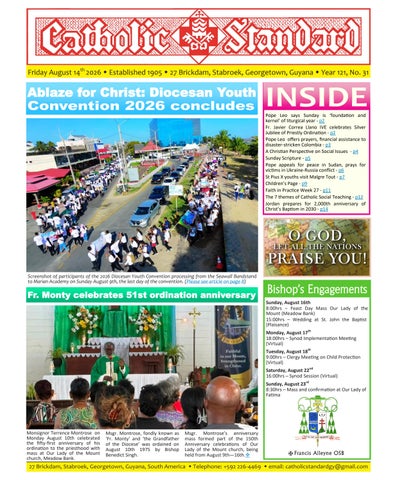
Ablaze for Christ: Diocesan Youth Pope Leo says Sunday is ‘foundation and kernel’ of liturgical year - p2 Fr. Javier Correa Llano IVE celebrates Silver Jubilee of Priestly Ordination - p2 Pope Leo offers prayers, financial assistance to disaster-stricken Colombia - p3 A Christian Perspective on Social Issues - p4 Sunday Scripture - p5 Pope appeals for peace in Sudan, prays for victims in Ukraine-Russia conflict - p6 St Pius X youths visit Malgre Tout - p7 Children’s Page - p9 Faith in Practice Week 27 - p11 The 7 themes of Catholic Social Teaching - p12 Jordan prepares for 2,000th anniversary of Christ’s Baptism in 2030 - p14
Screenshot of participants of the 2026 Diocesan Youth Convention processing from the Seawall Bandstand to Marian Academy on Sunday August 9th, the last day of the convention. (Please see article on page 8)
Fr. Monty celebrates 51st ordination anniversary
Bishop’s Engagements Sunday, August 16th 8:00hrs – Feast Day Mass Our Lady of the Mount (Meadow Bank) 15:00hrs – Wedding at St. John the Baptist (Plaisance) Monday, August 17th 18:00hrs – Synod Implementation Meeting (Virtual) Tuesday, August 18th 9:00hrs – Clergy Meeting on Child Protection (Virtual) Saturday, August 22nd 16:00hrs – Synod Session (Virtual) Sunday, August 23rd 8:30hrs – Mass and confirmation at Our Lady of Fatima
Monsignor Terrence Montrose on Monday August 10th celebrated the fifty-first anniversary of his ordination to the priesthood with mass at Our Lady of the Mount church, Meadow Bank.
Msgr. Montrose, fondly known as ‘Fr. Monty’ and ‘the Grandfather of the Diocese’ was ordained on August 10th 1975 by Bishop Benedict Singh.
Msgr. Montrose’s anniversary mass formed part of the 150th Anniversary celebrations of Our Lady of the Mount church, being held from August 9th—16th.❖
Francis Alleyne OSB
CATHOLIC STANDARD Friday, August 14th 2026
Year of St. Francis Jubilee Prayer Saint Francis, our brother, you who eight hundred years ago went to meet Sister Death as a man at peace, intercede for us before the Lord. You recognized true peace in the Crucifix of San Damiano, teach us to seek in Him the source of all reconciliation that breaks down every wall. You who, unarmed, crossed the lines of war and misunderstanding, give us the courage to build bridges where the world raises up boundaries.
In this time afflicted by conflict and division, intercede for us so that we may become peacemakers: unarmed and disarming witnesses of the peace that comes from Christ. Amen - Pope Leo XIV
VATICAN CITY (CNS) — Pope Leo XIV urged Catholics to gather in person for Sunday Mass and called for working conditions that allow people to attend, saying Sunday is “the foundation and kernel of the whole liturgical year.” “To sanctify Sunday, it is essential to celebrate the Eucharist,” the pope said at his Aug. 12 general audience in St. Peter’s Basilica. “In this regard, I urge everyone to seek the best possible conditions so that even those who are unable to take time off work on Sundays may take part in Holy Mass.” Continuing his series on the documents of the Second Vatican Council, Pope Leo reflected on ‘Sacrosanctum Concilium,’ the Constitution on the Sacred Liturgy. The liturgical year is not a static representation of past events, but an ongoing encounter with Christ, he said. At its core is Easter, when Christ rose from the dead, and for that reason, the pope said, it is “essential for the faithful to sanctify the Lord’s Day by gathering to celebrate the Eucharist.” “May our active participation and steadfast witness help us to enter ever more deeply into the reality of belonging to Christ, and may we anticipate with hope his coming in glory,” he said in his remarks to English-speaking pilgrims. Pope Leo recalled St. John Paul II’s description of Sunday as the “weekly Easter” and “the day of the Lord, the day of the Church, the day of man and, finally, the ‘day of days.'” Even in languages such as English and German, where the name for Sunday refers to the “day of the sun,” Pope Leo said Christians can discern a reference to Christ, “the true ‘sun of righteousness’ who enlightens every person.” Listening to the word of God, receiving the body of Christ and gathering together on Sundays, the pope said, allow “the Christian community” to make “visible its communion with the Lord” and bear witness to its fidelity to Christ and the Church. “This assembly cannot be substituted by a solely virtual presence, nor can it be reduced to a merely passive gathering,” he said, stressing that the liturgical assembly is fulfilled through the active participation of the faithful.❖
Page 2
Pope Leo XIV greets a baby and family before his weekly general audience in St. Peter’s Basilica at the Vatican Aug 12, 2026. (CNS photo/Vatican Media)
Fr. Javier Correa Llano IVE celebrates Silver Jubilee of ordination to the priesthood
On Sunday August 9th, the Catholic community of Santa Rosa, Moruca, Region 1, Essequibo, Guyana, gathered in joyful thanksgiving to celebrate the Silver Jubilee of Priestly Ordination of their Parish Priest, Fr. Javier Correa Llano, IVE. The community joined Fr. Javier in giving thanks to God for 25 years of faithful service to the priesthood,
while expressing their love and appreciation for his dedicated ministry and pastoral care. It was a beautiful celebration of faith, gratitude and the gift of priestly vocation. Congratulations, Fr. Javier, on 25 years of priestly ministry! May God continue to bless and strengthen you as you serve His people.❖ (Adapted from Catholic Media Guyana FB)
CATHOLIC STANDARD Friday, August 14th 2026
Page 3
assistance to disaster-stricken Colombia
Rescuers work amid the rubble at the Torres de Limonar building in Cali, Colombia, Aug. 13, 2026, in the aftermath of an 7.4 magnitude earthquake that struck the country Aug. 10. The Colombian Bishops' Conference confirmed that Pope Leo XIV, through the papal almoner's office, sent an initial donation of 100,000 euros (more than US$115,000) for relief efforts in the country. (OSV News photo/Sergio Acero, Reuters) (OSV News) — Pope Leo XIV sent a donation of 100,000 euros (approximately $115,321) for humanitarian relief efforts in Colombia, which is still reeling in the aftermath of a deadly earthquake early this week. According to Vatican News, the financial contribution was sent through the Dicastery for the Service of Charity and will go to the dioceses affected by the 7.4 magnitude earthquake that struck the country Aug. 10. Further aid will come following discussions between the papal almoner, Spanish Archbishop Luis Marín de San Martín, the apostolic nunciature in Colombia and the Colombian Bishops’ Conference, Vatican News reported.
Many are still missing According to The Associated Press, Colombian President Abelardo de la Espriella, who was sworn in to office just three days before the quake, said the death toll had reached 265. Although de la Espriella said the number of missing was at 500, civilian-run databases estimated more than 4,000 missing, AP reported.
Pope Leo’s donation is one of several the country has received following the disaster. The U.S. State Department said it deployed a disaster assistance response team to help coordinate relief efforts and offered $15.5 million in humanitarian aid. Other countries in the region, including Mexico and El Salvador, have also contributed tons of food, medicines and other humanitarian aid to Colombia. Meanwhile, the Latin American and Caribbean Episcopal Council, known as CELAM, urged bishops’ conferences across Latin America “to accompany, pray and collaborate in solidarity so that communities can rebuild not only their homes and infrastructure, but also hope and confidence in the future.”
Gratitude to those assisting the victims Addressing Spanish-speaking pilgrims during his weekly general audience Aug. 12, Pope Leo expressed his solidarity with the people of Colombia. “As I pray to the Lord for the eternal rest of the deceased, I assure my pray-
ers for their families and all those who have been affected by this tragedy. I express my gratitude to all those working in rescue efforts and assistance to the victims,” the pope said. In a statement published Aug. 12, the Colombian Bishops’ Conference expressed its gratitude to Pope Leo and said the pope’s words and the initial donation reflected his closeness to those suffering in the country. “The Colombian Episcopal Conference receives with profound gratitude this new gesture of closeness from Pope Leo XIV and the solidarity of the universal Church with the Colombian people,” the conference said. “In communion with the Holy Father, it reaffirms its commitment to accompany the affected families and communities, strengthen solidarity networks, and contribute, through the pastoral and charitable work of the Church, to caring for those most in need.” According to the bishops’ conference, the donation was a “result of the ongoing communication that has been maintained between the Holy See and the Church in Colombia since the first hours after the earthquake.”
Helping those who need it the most The pope’s donation, the bishops said, will be used to address the most pressing needs, and the Vatican said it would provide additional assistance once “new needs are identified and promptly communicated to the Dicastery for the Service of Charity.” The Colombian Bishops’ Conference said that it is compiling a report on the needs of the affected communities “with the aim of directing aid to those who need it most.” “For the Church, this response expresses an essential dimension of its mission: to be close to those who suffer and to transform solidarity into concrete actions of fraternity and service,” the bishops’ conference said. “The pope’s prayer, the Church’s support, and concrete aid thus come together in a single response: to be close to Colombia in this time of sorrow and to help communities face the emergency with hope and solidarity,” it said. ❖
CATHOLIC STANDARD Friday, August 14th 2026
A Christian Perspective on Social Issues
Tension and turmoil By GHK Lall The fields are many and they are ripe. The fruits are, for the most part, wrong. Sour and spoiled. There’s an edge to the teeth, a metallic taste that lingers. Not quite bitter; definitely not sweet. Look around. Pause for a moment. Listen. It seems that the world is awash with tension and conflict. Communities and whole countries trapped in turmoil. Guyana is no exception. In the local environment, the masks are more firmly in place, the faces not so grim. But is it enough? The Middle East has not been an oasis of calm in recent decades. Tensions flare, then fade into a restless uneasiness. More recently, as in now, the Strait of Hormuz has grabbed all the headlines. Why does this have to be? Where could it lead? Closer to Yemen and the Red Sea, there is another Strait that could be another chokepoint and flashpoint. The rumblings of conflict have shattered that stillness and boats are now on high alert. Men with powerful visions, and the tools to back, are plotting their moves, refining their plans. Nigeria, the Sudan, and Pakistan all know about
tension and turmoil. The two have become a way of life. It is a dog’s life. An explosion out of nowhere, in the safest of places, could be a life changer. If there is still life left, that is. It may be said to be a different world in those parts, with different approaches to the sanctity of life, and different mindsets. But what about the so-called modern, developed world? In America, long the pacesetter, the place that served as a model for imitation, what could be said about there? Once a beacon of light, once a sanctuary to welcome the weary and worn out. There is a never-ending stream of disrespect, what divides, and what could ultimately destroy. The checks and balances, the guardrails, erected over centuries have eroded. They sway and flake off like chips from the unrelenting assaults of what should be, and who shouldn’t be around. There is not even the care to be veiled, however thin, no more. Who’s welcome. Who shouldn’t be here, should be put out from the space long occupied by all for the benefit of all. Tensions crackle. Stirred to keep the pot boiling at high temperatures. They rent at the fabric of what holds society together. If America, the land of the tolerant, then why not everywhere else? In the descent to turmoil and chaos. Coming closer to home, there’s Venezuela. Years of instability and gnawing tensions have given way to a watchful quiet. Can it hold? If so, then for how long? At home, right here in Guyana, I stand at the side and watch. The sugarcoating has started to peel away. Many had seen through it. Many had shrugged their shoulders at it. Christians from across the board took no issue with the sugarcoating and lined up to take part in the sugar
truck. Too many followers of Christ do so, while the flock is afflicted and distressed. There’s the daily struggle to make it. The next meal. The next bill. The next demand that can’t be met. There has to be constant juggling to stay afloat. For some it is to stay alive and sane. The descent of a boat to a watery grave released some of the pent-up frustrations and tensions. It took a hundred dead, and an unknown number missing, for the other side of Guyana to show its face. The picture was far from pretty. But it gave citizens a glimpse of how tense below the surface is, and how it wouldn’t require much to set this country on a different footing. As in Africa and America and elsewhere, the lines are being drawn. The points of contentions are the usual: Who is in, should be in; and who’s out, and keep it that way. In Guyana, unlike other places, there’s enough to involve everyone. For them to feel included. For them to walk away feeling that they have been treated well. Hasn’t happened. Patience is stretched. Those with the wherewithal to make a difference are indifferent. The difference now is that there are all these visits, all these gifts. The question is this: will they suffice? Will they last? With so much in hand, there shouldn’t be so many, not any, who’s out of pocket. There is a choice that looms large in this country: continue in the old ways. Or make changes. Try a different path. Let there be a sense of fairness, justness, what feels right and is right. Tension is an ever-present reality. It doesn’t have to be. For that leads to turmoil, and few are those who delight to its dark presence.❖
Page 4
Prayer for our Priests
Gracious and loving God, we thank your for the gift of our priests. Through them, we experience your presence in the sacraments. Help our priests to be strong in their vocation. Set their souls on fire with love for your people. Grant them the wisdom, understanding, and strength they need to follow in the footsteps of Jesus. Inspire them with the vision of your Kingdom. Give them the words they need to spread the Gospel. Allow them to experience joy in their ministry. Help them to become instruments of your divine grace. We ask this through Jesus Christ, who lives and reigns as our Eternal Priest. Amen
CATHOLIC STANDARD Friday, August 14th 2026
First Reading Isaiah 56:1. 6-7 I will bring foreigners to my holy mountain Thus says the Lord: Have a care for justice, act with integrity, for soon my salvation will come and my integrity be manifest. Foreigners who have attached themselves to Yahweh to serve him and to love his name and be his servants – all who observe the sabbath, not profaning it, and cling to my covenant – these I will bring to my holy mountain. I will make them joyful in my house of prayer. Their holocausts and their sacrifices will be accepted on my altar, for my house will be called a house of prayer for all the peoples. Responsorial Psalm Psalm 66 Response: Let the peoples praise you, O God; let all the peoples praise you. 1. O God, be gracious and bless us and let your face shed its light upon us So will your ways be known upon earth and all nations learn your saving help. R/ 2. Let the nations be glad and exult for you rule the world with justice. With fairness you rule the peoples, you guide the nations on earth. R/ 3. Let the peoples praise you, O God; let all the peoples praise you. May God still give us his blessing. till the ends of the earth revere him. Response
Our Gospel today, from Matthew, reminds us to trust in Him even when it seems He is not answering our prayers. God wants to lead us to the joy of heaven to spend eternity with Him.
Page 5
Gospel Acclamation Jn 10: 27 Alleluia, alleluia! The sheep that belong to me listen to my voice, says the Lord, I know them and they follow me. Alleluia! or Ps 129: 5 Alleluia, alleluia! My Soul is waiting on the Lord, I count on his word Alleluia!
SECOND READING: Romans 11:13-15. 29-32 With Israel, God never takes back his gifts or revokes his choice. Let me tell you pagans this: I have been sent to the pagans as their apostle, and I am proud of being sent, but the purpose of it is to make my own people envious of you, and in this way save some of them. Since their rejection meant the reconciliation of the world, do you know what
their admission will mean? Nothing less than a resurrection from the dead! God never takes back his gifts or revokes his choice. Just as you changed from being disobedient to God, and now enjoy mercy because of their disobedience, so those who are disobedient now – and only because of the mercy shown to you – will also enjoy mercy eventually. God has imprisoned all men in their own disobedience only to show mercy to all mankind.
For that, we must be strong in faith and live our lives as an act of love and gratitude to Him. In other words, we must allow Him to transform us into saints. This is what the stewardship way of life is meant to do. Sometimes, that will feel painful to us. Often, it will be challenging. Jesus certainly challenged the Canaanite woman in today’s Gospel passage from Matthew. She called out to Him on behalf of her daughter, who was being tormented by a demon. What did Jesus do in reply to this mother’s desperate plea?
Nothing. He “did not say a word in answer to her.” Undeterred, the woman continues to call out to Him, yet He still does not give her what she asks for. Instead, He continues to challenge her faith. And she rises to the challenge to such an impressive degree that Jesus exclaims, “O woman [a term of deep respect in that day], great is your faith! Let it be done for you as you wish.” Imagine hearing those words proclaimed over us by God. Truly there could be no higher honour than hearing our Lord say that to us.
GOSPEL: Matthew 15:21-28 Woman, you have great faith. Jesus left Genenesaret and withdrew to the region of Tyre and Sidon. Then out came a Canaanite woman from that district and started shouting, ‘Sir, Son of David, take pity on me. My daughter is tormented by a devil.’ But he answered her not a word. And his disciples went and pleaded with him. ‘Give her what she wants,’ they said ‘because she is shouting after us.’ He said in reply, ‘I was sent only to the lost sheep of the House of Israel’. But the woman had come up and was kneeling at his feet. ‘Lord,’ she said ‘help me.’ He replied, ‘It is not fair to take the children’s food and throw it to the house-dogs’. She retorted, ‘Ah yes, sir; but even house-dogs can eat the scraps that fall from their master’s table’. Then Jesus answered her, ‘Woman, you have great faith. Let your wish be granted.’ And from that moment her daughter was well again.❖
So we must accept the difficulties that come with the stewardship way of life. Some days will be a true challenge to our trust in God. But those are the days when God is making saints of us. Let’s embrace the hard days during these difficult times. The deep joy that eventually comes, the eternal reward He promises, will be so worth it.❖ [www.catholicsteward.com/blog/ ]
CATHOLIC STANDARD Friday, August 14th 2026
Page 6
Gospel Pope appeals for peace in Sudan, prays Reflection
Love is said to be the greatest power on earth. It is amazing what people can do when they are moved by love. We see this especially in mothers who will do anything, brave anything, suffer anything and endure anything, for the sake of her child. We have all met women who deprive themselves so that their children will not know want. The woman in today’s Gospel story is an example of this kind of mother. She is a determined woman who refused to give up and it is all for her daughter. She is an example of perseverance, courage and love. According to Jesus she is a woman of great faith. This doesn’t mean that her faith made things easier for her. In fact, the opposite may be the case. We often hear people say that all it takes is faith and everything will fall into place. This isn’t necessarily so, but a person with faith has the courage to struggle on, even though not knowing if the result will be a happy one.
To the Jews the Canaanites were considered a sinful people. As far as they were concerned, God’s love and protection were only extended to the Jewish people. Yet we note that the Canaanite woman had more faith in Jesus than did his fellow Jews. Even with all the signs and miracles he worked, few ever came to believe in him. The woman believed in Jesus even though she wasn’t of the right race or religion, even though Jesus rejected her at first, even though the apostles were angry with her persistent shouting and wanted to get rid of her. Her focus was on Jesus as she believed he could help her. Like her, we too need to believe and to focus our faith in the Lord for whom all things are possible. ❖ [From: Journeying with the Word of God, The Religious Education Department, Diocese of Georgetown, Guyana ]
In this file photo, Sudanese refugee women walk at the Tulum refugee camp amid ongoing conflict in Sudan between the paramilitary Rapid Support Forces and the Sudanese army in Wadi Fira province, eastern Chad, Nov. 30, 2025. (OSV News photo/Amr Abdallah Dalsh, Reuters) (OSV News) — Pope Leo XIV called for an immediate ceasefire and humanitarian aid to innocent civilians in Sudan caught between conflict between state military and paramilitary forces. Addressing pilgrims gathered in St. Peter’s Square in English, the pope expressed his concern with the ongoing conflict, especially those suffering in elObeid, the capital of Sudan’s North Kordofan state. “In expressing my spiritual closeness to all the people of the nation, I renew my appeal to those in authority to guarantee humanitarian corridors for the civilian population,” he said after praying the Angelus prayer Aug. 9. Urging the international community to aid in “bringing about an immediate ceasefire,” the pope prayed that “the Lord may sustain those who are suffering, convert the hearts of those who sow violence, and grant the longawaited peace.”
UN alarm over Sudan Pope Leo’s concern for el-Obeid came as the United Nations recently warned that the city is in danger of becoming the site of mass atrocities. In a June 2026 statement, the U.N. Security Council expressed its “alarm” over reinforcements established around elObeid by the paramilitary Rapid Support Forces, or RSF. Warning of “the imminent risk of mass atrocities,” the U.N. Security Council “demanded the RSF immediately halt its assault on El Obeid.”
“The members of the Security Council expressed deep concern over continued violence across Sudan, including reports of escalating violence in the Kordofan states, which risks further exacerbating an already dire humanitarian situation,” it said, noting RSF drone strikes and calling for investigations into alleged abuses and violations.
Women, girls at risk U.N. Women, the secretariat of the U.N. Commission on the Status of Women, also condemned the attacks on women and girls who face daily attacks. “In El Obeid, Sudan, drone attacks during the day and sexual violence at night have left no safe window for women and girls to collect water,” said Anna Mutavati, U.N. Women’s regional director for East and Southern Africa, during a briefing with journalists in Geneva reported July 24. According to Mutavati, many women and girls have been “harassed, raped and subjected to other forms of sexual violence” while trying to obtain drinking water. The U.N. Human Rights Office also said that drone strikes in Sudan have killed 880 civilians in the first four months of 2026, prompting its chief, Volker Turk, to declare that the conflict was “on the cusp of entering yet another new, even deadlier phase.”
Children killed in war After the Angelus, Pope Leo turned his attention to the war between Russia
Subscribe to the Catholic Standard it’s free! Message us giving your name & number at +592 701-7639. Send us an email at catholicstandardgy@gmail.com under the heading CS Subscription, and include your name.❖
and Ukraine and lamented the killing of innocent people, particularly children in both countries. “These incidents are occurring one after another, indeed they are multiplying, resulting in ever-increasing numbers of civilian victims, including children,” the pope said. “My thoughts are with the victims’ families, the wounded and all those who are suffering due to the ongoing conflict.” According to Reuters, one child was killed and two injured when a Ukrainian drone struck a playground in Russia’s Belgorod region Aug. 2. The following day, seven people, including three children, were killed when a Ukrainian drone struck near a beach resort in Gelendzhik, Russia. Russia has also attacked civilian areas, including a residential building in Radushne, located in Ukraine’s Dnipropetrovsk region July 30, leaving dead eight people, including several children, with dozens of others wounded in the aftermath. A Russian drone strike in the northeast Ukrainian city of Sumy Aug. 4 killed three people, including two children, CBS News reported.
UNICEF: ‘Children have the right to be safe’ The deaths of children in both countries prompted a statement from UNICEF denouncing the targeting of civilian areas. “A playground. A?beach. A family home. Children have the right to be safe in the places where they live and play, wherever they are,” UNICEF said Aug. 4. “UNICEF again calls on all parties to uphold their obligations under international humanitarian law — including the protection of children and civilian infrastructure. Attacks that kill and injure children must stop,” the statement read.
Pope Leo: ‘War only begets more war’ Pope Leo renewed his appeal for “humanitarian law to be respected” and called on both Russia and Ukraine to “cease attacks on civilian targets.” “War only begets more war and causes immense suffering,” the pope said. “It is time to put an end to this vicious cycle of violence and make room for diplomacy and dialogue, so as to open the way to peace.”❖
Catholic Standard For 121 years, the Catholic Standard has been sharing the Gospel of Jesus Christ. Now reaching 10,000+ followers on Catholic Media Guyana Facebook plus going straight to your inbox and WhatsApp, our vibrant weekly e-paper is a trusted source which delivers informative and inspiring stories from across the diocese and around the world. Want to promote your business or event? Advertise with us! Call 675-4542 or email catholicstandardgy@gmail.com ❖
CATHOLIC STANDARD Friday, August 14th 2026
St Pius X youths visit Malgre Tout
Page 7
Journeying with the Word of God
MAKING THE WORD OF GOD YOUR OWN Step 1: Look at today’s Readings prayerfully. 1st Reading: The prophet Isaiah points out that God’s house is open to all those who worship with sincerity. On Sunday July 26th the youths of St. Pius X parish, West La Penitence, Georgetown, visited the parish of Our Lady of the Annunciation, Malgre Tout, West Bank Demerara, Region 3. The visit was the initiative of the Black family. The day - which was also the day the church celebrates grandparents and the elderly - started with Mass. The children were therefore invited by the celebrant Fr. Francis Xavier to stand by the grandparents and pray for them. After Mass the youths of St. Pius X and Malgre Tout breakfasted together and had fellowship with each other during a session led by Mr. and Mrs. Black.
2nd Reading: Paul tells the Christians in Rome that God never takes back his gifts. Those who return to him in sincerity are sure of obtaining mercy. Gospel: This is the story of a pagan woman who had extraordinary faith in Jesus and how that faith was rewarded.
Step 2: Applying the values of the Readings to your daily life.
This initiative from the Blacks will become a regular activity for the young people to meet their peers while visiting other parish communities and engaging in discussion on topics of faith.
Thanks to Fr. Carl Philadelphia, Catechists, parents and parishioners who supported this initiative.❖ [Adapted from St. Pius X R.C Church (Guyana) FB]
1. What is your overall impression of beggars? How do you feel they should be treated? 2. Jesus told the woman in the Gospel passage that she had great faith. How would you describe faith and what could you say about your faith? 3. In the incident with the Canaanite woman Jesus said that he was sent only to the lost sheep of the House of Israel. Today we understand better who the lost sheep are. Do you sometimes feel like a lost sheep just waiting for Jesus to find you? 4. Jesus praises the Canaanite woman for her great faith but faith doesn’t always make things easy. Is this your experience?
Step 3: Accepting the message of God’s
Word in your life of faith.
As a Christian it is necessary to have great faith. However, faith is not a magic wand that we wave and make everything easy. What faith does is bring out from us humility, courage, perseverance and love. A person of faith is like the mother who never gives up. In the face of all opposition, the person of faith keeps trying and does not give up especially when their action is guided by love.
Step 4: Something to think & pray about 1. Reflect on your experiences of a mother’s love. Would you say it is anything like the love shown by the Canaanite woman for her child? Do you think you can give this kind of love? What do you think is meant by “unconditional love”? 2. In your prayers remember the poor and disadvantaged members of our community and of society who have to get by on the crumbs of life’s rich banquet.❖ [From: Journeying with the Word of God, The Religious Education Department, Diocese of Georgetown, Guyana ]
CATHOLIC STANDARD Friday, August 14th 2026
Page 8
Ablaze for Christ: Diocesan Youth Convention 2026 concludes
Panel Discussion members (L-R): Fr. Joel Thompson SJ, Bishop John Persaud, Archbishop Jason Gordon, Bishop Francis Alleyne OSB & Sr. Marie Harper OSU
The 2026 Diocesan Youth Convention was held from Friday August 7th to Sunday August 9th at Marian Academy, Georgetown, where more than 250 young people from across Guyana gathered for a weekend of faith, fellowship and encounter with Christ. (Please see the Catholic Standard of Aug. 7th for a report of the first day) Day 2 of the Convention, Sat. August 2nd, continued under the theme “Fan the Flame: Ablaze for Christ,” with a presentation by Archbishop Charles Jason Gordon of Trinidad & Tobago entitled “Discipleship: A Journey to More and More Grace” (2 Peter 1:2).
Archbishop Gordon reminded the young people that discipleship is not a single moment, but a lifelong journey of allowing God’s grace to penetrate more deeply into every area of our lives. He emphasised that through Baptism we have already received the gift of life in Christ; the journey of discipleship is about allowing that grace to take root, transform us from within, and bear fruit in the way we live. At the heart of his presentation was the kerygma, the joyful proclamation that Christ has died, Christ is risen, Christ lives now, and Christ will come again. This Good News is not simply something to know, but something that should transform our lives and lead us into mission. Archbishop Gordon challenged the young people to consider both who handed the faith on to them and, importantly, to whom they are now handing it on. As missionary disciples, our encounter with Jesus must overflow into witness, service and love for others. The presentation was followed by a lively Panel Discussion, which gave the young people an opportunity to ask some of their burning questions. The panel comprised Archbishop Jason Gordon, Bishop Francis Alleyne OSB, Bishop John Persaud, Fr. Joel Thompson SJ, and Sr. Marie Harper OSU, and was moderated by Ms. Nadia De Abreu, a member of the Diocesan Youth Team. In the afternoon, participants moved beyond the convention venue and put discipleship into action through outreach activities, visiting homes for the elderly, a children’s home and reaching out to the less fortunate on the streets. It was an opportunity for the young people to share Christ’s love through their presence, compassion and service. They visited Archer’s Home for Senior Citizens, the Children’s Convalescent Home, St. Thomas More Men’s home, Holy Family Home and Nazareth
Convention participants praying the Scriptures using Lectio Divina
Visiting the Children’s Convalescent Home Home, while another group went out to Christ through prayerful listening to the feed the homeless. Word of God. Day 2 concluded with Adoration of the Fr. Joel introduced Lectio Divina as a Blessed Sacrament and the Sacrament way of helping our young people to of Reconciliation, which provided listen to God’s Word, share from the participants with a time of prayer, heart, and discover how the Gospel encounter and renewal as they calls us to live as Church within our continued to fan the flame of faith and communities. become ever more ablaze for Christ. Participants were guided through a The final day of the Convention - simple seven-step process: inviting the Sunday August 9th – began with the Lord into their midst, reading the participants processing from the Gospel, identifying words or phrases Seawall Bandstand to Marian Academy, that touched their hearts, spending with each parish or cluster headed by time in silence and listening, sharing youths bearing the banner of their their reflections, discerning a practical group. response as a group, and concluding in The closing mass was celebrated by prayer. Bishop John Persaud of Mandeville, The session reminded our young Jamaica, along with Bishop Francis people that Scripture is not only someAlleyne OSB and Fr. Joel Thompson SJ, thing we read, but something we are as well as Msgr. Terrence Montrose. called to listen to, pray with and live After lunch, Bishop John Persaud gave out. the feature presentation of the day. The convention came to a close that Fr. Joel Thompson SJ led participants in evening with a lively Concert and Camp an afternoon session on Lectio Divina, Fire.❖ (Adapted from Catholic Media inviting our young people to encounter Guyana FB)
CATHOLIC STANDARD Friday, August 14th 2026
Dear Girls and Boys, When Jesus came to earth, he came to preach and teach first to the Jews. That does not mean that He didn't love the other people of the world, but the first priority in his ministry on earth was to bring God's chosen ones to repentance. When other people saw Jesus healing the sick and lame, they followed him wherever he went. One day there was a woman from Canaan who came to Jesus and asked him to heal her daughter. Jesus explained to the woman that his first mission on earth was to preach to the people of Israel. The woman refused to give up. She came closer, knelt down, and begged, "Please help me, Lord!" Jesus replied, "It isn't right to take food away from children and feed it to dogs." The woman answered Jesus and said, "Lord, that's true, but even dogs get the crumbs that fall from their owner's table." Jesus was so touched by the faith of that woman that he told her that because of her faith, her daughter would be healed. Even though Jesus came first to the Jews, he loved us so much that he shared his love with all of us. Dear Father, thank you for loving us so much that you shared your son with the whole world, so that through him we could be saved. In Jesus' name we pray. Amen. ❖
[ NFC - Sources: sdc.me.uk , catholickidsbulletin.com, sermons4kids.com , salfordliturgy.org.uk, young-catholics.com, thewordthisweek.net & thekidsbulletin.com ]
Page 9
CATHOLIC STANDARD Friday, August 14th 2026
Page 10
Apply now at https://marianacademy.spencercx.com/apply/sixth-form
CATHOLIC STANDARD Friday, August 14th 2026
Page 11
Faith in Practice: Living and Knowing our Faith
What Kind of Development for Guyana?
Catholic Social Teaching | Part 3
Responsible development therefore requires strict environmental safeguards, transparent management of revenue, investment in renewable energy, and a realistic discussion about the scale and duration of our dependence on oil. The same discernment applies to mining. Mining creates employment and income, but it can also damage forests, rivers, health, social connections, Indigenous lands and community life. Financial profit cannot repair every destroyed relationship. Those most affected must have a genuine voice in decisions, and companies and governments must be accountable for long-term environmental and social costs.
Fr. Joel Thompson SJ Last week, we considered how a Samaritan Church combines charity with justice and confronts “structures of sin.” We conclude this series by exploring what is meant by “development”. What does Catholic Social Teaching say about development? When we hear of development, we may picture skyscrapers, highways, bridges, hotels and new housing. These are important since good infrastructure connects communities, creates opportunities and improves lives. But buildings and economic growth are means, not the final goal. A country can become wealthier on paper while many of its people remain unsafe, poor, excluded or unable to flourish.
The Common Good
Development is More Than Economic Growth St Paul VI taught that authentic development cannot be restricted to economic growth. It must promote “every person and the whole person” (Populorum Progressio, 14). Pope Leo XIV makes the same point in Magnifica Humanitas: development is truly human when it places people, rather than the accumulation of wealth, at its center. It must include the spiritual, cultural, moral and relational dimensions of life while respecting creation (cf. MH 83–84). True development goes beyond asking how much money we are making from oil and other revenue streams to asking whether people in Guyana are healthier, safer and better educated. Are families and communities flourishing? Are cultures and languages respected? Do Guyanese trust public institutions more? Are people growing in responsibility, character and concern for one another? Is creation being protected? Is Guyana growing morally or only economically? Jesus reminds us that “one does not live by bread alone” (Mt 4:4). Bread is necessary, but it is not sufficient. We need material security, but we also need meaning, culture, belonging, love, beauty, faith and hope. We cannot live on money alone. Catholic social teaching describes development as relational because life itself is relational. Laudato Si’ identifies three fundamental and closely connected relationships: with God, with our neighbour and with the earth. It also notes that sin wounds us inwardly, damaging our relationship with ourselves (cf. LS 66, 70). These dimensions are interwoven.
When one is harmed, the others eventually suffer. Development, therefore, should strengthen our relationship with God, ourselves, other people and creation. Economic activity that destroys communities or poisons land and water cannot be called fully human development. Neither can material progress accompanied by loneliness, violence, corruption or loss of cultural identity. Let us consider education. Constructing a school is valuable, but the building alone is not development. Teachers must be properly trained and supported. The curriculum should be relevant to the learners’ lives, language and culture. Education should develop not only examination results, but also curiosity, conscience, character, relationships and the ability to serve society. The true measure of the school is the flourishing of its
students and community. Are schools overly focused on academics at the expense of moral and psychosocial development?
Oil, Mining and Moral Discernment Guyana’s oil resources can provide revenue for better education, healthcare, housing, transport and protection for the vulnerable. Catholic teaching does not say should reject the use of natural resources. However, it requires us to consider the costs, benefits and risks for everyone. Oil extraction and use contribute to carbon emissions, global warming and climate change. These, in turn, threaten coastlines, water supplies and food security, with the poor usually suffering first and worst (e.g. remote hinterland communities dependent on farming for food).
The Catechism defines the common good as the social conditions that allow people, as groups or individuals, to reach their fulfilment “more fully and more easily” (CCC 1906). It is not simply what benefits the majority, and certainly not what enriches a small minority. It includes everyone, especially the poor and marginalized. The MV Barima tragedy should therefore remain part of our national examination of conscience. Investment in safe, dignified and dependable public transport is not less important because its users are ordinary people or residents of distant communities. Budgets, maintenance schedules, inspections and safety standards are moral matters because they affect human lives. Our priorities reveal whose lives we value. Before calling any project “development,” we should ask whether it protects human dignity. We should also ask whether it serves the poor as well as the powerful. Were affected communities heard? Does it strengthen relationships? What will it do to land, water and future generations? Is its management transparent? “What does it profit a person to gain the whole world and forfeit their life?” (Mk 8:36). We might ask the same of a nation. What would it profit Guyana to gain impressive buildings and great wealth if we lose our communities, our ethics, our environment or our soul? True development enables every person and community to flourish within a healthy web of relationships. It puts wealth at the service of life, power at the service of participation, and progress at the service of the common good. That is the development worthy of the Guyana we hope to build.❖
CATHOLIC STANDARD Friday, August 14th 2026
Page 12
CATHOLIC STANDARD Friday, August 14th 2026
Page 13
CATHOLIC STANDARD Friday, August 14th 2026
Page 14
Saint of the Week
Archbishop Pierbttista Pizzaballa, Latin patriarch of Jerusalem, processes along with church leaders from the Maronite, Chaldean, Syriac, and Catholic Churches in Jordan outside the Catholic Church of the Baptism of Christ in Bethany Beyond the Jordan near Amman Jan. 13, 2023. Jordanian Prime Minister Jafar Hassan signed agreements Aug. 12, 2026, to begin work on the development of the lands adjacent to the Baptism Site to commemorate the second millennium of Christ's baptism in 2030 at the direction of Jordan's King Abdullah II. (OSV News photo/courtesy Catholic Center for Studies and Media, Amman, Jordan) (OSV News) — Jordan announced ‘A prophetic sign of unity’ past, but a prophetic sign of unity, the start of its preparations for the During a May 18 meeting with peace and living faith for the historic 2,000th anniversary of the King Abdullah and the country’s whole world.” Baptism of Jesus Christ in 2030 at “May God accompany us all on the site where it took place at clerics, Cardinal Pizzaballa stressed this preparatory process for this that “baptism of the Lord is not Bethany Beyond the Jordan, also just an historical event of the past, important event,” he said. known as Al-Maghtas. but an eternal moment that still Hassan, Jordan’s prime minister, So far, four popes have visited the speaks to each of us.” highlighted Jordan’s message of site of great religious importance, coexistence, respect for others, “In it we see the humility of the including St. Paul VI in 1964, peace, love and human fraternity. Son of God who entered the followed by St. John Paul II, Pope He also said the second millenniwaters of Jordan to sanctify Benedict XVI and Pope Francis. um of the Baptism of Jesus Christ creation and open to all of us the Jordan is the only country to host reflects Jordan’s historical and visits of the four popes, all affirm- way of salvation,” the cardinal said. “Baptism marks the beginning: the religious standing and its role as a ing the site’s significance. global destination for Christian Jordanian Prime Minister Jafar beginning of the mission of Christ pilgrimage, Hassan signed agreements Aug. 12 and the beginning of our new life Hassan said the government is to begin work on the development in it,” he said. of the lands adjacent to the Acknowledging King Abdullah’s mobilizing all available resources Baptism Site to commemorate the custodianship of Christian holy to support the occasion, describsecond millennium of Christ’s sites and peacemaking efforts, ing it as an opportunity to baptism in 2030 at the direction of Cardinal Pizzaballa said that reinforce Jordan’s position as a Jordan’s King Abdullah II. through the commemoration of land of religious heritage and a Projects totaling $120 million Christ’s baptism, “we can make global destination for Christian include the construction of a Bap- 2030 not just a memory of the pilgrims.❖ tism museum and a pilgrim’s and visitor’s village as well as the development of ecological walking trails near the World Heritage site, in line with UNESCO recommendations for the site’s conservation. King Abdullah and his government are working with Cardinal Pierbattista Pizzaballa, the Latin Patriarch of Jerusalem, and the Council of Church Leaders in Jordan, including Auxiliary Bishop Iyad Twal, the Latin Patriarchal Vicar in Jordan, while coordinating with churches and Christian institutions worldwide. Organizers said they hope to see millions of Christian pilgrims and other participants coming to Jordan to engage in this historic commemoration of the Baptism Site, the starting point of Christ’s In this file photo, pilgrims bathe in the Israeli side of the Jordan River earthly mission after his baptism overlooking Jordan Jan. 28, 2023, in one of the places traditionally held in the Jordan River. as marking the location of the Baptism of Christ. (OSV News photo)
August 21st: St. Pius X ( June 2nd 1835– August 20th 1914 ) Pope Pius X is perhaps best remembered for his encouragement of the frequent reception of Holy Communion, especially by children. Most Catholics at that time received Holy Communion only once or twice a year. He encouraged them to receive Holy Communion frequently, even daily, and lowered the age of first communion from about 18 to the age of 7. He promoted communion to be brought to the sick. He encouraged all Catholics to read Sacred Scripture each day, preached publicly every Sunday on the Gospel, and founded the Pontifical Biblical Institute to help in the understanding of the Bible. Pius also worked for the reform of Church music, began the reform of Canon Law, and fostered Marian devotion. During his 11 years as pope, he brought renewal to almost all areas of Church life. Describing Pius X, a historian wrote that he was “a man of God who knew the unhappiness of the world and the hardships of life, and in the greatness of his heart wanted to comfort everyone.” Pius X died on August 20th 1914 and was canonized on May 29th 1954. He is the Patron Saint of First Communicants and Pilgrims.❖ [franciscanmedia.org & salfordliturgy.org ]