Friday October 2nd 2026 Established 1905 27 Brickdam, Stabroek, Georgetown, Guyana Year 121, No. 38
Pope Leo draws 800,000 to Vatican finds IVE, SSVM founder guilty of sexual abuse - p2 Hundreds of children join Pope Leo in praying the rosary for peace in Vatican Gardens - p3 A Christian Perspective on Social Issues - p4 Sunday Scripture - p5 Vatican history commission working to preserve truth in the AI age - p6 Pope’s October prayer intention - p8 Children’s Page - p9 Growing in Grace Week 95 - p10 Moved by Pope Leo’s empathy, French abuse survivors urged action on ‘systemic’ failures - p10 Faith in Practice Week 34 - p11 Highlights of Pope Leo’s visit to France - p12 Archbishop Emeritus Robert Rivas dies at 80 - p13 Christian Life Programme strengthens Faith and Family Life - p14
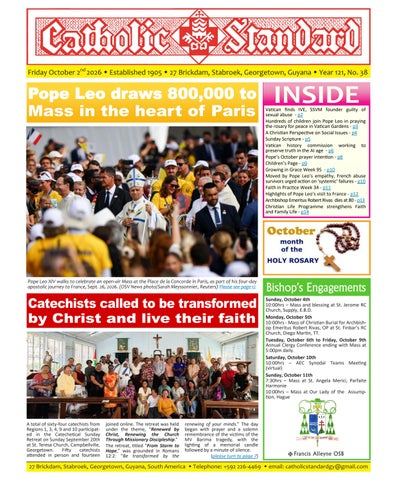
Pope Leo XIV walks to celebrate an open-air Mass at the Place de la Concorde in Paris, as part of his four-day apostolic journey to France, Sept. 26, 2026. (OSV News photo/Sarah Meyssonnier, Reuters) Please see page 12
Bishop’s Engagements Sunday, October 4th 10:00hrs – Mass and blessing at St. Jerome RC Church, Supply, E.B.D. Monday, October 5th 10:00hrs - Mass of Christian Burial for Archbishop Emeritus Robert Rivas, OP at St. Finbar’s RC Church, Diego Martin, TT. Tuesday, October 6th to Friday, October 9th Annual Clergy Conference ending with Mass at 5:00pm daily. Saturday, October 10th 10:00hrs – AEC Synodal Teams Meeting (virtual) Sunday, October 11th 7:30hrs – Mass at St. Angela Merici, Parfaite Harmonie 10:00hrs – Mass at Our Lady of the Assumption, Hague
A total of sixty-four catechists from Regions 1, 3, 4, 9 and 10 participated in the Catechetical Sunday Retreat on Sunday September 20th at St. Teresa Church, Campbellville, Georgetown. Fifty catechists attended in person and fourteen
joined online. The retreat was held under the theme, “Renewed by Christ, Renewing the Church Through Missionary Discipleship.” The retreat, titled “From Storm to Hope,” was grounded in Romans 12:2: “Be transformed by the
renewing of your minds.” The day began with prayer and a solemn remembrance of the victims of the MV Barima tragedy, with the lighting of a memorial candle followed by a minute of silence. (please turn to page 7)
Francis Alleyne OSB
CATHOLIC STANDARD Friday, October 2nd 2026
Year of St. Francis Jubilee Prayer Saint Francis, our brother, you who eight hundred years ago went to meet Sister Death as a man at peace, intercede for us before the Lord. You recognized true peace in the Crucifix of San Damiano, teach us to seek in Him the source of all reconciliation that breaks down every wall. You who, unarmed, crossed the lines of war and misunderstanding, give us the courage to build bridges where the world raises up boundaries.
In this time afflicted by conflict and division, intercede for us so that we may become peacemakers: unarmed and disarming witnesses of the peace that comes from Christ. Amen - Pope Leo XIV
In a press release published on Tuesday, September 29, 2026, the Holy See announced that Father Carlos Miguel Buela had been found guilty of sexual abuse. The Argentine priest - who died in 2023 - was the founder of the Institute of the Incarnate Word (IVE) and the Servants of the Lord and the Virgin of Matará (SSVM). The papal delegates, who were appointed by Rome in 2025 to take over the governance of these two institutes, are calling on them to reform. Father Buela, originally from Buenos Aires, founded the Institute of the Incarnate Word, a missionary institute, in Mendoza, Argentina, in 1984. He subsequently founded a female branch, the Servants of the Lord and the Virgin of Matará, in 1988. He was in conflict with Argentine bishops starting in the 1990s, as well as facing accusations of abuse in the 2000s. The Holy See forced him to step down from the leadership of the institute in 1994. However, he managed to get himself reelected as superior general in 2001, before being removed once again by Rome in 2010. He consistently disobeyed the penalties imposed on him, even following a new canonical investigation in 2020-2021 led by the Spanish Cardinal Santos Abril y Castelló. Despite Father Buela’s death in 2023, the two institutes have not yet completed a process of reform. Certain members within them have continued to be loyal to their founder. The official website of the Institute of the Incarnate Word still makes no mention of the abuses committed by the Argentine priest.
Rome’s latest intervention in the institutes The Holy See was ultimately forced to appoint papal delegates with full governing powers in 2025, with the mission of taking back control over these institutes. At the conclusion of this investigation, these two delegates — Sister Clara Echarte Oñate, a member of the Daughters of Jesus, and Bishop José Antonio Satué Huerto of Málaga — gathered all the provincial superiors of the two institutes for a meeting in Rome. During this meeting, which took place on September 14, the delegates confirmed the conviction of Father Buela for “an offence against the sixth commandment, committed with violence against several people” — that is, sexual abuse involving violence. The decision was issued by a Special Penal Tribunal of First Instance and an Appeals Tribunal established by the Holy See specifically to handle this case. The Vatican emphasized that both tribunals were competent to hear the case and that they had
obtained “moral certainty” regarding the offense.
The statement framed the decision within the broader renewal process currently underway in both the Institute of the Incarnate Word and the Servants of the Lord and the Virgin of Matará, which remain under Vatican oversight. The purpose of the announcement is to “help re-establish the truth” out of respect for the victims. However, Rome also wishes to help the members of the two institutes undertake a “process of re-examining the charism and reviewing, renewing and purifying the spirituality, formation and apostolate proper to each Institute, distinguishing between the gift of the Spirit bestowed for the building up of the Church and the Founder’s limitations or personal conduct.” The goal, the statement said, is to distinguish the charism received for the service of the Church from the personal conduct and shortcomings of Buela, whose legacy has long been overshadowed by allegations of sexual abuse, manipulation, and serious failures in governance.
A path of renewal The Vaticanʼs measures amount to what is effectively a process of institutional renewal. The effort bears similarities to the path undertaken by the Holy See with the Legionaries of Christ and Regnum Christi after the confirmation of abuses and crimes committed by their founder, Marcial Maciel. The initiative has the support of the Dicastery for Institutes of Consecrated Life, headed by Sister Simona Brambilla, as well as the two pontifical delegates originally appointed by Pope Francis and later confirmed by Pope Leo XIV: Bishop José Antonio Satué of Teruel and Albarracín, Spain, for the menʼs branch and Sister Clara Echarte for the womenʼs branch.
Presence in 45 countries
The Religious Family of the Incarnate Word is present in 45 countries and
Page 2
includes more than 3,000 members, including priests, religious sisters, and lay members of its Third Secular Order. Founded in Argentina in 1984, it experienced rapid international growth in the decades that followed. However, just 11 years after its founding, the Holy See began intervening in the congregation amid allegations of sexual abuse against Buela and other concerns involving the exercise of authority and community life. Since then, various pontifical commissioners and delegates have sought to address the situation. A major milestone came in December 2016, when the Diocese of San Rafael in Argentina publicly announced that the Vatican had found Buela guilty of “improper behavior with adults.” In a statement read at the time during a press conference, the diocese said allegations had emerged involving “sexual actions affecting religious and seminarians of the institute.” In 2019, Spanish Cardinal Santos Abril y Castelló was appointed pontifical commissioner. He imposed restrictions on the congregationʼs expansion and publicly denounced the internal resistance he encountered during his mission.❖ (From Aleteia and EWTN News)
CATHOLIC STANDARD Friday, October 2nd 2026
Page 3
Hundreds of children join Pope Leo in praying
VATICAN CITY (OSV News) — Pope Leo XIV prayed the rosary with hundreds of children and their families at the Lourdes grotto in the Vatican Gardens Oct. 1 after the pope invited Catholics to pray the rosary throughout the month of October for peace in the world. “Tonight and in these coming days, we are not alone in prayer. Across the globe, one million children are praying with us,” Pope Leo told the children. “One million! Just think: 50 million ‘Hail Marys’ rising to Heaven from every corner of the earth and in every language, asking for peace, and coming together as if in a single, immense rosary, to embrace and bind together all the continents, races, and nations of the planet,” he said. The prayer with the pope as the sun set over the Vatican Gardens was part of the “One Million Children Praying the Rosary” initiative organized by Aid to the Church in Need, a pontifical foundation that supports persecuted and suffering Christians around the world.
“Tonight we’ve gathered to be together with the two people who love us more than anyone else. Do you know who they are?” the pope asked. “The Lord Jesus and his mother Mary, who never leave us alone and who are always close to us.” At the beginning of the prayer vigil, the pope was accompanied by a child as he brought a bouquet of flowers to the altar at the Lourdes grotto. The gathering came just days after Pope Leo visited the original Marian grotto in Lourdes, France, where the Virgin Mary appeared 18 times to St. Bernadette Soubirous in 1858. The Lourdes grotto in the Vatican Gardens dates back to Pope Leo XIII, who decided near the end of his life to install a reproduction of the Lourdes grotto in France. It was solemnly inaugurated in 1905 by his successor, Pope Pius X. As the pope spoke enthusiastically to the children and their families, a young child ran across the gardens in front of him. Pope Leo invited the children to shout, “I love you, Jesus,” and “I love you, Mary.”
Mysteries of the rosary: his baptism in the Jordan River, the wedding feast at Cana, the proclamation of the kingdom of God, the Transfiguration and the institution of the Eucharist at the Last Supper. “These are moments in which he gave us wonderful gifts that we must never forget, and for this we want to thank him,” he added. The children prayed the “Hail Mary” prayer in several languages, including Italian, Arabic, Urdu, German, and Spanish, offering decades of the rosary for peace in Syria, Lebanon, South Sudan, Cuba, Venezuela, and other countries. The “One Million Children Praying the Rosary” initiative began in Venezuela in 2005 and has since grown into a worldwide prayer movement involving children, families, parishes, schools and Church groups across the globe. The campaign draws inspiration from words attributed to St. Pio of Pietrelcina, commonly known as Padre Pio: “When one million children pray the Rosary, the world will change.” In 2026, the campaign is also inspired by the message of Our Lady of Fatima: “In the end, my Immaculate Heart will triumph.”
“Yes, we love you, Jesus and Mary, and tonight we ask you for a special gift: peace for all the children of the world, especially for those living in war-torn areas in so many countries around the world,” the pope said. “We do this through the prayer of the Holy Rosary, which is a simple prayer that everyone can recite.” Before beginning the rosary, the pope explained that the children would reflect on five moments in the life of Jesus, corresponding to the Luminous
Children pray for areas affected by conflict, poverty
A weeklong prayer campaign Praying for peace around the this year For the first time, the 2026 campaign is globe taking place over an entire week, from Oct. 1-7, allowing dioceses, parishes, schools, communities and families around the world to choose a day suited to their pastoral circumstances while uniting in prayer for peace and unity. The campaign will conclude Oct. 7, the feast of Our Lady of the Rosary. Pope Leo arrived at the Vatican Gardens singing the hymn “Jesus Christ, You Are My Life” with the children and the crowd gathered in the gardens for the prayer.
Children in communities around the world are participating in the initiative, including in areas affected by war, poverty and political instability. In Sudan, where an ongoing conflict has caused widespread suffering, Father Franck Mandozi of the Pastoral Region of Kosti confirmed that children from several parishes and schools
would take part. In the Bolivian Amazon, Sister Patricia Alejandra Botello López said children in a Tsimané Indigenous community were already praying the rosary in both Tsimané and Spanish. In Zimbabwe, children at St. Christopher’s Parish in the Archdiocese of Bulawayo are scheduled to gather Oct. 4. In the following weeks, the parish’s priest, Father Charles Mafurutu, also planned to visit remote communities and Mass centers across the parish territory. The prayer in the Vatican Gardens kicked off the month of October, which the Church dedicates to prayer of the Holy Rosary. During his Angelus address in Lourdes a few days earlier, Pope Leo invited Catholics around the world to pray the rosary throughout October for an end to war and peace among nations. “I invite all the faithful and all Christian communities to pray the holy rosary throughout the coming month of October, with the particular intention that wars may cease and that peace may be established among peoples in conflict,” he said. “Let us accompany this prayer with concrete acts of penance and mercy, committing ourselves always to fostering dialogue and reconciliation,” he added. Speaking to the children in the Vatican Gardens, Pope Leo emphasized that prayer must be accompanied by acts of charity. “Prayers must always be accompanied by good deeds and acts of love. That’s how peace grows!” he said. ❖
CATHOLIC STANDARD Friday, October 2nd 2026
A Christian Perspective on Social Issues
Cubans the language of pain, misery By GHK Lall I see them in their uniforms. Backpacks tight around shoulders. Jeans clad; sandal shod. Feet striding purposely. Cubans on the move at the crack of dawn. I gave a glimpse into their world on the first Sunday in July. A hard one it is. Some harder ones have since come to my attention. From the mouths of their compadres themselves. Eyewitnesses or within earshot. I make myself available, be a good listener. Absorbing and disgusting. This cannot be Guyana. Guyanese are not that kind of exploiters. Better should have been known. Foreigners working. Working extra. They get cheated for one or the other; often both. What are they going to do? Lodge a complaint at the Ministry of Labor? Approach the Guyana Police Force? No passport. No documents. Thus, hostages are made, and hostages are held. To the exploitations of greedy Guyanese. Those who get the subcontracts. Those who have the connections. There is the law. Then, there are those to whom the laws of Guyana apply. And don’t. Cuban, Haitians, Venezuelans are caught and locked in that snare. The
lot of a migrant is a grueling one. I know that firsthand. One can only imagine the life of those illegal ones operating on the edges, and in the shadows, of Guyana. There’s Guyana’s rushing, rising, seas of commerce. Why hire a Guyanese, when a Cuban can be had for next to nothing? Or, not paid at all, when they are in the hands of some real low class Guyanese business scoundrels. Worked to the bone. Given the dirty jobs. Then, cheated or robbed blind, for the bitter icing at the top of their rancid cake. Who is there to speak for them? Who in Guyana cares enough to understand their language of pain and heartbreak? It’s the language of the wandering, hoping, grinding-it-out migrant. When English is the mystery of hieroglyphics and cuneiforms, then it transforms into a double jeopardy for them. Somebody has to take a stand for them. Someone has to speak for them. Since there are only a few others, then standing and speaking become a duty that is mandatory. Among the reported exploiters and cheaters are members of my own church. I understand that there are many others and they are stalwarts in some of the major faiths practiced in this country. When the so-called pious are among the leading predators of migrants, then what could be expected from the out-and-out hustlers and moneychangers? Those who are ready to do anything for a dollar, then another thousand. The world of ordinary Guyanese, born and bred here, is an ugly one. Imagine the world of migrants-be they Cuban, Haitian, Venezuelan-and how darkly and extraordinarily draining that must be. A land that is simultaneously a
paradise of plenty, and a place of poverty. The oil made the jobs possible. For that a special type of jobber is needed. Those who are ready to swallow the sewage. Those at whom some Guyanese are only too ready to shovel some of the same down their shirtfronts, if not their throats. Where is the money? What about the overtime? What about my spare time? Why work me like a dog? And why then fire me when I am sick and dragging? Like a donkey weighed down with an unbearable load. Why when I question the inflated bills that have to be wrong, and the wrong of passport seized and held? Why threaten to get me deported when I speak of these things that damage my existence, that force me to live like an animal? Why? Why? Why? I hear the travails of the foreign workers toiling in this savage land. I cry for them. A voice raised. A minister in a government office listening. A minister in a house of prayer listening. And both deciding to do something about Cubans, Haitians, Venezuelans, and Africans and Indians from the continent and subcontinent from which they hail, are named. Commerce shouldn’t make criminals of Guyanese. Nor should Guyanese be criminally-minded to migrants. I ring the bell. One migrant standing for other migrants.❖
Page 4
Prayer for our Priests
Gracious and loving God, we thank your for the gift of our priests. Through them, we experience your presence in the sacraments. Help our priests to be strong in their vocation. Set their souls on fire with love for your people. Grant them the wisdom, understanding, and strength they need to follow in the footsteps of Jesus. Inspire them with the vision of your Kingdom. Give them the words they need to spread the Gospel. Allow them to experience joy in their ministry. Help them to become instruments of your divine grace. We ask this through Jesus Christ, who lives and reigns as our Eternal Priest. Amen
CATHOLIC STANDARD Friday, October 2nd 2026
FIRST READING Isaiah 5: 1-7 The vineyard of the Lord of hosts is the House of Israel. Let me sing to my friend the song of his love for his vineyard. My friend had a vineyard on a fertile hillside. He dug the soil, cleared it of stones, and planted choice vines in it. In the middle he built a tower, he dug a press there too. He expected it to yield grapes, but sour grapes were all that it gave. And now, inhabitants of Jerusalem and men and women of Judah, I ask you to judge between my vineyard and me. What could I have done for my vineyard that I have not done? I expected it to yield grapes. Why did it yield sour grapes instead? Very well, I will tell you what I am going to do to my vineyard: I will take away its hedge for it to be grazed on, and knock down its walls for it to be trampled on. I will lay it waste, unpruned, undug; overgrown by the briar and the thorn. I will command the clouds to rain no rain on it. Yes, the vineyard of the Lord of hosts is the House of Israel, and the men and women of Judah that chosen plant. He expected justice, but found bloodshed, integrity, but only a cry of distress. RESPONSORIAL PSALM Psalm 80 Response: The vineyard of the Lord is the House of Israel. 1.You brought a vine out of Egypt; to plant it you drove out the nations. It stretched out its branches to the sea, to the Great River it stretched out its shoots. 2.Then why have you broken down its walls? It is plucked by all who pass by. It is ravished by the boar of the forest, devoured by the beasts of the field.
3.God of hosts, turn again, we implore, look down from heaven and see. Visit this vine and protect it, the vine your right hand has planted. 4. And we shall never forsake you again: give us life that we may call upon your name. God of hosts, bring us back; let your face shine on us and we shall be saved. SECOND READING Philippians 4: 6-9 The God of peace will be with you. There is no need to worry; but if there is anything you need, pray for it, asking God for it with prayer and thanksgiving, and that peace of God, which is so much greater than we can understand, will guard your hearts and your thoughts, in Christ Jesus. Finally, brothers, fill your minds with everything that is true, everything that is noble, everything that is good and pure, everything that we love and honour, and everything that can be thought virtuous or worthy of praise. Keep doing all the things that you learnt from me and have been taught by me and have heard or seen that I do. Then the God of peace will be with you. GOSPEL Matthew 21: 33-43 He will lease the vineyard to other tenants.
We have been given so many gifts and blessings by our Heavenly Father. Yet, in our fallen state it is all too easy to take them for granted. Our readings today teach us that we must live with an intentional awareness of our many blessings and use them gratefully to glorify God. In our Gospel passage from Matthew, Jesus uses the image of a vineyard to teach the importance of using our blessings well. He tells the story of a
Page 5
Jesus said to the chief priests and the elders of the people, “Listen to another parable. There was a man, a landowner, who planted a vineyard; he fenced it round, dug a winepress in it and built a tower; then he leased it to tenants and went abroad. When vintage time drew near he sent his servants to the tenants to collect his produce. But the tenants seized his servants, thrashed one, killed another and stoned a third. Next he sent some more servants, this time a larger number, and they dealt with them in the same way. Finally he sent his son to them. ‘They will respect my son,’ he said. But when the tenants saw the son, they said to each other, ‘This is the heir. Come on, let us kill him and take over his inheritance.’ So they seized him and threw him out of the vineyard and killed him. Now when the owner of the vineyard comes, what will he do to those tenants?” They answered, “He will bring those wretches to a wretched end and lease the vineyard to other tenants who will deliver the produce to him when the season arrives.” Jesus said to them, “Have you never read in the scriptures: “It was the stone rejected by the builders that became the keystone. This was the Lord’s doing and it is wonderful to see? “I tell you, then, that the kingdom of God will be taken from you and given to a people who will produce its fruit.” ❖
landowner who plants a vineyard and leases it to tenants before he goes on a journey. Instead of tending the vineyard, the tenants mistreat the servants in the vineyard and even the son of the landowner, whom they kill. When the landowner realizes what the tenants have done, he puts them to death and leases his vineyard to tenants who “will give him the produce at the proper times.”
By Baptism, we have received the gift of salvation and membership in Kingdom of God — we are now “tenants” called to work in the “vineyard” and produce fruit for its owner, our Heavenly Father. Jesus makes it clear that we if we squander the gift of salvation, we will lose it. It is a sobering truth. So, let use our intellect to think on these gifts throughout the day and resolve to use all our gifts for God’s glory. ❖ [www.catholicsteward.com/blog/ ]
CATHOLIC STANDARD Friday, October 2nd 2026
Gospel Reflection
T
he parable of the vineyard and the tenants is a teaching of Jesus that we are responsible for what we have been given. It is all about stewardship. God has made each of us a steward with unique abilities and talents. Our whole life is therefore in partnership with God in the care of the vineyard. We are responsible for the earth on which we live (or at least for the corner in which we live) and we are responsible for each other. We are to transform our own little vineyard into a place of justice and peace. The attitude of good stewardship and a sign of spiritual maturity is when we stop thinking along the lines of “mine” and move to saying “our”.
God is of course the owner of the vineyard. We are only the tenants who are to ensure it bears good fruit. And the fruits that God expects from the vineyard and from his people are peace, justice in dealing with others, true worship and goodness, caring and sharing. Instead, we readily find in the vineyard hatred and wars, idolatry, injustice and exploitation of the weak and the poor, evil and greed, pride and arrogance. At times we fail, not just as individuals but also as church. Our Christian community is the vineyard the Lord planted and looked after with much care. He even gave his life for it. We, the tenants of his vineyard, now have the great privilege and the great challenge to produce the fruits God intended to come from it. ❖ [From: Journeying with the Word of God, The Religious Education Department, Diocese of Georgetown, Guyana ]
PHILADELPHIA (OSV News) — Pope Leo XIV has added one of America’s leading Catholic educators with expertise in the connection between history and the faith to a key pontifical commission at the Vatican focused on preserving truth, at a time when the Holy Father is warning of how a failure to accurately understand history could lead to a politically and technologically more dangerous future for the world. Philadelphia-based Francesco Cesareo, whose appointment was announced Aug. 25, is one of the newest members of the Pontifical Committee for Historical Sciences. “It’s very much a research-oriented commission that helps to advise the Holy Father and the Curia when it comes to questions of historical importance,” said Cesareo who is currently an adjunct professor of history at both St. Charles Borromeo Seminary and Villanova University, Pope Leo’s alma mater. “The work of the commission is to preserve and to nurture historical truth and then to pass it on to the next generation,” he told OSV News.
Page 6
Francesco Cesareo, then chairman of the National Review Board, is pictured in an Oct. 10, 2018, photo. The Philadelphia-based adjunct professor of history at both St. Charles Borromeo Seminary and Villanova University is one of the newest members of the Pontifical Committee for Historical Sciences. (OSV News photo/Bob Roller, CNS)
Pennsylvania, outside Origins of the Vatican’s history Safeguarding truth and fact for Ambler, Philadelphia, Cesareo shared that commission the Vatican The committee, launched by Pope Pius XII in 1954, came nine years after the end of World War II. It came from what the committee called “perspective radically renewed by the progress made in the historical sciences” since the war, which was replete with political propaganda and ideology-based information control that often disguised horrific truths about the actions of the war’s combatants. “That’s one of the goals of the commission,” said Cesareo, “to ensure that historical truth is accessible and is communicated and not distorted by whatever ideological perspective one may have.” Cesareo is the sole American on the Vatican committee as of Sept. 23. He is also the president emeritus of Assumption University in Worcester, Massachusetts. He has taught or led academic departments at Albertus Magnus College in New Haven, Connecticut; John Carroll University in Cleveland; Duquesne University in Pittsburgh; and St. John’s University in New York City. His educational background has included numerous roles of study at the Vatican and in universities in Rome.
Cesareo’s new role at the pontifical commission involves supporting and enacting ways of safeguarding and sharing truth and fact, and their relationship with the Catholic faith. “The Church has a rich treasury of historical data and evidence that goes back centuries,” Cesareo said, “and to be able to ensure that that patrimony is available to scholars and to future generations is critical to continuing to delve into historical truth and the importance of historical truth.” Indeed, the understanding of objective truth and the capability for powerful owners of technology like artificial intelligence, or AI, to falsely skew perception of that truth was part of Pope Leo’s motivation for writing his groundbreaking encyclical letter, “Magnifica Humanitas.” “When people come to believe that nothing is genuinely true and that principles are hollow words, then the fuse in their hearts is lit for new eruptions of intolerance and aggression,” the pope wrote in “Magnifica Humanitas” which was released in May.
AI and the risks to historical memory During the Aug. 25 Cardinals’ Forum at the St. Charles Borromeo Seminary in
Subscribe to the Catholic Standard it’s free! Message us giving your name & number at +592 701-7639. Send us an email at catholicstandardgy@gmail.com under the heading CS Subscription, and include your name.❖
history acts as the foundational framework for the whole encyclical. He explained how the pope saw the “loss of historical memory” could lead to “potentially dire consequences, which he characterizes as historical nihilism.” “Pope Leo explicitly states in this chapter that artificial intelligence is not just a passing crisis to be managed, but a historic shift that challenges the categories of Catholic social doctrine from within,” Cesareo said. Father Thomas Dailey, the John Cardinal Foley Chair of Homiletics & Social Communications and project director of the seminary’s Catholic Preaching Institute, emceed and presented during the Cardinals’ Forum with Cesareo. “Catholic social doctrine is basically a theology of history in terms of how the Church navigates, not in isolation, but navigates by journeying through a particular time and a particular moment so that the Gospel becomes the means by which we can answer the fundamental questions so that humanity is not alienated,” Father Dailey said. He added, “If anyone is going to have at least some influence on the pope’s thinking along this journey, it will be Dr. Cesareo.”❖
Catholic Standard For 121 years, the Catholic Standard has been sharing the Gospel of Jesus Christ. Now reaching 10,000+ followers on Catholic Media Guyana Facebook plus going straight to your inbox and WhatsApp, our vibrant weekly e-paper is a trusted source which delivers informative and inspiring stories from across the diocese and around the world. Want to promote your business or event? Advertise with us! Call 675-4542 or email catholicstandardgy@gmail.com ❖
CATHOLIC STANDARD Friday, October 2nd 2026
Catechists called to be transformed by Christ and live their faith (From P1)
Page 7
Journeying with the Word of God
MAKING THE WORD OF GOD YOUR OWN Step 1: Look at today’s Readings prayerfully.
In his presentation, His Lordship Bishop Francis Alleyne, OSB, reflected on the call of Romans 12:2 and challenged participants to allow their faith to bring about genuine transformation in the way they think and live. Bishop Francis reminded participants that faith cannot simply be something professed in words or practised within the walls of the Church. Rather, faith should shape everyday choices, attitudes and behaviour. He encouraged those present not to become content with accepting negative practices simply by saying, “This is Guyana,” but instead to allow their Christian faith to influence the kind of society they help to build. Drawing attention to the MV Barima tragedy, Bishop Francis urged participants not to allow the incident or those who lost their lives to become a distant memory. Remembering such tragedies, he indicated, should
also lead to reflection on personal and collective responsibility. He encouraged people to obey traffic rules, act with integrity and recognise that living the faith includes the choices made in ordinary daily life. The retreat continued with a presentation by Sr. Denise Lyttle, RSM, on accompanying persons who carry invisible wounds. Participants reflected on how the Church can share the Gospel with those experiencing grief, heartbreak, financial difficulties, depression and other challenges, and were invited to consider who in their communities may be in need of accompaniment. In the afternoon, Fr. Joel Thompson, SJ, focused his presentation on the key concept of engagement. Reflecting on the example of Jesus, who continually engaged people whom others overlooked, Fr Joel reminded catechists that they too are called to notice and reach out to
those who may feel invisible within parish communities. He encouraged catechists to engage especially with persons who may be struggling with their faith, feeling disconnected from the Church or quietly carrying difficulties that others may not recognize. This spirit of engagement, he noted, is essential to building parish communities where people feel seen, welcomed and accompanied. A spiritual conversation on the Good Samaritan was later facilitated by Fr Francis, leading participants towards practical commitments for their ministry. Catechists considered what they could do differently and identified personal commitments they could make in the year ahead. The retreat concluded with Holy Mass, bringing together the day’s call to renewal, accompaniment, engagement and missionary discipleship.❖ (Adapted from Catholic Media Guyana FB)
1st Reading: Like the gardener who has planted fruit trees, God hopes to see his faithful produce a harvest worthy of their calling. His followers are to mend their ways in order not to disappoint God. 2nd Reading: Paul is writing from prison but there is nothing gloomy in his message today. He urges the believers to think positive thoughts and to follow high ideals. Gospel: Jesus uses the image of the vineyard in his parable of how God’s people have shown poor returns for all the love and care they were given. It is also a warning for us all.
Step 2: Applying the values of the Readings to your daily life. 1. Think of the vineyards in which you live. What are the cries of distress you hear coming from them? How are you responding to those cries? 2. Considering the times in which we live, what do you think of Paul’s advice not to worry? 3. Do you feel you respond to God with justice, honesty and decency at all times? What is holding you back from making the right responses? 4. The true fruits of God’s vineyard include generosity, care for the least among us and openness to all. Would you say you have been producing fruits like those?
Step 3: Accepting the message of God’s
Word in your life of faith.
In the parable of the vineyard and the tenants, a lot of ugly things happen. But evil does not have the last say. In the end, good triumphs. This shows that there is only one way to overcome evil and that is with good. Jesus did not answer evil with more evil. He triumphed over evil with good.
Step 4: Something to think & pray about 1.The vineyard into which we have been placed is our home with the family, our workplace, our school, our neighbourhood, our country. We do not own the vineyard into which we have been placed. We are just tenants who have the challenging task of ensuring that the right kind of fruit comes from whatever vineyard we find ourselves. What kind of a tenant would you say you have been? What do you need to do in your life in order to be a better tenant? 2.Pray that you will not be an instrument for producing bad fruit in the vineyard in which you find yourself but will always strive to produce good fruit and so help to fill the world with peace, joy and harmony.❖ [From: Journeying with the Word of God, The Religious Education Department, Diocese of Georgetown, Guyana ]
CATHOLIC STANDARD Friday, October 2nd 2026
Page 8
Pope’s October prayer intention
For mental health ministry
VATICAN CITY (Vatican News) — Pope Leo XIV has dedicated his October prayer intention to mental health ministry, calling on the Church to listen without judging and accompany those who suffer without excluding them. In a video produced by the Pope’s Worldwide Prayer Network, the pope prayed that the Church may be an “open house” where people facing challenges to their mental health find welcome, dignity and hope. Holding an image of St. Dymphna, patroness of people suffering from mental disorders and of mental health professionals, Pope Leo addressed the Lord, saying that it is he who knows the innermost depths of our hearts and “the silent wounds that sometimes no one sees.” “Today we bring before you our brothers and sisters who struggle with challenges to their mental health, who suffer in solitude with anxiety, depression, or any other mental illness,” he prayed.
Asking forgiveness for times Christians have looked away Pope Leo asked forgiveness for the times when Christians have looked the other way, contributing to stigma and discrimination against people with mental illnesses. He prays that the Church may become “a safe space where everyone has a place — a community that accompanies and never excludes, that listens without judging and draws near without fear.” The pope also remembered those who provide care, including professionals, family members and volunteers, asking God to give them strength and compassion. “Send your Spirit upon us, that we may learn to welcome and integrate care for mental health into the life and ministry of our communities and of the whole Church,” he said, “and thus become a living sign of your mercy, which never abandons and always restores.”
Over a billion people in world live with mental disorder More than a billion people worldwide live with a mental disorder, while public spending on mental health accounts for barely 2% of health budgets, according to
data from the World Health Organization, presented in September 2025. Jesuit Father Cristóbal Fones, international director of the Pope’s Worldwide Prayer Network, noted that many people experiencing mental illness have felt unable to speak about it, or have encountered judgement and misunderstanding. “That is why, as a Church, we come together to open our hearts to this reality and to pray together, throughout this entire month, for all of them and also for those who accompany them,” he said. ❖
CATHOLIC STANDARD Friday, October 2nd 2026
Dear Girls and Boys, In today's Gospel reading, Jesus tells the parable of the vineyard that was leased out to tenants. When the owner's servants came to collect the pay, the tenants beat them. When the owner sent his son, they killed the son because they thought they would be able to take the vineyard if the son was dead. This story is about God's people. For hundreds of years God cared for His people, leaving leaders in charge. But when He sent His Son Jesus, the leaders did not respect Him. In fact, they killed Him on the cross! God's people were like the vineyard and the leaders were like the tenants who killed the son. In a way your life is like a vineyard too. God has given it to you and cared for you all your life. When God wants you to do something for Him, you have the choice of doing what He asks or being like the bad tenants and refusing. Whenever we don't do what is right, we are offending Jesus. But you don't want to be like those bad tenants, do you? Make sure that everything you do is for God! This story reminds us that God is like the landowner who trusts us with wonderful gifts—our families, friends, talents, and the world around us. Sometimes we forget to say ‘Thank you’ or take care of these gifts the way God wants. Jesus wants us to be good caretakers of everything God gives us, treating others with kindness and remembering all blessings come from God's love.❖
[ NFC - Sources: sdc.me.uk , catholickidsbulletin.com, sermons4kids.com , salfordliturgy.org.uk, young-catholics.com, thewordthisweek.net & thekidsbulletin.com ]
Page 9
CATHOLIC STANDARD Friday, October 2nd 2026
Page 10
Moved by Pope Leo’s empathy, French abuse survivors urged action on ‘systemic’ failures of a hope that things can change.” The pope, she continued, “listened deeply” and “not just superficially with nice words that would never lead to anything substantial.” Regarding the systemic nature of abuse, Garnier said she told the pope she disagreed with the country’s bishops’ assessment that the Church in France has “moved beyond the systemic problem.” “I told the pope, ‘No, no, no; we haven’t moved past it,’ and I think he is well aware of that,” she recalled. “It wasn’t just a matter of a few vulnerable children being in the wrong place at the wrong time, either,” Garnier added. “No, the system itself is involved — the proof lies in what we experienced. I hadn’t intended to focus so much on the collective aspect, but ultimately, that is where the conversation leads: it is a systemic problem.” After a nearly two-hour meeting with Pope Leo XIV Sept. 27, 2026, survivors of abuse by members of French clergy, Veronique Garnier, Olivier Mardi, Jerome Guillement, Bertrand Virieux, and Jean-Marie Delbos, pose after speaking to journalists in Lourdes. (OSV News photo/Clotaire Achi, Reuters) (OSV News) — French survivors of clergy sexual abuse who met with Pope Leo XIV in Lourdes said they were struck by the pontiff’s deep personal empathy and his frank acknowledgment of the institutional failures that allowed the crisis to fester within the Church. Speaking at an invitation-only press conference in Lourdes following the Sept. 27 audience, five of the seven survivors who took part — Véronique Garnier, Olivier Mardi, Jérôme Guillement, Bertrand Virieux, and Jean-Marie Delbos — said the encounter shattered their expectations. Two other participants chose to remain anonymous. According to the Vatican, the pope met with the survivors — four men and three women — individually and as a group. “Pope Leo expressed his closeness to them and, through them, to all those who have suffered and still suffer from the wounds of the abuse they endured,” the Vatican said. Delbos, 80, who was abused as a child while attending the Notre-Dame de Bétharram boarding school, said that despite having left the Catholic Church six decades ago, he was overwhelmed by emotion. “When he saw what state I was in, he took me in both arms,” Delbos recalled. “I never imagined it would be the pope holding me. It was an extraordinary moment.” Guillement, who was abused as a teenager by his parish priest and now leads a survivors’ panel working with French Catholic schools, said he urged the pope to focus on prevention “not through endless training modules or procedures, but prevention rooted in real culture change.” He also noted that Pope Leo “has a very clear opinion” on the systemic nature that allowed the clergy abuse crisis to persist. “From his point of view, abusers are individuals, sure, but what creates the space and allows these abusers to keep
offending is the systemic structure within the institution — a structure that was there in the past, but in his eyes, is still very much in place,” Guillement said. “That point struck me as particularly powerful, because it highlights — as he stated repeatedly — just how pervasive this systemic issue remains,” he added. “He emphasized repeatedly that, even though significant work has been done in France — and he acknowledges his own substantial contribution there — the Church in France still has a great deal more to do.” Asked by a reporter whether the pope formally acknowledged the systemic nature of abuse, Guillement replied, “Absolutely.” The pope, Guillement recalled, stressed that abusers “are individuals, distinct individuals. But the way they can — and have — spread over time is really linked to the systemic dimension.” “And he added: ‘I speak of it in the past tense, but it is a dimension that is still present — this systemic dimension,'” Guillement said.
From skepticism to guarded hope Garnier, who was abused by a priest in the Diocese of Nancy, admitted she was skeptical going into the audience, especially after attending the papal Mass at Lourdes, where she felt overwhelmed by the blaring music and crowds. In contrast, she described the private audience as “an encounter with a simple man.” Because the meeting began earlier than scheduled, Garnier said she felt a “great sense of relief and joy in knowing I could say everything I wanted to because I had more time.” “He has a very, very strong presence, yet it’s gentle and simple,” she recalled. “At one point, he told us to eat some cookies — just to eat. It was something easy, something that I think truly speaks
An unexpected sign of the cross Delbos described himself as a “notorious nonbeliever,” who had left the Catholic Church since his abuse 65 years ago. Yet he was amazed to be present at the papal Mass in Lourdes, admitting he was “deeply moved,” and even more so during his meeting with Pope Leo. “Making the sign of the cross — you wouldn’t have expected that from me,” Delbos told journalists. “But I swear, when he gathered us and said, ‘I am going to bless you,’ I made the sign of the cross. Even a notorious nonbeliever like me — that man made me make the sign of the cross after 65 years.” While the pain of his abuse would remain for the rest of his life, Delbos admitted that he has a new perspective on “what the Church is, and who this pope is.” “He really shook me up,” he said. “And I’m not usually the type of person who gets emotional easily. But I can tell you, I felt something there I never would have imagined.” Delbos said he told the pope about the abuse he suffered at Notre-Dame de Bétharram. According to the Reuters news agency, some 250 complaints were filed in 2025 by former students who were abused at the Catholic boarding school since the 1950s. The survivor said he told Pope Leo that the priest who abused him “was promoted” within his congregation, the Bétharram Fathers, and was never punished, adding that he asked for the religious congregation to be dissolved. “I understand that dissolving a congregation will not happen in the coming days. There will certainly be studies of possibilities,” Delbos said. “But he listened. And just having the pope listen to a poor wretch like me propose something like that — I must admit it gave me great confidence.” “We will see what happens,” he said.❖
By Renika Anand
Hope in spite of pain Jon Foreman, an American musician, once said, “Hope is not a substitute for pain. Hope is in spite of pain.” It is not easy to stand in the rain and still remember what warm sunlight feels like. In the darkest days, the importance of remembering brightness fades away from our minds, and all of our energy begins to flow towards the pursuit of simply surviving in the darkness. Eventually, the feeling of grief, pain or suffering becomes a habit. We stop remembering what it feels like to be happy and peaceful inside of our hearts. This change is so deep that even hope becomes uncomfortable, because we believe that we are wanting for something that is not ours to want. Pain becomes who we are. It is easy to overcome sadness and pain when we remember what it is that they are - just feelings. They are reactions to situations that we encounter in our lives, like images reflecting off of moving water. They are designed to be transient, not permanent. Our emotions rarely have the power to change the outcome of a situation unless we allow them to do so. So, instead of handing away power to anger or sadness, let us give it to hope instead. May the God of hope fill you with all joy and peace as you trust in him, so that you may overflow with hope by the power of the Holy Spirit. - Romans 15:13 .❖
CATHOLIC STANDARD Friday, October 2nd 2026
Page 11
Faith in Practice: Living and Knowing our Faith The Seven Deadly Sins and Healing Virtues | Part 6
Greed and Generosity: How much is too much? During this Season of Creation, we must also examine greed disguised as progress and development. When carbon pollution, destructive mining and logging, or excessive extraction are accepted for short-term profit, communities and future generations bear the cost. Development should promote lasting flourishing for people and creation. The Catechism teaches that our use of natural resources must respect our neighbours and generations to come (CCC 2415).
Fr. Joel Thompson SJ “Take care! Be on your guard against all kinds of greed; for one’s life does not consist in the abundance of possessions.” (Luke 12:15)
Greedy or Ambitious? Am I greedy, or am I just ambitious? Think about that for a moment. Where do we draw the line? Our society often measures success by what we earn, own and display. We want to do well in school, improve our circumstances and provide for our families. These are good things. So, when do these good desires creep into the vice of greed?
Detachment
What Is Greed? Greed, also called avarice, is a disordered desire for money, possessions and the power they bring. The Catechism warns against “the desire to amass earthly goods without limit” (CCC 2536). Greed makes us crave more than we need. Do you really need that latest expensive phone? Responsibly saving or enjoying something beautiful is not automatically sinful. The problem is our attachment. Attachment is when something matters more than loving God and our neighbour. Greed can be seen on our roads when minibus or taxi drivers speed and drive recklessly to make more trips and earn more money. The lives of passengers and other road users are put at risk for the sake of profit. We might think that only the rich are greedy. However, people with little can be consumed by the desire to possess, while someone rich may be generous. What matters is how we acquire, use and share what has been given to us. Jesus warns us that our lives cannot be measured by possessions (Luke 12:15). In the parable that follows, the rich man plans bigger barns yet forgets his dependence on God. We too can become so occupied with securing our future that we neglect the people and responsibilities before us.
Greed or Healthy Ambition? A healthy ambition involves developing our gifts, working honestly and serving well. A job should help us provide for ourselves and contribute to society. Greed results from wanting more and more even at another person’s expense or at the expense of our health, relationships (including with God) and well-being. St Paul encourages us to “strive eagerly for the greatest spiritual gifts” (1 Corinthians 12:31). He then leads us
into his teaching on love. Our desire to grow should likewise be guided by love.
The Virtue of Generosity The virtue opposing greed is generosity. Generosity lies between stinginess and wasteful extravagance. We can fail by refusing to share, but also by squandering what is entrusted to us. Generosity means using our resources wisely and giving according to our means and responsibilities.
The Cost of Greed Greed can lead to theft, cheating, corruption, oppression and even murder. It treats our neighbours as
competitors or obstacles, as though their well-being must be sacrificed for our gain. Workers become sources of profit rather than people with dignity. When employers demand long hours in unsafe conditions to increase profits, greed is at work. St James condemns withholding workers’ wages (James 5:4). Our gain must never depend on another person’s suffering. Fast fashion can feed this appetite for more. We buy clothes to keep up with the latest styles and discard them after a few wears. We should consider both the people who make our clothes and what happens to the clothing we throw away. Do we really need another outfit?
St Ignatius of Loyola offers the spiritual remedy of detachment. Created things should help us love and serve God. We need the freedom to use them rightly and let them go when they prevent that purpose. The Catechism also insists on detachment from riches (CCC 2544). To test if you’re attached to something, ask yourself whether you can share it or do without it. Also, ask yourself whether it helps you to serve God and others or whether it begun to control you. Let us practice generosity regularly. Set aside something for those in need. Share time and skills, as well as money. Before buying, ask yourself whether you need it. Use, repair and pass on what you already have. Give something useful and good, rather than only what you no longer want. Practice gratitude, too. Thank God for what you have instead of continually measuring your life against what others possess. Employers must also pay fairly and respect their workers. Donating to the Church or charity cannot excuse treating people unjustly. St Augustine reminds us that our hearts are restless until they rest in God. No salary, possession or purchase can fill that deepest longing. May we always use our gifts for the good of others. ❖
CATHOLIC STANDARD Friday, October 2nd 2026
Page 12
Highlights of Pope Leo’s apostolic journey to France highlighting their “care for the poor, the sick and the elderly; education of children and universities; hospitals and medicine; architecture and engineering; the development of the sciences; law and the organization of cities and States themselves.” “Without this monastic tradition, European civilization as we know it would not exist,” he said. Contemporary Europe, Leo said, must look back to its roots, while also remaining open to dialogue with others. In another address, the pope encouraged the French bishops to be “a prophetic authority” in re-proclaiming Christ to the nation nicknamed “the eldest daughter of the Church.”
Robert Schuman Pope Leo lauded Venerable Robert Schuman, a former French prime minister and foreign minister who helped create the Council of Europe and NATO in the post-War era. Schuman is credited with help to pave the path that would eventually lead to the creation of the European Union. A devout Catholic, he was declared Venerable in 2021. Pope Leo delivered two speeches at the Robert Schuman Conference Centre in Metz. He said Europe and the whole world should look to Schuman’s example of dialogue and the relentless pursuit of peace. “Schuman reminds us that we must always be realistic and courageous,” the pope said. “We must never lose confidence in our ability to move forward, even when the steps we take are small and almost unnoticed.”
Pope Leo XIV leads a candlelight procession at the Sanctuary of Our Lady of Lourdes during his four-day apostolic journey to France, in Lourdes, France, Sept. 27, 2026. (OSV News photo/Remo Casilli, Reuters) (The Pillar) - Pope Leo visited France “Dear brothers and sisters who are sick, present to grapple with the question of Fri. Sept. 25 - Mon. Sept. 28 , the first I want to tell you that you are not a what it means to be human. state trip to the country by a pope in burden. You are the beating heart of “Human beings cannot live without nearly 20 years. Pope Leo traveled to our humanity and a precious treasure meaning. Meaning is the oxygen of the Lourdes, addressed UNESCO, and visit- for the Church,” he said. mind,” he said. ed Notre-Dame Cathedral, among other He also warned against the practice of events on the papal agenda. Here are assisted suicide as a way to escape Notre-Dame: A sign of hope some highlights from the trip: suffering. France adopted a law legaliz- Pope Leo met on Friday with clergy and consecrated men and women at Notreing assisted suicide earlier this year. A warm welcome Dame Cathedral. Recalling the massive Pope Leo was welcomed in France by “I know that for some of you, because fire that devastated the famous gothic of particular illnesses and, at times, large and enthusiastic crowds. terrible pain, your horizon may appear cathedral in 2019, the pope said the The country, in which fewer than 5% of dark, uncertain and without hope,” the rebuilding of the famous landmark is a Catholics attend Mass on Sunday, has pope said. “But no human law should sign of hope and renewal. Meeting with youth seen a major surge in adult baptisms in ever make you lose the certainty of At the same time, he added, “we must On Friday evening, Pope Leo led a recent years, as well as a rise in new your dignity. On the contrary, it is not forget that this Cathedral, like every prayer vigil with youth gathered at the seminarians. precisely in the name of this inalienable other church, was built for the purpose national stadium. Some 80,000 people According to Vatican estimates, more dignity of the human person that we of prayer and the worship of God. It is were estimated to be in attendance. than 750,000 people attended a papal must reject the temptation to cause the place where the Christian commu- The pope answered questions from Mass in Paris on Saturday Sep. 26, death under the guise of false compas- nity celebrates the highest form of young people, and spoke about roughly three times the size of the sion.” prayer and worship, renewing in the discernment, evangelization, and the crowd at the last papal Mass in the Eucharist the redemptive sacrifice of importance of cultivating fraternity French capital, which took place in Artificial intelligence and a Christ. This Cathedral is not merely a with those who do not follow Christ. 2008. stone structure to be admired; instead, ‘paradise of machines’ “Our battle is not a battle against During his homily, Leo invited those Artificial intelligence – a recurrent em- it lives by the sacred mystery celebrat- others,” he said. “It does not employ present to re-center their lives on phasis of Leo’s developing papacy – ed within it. Without the liturgy, it the weapons of violence, contempt or Christ. “Brothers and sisters, we must was a theme in several of his speeches would lose its soul.” oppression. Our only weapon is that of acknowledge that nothing in this world in France. self-giving love.” The roots of Europe can ever fully satisfy us,” he said. “Jesus In a speech to civil authorities, the Christ, the Good Shepherd, leads us, as pope warned of the potential of “losing During his trip, the pope repeatedly He also encouraged the youth to a shepherd leads his sheep, to the our humanity amid a ‘paradise of called Europe to look back to its roots entrust their futures to God, and to realize that God is bigger than their in order to pursue peace and unity. source of happiness and peace.” machines’ invading and conditioning “We cannot speak of Europe,” he said anxieties and worries. French President Emmanuel Macron our daily lives.” made a last-minute decision to attend a He called for “education in ethical in an address in the city of Metz, “Throughout the history of the world, there is no failure from which God separate papal Mass in Metz on Pope discernment and the capacity to “without mentioning Christianity.” Leo’s final day in the country, a decision acknowledge the moral good,” adding, He pointed to the “profound influence cannot lift us up, for his mercy is our that drew significant notice in local “This is indispensable if we are to of St. Benedict and his monks,” joy,” Pope Leo said.❖ media, given the country’s strict secu- recognize the genuine good that larization policy. enables human beings to flourish in Lourdes: ‘A pilgrim among accordance with their primordial vocation.” pilgrims’ In his UNESCO address, the pope also Pope Leo spent a little over a day in discussed AI, warning of the threat of Lourdes, where he described himself as dehumanization that accompanies “a pilgrim among pilgrims.” technological developments. The pope prayed at the site of the “The paradox has become increasingly famous Marian apparitions, celebrated evident: while ‘intelligence’ is attributMass, met with the French bishops, and ed to computational systems, we strugled a candle-lit procession. He encour- gle to recognize the inalienable dignity aged penance as “an act of love” and of human persons, whose lives are emphasized that in Christ, it is possible judged according to the criterion of to find “serenity and joy amidst suffer- efficiency and, when deemed no longer ing.” productive, are rejected and discardThe pope also met with a group of sick ed,” he said. individuals at Lourdes, reaffirming their The pope’s UNESCO speech urged the dignity and promising prayers on their agency to prioritize the dignity of the behalf. human person in its educational and Pope Leo XIV greets young people during a prayer vigil at the Stade de France in cultural pursuits. He encouraged those Saint-Denis, France, Sept. 25, 2026. (Vatican Media)
CATHOLIC STANDARD Friday, October 2nd 2026
Archbishop Emeritus Robert Rivas OP passes away at 80
Below is the press release from the Antilles Episcopal Conference Secretariat on the death of Archbishop Emeritus Robert Rivas OP: It is with profound sadness that the Antilles Episcopal Conference announces the passing of the Most Reverend Archbishop Robert Rivas, O.P., Archbishop Emeritus of Castries. Archbishop Rivas passed away peacefully in his sleep at approximately 2:30 a.m. on Sunday 27th September, 2026. We entrust him now to the loving mercy of God, confident that he is at peace with the Lord whom he served faithfully throughout his life. Born in Trinidad and Tobago on 7 June 1946, Archbishop Rivas was ordained a priest of the Order of Preachers (Dominicans) in 1971. He served the Church in Trinidad and Tobago before being appointed the first Bishop of Kingstown, Saint Vincent and the Grenadines, in 1990. He later served as Apostolic Administrator of Bridgetown,
Barbados, before becoming Coadjutor Archbishop of Castries in 2007 and became Metropolitan Archbishop of Castries in 2008. He retired in 2022. Throughout his priestly and episcopal ministry, Archbishop Rivas served the people of the Caribbean with dedication, particularly through his work in pastoral ministry, evangelisation, communications, youth and formation. The Antilles Episcopal Conference gives thanks for the gift of his life and ministry and extends its heartfelt condolences to his family, the Dominican Order, the clergy and faithful of the Archdiocese of Castries, and all who mourn his passing.
May he rest in the peace of Christ. Eternal rest grant unto him, O Lord, and let perpetual light shine upon him. May he rest in peace. Amen.❖
Page 13
CATHOLIC STANDARD Friday, October 2nd 2026
A two-day Christian Life Programme (CLP) was held on Saturday, 19 September and Sunday, 20 September 2026, at the Catholic Life Centre. The programme brought together approximately 100 parishioners from the Cathedral, Our Lady of Fatima and Sacred Heart churches. The programme was conducted by a visiting team from the United States of America and led by Couples for Christ, a Christian lay movement dedicated to renewing and strengthening Christian family life. Founded in the Philippines in 1981, the movement now serves families and individuals in countries around the world, helping them to grow as committed disciples of Jesus Christ. The programme welcomed married couples, young people, single adults, widows, widowers,
Page 14
Saint of the Week
divorced and separated persons, as well as single parents. Through its various family-life ministries, Couples for Christ supports people at different stages of life in
discovering their unique mission within the Church and living their faith more fully.❖ (Catholic Media Guyana)
October 4th
St Francis of Assisi Patron Saint of ecology
Francis was born in Assisi, Italy in 1182. He was a light-hearted youth, but changed, giving up his inheritance, offering his whole life to God and embracing poverty. He gathered followers around him, instituting a Rule that was approved by Pope Innocent III. The result was the Franciscan Order, known for preaching and for the love of poverty. Francis was torn between a life devoted entirely to prayer and a life of active preaching of the Good News. He decided in favor of the latter, but always returned to solitude when he could. He died in 1226 at the age of 44. Saint Francis: Patron Saint of ecology, inspiration to thousands, claimed by people of all faiths as well as by those with no particular faith, a truly “catholic and apostolic man.” Though born in the 13th century, he belongs to all ages.❖ [franciscanmedia.org & salfordliturgy.org.uk ]